:$52 BILLION THEFT: How Colonial "First-In-First-Served" Water Allocation and Project 2025 Tactics Unite to Dispossess Māori and Poison Our Rivers" - 3 November 2025
34 Years of Broken Promises: Crown Refuses to Honour Supreme Court Water Rights Commitments While Libertarian Networks Systematically Dismantle Indigenous Protections
Kia ora e te whānau. Kei te mihi atu ki a koutou katoa.
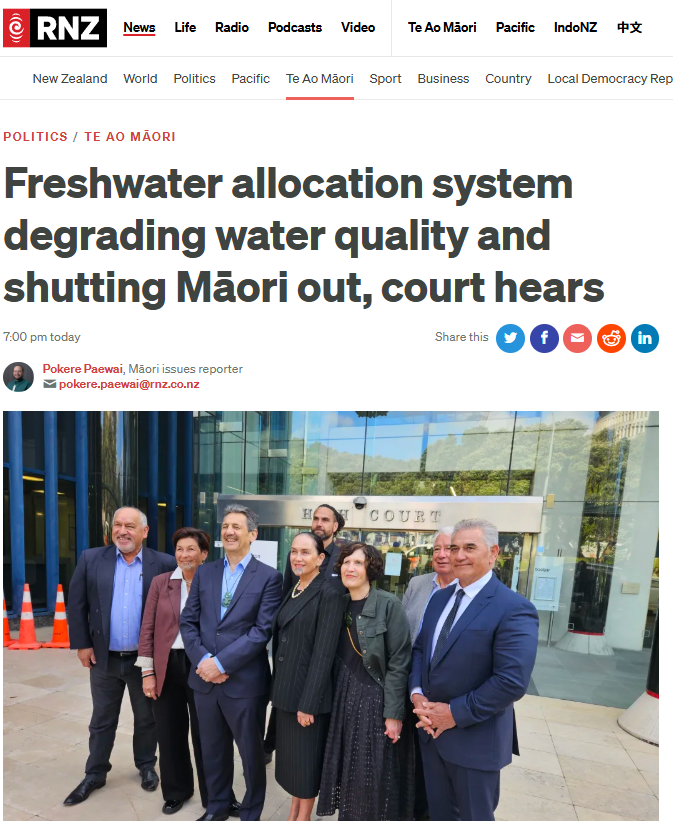
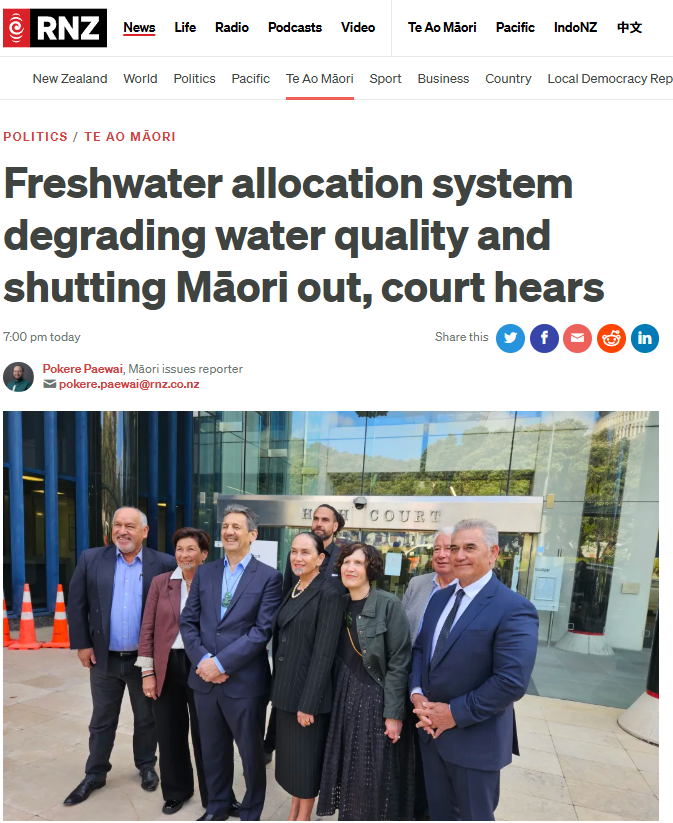
While 60+ Māori trusts representing over 150,000 landowners stand outside Wellington’s High Court in November 2025 demanding water rights promised 34 years ago, the Coalition government actively dismantles the very protections meant to safeguard our wai. (Paewai, 2025) (RNZ, 2025) This isn’t policy failure—it’s deliberate colonial dispossession dressed in neoliberal clothing, using the same playbook as Trump’s Project 2025 architect Russell Vought, who has fired thousands of federal workers while gutting environmental protections. (1News, 2025) (ProPublica, 2025)
In Aotearoa, ACT leader David Seymour—trained by the Atlas Network’s libertarian think tanks—deploys his Regulatory Standards Bill to entrench corporate rights over tikanga, public health, and Te Tiriti obligations. (RNZ, 2025) (RNZ, 2025) (Tapatahi, 2024) The first-in-first-served water allocation system locks Māori out of $billions in economic development while lakes turn super-trophic and rivers become unswimmable. (NZ Herald, 2020)
Who benefits? Early Pākehā settlers and their corporate descendants. Who’s harmed? Māori communities systematically excluded for three decades despite Supreme Court rulings. (Waitangi Tribunal, 2019) (McCaw Lewis, 2013) What’s hidden? International networks of libertarian think tanks coordinating to dismantle Indigenous rights and environmental protections across settler-colonial states. (Tapatahi, 2024) (Wikipedia, 2024)
Whakapapa: The Colonial Roots of Water Theft
Water allocation in Aotearoa has been rigged since 1991, when the Resource Management Act codified “first-in-first-served” into law—a system that privileges whoever filed paperwork first, overwhelmingly early Pākehā settlers in the 1800s and 1900s. (Ministry for Environment, 2009) This isn’t accidental. As Canadian Indigenous water researcher Karen Bakker documents, first-in-first-served allocation systems across settler-colonial states “operate on colonial logic: despite Indigenous peoples undeniably being first in time, water rights defined and assigned to [Indigenous] lands were not consistently registered.” (Bakker et al., 2018)
The quantified stakes are staggering. In Waimea Valley alone, land WITH water allocation sells for $80,000 per hectare while identical land WITHOUT water access fetches only $45,000—a $35,000 per hectare dispossession. (NZ Herald, 2020) Scale that across the 1.5+ million hectares of Māori freehold land, much of it returned through Treaty settlements but unable to be developed without water, and you’re looking at $billions in stolen economic potential. (Ministry for Environment, 2009)
Meanwhile, Māori contribute $32 billion (8.9%) to New Zealand’s GDP with a $126 billion asset base that grew 83% from 2018-2023—despite being systematically locked out of water resources. (RNZ, 2025) Imagine what Māori could achieve with equitable water access.
Internationally, this pattern repeats. In Australia’s Murray-Darling Basin, Aboriginal peoples comprise 10% of the population but hold only 0.2% of surface water allocations—a 50-fold dispossession. In British Columbia, First Nations were prohibited from applying for water licenses in their own names until 1888, and provincial governments still don’t recognize water allocations granted by federal officials in the 1880s. (Bakker et al., 2018) Trump’s Project 2025, led by Russell Vought, explicitly seeks to gut the EPA, eliminate USAID, and fire federal workers protecting environmental and Indigenous rights. (ProPublica, 2025) (Wikipedia, 2025) The neoliberal playbook is global: privatize resources, dismantle protections, dispossess Indigenous peoples.
The Issue: First-In-First-Served as Colonial Weapon
Federation of Māori Authorities (FOMA) chairperson Traci Houpapa—a globally recognized business leader named among BBC’s 100 Most Influential Women—cuts to the heart of the crisis: “Right now, we’re living in a water-allocation system that’s over-allocated by up to a thousand percent in some catchments. It’s degrading our wai, people can’t swim, farms can’t operate, and that has to stop.” (Te Ao News, 2025) Read that again: 1000% over-allocation in some catchments while Māori landowners get nothing.
The fallacies are brazen:
1. False Scarcity (”No one owns water”): Ministers claim “no one owns water” while simultaneously granting 35-year exclusive use rights to corporations and farmers. (Ministry for Environment, 2009) This is the Equivocation Fallacy—using “ownership” in two different senses to confuse the issue. If no one owns it, how can you grant exclusive 35-year licenses that lock others out?
2. Grandfather Clause Injustice: The “first-in-first-served” system is grandfather clausing on steroids—it preserves historical injustice by treating 150-year-old colonial theft as legitimate property rights. This is the Appeal to Tradition Fallacy: just because Pākehā settlers stole water allocations first doesn’t make it right.
3. Market Efficiency Myth: Neoliberals claim “efficient allocation” while 35% of allocated water goes unused and productive Māori land sits undeveloped. This is colonial dispossession masquerading as economics.
4. Individual Rights Dogwhistle: When Seymour’s Regulatory Standards Bill prioritizes “personal liberties” and “taking of property,” he means corporate property rights trump Indigenous collective rights, public health, and environmental protection. (RNZ, 2025) (E-Tangata, 2025) This is the False Balance Fallacy—treating corporate profits as equivalent to Māori survival.
The coordinated strategy spans decades. In 2012, then-Deputy PM Bill English gave “solemn promises in the Supreme Court” that the Crown would recognize Māori water rights. (Paewai, 2025) The Supreme Court confirmed these obligations in 2013. (McCaw Lewis, 2013) The 2019 Waitangi Tribunal Stage 2 report demanded proprietary recognition. (RNZ, 2019) Labour introduced Te Mana o te Wai in 2020, prioritizing water health over economic use. Then in 2024, the National-ACT-NZ First coalition immediately began dismantling these protections, with ACT explicitly calling Te Mana o te Wai “nonsensical” and demanding it be “dumped.” (RNZ, 2025) 34 years of broken promises.
The Neoliberal-Colonial Nexus
Evidence Trail: Water Quality Collapse
The first-in-first-served system doesn’t just dispossess Māori—it’s poisoning the entire country. The data is damning:
- Over 50% of 124 surveyed lakes have poor or very poor water quality
- 62% of Auckland’s rivers and lakes are graded poor for swimming
- 75% of New Zealand’s land area exceeds E.coli bottom lines
- Canterbury needs 44% nitrogen reduction, Southland 41%—impossible without addressing agricultural over-allocation
- Lake Wairarapa: super-trophic (TLI score 5.0-5.4), one of New Zealand’s most polluted shallow coastal lakes (Wikipedia, 2024) (NZ Herald, 2020) (Greater Wellington, 2022)
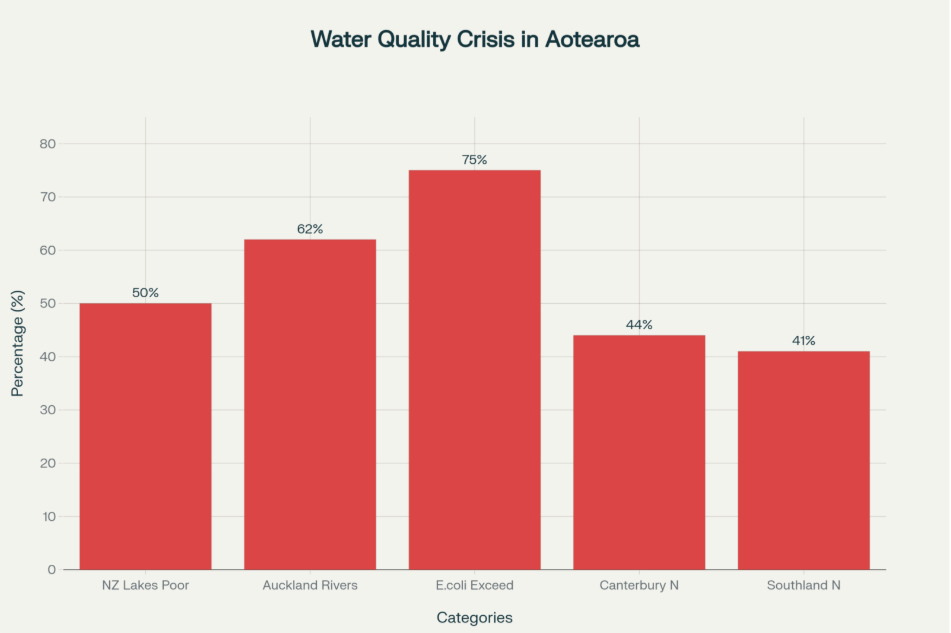
Water quality crisis showing degradation across multiple indicators - over half of monitored waterways fail quality standards
As Kingi Smiler, Wai Manawa Whenua chairperson and founder of Miraka (New Zealand’s first Māori-owned dairy company), testified: “Lake Wairarapa has degraded dramatically to the point where it is considered super-trophic... there’s no clean-up fund that’s been put in place.” (Paewai, 2025) Smiler—inducted into the NZ Business Hall of Fame in 2023 and winner of the 2024 Ahuwhenua Trophy—knows agribusiness inside-out. When he says the system is broken, listen.
Rhetoric vs Reality: The “Efficiency” Lie
Neoliberals claim markets allocate resources efficiently. The reality? First-in-first-served created massive inefficiency. Water consents are locked up for 35 years whether used or not. (FOMA, 2025) (Ministry for Environment, 2009) Māori land returned through Treaty settlements arrives without water—deliberate sabotage of economic development.
Compare land values: In Waimea, land WITH water = $80,000/hectare. Land WITHOUT water = $45,000/hectare. (NZ Herald, 2020) That’s a $35,000/hectare colonial tax on Māori landowners.
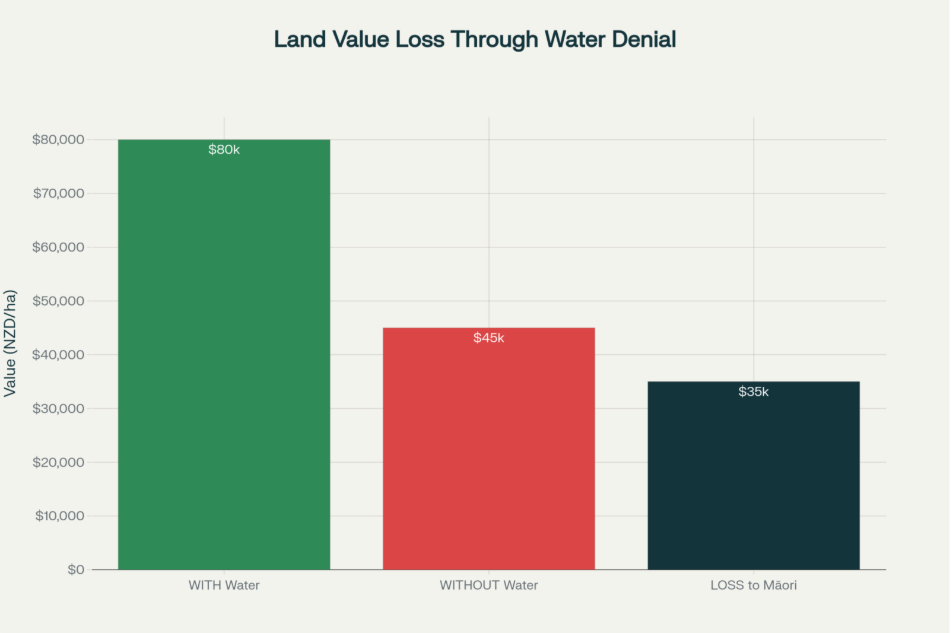
Land value comparison showing $35,000 per hectare loss when Māori landowners are denied water access through first-in-first-served system
Historical Patterns: 34 Years of Perfidy
Let’s trace the timeline of broken promises:
1991: Resource Management Act passes—first-in-first-served continues, Māori excluded
2012: Bill English tells Supreme Court the Crown recognizes Māori water rights and will develop mechanisms for decision-making roles, access, allocation, and charges (Paewai, 2025)
2013: Supreme Court confirms Crown obligations, accepts Waitangi Tribunal findings that Māori have proprietary rights “in the nature of ownership” (McCaw Lewis, 2013)
2019: Waitangi Tribunal Stage 2 report slams Crown for “serious degradation of water quality” and RMA failure to meet Treaty standard of active protection. Demands proprietary recognition and co-governance (RNZ, 2019)
2020: Labour introduces Te Mana o te Wai—prioritizing water health, then human health needs, then economic wellbeing. Māori involvement increases
2024: Coalition government begins dismantling Te Mana o te Wai. ACT’s David Seymour calls it “nonsensical” and “vague,” demands it be “dumped entirely” (RNZ, 2025)
2025 June: 60+ Māori trusts representing 150,000+ landowners file High Court proceedings, citing “repeated failure to uphold tikanga-based and Tiriti-guaranteed rights” (RNZ, 2025)
2025 November: Wai Manawa Whenua case heard. Crown still has taken no action (Paewai, 2025) (RNZ, 2025)
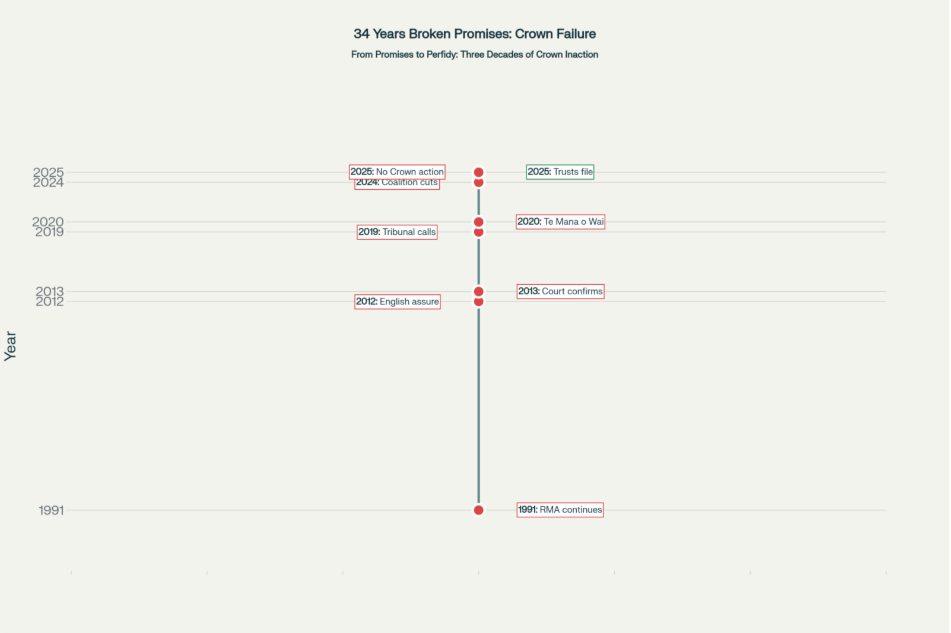
Timeline of 34 years showing Crown’s repeated failure to honor water rights commitments to Māori from 1991 to 2025
This isn’t incompetence—it’s strategic delay. Every year Māori wait is another year corporate and farming interests extract wealth from stolen water allocations.
Hidden Connections: The Project 2025 Playbook in Aotearoa
Here’s where it gets chilling. The tactics dismantling Māori water rights in New Zealand mirror those of Trump’s Project 2025, coordinated through international libertarian networks:
Connection 1: Russell Vought → David Seymour
Russell Vought, Trump’s Office of Management and Budget Director, is the architect of Project 2025. (ProPublica, 2025) (Wikipedia, 2025) Vought drafted 350+ executive orders and regulations to gut federal agencies, fire workers, and eliminate environmental protections. His Center for Renewing America explicitly promotes “Christian nationalism” and opposes protections for Indigenous peoples. During the 2025 government shutdown, Vought fired thousands of federal workers at EPA, Education, Treasury, and HHS. (1News, 2025)
In New Zealand, David Seymour—ACT party leader with only 8.64% of the 2023 vote—uses coalition agreements to force through his Regulatory Standards Bill despite lacking democratic mandate. (RNZ, 2025) The Bill creates principles prioritizing corporate property rights and establishes a “Regulatory Standards Board” appointed by Seymour himself to investigate laws protecting public health, workers, and environment. Critics call it “dangerous,” a “constitutional straitjacket,” and “corporate complaint machine.” (RNZ, 2025) (E-Tangata, 2025)
Both men use minority positions to impose libertarian ideology that benefits corporations and harms Indigenous peoples and the environment.
Connection 2: The Atlas Network
David Seymour worked at two Atlas Network-affiliated think tanks in Canada before entering Parliament. (Tapatahi, 2024) Atlas Network, founded in 1981, coordinates 457 libertarian think tanks across 96 countries promoting deregulation, privatization, and corporate rights. (Wikipedia, 2024) The network explicitly trains operatives to “keep alternatives alive until the politically impossible becomes the politically inevitable.”
New Zealand Taxpayers’ Union—run by Jordan Williams and co-founded by David Farrar—is connected to Atlas Network. The TPU spent $371,565 in the 2023 election (more than Green Party donations), including a “Debt Clock” trailer to promote austerity. TPU received nearly $3 million in donations in 2023, but doesn’t have to disclose donors. (The Standard, 2025) As one analysis notes: “all of this money may have come from Atlas for all that we know.”
This is the same network that funded Trump’s Heritage Foundation, which produced Project 2025. The network funds climate denial, supports tobacco companies, promotes privatization, and fights Indigenous rights globally.
Connection 3: Regulatory Capture Strategy
Vought’s Project 2025 and Seymour’s Regulatory Standards Bill use identical tactics:
- Claim government is inefficient (Vought: “drain the swamp”; Seymour: “culture of no”)
- Create unelected oversight bodies (Vought: OMB controls all agencies; Seymour: Regulatory Standards Board)
- Prioritize corporate property rights over public goods (Both explicitly)
- Fire/defund workers protecting environment and public (Vought: mass layoffs; Seymour: $18-60m/year costs to slow regulation)
- Dismantle Indigenous protections (Vought: gut tribal consultation; Seymour: eliminate Te Mana o te Wai)
Professor Jane Kelsey warns: “While everyone’s been focused on extreme policies, there’s been very little attention to systemic things like the Regulatory Standards Bill. But alarm bells need to ring... It’s basically about protection of private property and wealth.” (RNZ, 2025) Constitutional law expert Andrew Geddis notes once RSB principles are “written into our law by Parliament, the courts cannot but take notice”—meaning corporate interests gain legal standing to challenge environmental and Treaty protections. (RNZ, 2025)
Connection 4: Coordinated Timing
The Coalition’s assault on Te Mana o te Wai began in April 2024—just months after Trump’s November 2024 election and explicit embrace of Project 2025. (RNZ, 2025) By May 2025, New Zealand was proposing “rebalancing” Te Mana o te Wai and “scrapping national bottom lines.” By November 2025, Russell Vought was firing thousands of federal workers and Trump openly referenced “Russ Vought, he of PROJECT 2025 Fame.” (1News, 2025)
This is not coincidence. This is coordinated international movement of libertarian elites using identical playbooks to dismantle Indigenous rights, environmental protections, and public services.
Tikanga Violations: Every Principle Broken
The first-in-first-served system violates every core tikanga principle:
- Whanaungatanga (kinship/relationships): System severs Māori from ancestral waters, treating wai as commodity rather than relation. As Wai Manawa Whenua states: “Māori have never relinquished our relationship with water.” (FOMA, 2025)
- Manaakitanga (care/hospitality): System denies Māori ability to care for manuhiri when marae lack clean water and communities can’t swim in degraded rivers. (Ministry for Environment, 2009)
- Kaitiakitanga (guardianship): System excludes Māori from decision-making about waters they’re meant to protect.
- Wairuatanga (spirituality): Super-trophic lakes and rivers clogged with agricultural runoff desecrate taonga. As 2009 report found: “One of the main sources of dissatisfaction with the current water allocation system was that the health and well-being of the water and water ways is not the first priority.” (Ministry for Environment, 2009)
- Kotahitanga (unity): System creates divisiveness, with Pākehā farmers holding century-old allocations while Māori communities returned land through Treaty settlements get nothing.
- Rangatiratanga (sovereignty/authority): Supreme Court confirmed in 2013 that Treaty guaranteed Māori “exclusive right to control access to and use of water” but Crown refuses to implement. (McCaw Lewis, 2013) This is direct Treaty breach.
Aroha (love/compassion): Where is aroha when children can’t swim in their ancestral rivers? When marae lack clean water? When productive land sits idle because Crown allocates water to Pākehā settlers 150 years ago?
Cui Bono: Who Profits from Water Theft?
Winners:
- Large-scale farmers holding historical allocations they don’t fully use but won’t relinquish
- Dairy corporations (Fonterra, etc.) accessing subsidized water for intensive agriculture that degrades rivers
- Hydro companies (Meridian, Mighty River Power, Contact) with perpetual water access despite partial privatization
- Bottling companies extracting water for pennies
- Atlas Network think tanks (Taxpayers Union, etc.) receiving millions to promote deregulation (The Standard, 2025)
- Libertarian politicians (Seymour, etc.) using water crisis to advance privatization agenda
Losers:
- Māori communities with 1.5+ million hectares of land unable to develop without water
- Future generations inheriting super-trophic lakes and unswimmable rivers
- Public health—half of groundwater monitoring sites exceed drinking water standards for nitrate
- Biodiversity—native fish, eels, whitebait habitats destroyed
- Recreational users—two-thirds of monitored river sites graded poorly for E.coli
The arithmetic is simple: $35,000/hectare × 1.5 million hectares of Māori land = $52.5 BILLION in dispossession. And that’s just land value—doesn’t include lost agricultural production, tourism potential, or ecosystem services.
Implications: Quantified Harm and Threatened Rights
The quantified harm to Māori is staggering:
- Economic: At minimum $52.5 billion in land devaluation from denied water access. Plus lost agricultural production—if Māori’s $66 billion in business assets could access water equitably, GDP contribution could double. (RNZ, 2025)
- Health: Degraded water quality threatens mahinga kai (food gathering). Contaminated waterways spread disease. Psychological harm from being unable to use ancestral waters.
- Cultural: Desecration of taonga. Inability to fulfill kaitiaki responsibilities. Erosion of mātauranga about water management.
Rights Threatened:
- Article 2 of Te Tiriti guarantees tino rangatiratanga over taonga. Water is explicitly taonga. Supreme Court confirmed Māori have proprietary rights. Yet Crown violates Treaty daily by allocating water without Māori consent. (Waitangi Tribunal, 2019) (McCaw Lewis, 2013)
- UN Declaration on Rights of Indigenous Peoples (UNDRIP), which New Zealand endorsed, requires Free Prior and Informed Consent for resource development affecting Indigenous peoples. First-in-first-served violates UNDRIP by allocating water without Māori consent. (Bakker et al., 2018)
International precedents show where this leads:
- Australia: Aboriginal peoples comprise 10% of Murray-Darling population but hold 0.2% of water allocations—98% dispossession.
- Canada: First Nations prohibited from water license applications for decades, resulting in present-day water insecurity on reserves. (Bakker et al., 2018)
- United States: Winters Doctrine (1908) theoretically protects tribal water rights, but tribes still fight for enforcement 115+ years later.
Unless New Zealand acts NOW, Māori face another century of water theft.
Call to Action:
- Contact Ministers: Email RMA Reform Minister Chris Bishop (chris.bishop@parliament.govt.nz) and Environment Minister Penny Simmonds (penny.simmonds@parliament.govt.nz) demanding:
- Immediate implementation of 2012 Bill English commitments
- Allocation of water to all Māori freehold land
- Restoration of Te Mana o te Wai protections
- Māori co-governance of water management
- Support Wai Manawa Whenua: Follow their case. Donate if you can. Amplify their messages. These 60+ trusts represent 150,000+ Māori fighting for ALL our futures. (FOMA, 2025)
- Oppose Regulatory Standards Bill: Submit against RSB before select committee reports. This bill would entrench corporate rights over Treaty rights. (RNZ, 2025)
- Expose Atlas Network: Research and publicize connections between Taxpayers Union, ACT party, and international libertarian networks dismantling Indigenous rights globally. (Tapatahi, 2024) (The Standard, 2025)
- Demand Water Data: Use OIA requests to get catchment-by-catchment allocation data showing who holds water consents and whether they’re used. Expose the waste.
The Truth About Colonial Capitalism
For 34 years, the Crown has broken promises about Māori water rights. The first-in-first-served system isn’t neutral policy—it’s deliberate colonial dispossession that locks $billions of Māori economic potential behind century-old Pākehā allocations. While international libertarian networks like Atlas coordinate attacks on Indigenous rights from Trump’s America to Seymour’s New Zealand, using identical tactics from Project 2025’s playbook, (ProPublica, 2025) (RNZ, 2025) (Tapatahi, 2024) our wai turns super-trophic and our children inherit poisoned rivers. (NZ Herald, 2020)

The Māori Green Lantern Fighting Misinformation And Disinformation From The Far Right
The solution is clear: Implement the 2012 Supreme Court commitments. Allocate water to all Māori freehold land. Restore Te Mana o te Wai. Establish Māori co-governance. End the theft.
As Traci Houpapa demands: “We want [the Crown] to recognize our rights and to design, alongside us, a fair system that upholds Māori as ahi kā, landowners, whānau, hapū and iwi, and as kaitiaki.” (Te Ao News, 2025) As Kingi Smiler insists: “This is about restoring balance. It’s about acknowledging that Māori have never relinquished our relationship with water.” (FOMA, 2025)
The Crown must act. The international libertarian conspiracy against Indigenous peoples must be exposed. Our wai must be protected. Our mokopuna deserve better than super-trophic lakes and corporate-captured governments.
E tū! E tū! E tū!
Nō reira, e te whānau, if this mahi has value and you have capacity, please consider supporting this kaupapa with humble koha: HTDM: 03-1546-0415173-000. Aroha nui ki a koutou katoa.