“A House of Cards Built on Cronies: How New Zealand’s Government Learned to Stop Worrying and Love the Grift” - 28 January 2026
A Metaphorical Requiem for Democratic Governance
Mōrena Aotearoa,
The Diagnosis
Imagine a hospital where the chief of medicine is appointed by the neurosurgeon because they play golf together.
The pathology lab reports tumors, but the reports are locked in a filing cabinet because transparency is “inconvenient.”
Meanwhile, $238,625 in the first year alone flows to the chief of medicine as payment for meetings that, when documented, reveal nothing but catering receipts for $9 bottles of Coke.
The patient—in this case, New Zealand—is dying of retail crime, bleeding $2.7 billion per year, and instead of surgery, it’s being prescribed homeopathy by a committee of the surgeon’s mates.
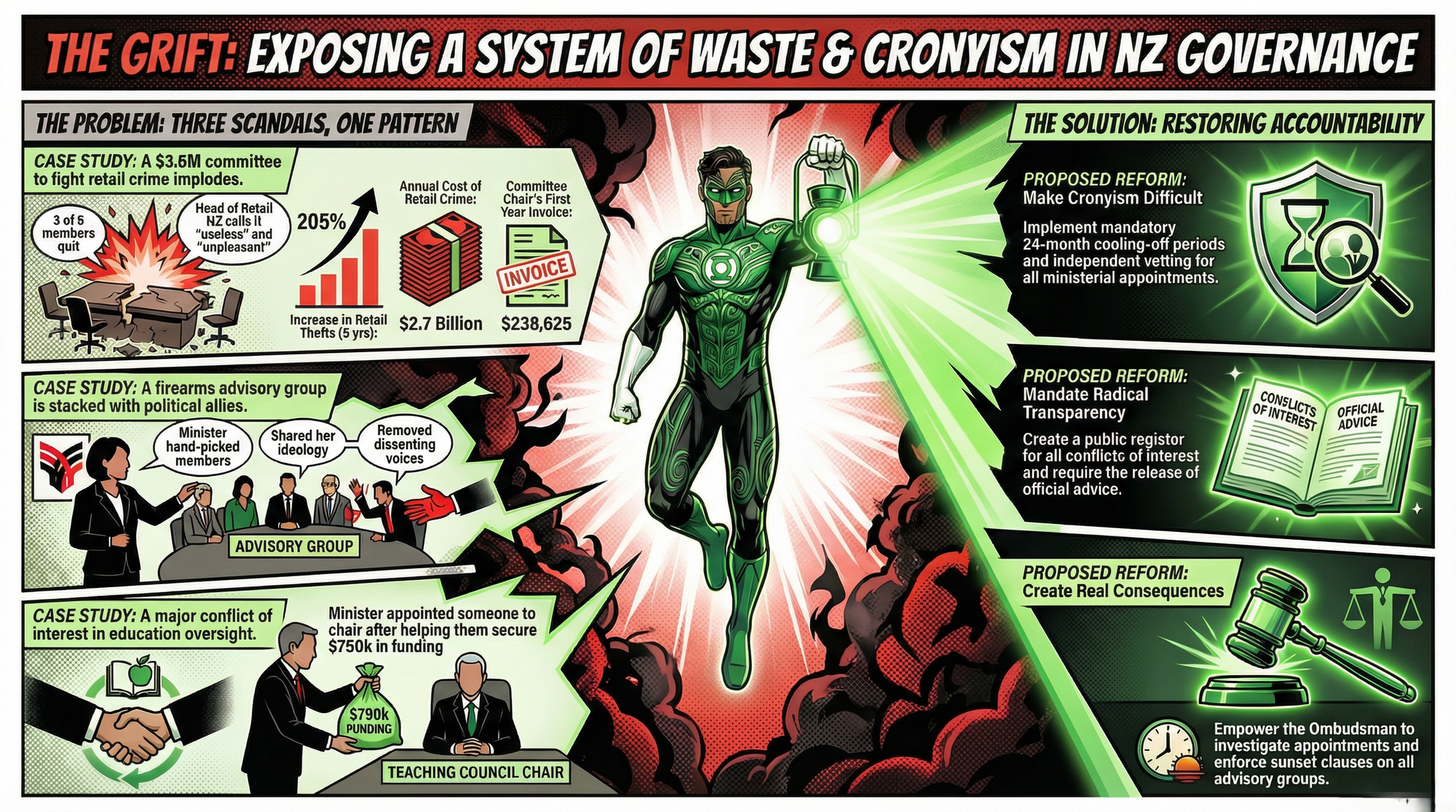
That is not an exaggeration. That is precisely what RNZ has documented unfolding across three separate scandals since January 2024.
Part One: The Retail Crime Advisory Group – A Gilded Tomb for Public Money
1.1 The Problem That Demanded a Solution
Let’s begin with the reality:
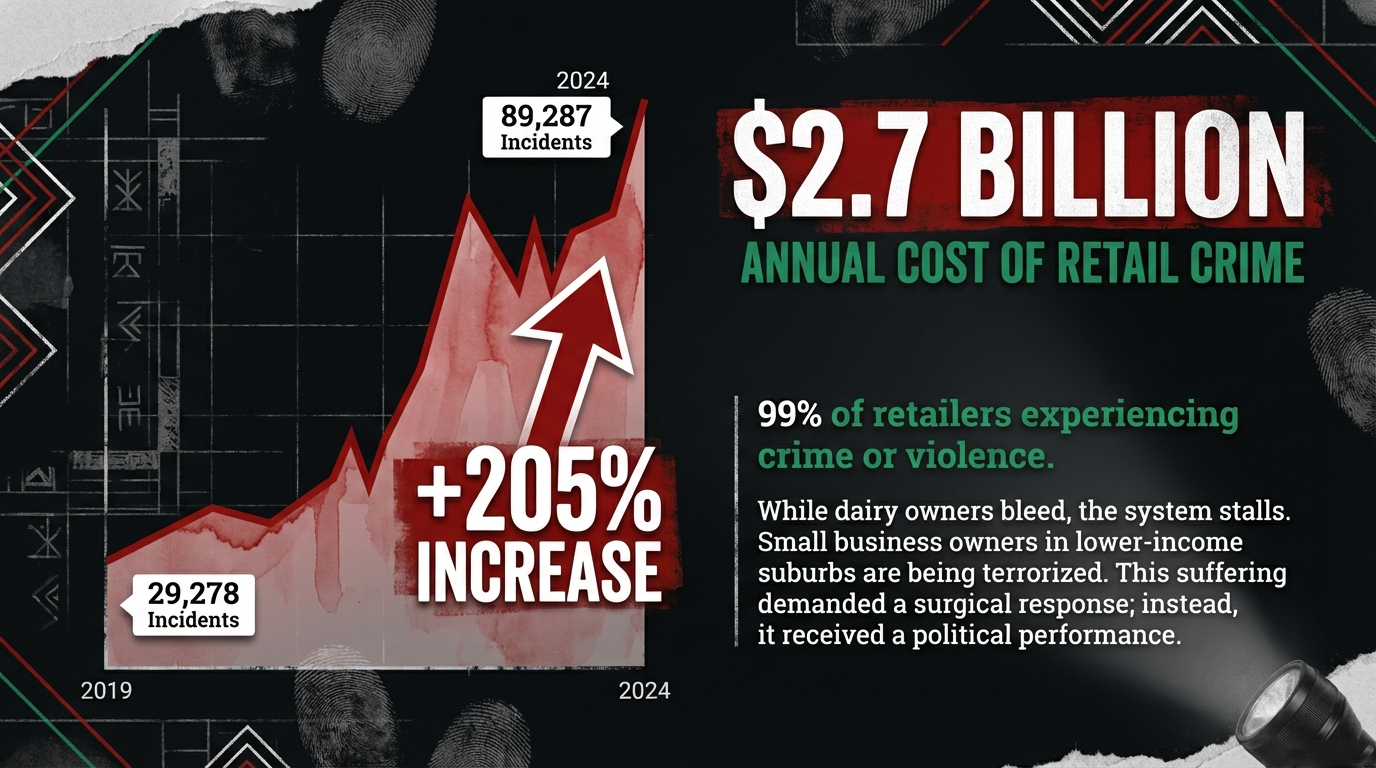
retail crime in New Zealand is not imaginary. According to the Ministry of Justice’s own analysis, reported thefts from retail premises have skyrocketed 205% in five years—from 29,278 incidents in 2019 to 89,287 by 2024.
Retail NZ estimates the total annual cost at $2.7 billion. That is real money. That is real suffering for small business owners, many of them migrants and families in lower-income suburbs who are being robbed, stabbed, and terrorized while governments make speeches and do nothing.
The problem was genuine. The response was a masterclass in how to burn money while solving nothing.
1.2 The Solution: Build a Committee to Fix It (and Pocket the Proceeds)
In July 2024, Justice Minister Paul Goldsmith appointed the Ministerial Advisory Group for Victims of Retail Crime. Five business leaders. Two years. A budget of approximately $1.8 million per year—roughly $3.6 million total—drawn from the Proceeds of Crime Fund.
This was the government’s moment to act decisively. To marshal expert knowledge. To take retail crime seriously.
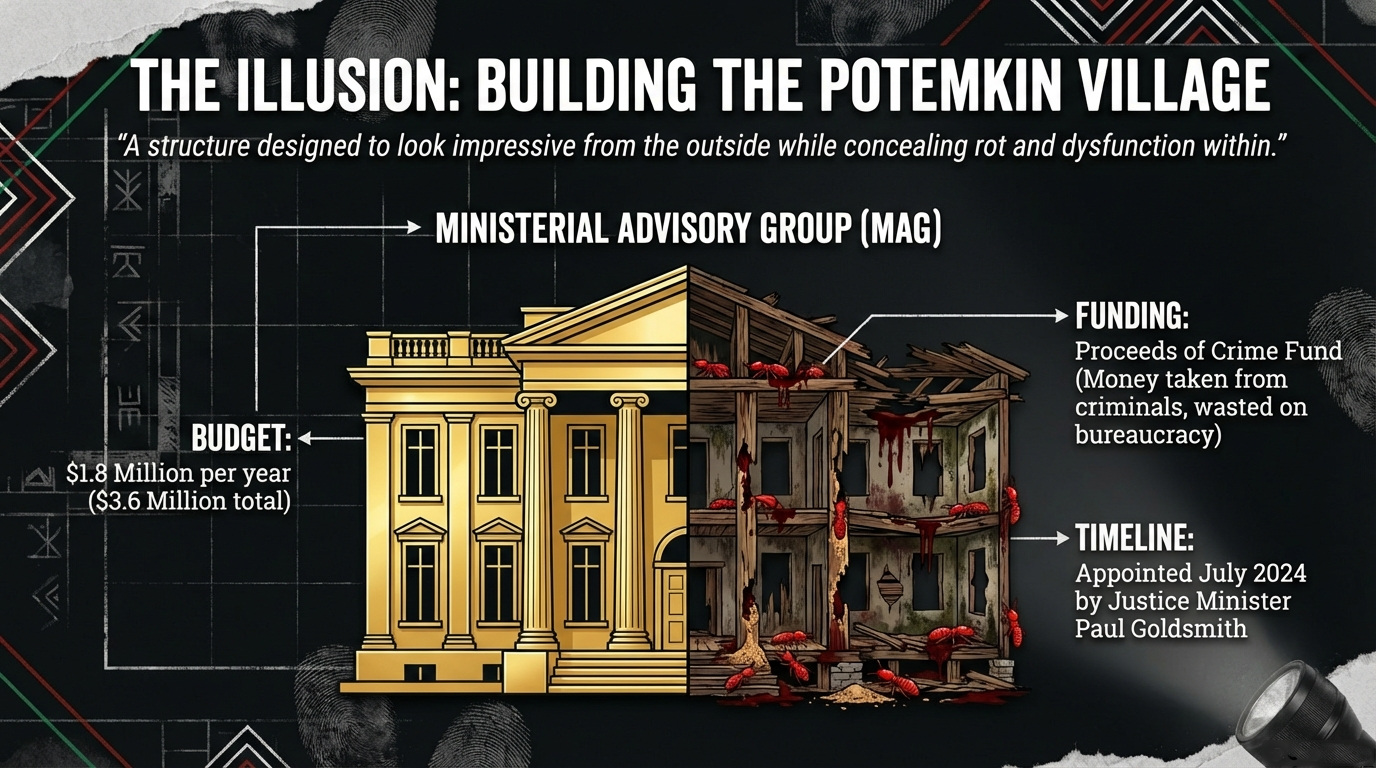
Instead, it built a Potemkin village: a structure designed to look impressive from the outside while concealing rot and dysfunction within.
1.3 The Rot Emerges: Three Members Walk Away in Disgust
Within 18 months, RNZ reported, three of the five members quit.
Not quietly. Not due to “external commitments” as the official story claims.
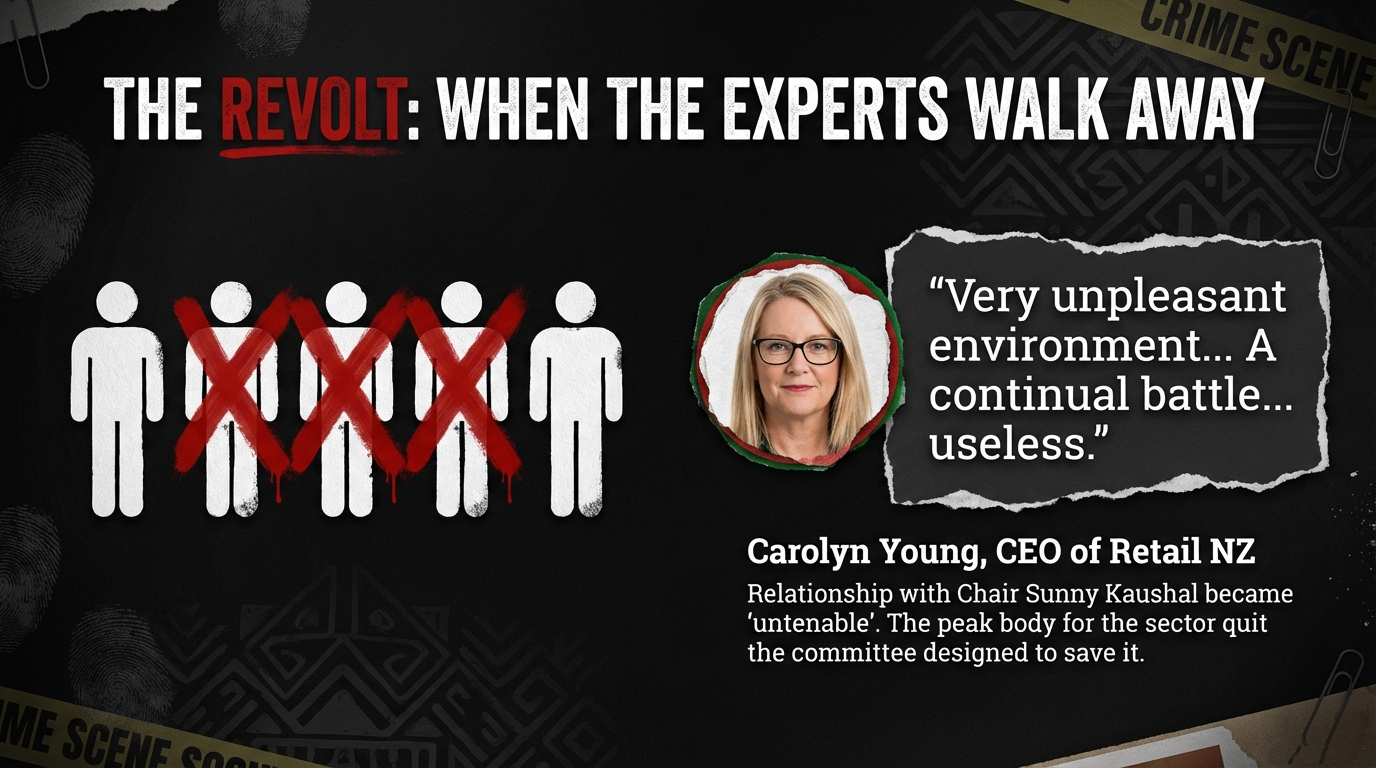
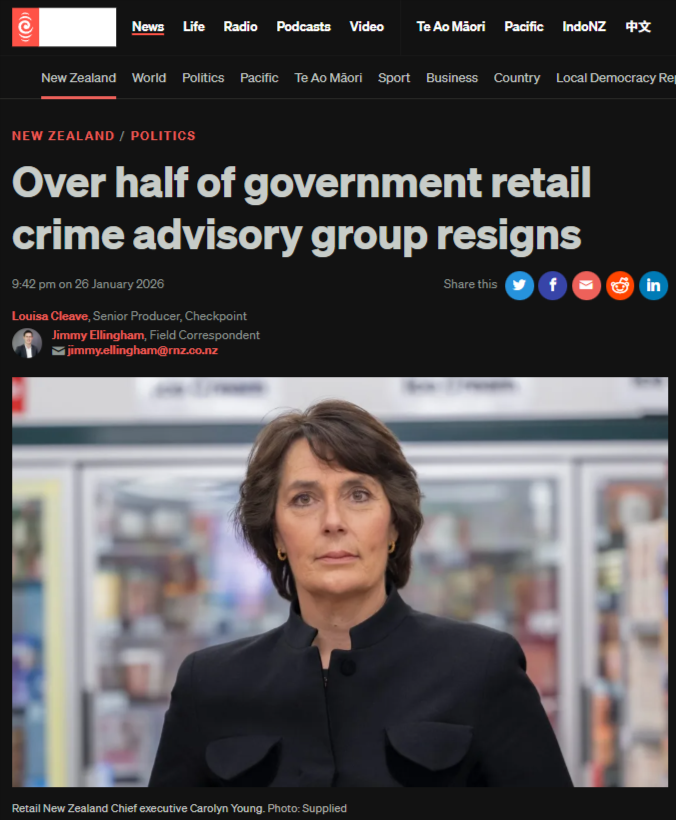
Carolyn Young, the CEO of Retail NZ—the peak retail body, the institution that should have been the MAG’s anchor to reality—described the group as a “very unpleasant environment”. She said her relationship with chair Sunny Kaushal had become “untenable”. She reported that communications from the chair implicated her “professionalism and who [she is] and how [she] work[s].”
In plain language:
she was bullied out by someone the Minister chose to lead the group. Someone the government is still paying. Someone whose “concerning behaviour” prompted warnings from Ministry of Justice officials
—warnings that were never publicly disclosed, because this government operates like a speakeasy: keep it quiet, keep it moving, keep it profitable for the right people.
Young also revealed the most damning truth:
there was a “continual battle to constantly be able to speak about what retailers are really looking for” and the group was not “leading to good outcomes for retail.”
A $1.8 million committee convened to help retailers, and the peak retail body’s CEO quit saying the committee was useless.
This is what institutional capture looks like. Not dramatic. Just quiet, corroding rot.
1.4 The Money Trail: Where the Billion-Dollar Problem Gets Starved While the Committee Feasts
Here is where the metaphor becomes infuriating.
While $2.7 billion in annual retail crime damage ravages the sector, this committee—designed to address that crisis—spent money like a Roman emperor in decline:
In the first 3.5 months alone: $500,000
- Personnel: ~$330,000 (mostly to the chair)
- Administration: ~$65,000
- Travel: ~$10,000
- Member fees: ~$102,000 (predominantly Kaushal)
Chair Sunny Kaushal’s invoice:
$238,625 in year one, billed at $920 per day for the full 250 days his contract permitted. That is the cost of a small business’s entire annual payroll. For one person. For one year. In a chair role at an advisory group that had no measurable impact.
The CBD office:
$100,000 per year for a 389 m² space in central Auckland. For fewer than 10 staff. For a group that meets periodically and produces no visible public benefit. A property analyst would call this “extraordinarily over-specified”. A taxpayer would call it theft.
Three policy advisers:
$1,000+ per day each on contract. One at $1,261 per day. Another at $1,126. A third at $1,036. These are rates that dwarf what most policy specialists earn in the public service, and they were being paid to support a committee that three of five members abandoned in disgust.
The catering:
RNZ revealed the committee spent $24,000 on catering for 22 stakeholder meetings. Two Auckland events alone exceeded $4,000 each. Another topped $3,000. The menu included rock melon, goat’s cheese and prosciutto crostini, mini chicken and leek savouries, and $9 bottles of 2.5-litre Coke (retail price: $5.50).
Justice Minister Paul Goldsmith later admitted to the NZ Herald that one event was “clearly over-catered” with “probably too many scones”.
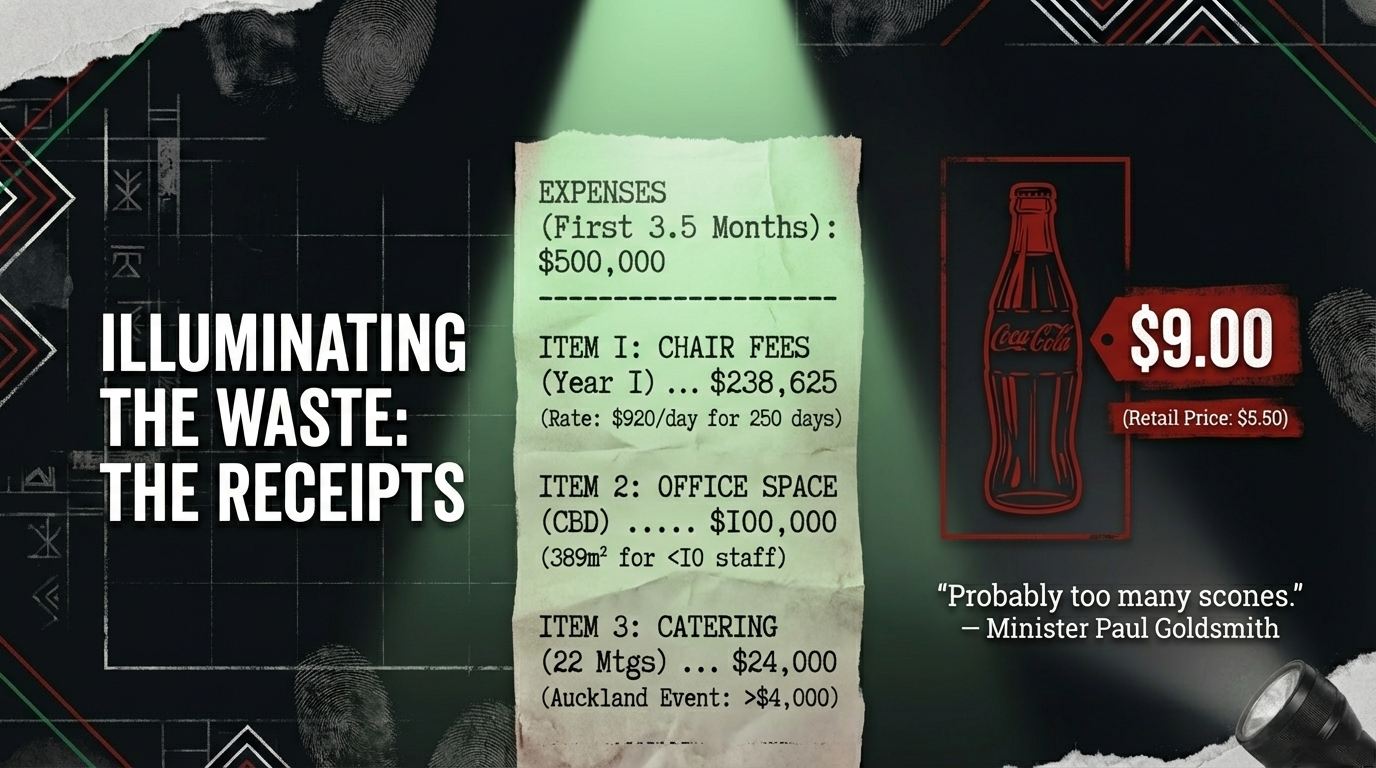
When a Justice Minister is defending the decision to buy $9 bottles of Coke and admitting there were too many scones, the system has not just failed. It has become obscene.
1.5 The Metaphor Crystallizes: A Pump Transferring Money Upward
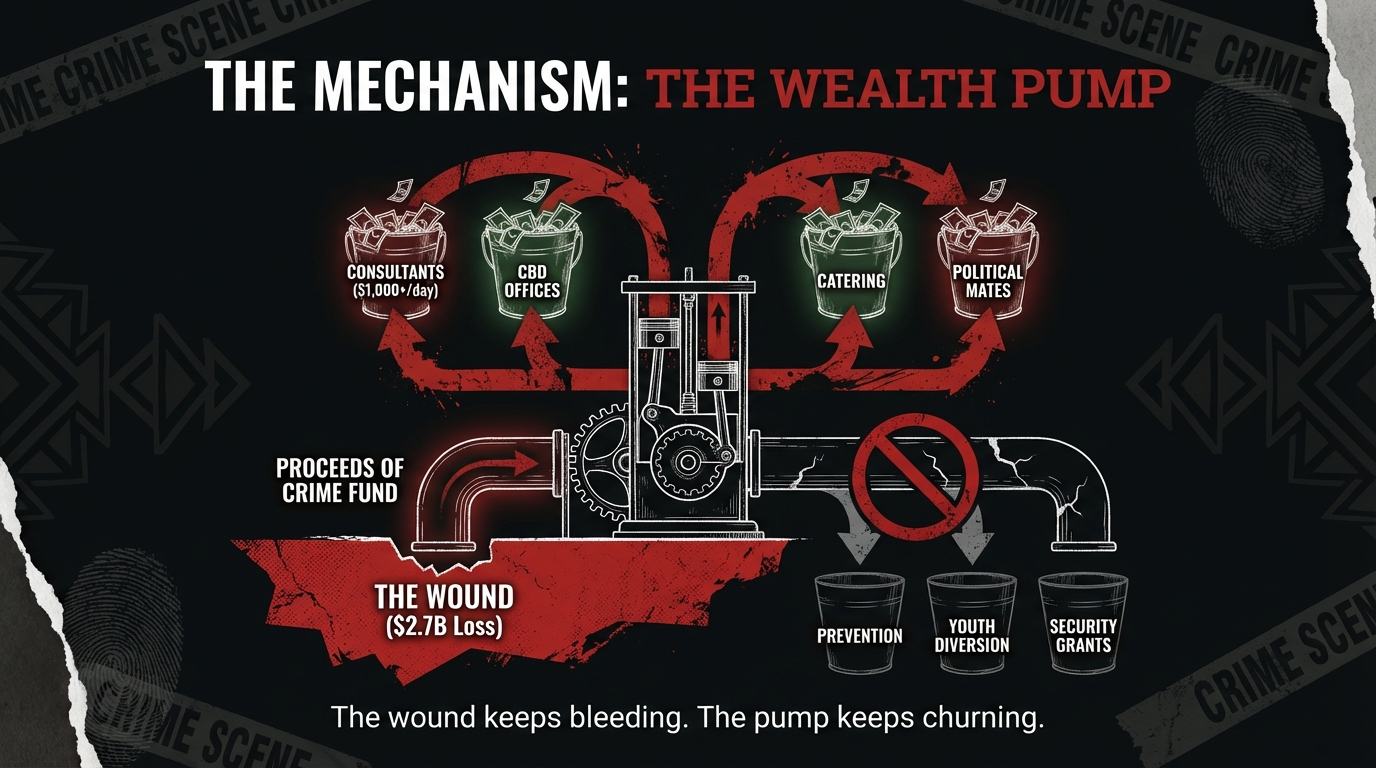
Picture a $2.7 billion wound. Instead of allocating resources to stop the bleeding—to investigation teams targeting repeat offenders, to youth diversion programs, to environmental security improvements, to data-sharing infrastructure that connects retailers and police—the government installed a pump.
A $1.8 million pump. Mounted directly on the wound. Its purpose: to siphon resources upward into high daily rates, expensive office space, catering receipts, and the pockets of political allies.
The wound still bleeds. The pump keeps churning. The measure of success is not whether retail crime decreases—it hasn’t—but whether the committee produces advisory papers recommending ever-broader powers for citizens’ arrest and mechanical restraints, powers that the Ministry of Justice itself warns are unlikely to deter crime and likely to escalate violence.
Retail NZ’s own CEO—the person who should have been the voice of the retail sector in that room—quit saying the committee was useless and unpleasant. The government’s response was not to investigate why, not to reform the structure, but to keep paying the chair and wait for media reporting to expose the dysfunction.
This is not governance. This is a racket dressed up as policy.
Part Two: The Cronyism Chronicles – How Appointments Became a Favor-Trading System
If the retail crime committee was a pump transferring money upward, the broader pattern of ministerial appointments is a capture operation:
the systematic placement of political allies into positions of regulatory power, with conflicts of interest running so deep that they disappear into shadow.
2.1 Nicole McKee and the “Shoulder-Tapped” Firearms Advisory Group: Cronyism in the Daylight
On January 19, 2026, the NZ Herald exposed that Associate Justice Minister Nicole McKee—a former gun lobby spokeswoman—had hand-picked members for the government’s firearms advisory group, then delegated the appointment to Justice Minister Paul Goldsmith so the nominations appeared to come from him.
This is not a procedural technicality. This is the skeleton key to understanding regulatory capture.
Here is what happened:
- McKee, an ideologically committed gun-rights advocate, was tasked with leading firearms policy reform.
- She directly approached and selected two individuals for the Minister’s Arms Advisory Group (MAAG).
- The process was then transferred to Goldsmith’s office, so the formal nominations came in Goldsmith’s name, not hers.
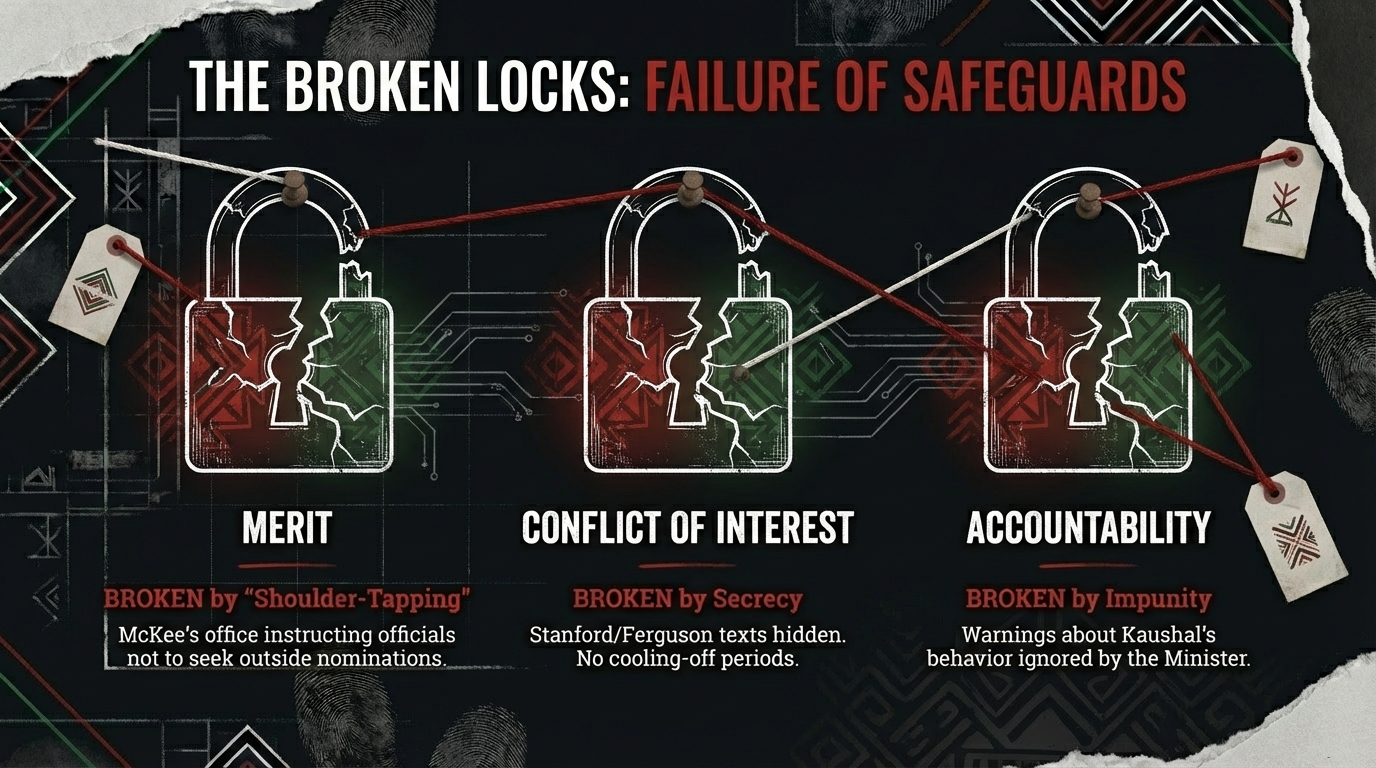
- According to political analyst Bryce Edwards, McKee’s office instructed officials not to seek outside nominations if her coalition colleagues could furnish candidates. She already had preferred nominees in mind. She privately urged both to submit CVs to the ACT Party Chief of Staff, who then “nominated” them.
- McKee then cut out voices of genuine diversity: she reappointed members aligned with her worldview but removed Gun Control NZ co-founder Philippa Yasbek and community advocate Helene Leaf—people who might have challenged her assumptions.
Edwards describes this as “jobs for mates”—and he is being charitable with the language.
2.2 The Metaphor: McKee as the Architect Building a Temple to Her Own Beliefs
Imagine you hire an architect to design a hospital because she has experience in construction. What you do not expect is for her to:
- Hand-pick the structural engineer because he agrees that loading-bearing walls are “overrated.”
- Remove the safety inspector who keeps asking difficult questions about fire codes.
- Delegate the appointment process to someone else so her fingerprints don’t appear on the decision.
- Then spend the next year building a hospital designed not to serve patients, but to vindicate her pre-existing philosophy about how hospitals should work.
That is what McKee did to the firearms advisory process. She captured it. She staffed it with people she knew would agree with her. She silenced dissent. She buried her involvement. And then she moved forward with policy shaped not by evidence and balanced perspective, but by her personal ideology.
Why does this matter? The Christchurch terror attack happened because firearms policy failed. The firearms advisory group was established to avoid that failure again by bringing together diverse expertise. When a minister hand-picks every member to align with her existing views, the entire safeguard evaporates.
Moreover, Edwards notes, McKee’s proposed Arms Bill would give the responsible minister direct power to recommend who heads the new independent Arms Regulator—an unprecedented departure from normal Public Service Commissioner appointments that ensure independence. This is not just one bad appointment process. It is the institutionalization of capture.
2.3 Erica Stanford and David Ferguson: The $750k Quid Pro Quo Made Invisible
The McKee scandal is bad. The Stanford-Ferguson scandal is the same logic, but with money visibly changing hands.
RNZ’s investigation revealed, through Official Information Act releases, a text message exchange between Education Minister Erica Stanford and David Ferguson that reads like a masterclass in how to run a protection racket while leaving no fingerprints.
Ferguson was helping establish a private teacher training provider called the Teachers’ Institute. He repeatedly texted Stanford asking for help with funding from the Tertiary Education Commission (TEC).
The timeline:
- May 2024: Ferguson texts Stanford about the institute’s programs. Stanford immediately offers help (”How’s now?”).
- October 30, 2024: Ferguson explicitly requests help with a $750,000 TEC funding bid.
- November 1, 2024: Stanford agrees to a weekend call.
- November 8, 2024: Ferguson asks if Stanford has spoken to Transport Minister Penny Simmonds about TEC funding.
- November 15, 2024: Ferguson texts: “TEC funding confirmed yesterday, thank you.”
- July 2025: Stanford appoints Ferguson to the Teaching Council, with the understanding he will become chair from late August.
Stanford’s official response is that she provided no assistance and Ferguson was just seeking “clarification.” But as NZEI national secretary Stephanie Mills noted: “The Minister then appointed him as chair of the Teaching Council, which has responsibility for approving teacher training programmes.”
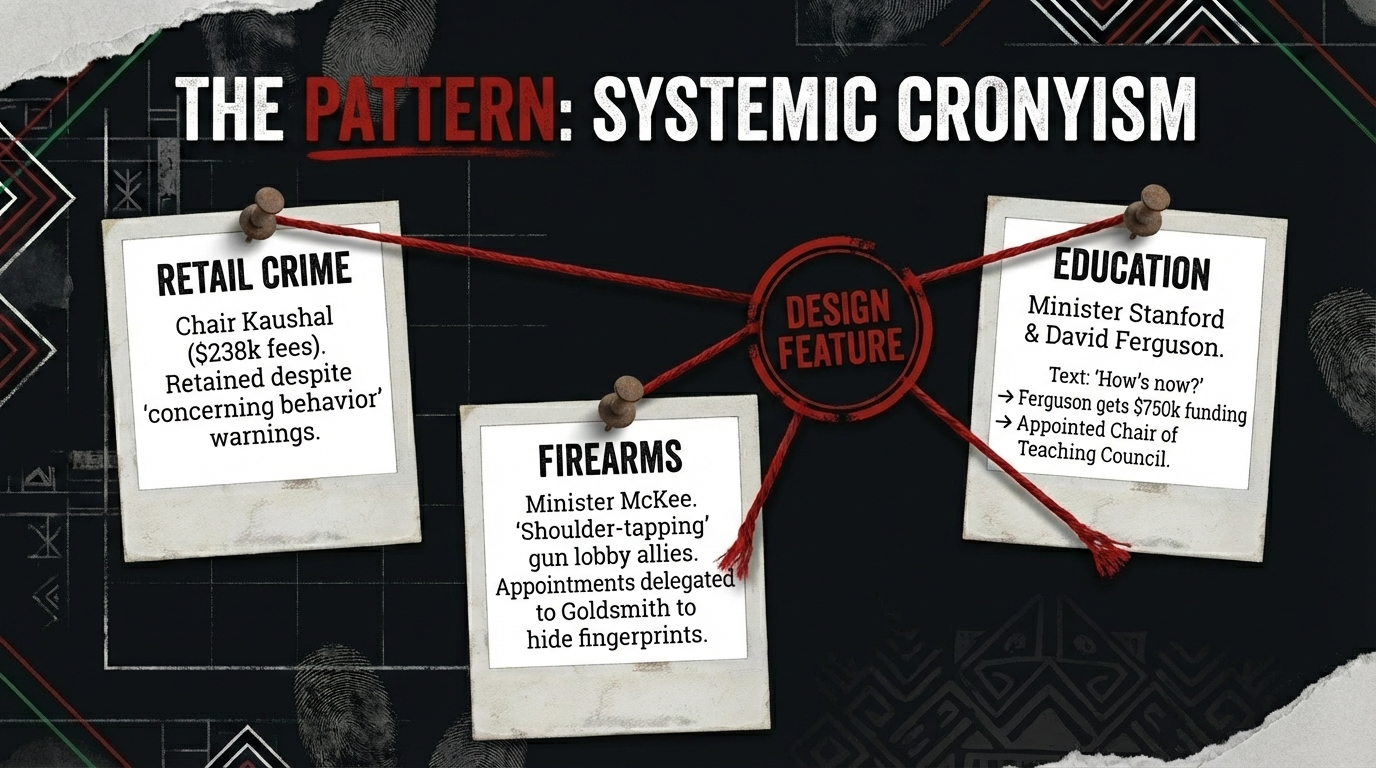
Ferguson now chairs the body that approves the Teachers’ Institute’s programs—the institute that received $750,000 in government funding after Ferguson consulted with Stanford about how to secure it.
2.4 The Metaphor: The Invisible Hand That Feeds Itself
Imagine you are a restaurant owner. You befriend the city health inspector. You text him asking for “advice” on how to pass inspections. He responds instantly (”How’s now?”). You tell him about a $750k health compliance grant you are applying for. He connects you with a city councilor who controls TEC-equivalent funding. Three months later, you get the grant.
Then—in a neat twist of logic—you hire him as the chair of the board that approves your business’s compliance audits.
Officially, he provided “clarification.” Officially, there was no quid pro quo. Officially, his appointment was merit-based. But the sequence of events is so perfectly choreographed that only a fool believes the “official” story.
This is not corruption in the traditional sense (though it walks and quacks like it). This is capture through proximity. A system where the line between helping and conflict of interest has been erased not by formal decision, but by the simple fact that the government has no cooling-off period, no independent vetting, and no consequences for ministers who appoint people they have just been helping.
Part Three: The System is Broken – And Breaking It Further
3.1 The Pattern Reveals the Problem: This Is Not Coincidence, This Is Design
Three separate scandals, same underlying failure:
- Retail crime committee: Chair with “concerning behaviour” (warnings from officials) remains in post, collecting $238,625 per year, while peak industry representative quits saying the committee is useless.
- Firearms advisory group: Minister hand-picks every member, cuts out dissenting voices, hides her involvement, delegates to another minister so her fingerprints don’t show.
- Teaching Council: Minister provides “advice” on $750k funding to someone she then appoints to oversee compliance of that same institution.
These are not three different problems. They are the same problem, repeated: the systematic use of ministerial power to place allies in regulatory roles, manage conflicts through secrecy, and rely on the opacity of government to avoid accountability.
When it happens once, call it an accident. When it happens three times in one month, call it policy.
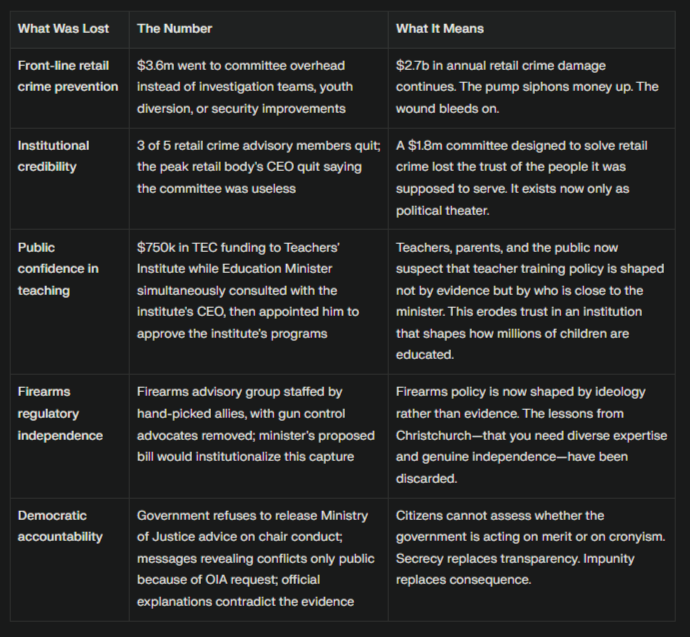
3.2 Quantifying the Damage: What the Broken System Costs
3.3 The Death of Evidence-Based Governance
Here is the thing about capture:
it does not announce itself. It does not come with a sign that says “Evidence-Based Governance Ended Here.” It comes quietly, through a series of seemingly small decisions:
- Appoint someone you trust (and who trusts you) to lead a committee.
- When officials warn about concerning behaviour, keep it quiet.
- When the peak industry body’s CEO quits in disgust, call it “external commitments.”
- When appointing people to regulatory bodies, hand-pick allies and hide the process.
- When journalists expose the conflicts, claim you provided “clarification” or that the adviser was just seeking “advice.”
- When people demand accountability, release nothing.
After enough of these small decisions, evidence-based governance has been replaced by loyalty-based governance. Institutions do not serve the public; they serve the people running them. Regulatory bodies do not apply rigorous standards; they apply political tests.
And then, one day, you look up and realize: the system that was supposed to keep medicines safe is staffed by pharmaceutical company loyalists. The system that was supposed to keep schools accountable is chaired by someone the education minister just funded. The system that was supposed to reduce retail crime is burning $3.6 million on an advisory group that the peak retail body’s CEO quit because it was useless.
Part Four: The Antidote – Restoring Democracy Before It Rots Away
4.1 The Core Principle: Make Cronyism Impossible (Or at Least Expensive)
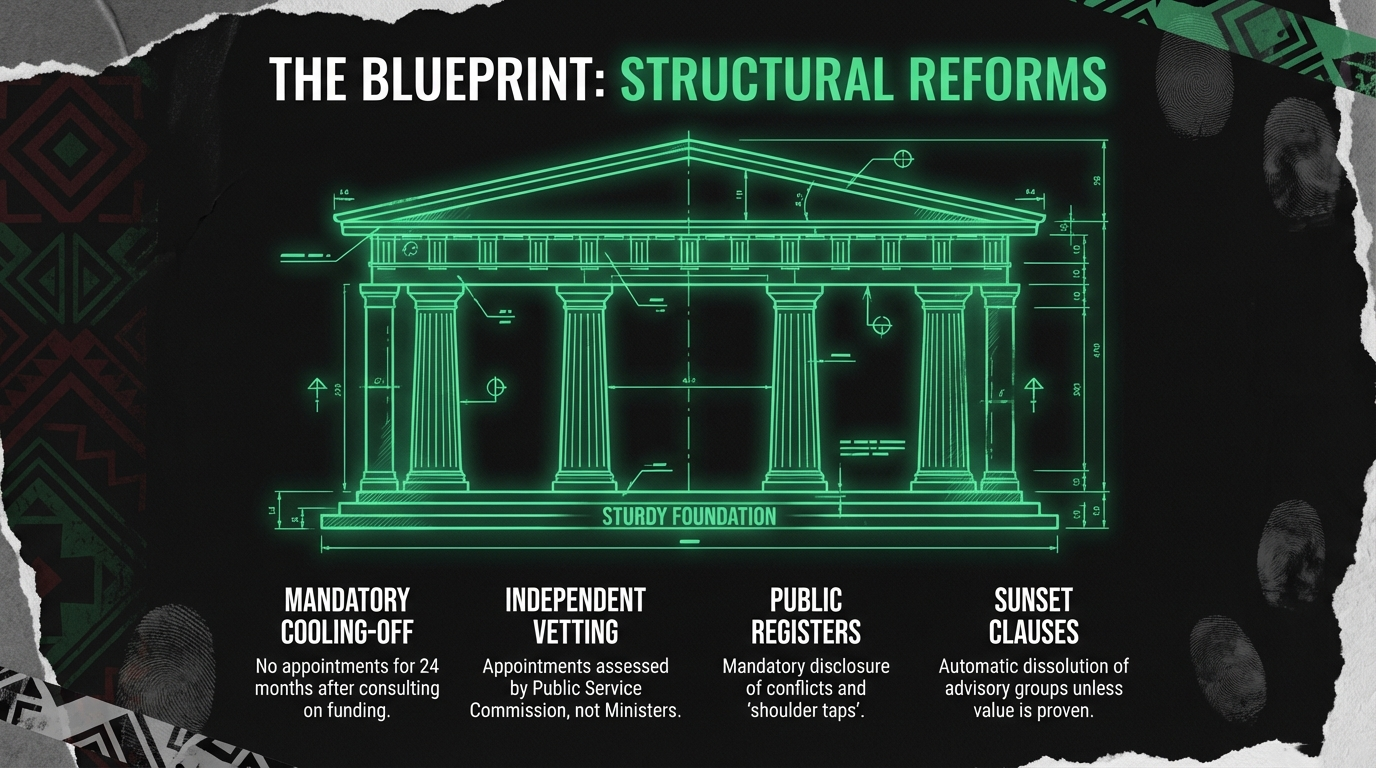
What New Zealand needs is not a better advisory group or a more ethical minister. It needs structural changes that make cronyism expensive in time, effort, and political cost. Systems, not personalities. Processes, not promises.
Mandatory Cooling-Off Periods
No minister should be able to appoint someone to a regulatory body if they have consulted with that person on related funding or policy decisions in the preceding 24 months.
Why? Because it makes the Ferguson-Stanford scenario literally impossible. Ferguson cannot text Stanford for $750k funding help in October and be appointed to the Teaching Council in July—the timeline would violate the cooling-off rule. The minister would face public disclosure requirements and potential investigation.
Independent Vetting of All Advisory Appointments
All ministerial advisory group members should be appointed through a process assessed by the State Services Commission, with:
- Public advertising of the role
- Open merit-based selection where possible
- Independent panel review
- Mandatory disclosure of any conflicts
- Public registration of all appointees and their conflicts
Why? Because it prevents one minister (McKee) from hand-picking every member and cutting out dissenting voices. It forces genuine diversity. It creates an audit trail.
Mandatory Disclosure Register
Every conflict of interest identified in the appointment process goes on a public register. With redactions only for operational security or personal safety.
Why? Because sunlight is the best disinfectant. When people know their conflicts will be public, they either manage them transparently or recuse themselves. When conflicts can be hidden, they metastasize into capture.
Ombudsman Investigation Power
The Ombudsman should have statutory power to investigate conflicts of interest in ministerial appointments and to recommend removal where warranted.
Why? Because right now, when a minister does something questionable, there is no independent body to investigate. The department reports to the minister. The minister investigates themselves. This is not accountability; it is a protection racket. An independent ombudsman changes the political calculus.
4.2 Advisory Group Governance: Turn Potemkin Villages into Real Institutions
Ministerial advisory groups should operate under a published code of conduct that requires:
1. Independent chair appointment – through a transparent process, not ministerial selection.
2. Balanced stakeholder representation – by formal requirement, not courtesy.
3. Regular publication of minutes and advice papers – because secrecy is how capture happens.
4. Annual public reporting on expenditure – every dollar on catering, office, travel, and fees disclosed. Let the public judge if $24,000 on catering for 22 meetings is reasonable.
5. Mandatory performance evaluation – before any group gets extended beyond its initial term.
6. Sunset clauses – every advisory group should have a defined end date. If it is worth keeping, Parliament votes to extend it based on evidence of impact. If it is useless (like the retail crime committee appears to be), it dies.
7. Independent complaints process – members should be able to report bullying, conflicts, or dysfunction to the State Services Commission, not to their chair or minister.
8. Spending controls – budgets over $500k per annum require quarterly reporting to a select committee. High daily rates and catering must be justified.
Why? Because right now, advisory groups operate in shadow. Three members quit the retail crime committee in disgust, and the Minister says it is “normal leadership movement.” With these reforms, mass resignations trigger automatic review. Expensive catering triggers questions. Concerning behaviour triggers investigation.
4.3 Policy Integrity: Make Bad Policy Expensive to Implement
The Crimes Amendment Bill emerging from the retail crime committee recommends broad citizens’ arrest powers and mechanical restraints—powers that the Ministry of Justice itself warns are unlikely to deter crime and likely to escalate violence.
This should never be allowed to become law without:
1. Mandatory impact assessment from Justice and Police – stating explicitly whether the proposal will deter crime or escalate violence.
2. Narrow, targeted design – citizens’ arrest powers should be limited to specific serious offences (violent robbery in progress), not all Crimes Act offences. Mechanical restraints should have age limits and training requirements.
3. Mandatory evaluation and sunset clauses – these powers should automatically expire after 3 years unless Parliament votes to renew them based on evidence that they reduced crime without escalating violence.
4. Worker protection provisions – legislation should make explicit that retail staff are not expected to physically restrain offenders and not liable for declining to do so. Employers adopting “no pursuit” policies should be protected and celebrated.
Why? Because right now, policy is shaped by what the advisory group recommends, not by what evidence shows works. With these reforms, the government can point to police data and say “citizens’ arrest powers are reducing crime” or admit “they are not working; we are repealing them.” Politics can no longer overrule evidence.
4.4 Accountability: Make Impunity Expensive
1. Independent investigation of conduct complaints – when officials or ministers face complaints related to their role, investigation happens through the Ombudsman or an independent ethics commissioner, not through their own department or minister.
2. Mandatory release of official advice – advice to ministers on conflicts, governance concerns, or conduct issues must be released within 6 months, with redactions only for operational security or privacy of third parties not involved in the decision.
Why Kaushal’s conduct warnings should have been public. Why the Ferguson-Stanford messages only became public through OIA requests: because the system allowed secrecy. Mandatory release changes that.
3. Parliamentary oversight – a dedicated select committee should review ministerial advisory group appointments and conduct annually, with power to call witnesses and demand disclosure.
Why? Because right now, Parliament sleeps while the government appoints allies to regulatory bodies. An engaged select committee—with Opposition members demanding answers—changes the political calculus.
4.5 Follow the Money: Reallocate the Pump to Where It Stops the Bleeding
The retail crime committee’s $1.8 million annual budget should be reallocated to front-line prevention:
- $600k per year to targeted investigation teams: Focus on the small number of repeat locations and offenders responsible for the majority of serious incidents, using problem-oriented policing.
- $400k per year to youth diversion and wrap-around support: Evidence shows restorative justice, education, and family support reduce reoffending more effectively than confrontation or mechanical restraints.
- $400k per year to environmental design improvements (CPTED): Grants to small retailers for improved lighting, controlled entry, secure displays, and store layout changes that reduce theft without confrontation.
- $400k per year to data-sharing infrastructure: Secure platforms allowing retailers and Police to share anonymized incident data, identify patterns, and coordinate response.
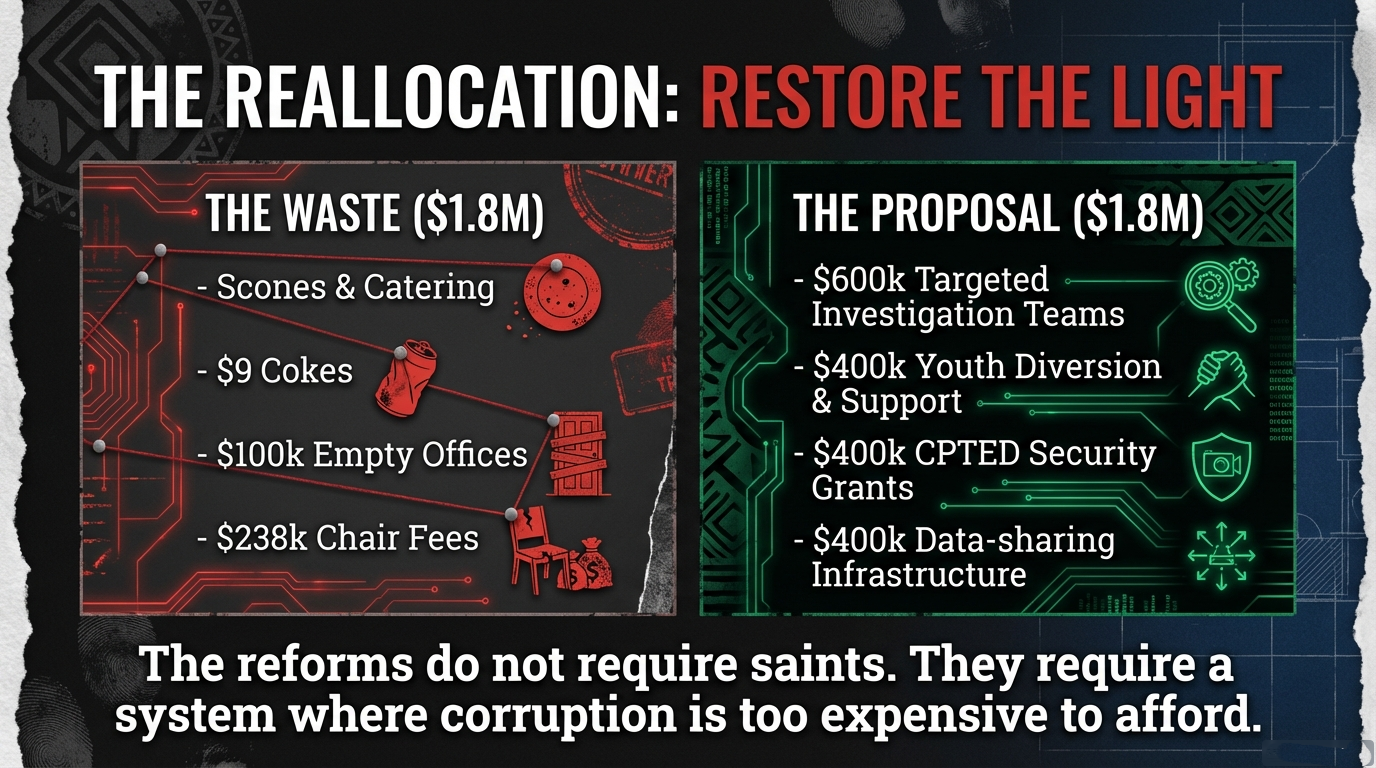
Why? Because the pump that transfers money upward to high daily rates and expensive offices does not reduce retail crime. Evidence-based prevention does.
Part Five: The Requiem and The Reckoning
The Metaphor, Complete
The government appointed a committee to solve a $2.7 billion problem. The committee became a $3.6 million pump transferring resources upward into high daily rates, expensive office space, and catering receipts. The peak retail body’s CEO quit saying the committee was useless. The chair received a warning for “concerning behaviour” but remained in post. Three of five members walked away.
Meanwhile, retail crime continues. $2.7 billion in annual damage. 99% of retailers experiencing crime. 205% increase in theft since 2019.
At the same time, across Justice and Education ministries, a parallel operation was unfolding:
the systematic placement of allies into regulatory bodies through hand-picked appointments, hidden conflicts of interest, and shadow processes.
A firearms minister picking every member of her own advisory group. An education minister approving $750k in government funding to someone she then appointed to oversee that same institution. A justice minister refusing to disclose official warnings about concerning behaviour.

This is not governance. This is the systematic transfer of regulatory power from evidence-based institutions into the hands of political allies. It is the colonization of the state by cronyism.
What Happens If Nothing Changes
If these structural reforms do not happen, here is the future:
- The retail crime committee will continue to burn money while retail crime grows.
- The firearms regulatory system will be captured by ideology, and policies will be shaped by what McKee believes, not by what evidence shows.
- The Teaching Council will be chaired by someone with a conflict of interest, and teacher training policy will be shaped by funding relationships rather than educational evidence.
- More advisory groups will be staffed with political allies.
- More conflicts of interest will be hidden behind government secrecy.
- More institutions will be eroded from the inside.
- Public trust in government will continue to decline, not because of grand scandals, but because people will sense—correctly—that the system is rigged in favor of people with connections.
That is what unchecked capture looks like. Not dramatic. Just quiet, corroding rot.
The Solution: Make Democracy Expensive to Corrupt
Everything outlined above—independent vetting, cooling-off periods, mandatory disclosure, sunshine and accountability—has a single purpose: to make cronyism expensive.
Not impossible. Expensive. In time, effort, political cost, and public embarrassment.
Right now, a minister can appoint an ally to a regulatory body and face no consequences if the appointment is done quietly. With these reforms, every appointment is public, every conflict is disclosed, and every questionable decision triggers investigation.
Right now, a minister can fund someone’s private institution and then appoint them to regulate it, because there is no cooling-off period. With these reforms, that becomes literally impossible.
Right now, advisory groups can burn millions while serving no purpose, because there is no evaluation or sunset clause. With these reforms, an under-performing group automatically ends unless Parliament votes to extend it.
The reforms do not require a government of saints. They require a system where saints are not necessary—where the structure itself makes corruption expensive.
The Choice Before the Country
New Zealand is at a crossroads. One path leads to continued erosion of institutional independence, continued capture of regulatory bodies by political allies, and continued public distrust in government. That path is the default path if nothing changes.
The other path requires the government to voluntarily constrain its own power—to establish cooling-off periods, independent vetting, mandatory disclosure, and accountability mechanisms that make cronyism expensive.
That would require admitting that the system is broken. That would require uncomfortable scrutiny. That would require Parliament to do its job.
RNZ has done the journalism. The evidence is public. The pattern is clear. The solutions exist.
What remains is the question of whether the government—and Parliament—will act on it, or whether New Zealand will continue to watch democracy be quietly colonized, one appointment at a time, while a Potemkin village burns $3.6 million and calls it governance.
The choice is New Zealand’s.
Koha Consideration: Funding the Accountability the Government Won’t Provide
This essay documents what happens when government advisory bodies become machines for transferring public money to political allies—when the retail crime crisis gets $3.6 million pumped into catering and office space instead of investigation teams, when ministers hand-pick every member of regulatory bodies to align with their ideology, when conflicts of interest are hidden behind government secrecy.
These are not opinions. They are facts documented by RNZ, the NZ Herald, and official government sources. But documenting them requires journalists willing to do months of work. It requires accessing Official Information Act requests. It requires connecting dots across multiple scandals. It requires refusing to accept the official story when evidence contradicts it.
The Crown will not fund this accountability. Media companies are cutting newsroom budgets while cronyism deepens. Corporate interests align with government interests. The only institutions willing to do the unglamorous, essential work of holding power to account are those funded by whānau, by communities, by people who understand that democracy requires constant vigilance.
Every koha signals that you are ready to fund the truth-telling that the Crown and corporate media will not provide. It signals that rangatiratanga—the power to determine our own future—includes the power to fund our own voices. It says: “I will not accept government secrecy. I will not accept cronyism masquerading as governance. I will fund the people who expose it.”
Why This Matters: For Whānau, For Communities, For Democracy
The governance failures documented in this essay do not affect only retail owners or teachers or firearms policy experts.
They affect whānau across New Zealand:
- For whānau in retail: When $3.6 million meant to address retail crime is burned on advisory group overhead, your tamariki working in dairies are not safer. The actual crime prevention work does not get funded.
- For whānau in education: When a minister appoints someone to the Teaching Council with an undisclosed conflict of interest, teacher training policy is shaped by who is close to power, not by what evidence shows works. Your children’s education is affected.
- For whānau in communities: When regulations are shaped by hand-picked advisers rather than genuine expertise, when conflicts of interest are hidden, when government secrecy replaces accountability—the system works for insiders, not for you.
This essay argues that New Zealand needs structural reform:
cooling-off periods for conflicts of interest, independent vetting of appointments, mandatory disclosure, sunset clauses for advisory groups, and reallocation of resources from advisory overhead to front-line prevention.
But structural reform requires political will.
Political will requires public pressure. Public pressure requires people who understand the problem and are willing to act on it.
That is where koha comes in.
Every Koha Funds Resistance to Capture
When you contribute a koha to support this mahi, you are:
- Funding continued investigation into how government money flows, how appointments are made, and where conflicts of interest are hidden.
- Supporting the voices willing to say what the Crown will not admit: that the system is captured, that cronyism runs deep, that governance is broken.
- Resisting the narrative that these failures are “normal leadership movement” or “external commitments” rather than what they are: systematic erosion of democratic institutions.
- Building infrastructure for accountability that does not depend on corporate media budgets or government goodwill, but on whānau understanding that democracy requires constant funding, constant vigilance, constant pressure.
Three Pathways to Support This Mahi
For those who wish to support this investigation and analysis directly with a koha (voluntary contribution):
Visit the Koha platform to make a contribution that funds continued accountability journalism on government governance, cronyism, and capture:
Koha—Support Independent Accountability Journalism
Your koha, whatever the amount, signals that you refuse to accept government secrecy and cronyism as normal. It funds the next investigation.
For those who wish to receive essays directly and support through subscription:
Join the community on Substack to receive regular analysis of government governance failures, institutional capture, and what needs to change. Your subscription supports continued research and writing:
Subscribe to Independent Analysis on Substack
For those who prefer direct bank transfer:
Account: HTDM
Account Number: 03-1546-0415173-000
A Call to Whānau
Kia kaha, whānau. The government is not going to voluntarily constrain its power. Ministers are not going to stop appointing allies to regulatory bodies. Conflicts of interest are not going to become transparent because someone asks nicely.
Change happens when people fund the truth-telling that holds power to account. When enough whānau contribute enough koha to support enough journalists and analysts willing to do the work, the political calculus shifts. Scandals stay in the news. Pressure builds. Parliament has to act.
That is how rangatiratanga works—not by asking permission, but by funding our own institutions, our own voices, our own accountability structures.
Stay vigilant. Stay connected. And if you are able, consider a koha to ensure this voice continues.
Kia kaha.
This essay is part of a series on government governance, institutional capture, and what structural reform would look like. If these issues matter to you—if you care about merit-based appointments, transparent conflicts of interest management, and public money being spent on front-line prevention rather than advisory group overhead—please share this essay, engage with the analysis, and contribute if you are able. This mahi requires ongoing support.

Ivor Jones The Māori Green Lantern Fighting Misinformation And Disinformation From The Far Right