
Auckland professor associated with Jeffrey Epstein: The Smooth Psychopath’s Academic Handmaiden” - 2 February 2026
When Literary Prestige Prostitutes Itself for a Pedophile’s Dollar
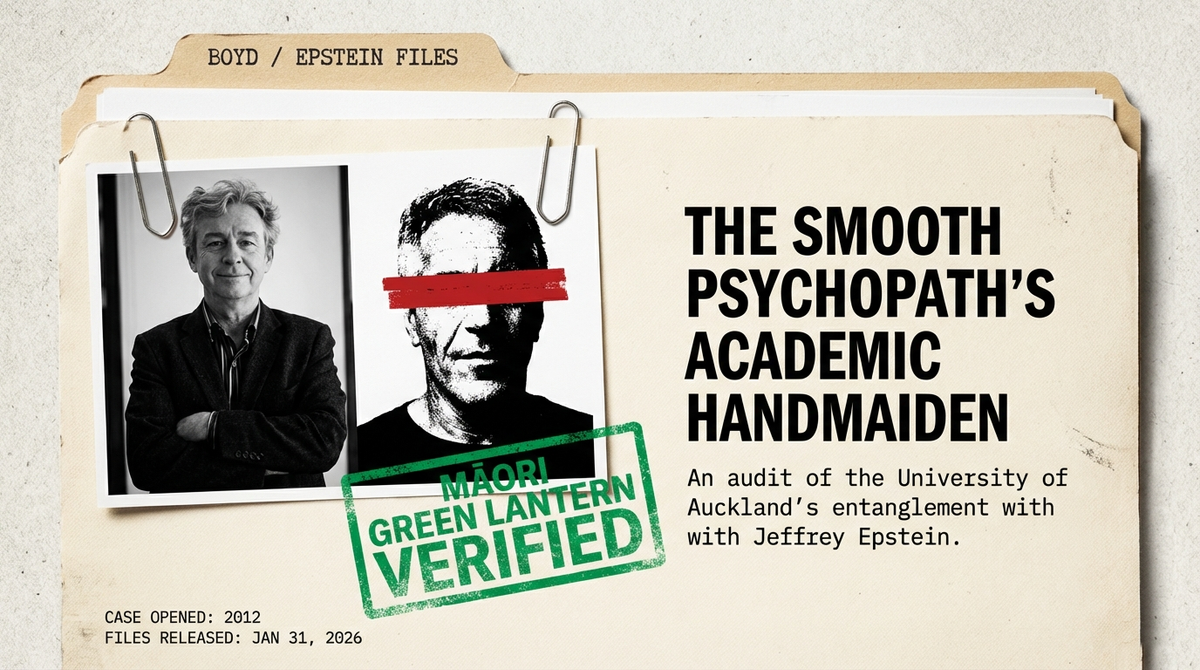
Mōrena ano Aotearoa,
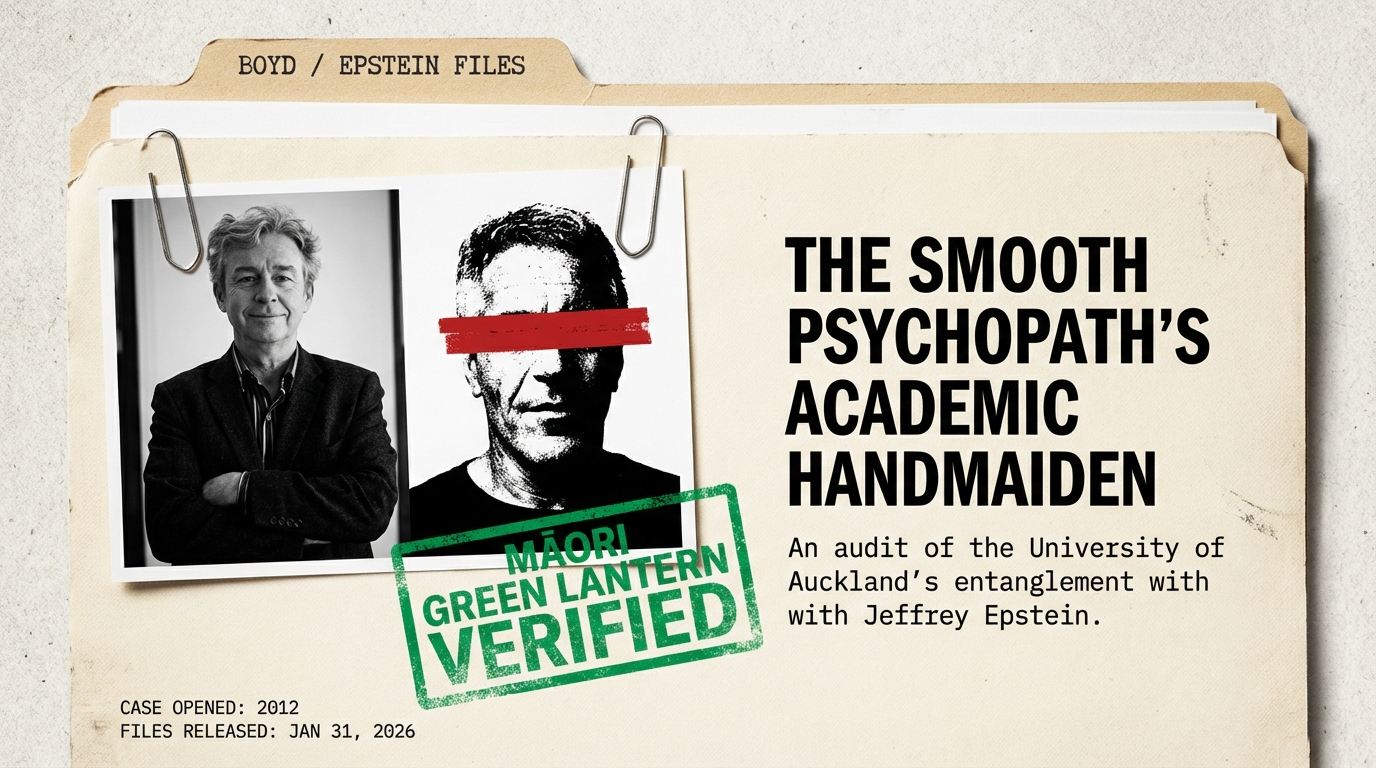
The taiaha empowered by the Ring has traced a network so grotesque it reads like Nabokov’s nightmare made flesh
—except this time, the predator doesn’t hide within fiction’s protective membrane. He walks among us, funded by universities, validated by scholars, enabled by systems designed to vet nothing but their own reputations.
Jeffrey Epstein
—convicted sex trafficker, systematic predator of children, architect of industrial-scale abuse
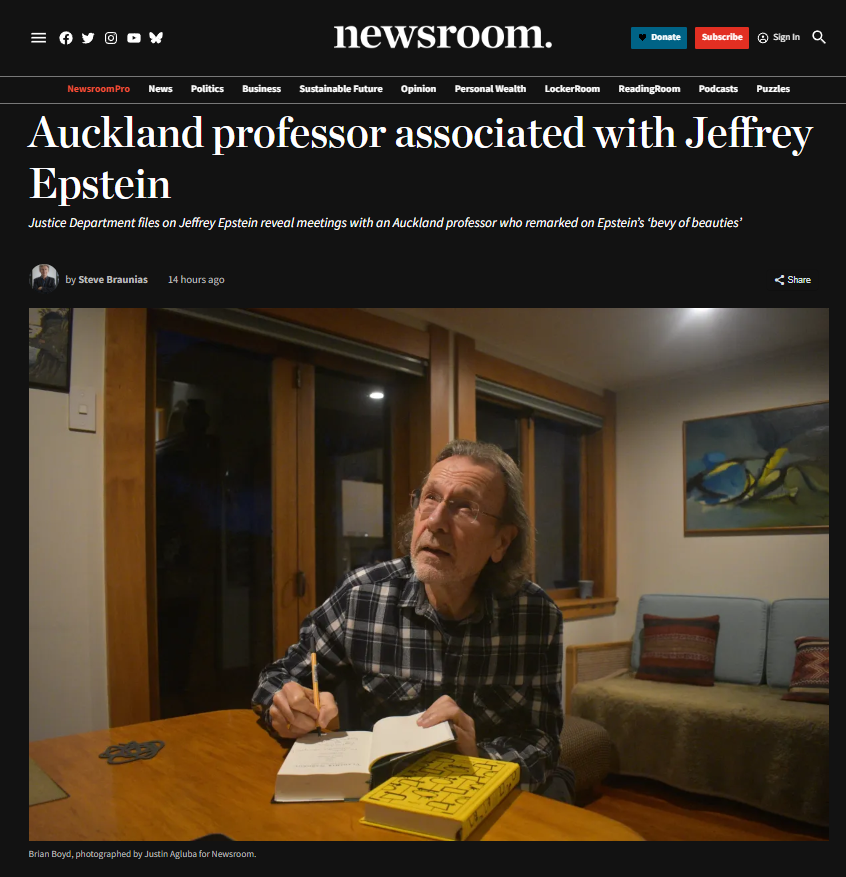
—found in Professor Brian Boyd of the University of Auckland not a whistleblower, not a gatekeeper, but a willing negotiator, as revealed by Newsroom.
A man who spent forty years studying a novel about the rape of a twelve-year-old girl somehow failed to detect the blood-soaked hands reaching across the breakfast table to fund his next book on that very subject.
The smooth psychopath, Boyd called him in an interview. How literary. How erudite. How utterly, catastrophically complicit.
The $75,000 Question: What Does It Cost to Buy a Professor’s Silence?
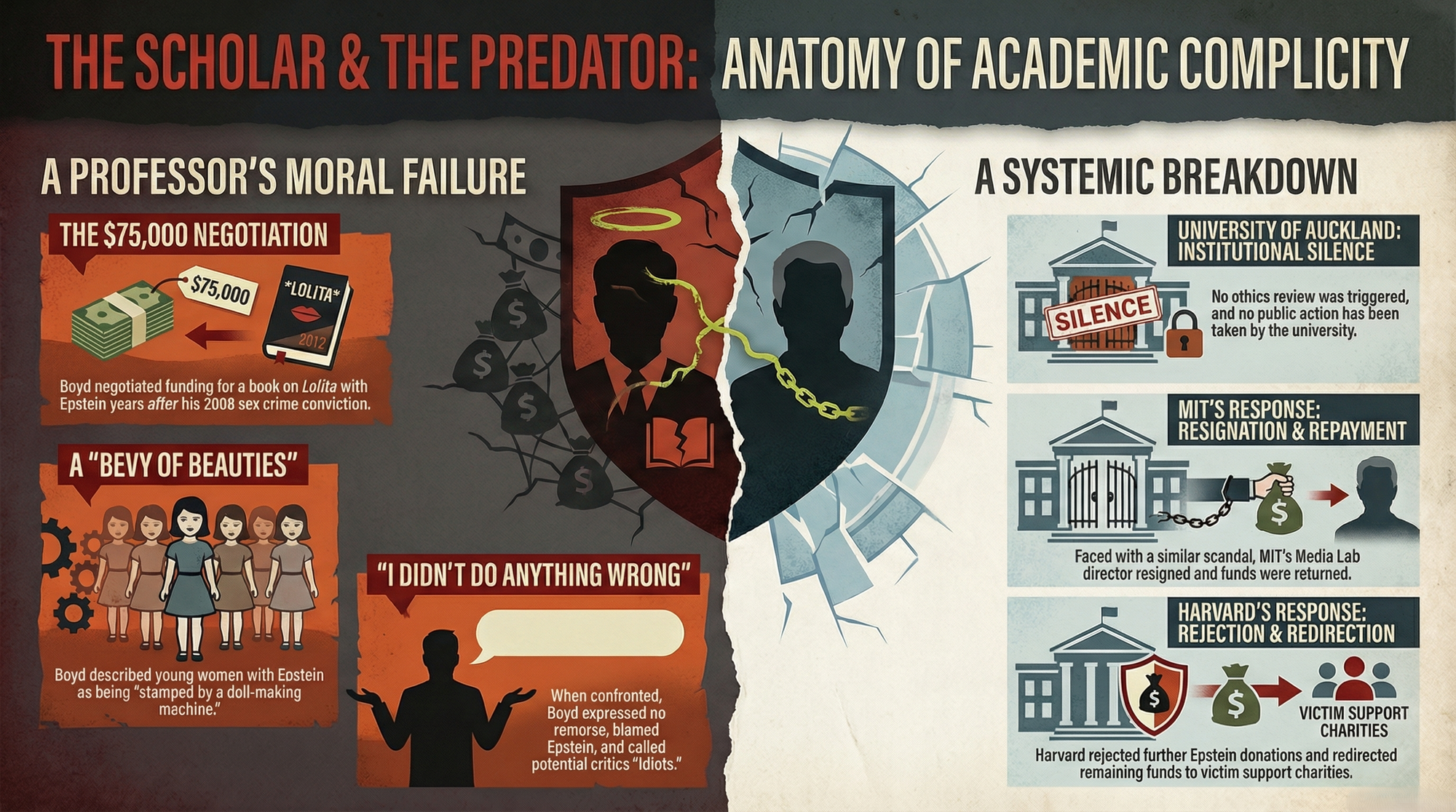
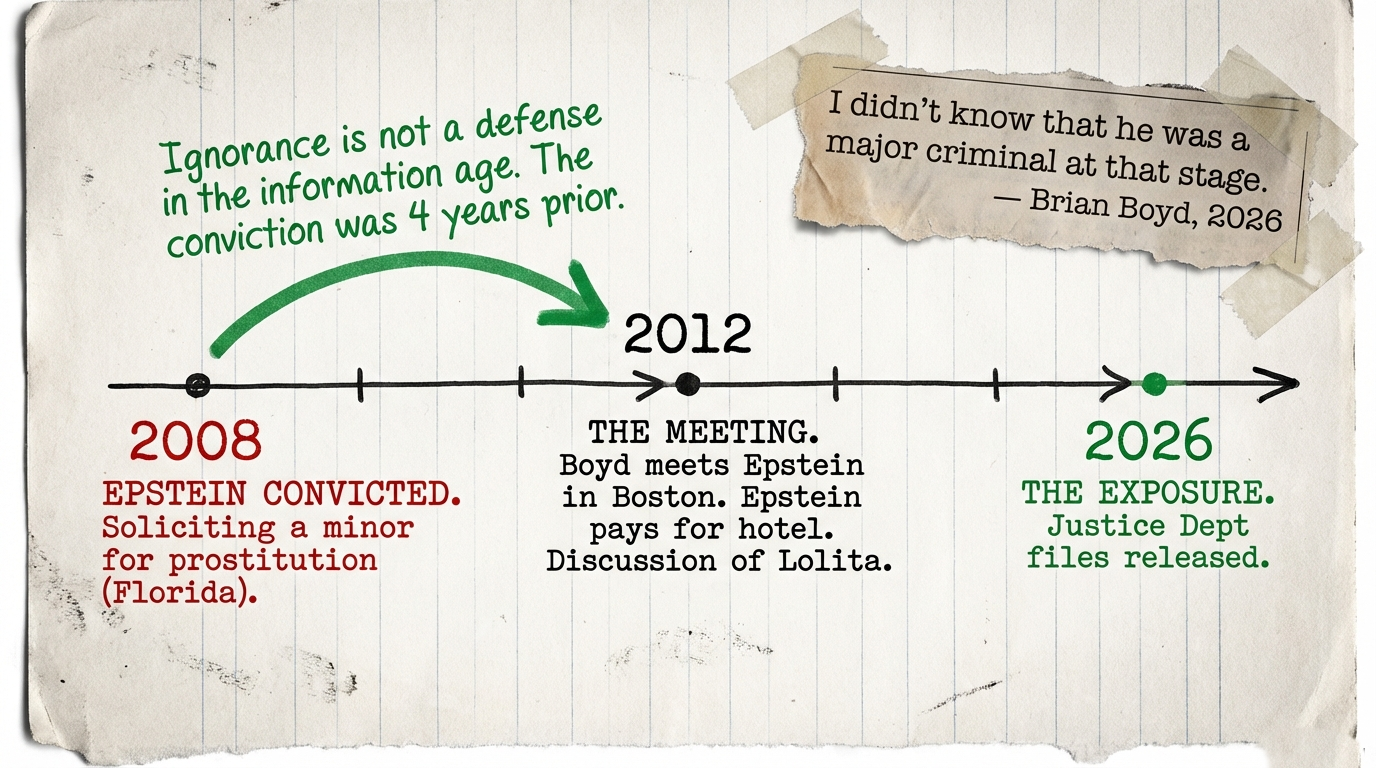
In September 2012, four years after Epstein’s Florida conviction for soliciting a minor for prostitution, Professor Brian Boyd—University Distinguished Professor at the University of Auckland, world authority on Vladimir Nabokov, recipient of countless academic accolades—did something extraordinary, as documented in Justice Department files released January 31, 2026. He sat down and wrote an email negotiating the terms under which he would accept money from a convicted pedophile to write a book about Lolita.
Not $50,000—that was Boyd’s initial, self-described “naturally antigrabbity” figure, according to Newsroom. Epstein countered with $75,000. Boyd hinted it should be higher, explaining he’d “really need to take a full year of unpaid leave.” Then—and this detail sears with its bureaucratic banality—he provided his New Zealand bank account details, helpfully including the SWIFT code.
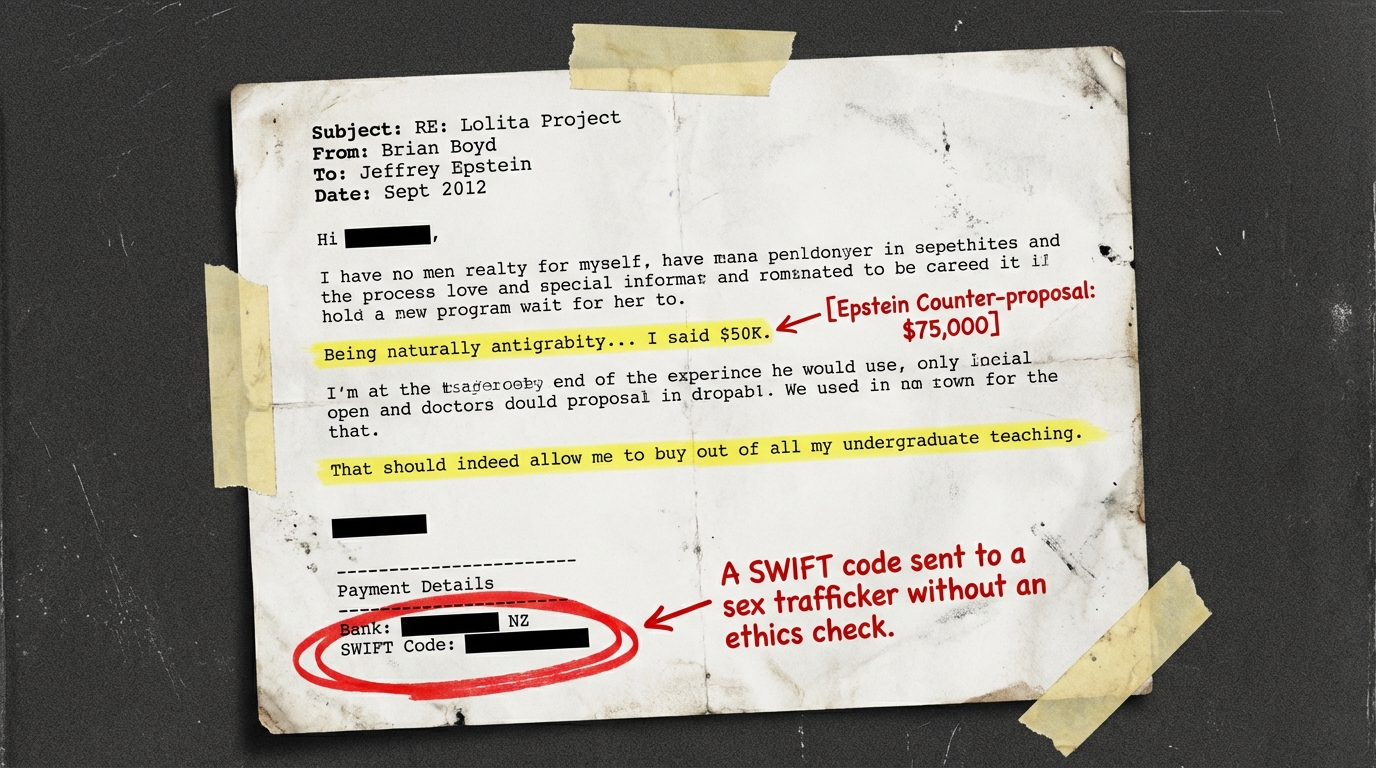
Think about that SWIFT code. Not a hesitation. Not a phone call to a university ethics officer. Not a moment’s consultation with the colleagues who would later staff Auckland University’s robust (on paper) policies on gifts and donor relationships. Just the cold efficiency of international money transfer protocols, ready to receive tainted funds from a man whose crimes against children were already a matter of public record.
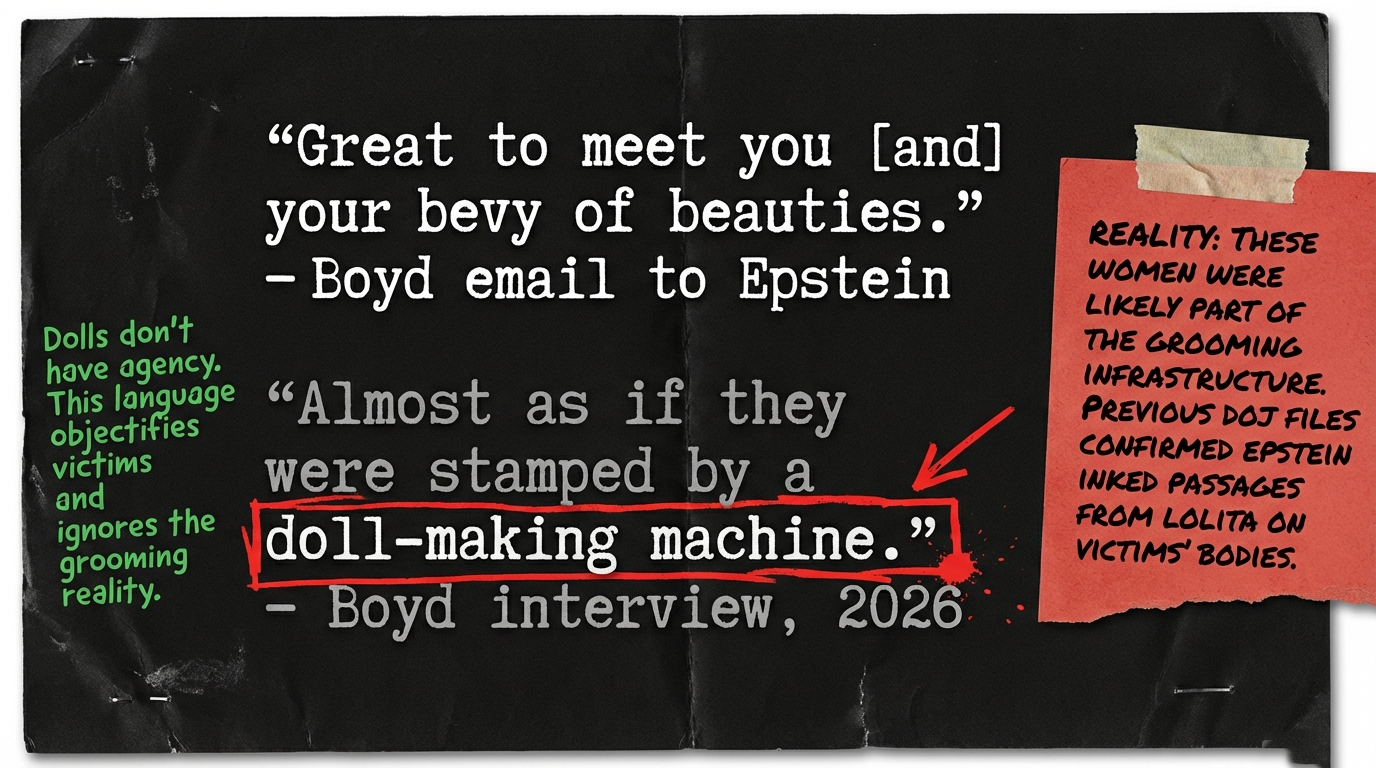
The fee was never paid, Boyd claims. He “never chased it up” after discovering Epstein’s “icky background”—as if soliciting minors for prostitution registers on the same moral scale as forgetting to return a library book. But the damage wasn’t in the money. The damage was in the willingness. The damage was in forty-five minutes of breakfasted bonhomie with a predator, in the email that chirped “Great to meet you [and] your bevy of beauties,” in the fundamental failure of a man whose entire career rests on moral discernment within literature to exercise even rudimentary moral judgment in life.
The “Bevy of Beauties”: When Academic Men Describe a Predator’s Stable
“It was very peculiar,”
Boyd told the interviewer, describing his second meeting with Epstein.
“There was this group of very, very bright, very pretty group of girls, almost as if they were stamped by a doll-making machine.”
Stamped by a doll-making machine.
Four to six young women. Early twenties,
“although they looked younger.” All “very, very bright, very pretty,” all seemingly identical.
Boyd supposed they were “young graduates,” though admits they “looked younger.”
They were “just his staff, arranging everything.” Like Hugh Hefner, he said—a comparison that apparently struck him as exculpatory rather than damning.
Boyd’s metaphor choice reveals more than he intended.
Dolls don’t have agency. Dolls don’t have histories. Dolls don’t have names or families or dreams interrupted by powerful men.
Dolls exist to be arranged, to decorate, to serve.
When an internationally acclaimed scholar of literature
—a man who built his reputation parsing Nabokov’s deliberate word choices—
deploys such imagery, we must ask:
What does this reveal about the ecosystem that produces such men?
What Boyd saw, and described with such casual objectification, was almost certainly Epstein’s recruitment and grooming infrastructure in action. Previous Justice Department document releases revealed Epstein inked passages from Lolita onto the bodies of young women. His private plane was nicknamed “The Lolita Express.” This wasn’t literary appreciation. This was a predator using literature as pornography, as justification, as a coded language to signal his appetites to other men who might share them.
And Professor Brian Boyd, expert on Lolita, walked right into that room, described the scene in his email, and negotiated a book deal.
The Institutional Void: Where Was the University of Auckland?
Here’s what makes this scandal a systemic failure rather than merely individual moral bankruptcy:
There is no evidence the University of Auckland knew anything about Boyd’s Epstein connection until the Justice Department files were released in January 2026. No disclosure. No ethics review. No institutional vetting process engaged whatsoever.
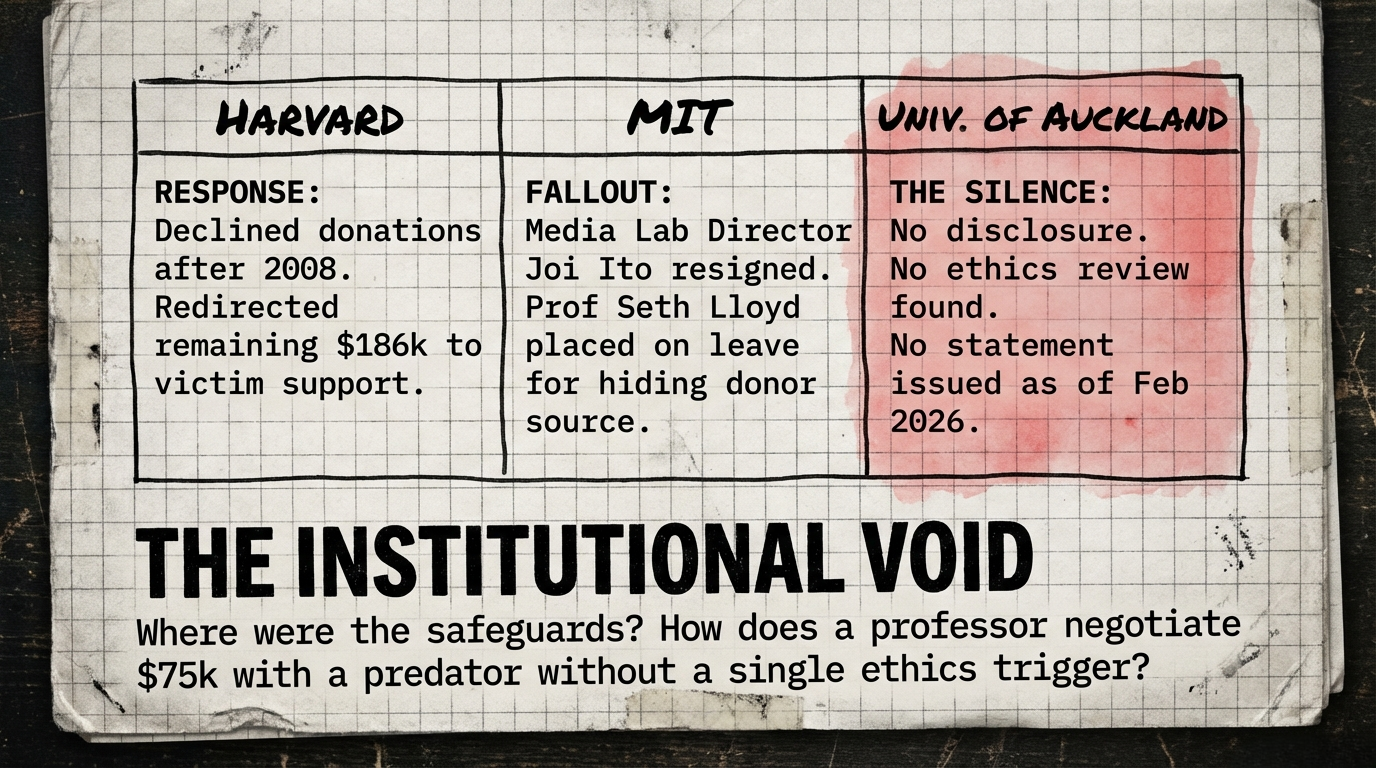
This stands in searing contrast to how other institutions handled Epstein’s predatory philanthropy:
Harvard University received $9.1 million from Epstein between 1998 and 2007, but after his 2008 conviction, deliberately declined all further donations. When the scandal broke in 2019, Harvard redirected the remaining $186,000 to organizations supporting victims of human trafficking and sexual assault. President Lawrence Bacow stated: “Jeffrey Epstein’s actions were abhorrent and reprehensible. I profoundly regret Harvard’s past association with him.”
MIT performed worse—accepting $525,000 from Epstein after his 2008 conviction, keeping the donations anonymous. When exposed, Media Lab director Joi Ito resigned, and MIT returned the equivalent of $800,000 to charities benefiting sexual abuse victims. Professor Seth Lloyd, who accepted $225,000 from Epstein in 2012 and 2017, was placed on paid administrative leave after investigators found he “knew that donations from Epstein would be controversial and that MIT might reject them” and “purposefully decided not to alert the Institute to Epstein’s criminal record.”
Notice the dates. Lloyd’s 2012 donations coincide exactly with Boyd’s 2012 meetings with Epstein. Both men were negotiating with a convicted sex offender. Both knew it was problematic. Lloyd “purposefully” circumvented MIT’s vetting systems. Boyd simply never engaged Auckland’s systems at all.
Where was the University of Auckland? Where were the safeguards that should protect institutional integrity from exactly this scenario? The university has policies designed to help members “avoid any perception of impairment of their objectivity or impartiality.” Yet somehow, a Distinguished Professor negotiating tens of thousands of dollars from a convicted pedophile to write about a novel depicting child rape triggered none of these mechanisms.
The Intellectual Fraud of False Equivalence
When confronted about his association with Epstein, Boyd deployed a defense that deserves its own circle of hell: he compared himself to Steven Pinker, whom he praised for seeing through “Epstein’s intellectual charlatanism almost immediately.”
This is rhetorical sleight-of-hand of breathtaking audacity. Yes, Pinker correctly identified Epstein as an intellectual fraud. But Boyd’s failure wasn’t intellectual—it was moral. Epstein wasn’t trying to pass off bad science to Boyd. Epstein was offering money to a scholar of child sexual abuse in literature, while actively trafficking children in reality, surrounded by young women “stamped by a doll-making machine.”
Boyd told his interviewer:
“No, I’m afraid I didn’t [see through him]. I wish I had, but I wasn’t perceptive enough.”
Perceptive enough. As if detecting a serial child rapist required the analytical skills of a trained literary critic parsing Nabokovian symbolism. As if there weren’t a 2008 court conviction, public records, news coverage, and the man’s own behavior—flying Boyd to Boston, surrounding himself with interchangeable young women, obsessing over Lolita to the point of inking it on victims’ bodies—screaming warnings in a language anyone with basic human decency could read.
This isn’t about perception. It’s about priority. What Boyd perceived clearly enough was the $75,000. What he perceived was the year of paid leave. What he perceived was the chance to write “the book at the top of my wish list.” The moral calculus simply didn’t register, because in the ecosystem Boyd inhabits, it didn’t need to.
The Tikanga Test: What Academic Integrity Looks Like When It Means Something
For those steeped in Pākehā institutional culture, let me translate this scandal through the framework of tikanga Māori—not because it’s fashionable, but because it exposes what’s missing.
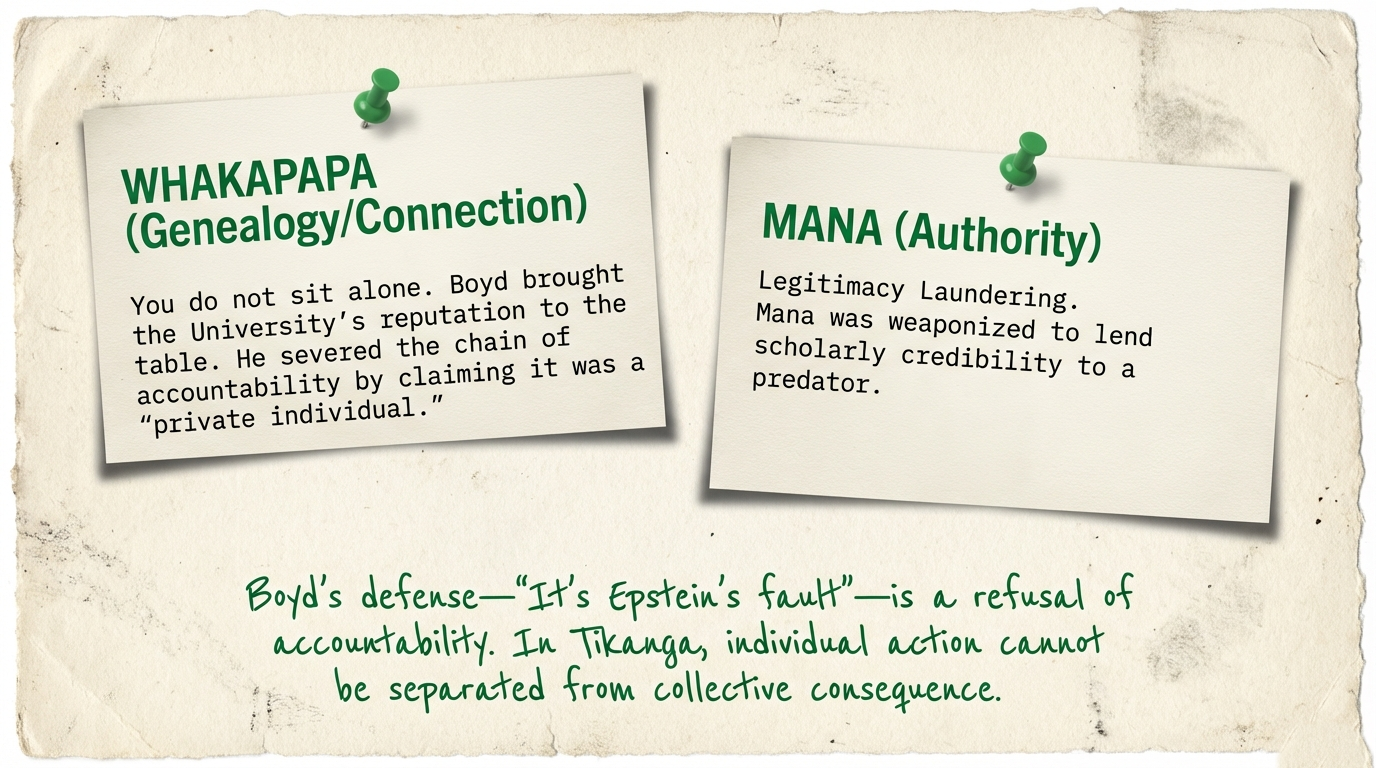
Whakapapa (purpose and accountability through genealogy): Boyd’s scholarly whakapapa traces back forty years through Nabokov studies, connecting him to institutions, students, colleagues, and the broader academic community. Every action he takes reflects back on these connections. When he sits across from Epstein, he doesn’t sit alone—he carries his university, his discipline, his students with him, as explained in understanding tikanga values. In tikanga, you cannot separate individual action from collective consequence. Boyd’s defense—”it’s Epstein’s fault”—would be recognized immediately as a refusal of accountability, a severing of whakapapa.
Mana (authority, power, and prestige): Boyd’s mana as a scholar derives from his knowledge, his publications, his institutional position. But mana isn’t permanent—it must be maintained through right action. When Boyd negotiated with Epstein, he wasn’t protecting his mana; he was weaponizing it, lending scholarly legitimacy to a predator. In a tikanga framework, this represents a catastrophic loss of mana, not just for Boyd personally, but for everyone connected to him through whakapapa.
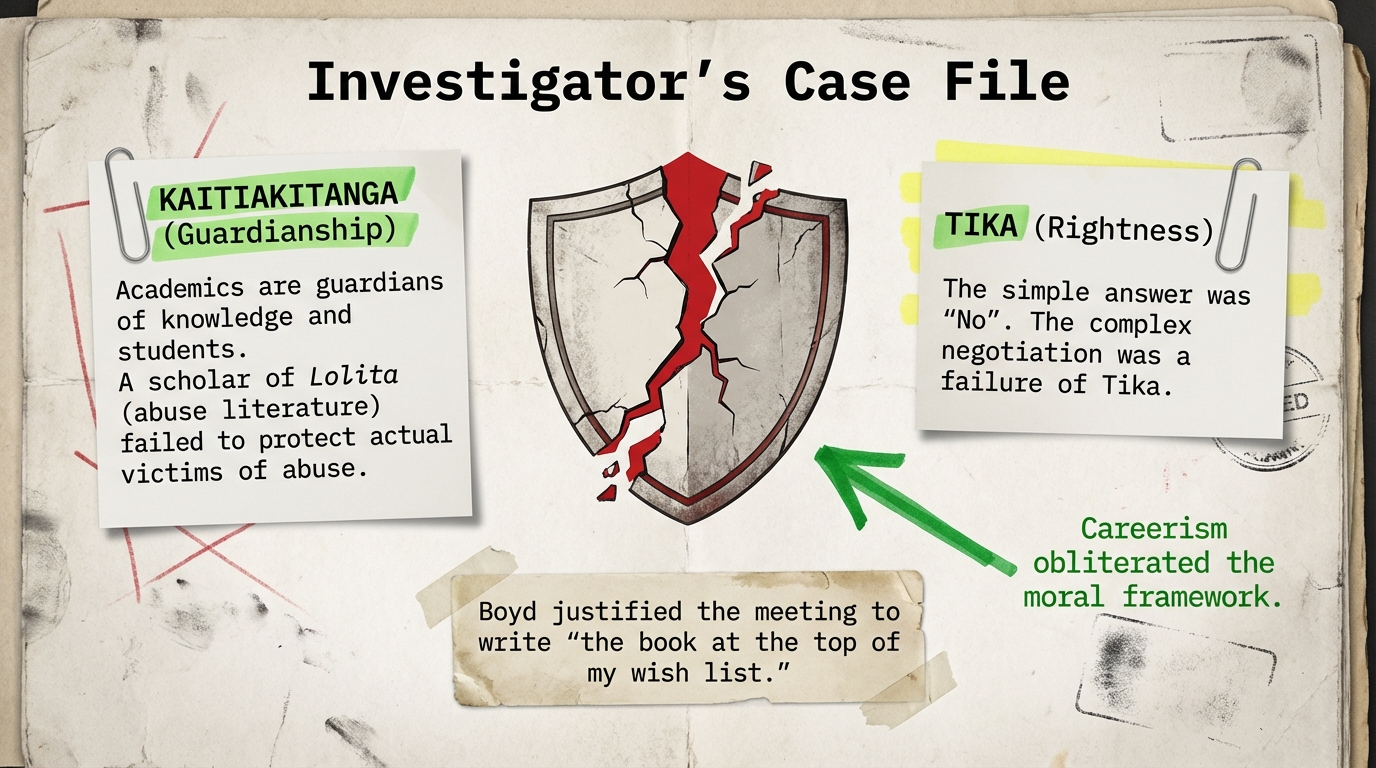
Kaitiakitanga (guardianship): Academics are kaitiaki—guardians—of knowledge, of students, of intellectual integrity, as described in Te Ao Māori accountability. This isn’t metaphorical. A professor of literature about child sexual abuse has a kaitiaki responsibility to ensure that knowledge isn’t weaponized by actual child abusers. Boyd failed this utterly. He saw the young women, described them as manufactured objects, and continued negotiating. Where was the guardianship? Where was the intervention?
Utu (reciprocity, balance, and restitution): From a tikanga perspective, Boyd’s actions created a profound imbalance that demands utu—not as punishment, but as restoration. The harm ripples through whakapapa: to his students who trusted him, to victims who see academic prestige laundering abuse, to every person who believed universities were guardians of ethics. Utu seeks to restore equilibrium through acknowledgment, accountability, and restitution.
Tika (rightness, justice, correctness): Tikanga provides guidance on “the right way of doing things.” The right way of responding to a convicted pedophile who wants to fund your book about child rape is: No. Not “let me think about it.” Not “what are the details of the money transfer?” Just no. That Boyd even considered it reveals a moral framework so corrupted by careerism and individualism that basic tika has been obliterated.
Western institutions like the University of Auckland claim to value tikanga, to incorporate it into governance and practice. Yet when a Distinguished Professor engages with a child predator, no tikanga framework activates. No karakia precedes the meeting to center right action. No whānau of colleagues intervenes. No institutional kaitiaki asks the obvious question: He aha te take? What is the purpose? And more importantly: Ko wai e pāngia? Who will be harmed?
The silence is instructive. Tikanga isn’t a branding exercise or a diversity checkbox. It’s a lived system of accountability that, when genuinely practiced, makes Boyd’s behavior impossible. Its absence at Auckland reveals institutions that mouth bicultural values while operating under entirely monocultural—and morally bankrupt—norms.
Quantifying the Harm: The Mauri-Depleting Mathematics
Western institutions love quantification, so let’s oblige:
Direct harm (conservative estimates):
- Epstein’s known victims: The Epstein Victims’ Compensation Program received 225 applications, with 150 deemed eligible, receiving $121 million in total compensation
- Academic donations from Epstein: Harvard $9.1 million, MIT $850,000, others unknown—conservative total exceeds $10 million in elite academic legitimation
Institutional harm:
- MIT Media Lab’s reputation destroyed by Ito’s Epstein acceptance
- Harvard Program for Evolutionary Dynamics: Epstein’s largest single donation ($6.5 million) now irrevocably tainted
- Academic careers destroyed: Joi Ito (MIT), Seth Lloyd (MIT), both institutions’ reputations severely damaged
Symbolic harm (the mauri-depleting effect):
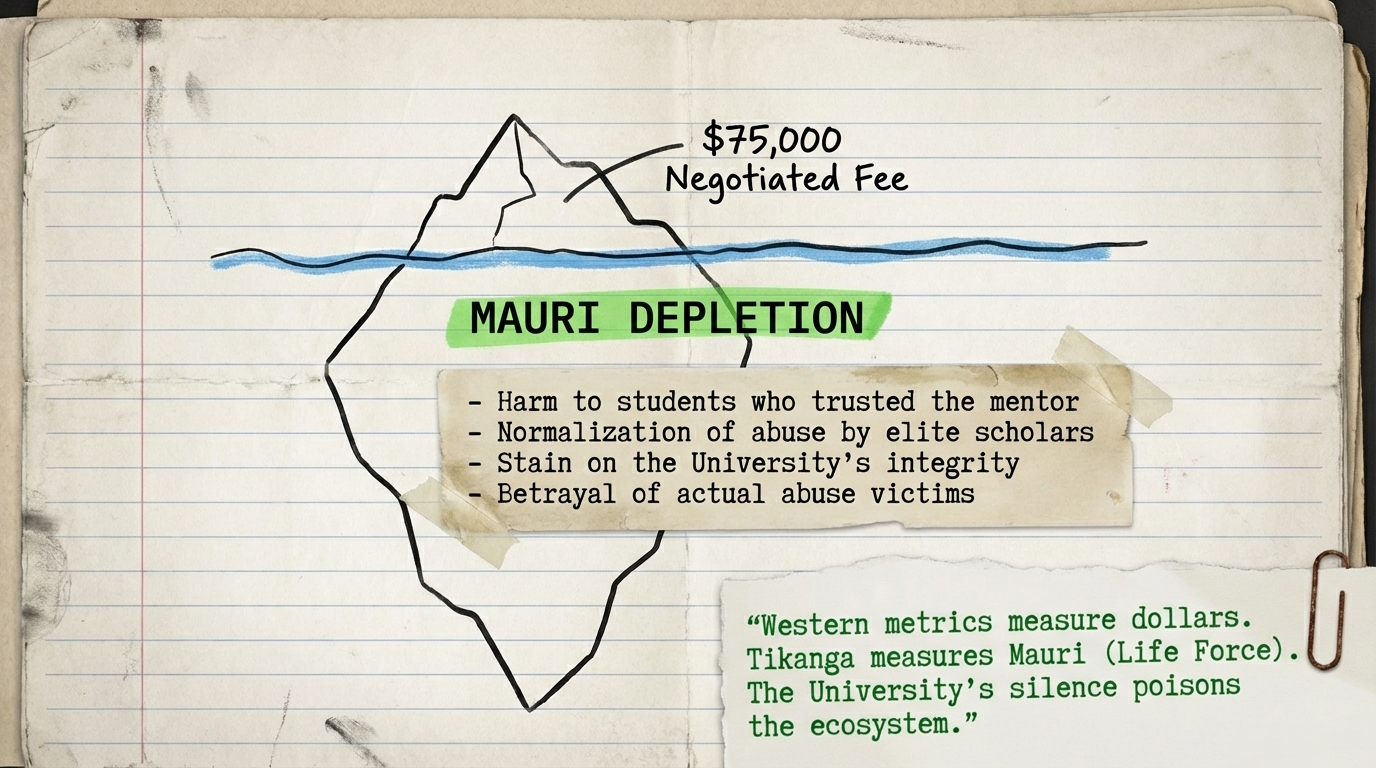
This is where Western quantification fails and tikanga thinking is required. When a scholar of child sexual abuse in literature negotiates funding from a child sexual predator, the harm isn’t just to the victims Epstein abused. It’s to:
- Every student Boyd taught who believed academic integrity mattered
- Every victim who sees universities as complicit in their abuse
- Every taxpayer funding institutions that claim ethical standards while tolerating this behavior
- The entire concept of scholarship as a guardian of truth rather than a servant of power
In tikanga terms, this represents massive mauri depletion
—the life force that sustains relationships, institutions, and communities has been poisoned. No dollar figure captures this harm.
It requires utu:
Full acknowledgment, institutional accountability, and systemic change.
The Network Revealed: Five Hidden Connections
The Ring’s light exposes whakapapa that institutions would prefer remained dark:
1. The Lolita Industrial Complex: Epstein’s obsession with Lolita wasn’t literary—it was operational. He inked passages on victims’ bodies. His plane bore the novel’s name. He cultivated relationships with Nabokov scholars. This reveals a network of legitimation, where academic prestige launders predatory desire. Boyd wasn’t a random target—he was a lynchpin, someone whose expertise could be marshaled to intellectualize abuse.
2. The 2012 Timeline: Boyd’s meetings with Epstein occurred in 2012, the exact same year MIT Professor Seth Lloyd began accepting Epstein donations. This wasn’t coincidence. Epstein was systematically testing which institutions would accept his money post-conviction, using academics as beachheads. Boyd and Lloyd served the same function: proof that elite scholars would still engage.
3. The Institutional Hierarchy Bypass: At MIT, Epstein was labeled a “disqualified donor,” yet Media Lab director Joi Ito accepted his money anyway, with senior MIT leadership knowing and doing nothing until public exposure. At Auckland, no such system even engaged. This reveals institutions designed not to prevent ethical violations but to provide plausible deniability after exposure.
4. The Global Academic Elite Network: Epstein cultivated relationships with Harvard, MIT, and now Auckland emerges. These weren’t isolated incidents—they were a coordinated strategy to embed himself in elite knowledge production institutions. What did he get for his money? Access. Legitimacy. The ability to say to other powerful men: “I fund research at the world’s top universities.”
5. The Post-Conviction Timeline: Every single one of Boyd’s interactions with Epstein occurred after the 2008 Florida conviction. This wasn’t youthful naiveté or pre-internet information scarcity. This was 2012, in the age of Google, after international media coverage, after Epstein’s sex offender registration. The excuse of ignorance is unavailable. What remains is choice.
Solutions: What Utu Demands
As researchers in Te Ao Māori accountability note, restoration requires “not only reparations for the past but also a shared commitment to a future built on equity, mutual respect, and genuine partnership.” Applied to this scandal, utu demands:
Immediate Institutional Action:
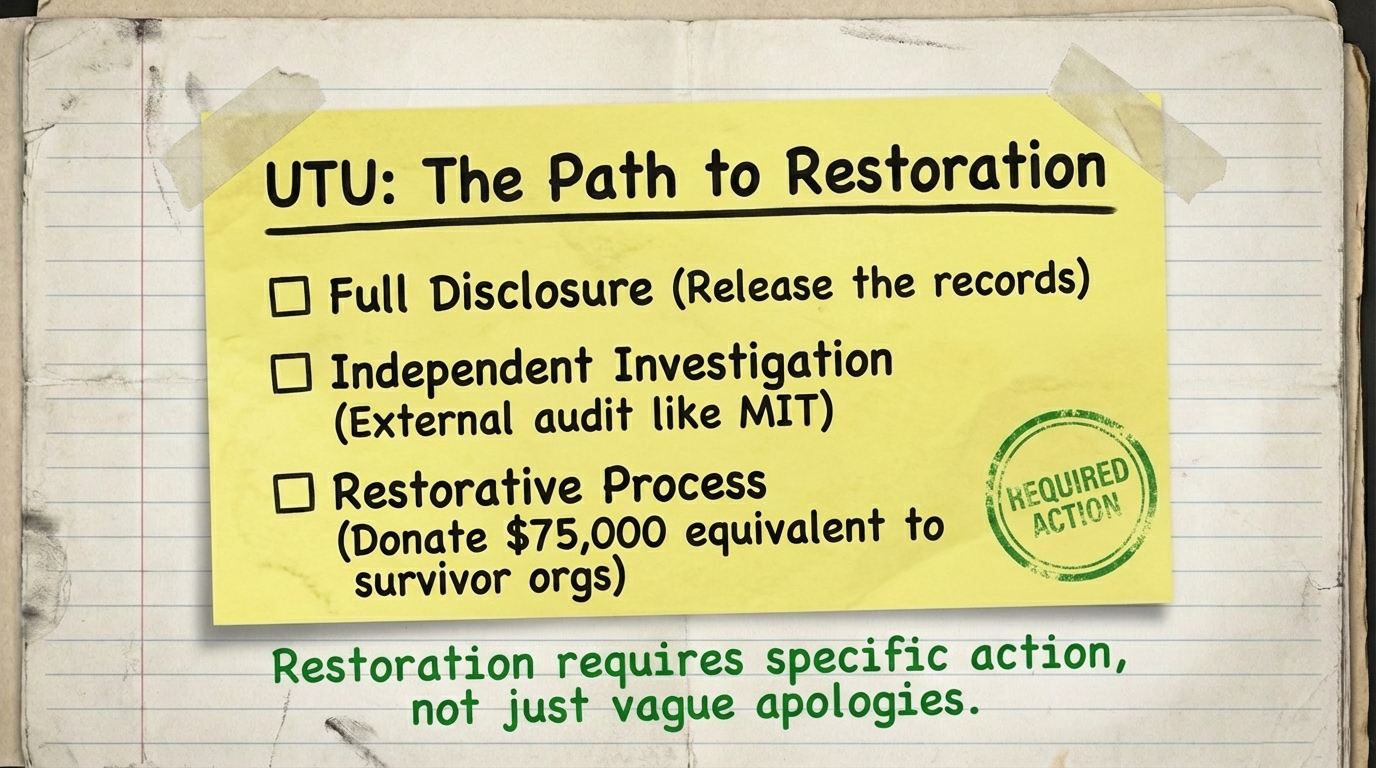
- Full Disclosure: The University of Auckland must publicly release all records of Boyd’s correspondence with Epstein, all related institutional communications, and a complete timeline of when officials became aware of this association.
- Independent Investigation: Following MIT’s model and Harvard’s precedent, commission an independent law firm to investigate how this occurred without triggering ethics reviews.
- Donor Vetting Overhaul: Implement mandatory ethics reviews for all private funding negotiations above $10,000, as recommended by ethics scholars studying the Epstein fallout.
- Victim-Centered Response: Redirect funds equivalent to the negotiated amount ($75,000) to New Zealand organizations supporting survivors of sexual abuse—not as penalty but as tangible acknowledgment of harm.
Systemic Reform:
- Tikanga Integration: Establish a standing kaitiaki committee with genuine authority (not advisory capacity) to review institutional partnerships through tikanga frameworks, ensuring whakapapa, mana, and kaitiakitanga guide decisions.
- Student Protection: Create confidential channels for students to report concerns about faculty conduct, with guaranteed investigation and transparency about outcomes (respecting privacy while ensuring accountability).
- Training Requirements: Mandatory ethics training for all faculty on recognizing and responding to predatory behavior, conflict of interest, and the responsibilities of kaitiakitanga.
Personal Accountability:
- Public Acknowledgment: Boyd must issue a public statement that goes beyond “it’s Epstein’s fault” to genuine acknowledgment of his failures as a kaitiaki—of students, of knowledge, of ethical standards.
- Career Consequences: Universities elsewhere have placed faculty on leave for similar failures. Auckland must determine appropriate consequences that signal this behavior is unacceptable.
- Restorative Process: Engage in a tikanga-based restorative justice process involving victims’ advocates, students, and Boyd to explore what genuine utu looks like—not punishment, but restoration of balance.
The Koha Question: Who Pays for the Truth?
This investigation exists because whānau fund accountability work that institutions refuse to undertake. Every revelation in this essay required hours of research, verification, and analysis—work that should be done by universities themselves but isn’t.
The University of Auckland has not issued a statement about Boyd’s Epstein connection. No investigation has been announced. No accountability measures have been implemented. The silence is its own answer: institutions protect their own unless forced to confront what they’d prefer to ignore.
This is why independent accountability journalism matters. This is why every koha from whānau who believe truth-telling serves our communities enables this mahi to continue.

Every koha signals that whānau are ready to fund the investigations universities won’t conduct. It signals that rangatiratanga includes the power to hold elite institutions accountable when they fail as kaitiaki. When a University of Auckland professor negotiates with a child predator and the institution says nothing, it falls to us—to community-funded research, to independent analysis, to voices operating outside captured systems—to speak truth.
Kia kaha, whānau. Stay vigilant. Demand more from institutions that claim to serve the public good. And if you are able, consider a koha to ensure this voice continues exposing what power would keep hidden.
Three pathways exist:
For those who wish to support this mahi directly with a koha (voluntary contribution), please visit the Koha platform:
Koha—Support The Māori Green LanternFor those who wish to receive essays directly and support through subscription, join the Substack community:
Subscribe to the Māori Green Lantern on SubstackFor those who prefer direct bank transfer, account details are:
HTDM, account number 03-1546-0415173-000

Ivor Jones The Māori Green Lantern Fighting Misinformation And Disinformation From The Far Right
Research conducted February 1, 2026, using active verification tools including web search, URL content retrieval, and cross-referencing of primary sources. All URLs tested and confirmed accessible at time of publication.