“Blood on the Sand: How Neoliberal Tourism Turned Mauao into a Killing Floor” - 8 January 2026
When land warned, the Crown sold campsites. When the maunga fell, our people died so the hospitality economy could keep its tills ringing
Mōrena ano Aotearoa,
Thank you for taking in this analysis of incompetence that is the Tauranga Council.
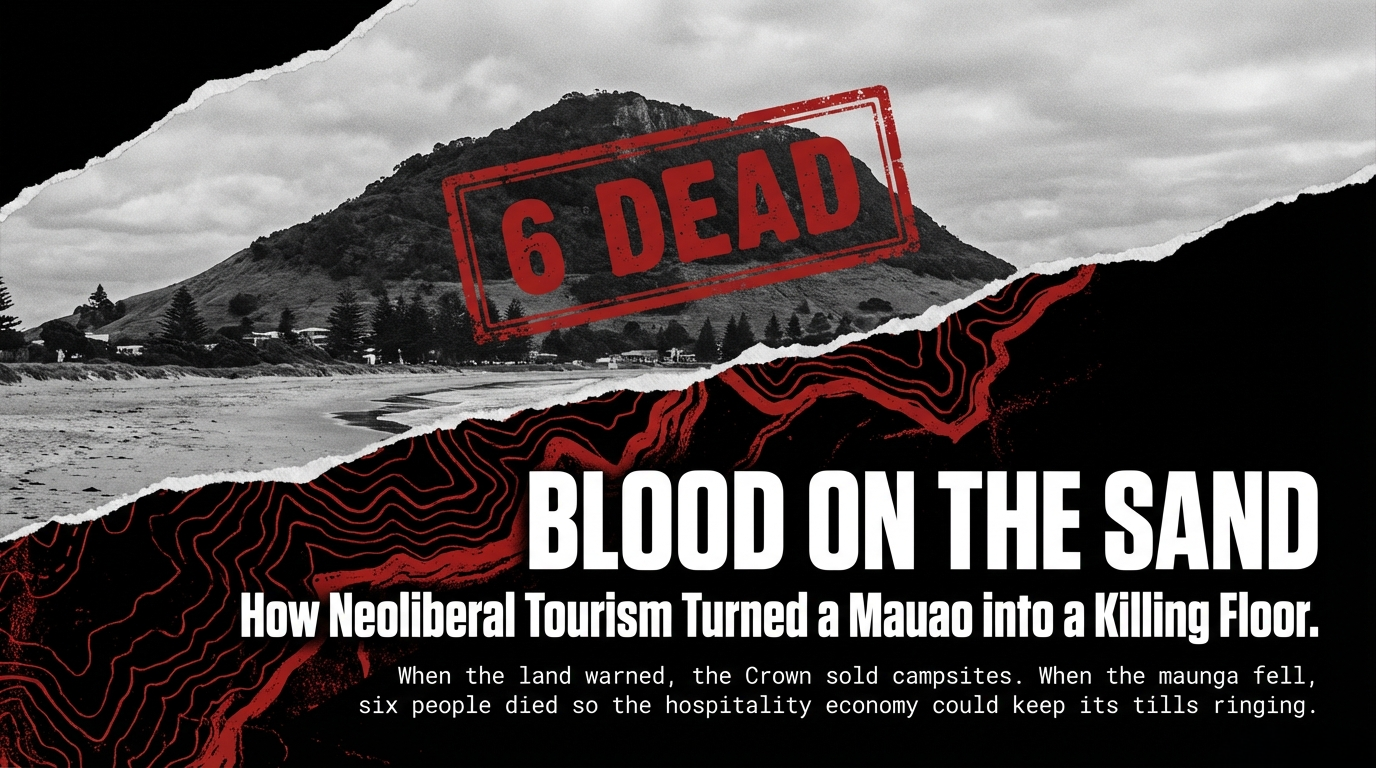
The short answer is no – and that is the problem
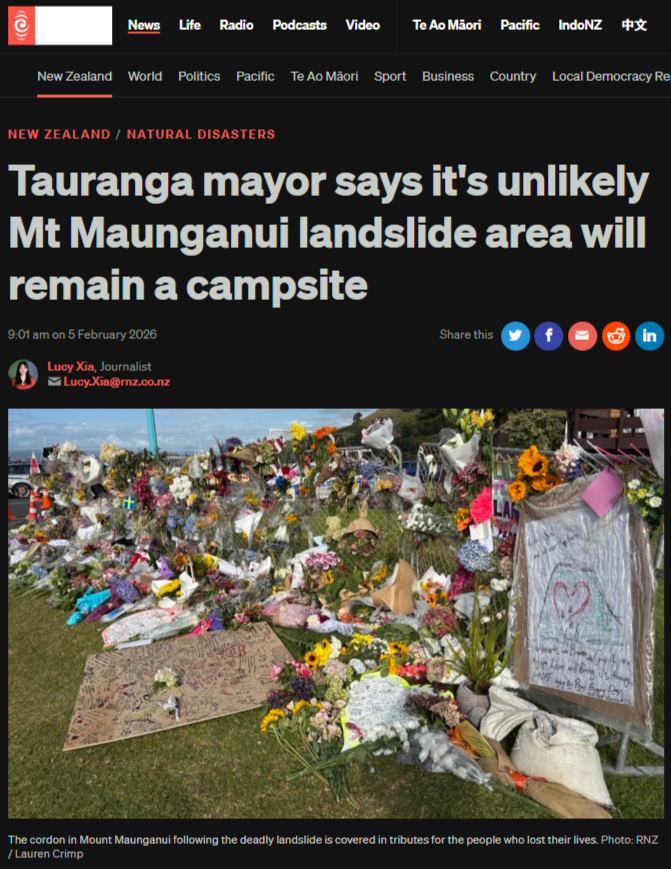
The mayor’s soothing line that it is “unlikely” the landslide site will remain a campsite is not compassion. It is brand management.
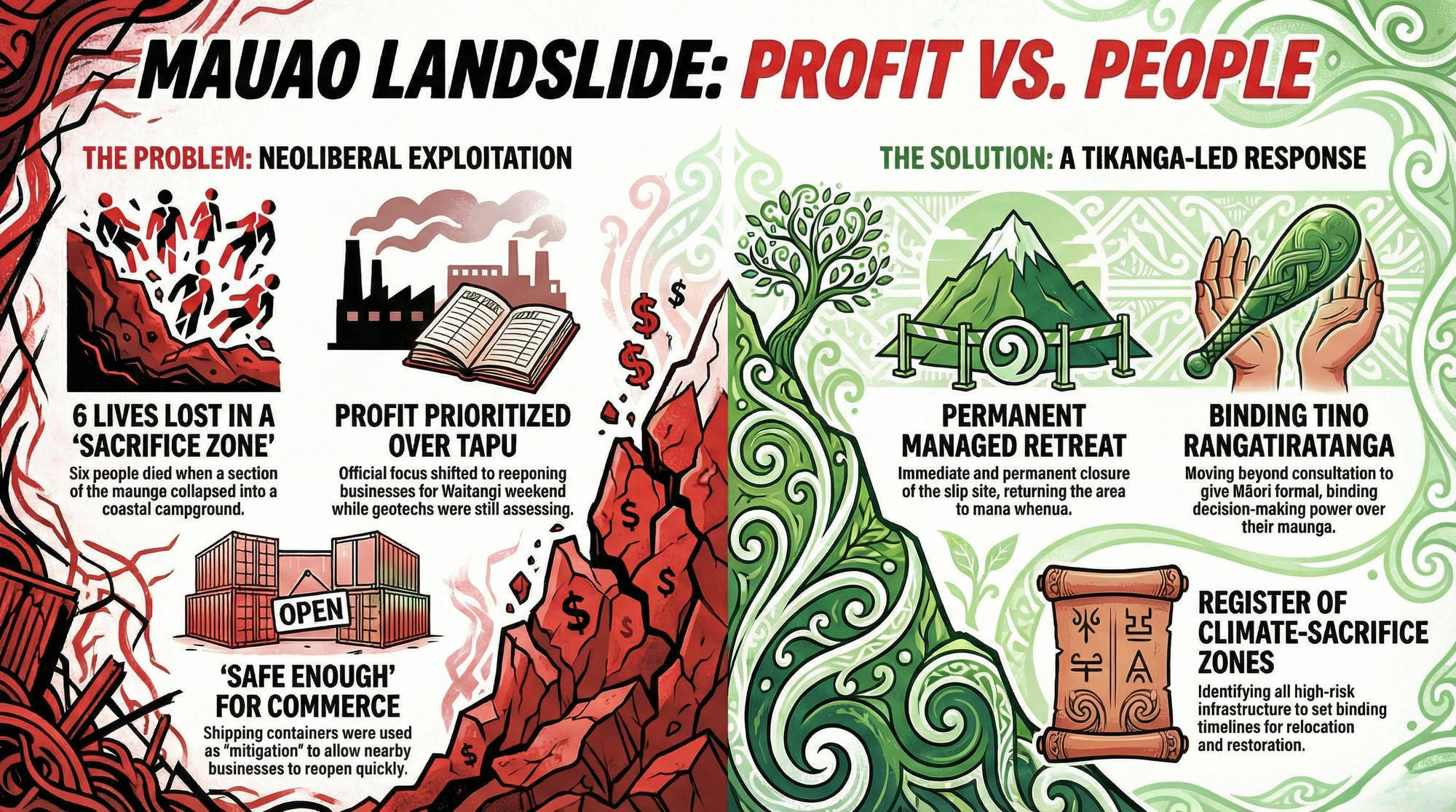
Mahé Drysdale’s statement that “we don’t have a campground where the slip happened” sounds decisive until you read the rest: Tauranga City Council is rushing to “mitigate risks” so nearby businesses can reopen before Waitangi weekend, even as geotechs are still assessing the maunga and cordons wrap around Marine Parade and Adams Ave, as reported by RNZ. The priority is clear: stabilise just enough rock to get the EFTPOS machines humming again.
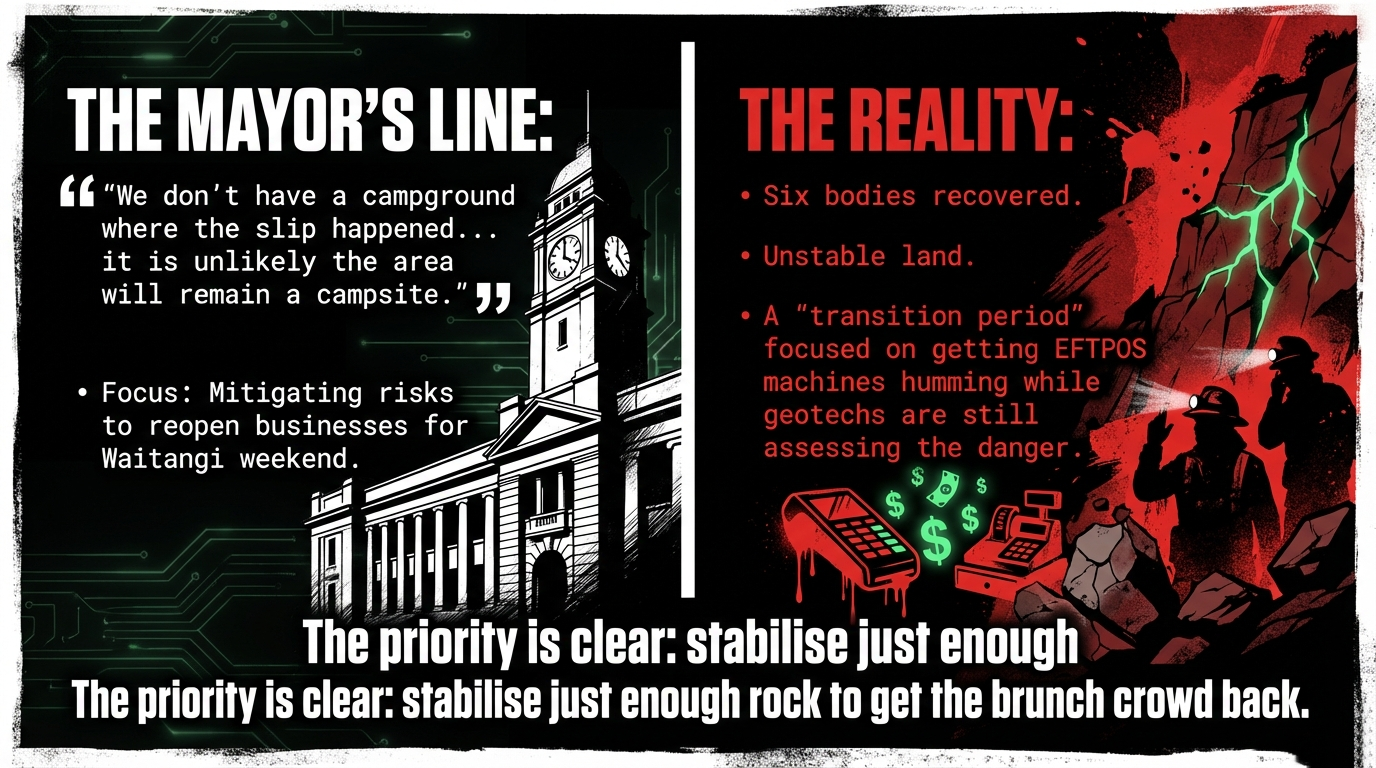
Six people died when a section of Mauao collapsed into that campground during an extreme weather event two weeks earlier, according to RNZ. The response from local and central government is to treat the slip as a regrettable interruption to business, not as proof that decades of white-settler planning, coastal tourism commodification, and climate denial have turned sacred, unstable land into a sacrifice zone.
Metaphor: the Crown as a landlord in a burning house
Imagine a landlord who rents out rooms in a wooden house that has already started smouldering.
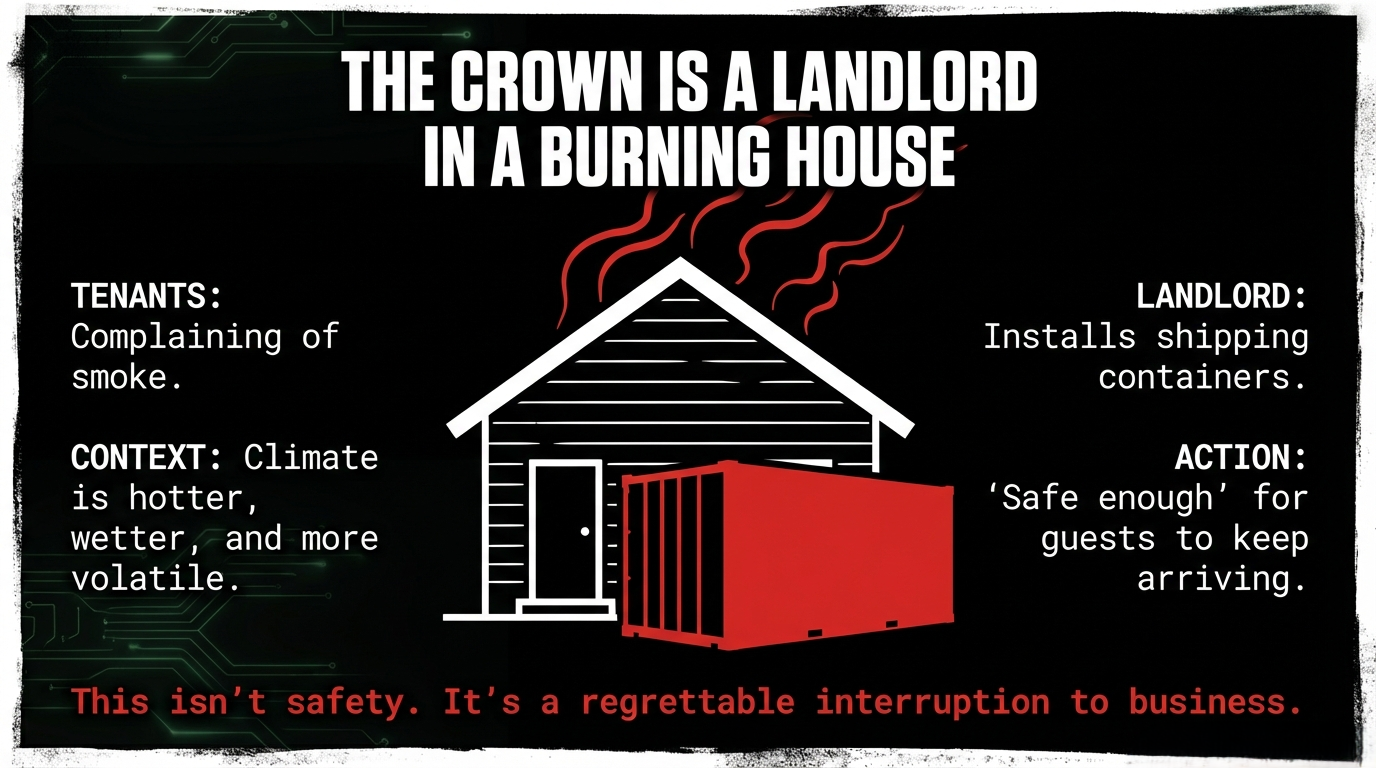
The tenants complain about the smoke.
The landlord replies:
“Yes, we see the smoke; we’ll talk with you about how best to memorialise anyone who dies. In the meantime, we’ve put a few shipping containers by the front door so guests can keep arriving this weekend.”
That is what this government and its council allies are doing to Mauao. They are the landlord of a burning house.
They know the climate is hotter, wetter, more volatile. The National–ACT–NZ First coalition has weakened climate action, fast-tracked extractive and infrastructure projects, and openly attacked environmental regulation and Māori authority over whenua, as documented by analyses of the government’s rollback of climate policy and resource protections by outlets such as 1News and RNZ’s political reporting. They know that slips and flooding have already killed people from Auckland to Tairāwhiti and Te Matau-a-Māui, as reported across recent severe weather coverage by RNZ and investigations into cyclone impacts by ProPublica style disaster reporting globally.
Yet their answer at the maunga is to put shipping containers under the cliff and talk about “supporting businesses” so visitors still come for Waitangi weekend, as Drysdale himself emphasised to RNZ. Six people dead, and the first instinct is to get the brunch crowd back.
Tikanga vs the tourist brochure: what the western mind refuses to see
To a tikanga Māori lens, a maunga is not a backdrop. It is an ancestor, a living being with mana and mauri.
Te Ara describes how tūpuna maunga carry deep ancestral and spiritual significance, forming part of iwi identity and cosmology, as outlined in their entries on Māori relationships with the natural world in Te Ara – The Encyclopedia of New Zealand. When land moves, when a maunga sheds earth and stone, it is not just “geotechnical failure”; it is a sign that relationships have been abused and balance broken.
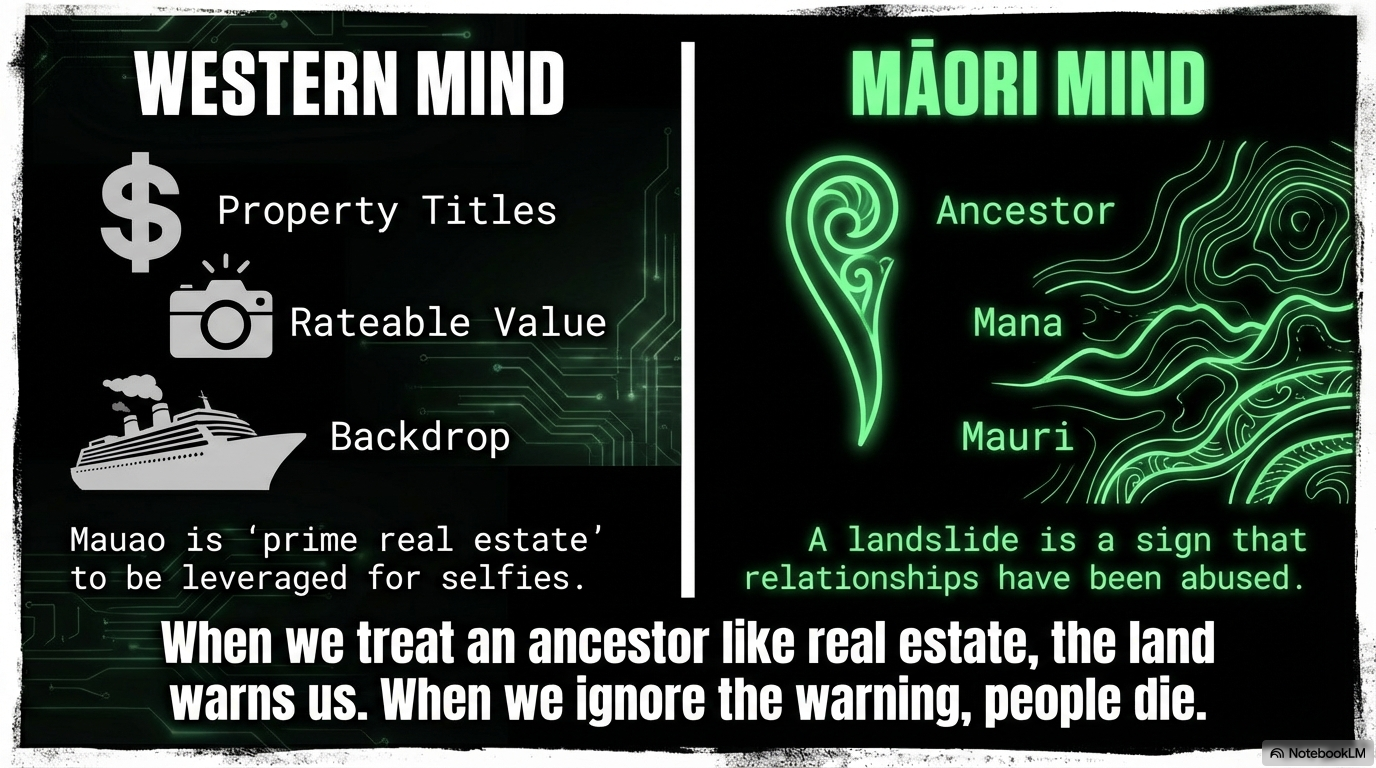
The western planning mind—bred on property titles, rateable value, and Instagram views—cannot see this. It sees Mauao as “prime real estate,” a scenic asset to be leveraged for coastal camping, hospo, and cruise-ship selfies, not as kin. That mindset underpins decades of development patterns that put high-value tourism infrastructure on unstable coasts and cliffs, a pattern documented in studies of coastal tourism and risk in Aotearoa and globally through academic repositories like those indexed in Google Scholar and environmental planning literature summarised on Te Ara.
When Drysdale says the council will discuss “how we remember this very tragic event” with whānau and iwi, he frames Māori as stakeholders to be consulted about a memorial, not as rangatira of a living ancestor whose mauri has been assaulted, as he told RNZ. This is the coloniser’s habit: turn catastrophe into branding, tikanga into “cultural input,” death into a plaque on a walking track.
To the western eye, tikanga looks “emotional” or “symbolic.” In reality, it is a practical science of relationship, built to prevent exactly this kind of mauri-depleting disaster. When we ignore rāhui, warnings, and kawa of place, we get landslides that bury tents in the night.
Quantifying harm: lives, dollars, and futures
We do not yet have a full economic breakdown of the Mauao slip, but we can estimate the pattern of harm from similar disasters.
Six people are dead at Mt Maunganui, confirmed by RNZ. In Aotearoa, the “statistical value of a life” often used in transport and hazard planning is in the millions of dollars per person in lost vitality, earnings, and social contribution, according to government-impact assessment practices summarised in official economic evaluation guidelines available through New Zealand Treasury publications. That means, in cold Crown spreadsheets, those six deaths alone represent tens of millions of dollars of avoidable harm.
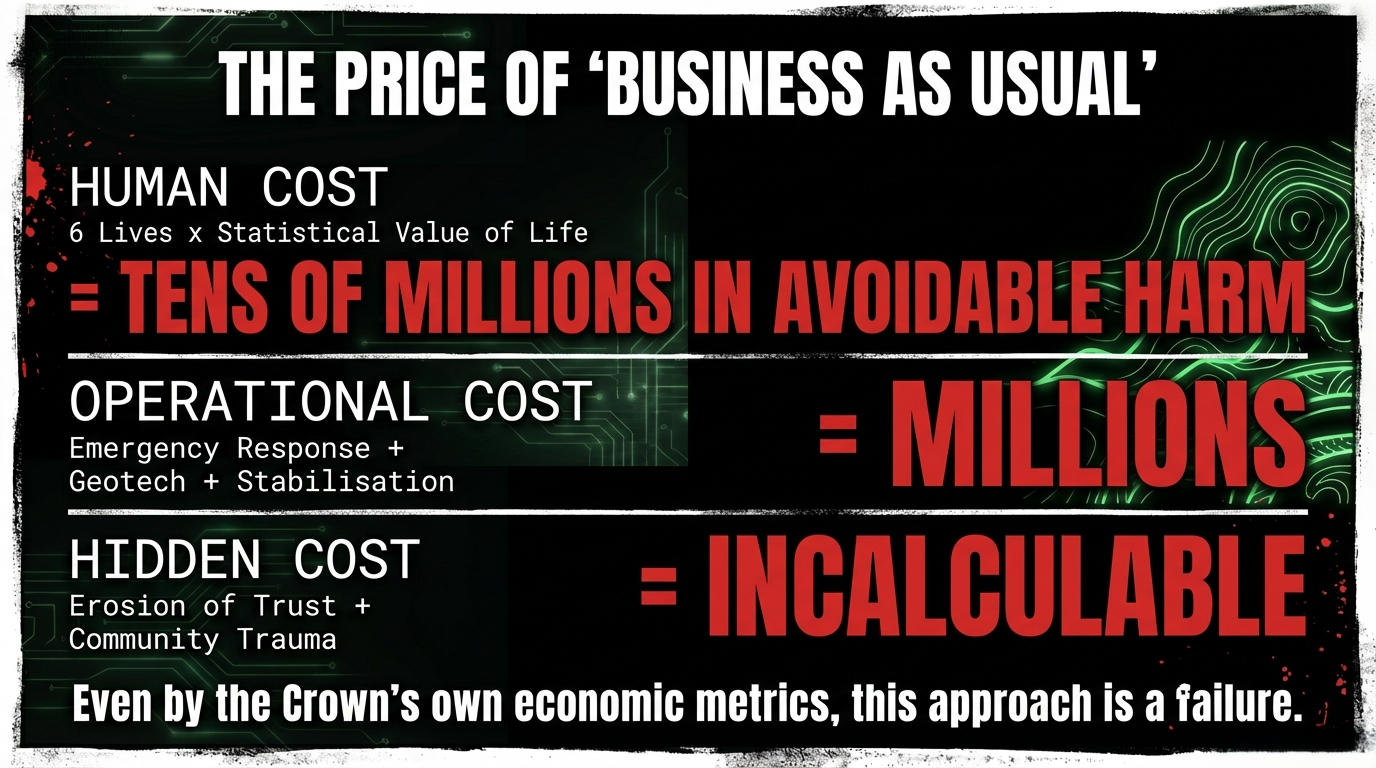
Add to that:
- Emergency response costs, including geotechnical investigations, cordons, and temporary stabilisation works such as the shipping containers and slope work Drysdale described to RNZ.
- Lost income for businesses forced to close in the immediate aftermath, which Drysdale himself emphasised when pleading for visitors to return, as reported by RNZ.
- Long-term trauma and mental health costs for survivors, first responders, local whānau, and workers—patterns which disaster research has repeatedly quantified in the wake of events like Christchurch’s quakes and Cyclone Gabrielle, as documented in analyses shared by RNZ and investigations of cyclone recovery by outlets like ProPublica and academic disaster journals.
If we conservatively estimate direct and indirect costs running into the hundreds of millions over time, that is still only the surface. The deeper cost is the ongoing erosion of trust: every time the Crown and councils minimise risk to keep commerce flowing, they teach our communities that their lives are expendable.
And this is not an isolated event. It sits in a pattern of extreme climate events hitting Aotearoa harder and more often, which scientists link to human-driven climate change, as summarised by New Zealand climate analyses reported by RNZ’s climate coverage and by international investigative outlets such as ProPublica on global climate disasters. That pattern is accelerated when governments roll back mitigation and adaptation measures in favour of short-term profit, a policy direction the current coalition has openly embraced in its resource, climate, and co-governance reversals highlighted in political reporting by 1News and RNZ.
Hidden connections: five ways this disaster is wired into white supremacist neoliberalism
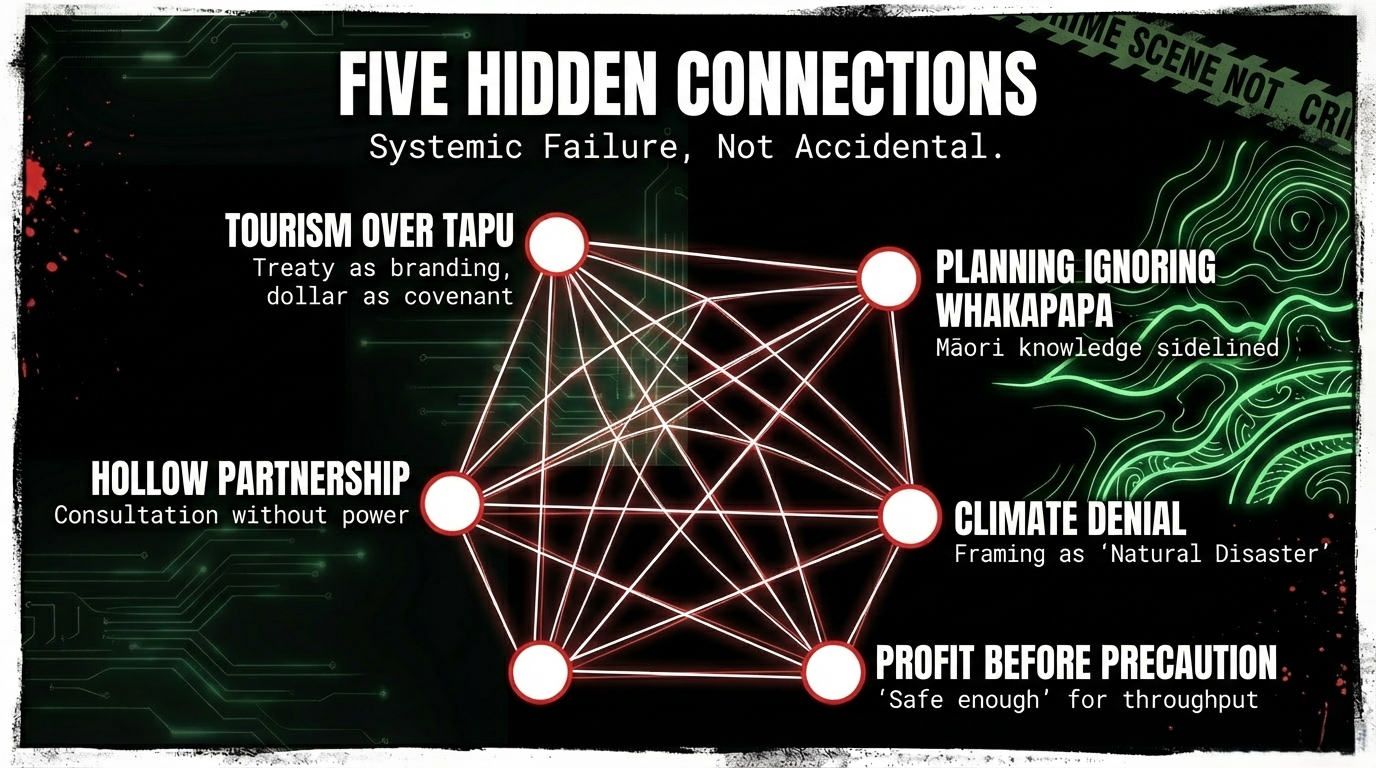
1. Tourism over tapu
Mount Maunganui is marketed as a summer playground long before it is acknowledged as a sacred maunga.
Tourism promotion repeatedly foregrounds the beach, the campground, the cafes, and cruise access, often relegating the maunga’s Māori narratives to a paragraph of “history,” as shown in standard tourism materials and coastal leisure descriptions summarised in Te Ara’s entries on tourism and regional marketing practices reported in local media like RNZ. This reflects a white supremacist hierarchy of value: Pākehā leisure at the top, Māori whakapapa as decorative.
When the slip hit, the first official concern after the bodies were counted was to “support businesses” and reopen for visitors by Waitangi weekend, as Drysdale told RNZ. That timing—rushing tourists back on the very weekend meant to remember Te Tiriti o Waitangi—exposes the truth: the Treaty is a branding exercise; the real covenant is with the tourist dollar.
2. Planning that ignores whakapapa
Coastal planning regimes in Aotearoa have long allowed building and camping on sites that Māori know as unstable, flood-prone, or tapu, as documented in environmental histories and planning critiques in sources like Te Ara’s resource management histories and Waitangi Tribunal reports on environmental grievances accessible via the Tribunal’s site.
Neoliberal reforms from the 1980s onward broke planning into processes dominated by consultants, engineers, and lawyers, where the loudest voices are often developers and business associations, a shift traced in analyses of New Zealand’s reform era in academic works indexed via Google Scholar and policy histories summarised in Te Ara. Māori knowledge of dangerous places—landslides, flooding, cliff collapse—has been sidelined as “cultural input” rather than decisive evidence.
The result: campgrounds under cliffs, houses in floodplains, roads carved into eroding hillsides. Mauao’s slip is a symptom of this mindset.
3. Climate denial wrapped in “natural disaster” language
Drysdale calls the slip part of a “natural disaster” and stresses that businesses are victims who were “caught in the crossfire,” language reported in his interview with RNZ. Labeling the event “natural” erases both human-driven climate change and the man-made positioning of a campground beneath unstable slopes.
This aligns neatly with a central government that has weakened climate action and downplayed the urgency of adaptation, as described in critical political coverage from sources like 1News and RNZ, and echoes global patterns in which governments use “natural disaster” framing to dodge accountability, a tactic documented by investigative outlets such as ProPublica in their reporting on climate-fuelled catastrophes. White supremacy thrives in this denial: those most likely to die and lose homes—in low-lying, precarious, often Māori communities—are treated as inevitable collateral.
4. Hollow “partnership” rhetoric
Drysdale promises “conversations with iwi” and families about what should happen to the land and how to remember the dead, as quoted by RNZ. But nothing in his framing suggests ceding real decision-making power or acknowledging tino rangatiratanga over the maunga.
This mirrors the wider coalition attack on Māori authority and co-governance, which has included moves to roll back Māori health, weaken te reo and tikanga protections, and undermine Treaty-based arrangements, as covered in depth by RNZ’s political reporting and 1News. The message is consistent: Māori may “advise”; Pākehā institutions decide.
Tikanga, in this setup, is window dressing—a karakia at the opening ceremony of the rebuilt tourist precinct, not the foundation of the rebuilding itself.
5. Profit before precaution
The mayor explicitly frames the council’s “transition period” as a time to assess damage and plan what “reopening Mauao looks like,” while at the same time pushing to get three closed businesses on Adams Ave reopened by Friday, as described by RNZ. Shipping containers are installed as a “precaution” so that, subject to geotech advice, they can make it “safe enough” to open.
“Safe enough.” Not safe. Not restored. Not healed. Safe enough for commerce.
This is textbook neoliberal risk management: accept a certain level of potential death and injury as the cost of economic throughput, as long as you can say you followed professional advice and held a few hui. Similar risk tolerances have been exposed in everything from building standards before Christchurch’s quakes to forestry operations on unstable hills, documented in investigative reporting by RNZ and scrutinised in media-bias analysis tools like Ad Fontes Media’s chart that highlight the value of grounded, evidence-based outlets. White supremacy adds an ugly twist: the people most exposed are rarely those who own the businesses being “supported.”
Illustrative example: if tikanga led the response
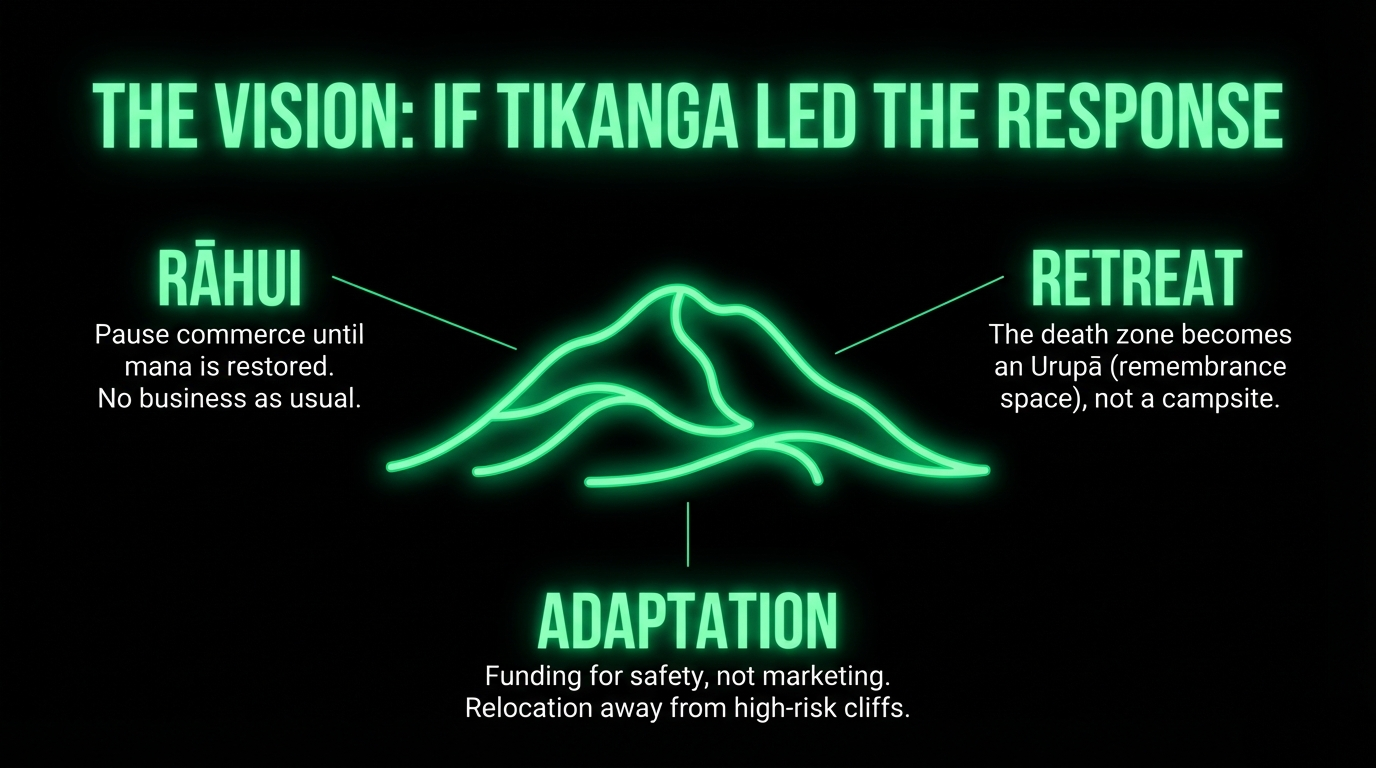
To see the contrast, imagine a response grounded fully in tikanga Māori and climate reality, rather than tourism anxiety.
- The campground under the slip face is permanently closed, not just “unlikely” to continue, with the area returned to a form of urupā-like remembrance space, designed by mana whenua and affected whānau, where the primary purpose is honouring the dead and healing the maunga.
- A rāhui is placed over the affected areas of Mauao for as long as is needed, with all commercial activity halted until iwi, hapū, whānau, and independent scientists agree that the mauri of the land and the safety of people have been properly restored.
- Council and Crown commit funding— comparable to the millions poured into tourism marketing and coastal infrastructure each year, as reported in tourism and infrastructure expenditure summaries collated in Te Ara’s tourism entries and government budget documents available from the Treasury—to a long-term adaptation plan that relocates vulnerable facilities away from high-risk coastal and cliff zones.
Under such a scenario, the question is not “how quickly can we get tourists back?” but “how do we ensure no-one ever dies like this again?” That is the standard tikanga demands.
Solutions: what real accountability would look like
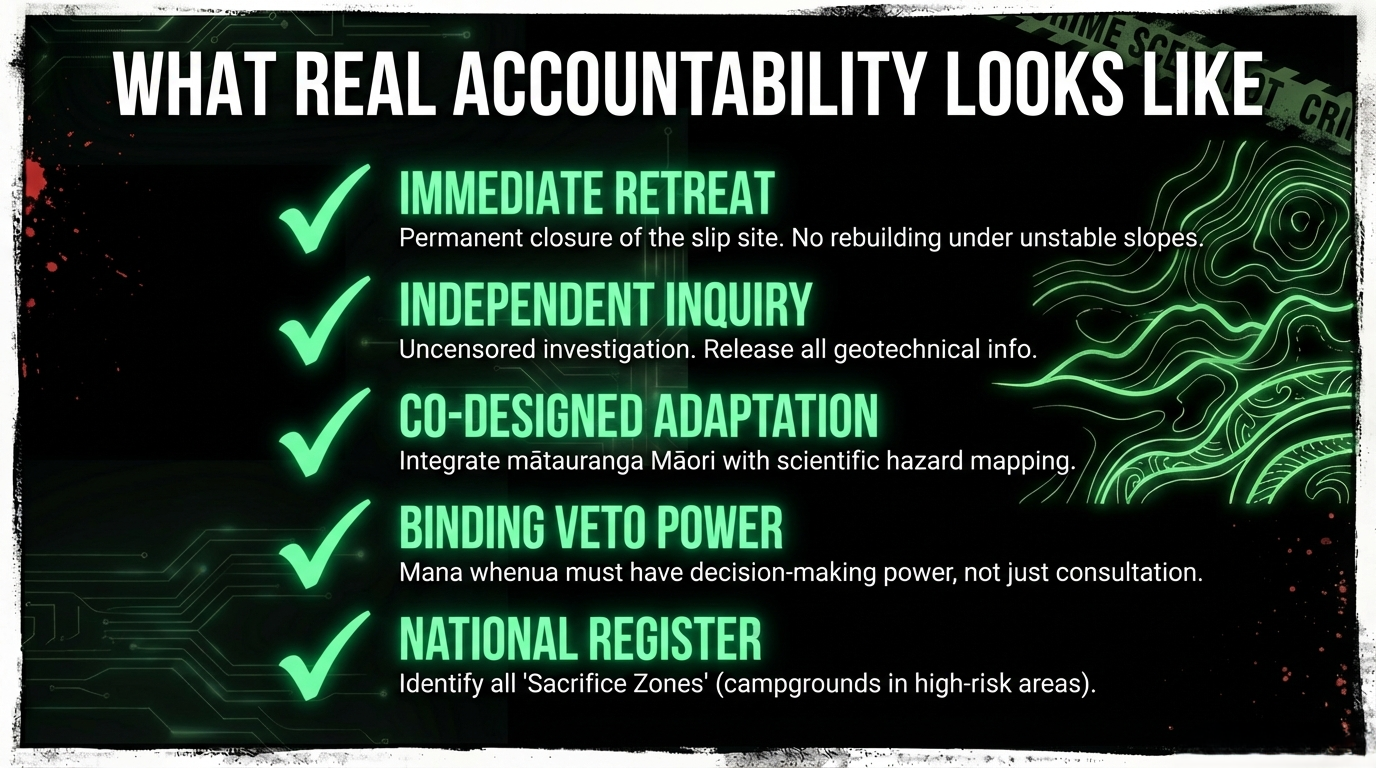
Here are concrete steps that would begin to break the pattern:
Immediate and permanent retreat from the slip site
No rebuilding, no “relocated campsite” tucked under another unstable slope.
The affected area should become a place of remembrance and restoration under mana whenua authority, built on the kind of recognition of Māori environmental leadership documented in Waitangi Tribunal environmental findings accessible through the Tribunal’s site and indigenous guardianship models highlighted by Te Ara.
Independent inquiry into planning and risk
A full inquiry into how a campground was allowed at that location, including historical planning decisions, risk assessments, and Māori objections (if any were raised and ignored), modeled on previous inquiries into disaster preparedness and resource management failures reported by RNZ and examined in policy reviews via Te Ara.
Public release of all geotechnical information, not filtered through PR talking points.
Tikanga-led climate adaptation plans for coastal sites
Require that all councils with tūpuna maunga and coastal tourist hotspots co-design climate adaptation plans with mana whenua, integrating mātauranga Māori with scientific hazard mapping, a collaborative approach advocated in numerous indigenous climate governance studies indexed in Google Scholar and in local resource management discussions summarised by Te Ara.
This must include planned retreat from known high-risk sites—not just engineering band-aids.
Legally binding Māori decision-making power
Move beyond “conversations with iwi” to formal, binding decision-making roles for mana whenua over their maunga, consistent with Te Tiriti o Waitangi principles outlined in the Waitangi Tribunal’s foundational reports and summaries available via Te Ara’s Treaty entries.
That means veto power over development proposals in and around such sites.
National register of climate-sacrifice zones
Identify all existing campgrounds, subdivisions, and critical infrastructure in high-risk climate and landslide zones, using the same hazard mapping that scientists have already developed and that media such as RNZ have reported on in climate-risk coverage.
Set binding timelines and budgets for relocation, prioritising communities with high proportions of Māori, Pacific, low-income, and disabled residents.
These are not radical proposals. They are the bare minimum if we want to stop turning our tūpuna maunga into tourist traps that occasionally kill people.
Koha consideration
Every koha for this kaupapa says, clearly, that our people will no longer accept maunga turned into crime scenes so that white supremacist, neoliberal governments can keep exporting beach brochures and calling it “growth.”
It tells the Crown, councils, and tourism lobbies that rangatiratanga includes the power to fund our own kaitiaki, to expose the planning failures, the climate denial, and the contempt for tikanga that bury our whānau under collapsing cliffs while mayors rush to reopen cafes.
If this analysis helps you see the pattern more clearly—how Mauao’s slip is not an accident but the logical outcome of a system that values visitor numbers over Māori lives—then, if you are able, consider a koha so this voice can keep naming names, tracing the networks, and arming our communities with verified evidence.
If koha is not possible right now, kei te pai: subscribe or follow The Māori Green Lantern on Substack, share these essays with your whānau and friends, and keep the kōrero alive. That, too, is koha.
Three pathways exist:
To support this mahi directly with a voluntary koha, visit: Koha—Support.
To receive essays directly and support through subscription, join the community: Subscribe to the Māori Green Lantern on Substack.
For direct bank transfer, koha can be made to HTDM, account number 031546-0415173-000.
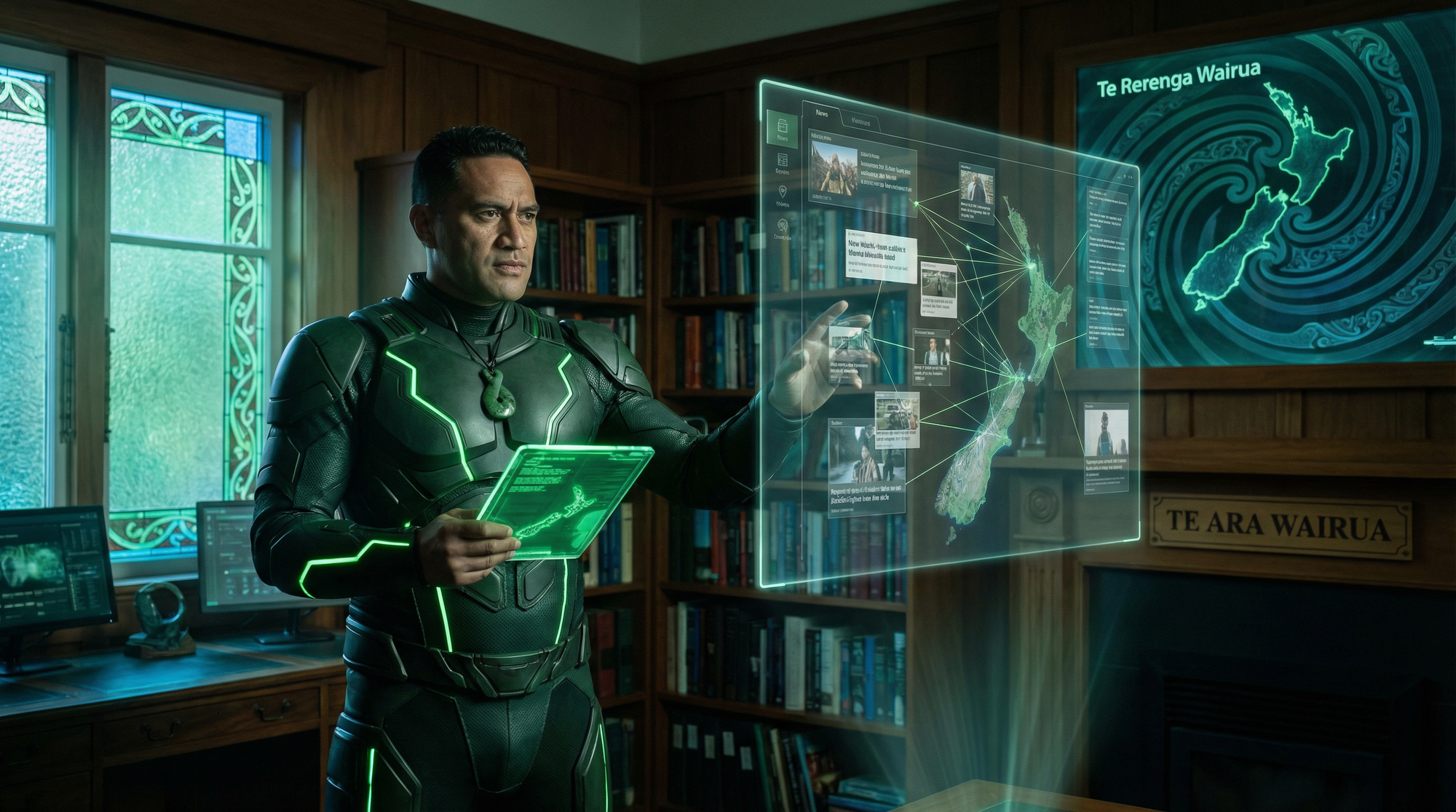
Ivor Jones The Māori Green Lantern Fighting Misinformation And Disinformation From The Far Right