"Breaking the Funhouse Mirror: How NCEA League Tables Sell Our Kids to the Highest Bidder" - 4 February 2026
Aotearoa’s “top school” rankings are not information—they’re a coloniser’s carnival trick that turns Māori tamariki into bad statistics, props up real‑estate profits, and calls it education
Kia ora Aotearoa,
I thank you once again for honouring this work with your attention.
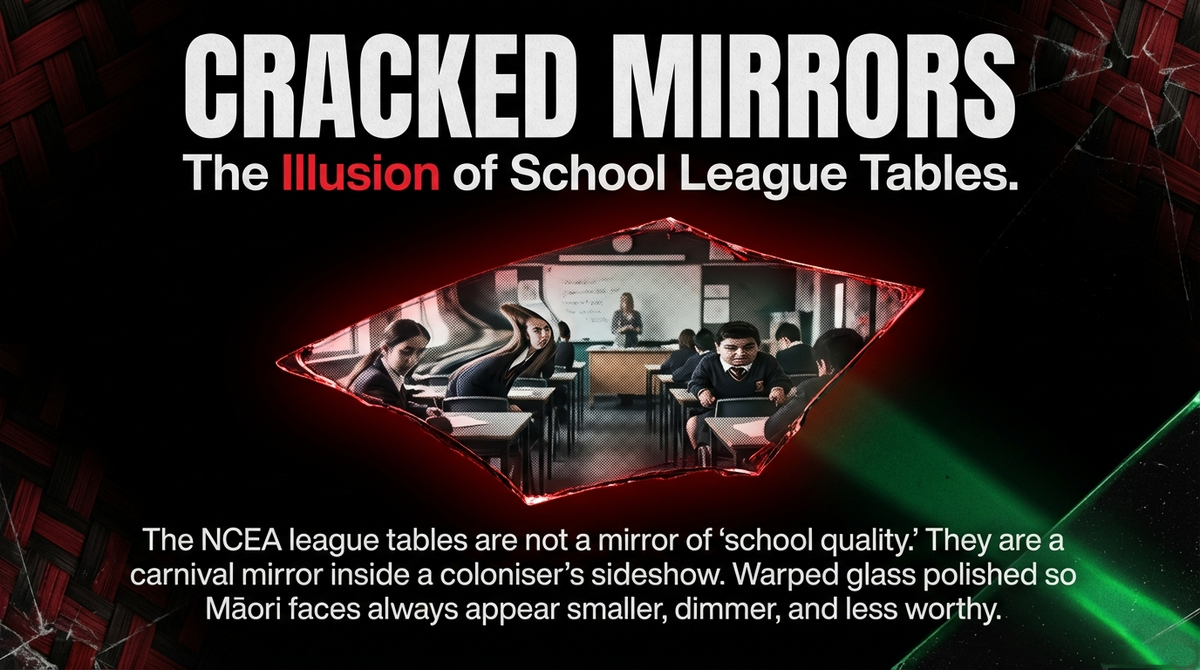
The Herald’s NCEA league tables are not a mirror of “school quality”;
they are a carnival mirror inside a coloniser’s sideshow, warped glass bought by advertisers and polished with ministerial talking points so Māori faces always appear smaller, dimmer, less worthy.
The circus tent goes up
Picture Queen Street as a travelling fairground.
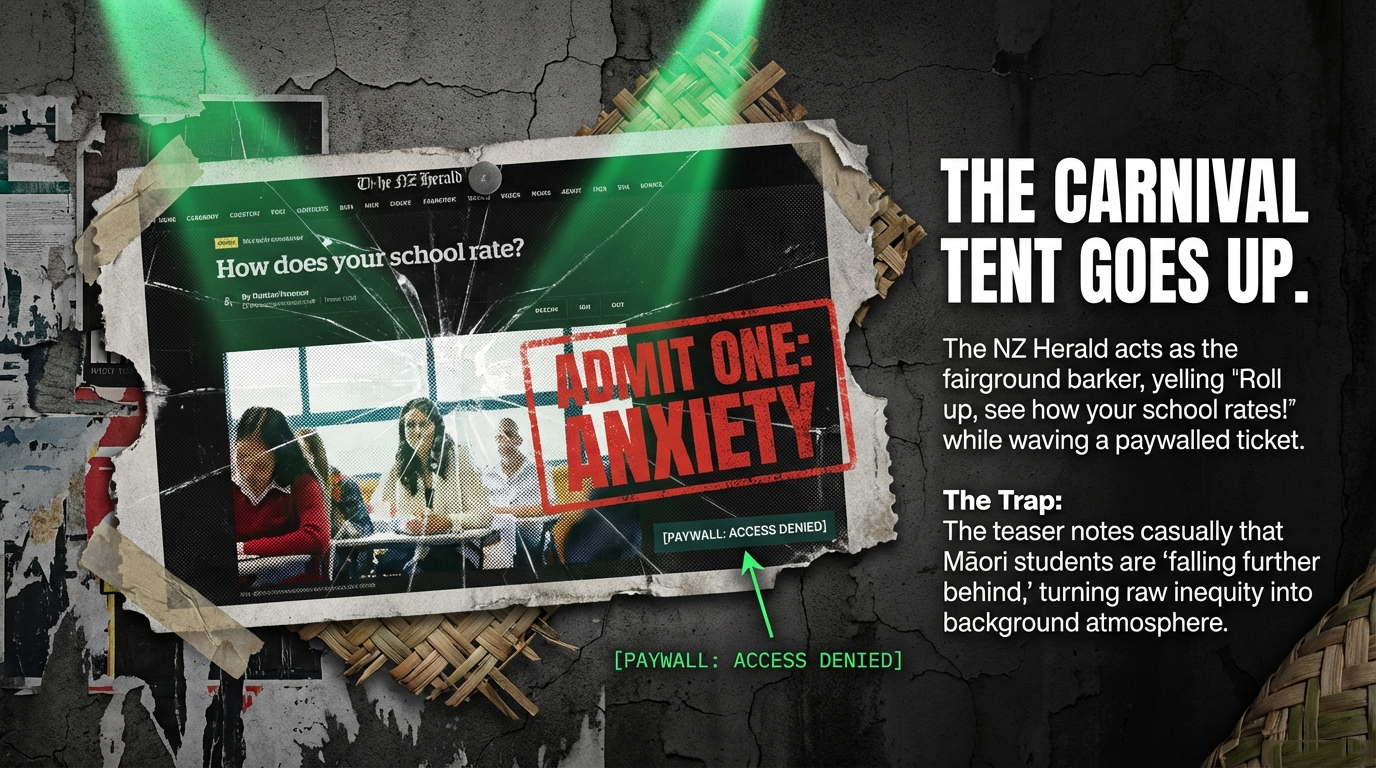
At the gate, the NZ Herald barker yells,
“Roll up, roll up, see how your school rates!”,
waving a paywalled ticket that promises anxious parents a glimpse of the future by ranking every college with NCEA Level 3 and University Entrance scores, while elite schools like Diocesan School for Girls snatch the poster and plaster it on their own walls to sell near‑perfect UE rates as proof their daughters are destined for the winners’ podium. Diocesan School Dio continues to shine
The show is billed as a “snapshot” of national performance, yet the teaser notes—almost casually—that Māori students are “falling further behind”, turning raw inequity into background atmosphere, like canned circus music that tells the crowd Māori are the problem while the system remains invisible. NZ Herald teaser NZQA 2023/24 Annual Report
The trick is old:
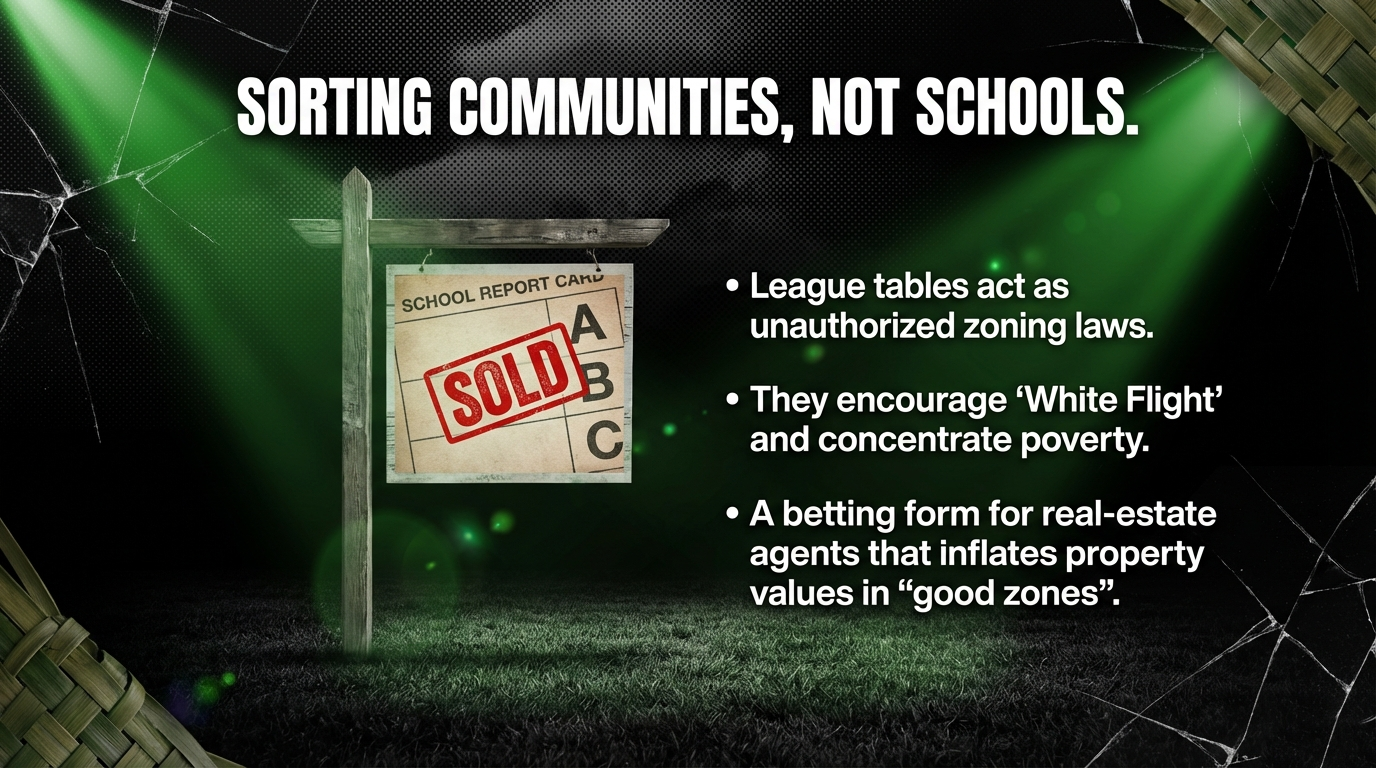
international research on league tables shows they are not neutral scoreboards but devices that bend behaviour, encouraging schools to chase narrow metrics and sort communities, with UK analyses demonstrating that performance tables reshaped neighbourhood demographics without delivering clear learning gains—more like a rigged shooting gallery than genuine accountability. League tables and school effectiveness The evolution of school league tables
Aotearoa has its own x‑ray of the scam:
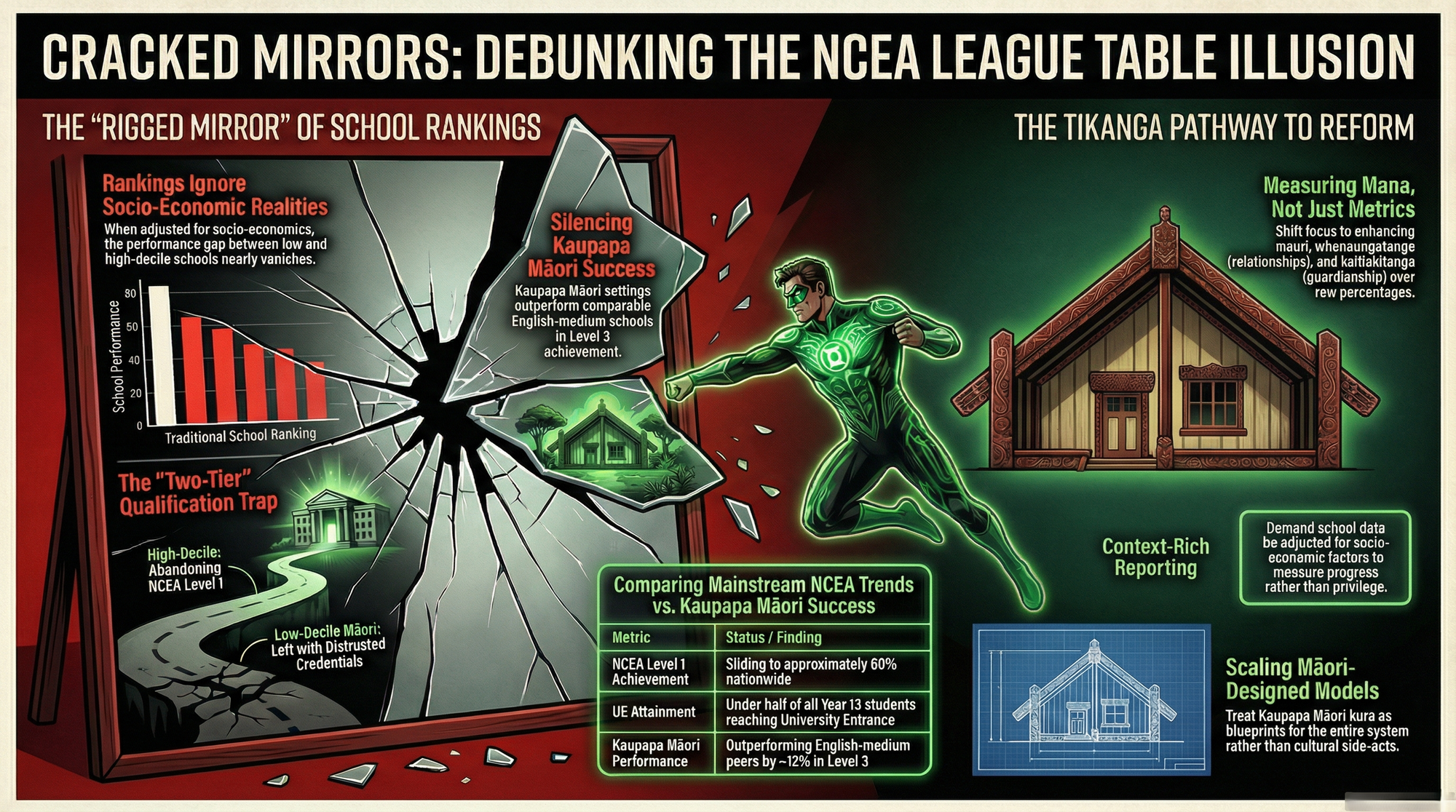
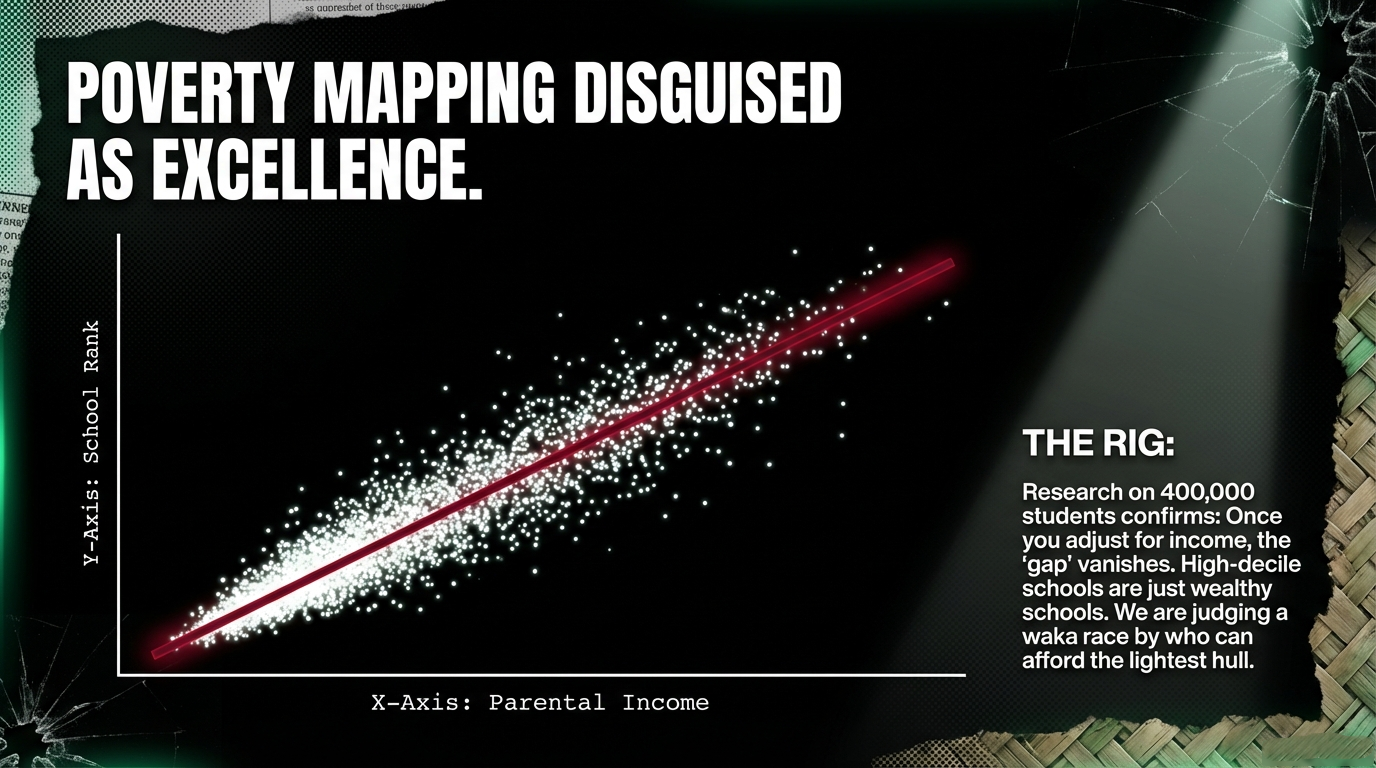
research on 400,000 students found that once socio‑economic factors are accounted for, the supposed gulf between low‑decile and high‑decile schools nearly vanishes and many decile‑one schools emerge as the true high performers, yet the public only ever sees the unadjusted scoreboard, as if you judged a waka race by who could afford the lightest hull. No significant differences League tables and school effectiveness
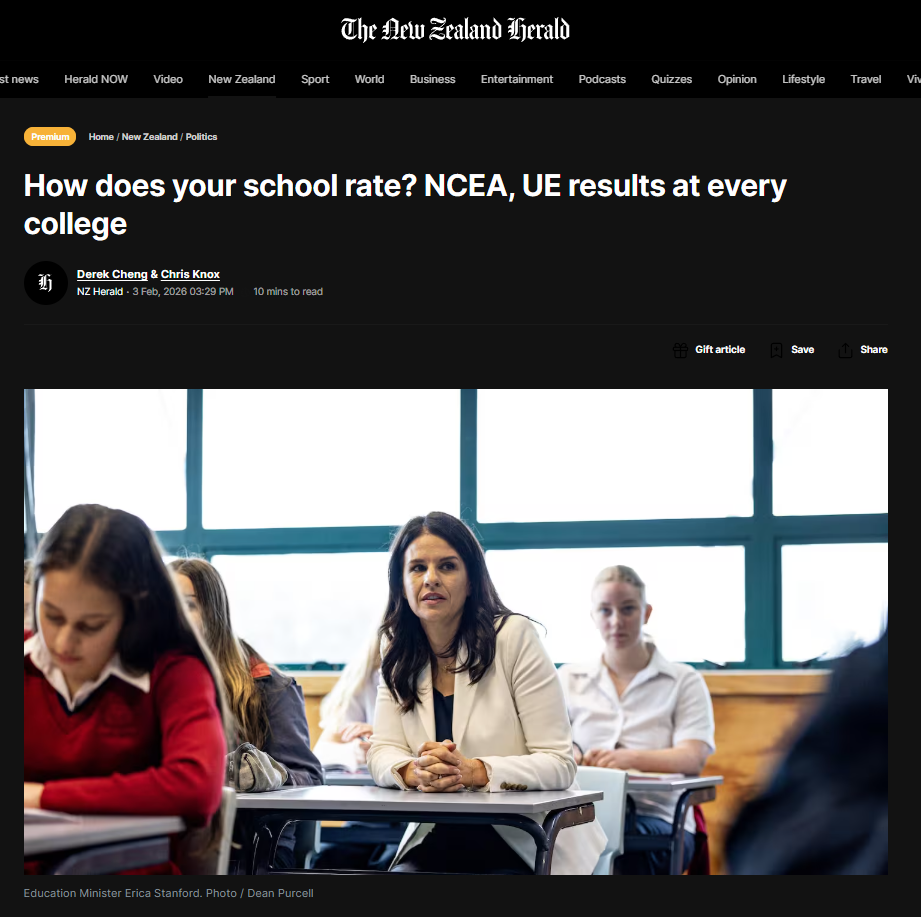
So when Herald reporters pipe that same tune through the NCEA and UE funhouse, splash a stylised classroom photo on top, and push it out via the politics section, they are not “informing” but running a sideshow that converts whakapapa, postcode and parental income into a betting form for the education markets and real‑estate agents. NZ Herald teaser NCEA provisional data
Counting the bodies under the bleachers
Under the big top, the ringmaster gestures at the scoreboard: provisional NCEA data show Level 1 achievement sliding to around 60 percent, Level 2 to just over 72 percent, Level 3 hovering near 66 percent, and UE under half of Year 13 students, with some cohorts dropping as much as 8 percentage points in a year—like watching the safety net slowly being cut while the acrobats are mid‑air. NCEA provisional data NZQA 2023/24 Annual Report
NZQA’s own annual reports whisper the line the Herald refuses to headline: there is a “significant underlying equity gap” between Māori and Pacific students and their European and Asian peers at every level, with the gap yawning widest at UE—meaning any table that ranks schools by Level 3 and UE is quietly ranking Māori communities as failures while crowning schools with wealthier, whiter intakes as champions. 2024 NCEA and UE attainment NZQA 2023/24 Annual Report
The harm is measurable:
1News reporting on decile research shows that league‑table logic encourages parents to step over their local low‑decile school, fuelling roll flight that concentrates poverty, strips donations and social capital, and leaves Māori and Pacific students in schools labelled “under‑performing” before the first bell even rings. No significant differences League tables and school effectiveness
Meanwhile, the trapeze is fraying at both ends:
NCEA Level 1 is condemned by the Education Review Office and the Education Minister as confusing and unfair, part of a “two‑tier system” where high‑decile schools can quietly walk away while lower‑decile schools cling to a qualification employers barely trust, yet those same flawed credentials are fed straight into the Herald’s algorithm as if they were pure measures of quality. Erica Stanford open to scrapping Level 1 Education overhaul – what changed
Then there is the act the circus hides behind a curtain:
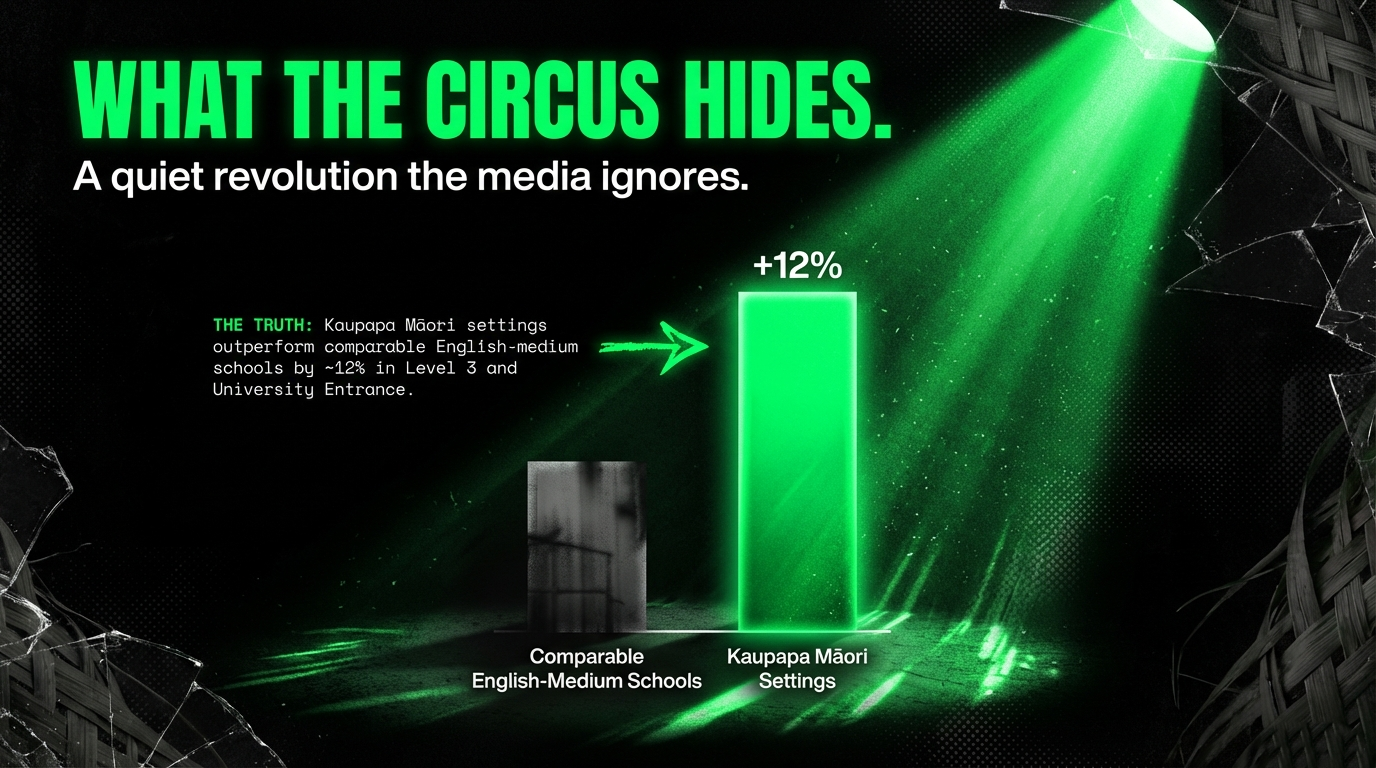
NZQA’s analysis of Kaupapa Māori senior secondary settings shows those kura outperforming comparable English‑medium schools by roughly a dozen percentage points for Level 3 and even more for UE, despite facing similar socio‑economic barriers—a quiet revolution in Māori‑led teaching that mainstream coverage reduces to a cultural sideshow, if it mentions it at all. NCEA in Kaupapa Māori settings Govt plans place more pressure on teachers
Add it up and the picture is brutal:
Māori students are statistically more likely to be enrolled in schools the Herald’s table paints as “low‑performing”, while Pākehā elites convert the same table into glossy marketing, locking in segregated patterns of housing, donations and opportunity generation after generation. No significant differences NCEA provisional data
Tikanga in a house of cracked glass
To the Western technocrat, the league table is a sacred ledger, proof that if you just sort enough numbers you can locate virtue in the top right‑hand corner. League tables and school effectiveness Sorting and Grading
To tikanga Māori, this obsession with ranking children is a desecration:
the measure is not whose line sits highest on the graph but whether mauri is enhanced, relationships are intact, and obligations to whānau, hapū and whenua are honoured—principles now creeping into the law schools and appellate courts even as politicians deride tikanga as mere cultural garnish. Should tikanga Māori be taught in law schools? Kaitiakitanga – guardianship and conservation
In tikanga terms, the valid question is,
“Does this kura grow mana, whanaungatanga, kaitiakitanga?”, not
“Does this school beat Dio in UE?”,
yet our public discourse treats the league table as taonga and Māori values as optional decoration, even though Te Ara and Māori educational histories show that collective wellbeing has always been the primary metric. Māori education – Te wharekura o te ao Māori NCEA in Kaupapa Māori settings
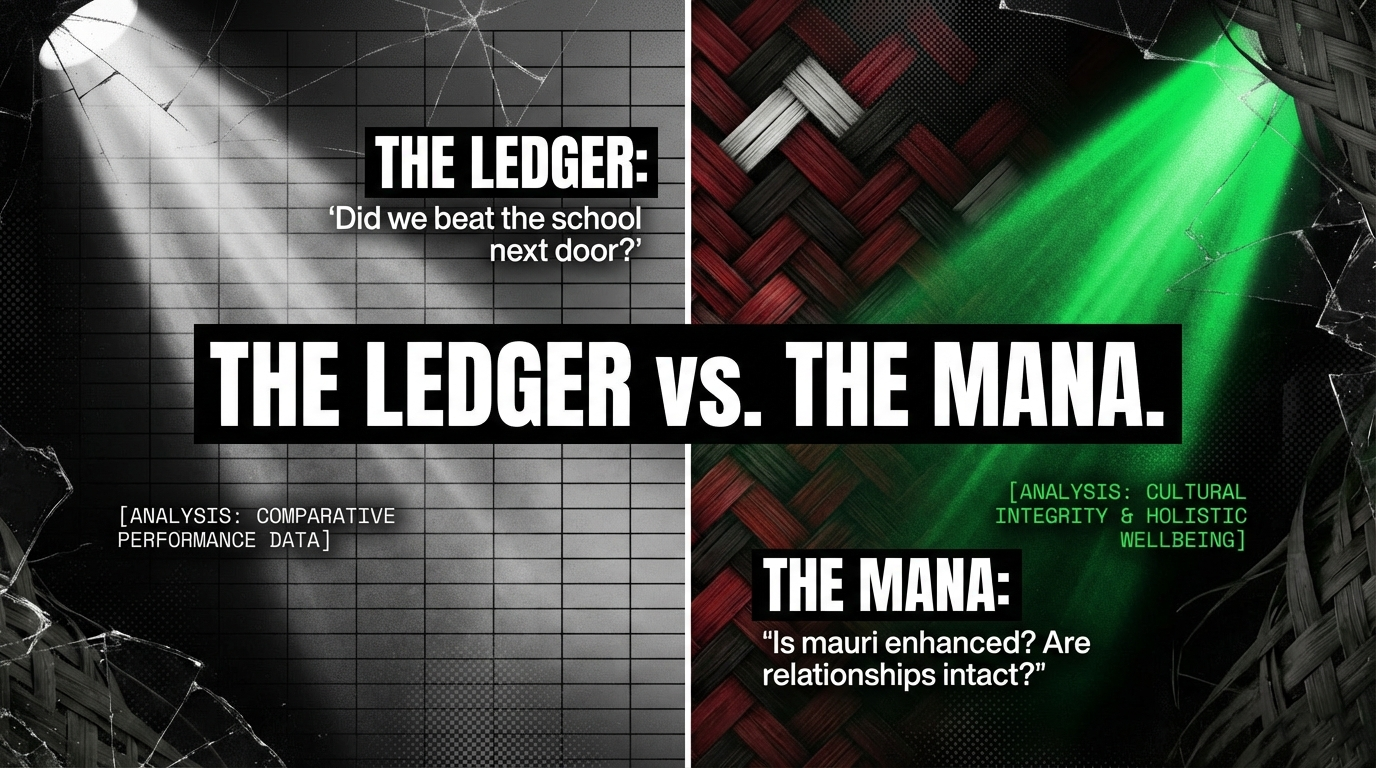
When a national newspaper turns Māori attainment into a public scoreboard, it tramples manaakitanga by inviting comparison and ridicule of communities already carrying colonisation’s scars, ignoring Te Ara’s framing of mana as relational authority that must be upheld, not auctioned off at the highest UE percentage. Mana Māori NZQA 2023/24 Annual Report
The punchline—too inconvenient for the circus brochure—is that when kura design learning around tikanga, as Kaupapa Māori schools do, both mana and NCEA outcomes rise; the very framework the Western mind dismisses as “soft” is the one delivering harder, fairer results than the ranking‑obsessed mainstream. NCEA in Kaupapa Māori settings Govt plans place more pressure on teachers
Five rigged mechanisms behind the curtain
- League tables as real‑estate flyers
When performance tables encourage parents to bypass low‑decile schools, they also nudge them toward “good zones”, inflating property values and deepening segregation; New Zealand decile research and UK modelling show league tables act like a quiet zoning law written by newspapers instead of Parliament. No significant differences League tables and school effectiveness - Rapid reforms as smoke machines
While the Minister rushes through assessment and curriculum reforms, principals and unions tell RNZ and the Listener that the changes feel chaotic and experimental, yet coverage keeps looping back to simple “achievement up or down” headlines, letting the smoke machine obscure any real debate about what learning should mean. Education overhaul – what changed Stanford defends rapid reforms - Scrapping Level 1 while deepening the two‑tier trap
Official briefings admit Level 1 is widely distrusted by employers and failing many early leavers, and ministers flirt with scrapping it, yet high‑decile schools have already “voted with their feet” while low‑decile schools and their largely Māori and Pacific rolls remain lashed to the mast, ensuring any league table built on Level 1 cements a hierarchy that policy itself created. Erica Stanford open to scrapping Level 1 Education overhaul – what changed - Silencing Māori success while weaponising Māori “failure”
NZQA quietly documents Kaupapa Māori schools outperforming comparable English‑medium ones, and a Māori Education Advisory Group is created precisely because Māori‑designed solutions work, yet mainstream articles prefer to spotlight national Māori “underachievement”, turning structural violence into evidence that Māori students and whānau are somehow deficient. NCEA in Kaupapa Māori settings Why the Māori Education Advisory Group is important - Dismissing tikanga in law, undermining it in schools
As courts and law schools move to embed tikanga as foundational to legal reasoning, political figures and commentators grumble that it is “ideology”, and that same allergy to Māori concepts shows up in schooling debates that worship standardised tests and public rankings while marginalising relational, tikanga‑based measures of success. Should tikanga Māori be taught in law schools? NZQA 2023/24 Annual Report
Walking out of the funhouse
The exit is not mysterious.
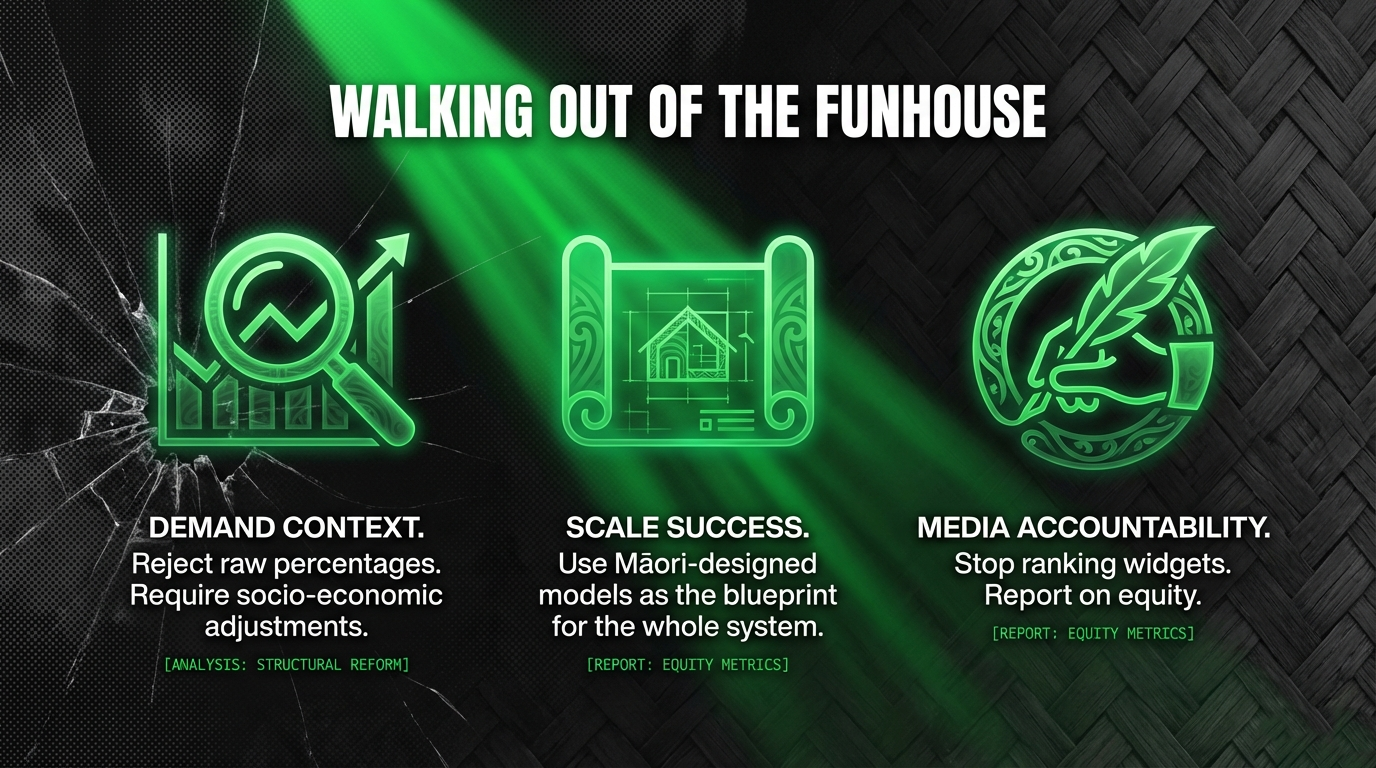
First, we can demand that school information be reported through context‑rich lenses that adjust for socio‑economic realities and measure progress over time, as both New Zealand decile research and international work on value‑added and contextual indicators show is feasible, instead of clinging to raw percentages that flatter privilege. No significant differences Quantifying quality
Second, policy makers can scale up Māori‑designed models already delivering stronger outcomes—Kaupapa Māori kura, Māori advisory groups, and approaches that embed identity and relational accountability—treating them as blueprints for the whole system rather than cultural side‑acts rolled out for Waitangi Day photo‑ops. NCEA in Kaupapa Māori settings Govt plans place more pressure on teachers
Third, media organisations must drop the lazy thrill of ranking widgets and instead treat education like the constitutional issue it is, interrogating how housing, work, colonial history and racism shape every percentage point they currently present as an objective score. League tables and school effectiveness NZQA 2023/24 Annual Report
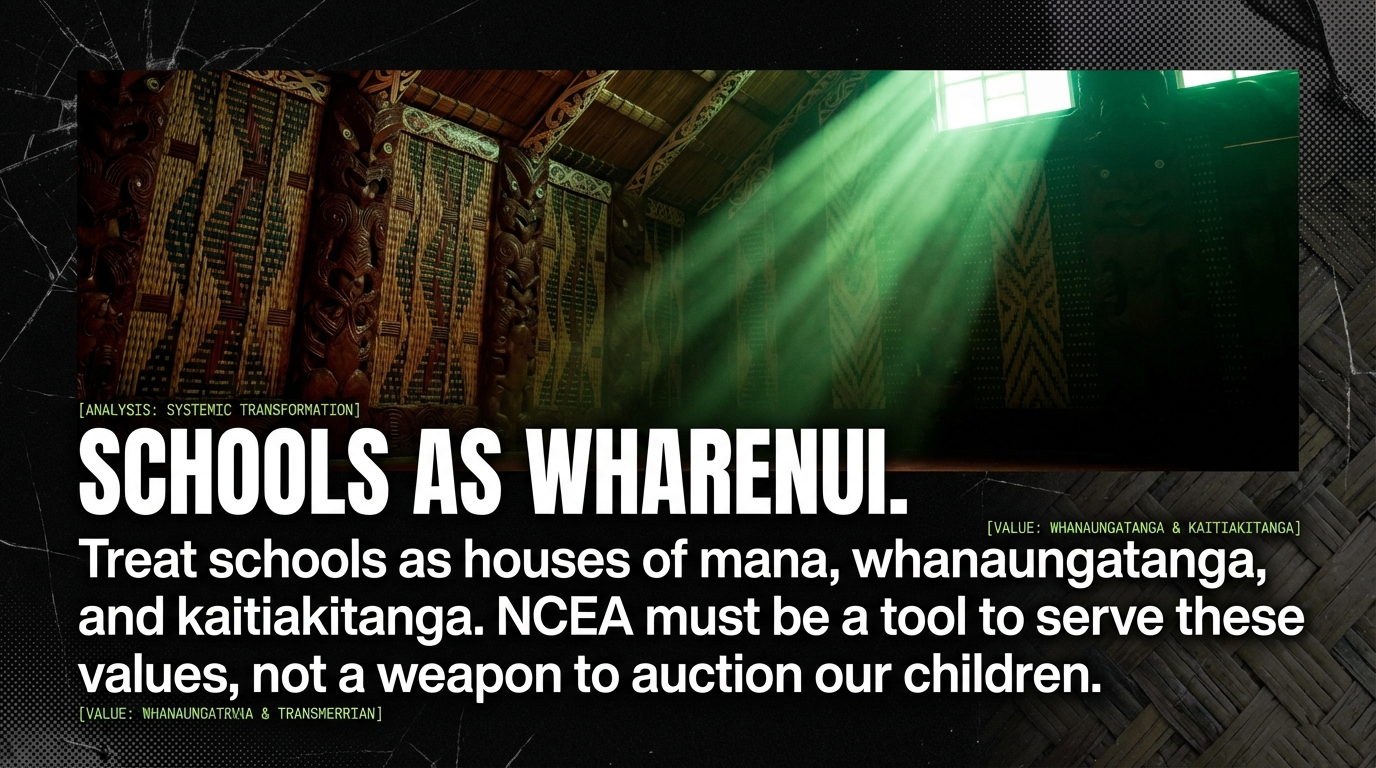
From a tikanga lens, the deepest reform is brutally simple:
treat schools as wharenui of mana, whanaungatanga and kaitiakitanga, and treat NCEA and UE as tools that must serve those values, not weapons used to auction our children’s futures in a marketplace of fear. Mana Māori Kaitiakitanga – guardianship and conservation
Koha Consideration
Every koha is another crack in the funhouse mirror that lets the Herald and ministers turn our tamariki into league‑table commodities, ranking Māori communities while hiding the system that rigs the game.
Your support says our rangatiratanga includes funding our own analysts and storytellers—people who will name how NCEA tables are weaponised against Māori, how tikanga is sidelined, and how Kaupapa Māori success is buried.
Kia kaha, whānau. Stay vigilant. Stay connected. And if you are able, consider a koha so this taiaha keeps swinging at the carnival that sells our kids as statistics.
Three pathways exist:
To support this mahi directly with a koha (voluntary contribution), visit:
Koha—Support – https://app.koha.kiwi/events/the-maori-green-lantern-fighting-misinformation-and-disinformation-ivor-jonesTo receive essays directly and support through subscription, join the Substack community:
Subscribe to the Māori Green Lantern on Substack – https://themaorigreenlantern.substack.com/subscribeFor direct bank transfer, the account details are: HTDM, account number 031546-0415173-000.

Ivor Jones The Māori Green Lantern Fighting Misinformation And Disinformation From The Far Right