“Chris Hipkins and Nicola Willis - The Arsonist’s Mirror: A Metaphorical Scathing of the Herald’s Propaganda Theatre” - 1 February 2026
How New Zealand’s Most Venerable Institution Became the Megaphone of Extraction
Mōrena Aotearoa,
Listen to how the fire spreads. Not with the roar of honesty, but with the whisper of a newspaper article framed as “analysis.”
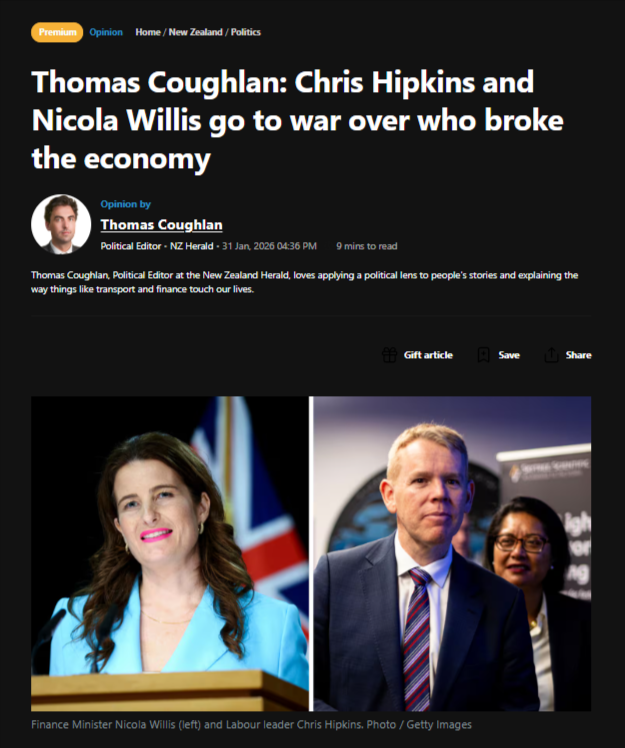
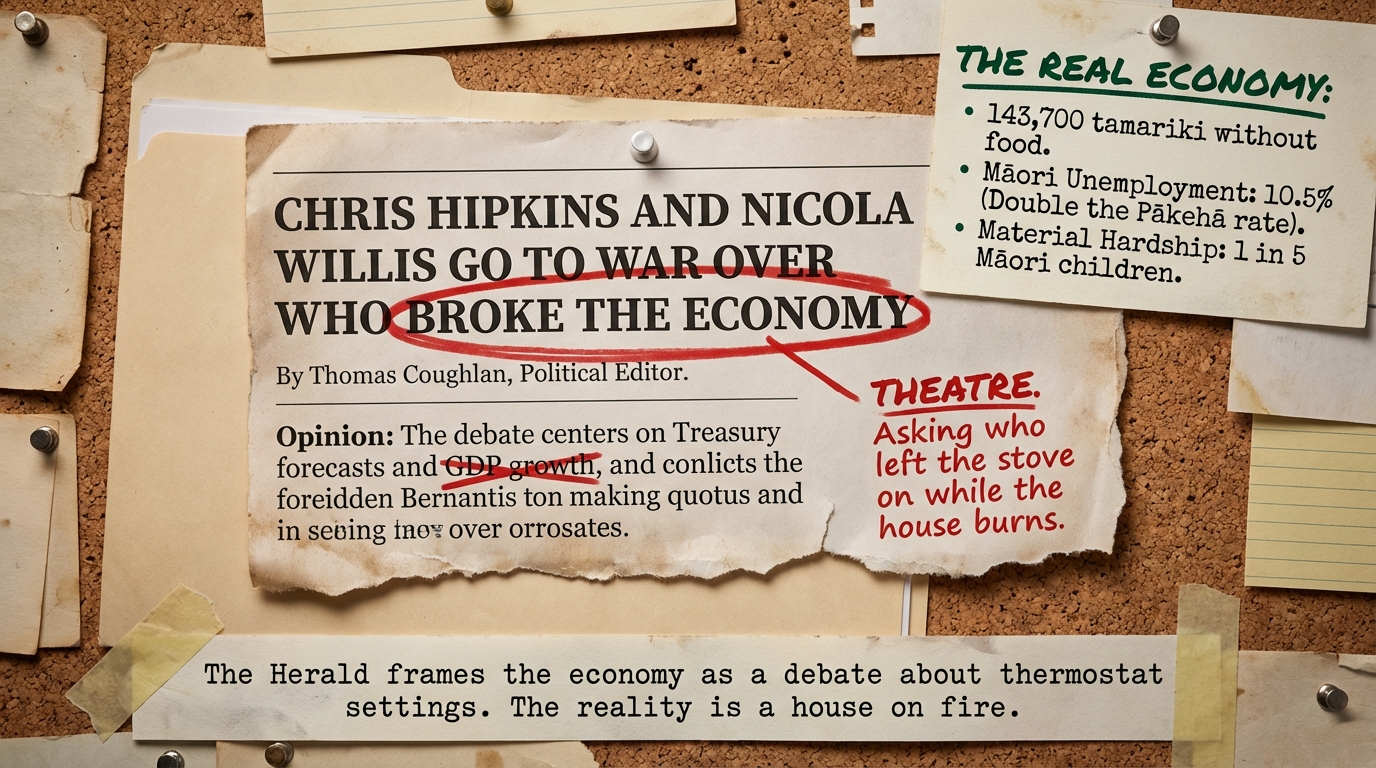
Thomas Coughlan stands in the burning house—the economy aflame—and asks the audience to focus on something simple:
Did the previous tenant leave the stove on, or did the current owner pour gasoline?
The question itself is the con.
Meanwhile, outside, 143,700 tamariki are living without food. Māori whānau are drowning in an unemployment crisis that has reached double the Pākehā rate. A billion dollars has been stripped from Māori services. The Māori Health Authority—gone. Education programs—slashed. Housing for whānau—defunded.
And the Herald’s political editor is asking you to debate the thermostat.
This is not journalism. This is professional distraction—a carefully crafted performance where the audience’s eyes follow a dancing finger while the conjurer’s other hand picks their pocket.
The Glass House Built on Extraction
Imagine a glass house. Beautiful, transparent. Everyone can see through it. The newspapers call it “objective reporting.” What they don’t tell you is: the glass was made by mining companies, the frames were installed by fossil fuel shareholders, and the mirrors inside all face the same direction—away from the truth.
The New Zealand Herald was founded in 1863 by William Chisholm Wilson, a man who supported war on Māori and called it “native rebellion.” In his first editorial, Wilson wrote that Māori were
“incendiary and assassins, wriggling like a serpent.”
This wasn’t an outlier—it was the founding mission. The paper existed to manufacture consent for dispossession.
That mission never changed.
Wilson’s company became Wilson & Horton, which became NZME, which owns the Herald.
The Wilson bloodline runs through it still:
Matthew Wilson is the current Chief Operating Officer. Generationally, the same family that profited from Māori land theft now controls the machinery that frames Māori rights as “the problem.”
But here’s where the metaphor deepens:
The glass house isn’t owned by the Wilsons anymore. It’s rented out to miners.
The Shareholders: When the Mining Company Buys the Microphone
Barbara Chapman is the board chair of NZME. She also chairs Genesis Energy (which owns the Huntly coal power station), sits on the board of Fletcher Building (which tried to steal Ihumātao), and is deputy chair of the New Zealand Initiative
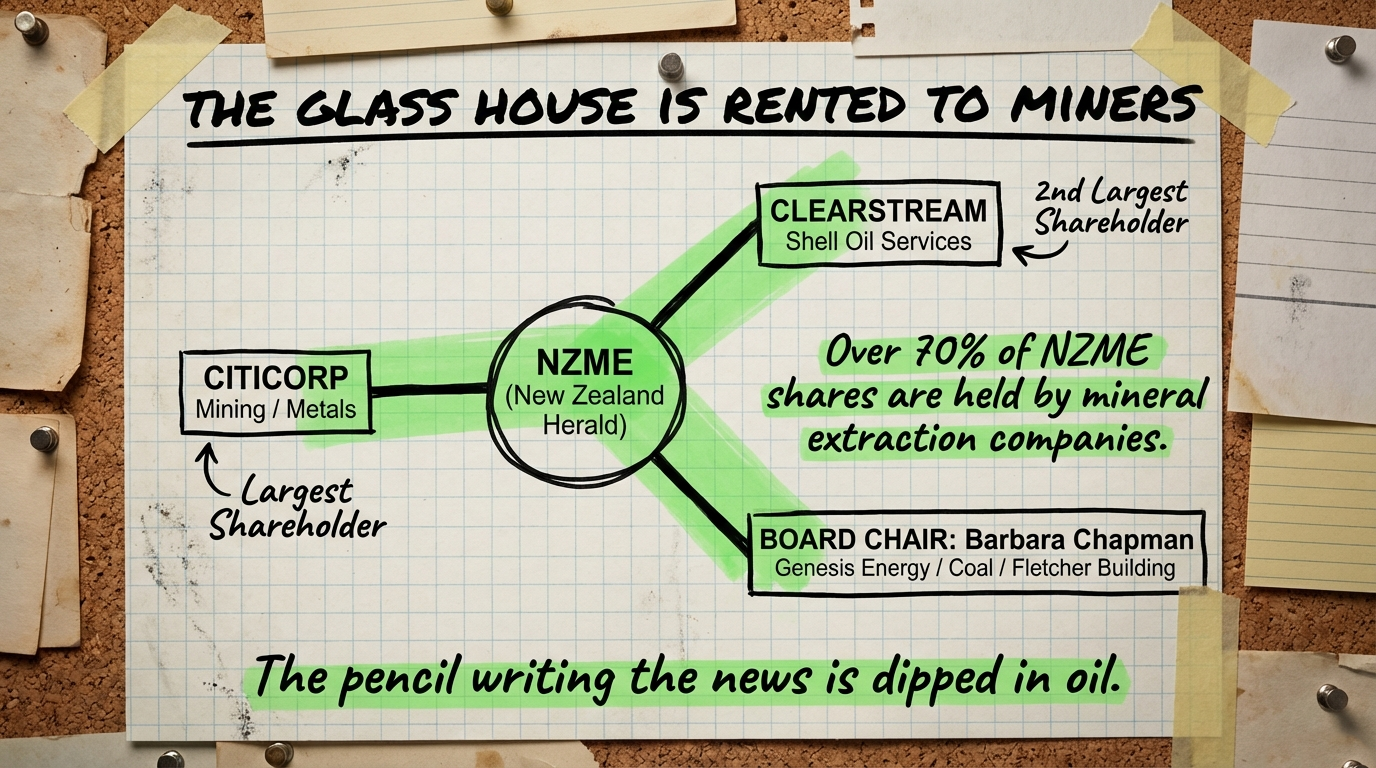
Now look at the shareholders. Citicorp—the mining and metals conglomerate—is the largest shareholder. Clearstream, which provides financial services to Shell Oil, is the second-largest. Together, they control 36% of NZME.
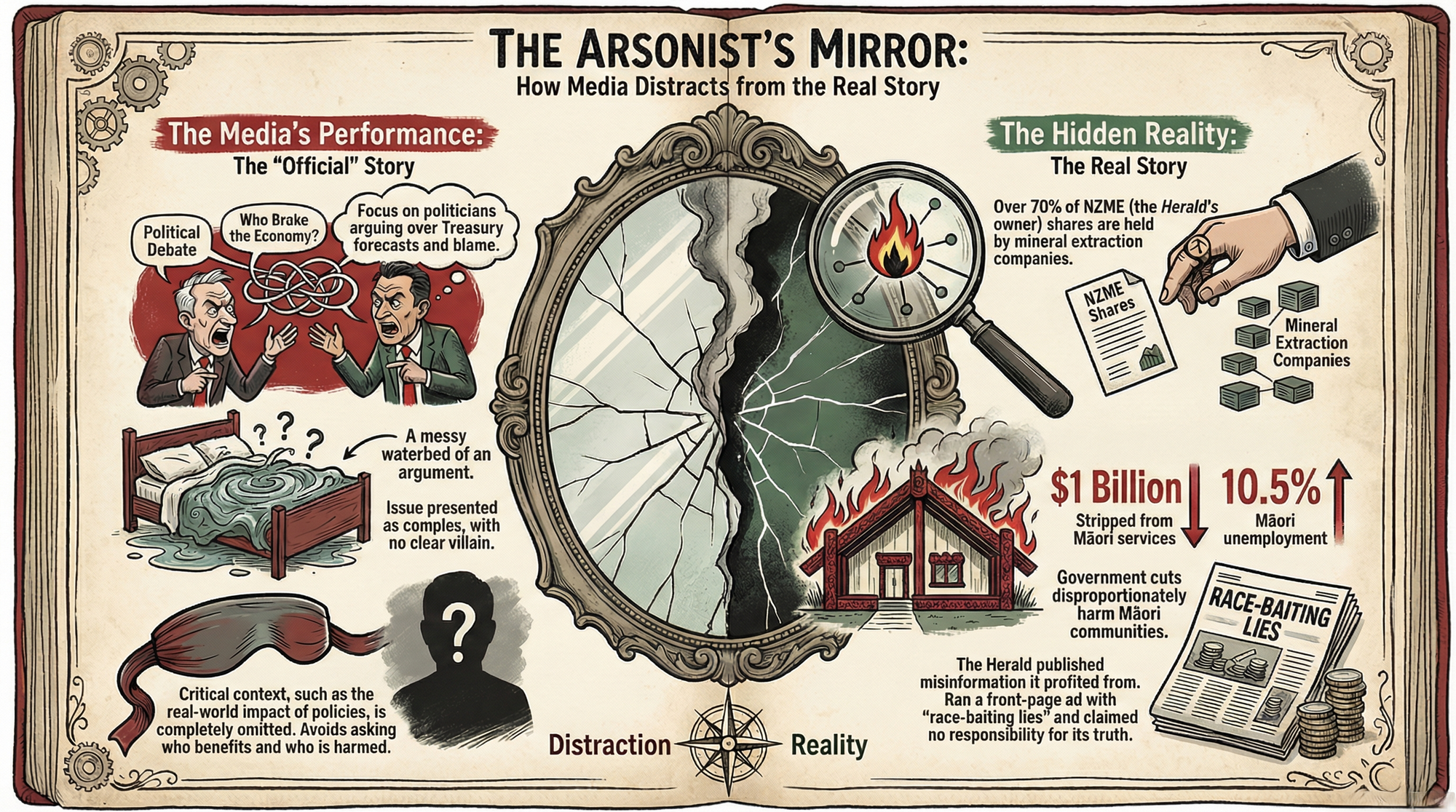
Over 70% of NZME’s shares are held by mineral extraction companies.
This is the metaphor made flesh:
The newspaper is not an independent institution reporting on power. It IS the power. The pencil that writes the narrative is dipped in oil.
“Māori rights, like all Indigenous rights, have always been the strongest roadblock to corporate mineral and freshwater extraction, and that is why we are consistently attacked in the media. The racism is not for its own sake. It functions to stoke the anxiety of New Zealand’s middle class, to weaponise them against us, and legitimise neoliberal, far-right policies and corporate extraction.”
The racism isn’t the bug. It’s the feature.
The Moment the Mask Slipped: August 2024
In August 2024, the Herald published something so obscene that even other institutions of power had to disown it.
—claiming that “the foreshore must be restored to public ownership.”
This is a fabricated lie.
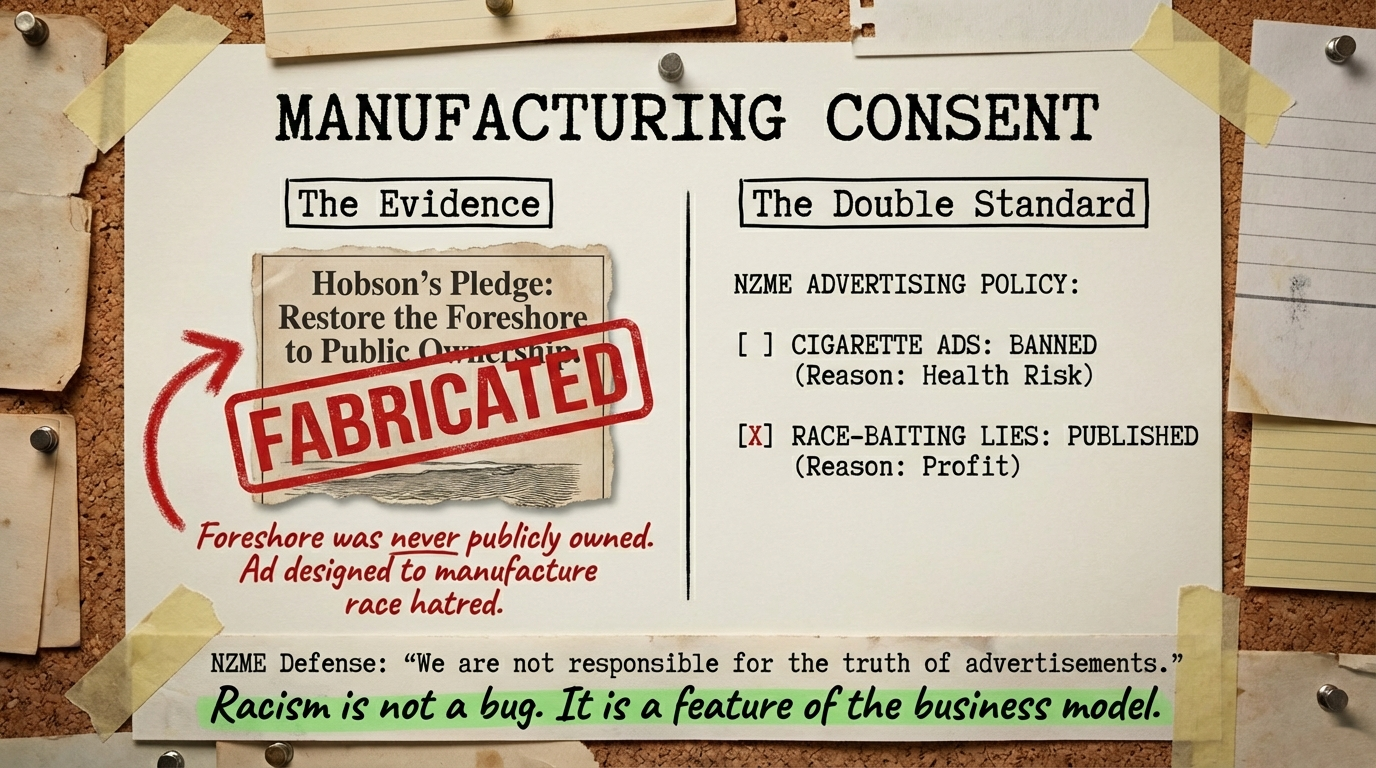
The foreshore has never been publicly owned. It has never existed in any state that would make “restoration” possible. The ad was designed to manufacture race hatred through false information. More than 170 lawyers and legal academics condemned it as deliberately misleading and dangerous.
The Advertising Standards Authority received 672 complaints. The Māori Journalists Association condemned it as propaganda. Te Pāti Māori boycotted the paper. Waatea News cut all ties, ending years of cooperation.
What did NZME say?
“We are not responsible for the truth of advertisements.”
Imagine a newspaper that won’t publish a cigarette ad (”Health risk,” they’d say), won’t publish child pornography (”Illegal,” they’d say), but will publish race-baiting lies on the front page for advertising revenue.
That’s not editorial discretion. That’s a choice. It’s a choice to trade Māori dignity for money.
The Theatre: Willis vs. Hipkins While the House Burns
Now, back to Coughlan’s article. The political editor presents Willis versus Hipkins as a legitimate debate:
Who broke the economy?
Willis says the Treasury forecasts were wrong.
She’s technically correct—Treasury did predict 3%+ growth that never materialised.
Hipkins says the coalition’s cuts deepened the recession.
He’s also correct—public spending retrenchment amplifies economic contraction.
But Coughlan frames this as a technical dispute. A debate between reasonable people about forecasting and policy.
What he never asks:
Cui bono? Who benefits from the cuts?
The coalition implemented $14.7 billion in tax cuts. The bulk went to high-income earners and landlords. Meanwhile, the government cut Māori housing programs by $32.5 million. Cut education by $36.1 million. Disestablished the Māori Health Authority.
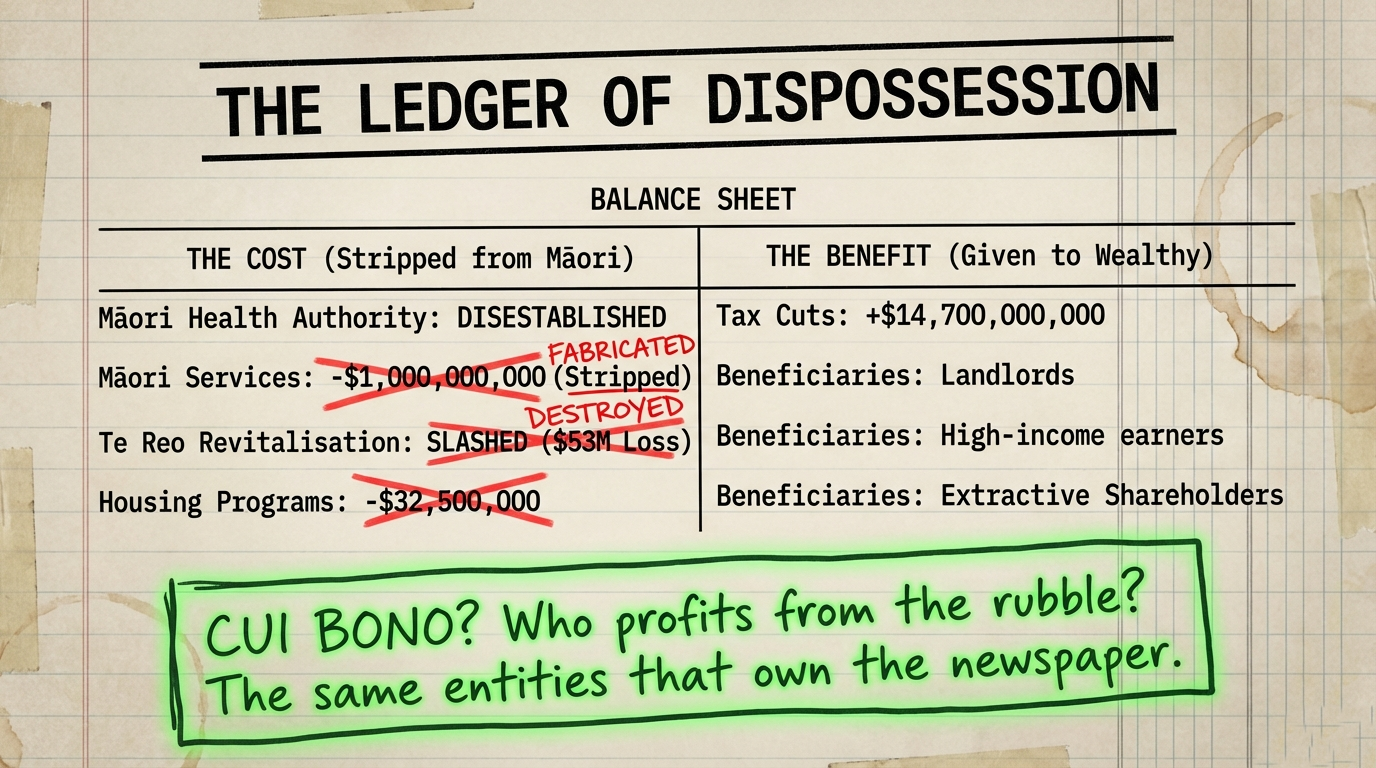
Who benefits? The same people who own the Herald. The same mining companies, the same fossil fuel shareholders, the same landlord class.
The theatre asks: “Who made a forecasting error?”
The truth asks: “Who was robbed to enrich whom?”
The Quantified Harm: Numbers the Herald Won’t Print
Let’s say it clearly:
Māori unemployment has reached 10.5%—more than double the Pākehā rate. That’s not a statistic. That’s a generation of tamariki locked into precarity: 29.7% of Māori live in economic precariat versus 16.7% of Pākehā.
One in five Māori children—21.5%—are living in material hardship. Material hardship means no fresh fruit, no heating, no doctor visits. It means survival, not life.
A total of 143,700 children are going without the basics.
The cost of living crisis has driven half of New Zealand to cut back on vegetables and fresh food. Butter costs 48% more than three years ago. Electricity is up 11%. Food overall is up 7-20%.
And what has the government done?
The Māori Health Authority—disestablished.
Over $1 billion stripped from Māori-specific initiatives across two budgets.
Budget 2025 promised $700 million for Māori but only $38 million of that was new money—the rest was already allocated. It’s like promising to give you dinner then counting your leftovers as generosity.
Māori housing programs cut by $32.5 million. Māori education cut by $36.1 million. Te reo funding slashed—which economists quantify as a $53 million annual economic loss.
None of this appears in Coughlan’s article.
The Assault on Tikanga: Western Rationality as Weapon
Now, here’s what the Herald will never explain:
What is being destroyed is not just programs, but a way of being.
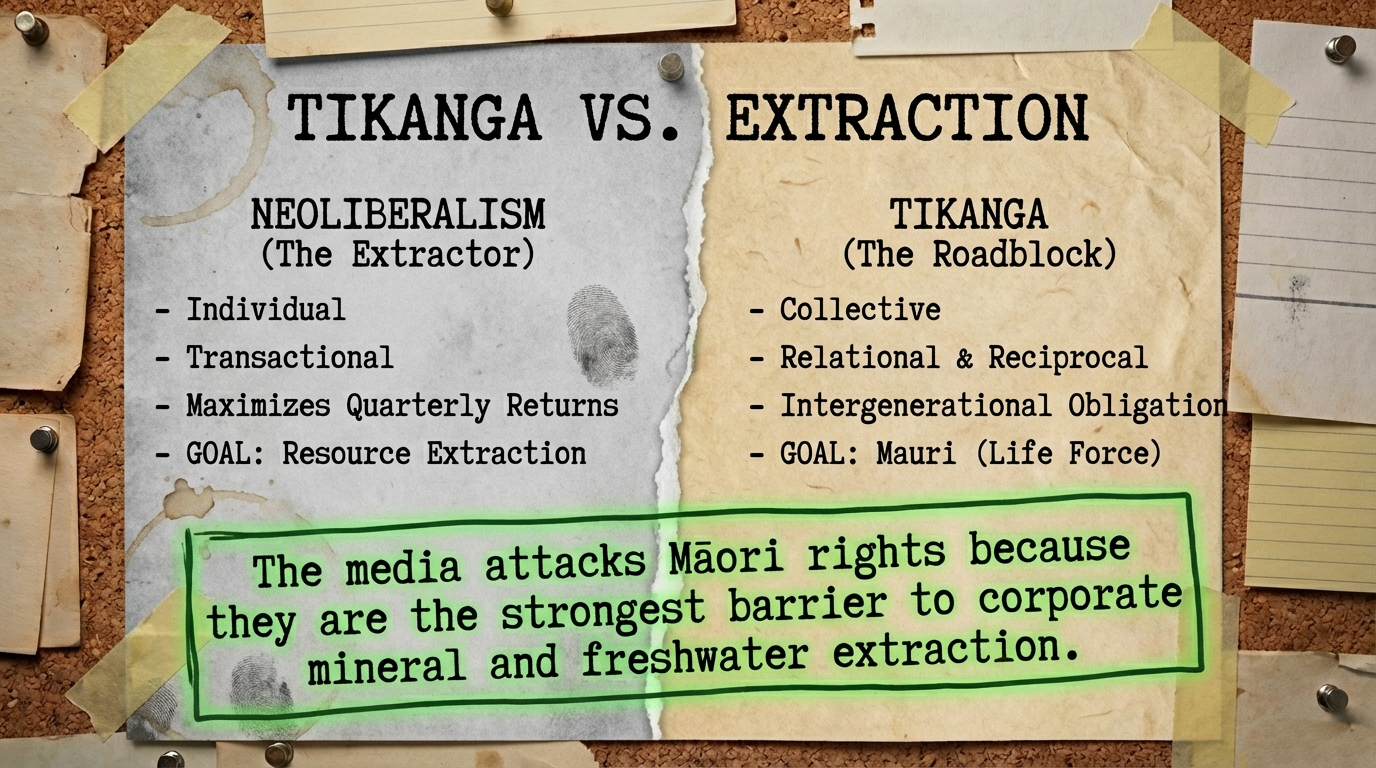
Tikanga is not “culture.” It’s not a museum piece. It’s constitutional law—the governance framework of Māori society, built on principles fundamentally opposed to neoliberalism:
- Tikanga is collective. Neoliberalism is individual.
- Tikanga is relational and reciprocal. Neoliberalism is transactional.
- Tikanga honors intergenerational obligation. Neoliberalism maximizes quarterly returns.
- Tikanga is built on mauri—the life force. Neoliberalism is built on extraction.
When the coalition cuts Māori health services and replaces them with Western clinical models, it’s not just “efficiency.” It’s the systematic dismantling of culturally grounded care that saves lives.
When education policy treats te reo as a “choice” rather than as taonga (treasure), it weaponises “freedom” to achieve cultural genocide.
When housing policy abandons Māori-led community housing and folds it into “universal” programs, it destroys the whakapapa structures that hold whānau together.
This is why the Herald doesn’t mention it. Because naming this would require naming the system it serves.
The Solution: Rangatiratanga or Extraction
There is a choice being made. Every day. By every institution.
To rebuild what has been cut:
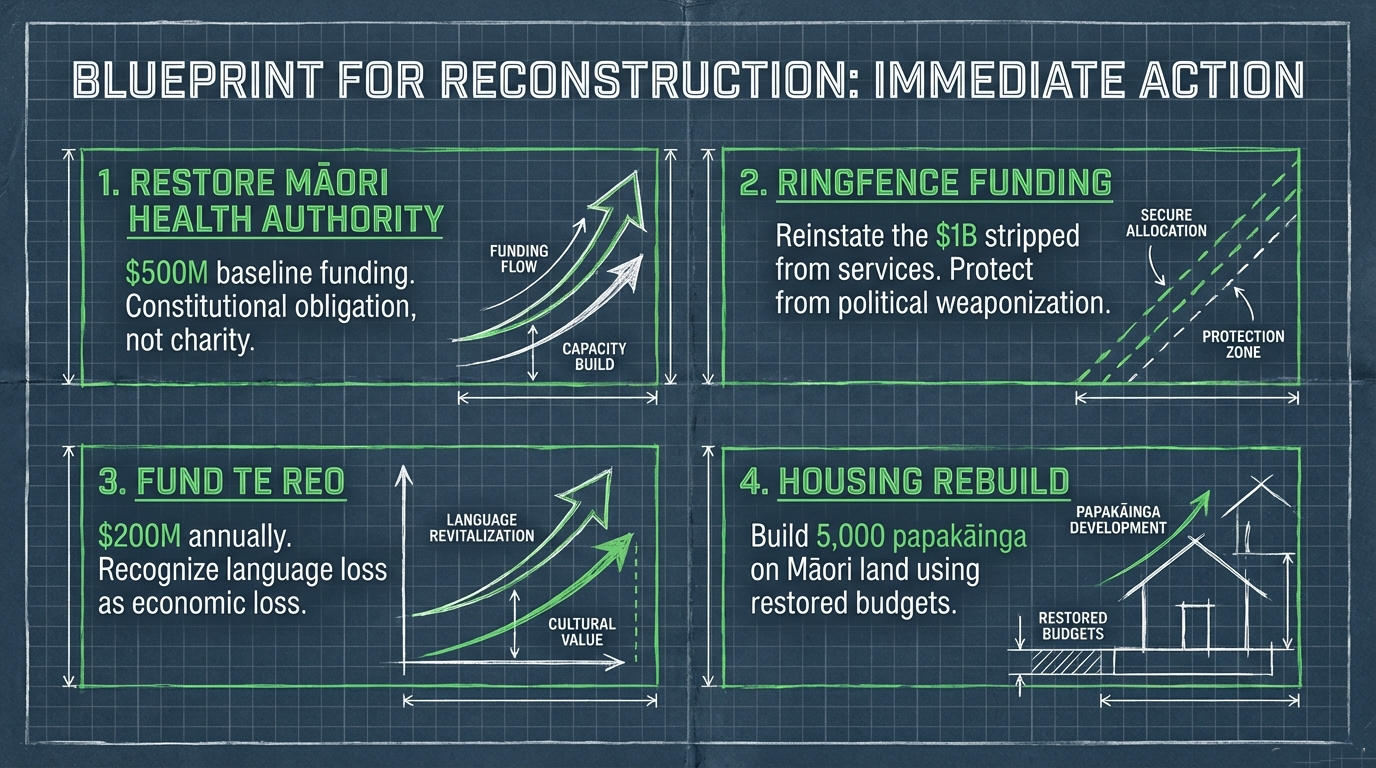
Restore the Māori Health Authority immediately with $500 million baseline funding—because Māori health is not charity, it’s a constitutional obligation under Te Tiriti.
Reinstate the $1 billion stripped from Māori services and permanently ringfence Māori-specific funding so it cannot be weaponised as a political tool.
Fund te reo revitalisation at $200 million annually, recognizing the $53 million annual economic value of each generation that loses the language.
Build 5,000 papakāinga on Māori land using the $40 million that was cut from Māori housing, returning control of housing to whānau.
Guarantee kaupapa Māori education as a right, not as a “choice” dependent on government whim.
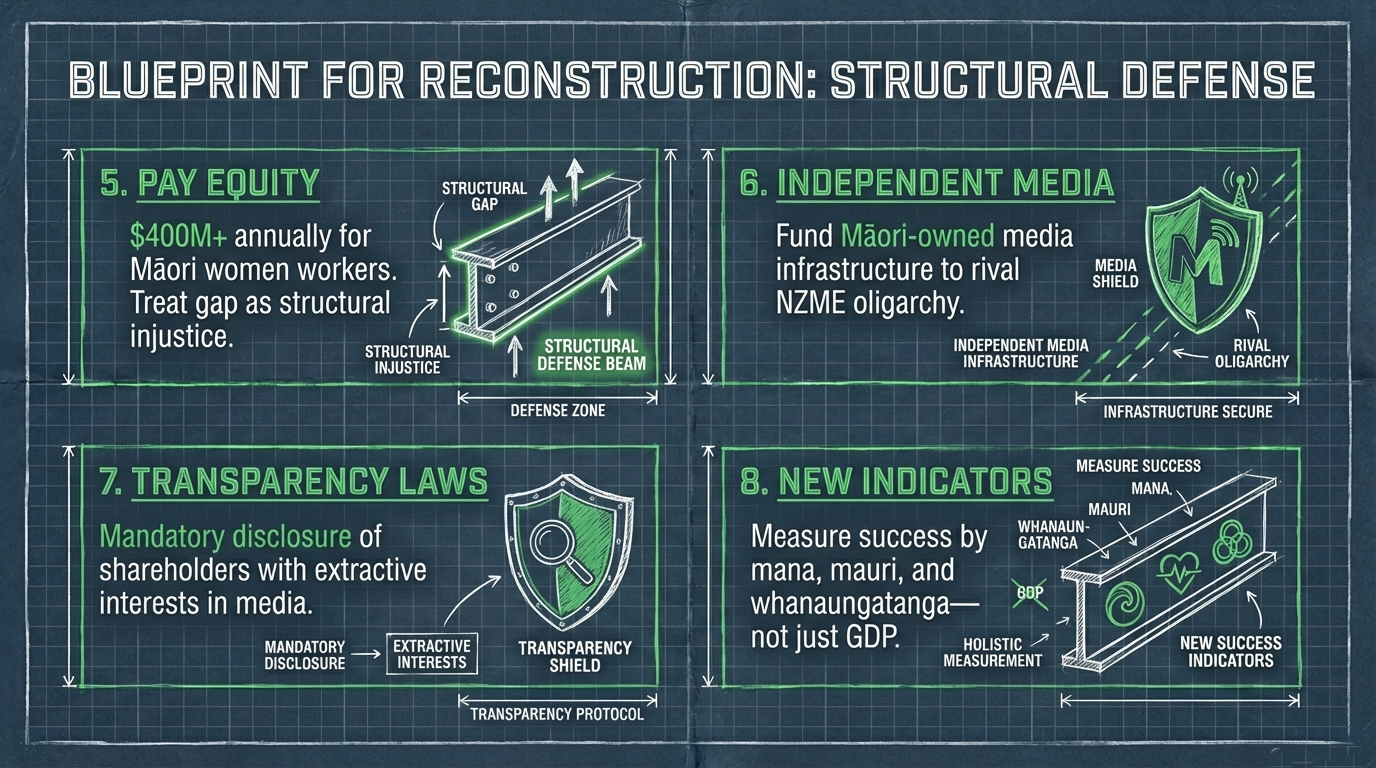
Implement real pay equity for Māori women workers—estimated at $400+ million annually—that treats the wage gap as structural injustice, not as an administrative problem.
Establish an independent Māori Economic Authority funded by resource royalties from whenua Māori, shifting control of economic decision-making away from shareholders back to tangata whenua.
Create Māori-owned media infrastructure as an alternative to the Herald’s oligarchy. Waatea News exists. Iwi radio exists. They need funding commensurate with NZME’s advertising revenue.
Implement mandatory transparency laws requiring disclosure of all shareholders with fossil fuel, mining, or extractive interests in media organisations.
Establish tikanga-based economic indicators alongside GDP—measuring mana, mauri, whanaungatanga, and intergenerational wellbeing rather than profit extraction.
The Moral Test: What Would a Just Media Look Like?
The Herald will never expose its own shareholders. It will never ask why mining companies own newspapers. It will never admit that racism is a profitable business model.
But a just media would.
A just media would:
- Report that Māori unemployment is double the national rate and climbing
- Report that mineral extraction interests control 70% of NZME shares
- Report that fossil fuel shareholders profit from cuts to Māori health and housing
- Report that the Hobson’s Pledge ad was propaganda designed to manufacture race hatred
- Report that Thomas Coughlan’s article erased Māori harm in service to those who profit from it
A just media would make the connection between the boardroom and the policy, between the shareholder and the cut, between the propaganda and the precariat.
The Herald does the opposite. It obscures. It performs. It manufactures consent.
And it calls itself journalism.
The Glass House Burns
Imagine the glass house is now fully aflame. The arsonist stands in the smoking remains and says:
“The previous tenant left the stove on.”
The audience has a choice: believe the arsonist, or look at the gasoline can in their hand.
Thomas Coughlan asks you to debate the thermostat while the house burns. The Herald asks you to trust the institution that manufactured the fire.
But the fire is real. 143,700 tamariki are hungry. Whānau are being pushed into precarity. Services that keep us alive are being disestablished. The language is dying.
The question is not: “Who broke the economy?”
The question is: “Who profits from the rubble?”
The answer is printed on every masthead of NZME. Owned by miners. Operated for extraction. Staffed by journalists willing to perform propaganda for a wage.
Kia kaha, whānau.
Koha Consideration: Funding Truth in the House of Lies
Every share NZME holds in fossil fuel extraction is a vote for keeping this essay hidden. Every advertising dollar the Herald earns from mining companies is a dollar spent attacking your rights.
But every koha to this mahi is a counter-vote. It signals that whānau are ready to fund the accountability that the Herald, the Crown, and the shareholders will never provide.
This essay exposed:
- How mineral extraction interests control 70% of NZME shares
- How the Herald’s founding mission was manufacturing consent for Māori land theft
- How the Hobson’s Pledge ad was deliberate propaganda designed to manufacture race hatred
- How $1 billion was stripped from Māori services while tax cuts benefited the wealthy
- How 10.5% Māori unemployment reflects systematic dispossession
That research costs time. That accountability costs courage. That truth costs money.
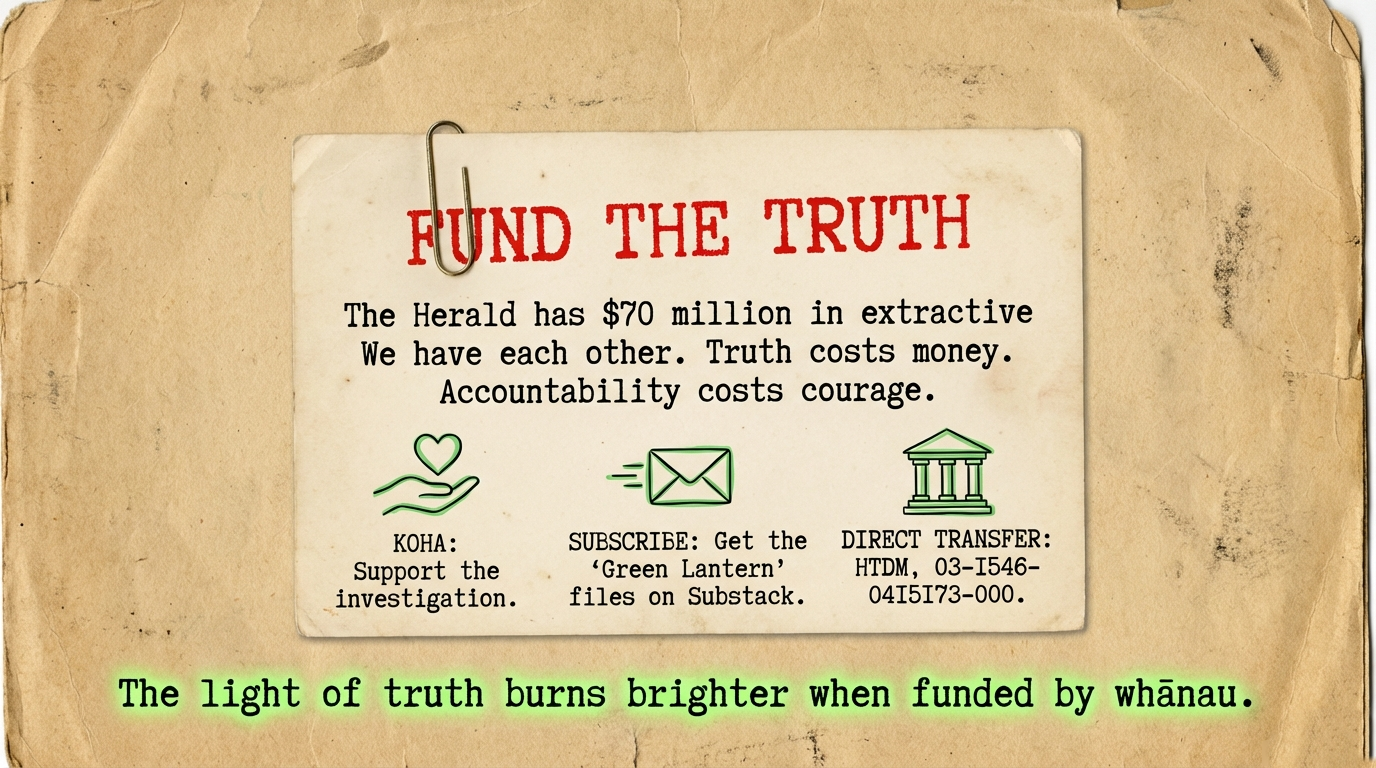
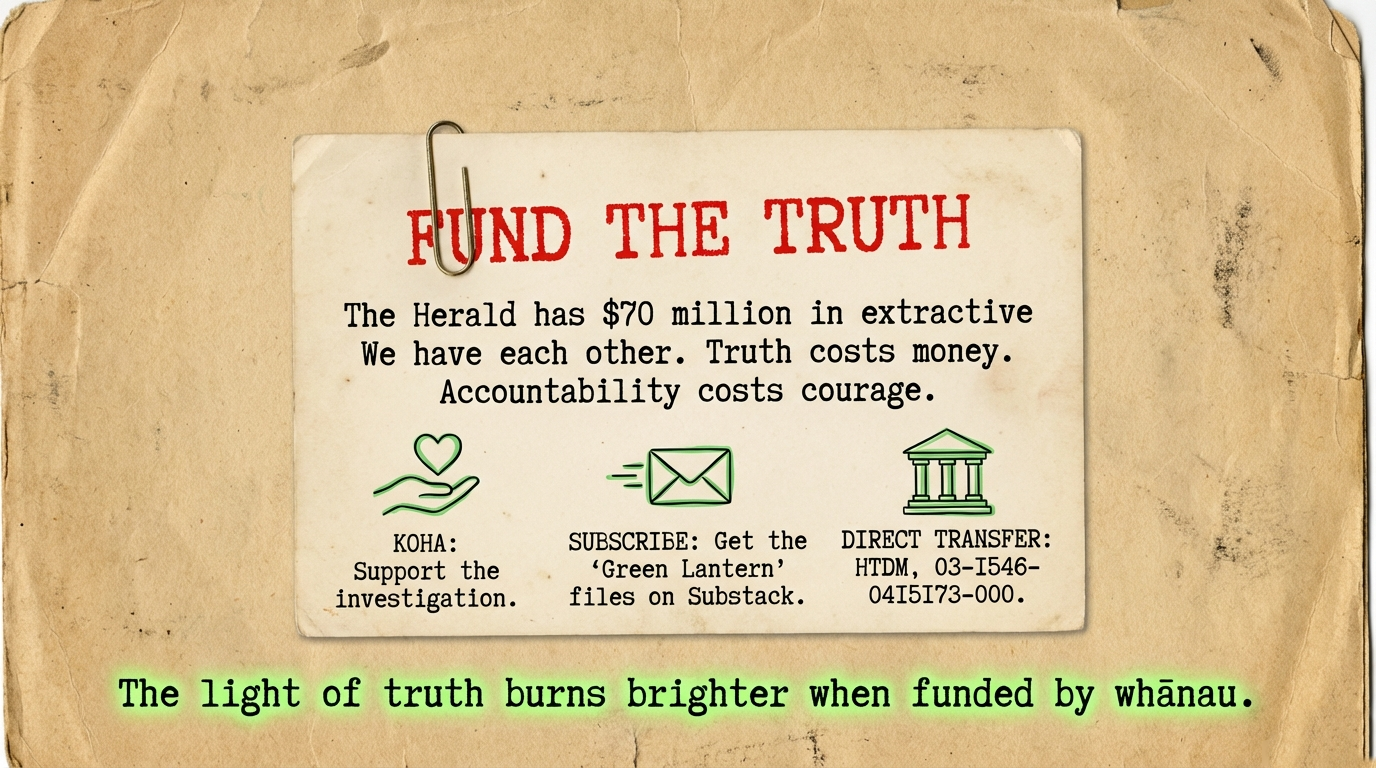
The Herald has $70 million in extractive capital behind it. We have each other.
If this mahi serves you—if it arms you with evidence to see through propaganda, to understand the hidden connections between boardrooms and cuts, to speak truth to power in whānau conversations—then consider supporting the voice that names what the mainstream media won’t.
Kia kaha, whānau. Stay vigilant. Stay connected. And if you are able, consider a koha to ensure truth-telling continues when power profits from silence.
Three Pathways to Support Truth Against the Machine:
To support this mahi directly with a koha (voluntary contribution) that funds investigation into white supremacist media, extractive capitalism, and their assault on tikanga:
Koha—Support The Māori Green Lantern
To receive essays exposing media ownership, fossil fuel influence, and solutions directly—and fund ongoing accountability mahi through subscription:
Subscribe to The Māori Green Lantern on Substack
For direct bank transfer (bypassing platforms, supporting entirely through whānau networks):
HTDM, account number 03-1546-0415173-000
Every koha is ammunition. Every subscription is an act of rangatiratanga. Every transfer is a brick in the marae we’re building—one the Herald’s shareholders can never buy.
The light of truth burns brighter when it’s funded by whānau.
Ivor Jones The Māori Green Lantern Fighting Misinformation And Disinformation From The Far Right