"Chris Hipkins’ Labour Keeps the Neoliberal Knife at Māori Throats: Red Cloak, Imported Death" - 6 February 2026
Chris Hipkins isn’t our shield from ACT and National—he’s their red‑branded accomplice, wrapping Māori harm in te reo, “values,” and manufactured excuses while the same colonial machine keeps killing
Kia ora ano Aotearoa,
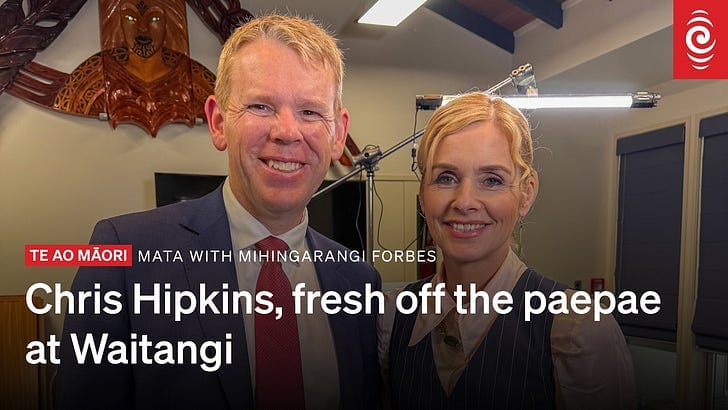
Hipkins walks off the paepae at Waitangi wrapped in a red cloak of “values” and “partnership,” but underneath is the same cold steel of Crown control and neoliberal cruelty that has been gutting Māori bodies for generations. In the MATA interview and across his record, he performs empathy for Māori while defending the very economic and constitutional cage that ACT, National and New Zealand First are now using to smash Te Tiriti, Te Aka Whai Ora and every foothold of Māori rangatiratanga.
You can watch the full performance here: RNZ – Chris Hipkins, fresh off the paepae at Waitangi.
Hipkins’ cloak of empathy over a rusted Crown engine
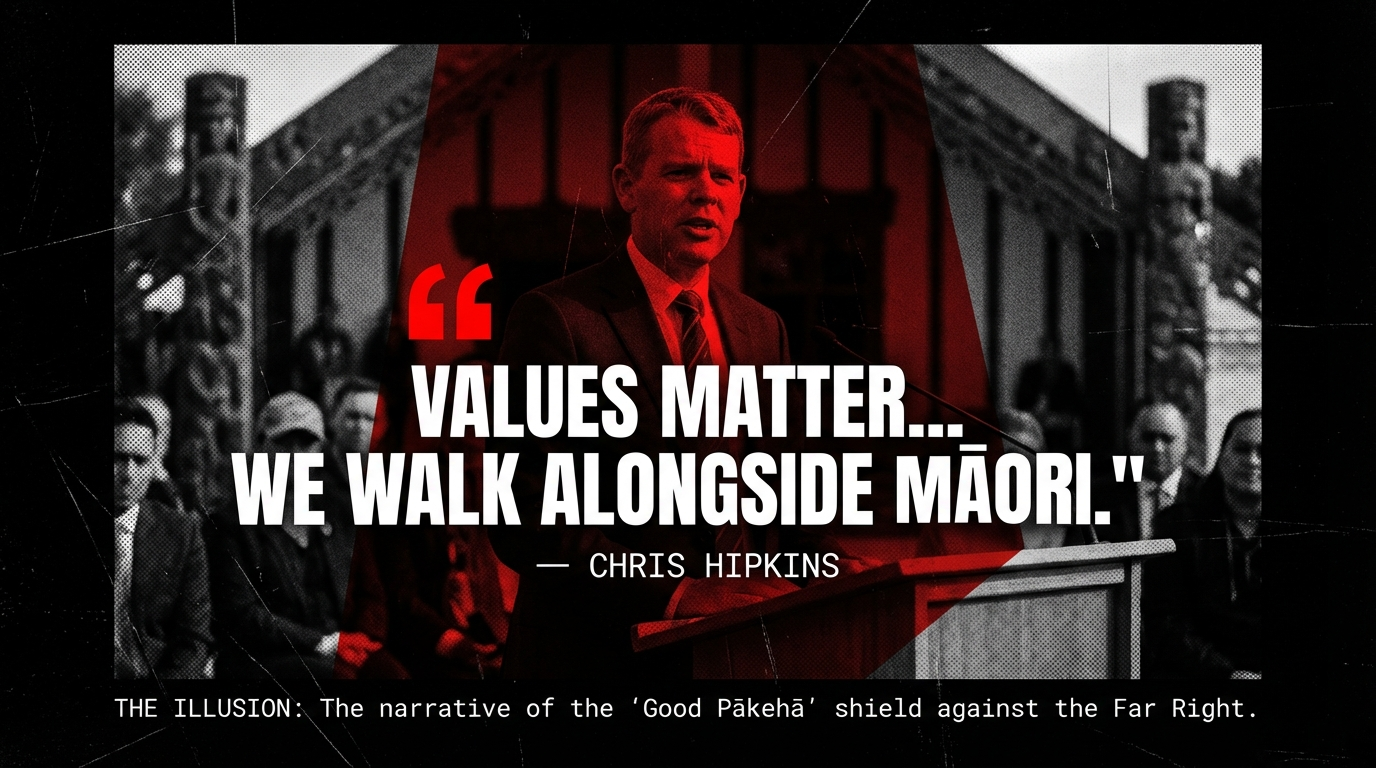
On MATA, Hipkins calls ACT’s Treaty Principles Bill a “grubby little bill” and rails against policies “unfairly targeting Māori,” echoing his attacks on the coalition’s agenda over Māori wards, boot camps and Treaty roll‑backs, as reported by 1News. He positions himself as the “good” Pākehā who understands Māori hurt and who will “stand alongside our indigenous people,” a line he has repeated at Rātana and in his “values matter” speech, published by Labour and reported by 1News.
Yet when he held power, Labour left the core neoliberal machine untouched. The electricity market, supermarket duopoly and landlord‑centred housing system remained intact, entrenching a cost‑of‑living crisis that hits Māori hardest, as health and cost‑pressure coverage shows in RNZ’s Budget reporting. Labour expanded police numbers, avoided wealth taxes, and refused to structurally regulate corporate power, a pattern I describe as “manufactured cruelty” in “MANUFACTURED CRUELTY: How the Government Deliberately Inflicts Harm,” on The Māori Green Lantern Substack.
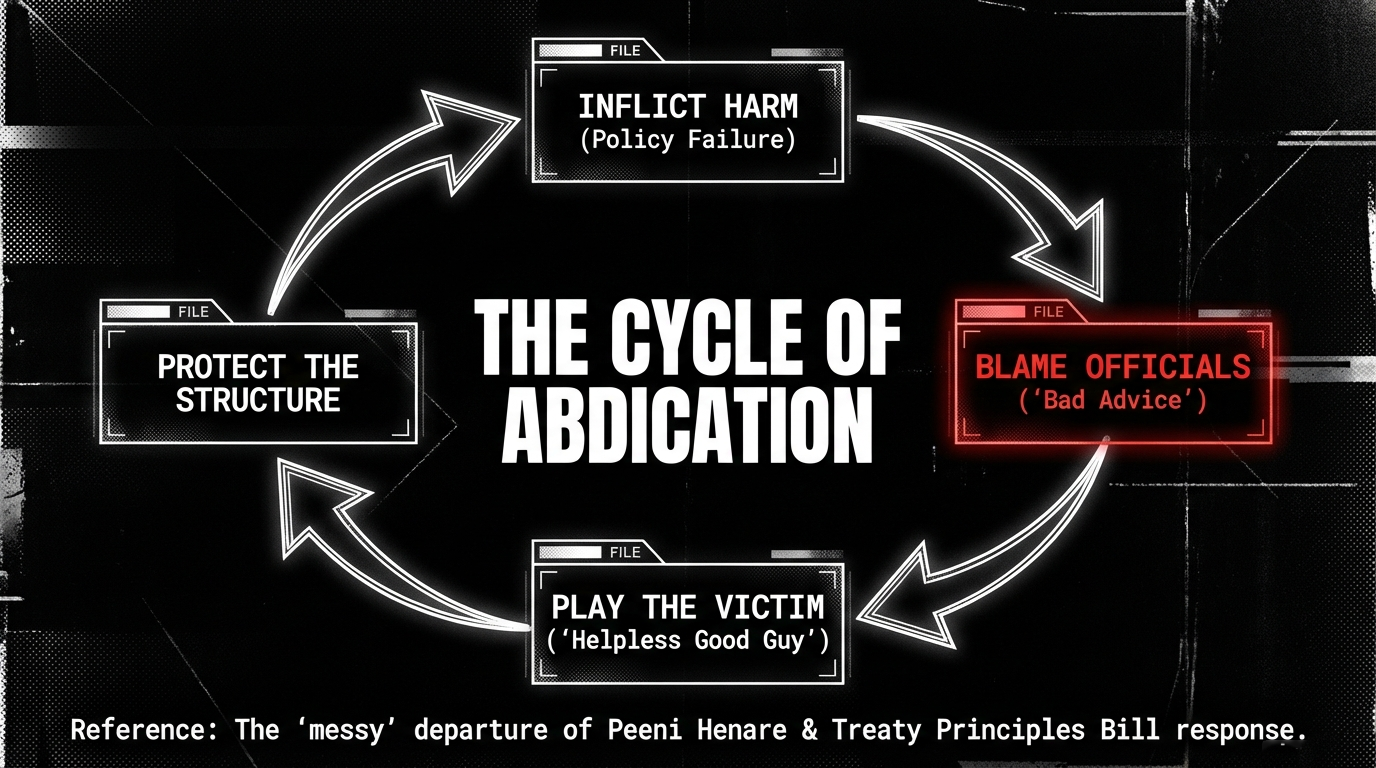
In “The ‘Bad Advice’ Excuse – Chris Hipkins Dodges Responsibility While Māori Pay the Price,” I show how Hipkins’ favourite move is to blame “bad advice” whenever Labour’s failures—especially towards Māori—are exposed, turning ministers into victims of their own bureaucracy while the actual structures (markets, police, Crown supremacy) remain sacred and untouched, as analysed with examples in that essay. On MATA he plays the same game: he mourns the rise in racism and the coalition’s cruelty, but never admits Labour’s deep complicity in building and maintaining the cage.
Example from the interview:
- He says Māori are reporting rising racism and calls it “heartbreaking,” aligning with polling that only 10% of New Zealanders think the coalition’s policies reduce racial tension, as shown by 1News’ Verian poll.
- But he treats racism like weather, not like the direct output of policies—including Labour’s own market‑friendly settings—that shove Māori into the sharp end of poverty, under‑funded health and over‑policed streets, a structural link I map explicitly in “Manufactured Cruelty” and “Imported Death: How Billionaire Networks, Project 2025, and the Atlas Machine Are Reshaping Aotearoa,” on Substack.
To the western mind, this is “balanced leadership.” To tikanga, it is a breach of pono and kawenata: big words, no structural action.
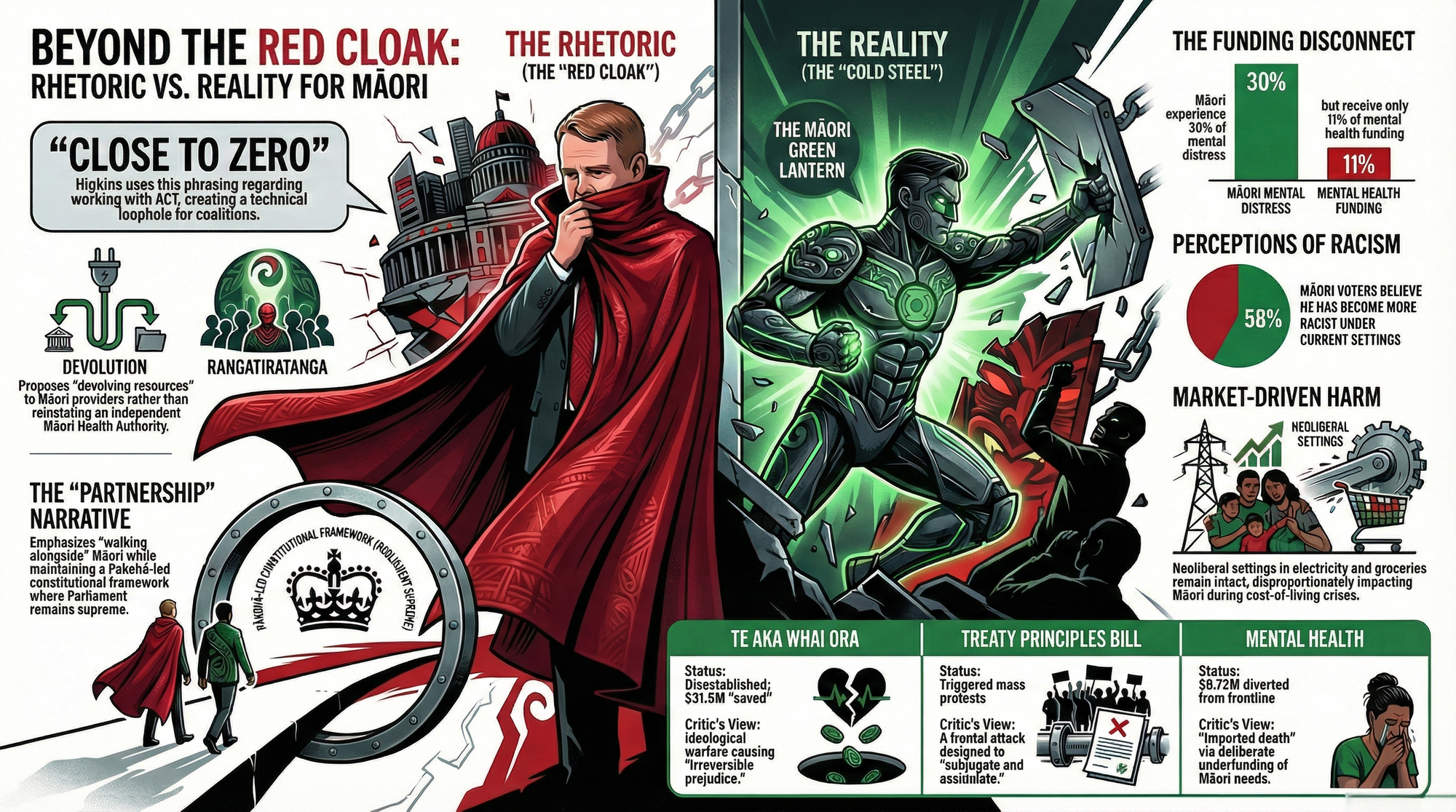
“Close to zero”: Hipkins’ ACT coalition dog‑whistle
When asked on MATA whether Labour could work with ACT, Hipkins says the chance is “close to zero,” not “zero,” a careful phrase you can hear directly in the RNZ interview. That microscopic gap—“close to”—isn’t accidental. It is a technical escape hatch for future coalition deals: a signal to the political class that there is no line Labour will absolutely never cross, even if Māori are under direct legislative attack.
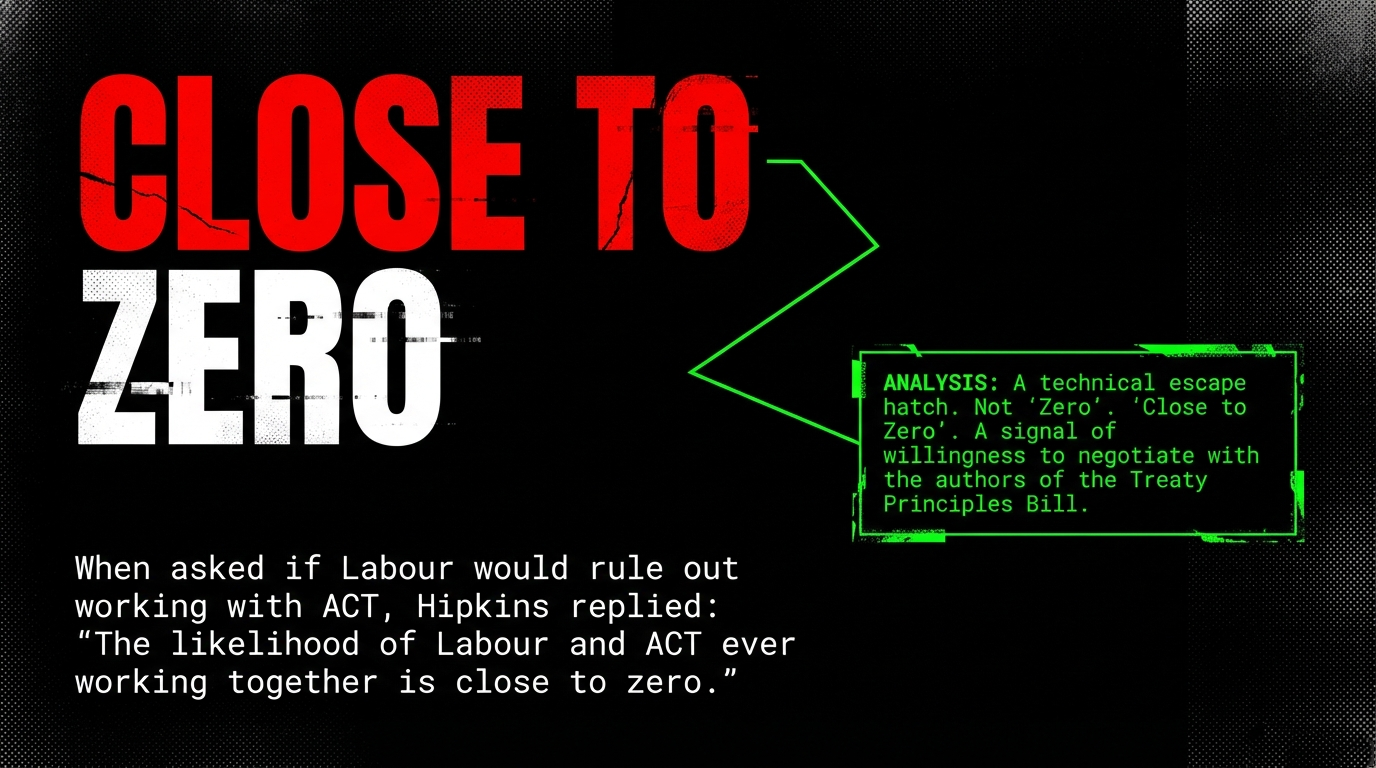
This sits alongside his record of telling Māori one thing and leaving himself room to do another. At Rātana he promises Labour will “walk alongside Māori,” while warning the coalition will do things “to Māori,” as covered by 1News. But nowhere—neither in that speech nor on MATA—does he categorically renounce working with a party whose Treaty Principles Bill has been condemned internally by the Ministry of Justice as likely breaching the spirit and text of Te Tiriti and international obligations, as revealed by the leaked document reported by 1News.
In “The ‘Bad Advice’ Excuse,” I argue that Hipkins has already rehearsed the lines he will use if Labour later cuts a deal with ACT: he will blame “circumstances,” “the will of the voters,” or say it was needed to keep “worse forces” out, just as he uses officials to absorb blame for past cruelty, a pattern detailed in that Substack piece. The MATA phrasing “close to zero” is the moral cowardice made audible.
Quantified harm around that “grubby bill”:
- The Treaty Principles Bill has triggered mass protests and driven up racial tension; just 10% of New Zealanders think the coalition is reducing racial tensions, according to 1News.
- Internal Ministry analysis warns the Bill risks breaching Te Tiriti and international human rights standards because it unilaterally redefines Treaty “principles” and sidelines Māori, as exposed by 1News.
In “Imported Death,” I show how this is part of a global Atlas‑style playbook: strip Indigenous protections, neutralise Treaty obligations, and lock in a monocultural, market‑first constitution that cannot be easily reversed, as I document with international and local connections in that essay. Hipkins condemns the bill’s “tone” but refuses to slam the door on the party behind it.
Te Aka Whai Ora: strangling the vine, then calling it “devolution”
The most dangerous part of the MATA interview is Hipkins’ handling of Te Aka Whai Ora. When pressed on whether Labour would reinstate an independent Māori Health Authority, he refuses to promise anything. Instead, he leans on two moves you can hear in the RNZ video:
- He repeats the coalition’s narrative that some were “burned and traumatised” by Te Aka Whai Ora’s implementation.
- He pivots to talk about “other ways” to get money “directly into the hands of Māori” through “a more devolved approach to funding.”
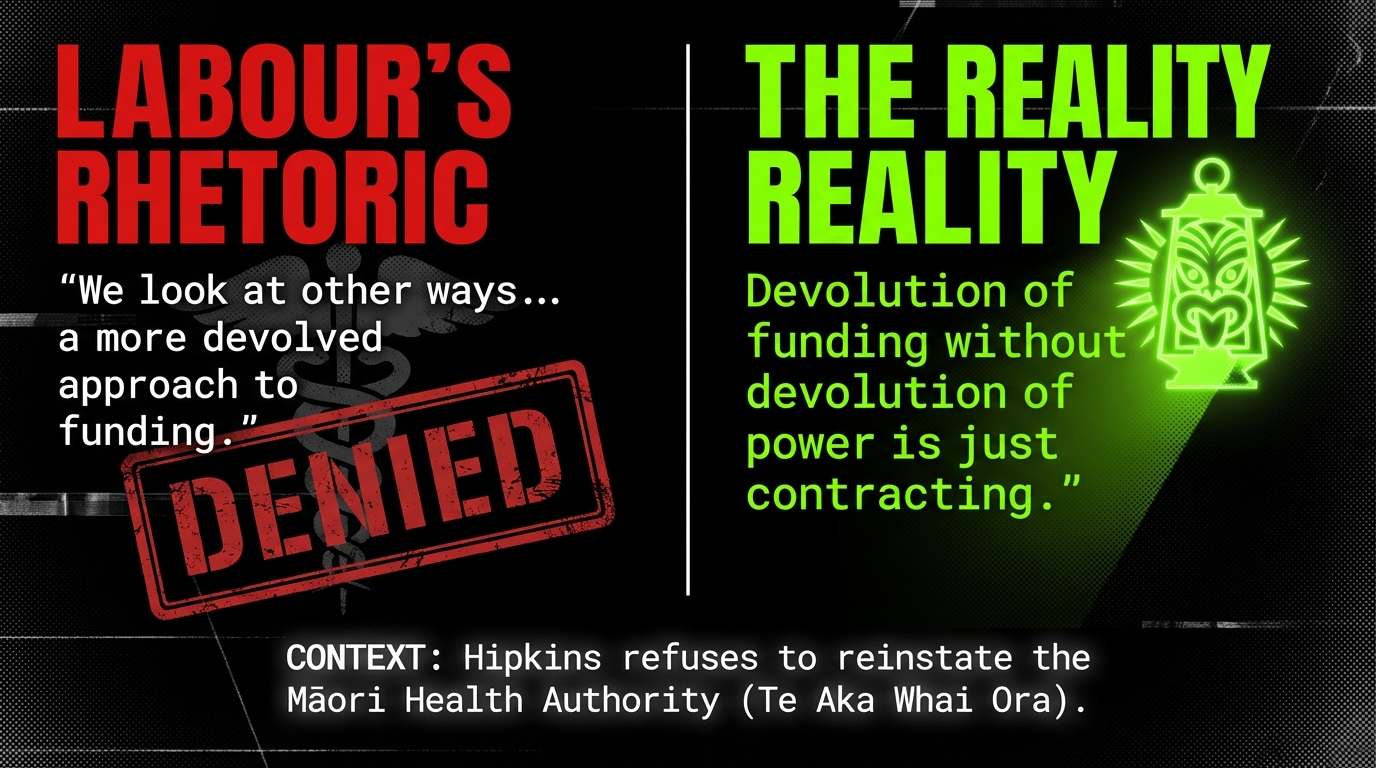
This is pure neoliberal technocrat talk. Devolution of funding without devolution of power is just contracting. Māori providers become frontline shock absorbers inside a Crown‑designed system that has always failed us.
The Crown’s own paperwork spells out what actually happened. Manatū Hauora’s memo “Update on the disestablishment of Te Aka Whai Ora Māori Health Authority” confirms that Te Aka Whai Ora’s staff, functions and roughly $35.5m administration budget were folded into Te Whatu Ora and the Ministry, with formal disestablishment on 30 June 2024, as detailed in the Ministry of Health PDF. The Waitangi Tribunal’s urgent inquiry found the Crown breached tino rangatiratanga, partnership, good government and active protection principles by rushing this through under urgency, without meaningful Māori consent, and warned that removing Te Aka Whai Ora in favour of an undefined future model is “on its face” prejudicial to Māori, as summarised in its decisions reported by 1News and outlined on the Tribunal’s site.
In “Imported Death,” I lay out the numbers:
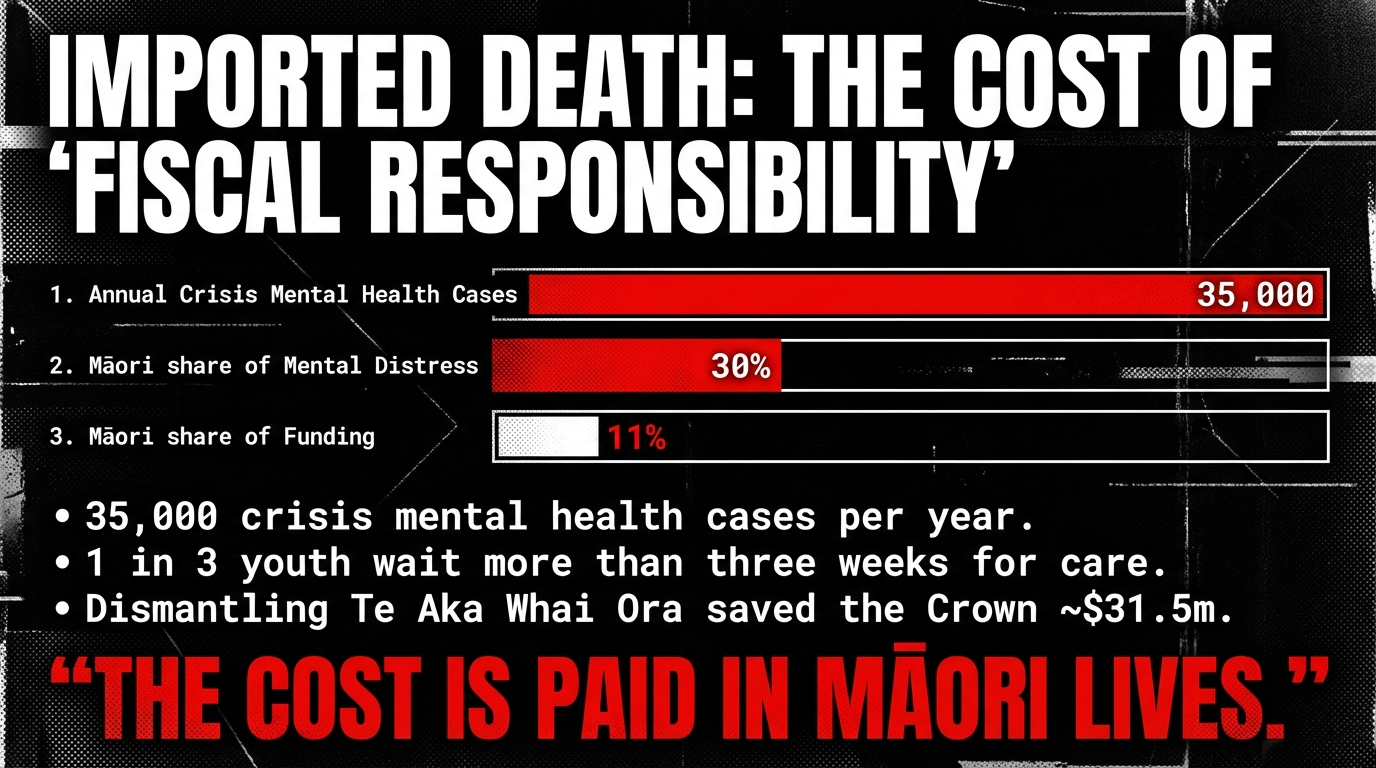
- Around 35,000 people a year access crisis mental health services; one in three youth wait more than three weeks for care; Māori experience roughly 30% of mental distress but receive only about 11% of mental health funding, as collated in that essay from official data, in Imported Death.
- While that is happening, the coalition has diverted $9.72m away from frontline mental health and is saving roughly $31.5m from Te Aka Whai Ora’s disestablishment, and about $71m by reinstating prescription charges, as outlined in Budget analysis by RNZ.
Te Aka Whai Ora was explicitly created because mainstream systems failed Māori: poorer life expectancy, higher chronic disease, more preventable deaths, as noted in Te Aka Whai Ora’s own reporting such as Te Pūrongo Q3 2023/24. The Tribunal has now said that dismantling it causes serious and irreversible prejudice; that is, people will die earlier because the Crown chose ideology over evidence, as the Waitangi Tribunal makes clear.
Hipkins’ refusal on MATA to pledge reinstatement shows Labour is welded to the same neoliberal health frame: Māori can get contracts, not control. In “Imported Death,” I call this “ideological warfare dressed as fiscal responsibility”—death imported into Māori communities via policy choices, not accidents, as argued in that Substack essay.
Labour, National, ACT: three heads of the same neoliberal taniwha
Hipkins wants you to believe Labour is the moral opposite of ACT and National—a bulwark protecting Māori from “extremes.” The record says otherwise.
- Labour built Te Aka Whai Ora but refused to entrench it or anchor it in a binding Treaty clause, so a single election and a one‑day urgency process could destroy it, as the Tribunal notes, as summarised on the Waitangi Tribunal site.
- Labour kept the neoliberal economic settings: independent Reserve Bank, deregulated supermarkets, privatised power, landlord‑friendly housing rules. National and ACT now use those same settings to amplify harm—cutting Māori institutions, re‑introducing prescription fees, driving repressive Treaty reforms—covered in Budget and policy stories by RNZ and in Treaty‑Bill coverage by 1News.
In “Imported Death,” I show how both Labour and the coalition operate within the same Atlas‑style script:
- protect capital,
- keep Te Tiriti soft and non‑binding,
- treat Māori institutions as negotiable policy widgets,
- underfund mental health and Māori services,
- then talk about “fiscal constraints” and “efficiency,” as I lay out with sources in that essay.
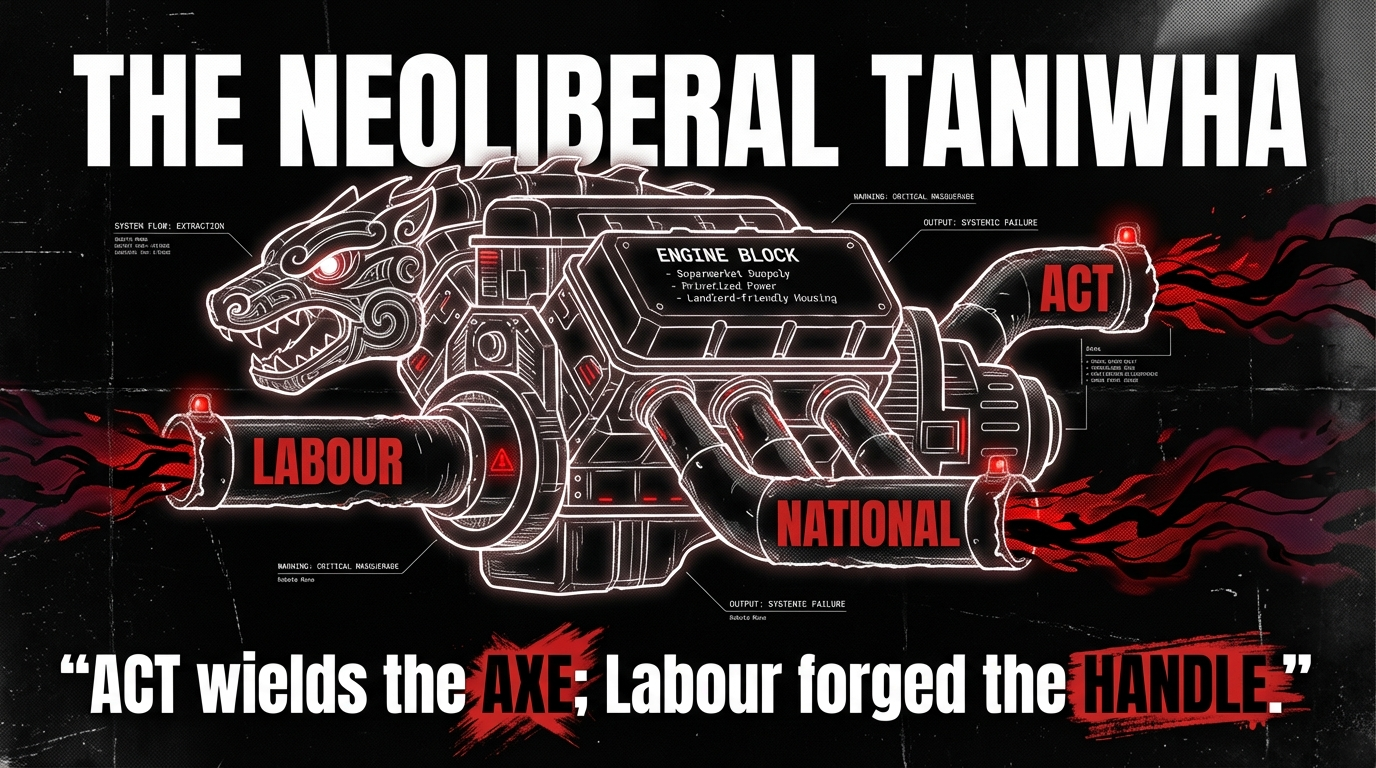
In “The ‘Bad Advice’ Excuse,” I argue that Hipkins is not the enemy of neoliberalism; he is its perfect front‑man: fluent in te reo phrases and compassion, ruthless in protecting the status quo when the cameras are off, as dissected in that Substack piece. ACT and National wield the axe; Labour forged the handle and insists on taking a photo with the stump.
Treaty, partnership and the “kind” face of white supremacy
On MATA and at Waitangi, Hipkins leans heavily on “partnership,” “mahi tahi” and “common ground.” He repeats the line that non‑Māori have “nothing to fear and much to gain” from honouring Te Tiriti, a message he used in 2023 at Waitangi, reported by 1News. He speaks of a 2040 where outcomes in health, education and housing are more equitable, and where there is a “more united view” of Te Tiriti, framing conflict as misunderstanding rather than structural theft, as you hear in his RNZ MATA interview.
Meanwhile, the Treaty Principles Bill aims to redefine those very principles unilaterally, replacing decades of jurisprudence with a Crown‑written list, justified as “equality” by Seymour and condemned by submitters as designed to “subjugate, humiliate, assimilate and oppress iwi Māori,” as reported in submissions coverage by RNZ. Analysts at e‑Tangata and international outlets like Al Jazeera have described it as a frontal attack on the Treaty settlement framework and Māori rights.
Hipkins’ answer to this on MATA is not “we will entrench Te Tiriti” or “we will guarantee a Māori veto over such bills.” Instead, he offers vibes: “mahi tahi,” “shared values,” “we must work together.” In “Imported Death” and my Treaty Principles Bill breakdown, I argue that this is the “kind” face of white supremacy:
- Keep the constitutional scaffold the same—Parliament supreme, Te Tiriti non‑entrenched.
- Wrap it in te reo, kapa haka and talk of partnership.
- Refuse any hard commitments that would give Māori real power to stop bills like ACT’s, even when your own officials warn they may breach Te Tiriti and international law, as per the 1News leak.
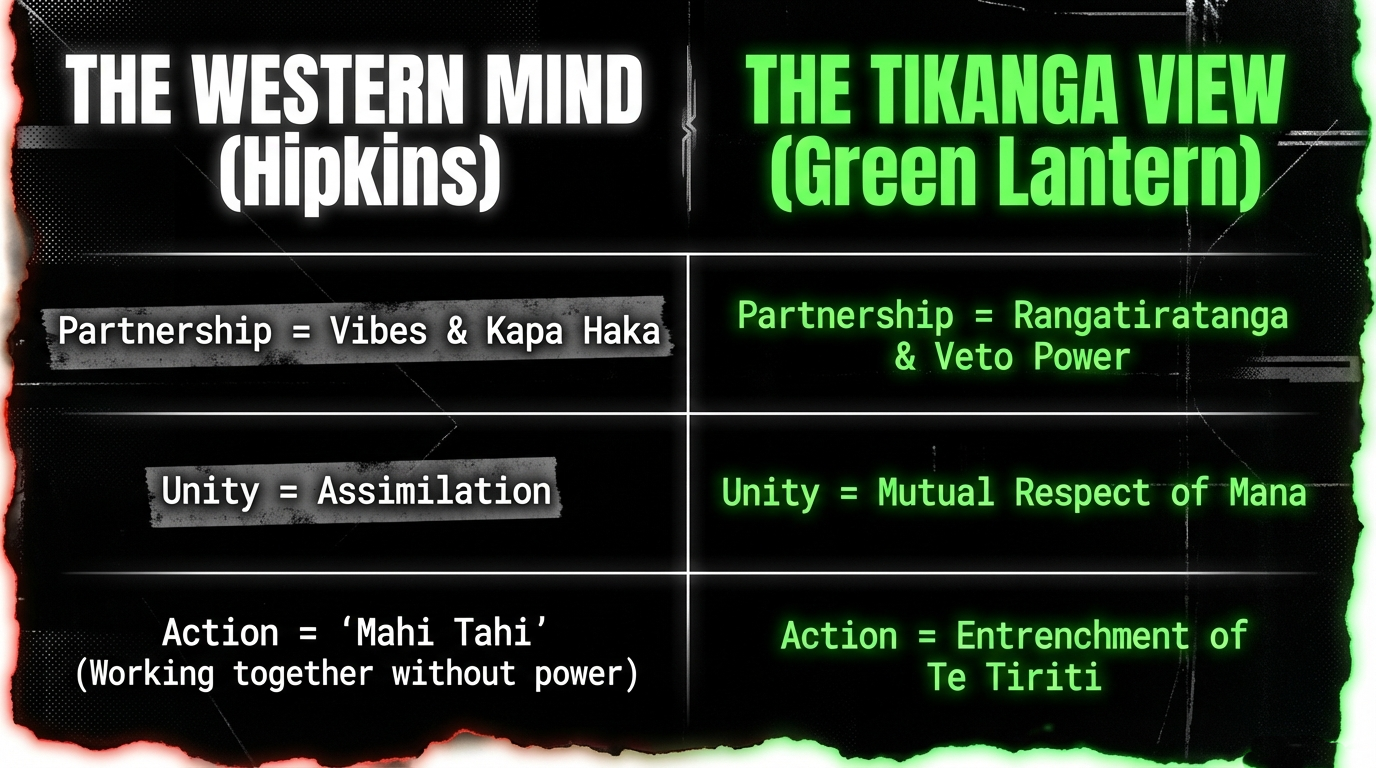
Tikanga vs the western mind:
- Under tikanga, partnership without rangatiratanga is a lie. A relationship that lets one party unilaterally rewrite the founding agreement and dismantle shared institutions is a breach of tapu and mana.
- Under western liberalism, it’s “pragmatic politics.” The MATA interview is a masterclass in this: he uses tikanga language to sell a Pākehā constitutional reality.
Punishing Māori resistance and exporting death
The MATA kōrero sits inside a wider machinery of punishment and neglect.
- When Te Pāti Māori MPs used haka in the House to oppose the Treaty Principles Bill, the Privileges Committee recommended severe suspensions without pay, a move critics saw as racially disproportionate and punitive towards Māori protest, as analysed by RNZ’s “The House” and in coverage of proposed punishments by RNZ.
- Māori health inequities remain stark; Te Aka Whai Ora was established in response to decades of evidence that mainstream systems failed Māori, as noted in 2022 coverage of Māori structural gains by 1News and reinforced in Te Aka Whai Ora’s own performance reports, like its Q3 2023/24 report. The Tribunal now confirms that disestablishing it causes serious and potentially irreversible prejudice, as outlined by the Waitangi Tribunal.
In “Imported Death,” I call this what it is: a deliberate policy architecture that exports death into Māori communities. Numbers: 35,000 crisis cases a year; one‑third of young people waiting more than three weeks for help; Māori heavily over‑represented; funding still nowhere near proportional; and a government that responds by dismantling a Māori health authority and shaving millions off frontline mental health, as detailed with references in that Substack essay. Hipkins’ Labour had years to reverse this trajectory. They did not.
From metaphors to mana motuhake: what real change would look like
If we strip away the metaphors, real solutions require breaking the bipartisan neoliberal consensus.
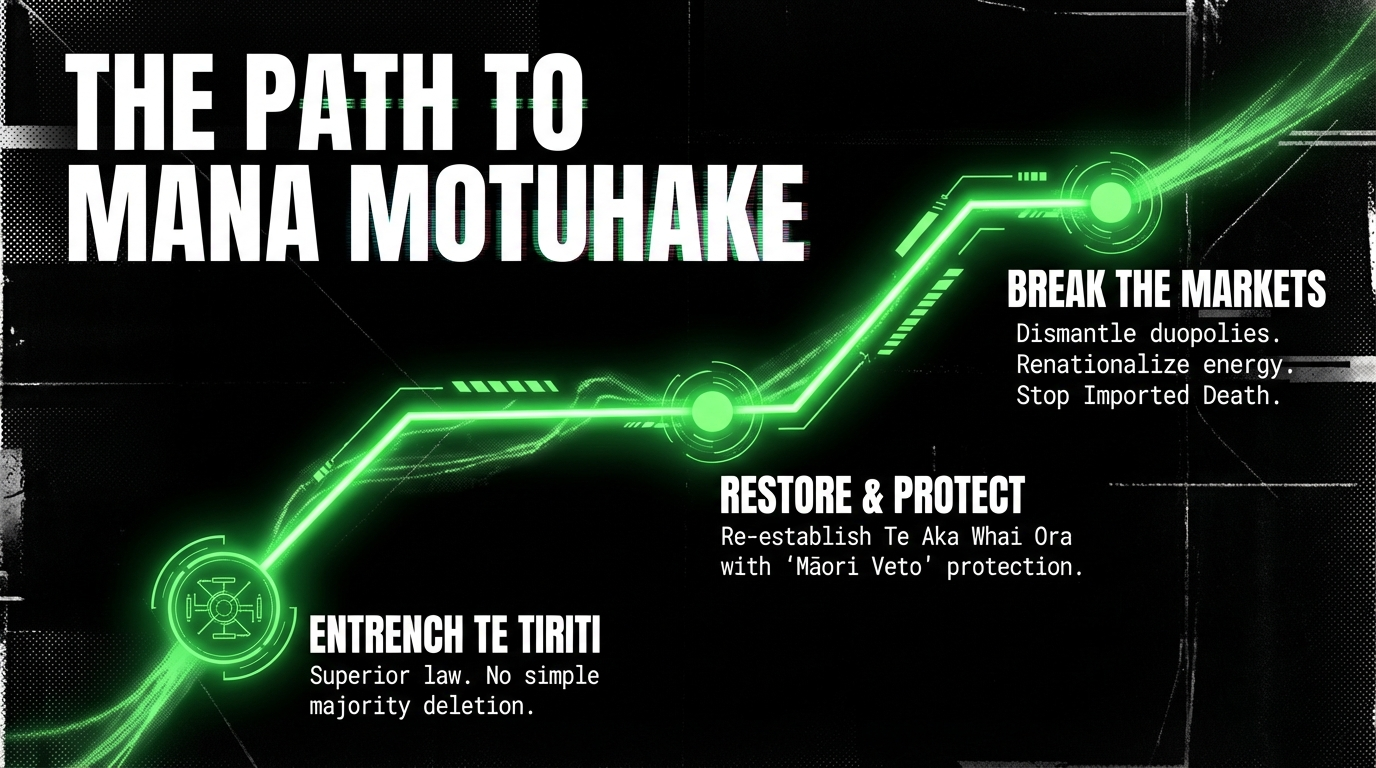
Entrench Te Tiriti and rangatiratanga
Embed Te Tiriti as a superior, entrenched constitutional clause that no simple majority can override, making racist projects like the Treaty Principles Bill impossible. The Ministry of Justice’s warnings and mass mobilisation against the Bill, as shown by 1News and analysed by e‑Tangata, provide both legal and political cover to do this—if there was political will.
Restore and protect Te Aka Whai Ora properly
Re‑establish Te Aka Whai Ora with Treaty‑anchored protections that prevent any future government from dismantling it without Māori consent and a robust Treaty‑consistency process, as the Waitangi Tribunal’s findings justify, documented on the Tribunal’s site.
Break neoliberal markets and co‑own key infrastructure
Dismantle the grocery duopoly, renationalise or co‑own energy with iwi, and move essential services out of profit‑first logics. Even Hipkins admits the markets aren’t working, as he concedes on RNZ’s MATA, and Budget coverage shows how shareholder‑first systems keep driving up costs, as discussed by RNZ.
Māori control, not just Māori delivery
Shift from “devolution of funding” to genuine Māori control over design, metrics and enforcement. This means embedding tikanga‑based measures—mauri, mana, whanaungatanga—into law and funding criteria, as I propose in “Imported Death,” where I outline how current frameworks force Māori providers into Pākehā box‑ticking while carrying disproportionate crisis load, in that essay.
Until those shifts happen, Labour is not an ally. It is simply the soft‑spoken head of the same neoliberal taniwha that ACT and National represent more openly.
Koha: fuelling our own green lanterns
Every koha to this kaupapa is a refusal to be lulled by red‑tie metaphors while our institutions are dismantled and our people are fed into the gears of imported death.
It says: we see the machine that disestablishes Te Aka Whai Ora to save millions, redirects mental health funding into “innovation” schemes, and tells us to trust “devolution” and “partnership,” as documented by Manatū Hauora and condemned by the Waitangi Tribunal.
Every koha signals that whānau are ready to fund the accountability that Crown and corporate structures will not provide. It signals that rangatiratanga includes the power to fund our own truth‑tellers, who will name names, dissect interviews like Hipkins’ MATA appearance with RNZ, and map the direct line from pretty rhetoric to policy harm, as I do in “Bad Advice,” “Imported Death” and “Manufactured Cruelty” on The Māori Green Lantern Substack.
If you are able, consider a koha to ensure this voice continues. If you are unable to koha, kei te pai – subscribe or follow The Māori Green Lantern on Substack, kōrero, and share with your whānau and friends. That is koha in itself.
Three pathways exist:
- Koha platform: Koha—Support.
- Substack subscription: Subscribe to the Māori Green Lantern on Substack.
- Direct bank transfer: HTDM, account number 031546-0415173-000.
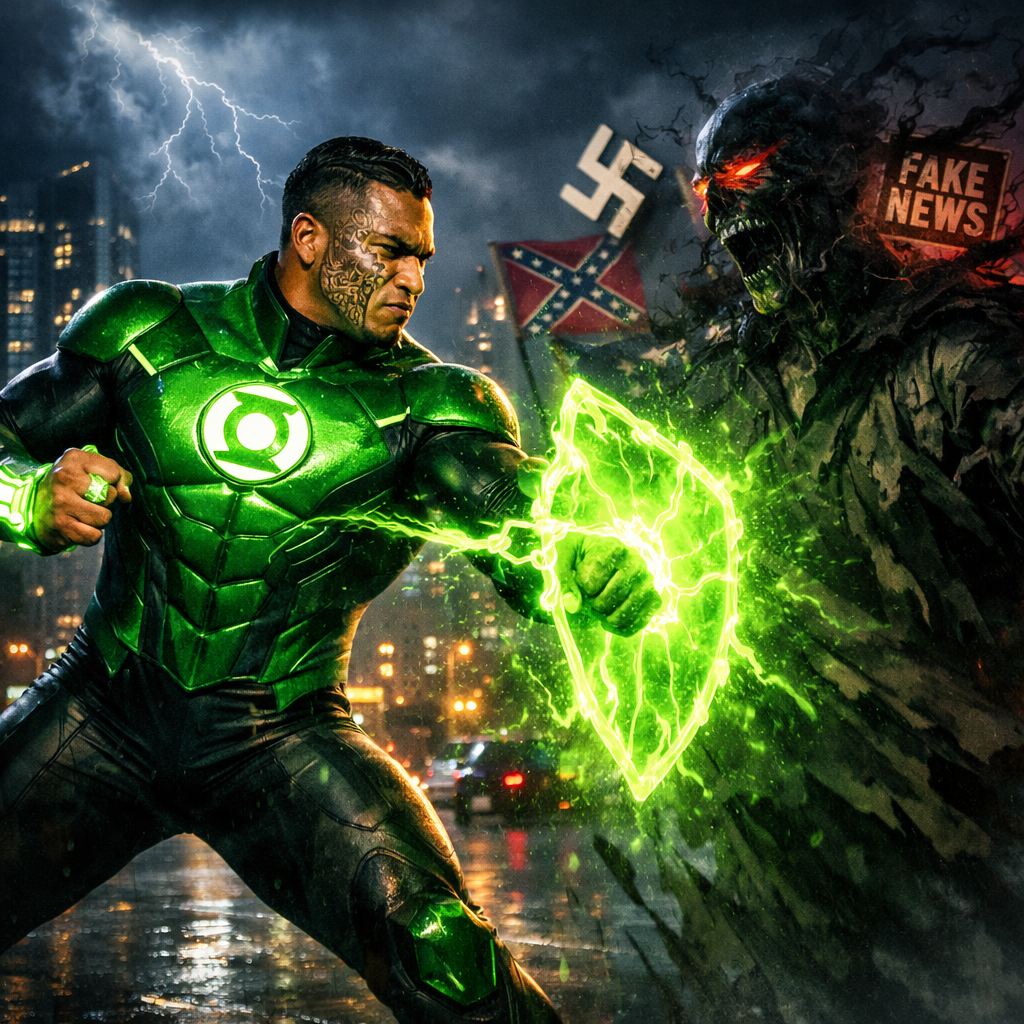
Ivor Jones The Māori Green Lantern Fighting Misinformation And Disinformation From The Far Right