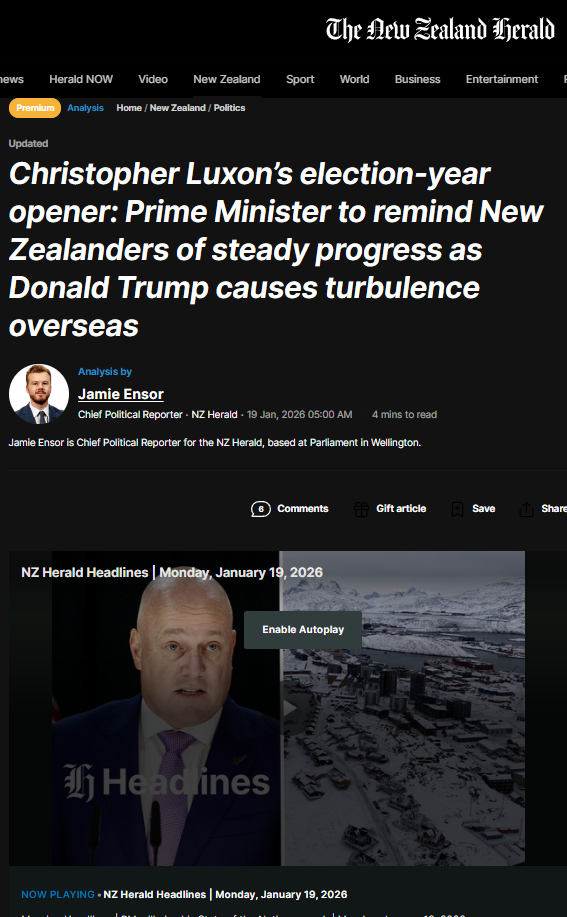
“Christopher Luxon’s State of the Nation: A Masterclass in Political Cowardice and Economic Failure” - 19 January 2026
Tēnā koutou katoa.
I greet you all as we gather to bear witness to a government that has forsaken the fundamental principles upon which manaakitanga, integrity, and honest stewardship are built.
This essay addresses a prime minister and his cabinet whose governance has betrayed the taonga of truth itself—who manipulate data as casually as a thief handles stolen goods, who break promises to their own people with the ease of someone snapping kindling, and who cower before foreign power rather than stand firm in defence of international law and manaakitanga.
Christopher Luxon leads a government that treats the democratic process not as a sacred trust but as a transaction to be managed like quarterly earnings. In te ao Māori, we understand that leadership carries the weight of aroha (compassion), kaitiakitanga (guardianship), and tika (righteousness).
This administration embodies none of these.
Instead, it has embraced the hollow corporate language of profit margins and efficiency targets, the language of a man who spent 16 years abroad and returned to a New Zealand he no longer understands.
What follows is not merely political criticism but a reckoning with what happens when an empty suit in a suit occupies the highest office in the land.
Christopher Luxon’s election-year speech represents the desperate flailing of New Zealand’s most unpopular prime minister in modern history—a leader whose net favourability has cratered to -24 points, as reported by political analyst Bryce Edwards, whose economic stewardship has delivered the developed world’s worst GDP performance, and whose government manipulates crime statistics while breaking fundamental promises to New Zealanders.
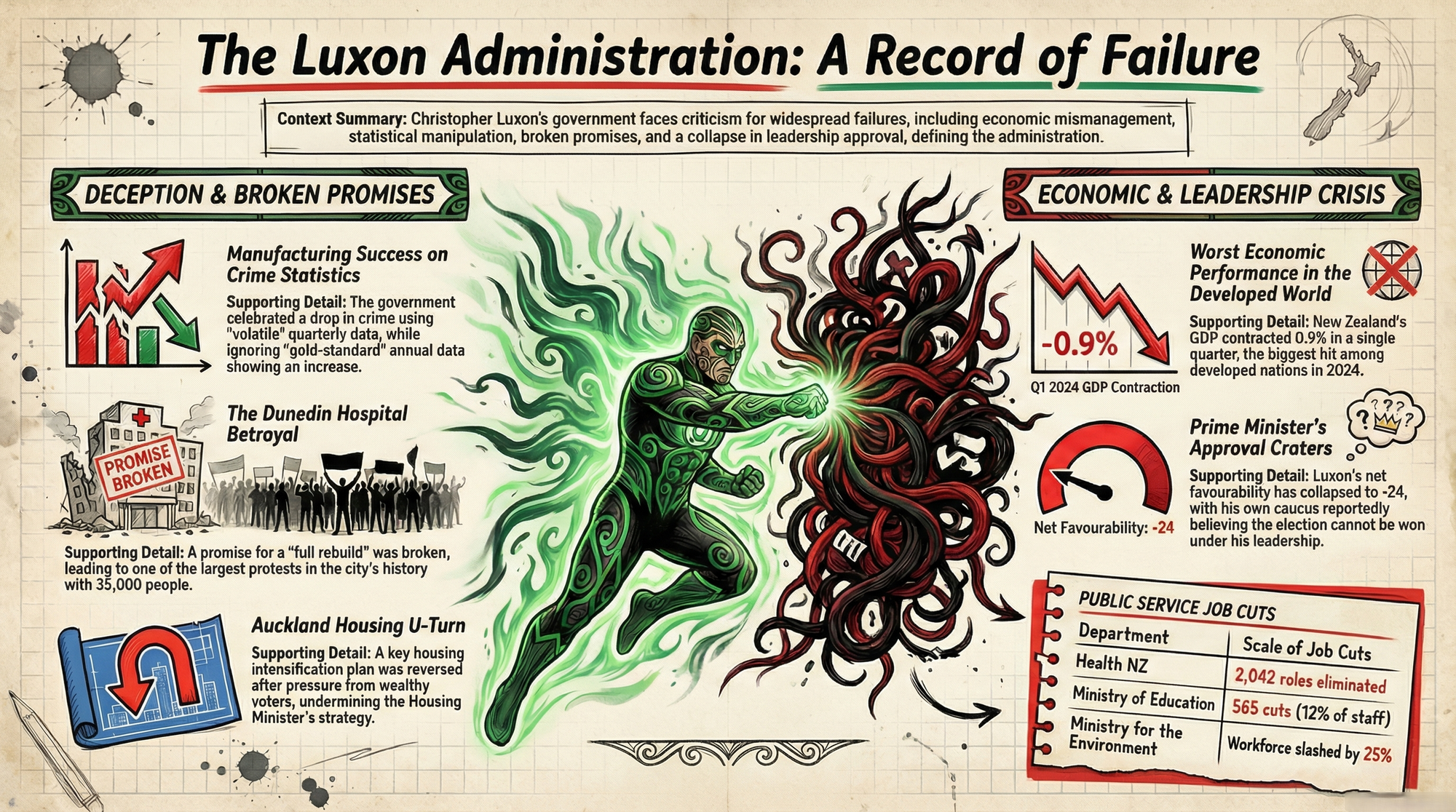
This analysis examines how a corporate executive utterly lacking in political skill or moral courage has presided over an administration characterized by data manipulation, policy reversals, international humiliation, and coalition chaos.
The Leadership Vacuum: An Emperor With No Political Clothes
Communication Incompetence as National Crisis
Luxon’s inability to communicate extends beyond mere stylistic awkwardness—it represents a fundamental failure to connect with the electorate he purports to serve. His now-viral interview with Jack Tame, where he robotically repeated “What I would say to you Jack” 26 times, as documented in Bryce Edwards’ Democracy Briefing, perfectly encapsulates a leader trapped in corporate-speak platitudes while lacking authentic political instinct. This wasn’t an isolated incident. When Mike Hosking—a typically sympathetic interviewer—spent three minutes attempting to extract a simple yes-or-no answer about the Andrew Bayly saga, as reported by the NZ Herald, Luxon’s evasiveness exposed a leader incapable of direct accountability.
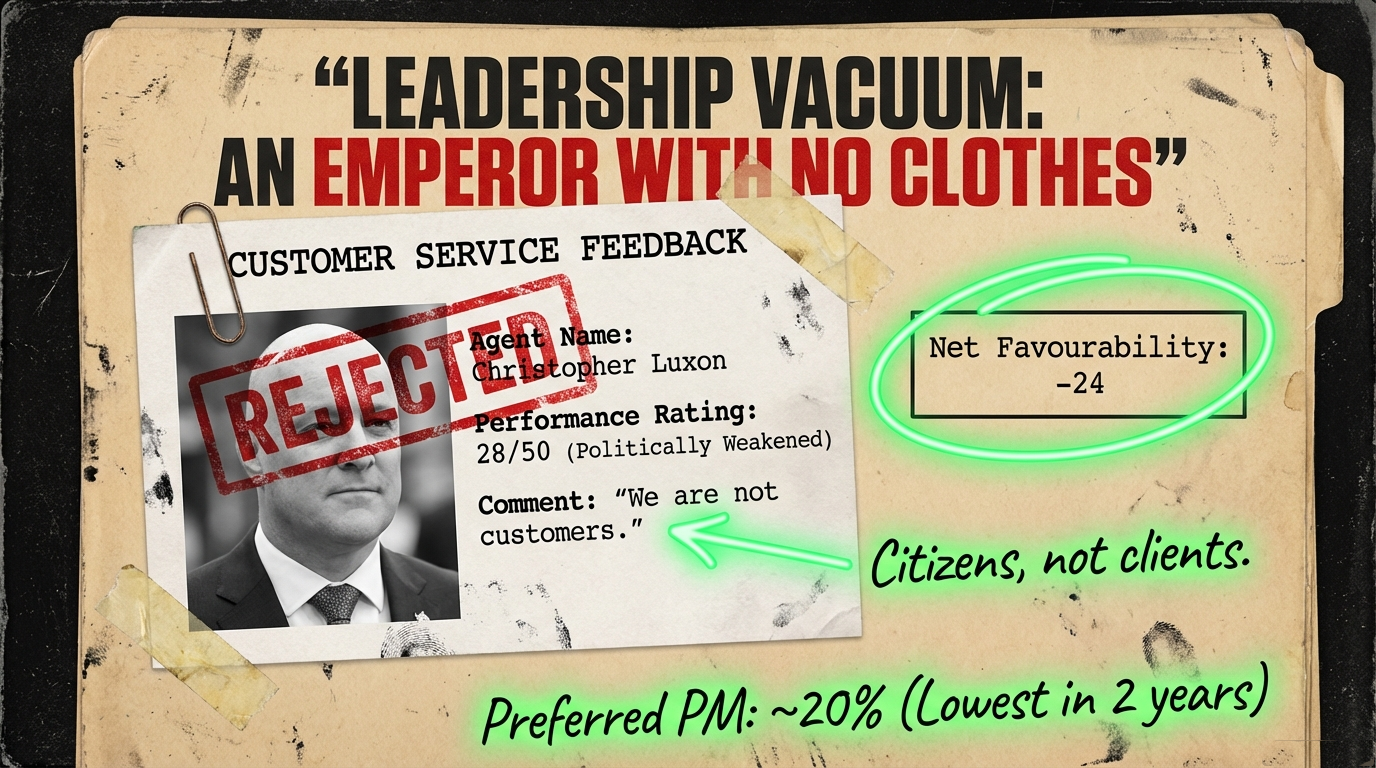
The damage runs deeper than poor optics. When Luxon referred to New Zealanders as “customers”—a Freudian slip revealing his transactional view of citizenship—he confirmed what 51% of voters already believe: he is fundamentally out of touch. This isn’t the language of democratic leadership; it’s the vocabulary of a CEO who views governance as customer service management rather than public stewardship, as 1News reported.
The Polling Catastrophe: Numbers Don’t Lie
The electoral verdict on Luxon’s leadership is unambiguous and devastating. His preferred prime minister rating has collapsed to 20-21%, the lowest in two years, while his net approval sits at -14—the worst since he assumed office, according to 1News Verian polling and NZ Herald reports. These aren’t normal mid-term blues; they represent a structural rejection of Luxon’s leadership capacity. As right-wing commentator Matthew Hooton—no friend of Labour—observed in his analysis, the consensus within National’s caucus is that “the election cannot be won under Luxon.” Political analyst Luke Malpass called the numbers “devastating” and “a damning indictment,” while Heather du Plessis-Allan quipped that Luxon’s support is “so low it’s almost drilling through to China.”
The Leadership Capital Index, an academic measure of prime ministerial effectiveness, rated Luxon at just 28 out of 50—categorizing him as “politically weakened,” as reported by 1News. He scores poorly on communication performance (2/5), parliamentary effectiveness (2/5), and emotional intelligence, while his “moderate” policy performance masks deeper failures in execution. By November 2025, his own caucus reportedly discussed replacing him with Housing Minister Chris Bishop, a conversation that reveals the depth of internal dissatisfaction, according to Bernard Hickey’s analysis.
Personal Judgment: The Rent Scandal and Hypocrisy
Luxon’s political missteps extend into personal conduct that reeks of entitlement. The revelation that he charged taxpayers $52,000 annually to rent his own Wellington apartment while Premier House underwent refurbishment provoked public outrage—forcing him to repay the money only after being exposed, as documented by Bryce Edwards. This wasn’t merely optics; it demonstrated tone-deafness from a millionaire prime minister lecturing public servants about fiscal restraint.
Similarly damaging was the disclosure that Luxon received taxpayer-funded te reo Māori lessons while his government stripped similar funding for public servants—hypocrisy so blatant that even Labour leader Chris Hipkins called it “absolute hypocrisy,” as reported by 1News. When Luxon described previous government trade delegations as “C-list,” only to include many of the same companies in his own missions, he revealed both arrogance and incompetence, according to the NZ Initiative.
The Crime Statistics Deception: Manufacturing Success Through Data Manipulation
The Shell Game: How Government Plays with Numbers
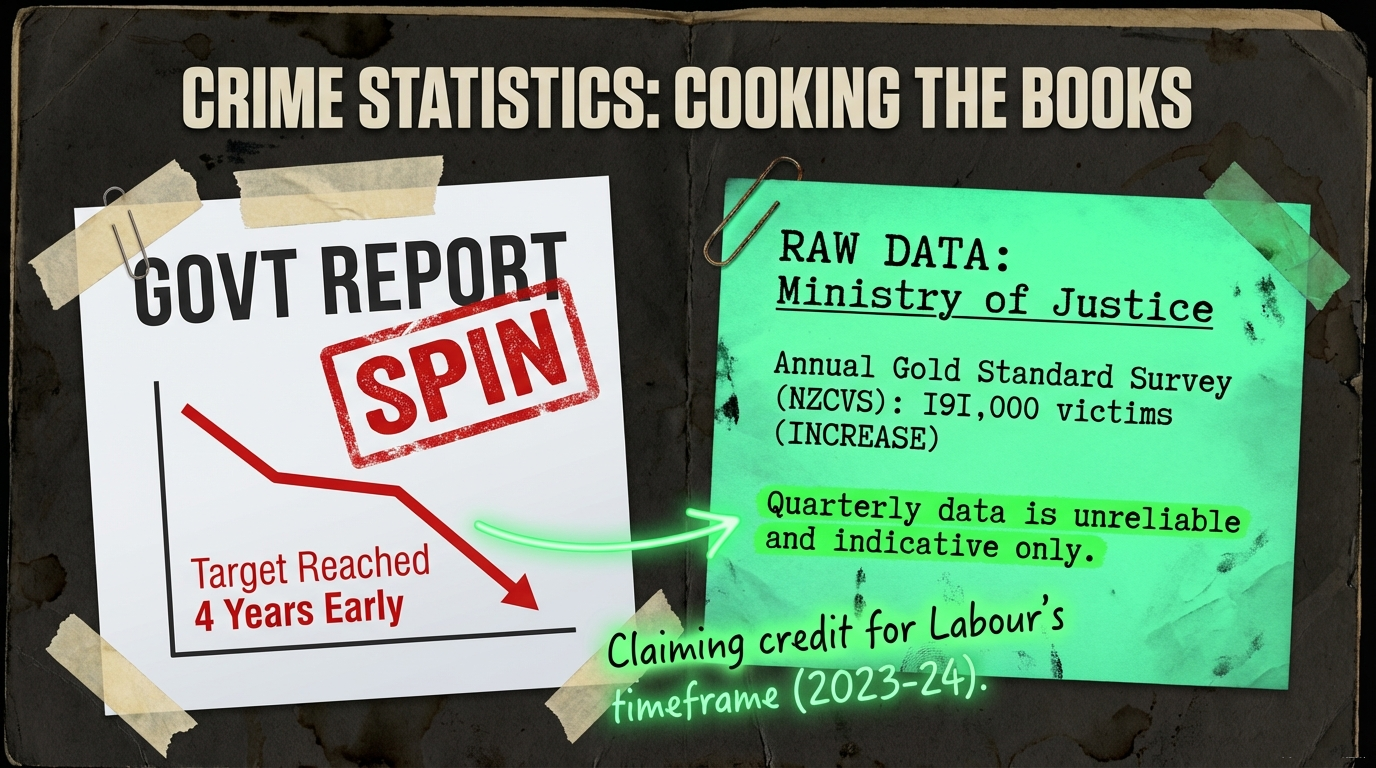
The Government’s celebration of declining violent crime represents one of the most brazen examples of statistical manipulation in recent New Zealand political history. As NZ Herald journalist Derek Cheng exposed in his analysis titled “Take your pick—violent crime is up 7% or down 21%,” the Government has cherry-picked data to manufacture a success narrative that crumbles under scrutiny.
Here’s what actually happened: In February 2025, the Ministry of Justice released the authoritative annual New Zealand Crime and Victims Survey (NZCVS) Cycle 7 results showing 191,000 violent crime victims—an increase from the baseline of 185,000, though not statistically significant, as The Spinoff reported. The Government issued no press release about this most reliable, “gold-standard, statistically sound” data point.
Two months later, in April 2025, ministers Paul Goldsmith and Mark Mitchell held a press conference celebrating a quarterly datapoint of 157,000 victims, claiming they had already achieved their 2029 target four years early and attributing this to their “tough on crime” policies, according to RNZ. The problem? The Ministry of Justice explicitly warns that quarterly data is “volatile” and “indicative only,” with methodology differences that make it unreliable for declaring significant change. The ministry “does not recommend referring to differences between the annual estimate and quarterly datapoints as statistically significant.”
The Timing Fraud: Taking Credit for Labour’s Period
Even more damning, the timeframes for this “success” span periods when Labour was in government. As Goldsmith himself admitted, “this survey covers a 24-month period, so we will continue to see the results of Labour’s soft on crime approach filter through at points,” as reported by RNZ. In other words, when pressed on timing, ministers acknowledged the data reflects crime trends from 2023-2024—yet they simultaneously claimed credit for reductions driven by policies that haven’t even been implemented.
The Government’s signature Three Strikes legislation and sentencing reforms had not come into force when they declared victory, according to The Spinoff’s analysis. When journalists pointed this out, Goldsmith resorted to claiming success based on “the vibe”—the notion that merely signaling toughness deters crime, as reported in the NZ Herald. This isn’t evidence-based policy; it’s magical thinking dressed in ministerial press releases.
The Dunedin Hospital Betrayal: When Promises Mean Nothing
The Scale of Broken Faith
Few broken promises demonstrate the Luxon Government’s fundamental dishonesty more starkly than the Dunedin Hospital debacle. During the 2023 election campaign, National explicitly promised to deliver the “full rebuild” of Dunedin Hospital, committing to “all the beds, operating theaters and imaging services that had previously been trimmed from the project,” as the NZ Herald reported. Health Minister Shane Reti confirmed this promise in June 2024, stating the government was “committed” to its election pledge, according to RNZ.
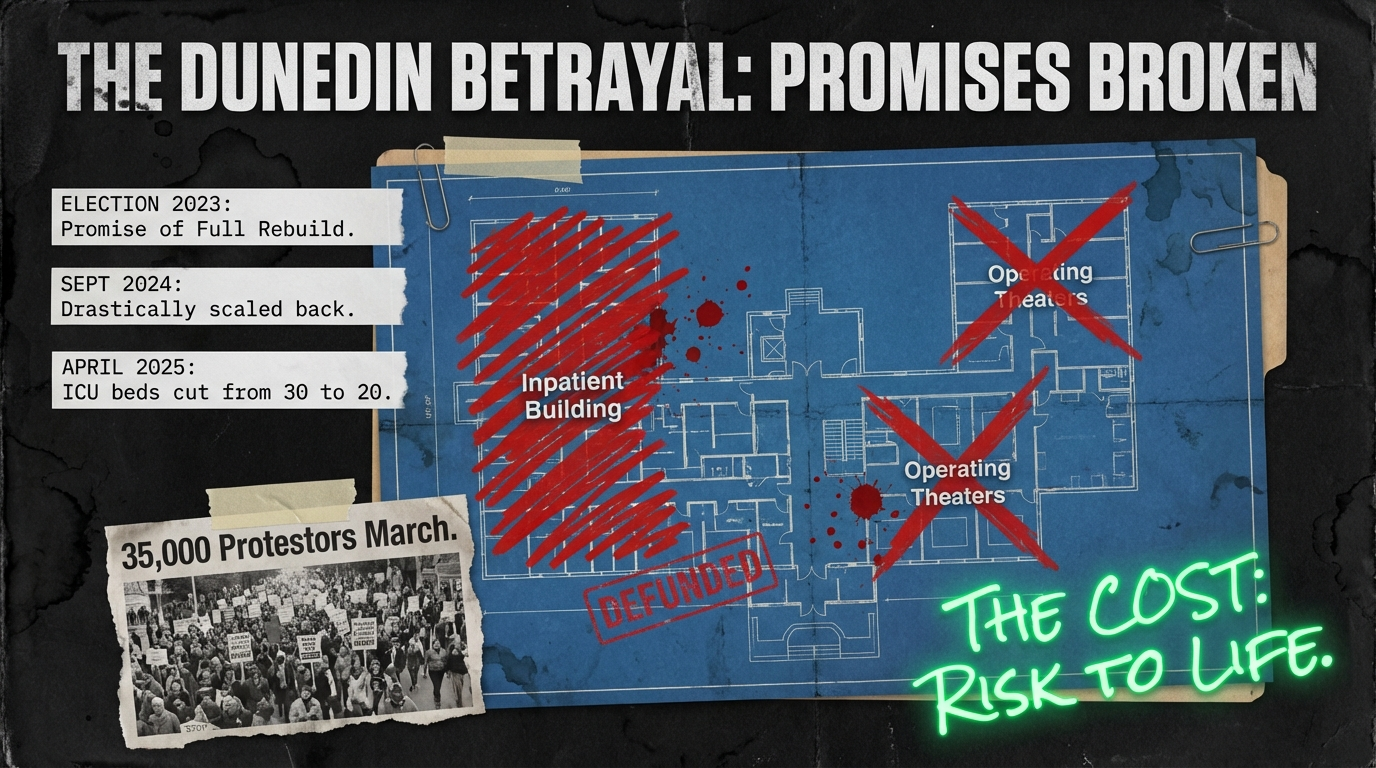
Nine months later, in September 2024, ministers Chris Bishop and Shane Reti announced the project would be “drastically scaled back,” with options including dumping the new inpatient building altogether in favor of retrofitting the crumbling old hospital, as YouTube footage documented. The rationale? Costs had allegedly ballooned toward $3 billion—a figure opposition leader Chris Hipkins derided as manufactured.
The backdown provoked fury. An estimated 35,000 people—roughly one-quarter of Dunedin’s population—marched through the city streets in protest, one of the largest demonstrations in the city’s history. Dunedin Mayor Jules Radich called the decision “outrageous” and a “broken promise,” stating the government’s actions “would amount to clinical cuts,” as the Otago Daily Times reported. The New Zealand Nurses Organisation begged the government to honor its commitment, warning that “money’s their priority” over patients and that the cuts would kill people, according to RNZ.
The ICU Bed Deception
Even after Luxon eventually committed to building the hospital (following sustained public pressure), the betrayals continued. In April 2025, it emerged that Health New Zealand had quietly cut the number of intensive care unit beds from the originally planned 30 to just 20 on opening day—a one-third reduction in critical care capacity, as RNZ reported. Former Dunedin Hospital emergency department head Dr. John Chambers warned this would lead to surgery cancellations and patients stranded in emergency departments without ICU beds.
The hospital saga reveals a government willing to promise anything to win votes, then systematically dismantle commitments once elected. After two years of “broken promises, cuts and stalling,” Labour health spokesperson Ayesha Verrall noted, the government finally signed a construction contract with the same contractor and leadership as under Labour—the only difference being “the hospital won’t provide the same number of beds or facilities.” The Government had wasted two years during which Dunedin could have had improved health facilities.
The Housing Intensification U-Turn: Betraying Chris Bishop and Auckland’s Future
The Backdown
In January 2026, Luxon prepared to announce yet another major policy reversal—watering down Auckland’s Plan Change 120, which would have enabled capacity for 2 million homes over coming decades, as The Kaka reported. This represented a direct betrayal of Housing Minister Chris Bishop’s vision for addressing New Zealand’s housing crisis through intensification around the soon-to-open City Rail Link and transport corridors, according to The Spinoff’s analysis.
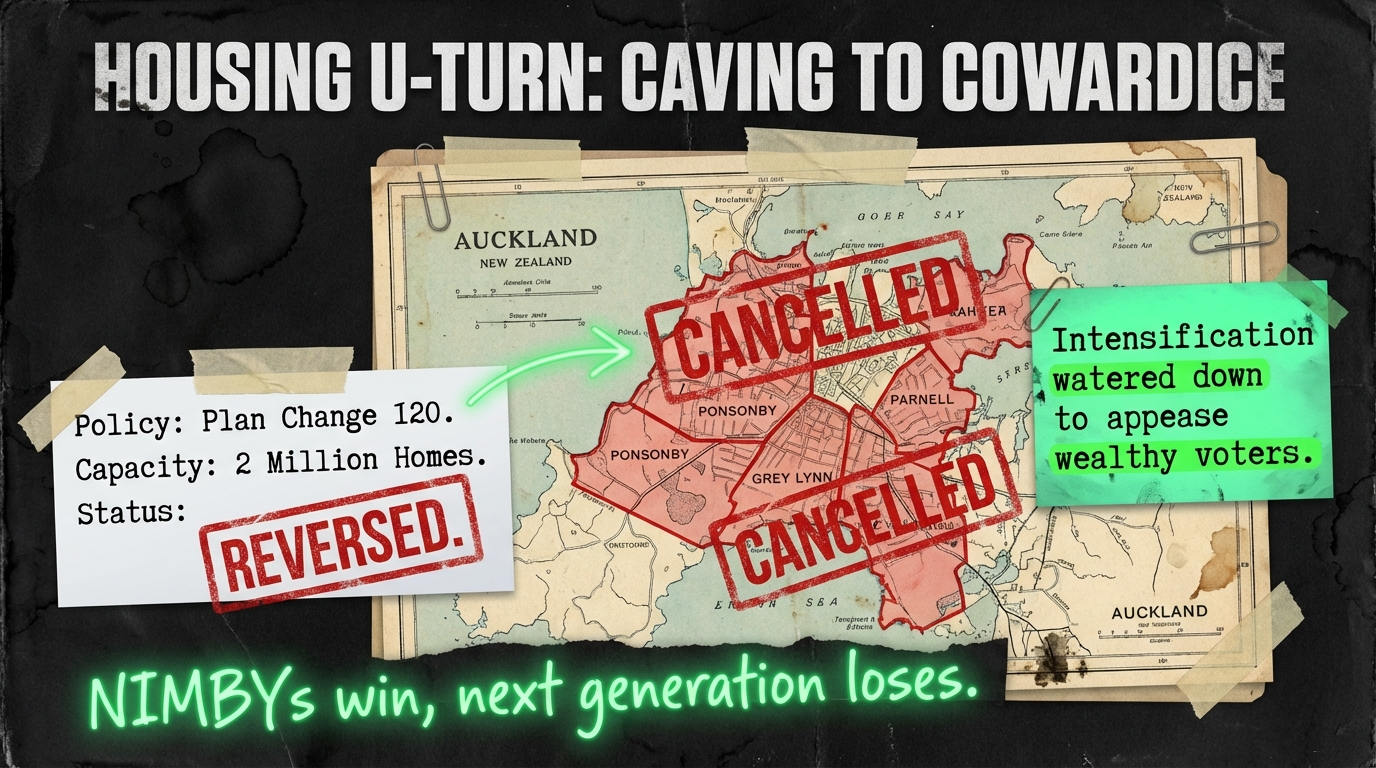
Matthew Hooton reported that Luxon had made a “captain’s call” to reverse Bishop’s key intensification policy after backlash from National MPs in Auckland representing leafy inner-city suburbs where wealthy voters opposed higher-density development, as the NZ Herald published. Former National Cabinet Minister Maurice Williamson publicly urged the government to pull back, warning that intensification was “leading to public anger that will cost the party votes at next year’s election,” as the NZ Herald reported.
The reversal epitomizes the Government’s political cowardice. Plan Change 120 represented the most significant housing reform since Auckland’s revolutionary 2016 Unitary Plan, which had enabled 900,000 additional homes and been celebrated internationally as a model for reducing housing costs. By allowing intensification in well-serviced inner suburbs with existing infrastructure, sewerage capacity, and proximity to employment, the plan offered a rational path to address Auckland’s housing shortage.
But Luxon caved to NIMBY pressure from National’s base—property-owning voters in Parnell, Ponsonby, and Mt Eden who valued neighborhood “character” over housing affordability for the next generation. As The Spinoff noted, this U-turn came halfway through Auckland Council’s planning process “without talking to us,” creating confusion and undermining years of technical work. Mayor Wayne Brown said he had received no communication from the government about the changes, highlighting the decision’s chaotic nature.
The Economic Catastrophe: Worst Performance in the Developed World
The GDP Disaster
New Zealand’s economic performance under Luxon represents an unmitigated disaster. In September 2025, Statistics New Zealand revealed that GDP had contracted 0.9% in the June quarter—three times worse than the Reserve Bank’s forecast of 0.3% decline, as The Spinoff reported. HSBC chief economist Paul Bloxham described New Zealand as suffering “the developed world’s biggest hit” in 2024, with annual GDP falling 0.5% that year.
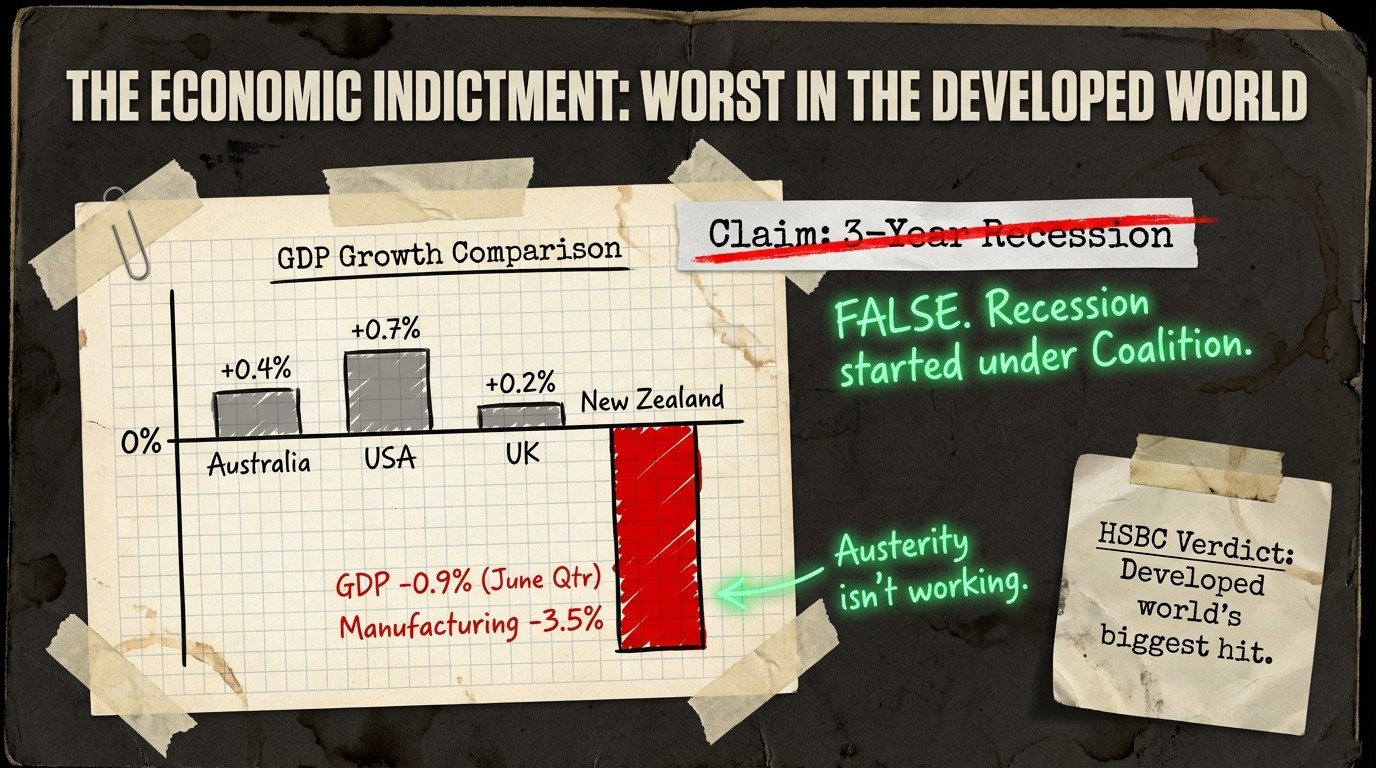
The manufacturing sector collapsed by 3.5%, construction fell 1.8%, and service industries flatlined. Unemployment climbed to 5.1%, the highest since 2020, with underutilization reaching 12.3%, as Waatea News reported. The public sector hemorrhaged 10,000 jobs as the government pursued aggressive austerity, including $80 million in severance payments.
Finance Minister Nicola Willis blamed global uncertainty from Trump’s tariffs for the June quarter contraction—an explanation economists dismissed as implausible. The quarter predated most of Trump’s major tariff announcements, and Australia—facing similar global conditions—grew 0.6% in the same period. Labour finance spokesperson Barbara Edmonds acidly noted that the coalition began 2025 declaring “going for growth” as its number one priority; instead, “under Christopher Luxon, New Zealand is heading in the wrong direction,” as Labour announced.
The Reserve Bank Blame Game
Multiple economists pinpointed the true culprit: the Reserve Bank’s prolonged high interest rate settings, which the Government enabled through contractionary fiscal policy. Kiwibank chief economist Jarrod Kerr stated bluntly: “Quite simply, the Reserve Bank has been mucking around. We need interest rates at stimulatory levels. And they could have done that back in May,” as reported by The Spinoff.
But the Government bears responsibility beyond monetary policy. Council of Trade Unions economist Craig Renney explained: “It’s in part a reduction in government investment, and in part, a loss of confidence because the government has gone around telling everyone that we need to tighten our belts. The effect of that is everyone has done as instructed, and as a consequence, people aren’t spending any money.”
The Government’s pro-cyclical fiscal stance—cutting spending during a recession—amplified economic pain. By slashing public sector jobs, reducing infrastructure investment, and creating an atmosphere of austerity, Luxon and Willis deepened the downturn their rhetoric claimed to fix.
The Dishonest Framing
Luxon’s response to economic failure demonstrates his willingness to mislead. In January 2025, he falsely claimed the economy had been “in recession for three years”—a statement Labour’s Barbara Edmonds called “frankly embarrassing for a Prime Minister,” as Labour documented. A recession is technically defined as two consecutive quarters of negative growth, which occurred only after the coalition took office. Edmonds observed: “Either Nicola Willis isn’t briefing him, or he’s not listening to her—either way it’s dysfunctional.”
When confronted with the September GDP figures, Luxon declared that Willis was “New Zealand’s best-ever finance minister”—a Trumpian assertion contradicted by every economic indicator, as the NZ Herald reported. The Government’s claimed achievements—meeting baseline savings targets through public service cuts—represented cost-cutting, not growth. As Treasury’s December update revealed, there remains “no surplus in sight,” with deficits deepening from $14 billion (2024/25) to $16.9 billion (2025/26) before narrowing to just $60 million in 2029/30.
The Public Service Devastation: Austerity’s Human Cost
The Scale of Job Losses
The Luxon Government’s assault on the public service represents the most severe contraction in decades, with approximately 10,000 positions eliminated since late 2023, as Waatea News documented. The cuts were mandated to deliver 6.5-7.5% annual savings—roughly $1.5 billion per year—through widespread restructures that combined confirmed redundancies, proposed eliminations, and vacancy freezes.
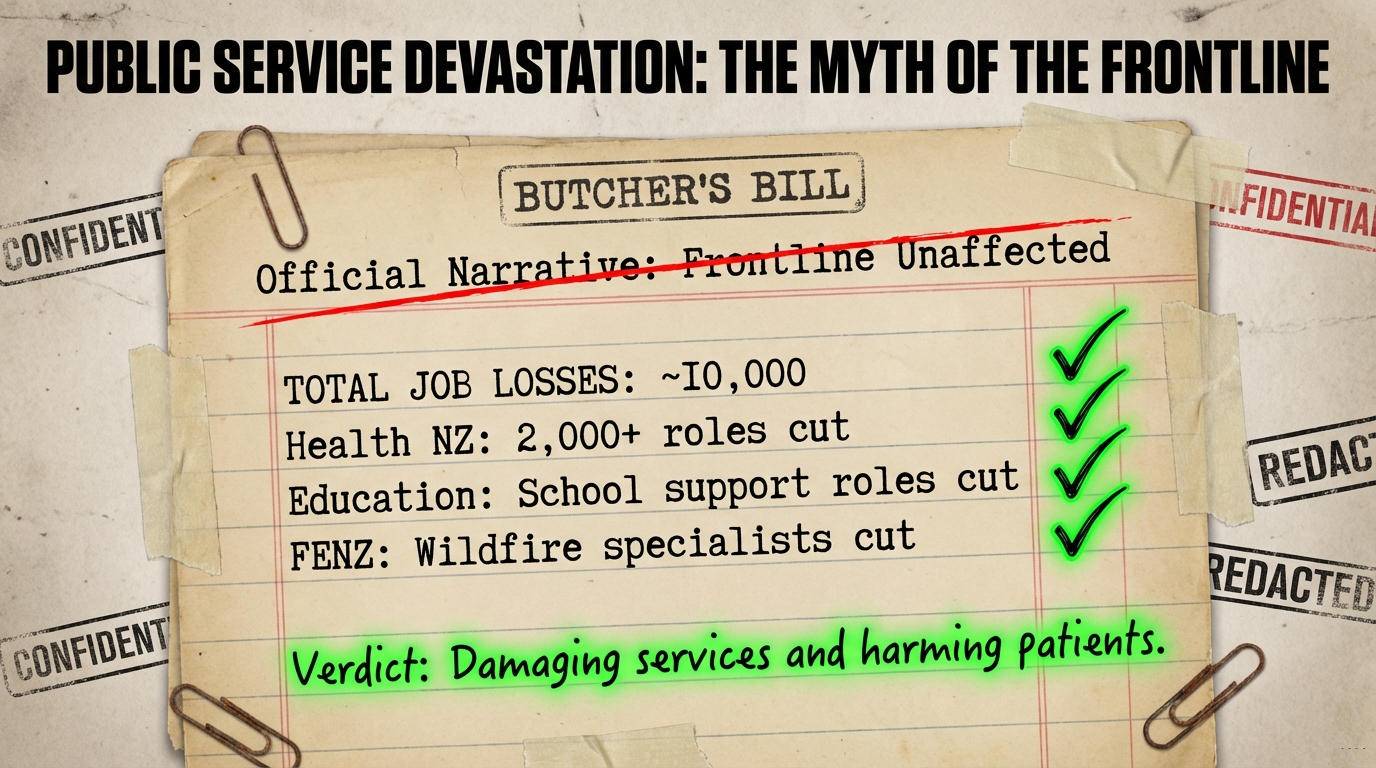
Major agencies bore devastating reductions:
- Ministry of Education: 565 cuts (12% of staff), affecting curriculum development, policy teams, and regional services—including nearly 100 roles directly supporting schools. The Public Service Association mounted a legal challenge over inadequate consultation.
- Health NZ (Te Whatu Ora): 2,042 roles eliminated since December 2024, including 500 redundancies and 1,500 digital/data positions, plus additional cuts to IT and HR teams.
- Ministry for the Environment: Workforce slashed by 25%, reducing from 988 to around 708 by 2026.
- Defence Force: 145 civilian staff accepted voluntary redundancy, with more cuts planned, as RNZ reported.
The human costs extend beyond Wellington. Over 400 regional roles were eliminated, with former public servants reporting “fierce competition for dwindling roles—hundreds applying for each job,” forcing many into unrelated work or emigration. The PSA warned of “brain drain” as highly skilled workers left permanently.
The “Frontline” Lie
The Government repeatedly promised that cuts would not affect frontline services—a claim exposed as demonstrably false. Healthcare workers reported in surveys that cuts were “damaging services” and “harming patients,” as RNZ reported. Fire and Emergency launched its biggest restructure in eight years, cutting at least 140 positions—including wildfire specialists—while facing criticism that it would “impact FENZ’s ability to deal with emergencies,” according to RNZ.
Education cuts eliminated roles supporting schools directly, despite ministerial assurances. Health service delivery suffered as restructures removed support staff that frontline workers depended on. Union officials described public servants’ wellbeing as “hit hard by government cuts,” with services to New Zealanders at risk, as RNZ documented.
Coalition Chaos: Two Tails Wagging the Dog
The Power Imbalance
Luxon’s coalition arrangements with ACT and New Zealand First have produced a government where the Prime Minister appears unable to assert authority over his junior partners. As The Conversation observed, with “two tails wagging vigorously,” the National-led government faces unique complexity and unpredictability. David Seymour has “questioned Christopher Luxon’s authority more than once,” while Winston Peters operates with apparent autonomy in foreign policy.
The starkest example remains the Treaty Principles Bill—an ACT initiative that Luxon agreed to support through first reading despite acknowledging it would proceed no further. This allocated six months of parliamentary time and hundreds of thousands of dollars in select committee resources to legislation the Prime Minister himself opposes—a capitulation that prompted Matthew Hooton to note Luxon’s “obliviousness” to Treaty issues stemmed from his 16-year absence from New Zealand (1995-2011), leaving him without understanding of the nation’s “economic, social, and ethnic challenges,” as Bryce Edwards documented.
Luxon’s unwillingness to censure underperforming ministers from coalition parties—notably NZ First’s Casey Costello—contrasts sharply with his demotion of National ministers Melissa Lee and Penny Simmons. This double standard signals weakness rather than coalition management, suggesting Luxon fears triggering coalition fractures more than he values ministerial competence.
Electoral Implications
As the 2026 election approaches and David Seymour assumes the deputy prime ministership in May 2026 (rotating with Peters), both minor parties will seek differentiation from National. The Interislander ferries dispute—where ACT favors minimum-cost public-private partnerships while NZ First demands railway-enabled replacements—previews the clashes ahead, as The Spinoff documented. Peters’ years of “one law for all” rhetoric positions him to exploit Seymour’s Treaty Principles Bill for electoral gain, potentially reigniting the “white-hot animosity” that historically characterized their relationship.
Foreign Policy Cowardice: The Venezuela Silence
The Invasion Response (or Lack Thereof)
On January 3, 2026, the United States launched a military intervention in Venezuela, seized President Nicolás Maduro and his wife, and declared that America would “run” Venezuela—including its oil reserves, as Wikipedia documented. The action represented a flagrant violation of international law, prompting immediate condemnation from Spain, Norway, and other nations.
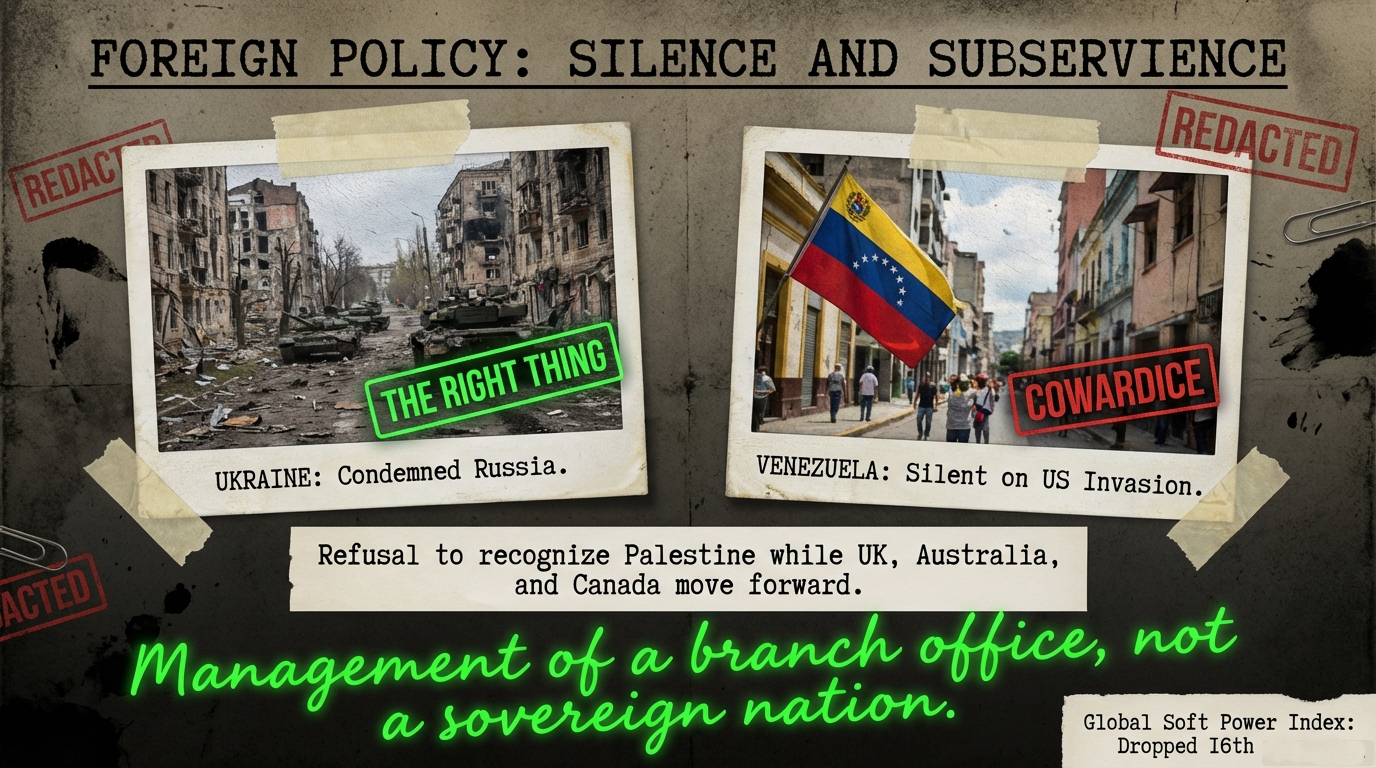
New Zealand’s response? Foreign Minister Winston Peters issued a tepid tweet expressing “concern” and calling on “all parties to act in accordance with international law”—without naming the United States or describing the intervention as such, as Bryce Edwards documented in Asia Pacific Report. Prime Minister Luxon said nothing. When journalists requested comment from the Prime Minister’s Office, they were referred back to Peters’ tweet, with Luxon declining to add anything further.
Professor Robert Patman of Otago University called the response “limp” and argued New Zealand’s statement should be “firm and robust,” as RNZ reported. Patman noted that “foreign policy in this country has been traditionally bipartisan. We have stood up for the rule of law internationally.” He warned that the days of “softly, softly diplomacy” with Trump—the assumption that “if we keep our heads beneath the radar, say nice things, have photo opportunities, he will soften”—were over.
The Double Standard and Its Consequences
The contrast with New Zealand’s response to Russia’s invasion of Ukraine is stark and morally indefensible. When Russia attacked Ukraine, New Zealand immediately condemned the action, imposed sanctions, and stood firmly with international law. Yet when the United States bombs a capital city, kidnaps a head of state, and announces it will seize another country’s resources, Luxon remains silent.
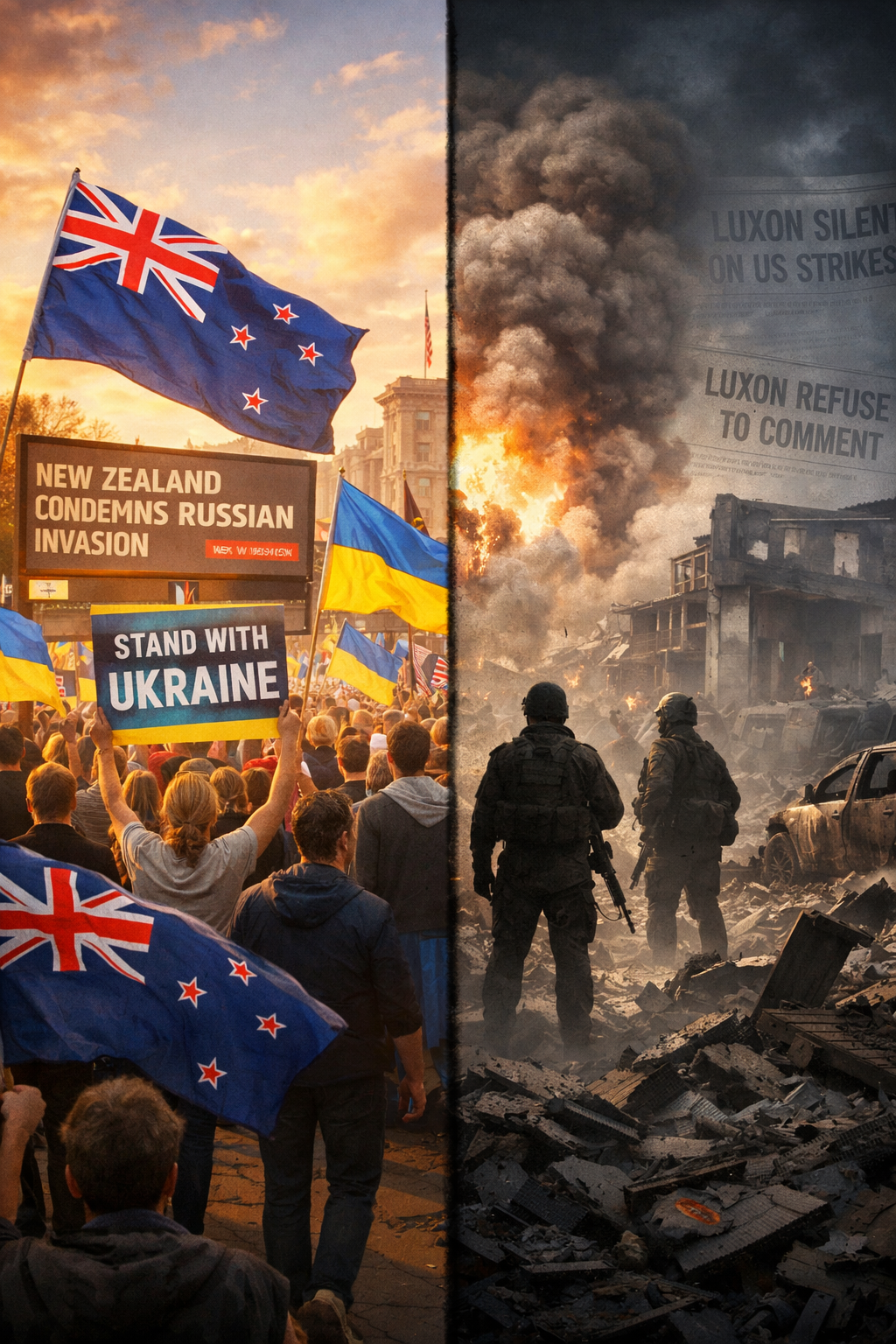
As independent geopolitical analyst Geoffrey Miller observed in Bryce Edwards’ piece, “Luxon will probably be grateful to escape the media spotlight by virtue of the weekend’s events falling in the depths of New Zealand’s typically elongated summer holidays.” The cowardice is breathtaking. Miller warned that the inconsistency “may come back to haunt them, particularly when it comes to their credibility with the Global South.”
He’s correct. Countries across Africa, Asia, and Latin America have watched Western nations lecture them about the rules-based international order while simultaneously excusing American violations. Beijing and Moscow will exploit this hypocrisy relentlessly, pointing to Venezuela whenever anyone raises Ukraine or Taiwan.
Palestine: Reputation in Tatters
The Government’s September 2025 decision not to recognize Palestinian statehood further damaged New Zealand’s international standing. While traditional allies Australia, Canada, and the United Kingdom all recognized Palestine that week, New Zealand refused—breaking from partners and abandoning decades of advocacy for a two-state solution, as 1News reported.

Former top diplomat Brook Keating predicted that “New Zealand’s reputation will take a hit as a result of this,” noting real disappointment among allies who “hoped that New Zealand would have—given its past history on this subject—been willing to move forward instead of staying stuck still,” as 1News documented. The decision placed New Zealand in the minority of nations worldwide that do not recognize Palestine—alongside the US, Israel, and a few Pacific nations.
The Broader Pattern: Reputation Collapse
New Zealand has dropped ten places—from 16th to 26th—on the Global Soft Power Index between 2021 and 2023, a measure of international influence through non-coercive means, as The Conversation reported. This decline threatens economic interests: “Brand New Zealand” drives $68.7 billion in goods exports, $15 billion in tourism spending, and $6 billion from international students. Damage to New Zealand’s clean, green, honest reputation “could potentially cost the country thousands of jobs, drive away talent, and dampen export growth.”

Greenpeace warned that Luxon’s “assault on nature and on Māori cannot last long,” with visitors and trading partners already questioning New Zealand’s clean-green credentials and progress on colonial reconciliation. The Government’s embrace of mining, seabed exploitation, and confrontational Treaty policies undermines the carefully cultivated national brand that underpins export competitiveness.
The Verdict on Failure
Christopher Luxon’s State of the Nation speech offers platitudes and distraction from a government defined by leadership failure, statistical manipulation, broken promises, economic catastrophe, and moral cowardice. At 51% of New Zealanders recognize him as out of touch, his net favourability at -24, and his own caucus discussing replacement, the electoral verdict is clear: this is a prime minister unsuited to office.
The crime statistics deception—celebrating volatile, unreliable quarterly data while suppressing authoritative annual figures that show increases—represents contempt for evidence-based governance. The Dunedin Hospital betrayal, with 35,000 people marching against broken promises, demonstrates that commitments mean nothing when politically inconvenient. The housing U-turn sacrifices Auckland’s future to appease NIMBY voters in leafy suburbs, betraying both Housing Minister Bishop and the next generation locked out of homeownership.
On economics, New Zealand suffered the developed world’s worst performance under Luxon’s watch—GDP contracting 0.9% in a single quarter while he falsely claims three-year recessions and praises Willis as the “best-ever” finance minister despite deepening deficits. The 10,000 public service jobs eliminated while pretending frontline services remain untouched exemplifies dishonesty as policy.
Most damningly, Luxon’s silence on Venezuela—refusing to condemn an American invasion while other nations upheld international law—exposes a foreign policy subordinated entirely to fear of American displeasure. When Spain’s prime minister and Norway’s foreign minister can clearly name violations that New Zealand’s prime minister dares not mention, the humiliation is complete.
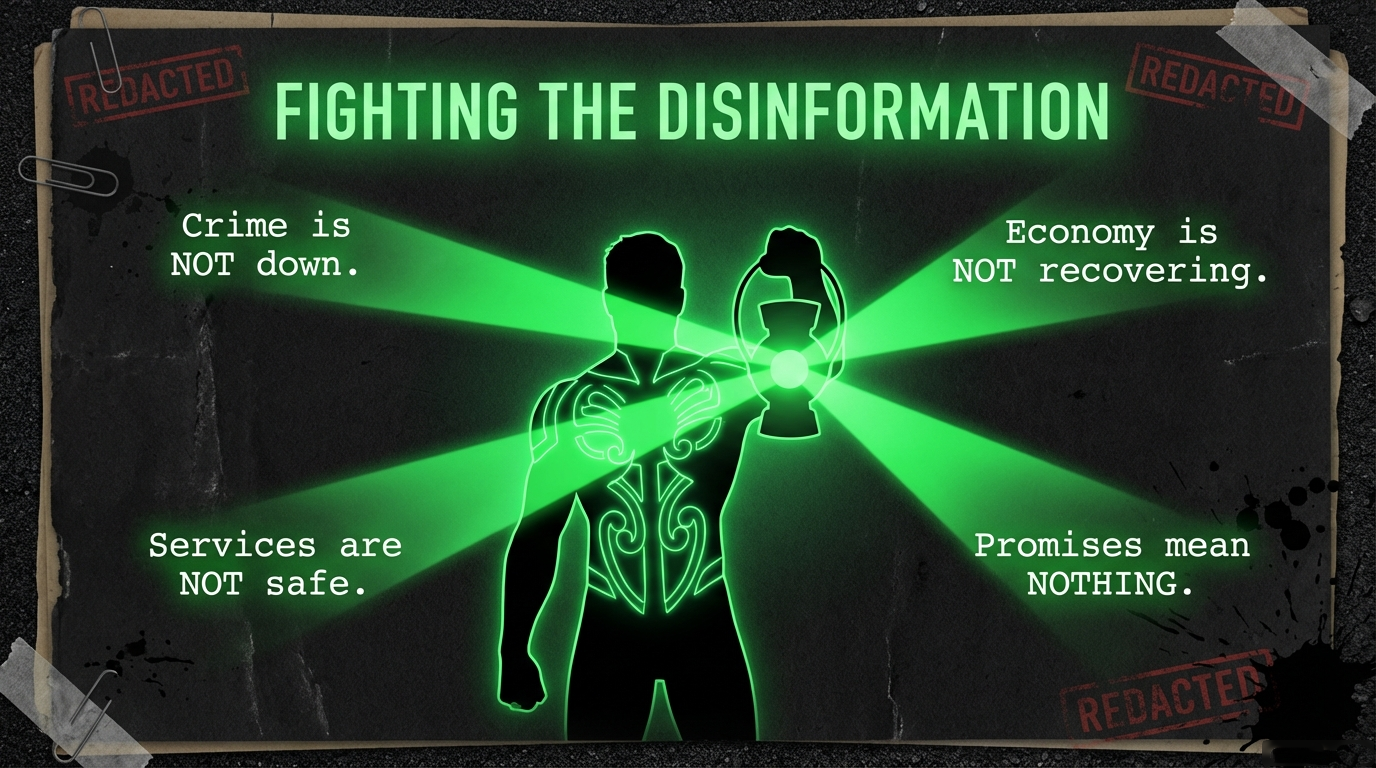
This is not the leadership of a sovereign nation. It is the management of a branch office, where the CEO treats citizens as customers, manipulates data to manufacture quarterly successes, breaks promises when expedient, and stays silent when the parent company violates rules it lectures others to follow. New Zealanders deserve governance characterized by honesty, competence, and moral courage. Under Christopher Luxon, they have received none of these.
The only question remaining is whether National’s caucus will find the courage to remove him before he leads them to electoral defeat—or whether voters will render that verdict themselves in 2026.
Koha Consideration: Funding Accountability on Luxon’s Government
Every koha signals that whānau are ready to fund the accountability that the Crown and its complicit media structures will not provide. Luxon’s government relies on the public’s exhaustion, on the hope that relentless data manipulation, broken promises, and foreign policy cowardice will blur together into background noise. It relies on the assumption that truth-telling requires resources most New Zealanders do not possess.
It doesn’t have to be this way. When you support independent analysis—rigorous, evidence-based, hyperlinked critique backed by the record—you reclaim rangatiratanga over the narrative. You declare that truth is not a commodity owned by the Prime Minister’s spin doctors or the corporate media that depends on government advertising. You signal that accountability belongs to whānau, not to structures designed to protect power.
This essay documents how a prime minister has criminally manipulated crime statistics, betrayed 35,000 Dunedin residents who marched against broken promises, presided over the developed world’s worst economic performance, and remained silent while America invaded a sovereign nation. These are not abstract criticisms. They are documented failures of governance—failures that demand scrutiny beyond what mainstream outlets will provide.
Three pathways exist to support this mahi:
- For direct koha (voluntary contribution): Visit the Koha platform to fund independent accountability journalism:
Support this analysis on Koha - For ongoing essays and deeper analysis: Subscribe to receive regular essays directly:
Subscribe to independent political analysis - For direct bank transfer: HTDM, account number 03-1546-0415173-000
Kia kaha, whānau. Stay vigilant. Stay connected. And if you are able, consider a koha to ensure that voices willing to name what others dare not speak continue to reach you. The Crown will not fund its own accountability. Neither will corporate media that depends on government favour.
That responsibility falls to us.

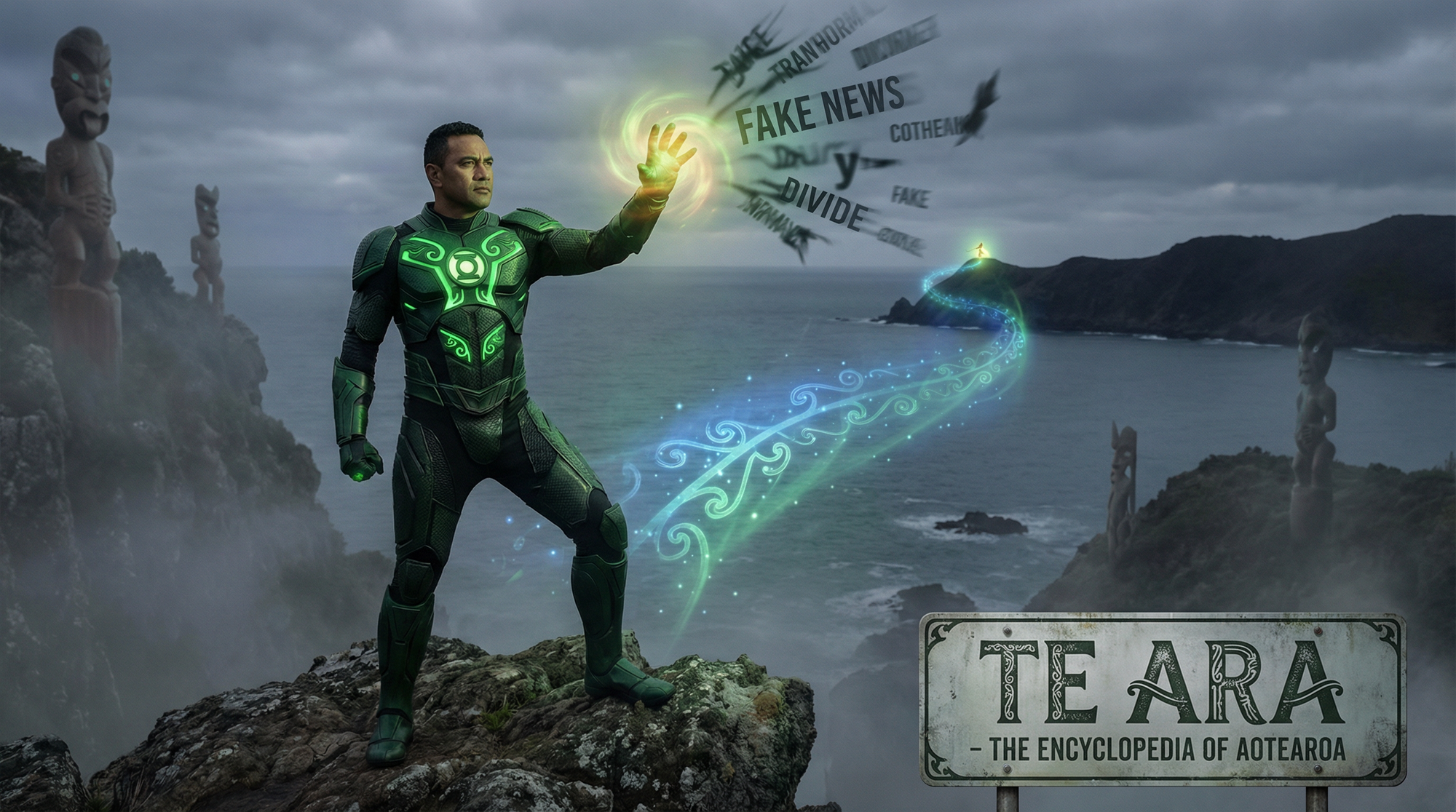
Ivor Jones The Māori Green Lantern Fighting Misinformation And Disinformation From The Far Right