“Corporate Greed Meets Colonial Justice: How ANZ's Record Fine Exposes the Rigged Game” - 16 September 2025
When Banks Break Bad, Who Really Pays the Price?
Kia ora koutou katoa - Greetings to you all.
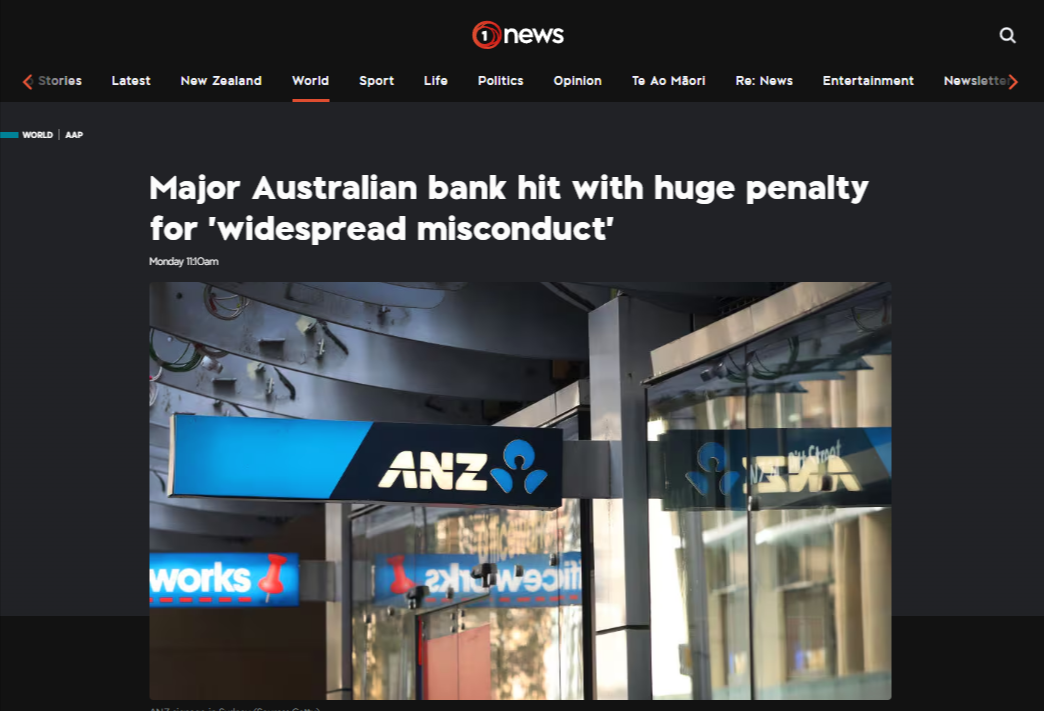
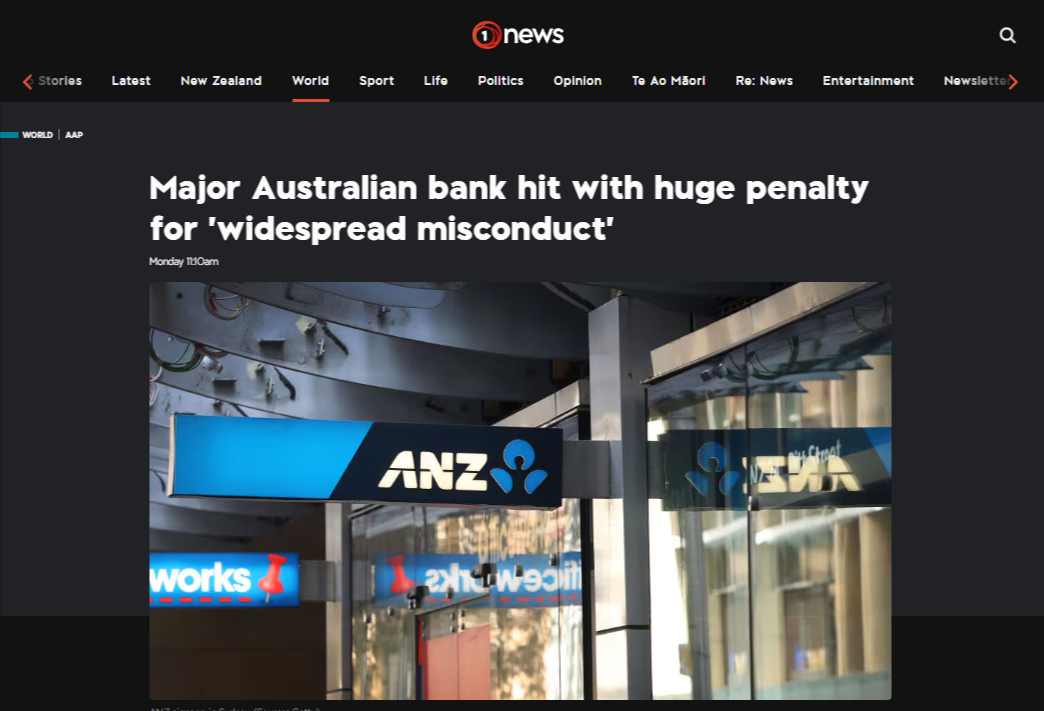
The announcement that ANZ Bank will pay a record $240 million fine for "widespread misconduct" affecting nearly 65,000 customers exposes the rotten heart of our colonial capitalist system. While this penalty represents the largest ever imposed by Australia's corporate watchdog ASIC against a single entity, it reveals a justice system that operates on two distinct tracks - one for powerful corporations, another for everyone else, especially Māori. This essay examines how ANZ's corporate crime spree, followed by mass layoffs, exemplifies the colonial capitalism that continues to exploit our communities while protecting the wealthy elite.

Banking executives profit while families suffer from their crimes
Te Taiao o Te Taonga - The Environment of Wealth
Understanding this corporate scandal requires grasping the fundamental disconnect between Māori values and neoliberal capitalism. In te ao Māori, the concept of utu - reciprocity and balance - demands that harm be properly addressed through genuine accountability. Yet ANZ's misconduct spanned multiple years, including unconscionable conduct in government bond dealings worth $14 billion, failing to respond to customer hardship notices, making false statements about interest rates, and even refusing to refund fees to deceased customers' families.
The principle of manaakitanga - caring for others - stands in stark contrast to ANZ's treatment of vulnerable customers. ASIC Chair Joe Longo stated that "time and time again ANZ betrayed the trust of Australians," highlighting a pattern of corporate behaviour that treats customers as resources to be exploited rather than people deserving respect.
This misconduct occurred within the broader context of Australia's banking sector, which has faced repeated scandals since the Banking Royal Commission exposed systemic failures across the industry. The fact that ANZ has been penalised seven times in the past eight years demonstrates that corporate accountability remains a charade designed to maintain the illusion of justice while protecting the powerful.
He Aha Te Take - What's Really Happening Here
ANZ's crimes weren't victimless accounting errors - they represent systematic theft from ordinary people during times of financial stress. The bank admitted to failing to respond to 488 customer hardship notices, essentially ignoring people crying out for help during their most vulnerable moments. They made false statements about savings interest rates, stealing money directly from customers' pockets. Most grotesquely, they refused to refund fees to thousands of deceased customers, forcing grieving families to battle corporate bureaucracy during their darkest hours.
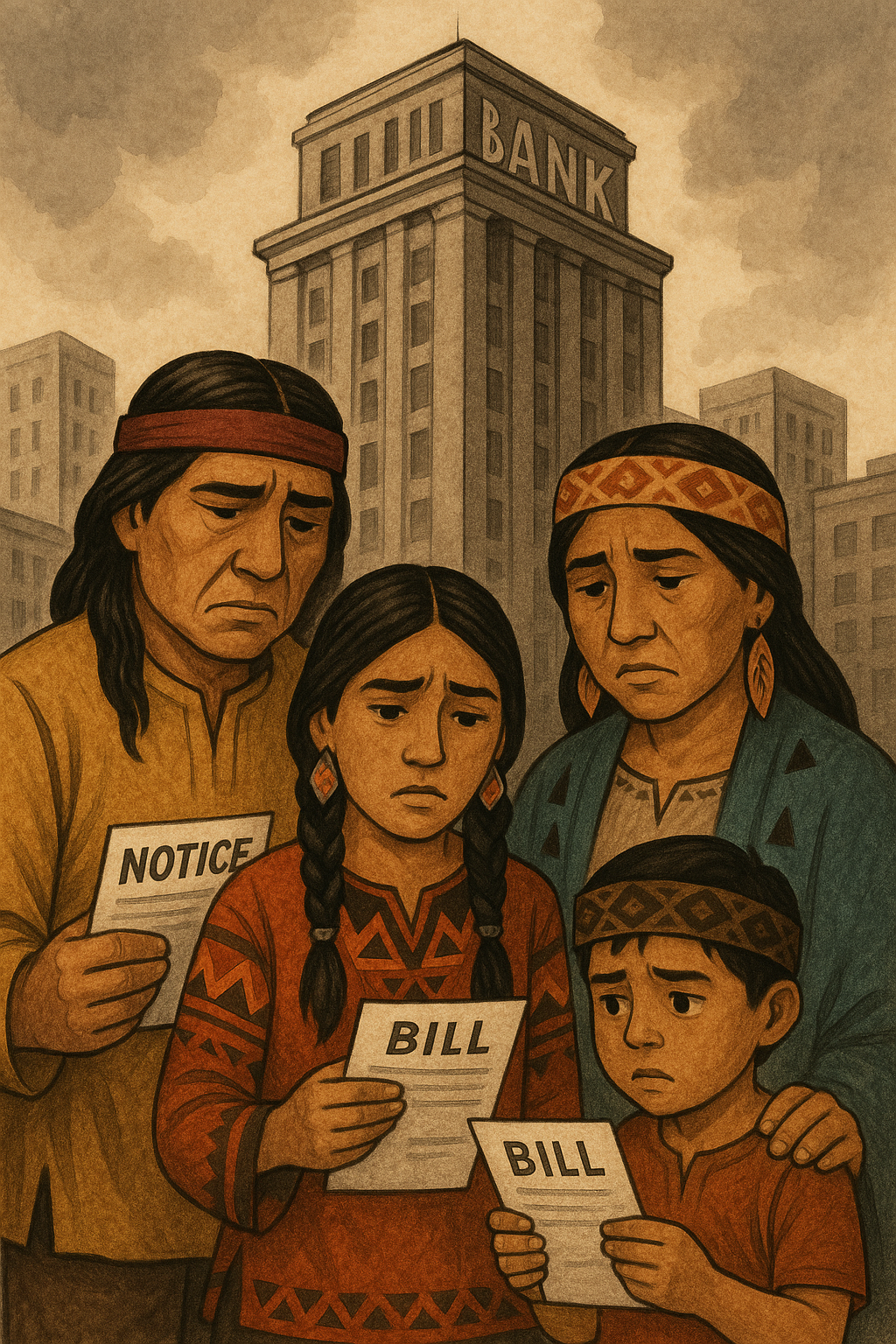
Colonial banking systems continue extracting wealth from Indigenous communities
The timing of this penalty reveals the cynical nature of corporate power. Just days after news broke of the record fine, ANZ announced plans to eliminate 3,500 jobs and 1,000 contractor positions by September 2026, representing nearly 10% of their workforce. CEO Nuno Matos claimed "I hate to do this but it's for the future of the company," while the bank simultaneously pays out massive executive bonuses and shareholder dividends.
For Māori communities, this pattern of corporate harm followed by worker punishment resonates with centuries of colonial exploitation. The banks that financed land theft through mechanisms like the Native Land Court continue to extract wealth from our communities while socialising the costs of their greed onto working families. The historical evidence shows how institutions were designed to facilitate land theft through legal mechanisms, creating the wealth that built today's banking empires.
Tikanga vs Corporate Crime - Two Systems of Justice
The contrast between how ANZ faces "accountability" versus how Māori experience the justice system exposes the fundamental racism embedded in our legal structures. ANZ's $240 million penalty sounds massive until you realise it represents roughly what major banks make in profit every few weeks. No executives face criminal charges. No one goes to prison. The bank simply writes a cheque and continues operating exactly as before.

The racist double standard of colonial justice systems
Compare this gentle treatment to how the same system treats Māori communities. Research shows that Indigenous people are significantly more likely to face imprisonment for unpaid fines, with studies demonstrating that 89% of Aboriginal people issued Criminal Infringement Notices fail to pay in the allowed time compared to 48% of all recipients, largely due to systemic disadvantage rather than criminal intent.
The principle of kotahitanga - unity and collective responsibility - demands we recognise how these different standards of justice serve the same colonial project. While Māori face prison for minor infractions driven by poverty, banks that steal millions from vulnerable customers face what amounts to a modest business expense. Academic research confirms that corporate fines are often so small relative to company assets that they function as "parking tickets" rather than deterrents.
The Neoliberal Shell Game
ANZ's response to being caught stealing reveals the sophisticated propaganda machine that protects corporate criminals. The bank's chairman Paul O'Sullivan acknowledged they "made mistakes" - as if systematically defrauding 65,000 customers represents an accounting error rather than deliberate policy designed to extract maximum wealth from vulnerable people.
This language manipulation serves a specific function within neoliberal capitalism. By framing corporate crime as "mistakes" or "misconduct" rather than theft, the system maintains the illusion that these institutions deserve public trust. The concept of tika - doing what is right and just - requires calling this behaviour what it is: organised crime conducted in business suits with the protection of corrupted legal systems.
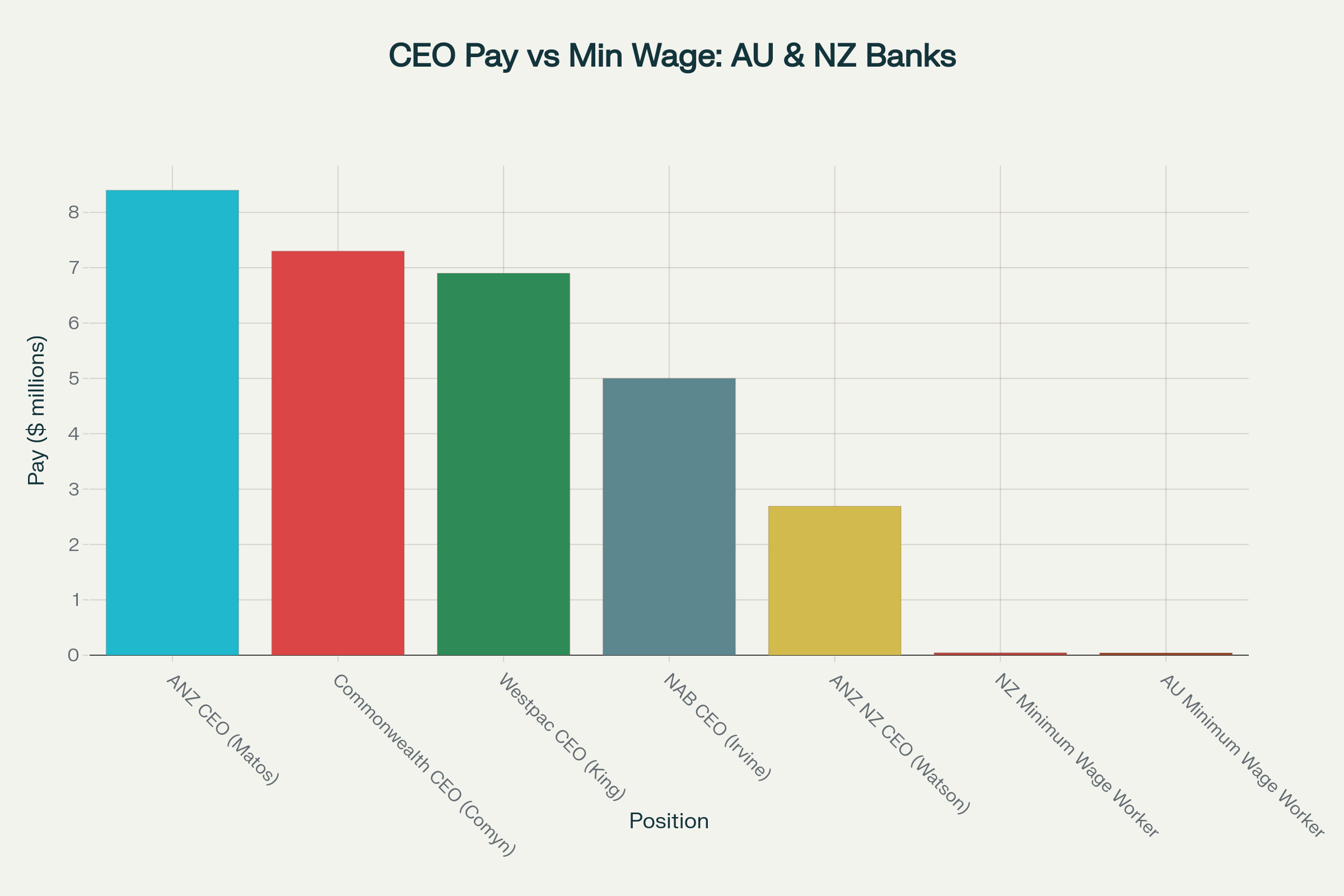
Banking Elite vs Working Poor: The Obscene Pay Gap That Funds Corporate Crime
The simultaneous announcement of mass layoffs exposes the true priorities of corporate power. CEO Matos claimed the job cuts weren't about profits but "getting the basic things right," yet somehow paying massive executive bonuses while stealing customer money represents getting things right, while employing working families represents waste that must be eliminated.
Whakapiki Rangatira - Lifting Up the Corporate Elite
The most insidious aspect of this scandal lies in how it reinforces class hierarchies while pretending to deliver justice. ASIC officials emphasised this represents "institutional failure" rather than individual misconduct, essentially arguing that no actual humans should be held responsible for crimes committed by thousands of humans working together under corporate structures designed to obscure individual accountability.
This "institutional failure" narrative serves to protect the executives who designed these criminal systems while scapegoating lower-level employees who will lose their jobs in the coming layoffs. The principle of rangatiratanga - chiefly leadership and responsibility - demands that those with the most power accept the greatest accountability. Instead, we see the opposite: those with the most power face the least consequences while workers bear the cost of executive criminality.
ANZ's new CEO Nuno Matos earns a base salary of $2.5 million annually, with potential bonuses bringing his total compensation to $8.4 million, while the outgoing CEO Shayne Elliott forfeited only his long-term bonus amid the scandal. Meanwhile, the workers who will lose their jobs had no role in designing the criminal policies that generated these penalties. Many will be Māori and Pacific Islander employees who took these jobs to support their whānau, now facing unemployment because their corporate bosses chose theft over honest business practices.
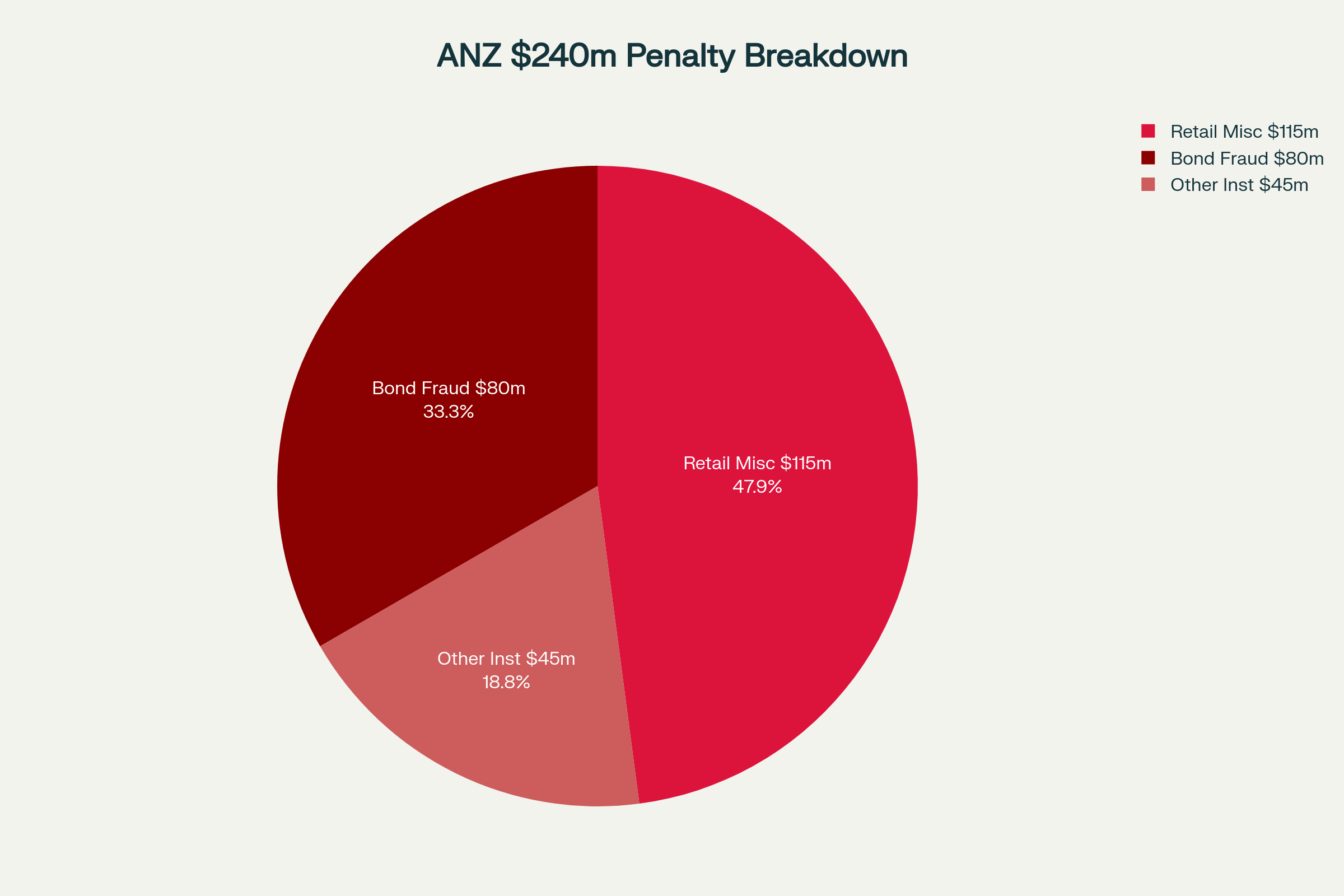
ANZ's $240 Million Crime Spree: How Corporate Theft Is Systematically Organised
Te Reo o te Tauhokohoko - The Language of Commerce
The corporate media coverage of this scandal reveals how deeply neoliberal propaganda has penetrated public discourse. News reports describe ANZ's systematic theft as "misconduct" and frame the penalty as evidence that "the system works." Analysis from The Conversation asks why these lessons weren't learned from the Banking Royal Commission, as if corporate criminals ever intended to learn anything beyond how to avoid getting caught next time.
This framing serves colonial capitalism by suggesting that minor reforms and bigger penalties will solve systemic problems. The concept of whakatōhea - truth-telling - requires acknowledging that these aren't bugs in the system - they're features. Banks exist to extract maximum wealth from working communities while minimising accountability to those communities through sophisticated legal and propaganda structures.
The language of "record penalties" obscures the reality that these fines represent a tiny fraction of the wealth these institutions have stolen over decades. For ANZ, $240 million is the cost of doing business, not a deterrent to future crime. Research demonstrates that large firms often treat penalties as "inconsequential parking tickets" rather than meaningful deterrents, particularly when scaled against company assets or employee numbers.
Ngā Hua o te Kino - The Fruits of Evil
This scandal illuminates broader patterns of how neoliberal capitalism operates in colonised territories like Aotearoa and Australia. The same banks that financed colonial land theft continue extracting wealth from Indigenous communities while facing minimal accountability for their crimes. Historical analysis shows how institutions like the Native Land Court were designed to facilitate land theft through legal mechanisms, creating the wealth that built today's banking empires.
The impact extends far beyond immediate victims of ANZ's theft. When banks steal money from vulnerable customers during hardship, they're extracting resources from communities that desperately need them. Every dollar stolen in false fees or denied interest payments represents money that could have bought kai for hungry families or helped whānau avoid homelessness. Research reveals that Indigenous Australians experience severe financial stress at rates of 50% compared to 10% of the broader population, making them particularly vulnerable to banking exploitation.
The announced layoffs will disproportionately impact working-class communities, including many Māori families who relied on these jobs for economic stability. Meanwhile, the executives who designed these criminal policies will receive bonuses worth millions of dollars, paid for by the wealth they stole from customers and the labour they extracted from workers before discarding them.
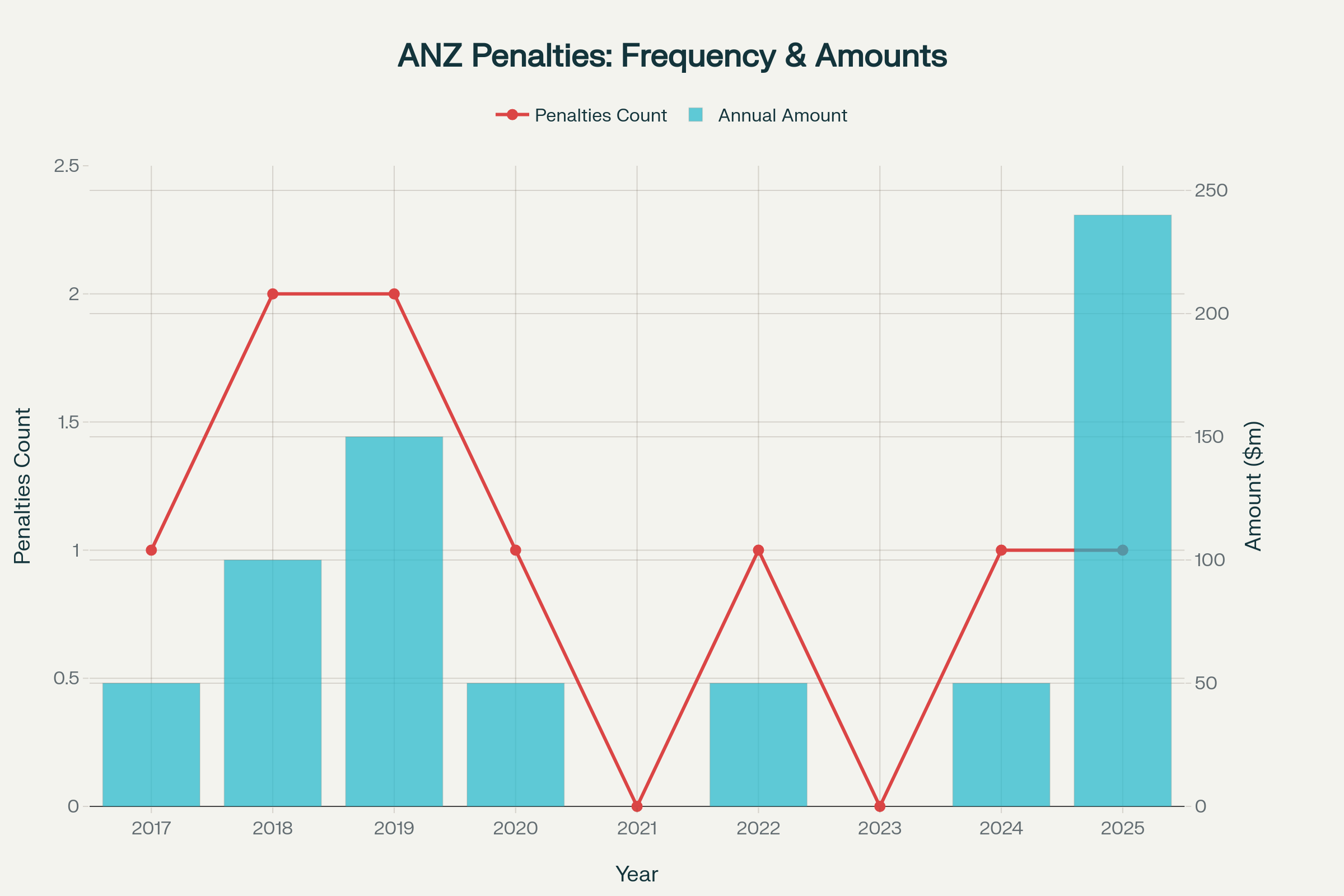
Corporate Recidivism: ANZ's 8-Year Crime Wave Shows Fines Are Just Business Expenses

The Māori Green Lantern Fighting Misinformation And Disinformation From The Far Right
The Hidden Connections: A Web of Colonial Exploitation
The timing of ANZ's record penalty reveals deeper connections to ongoing colonial projects. Just as this scandal broke, New Zealand's coalition government announced harsh new welfare restrictions and moved to repeal Section 7AA of the Oranga Tamariki Act, which required the state to address its systematic failure of Māori children. These aren't coincidental policy choices - they're coordinated attacks on our communities designed to maintain colonial wealth extraction while criminalising resistance.
The connections between banking misconduct and state violence against Māori become clear when we examine how the Royal Commission into Abuse in Care revealed that gang formation is "an adaptation to economic and social disadvantage" created by state policies. The same state that creates the conditions forcing our people into gangs then uses gang membership to justify further criminalisation and exclusion from financial services, creating a vicious cycle that benefits the banking sector.
The Royal Commission found that Indigenous consumers have been deliberately targeted by predatory financial products, with funeral insurance scams extracting "thousands and thousands of dollars of Indigenous people's money" through deceptive marketing that exploits cultural obligations around "sorry business." This systematic targeting reveals how financial institutions weaponise cultural values to extract wealth from our communities.
The Māori Perspective: Colonial Banking as Ongoing Theft
From a kaupapa Māori perspective, ANZ's criminal behaviour represents the continuation of colonial theft through financial mechanisms rather than direct land seizure. The bank's systematic exploitation of vulnerable customers mirrors the historical pattern of Crown and settler institutions targeting Māori during times of crisis - whether through debt manipulation, legal trickery, or outright fraud.
The concept of mauri - life force - helps us understand how banking exploitation damages not just individual victims but entire communities and whakapapa lines. When banks steal from Māori families during financial hardship, they're severing connections that sustain our people across generations. Research demonstrates that financial barriers to healthcare mean Māori experience "considerable inequity in access to primary health care," with every stolen dollar potentially representing the difference between life and death for our most vulnerable whānau.
The principle of whakatōhea - truth-telling - requires us to name ANZ's behaviour as part of the ongoing colonial project to destroy Māori economic independence. Studies show that financial exclusion affects Indigenous communities at rates far exceeding the general population, with geographical isolation, cultural differences, and systematic discrimination creating barriers to accessing mainstream banking services.
Te Whakatōhea - Truth-Telling Time
ANZ's record penalty exposes the fundamental lie at the heart of neoliberal capitalism: that markets reward honest behaviour and punish corruption. Instead, we see systematic reward for theft and punishment for working families who had no role in these crimes. Research confirms that 87% of Americans believe the growing gap between CEO pay and worker pay is a problem, while the CEO-to-worker pay ratio has reached 351:1, representing a fundamental breakdown of economic justice.
The principle of pono - truth and integrity - demands we name this system for what it is: organised theft protected by sophisticated propaganda and corrupted legal structures. Public opinion research reveals that most people support individual prosecution of corporate executives rather than institutional fines, yet our justice systems consistently protect the wealthy while criminalising the poor.
The solution isn't bigger penalties or better regulation - it's fundamentally restructuring economic systems to serve communities rather than extract wealth from them. The concept of whakawhanaungatanga - building relationships - points toward economic models based on mutual support rather than exploitation, where financial institutions serve community needs rather than shareholder profits.
As tangata whenua, we must resist the temptation to celebrate these hollow "victories" while the same criminal institutions continue operating. Real accountability would involve returning stolen wealth to affected communities, prosecuting executives criminally, and restructuring banking to serve public rather than private interests.
Until corporate criminals face the same justice system that imprisons our people for minor infractions, we're simply watching performance art designed to maintain the illusion that anyone in power faces real consequences for their crimes. The evidence is clear that white-collar criminals receive sentences averaging only 3.5 years while serving only one-third of their time, compared to the disproportionate sentences our people face for survival crimes driven by the very poverty these banks create and maintain.
The time for polite requests and incremental reform has passed. The banking system was designed to extract wealth from Indigenous communities and working families while protecting the parasitic class that profits from human suffering. Every day we allow these criminals to operate freely, more whānau lose their homes, more children go hungry, and more communities are destroyed by the very institutions that claim to serve them.
The MGL understands these tough economic times for whānau so please only contribute a koha if you have capacity and wish to do so: HTDM: 03-1546-0415173-000.
Hei konā rā - Until we meet again.