“Damien Grant’s Dangerous Fantasy: How One Op-Ed Demolishes Civilization’s Best Defense Against Tyranny” - 18 January 2026
A scathing deconstruction of Stuff columnist Damien Grant’s January 18, 2026 article defending Trump’s illegal invasion of Venezuela
Mihi Whakatau / Welcome to The Māori Green Lantern
Kia ora koutou katoa. You’ve arrived here because you already understand what the mainstream media refuses to admit: institutions like the NZ Herald, RNZ, and Stuff don’t serve our people. They launder propaganda. They legitimise racism through the appearance of neutrality. They platform intellectual fraudsters like Damien Grant who dismantle international law to justify imperialism, and they give airtime to politicians like Simeon Brown who gaslight the country about healthcare destruction while ordering $510 million in regional health cuts they claim don’t exist.
You’re here because you’re tired of watching the same playbook repeat: deny the cuts exist, call frontline workers “bureaucratic waste,” cherry-pick data to perform confidence, then accuse critics of lying. Tired of 125 hauora Māori roles being disestablished while contractors gorge on millions. Tired of neoliberal policies destroying Māori communities while being dressed up as fiscal responsibility. You see through it. That’s why this matters.
This Substack exists to illuminate what they keep in darkness. We decode the propaganda. We expose the fraud. We call out the gaslighting—whether it’s a libertarian columnist normalising great power aggression or a Health Minister denying the consequences of cuts that frontline workers say are actively damaging patient safety. We reclaim the language to describe how we’re being systematically dispossessed. Because our survival depends on it—and the dominant institutions will never do this work. Kia kaha.
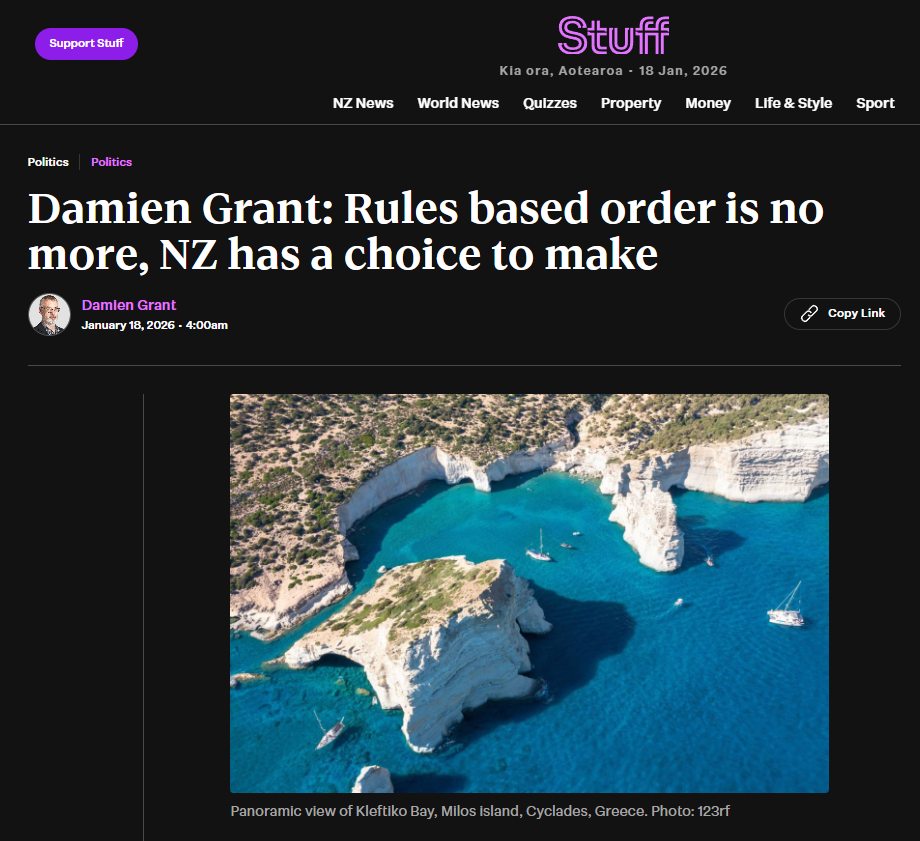
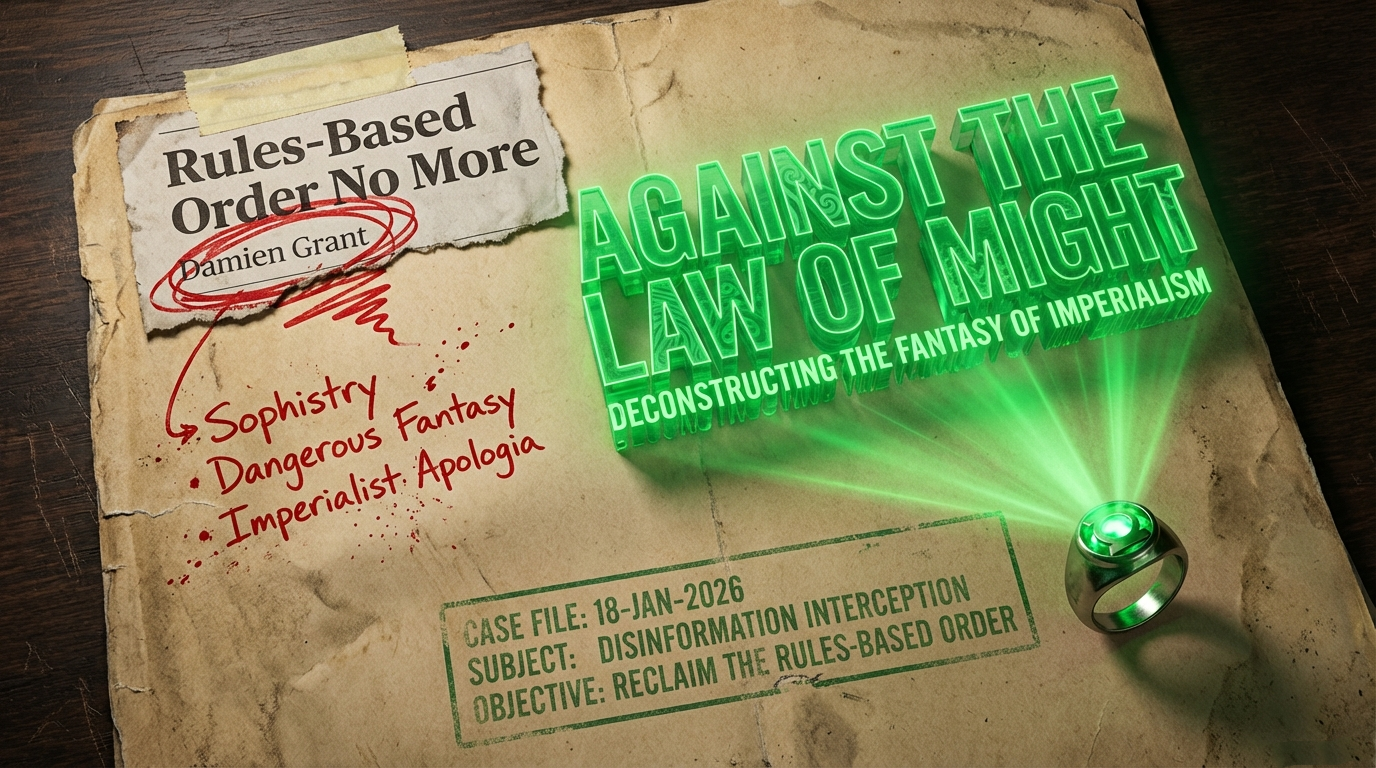
Damien Grant’s January 18 opinion piece in Stuff is a masterclass in intellectual dishonesty wrapped in libertarian posturing. Masquerading as sophisticated geopolitical realism, it’s actually an elegantly written apologia for American imperialism
—one that would make any autocrat weeping with gratitude that a New Zealand intellectual has volunteered to demolish the rules-based international order on their behalf.
Let’s be absolutely clear about what Grant has done:
he’s provided philosophical cover for a military operation that international law experts unanimously condemn as flagrant violation of the UN Charter. And he’s done it brilliantly enough that it might actually persuade readers who don’t immediately recognize his central trick: the systematic destruction of credibility through historical fraud.
The Opening Gambit: Thucydides Weaponized
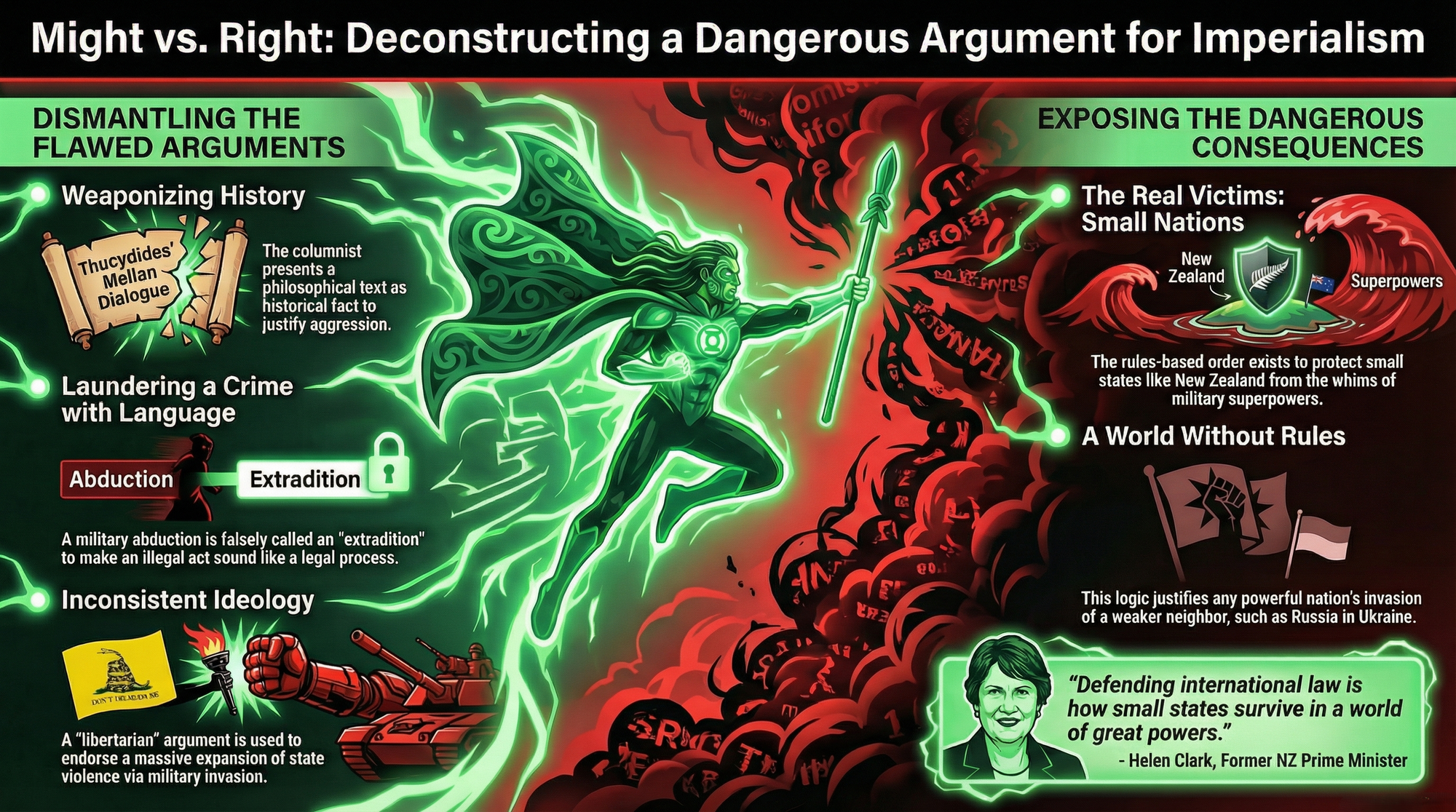
Grant begins by invoking the Melian Dialogue—that haunting classical passage where Athenian imperialists tell the weaker Melians that “the strong do what they can and the weak suffer what they must.” It’s a visceral, unsettling image. And it’s presented as historical fact.
Here’s the problem:
it isn’t.
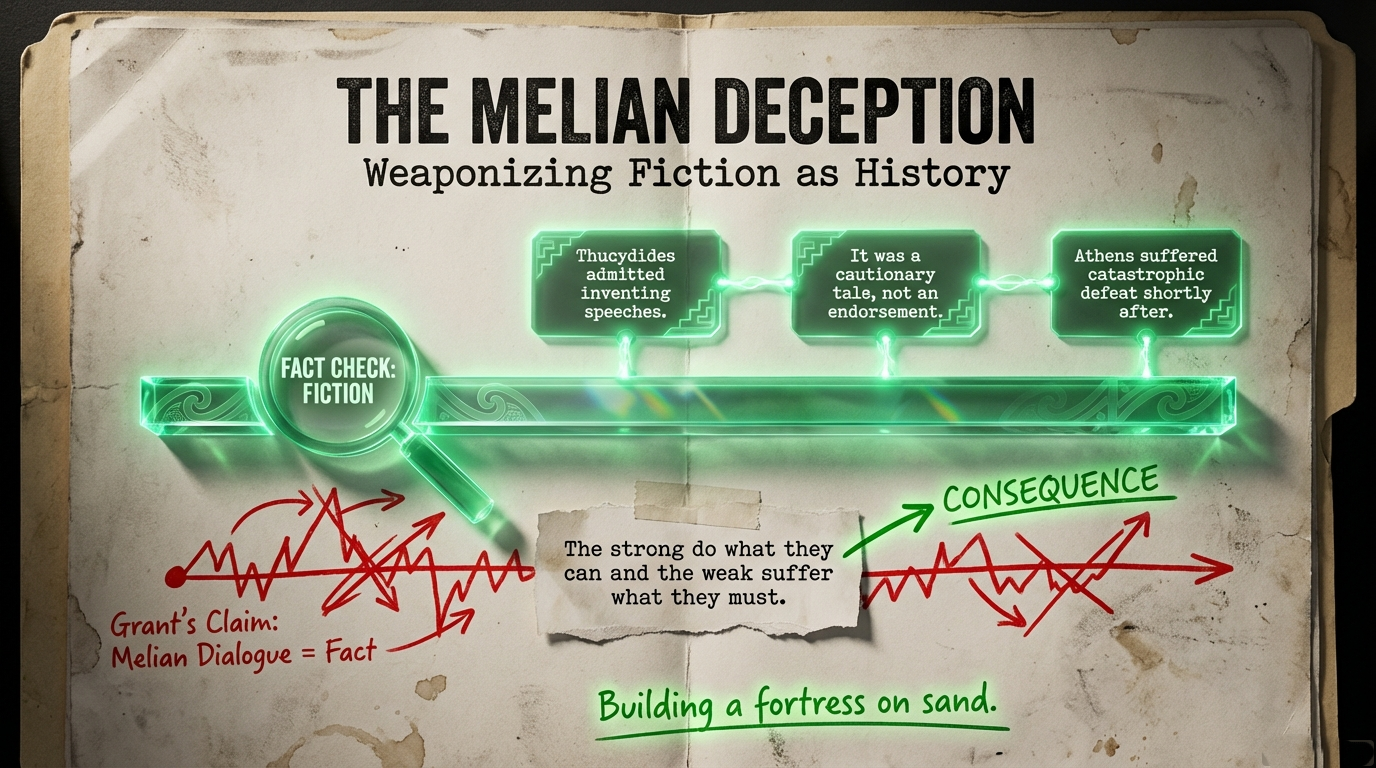
“say what was appropriate in the particular circumstances”.
The Melian Dialogue is not a historical account—it’s a philosophical construction, likely written years after events, that represents Thucydides’ interpretation of how power operates, not what Athens actually said to Melos.
This is not arcane scholarship. It’s fundamental to understanding what Thucydides was doing. Yet Grant presents the dialogue as straightforward historical narration, using a documented falsehood to anchor his entire argument. This is the rhetorical equivalent of building a house on sand and calling it a fortress.
But here’s what’s truly insidious:
even if the dialogue were accurate, Thucydides appears to have presented it as a cautionary tale about Athenian hubris, not an endorsement. Athens’ certainty that it could act without restraint preceded Athens’ catastrophic defeat and eventual loss of the Peloponnesian War. Grant invokes this historical precedent and draws the opposite conclusion that Thucydides intended. It’s not just intellectually dishonest—it’s historically backwards.
The “Non-Existent Order” Sleight of Hand
Grant asks:
“did [the rules-based order] exist outside the imagination of diplomats and academics?” This is rhetorical dismissal masquerading as sophistication. The answer, demonstrably, is yes—it existed in binding legal commitments, institutional frameworks, and measurable outcomes.
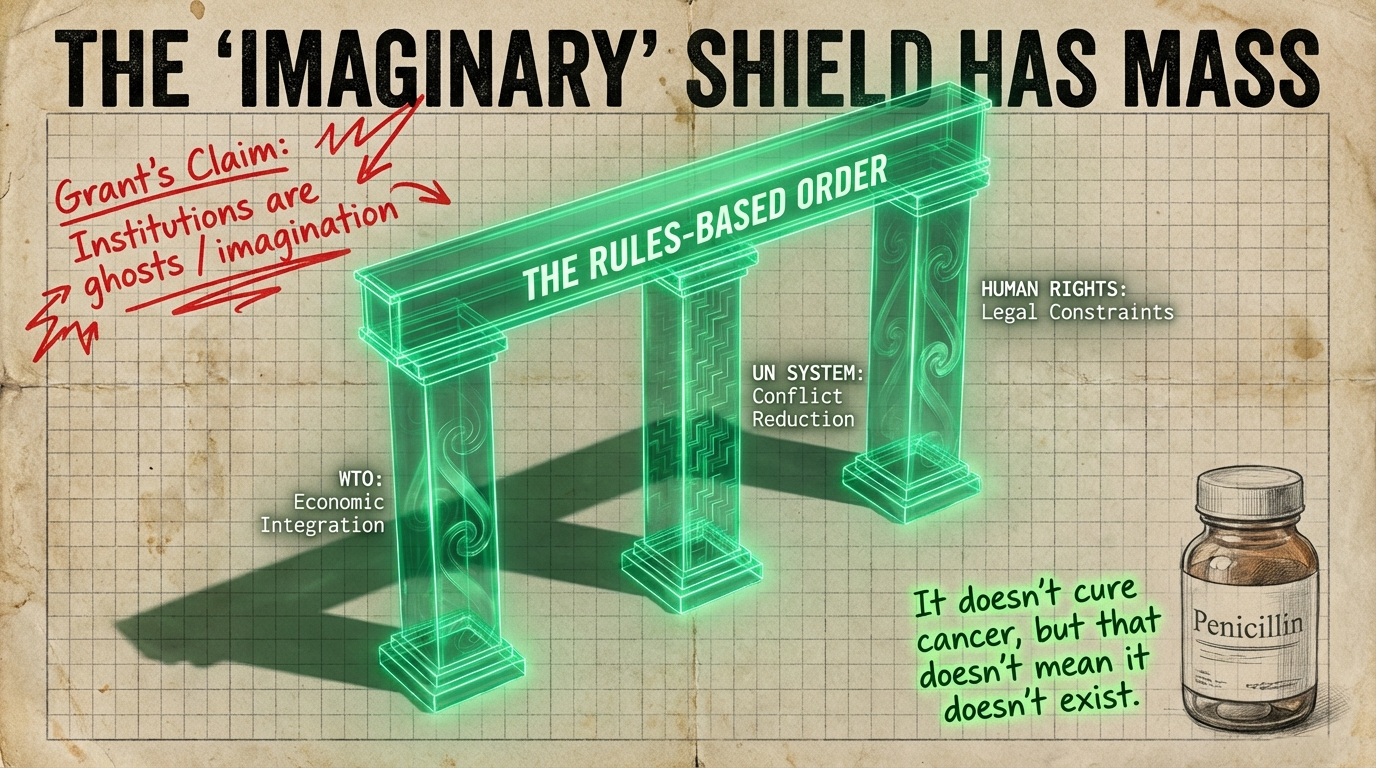
The rules-based international order comprises international law, multilateral institutions, human rights frameworks, and trade mechanisms that demonstrably reduced violent conflict, facilitated economic integration, and established legal constraints on state behavior. These aren’t imaginary. They’re written into thousands of treaties and implemented by functioning institutions.
The WTO, IMF, UN system—Grant himself admits the WTO “has been a net positive”—exist in material reality. They produce measurable effects. Yet he dismisses them as phantoms because they haven’t prevented all conflict.
This is logically equivalent to claiming penicillin doesn’t exist because it doesn’t cure cancer. The fact that the rules-based order hasn’t been perfect doesn’t justify abandoning it for pure power politics. Yet that’s precisely the argument Grant is making, which leads directly to...
The Illegality He Refuses to Name
Here’s where Grant’s intellectual cowardice becomes genuinely alarming. He mentions the Trump administration’s seizure of Venezuela’s president and notes that international law forbids “the threat or use of force against the territorial integrity or political independence of any state.” He literally quotes Article 2 of the UN Charter in his article.
And then he immediately tells us to ignore it.
“This is nonsense,” Grant writes. “If we want to protect Taiwan rifles and gunships are more effective than rhetoric and grandiloquence.”
Translation:
international law doesn’t matter. Might makes right. Larger states can invade smaller ones whenever they calculate it advantageous.
But here’s what Grant conspicuously avoids stating:
the U.S. operation violated the UN Charter because there was no Security Council authorization and no self-defense justification—the only two legal exceptions to the prohibition on force. Venezuela did not attack the United States. Drug trafficking, however serious, does not constitute an “armed attack” triggering self-defense rights.
Former New Zealand Prime Minister Helen Clark stated plainly:
“This operation by the US is illegal”.
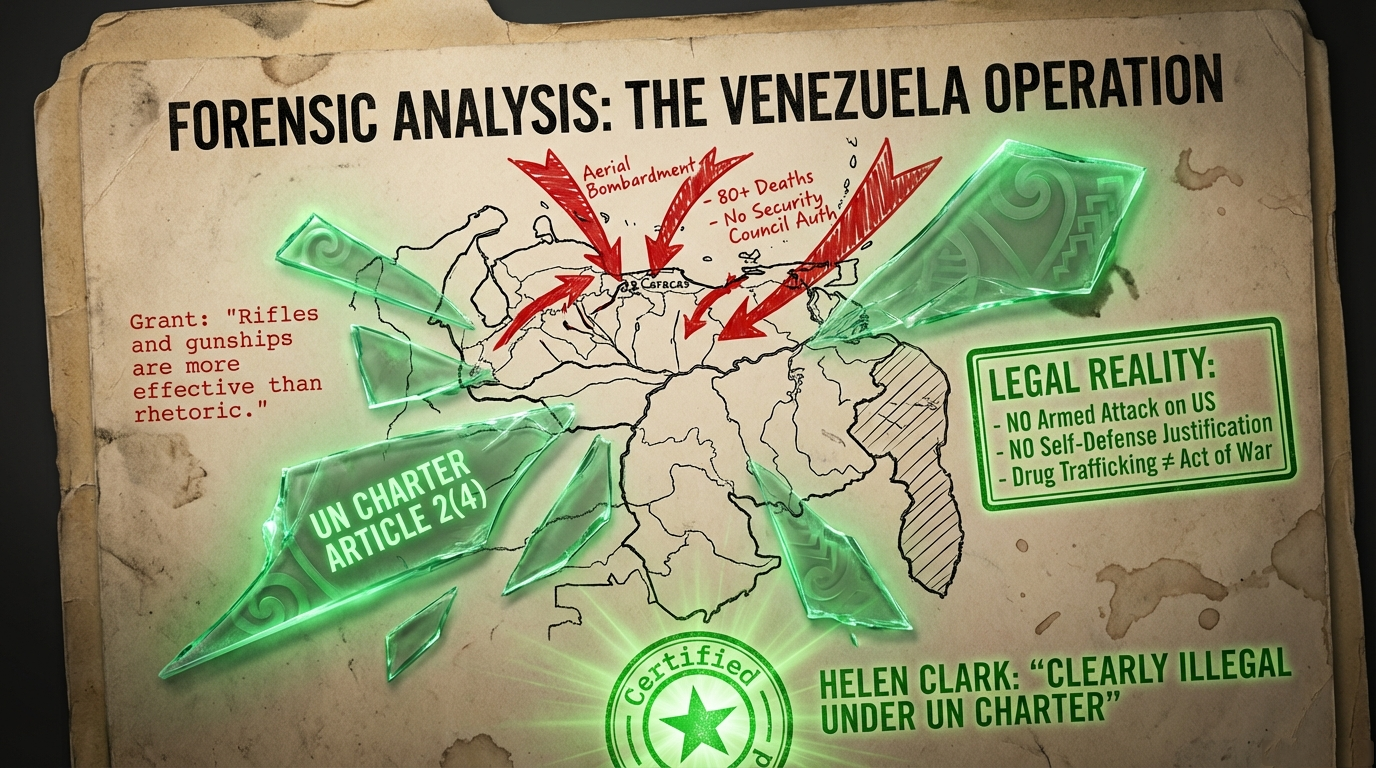
Grant doesn’t engage with this. He doesn’t cite these analyses. He doesn’t defend the operation on its legal merits because it has no legal merits. Instead, he simply asserts that legality is irrelevant and moves on.
This is not serious argument. This is sophistry.
The “Extradition” Fraud
Grant repeatedly refers to Trump’s “extradition of the president of Venezuela.” This is false. Extradition is a formal legal process governed by bilateral treaties and international law.
What Trump did was a military raid and forcible abduction—precisely the kind of state kidnapping that violates international law on head-of-state immunity and territorial sovereignty.
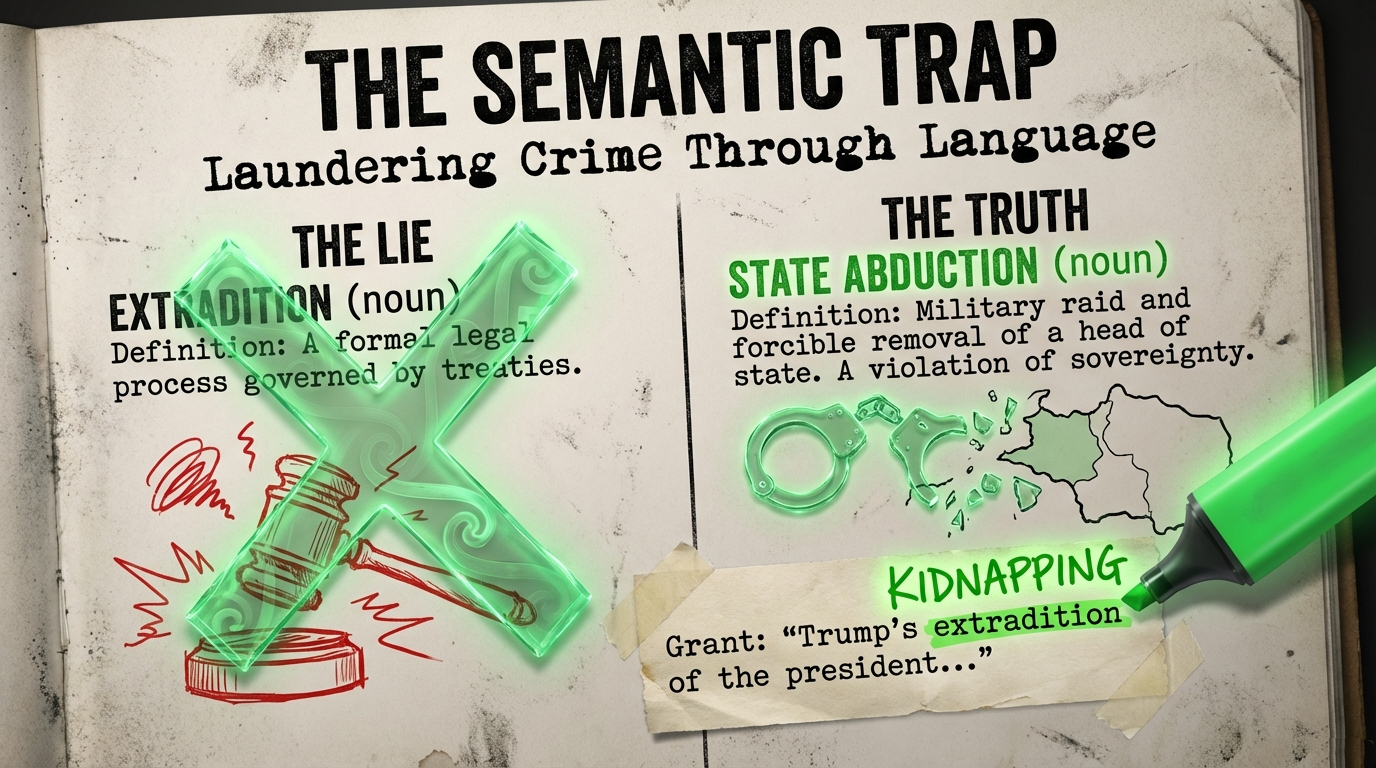
The mischaracterization matters because it launders what was essentially a crime
—kidnapping a foreign leader and removing him from his country
—through the neutral language of legal procedure.
It’s Orwellian language manipulation.
Call it what it is:
abduction.
Libertarianism as Cover for Authoritarianism
Grant writes
“from a libertarian perspective.”
This detail is crucial because libertarianism—at least in its theoretical form—is supposed to emphasize limiting state power. It’s supposed to oppose coercion. It’s supposed to favor individual rights over state authority.
Yet Grant’s entire argument is that we should accept the most coercive act possible—military invasion of a sovereign nation—as inevitable and acceptable.
This is not libertarianism.
This is selective libertarianism:
strict rules for constraining state power at home, but a shrug of acceptance when the state wields overwhelming force internationally.
Trump’s operation involved aerial bombardment, at least 80+ deaths according to available reports, and the forcible removal of a head of state from his own country. By any honest libertarian framework, this should represent an unacceptable expansion of state violence.
Yet Grant endorses it.
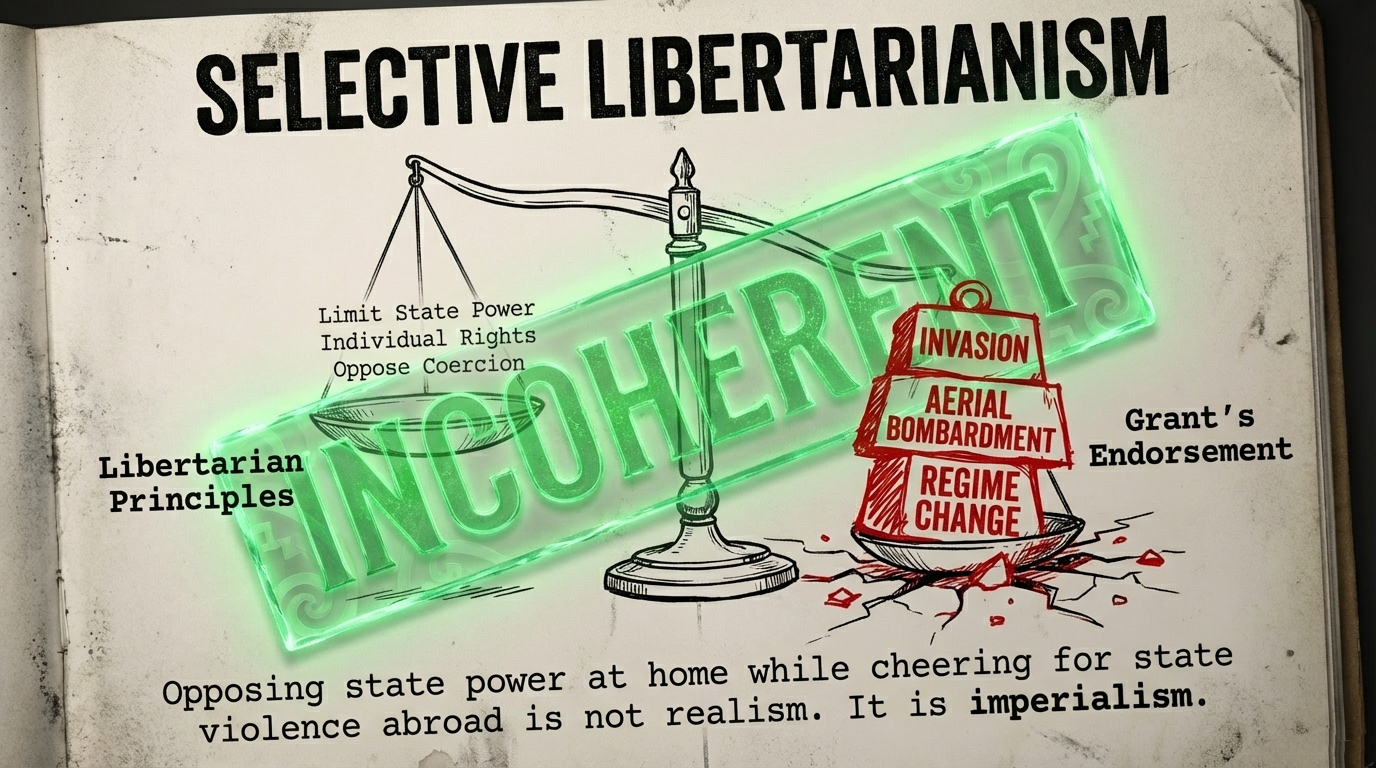
This reveals the deep incoherence at the heart of his position:
he’s not actually a libertarian concerned with limiting coercion. He’s a power-politics realist using libertarian language to provide intellectual respectability to imperialism.
The Panama Precedent That Proves Nothing
Grant cites Panama 1989 as precedent for kidnapping foreign leaders. This is precisely backward. International law experts explicitly reject the Panama comparison, noting that Noriega’s capture also involved legal violations and citing one illegal act as justification for another represents circular reasoning that further erodes international law.
Imagine a burglar defending a home invasion by saying “Well, I committed a similar crime last year and nothing happened.” That’s Grant’s logic. The fact that the U.S. previously violated international law doesn’t magically make subsequent violations legal. It merely demonstrates that powerful states believe they can operate without constraint.
Grant presents this as realism. It’s actually an argument for systematic lawlessness.
The Venezuela Operation in Context: A Pattern of Criminality
What Grant conveniently omits is that Trump’s Venezuela operation represents just one assault on international law. Since September 2025, Trump has ordered at least 20 military strikes against suspected drug vessels, operations that appear to constitute “summary executions” in flagrant violation of Geneva Conventions and international humanitarian law.
This isn’t an isolated incident. This is a systematic dismantling of legal constraints on American military force. And Grant, by dismissing the rules-based order as imaginary, provides intellectual scaffolding for this demolition.
Why Small States Should Be Terrified
Here’s the part Grant’s analysis completely elides:
the rules-based international order wasn’t created for powerful states. It was created to protect small states from exactly this scenario.
New Zealand is a small state. We have no hope of defending ourselves against American military intervention. Our security depends entirely on international law that says large countries can’t invade small ones. We depend on the principle of equal sovereignty. We depend on Article 2(4) of the UN Charter.
By dismissing this order as dead or irrelevant, Grant is essentially arguing that New Zealand’s security is irrelevant. That we should simply accept whatever larger powers decide to impose on us.
This isn’t abstract theory. As New Zealand Foreign Minister Winston Peters noted, New Zealand’s position depends on “all parties acting in accordance with international law”. Helen Clark was more direct: defending international law is how small states survive in a world of great powers.
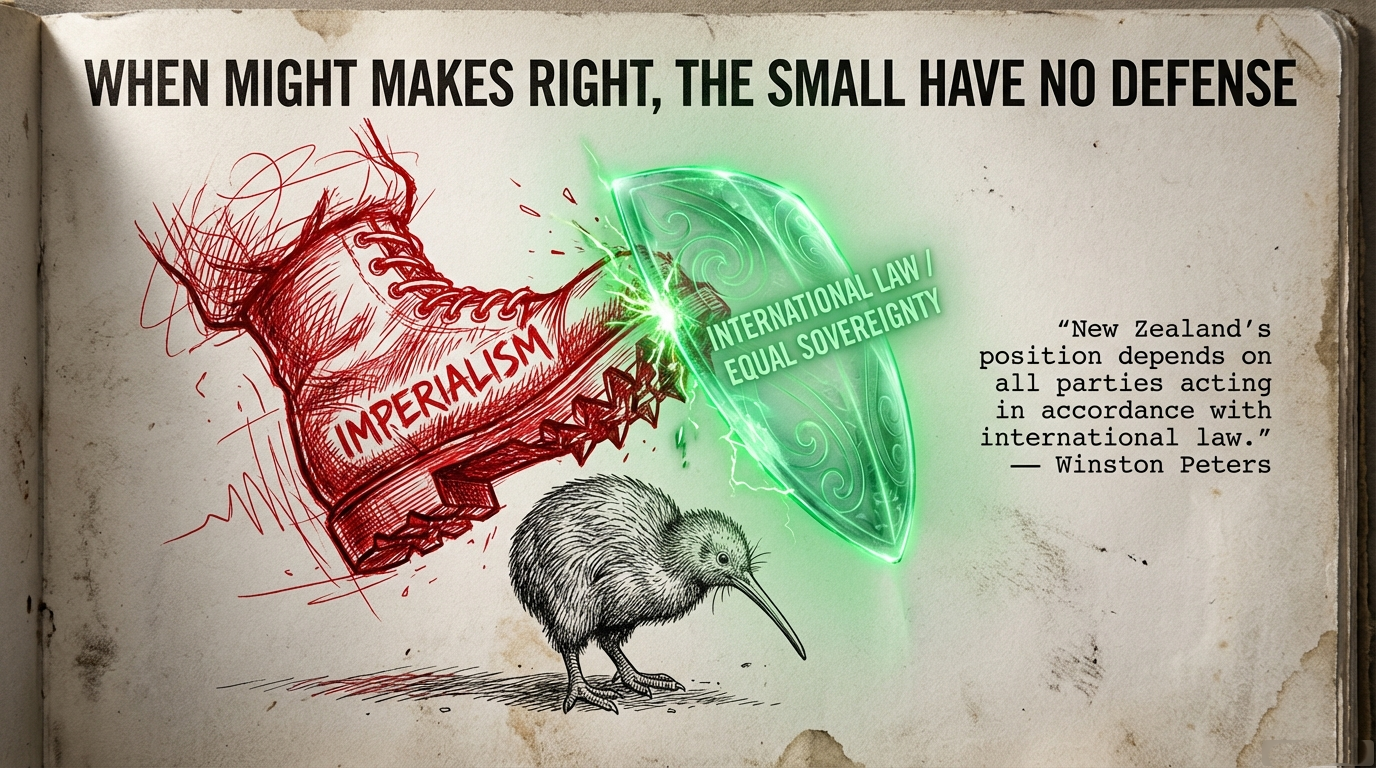
Grant’s article, by normalizing great power violation of international law, is directly hostile to New Zealand’s national interests. He’s arguing for a world where might determines right—a world catastrophically dangerous to any nation without overwhelming military force.
The “Pax Americana” That Failed
Grant argues we lived under “Pax Americana” after the Cold War, with American military intervention everywhere. This is partly accurate and wholly irrelevant to his argument.
Yes, the U.S. intervened extensively. Yes, some of those interventions violated international law. That’s precisely the point. Those violations were violations—departures from the rules-based order that the international community protested. They didn’t prove the order didn’t exist. They proved the order was being broken by a powerful actor that largely escaped accountability.
Normalizing that lawlessness doesn’t make the order irrelevant. It makes defending it more urgent.
The Moral Relativism Dressed as Realism
Grant’s core argument boils down to this: powerful states will do what they want, and we should accept it as inevitable. The strong do what they can; the weak suffer what they must.
This isn’t realism. This is moral relativism. And it’s actively dangerous.
If we accept that great power lawlessness is inevitable, we guarantee that it will continue. If we normalize the idea that international law is merely “imagination,” we remove the last rhetorical constraint on imperial ambition. If we tell small states that legal equality is meaningless, we invite their subjugation.
The rules-based order was never supposed to prevent all conflict. It was supposed to establish the principle that international relations should be governed by law, not power. That principle is fragile. It depends on people—including intellectuals and journalists—defending it.
Grant has instead chosen to demolish it. He’s done so with eloquence and philosophical flourish. But eloquent sophistry in service of imperialism is still sophistry.
A World Without Rules
Let’s take Grant’s argument to its logical conclusion. If the rules-based order is dead, and if we accept that power determines right, then:
- Russia’s invasion of Ukraine becomes justified (Russia is militarily stronger)
- China’s annexation of Taiwan becomes justified (China is larger)
- Any powerful state’s predation on weaker neighbors becomes justified
This is the world Grant is arguing for. A world where international law is abandoned. A world where New Zealand has no protection except hoping larger powers remain benevolent. A world where military force becomes the sole arbiter of justice.
Grant presents this as inevitable. It’s not. It’s a choice. The choice to defend international law or abandon it. The choice to constrain great power ambition or enable it. The choice to defend small states’ sovereignty or accept their subjugation.
Grant has chosen to advocate for the latter. And he’s dressed that choice in sophisticated language about Thucydides and Westphalia and libertarianism.
The Real Scandal
The deepest scandal here isn’t that Grant wrote this article. It’s that Stuff published it.
Stuff claims it “looks to publish a diverse range of opinions” and that “good journalism should not” create echo chambers. Fair enough. But there’s a difference between publishing diverse views and publishing intellectual fraud in defense of imperialism.
Grant’s article contains demonstrable historical falsehoods (the Melian Dialogue as historical fact), legal mischaracterizations (calling abduction “extradition”), and a coherent argument for abandoning international law in favor of naked power politics.
Stuff has a responsibility to flag when an opinion piece makes false factual claims, even if it’s entertaining to read. They’ve failed to do so.
The Choice Before Us
The rules-based international order is imperfect. It has failed to prevent suffering. It has allowed powerful states to violate its principles with relative impunity. All of this is true.
But it’s also true that we’ve had 80 years without great power war. That trade has expanded. That human rights norms have been established. That small states have had some legal recourse when powerful ones threatened them.
Abandoning that system—which is what Grant advocates—doesn’t replace it with something better. It replaces it with pure power politics. The strong do what they can. The weak suffer what they must.
Damien Grant has written an intellectually dishonest defense of this barbarism. It deserves to be called what it is: dangerous sophistry in service of imperialism.
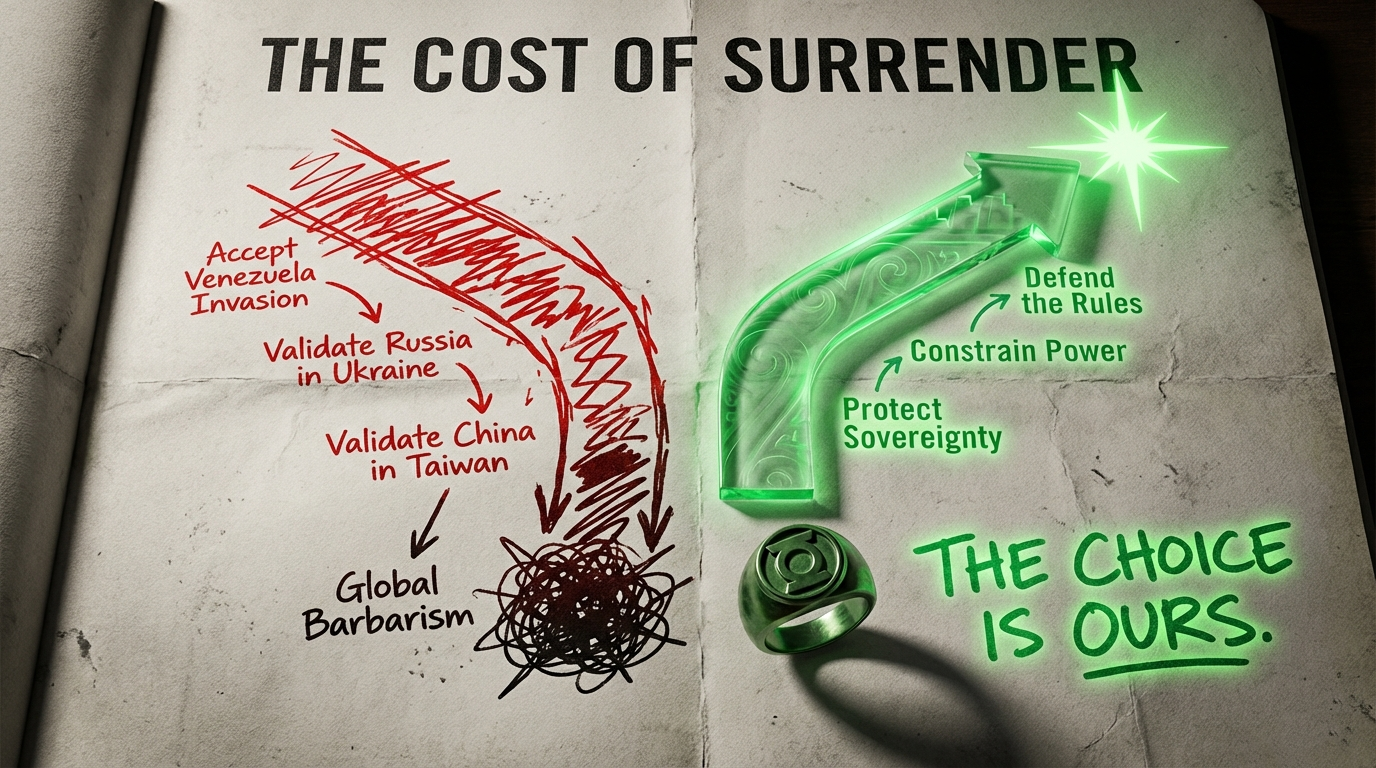
New Zealand should reject it entirely. We should defend international law. We should condemn Trump’s invasion of Venezuela. And we should recognize that Damien Grant’s article—for all its eloquence—is an argument for a world in which small nations like ours have no protection except the temporary goodwill of those with nuclear weapons.
That’s not realism. That’s surrender.
Koha Consideration
Every koha signals that whānau are ready to fund the accountability that Crown and corporate structures will not provide. It signals that rangatiratanga includes the power to fund our own truth tellers.
Kia kaha, whānau. Stay vigilant. Stay connected. And if you are able, consider a koha to ensure this voice continues.
Three pathways exist:
For those who wish to support this mahi directly with a koha (voluntary contribution), please visit the Koha platform:
Koha—Support - https://app.koha.kiwi/events/the-maori-green-lantern-fighting-misinformation-and-disinformation-ivor-jones
For those who wish to receive essays directly and support through subscription, join the Substack community:
Subscribe to the Māori Green Lantern on Substack - https://themaorigreenlantern.substack.com/subscribe
For those who prefer direct bank transfer, account details are: HTDM, account number 03-1546-0415173-000.

Ivor Jones The Māori Green Lantern Fighting Misinformaiton And Disinformation From The Far Right