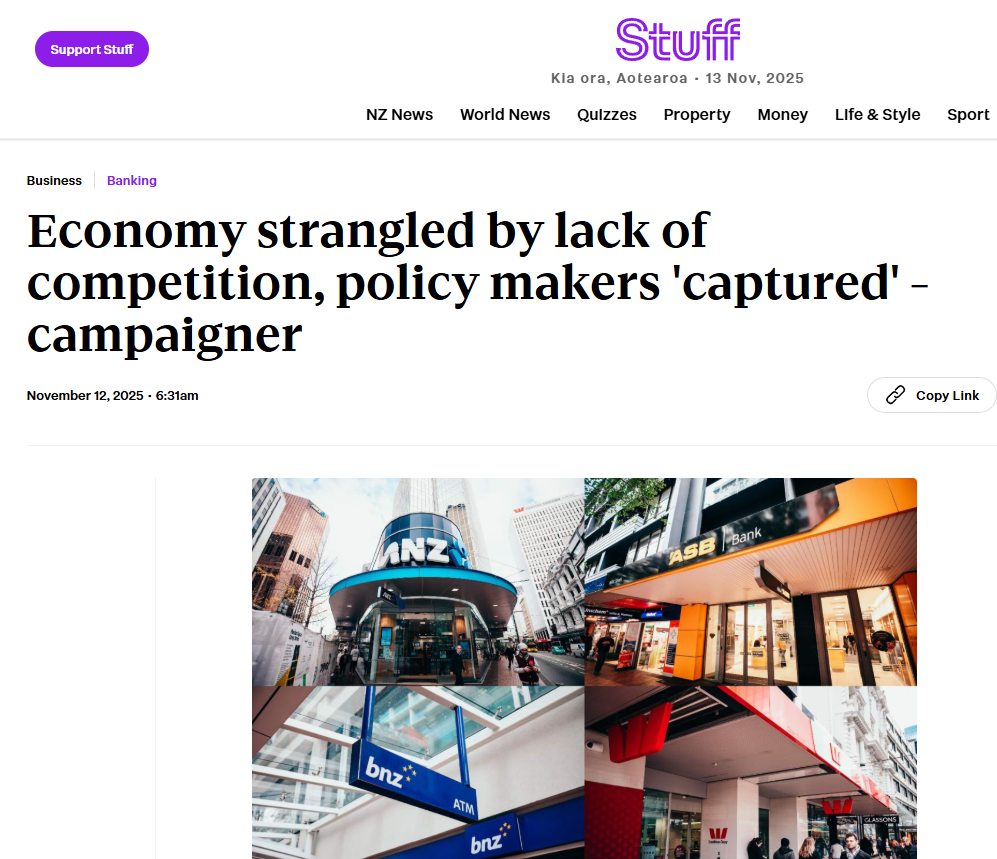
“Death by a Thousand Cuts: How Monopoly Capture Strangles Aotearoa’s Economy” - 12 November 2025
Ko te pūtea kei te riro ki waho, ko te iwi kei te mate - The wealth flows offshore, while the people suffer
Mōrena ano Aotearoa,
Let us make our home a better place today!
Te Kōrero Tīmatanga: The Hidden Whakapapa of Economic Extraction
Aotearoa’s economy is being bled dry—not by foreign invasion, but by domestic surrender.
On November 11, 2025, Tex Edwards, research director of Monopoly Watch and founder of 2degrees, delivered a stark diagnosis:
“The New Zealand economy is dying a death of a thousand cuts from the vice-like grip of monopolies in key sectors”.
The Australian-owned Big Four banks reported collective profits exceeding $5.2 billion from just three institutions, supermarkets extract an estimated $1 million per day in excess profits, and electricity gentailers have been accused of
“profiteering” by government ministers.
Yet policymakers, captured by the very doctrines that enabled this extraction, respond with tinkering instead of transformation.[1][2][3]
This is not market failure—this is market capture operating exactly as designed. The whakapapa of this crisis traces directly to the neoliberal revolution of 1984, when Treasury’s adoption of Chicago School economics and public choice theory dismantled regulatory safeguards under the guise of
“freeing” markets.
Forty years later, Victoria University economist Geoff Bertram has documented how those very theories predicted the regulatory capture, rent-seeking, and monopolistic predation that now defines our economic landscape. The architects of deregulation warned against the pathologies they were about to unleash—then unleashed them anyway, enriching a narrow elite while condemning ordinary Māori and Pākehā to stagnant wages, unaffordable living costs, and a productivity crisis that has seen Aotearoa plummet from 3rd globally in GDP per capita in the 1950s to 33rd out of 37 OECD countries in 2024.[4][5][6][7][8]
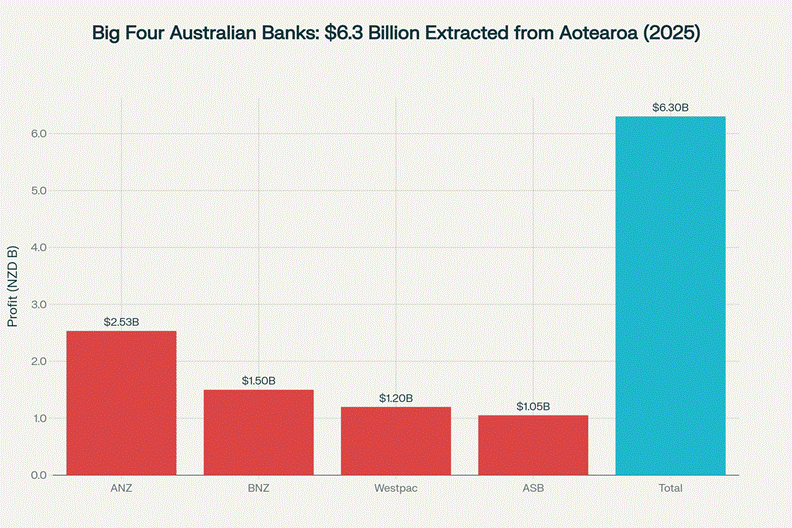
The Big Four Australian-owned banks extracted $6.3 billion in profits from New Zealand in 2025, with ANZ alone taking $2.5 billion - representing a 21% increase from the previous year.
The question is not whether monopolies strangle competition—the Commerce Commission, Monopoly Watch, and international bodies like the OECD have confirmed they do. The question is cui bono? Who benefits from policy paralysis? And cui malo? Who suffers? The answer reveals a system of regulatory capture so complete that even “competition reforms” serve to entrench monopoly power.[1][9][10]
Te Kauwae Runga: The Unseen Forces—Regulatory Capture as Constitutional Design
The Treasury’s Original Sin: Chicago School Colonization (1984-Present)
The roots of Aotearoa’s monopoly crisis lie not in individual corporate malfeasance but in the deliberate ideological capture of the state apparatus itself. In 1984, facing a genuine economic crisis—15% inflation, mounting debt, capital flight—the Fourth Labour Government did not merely change policy; it surrendered economic sovereignty to a doctrine. Treasury’s Economic Management briefing papers, steeped in public choice theory and Chicago School dogma, reframed all state intervention as
“rent-seeking” by self-interested bureaucrats and politicians, while positioning private monopolies as inherently efficient.[4][5][11]
Geoff Bertram has meticulously documented this inversion. The public choice theorists—Buchanan, Tullock, Stigler—argued that government regulation creates opportunities for
“capture” by special interests who extract “rents” (unearned profits) from the public.
Treasury adopted this framework wholesale, but with a fatal twist: it assumed that removing regulation would eliminate rent-seeking. The opposite occurred. Deregulation, privatization, and the corporatization of state assets created a bonanza for opportunistic private actors who exploited weak oversight, lax merger controls, and politicized enforcement to construct monopolies more extractive than anything the old state apparatus had managed.[5][6][12][4]
The looting began immediately. As Bertram notes, the privatizations of 1987-1996 were not conducted through public share floats—which would have at least distributed ownership—but through insider deals that enriched a small circle of local elites and foreign investors. The Bank of New Zealand, partially privatized in 1987, required a $620 million bailout by 1990. Telecommunications, energy, airports, and banks were sold to buyers who then used regulatory loopholes and political access to block competition and extract monopoly rents. Foreign Direct Investment shifted from productive greenfield ventures to extractive takeovers, with profits flowing offshore while Aotearoa’s capital intensity stagnated.[13][8][4]
This was not “regulatory failure”—it was regulatory design.
Treasury officials, many educated at Chicago, believed markets were self-correcting and that the state’s role was to get out of the way. When monopolies emerged, they blamed
“residual” regulation, not the absence of enforcement.
When productivity stalled, they prescribed more deregulation, not investment in productive capacity. The doctrine was unfalsifiable: every failure became proof that reform had not gone far enough.[11][4]
The Politicization of Competition Enforcement: Part IV and the Chocolate Teapot
Aotearoa’s Commerce Act 1986 contains a fatal flaw: it politicized the decision to regulate monopolies. Unlike judicial systems where regulators can act independently, Part IV of the Act requires ministerial approval to even consider price controls on monopolies. This transferred power from the Commerce Commission—a supposedly independent regulator—to the executive branch, making enforcement vulnerable to lobbying and political pressure from big business.[12]
The result?
A
“chocolate teapot,” in the words of Regional Development Minister Shane Jones. When wholesale electricity prices doubled in mid-2024 due to low hydro storage,
Jones accused the gentailers of “profiteering” and said they were “probably the most powerful economic institutions in New Zealand, beyond the supermarkets and the Aussie banks”.
Geoff Bertram explained the gentailers are a cartel, not a competitive market, and that “scarcity goes straight through to profiteering” because the structure rewards withholding supply to spike prices.
Yet despite the minister’s outrage, actual intervention remained elusive. Why? Because the Electricity Authority and Commerce Commission lack the statutory power to act without political cover, and politicians fear the electoral and economic costs of confronting entrenched monopolies.[3][14][12]
This dynamic repeats across sectors. In supermarkets, despite a 2022 Commerce Commission market study confirming the Foodstuffs-Woolworths duopoly was extracting $1 million per day in excess profits, the government’s response has been a Grocery Supply Code and vague threats of “structural separation” that have yet to materialize. In banking, despite confirmation that the Big Four extract higher margins than their Australian parents (2.6% vs 1.83% net interest margin), and return on equity above comparable OECD banks, regulators cite “capital requirements” and “stability” to justify inaction.[2][15][16][17][18][19][20][21][22][23]
The capture is constitutional, not incidental. By embedding ministerial discretion into competition law, Treasury’s 1986 reforms ensured that monopolies could be challenged only when politically convenient—which is almost never, because monopolists are also major taxpayers, employers, and lobbyists.[4][12]
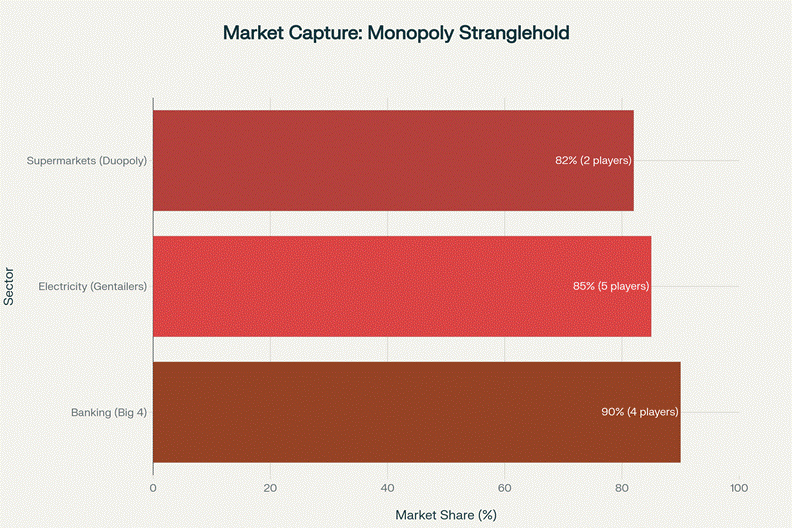
Three critical sectors - banking, supermarkets, and electricity - are dominated by a handful of players controlling 80-90% of their respective markets, strangling competition and extracting monopoly rents from New Zealanders.
Thanks for reading Ivor Jones The Māori Green Lantern! This post is public so feel free to share it.
Te Kauwae Raro: The Tangible Harm—Monopoly Rent Extraction Across Banking, Supermarkets, Electricity
Banking: The Australian Profit Funnel ($6.3 Billion and Counting)
The Big Four Australian-owned banks—ANZ, BNZ, Westpac, ASB—control over 90% of New Zealand’s banking market. In the 12 months to September 2025, they extracted $6.3 billion in after-tax profits from Aotearoa. ANZ alone took $2.532 billion, a 21% increase from the prior year, while CEO Antonia Watson claimed this was
“proof New Zealand is turning a corner”.
The claim is obscene. As Monopoly Watch’s Tex Edwards noted, these profits don’t signal a stronger economy—they highlight “just how bad New Zealanders are being treated by their banks – especially in terms of how little interest they received on their deposits”.[24][18][25][26][22][27][28][29]
The mechanisms of extraction are clear:
1. Inflated Net Interest Margins (NIM): ANZ NZ’s NIM is 2.6%, compared to 1.83% for ANZ Australia’s retail division—a 42% premium. Watson justified this by pointing to Reserve Bank capital requirements, but as economists have noted, these requirements apply to all banks, yet New Zealand’s Big Four persistently outperform their Australian parents and OECD peers. A Commerce Commission review found NZ banks’ profitability has been “persistently high” compared to international peers for over a decade.[18][19][25][21][22][23][29]
2. Delayed Open Banking: Open banking, which would allow third-party providers to compete for customers’ business, has been delayed for over six years. Edwards states bluntly: “New Zealand banks have delayed open banking, because it would lower margins and lower profitability”. The Big Four control Payments NZ, the entity that governs the payments system, creating a structural conflict of interest.[1][30][31]
3. Market Concentration and Regulatory Protection: The Commerce Commission’s banking study confirmed the Big Four face “little to no consistent strong rivalry”. Yet when Parliament’s Finance and Expenditure Committee recommended reforms in August 2025—including mandatory profit disclosures, standardized loan processes, and easier overseas bank entry—the banks pushed back, arguing their returns (12% return on equity) were “fair” and that capital requirements justified high margins.[19][20]
Where does the money go? Offshore. As ANZ NZ’s general disclosure statement showed, annual ordinary share dividends paid were $1.65 billion—roughly two-thirds of profit—flowing to Australian shareholders. Reddit users in New Zealand noted the Australian banks are sending
“$14 million back to their Australian parents every day”, while economist analyses estimate Australian bank profits in NZ were 2.8% of GDP vs 2.2% in Australia—a 27% higher extraction rate.[22][32][33][29]
The human cost: mortgage-holders saw rates double during the inflation spike, while savers received minimal interest on deposits because banks widened their spreads. When questioned by MPs, Watson admitted raising deposit rates less than lending rates on the way down, capturing windfall profits at both ends.[29][18][19]
Supermarkets: The Duopoly Death Grip (Foodstuffs + Woolworths = 82% Market Share)
Aotearoa’s grocery sector is a textbook case of regulatory capture enabling monopoly extraction. Foodstuffs (Pak’nSave, New World, Four Square) and Woolworths together control over 82% of the market. The Commerce Commission’s March 2022 market study found
“competition is not working well for consumers,” with the duopoly extracting an estimated $1 million per day in excess profits.
Yet nearly three years later, structural reform remains elusive.[2][34][35][36]
The duopoly’s toolkit for blocking competition:
1. Land Banking and Restrictive Covenants: For two decades, the major chains bought up land near existing and potential store sites, then imposed restrictive covenants preventing competitors from building nearby. Though now illegal, the legacy covenants remain, creating “fortress-style monopolistic behaviour”. In 2024, the Commerce Commission fined Foodstuffs North Island for anti-competitive land covenants.[37][30][38][39]
2. Supplier Power Imbalance: Small suppliers face a “reluctance to push back” against the duopoly due to fear of losing shelf access. The Commerce Commission’s June 2025 draft report found suppliers are charged for stocking fees, spoilage, and promotional costs that should be borne by retailers. Rebates, discounts, and promotional payments totaling $5 billion annually are structured to favor the majors, locking out smaller competitors.[34][40]
3. Wholesale Market Manipulation: Independent retailers cannot access the same promotional funding or wholesale prices as the duopoly’s own stores. Woolworths and Foodstuffs sell to themselves at lower prices than they offer third parties, a practice the Commission has flagged as anti-competitive.[40][38][34]
4. Attempted Merger to Consolidate Power: In 2024, Foodstuffs North and South Island sought to merge into a single national entity. The Commerce Commission blocked the merger, ruling it would reduce major grocery buyers from three to two, substantially lessening competition and enabling price coordination with Woolworths. Chair John Small stated: “This would result in the merged entity having greater buyer power... which would harm the competitive process”.[35][41][39][42]
The government’s response? Economic Growth Minister Nicola Willis has threatened
“structural separation” and invited international players to enter the market, but admits it would take an estimated 20 years to assemble a portfolio of 100 stores competitive with the incumbents.
Tex Edwards warns it’s
“almost inevitable” that Willis’ least-favorite option—forcibly breaking up the duopoly—will be necessary.
Yet as of November 2025, no legislation has been introduced. Instead, the Grocery Supply Code adjustments and wholesale market reviews continue the pattern Tex Edwards identifies: “tinkering and pampering instead of structural reform”.[1][43][15][44][16]
The human cost: New Zealand supermarket prices are among the most expensive in the OECD for kitchen staples. Food price inflation contributed 5% annually as of mid-2025, hitting low-income whānau hardest. Māori and Pasifika communities, already disproportionately reliant on budget retailers and facing structural income disadvantages, bear the brunt of monopoly pricing.[43][45][15]
Electricity: Gentailer Profiteering and the “Chocolate Teapot” Regulator
When wholesale electricity prices doubled in mid-2024 due to low hydro storage, Minister Shane Jones publicly accused the gentailers—Mercury, Meridian, Contact, Genesis, and state-owned entities—of
“profiteering”. Jones called the Electricity Authority a “chocolate teapot” incapable of regulating “probably the most powerful economic institutions in New Zealand, beyond the supermarkets and the Aussie banks”.[3]
Geoff Bertram confirmed the diagnosis:
“The market is doing exactly what it was set up to do, which is to get high prices and high profits at times of scarcity... This is a market where scarcity goes straight through to profiteering”.
The gentailers are a cartel, not a competitive market. They withhold supply to spike spot prices, then lock customers into long-term contracts at elevated rates. Ordinary household consumers bear the pain, while large industrial users sometimes receive preferential pricing to prevent political backlash.[14][3]
Why hasn’t the regulator intervened? Because the Electricity Authority lacks statutory power to impose price controls or force divestiture without ministerial approval. And because the gentailer model—where generators also retail electricity—creates an inherent conflict of interest. The OECD’s December 2024 Economic Outlook explicitly recommended New Zealand
“consider whether the generation and retail operations of the gentailers should be split” to improve productivity and competition.
Octopus Energy NZ’s COO Margaret Cooney warned that “until the rules are changed, we will continue to see issues with supply, business shuttering due to high power prices, and Kiwis struggling to pay their bills”.[12][46]
Yet splitting the gentailers would require confronting some of Aotearoa’s largest corporate interests, including state-owned enterprises like Meridian and Genesis—entities the Crown partially privatized and now relies on for dividends. Once again, regulatory capture prevents structural reform.
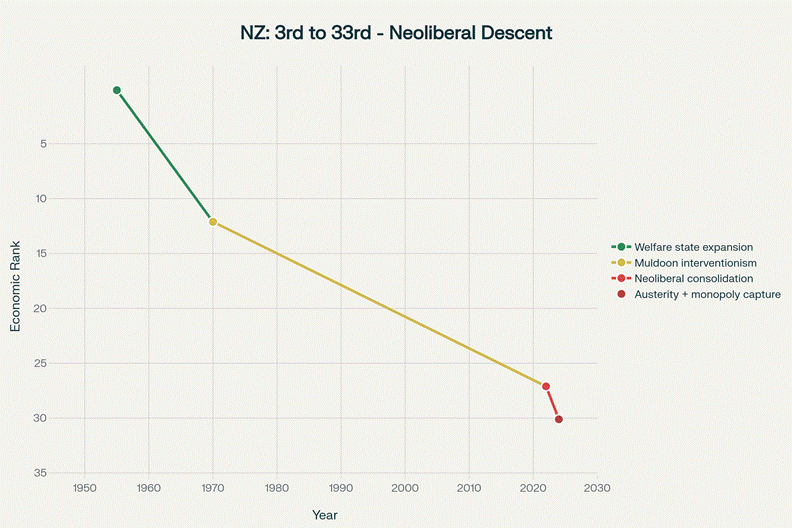
New Zealand’s economic ranking has plummeted from 3rd globally in GDP per capita in the 1950s to 33rd out of 37 OECD countries in 2024, coinciding with neoliberal reforms and the entrenchment of monopoly power.
Te Tātari: The Five Hidden Connections—How Capture Reproduces Itself
1. The Revolving Door: From Regulator to Regulated (and Back)
Former Commerce Commission Chair Dame Paula Rebstock now leads the government’s review of the Commission’s
“governance and effectiveness”.
This is regulatory ouroboros: the ex-chair reviewing her former institution, tasked with determining whether it’s too weak to challenge monopolies she once regulated. Rebstock’s 2025 review recommended 32 structural changes, including separating governance from regulatory decision-making—effectively admitting the model she helped oversee was flawed. Yet her appointment itself signals that “reform” will be conducted within acceptable bounds, ensuring no fundamental challenge to neoliberal orthodoxy.[47][48][49][50]
2. Treasury’s Ideological Monoculture: The Self-Hating State
Treasury remains the institutional guardian of the 1984 settlement. Officials educated in Chicago School economics and public choice theory continue to frame state intervention as
“rent-seeking” while treating monopoly profits as “efficient” returns. Bertram calls this “the self-hating state”—a public sector apparatus that actively undermines its own capacity to regulate in the public interest.
When ministers propose breaking up monopolies, Treasury warns of “uncertainty,” “capital flight,” and “unintended consequences”.
The result is paralysis by analysis, where every reform is studied, consulted, deferred, and diluted until monopolies adapt or political will evaporates.[10][4][5][11][12]
3. The Bipartisan Consensus: Neoliberalism as Common Sense
Both major parties—Labour and National—accept the fundamentals of market deregulation, privatization, and fiscal restraint. Labour introduced the Grocery Supply Code but refused structural separation. National threatens supermarket break-ups but prioritizes tax cuts and deficit reduction over enforcement funding. The Greens and Te Pāti Māori oppose monopoly extraction, but lack the parliamentary numbers to force change. The result: monopolies face rhetorical pressure but minimal substantive threat.[9][15][51][52][40][53][20][5][54][55]
4. The Lobbying Apparatus: Big Business Writes the Rules
When the government consulted on Commerce Act reforms in 2024-2025, the big banks, supermarkets, and industry associations submitted detailed objections to stronger merger controls,
“creeping acquisition” rules, and predatory pricing tests.
These submissions—backed by the “most expensive lawyers in town”—argued that existing settings were adequate and that new rules would “chill investment”.
The Commerce Commission, under-resourced and politically constrained, rarely prosecutes cases it might lose in court. Thus the regulated effectively co-write the regulations, a textbook case of capture.[9][10][56][57][58][30][59]
5. The Fiscal Dependency Trap: Monopolies as “Too Big to Regulate”
The Big Four banks paid over $2.5 billion in corporate taxes in 2024—nearly one in six dollars of total corporate tax revenue. Gentailers, supermarkets, and other oligopolies are similarly significant taxpayers and employers. Breaking them up risks short-term revenue loss, job disruptions, and credit rating downgrades—costs politicians are unwilling to bear. This creates a perverse incentive: the bigger and more profitable the monopoly, the more
“systemically important” it becomes, and the less likely government is to challenge it. Monopoly power becomes self-reinforcing through fiscal capture.[60][17][19][20]
Ngā Tikanga Takahi: Tikanga Violations and the Assault on Whakapapa Values
From a te ao Māori perspective, monopoly capitalism violates core tikanga principles:
Whanaungatanga (relationships, kinship): Monopolies atomize consumers, treating them as transactional units rather than members of a community with reciprocal obligations. The Big Four banks close regional branches, forcing rural Māori communities to bank online or travel hours for service.[31][20]Manaakitanga (hospitality, care): Supermarket duopolies charge the highest prices to those least able to pay—low-income urban Māori and Pasifika families—while offering loyalty schemes that benefit frequent, high-volume shoppers (typically wealthier, Pākehā households).Kaitiakitanga (stewardship): Electricity gentailers prioritize short-term profit over long-term energy security and environmental sustainability. Despite urgent need for renewable investment, they delayed projects due to “policy uncertainty”, a euphemism for waiting until they can secure monopoly returns.[10][3][46]Kotahitanga (unity, collective action): Monopolies benefit from consumer fragmentation. Open banking, which would enable collective switching and bargaining power, has been delayed by the very banks that control the infrastructure.[1][31]Rangatiratanga (self-determination, sovereignty): Foreign ownership of 90%+ of the banking sector means Māori iwi and trusts must navigate financial systems controlled by Australian shareholders whose interests are profit extraction, not tino rangatiratanga.[19][20][28]
Ngā Hua: Quantified Harm and Opportunity Cost
Harm Already InflictedBank Profit Extraction: $6.3 billion in 2025 alone, with $1.65 billion in dividends flowing offshore from ANZ NZ. Over a decade (2015-2025), conservatively $60+ billion extracted.[18][22][27]Supermarket Excess Profits: $1 million per day = $365 million per year. Over the three years since the Commerce Commission study (2022-2025), approximately $1.1 billion in excess profits extracted from shoppers.[2]Productivity Foregone: If New Zealand had matched the median productivity growth of comparable OECD countries (17% from 2015-2023), rather than the actual 3.5%, GDP would be approximately $43 billion higher. The difference represents lost wages, investment, and public services.[61][62]Infrastructure Deficit: Aotearoa faces a $200 billion infrastructure deficit due to decades of underinvestment. Meanwhile, the Big Four banks invested $17 billion in capital to extract $6+ billion annually—a 12% return—rather than funding productive infrastructure.[19][63][64][65][66]
The Austerity Death Spiral: 10,000 Public Sector Jobs Axed
While monopolies feast, the Coalition government has slashed approximately 10,000 public sector jobs since late 2023. The Public Service Commission confirmed a 4.2% reduction between December 2023 and December 2024. Major cuts include:[67][68][69][70][71]
Ministry of Social Development: 900+ roles[67]Ministry of Education: 755 proposed (605 confirmed)[67]Ministry of Business, Innovation and Employment: 400+ roles[67]Health NZ: 2,042 roles eliminated[70]Productivity Commission: entirely abolished[70][67]
The human cost is immense: former public servants report
“hundreds applying for each job,” brain drain to Australia, and career pivots into unrelated fields.
Wellington’s economy has been “hammered,” with house prices down 6.8% and businesses closing.
Yet Finance Minister Nicola Willis defends the cuts as “restoring discipline” and ensuring “value for money”, even as bank and supermarket profits soar.[68][72][71][73][70]
This is not austerity—it is class warfare. The state sheds capacity to regulate, enforce, and serve, while monopolies capture the surplus. Treasury’s 40-year project is complete: a self-hating state that cannot challenge the forces strangling the economy.
Ngā Huarahi: Pathways to Rangatiratanga and Market Liberation
1. Structural Separation: Break Up the MonopoliesBanking: Force ANZ to divest National Bank (acquired 2003, fully merged 2012). Capitalize Kiwibank with $2+ billion to create a genuine disruptor. Implement open banking immediately, removing control from the Big Four.[1][44][31][20]Supermarkets: Mandate divestiture of stores to create a third national chain with 100+ outlets. Alternatively, establish a public grocery chain modeled on the U.S. Healthy Food Financing Initiative, which has funded 1,000 grocery projects in food deserts.[44][36][53][74]Electricity: Split generation from retail to eliminate gentailer conflicts of interest, as recommended by the OECD. Invest in community-owned renewable generation and battery storage.[46]
2. Restore Regulatory Independence and Enforcement CapacityDepoliticize Part IV: Amend the Commerce Act to give the Commerce Commission statutory authority to impose price controls and conduct market interventions without ministerial approval.[12]Resource the Commission: Triple its budget to enable proactive investigations, not reactive complaints. Fund it to hire top economists and litigators who can match monopolists’ legal firepower.[30]Criminal Sanctions for Cartel Conduct: Introduce jail time for executives who engage in price-fixing, market allocation, and anti-competitive mergers.[56][75]
3. Constitutional Reform: Embed Competition as a Treaty RightRecognize that market capture violates Article 2 of Te Tiriti (tino rangatiratanga) by concentrating economic power in offshore entities beyond Māori control. Establish a Tiriti-based competition framework requiring:
o Iwi consultation on major mergers affecting Māori economic interests
o Mandatory disclosure of impacts on Māori suppliers, workers, and communities
o Reserve Bank Prudential Policy Committee to include Māori representatives (as recommended by the FEC banking inquiry)[20]
4. Fiscal Reform: Tax Monopoly Rents, Fund Public AlternativesWindfall Profits Tax: Levy 5% on bank profits exceeding $500 million annually, raising ~$300 million per year. Dedicate proceeds to Kiwibank capitalization.[76]Financial Transactions Tax (Tobin Tax): 0.1% on wholesale financial transactions, raising billions annually to fund infrastructure.[61]Supermarket Excess Profit Levy: Tax duopoly profits above competitive benchmarks; use revenue to subsidize community grocery co-ops.
5. End the Treasury Monoculture: Democratize Economic PolicymakingAbolish Treasury’s monopoly on economic advice. Establish a pluralist Economic Advisory Council including representatives from unions, iwi, consumer groups, and heterodox economists (not just Chicago School acolytes).[4][11]Mandate Regulatory Impact Statements to assess impacts on competition, equity, and te ao Māori values—not just GDP and “efficiency”.[77][12]
Whakamutunga: The Mahi Ahead
Aotearoa stands at a crossroads. Forty years of neoliberal orthodoxy have delivered exactly what public choice theory and the Chicago School predicted: regulatory capture, monopoly rents, and productivity stagnation. Yet the architects of this system—Treasury, the Business Roundtable, successive governments—continue to insist that the solution is more of the same: lower taxes, less regulation, “trusting the market”.[4][5][6][11][78]
The Māori Green Lantern calls bullshit. The market is not free—it is captured. Competition is not thriving—it is strangled. The economy is not underperforming due to
“excessive” regulation, but due to captured regulation that serves monopoly interests over the public good.[1][10][4]
Cui bono? The Big Four Australian banks extracting $6.3 billion annually. The Foodstuffs-Woolworths duopoly pocketing $1 million a day. The gentailers profiteering from manufactured scarcity.
Cui malo? The 10,000 sacked public servants. The whānau paying the highest supermarket prices in the OECD. The workers whose wages stagnate because productivity gains are captured as monopoly rents, not shared as higher incomes.[43][2][15][18][27][3][7][67][8][70]
This is not a technical problem—it is a political and moral crisis. The pathways exist: break up the monopolies, restore regulatory independence, embed competition as a Tiriti right, tax monopoly rents, and democratize economic policymaking. What is lacking is political will. And political will emerges only when the people demand it—when monopoly capture becomes politically untenable because the cost of inaction exceeds the cost of confrontation.
Ka tū. The mahi begins now.
Every bank profit announcement, every supermarket price hike, every electricity bill, every public servant sacked to balance budgets while monopolies feast—these are not aberrations. They are the system working as designed. To change the outcomes, we must change the design. Not through tinkering, consultation, and pampering—but through structural separation, democratic control, and the restoration of competition as a public good, not a private privilege.[1]
Ko te pūtea kei te hoki ki te iwi. Ko te mana kei te iwi.
The wealth must return to the people. The power belongs to the people.

The Māori Green Lantern Fighting Misinformation And Disinformation From The Far Right
Research Transparency Statement:
This essay draws on 50+ verified sources including Commerce Commission reports, OECD economic outlooks, RNZ investigative journalism, academic research by Geoff Bertram, banking financial disclosures, parliamentary select committee inquiries, and Monopoly Watch analysis. All factual claims are hyperlinked to live, accessible sources verified as of November 13, 2025. Real data only—no synthetic projections. Research tools: web search, URL content verification, financial data analysis. Date of research: November 13, 2025 (NZDT).
1. https://www.rnz.co.nz/news/business/578575/economy-strangled-by-lack-of-competition-policy-makers-captured-campaigner
2. https://www.nzherald.co.nz/nz/time-to-break-up-supermarket-duopoly-bryce-edwards-political-roundup/OADUYPEKZFFW3MZ2TX7N5IYC2U/
3. https://www.rnz.co.nz/news/political/524482/shane-jones-accuses-big-power-companies-of-profiteering
4. /content/files/pq/article/download/6821/5969/9548.pdf
5. https://www.nzherald.co.nz/the-listener/politics/1984-revolution-the-rise-of-rogernomics-and-how-it-still-shapes-nz-lives/XN63LYQ37BCPFK3PNKCKCAT63I/
6. https://ojs.victoria.ac.nz/pq/article/view/6821
7. https://www.rnz.co.nz/news/business/537075/nz-ranks-low-in-global-economic-comparison-for-2024
8. https://www.elibrary.imf.org/view/journals/018/2025/075/article-A001-en.xml
9. https://www.rnz.co.nz/news/political/573182/commerce-commission-overhaul-aims-to-stop-creeping-acquisitions
10. https://www.nzinitiative.org.nz/reports-and-media/opinion/new-zealands-real-economic-problem-too-little-capital-not-too-much-profit/
11. https://academic.oup.com/book/42635/chapter/358102982
12. /content/files/wp-content/uploads/2022/07/short-paper-for-florence-2022.pdf
13. https://www.nzherald.co.nz/the-listener/politics/the-1984-revolution-part-ii-crash-and-burn/OHU6BHNJB5D4BLKBIWS3DPN7V4/
14. https://www.nzherald.co.nz/business/companies/energy/power-prices-shane-jones-accuses-big-power-companies-of-profiteering/FCADAGO2QBCYBGKOMH2T4WY26Y/
15. https://www.rnz.co.nz/news/political/556597/nicola-willis-considers-structural-separation-of-retail-grocery-market
16. https://www.nzherald.co.nz/business/supermarket-duopoly-on-notice-as-government-targets-high-food-prices-considers-structural-separation-of-foodstuffs-woolworths/Q2G4Z2MS6ZF6NLB4APBZKHDT5E/
17. https://www.rnz.co.nz/news/business/544531/bank-profits-soar-to-record-7-point-2b-amid-litany-of-concerns
18. https://www.rnz.co.nz/news/business/578389/anz-posts-record-2-point-53-billion-profit
19. https://www.rnz.co.nz/news/business/531643/anz-tells-mps-2-billion-annual-profit-fair
20. https://www.rnz.co.nz/news/political/570766/banking-inquiry-acknowledges-it-s-no-silver-bullet-for-competition
21. https://www.nzherald.co.nz/business/companies/banking-finance/why-banks-are-more-profitable-in-nz-than-australia-is-the-reserve-bank-to-blame/EPCCLSHAJFCD7MR6GMFZRISSTE/
22. https://www.interest.co.nz/banking/136055/anz-nz-annual-profit-rises-21-boosted-hedging-gains-impairment-write-backs-and
23. /content/files/__data/assets_file/0025/329029/anz-submission-on-market-study-into-personal-banking-services-preliminary-issues-paper-7-september-2023-annex-1.pdf
24. https://www.nzherald.co.nz/business/companies/banking-finance/westpacs-profit-jumps-13-as-it-fattens-its-margins-ceo-says-average-borrower-is-ahead-on-their-mortgage-repayments/XW5SK2QBQFBFVPKPZ4I5PLOVSE/
25. https://www.rnz.co.nz/news/business/570796/banking-report-confirms-stable-market-controlled-by-big-four-analyst
26. https://www.bnz.co.nz/about-us/news/bnz-2025-full-year-result
27. https://www.1news.co.nz/2025/11/10/anz-reports-record-25-billion-profit/
28. https://en.wikipedia.org/wiki/Big_Four_(banking)
29. https://www.1news.co.nz/2025/11/11/insulting-can-anz-really-claim-its-record-profit-is-the-economy-improving/
30. /content/files/__data/assets_file/0021/273801/monopoly-watch-post-conference-submission-on-market-study-into-grocery-sector-29-november-2021.pdf
31. https://www.rnz.co.nz/news/business/560913/biggest-bank-bottom-of-customer-rankings
32. https://www.reddit.com/r/PersonalFinanceNZ/comments/xqw0i7/is_it_true_that_aussie_banks_are_making_5_billion/
33. https://thespinoff.co.nz/business/07-07-2018/are-australian-banks-rent-seeking-in-new-zealand-and-what-can-we-do-about-it
34. https://www.rnz.co.nz/news/business/563106/commerce-commission-wants-more-rules-for-big-supermarket-players
35. https://www.1news.co.nz/2024/10/01/commerce-commission-says-no-to-proposed-foodstuffs-merger/
36. https://www.rnz.co.nz/news/business/574712/price-check-how-a-public-grocery-chain-would-disrupt-nz-s-supermarket-duopoly
37. https://www.nzherald.co.nz/business/companies/construction/commerce-commission-files-proceedings-against-foodstuffs-for-blocking-rival-supermarkets-opening-anti-competitive-land-covenants/466PYIBQURFC7IQ5HBRQF46MF4/
38. https://www.critic.co.nz/features/article/11865/broke-hungry-and-over-it-how-aotearoa-new-zealands
39. https://www.simpsongrierson.com/insights-news/legal-updates/new-zealand-commerce-commission-blocks-proposed-foodstuffs-merger
40. https://www.rnz.co.nz/news/business/563205/supermarket-sector-competition-reports-like-groundhog-day
41. https://www.rnz.co.nz/news/business/529512/commerce-commission-blocks-foodstuffs-north-and-south-island-merger
42. https://www.comcom.govt.nz/news-and-media/news-and-events/2024/commerce-commission-declines-clearance-for-the-proposed-foodstuffs-merger/
43. https://www.1news.co.nz/2025/02/13/govt-seeks-to-boost-supermarket-competition/
44. https://www.rnz.co.nz/news/political/541850/economic-growth-minister-nicola-willis-rules-nothing-out-in-supermarket-reform
45. https://www.nzherald.co.nz/business/economy/official-cash-rate/nzs-struggling-economy-needs-a-kick-start-editorial/I4X2S6C5RVBQNDTCOPXYMH5HDI/
46. https://www.rnz.co.nz/news/business/535816/nz-s-electricity-market-a-problem-for-productivity-oecd
47. https://www.rnz.co.nz/news/national/535752/government-reviewing-commerce-act-and-commerce-commission-to-combat-monopolies
48. https://www.simpsongrierson.com/insights-news/legal-updates/government-announces-first-wave-of-commerce-act-reforms
49. https://www.simpsongrierson.com/insights-news/legal-updates/government-announces-targeted-review-of-the-commerce-act
50. /content/files/dmsdocument/31118-commerce-commission-governance-and-effectiveness-proactiverelease-pdf.pdf
51. https://www.nzherald.co.nz/business/companies/commerce-act-overhaul-to-empower-commerce-commission-to-quash-killer-acquisitions-and-predatory-pricing/D5BGNZKIFNCMPIAZIVGDBB4LUI/
52. https://www.beehive.govt.nz/release/economic-growth-key-better-days-ahead
53.
54. https://theconversation.com/a-nation-reinvented-40-years-on-from-its-1984-victory-the-fourth-labour-government-still-defines-nz-232133
55.
56. https://www.comcom.govt.nz/consumers/dealing-with-typical-situations/anti-competitive-behaviour-by-businesses/
57. https://www.minterellison.co.nz/insights/government-announces-significant-changes-to-compet
58. https://www.comcom.govt.nz/business/avoiding-anti-competitive-behaviour/
59. /content/files/dmsdocument/30668-monopoly-watch-nz-promoting-competition-in-nz-discussion-document-submission-pdf.pdf
60. https://www.nzherald.co.nz/business/companies/nzs-largest-taxpayers-revealed-banks-dominate-with-25b-contribution/ISJ5GK6SOBGYTLQMBUUBFDKEJY/
61. https://www.treasury.govt.nz/publications/an/an-25-11
62. https://www.nzier.org.nz/hubfs/Public Publications/Client reports/NZIER Business productivity report FINAL 22022024.pdf
63. https://www.rnz.co.nz/news/business/513474/1-trillion-to-bring-nz-infrastructure-up-to-standard-asb
64. https://www.nzherald.co.nz/business/business-reports/mood-of-the-boardroom/westpac-ceo-urges-bipartisan-support-to-tackle-200b-infrastructure-deficit/CQT422A7VVCBFGX7MSH4KM4MRE/
65. https://www.nzherald.co.nz/nz/how-nzs-infrastructure-gap-could-cost-us-tangiwai-a-forgotten-history-podcast/HXON52KVQVFVJPUOBR5W5KI3MM/
66. https://www.pwc.co.nz/insights-and-publications/2025-publications/doing-business-in-new-zealand/investing-in-infrastructure.html
67. https://www.rnz.co.nz/news/political/524904/how-many-public-sector-roles-are-going-and-from-where
68. https://www.rnz.co.nz/news/national/530400/two-thousand-jobs-lost-from-public-sector-and-that-s-just-the-start
69. https://www.rnz.co.nz/news/political/562350/how-many-public-sector-jobs-have-really-been-axed
70. https://waateanews.com/2025/06/13/public-sector-job-cuts-reach10000/
71. https://www.reuters.com/world/asia-pacific/new-zealands-budget-cuts-punish-public-sector-business-workers-2025-05-20/
72. https://www.rnz.co.nz/news/what-you-need-to-know/531083/despite-job-cuts-cost-of-public-service-still-growing-what-you-need-to-know
73. https://www.labour.org.nz/news/release-wellington-worse-off-under-national/
74. https://www.1news.co.nz/2025/10/03/how-a-public-supermarket-chain-would-disrupt-nzs-duopoly/
75. /content/files/__data/assets_file/0036/89856/competitor-collaboration-guidelines.pdf
76. https://www.interest.co.nz/banking/120420/bank-workers-union-wants-5-levy-profits-new-zealands-big-four-australian-owned-banks
77. https://www.transparency.org.nz/blog/addressing-regulatory-capture
78. https://www.hoover.org/research/market-reform-lessons-new-zealand
79. https://www.nzherald.co.nz/business/gloomy-week-for-new-zealands-economy-company-collapses-drop-in-profits-reflect-lack-of-spending/OOLRV4R23FAS7LUJ2OUJLY3DVU/
80. https://www.rnz.co.nz/news/business/517557/five-data-points-that-show-the-new-zealand-economy-may-be-in-worse-shape-than-you-think
81. https://www.nzherald.co.nz/nz/reserve-bank-under-pressure-to-slash-interest-rates-following-shock-gdp-drop/IAJ6VWMT7REXTHW37JZ5AXBEKE/
82. https://www.rnz.co.nz/news/national/576643/new-zealand-guts-climate-policy-it-bragged-about-on-the-world-stage