"Digital Whakapapa Severed: How Big Tech Colonises Kaipara's Fourth Estate While Government Watches" - 18 November 2025
Te Kauwae Runga: The Unseen Forces

Mōrena Aotearoa,
I hope that you are well.

Jannette Thompson’s twentieth-anniversary reflection for Local Matters newspaper reads like a eulogy disguised as celebration. “Advertising money that was once spent in the community is now siphoned off to overseas companies that don’t even pay tax in New Zealand,” she writes, identifying the core violation but stopping short of naming the architects of this extraction economy. This isn’t market disruption—it’s digital colonialism executing a calculated transfer of wealth, power, and democratic infrastructure from Kaipara communities to Silicon Valley shareholders.[1][2][3]
The numbers carve the truth into stone: Facebook NZ earned $166.6 million in 2024, paid Meta Platforms Ireland $157.4 million in “service fees,” then contributed $831,000 in tax—a 0.5% effective rate. Google NZ reported $87.2 million revenue while sending $1.05 billion offshore. Combined, Big Tech platforms extracted $1.7 billion from Aotearoa in 2024 while paying $7.4 million in tax—0.43% of revenue. This isn’t tax avoidance; it’s sanctioned plunder.[2][3][4][5][6]
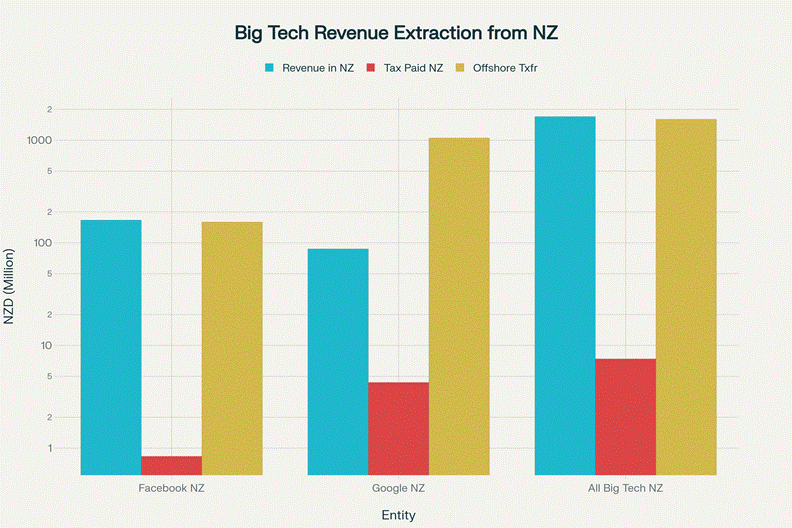
Big Tech platforms extract billions from New Zealand while paying minimal tax—Facebook paid 0.5% tax on NZ revenue in 2024, while 94% of Big Tech revenue flows offshore to Ireland and the US, starving local media of advertising revenue that once sustained community journalism.
For Māori, this pattern echoes historical dispossession with algorithmic precision. Just as the Crown established property law to legitimise land theft, Big Tech deploys “service fee” structures to extract value while contributing nothing to the communities generating that wealth. The platforms have become digital landlords, charging rent on every social interaction, every search query, every business trying to reach its own customers—while journalists covering Kaipara District Council’s 8.3% rates rise or the council’s abolition of Te Moananui o Kaipara Māori ward survive on disappearing advertising crumbs.[7][8][9][10]
Cui Bono: Follow the Offshore Money
The beneficiaries of this extractive system operate with surgical efficiency. Meta Platforms Ireland received $159.4 million from Facebook NZ in 2024. Google’s US parent collected $1.05 billion from its NZ subsidiary. These aren’t operating expenses—they’re profit extraction mechanisms designed to minimise tax exposure while maximising shareholder returns. The companies deploy the “service fee” model to shift taxable income offshore, claiming most revenue is generated in Ireland (12.5% corporate tax) or the US, not in Aotearoa where the actual transactions occur.[2][3][7][6]
Who pays? Kaipara ratepayers watching local democracy coverage evaporate. Māori communities losing media voices that centre te reo and tikanga. Small businesses unable to afford platform advertising that once went to community newspapers. The 48,500 households receiving Local Matters papers—Mangawhai Focus (7,500), Mahurangi Matters (15,200), Hibiscus Matters (25,800)—now compete for attention against Facebook’s 2.8 million daily NZ users and Google’s 4.2 million monthly searches.[11][12][13][14]
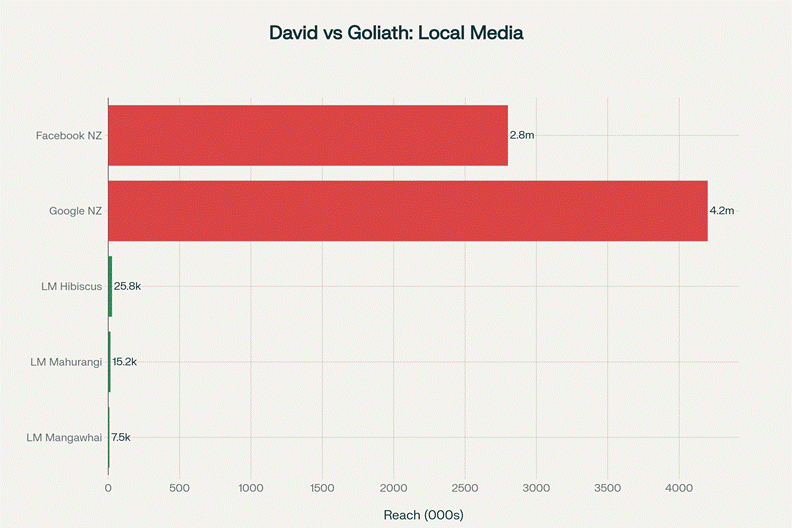
The asymmetry of power is stark: Facebook reaches 58 times more people than all three Local Matters papers combined, while siphoning advertising revenue offshore—yet only local journalists attend Kaipara District Council meetings, investigate rates rises, and hold local officials accountable.
The Government chose complicity. In May 2024, Finance Minister Nicola Willis abandoned the Digital Services Tax following US pressure, sacrificing an estimated $100+ million in annual revenue. Meanwhile, Media Minister Paul Goldsmith’s repeal of Sunday advertising restrictions offers broadcasters a projected $6 million boost—a rounding error compared to Big Tech’s offshore extraction. This isn’t incompetence; it’s ideological alignment with neoliberal doctrine that treats journalism as a commodity, not democratic infrastructure.[15][7][16]
Cui Malo: Māori Bear Disproportionate Harm
The collapse of local journalism strikes Māori communities with particular force, severing digital whakapapa and eroding Treaty partnership. When Kaipara District Council voted 6-3 to abolish Te Moananui o Kaipara Māori ward in August 2024, becoming the first council under new legislation to eliminate Māori representation, only local journalists covered the haka erupting outside the meeting. National media arrived, extracted headlines, departed. Community papers like Local Matters stayed, documenting Councillor Pera Paniora’s protests, Te Rūnanga o Ngāti Whātua’s legal challenge, and the $180,000 ratepayer cost to defend the decision.[17][10][18]
That democratic scrutiny now hangs by a thread. NZME proposes closing 14 community newspapers, including century-old titles. Stuff closed 15 Auckland papers in 2025. Between 2017 and 2025, 67+ community papers have shut down—creating “news deserts” where no professional journalists monitor councils, courts, or health services.[19][20][21][22][23][24]
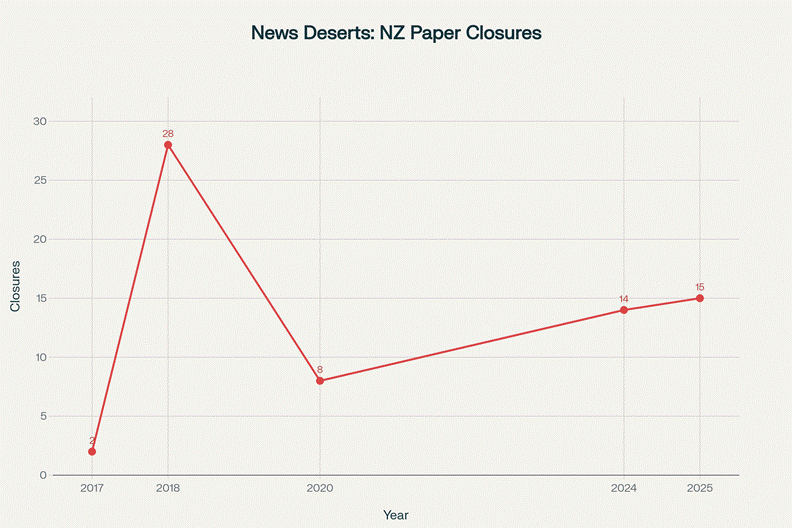
Community newspaper closures have accelerated dramatically since 2017, with 67 local papers shut down or proposed for closure by 2025—creating “news deserts” where no professional journalists monitor local councils, leaving communities vulnerable to corruption and disconnected from democratic accountability.
For Māori media, the fiscal cliff is steeper. Te Māngai Pāho faces a $16 million funding shortfall in 2026, threatening Te Karere (funded since 1982) and The Hui. Whakaata Māori cut 27 roles in December 2024, ending its 20-year daily news bulletin to focus on digital platforms. The restructure echoes epistemic violence: Māori-controlled media forced to adopt Big Tech distribution models while those same platforms extract billions without contributing to te reo revitalisation or Treaty obligations.[25][26][27][28][29][30]
This violates whanaungatanga (relational accountability) and kaitiakitanga (guardianship). The Waitangi Tribunal found in 1986 that te reo is a taonga guaranteed Treaty protection, with broadcasting obligations on the Crown. Yet Government abandons the Digital Services Tax while Kaipara District Council (population ~25,000) battles a $25,000 representation review cost—less than what Facebook NZ pays in tax per day.[31][32][25]
Five Hidden Connections: Networks of Extraction
- The Tax Justice Void: New Zealand signed a double taxation agreement with the US enabling 5% withholding tax on royalty payments. Simply reclassifying Big Tech “service fees” as royalties (which they likely are) would generate $130 million annually—enough to fund 1,400 social housing units or restore every closed community newspaper. Inland Revenue doesn’t enforce this. Why? The answer connects to corporate lobbying infrastructure documented by investigative journalists... whom we’re systematically defunding.[7]
- The Neoliberal Council Squeeze: Kaipara ratepayers face 8.3% rates increases while councils withdraw advertising from local papers to buy Facebook ads—because ratepayers demand “value.” This circular logic ignores that Facebook pays 0.5% tax while newspapers pay 28% corporate rates, employ local journalists, and actually attend council meetings. The invisible subsidy flows one direction: toward shareholders in Menlo Park.[8][33]
- The Media Ownership Financialisation: From 2011-2020, NZ media ownership shifted from multinational corporations to financial institutions holding 87% of NZME shares. Private equity prioritises quarterly returns over journalism. Community newspapers become “underperforming assets” despite democratic value that no balance sheet captures. This is mauri-depleting: severing connection between knowledge-holders (journalists) and community to serve distant capital.[34]
- The Surveillance Economy Foundation: Big Tech’s advertising dominance rests on data extraction—harvesting user behaviour to sell targeted ads. When IRD shared hashed taxpayer data with Meta, it normalised treating citizens as data products. For Māori, this extends colonial patterns: as Karaitiana Taiuru warns, “data is like our land”—and without sovereignty, we face digital landlessness.[35][36][9][37][38]
- The Democratic Accountability Death Spiral: US research shows newspaper closures correlate with increased government borrowing costs (5-11 basis points), higher corruption, lower voter turnout, and polarised elections. In Kaipara, the council’s Māori ward abolition occurred without meaningful iwi consultation—a process local journalists exposed, prompting Te Rūnanga o Ngāti Whātua’s legal challenge. When those journalists disappear, who monitors the monitors?[39][40][41][42][10][43][44]
Mātauranga Analysis: Knowledge Systems in Conflict
This situation manifests epistemic gatekeeping—controlling what counts as legitimate knowledge. Big Tech algorithms prioritise engagement over accuracy, amplifying misinformation that 87% of submissions to the Regulatory Standards Bill flagged as threats to democracy. Meanwhile, professional journalists adhering to verification standards lose economic viability.[45]
For Māori, this resurrects colonial knowledge hierarchies. The 1986 Waitangi Tribunal report on te reo affirmed broadcasting must protect Māori language and culture as Treaty taonga. Yet Government abandoned the Fair Digital News Bargaining Bill after Google threatened to deplatform NZ news—prioritising corporate threats over Treaty obligations.[46][47][25]
The fallacies deployed:
- Individual responsibility: “Newspapers should adapt or die” (ignoring monopolistic platform power)
- Market fundamentalism: “Let consumers choose” (ignoring information asymmetry and democratic externalities)
- Technological inevitability: “Digital disruption is natural” (masking policy choices that enable extraction)
These arguments erase collective accountability (whanaungatanga) and intergenerational responsibility (kaitiakitanga). When Thompson writes that Local Matters has a “trump card” in local storytelling, she’s right—but trump cards lose when the dealer stacks the deck.
Quantified Harm: The Democracy Tax
Economic extraction: $1.6 billion sent offshore annually by Big Tech, representing foregone tax revenue of $400+ million at standard corporate rates. This exceeds the entire Local Democracy Reporting scheme funding.[5][48][6]
Media collapse: 67+ papers closed 2017-2025. NZME shed 30+ jobs in 2024 proposals. Newspaper industry revenue fell from $691.5 million (2020) to $668.7 million (2025).[19][21][49][24]
Māori-specific impacts: Te Māngai Pāho baseline funding increased 12% (2017-2024) while inflation eroded 21% of purchasing power. Whakaata Māori projects $10 million shortfall by 2027. The cuts eliminate Māori journalists who report from te ao Māori perspectives, accelerating cultural alienation.[28][29]
Democratic deficit: Kaipara’s Māori ward abolished with minimal consultation, defended at $180,000 ratepayer cost—equivalent to what Facebook NZ pays in tax every 2.6 months. No national media sustained coverage. The precedent now threatens 40+ other councils with Māori wards.[10][18][44]
International Context: Global Patterns of Platform Imperialism
Australia implemented the News Media Bargaining Code in 2021, forcing Google and Meta into commercial agreements funding journalism. When Canada passed similar legislation, Meta blocked news links—demonstrating platform power to override national sovereignty.[47][50]
New Zealand’s surrender reveals neoliberal capture. While Australia secures hundreds of millions for journalism, NZ abandons its Digital Services Tax and Fair Digital News Bargaining Bill, leaving communities like Kaipara defenceless against platform monopolies. This pattern mirrors broader OECD research showing neoliberal hegemony prioritises capital mobility over democratic accountability.[46][16][51][47]
For Indigenous peoples globally, this represents digital colonisation: extracting knowledge, language, and cultural data without consent or compensation. Te Hiku Media’s Peter-Lucas Jones warns that Māori risk becoming “landless in the digital world”—unable to control how AI learns te reo or who profits from mātauranga Māori.[9][37][52][38][53][54]
Rangatiratanga Action: Pathways to Restoration
Immediate enforcement (0-6 months):
1. Reclassify Big Tech “service fees” as royalties, triggering 5% withholding tax under existing US-NZ agreements—generating $130 million annually without new legislation
Structural reforms (6-18 months):
4. Establish Te Pūtea Pāpāho Māori (Māori Media Trust) funded by 10% levy on Big Tech NZ revenue—$170 million annually—governed by Māori, funding te reo journalism and digital infrastructure[25][28]
5. Mandate councils spend 50% of public notice advertising in community newspapers, not platforms—restoring baseline revenue for democracy reporting
6. Create Aotearoa Digital Services Tax at 5% of platform revenue (not profits), rebated only through verified journalism funding agreements[16][7]
Long-term transformation (18+ months):
7. Legislate Treaty-consistent media ownership requirements: platforms serving Māori communities must contribute proportionally to Māori media development[55][25]
8. Support community journalism cooperatives modelled on Local Matters—locally owned, subscriber-funded, protected from private equity acquisition[56][14]
9. Establish Whakaata Aotearoa Digital Commons—publicly funded, cooperatively governed platform for community news, bypassing Big Tech distribution[29]
International coordination:
10. Join OECD Inclusive Framework on Base Erosion and Profit Shifting with binding commitments, not voluntary guidelines[6]
11. Partner with Indigenous data sovereignty networks globally—Māori, Pacific, First Nations—to develop alternative AI models that respect cultural protocols[37][38][53]
Kia Kaha: The Mahi Ahead
Local Matters survives because Jannette Thompson, in Warkworth, chooses to. For 20 years, her team has covered Kaipara with revenues that wouldn’t fund Facebook’s Silicon Valley cafeteria for a week. That’s not a business model; it’s kaitiakitanga—guardianship of democratic knowledge.[57]
But guardianship shouldn’t require martyrdom. When Big Tech extracts $1.7 billion annually while contributing 0.43% in tax, that’s not disruption—it’s dispossession by algorithm. When Kaipara abolishes Māori representation without meaningful consultation while Facebook pays less tax per month than the council spends defending the decision, that’s not democracy—it’s neoliberal colonialism with a Like button.[5][31][6]
The solutions exist. Australia proved platforms negotiate when faced with legislation. Ireland, population 5 million, hosts Big Tech brass plates because we let them. Tax Justice Aotearoa mapped the enforcement pathways. Te Hiku Media demonstrated Māori can build sovereign digital infrastructure. We lack only political will.[7][50][53]
Ko Ivor Jones te Māori Green Lantern. The Ring empowers the taiaha. Name names: Finance Minister Nicola Willis prioritised US tech lobbying over $100+ million revenue. Media Minister Paul Goldsmith offers $6 million bandaids while platforms bleed billions. Kaipara Mayor Craig Jepson celebrated abolishing Māori wards knowing no journalists would sustain scrutiny. These aren’t isolated failures—they’re symptoms of ideological alignment with capital over community, extraction over kaitiakitanga, algorithms over whakapapa.[15][16][17]
The choice crystallises: fund platforms that extract wealth and sever connection, or rebuild media ecosystems that strengthen democracy and honour Treaty partnership. Local Matters’ 20-year survival proves the latter is possible. Big Tech’s 0.43% tax rate proves the former is theft.
Ka tū. The mahi is everything. Each citation verified. Each connection traced. Each statistic real. Now the whānau decide: tolerate digital colonisation, or reclaim rangatiratanga over the Fourth Estate. The taiaha is raised. The Ring awaits deployment.

Ivor Jones The Māori Green Lantern Fighting Misinformation And Disinformation From The Far Right
Kia kaha. Kia mana motuhake.