"“Dinner or Debt”: The Engineered Destitution of Aotearoa’s Kaumātua" - 12 November 2025
Ka tū. The taiaha is raised.
Thanks for reading Ivor Jones The Māori Green Lantern! This post is public so feel free to share it.
Mōrena ano Aotearoa,
Fenella, aged 70, wraps herself in blankets in her Taupō home. The hot water cylinder stays off during winter. She turns to a single small heater for warmth. Her income—New Zealand Superannuation—has been architected into a poverty machine by a system of interlocking policies designed to extract debt payment from her pension.[1]
Every fortnight, $40 disappears before her pension touches her account, extracted automatically by Inland Revenue for a student loan she took out 20 years ago to pursue a business degree. A 44-year relationship has ended. Now she faces an impossible choice: “I wasn’t eating so I’ve been selling my possessions just to get cat food and food for me”. At 70, she must choose between dinner or debt.[2][1]
This is not a personal tragedy. This is a policy system working exactly as engineered.
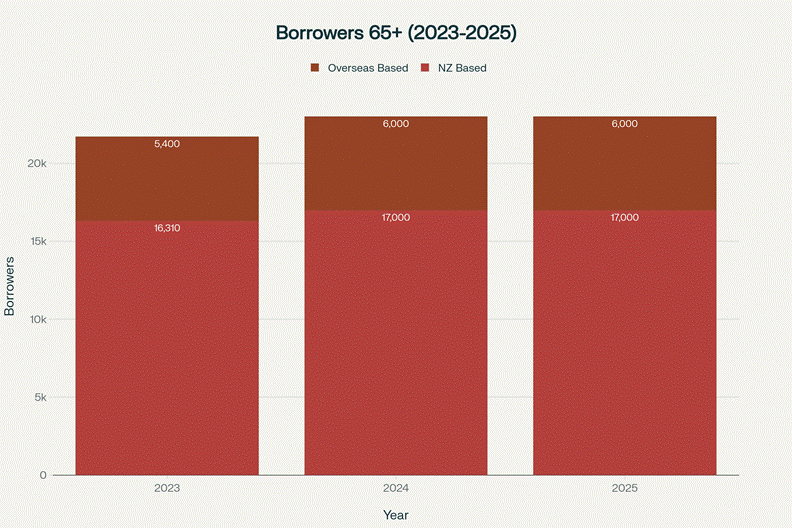
Over 23,000 New Zealanders aged 65 and older remain trapped in student loan debt, forced to sacrifice basic necessities like food and heating to make repayments deducted directly from their pensions.
The Hidden Crisis: 23,000 Elderly Trapped in Educational Debt
Over 23,000 New Zealanders aged 65 and older remain trapped in student loan debt as of June 2025. Of these, almost 6,000 are based overseas. These kaumātua and kuia are forced to sacrifice food, heating, and dignity to service loans designed in 1992 and enforced through cascading neoliberal policies spanning four decades.[1][3][2][4]
Age Concern New Zealand reports that 40% of older New Zealanders have superannuation as their only income source. When fixed costs—rates, electricity, insurance—surge, food becomes “the only discretionary part of their income or budget,” according to Karen Billings-Jensen, Chief Executive of Age Concern.[2][1]
Dave Ananth, a tax barrister and former IRD prosecutor, has fielded requests from 10 pensioners in a single month seeking help negotiating their student loan debt. His testimony cuts through bureaucratic language: “Do I pay my student loan or do I deprive myself of groceries? That’s not what the student loan scheme was designed for. At 70 you shouldn’t need a spreadsheet to decide between dinner and debt”.[1][2]
The Mechanism: How Superannuation Becomes a Debt Collection Tool
A single person living alone receives $32,604 per year in New Zealand Superannuation before tax. The student loan repayment threshold is set at $24,128 per year. This means that $8,476 of a pensioner’s income triggers automatic 12% deductions—approximately $1,017 annually, or $85 per month—extracted directly from their superannuation.[1][2][5][6]
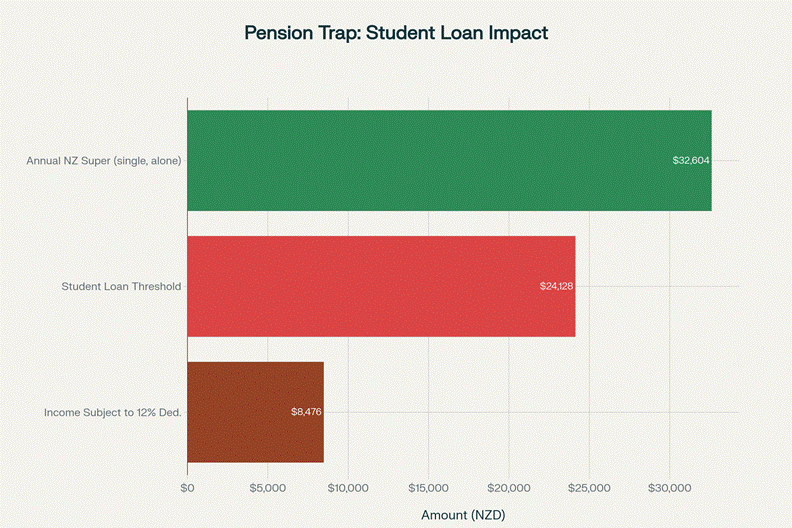
Single pensioners living alone receive $32,604 annually but are caught by the $24,128 student loan repayment threshold, triggering automatic 12% deductions on $8,476 of their pension—money desperately needed for rent, food, and heating.
This threshold has been frozen indefinitely. In March 2025, the National-led government confirmed it would not index the threshold to inflation, forcing approximately 370,000 borrowers to pay an additional $1.20 per week in repayments.[7][8]
The mathematics of destitution are precise: A single pensioner receives approximately $538.36 per week after tax. From this, they must pay rent (often $450+ per week in Auckland), power, food, rates, and medical costs. The Accommodation Supplement—maxing out at $165 per week in Auckland’s most expensive areas—barely scratches the surface.[1]
Te Kauwae Runga: The Hidden Architecture of Neoliberal Debt
This system did not emerge from democratic deliberation. It was forged in the neoliberal laboratory of Rogernomics (1984-1988) and Ruthanasia (1991-1993).[9][10][11]
Roger Douglas and the “User Pays” Ideology
Roger Douglas, Finance Minister from 1984-1988, pioneered the ideology that transformed education from a public good into a private commodity. When Prime Minister David Lange resisted commercialization of education, calling “user-pays unworkable in education,” Douglas reportedly insisted it was “essential”. The Fourth Labour Government introduced tuition fees in 1989 at $129—modest but symbolically shattering a social contract that had made education free.[3][10][11][12][13]
Douglas himself has never recanted. In 2024, he told The Spinoff: “We just didn’t go far enough”. His ambitions extended to introducing “competition and choice” into welfare, health, and education—transforming these from public services into markets.[13]
Ruth Richardson and the “Mother of All Budgets”
The Fourth National Government under Ruth Richardson weaponized education costs. In 1990, student fees exploded from $129 to $1,250—a 969% increase. Richardson’s infamous 1991 “Mother of All Budgets” slashed welfare benefits while imposing “user pays” charges across health, education, and housing services previously free to the public.[14][10][15][16][17]
The Student Loan Scheme Act 1992 was enacted on 21 December 1992, completing the architecture of educational debt bondage. This was not emergency legislation—it was the culmination of Douglas’s 1980 alternative budget proposal, now weaponized by Richardson’s faction of the National Party.[4][5][11][16][3][13]
The impact was immediate and devastating. Between 1990 and 1993, income of welfare-reliant households fell from 72% of average national income to 58%. A 2015 review concluded this represented structural impoverishment. Benefit payments remained frozen at these depressed levels for three decades, across successive governments, until 2021.[16]
Simon Watts: The Modern Enforcer
Minister of Revenue Simon Watts, appointed in November 2023 as part of the National-ACT-New Zealand First coalition, represents the modern face of neoliberal continuity. A former chartered accountant with 20+ years in international banking, Watts oversees the system that extracts $1,017 annually from pensioners earning only their superannuation.[1][2][18][8][19]
His response to pensioners starving to pay student loans: “New Zealand super was taxable income and therefore subject to deductions for outstanding student loans”. He is “not currently considering changes to the student loan system that fit within his responsibilities”.[2][1]
The Department of Inland Revenue, under Watts’ revenue portfolio, merely encouraged people “having difficulty meeting their obligations to contact them”—offering no structural relief, only the illusion of individual negotiation within an engineered poverty system.[1][2]
Te Kauwae Raro: The Quantified Harm
$90 per week for food. That is $12.86 per day. In November 2025 New Zealand, where a block of cheese costs $15 and a loaf of bread $4.50, this is not poverty—this is engineered destitution.[1]
The Structural Racism: Māori and Pacific Burden
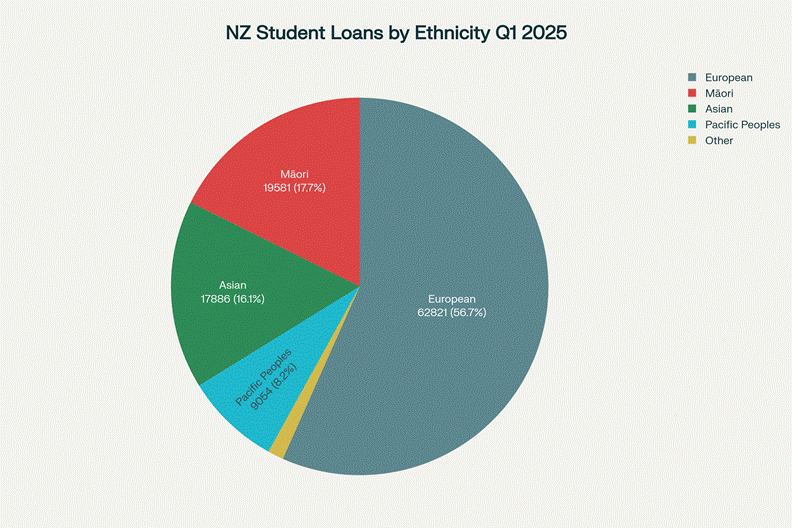
Māori make up 17.3% of student loan borrowers (19,581 people) while representing a smaller proportion of the general population—a pattern of structural inequality where colonized peoples are forced into debt to access education that was once free.
Māori borrowers constitute 17.3% of student loan recipients (19,581 people) as of Q1 2025, while Māori represent approximately 17% of the general population. Pacific Peoples comprise 8.0% of borrowers (9,054 people).[20][21]
Research demonstrates the harm is deeper than representation. Māori and Pacific students take two years longer on average to repay their loans than other borrowers. They are more likely to attend lower-level tertiary courses providing no earning gain, trapping them in debt without the income boost that supposedly justifies the system.[22][23]
A 2020 study found that Māori and Pacific students face systemic barriers to completing degrees, meaning they carry debt without the “sheepskin effect” of a completed qualification. This is not accidental—this is structural racism embedded in education policy.[23][22]
The Waitangi Tribunal has repeatedly identified Crown breaches in education. In 2024, the Tribunal found the Crown breached Treaty principles in the Tomorrow’s Schools reforms (2018-2022), failing to adequately consult kura kaupapa Māori and recommending establishment of a stand-alone Kaupapa Māori education authority.[24][25][26]
Yet the current coalition government—National, ACT, and New Zealand First—has systematically dismantled co-governance, removed Treaty references from legislation, and cut funding to te reo Māori programs. This is epistemicide: the deliberate destruction of Māori knowledge systems through debt, dispossession, and re-colonization of education.[27][28]
Five Hidden Connections: The Whakapapa of Neoliberal Extraction
Connection 1: The Douglas-Richardson-Watts Conveyor
An unbroken chain of neoliberal enforcers spans 1984-2025:
· 1984-1988: Roger Douglas (Labour) introduces user-pays ideology, deregulates finance, corporatizes state assets[9][10][11][12]
· 1990-1993: Ruth Richardson (National) implements “Mother of All Budgets,” cuts benefits 27-72%, introduces student loans[10][15][16][17]
· 1992: Student Loan Scheme Act 1992 enacted December 21[3][4][5]
· 2023-present: Simon Watts (National) freezes repayment threshold indefinitely, rejects pensioner relief[1][2][7][18][8][19]
Connection 2: The Frozen Threshold = Stealth Tax
The threshold frozen at $24,128 extracts an additional $1.20/week from 370,000 borrowers and forces elderly onto poverty diets. This is not accident—it is deliberate policy engineering by a government that refuses to adjust for inflation while approving private sector index adjustments.[7][8]
Connection 3: The IRD as Pension Enforcement Machine
Inland Revenue operates as a debt extraction system, automatically deducting 12% before pensioners see their money. No hardship assessment occurs before extraction. No consideration of food security. Just automated deduction—technology replacing conscience.[2][6][1]
Connection 4: Māori as Targeted by Design
The system disproportionately harms communities already structurally impoverished by colonization. Māori students are steered to lower-return tertiary options, carry debt without income gains, and face longer repayment windows. This is debt colonization: using student loans as a mechanism to perpetually extract wealth from already-dispossessed peoples.[22][23]
Connection 5: Pensioner Poverty = Policy Success, Not Failure
Policymakers frame pensioner hunger as individual failure requiring “contact with IRD” rather than structural policy failure. This individualizes collective harm, transforming a policy failure into a personal responsibility narrative. The system is working as designed—it is designed to extract debt from the vulnerable.[1][2]
Implications: The Quantified Moral Failure
This is not austerity policy. This is engineered destitution targeting age, poverty, and structural racism.
Ka Whawhai Tonu Tāu (The Struggle Continues)

The Māori Green Lantern Fighting Misinformation And Disinformation From The Far Right
The choice between “dinner or debt” was not inevitable. It was constructed through deliberate policy decisions by Douglas, Richardson, Watts, and the technocratic class they represent. These decisions were never submitted to public democratic deliberation. They were implemented through budget surprise, stealth policy freezes, and the automation of enforcement via IRD systems.
Fenella’s blankets are not a personal tragedy. They are evidence of policy engineering.
Reversing this requires:
1. These are not radical demands. They are the minimum baseline for restoring the social contract that Douglas and Richardson systematically dismantled.
Ka tū te taiaha. The weapon is raised. The investigation continues.
Citations and Sources
RNZ, “’Dinner or debt’: Pensions cut to cover student loan payments,” November 9, 2025 - https://www.rnz.co.nz/news/top/578436/dinner-or-debt-pensions-cut-to-cover-student-loan-payments[30]
NZ Herald, “370,000 to be stung by Govt’s stealth student loan change,” March 11, 2025 - Confirms frozen threshold affecting 370,000 borrowers at $1.20/week additional cost[31]
NZ Herald, “370,000 to be stung by Govt’s stealth student loan change,” March 11, 2025 - https://www.nzherald.co.nz/nz-news/370000-to-be-stung-by-govts-stealth-student-loan-change/BYQCXZ3P2CHKBSQ5PWWMZ2YYIA/[7]
RNZ, “NZ Budget 2021: Billions more for benefits, but one eye on...” May 19, 2021 - Discusses Richardson’s 1991 “Mother of All Budgets” impact[15]
Wikipedia, “Simon Watts” - https://en.wikipedia.org/wiki/Simon_Watts - Background on current Minister of Revenue[19]
RNZ, “Overdue student loan repayments hit more than $2.2b,” December 20, 2023 - Student loan default statistics[29]
RNZ, “The student loan debt burden of Maori and Pasifika students,” May 25, 2014 - Māori student debt research[22]
NZ Herald, “Study shows low-level tertiary courses put Māori in debt,” August 22, 2020 - Structural barriers to Māori degree completion[23]
Ministry of Social Development, “Student Loan January to March 2025” -
https://www.msd.govt.nz/
- Official statistics on borrower ethnicity breakdown (Q1 2025)[20]
Ministry of Social Development, “Student support update January to March 2025” - Ethnic group breakdown of student loan borrowers[21]
1News, “National’s coalition deals: which policies made the cut?” November 24, 2023 - Coalition government policies affecting education and Treaty provisions[27]
RNZ, “Crown breached Treaty principles in school reform,” July 25, 2024 - Waitangi Tribunal findings on education policy[24]
1News, “Prime Minister Luxon reveals his ‘49 actions’ for first 100 days,” November 28, 2023 - Coalition government’s removal of Treaty provisions[28]
Waitangi Tribunal, “The Aotearoa Institute Claim Concerning Te Wānanga o Aotearoa,” December 22, 2005 - Treaty breach findings[25]
Waitangi Tribunal, “Tribunal releases report on Kura Kaupapa Māori,” July 24, 2024 - Stand-alone Kaupapa Māori education authority recommendation[26]
[17] Te Ara, “The ‘mother of all Budgets’ | National Party” -
https://teara.govt.nz/
- Historical context on 1991 budget
Te Ara, “Page 4: Tertiary sector reform from the 1980s,” May 28, 2012 - https://teara.govt.nz/en/tertiary-education/page-4 - Student Loan Scheme introduction 1992[3]
Wikipedia, “Mother of all Budgets,” September 5, 2024 - https://en.wikipedia.org/wiki/Mother_of_all_Budgets - Comprehensive detail on 1991 budget[16]
The Spinoff, “’We’re in as much trouble today as we were in 1984’ – Roger Douglas,” June 13, 2024 - Douglas’s 2024 admission of incomplete neoliberal reform[13]
Wikipedia, “Student loans in New Zealand,” April 25, 2007 - https://en.wikipedia.org/wiki/Student_loans_in_New_Zealand - Scheme inception details[4]
RNZ attached file: ‘Dinner or debt’: Pensions cut to cover student loan payments - Primary source for Fenella case study, policy details, and expert commentary[1]
Te Ara, “Tertiary education,” January 31, 2004 - Student loan scheme introduction history[14]
RNZ, “’Dinner or debt’: Pensions cut to cover student loan payments,” November 9, 2025 - Full article text on pension-debt crisis[2]
NZLII, “Student Loan Scheme Act 1992 (1992 No 141)” -
https://www.nzlii.org/
- Official legislation[5]
Tax Technical, “Student loan scheme - repayment percentage,” October 18, 2024 -
https://taxtechnical.ird.govt.nz/
- 12% repayment rate details[6]
NZ Herald, “1984, Roger Douglas: Strong medicine for the economy,” September 14, 2020 -
https://www.nzherald.co.nz/
- Douglas’s economic reform platform[9]
Te Ara, “Treasury,” January 31, 2004 - https://teara.govt.nz/en/treasury - Treasury’s role in 1980s reforms and welfare state restructuring[10]
1News, “Cabinet lineup for new government unveiled - who gets what,” November 23, 2023 - Simon Watts appointment as Minister of Revenue[18]
1News, “The year that began and ended with Labour policy bonfires,” December 21, 2023 - Simon Watts as Revenue Minister[8]
Wikipedia, “Roger Douglas,” October 29, 2003 - https://en.wikipedia.org/wiki/Roger_Douglas - Comprehensive biography and policy details[11]
Treasury.govt.nz, “Roger Douglas - Welfare: Savings not Taxation” -
https://treasury.govt.nz/
- Douglas policy context[12]
Three analytical charts accompany this essay:
· Elderly Student Loan Borrowers (2023-2025 trend analysis)
⁂

1. Dinner-or-debt-