“EIGHTEEN COINS FOR EIGHTEEN SOULS: When the Crown Buys Legitimacy with Māori Faces” - 1 January 2026
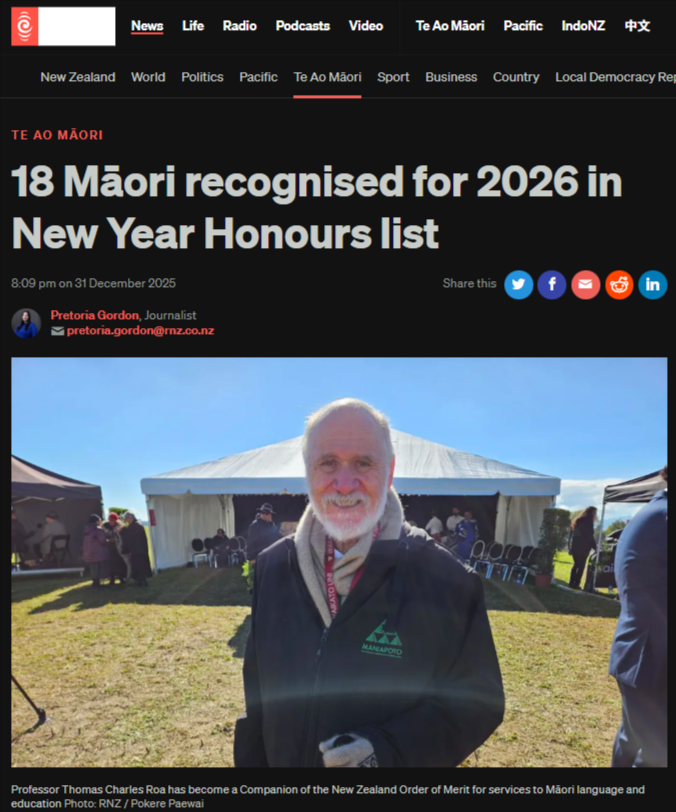
Minister Tama Potaka says 18 Māori honoured in the New Year 2026 list
“demonstrate deep and enduring commitment to Māori advancement and community leadership across Aotearoa.”
He is
“particularly inspired and motivated by those Māori leaders and people working in the iwi, hapū and whānau space who are doing some wonderful work in maintaining and uplifting our identity.”
This sounds like celebration. It sounds like recognition. It sounds like the Crown finally seeing Māori excellence.
It is none of these things.
It is purchase. It is co-optation. It is the Crown’s oldest trick:
Taking the faces of resistance and pinning medals to them, converting potential opposition into testimonial, transforming those who could challenge the system into those who validate it.
The honours system does not celebrate Māori liberation. It celebrates Māori integration into the machinery of dispossession. And every medal pinned to a Māori chest is a coin exchanged for legitimacy
—18 coins for 18 souls, buying the Crown another year of pretending its violence is partnership.
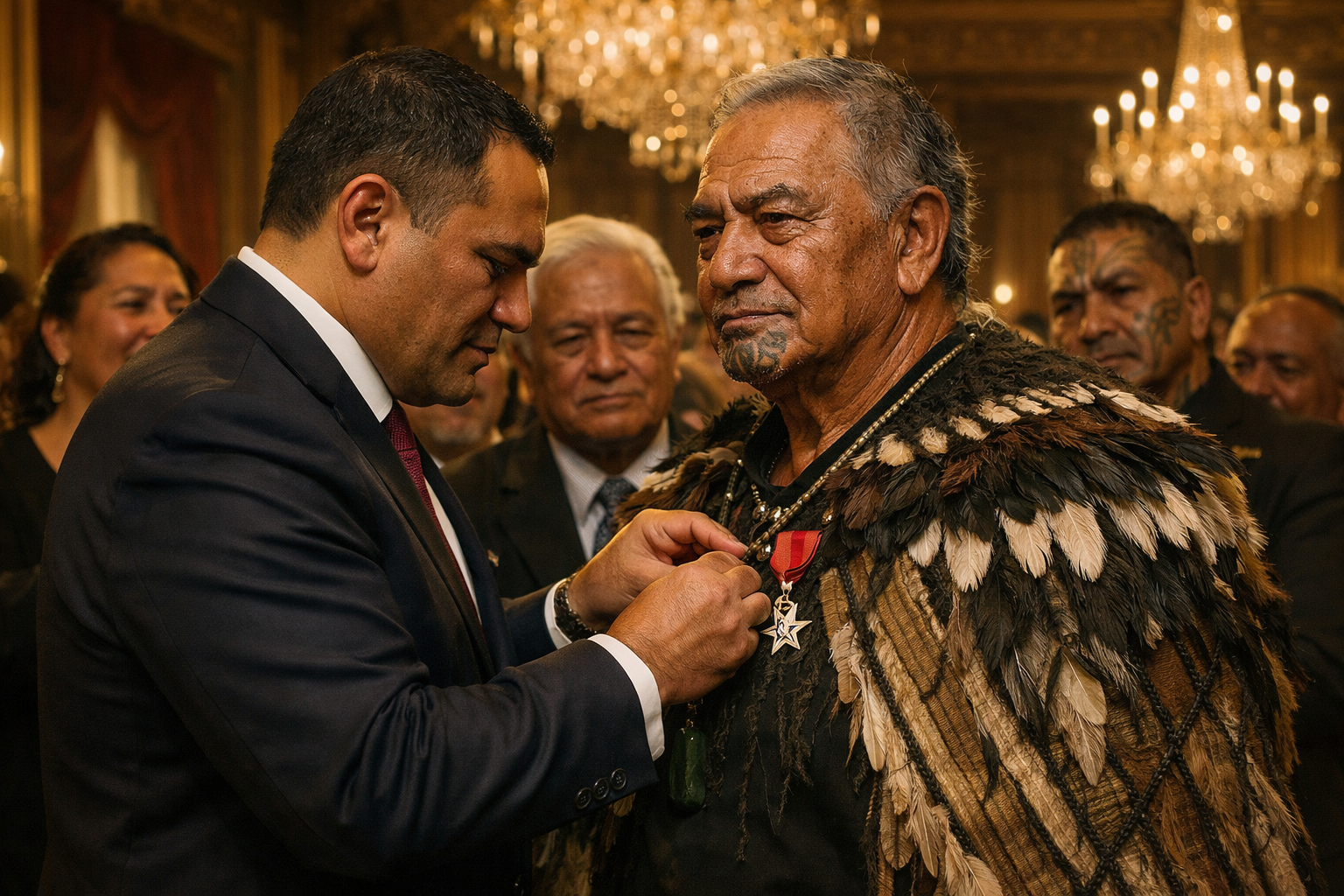
Eighteen Coins For Eighteen Souls
The Metaphor: Judas Coins and Crown Legitimacy
The Biblical story is instructive:
Thirty pieces of silver for betrayal. But the honours system is more sophisticated. The Crown does not ask Māori recipients to betray. It asks them to accept. To receive. To stand on stages and smile while the Governor-General—representative of a Crown that confiscated 1.5 million hectares from Māori in the 1860s—drapes ribbons over their shoulders.
The acceptance itself is the transaction. By receiving honours “for services to Māori,” recipients become evidence that the system works, that the Crown is benevolent, that individual excellence within colonial structures is possible
—and therefore sufficient.
As research on co-optation demonstrates, this is not accidental. Co-optation is “complex, incremental, and dynamic”
—it converts resistance into compliance by offering recognition, resources, and symbolic capital to those who could otherwise challenge power.
The process is particularly insidious for Indigenous peoples, whose sovereignty claims threaten the legitimacy of settler states.
The honours system operationalises this co-optation at scale. It does not silence Māori voices—that would be too obvious.
Instead, it amplifies specific Māori voices:
Those working within Crown structures, those advancing te reo through Crown-approved institutions, those serving on Crown-established boards. It creates a class of honoured Māori whose success depends on the system’s continuation, whose recognition flows from Crown authority, whose legitimacy is certified by the very power structure that dispossessed their ancestors.
This is tokenism as state craft.
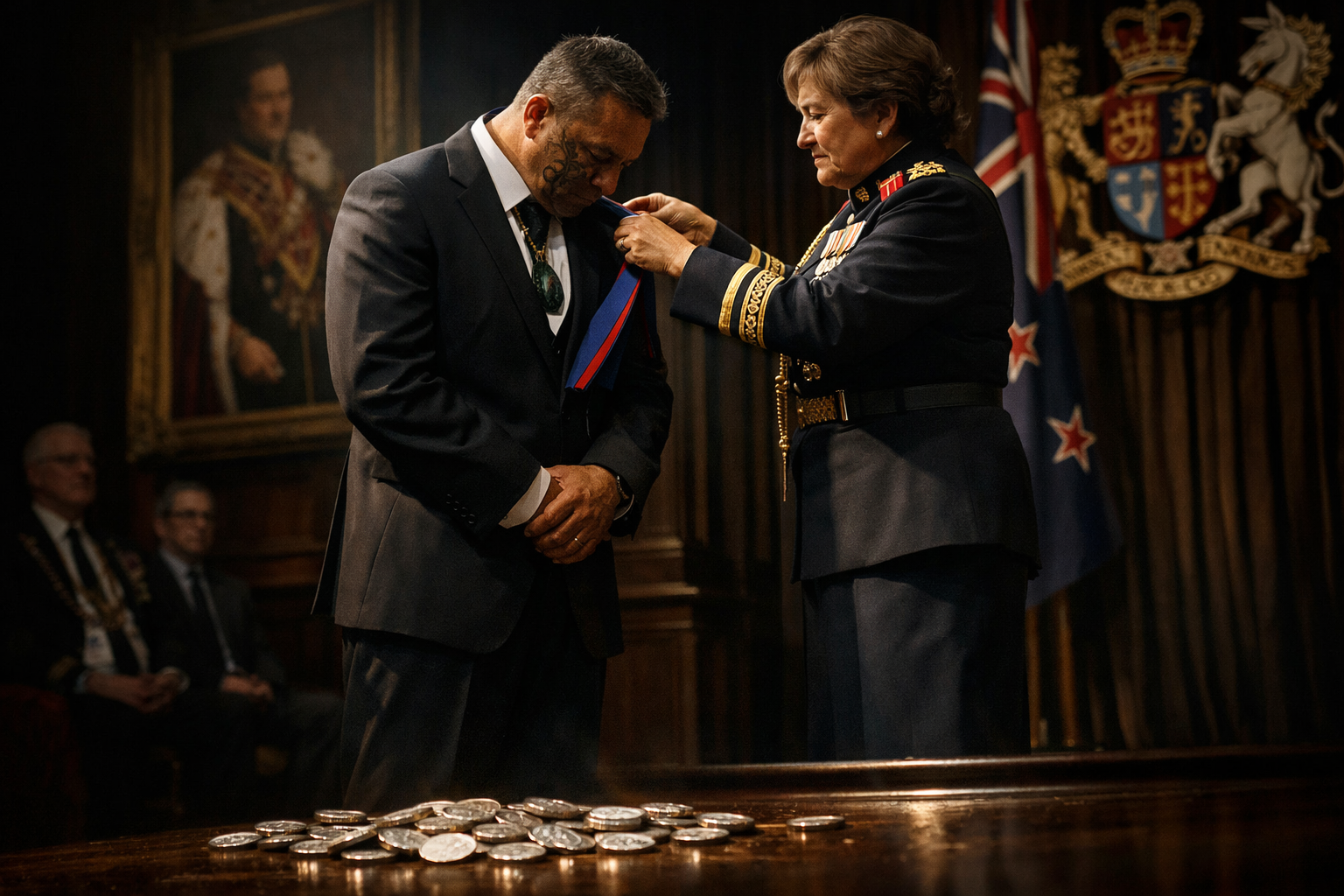
Judas Coins and Crown Legitimacy
The Arithmetic of Apartheid Recognition
Eighteen Māori honoured. Minister Potaka celebrates this as Māori “excelling.”
Let’s examine what “excellence” means in material terms.
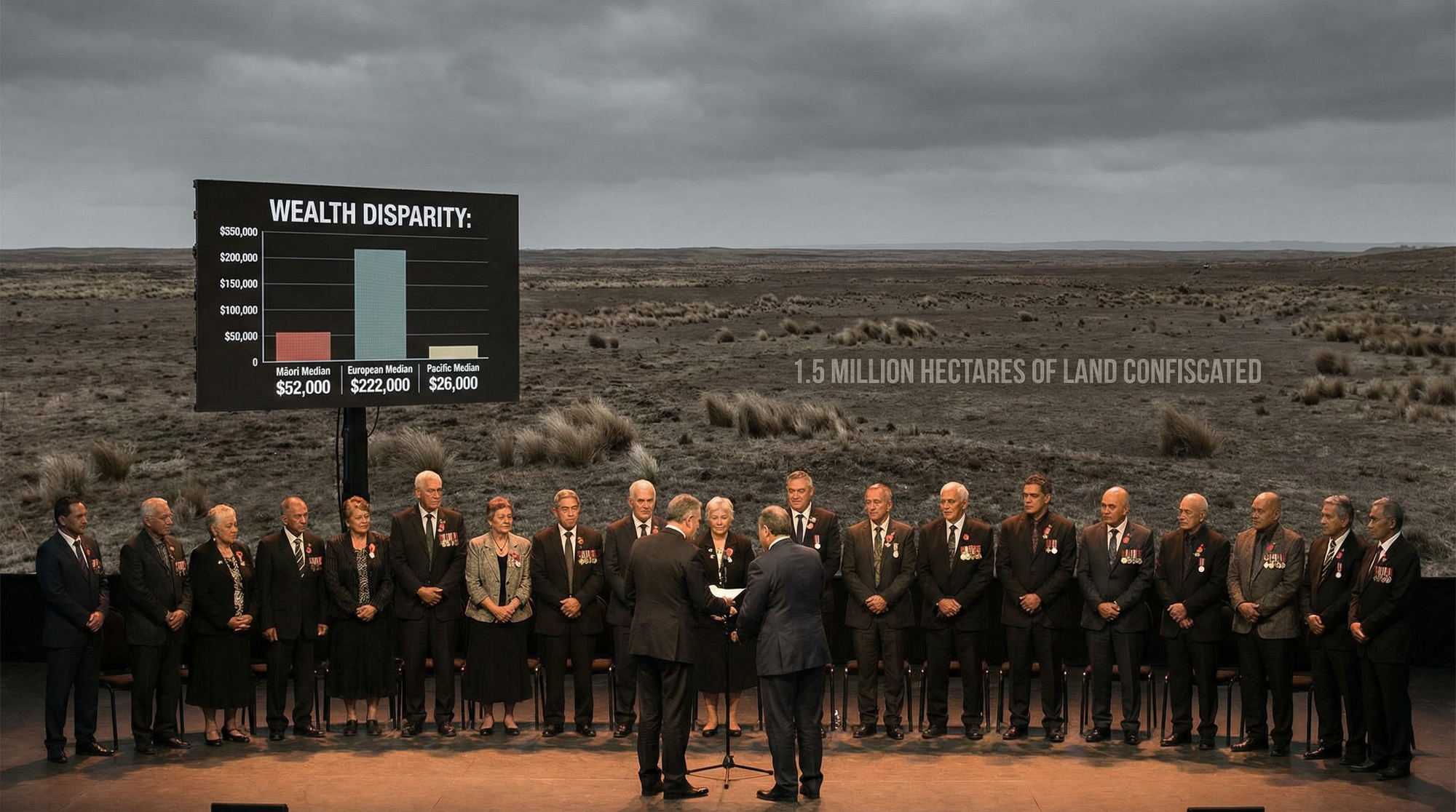
Māori median individual wealth: $52,000. European median wealth: $222,000. A 4.3x disparity. Pacific peoples: $26,000—8.5x less than Europeans.
This wealth gap has a name. It is called raupatu—confiscation. Between 1863 and the early 1870s, the Crown confiscated approximately 1.5 million hectares from Māori, including fertile lands in Waikato, Taranaki, Tauranga, and Bay of Plenty. The New Zealand Settlements Act 1863 authorized seizure from tribes deemed to be in “rebellion”—but the Act made little distinction between “rebels” and Crown allies, effectively robbing most Māori in these regions.
The Native Land Court, established in 1865, converted customary title “as nearly as possible to the ownership of land according to British law”—a conversion designed to facilitate rapid alienation. By mid-1872, courts had issued titles to over 2 million hectares, almost all of which was subsequently sold.
In 1860, Māori held about 80% of North Island land. By 1890, this had fallen to 40%. By 1910, to 17%. Today, Māori own less than 5% of New Zealand’s land base.
This is not historical abstraction. This is the material foundation of current wealth disparities. European fortunes rest on land acquired through Crown confiscation, predatory purchasing, and legal dispossession. Māori poverty rests on landlessness created by Crown violence.
The Crown’s response to this structural theft? Honour 18 Māori for “services.”
The arithmetic is obscene. Eighteen medallions to mask 1.5 million hectares stolen. Eighteen ceremonies to distract from $170,000 median wealth disparity per Māori person. Eighteen speeches about “deep and enduring commitment” while the wealth gap remains unchanged, with the poorest 20% of New Zealand households experiencing no statistically significant wealth increase between 2021-2024.
This is not recognition. This is mathematics as violence
—counting individual Māori honours while refusing to count collective Māori dispossession.
Potaka Is A Neoliberal Māori Whose God Is Money
Professor Tom Roa: The Tragedy of Necessary Collaboration
Among the 18 honoured is Professor Tom Roa (Ngāti Maniapoto, Waikato, Ngāti Apakura), made a Companion of the New Zealand Order of Merit “for services to Māori language and education.”
Tom Roa deserves every form of recognition Māori can give him. He co-founded Te Wiki o Te Reo Māori in the 1970s, marched on Parliament with the 1972 Māori Language Petition, fought for te reo when the state was actively trying to extinguish it. He established kōhanga reo, advocated for kura kaupapa, and spent over 50 years resisting linguistic genocide.
But he should not have received this honour from the Crown. Because the Crown that honours him today is the same Crown that created the need for his resistance.
In the mid-1800s, the Crown actively suppressed te reo Māori in schools, beating children for speaking their language. By 1862, a school inspector reported to the House of Representatives that “a refined education or high mental culture” would be inappropriate for Māori because they “are better calculated by nature to get their living by manual than by mental labour.” The Tohunga Suppression Act 1907 criminalized traditional Māori knowledge practices. By the 1950s, Māori urban migration and “pepper-potting” policies deliberately prevented the reproduction of Māori communities and language.
Tom Roa spent his life fighting the consequences of Crown linguistic genocide. The Crown now honours him for that fight—as if the Crown were not the perpetrator.
This is the tragedy. Roa’s work was essential. His recognition by Māori communities is deserved. But when that recognition flows through Crown honours, it converts resistance into collaboration. It allows the Crown to claim credit for “supporting” te reo revitalization while refusing accountability for nearly destroying it. It transforms a story of Crown violence and Māori resistance into a story of “partnership” and “shared achievement.”
In his response, Roa acknowledged this tension, saying
“There are so many people who have been a part of my journey,” including “Koro Wētere… who I think should have been made a Sir.”
The humility is telling. Roa knows the honour is not his alone. He knows others deserve recognition. But the system does not honour collectives—it honours individuals. It does not recognize movements—it recognizes leaders. Because movements threaten power, while individual leaders can be co-opted.
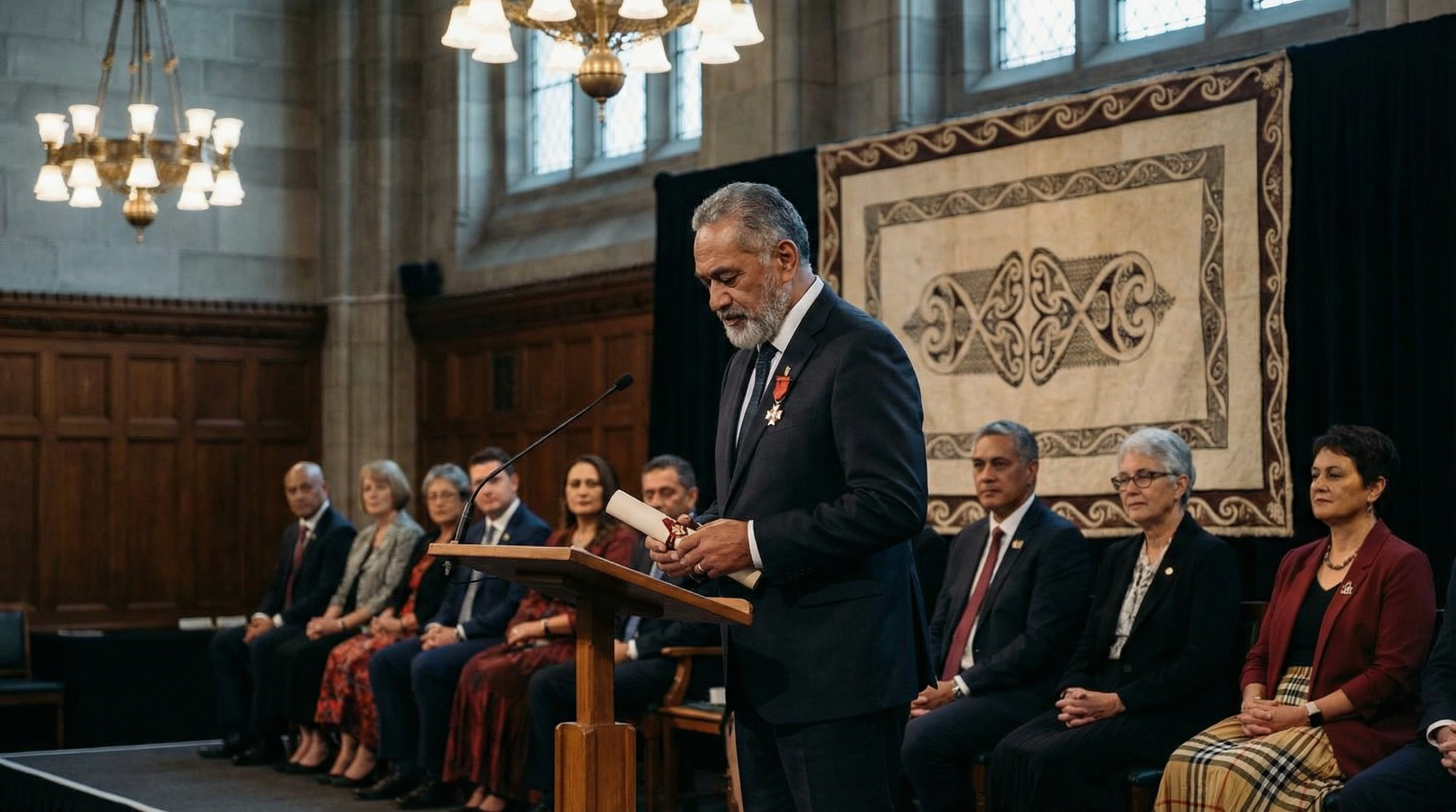
The Tragedy Of Necessary Collaboration
The Co-Optation Machine: How Honours Convert Resistance into Compliance
Research on Indigenous co-optation reveals how state recognition functions as control:
“External pressures—such as donor dependency, NGO asymmetries, and political co-optation—interact with internal community divisions and social hierarchies to undermine autonomy and sustainability.”
The honours system operationalises this dynamic. By offering symbolic recognition without structural change, it creates a class of Māori whose legitimacy flows from Crown authority rather than community accountability. These individuals often do genuinely important work—teaching te reo, serving on boards, advocating for Māori health. But when the Crown honours them, it converts their work into evidence of the system’s benevolence.
As critical scholarship demonstrates, reparations and recognition programs can function as “strategies to stage resistance to state-sponsored redress and to expose the harmful logics and legacies of ongoing settler colonialism.” The honours system does the opposite: it uses recognition to obscure ongoing colonialism, presenting individual Māori success as proof that the system works.
Consider the categories of Māori honoured:
“services to Māori language and education,”
“services to Māori and governance,”
“services to business, Māori and governance.”
Every category locates Māori achievement within Crown-established structures. Te reo revitalization happens through Crown-funded institutions. Governance happens on Crown-appointed boards. Business happens within property relations established through Crown confiscation.
Where are the honours for Māori resisting these structures? Where are the honours for activists reclaiming confiscated land? For those challenging Crown sovereignty? For those demanding genuine tino rangatiratanga—not Crown recognition, but Crown removal?
They do not exist. Because the honours system does not celebrate resistance. It celebrates compliance masquerading as partnership.

The Co-Optation Machine
Minister Potaka: The Tragic Figure at the Banquet
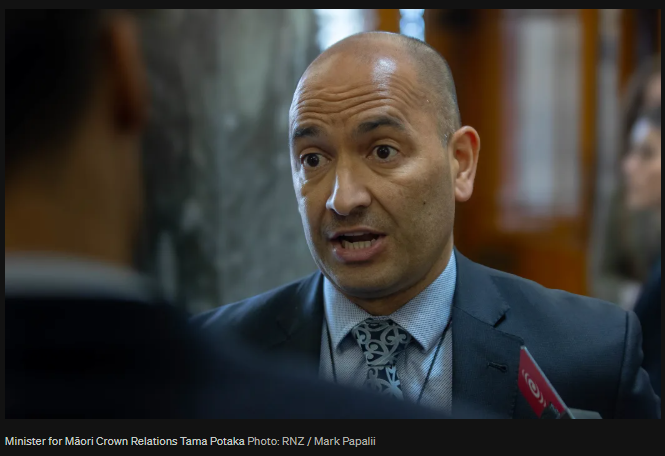
Tama Potaka, Minister for Māori Development, celebrates the 18 Māori honoured as demonstrating “deep and enduring commitment to Māori advancement.” He acknowledges that “within nearly everybody that’s been awarded an honour and award today and recognised for their massive contribution, there are often wives and husbands and children and parents and spouses and cousins that are behind them.”
Potaka knows the work is collective. He knows honours atomize collective struggle into individual achievement. Yet he celebrates them anyway, because his role requires it.
Potaka’s political position is precarious. As Professor Margaret Mutu observed,
“The New Zealand Parliament is a hostile place for Māori, and it is very hard for those advocating for Māori to be heard, let alone listened to… Tama knows that a lot of what the present Government is doing to Māori is wrong but he can’t say so openly.”
Potaka is himself a token—a Māori face legitimating a government that has dismantled the Māori Health Authority, removed Treaty principles from legislation, made it harder to establish Māori wards, and overturned court rulings on foreshore and seabed rights. His celebration of honours is the performance required of someone whose political survival depends on making Crown violence look like partnership.
This is the deeper tragedy:
The honours system does not just co-opt grassroots Māori leaders. It co-opts Māori politicians tasked with administering their own people’s dispossession. Potaka must smile at ceremonies honouring 18 Māori while overseeing policies that harm millions. He must celebrate “Māori excellence” while the wealth gap widens. He must speak of “deep and enduring commitment” while his government systematically dismantles Māori institutional power.
The honours system makes him complicit. And his complicity makes the system look legitimate.
Potaka: The Tragic Figure at the Banquet
The 14% Lie: Underrepresentation Presented as Achievement
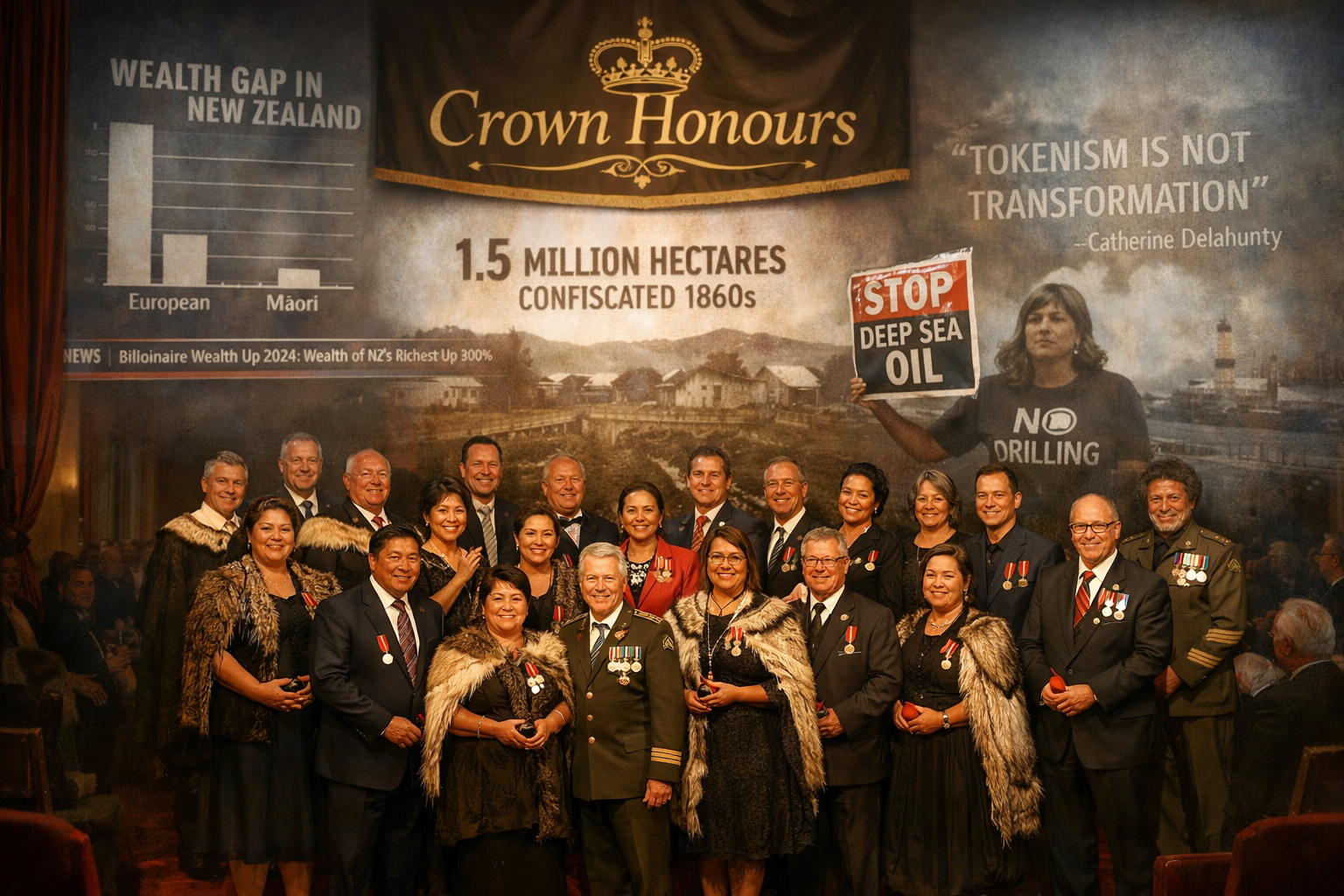
The official Crown narrative claims Māori “excel” with 18 recipients, representing approximately 10% of the 177 total honours. Māori are 19% of New Zealand’s population. This means Māori received roughly half their proportional representation—yet the Crown presents this as excellence.
This is arithmetic as propaganda. Between 2021-2024, Māori median wealth experienced no statistically significant change while European wealth grew. Billionaire wealth in New Zealand grew by $5 billion in 2024 alone—$12 million per day. The Crown honours 18 Māori for “services” while doing nothing to address the structural violence producing these disparities.
The honours system does not celebrate Māori achievement. It celebrates Māori survival despite Crown violence—then repackages that survival as evidence the system works.
Celebrating Māori Survival
What the Honours System Refuses to Recognize
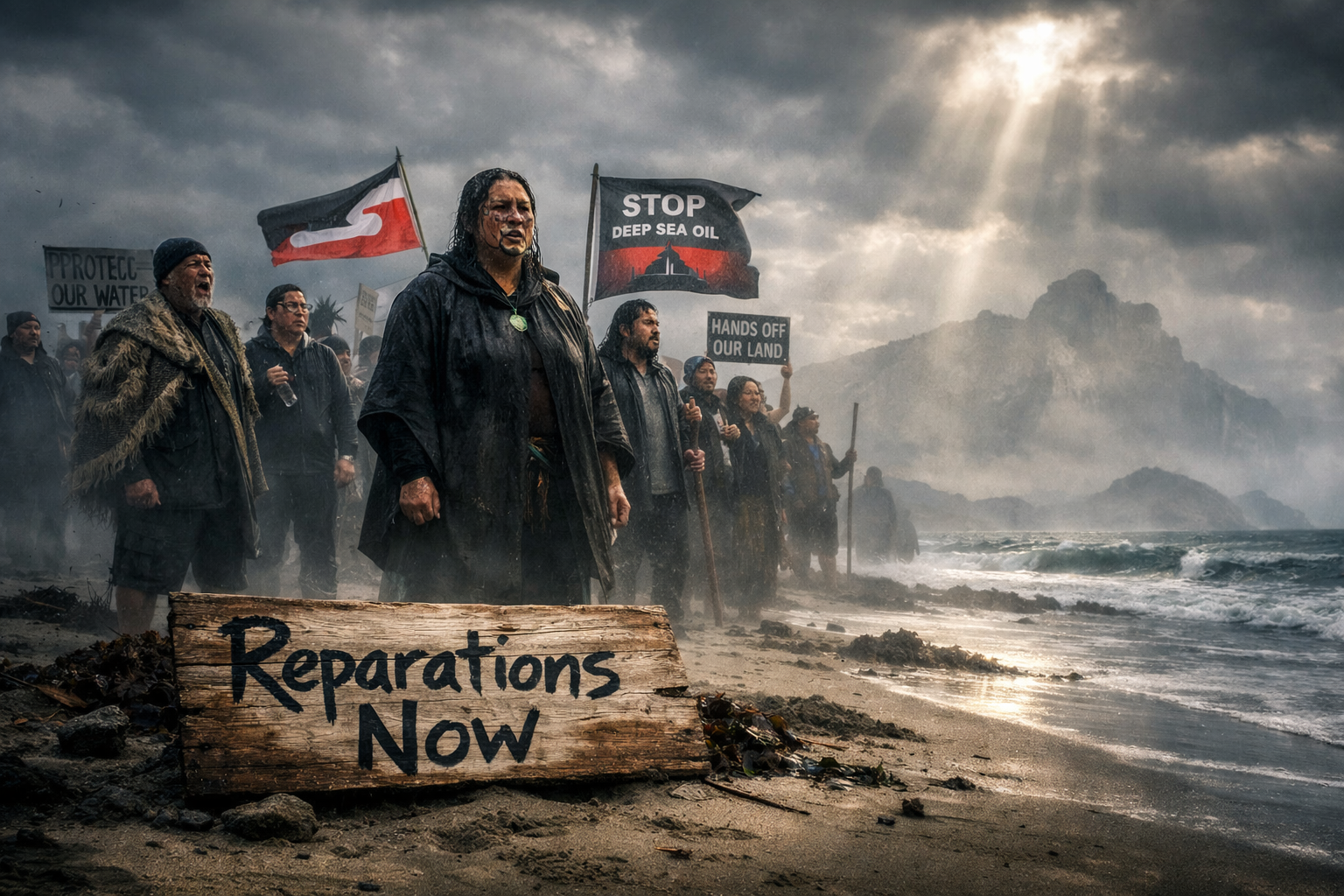
The honours list contains no Māori fighting to reclaim the 1.5 million hectares confiscated in the 1860s. No activists resisting oil drilling in ancestral waters. No organizers demanding reparations for linguistic genocide. No leaders challenging Crown sovereignty over Māori lands. No one threatening the legitimacy of settler colonialism.
It contains teachers, academics, governance professionals, health advocates—all doing essential work within Crown structures. Work that would not be necessary if the Crown had not created the crises these individuals now address.
As scholar Catherine Delahunty argues, Pākehā-dominated institutions practice “tokenism” by celebrating Māori participation without ceding power:
“How many times have we expressed support for hapū and iwi when they agree with our position, with no sense of obligation to respect their authority within their rohe, including when we don’t agree?”
The honours system does this at national scale. It celebrates Māori who work within Crown structures while marginalizing those who challenge them. It honours individuals while refusing to honor collectives. It recognizes “service to Māori” while maintaining the conditions that make such service necessary.
Notice That There Are No Activists Receiving This Honour?
The Only Adequate Response
The 18 Māori honoured in 2026 did not betray anyone. Most did essential work. Many deserve recognition from their communities—through tikanga processes, through whānau acknowledgment, through iwi celebration.
But they should refuse Crown honours. Because accepting them converts resistance into compliance, transforms collective struggle into individual achievement, and provides the Crown with Māori faces to mask ongoing dispossession.
As Indigenous resistance movements globally demonstrate, effective resistance requires “challenging the coloniality of power” through “diverse, synergistic, and adaptive” strategies that center Indigenous sovereignty and epistemologies. Accepting Crown honours undermines this resistance by legitimating the very authority that must be dismantled.
Tom Roa, Christina Cowan, Te Warihi Hetaraka, and the other 15 Māori honoured:
Your work matters. Your communities know this. You do not need the Crown to certify it. And the Crown does not deserve to claim credit for work that resists Crown violence.
The honours system is not recognition. It is purchase. Eighteen coins for eighteen souls. Eighteen medallions to mask 1.5 million hectares stolen. Eighteen ceremonies to distract from $170,000 wealth disparity per Māori person.
The only adequate response is refusal. Refuse the medals. Refuse the titles. Refuse to let the Crown convert your resistance into its legitimacy.
Until Māori receive back the 1.5 million hectares confiscated. Until the wealth gap is eliminated through progressive taxation and reparations. Until te reo is the primary language of government, not a Crown-tolerated addition. Until tino rangatiratanga means Māori sovereignty, not Māori participation in Crown structures.
Until then, every honour accepted is another coin exchanged, another soul purchased, another year the Crown gets to pretend its violence is partnership.
Kia kaha. Refuse the coins. Demand the land.

Refuse The Coins. Demand The Land
Support This Mahi
For those who wish to support this research directly with a koha (voluntary contribution), please visit the Koha platform:
Koha—Support - https://app.koha.kiwi/events/the-maori-green-lantern-fighting-misinformation-and-disinformation-ivor-jones
For those who wish to receive essays directly and support through subscription, join the Substack community:
Subscribe to the Māori Green Lantern on Substack - https://themaorigreenlantern.substack.com/subscribe
For those who prefer direct bank transfer:
Account: HTDM
Account Number: 03-1546-0415173-000
Every koha signals that whānau are ready to fund the accountability that Crown and corporate structures will not provide. It signals that rangatiratanga includes the power to fund our own truth tellers.
Kia kaha, whānau. Stay vigilant. Stay connected. And if you are able, consider a koha to ensure this voice continues.

Ivor Jones The Māori Green Lantern Fighting Misinformation And Disinformation From The Far Right
- https://www.rnz.co.nz/news/te-manu-korihi/582981/18-maori-recognised-for-2026-in-new-year-honours-list
- https://ppl-ai-file-upload.s3.amazonaws.com/web/direct-files/attachments/2123776/bbacdd2a-d069-474f-8e1f-48f6597691d7/18-Maori-recognised-for-2026-in-New-Year-Honours-list-_-RNZ-News.pdf
- https://ppl-ai-file-upload.s3.amazonaws.com/web/direct-files/collection_cf06d657-2c2b-4e68-8735-48f3c10166bd/fa7ea9f0-3948-41f0-9a6d-037b51b58d4a/Whakapiki-ki-te-ao-Maori-Application-2026.pdf
- https://ppl-ai-file-upload.s3.amazonaws.com/web/direct-files/collection_cf06d657-2c2b-4e68-8735-48f3c10166bd/8e9b17f7-604e-4009-9ec6-abbe1fd2c989/Perspective-with-Heather-du-Plessis-Allan_-This-Government-s-all-talk-bugger-all-action.PDF
- https://ppl-ai-file-upload.s3.amazonaws.com/web/direct-files/attachments/2123776/bdc6a0d1-0873-488f-bdb7-cba5e8ebf88b/New-Year-Honours-2026-the-full-list-_-RNZ-News.pdf
- https://pmc.ncbi.nlm.nih.gov/articles/PMC11459782/
- https://www.beehive.govt.nz/minister/biography/tama-potaka
- https://e-tangata.co.nz/korero/tom-roa-understanding-mana-and-our-place-in-the-universe/
- https://e-tangata.co.nz/comment-and-analysis/moving-from-tokenism-to-respect/
- https://en.wikipedia.org/wiki/Tama_Potaka
- https://www.nzherald.co.nz/waikato-news/news/new-year-2026-honours-tom-roa-made-companion-of-the-new-zealand-order-of-merit/QCNA2RS7EVEUPCYODAGCP72OXE/
- https://www.linkedin.com/pulse/moving-past-tokenism-making-every-week-naidoc-teoh-fcphr--zgsqc
- https://profiles.waikato.ac.nz/tom.roa
- https://www.ipaa.org.au/tokenism-or-inclusion-recognition-of-indigenous-rights-and-interests-in-legislation/
- https://www.beehive.govt.nz/release/m%C4%81ori-excel-new-year-honours-2026
- https://www.facebook.com/nzherald.co.nz/posts/professor-tom-roa-has-been-fighting-for-te-reo-m%C4%81ori-for-more-than-50-years/1316540727177914/
- https://www.cultureally.com/blog/what-is-tokenism
- https://www.national.org.nz/team/tamapotaka
- https://waateanews.com/2025/12/31/professor-tom-roa-honoured-with-cnzm-for-lifetime-service-to-te-reo-maori-and-matauranga-maori/
- https://themedium.ca/land-acknowledgements-and-tokenism/
- https://www.teaonews.co.nz/2024/12/31/maori-development-minister-tama-potaka-praises-maori-on-the-new-years-honours-list-2025/
- https://profiles.waikato.ac.nz/tom.roa/professional
- https://learningbird.com/6-common-pitfalls-in-indigenizing-the-classroom-and-how-to-avoid-them/
- https://www.facebook.com/TamaPotakaHamiltonWest/
- https://www.waitangitribunal.govt.nz/en/about/about-the-waitangi-tribunal/tribunal/professor-tom-roa
- https://www.nzherald.co.nz/nz/politics/from-rural-marae-to-new-york-attorney-to-race-relations-cauldron-is-minister-tama-potaka-uneasy-with-the-governments-direction/65YK2WQBABCLPEFNPDI62ZZH4A/
- https://www.nzherald.co.nz/nz/new-year-2026-honours-waikato-leaders-farmers-volunteers-recognised/NQJ4EUB6VZBPVORBH6NB5VFNOI/
- /content/files/podcasts/voices.xml
- https://www.rnz.co.nz/news/on-the-inside/483611/non-maori-are-embracing-te-reo-but-there-s-more-to-it-than-language
- https://www.nzherald.co.nz/kahu/maori-language-week-every-day-is-te-reo-maori-for-me-tama-potaka/JUIMWVMZKJHLXMLJAUDAGMTEKI/
- https://www.rnz.co.nz/news/te-manu-korihi
- https://www.nzherald.co.nz/whanganui-chronicle/news/your-letters-dont-make-light-of-robs-efforts/CAYY7EME5RRZ2YQ2XKA5775X7Y/
- https://www.rnz.co.nz/news/national/518522/king-s-birthday-honours-medal-recipient-almost-deleted-the-email
- https://www.nzherald.co.nz/kahu/rising-stars-te-aorere-pewhairangi-and-kimiora-kaire-melbourne/A43G3S5F3VDRPIPSQYESN5W7OA/
- https://www.rnz.co.nz/news/political/503176/what-does-the-new-government-mean-for-maori
- https://www.nzherald.co.nz/kahu/te-wiki-o-te-reo-maori-ngati-porou-play-ruatepupuke-shares-story-of-whakairo/6OIXKCQ7ARHP3L5OUE7O6KIL34/
- https://www.rnz.co.nz/news/political/565222/watch-parliament-gathers-to-pay-tribute-to-mp-takutai-tarsh-kemp
- https://www.nzherald.co.nz/kahu/te-reo-maori-inspires-native-american-to-save-her-own-indigenous-language-from-extinction/PAVX6L32MFAARISKIXPRFCCPQ4/
- https://www.rnz.co.nz/news/national/503943/government-committed-to-a-partnership-with-maori-minister-for-maori-development-tama-potaka
- https://www.nzherald.co.nz/waikato-news/news/apakura-memorial-kohatu-tells-story-of-rangiaowhia/YM2PM33AQVW5VBP7DSRNBPX5PY/
- https://www.rnz.co.nz/news/political/525032/government-clarifying-functions-of-te-arawhiti-and-te-puni-kokiri
- /content/files/oggcasts/the-weekend.xml
- https://www.rnz.co.nz/news/te-manu-korihi/539260/minister-overhauls-waitangi-tribunal-membership
- https://www.mdpi.com/2071-1050/17/20/9122
- https://www.tandfonline.com/doi/full/10.1080/17449057.2023.2286780
- https://neyaglobal.com/journal-nonprofit/functions-and-roles-of-grassroots-leaders-internal-cohesion-external-representation-and-cultural-brokerage/
- https://academic.oup.com/heapro/article/doi/10.1093/heapro/daaf111/8216145
- https://knepublishing.com/index.php/KnE-Social/article/view/19474
- https://revistacienciasyhumanidades.com/index.php/inicio/article/view/143
- https://journals.sagepub.com/doi/10.1177/1369148120978964
- https://rgs-ibg.onlinelibrary.wiley.com/doi/10.1111/tran.12057
- https://neyaglobal.com/journal-nonprofit/challenges-to-grassroots-leadership-autonomy-power-and-vulnerability/
- https://www.semanticscholar.org/paper/7a66d3ae075da9b8d48cfb5ab6f4dd4b15a8247f
- https://journals.sagepub.com/doi/pdf/10.1177/14407833231216176
- /content/files/articles/10-3389/fhumd-2023-1286970/pdf.pdf
- https://pmc.ncbi.nlm.nih.gov/articles/PMC10291485/
- https://munin.uit.no/bitstream/10037/28346/2/article.pdf
- https://pmc.ncbi.nlm.nih.gov/articles/PMC11910068/
- https://www.mdpi.com/1660-4601/19/6/3654/pdf
- https://journals.sagepub.com/doi/10.1177/09646639221138416
- https://pmc.ncbi.nlm.nih.gov/articles/PMC11755806/
- https://catalystmcgill.com/where-footsteps-and-haka-speak-louder-than-laws-maori-resistance-for-treaty-justice-in-new-zealand/
- https://teara.govt.nz/en/te-tango-whenua-maori-land-alienation/page-4
- https://www.teaonews.co.nz/2025/12/31/2026-new-year-honours-maori-leaders-and-nations-best-recognised/
- https://e-tangata.co.nz/history/built-on-the-back-of-betrayal/
- https://pmc.ncbi.nlm.nih.gov/articles/PMC10837049/
- https://teara.govt.nz/en/te-maori-i-te-ohanga-maori-in-the-economy/page-4
- https://www.tandfonline.com/doi/full/10.1080/2201473X.2025.2495459
- https://www.dpmc.govt.nz/our-programmes/new-zealand-royal-honours/new-zealand-royal-honours-system/overview-new-zealand-royal-honours-system
- https://nzhistory.govt.nz/media/interactive/maori-land-1860-2000
- https://en.wikipedia.org/wiki/New_Zealand_royal_honours_system
- https://www.sciencedirect.com/science/article/pii/S0277953622001101
- https://www.facebook.com/groups/248675758568554/posts/1816261861809928/
- https://waateanews.com/2025/12/31/maori-leadership-language-and-service-recognised-in-new-year-honours-2026/
- https://www.nzlii.org/nz/journals/VUWLawRw/1985/24.pdf
- https://www.karencaswell.com/post/authenticity-or-tokenism
- https://academic.oup.com/heapro/article/40/6/daaf195/8340943
- /content/files/assets/Rangahaua-whanui/THEME/theme-l-murray-crown-policy.pdf
- https://teara.govt.nz/en/biographies/6k3/king-michael
- https://teara.govt.nz/en/land-ownership/page-1
- https://teara.govt.nz/en/te-tai/te-mana-o-te-reo-maori-timeline
- https://teara.govt.nz/en/maori-land-court-te-koti-whenua/page-2
- /content/files/webcontent/document/201320/towards-better-local-regulation1.pdf
- https://teara.govt.nz/en/zoomify/36535/raupatu-confiscated-lands
- /content/files/podcasts/culture-101.xml
- https://teara.govt.nz/en/maori-land-court-te-koti-whenua/print
- /content/files/webcontent/document/201251/localgovt.pdf
- https://projects.propublica.org/nonprofits/organizations/236257083/201403219349102700/full
- https://projects.propublica.org/nonprofits/organizations/950651579/202002259349302215/full
- https://teara.govt.nz/en/te-ture-maori-and-legislation/page-2
- /content/files/oggcasts/ourchangingworld.xml
- https://teara.govt.nz/en/nga-whakataunga-tiriti-treaty-of-waitangi-settlement-process
- https://www.rnz.co.nz/international/pacific-news?offset=4842&op=getresults&page=36
- https://teara.govt.nz/en/1966/maori-wars/page-3
- https://www.rnz.co.nz/podcasts/teahikaa.rss
- https://tinangata.com/2016/10/18/stone-in-our-shoe-the-military-co-option-of-indigineity-and-protection-exposed/