"Exposing the Neoliberal Propaganda Masquerading as Economic Wisdom" - 25 June 2025
Kia ora my brothers and sisters
Te whakatōhea o a tātou kōrero nei. The truth of our words here.
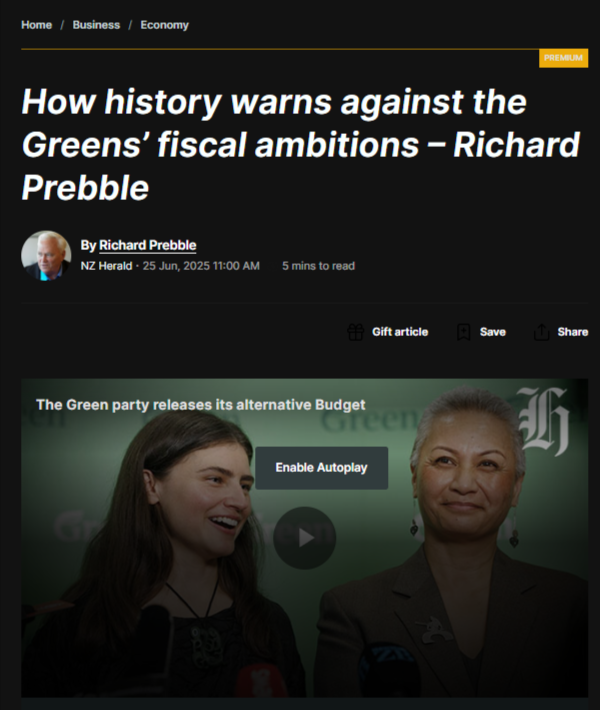
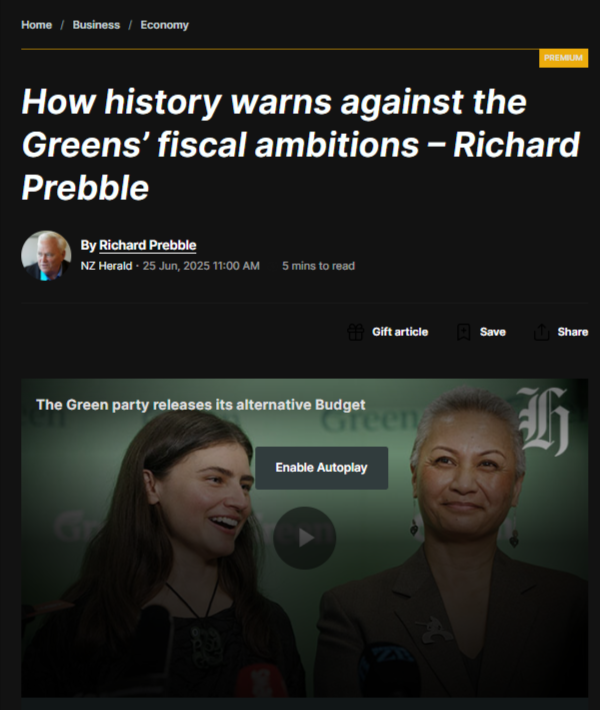
Richard Prebble, the architect of neoliberal destruction in Aotearoa, has emerged once again from the shadows to spread his tired old propaganda against the Green Party's wealth tax[1]. This man, who helped gut our public services and sold off our national assets, now dares to lecture us about fiscal responsibility while wrapping his message in historical fear-mongering and economic fallacies[1]. His commentary perfectly embodies the very neoliberal misinformation tactics that continue to harm tangata whenua and working people across our nation.
The Colonial Context of Economic Control
Understanding Prebble's position requires examining his role in the systematic dismantling of New Zealand's post-war consensus through the Fourth Labour Government's neoliberal reforms. From 1984 to 1990, Prebble served as Minister of State-Owned Enterprises, Transport, and Police, spearheading the privatisation agenda that transformed New Zealand from one of the most regulated economies to one of the most open[2][3]. These "Rogernomics" reforms removed public subsidies, deregulated financial markets, floated the dollar, and introduced GST while reducing the top tax rate from 66 to 48 percent[2][3]. The human cost was devastating, with unemployment soaring and thousands losing their jobs as manufacturing collapsed under import competition[4][5].
Prebble's current attack on the Green Party's fiscal proposals must be understood as part of this broader colonial project of economic control. When he warns about borrowing and debt, he conveniently ignores how the neoliberal policies he championed created the very inequality and social problems that require urgent government intervention today[4][3].
The Green Party's Progressive Vision Under Attack
The Green Party's alternative budget proposes raising $88 billion over four years through a 2.5 percent wealth tax on assets over $2 million and inheritance taxes[1][6]. This progressive taxation approach would fund essential services and infrastructure while addressing New Zealand's growing inequality[6][7]. The policy specifically targets only the wealthiest 0.7 percent of households, ensuring ordinary working families are protected[6].
Yet Prebble dismisses this as "clown economics"[1], parroting Finance Minister Nicola Willis's contemptuous language. His critique reveals the standard neoliberal playbook: use fear tactics about debt and borrowing while ignoring how wealth concentration has reached obscene levels under current policies. This is classic misdirection, designed to protect the interests of the wealthy elite he has always served.
Deconstructing the Historical Manipulation
Prebble's invocation of Joseph Ward's 1928 election promise represents a masterful example of historical manipulation[1]. He claims Ward "misread his notes" and promised £70 million instead of £7 million, suggesting this fiscal irresponsibility led to electoral success[8][9][10]. While Ward did indeed make this extravagant promise that contributed to the United Party's unexpected victory[8][9][10], Prebble cynically uses this example to suggest that progressive spending promises are inherently reckless populism[1].
The reality is more complex. Ward's promise came during economic uncertainty, and when he became Prime Minister, the deteriorating global situation and existing debt constraints meant he could barely borrow at all[11][12]. The lesson is not that government spending is always dangerous, but that political promises must be grounded in realistic economic planning. This historical context undermines rather than supports Prebble's anti-spending narrative.
Even more manipulative is his reference to "Sir Robert Muldoon's reckless borrowing"[1], conveniently forgetting his own role in the neoliberal response that followed. Muldoon's "Think Big" infrastructure projects may have created debt problems[13][14], but the neoliberal solution Prebble championed caused far greater social damage through unemployment, inequality, and the destruction of communities[4][5]. His selective historical memory reveals the propaganda nature of his argument.
The Māori Impact He Conveniently Ignores
Prebble's analysis becomes particularly insidious when he discusses the wealth tax's impact on Māori assets. He notes that "Māori corporations now own around 40% of commercial forestry, nearly 50% of fishing quota, and about 30% of sheep and beef farms"[1], warning that a 2.5 percent wealth tax would transfer 92 percent of these assets to the Crown over 100 years[1]. This appears to show concern for Māori interests, but it actually reveals his fundamental misunderstanding of tino rangatiratanga and collective wealth.
The statistics he cites are accurate - Māori collectives do own approximately half of New Zealand's agriculture, forestry, and fishing assets, totaling around $19 billion[15][16]. However, his analysis ignores several crucial factors. First, these assets were largely acquired through Treaty settlements that represented only a fraction of what was originally stolen through colonisation[17]. As Iwi Chairs Forum spokesman Ngahiwi Tomoana noted, Treaty settlements were "only settled at two percent of their real value," meaning Māori had already been "taxed 98 percent"[17].
Second, Prebble's mathematical projection assumes no exemptions or special provisions for Treaty settlement assets. The Tax Working Group specifically recommended exemptions for iwi transactions involving ancestral land recovery and asset transfers within tribes[17]. His failure to acknowledge these potential protections reveals his intent to stoke racial division rather than engage in honest policy analysis.
Most importantly, his framing treats Māori collective ownership as equivalent to individual capitalist wealth accumulation. This fundamentally misunderstands Māori economic models, which prioritise intergenerational stewardship and community benefit over individual profit maximisation[18][19]. When Ngāti Toa CEO Helmut Modlik explains their focus on "those who need it most" rather than "making money," he articulates a completely different value system from the neoliberal framework Prebble represents[18].
International Examples and Convenient Omissions
Prebble's reference to France scrapping its 1.5 percent wealth tax after wealthy emigration provides a superficial argument against progressive taxation[1][20]. He claims 10,000 wealthy citizens left France, taking $69 billion with them[1][20]. Similarly, he notes that 10,800 millionaires left the UK in 2024 following Labour's tax changes[1][21].
While these examples contain elements of truth, they represent cherry-picked data designed to support a predetermined conclusion. France's wealth tax was poorly designed and implemented in isolation without broader European coordination[20]. The UK's recent changes primarily affected non-domiciled tax arrangements that were already scheduled for reform[21]. More fundamentally, these examples ignore successful wealth tax implementations in other jurisdictions and the broader benefits of progressive taxation for social cohesion and public services.
The neoliberal obsession with capital mobility reveals a fundamental acceptance of economic blackmail by the wealthy. When billionaires threaten to leave rather than pay their fair share, the response should be "good riddance," not policy capitulation. Their threats expose the essentially parasitic nature of extreme wealth concentration in modern economies.

The Public Finance Act Mythology
Prebble's invocation of the Public Finance Act 1989 represents another layer of neoliberal mythology[1][22]. He claims this legislation mandates that governments "reduce total debt to prudent levels" and ensure "operating expenses do not exceed operating revenues"[1][22]. While these provisions exist, his interpretation treats them as sacred commandments rather than policy tools that can be modified through democratic processes.
The Public Finance Act was itself part of the neoliberal restructuring that Prebble helped implement[22]. Its emphasis on balanced budgets and debt reduction reflected the ideological preferences of that era, not eternal economic truths. Many economists now recognise that government debt serves different functions from household debt and that deficit spending can be essential for economic stability and social investment.
His criticism that current Labour and National budgets fail to meet these requirements actually undermines his own argument[1]. If even conservative governments cannot maintain balanced budgets under current economic conditions, perhaps the problem lies with the artificial constraints rather than government spending priorities.
The Size of Government Red Herring
Prebble's attack on public sector employment reveals classic neoliberal misdirection[1]. He complains that Labour added 16,000 civil servants at a cost of $1.66 billion annually, while the current coalition has only cut 2,200 jobs[1]. His claim that public sector workers now earn "$10 an hour more than private sector workers" feeds into right-wing resentment politics designed to turn working people against each other[1].
This analysis ignores the fundamental question of what public services should provide and how they should be funded. The neoliberal obsession with small government inevitably leads to inadequate provision of essential services like healthcare, education, and social support. When Prebble complains about government spending reaching 41.39 percent of GDP according to IMF estimates[1], he treats this as inherently problematic rather than asking whether these services improve people's lives and social outcomes.
His reference to research suggesting that 24 percent of GDP represents the optimal government size reveals the ideological nature of these debates[1]. Such research typically assumes that market outcomes are inherently superior to democratic decision-making, ignoring market failures, inequality, and social needs that markets cannot address.
The Broader Pattern of Far-Right Propaganda
Prebble's commentary exemplifies the sophisticated propaganda techniques that the far-right uses to maintain economic inequality and prevent progressive change. His arguments demonstrate several key characteristics of this messaging:
Historical cherry-picking: Using selective examples from the past to support predetermined conclusions while ignoring contradictory evidence or context.
Mathematical manipulation: Presenting complex projections as certainties while ignoring variables, exemptions, and policy modifications that could alter outcomes.
False equivalencies: Treating different types of economic actors (individual billionaires versus Māori collectives) as identical to obscure power relationships and cultural differences.
Concern trolling: Pretending to worry about Māori interests while actually undermining policies that could benefit tangata whenua and all working people.
Economic blackmail normalisation: Accepting wealthy threats to leave the country as legitimate policy constraints rather than examples of antisocial behaviour.

The Kaitiakitanga Alternative
Understanding this propaganda requires grounding our analysis in Māori values that offer alternatives to neoliberal individualism. The principle of kaitiakitanga emphasises our responsibility to protect and nurture resources for future generations[23][24]. This directly contradicts the neoliberal focus on short-term profit maximisation and capital mobility that Prebble represents.
Similarly, the concept of tino rangatiratanga encompasses not just political sovereignty but economic self-determination[25][26][24]. When Māori collectives use their assets to provide essential services like healthcare, education, and housing[18][19], they demonstrate economic models based on community wellbeing rather than individual accumulation.
The principle of manaakitanga requires us to care for others and share resources generously[24]. This value system makes wealth taxes appear not as punitive measures but as expressions of collective responsibility for social wellbeing. When society ensures that everyone has access to quality healthcare, education, and housing, it strengthens the entire community.
Exposing the Neoliberal Endgame
Prebble's opposition to progressive taxation ultimately serves to maintain a system that concentrates wealth and power among a tiny elite while leaving the majority struggling with inadequate public services and growing inequality. His warnings about capital flight and economic catastrophe are designed to prevent democratic societies from reclaiming control over their economic destinies.
The neoliberal project that Prebble championed has failed by its own standards. After four decades of deregulation, privatisation, and tax cuts for the wealthy, New Zealand faces housing unaffordability, growing inequality, environmental degradation, and inadequate public infrastructure. The promises of prosperity and efficiency have proven false, yet the same voices continue demanding more of the same failed policies.
The Path Forward
Progressive taxation represents one tool for addressing these systemic failures and building a more equitable society. The Green Party's wealth tax proposals deserve serious consideration based on their merits, not dismissal through fear-mongering and historical manipulation. Democratic societies have the right to decide how resources should be distributed and what level of inequality they will tolerate.
For tangata whenua, these debates connect directly to the ongoing struggle for economic justice and self-determination. The wealth tax could provide funding for addressing historical grievances, supporting Māori development, and ensuring that Treaty obligations are properly resourced. Rather than threatening Māori assets, progressive taxation could strengthen the collective economic base needed for tino rangatiratanga.
Richard Prebble's attack on the Green Party's fiscal policies represents more than just disagreement about tax policy - it embodies the sophisticated propaganda system that maintains economic inequality and prevents progressive change. His historical manipulation, mathematical misdirection, and concern trolling reveal the techniques used to defend an unjust status quo.
As tangata whenua and allies committed to social justice, we must develop the analytical tools needed to deconstruct these arguments and expose their underlying purpose. The struggle for economic justice requires understanding how neoliberal propaganda operates and developing alternative narratives based on our own values and aspirations.
The choice before us is clear: we can continue accepting the economic blackmail of the wealthy elite, or we can build a society based on collective responsibility, environmental sustainability, and genuine prosperity for all. Prebble's commentary reminds us which side he serves - the same interests he has always championed throughout his destructive political career.
Kia kaha, kia māia, kia manawanui. Be strong, be brave, be steadfast.
For those who find value in these analyses and wish to support continued investigation of far-right propaganda and neoliberal misinformation, please consider a koha to: HTDM: 03-1546-0415173-000. In these challenging economic times, please only contribute if you have the capacity and desire to do so.
Heoi anō. That is all for now.
[1] https://ppl-ai-file-upload.s3.amazonaws.com/web/direct-files/attachments/2123776/40f38358-ee30-4bed-afe8-840d5eb1c01d/How-history-warns-against-the-Greens-fiscal-ambitions-Richard-Prebble-NZ-Herald.pdf [2] https://www.rnz.co.nz/news/political/522009/a-nation-reinvented-40-years-on-from-its-1984-victory-the-fourth-labour-government-still-defines-nz [3] https://en.wikipedia.org/wiki/Rogernomics [4] https://iso.org.nz/2020/03/17/8478/ [5] https://nzhistory.govt.nz/culture/the-1980s/overview [6] https://www.nzherald.co.nz/nz/politics/wealth-tax-hikes-will-pay-for-income-tax-cuts-and-welfare-overhaul-greens/FCRYI5THFVECPNUS2IB2N7REWA/ [7] https://www.1news.co.nz/2023/10/01/greens-wealth-tax-to-raise-billions-even-with-avoidance/ [8] https://www.rnz.co.nz/national/programmes/afternoons/audio/201851773/the-history-of-election-bribes-in-nz [9] https://teara.govt.nz/en/biographies/3c24/coates-joseph-gordon [10] https://en.wikipedia.org/wiki/Joseph_Ward [11] https://www.scoop.co.nz/stories/HL2407/S00031/new-zealands-joe-bidenward-moment.htm [12] https://www.eastonbh.ac.nz/2011/07/great-days-in-new-zealand-borrowing/ [13] https://www.rnz.co.nz/programmes/two-cents-worth/story/2018734102/think-big-the-sequel [14] https://www.nzherald.co.nz/nz/july-1984-when-life-in-nz-turned-upside-down/5M6QM3JBS5FVHB4JZWH7Q76D4M/ [15] /content/files/assets/te-ohanga-maori-2023-report.pdf [16] /content/files/media/3qqfcrcu/m_c4_81ori-economy-2023-mbie-berl-nov-2024-march-2025.pdf [17] https://www.rnz.co.nz/news/te-manu-korihi/386579/should-iwi-pay-capital-gains-on-traditional-assets [18] https://www.rnz.co.nz/news/te-manu-korihi/544464/new-report-highlights-dramatic-growth-in-maori-economy [19] https://www.nzherald.co.nz/kahu/maori-economy-surpasses-100b-goal-assets-grow-to-126b-in-2023/2XZMCT34HJEULE6Z3NP7VYRLOY/ [20] https://mises.org/mises-wire/wealthy-are-fleeing-frances-wealth-tax-france [21] https://taxnatives.com/blog/labours-tax-plans-trigger-exodus-of-millionaires-from-the-uk/ [22] http://www.nzlii.org/nz/legis/hist_act/pfa19891989n44150.pdf [23] https://teara.govt.nz/en/te-tiriti-o-waitangi-the-treaty-of-waitangi/print [24] /content/files/assets/Documents/maori-leadership-literature-review.pdf [25] https://teara.govt.nz/en/principles-of-the-treaty-of-waitangi-nga-matapono-o-te-tiriti-o-waitangi/page-5 [26] https://teara.govt.nz/en/kawanatanga-maori-engagement-with-the-state/page-1 [27] https://www.nzherald.co.nz/business/economy/how-history-warns-against-the-greens-fiscal-ambitions-richard-prebble/MKMY5UCENJELLBJKF7ZJB7M3DE/. [28] https://bmcpublichealth.biomedcentral.com/articles/10.1186/s12889-022-12649-4 [29] https://www.cambridge.org/core/product/identifier/S0898588X21000079/type/journal_article [30] https://www.ssbfnet.com/ojs/index.php/ijrbs/article/view/2290 [31] https://www.tandfonline.com/doi/full/10.1080/15377857.2023.2192594 [32] https://www.ajol.info/index.php/ajosi/article/view/267374 [33] https://academic.oup.com/jvc/article/29/1/47/7238861 [34] https://www.nzherald.co.nz/kahu/richard-prebble-and-i-used-to-be-in-the-same-political-party-no-not-act-rob-campbell/VTROMSTAFZFRHHLRKK34BALRGQ/ [35] https://www.nzherald.co.nz/nz/politics/turning-the-treaty-into-a-socialist-manifesto-richard-prebble-resigns-from-waitangi-tribunal/24AHOX5RHBBFDFITFUB2KQ55H4/ [36] https://www.nzherald.co.nz/business/economy/how-history-warns-against-the-greens-fiscal-ambitions-richard-prebble/MKMY5UCENJELLBJKF7ZJB7M3DE/ [37] https://www.nzherald.co.nz/nz/last-growl-for-parliaments-mad-dog/WBET2S3ENKAF2YX4PTGOGQHFLQ/ [38] https://www.nzherald.co.nz/nz/richard-prebble-rolling-with-the-punches/2HLSK3PVSRKBPUQJAV76SFCJSQ/ [39] https://en.wikipedia.org/wiki/Richard_Prebble [40] https://en.wikipedia.org/wiki/ACT_New_Zealand [41] https://www.waitangitribunal.govt.nz/en/about/about-the-waitangi-tribunal/tribunal/the-honourable-richard-prebble [42] https://www.wikiwand.com/en/articles/Richard_Prebble [43] https://pmc.ncbi.nlm.nih.gov/articles/PMC7898002/ [44] /content/files/articles/10-3389/fmars-2021-684303/pdf.pdf [45] https://journals.lww.com/10.4103/0972-4923.121002 [46] https://teara.govt.nz/en/nga-haumi-a-iwi-maori-investment/page-1 [47] https://teara.govt.nz/en/te-maori-i-te-ohanga-maori-in-the-economy [48] https://teara.govt.nz/en/te-hi-ika-maori-fishing [49] https://www.rnz.co.nz/news/political/493625/hipkins-tax-pledge-could-threaten-coalition-talks-greens-te-pati-maori [50] https://www.stats.govt.nz/information-releases/tatauranga-umanga-maori-statistics-on-maori-businesses-2023-english/ [51] https://rep.infometrics.co.nz/new-zealand/ethnicity/businesses/industry-structure?compare=metro-areas%2Cprovincial-areas%2Crural-areas [52] https://www.nzherald.co.nz/nz/emcolin-jamesem-history-lessons-for-election-watchers/PCBWKVI7ZMGCZ7XWWSTTR52WUY/ [53] https://teara.govt.nz/en/1966/political-parties/page-17 [54] https://www.nzherald.co.nz/business/companies/banking-finance/the-low-tax-countries-wooing-the-worlds-wealthy/VWVTB3MYFRGVZOC3UXU27PAHLY/ [55] https://www.nzherald.co.nz/nz/ibrian-gaynori-debt-profile-puts-economy-on-alert/YVWHJZXSVGNYTW66QPWN3JOCWY/ [56] https://nzhistory.govt.nz/culture/the-1920s/1928 [57] https://teara.govt.nz/en/biographies/2w9/ward-joseph-george [58] https://www.icevirtuallibrary.com/doi/10.1680/jurdp.21.00048 [59] https://history.jes.su/s207987840030904-3-1/ [60] https://www.tandfonline.com/doi/full/10.1080/13504630.2021.1931094 [61] https://onlinelibrary.wiley.com/doi/10.1111/1467-8500.12685 [62] https://teara.govt.nz/en/national-party/print [63] https://www.nzherald.co.nz/the-listener/politics/1984-revolution-the-rise-of-rogernomics-and-how-it-still-shapes-nz-lives/XN63LYQ37BCPFK3PNKCKCAT63I/ [64] https://www.nzherald.co.nz/the-listener/new-zealand/inform-your-opinion-maori-got-the-treaty-of-waitangi-what-more-do-they-want/ZTFIYWG37FCYXG5VYEIUN375PU/ [65] https://theconversation.com/a-nation-reinvented-40-years-on-from-its-1984-victory-the-fourth-labour-government-still-defines-nz-232133 [66] https://www.rnz.co.nz/news/on-the-inside/522009/a-nation-reinvented-40-years-on-from-its-1984-victory-the-fourth-labour-government-still-defines-nz [67] /content/files/concert/schedules/whole_week/20140509.pdf [68] /content/files/concert/schedules/whole_week/20140509.pdf [69] https://teara.govt.nz/en/photograph/2451/tino-rangatiratanga-flags-at-parliament [70] https://teara.govt.nz/en/flags/page-2 [71]
https://themaorigreenlantern.maori.nz
[74] /content/files/bitstream/handle/1828/12841/nascimento_victor_ma_2021.pdf [75] https://nz.linkedin.com/in/hetangatadigitalmedia [76] https://www.tandfonline.com/doi/full/10.1080/00472336.2018.1441428 [77] https://jech.bmj.com/lookup/doi/10.1136/jech-2014-204803 [78] https://www.iib.ac.rs/istorijskicasopis/IC2473341D.html [79] https://revue.univ-oran2.dz/revuealtralang/index.php/altralang/article/view/434 [80] https://teara.govt.nz/en/treasury/print [81] https://www.nzherald.co.nz/author/richard-prebble/ [82] https://teara.govt.nz/en/public-service/page-4 [83] /content/files/wp-content/uploads/040richard-prebble-conversationsfromfrontierformatted-final.pdf [84] https://ifamagazine.com/green-party-proposes-wealth-tax-raid-alongside-ni-hike-and-pension-tax-relief-overhaul/ [85] /content/files/wp-content/uploads/new-zealand-publicfinanceact1989-english.pdf [86] https://www.semanticscholar.org/paper/0f356397f7f395ffa91a9d43475563ed59c9b319 [87] https://www.semanticscholar.org/paper/91460808388549568dc4d2ae08e360a79d25bc3b [88] https://www.semanticscholar.org/paper/e7316acf472d67dcd27fe3b7cd86c06840734b92 [89] https://www.semanticscholar.org/paper/5b62bb8a87e5852e16fff3b5f7748ce721144fa8 [90] https://www.semanticscholar.org/paper/feb3172cd8c166c7d2bbf317e4ae7d6cbbe1fc33 [91] https://injuryprevention.bmj.com/lookup/doi/10.1136/ip.2003.004895 [92] https://www.nzherald.co.nz/business/economy/employment/maori-economy-put-at-687b-workforce-up-by-100000-people-new-berl-report/L5AYBCPGGUKPJPBQJAC4BN3GNA/ [93] https://teara.govt.nz/en/taxes/print [94] https://www.nzherald.co.nz/business/study-shows-higher-house-prices-linked-to-income-inequality/RKV7LCV3DSMXWLR64JOH4JDAAE/ [95] https://www.stats.govt.nz/information-releases/tatauranga-umanga-maori-statistics-on-maori-businesses-december-2024-quarter/ [96] https://mukatangata.workforceskills.nz/explore-industries/all-food-and-fibre/industry-all-people-food-and-fibre/all-people-food-and-fibre/maori-businesses [97] /content/files/sites/default/files/2019-02/twg-bg-4032530-understanding-impacts-for-maori-and-update-on-te-ao-maori-framework.pdf [98] https://www.mediapart.fr/en/journal/france/090815/rising-number-wealthy-french-fleeing-abroad [99] https://www.semanticscholar.org/paper/4a8edceb8f67b86d538759e44d7ef0a2fff9f00a [100] https://journals.sagepub.com/doi/10.1177/0021140014545009 [101] https://teara.govt.nz/en/biographies/2w9/ward-joseph-george/print [102] https://www.rnz.co.nz/news/rich/528379/wealthy-people-pay-lower-tax-in-nz-than-in-similar-states-study-shows [103] https://teara.govt.nz/en/balance-of-payments/print [104] /content/files/sites/default/files/embedded_images/banking-crises-in-nz_0.pdf [105] https://www.easterneye.biz/uk-millionaires-exodus-tax-labour/ [106] https://muse.jhu.edu/article/36341 [107] https://www.semanticscholar.org/paper/64d193261ae72f34cf89a3d0a6e5e6caf640412c [108] https://journals.sagepub.com/doi/10.1177/0010414098031002004 [109] https://www.cambridge.org/core/product/identifier/S0147547907000567/type/journal_article [110] https://www.semanticscholar.org/paper/1dc974e920ebe9e46cea06d992291499393644c0 [111] https://muse.jhu.edu/article/36445 [112] https://www.rnz.co.nz/news/national/488705/wealthiest-paying-tax-at-much-lower-rate-than-most-other-new-zealanders-ird-report [113] https://www.nzherald.co.nz/the-listener/politics/schnapps-judgement-revisiting-the-84-election-that-changed-nz-forever/HQ7SF3YOXBFK3J2PNFWYIXWP3M/ [114] https://teara.govt.nz/en/te-tai/about-treaty-settlements [115] https://www.rnz.co.nz/news/political/488773/capital-gains-tax-back-in-the-spotlight-following-ird-investigation [116] https://freedomandprosperity.org/2020/publications/the-economic-effects-of-wealth-taxes/ [117] https://thedailyblog.co.nz/2025/02/15/guest-blog-tadhg-stopford-the-rare-genius-of-sir-robert-muldoon/ [118] https://teara.govt.nz/en/te-tiriti-o-waitangi-the-treaty-of-waitangi/page-3 [119] /content/files/wp-content/uploads/2022/01/gaillard-jmp.pdf [120] https://www.nzherald.co.nz/kahu/treaty-principles-bill-we-all-have-tino-rangatiratanga-the-right-to-self-determine-not-only-maori-david-seymour/SKSNCSI7HZDNRIPPPPKI5AFNIA/ [121] https://teara.govt.nz/en/cartoon/35054/tino-rangatiratanga-coat-of-arms [122] https://teara.govt.nz/en/document/4216/the-three-articles-of-the-treaty-of-waitangi [123] https://twitter.com/htdm [124]
[125] https://thespinoff.co.nz/atea/06-02-2018/the-treaty-of-waitangi-granted-us-tino-rangatiratanga-but-what-is-it [126] https://www.massey.ac.nz/massey/fms/Colleges/College%20of%20Business/Communication%20and%20Journalism/Staff/Staff%20research%20files/SPhelan/The%20Discourses%20of%20Neoliberal%20Hegemony%20.pdf