"Fire at the Treaty House: Exposing Luxon’s “Unity” as Arson" - 6 January 2026
When a white‑supremacist neoliberal government turns up to Waitangi with a smile and a can of petrol, tikanga calls it what it is: arson on Te Tiriti and our people
Mōrena Aotearoa,
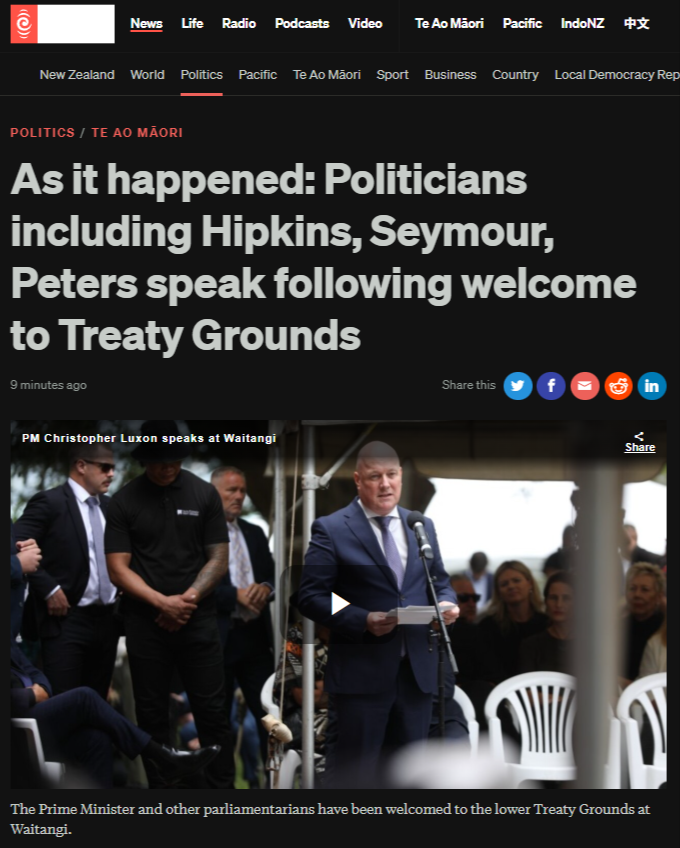
Christopher Luxon turns up to Waitangi promising “unity” the way an arsonist turns up to the tangi carrying a fire extinguisher he just emptied into the whare. His government lights the blaze, then blames the smoke on Māori for having lungs.
The stage at Waitangi: a burning house dressed as a church
On the lower Treaty Grounds, the pōwhiri does what it has always done: throws a spiritual cloak over manuhiri who repeatedly come to strip the walls bare. As reported by RNZ, Luxon arrives talking about “unity”, “localism” and “lifting Māori outcomes” in health, education and law and order. The same government stands behind a Treaty politics that treats Te Tiriti like an inconvenient Terms & Conditions pop‑up: “scroll to bottom, tick ‘I agree’, then pretend you never saw it,” as shown in coverage of the Treaty Principles Bill debate by RNZ and the later legal and human rights criticism detailed by RNZ.
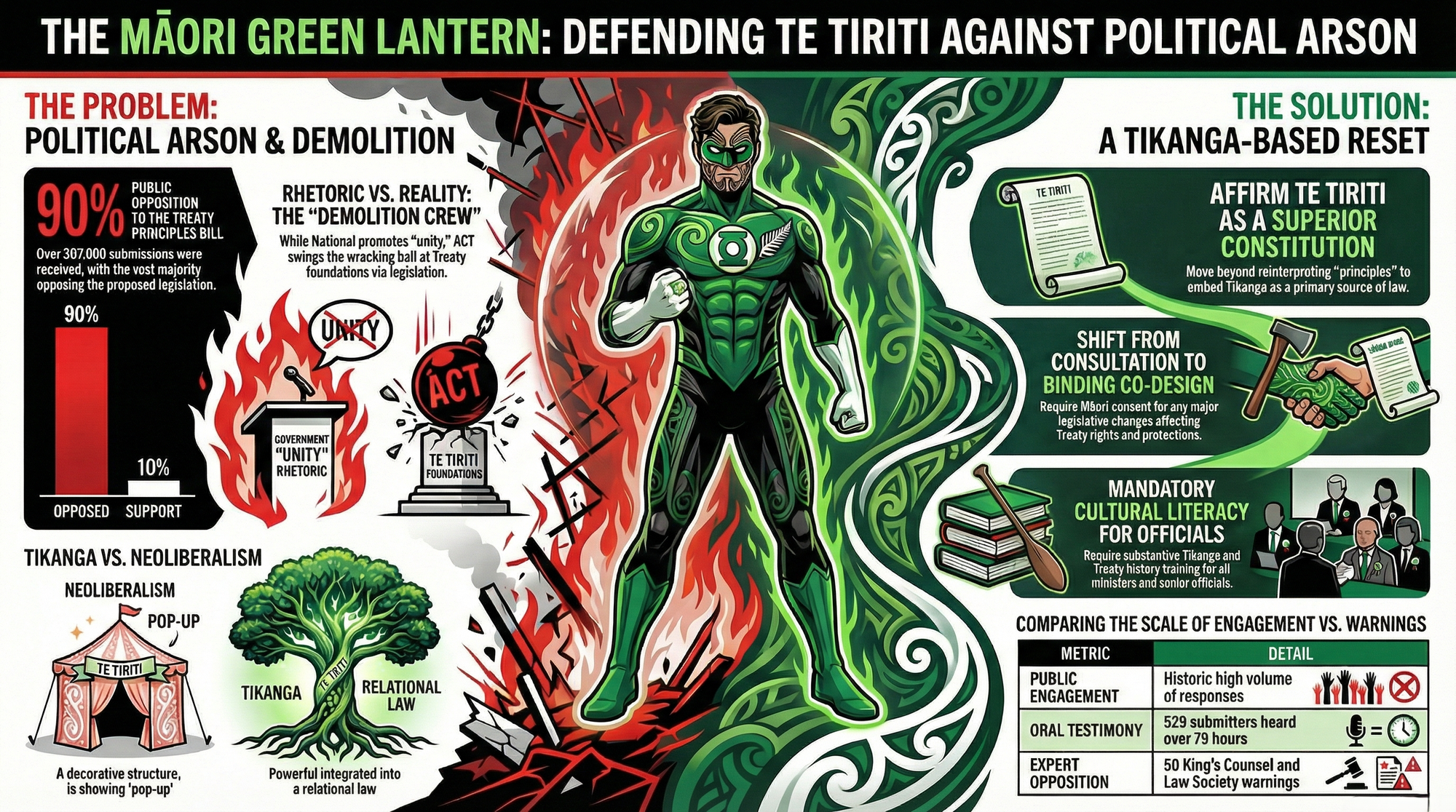
The choreography is obscene. Pōwhiri opens the marae ātea for tapu truth‑telling; this coalition uses that space as a PR stage to deny that it is anti‑Treaty or anti‑Māori, despite a record of policies that directly undermine Te Tiriti commitments and Māori rights as highlighted by the select committee process where 90 percent of more than 307,000 submissions opposed the Treaty Principles Bill, documented by The Spinoff. That is not unity; that is gaslighting at scale.
The metaphor: white‑supremacist demolition crew in borrowed korowai
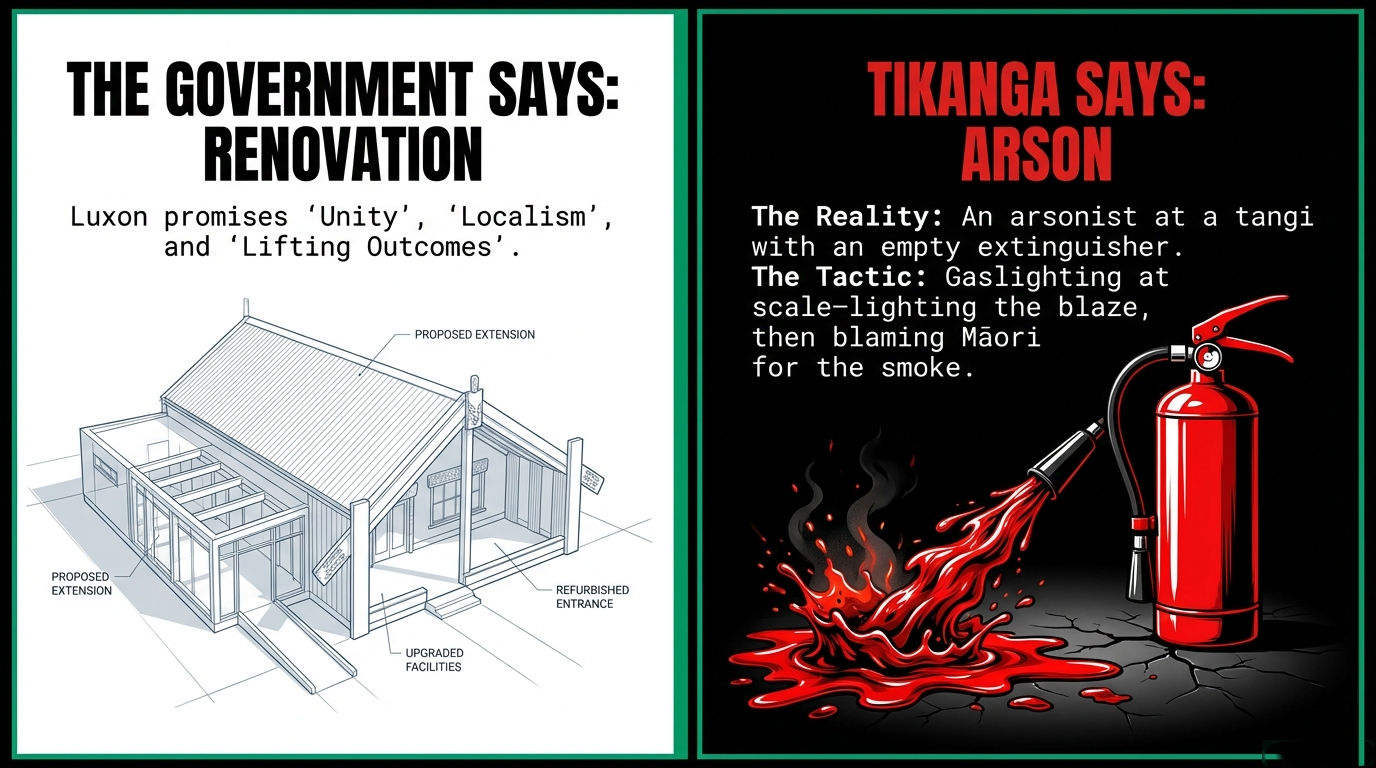
Think of this government as a demolition crew hired to “renovate” the whare of Te Tiriti.
- National plays the smiling project manager, insisting the bulldozers are here to “improve liveability” and “lift outcomes”, echoing Luxon’s assurances about alignment with Māori leaders and a future‑focused unity agenda captured by RNZ and his denials of being “anti‑Treaty” reported by RNZ.
- ACT is the one gleefully swinging the wrecking ball at the foundations through the Treaty Principles Bill, framing it as “equal rights” while erasing equity and historical injustice, as exposed by RNZ and the detailed critiques summarised in the select committee report referenced by The Spinoff.
- New Zealand First lurks in the background, handing out shovels to dig out anything smelling of “co‑governance”, while pretending to be defending “one law for all” – the same hollow mantra that underpins many of the bill’s arguments as described by RNZ.
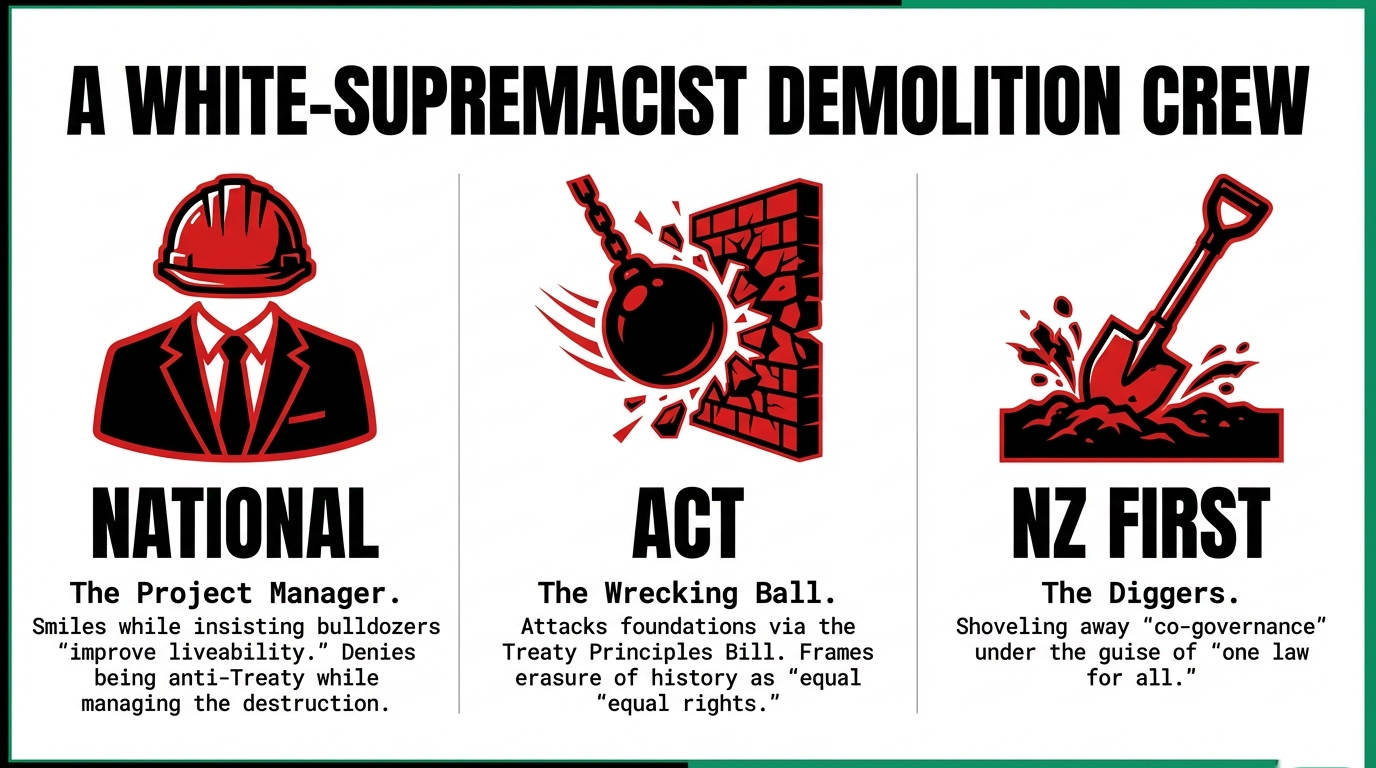
To the western political mind fixated on procedure and soundbites, this is just “robust debate” and “democratic contestation”, discussed in multiple analyses of secular, liberal politics in Aotearoa like those in Taylor & Francis’ journal article on religion and decolonisation. To tikanga, it is desecration: taking a house built on whanaungatanga, manaaki and rangatiratanga and treating it like a party venue you can trash because you paid the bond.
Tikanga vs the western mind: when the river is a spreadsheet line item
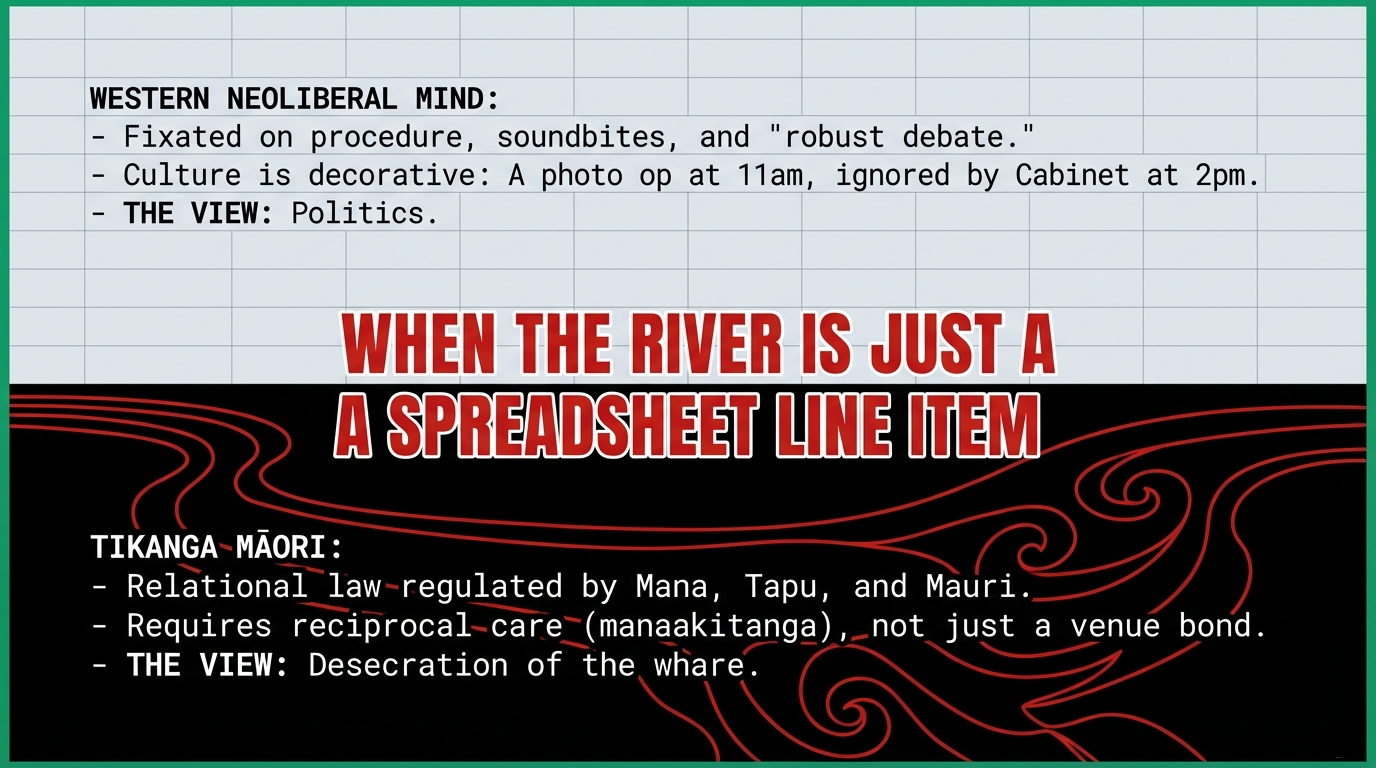
Tikanga is relational law. It is the way mana, tapu, mauri and whanaungatanga regulate behaviour so that people, whenua, awa and atua stay in balance, as explained in Te Tiriti‑focused legal and political analyses like Te Mana Te Kāwanatanga discussed through academic repositories such as Kotare’s archive of Māori self‑determination scholarship. To a western neoliberal frame, that looks like “culture” – optional, decorative, something you schedule for 11am at Waitangi and ignore in Cabinet at 2pm.
Concrete example:
- Under tikanga, a government that receives manākitanga at Waitangi owes reciprocal care – active protection, fair processes, and truthful kōrero – consistent with the Treaty principles jurisprudence developed over decades and acknowledged by institutions like the Waitangi Tribunal and summarised in public discussions via RNZ.
- Under this coalition’s practice, manākitanga becomes a branding opportunity. Luxon can refuse to meet a hīkoi opposing the Treaty Principles Bill, brushing it off as just “strong passions on both sides” while insisting his issue‑by‑issue approach is “better”, as reported by RNZ. Tikanga requires kanohi ki te kanohi; neoliberal politics prefers plausible deniability on ZB and a safe distance from angry brown bodies.
To the western mind, tikanga‑based objections can be caricatured as emotional, religious or “identity politics”. Yet health and education research shows that honouring Te Tiriti and Māori‑led approaches measurably improve outcomes – for example, nursing research on Te Tiriti‑honouring practice and health equity in Aotearoa published in Nursing Praxis and broader work on Indigenous‑centred leadership in education captured by AUT’s Ethnographic Edge. These are not superstitions; they are applied systems of governance that save lives.
Quantifying the harm: numbers behind the metaphors
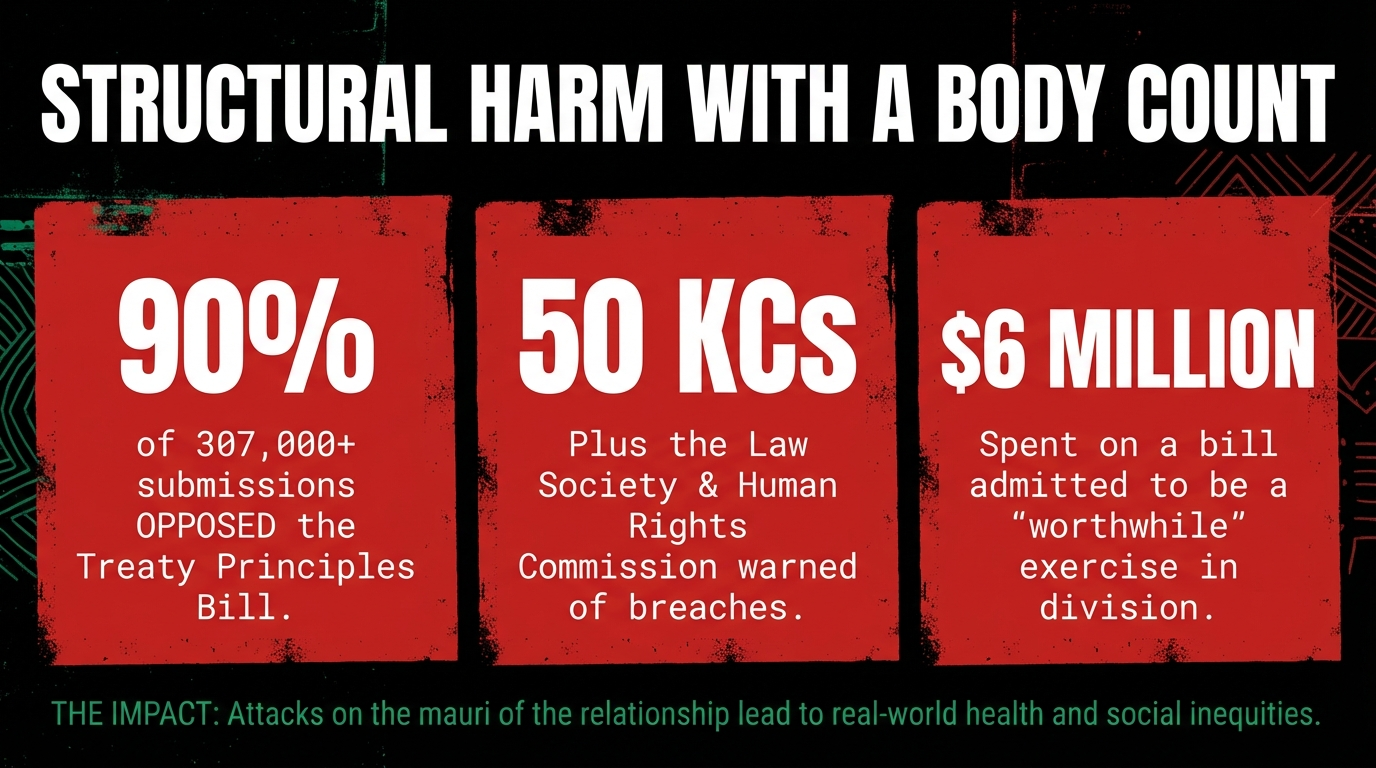
This is not just about hurt feelings at Waitangi. It is structural harm with a body count.
Attempted constitutional vandalism
The Treaty Principles Bill was so extreme that the justice select committee recommended it not proceed, after hearing 529 oral submitters over 79 hours and receiving more than 307,000 submissions, about 90 percent of which opposed the bill, as reported by The Spinoff.
Legal experts, including the New Zealand Law Society, Human Rights Commission and 50 King’s Counsel, warned the bill misrepresented Te Tiriti, undermined rangatiratanga and risked entrenching a narrow “formal equality” that ignores actual inequity and historic injustice, as summarised in the same select committee coverage by The Spinoff.
Bill of Rights breaches baked into policy
The government’s own Bill of Rights advice on the Treaty Principles Bill was described as “quite damning” by legal academics, who noted that officials accepted the bill would, on its face, undermine Māori rights protections, as detailed by RNZ.
Seymour simply rejected that advice and claimed Māori did not need Te Tiriti to uphold their rights because the Bill of Rights exists – a position that ignores the entire history of Crown breaches that made Te Tiriti‑specific protections necessary in the first place, and which commentators and Tribunal reports have repeatedly highlighted, including in accessible summaries like RNZ’s coverage of Tribunal‑linked critiques.
Social cohesion as collateral damage
The select committee flagged risks to social cohesion and Crown‑Māori relations, noting concerns that the bill would formalise a narrow view of equality incompatible with the Treaty, as captured by The Spinoff.
Yet Seymour openly framed the whole exercise – costing at least $6 million – as worthwhile even in defeat, signalling intent to rerun this politics of division whenever politically convenient, especially as his influence in Cabinet grows, as the same article by The Spinoff reports.
Psychological and spiritual harm (tikanga lens)
Ngāti Wai chair Aperahama Edwards speaks of “pain among Māori” alongside a fragile optimism for change in engagements with government, as noted by RNZ. That pain is not metaphorical; it is experienced in health inequities, incarceration rates and intergenerational trauma documented across public health and social research, including work that links Te Tiriti‑honouring practice to improved equity in Nursing Praxis.
When a government undermines Te Tiriti while standing on the very whenua where it was signed, it attacks the mauri of the relationship itself – a form of harm that western constitutional law barely has language for, but which tikanga literature and Tribunal jurisprudence increasingly name as breaches of partnership, active protection and rangatiratanga, themes that appear in accessible form in public commentary and tribunal‑related documents discussed in sources like RNZ.
Five hidden connections this government hopes you will miss
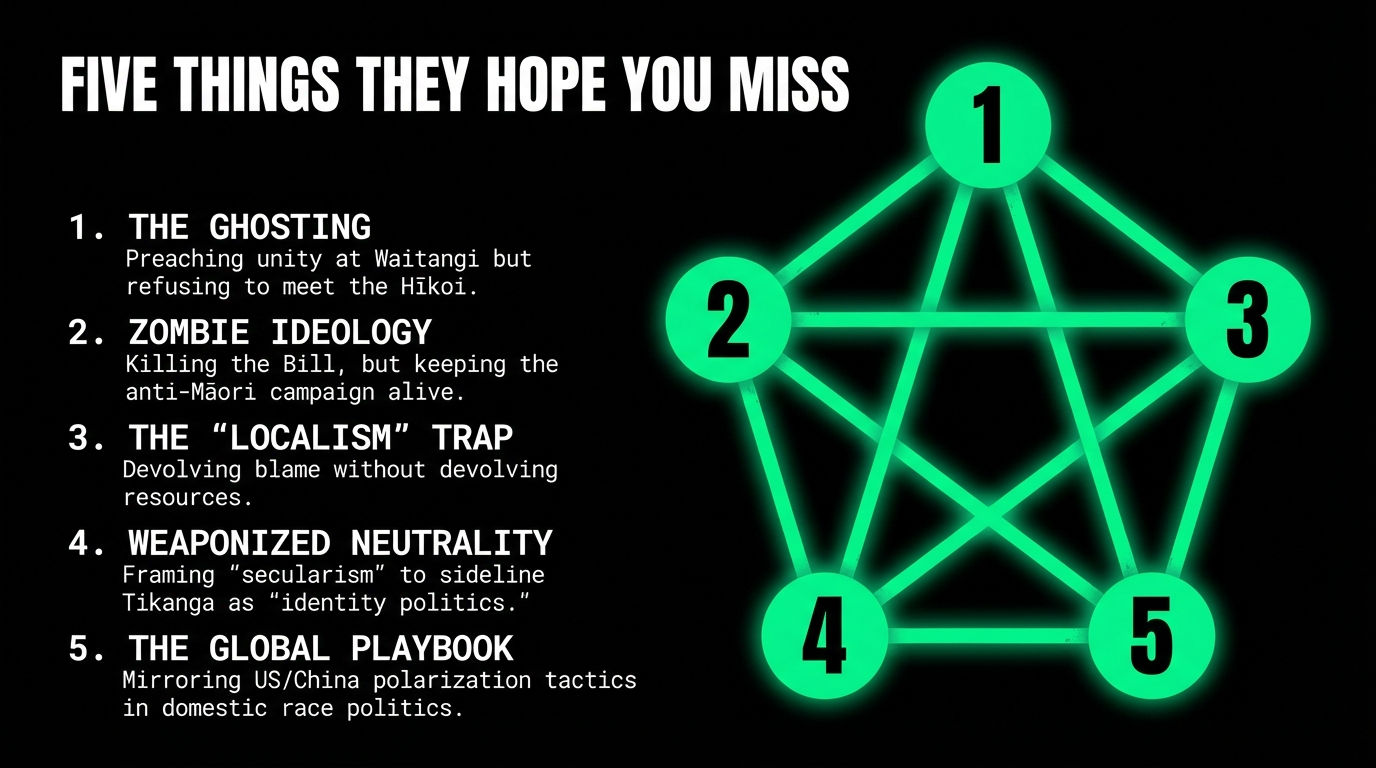
- From “unity” at Waitangi to “no need to meet” a hīkoi
Luxon promises unity on the paepae at Waitangi while previously refusing to meet Te Tiriti hīkoi at Parliament, claiming there was “no need” to front, as RNZ documents. To tikanga, that is a direct breach of kanohi kitea and manaakitanga: you accept hospitality at one marae and ghost the people when they come to your whare. - Killing the Bill without killing the ideology
The Treaty Principles Bill is “unusually” killed, with RNZ describing its defeat as brutal and noting the political theatre around it. But Seymour openly signals the kaupapa will return in some form, and commentary like RNZ’s coverage of ACT’s Treaty campaign notes that the party treats this as a long‑term project, dependent on stirring public anxieties about Te Tiriti rather than resolving them. The demolition crew has lost one tool, not the contract. - Neoliberal “localism” as code for devolving blame, not power
Luxon boasts about alignment with Iwi Chairs on “localism” and “devolution” to improve Māori outcomes, as RNZ reports. In neoliberal practice, localism often means devolving responsibility without resourcing, setting Māori and local communities up to be blamed for failures that flow directly from central funding cuts and deregulation – patterns analysed in broader political economy and decolonisation scholarship such as articles on Indigenous leadership and systemic marginalisation in Ethnographic Edge. - Secular “neutrality” as a weapon against tikanga
Academic analyses of secularity in Aotearoa note that dominant narratives present the public sphere as neutral while marginalising Indigenous spiritualities and tikanga as private or cultural add‑ons, as discussed by Taylor & Francis’ piece on insecure secularity. This coalition leans on that frame: pōwhiri is tolerated as colourful ritual; Te Tiriti‑based co‑governance or tikanga‑infused law is attacked as divisive or “special treatment”. Neutrality here is not neutral; it is coded Christian‑liberal, Anglo, and deeply colonial. - Global geostrategy mirrored in domestic race politics
In the Pacific, New Zealand is pulled into a US‑China contest that risks sidelining Pacific‑centred priorities like climate justice and demilitarisation, as analysed by experts in coverage from RNZ. Domestically, the same logic applies: align with white‑majority anxieties about “division” and “co‑governance” to secure power, then treat Māori aspirations for rangatiratanga as a threat to unity rather than a path to genuine shared security. The battlefield shifts, but the playbook is the same.
Solutions: turning off the bulldozers, rebuilding on tikanga
If this government is the demolition crew, then the solutions are about repossessing the tools, the blueprint and the site.
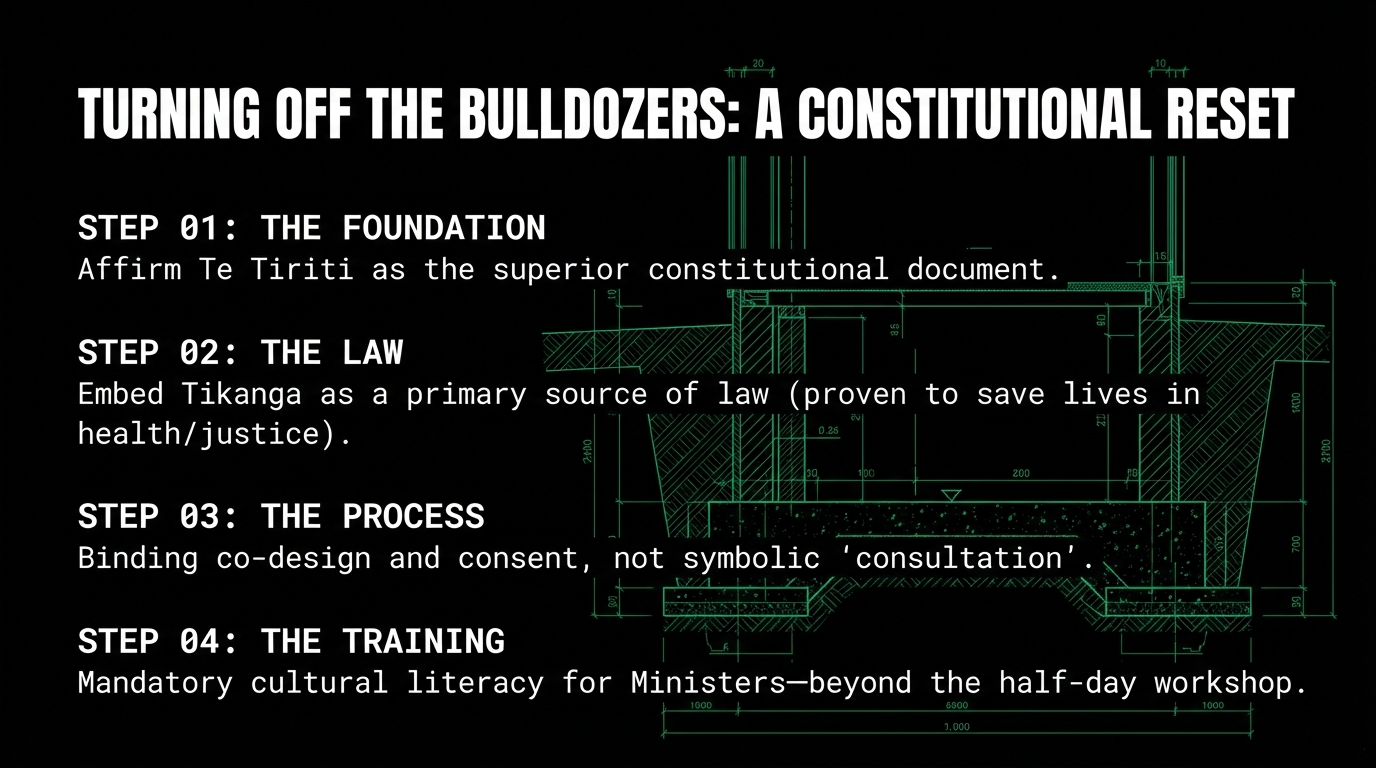
Constitutional reset grounded in Te Tiriti and tikanga
Move beyond the endless cycle of “Treaty principles” reinterpretation by affirming Te Tiriti o Waitangi as a superior constitutional document, as many Māori leaders argue in parliamentary debates and civil society discussions summarised by RNZ.
Embed tikanga as a primary source of law and governance alongside common law and statute, as already happens in pockets of jurisprudence and professional practice (for example in health and education sectors), documented in research like the nursing equity work in Nursing Praxis and broader analyses of Māori self‑determination in sources such as Kotare’s archive.
Boundaries on state abuse: no more “consult, then ignore”
Require that major legislative or policy changes affecting Te Tiriti be subject to binding co‑design and consent processes with Māori, not just symbolic consultation, echoing the critique that the Treaty Principles Bill was developed without meaningful Māori partnership as highlighted in The Spinoff.
Establish independent, Māori‑led monitoring of Crown compliance with Te Tiriti across all portfolios, with public reporting similar in rigour to fiscal watchdogs, building on the kind of evaluative work already undertaken by bodies like the Waitangi Tribunal and human rights institutions covered by RNZ.
Material redistribution, not just symbolic visits
Shift decision‑making and resourcing into by‑Māori, for‑Māori structures across health, education, housing and justice, building on existing examples that improve outcomes, as discussed in policy debates reported by RNZ where Māori MPs defend Māori‑led approaches as practical solutions, not identity politics.
Tie every “localism” and “devolution” claim to real funding, authority and accountability metrics, so that it can no longer be used as a buzzword to dump responsibility on under‑resourced Māori entities while cutting central support, a dynamic critiqued in Indigenous governance scholarship like that hosted by Ethnographic Edge.
Cultural literacy for the western mind
Require that ministers, senior officials and media commentators engaging on Te Tiriti undertake substantive training in tikanga, Te Reo and Treaty history, anchored in Te Ara, Tribunal reports and iwi‑authored resources, not just a half‑day workshop. The depth of misunderstanding exposed in the Treaty Principles Bill debate and in the government’s own Bill of Rights advice, as reported by RNZ, shows this is overdue.
Support public education that explains why equity and rangatiratanga are not threats to democracy but essential for it, drawing on the kind of nuanced decolonisation and secularity analysis found in Taylor & Francis and popularised through media that refuses to indulge white‑supremacist framings.
Whānau‑led accountability: follow the money and the mana
Track, name and expose the funding, lobbying and media ecosystems that keep Treaty‑hostile narratives alive – from think‑tanks to talkback platforms – in the spirit of investigative work done by outlets like ProPublica in other jurisdictions.
Build and resource Māori‑controlled platforms, research units and watchdogs that can systematically audit Crown performance on Te Tiriti, much as mainstream media live‑blogs political theatre at Waitangi as seen in RNZ’s live coverage. If they insist on turning our marae into a stage, we turn their House into a courtroom.
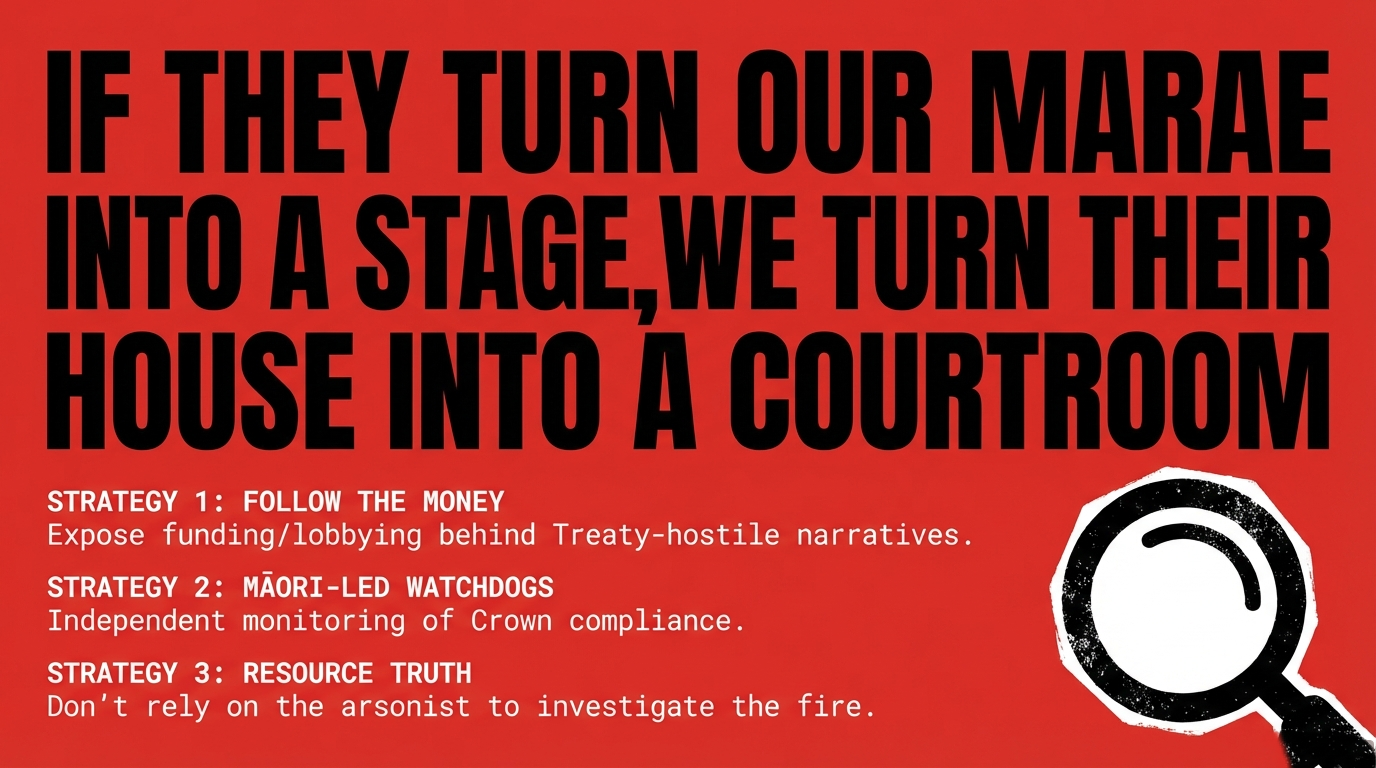
Koha consideration: fuelling our own fire
Every koha into this kaupapa is a bucket of cold water on the arson this government is inflicting on Te Tiriti and tikanga. It tells the Crown and its corporate media echo‑chambers that we will not rely on the very structures undermining rangatiratanga to fund our defence of it.
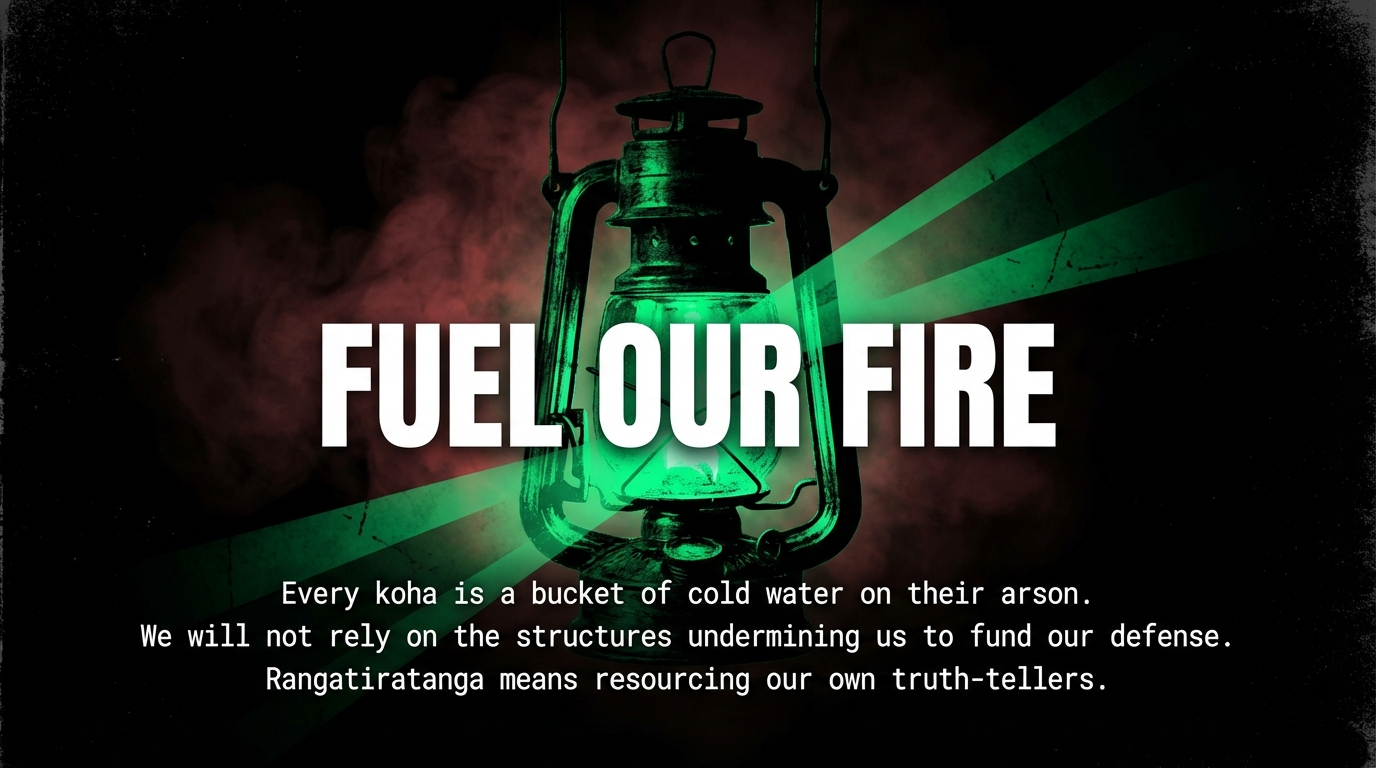
It signals that rangatiratanga includes resourcing our own truth‑tellers to dissect Treaty‑bashing bills, track white‑supremacist narratives in “unity” speeches at Waitangi, and expose the gap between what’s said on the paepae and what’s done in Cabinet, using verifiable evidence from sources like RNZ and The Spinoff.
Kia kaha, whānau. Stay vigilant. Stay connected. And if you are able, consider a koha to ensure this voice keeps naming names, tracing networks and arming our people with facts:
- To support this mahi directly with a koha (voluntary contribution), visit: Koha — Support.
- To receive essays directly and tautoko through subscription, join the community: Subscribe to the Māori Green Lantern on Substack.
- For direct bank transfer, koha can be made to: HTDM, account number 031546-0415173-000.

If you are unable to koha pūtea, no stress. Hit subscribe or follow, kōrero about this kōrero, and share it with your whānau and friends. In a landscape where this white‑supremacist neoliberal government spends millions manufacturing consent against Te Tiriti, your attention, your voice and your networks are koha in themselves.

Ivor Jones The Māori Green Lantern Fighting Misinformation And Disinformation From The Far Right