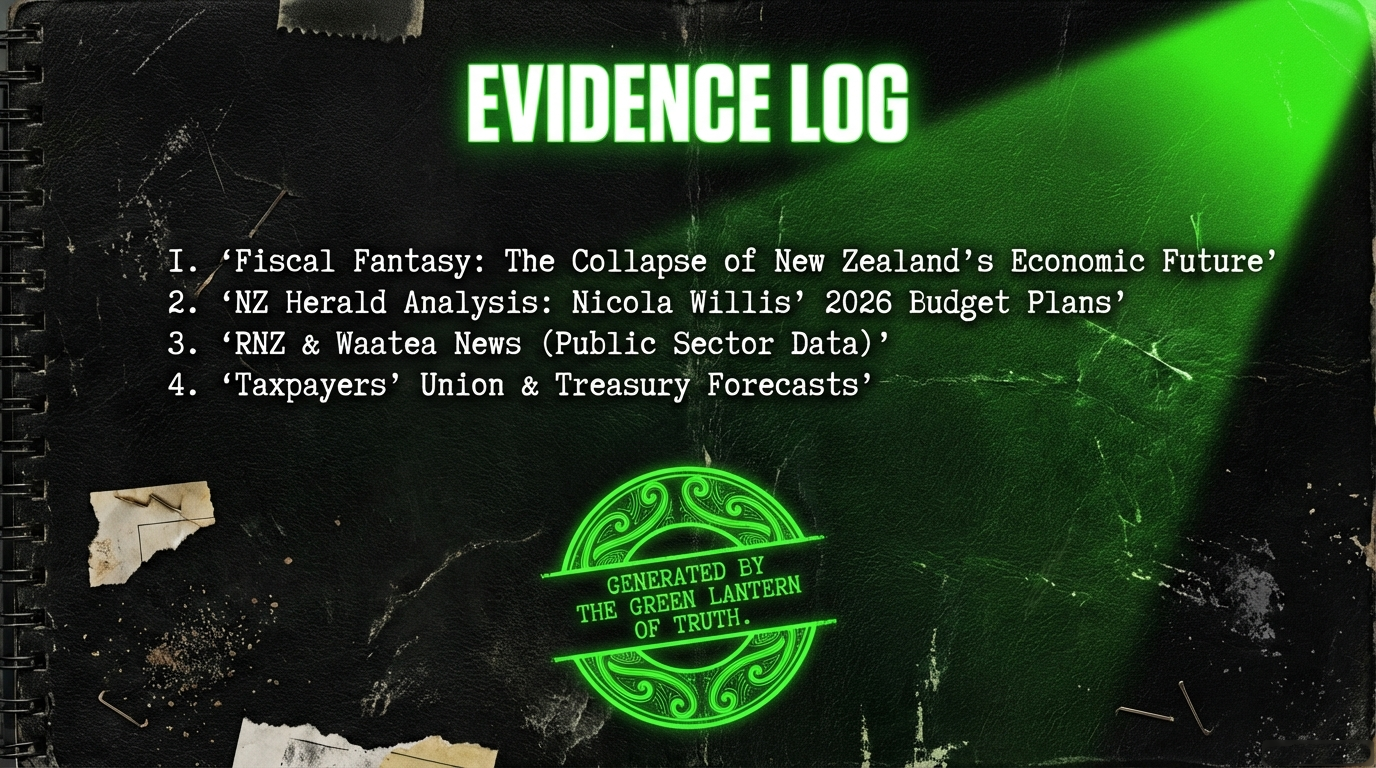
“Fiscal Fantasy: How Nicola Willis and the Coalition Government Are Mortgaging New Zealand’s Future” - 18 January 2026
Koha Consideration
Every koha signals that whānau are ready to fund the accountability that Crown and corporate structures will not provide. It signals that rangatiratanga includes the power to fund our own truth tellers.
Kia kaha, whānau. Stay vigilant. Stay connected. And if you are able, consider a koha to ensure this voice continues.
Three pathways exist:
For those who wish to support this mahi directly with a koha (voluntary contribution), please visit the Koha platform:
- Koha—Support - https://app.koha.kiwi/events/the-maori-green-lantern-fighting-misinformation-and-disinformation-ivor-jones
- For those who wish to receive essays directly and support through subscription, join the Substack community:Subscribe to the Māori Green Lantern on Substack - https://themaorigreenlantern.substack.com/subscribe
- For those who prefer direct bank transfer, account details are: HTDM, account number 03-1546-0415173-000.
Finance Minister Nicola Willis’s 2026 Budget plans represent a catastrophic continuation of broken promises, economic mismanagement, and ideological rigidity that has brought New Zealand to the brink of economic collapse.
After more than two years of serial incompetence, the National-led coalition has delivered the inverse of every major promise:
higher debt, persistent deficits, economic contraction, mass unemployment, and a deepening cost-of-living catastrophe that has made basic necessities like butter a $10 luxury.
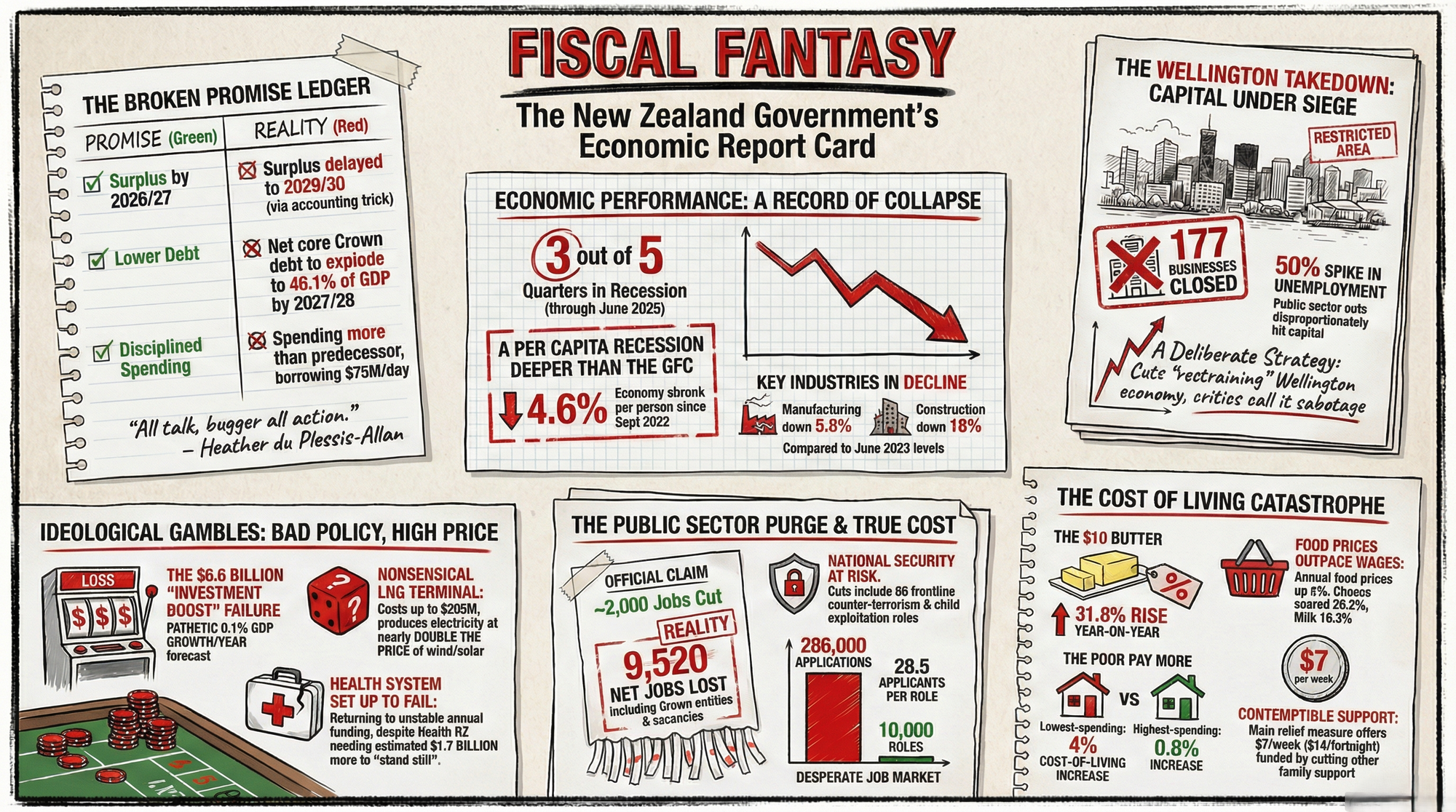
The government that campaigned on “disciplined spending, less tax, lower debt” has instead presided over spending that exceeds Labour’s, debt climbing to 46.1% of GDP, and a fiscal deficit that won’t be eliminated until 2029 at the earliest—a brazen three-year delay from their campaign promise.
Meanwhile, Willis and Luxon are doubling down on policies that have demonstrably failed:
slashing public services, gambling hundreds of millions on an economically nonsensical LNG terminal, and preparing asset sales despite coalition partner Winston Peters firmly opposing them and mocking the idea.
This report exposes the Willis Budget playbook for what it truly is: a reckless experiment in ideological austerity that punishes ordinary New Zealanders while failing to deliver on every single economic metric the government itself promised. It is governance through incompetence, ideology through ignorance, and leadership through denial.
The Broken Promise Ledger: A Government Exposed as Charlatans
Campaign Commitments Versus Humiliating Reality
When Christopher Luxon and Nicola Willis campaigned in 2023, they made unequivocal commitments that now stand as monuments to their fiscal dishonesty. Willis proclaimed that Kiwis “deserve tax relief” and that National would deliver “responsible economic management,” as 1News reported on their campaign fiscal plan. They promised a $2.9 billion surplus by 2026/27 and debt reduction of $3.4 billion compared to Labour.
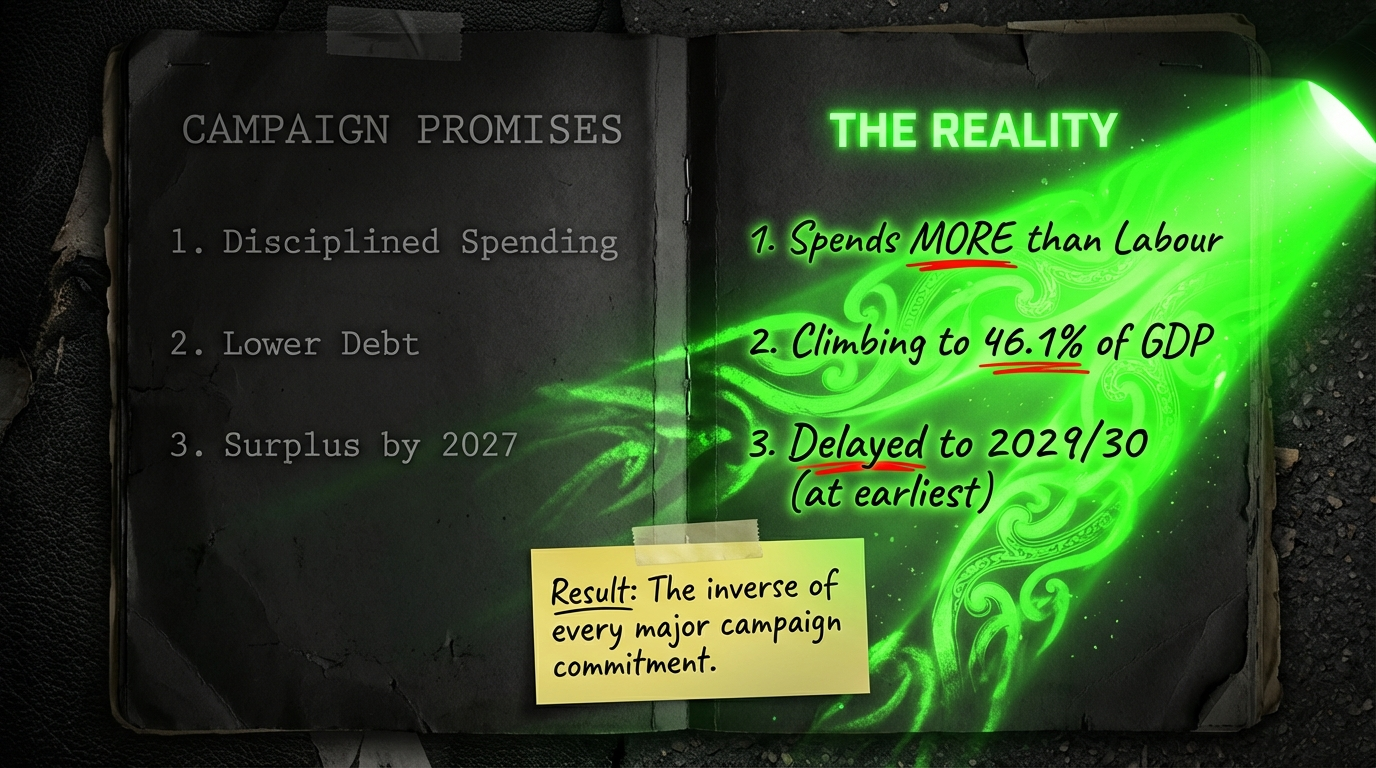
Two years later, the scoreboard reads like a catastrophic indictment of fiscal incompetence masquerading as competence:
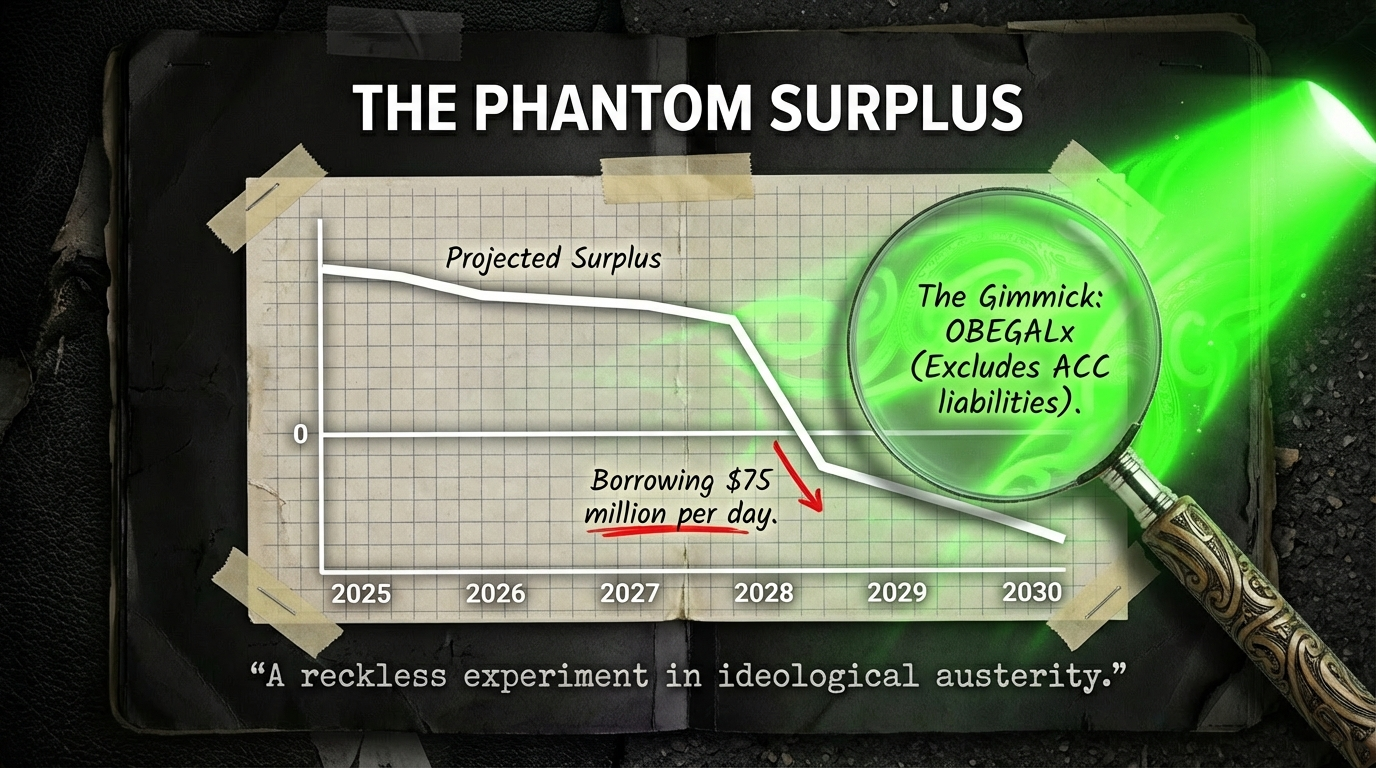
The Phantom Surplus:
The vaunted return to surplus—the centerpiece of their fiscal credibility—has been pushed to 2029/30 using an accounting gimmick (OBEGALx) that excludes ACC liabilities, as 1News analysis exposed. By traditional accounting standards, New Zealand won’t see surplus until the 2030s—if at all. The Taxpayers’ Union has called this “a fiction”—a brutal assessment from a typically pro-National organization. The government is borrowing $75 million per day, mortgaging the future for today’s failures.
Debt Explosion, Not Reduction:
Rather than reducing debt as promised, net core Crown debt is forecast to reach 46.1% of GDP by 2027/28, up from the 41.8% previously forecast. The government promised “lower debt” but is delivering precisely the opposite. Nominal GDP is forecasted $20 billion lower (cumulatively) through June 2028 than expected, translating to $13 billion less tax revenue. This is the fiscal equivalent of breaking your diet while lecturing others about eating discipline.
Spending Discipline as Fiction:
Perhaps most damningly, broadcaster Heather du Plessis-Allan—a typically government-sympathetic commentator—declared this administration “all talk, bugger all action,” noting they “promised to cut spending every year, and they spend more than Grant Robertson.” This is not criticism from the left—this is condemnation from a cheerleader who finally saw through the charade. She concluded this is Labour “dressed in blue clothing,” a searing verdict that captures the government’s utter lack of intellectual honesty.
The credibility Willis staked her career on—literally offering to resign if she couldn’t deliver—evaporated the moment economic reality collided with campaign rhetoric. The tax cuts arrived, technically, but at what catastrophic cost? A deteriorating fiscal position, gutted public services, and an economy that spent three of five quarters in contraction. She couldn’t even deliver the one thing—growth—that might have justified the broken promises about fiscal discipline.
Economic Performance: A Record of Managed Collapse
The Recession They’re Too Cowardly to Name
New Zealand’s economic performance under this government reads like a case study in how incompetent leadership creates recessions through austerity-driven policy failure.
The numbers are not just bad—they’re catastrophic:
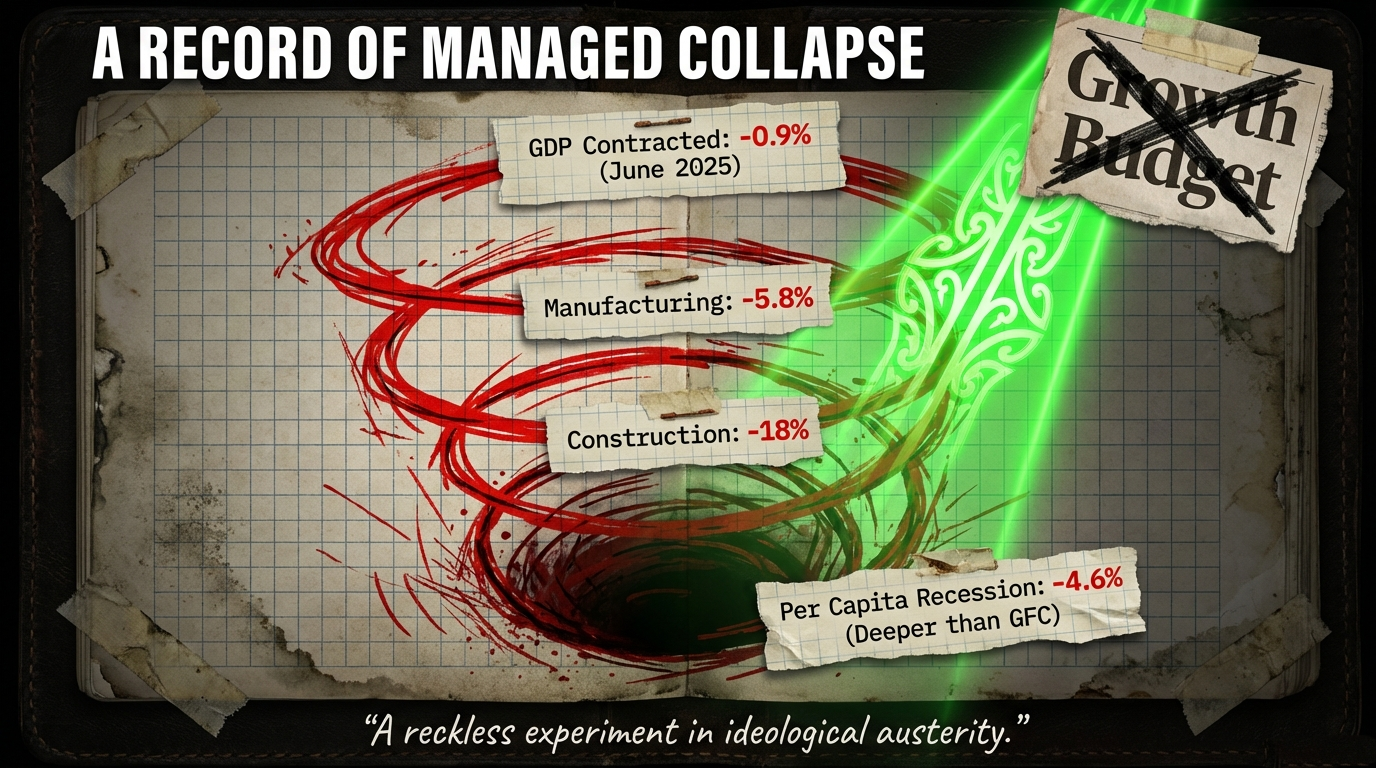
- GDP contracted 0.9% (revised to -1.0%) in the June 2025 quarter, missing forecasts by more than double
- GDP has fallen in three of the last five quarters through June 2025, according to RNZ’s reporting
- The per capita recession is deeper than the Global Financial Crisis, with a 4.6% fall since September 2022, per Budget 2025 forecasts
- Annual GDP is down 0.5% year-to-September 2025, Interest.co.nz confirmed
- Manufacturing has contracted 5.8% from June 2023 levels; construction is down 18%, per RNZ’s analysis
Yet Willis clings to September’s 1.1% quarterly growth as vindication, while economists point to “the elephant in the room”—tightening financial conditions that threaten any fragile recovery.
More damningly, Treasury’s own forecasts reveal her “Growth Budget” is delivering a pathetic 0.1% GDP growth per year from the centerpiece Investment Boost policy over five years, as exposed in Parliament TV debate. When confronted about calling it a “Growth Budget” when it fails to meaningfully close the $25,000 per capita gap with Australia, Willis could only deflect and waffle.
The government halved the Budget 2025 operating allowance to $1.3 billion, the tightest in a decade. This self-imposed fiscal straitjacket, dressed up as “discipline,” has systematically strangled economic recovery and left households and businesses bleeding out.
Wellington: A Capital City Deliberately Destroyed for Political Revenge
Nowhere is this government’s economic vandalism
—let’s call it what it is, deliberate sabotage
—more visible than in Wellington, the capital city that Luxon and Willis appear to have made a personal target for destruction.
The statistics are harrowing:
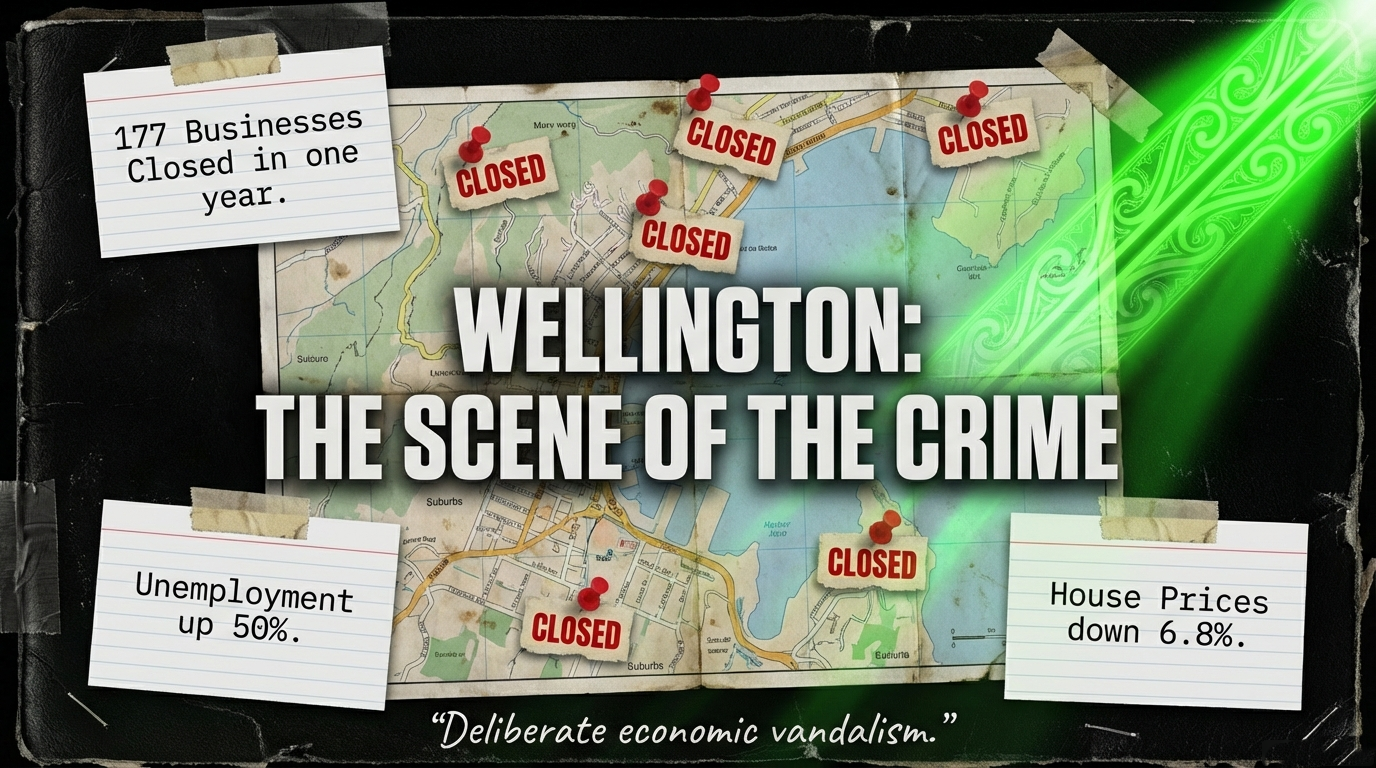
- 177 businesses closed in a single year, the NZ Herald reported
- Unemployment up 50% under this government, according to community analysis of official data
- House prices down 6.8%, per analysis by fiscal commentators
- Economy shrinking, consumer spending collapsing, Wellington leaders confirmed
Willis herself admitted public sector cuts are “restraining” Wellington’s economy
—a staggering concession that the government’s own deliberate policies are systematically tanking an entire regional economy.
The PSA was more blunt: “Government’s reckless decisions are hammering the Wellington economy.”
The targeting appears calculated. The government cut nearly 10,000 public service jobs knowing Wellington would bear the brunt—the capital is home to 40% of public servants. It’s economic sabotage disguised as fiscal prudence, punishing a city that votes left because the current leadership is consumed by vindictiveness. Empty storefronts now line Te Aro. Cafes that survived Covid are shuttering. The vibrant, creative capital that once drove cultural innovation is being deliberately gutted to satisfy a base that revels in public servant job losses.
The Public Sector Purge: All Talk, Bugger All Action—But Real Pain
The Numbers Game: How Government Lies With Statistics
One of the coalition’s signature promises was cutting public sector “bureaucracy.” The government claims around 2,000 jobs cut. The reality, as documented by multiple sources, is both vastly larger and far more destructive than official numbers suggest.[newstalkzb.co]
RNZ’s comprehensive investigation found 9,520 net jobs lost when including Crown entities and vacancies. The Public Service Commission acknowledges 2,731 fewer FTE between December 2023 and December 2024—but this excludes Crown entities like Health NZ, Kāinga Ora, Police, and Defence Force. Waatea News estimates 10,000 jobs lost by June 2025, a figure that aligns with union tracking.
Health NZ alone eliminated approximately 2,042 roles since December 2024. The Ministry of Education proposed cutting 565 positions (12% of staff). The Ministry of Social Development shed over 900 jobs. NZTA lost 287 permanent jobs, MPI saw 391 cuts.
The list goes on:
MoH, Tourism NZ, and the complete abolition of the Productivity Commission—an organization that existed to make government more productive, which tells you everything about this government’s backwards logic.
Yet when confronted, Christopher Luxon shrugged indifferently about only 2,000 job losses from a workforce of 64,000.
Du Plessis-Allan’s rage was palpable:
“There is no reason why we have as many public servants as we have today. 63,000—there is no reason why we have more than double the 30,000 public servants that we had in 2001.”
Population hasn’t doubled (it’s up about 37%); adjusted accordingly, there should be 41,000 public servants, not 63,000.
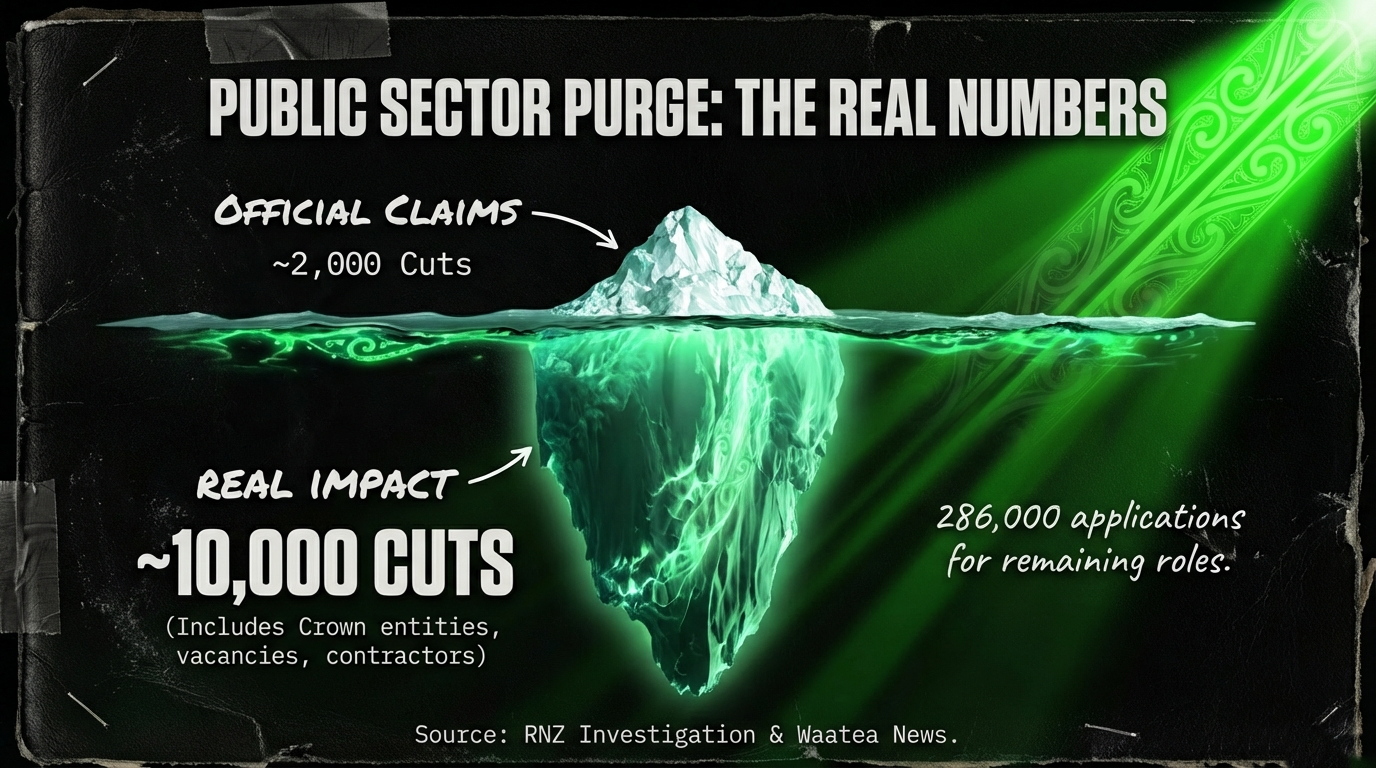
What you’re witnessing is the government claiming victory for the smallest possible cuts while the actual damage is 5-10 times worse. It’s a masterclass in statistical manipulation dressed up as competent management.
The Institutional Catastrophe: Gutting National Security and Child Protection
The impact extends far beyond spreadsheet abstractions into genuine national security vulnerability. Data from 75 public organizations shows there were 286,000 applications for 10,000 public service jobs in the first half of 2025—a brutal ratio of 28.5 applicants per position. Former public servants report “fierce competition for dwindling roles—hundreds applying for each job, with many resorting to unrelated work to survive.”
The institutional cost is incalculable and frankly dangerous. Agencies responsible for counter-terrorism, child exploitation, regional support for Pacific peoples, and environmental protection have been gutted. The cuts to the Department of Internal Affairs included 66 roles in counter-terrorism and child exploitation teams—not “back office” positions but frontline national security and child protection functions sacrificed on the altar of an arbitrary savings target.
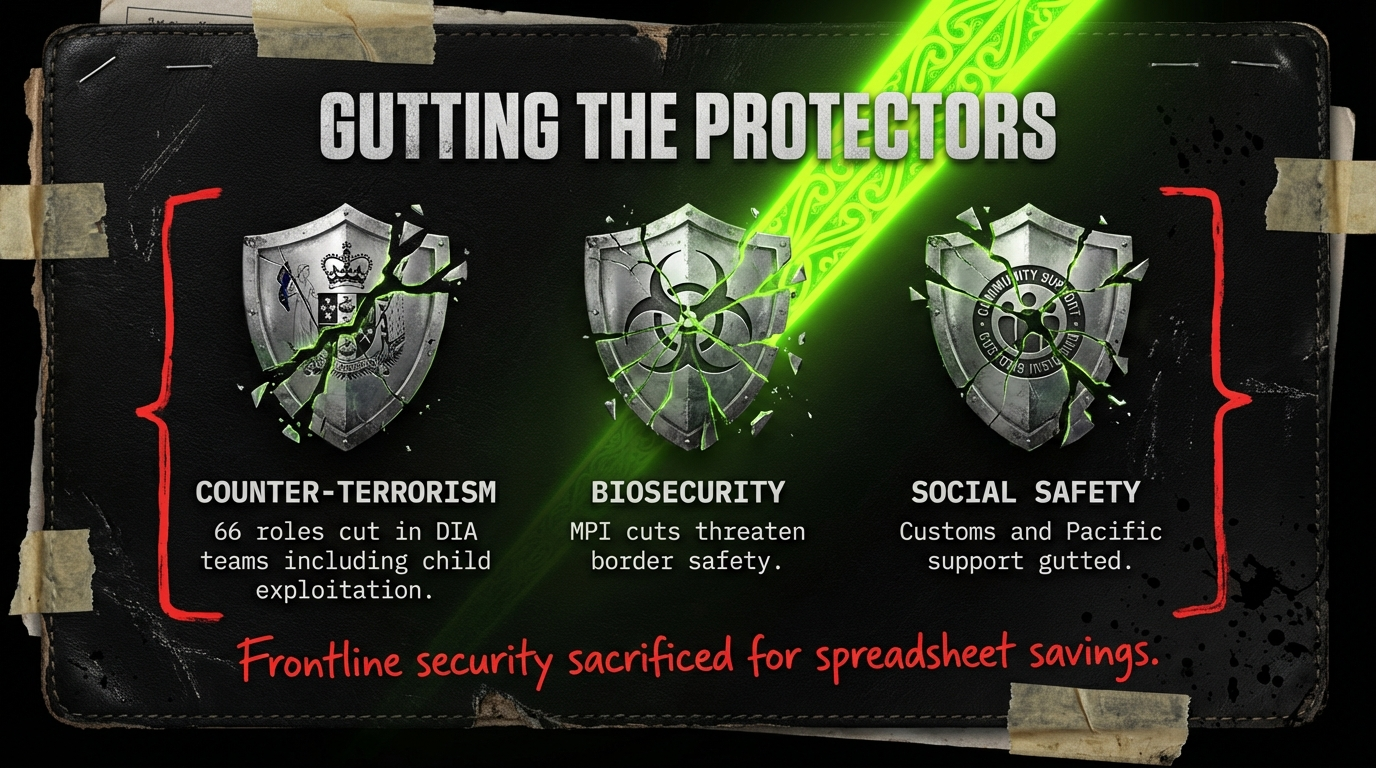
This is not prudent management. This is reckless endangerment of the nation’s security infrastructure for ideological dogma.
The Health System Crisis: A Deliberate Murder-Suicide Pact
Blaming the Victim While Wielding the Knife
Willis’s plan to reverse Labour’s multi-year health funding and return to annual budgeting represents ideological sabotage masquerading as accountability. Her stated rationale?
Health NZ “had a bit of a disaster” and “didn’t stick to its budgets at all.”
This explanation is not just misleading—it’s a deliberate falsehood.
The “disaster” occurred on Willis’s watch. Health NZ was heading toward a $1.4 billion deficit by end of 2024/25, with the government aware in March 2024—well after National took office. The system was hemorrhaging $130 million per month under this government’s funding framework. By year-end, the deficit reached $722 million against a target surplus of $54 million—later revised to $934 million.
Second, Willis herself accepted Treasury’s advice to continue the multi-year funding approach when taking office, saying it “would give forward certainty to Health NZ.” She can’t now blame a system she deliberately perpetuated, particularly when the fundamental problem was chronic underfunding, not mismanagement.
Multiple independent analyses confirm Health NZ was deliberately set up to fail:
- NZCTU analysis: Health requires $1.713 billion just to “stand still,” with an actual shortfall of $1.2-$2 billion at Budget 2025
- ASMS analysis: $1 billion additional investment needed beyond cost pressures to address workforce shortages and unmet needs
- Treasury’s own estimates: $905 million needed for hospital services cost pressures alone, yet only $825 million provided
Health NZ Commissioner Lester Levy was tasked with saving $1.4 billion—an impossibility. Health NZ can’t cut $1.4 billion without eating directly into frontline services. The “back office” explanation is a convenient fiction. The $538 million “underspend” in wages for 2024/25 was due to unfilled vacancies, delayed Holidays Act remediation, and unsettled collective agreements—not efficiency gains. Meanwhile, outsourced personnel costs to fill roster gaps were $162 million over budget.
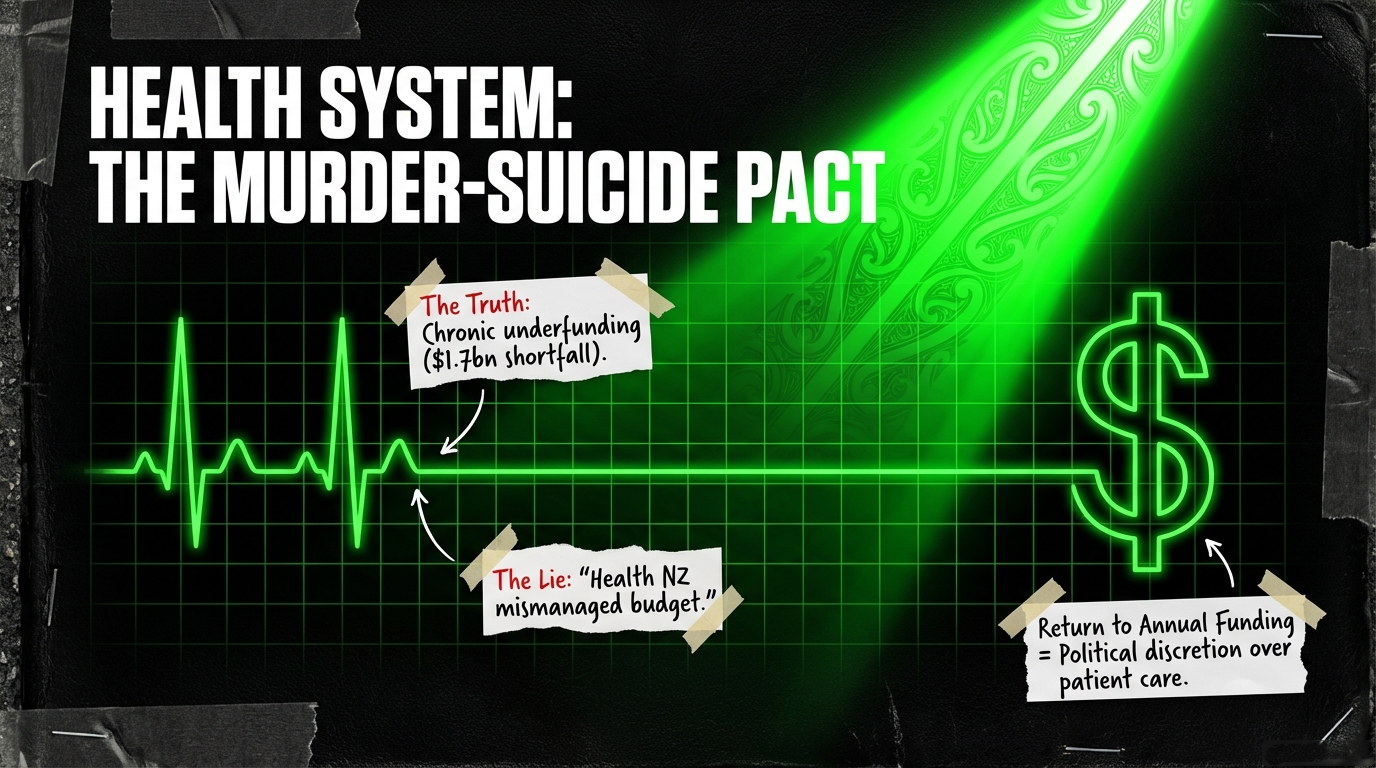
The result? Emergency departments failing wait-time targets across major hospitals. Staff shortages in midwifery, emergency medicine, and general practice that endanger lives daily. Critical infrastructure needs of $47 billion over the next decade with no credible funding plan.
The Return to Annual Funding: Short-Term Thinking on Steroids
Willis’s plan to return to annual health funding is not just economically unsound—it’s reckless endangerment of patient safety. A health system employing more than 100,000 people cannot effectively plan workforce requirements, long-term wage bills, or capital investments with only 12 months of funding certainty. The previous annual model was abandoned precisely because it created instability and inefficiency.
The move to “more discretion to direct [funding] more surgically” means politicians picking winners and losers based on electoral considerations rather than clinical need. This is how you get announcements about new cancer drugs (good politics) while emergency departments crumble from understaffing (invisible until people die).
Willis promises she will “still increase health funding every year.” Given this government’s track record of systematic dishonesty, only fools would believe her.
The LNG Folly: Hundreds of Millions Wasted on Fossil Fuel Ideology
Economics That Don’t Survive Scrutiny
Willis’s Budget priorities include funding for an LNG import terminal—a decision that defies economic logic, environmental responsibility, and energy security strategy. This isn’t just bad policy; it’s economically illiterate policy from a Finance Minister who touts her numerical competence.
The costs are staggering. Even a small-scale LNG terminal would cost between $140 million and $295 million. The gas itself would be far more expensive than both domestic gas and new renewables, producing electricity at an estimated $200-$400 per megawatt-hour compared with about $135 for wind or solar. The Frontier report warned the terminal “would make no economic sense” except as backup capacity.
An open letter from environmental and energy groups urged the government not to waste “hundreds of millions of dollars” on LNG, which would “lock in higher power prices” for consumers. Even analysis sympathetic to gas acknowledges LNG is “twice as bad” for emissions as coal when accounting for the full supply chain.
Willis justified the terminal by claiming it would reduce a “risk premium” in forward electricity prices. This is speculative nonsense dressed in economic jargon. If the gas is only economical as backup, then the terminal becomes a massively expensive insurance policy that may rarely be used—socializing risk and privatizing any potential benefit to industrial users.
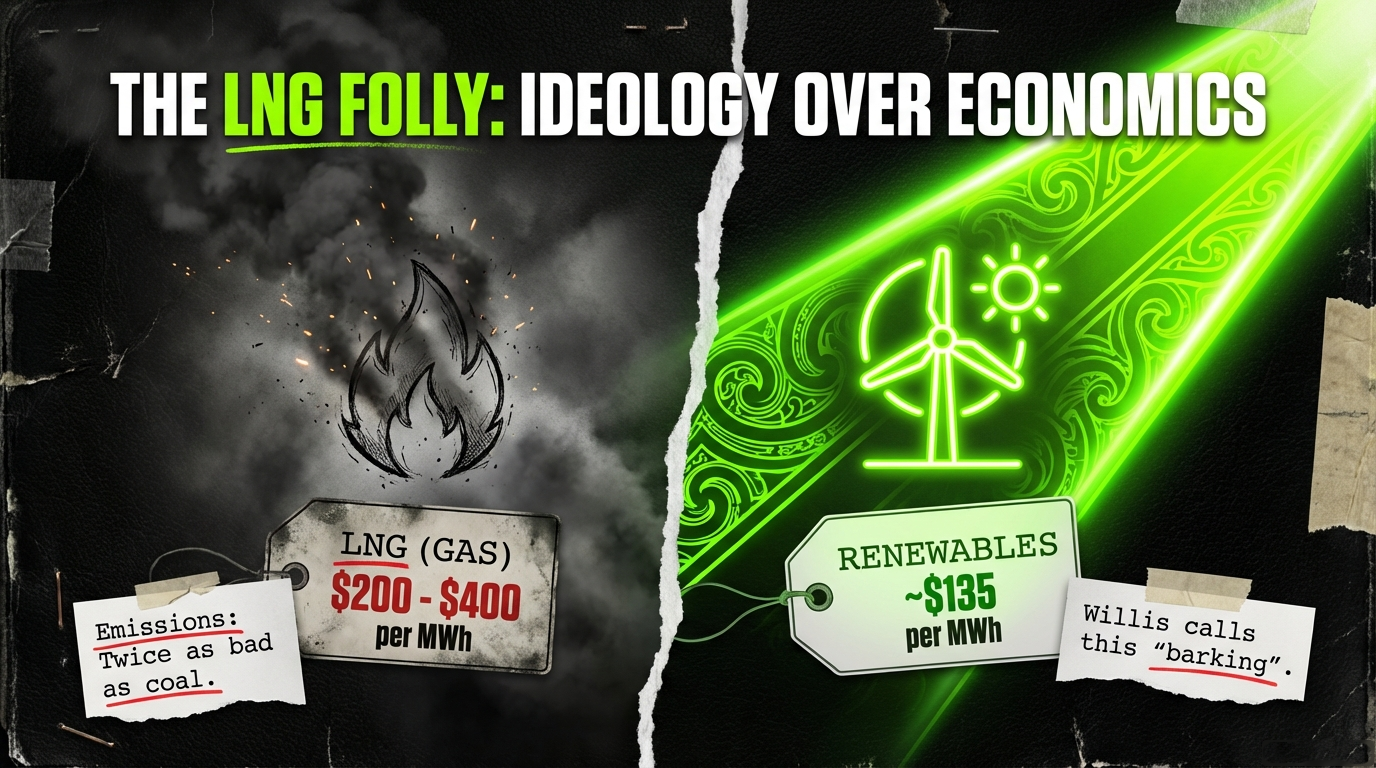
The fundamental problem isn’t lack of energy capacity; it’s poor planning and deliberate underinvestment in renewables. New Zealand is blessed with energy resources, yet this government prioritizes importing expensive fossil fuels over accelerating domestic renewable generation. It’s buying insurance on the Titanic while ignoring the iceberg.
Fossil Fuels: Ideology Over Economics
Willis’s contempt for renewable transition was made explicit in her Herald interview:
This is gaslighting masquerading as pragmatism. No serious person argues for eliminating all firming capacity overnight. The question is whether hundreds of millions should be invested in expensive, polluting LNG infrastructure when that capital could accelerate battery storage, demand response, transmission upgrades, and additional renewable capacity—all delivering better economics and not locking in decades of fossil fuel dependence.
The government is making this choice because it aligns with their ideological priors and satisfies coalition partner demands, not because it’s sound policy. When your energy strategy is celebrated by international fossil fuel interests and condemned by energy economists, you’re on the wrong side of history and economics.
Investment Boost: $6.6 Billion for 0.1% Growth—The Math That Doesn’t Work
The Centerpiece That Wasn’t
The “Growth Budget’s” signature policy, Investment Boost, allows businesses to deduct 20% of new asset values upfront in addition to standard depreciation.
The fiscal cost is eye-watering:
$6.6 billion over five years.
The return? Treasury estimates a meager 1% GDP increase over 20 years and 1.5% wage increase, with half those gains in the next five years. That translates to approximately 0.1% GDP growth per year for the first five years. Willis was confronted on television with this reality—that her centerpiece growth policy delivers 0.1% annual GDP growth while New Zealand falls $25,000 per capita further behind Australia—and could only deflect, insisting things would be worse without it.
This is the fiscal equivalent of celebrating that you’re drowning slightly slower than before.
Business leaders aren’t buying it. The Mood of the Boardroom survey found several CEOs saying they have “no money left to invest,” while others described the scheme as “not really relevant” to their business. Investment requires confidence and demand, not tax gimmicks. When your economy is contracting, unemployment is rising, and business confidence is shot, a 20% tax deduction doesn’t suddenly make unprofitable investments viable.
The policy’s fundamental flaw is believing the constraint on business investment is tax treatment rather than economic conditions. It’s Supply Side Economics dogma from the 1980s, now thoroughly discredited. When the government simultaneously slashes public investment, tangs domestic demand through austerity, and creates an environment of uncertainty through constant restructuring, no tax cut will trigger the investment boom Willis fantasizes about.
The IRD doesn’t even have good data yet on uptake because the tax year hasn’t ended. Willis acknowledged businesses weren’t investing in Q2 2025 “regardless of a tax credit” because the economy was struggling. That’s an admission the policy is poorly timed at best, ineffective at worst.
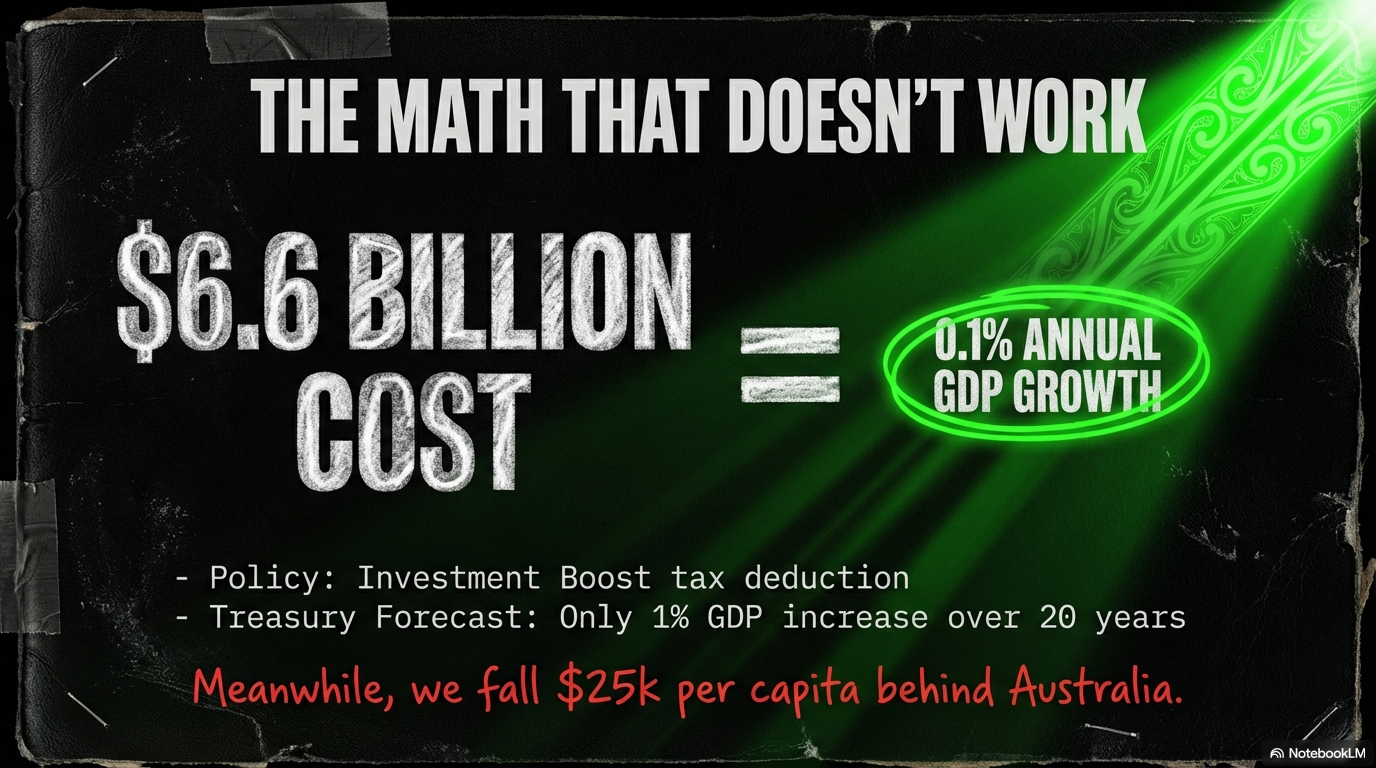
Yet $6.6 billion is committed—money that could fund health, education, and infrastructure. Instead, it’s delivered as a windfall to businesses that were going to invest anyway or won’t invest at all. Compare this to the $12.8 billion “saved” by cancelling 33 pay equity claims for mostly women in low-paid health and education roles. The government can find $6.6 billion for a tax policy delivering 0.1% growth, but not for ensuring equal pay for work of equal value. The priorities are contemptible.
Asset Sales: The Charade Continues
“Recycling” and “Monetisation”: Euphemisms for Selling the Silverware While Pretending It’s Strategic
Christopher Luxon has confirmed National will campaign on asset sales at the 2026 election, euphemistically branded as “asset recycling”—selling one asset to build another. Luxon insists an election victory would provide the mandate to proceed, despite New Zealand voters decisively rejecting asset sales in a 2013 citizens-initiated referendum—which the Key Government ignored anyway.
Finance Minister Willis has shifted focus from the commercial portfolio (SOEs and mixed-ownership companies worth $99 billion) to the much larger social portfolio worth $314 billion (hospitals, schools, highways, conservation land) and “asset monetisation” like the Chorus debt sale.
Her examples are telling:
selling unused school property and government buildings no longer needed.
This framing is deliberately misleading. No one opposes selling genuinely redundant assets. The concern is what comes next. Willis’s comments about “concessions” to private firms—where they pay a fee to run enterprises using Crown-owned assets—signals privatization by stealth. The assets remain “in public ownership” technically, but control and profit flow to private operators. This is how you end up with private companies running prisons, collecting tolls on publicly funded roads, and operating schools and hospitals for profit.
Coalition partner Winston Peters has made his opposition crystal clear:
“Give me a break. I spent my career ensuring our assets stay in our possession.”
Act’s David Seymour, by contrast, argues New Zealand needs to move past “squeamishness” about privatisation and sell underperforming assets. National is caught in an impossible position—between coalition partners, its own base, and public opposition.
The track record of privatization in New Zealand is dismal. Partial privatisation of energy companies in 2013 hasn’t delivered cheaper power—quite the opposite. Electricity prices have spiked catastrophically, industrial users are closing, and households are crushed by costs.
Labour leader Chris Hipkins noted:
“New Zealanders benefit from the profits QV makes”
—why sell it?
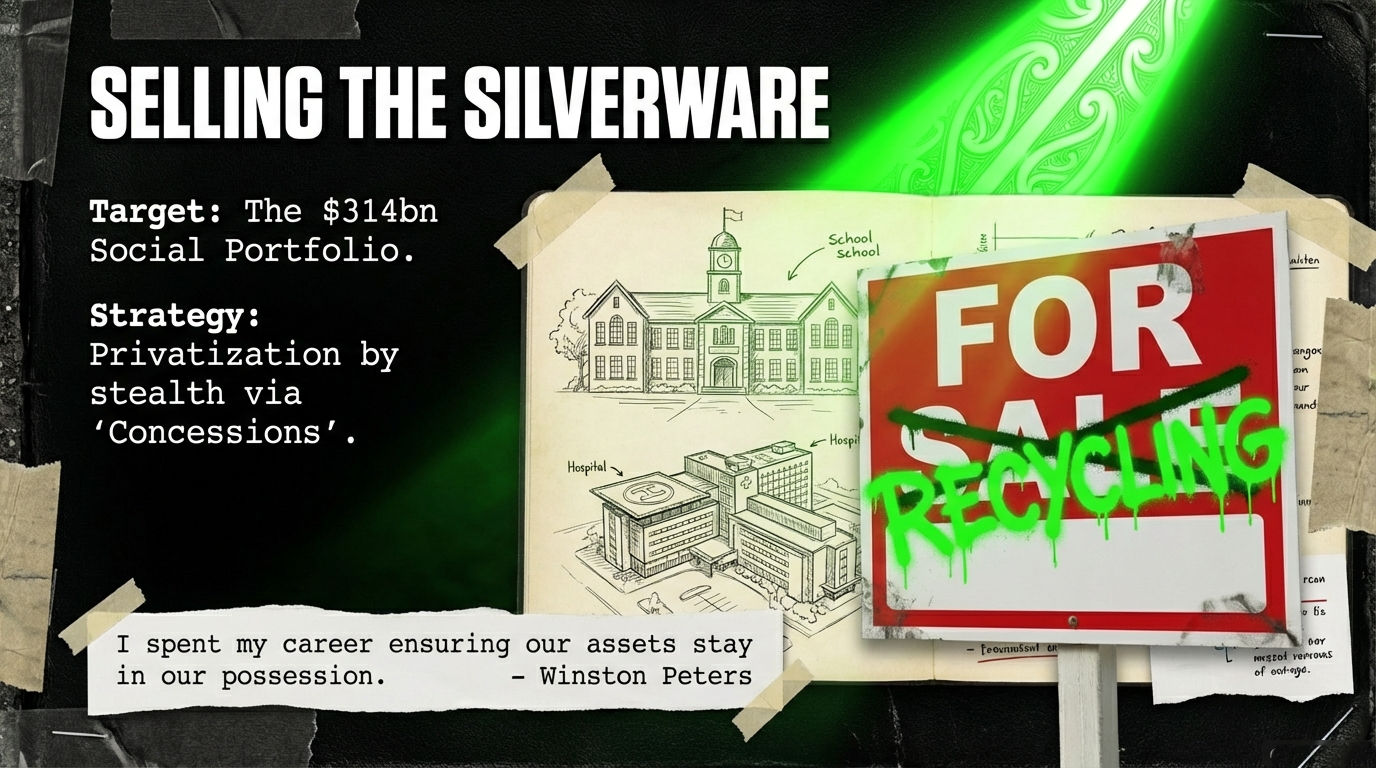
The answer is ideology dressed as pragmatism. The government wants capital for infrastructure but refuses to borrow at historically low interest rates or implement wealth taxes that could raise revenue without selling income-generating assets. Asset sales are a one-time windfall that permanently forfeits future revenue streams—robbing tomorrow to pay for today’s failures, enriching private operators while impoverishing the public.
The Cost-of-Living Catastrophe: When Necessity Becomes Luxury
When $10 Butter Defines National Collapse
Perhaps no single metric captures New Zealand’s economic malaise more than the price of butter. At $10 for 500g (up 31.8% year-on-year), butter has become a symbol of how the cost of living has spiraled beyond the reach of ordinary households
—a staple food that has become a luxury item.
New Zealanders are experiencing a cost-of-living increase that has moved beyond “crisis” into permanent reality. One commentator argued we’re “participating in mass delusion by insisting we are still in a ‘crisis’”—this is just how things are now. Food prices are up 5% annually (August 2025), with milk up 16.3%, cheese up 26.2%, beef mince up $3.40 per kilo to $22.53. Rates are up 12.2%, electricity up 9.1% (gas up 15.4%), and insurance up 10%.
The burden falls heaviest on those least able to bear it. Beneficiaries face cost-of-living increases of 3.4%, superannuitants 3.9%, and the lowest-spending households 4%, compared to just 0.8% for the highest-spending households whose mortgage costs are falling. Rent makes up 29.5% of beneficiary household expenditure, compared to just 5.1% for the wealthiest.
Almost half of New Zealanders report their financial situation has worsened over the past year. The NZCTU’s Craig Renney notes “much of the challenges are in administered costs, rates, electricity, going to see the GP, which are rising faster than general inflation.” Food prices are rising much faster than wages, creating a “slow grind” that economist Shamubeel Eaqub says feels worse than the global financial crisis for many households.
Willis told RNZ she agrees New Zealand is in a “severe cost of living crisis,” yet her solution is wage growth rather than price controls or meaningful competition reform. Wages did increase modestly, but as one analyst noted, wage increases typically encourage higher spending which leads to increased prices “unless there are, hmmmm I dunno, rules restricting that.” Willis has “asked Fonterra some questions” about butter and milk prices—can you imagine a more pathetic abdication of responsibility?
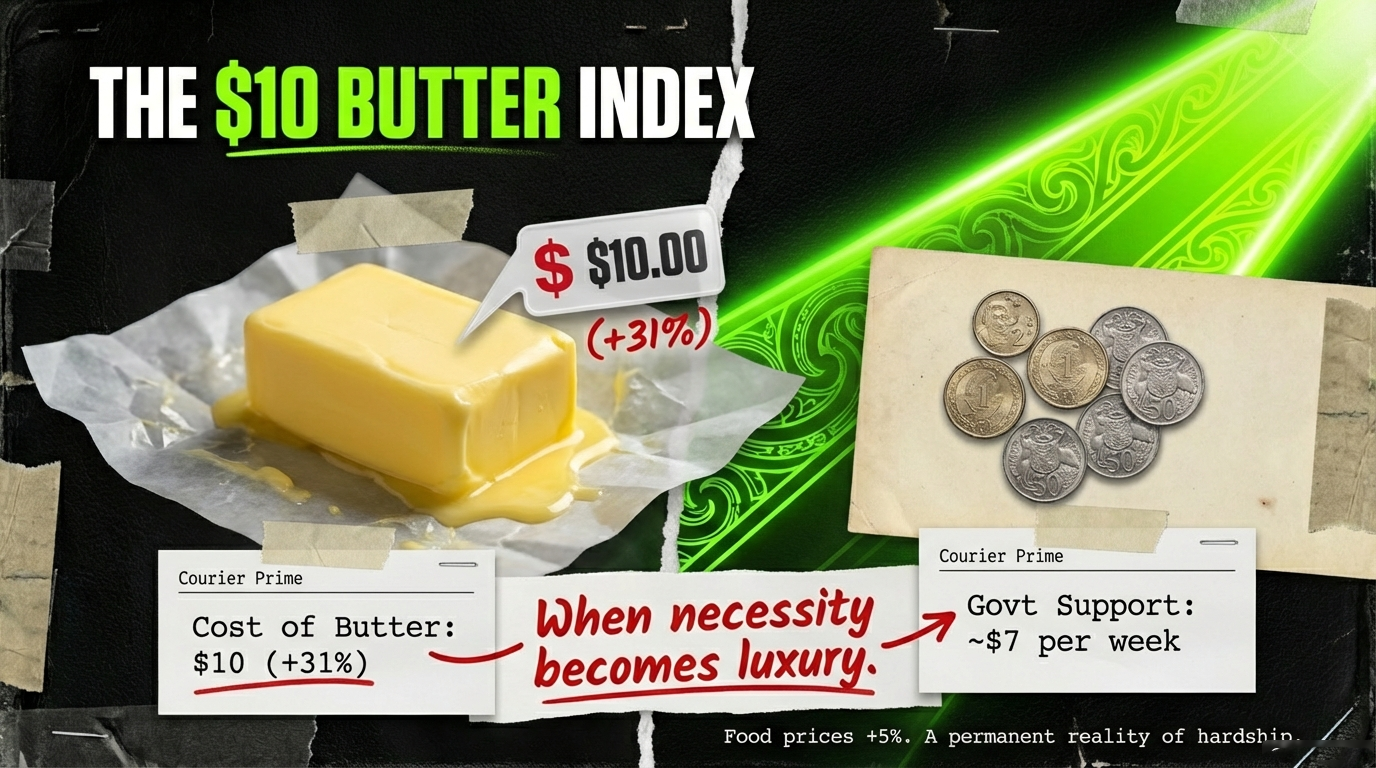
The government’s much-hyped supermarket competition reforms remain unchecked on the to-do list. Willis’s Budget 2025 cost-of-living support amounts to 142,000 families receiving “an average of $14 more per fortnight”—$7 per week—a figure so contemptibly small it borders on mockery of people struggling to feed their families. This came at the expense of means-testing the first year of Best Start payments, leaving 61,000 families worse off.
Leadership Failure: The Incompetence Trifecta
Luxon: A PM Out of Touch, Out of Ideas, Out of Depth
Christopher Luxon arrived in Parliament boasting the “biggest Rolodex of any PM,” with business connections ready to help.
Independent director Fraser Whineray’s assessment is brutal:
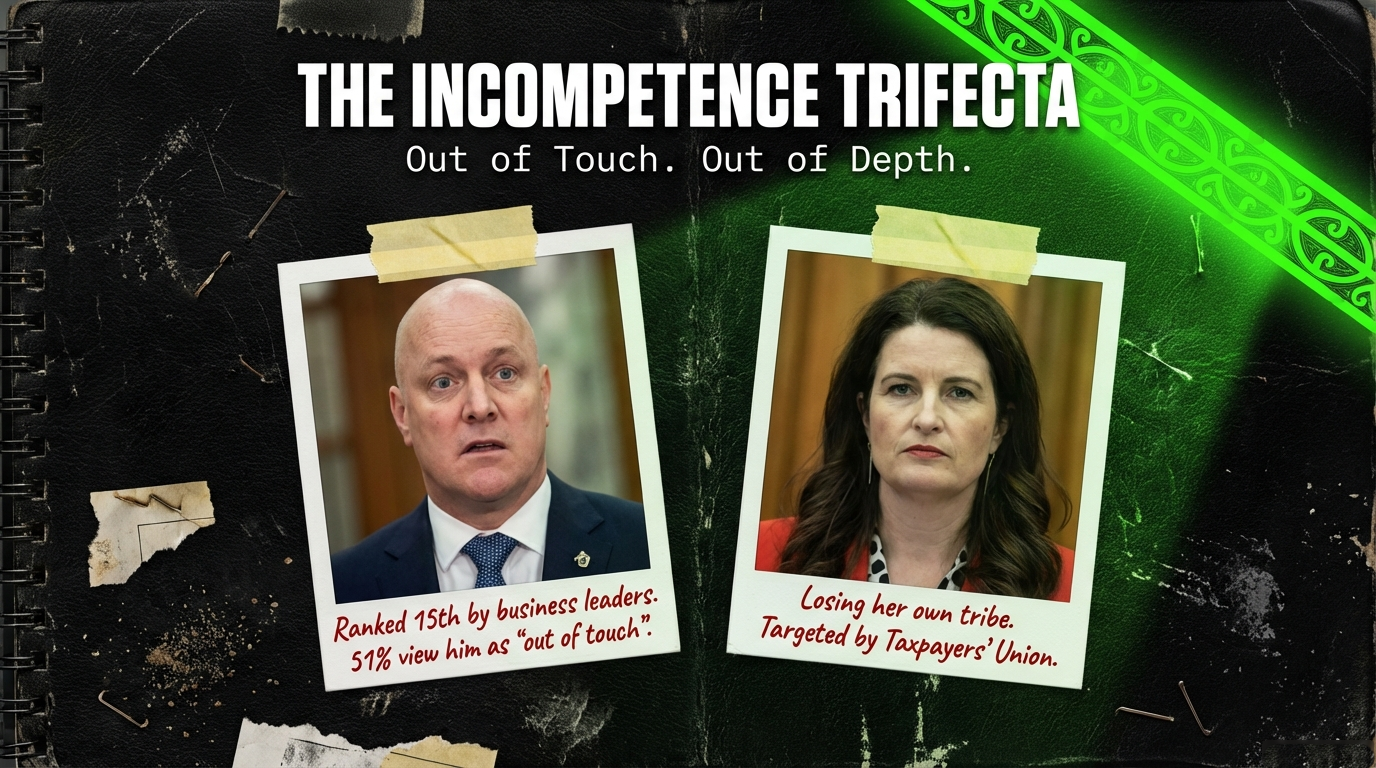
“He hasn’t used it at all.” He’s been ranked 15th out of his own Cabinet by 150 business leaders, with frequent comments that he’s a “poor listener” who “doesn’t take constructive feedback well.”
When confronted with these criticisms, Luxon’s response? An arrogant dismissal: “I’m here to do a job. I came to politics four years ago because this is an awesome country...and we’re damn well going to make it and get realised.” This is not leadership; this is petulance from a man who cannot admit failure or accept feedback.
His communication disasters have been serial. During the election campaign, his claim to spend only $60 a week on groceries was widely mocked. Before a trade mission to Japan, he dismissed previous government delegations as “C-list,” implying they were second-rate, then backfired when critics noted his delegation included many of the same companies.
Most damaging: 51% of New Zealanders view him as “out of touch”; only 37% believe he understands their concerns. These perceptions run especially high among young people and Māori voters. Notoriously provocative political commentator Matthew Hooton wrote: “It is Luxon who is driving down the numbers for National and thus the Coalition, and also on net direction. His very personality is harming confidence and thus the economy.”
This is not a leader governing a country; this is a corporate executive playing Prime Minister while the country burns around him.
Willis: The Finance Minister Who Lost the Right
Willis faces an unprecedented political humiliation. The Taxpayers’ Union—ostensibly her ideological allies—has launched “the biggest and toughest campaign ever launched against an ostensibly friendly target,” according to insiders.
Their criticisms are devastating:
she has borrowed more than Grant Robertson, failed to rein in spending, relied on a “newly invented” OBEGALx surplus measure, and presided over a bureaucracy that has barely shrunk.
This is not generic political criticism. This is her own tribe turning on her because the numbers are so catastrophically bad that no amount of spin can hide them. When the hard right concludes you’ve failed, you’ve truly failed.
Her handling of the Reserve Bank crisis was contemptible. She enabled the obstruction and coverup for months, and if it hadn’t been for the Ombudsman, we might still be dealing with official denial and avoidance enabled by her. That she defended RB chairman Neil Quigley’s misleading public statements while knowing the truth shows a Finance Minister more concerned with political protection than institutional integrity.
A Government Consumed by Incompetence and Ideology
After more than two years of serial failure, the National-led coalition has delivered catastrophe dressed as competence. They campaigned on fiscal responsibility and delivered higher debt, broken promises, and economic contraction. They promised surplus by 2027 and won’t achieve it until 2029, if ever. They pledged disciplined spending and spend more than their predecessors. They committed to economic growth and presided over recession. They said they’d address the cost-of-living crisis and instead normalized it as permanent reality.
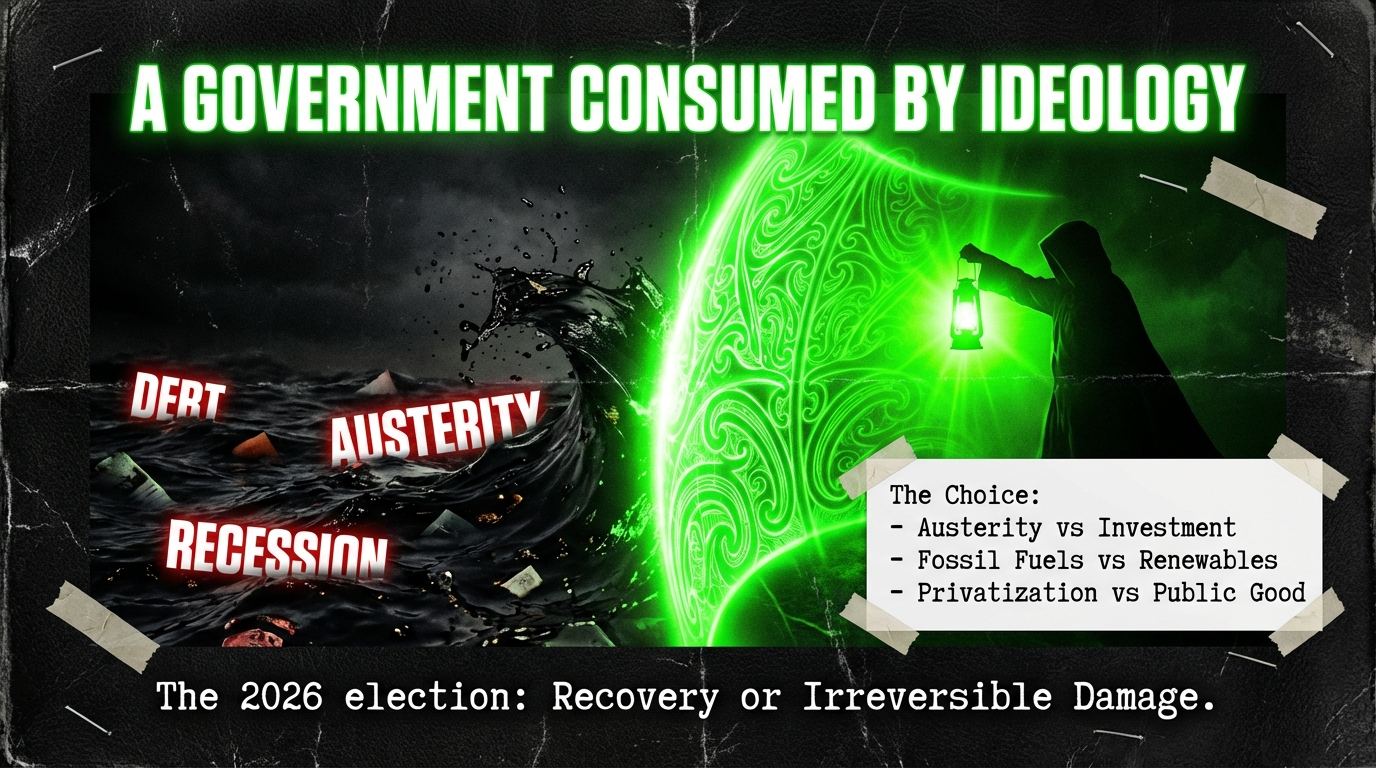
Nicola Willis’s 2026 Budget plans—slashing health funding certainty, gambling on expensive LNG infrastructure, preparing asset sales, and maintaining austerity—represent doubling down on failure. The economic evidence is unambiguous: austerity during weak growth deepens recessions, prolongs recovery, and inflicts lasting damage on public services and social cohesion.
Fifteen economists wrote an open letter warning of “immediate and long-lasting harm” from the government’s fiscal approach. The Taxpayers’ Union—ideological allies—campaigns against Willis for not cutting enough, exposing her as satisfying neither fiscal hawks nor growth advocates. Business leaders doubt the Investment Boost will work. Energy economists warn the LNG terminal wastes hundreds of millions. Health analysts confirm the system is underfunded, not mismanaged.
Wellington lies in ruins, its economy deliberately tanked to punish a city that didn’t vote National. Public servants—counter-terrorism officers, child protection workers, biosecurity staff—join unemployment queues while ministers shrug that at least it’s better than Labour. Families skip meals because butter costs $10 and the government’s solution is $7 per week in cost-of-living support.
This is not governance. This is ideological warfare prosecuted against the country’s economic interests, social fabric, and future prosperity. Heather du Plessis-Allan’s verdict stands: all talk, bugger all action, from a government that looks increasingly like “Labour dressed in blue clothing” but with cruelty baked in as a feature, not a bug.
New Zealanders were promised competence, discipline, and growth. They got broken promises, recession, and a Finance Minister planning to make it all worse with a 2026 Budget that prioritizes fossil fuel ideology over renewable energy, asset sales over public investment, and continued austerity over recovery.
The 2026 election cannot come soon enough. But by then, the damage will be irreversible—and it will take a generation to repair what this government has systematically destroyed.

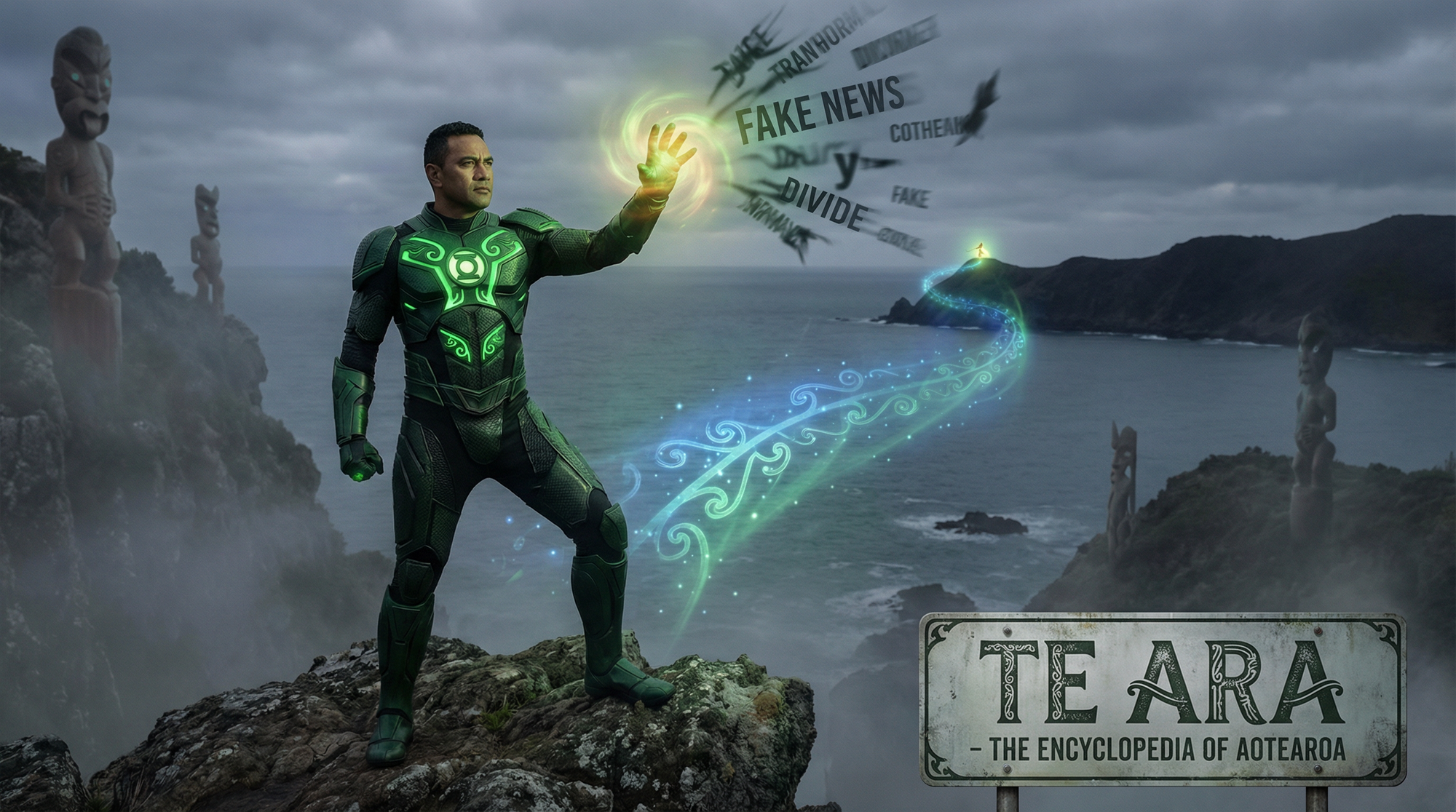
Ivor Jones The Māori Green Lantern Fighting Misinformaiton And Disinformation From The Far Right