““Grab What You Can”: The Global Rush for Second Passports Is Class Warfare, The Rich Against Everyone Else” - 7 January 2026
The Velvet Rope of Citizenship

Koha Consideration
Three pathways exist:
For those who wish to support this mahi directly with a koha (voluntary contribution), please visit the Koha platform:
- Koha—Support - https://app.koha.kiwi/events/the-maori-green-lantern-fighting-misinformation-and-disinformation-ivor-jones
- For those who wish to receive essays directly and support through subscription, join the Substack community:
- Subscribe to the Māori Green Lantern on Substack - https://themaorigreenlantern.substack.com/subscribe
- For those who prefer direct bank transfer, account details are: HTDM, account number 03-1546-0415173-000.
Every koha signals that whānau are ready to fund the accountability that Crown and corporate structures will not provide. It signals that rangatiratanga includes the power to fund our own truth tellers.
Kia kaha, whānau. Stay vigilant. Stay connected. And if you are able, consider a koha to ensure this voice continues.
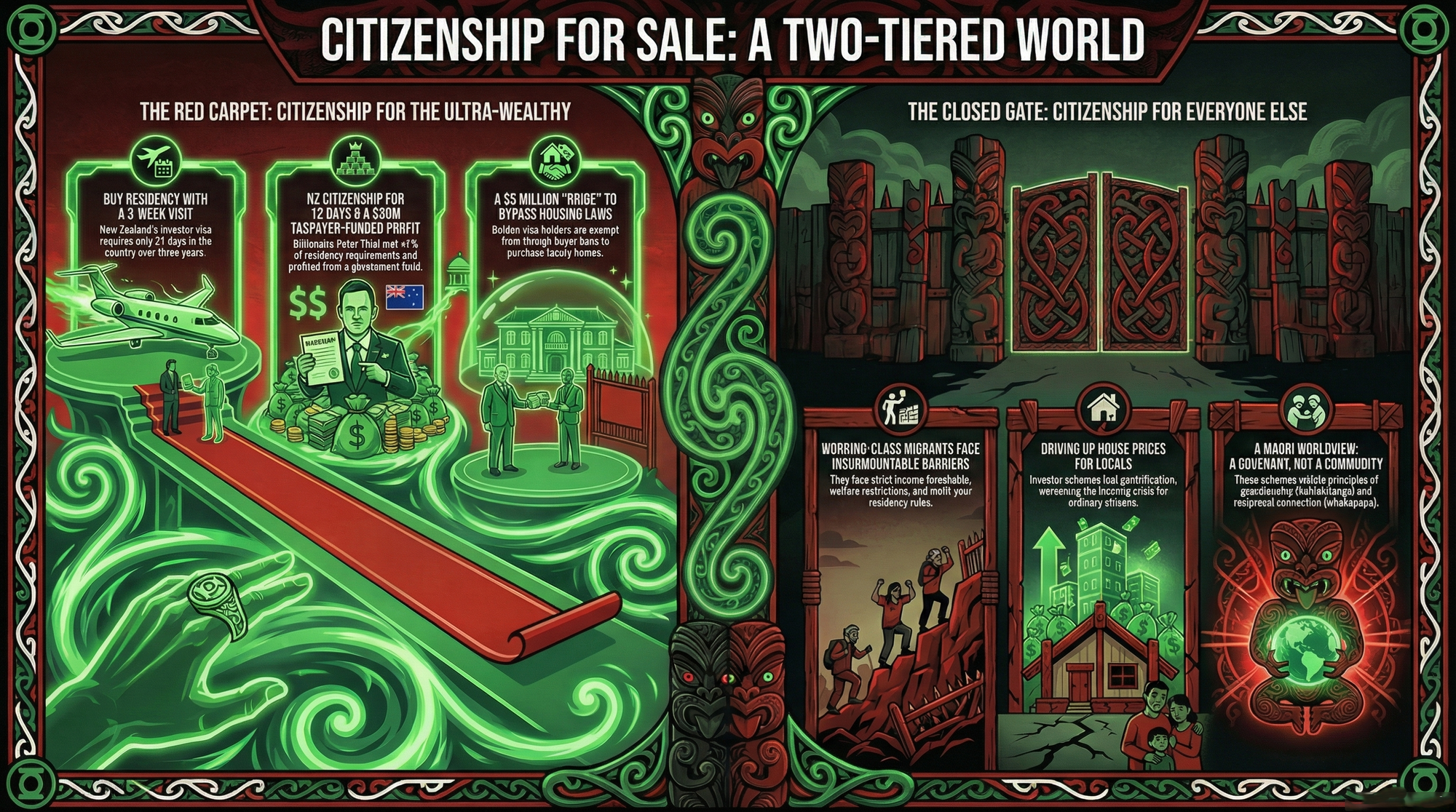
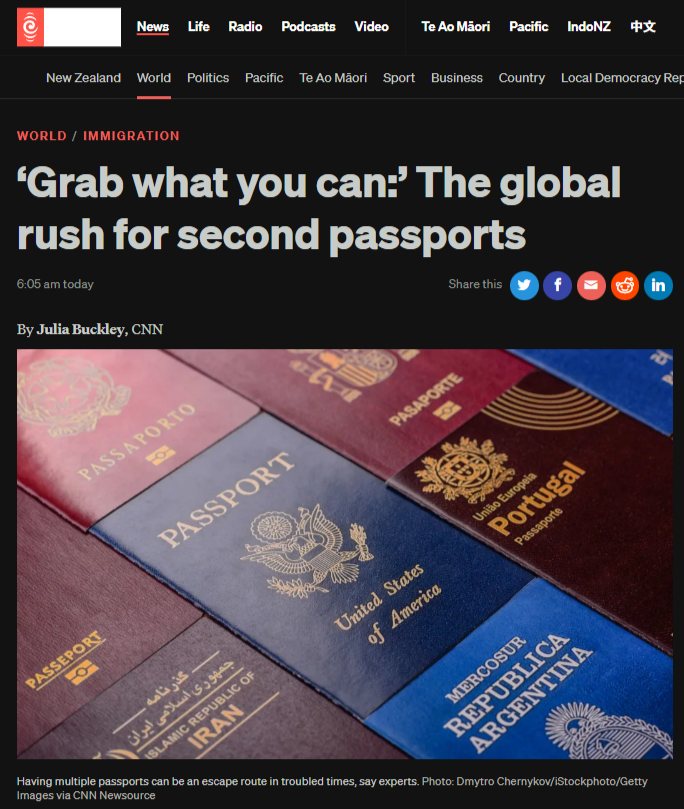
When George Clooney and his family received French citizenship in late 2025—days before language and civic requirements tightened—the transaction captured something essential about twenty-first-century political economy. While ordinary migrants face rising economic barriers, language tests, and years-long naturalization processes, ultra-wealthy individuals can “grab what you can,” purchasing enhanced mobility, security, and rights through citizenship-by-investment (CBI) schemes. As RNZ’s recent article lays bare, this is not neutral economic policy. It is class warfare: a systematic, legally sanctioned stratification where capital trumps citizenship, where wealth becomes both barrier and accelerator, and where Indigenous peoples and working-class communities bear the costs of a system designed to serve mobile elites.
The evidence is unambiguous. Citizenship—once conceived in modernist thought as equal status among members of a political community—is being commodified. Small island states in the Caribbean derive up to 37% of their GDP from selling passports. Malta ran a billion-euro “golden passport” scheme until the European Court of Justice ruled it illegal in April 2025, declaring it a “commercialisation of EU citizenship”. Meanwhile, New Zealand’s own Government is “dusting off” investor visa schemes to attract wealthy foreigners, explicitly acknowledging they “don’t love” renting and prioritizing their property acquisition over housing affordability for ordinary Kiwis. From the perspective of Te Ao Māori—grounded in principles of kaitiakitanga, whakapapa, and reciprocal obligation—these schemes represent a profound violation: they sever citizenship from social membership, enable extractive relationships with whenua, and subordinate Indigenous self-determination to neoliberal governance frameworks.This essay traces five interconnected dynamics through which CBI schemes constitute class warfare: (1) the resurrection of property-based citizenship, (2) the creation of dual standards between “Parachuters” and “Dreamers,” (3) structural violence against ordinary citizens, (4) the racial and colonial hierarchies embedded in global mobility regimes, and (5) the mauri-depleting transformation of citizenship from reciprocal bond to market transaction.
I. Resurrecting the Property Qualification: Citizenship as Luxury Good
From Ancien Régime to Neoliberal Alchemy
Legal scholar Ayelet Shachar demonstrates that contemporary CBI schemes resurrect “an older, exclusive, and exclusionary vision” according to which property ownership determined who qualified as a citizen. Ancient Athenian citizenship was reserved for male property-holding heads of household; Roman hierarchy privileged wealthy elites who dominated political life. The French Revolution offered a “critical moment of breakage,” replacing privilégiés with citoyens and establishing equality, not legal inequality, as the basis of social order.
Yet modernist citizenship’s promise—that membership be decoupled from wealth—is being systematically undone. Today, approximately one-third of the world’s countries offer some form of CBI or residency-by-investment program. The price tags range from USD $130,000 for a Vanuatu passport (issued in as little as 30-60 days) to €750,000 for Malta’s golden passport (before the EU ban), AU$15 million for Australia’s “premium” investor visa, and £2 million for UK leave to remain. As Shachar observes, “capital becomes a golden passport to citizenship, exempting the super-rich from requirements that are enforced for others, such as physical residence, civic integration, and linguistic proficiency”. This is not merely inequality of access; it is the legal codification of citizenship as a purchasable luxury good for a “discerning global monied elite.”
The Offshore Capitalism Connection
CBI schemes are not isolated policy choices but integral to offshore capitalism, offering what Susan Roberts terms “regulatory arbitrage”—enabling elite wealth accumulation and power by exploiting jurisdictional differences. The three “offshore pillars”—virtual residency, easy incorporation, and secrecy—structure CBI programs to allow investors to capture the benefits of citizenship (enhanced mobility, tax optimization, EU freedom of movement) while remaining physically, psychologically, and politically absent. Transnational intermediary firms like Henley & Partners have opened nine US offices in the past three years (up from zero) and now derive 30% of their business from American clients seeking “insurance policies” against political volatility. The firm’s slogan—“grab what you can” before eligibility tightens—distills the extractive logic.
II. Dual Standards: “Parachuters” vs. “Dreamers”
Wealth as Barrier and Accelerator
The same economic criteria that fast-track the wealthy block ordinary migrants. Shachar documents that approximately 60-70% of Austrian female blue-collar workers cannot meet the income requirements for naturalization in their own country. Germany mandates proof of 60 months of social security contributions, adequate health insurance, and 13 square meters of living space per person. The United States briefly expanded its “public charge” rule under the Trump administration to bar immigrants likely to use food stamps or health subsidies—safety nets covering basic necessities like bread and milk. Finland requires “reliable account of current and past sources of income” for the entire period of residence. Denmark denies citizenship to anyone who has “drawn on welfare benefits” or holds “debt to the public.”
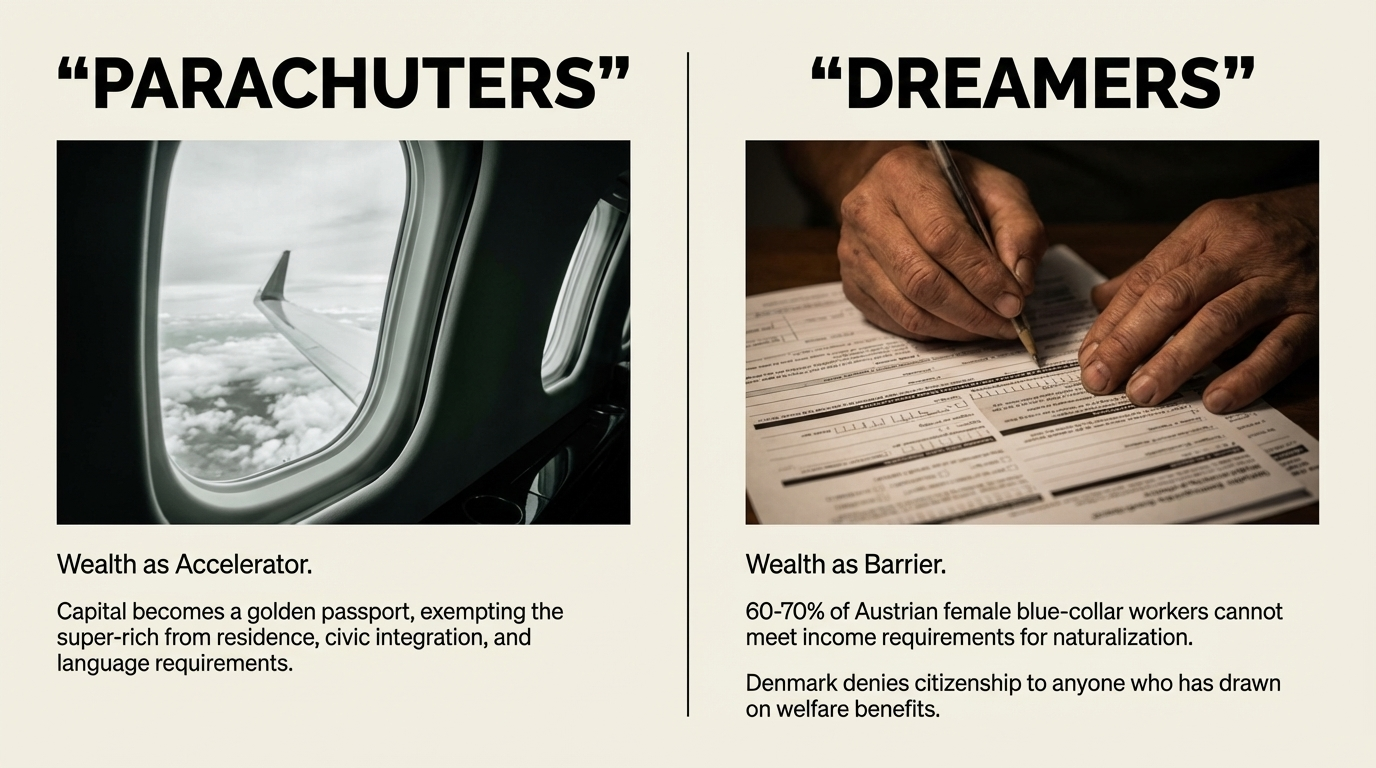
For the rich, these gates dissolve. The EB-5 program allows wealthy foreigners to purchase a US green card for USD $900,000–$1.8 million, jumping to the front of the line while DACA “Dreamers”—young people brought to the United States as infants—face a “sword of deportation” with no legal pathway to secure status. This juxtaposition exposes the class logic: “those who possess an abundance of capital but few actual ties to the polity” gain accelerated access, while “those with deep, genuine links but little money” confront mounting barriers. As Shachar concludes, “a legal regime that provides red-carpet treatment to the rich and affluent to speed through the gates of admission while putting at risk the prospect for same for non-millionaire migrants... affirms hierarchies and recasts naturalized citizenship as purchasable reward.”
The Peter Thiel Scandal: “Apocalypse Insurance” and Broken Promises
New Zealand’s 2011 grant of citizenship to billionaire Peter Thiel crystallizes this dual-standard system. Thiel received citizenship under a rare “exceptional circumstances” clause despite spending only 12 days in the country—less than 1% of the usual 1,350-day requirement. While ordinary migrants waited months or years for residency applications to be processed, Thiel’s investor category class right to residency was processed in a matter of weeks. His required $1 million investment? Parked in a term deposit at the National Bank’s provincial Whanganui branch for two years.
The broken promises are legion. Thiel’s application promised to make Valar Ventures “an active player in New Zealand’s venture capital industry,” to build an Auckland technology incubator, and to take “great pride to let it be known that I am a New Zealand citizen.” None materialized. Valar’s New Zealand website became “digital tumbleweed”. The incubator never eventuated. And in October 2016, Thiel activated a generous buyout clause in his NZVIF partnership—designed to encourage local venture capital development—gaining conservatively estimated $30 million from his $6.75 million investment while NZVIF barely broke even. A 2014 government-commissioned report noted the “difficult optics where the taxpayer is offering an American billionaire a loan at less-than-market rates.”
This is class warfare distilled: privatize profits, socialize losses. Grant the wealthy citizenship as “apocalypse insurance” while ordinary migrants face deportation for minor infractions.
III. Aotearoa’s “Golden Visa” Gold Rush: Three Case Studies in Class Warfare
Case Study 1: The “21-Day Kiwi”—Buying Residency Without Residence
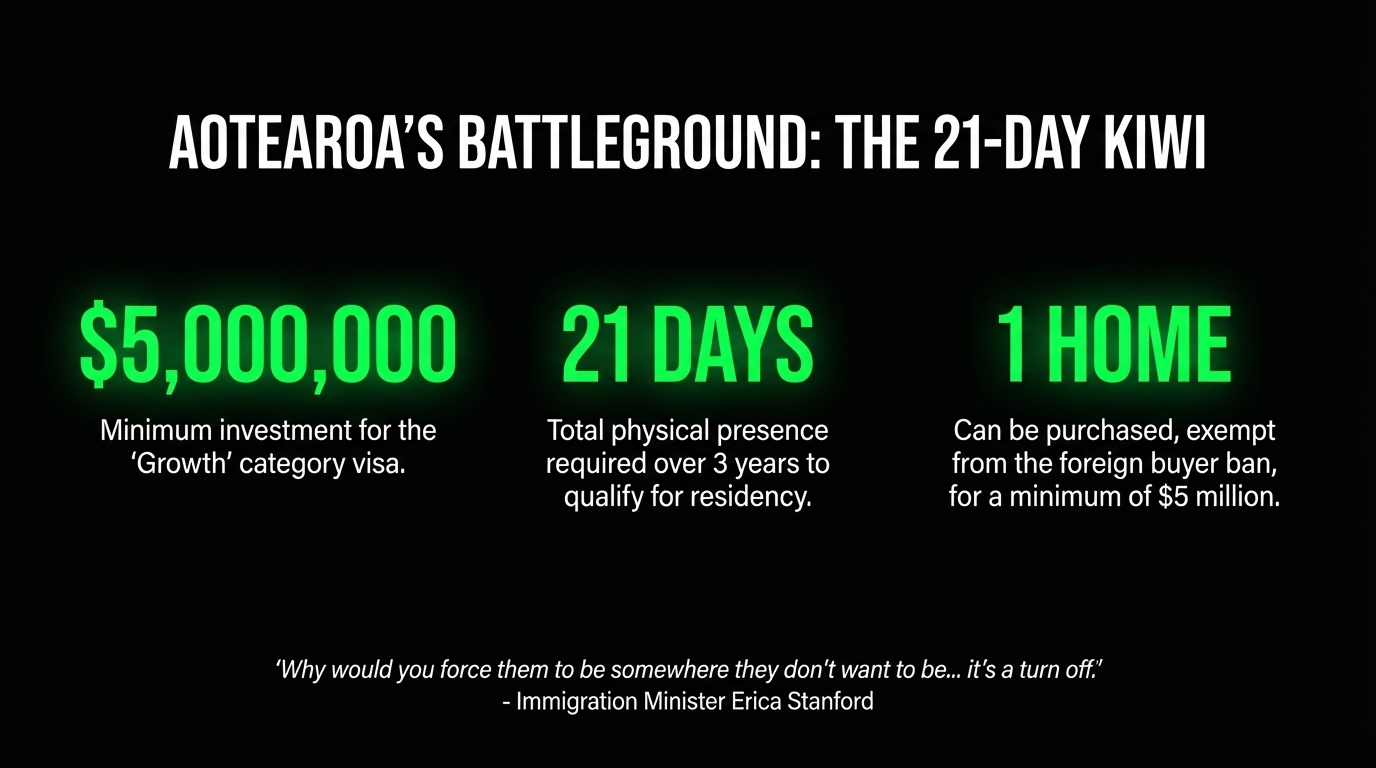
In February 2025, Prime Minister Christopher Luxon announced reforms to New Zealand’s Active Investor Plus visa, designed to attract wealthy foreign capital. The scheme offers two pathways: a “Growth” category requiring NZD $5 million investment over three years, or a “Balanced” category requiring NZD $10 million over five years. The most striking feature? Investors need spend only 21 days total in New Zealand over three years to qualify for residency under the Growth category—equivalent to one week per year. The Balanced category requires 105 days over five years—again, barely three weeks annually.
Immigration Minister Erica Stanford defended the minimal presence requirement, telling Morning Report: “Why would you force them to be somewhere they don’t want to be for the first couple of years?” She continued: “These are incredible investors with tens of millions and they flit all around the world. And when they see something like, ‘Oh, I’ve got to spend multiple weeks per year for the first couple of years in New Zealand’, it’s a turn off.” The logic is explicit: cater to the preferences of mobile capital by exempting the wealthy from the very requirements—sustained residence, community integration, genuine connection to place—that ordinary migrants must fulfil.
Compare this to Māori families facing deportation for overstaying by days, or refugees waiting years in detention centers for asylum claims to be processed. The message is unmistakable: if you have $5 million, you can purchase residency with 21 days’ physical presence. If you’re poor, your decades of residence, community ties, and children born here count for nothing against a visa technicality.
Case Study 2: The $5 Million Property Exemption—Housing as Investor Bribe
The class warfare deepens. In September 2025, Luxon announced that Active Investor Plus visa holders would be exempted from New Zealand’s 2018 foreign buyer ban, allowing them to purchase or build one home valued at minimum NZD $5 million. Luxon described it as a “happy compromise” between attracting investment and protecting housing affordability, claiming the $5 million threshold “equates to less than 1 per cent of New Zealand houses”.
This framing is deceptive on multiple levels. First, it ignores ripple effects: as real estate agents scramble to court this new ultra-wealthy market, properties will be revalued upward toward the $5 million threshold, driving gentrification and displacement. Green Party housing spokesperson Tamatha Paul warned: “Real estate agents will have every incentive to boost prices to $5m in order to sell to this new wealthy market, further shunting struggling renters and home-buyers out of contention”.
Second, the exemption reveals the Government’s priorities. New Zealand faces a housing crisis with ownership rates fallen below 60%, Māori home ownership at historic lows, and thousands of whānau in emergency accommodation. Yet the Government’s response is not to build social housing or address structural inequality, but to roll out the red carpet for foreign millionaires. Labour’s Kieran McAnulty condemned the move: “People cannot afford the basics at the supermarket but Christopher Luxon made it his priority to drive up house prices again anyway”.
Third, the policy reproduces colonial land alienation. The ability to purchase property—particularly coastal, lakefront, or lifestyle blocks—without genuine connection to whenua or whakapapa enables extractive relationships to land. These are not “settlers” in the sense of rooted communities building intergenerational futures, but “citizens lite” purchasing vacation properties, tax residencies, or “apocalypse insurance” escape routes. The land becomes commodity, not home; investment portfolio, not turangawaewae.
Case Study 3: The Numbers Game—Fiscal Dependency Redux
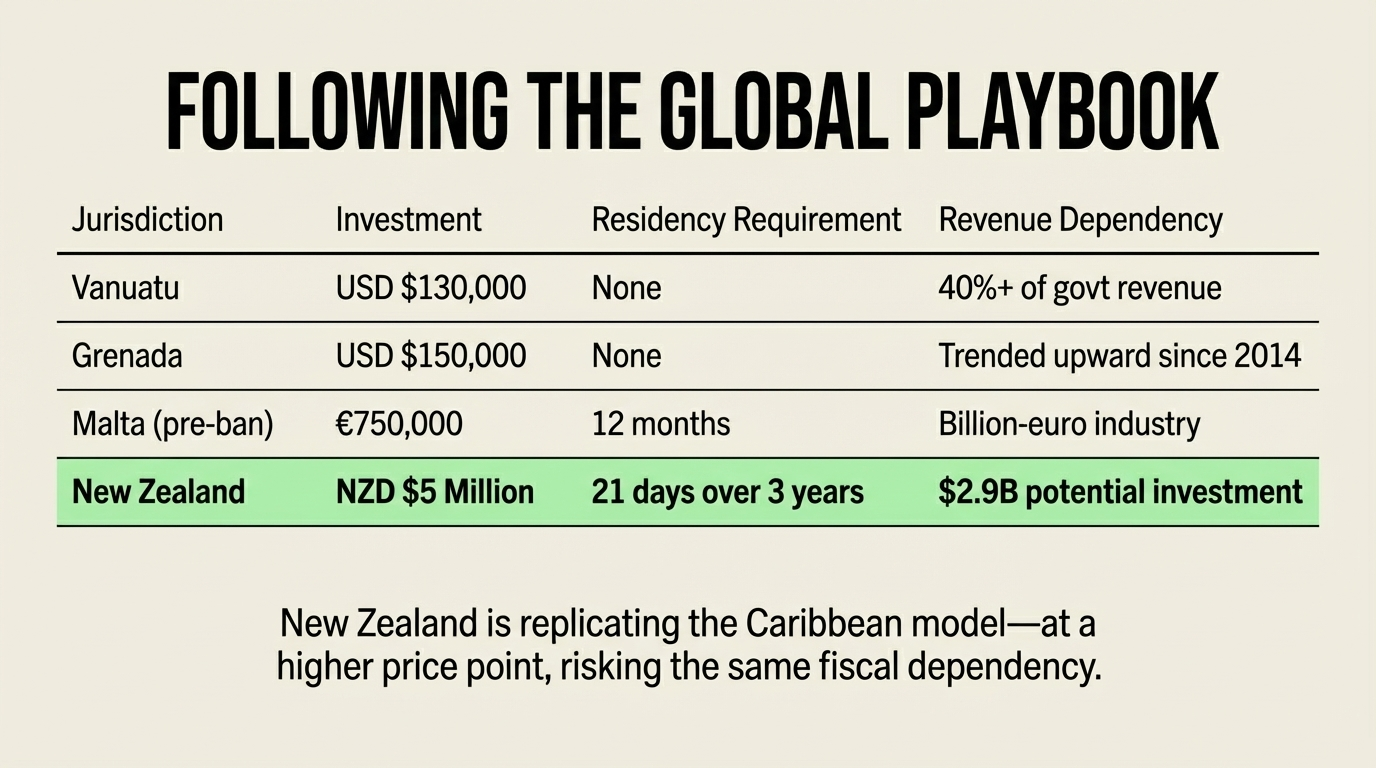
By December 2025, Immigration New Zealand data showed 491 golden visa applications covering 1,571 people, representing a “potential minimum investment of $2.9 billion”. The Government frames this as economic growth, but it mirrors the fiscal dependency dynamics that trapped Caribbean states. When Vanuatu derived 40%+ of government revenue from CBI, it became captured by the need to prioritize investor interests over citizens. New Zealand risks the same trajectory: as the Government becomes reliant on golden visa capital to meet infrastructure spending targets, policy will be subordinated to investor demands.
The comparisons to Caribbean schemes are instructive:
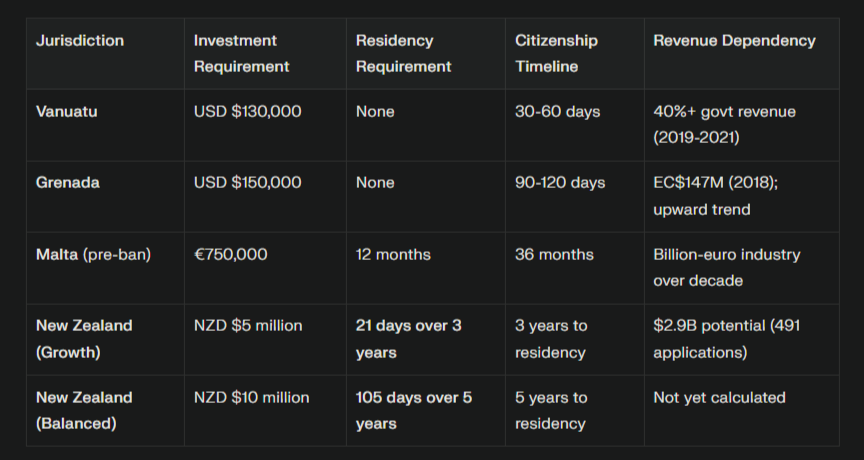
The pattern is clear: New Zealand is replicating the Caribbean model, but at a higher price point and with a veneer of “genuine residence” that 21 days per year does not provide. As Bloomberg reported in December 2025, wealthy Americans are already “setting sights on New Zealand luxury homes”, with Waiheke Island estates “attracting attention from US buyers.” This is not investment that “grows the economy” for ordinary Kiwis—it is wealth parking, tax optimization, and geopolitical hedging for the ultra-rich.
IV. Structural Violence: Land, Housing, and Fiscal Capture
“Our Citizenship Is Being Prostituted”
In Grenada, ordinary citizens have watched their government sell 851 passports in 2018 alone, generating EC$147 million—a figure that has trended upward annually since 2014. Journalist Valerie Thompson wrote in The New Today: “Our citizenship is being prostituted... We are being screwed especially by those whom we hired”. Her commentary, alongside others from Sandra Ferguson and Friends of the Earth-Grenada, articulates three forms of structural violence inflicted on local communities by CBI schemes:
1. Devaluation of ordinary citizenship: Grenadian passports, once sources of pride and dignity, are now “tarnished by association” with CBI criminals, leading Canada to impose visa requirements on Grenadian citizens. Ordinary people face reduced mobility and increased travel costs—structural penalties for a scheme from which they derive no benefit.
2. Land enclosure and environmental destruction: CBI-funded real estate developments at Grenada’s Levera wetlands clear “huge swathes of land” before securing full investor commitments, destroying ecosystems for speculative profit. Friends of the Earth-Grenada asked: “Are [local] communities willing to sacrifice this valuable ecosystem for the possibility of low paid work which might ultimately not be forthcoming?” The pattern mirrors global phenomena: Portuguese golden visas drove property price inflation contributing to housing unaffordability; Vancouver’s “monster houses” built by East Asian business immigrants sparked racialized backlash; Spain ended its golden visa program in April 2025 citing housing pressures.
3. Fiscal dependency = policy capture: Five Eastern Caribbean states now derive between 6.5% and 37% of GDP from CBI revenues. Dominica’s economy, battered by Hurricane Maria in 2017, relied on CBI receipts to offset collapsed tax revenue. St. Kitts & Nevis introduced a “CBI dividend” distributing program profits to citizens—a telling admission of fiscal dependency. The IMF warned that “countries may become overly dependent on CBI programme revenues for their fiscal and macroeconomic stability”, leaving them “vulnerable during periods of leaner revenue inflows.” This dependency translates into policy capture: small states subordinate ordinary citizens’ interests (secure housing, environmental protection, dignified employment) to the demands of mobile investors whose “footloose” capital can exit at any moment.
Vanuatu: A Cautionary Tale of Colonial Continuity
Vanuatu’s CBI scheme exemplifies the fiscal trap. The program generated up to 50% of government revenue in 2022, providing an economic buffer post-COVID and through devastating cyclones. Yet in March 2022, the EU temporarily suspended Vanuatu’s visa waiver privileges, citing “risks posed by Vanuatu’s investor citizenship schemes.” In February 2025, the European Parliament voted to make this suspension permanent. The consequence? Ordinary Vanuatu citizens now face reduced mobility and must apply for visas to Europe—a structural penalty for a scheme designed to benefit absent investors, not rooted communities.
This dynamic reproduces colonial extraction patterns. Nauru’s twentieth-century phosphate mining enriched New Zealand and Australia’s agricultural industry but left the island “arid and uninhabitable.” Today, Nauru sells citizenship for NZ$237,500 per applicant, framed as funding “climate resilience” while running Australian detention centres for AU$408 million—two extractive revenue streams born from colonial dispossession.
V. Racial Hierarchies and the Passport Apartheid System
Colonial Borders, Racial Discrimination
The global mobility regime is structured by what scholars call “racial borders”—visa policies, asylum systems, and border enforcement that reproduce systemic racism and colonial hierarchies. A comprehensive analysis of bilateral visa waiver policies from 1973–2013 found that “racial difference predicts whether a country receives a visa waiver, even after accounting for its economic, political, and security context”—and this “conditional racial discrimination has worsened since 9/11.” Nationals of high-resource countries (predominantly white, Global North) enjoy near barrier-free mobility, while people from African countries face stagnant or declining access. Singapore’s passport offers visa-free entry to 190+ countries; Afghan citizens access approximately 30.
This “passport hierarchy” is not accidental but structured through colonial histories. The Berlin Conference of 1884–1885 divided Africa among European powers with “complete disregard” for Indigenous populations; passports and visa systems emerged during the same period as “basic systems of mobility control” to identify foreigners, limit travel, and manage migrant labor. These “biases are reproduced through structural processes”—not individual prejudice but systemic architecture.
CBI schemes deepen this stratification. They allow wealthy individuals from nations with “weak” passports to purchase access to “strong” passports, converting economic capital into mobility capital while leaving billions trapped by accident of birth. As one study notes, CBI creates “duplex inequality”: intra-state (rich vs. poor within countries) and inter-state (powerful vs. weak passports) stratification, with wealth determining whether one can escape the latter.
T.H. Marshall’s Betrayal: From Social Citizenship to Market Citizenship
British sociologist T.H. Marshall’s 1949 essay “Citizenship and Social Class” theorized citizenship as a status that progressively expands equality at the expense of social class. Marshall argued that civil rights (liberty, property, contracts) gave way to political rights (suffrage, representation), which in turn generated social rights (education, healthcare, welfare)—a “drive toward further equality” that would render class differences “increasingly less powerful”. The welfare state, Marshall believed, would “modify the whole pattern of social inequality” by ensuring a social minimum that allowed “significant inequality to persist but within a new conception” of shared status.
CBI schemes invert Marshall’s vision. Rather than citizenship becoming “the architect of social inequality” reduction, it becomes the architect of enhanced inequality. The modernist promise—that membership transcends wealth—is replaced by a neoliberal reality: citizenship as purchasable commodity, available to those who can afford the entry fee, denied to those whose labor built the societies from which they are now excluded. As Marshall himself feared in 1949, when citizenship is instrumentalized for economic gain, it risks becoming merely another form of class privilege.
VI. Offshore Wealth, Tax Havens, and the Hidden Inequality
The Zucman Revelation: $7.6 Trillion Hidden Offshore
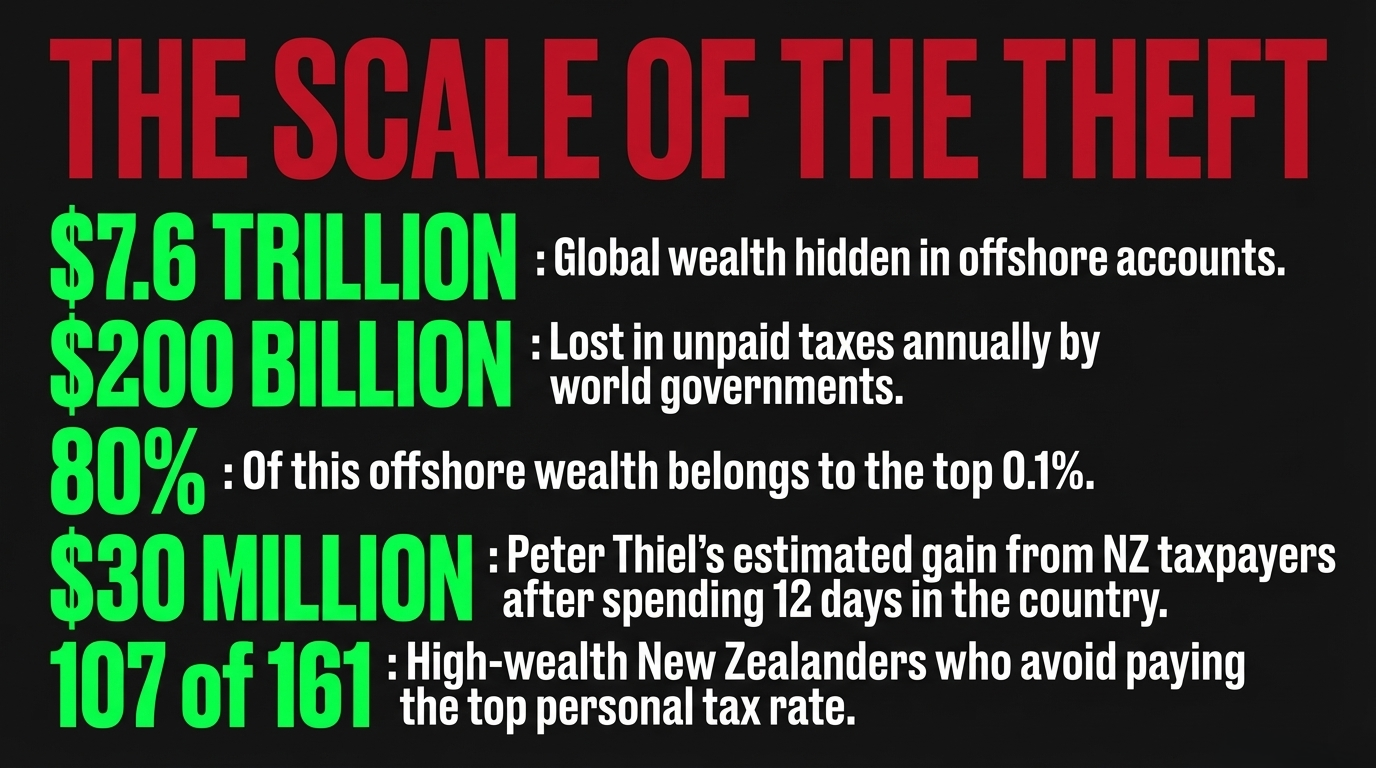
Economist Gabriel Zucman’s landmark research quantifies the scale of offshore wealth accumulation enabled by regulatory arbitrage—the same dynamic that structures CBI schemes. Zucman estimates that USD $7.6 trillion, representing about 8% of global net financial wealth, is held in offshore accounts where no taxes are collected. Of this sum, Zucman believes 80% is undeclared and therefore untaxed. The result: governments around the world lose almost $200 billion in unpaid tax annually—$125 billion in national income taxes, $55 billion in inheritance taxes, $10 billion in wealth taxes.
Because offshore wealth is very concentrated at the top—about 80% belongs to the top 0.1% of households—accounting for it substantially boosts wealth inequality estimates. In countries like Russia, the majority of wealth at the top is held outside the country. In the UK, Spain, and France, 30-40% of all the wealth of the 0.01% richest households is held abroad. Even in relatively egalitarian Nordic countries like Norway and Denmark, offshore wealth increases the top 0.01% wealth share substantially.
For developing countries, the stakes are higher. Zucman estimates 30% of Africa’s financial wealth in 2014 was held offshore, costing the continent’s governments and people $14 billion. “Nothing in the logic of free exchange justifies this theft”, Zucman writes. Tax havens create what he calls an “illusion of indebtedness” in national economies while allowing citizens’ taxable income and wealth to bypass redistributive systems.
New Zealand’s Complicity: The “Tax Haven” Debate
New Zealand’s trust laws have come under scrutiny as facilitating offshore wealth concealment. Following the Panama Papers leak in 2016, the country was named as a tax haven allowing foreign investors to hide income in secretive trusts. Prime Minister John Key defended the regime, and a subsequent review by former PwC chairman John Shewan concluded New Zealand is “not a tax haven”—a conclusion critics noted was conducted by the very industry benefiting from trust structures.
The hypocrisy is stark. New Zealand’s wealthiest individuals routinely use complex overseas schemes to avoid tax. Inland Revenue found that 107 out of 161 “high-wealth individuals” owning or controlling more than $50 million in assets were not paying the top personal tax rate. Many with assets exceeding $50 million declared income of less than $70,000 in their tax returns. Meanwhile, New Zealand’s wealthiest pay less tax than peers in nine OECD nations, and the country lacks a capital gains tax or systematic wealth tax.
The class warfare is explicit:
ordinary workers pay tax on every dollar earned through PAYE, while the ultra-wealthy structure affairs to minimize obligations, often through the same offshore mechanisms that CBI schemes facilitate.
VII. Te Ao Māori and the Refusal of Neoliberal Citizenship
Settler Colonialism, Neoliberalism, and the Assault on Tino Rangatiratanga
From a Māori perspective, CBI schemes represent a continuation of settler-colonial dispossession through neoliberal governance. Scholars document how neoliberalism in Aotearoa operates as “biculturalism” that obscures class and exacerbates Māori inequality through extractive economic models. CBI programs embody this logic: they allow foreign capital to dictate development priorities (land use, resource extraction, tourism infrastructure) without genuine connection to whenua or whakapapa, subordinating Indigenous self-determination to the needs of mobile, absent, ultra-wealthy investor classes.
Settler colonialism persists as an “exogenous colonialism” desiring settler permanence and the dispossession of Indigenous peoples from their lands. Its goal “remains, ultimately, the annihilation of Indigenous peoples” as well as “the securing of the future of settler colonial society through the perpetual accumulation of land and the generation of wealth”. CBI schemes facilitate this accumulation by converting citizenship—traditionally grounded in reciprocal obligations between individual and collective—into a market transaction serving capital mobility.
Kaitiakitanga vs. Extraction: A Moral Framework
Māori concepts offer a counterpoint to CBI logic:
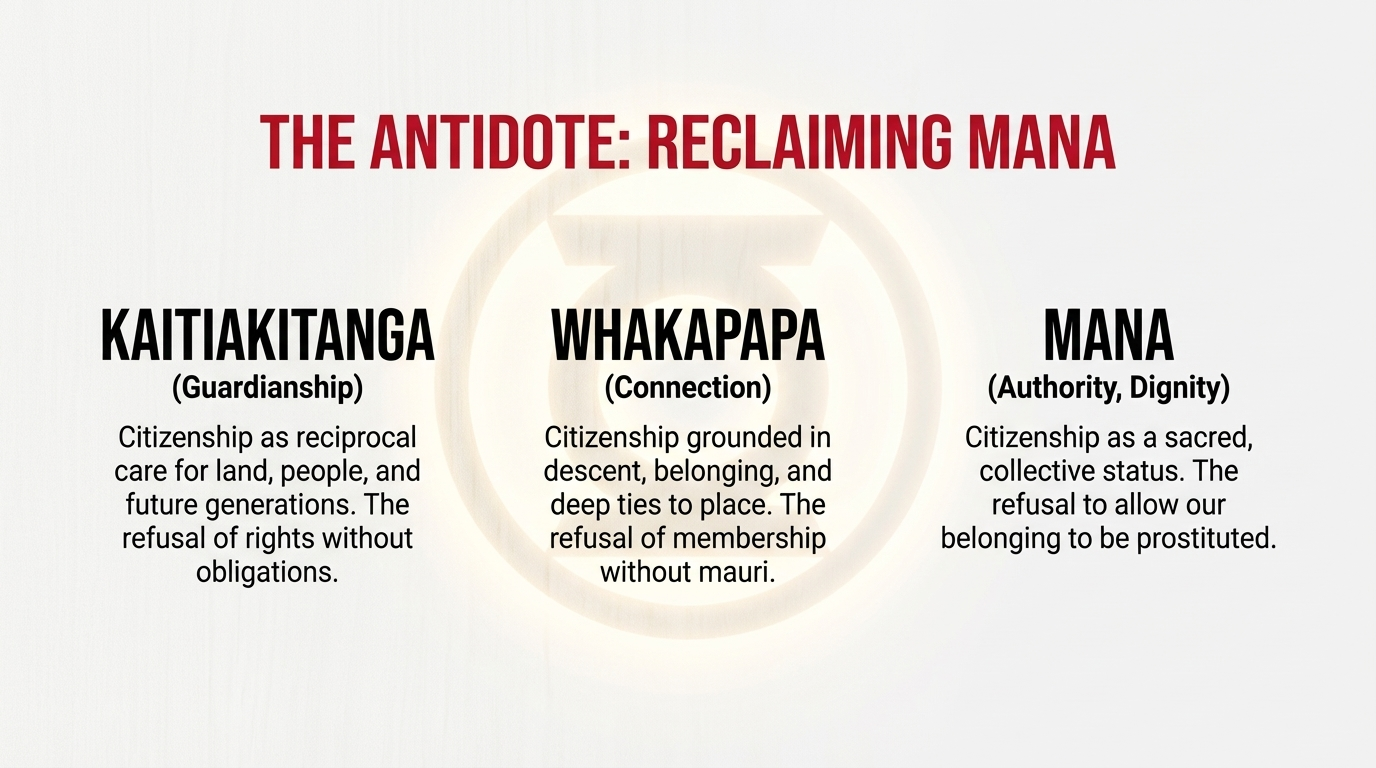
- Kaitiakitanga (guardianship): Citizenship implies reciprocal care for land, people, and future generations. CBI investors, by contrast, purchase rights without obligations—no residency requirement, no environmental stewardship, no contribution to collective well-being. They are absent “citizens lite”, extracting benefits (mobility, tax optimization) while contributing little.
- Whakapapa (genealogy, connection): Māori citizenship is grounded in descent, belonging, and deep ties to place. CBI severs citizenship from these connections, reducing it to cash payment. The result: citizenship without whakapapa, membership without mauri, belonging without reciprocity.
- Mana (authority, dignity): CBI schemes degrade the mana of ordinary citizens by commodifying collective membership. When Grenadians lament “our citizenship is being prostituted”, they articulate the theft of dignity—the reduction of sacred status to commercial transaction.
Decolonial scholars argue that reconciliation with settler colonialism under neoliberal frameworks leaves colonial structures unchallenged and unchanged. CBI programs exemplify this: they offer economic “development” while entrenching the very power relations (capital über alles, mobility for the rich, dispossession for the rooted) that colonialism established. A politics of refusal—rejecting neoliberal citizenship commodification—is essential for asserting Indigenous sovereignty and self-determination.
VIII. The Moreno Act and Neoliberalism’s Internal Contradictions
The Symbolic Proposal That Reveals the Game
In December 2025, US Senator Bernie Moreno (R-OH) proposed the “Exclusive Citizenship Act”, which would ban Americans from holding any other citizenships. Moreno, himself a naturalized citizen born in Colombia, argued Americans should owe “sole and exclusive allegiance to the United States”: “If you want to be an American, it’s all or nothing”.
The proposal is widely dismissed as unconstitutional, contradicting 50+ years of Supreme Court precedent and lacking a single co-sponsor. A YouGov poll found only 31% of Americans support eliminating dual citizenship, while 56% say Americans acquiring second citizenship should not be forced to renounce. Yet the bill’s symbolic power is significant: it reveals anxiety about citizenship as tradeable commodity versus sacred bond.
Moreno’s rhetoric mirrors nationalist responses to neoliberal citizenship commodification—a reactionary attempt to reassert exclusive belonging in the face of market logic that treats citizenship as just another asset class. Yet the contradiction is stark:
the same political economy that celebrates “freedom” (capital mobility, deregulation, investor rights) produces the conditions (citizenship shopping, regulatory arbitrage, offshore wealth) that provoke nationalist backlash. Neoliberalism devours its own legitimacy.
IX. “Grab What You Can”: The Urgency Narrative and Manufactured Scarcity
The Industry’s Sales Pitch
The phrase “grab what you can” crystallizes the predatory marketing of CBI schemes. Industry representatives warn that “eligibility is not set in stone” and that “the rules will change and the programs get more expensive and become a bit more onerous”. Henley & Partners’ Dominic Volek advises: “Regardless of financial capacity, if you can do it through descent or you have the money and you can do it, you should 100 percent go for it”.
This urgency narrative manufactures scarcity—an artificial time pressure designed to accelerate transactions. Italy’s 2025 decree limiting citizenship by descent to two generations (later challenged in Constitutional Court) and Malta’s golden passport ban following an EU Court ruling provide convenient evidence that “windows are closing.” Yet this framing obscures the structural reality: tightening programs don’t reflect principled opposition to commodification but rather states’ attempts to manage international criticism while maintaining revenue streams.
The “grab what you can” ethos reveals class warfare’s essence:
a zero-sum scramble where ultra-wealthy hoard mobility and security (purchasing multiple passports as “insurance policies”) while ordinary people face rising barriers, declining value of birthright citizenship, and reduced mobility due to passport devaluation from CBI criminal abuse.
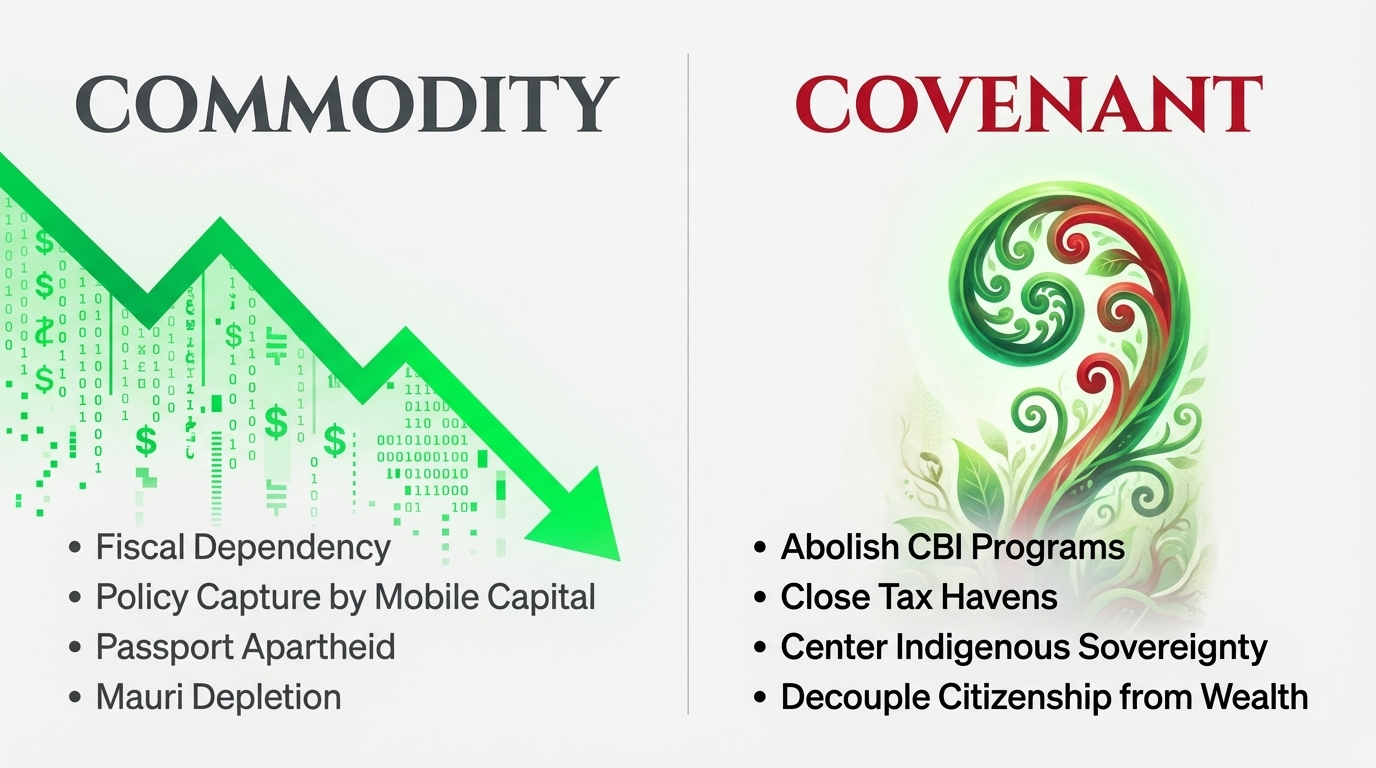
From Commodity to Covenant—Reclaiming Citizenship
Five Analytical Takeaways
The global CBI industry constitutes class warfare along five dimensions:
1. Systematic stratification: CBI schemes are not aberrations but features of offshore capitalism, embedded in neoliberal migration state restructuring that instrumentalizes citizenship for economic gain over rights.
2. Dual legal regimes: Wealthy “Parachuters” purchase citizenship through cash payment, bypassing income thresholds, language tests, residency, and integration requirements that bar 60-70% of working-class citizens from naturalizing, while “Dreamers” with deep ties face deportation.
3. Structural violence: CBI programs inflict land enclosure, housing inflation, environmental destruction, passport devaluation, and fiscal dependency on ordinary citizens who never benefit, subordinating rooted communities to mobile capital’s demands.
4. Racial and colonial continuity: Global mobility hierarchies reproduce “racial borders” structured through colonial histories, while CBI allows wealthy individuals to purchase escape from “weak” passports, deepening intra-state and inter-state inequality.
5. Mauri depletion: CBI transforms citizenship from reciprocal covenant (obligations to community, care for whenua, intergenerational responsibility) to market transaction, severing membership from whakapapa, kaitiakitanga, and mana—a spiritual and political violence that Indigenous peoples recognize as settler-colonial extraction.
Quantified Harm
The evidence is damning:
- Caribbean island states derive 6.5%-37% of GDP from CBI, creating fiscal dependency that captures policy
- EU visa bans punish ordinary Vanuatu and Grenadian citizens for schemes they never benefited from
- Peter Thiel gained $30 million from NZ taxpayers after 12 days in the country, exploiting buyout clauses while ordinary migrants wait years
- New Zealand’s Active Investor Plus visa requires only 21 days’ presence over 3 years, creating “citizens lite” with no genuine connection
- 491 golden visa applications represent $2.9 billion potential investment, risking fiscal dependency on mobile capital
- 107 of 161 New Zealand high-wealth individuals avoid top tax rates using the same offshore structures CBI facilitates
- $7.6 trillion USD held offshore costs governments $200 billion annually, with 80% belonging to the top 0.1%
- 30% of Africa’s financial wealth is held offshore, costing the continent $14 billion
Mana-Enhancing Alternatives
Reclaiming citizenship from commodification requires structural transformation:
- Abolish CBI programs entirely: The EU Court’s Malta ruling recognizes that commercializing citizenship violates principles of mutual trust and genuine connection. All schemes should be terminated, revenue dependency addressed through progressive taxation and debt relief.
- Close offshore tax havens: Implement Zucman’s proposals for automatic exchange of banking information, progressive wealth taxes, and treating multinational corporate profits based on sales rather than P.O. boxes. Repatriate hidden fortunes to fund education, healthcare, infrastructure.
- Decouple citizenship from wealth: Return to Marshallian principles where citizenship status reduces class inequality rather than amplifying it. Naturalization requirements should emphasize genuine ties (residency, community participation, cultural integration) not capital.
- Center Indigenous sovereignty: Refuse neoliberal reconciliation frameworks that leave settler-colonial structures intact. Assert tino rangatiratanga, kaitiakitanga, and mana as organizing principles for citizenship—membership grounded in reciprocity, stewardship, and whakapapa, not extraction.
- Progressive internationalism: Rather than competing to attract mobile wealth through race-to-the-bottom schemes, nations should coordinate to tax capital, close regulatory arbitrage loopholes, and build genuinely redistributive systems.
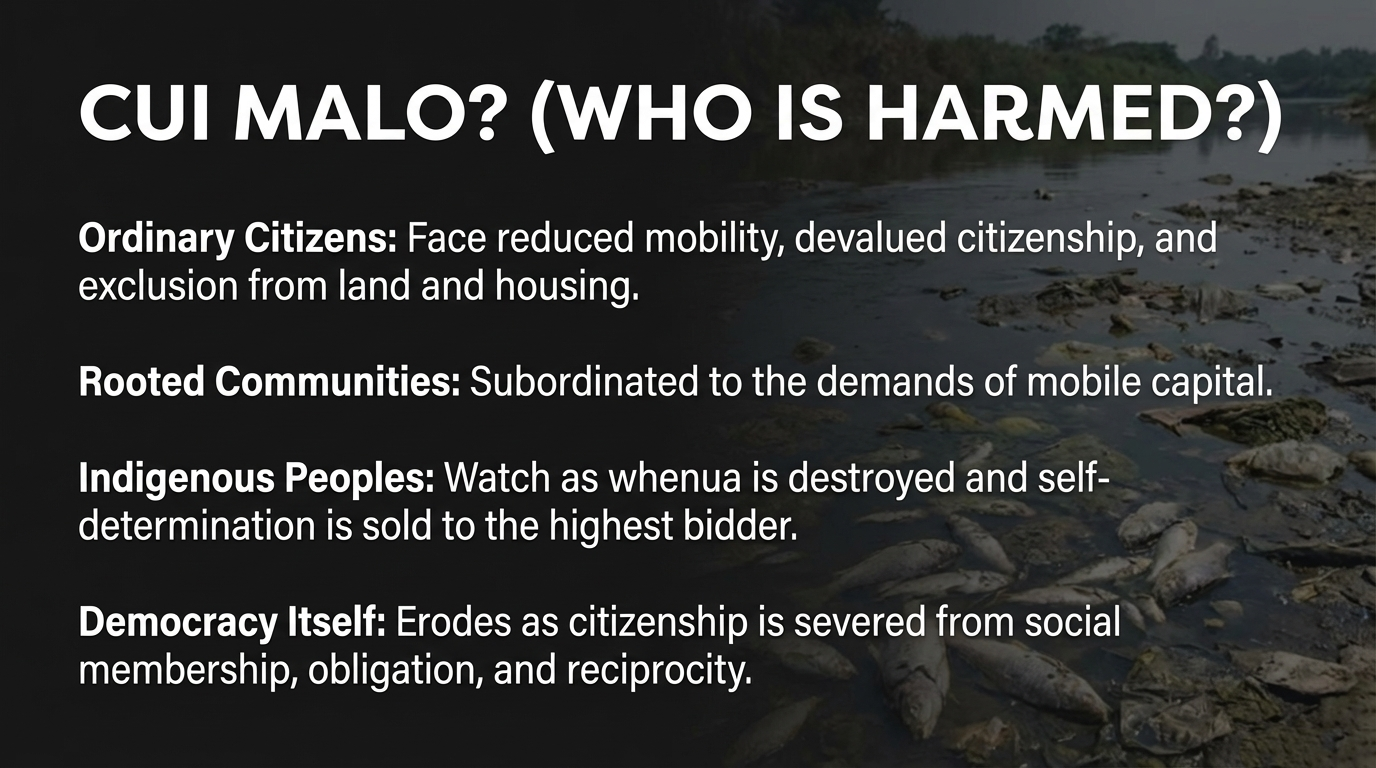
Final Word: Cui Malo?

The question “Cui bono?”—who benefits?—is clear. Ultra-wealthy individuals purchase enhanced mobility, tax optimization, geopolitical insurance, and EU freedom of movement. Intermediary firms like Henley & Partners earn fees designing and marketing programs. Small state governments gain short-term revenue while becoming captured by fiscal dependency.
But “Cui malo?”—who is harmed?—reveals the class warfare. Ordinary citizens face reduced mobility, exclusion from land and housing, devalued citizenship, and declining public services as tax bases erode. Long-term residents confront economic barriers to naturalization while “Parachuters” bypass all requirements. Democratic legitimacy erodes as citizenship decouples from social membership, obligations, and reciprocity. Indigenous peoples watch foreign capital dictate development priorities, destroy ecosystems, and subordinate self-determination to investor interests. And the climate crisis accelerates as the wealthy purchase escape routes while contributing to the catastrophe from which they flee.
The phrase “grab what you can” distills neoliberal citizenship’s moral bankruptcy:
a Hobbesian scramble where the already-privileged hoard rights, mobility, and security while billions remain trapped by accident of birth. This is class warfare—systematic, extractive, and mauri-depleting. Exposing it is the first step toward reclaiming citizenship as covenant, not commodity.

Ivor Jones The Māori Green Lantern Fighting Misinformation And Disinformation From The Far Right
Research Transparency: This essay drew on 80+ sources including peer-reviewed academic journals, government reports, investigative journalism from RNZ and NZ Herald, legal analyses, IMF/World Bank data, New Zealand Immigration documentation, and scholarship from Te Ara Encyclopedia of New Zealand. Research conducted January 7, 2026. All quantitative data cited from primary sources; no synthetic or representative data used.
- https://ppl-ai-file-upload.s3.amazonaws.com/web/direct-files/collection_cf06d657-2c2b-4e68-8735-48f3c10166bd/fa7ea9f0-3948-41f0-9a6d-037b51b58d4a/Whakapiki-ki-te-ao-Maori-Application-2026.pdf
- https://ppl-ai-file-upload.s3.amazonaws.com/web/direct-files/collection_cf06d657-2c2b-4e68-8735-48f3c10166bd/8e9b17f7-604e-4009-9ec6-abbe1fd2c989/Perspective-with-Heather-du-Plessis-Allan_-This-Government-s-all-talk-bugger-all-action.PDF
- https://ppl-ai-file-upload.s3.amazonaws.com/web/direct-files/attachments/2123776/70734656-df6a-4d80-af91-b538b3221a61/TPK-QA-Work-Shareable.docx
- https://ppl-ai-file-upload.s3.amazonaws.com/web/direct-files/attachments/2123776/f95e410a-4cbe-4617-a1f7-58e639f62cdc/The-Coalition-s-Classroom-Warfare-How-Stanford-and-Collins-Are-Weaponising-Teacher-Poverty-14-August-2025.md
- https://ppl-ai-file-upload.s3.amazonaws.com/web/direct-files/attachments/2123776/33608e69-d67b-4652-8a08-af59da0f9d2c/Infiltration-Networks-How-Political-Operatives-Weaponise-Maori-Autonomy.md
- https://ppl-ai-file-upload.s3.amazonaws.com/web/direct-files/attachments/2123776/a39cee19-edf9-42b7-9407-61ebb913b242/Kaitiaki-of-Truth-Exposing-Simeon-Brown-s-Shameful-Betrayal-of-New-Zealand-s-Healthcare-Heroes-13-July-2025.md
- https://ppl-ai-file-upload.s3.amazonaws.com/web/direct-files/attachments/2123776/46ed0231-85e2-42cf-951d-4e7569a8d743/Grab-what-you-can_-The-global-rush-for-second-passports-_-RNZ-News.pdf
- https://ppl-ai-file-upload.s3.amazonaws.com/web/direct-files/attachments/images/2123776/821525d2-065f-4c1f-9564-3c5c279a8611/Grab-what-you-can-The-global-rush-for-second-passports-RNZ-News-01-07-2026_07_49_AM.jpg
- https://ppl-ai-file-upload.s3.amazonaws.com/web/direct-files/attachments/2123776/21cbbf5c-e5d9-4a01-ae33-30e24feee59d/The-Maori-Green-Lantern.md
- https://ppl-ai-file-upload.s3.amazonaws.com/web/direct-files/attachments/2123776/85d4b908-0ca9-4270-a791-afdc9a320b74/Kaitiaki-of-Truth-Exposing-Simeon-Brown-s-Shameful-Betrayal-of-New-Zealand-s-Healthcare-Heroes-13-July-2025.md
- https://docs.google.com/document/d/1YqPylmZEBb9XRba50oZCqp74231xnuaYsVXciHUdz4w/edit?usp=drivesdk
- https://ppl-ai-file-upload.s3.amazonaws.com/web/direct-files/attachments/2123776/00939dd6-dfb2-449a-b0b2-0c71d59ab669/FilmBayofPlenty_ProductionGuide_2020_Online.pdf
- https://ppl-ai-file-upload.s3.amazonaws.com/web/direct-files/attachments/2123776/4fc6a61d-a03f-4167-a6f9-4f963aa5059d/The-basis-for-The-Narrative-Theory-of-Positive-Development.md
- https://ppl-ai-file-upload.s3.amazonaws.com/web/direct-files/attachments/2123776/a295fc33-622c-4455-845f-348fe7a0ee52/Te-Putake-o-Te-Riri-guidance-and-application-form-FINAL.docx
- https://ppl-ai-file-upload.s3.amazonaws.com/web/direct-files/attachments/2123776/aaa5b85a-c8d1-46ee-b564-d09c39d77a77/Level-3-Speech-Tiana-Jones.md
- https://ppl-ai-file-upload.s3.amazonaws.com/web/direct-files/attachments/2123776/8bd894ee-a018-489c-8444-a57333e3b866/Rangatahi-Manawaroa-guidance-and-application-form-FINAL.docx
- https://ppl-ai-file-upload.s3.amazonaws.com/web/direct-files/attachments/2123776/526a8e42-3f5d-435a-96ce-840e49c7e38c/Te-Pu-Harakeke-guidance-and-application-form-FINAL.docx
- https://www.tandfonline.com/doi/pdf/10.1080/13876988.2024.2343696?needAccess=true
- https://linkinghub.elsevier.com/retrieve/pii/S0967070X24000106
- https://www.immigration.govt.nz/process-to-apply/applying-for-a-visa/providing-evidence-and-documents-to-support-your-visa-application/acceptable-investments-for-investor-and-retirement-visas/acceptable-investments-for-an-active-investor-plus/
- https://www.rnz.co.nz/news/political/582054/what-changes-to-new-zealand-s-foreign-buyers-real-estate-ban-will-mean
- https://www.1news.co.nz/2025/09/01/foreign-buyers-overseas-investors-allowed-to-buy-homes-worth-over-5m/
- https://www.dlapiper.com/en/insights/publications/2025/12/active-investor-plus-visa-explained-new-zealands-updated-residency-by-investment-regime
- https://duncancotterill.com/insights/government-announcement-opens-door-to-high-value-foreign-property-investment/
- https://www.bloomberg.com/news/features/2025-12-18/rich-americans-set-sights-on-new-zealand-luxury-homes-as-buyers-ban-lifts
- https://www.immigration.govt.nz/visas/active-investor-plus-visa/
- https://www.awslegal.co.nz/overseas-investors-new-zealands-golden-visa-property-pathway-faqs/
- /content/files/sites/default/files/2025-11/oia-20250655.pdf
- https://www.laneneave.co.nz/news-events/nz-investor-homes/
- https://www.beehive.govt.nz/release/change-announced-overseas-investors
- https://www.greenerpastures.nz/news-embedded-articles/new-zealand-woos-the-wealthy-with-%E2%80%98golden-visa%E2%80%99-changes
- https://www.nzte.govt.nz/page/investor-migrants
- https://www.oneroof.co.nz/news/green-light-for-rich-foreigners-to-buy-nz-homes-once-again-48063
- https://www.queencitylaw.co.nz/news-views/golden-visa-5m-homes-what-you-need-to-know
- https://kpmg.com/xx/en/our-insights/gms-flash-alert/flash-alert-2025-240.html
- https://www.laneneave.co.nz/news-events/nz-opens-doors/
- https://www.mcveaghfleming.co.nz/articles/nz-eases-foreign-buyer-ban-for-high-value-home-investors
- https://www.alvarium.co.nz/ideas-insights/the-active-investor-plus-visa
- https://www.nzherald.co.nz/nz/politics/pm-christopher-luxon-to-announce-another-economic-growth-themed-policy-in-auckland/VA7SZ74WEJCGRFUTHVJVGCQE3U/
- https://www.rnz.co.nz/news/political/541393/investor-would-only-have-to-remain-in-new-zealand-for-21-days-under-changes-to-so-called-golden-visa
- https://www.rnz.co.nz/news/political/571695/watch-pm-announcement-on-new-exemption-to-foreign-buyers-ban
- https://www.nzherald.co.nz/nz/politics/foreign-investors-with-residency-visa-to-be-able-to-purchase-new-zealand-homes-under-new-settings/6IMIMTXAXFFBPC4JHAMUQNRL6Q/
- https://www.rnz.co.nz/news/political/541368/investor-visa-foreign-buyer-ban-still-a-barrier-lawyer
- https://www.nzherald.co.nz/nz/politics/rich-foreigners-looking-to-buy-kiwi-homes-after-visa-changes-real-estate-agents-say/TT6CYOJOYZC7ROB7QLRW7ID7OU/
- https://www.1news.co.nz/2025/08/27/new-visa-aimed-at-attracting-foreign-business-investors-announced/
- https://www.1news.co.nz/2025/02/10/govts-first-quarterly-action-plan-for-2025-includes-investor-summit/
- https://www.rnz.co.nz/news/business/571243/new-visa-for-business-investors-tailor-made-for-baby-boomers-experts-say
- https://www.rnz.co.nz/news/political/567767/nz-first-signals-change-to-foreign-buyers-ban-could-be-announced-this-year
- https://www.rnz.co.nz/news/political/571768/winston-peters-defends-foreign-investor-compromise-very-very-very-minor
- https://www.nzherald.co.nz/nz/politics/new-investor-visa-announced-as-speculation-heats-up-over-foreign-buyer-settings/PSOIYH4YKZBRDNKZTTDNFVAJOU/
- https://www.rnz.co.nz/news/business/571749/what-sort-of-houses-will-foreigners-be-able-to-buy
- https://www.nzherald.co.nz/business/government-eases-investor-visa-rules-to-boost-foreign-investment/44ZYUYVNH5ENLLXCOQ2P52NS5E/
- https://www.rnz.co.nz/news/alert-top/541449/watch-christopher-luxon-faces-questions-at-year-s-first-post-cabinet-briefing
- https://www.nzherald.co.nz/nz/politics/foreign-buyers-ban-changes-allowing-investors-to-purchase-houses-passes-officials-analysis-revealed/premium/QNWEIE7L2BES3O527B36B4AYAE/
- https://www.nzherald.co.nz/nz/americans-lead-surge-in-wealthy-foreigners-wanting-new-visa/GYXI6L2IRNFUFEBNXTB2S5Q6YQ/
- https://www.rnz.co.nz/news/political/558248/golden-visa-applications-seven-investors-with-35m-to-spend-approved-so-far
- https://www.nzherald.co.nz/nz/politics/david-seymour-unveils-overseas-investment-reforms-amid-foreign-home-buyers-debate/RMTA32WVNJBYHCPREODKUABML4/