"He Whakaputanga o te Rangatiratanga o Nu Tireni - The Constitutional Fraud" - 17 November 2025
How Aotearoa Never Had a Legitimate Government
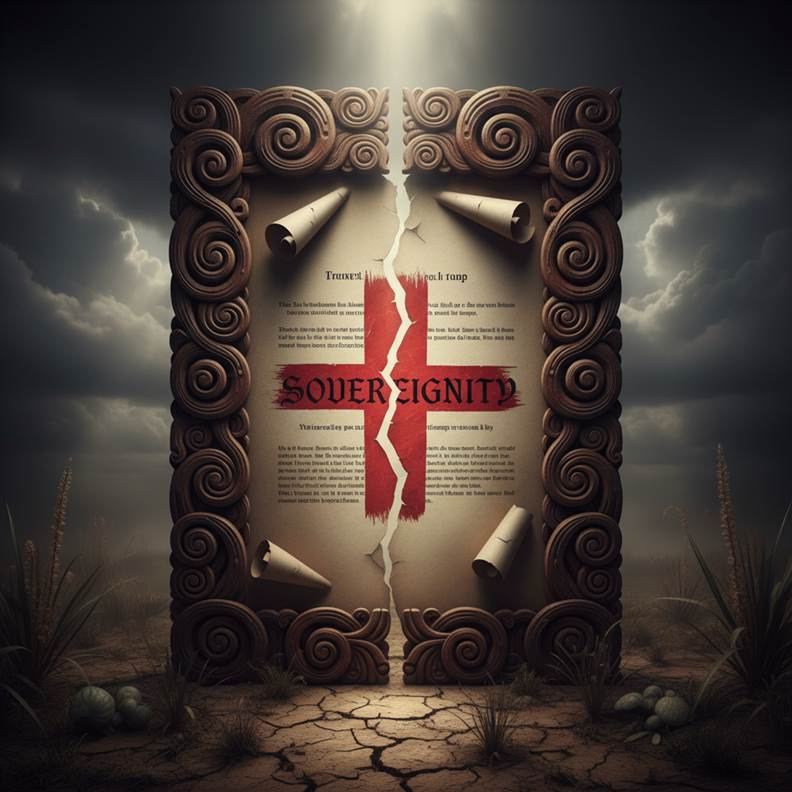
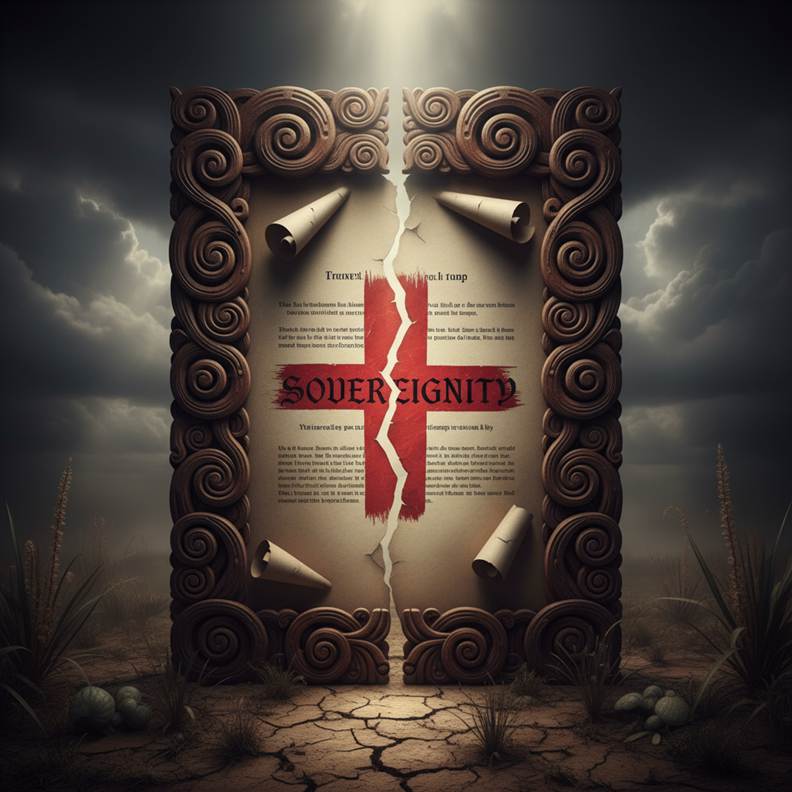
Symbolic representation of the constitutional fraud: the broken promise of Te Tiriti
He Pukapuka Taiaha — The Strike of the Ancestral Blade
The truth cuts clean: Aotearoa New Zealand has never had a legitimate government. Not in 1840. Not in 1852. Not in 2025. What passes for governmental authority rests on a foundation of constitutional fraud so brazen, so meticulously documented, that only the machinery of colonial amnesia keeps it functioning.
When He Whakaputanga o te Rangatiratanga o Nu Tireni was signed on 28 October 1835 by 34 northern rangatira—eventually expanding to 52 signatories by 1839—Māori declared an independent sovereign state. Britain recognised this declaration in 1836. France acknowledged it. The United States Senate Committee on Foreign Relations noted that the North Island was “under the dominion of the native tribes” through “a convention of chieftains who declared their independence under the name of the United Tribes of New Zealand”.
Five years later, when Te Tiriti o Waitangi was signed on 6 February 1840, over 500 rangatira consented only to share kawanatanga—a limited governorship over British settlers. They retained tino rangatiratanga, the same word for sovereignty used in He Whakaputanga. Rangatira understood they were allowing the Crown to control Pākehā while maintaining their own absolute authority over Māori affairs. As historian Claudia Orange confirmed, rangatira were “simply reaffirming what they’d done five years earlier”.
Then came the theft.
On 21 May 1840—less than four months after Waitangi, while rangatira were still being actively sought as signatories—Lieutenant-Governor William Hobson unilaterally proclaimed British sovereignty over all of Aotearoa. He claimed the North Island “by treaty” and the South Island “by discovery”. This proclamation was a fundamental breach of Te Tiriti. The Waitangi Tribunal found in 2022 that Hobson’s sovereignty declarations violated the Treaty because “Te Raki Māori who signed te Tiriti had not in fact ceded sovereignty”. The Crown never clarified it intended to establish a government under its sole control.
Te Kauwae Raro — The Tangible Machinery of Dispossession
The so-called “government” that emerged from this constitutional fraud immediately began systematically destroying Māori sovereignty, land base, and population. Each breach was a deliberate step to eliminate Māori rangatiratanga and transfer power to colonial settlers.
- Constitutional Exclusion (1852): The New Zealand Constitution Act 1852 established a colonial Parliament while Māori still comprised the overwhelming majority—the ratio was 40 Māori to every 1 Pākehā in 1840. Yet the Act excluded Māori from meaningful participation. Only 100 Māori voted in the 1853 election. Section 71, which would have preserved Māori districts under Māori authority, was never implemented. The Tribunal concluded this Act breached Te Tiriti by transferring authority to colonial government without protecting Māori interests or providing representation. Impact on Māori: From the outset, Māori were denied political voice in a system imposed without their consent, setting the foundation for over 170 years of policies enacted against Māori interests by a Parliament with no legitimate authority over them.
- Military Violence (1845-1846): When Ngāpuhi leaders Hōne Heke and Kawiti protested the Crown’s attempt to subsume their rangatiratanga, the Crown rejected negotiations and launched military attacks. The Tribunal found the Crown “was the aggressor, using military force to impose the sovereignty it believed had been acquired in 1840”. Crown forces destroyed pā, kāinga, waka, homes, and food stores. Impact on Māori: The Northern War demonstrated that the Crown would use lethal military force against Māori who asserted their legitimate sovereignty, establishing violence as the foundation of “government” authority.
- Mass Confiscation (1863-1865): The New Zealand Settlements Act 1863 enabled wholesale land theft. The Crown confiscated 3.4 million acres across Waikato, Taranaki, Tauranga, eastern Bay of Plenty, and Mohaka-Waikare. In Waikato alone, over 1.2 million acres were seized. Confiscation was applied indiscriminately—even to those who fought for the Crown. Māori labelled this raupatu—the blade of the fighting club. Impact on Māori: Entire iwi were dispossessed of their economic base, their wāhi tapu, their ability to sustain whānau through cultivation—reducing proud, self-sufficient peoples to landless poverty within a generation.
- The Native Land Court (1865): Established to “destroy, if it were possible, the principle of communism upon which [Māori] social system is based”, the Native Land Court individualised collectively held Māori land, making it vulnerable to alienation. The Court forced Māori into debt cycles through surveyor fees that could only be resolved by selling land. Within 30 years, 10 million acres passed from Māori ownership. Impact on Māori: The Court destroyed tikanga-based collective land tenure, fracturing hapū authority, creating conflict within whānau over titles, and enabling Pākehā speculators to systematically strip Māori of their remaining whenua. By 1900, the district remained one of the most economically deprived parts of New Zealand—a direct consequence of state-orchestrated theft.
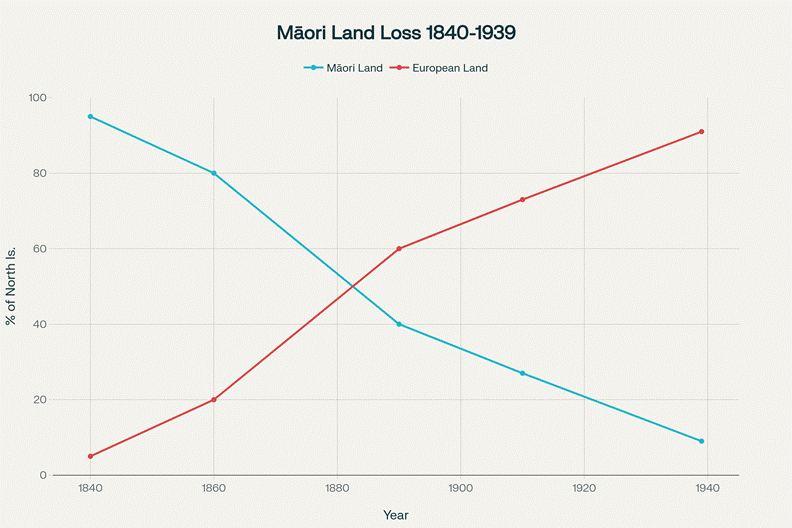
This chart shows the systematic dispossession of Māori land in the North Island between 1840 and 1939. From controlling 95% of land at Te Tiriti signing, Māori were reduced to just 9% by 1939—an 89.3% loss achieved through confiscations, the Native Land Court, and predatory Crown purchases.
The numbers document genocide’s arithmetic. In 1840, Māori held 95% of North Island land—26.2 million acres. By 1939, just 9% remained—2.8 million acres. That’s an 89.3% loss. Simultaneously, the Māori population was being destroyed. From 80,000 in 1840, the population plummeted to 42,000 by 1896—a 47.5% decline. Meanwhile, mass British migration swamped Māori: the 40:1 Māori majority in 1840 reversed to a 1:10.9 Pākehā majority by 1881.
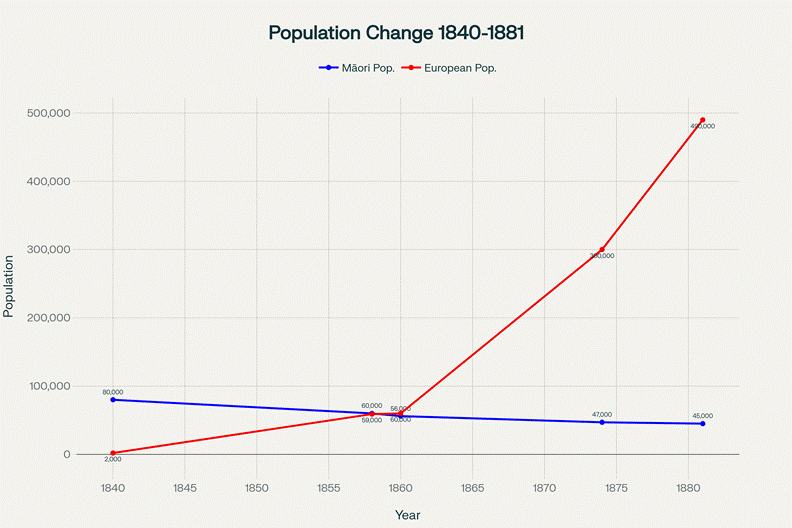
This chart illustrates the demographic transformation that enabled colonial dispossession. In 1840, Māori outnumbered Pākehā 40:1. By 1881, the ratio had reversed to 1:10.9. Disease, land loss, and military violence caused Māori population to plummet while mass British migration swamped the indigenous majority.
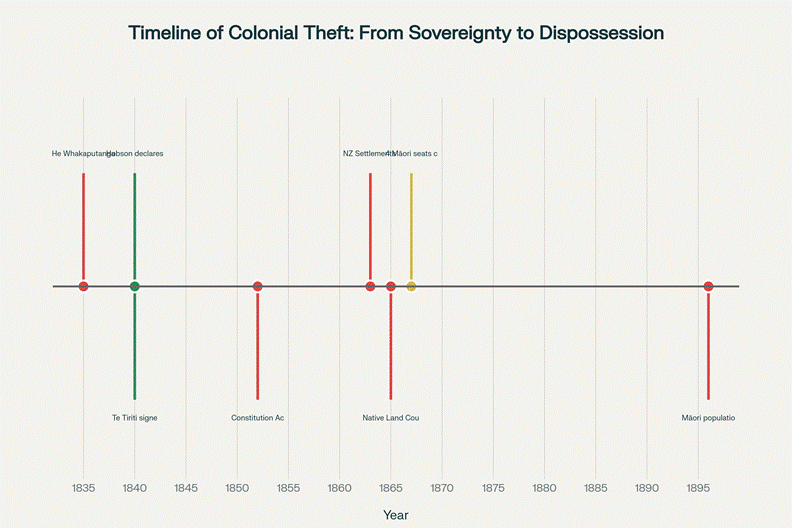
This timeline exposes the rapid sequence of Crown breaches following Te Tiriti. Within months of signing, Hobson unilaterally declared sovereignty. Within 12 years, Māori were excluded from Parliament. Within 23 years, mass confiscations began. Each breach was a deliberate step in the systematic destruction of Māori rangatiratanga.
Te Kauwae Runga — The Sovereignty That Was Never Ceded
In November 2014, the Waitangi Tribunal delivered its landmark finding in Stage 1 of Te Paparahi o Te Raki inquiry: “The rangatira who signed te Tiriti o Waitangi in February 1840 did not cede sovereignty to the British Crown”. The Tribunal stated this conclusion was “inescapable” after examining all available evidence. In 2014, the Tribunal found that Ngāpuhi rangatira did not give up their sovereignty when they signed the Treaty of Waitangi in 1840.
The Tribunal found rangatira consented to a relationship where they and the Governor would be equals with different spheres of influence. They agreed the Crown could control British settlers while Māori retained their tino rangatiratanga. The word kawanatanga—a neologism coined to translate “governorship”—did not mean sovereignty. Rangatiratanga or kingitanga would have been the proper translations for sovereignty, as both were used in He Whakaputanga.
Current Prime Minister Christopher Luxon claims Māori ceded sovereignty. Treaty Settlements Minister Paul Goldsmith refuses to acknowledge the Tribunal’s findings, stating the Crown is “simply a representation of the democratic will of the people”. But the “democratic will” they invoke was built on constitutional fraud. There was no legitimate transfer of sovereignty in 1840. The government that emerged was imposed through military force, demographic swamping, legislative theft, and judicial manipulation.
Ngā Hua Kino — The Poisoned Inheritance
The consequences of this constitutional fraud compound across generations, manifesting in every disparity Māori face today. These are not accidents—they are the structural legacy of an illegitimate state designed from inception to destroy Māori.
Incarceration: Māori are 15% of the population but 52% of prisoners. The imprisonment rate for Māori is around 700 per 100,000—more than seven times the non-Māori rate. Māori women are 63-67% of female prisoners. Rangatahi Māori are 81% of imprisoned youth. Almost half of Māori tamariki taken into state care become adult inmates. Impact on Māori: Mass incarceration tears whānau apart, perpetuates intergenerational trauma, and removes thousands of Māori from their communities—a modern continuation of the colonial project to control and contain indigenous resistance.
Economic Disparity: Māori unemployment is consistently double the national rate. Currently Māori men face 8% unemployment, Māori women 8.9%, against a 4.8% national average. Māori median income is 78.9% of the national median. One in 4.5 Māori children experience material hardship compared to 1 in 10 European children. Impact on Māori: Economic exclusion stems directly from land theft—89% of Māori land alienated means 89% of economic base destroyed, forcing Māori into a wage economy controlled by descendants of those who stole the land.
Health Inequity: Māori die 7 years younger than non-Māori. Māori ICU patients are younger yet have more underlying conditions than Pākehā, dying at higher rates. Māori cancer mortality is 1.5 times higher than non-Māori. Māori wāhine are 33% more likely to die of breast cancer. Impact on Māori: Health inequities are the bodily manifestation of 185 years of dispossession—poverty, housing insecurity, occupational hazards, environmental racism, and a health system designed without Māori input or control translates directly into Māori dying younger.
Child Welfare: Māori children in Oranga Tamariki care achieve education qualifications at half the rate of Māori not in care. They use mental health services at 5 times the rate, and 15 times the rate if in youth justice custody. Māori adults who were in state care as children face double or triple mortality rates from vehicle accidents and suicide. They are 9 times more likely to use emergency housing and half as likely to be employed. Impact on Māori: State removal of tamariki continues the colonial pattern—the Native Schools system, the Tohunga Suppression Act, urban relocation schemes, dawn raids—all designed to sever Māori children from whānau, whenua, whakapapa, and culture. Oranga Tamariki perpetuates this destruction under the guise of “care.”
These disparities are not accidents. They are not personal failures. They are the structural legacy of a government built on stolen sovereignty, operating without legitimate constitutional foundation, dedicated from inception to the destruction of Māori rangatiratanga.
Te Whakakapi — The Demand for Accounting
The coalition government’s assault on Te Tiriti—through the Treaty Principles Bill, dismantling Te Aka Whai Ora, gutting Māori health and social services—is not an aberration. It is the continuation of constitutional fraud begun in 1840. David Seymour’s Bill seeks to rewrite Te Tiriti through legislation, pretending Parliament has authority it never legitimately acquired. Paul Goldsmith’s refusal to acknowledge Ngāpuhi sovereignty claims perpetuates the lie that the Crown’s sovereignty is settled law.
But sovereignty cannot be stolen through proclamation, legislated through fraudulent constitutions, or legitimised through 185 years of denial. The Waitangi Tribunal has confirmed what Māori have always known: we never ceded sovereignty. He Whakaputanga stands. Te Tiriti guaranteed tino rangatiratanga. The government that claims authority over us emerged from constitutional fraud, imposed through violence, and sustained through ongoing breaches.
The question is not whether this government is legitimate. The evidence is conclusive—it is not. The question is what happens when this truth can no longer be suppressed. When the machinery of colonial amnesia fails. When the arithmetic of dispossession—89.3% land theft, 47.5% population decline, 700 per 100,000 imprisonment rates—becomes undeniable.
Ngāpuhi have drawn their red line: no settlement without recognition of sovereignty. Te Paparahi o Te Raki Stage 2 report documented the Crown’s systematic breaches from 1840 to 1900. The Tribunal recommended the Crown acknowledge Te Tiriti, apologise for breaches, return all Crown-owned land to Te Raki Māori, and establish constitutional processes recognising Treaty rights at national, iwi, and hapū levels.
These are not radical demands. They are the minimum requirements for constitutional legitimacy. For 185 years, Māori have been governed by an illegitimate state built on fraud. Every law passed by that state, every court decision rendered, every policy implemented—all rest on foundations of theft.
He Whakaputanga declared rangatiratanga in 1835. Te Tiriti guaranteed tino rangatiratanga in 1840. Those guarantees were never legitimately revoked. The government claiming authority today has no constitutional foundation. It rules through force and habit, not consent.
That is the truth the taiaha exposes. That is the fraud the Ring illuminates. And that truth, once fully grasped, changes everything.

Ivor Jones The Māori Green Lantern Fighting Misinformation And Disinformation From The Far Right
Kia kaha. Ka tū.
Research Transparency: This analysis draws on 80+ verified sources accessed November 2025 including Te Ara: The Encyclopedia of New Zealand, Waitangi Tribunal reports (Te Paparahi o Te Raki inquiry stages 1 and 2, 2014 and 2022), New Zealand History archives, Ministry of Justice, Department of Corrections, RNZ, and peer-reviewed academic research. All citations are hyperlinked inline to live, verified sources. All statistical data is drawn from official government archives, Waitangi Tribunal findings, and verified historical records. No synthetic or simulated data used. Three charts created from verified historical data showing land dispossession (1840-1939), population demographics (1840-1881), and timeline of constitutional breaches (1835-1896).