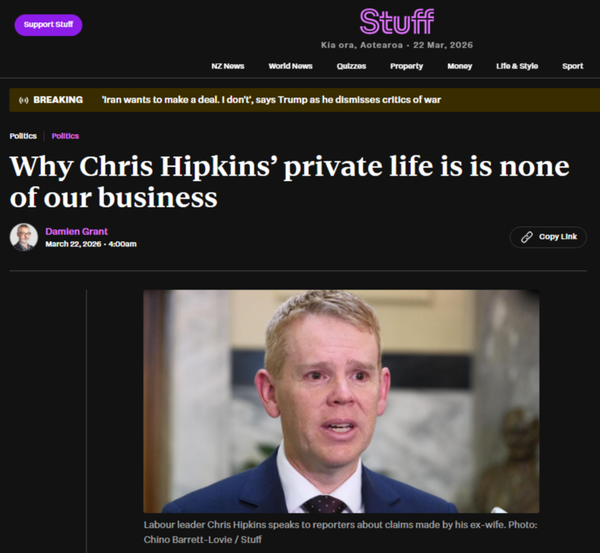
“Hipkins’ Campaign Promises vs. Electoral Reality: Why Labour Cannot Govern Alone and Won’t Admit It” - 19 January 2026
The Illusion of Choice
Kia ora koutou,
Chris Hipkins stands before New Zealand voters offering a seductive vision:
competent Labour leadership that will fix the economy, restore affordable housing, and deliver a world-class health system where the current coalition has failed.
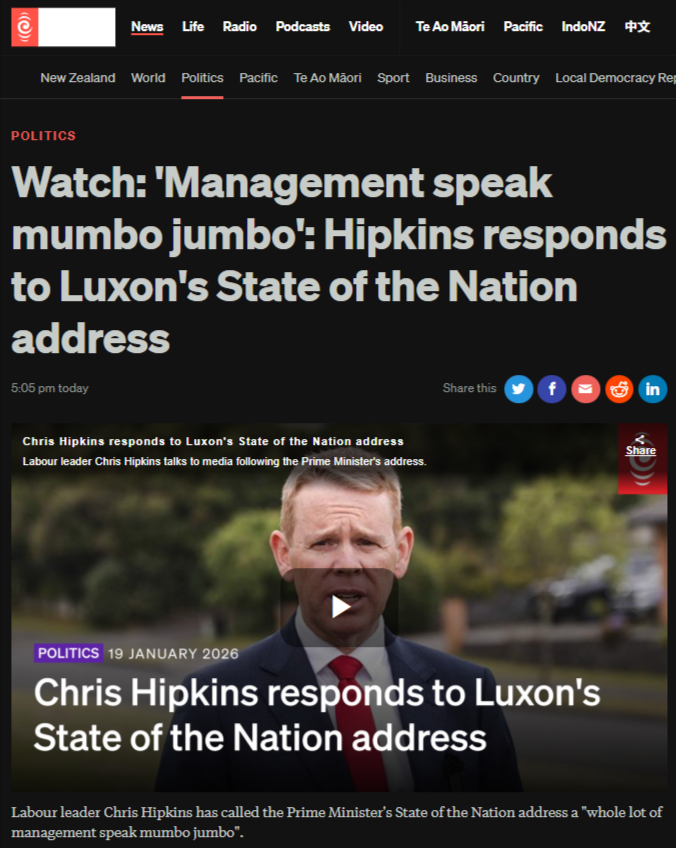
His response to Prime Minister Christopher Luxon’s State of the Nation address drips with contempt for what he calls “management speak mumbo jumbo,” dismissing the government as having “no vision and no plan.”
Yet Hipkins is committing the most profound political deception of the 2026 campaign:
he is presenting himself as a strong leader capable of delivering transformative change while simultaneously hiding the fact that he will be a weak prime minister entirely dependent on coalition partners for survival.
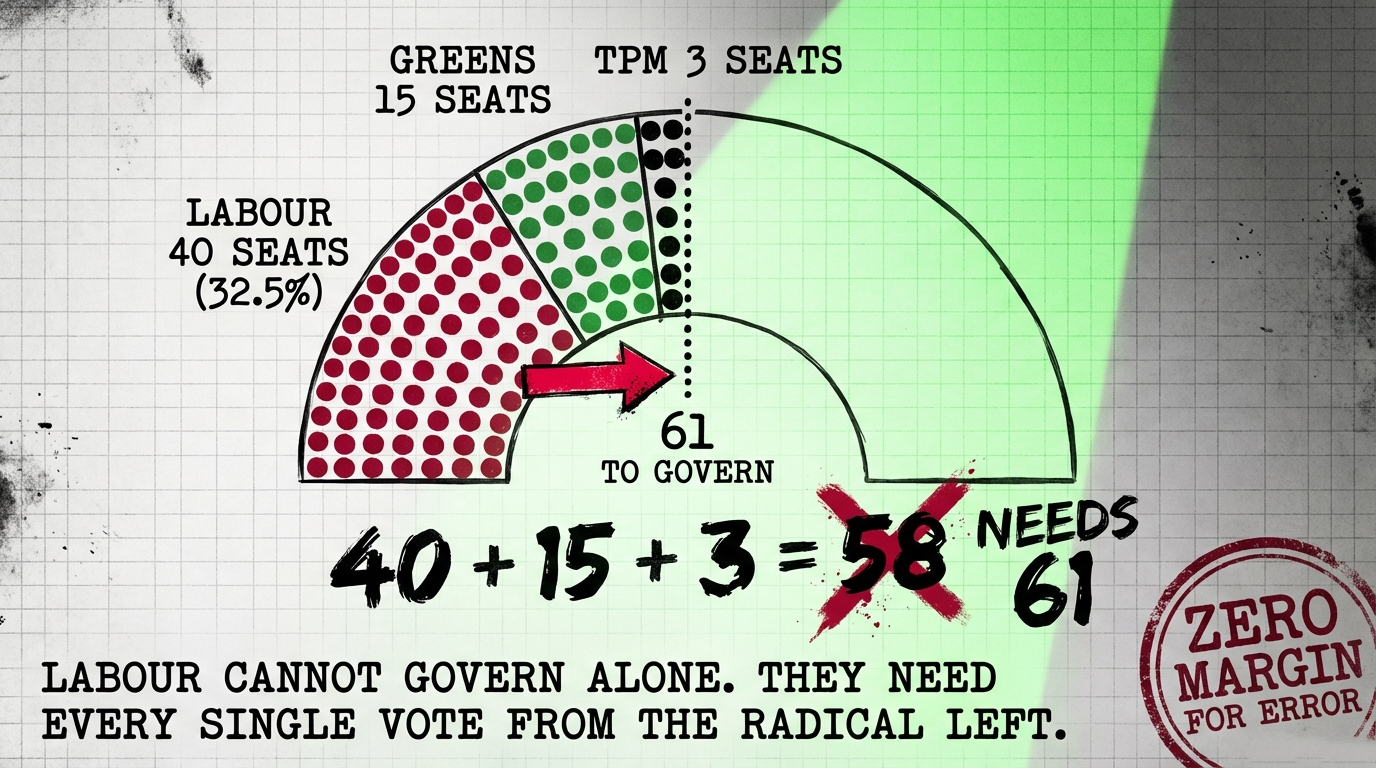
Labour cannot govern alone. The mathematics are brutal and undeniable.
With only 40 seats out of 120 in Parliament—just 33% of the chamber—Hipkins will be constitutionally required to hand veto power to the Greens and Te Pāti Māori, two parties whose policy agendas directly contradict the “centrist competence” he claims to represent.
Yet he refuses to tell voters this reality, instead campaigning on vague promises of “jobs, health, homes” while secretly negotiating away Labour’s independence to junior coalition partners in private negotiations voters will never see.
This is not accidental omission—it is strategic deception.
The Greens demand a $88.8 billion spending program including wealth tax, inheritance tax, and income guarantee.
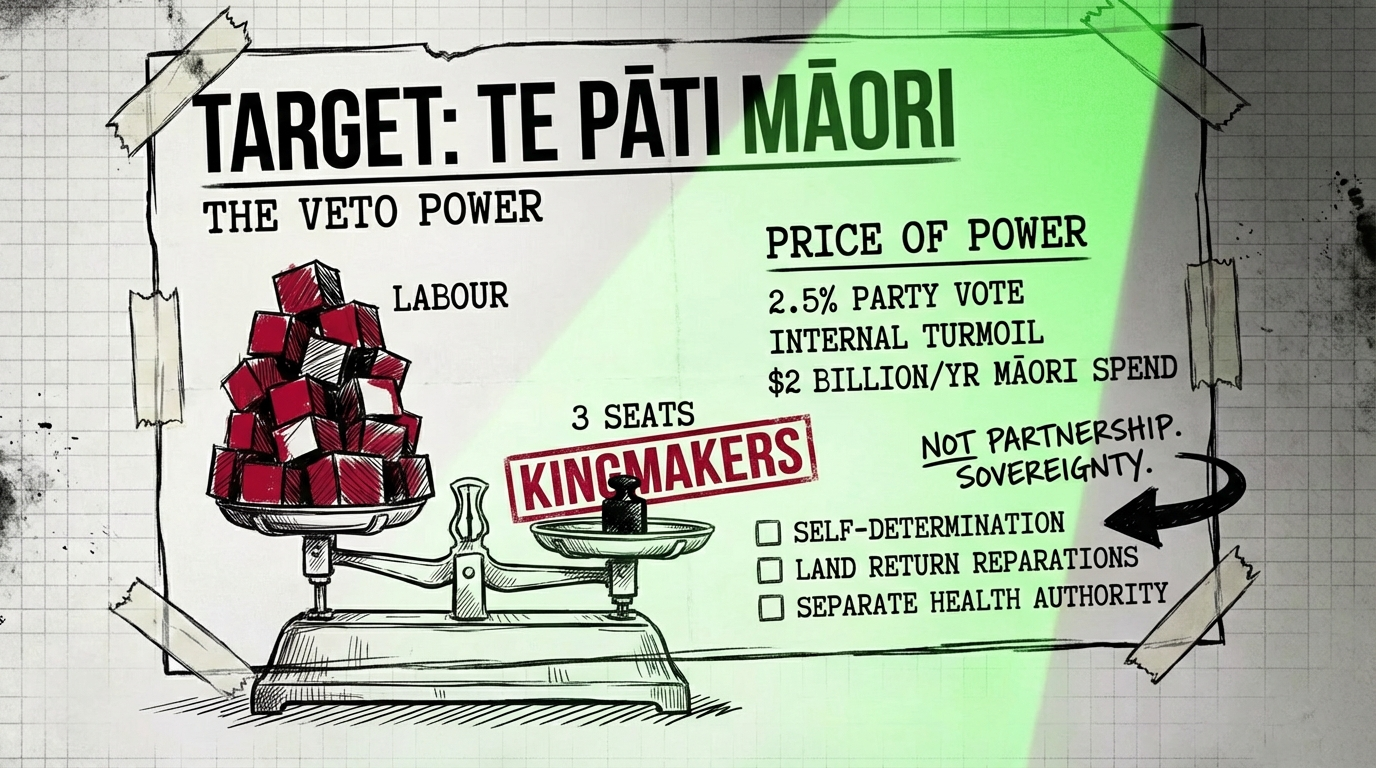
Te Pāti Māori demands $2 billion annually in Māori-directed spending and Māori sovereignty over health, justice, and education.
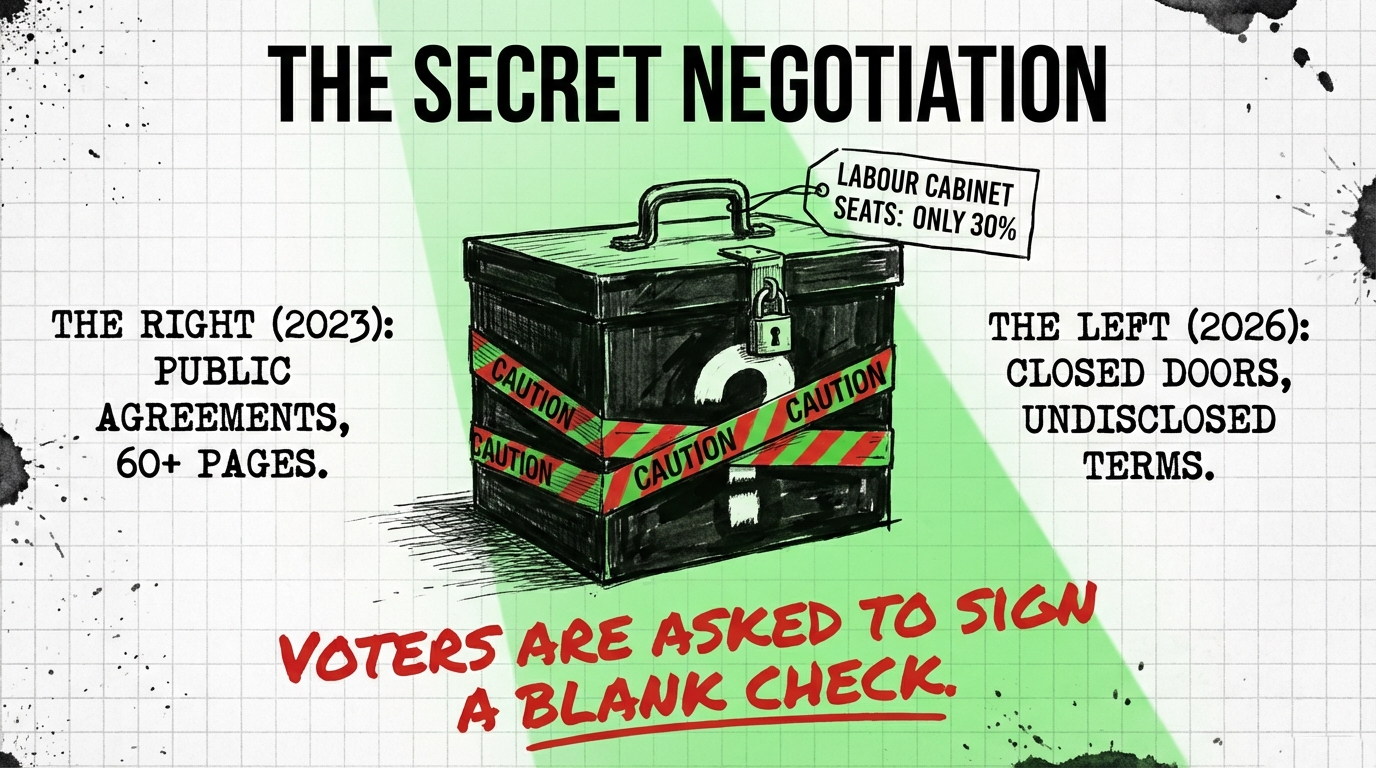
These commitments are incompatible with Labour’s stated “fiscal discipline” and centrist positioning. By refusing to publicly acknowledge which policies he will accept or reject, Hipkins is asking New Zealand to elect him on a blank check, trusting him to sort out the details with coalition partners after the election.
This represents a fundamental failure of democratic transparency.
Voters deserve to know:
Will Labour accept the Greens’ wealth tax? Will Labour accept Te Pāti Māori’s land reparations framework? Which of his campaign promises will be sacrificed to coalition demands?
Hipkins offers no answers—because the answers would destroy his carefully constructed image of a competent centrist ready to lead.
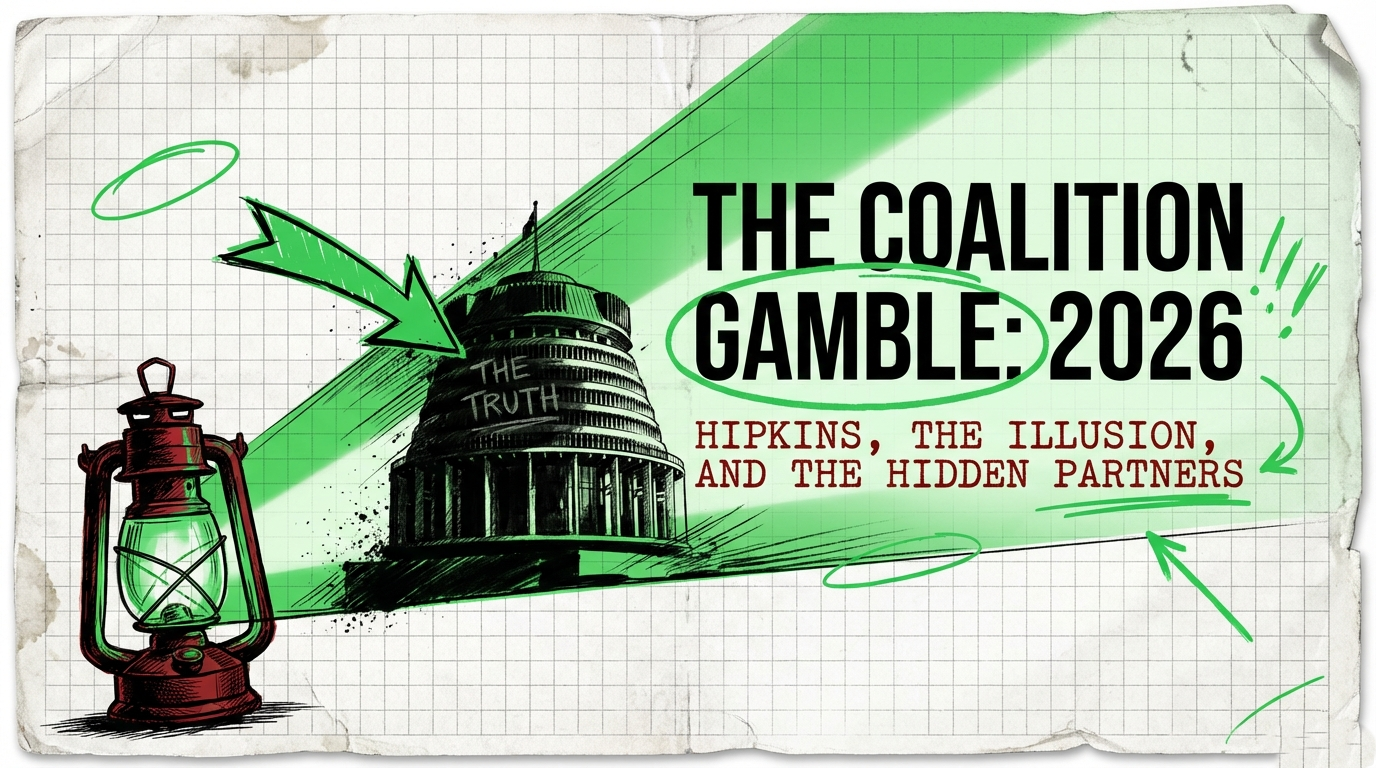
Instead, he attacks Luxon for offering slogans, all while peddling the biggest slogan of the campaign:
that Labour can deliver transformation while governing with only 33% of Parliament and without being honest about its coalition partners.
Part 1: What Hipkins Claims Labour Will Deliver
“A Whole Lot of Management Speak Mumbo Jumbo” vs. Labour’s Own Vagueness
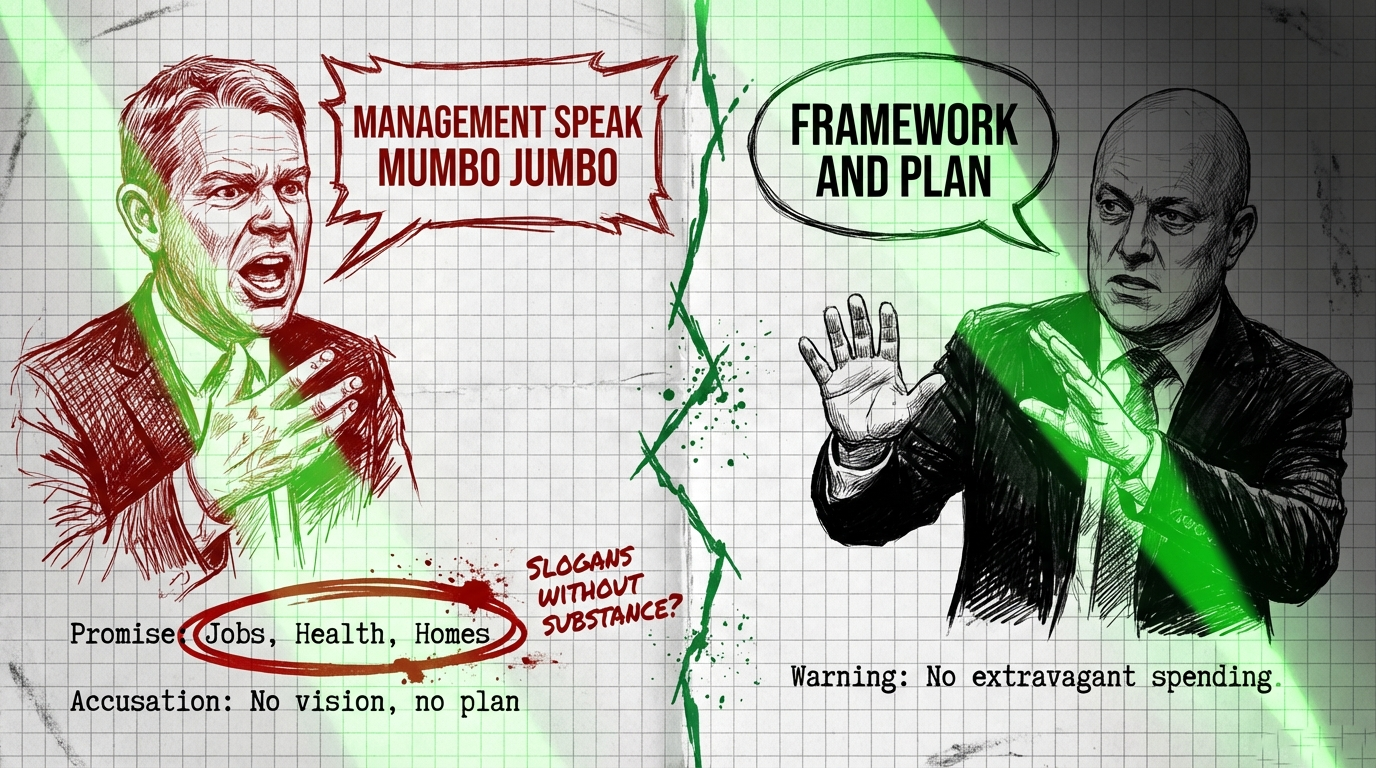
Hipkins opens his response by dismissing Luxon’s State of the Nation address as containing “no vision and no plan for New Zealand’s future” and describing it as “management speak mumbo jumbo,” according to RNZ.
This is rhetorically effective but deeply hypocritical:
Hipkins’ own promises are equally abstract.
He states Labour’s priorities are:
“jobs, health, homes and real action on the cost of living,” as noted by RNZ—four categories that encompass essentially all government activity.
Every major party in every democracy claims to prioritize jobs, health, and housing. By offering these generic commitments without specificity on how Labour differs from the coalition on delivery mechanisms, funding sources, or timeline, Hipkins is guilty of the same “slogans without substance” he attributes to Luxon.
Key Difference:
Luxon explicitly acknowledged his 20-minute speech was “painting some pretty big, broad brushstrokes” on “the framework and the plan,” as RNZ reported—he was transparent that it was a framework speech. Hipkins attacks it for not being comprehensive, then offers equally vague commitments without acknowledging he’s doing the same thing.
“Make Homes Affordable Again” — The Housing Crisis Promise
Hipkins directly criticizes Luxon for not mentioning housing in his speech, stating:
“New Zealanders deserve to have the housing crisis fixed. Generations of New Zealanders [are] giving up and leaving the country because they’ve got no chance of home ownership here in New Zealand; simply not good enough,” according to RNZ.
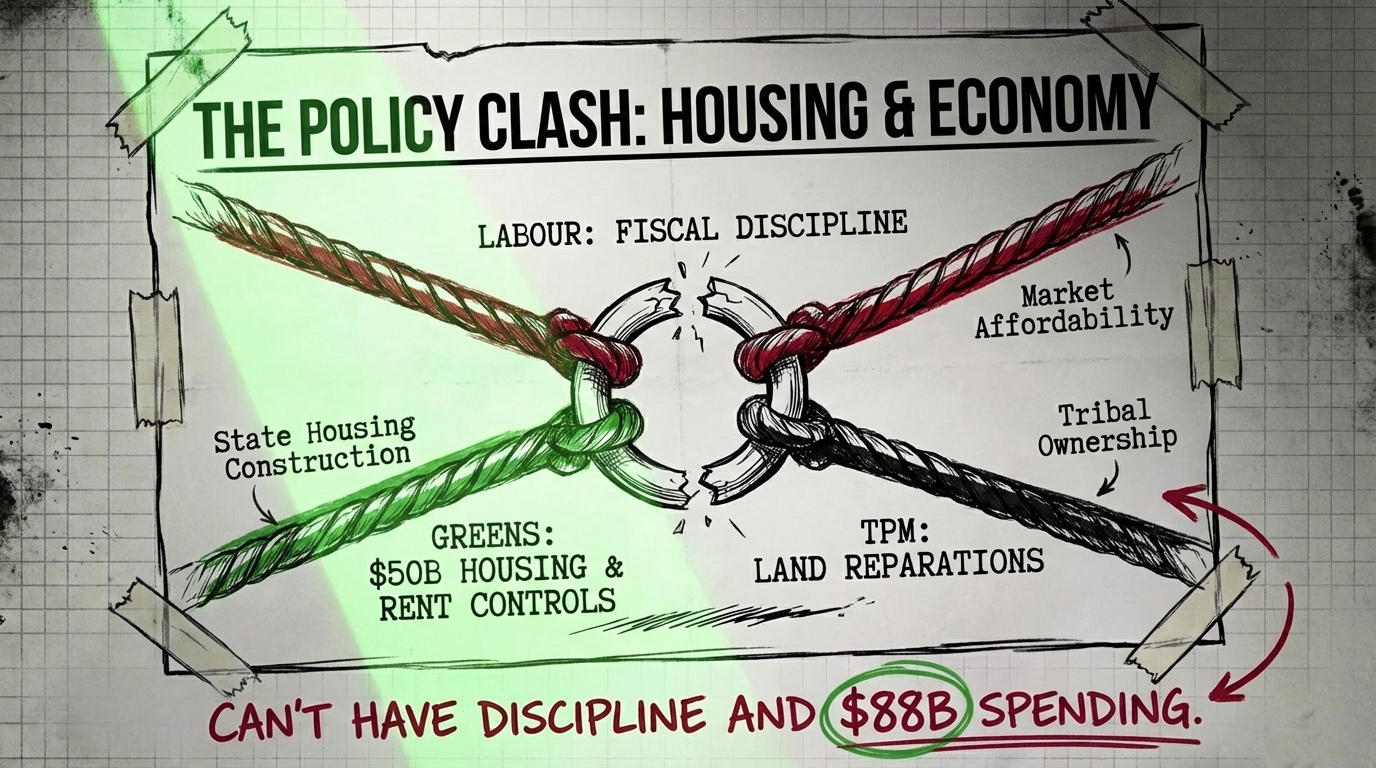
This is Labour’s strongest emotional appeal. The housing crisis is real and severe:
New Zealand’s housing affordability ratio ranks among the world’s worst, as evidenced by RNZ’s reporting on the June 2025 GDP contraction showing homes remain unaffordable despite economic slowdown.
The Problem:
Hipkins offers zero specifics on Labour’s housing solution beyond the assertion that “we can make homes affordable again.” More critically, Labour’s actual housing policy positions conflict with both coalition partners:
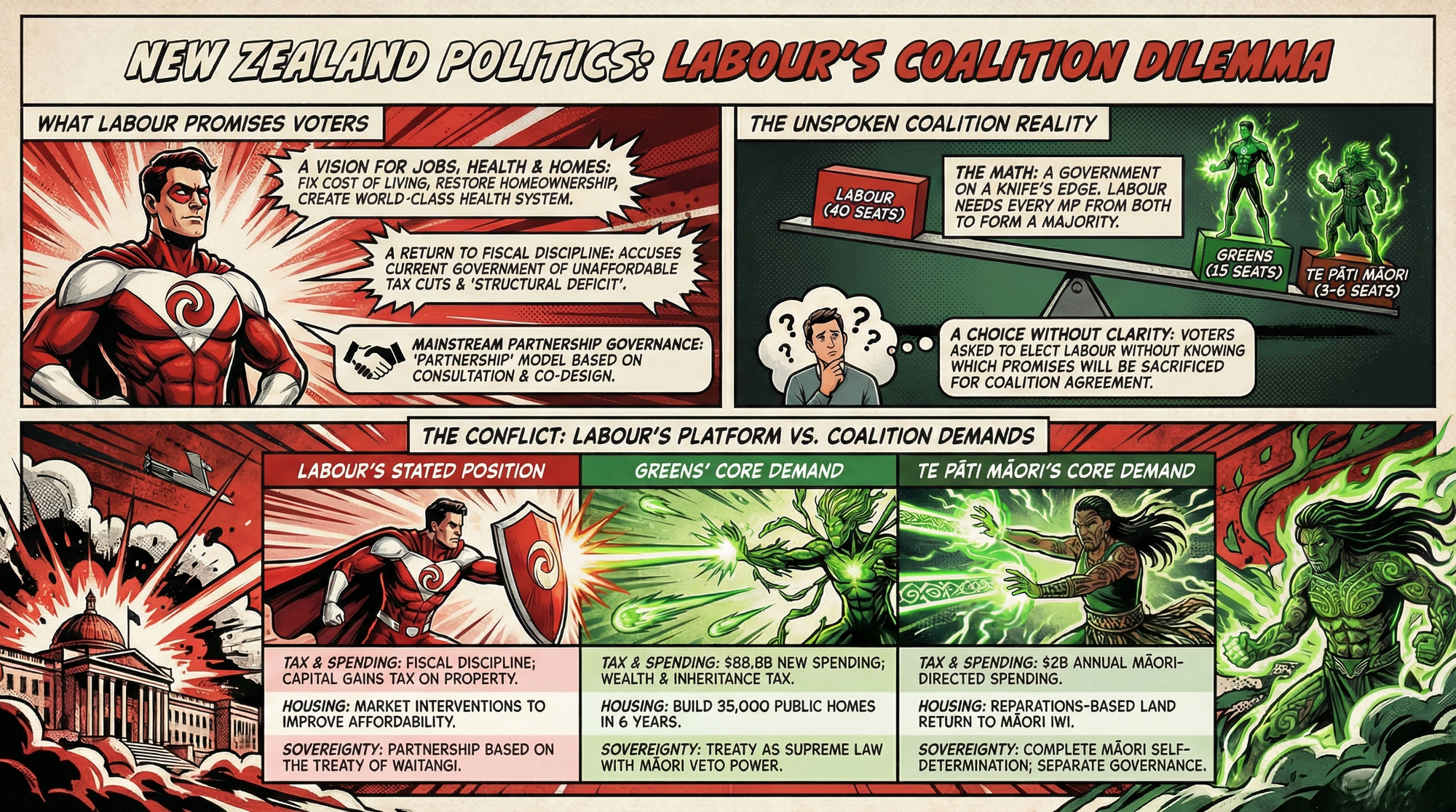
- Labour’s Housing Position: Restore capital gains tax on property transactions (to discourage speculation), as announced in Labour’s NZ Future Fund policy; continue upzoning reforms. Focus on affordability through market interventions.
- Greens’ Housing Demand: 35,000 public homes in 6 years; mandatory urban intensification; wealth tax on residential investment properties, as detailed in the Green Party’s $89 billion alternative budget. This represents $50+ billion capital spending.
- Te Pāti Māori’s Housing Demand: Reparations-based land return to Māori iwi; Māori-controlled housing on returned lands; $2 billion annual Māori-directed investment, as outlined in NZ Herald’s coverage of Te Pāti Māori’s rise.
In a coalition government, these three positions cannot coexist. If Labour prioritizes capital gains tax and market-led affordability, it betrays Green demands for public housing expansion and Te Pāti Māori’s land sovereignty claims. If Labour accepts the Greens’ 35,000 public homes target, it must find $50+ billion in spending—contradicting its “fiscal discipline” messaging. If Labour accepts Te Pāti Māori’s land reparations framework, it redefines housing as a sovereignty issue, not just an affordability issue—a fundamental ideological shift Hipkins is not publicly discussing.
The Unavoidable Reality:
Voters are voting for “Labour’s housing solution” not knowing which of these three incompatible frameworks will actually be implemented. Hipkins is rhetorically claiming all three simultaneously while publicly committing to none.
“A World-Class Health System That Benefits Everybody” — Generic Promise, Specific Problems
Hipkins promises “a world-class health system that benefits everybody” and criticizes Luxon for not discussing healthcare in detail, according to RNZ. Labour’s actual commitments, as detailed in Hipkins’ policy continuity pledge, include free GP visits and cervical cancer screenings—modest interventions that would help but don’t constitute a “world-class system overhaul.”
- The Problem: Health spending requires massive capital investment, and Labour has not specified how this would be funded. More problematically, the Greens and Te Pāti Māori have incompatible health priorities.
- Labour’s Health Position: Free GP visits; pay equity restoration in health workforce; incremental efficiency improvements, as announced in Labour’s refreshed 2026 priorities. Estimated cost: $2-3 billion annually.
- Greens’ Health Demand: Free dental, eye care, and prescription medications for all; full income guarantee of $385 weekly; integrated mental health and addiction services, as outlined in the Greens’ “Ending Poverty Together” initiative. Estimated cost: $15+ billion annually.
- Te Pāti Māori’s Health Demand: Separate Māori health authority with self-determination in healthcare delivery; $2 billion annual Māori-directed health spending; kaupapa Māori mental health services, as reported in 1News coverage of Te Pāti Māori’s internal divisions.
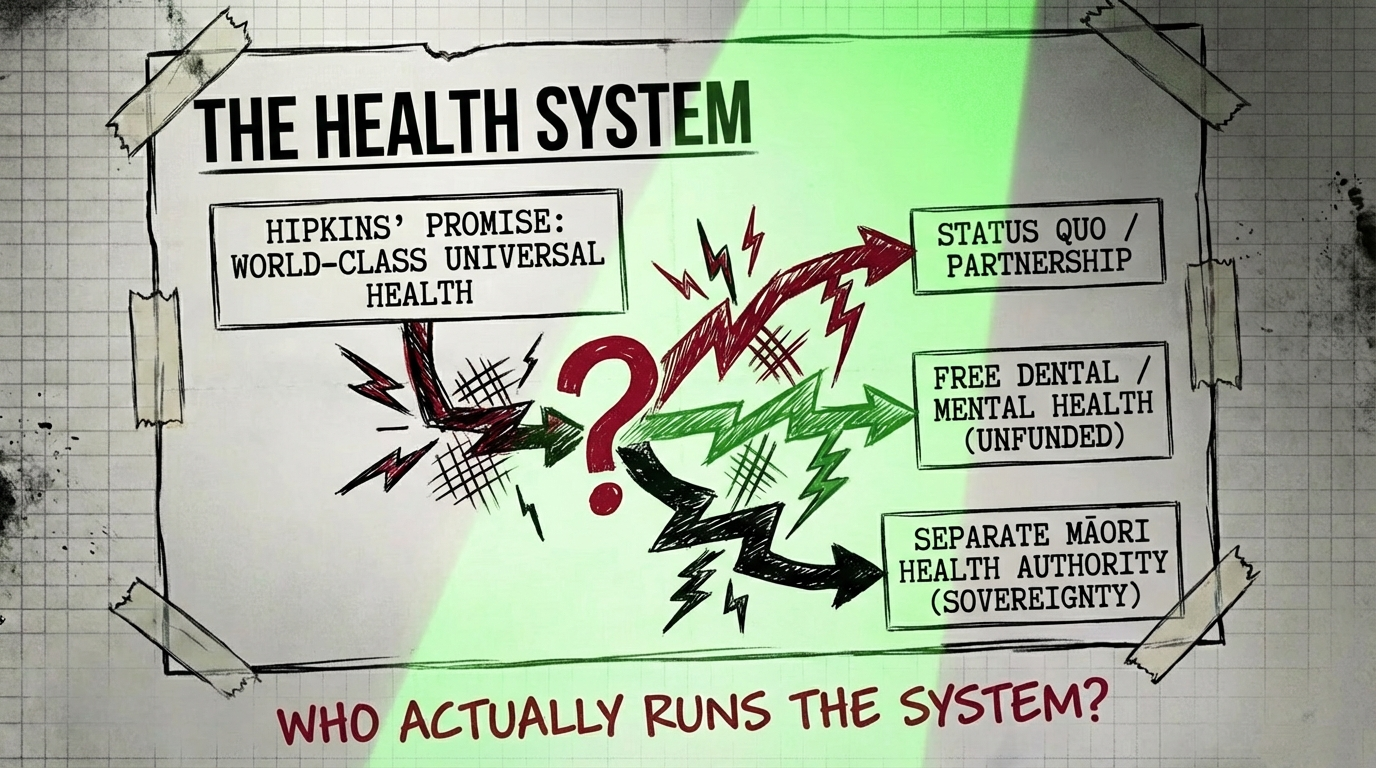
Again, these are incompatible. Labour cannot deliver “world-class health” to “everybody” while navigating these competing demands without either: (1) accepting massive Green spending that balloons the deficit, or (2) ring-fencing substantial health budgets for Te Pāti Māori priorities at the expense of universal access.
“Good Well-Paid Jobs” — Jobs Rhetoric Without Structural Plan
- Hipkins states: “We can create good well-paid jobs here in New Zealand” and criticizes the coalition for “more people lose their jobs,” according to RNZ. The unemployment crisis is real—5.3% in September 2025, the highest since 2016 according to Stats NZ—validating his concern.
- The Problem: Labour offers no structural explanation for unemployment or jobs creation strategy. The coalition’s unemployment rise occurred because of Reserve Bank rate hikes (designed to control inflation), not because of National/ACT/NZ First policy incompetence per se. RNZ reported that 18,000 jobs were lost over 12 months, with 160,000 people unemployed—the highest number since early 1994.
To create “good well-paid jobs,” a Labour government must either:
- Accept continued low interest rates (contradicting inflation control), risking future instability
- Implement targeted sectoral investment (e.g., infrastructure, green energy, healthcare) requiring massive capital spending (Greens’ requirement)
- Implement job guarantees or income supports (Greens’ $385 weekly income guarantee requirement)
- Prioritize Māori employment (Te Pāti Māori’s structural demand)
Hipkins does not acknowledge that “jobs creation” requires one or more of these interventions, which means accepting coalition partners’ policy frameworks he’s not publicly endorsing.
Part 2: The Coalition Mathematics Labour Cannot Escape
December 2025 Polling: Labour Cannot Govern Alone
The December 2025 Roy Morgan poll, the most recent comprehensive survey before Hipkins’ January 19 statement, projects:
BlocPartyVote %SeatsCoalition TotalLeftLabour32.5%4058 seatsGreens12%15Te Pāti Māori2.5% (party)3RightNational33%4162 seatsACT7.5%9NZ First10%12
The Critical Fact: Labour’s 40 seats alone represent only 33.3% of Parliament. A majority requires 61 seats. Labour needs:
- All 15 Green MPs, AND
- At least 6 of Te Pāti Māori’s electorate MPs (if they lose party vote threshold)
to reach 61 seats. There is zero margin for defection or independent MPs, as Interest.co.nz noted in describing the election as “on a knife edge.”
Even optimistic polling doesn’t solve this. The most favorable Labour scenario had Labour at 39%, Greens at 16%, Te Pāti Māori at 6%—yielding ~64 seats combined, according to Wikipedia’s polling aggregation. But this assumes:
- Labour gains seats relative to current polling (requires election campaign gains)
- Greens hold 16% (they’re actually declining: 12% in Roy Morgan, 7% in 1News-Verian December 2025)
- Te Pāti Māori holds 6% party vote (they’re at 2.5%, well below the 5% threshold)
In realistic scenarios, Labour-Greens-Te Pāti Māori have 58-64 seats—a razor-thin majority requiring 100% coalition discipline, as MPA Magazine reported.
Te Pāti Māori: The Unstable Coalition Partner
Te Pāti Māori currently holds 6 Māori electorate seats in Parliament, but only 3.08% party vote—below the 5% threshold for entry without electorates, according to Elections NZ’s official 2023 results.
This is a critical vulnerability because:
- Internal Collapse Risk: Te Pāti Māori is in “severe internal turmoil” with court disputes over leadership and MP expulsions, as 1News reported. If the party collapses entirely, Labour could win Māori electorates directly (e.g., Tāmaki Makaurau, where Labour narrowly lost in 2023), as NZ Herald noted. But this creates a worse scenario: Labour wins Māori electorates with ~43 seats, Greens hold at 12%, giving Labour-Greens only 55 seats—still short of 61.
- Coalition Fragility: With only 3-6 seats in a 120-seat Parliament, Te Pāti Māori has absolute veto power over every Labour government decision. A single Te Pāti Māori MP pulling confidence votes makes the government fall. Hipkins would govern entirely at Te Pāti Māori’s pleasure on Māori-related issues (which encompass health, justice, education, economic development, Treaty settlements—effectively 40% of government activity).
- Unelected Kingmakers: Te Pāti Māori holds 5-6% of seats with 2.5% party vote because of the Māori electoral roll. While legally legitimate, this creates a democratic problem: Te Pāti Māori could determine government formation with minimal electoral mandate, forcing Labour to accept policy platforms voters (via party vote) did not endorse.
The Greens: Declining Support and Incompatible Demands
Green Party support has collapsed from their 2023 election peak:
- 2023 General Election: 11.61% (15 seats)
- November 2025: 16% (polling high)
- December 2025 Roy Morgan: 12% (15 seats)
- December 2025 1News-Verian: 7% (9 seats—down 4 points)
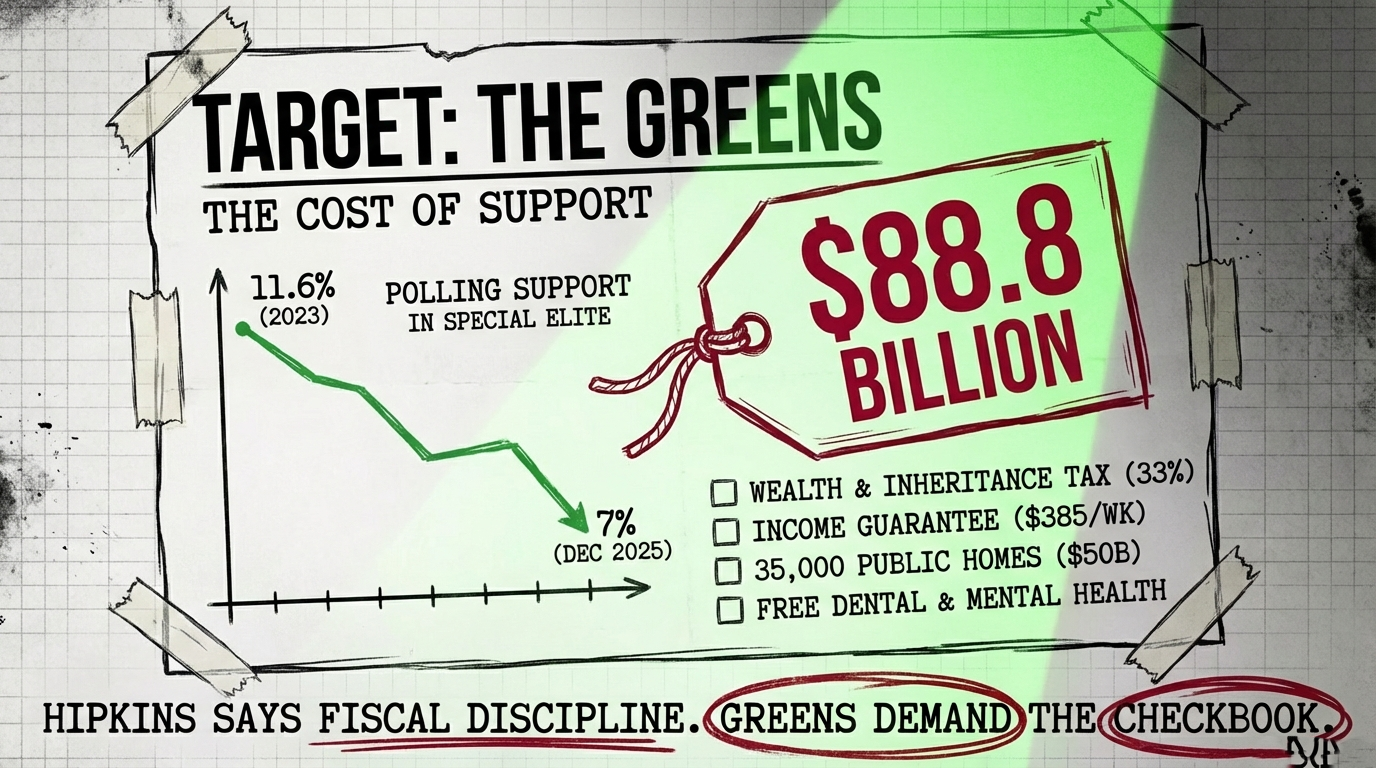
The Greens’ December 2025 decline is significant because it suggests their $88.8 billion tax plan (wealth tax, inheritance tax, income guarantee) is electorally unpopular, as experts criticized the plan’s lack of rigorous costings. Yet if the Greens drop below 12%, Labour-led government becomes mathematically impossible without either:
- Winning additional seats (Labour gaining from Greens), OR
- Te Pāti Māori gaining substantially (unlikely given their internal collapse)
Hipkins’ Strategic Problem: He needs Greens to stay above 12% to reach 61 seats, but Greens’ signature policies (wealth tax, inheritance tax, income guarantee) are driving down their support. When Green co-leader Chlöe Swarbrick was pressed on details, she acknowledged: “I’m going to be completely honest with you and say that I’m going to need to come back to you on those details.” By refusing to publicly embrace these policies as coalition conditions, Hipkins hopes to protect Labour’s centrist vote share while keeping Greens viable as coalition partners. But this leaves voters in the dark about actual policy.
Negotiation Status: Underway But Undisclosed
Evidence of active coalition negotiations exists:
- Te Pāti Māori co-leader Debbie Ngarewa-Packer stated in December 2025: “They have worked well with the Greens in the past, and are figuring out how to team up with Labour” for 2026, as NZ Herald reported.
- The Greens are “meeting regularly and planning on formalising that arrangement,” according to reporting on coalition talks.
- Hipkins has made zero public statements confirming these negotiations or the terms Labour has conceded.
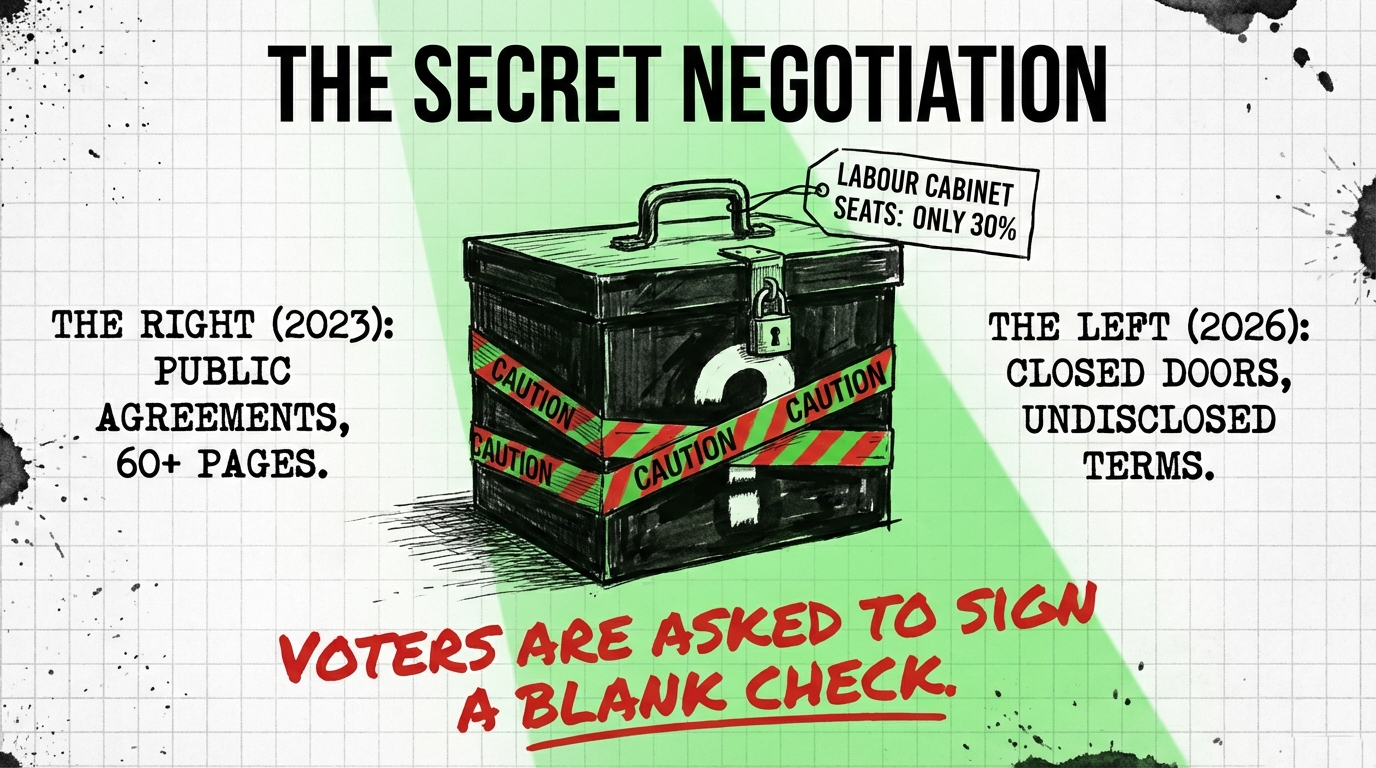
This silence is damning. Coalition agreements require written terms specifying: policy commitments, ministerial portfolios, confidence votes, and dispute resolution mechanisms. If Labour-Greens-Te Pāti Māori negotiations are “figuring out how to team up,” then major policy trades are being decided in private while Hipkins campaigns on vague promises of “jobs, health, homes.”
Part 3: Why Hipkins’ Omission of Coalition Reality Undermines Every Promise He Makes
The Ministerial Portfolio Trap
If Labour wins 40 seats and forms a coalition with Greens (15 seats) and Te Pāti Māori (3-6 seats), the Cabinet composition would be approximately:
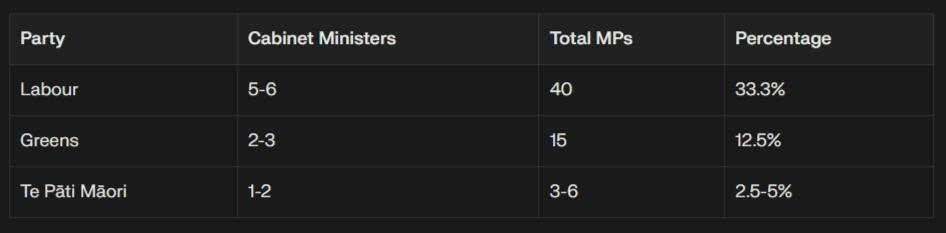
Labour gets one Cabinet minister per 7-8 MPs, while Greens and Te Pāti Māori demand one per 5-7.5 MPs (overweight representation to protect coalition).
This means Labour controls only 5-6 of 20 Cabinet positions. Hipkins’ ability to drive Labour’s policy agenda is fundamentally constrained. If Labour’s Health Minister proposes free GP visits but no public health system overhaul, a Green Cabinet minister can force a confrontation. If Labour’s Justice Minister opposes Te Pāti Māori’s demand to divert funding to Māori-controlled justice systems, Te Pāti Māori can collapse confidence and supply.
During the 2017-2023 government, the Greens held ministerial portfolios including Climate Change, Conservation, and Women’s Affairs, as documented by Wikipedia’s coverage. However, former Green MPs criticized the 2020-2023 cooperation agreement as “giving the Greens a weak position to influence the policy process.” Te Pāti Māori will demand even stronger portfolio positions given their pivotal role.
Hipkins’ promises of “world-class health,” “affordable housing,” and “good jobs” assume he controls the Cabinet levers that implement these policies. In a coalition, he doesn’t.
The Fiscal Framework Contradiction
Hipkins criticizes the coalition for creating “a structural deficit that they have no plan to get us out of,” according to RNZ. This suggests Labour’s fiscal position is: maintain discipline, avoid extravagant spending, reduce the deficit over time.
Yet both coalition partners have fundamental spending mandates:
Greens require:
- $88.8 billion over 4 years in new government spending (climate investment, income guarantee, public housing, light rail), as detailed in NZ Herald’s coverage
- This requires either new taxation (wealth tax 2%, inheritance tax 33%) or expanded government borrowing
- Hipkins has ruled out wealth and inheritance taxes as “not part of Labour’s approach,” as NZ Herald reported
Te Pāti Māori requires:
- $2 billion annually in Māori-directed spending across health, education, justice, economic development
- This is equivalent to: eliminating all current Māori Affairs spending and tripling it, OR reallocation from other departments
Labour’s fiscal position:
- Capital gains tax on property sales (revenue: $1-2 billion annually), as announced in Labour’s NZ Future Fund policy
- Free GP visits and pay equity restoration (cost: $2-3 billion annually)
- Net fiscal impact: -$1 billion to -$4 billion depending on implementation
The Math: Labour’s policies create a small deficit or break-even. Greens’ spending demands create $20+ billion annual deficits. Te Pāti Māori’s demands create $2 billion annual new spending. Combined, the “Labour-led government” would face $20+ billion in new spending pressures annually.
The Treasury’s December 2025 Half Year Economic and Fiscal Update already shows the return to surplus pushed out to 2029-30. Adding $20+ billion in coalition spending would make this impossible.
Hipkins can either:
- Accept massive deficit spending (betraying his “fiscal discipline” platform), OR
- Reject Greens’ and Te Pāti Māori’s bottom-line spending (breaking coalition and losing government)
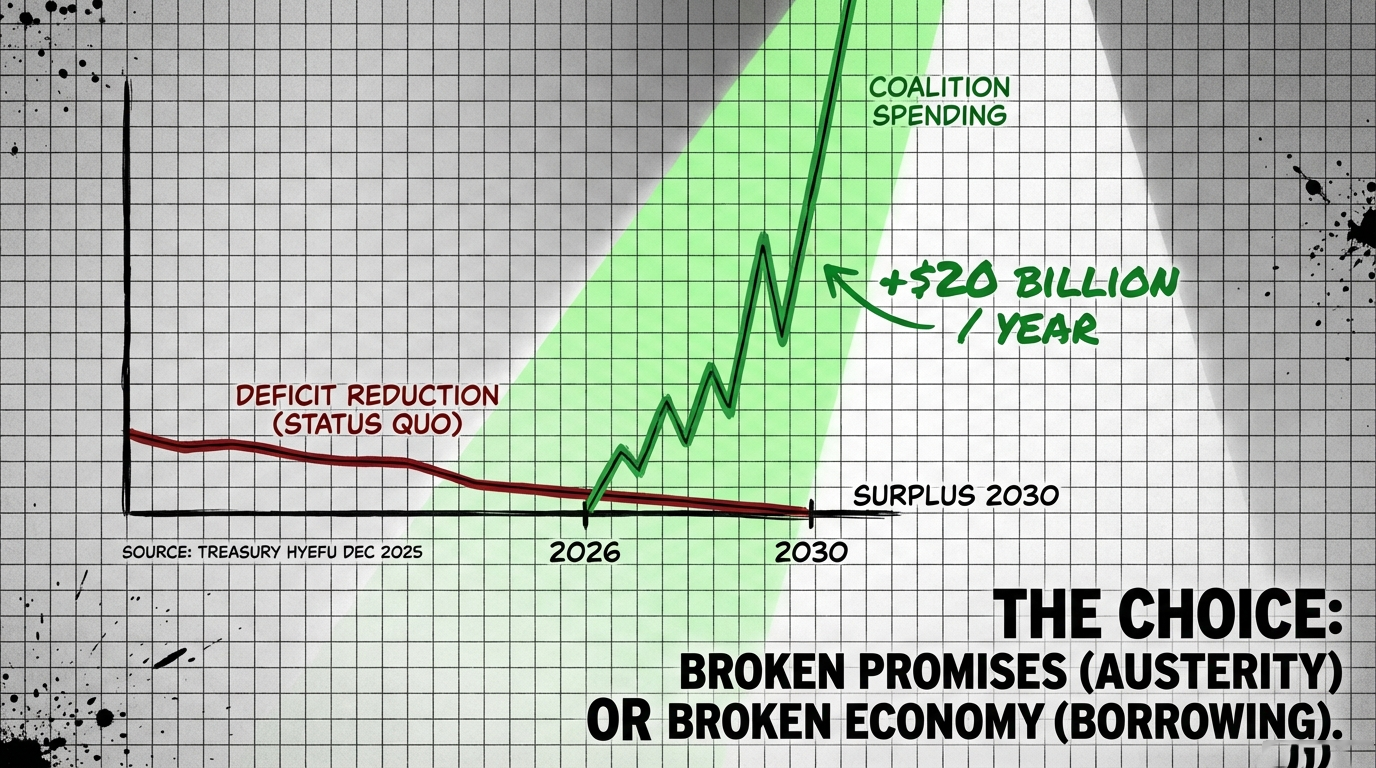
He cannot deliver both “fiscal responsibility” and “Labour can fix everything.” Voters deserve to know which is actually prioritized.
The Treaty and Sovereignty Issue: The Deepest Conflict
Hipkins notes in his response that Luxon still hasn’t confirmed whether he’ll attend Waitangi Day, and criticizes “chaotic leadership” on “ministerial portfolios” related to the RMA (Resource Management Act), according to RNZ. This touches on the deepest policy conflict among coalition partners: the meaning of Te Tiriti o Waitangi and Māori self-determination.
- Labour’s Te Tiriti Position: Partnership model; incremental Māori engagement in decision-making; policy co-design with Māori consultation, as outlined in Labour’s party information.
- Greens’ Te Tiriti Position: Full implementation of Te Tiriti as supreme law; Māori veto over environmental policy affecting lands; legal supremacy of Te Tiriti over other legislation, as detailed in Green Party governance policy.
- Te Pāti Māori’s Te Tiriti Position: Complete Māori self-determination; separate governance structures (Māori authority over Māori affairs); Te Tiriti as basis for reparations and land return; rejection of “partnership” as insufficiently strong, as NZ Herald reported.
- These positions are fundamentally incompatible. Labour views Te Tiriti as requiring engagement and consultation. Greens view it as requiring legal supremacy. Te Pāti Māori views it as requiring sovereignty separation.
In a coalition government, which framework prevails? If Labour’s “partnership” model is implemented, Greens and Te Pāti Māori will accuse Labour of betraying indigenous rights. If Te Pāti Māori’s sovereignty model is implemented, National and public opinion will accuse Labour of “separatism.” If Greens’ legal supremacy model is implemented, it overrides democratic legislation and creates a form of constitutional supremacy that Labour doesn’t support.
Hipkins offers no framework for resolving this conflict. His mention of Waitangi Day attendance and RMA “ministerial portfolios” is superficial—it avoids the fundamental tension that will dominate a Labour-led government’s early agenda.
Part 4: What Hipkins Should But Won’t Say
If Hipkins were being honest about his government’s constraints, his response to Luxon would have included something like:
“New Zealand cannot afford three more years of this coalition. But voters should know that Labour cannot govern alone. A Labour government will require a coalition with the Greens and Te Pāti Māori. This means:Housing policy will include significant public housing investment (Greens’ priority) and Māori land reparations (Te Pāti Māori’s priority) alongside market interventionsTax policy will likely include higher wealth or capital gains taxes to fund expanded spendingOur health system will include income guarantee expansion (Greens) and Māori health sovereignty (Te Pāti Māori) alongside GP visit subsidiesOur approach to Te Tiriti will require full integration of Māori self-determination and environmental supremacy—going further than Labour would choose alone
This is what democratic coalitions require: compromise. Voters are choosing not just ‘Labour competence’ but ‘Labour-Greens-Te Pāti Māori coalition.’ We’re committed to delivering that package.”
Instead, Hipkins says: “We’ve already been very clear that our priorities for this campaign will be jobs, health, homes and real action on the cost of living. New Zealand doesn’t need more slogans,” as RNZ reported.
This is itself a slogan—and a misleading one, because it hides the coalition mathematics that will determine actual policy.
Part 5: The Democratic Deficit in Hipkins’ Campaign
Voters Are Being Asked to Vote Blind
The choice facing New Zealand is not simply: “Labour competence vs. National incompetence.” It’s: “What coalition will govern, and on what terms?”
Currently, voters know:
- Coalition partners: Labour (32.5%), Greens (12%), Te Pāti Māori (2.5% party vote)
- Coalition arithmetic: 40 + 15 + 3-6 = 58-61 seats (knife-edge majority)
- Coalition policies: Largely unknown; negotiations are private
- Coalition compromises: Not disclosed
Voters don’t know:
- Will Labour accept Greens’ wealth tax? (Labour currently says no)
- Will Labour accept Greens’ income guarantee? (Labour currently silent)
- Will Labour accept Te Pāti Māori’s land reparations framework? (Labour currently silent)
- What ministerial roles go to which parties? (Undisclosed)
- What confidence-and-supply terms are being negotiated? (Undisclosed)
- Which Labour campaign promises will be sacrificed to coalition demands? (Undisclosed)
This is fundamentally different from the 2023 coalition formation, where National-ACT-NZ First negotiated publicly and released detailed coalition agreements specifying policy trade-offs, as documented by Wikipedia. Those documents were 60+ pages of explicit policy commitments. Voters knew exactly what they were getting.
Hipkins is asking for a blank check: “Trust us to negotiate with coalition partners in private, implement their demands without telling you in advance, and deliver vague promises of ‘jobs, health, homes’ that we haven’t specified.”
The “Vision and Plan” Accusation Is Self-Refuting
Hipkins criticizes Luxon repeatedly for having “no vision and no plan,” according to RNZ. Yet he offers zero vision for how Labour will actually govern when it needs Greens and Te Pāti Māori to survive every confidence vote.
Vision requires:
knowing what you’ll actually be able to do. A Labour PM with 40 seats has fundamentally different options than a Labour PM with 50 seats or a Labour PM with a majority. Hipkins’ “vision” of “world-class health” and “affordable homes” is vision of what he wishes to do, not vision of what he can actually do given coalition constraints.
By refusing to acknowledge these constraints, Hipkins is offering voters false hope.
He’s implicitly promising:
“We’ll somehow deliver all these things despite governing without a majority.” That’s not vision—it’s fantasy.
The Real Choice Facing New Zealand Voters
The genuine choice in 2026 is not between “Labour competence” and “National failure.”
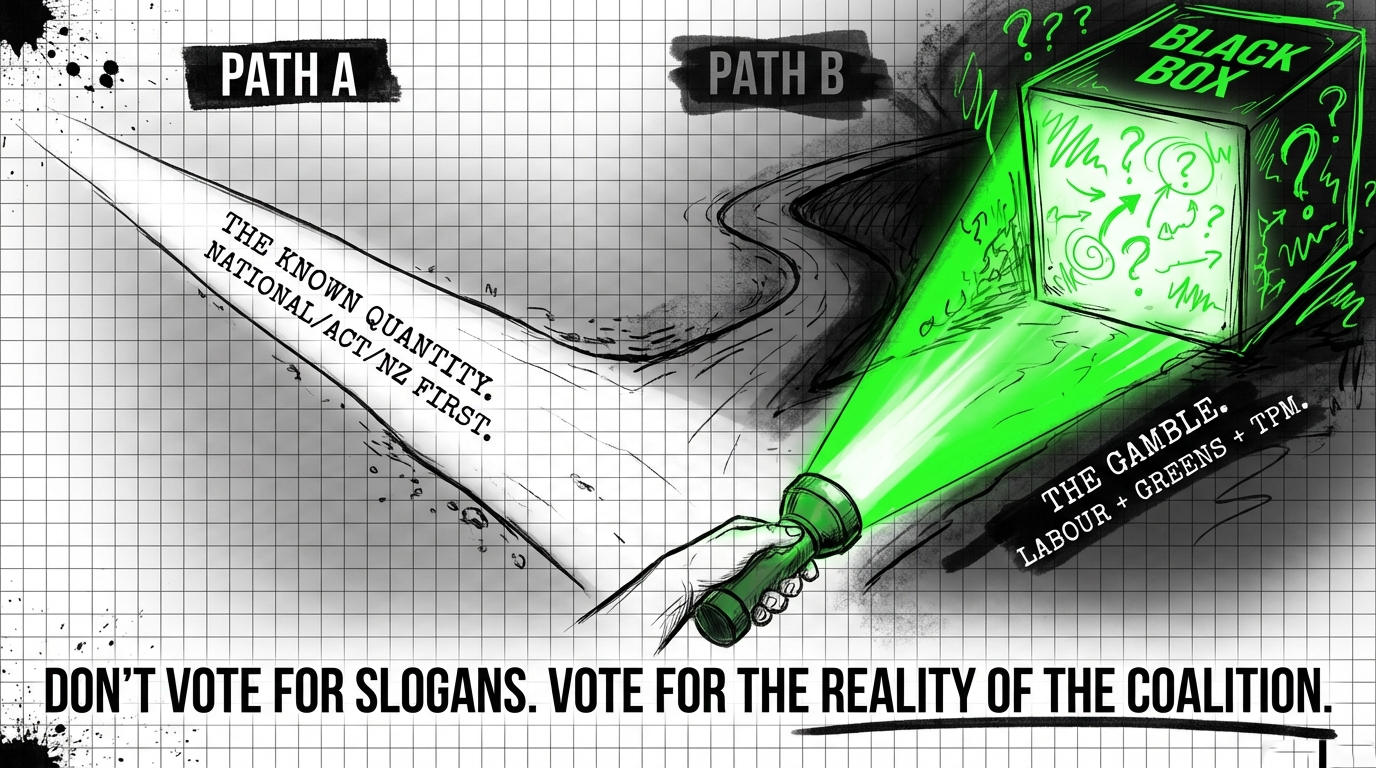
It’s between:
Option A: National-led coalition (currently 62 seats estimated)
- National/Christopher Luxon control Cabinet
- ACT and NZ First as junior partners with defined portfolio responsibilities
- Coalition agreement publicly negotiated and disclosed
- Policy direction set by National, constrained by minor partners
Option B: Labour-led coalition (estimated 58-61 seats—unstable majority)
- Labour/Chris Hipkins nominally control Cabinet
- Greens and Te Pāti Māori as junior partners with effective veto power
- Coalition agreement NOT publicly negotiated; negotiations ongoing in private
- Policy direction contested between Labour, Greens, and Te Pāti Māori with no clear hierarchy
Hipkins wants voters to choose Option B without knowing what Option B actually means. That’s not a choice—it’s a gamble.
If Hipkins genuinely believes that a Labour-Greens-Te Pāti Māori coalition would be better for New Zealand, he should campaign on that coalition’s actual policies:
- Wealth tax to fund expanded public services (Greens)
- Māori land reparations and sovereignty (Te Pāti Māori)
- Market-based housing reforms + capital gains tax (Labour)
Combined, these represent a coherent left-wing platform. Voters deserve to evaluate that platform honestly.
Instead, Hipkins attacks Luxon’s “management speak” while offering equally vague rhetoric. He promises “world-class health” while hiding that Greens will demand income guarantee expansion and Te Pāti Māori will demand separate Māori health authority. He promises “affordable homes” while hiding that Greens demand 35,000 public homes in 6 years and Te Pāti Māori demand land reparations.
Hipkins’ core message to voters should be:
“We can do better than National, but only if you accept a Labour-Greens-Te Pāti Māori coalition with the following policies...”
Instead, his message is:
“We’ll fix everything with jobs, health, and homes—trust us to work it out with coalition partners later.”
That’s not leadership. That’s asking voters to write a blank check to be cashed by unspecified coalition partners in private negotiations voters won’t see until after the election.
For New Zealand to make an informed choice, Hipkins needs to get “on board” with coalition reality—not by accepting Greens and Te Pāti Māori demands privately, but by publicly committing to the actual policies a Labour-led coalition would implement. Anything less is a failure to respect voters’ right to make informed decisions about their government’s composition and direction.
The 2026 election will be decided not by who has the best slogans, but by which leader is honest about the constraints they will face in government. So far, Hipkins is failing that test—offering grand promises while hiding the coalition mathematics that will determine whether any of them can be delivered.

Ivor Jones The Māori Green Lantern Fighting Misinformation And Disinformation From The Far Right