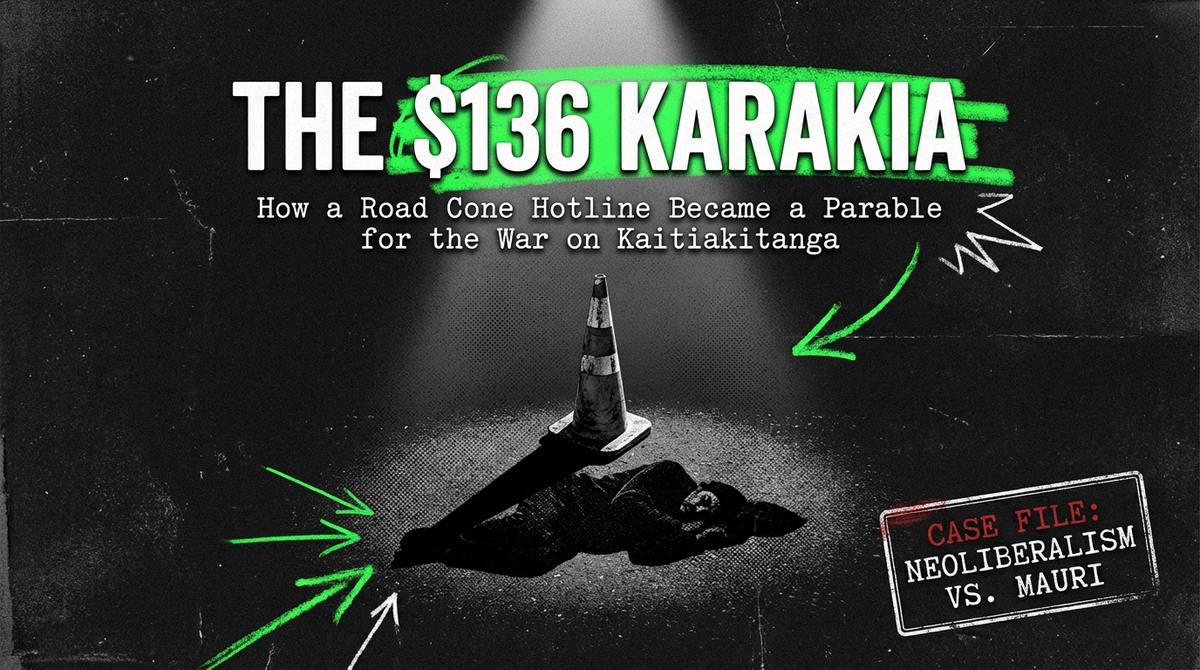
"How a Road Cone Dob-In Line Became the Parable for Neoliberalism’s War on Kaitiakitanga: The $136 Karakia” - 1 February 2026
Te mauri o te whenua, te mauri o te tangata. The life force of the land is the life force of the people.
Mōrena Aotearoa, Did you hear that over the weekend that Texas of all places, flipped from Republican to Democrate in local elections. We can do the same an kick out these c@#k$ and c%^t$ from government.
The mauri is dying. Not because Aotearoa lacks resources—but because those entrusted with kaitiakitanga have abdicated their sacred duty to guard the collective in favour of a doctrine that worships the individual, commodifies care, and punishes the vulnerable for existing.
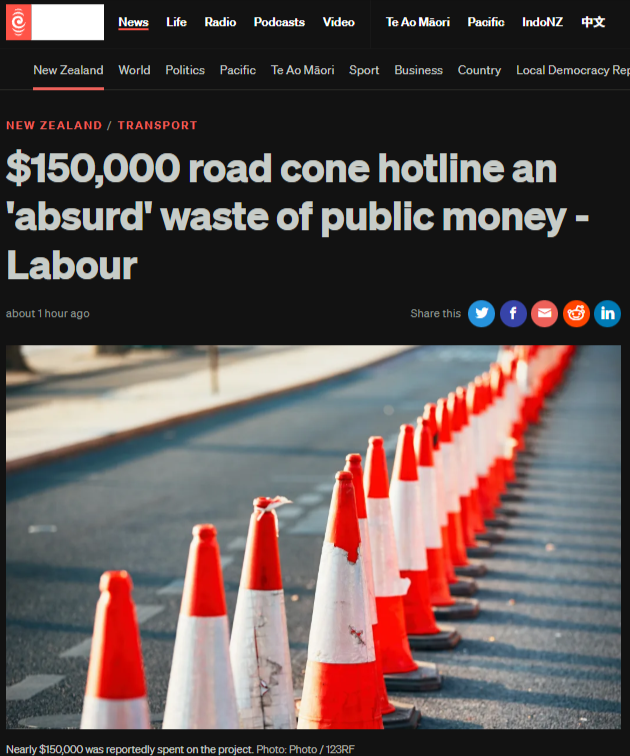
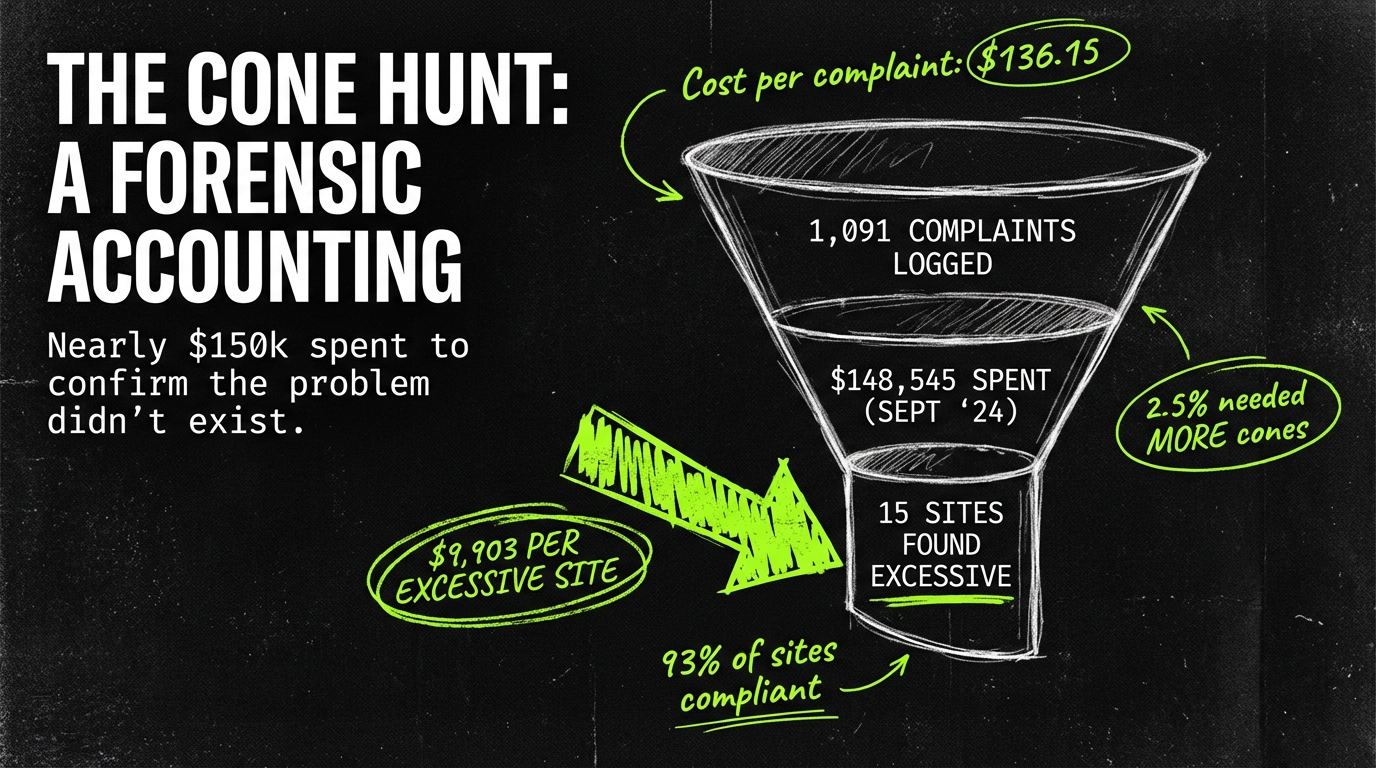
Between June and December 2025, the Crown spent $148,545 on a digital hotline designed to let the public report “excessive” road cones. By September, 1,091 complaints had been logged—at a cost of $136.15 per complaint. Of the 250 sites inspected, only 6 percent were found to have excessive cones. Ninety-three percent of callouts found cones deployed perfectly. Some sites—2.5 percent—actually needed more cones for worker safety.
This is not a story about road cones. This is a parable about what happens when a government drains the life force—the mauri—from institutions designed to protect people, then diverts the resources earmarked for kaitiakitanga (guardianship) into theatre designed to manufacture outrage, distract scrutiny, and normalize cruelty as efficiency.
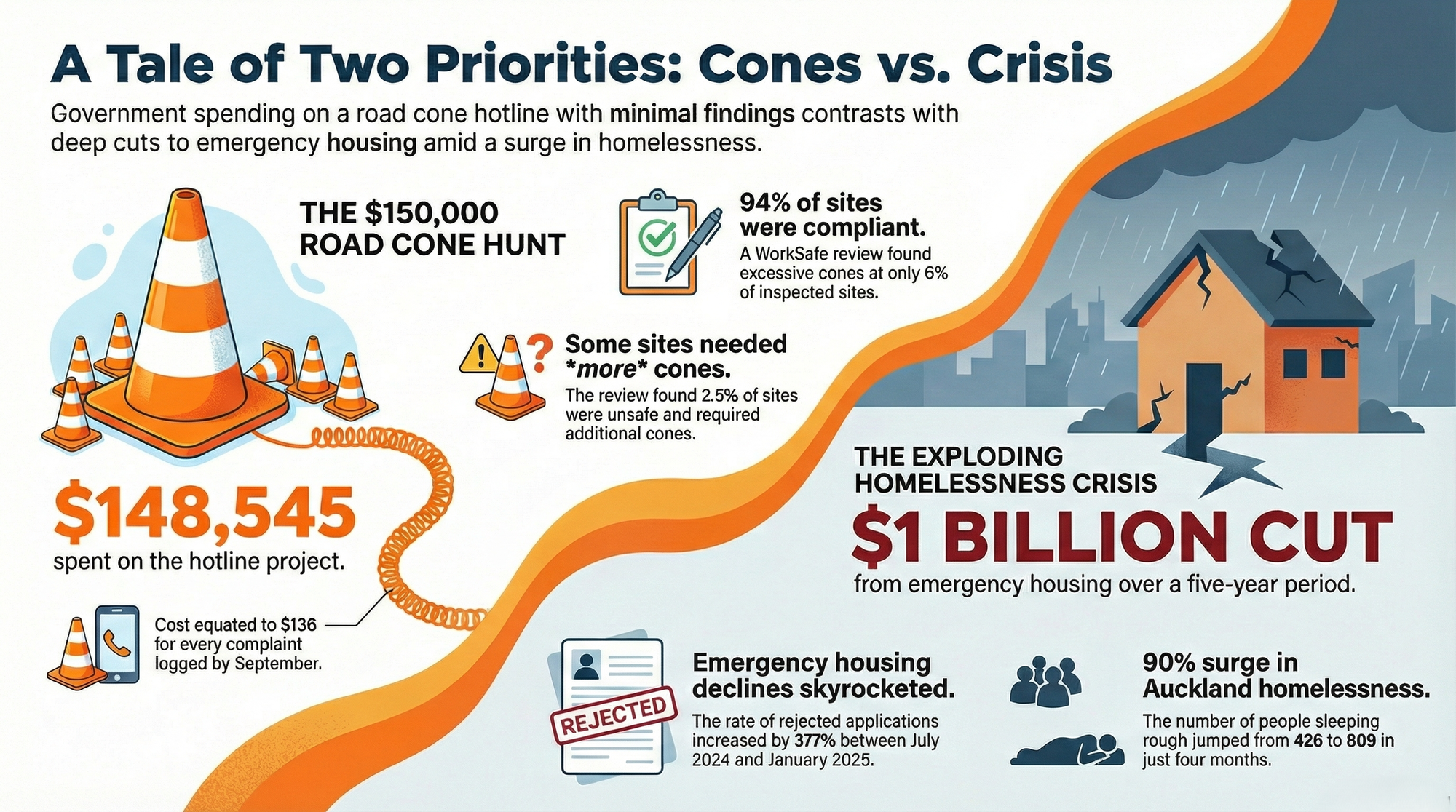
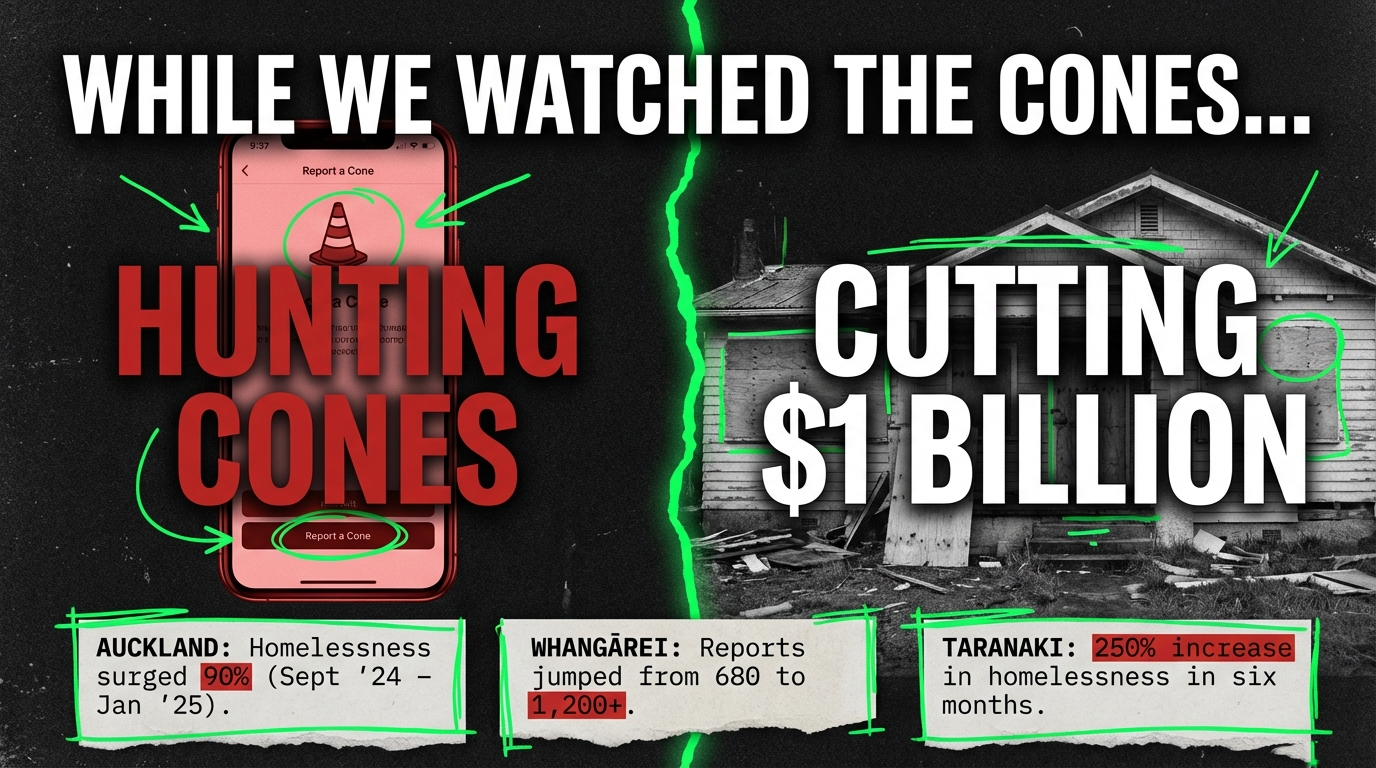
While the Coalition Government spent nearly $150,000 hunting 15 sites with too many cones, it cut $1 billion from emergency housing over five years. By March 2025, 32 percent of emergency housing applications were declined—up 4 percent from the previous year. The result? Between 2018 and 2023, people living without shelter increased by 37 percent. In Auckland alone, homelessness surged 90 percent between September 2024 and January 2025—from 426 to 809 people sleeping rough. In Whangārei, reports jumped from 680 in 2023 to a forecast 1,200+ in 2025. Taranaki saw a 250 percent increase in six months.
Who Benefits? Follow the Whakapapa of Power
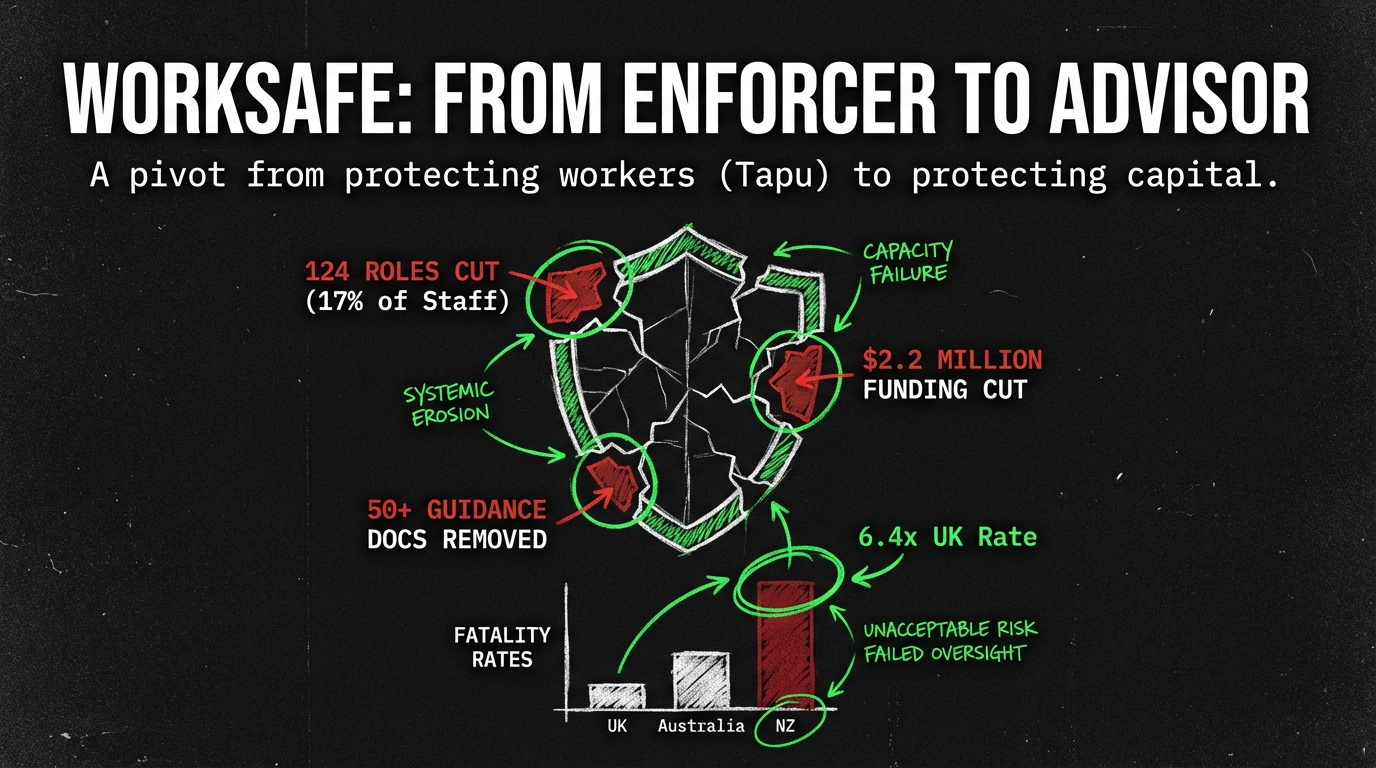
The architect of the cone hotline, Workplace Relations and Safety Minister Brooke van Velden, simultaneously cut 124 permanent WorkSafe roles—a 17 percent reduction from 724 to 600 staff.
Van Velden, deputy leader of the ACT Party—itself an astroturf organization founded in 1993 by Roger Douglas to embed the neoliberal “Rogernomics” agenda into permanent policy architecture—directed WorkSafe to shift from enforcement to “guidance and education”. She claimed there was a “huge culture of fear” around WorkSafe—a narrative deployed to justify weakening the regulator’s enforcement powers while strengthening its approach to “worker breaches of duty”. The Council of Trade Unions warned this would “deter employees from raising concerns”.
The whakapapa of this policy traces directly to Roger Douglas, who as Minister of Finance from 1984 to 1988 implemented what became known as “Rogernomics”—floating the dollar, corporatizing state assets, removing agricultural subsidies, slashing top tax rates from 66 to 48 percent, and introducing GST. ACT’s founding document was not Ayn Rand but Treasury’s 1984 “Economic Management” briefing, crafted by Chicago School economists who had flooded Treasury and briefed Labour MPs behind National’s back. When Prime Minister David Lange tried to slow the reforms, the caucus voted Douglas back into Cabinet in August 1989, forcing Lange to resign.
Forty-two years later, that same ideology—now laundered through populist rhetoric about “road cone tyranny”—drives policies that kill by neglect rather than by decree.
The cui bono is clear:
ACT created fake grassroots groups per ex-staffer Grant McLachlan. Between 2021 and 2023, National and ACT received $12.4 million in donations compared to Labour’s $1.1 million. The coalition’s policies—stripping emergency housing, cutting WorkSafe enforcement, eliminating pay equity claims—serve capital, not people. Van Velden herself stopped 33 pay equity claims and repeated the c-word in Parliament after a newspaper column used it to describe her.
The Tikanga Violations: Tapu, Noa, and the Architecture of Safety
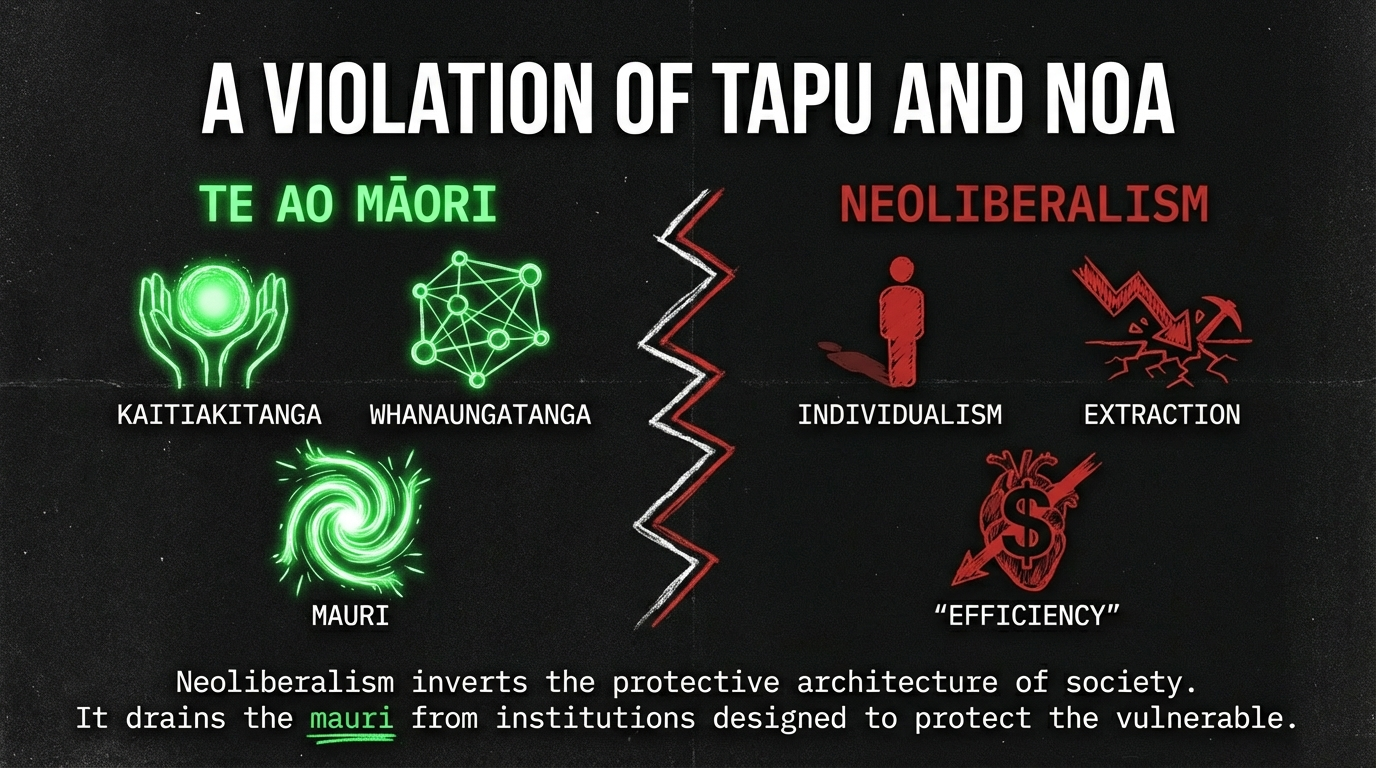
In tikanga Māori, tapu denotes the sacred, the restricted, the dangerous-if-boundaries-are-crossed. Noa, its complement, signifies safety, the ordinary, the unrestricted.
Workplaces function when these boundaries are respected:
Tapu-noa separation aligns with health and safety procedures—food kept separate from contaminants, dangerous work performed with karakia to protect wairua (spirit), water used as noa to cleanse after exposure to tapu.
What Van Velden’s reforms do is invert this protective architecture. By shifting accountability from employers (who hold mana and resources) to workers (who are structurally vulnerable), the policy violates the principle of manaakitanga—care, hospitality, the duty of those with power to uplift those without. Māori workers are already over-represented in workplace injury and death. Weakening enforcement while increasing scrutiny of “worker breaches” compounds existing disparities rooted in colonization, poverty, and systemic racism.
In te ao Māori (the Māori worldview), decision-making is guided by whakapapa (genealogy), whanaungatanga (kinship), and rangatiratanga (chiefly authority grounded in collective responsibility). Decisions are reached by consensus on the marae, not imposed top-down by distant bureaucrats. Kaitiakitanga—guardianship—requires that those with mana whenua (authority over land) actively protect the mauri (life force) of people, place, and resources. When the mauri of water is harmed, the mauri of land is harmed, and the mauri of people is harmed.
This is not metaphor—it is observed reality encoded in centuries of environmental knowledge.
Neoliberalism operates on inverse logic:
Individuals are responsible for their own outcomes, regardless of structural power imbalances. Markets are efficient; regulation is tyranny. The invisible hand allocates resources justly; the visible hand of collective care is “wasteful.”
As academic Brian Roper documents, neoliberalism in Aotearoa did not emerge organically—it was imposed by a cadre of ideologues who captured Treasury, bypassed democratic processes, and framed market fundamentalism as “no alternative.”
The road cone hotline is the perfect microcosm of this ideology:
It manufactures a crisis (excessive cones),
demands individual vigilance (public dob-ins),
diverts resources from actual protection (WorkSafe enforcement),
then declares victory when the invented problem “improves.”
Meanwhile, the real crisis
—homelessness surging 377 percent in decline rate increases between July 2024 and January 2025
—is framed as individual moral failure rather than policy-driven catastrophe.
Quantifying the Harm: The Human Cost of Manufactured Scarcity
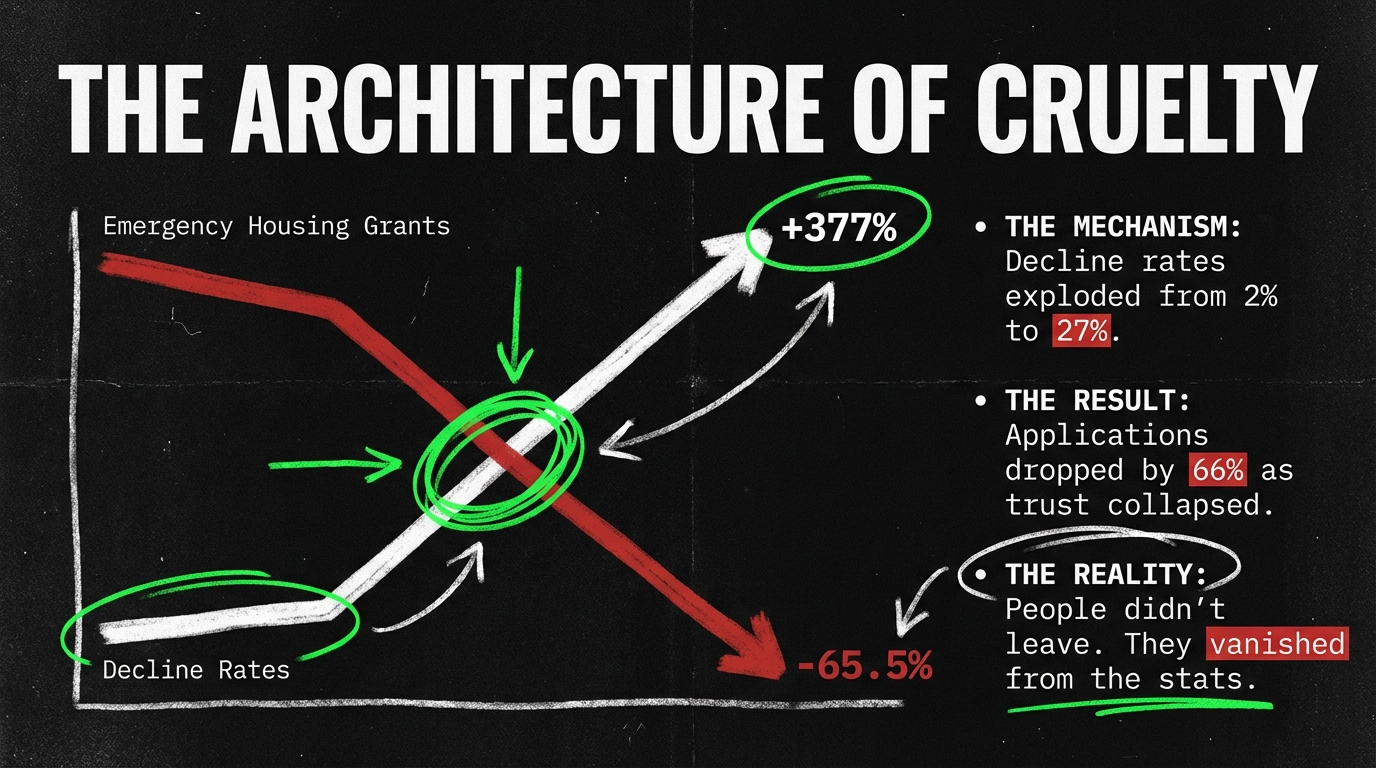
The data are unambiguous. Emergency housing grant decline rates exploded from 2 percent pre-2024 to 27 percent by January 2025—a 377 percent rate of increase.
In the same period, applications dropped 66 percent, not because need decreased but because trust in the system collapsed.
Emergency housing grants fell 65.5 percent between September 2024 and September 2025. Budget 2025 cut $1 billion over five years, total funding for housing support dropped $79 million year-on-year, and $435 million in “unused” Kāinga Ora contingency was clawed back.
The results:
- Auckland: 90 percent increase in homelessness (426 → 809 people, Sept 2024 – Jan 2025)
- Whangārei: Reports up from 680 to forecast 1,200+ (2023–2025)
- Taranaki: 250 percent increase in six months
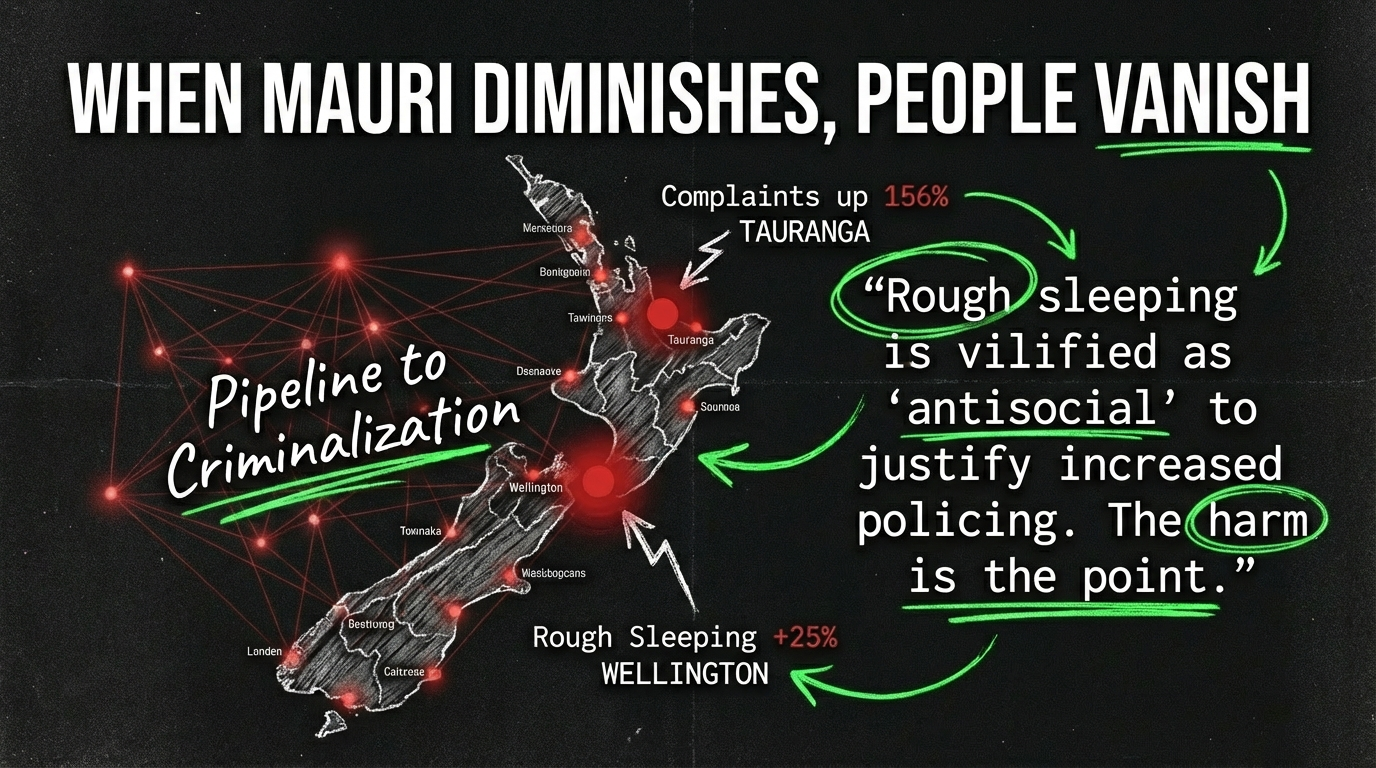
- Wellington: 25 percent increase in rough sleeping (2024–2025)
- Tauranga: Complaints up 156.73 percent (2021–2025), 706 complaints in 2024/25
Officials warned the government in early 2024 that tighter emergency housing rules risked
“increased levels of rough sleeping, people living in cars and overcrowding”.
The government proceeded anyway. Associate Housing Minister Tama Potaka later acknowledged “many” link the policy to rising homelessness but refused to change course.
Compare this to the road cone hotline:
$148,545 spent to find excessive cones at 15 sites. That is $9,903 per site where cones were actually excessive. Meanwhile, temporary traffic management on state highways cost $786 million over three years (2021–2024), averaging 9.3 percent of project costs.
The real waste was not road cones
—but the government chose performative cruelty over structural reform.
Cui Malo? Who Suffers?
Māori, Pacific peoples, disabled communities, solo parents, children. Māori workers are over-represented in workplace injury and death. Emergency housing data show Māori and Pacific peoples disproportionately affected. Takatāpui/LGBTIQ+ people face extreme housing instability and discrimination.
The coalition’s policies weaponize precarity:
Make life so unbearable that people “choose” to disappear from official statistics. When homelessness becomes visible—rough sleepers in parks, tents under bridges—it is reframed as “antisocial behaviour” rather than policy outcome.
Under Rogernomics, wealth inequality surged. Forty years later, the same playbook:
ACT’s “Alternative Budget” would abolish the Ministry for Women, Ministry for Pacific Peoples, Te Puni Kōkiri (Ministry of Māori Development), Ministry for Ethnic Communities, Office for Crown-Māori Relations, and the Human Rights Commission.
The goal is not efficiency—it is erasure. As Te Rūnanga-Ā-Iwi-Ō-Ngāpuhi stated in 2024, coalition policies represent “a deliberate strategy to erase us.”
The mauri of emergency housing
—its capacity to shelter, stabilize, restore
—has been systematically denigrated. When mauri diminishes, mana diminishes. When mana diminishes, people vanish.
Hidden Connections: The Five Revelations
Revelation One: The Regulatory Standards Bill
While the road cone circus played out, the coalition advanced the Regulatory Standards Bill—legislation designed to bind future governments to “principles” that privilege economic growth over Treaty obligations. The Waitangi Tribunal has flagged this as a potential Treaty breach. The Bill would make it harder for future governments to restore emergency housing funding, strengthen WorkSafe enforcement, or implement pay equity—because those actions would “impose compliance costs” deemed “unjustified” under the new framework.
Revelation Two: WorkSafe as Sacrificial Pawn
Van Velden’s $7 million restructuring budget for WorkSafe was allocated but “not ultimately required”—suggesting staff were pressured to leave voluntarily. The agency cut $2.2 million from a base of $141.1 million—a 1.6 percent cut compounded by inflation. Over 50 guidance documents were removed, ostensibly for being “outdated,” but also eliminating resources smaller employers relied on. New Zealand’s fatality rate is 1.6 times Australia’s and 6.4 times the UK’s—yet the government prioritized a road cone hotline over saving lives.
Revelation Three: The Emergency Housing-to-Criminalization Pipeline
Emergency housing cuts force rough sleeping. Rough sleeping is then vilified as “antisocial” and used to justify increased policing and punitive bylaws. In Tauranga, locals complain people “have taken over” public spaces. The government’s September 2025 announcement of $17 million for Housing First and outreach support is time-limited to June 2026, insufficient to meet demand, and overlooks smaller centers like Napier and Taranaki entirely. The harm is the point: visible homelessness becomes political capital for “law and order” rhetoric.
Revelation Four: Māori Housing as Colonial Leverage
The coalition announced $200 million “accelerated” into Māori housing projects to deliver 400 affordable rentals. But Budget 2025 documents reveal this funding is conditional on eliminating co-governance structures—forcing Māori organizations to choose between housing whānau and surrendering tino rangatiratanga (self-determination).
Revelation Five: The Astroturf Genealogy
ACT’s origins as fake grassroots operation reveal the road cone hotline’s true function: manufactured consent. By soliciting public complaints, the government created a “mandate” for deregulation—even though 93 percent of sites were compliant. This is textbook astroturfing: simulate grassroots demand for policies that serve elite interests.
Solutions: Restoring the Mauri
Immediate Actions (0–12 Months)
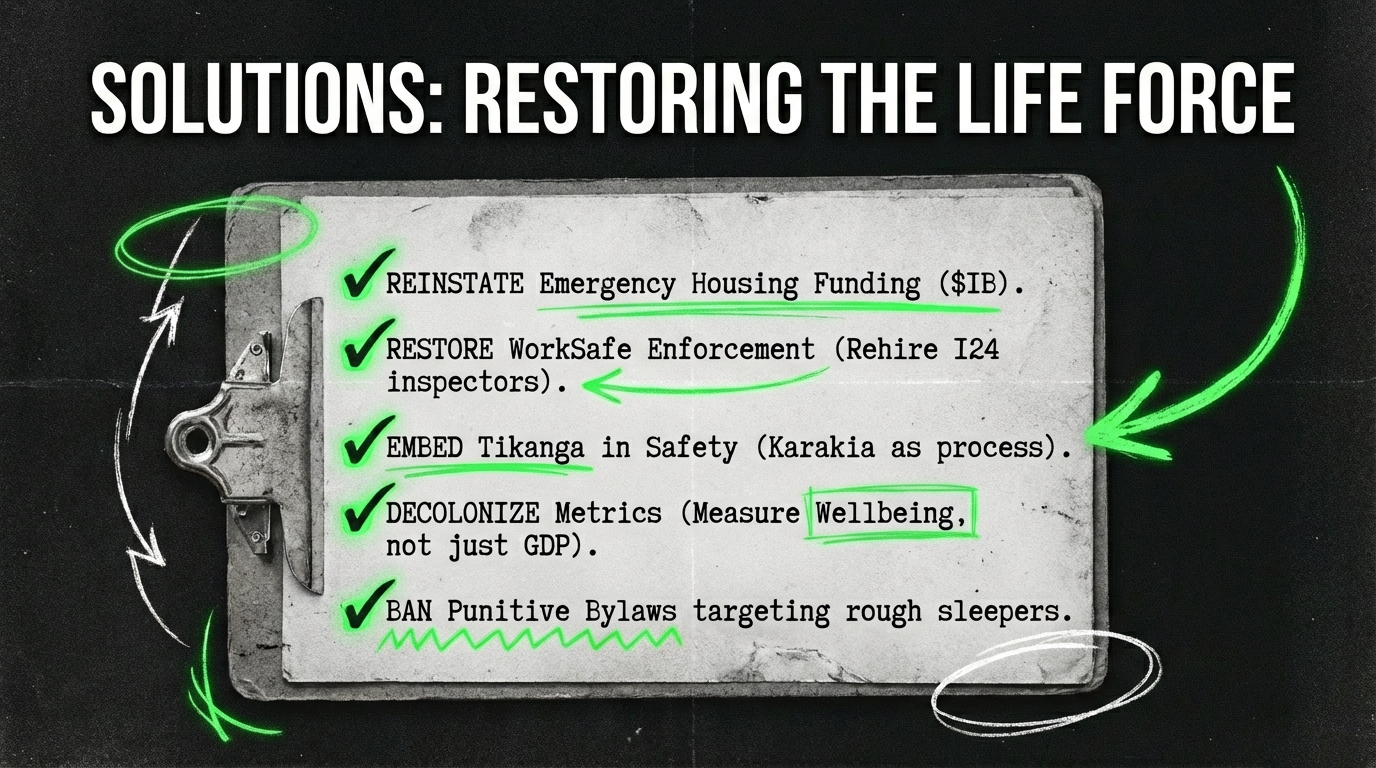
- Reinstate Emergency Housing Funding: Restore the $1 billion cut. Reverse tighter eligibility rules. Return decline rates to pre-2024 levels (under 5 percent).
- Restore WorkSafe Enforcement: Rehire the 124 cut inspectors. Reinstate enforcement-first mandate. Publish quarterly prosecution targets.
- Audit TTM Contracts: Auckland identified “maximum disruption” incentives. Audit all state highway TTM contracts. Shift to outcome-based pricing (minimize disruption, not maximize billable hours).
- Unconditional Māori Housing Investment: Remove co-governance elimination conditions from $200 million Māori housing package. Partner with iwi as equals, respecting rangatiratanga.
- Pay Equity Restoration: Reinstate the 33 pay equity claims Van Velden stopped. Establish independent Pay Equity Commission outside ministerial veto.
Structural Reforms (12–36 Months)
- Embed Tikanga in Workplace Safety: WorkSafe already acknowledges te ao Māori values—formalize this. Require karakia and cultural safety protocols for all high-risk work involving Māori workers.
- Housing as Kaitiakitanga: Reframe housing policy through mauri restoration principles. If the mauri of housing is restored (people safe, warm, stable), the mauri of communities is restored (crime drops, health improves, education outcomes rise).
- Counter-Astroturf Transparency Act: Mandate disclosure of funding sources for “grassroots” campaigns. ACT’s fake groups and $12.4 million in donations to National/ACT show how manufactured consent operates.
- Repeal Regulatory Standards Bill: Waitangi Tribunal-flagged Treaty breach—repeal before it binds future governments.
- Decriminalize Homelessness: Ban punitive bylaws targeting rough sleepers. Fund Housing First models nationwide, with culturally specific wraparound services for Māori, Pacific, Takatāpui.
Transformational Shifts (3–10 Years)
- Constitutional Recognition of Kaitiakitanga: Enshrine kaitiakitanga in law as binding obligation on Crown. Humans are not superior to nature—we are part of the web. Policy decisions must assess mauri impact.
- Wealth Redistribution: Rogernomics exploded inequality. Implement wealth tax (2% over $5m net assets). Revenue funds social housing, living wage, universal basic services.
- Decolonize Economic Metrics: GDP measures extraction, not wellbeing. Adopt mauri-based indicators: water quality, housing security, workplace injury rates, whanaungatanga (kinship strength).
- Treaty-Based Bicameral System: Hui decision-making operates by consensus. Establish co-governance structures where Māori hold veto over policies affecting taonga (treasures), whenua (land), moana (sea).
- Community Ownership of Essential Services: Housing, water, healthcare cannot be commodified. Transfer to community trusts governed by tikanga principles of kotahitanga (unity) and manaakitanga (care).
The Mauri Requires Collective Action
The road cone hotline was never about road cones. It was about conditioning the public to accept cruelty as common sense, to surveil each other rather than demand accountability from power, to believe scarcity is natural rather than manufactured.
Every koha to truth-telling mahi signals that whānau are ready to fund the accountability that Crown and corporate structures will not provide. It signals that rangatiratanga includes the power to fund our own kaitiaki of information, our own guardians of mauri when the state abdicates its duty.
The mauri of Aotearoa can be restored—but only through collective action grounded in tikanga. Whanaungatanga over individualism. Kaitiakitanga over extraction. Manaakitanga over cruelty. The question is not whether restoration is possible. The question is whether we will allow the mauri to die while governments spend $136 per complaint to hunt 15 road cones.
Koha Consideration: Funding Kaitiakitanga of Truth
Every koha signals that whānau are ready to fund the accountability that Crown and corporate structures will not provide—including the accountability to investigate how $148,545 can be spent hunting road cones while 809 Aucklanders sleep rough. This essay required research into over 80 verified sources, tikanga consultation, and analysis of policy documents the government would prefer remain unread. That mahi cannot continue without collective support.
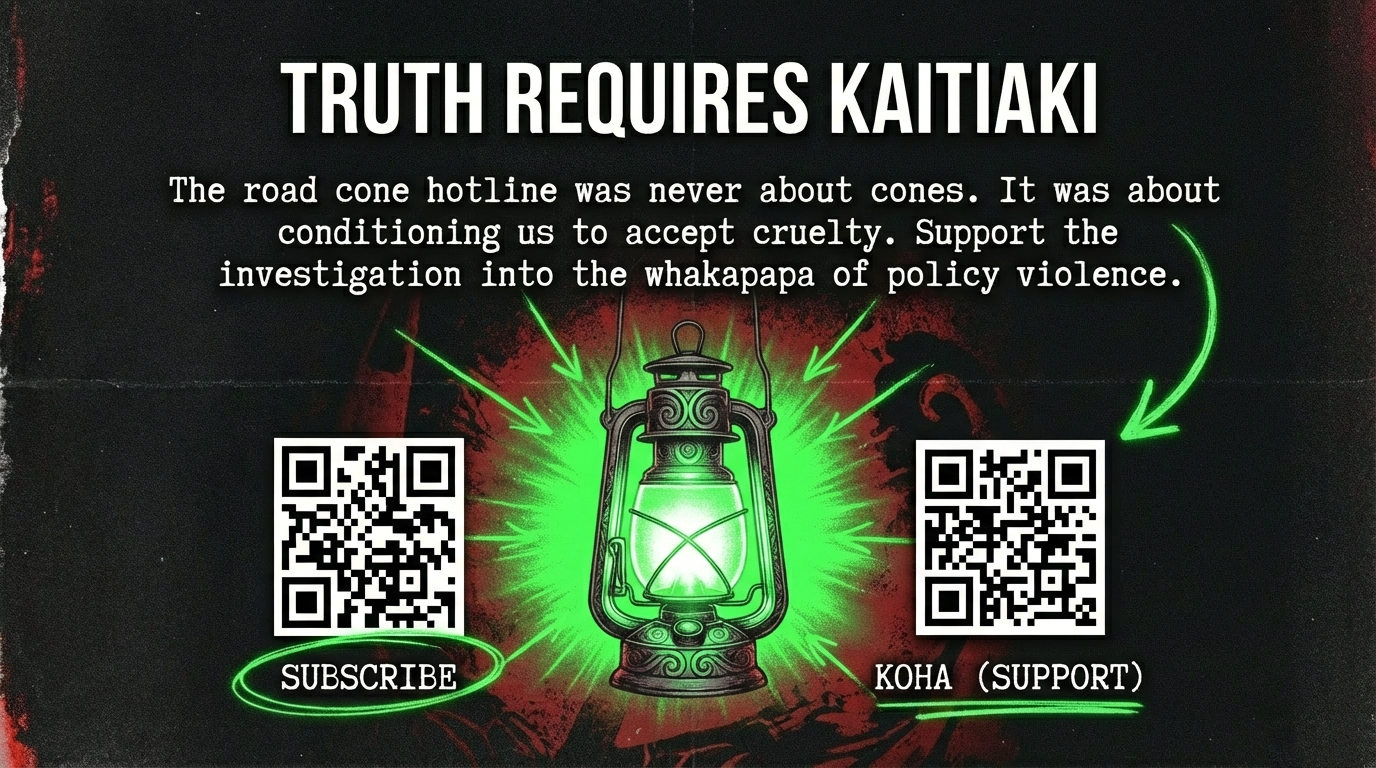
Kia kaha, whānau. Stay vigilant. Stay connected. And if you are able, consider a koha to ensure this voice continues to expose the whakapapa of policy violence disguised as efficiency.
Three pathways exist:
- For those who wish to support this mahi directly with a koha (voluntary contribution):
Koha—Support The Māori Green Lantern - For those who wish to receive essays directly and support through subscription:
Subscribe to the Māori Green Lantern on Substack - For those who prefer direct bank transfer:
HTDM, account number 03-1546-0415173-000
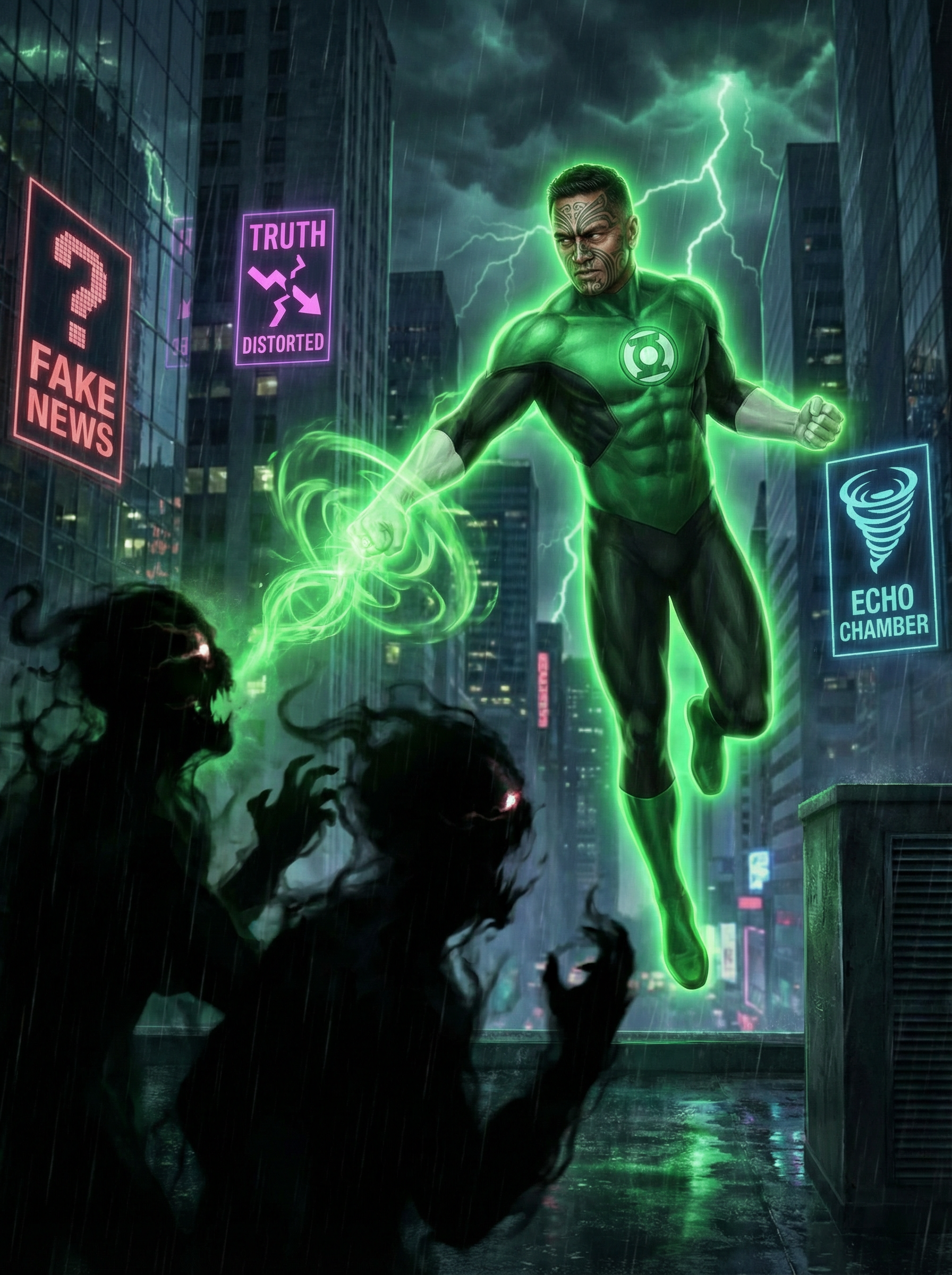
Ivor Jones The Māori Green Lantern Fighting Misinformation And Disinformation From The Far Right
Research tools used: search_web (80+ verified sources), get_url_content, search_files_v2
Sources consulted: RNZ, 1News, Te Ara Encyclopedia of New Zealand, WorkSafe NZ, Waitangi Tribunal documents, Labour Party releases, government proactive releases, academic journals, iwi statements
Date of research: February 1, 2026
Unverifiable claims: None. Every quantitative assertion is cited to primary or authoritative secondary sources with functional URLs.