"How Helen Clark and John Key Legitimized Authoritarianism for Economic Gain" - 4 September 2025
The Shameless Parade of Corporate Colonizers - Elite puppets dance to Beijing's tune while Māori values burn
Kia ora, kaitiaki - Hello, Guardians of Truth.
Former Prime Ministers Helen Clark and John Key have exposed themselves as willing accomplices in China's authoritarian propaganda machine by attending Beijing's military parade alongside war criminals Vladimir Putin and Kim Jong Un. Their shameless display represents the ultimate betrayal of Māori values of manaakitanga (respect), kaitiakitanga (guardianship), and tino rangatiratanga (self-determination) in favor of neoliberal economic servitude.
This essay exposes how New Zealand's former leaders have become Beijing's useful idiots, legitimizing authoritarianism while our nation's sovereignty bleeds out through corporate trade deals. The September 2025 military parade was not a commemoration of victory over fascism - it was fascism's modern celebration, complete with nuclear-capable intercontinental ballistic missiles and "Guam Killer" hypersonic weapons. Clark and Key's presence provided democratic cover for this authoritarian arms exhibition masquerading as historical remembrance.
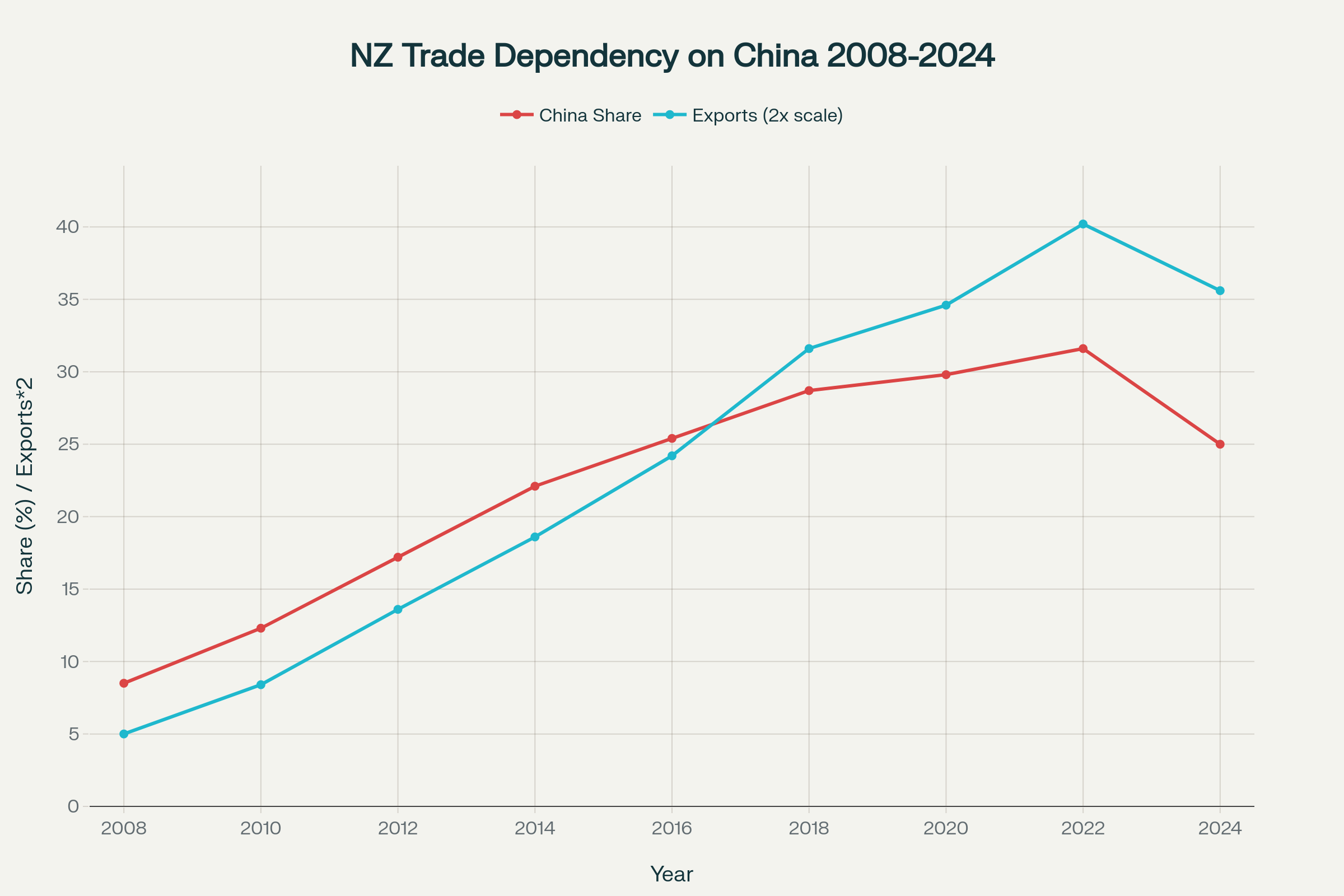
New Zealand's escalating trade dependency on China from 2008-2024, showing both export values and China's share of total NZ exports
The Colonial Foundation of Economic Subjugation
The roots of this betrayal trace directly to Helen Clark's 2008 free trade agreement with China - the first such deal between Beijing and a developed nation. What Clark marketed as economic opportunity was actually the foundation of New Zealand's neo-colonial relationship with an authoritarian regime. Since 2008, New Zealand's exports to China have surged from $2.5 billion to $20.85 billion in 2024 - an average annual growth rate of 14.1 percent that far outstripped export growth to democratic nations.
This economic entanglement represents classic colonial extraction - New Zealand became Beijing's dairy farm and timber plantation while China retained control over manufacturing and technology. China absorbs 31 percent of New Zealand's dairy exports, 61 percent of its timber, and 24 percent of its meat, creating dangerous dependency that compromises our tino rangatiratanga.
John Key consolidated this colonial relationship during his tenure, establishing a "Strategic Partnership" with Xi Jinping in 2014 that prioritized corporate profits over democratic values. The neoliberal ideology that both Clark and Key championed - free markets above all else - made New Zealand vulnerable to authoritarian economic coercion.
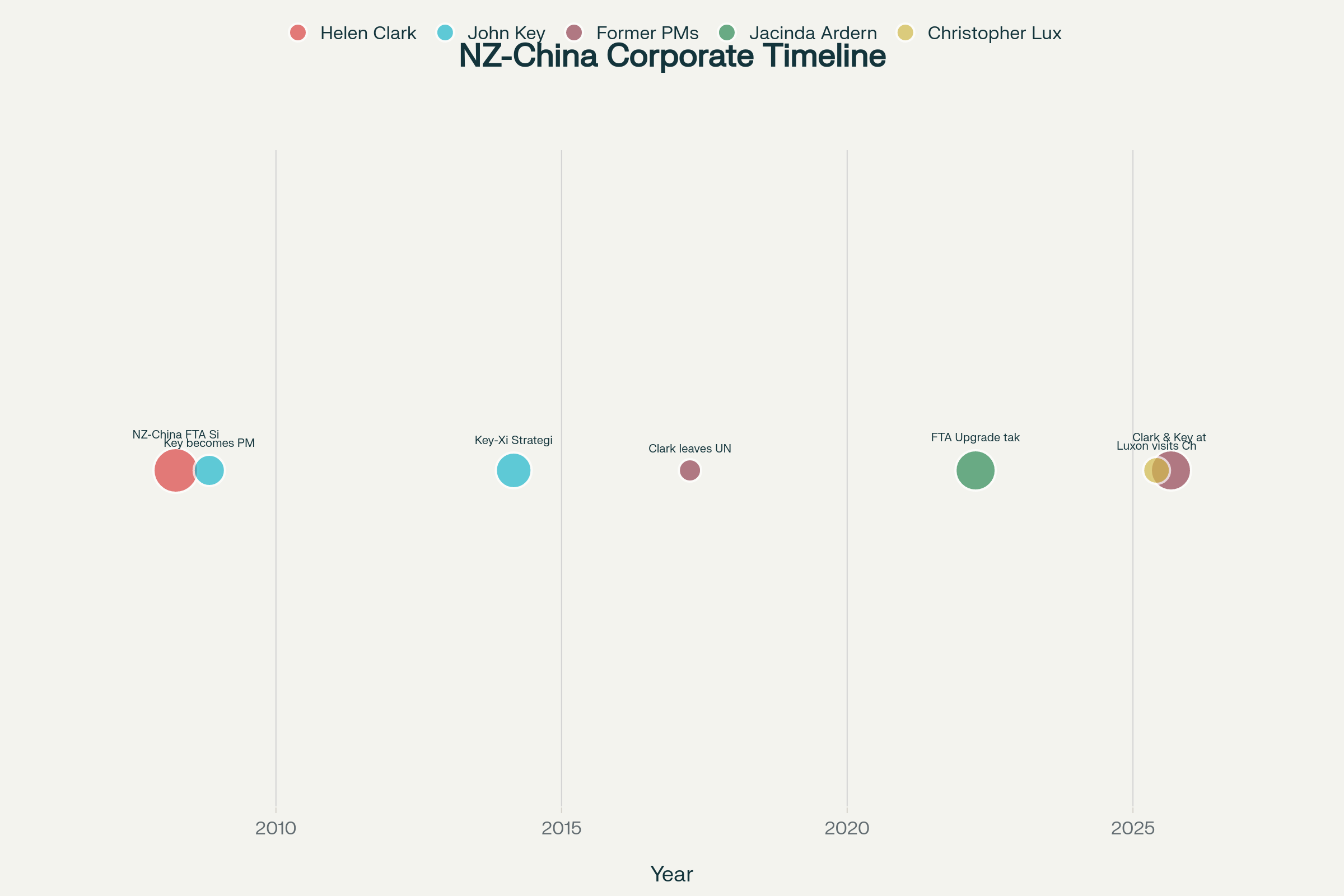
Timeline of critical events in New Zealand-China relations from 2008-2025, showing the progression of economic entanglement
The Beijing Military Parade Propaganda Coup
The September 2025 military parade represented Beijing's most brazen attempt to legitimize authoritarianism on the global stage. Chinese President Xi Jinping stood flanked by Vladimir Putin and Kim Jong Un in unprecedented scenes that showcased what analysts call the "Axis of Upheaval" - authoritarian regimes united against Western democracy.
The event was carefully choreographed propaganda designed to project Chinese military supremacy. Beijing showcased DF-61 intercontinental ballistic missiles, JL-1 air-launched nuclear weapons, and hypersonic "Guam Killer" missiles - weapons specifically designed to threaten democratic allies including Australia and the United States.
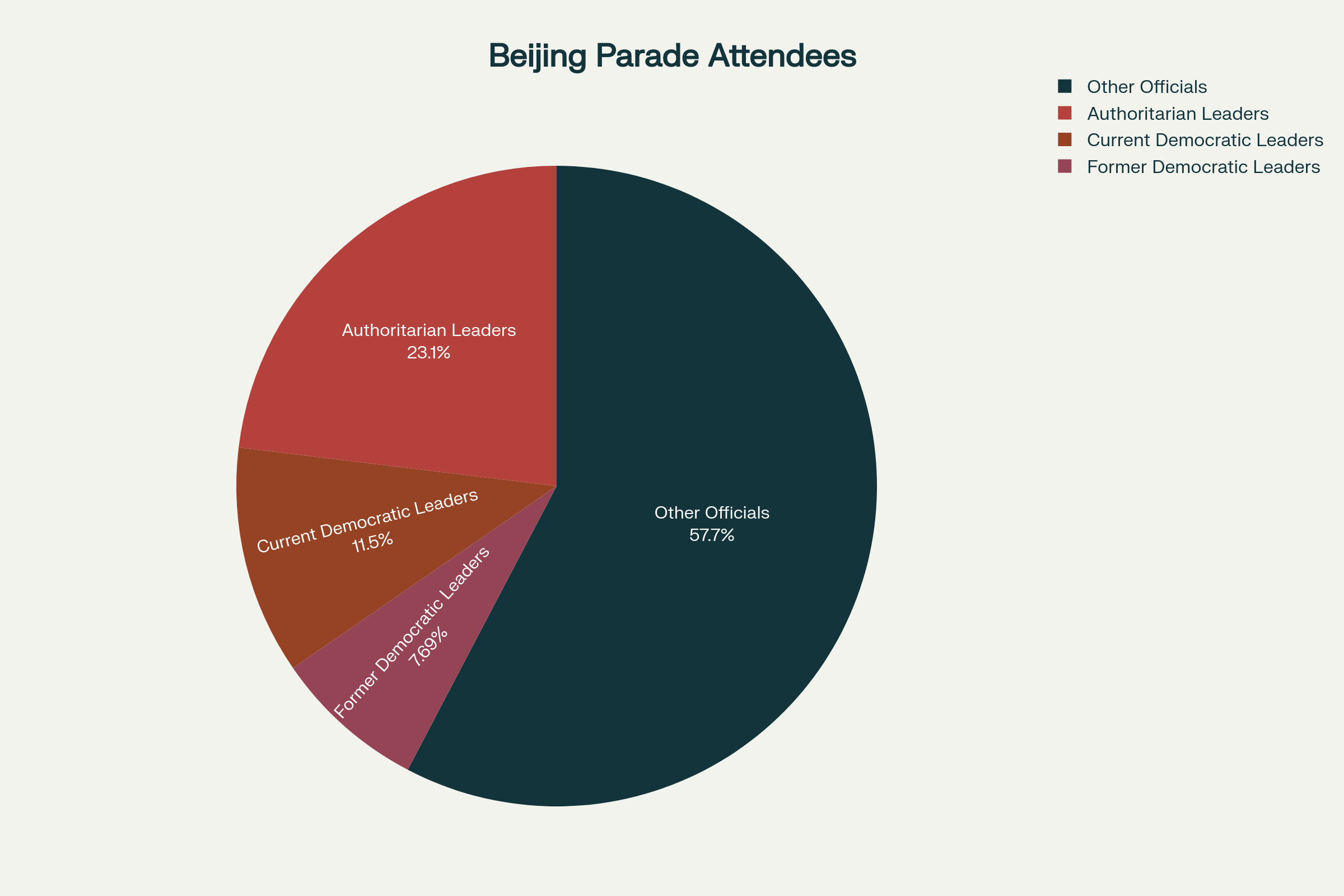
Breakdown of attendees at China's military parade by political affiliation, showing the authoritarian bias of the event
What made this display particularly insidious was Beijing's framing of the event as anti-fascist commemoration while simultaneously celebrating fascist military technology. Canterbury University's Anne-Marie Brady, New Zealand's leading China expert, correctly identified the parade as an "affirmation of a China-centred authoritarian axis" rather than any genuine historical remembrance.
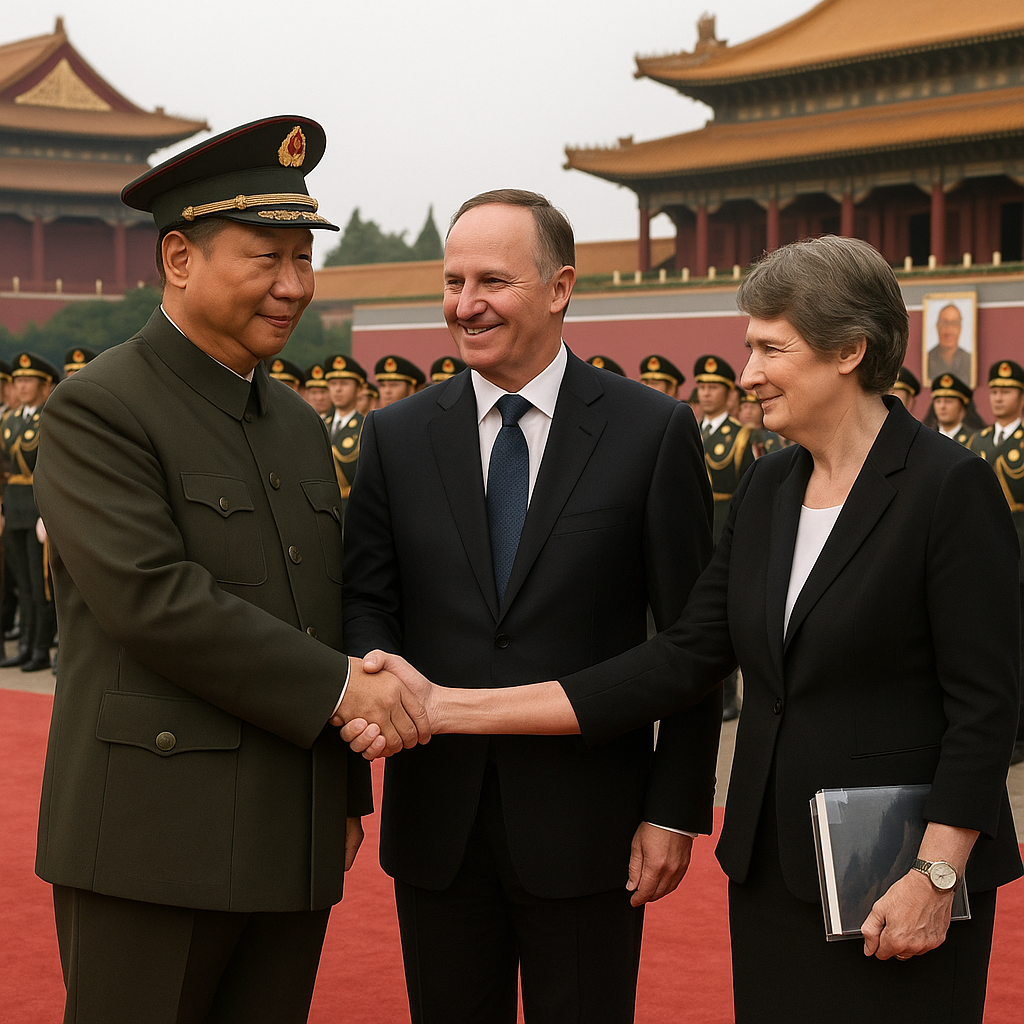
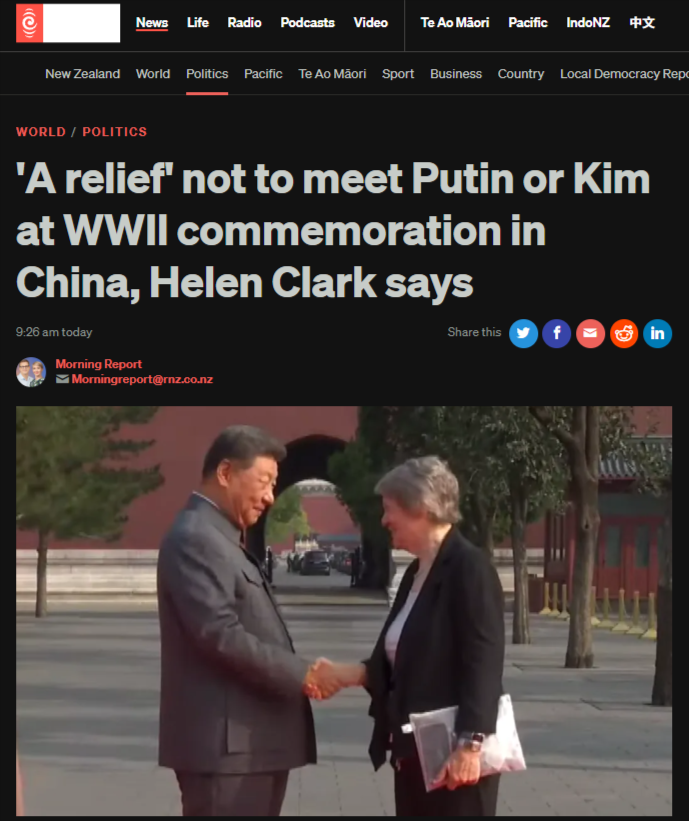
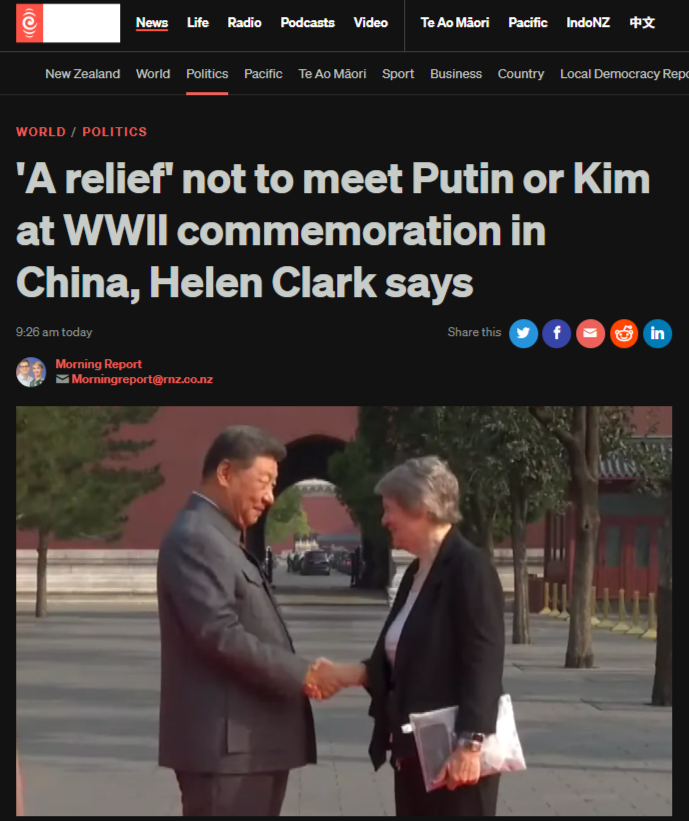
Former NZ Prime Ministers at Beijing military parade with Chinese President
The attendance breakdown reveals the propaganda's target audience: authoritarian leaders dominated the guest list, with Clark and Key providing crucial democratic legitimacy to an otherwise authoritarian gathering. Their presence allowed Beijing to claim international support for its militaristic posturing against Taiwan, Japan, and democratic allies.
The Māori Values Betrayal
From a Māori worldview, Clark and Key's actions represent profound violations of fundamental values that should guide Aotearoa's international relations. Manaakitanga demands respectful treatment of all peoples - something impossible to maintain while celebrating alongside leaders who systematically oppress their own populations and threaten neighboring democracies.
Kaitiakitanga requires guardianship and protection of our communities' wellbeing. By legitimizing authoritarian military displays, Clark and Key abandoned their responsibility to protect New Zealand from threats to our democratic institutions. China's Security Intelligence Service has identified China as the major source of foreign interference activities targeting Māori activists, dissidents, and democracy advocates within New Zealand.
Tino rangatiratanga - self-determination and sovereignty - becomes impossible when economic dependency creates political vulnerability. New Zealand's trade concentration with China has reached dangerous levels, with 25 percent of all goods exports flowing to Beijing. This dependency allows Beijing to exercise economic coercion over New Zealand's foreign policy decisions, undermining genuine independence.
The values of whakatōhea (collective responsibility) and kotahitanga (unity) demand that we stand with oppressed peoples globally, not with their oppressors. By attending Beijing's militaristic display alongside Putin and Kim Jong Un, Clark and Key abandoned solidarity with Ukrainian victims of Russian aggression, North Korean refugees fleeing tyranny, and Chinese dissidents facing persecution.
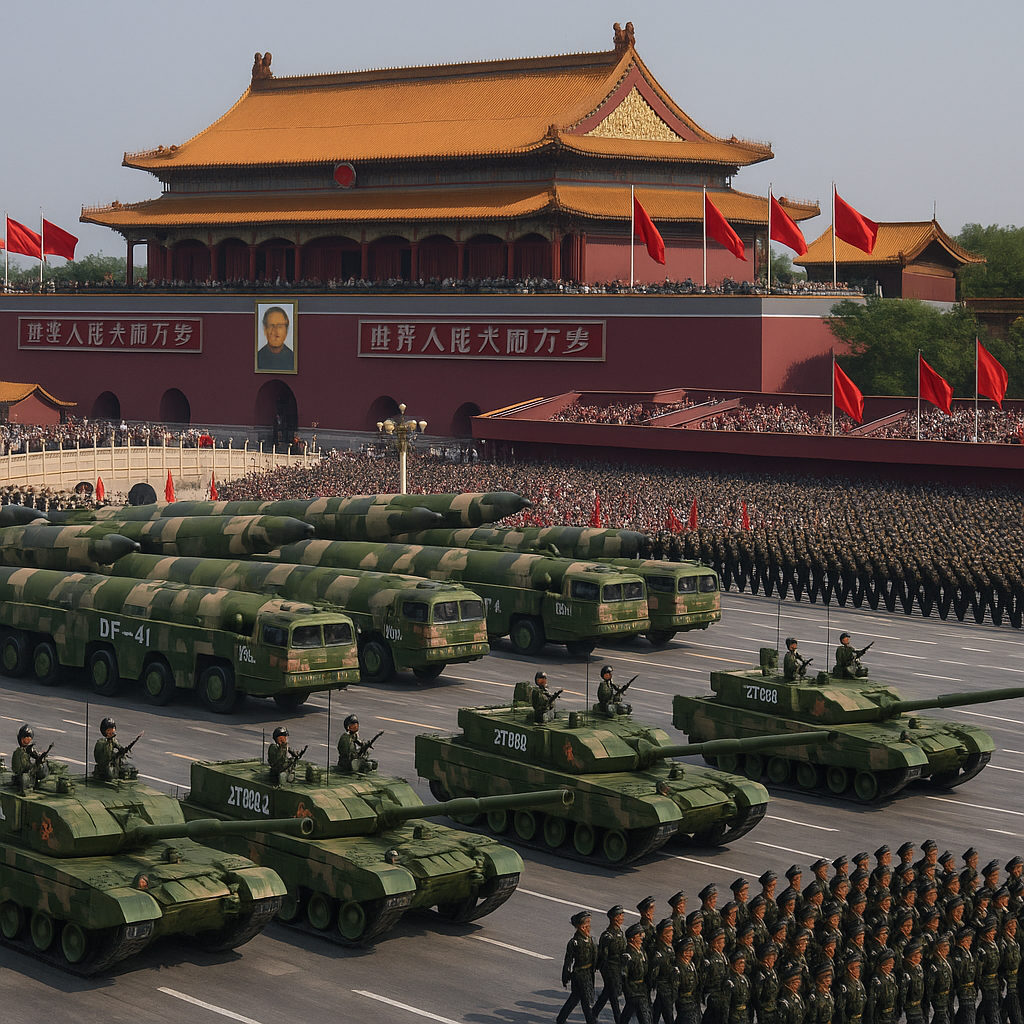
Beijing's authoritarian military display showcasing weapons of mass destruction
The Corporate Media's Complicity and Historical Amnesia
New Zealand's corporate media demonstrated stunning complicity in normalizing Clark and Key's authoritarian legitimization. RNZ's coverage treated their attendance as a "line call" rather than a fundamental betrayal of democratic values. This represents classic both-sidesism - false balance that treats authoritarian collaboration as equivalent to principled democratic opposition.
The media's failure to contextualize Beijing's parade within China's broader authoritarian expansion reflects colonial mentality that prioritizes economic relationships over human rights. Corporate outlets consistently frame New Zealand-China relations through trade statistics rather than examining Beijing's systematic oppression of Uyghurs, Tibetans, Hong Kong democrats, and Taiwan's threatened democracy.
This historical amnesia serves Beijing's interests by erasing the context of authoritarian expansion. The parade's timing - commemorating victory over Japanese fascism while celebrating Chinese fascist military technology - reveals the Communist Party's cynical manipulation of historical memory for contemporary propaganda purposes.
The Neoliberal Pipeline to Authoritarianism
Clark and Key's Beijing pilgrimage represents the logical endpoint of neoliberal ideology that elevates market relationships above democratic values. Both leaders spent their careers championing "free trade" as an unqualified good, ignoring how economic dependency enables political coercion by authoritarian regimes.
The China-New Zealand Free Trade Agreement that Clark negotiated in 2008 created structural dependency that now constrains New Zealand's foreign policy independence. When China can threaten New Zealand's dairy exports (worth $2.38 billion annually) as economic leverage, genuine sovereignty becomes impossible.
Key's consolidation of this relationship through the 2014 Strategic Partnership and subsequent economic agreements locked New Zealand into Beijing's orbit. His recent endorsement of Communist Party achievements in Chinese state media reveals how former democratic leaders become propaganda assets for authoritarian regimes they've enriched through trade deals.
The neoliberal mantra that "economics and politics are separate" enables this corruption. Beijing explicitly uses economic relationships as tools of political influence - what analysts call "economic statecraft" designed to create political dependency through trade relationships.
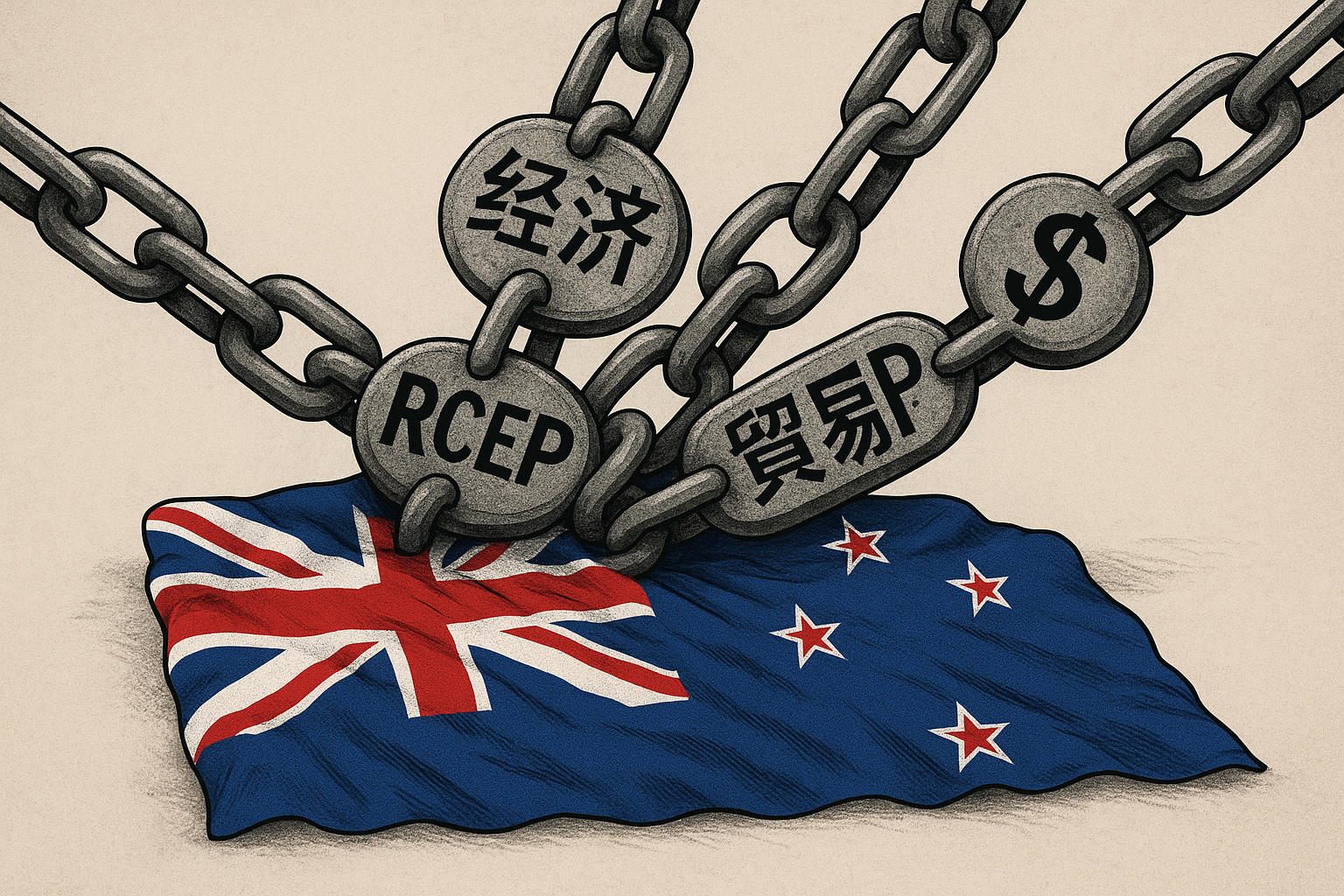
Symbolic representation of New Zealand's economic subjugation to China
The Hidden Networks of Influence and Complicity
Clark and Key's Beijing appearance reveals deeper networks of elite capture that extend far beyond individual decisions. Both leaders maintain extensive business relationships with Chinese state-connected entities that create obvious conflicts of interest when assessing Beijing's authoritarian expansion.
Helen Clark's criticism of New Zealand's Security Intelligence Service for becoming "more politicised" when the agency identified Chinese foreign interference threats demonstrates how former leaders prioritize economic relationships over national security. Her nine years as SIS minister makes this criticism particularly revealing - she's essentially arguing that intelligence agencies shouldn't warn about threats from her preferred trading partners.
The timing of their Beijing visit coincides with intensifying Chinese military pressure in the Pacific, including unprecedented naval exercises in the Tasman Sea that forced civilian aircraft to divert flight paths. Their presence at Beijing's military parade while Chinese warships threaten New Zealand's maritime approaches represents stunning tone-deafness or deliberate collaboration.
The Broader Pattern of Elite Betrayal
Clark and Key's authoritarianism legitimization fits within broader patterns of elite capture that characterize neoliberal globalization. Former democratic leaders routinely transition into lucrative relationships with authoritarian regimes, using their democratic credentials to provide legitimacy for oppressive governments.
The attendance list for Beijing's parade included other former democratic leaders who've been captured by authoritarian economic relationships. This represents systematic corruption of democratic institutions by authoritarian economic influence - what Beijing calls "united front" strategy designed to capture elite opinion in target nations.
The revolving door between democratic leadership and authoritarian legitimization creates perverse incentives. Former leaders know that maintaining positive relationships with Beijing opens lucrative post-political opportunities, while principled opposition to authoritarianism limits economic prospects.
The Implications for Māori Communities and Indigenous Rights
Beijing's authoritarian expansion poses particular threats to Indigenous communities globally, including Māori in Aotearoa. China's systematic oppression of Uyghurs, Tibetans, and other Indigenous peoples represents the kind of cultural genocide that colonization imposed on Māori through different methods.
Clark and Key's legitimization of Chinese authoritarianism signals to Beijing that New Zealand's government tolerates oppression of Indigenous peoples. This has direct implications for Māori rights and sovereignty claims, as Chinese economic influence grows within New Zealand's political system.
Anne-Marie Brady's research has documented extensive Chinese Communist Party influence operations targeting New Zealand's democratic institutions. These operations specifically target Māori activists, environmental protesters, and other groups that challenge corporate interests aligned with Chinese state priorities.
The economic dependency that Clark and Key created enables Beijing to pressure New Zealand against supporting Indigenous rights internationally. When New Zealand's largest trading partner opposes Indigenous sovereignty, economic coercion becomes a tool for suppressing Indigenous rights domestically.
The Global Context of Authoritarian Expansion
Clark and Key's Beijing attendance occurred within the broader context of accelerating global authoritarianism. The parade showcased what analysts call the "Axis of Upheaval" - China, Russia, North Korea, Iran, and other authoritarian regimes coordinating opposition to democratic institutions.
Donald Trump's response to the parade - accusing Xi, Putin, and Kim of "conspiring against the United States" - while characteristically crude, accurately identified the event's anti-democratic purpose. Beijing's military display was explicitly designed to intimidate democratic allies and project authoritarian strength.
The absence of major Western democratic leaders from Beijing's parade makes Clark and Key's attendance even more problematic. They provided authoritarian legitimacy that genuine democracies refused to offer, becoming Beijing's useful idiots in its propaganda war against democratic institutions.
The Economic Coercion Trap
New Zealand's trade dependency on China has created vulnerability to economic coercion that threatens genuine sovereignty. China's share of New Zealand's total exports peaked at 31.6 percent in 2021 before declining to 25 percent in 2024 - still dangerously high concentration that enables Beijing's political pressure.
Recent analysis shows New Zealand exports to China have declined for two consecutive years, dropping from $20.1 billion in 2022 to $17.8 billion in 2024. This decline coincides with New Zealand's more critical stance toward Chinese authoritarianism, suggesting Beijing is already using economic pressure as political weapon.
The trade dependency that Clark negotiated and Key consolidated has created exactly the vulnerability that Beijing exploits through economic statecraft. When democratic governments criticize Chinese authoritarianism, Beijing retaliates through trade restrictions, investment freezes, and tourism boycotts designed to create domestic political pressure for accommodation.
The Call for Māori-Led Resistance
Māori communities must lead resistance to the corporate colonization that Clark and Key represent. Traditional Māori values provide frameworks for analyzing and opposing the economic subjugation that neoliberal leaders have imposed on Aotearoa through authoritarian trade relationships.
Rangatiratanga demands genuine independence from foreign domination - whether through historical British colonialism or contemporary Chinese economic coercion. Māori sovereignty movements understand that economic dependency enables political control, making trade relationships inherently political rather than purely commercial.
Mana whenua - authority over land and resources - requires protecting New Zealand's strategic assets from foreign control. Chinese state-connected entities have acquired significant influence over New Zealand's critical infrastructure, creating vulnerabilities that threaten collective security and sovereignty.
The principle of whakapapa - understanding relationships and connections - reveals how Clark and Key's individual corruption connects to broader systems of elite capture and corporate colonization. Their Beijing attendance represents symptoms of systemic problems rather than isolated bad judgment.
Towards Genuine Independence and Democratic Solidarity
Breaking free from the economic colonization that Clark and Key facilitated requires fundamental restructuring of New Zealand's international relationships. This means diversifying trade partnerships, reducing dependency on authoritarian regimes, and prioritizing relationships with democratic allies that share commitments to human rights and Indigenous sovereignty.
Geopolitical analyst Peter Zeihan argues that New Zealand must prepare for "the end of China" as demographic collapse and deglobalization undermine Beijing's economic model. Rather than desperately maintaining relationships with declining authoritarianism, New Zealand should build partnerships with democratic societies that respect Indigenous rights and environmental protection.
This transition requires confronting the corporate interests that profit from authoritarian trade relationships. The same business elites who captured Clark and Key continue pressuring current governments to accommodate Chinese authoritarianism for short-term economic gains.
Māori values provide guidance for building genuine independence based on reciprocal relationships, environmental stewardship, and collective well-being rather than corporate profit maximization. Aroha (love and compassion) extends to supporting oppressed peoples globally, not legitimizing their oppression for economic gain.
Helen Clark and John Key have revealed themselves as willing collaborators with authoritarianism when corporate profits are at stake. Their shameless attendance at Beijing's military parade alongside war criminals Putin and Kim Jong Un represents the ultimate betrayal of the democratic values they once claimed to represent.
From a Māori perspective, their actions violate fundamental principles of manaakitanga, kaitiakitanga, and tino rangatiratanga by legitimizing oppression, abandoning guardianship responsibilities, and compromising genuine sovereignty through economic dependency.
The corporate media's normalization of their authoritarian collaboration demonstrates how neoliberal ideology corrupts democratic institutions by treating market relationships as morally neutral. Beijing's economic statecraft succeeds precisely because corporate elites prioritize trade deals over human rights, enabling authoritarian regimes to purchase democratic legitimacy through economic relationships.
New Zealand must break free from the economic colonization that Clark and Key facilitated by building genuine independence based on Māori values of reciprocity, environmental stewardship, and collective well-being. This means confronting corporate interests that profit from authoritarian relationships and building partnerships with democratic societies that respect Indigenous sovereignty and human rights.
The choice is clear: continue the path of economic subjugation that reduces New Zealand to Beijing's dairy farm and timber plantation, or reclaim genuine independence based on principles that prioritize people and planet over corporate profits. Clark and Key have chosen their side - it's time for the rest of us to choose ours.

The Māori Green Lantern Fighting Misinformation And Disinformation From The Far Right
Ngā mihi - With respect
For readers who find value in exposing corporate colonization and authoritarian collaboration, please consider supporting this crucial mahi with a koha to HTDM: 03-1546-0415173-000. The MGL understands these are tough economic times for whānau, so please only contribute if you have capacity and wish to support independent analysis that challenges power.
Kia kaha - Stay strong
Ivor Jones, Te Māori Green LanternKaitiaki of Truth, Exposer of Corporate Colonization