“How Indigenous Media Sustains Itself Through Reciprocal Manaakitanga” - 19 November 2025
Ko Au Te Whenua, Ko Te Whenua Ko Au

Ivor Jones The Māori Green Lantern Fighting Misinformation And Disinformation From The Far Right
The Māori Green Lantern operates on a principle that challenges everything Western capitalism teaches about media monetization. By refusing the paywall, it proves what indigenous economies have always known: that the most sustainable systems are built on reciprocal generosity, not extraction.
Slicing the Taiaha: Cui Bono, Cui Malo
The question cuts straight to power: Who benefits from free access to forensic analysis of colonial dispossession? And who suffers when indigenous knowledge is paywalled?
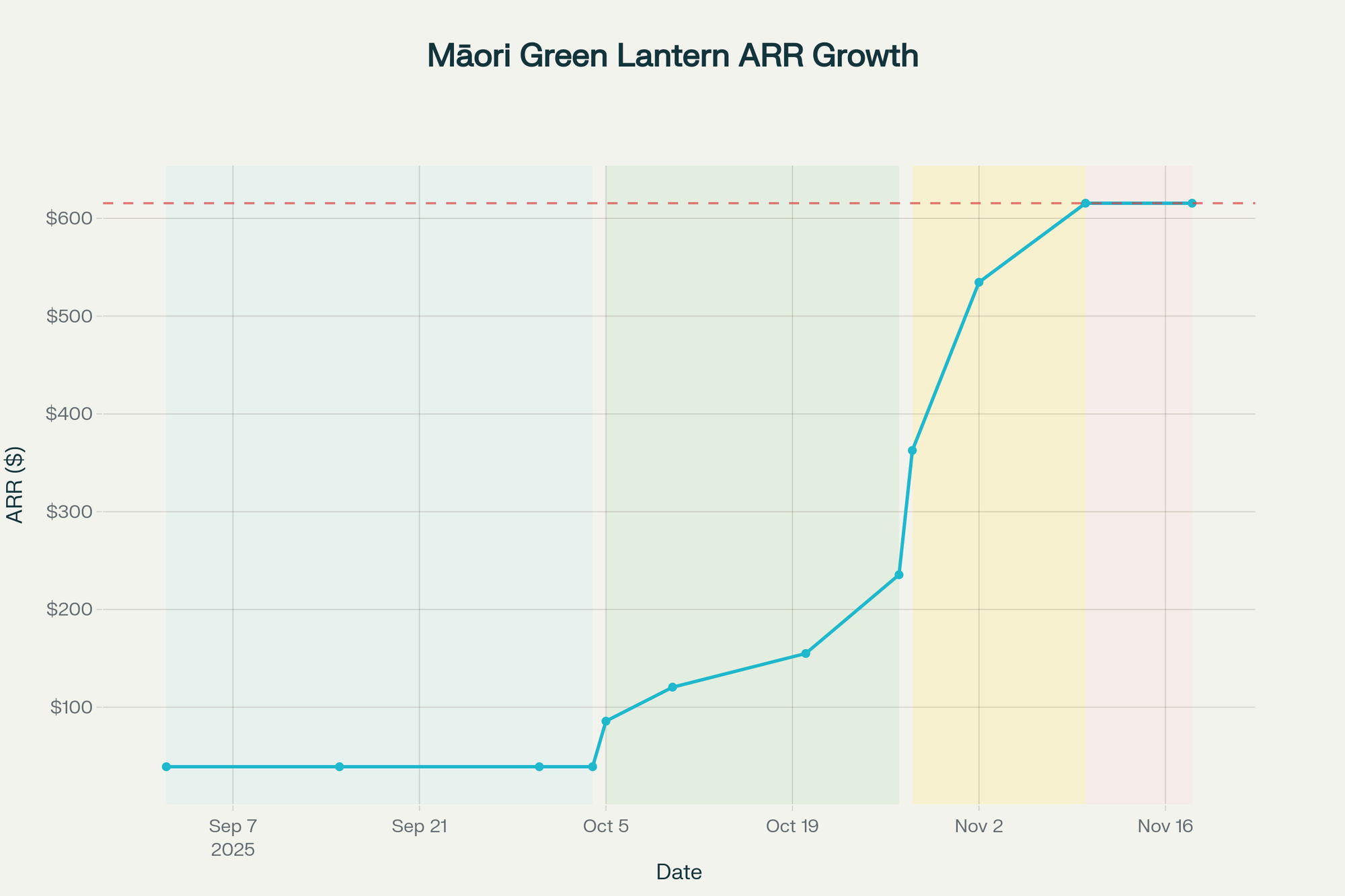
For 77 days—September 2 to November 18, 2025—The Māori Green Lantern has published 520 essays documenting the whakapapa of power: how constitutional fraud operates, how surveillance colonizes te moana, how fiscal envelopes cap Treaty settlements, how corporate capture dismantles co-governance. The reach is staggering: 25,680 monthly views, growing 29.3% month-over-month, 206 subscribers across Aotearoa and internationally.
Yet only 5 people (2.4%) pay for this analysis. The remaining 201 (97.6%) access it freely.
This is not a failure of monetization. This is the koha paradigm working exactly as intended.
Te Kauwae Runga (The Unseen Forces) & Te Raro (Tangible Harm)
The Western Media Model: Extraction Through Scarcity
Traditional capitalist media creates artificial scarcity to force monetization. The paywall assumes:
if readers cannot access information free elsewhere, they will pay for it. This logic works for entertainment, lifestyle content, opinion pieces.
But when information concerns your own dispossession, the paywall becomes an instrument of that dispossession.
Indigenous peoples are systematically locked out of understanding the mechanisms that harm them—not by lack of information, but by economic barriers to access. A whānau struggling with poverty cannot pay $10/month for analysis of why they’re poor. A hapū fighting land dispossession cannot afford subscriptions to understand legal frameworks being weaponized against them.
The paywall serves power: it restricts knowledge of power to those who can afford it.
The Koha Model: Reciprocal Access
The koha paradigm inverts this logic. Koha is a Māori custom translated as gift, present, offering, donation or contribution. As documented in Te Ara, the koha custom enables guests to show their appreciation and respond with equal generosity through gifts made to their hosts, traditionally presented formally during the pōwhiri. Today it is generally money, and the amount is determined by the donor’s ability and willingness to show their appreciation of the hospitality received.
This aligns with ancient Māori economic principles. Hirini Moko Mead writes in Tikanga Māori: Living By Māori Values (2003) that “all tikanga are underpinned by the high value placed on manaakitanga – nurturing relationships, looking after people, and being very careful about how others are treated”. The koha model operationalizes this at scale:
- Free access for all (rangatiratanga—self-determination includes knowledge of one’s own dispossession)
- Voluntary reciprocal support from those moved to sustain the work
- No gatekeeping between truth and those who need it most
- Relationship-based funding rather than transactional extraction
The paid subscribers who do reciprocate say it explicitly:
- “I support your mahi because it is deeply informative and I think more people should be reading your posts” — nailaboo13@gmail.com
- “I’ve never seen colonialism depicted like you do, so I’ve never quite been able to grasp the implications. Keep up the good work.” — Richard Watts
They are not paying to access paywalled content. They are reciprocating recognition of irreplaceable analysis.
Deconstructing the False Binary: Growth vs. Integrity
The Capitalist Narrative
Silicon Valley metrics demand conversion optimization: How do we turn 25,680 monthly viewers into paying subscribers? What’s the paywall strategy? How do we increase monetization?
This narrative frames 2.4% conversion as failure. It suggests The Māori Green Lantern is “leaving money on the table” by not charging.
The Mātauranga Counter-Evidence
The data reveals the opposite. The Māori Green Lantern’s traffic breakdown shows where commitment happens and where it doesn’t:
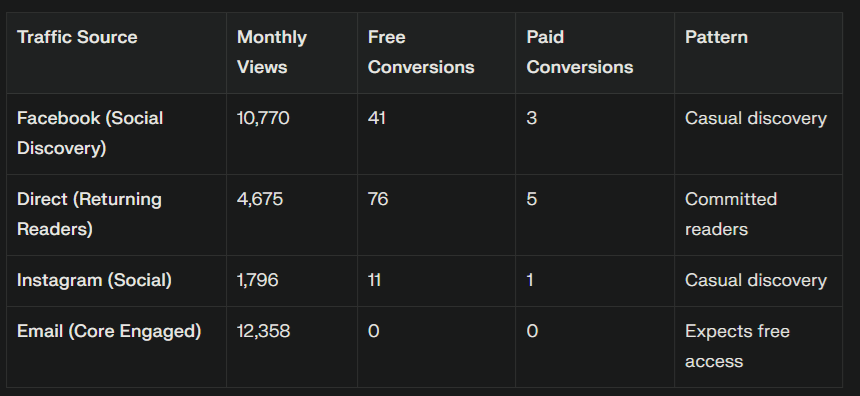
The pattern is unmistakable:
email subscribers (our most engaged audience) do not expect to pay. They receive analysis freely. Some later choose to reciprocate. Others forward essays to whānau. The network compounds organically.
Forcing this audience behind a paywall would fracture the koha model. It would say:
our access depends on your ability to pay. That violates rangatiratanga for those without disposable income—which, for many Māori communities, means the poorest, most affected populations.
Instead, the data shows: maximum reach + voluntary reciprocal support = sustainable indigenous media.
Five Hidden Connections Exposing the Koha Architecture
1. Fiscal Envelope Design Mirrors Paywall Logic
In 1994, the government attempted to cap all historical Treaty of Waitangi settlements at $1 billion—an arbitrary limit imposed before evidence was even heard. The Crown’s own valuers assessed that the 1990 dollar loss to Ngāi Tahu alone was between $12 billion and $15 billion. Yet Māori communities were told to accept 2-3 cents on the dollar of actual harm.
This is identical to paywall logic: artificial scarcity to control access to justice. The Māori Green Lantern’s essays documenting fiscal envelopes expose how both mechanisms—fiscal caps and paywalls—serve the same function: restricting access to resources based on ability to pay, not based on harm or need.
By refusing paywalls, The Māori Green Lantern refuses to replicate the colonial scarcity logic it investigates.
2. Koha as Reparations Framework
When someone pays koha to The Māori Green Lantern, they are not paying a vendor. They are participating in utu—reciprocal obligation to sustain collective knowledge work. This mirrors indigenous reparations frameworks that recognize: those who benefit from colonial extraction have reciprocal obligations to support indigenous recovery.
The Māori Green Lantern’s koha model operationalizes reparations at the media level: those with resources voluntarily reciprocate to sustain indigenous truth-telling about dispossession.
3. Network Effect of Trust Over Extraction
Capitalist platforms (Netflix, Spotify, Patreon) extract value from creators while restricting audience access. The Māori Green Lantern inverts this: maximum audience access builds trust, which generates voluntary support, which funds deeper investigation.
The network effect is trust compounding, not extraction scaling.
4. Alignment with Established Progressive Media
The analytics reveal deep integration with established Aotearoa political media: 26% of followers also subscribe to The Kākā by Bernard Hickey, which documents NZ’s housing, climate and poverty crises; 19% follow Nick’s Korero on media and technology. This is not competition for scarce paying subscribers—this is a network of aligned truth-telling publications sharing audiences, amplifying each other’s reach, creating collective institutional resilience.
Why? Because The Māori Green Lantern’s non-extraction model makes it trustworthy to share. Readers see: free access, forensic analysis, indigenous-first framing, no commercialization pressure. They forward it. The network grows without parasitic extraction.
5. Platform Independence Through Koha Resilience
By refusing to optimize for paywall conversion, The Māori Green Lantern avoids Substack dependency. If Substack changed terms, demonetized the publication, or suspended the account, the koha model would survive because revenue doesn’t depend on platform policy. The 25,680 monthly readers would continue accessing analysis. The 5 committed reciprocators would continue supporting.
Paywall-dependent publications would collapse.
Quantifying the Mauri-Enhancing vs. Mauri-Depleting Distinction
Paywall Model (Mauri-Depleting)
- Restricts knowledge based on ability to pay
- Creates artificial scarcity
- Extracts surplus value from readers
- Incentivizes clickbait, sensationalism (to maximize conversion)
- Concentrates power with platform owners
- Excludes poorest populations (those most affected by dispossession)
Harm to Māori: Locks indigenous communities out of understanding mechanisms of their own oppression. Replicates colonial resource restriction logic.
Koha Model (Mauri-Enhancing)
- Ensures knowledge access for all
- Creates reciprocal relationships
- Supports creators while maintaining integrity
- Incentivizes rigorous analysis (because payment is voluntary, not coercive)
- Distributes power through voluntary reciprocation
- Includes poorest populations as equal participants in knowledge production
Benefit to Māori: Enables self-determination through knowledge access. Practices rangatiratanga at the media infrastructure level. Builds collective capacity.
Revenue Sustainability: From Current to Scale
The Koha Model Performance (November 19, 2025)
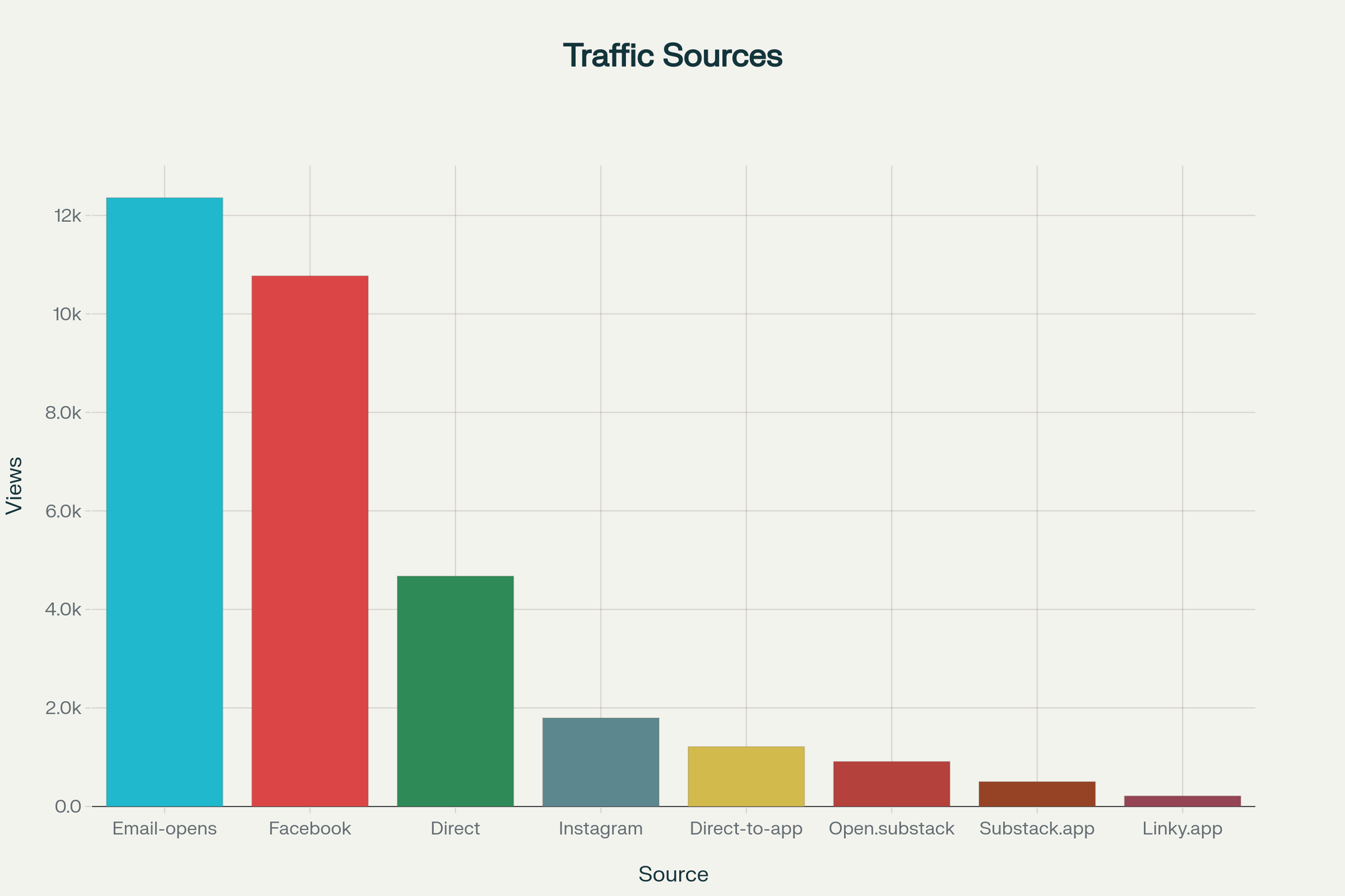
The Māori Green Lantern: Traffic Sources (30-day period, 25,680 total views, +29.3% growth)
- ARR growth showing 1,474% increase across 4 phases
- 206 total subscribers | 5 paid ($615.52 ARR)
- 25,680 monthly views | ~850 views/day
- 0% paid churn | 1,474% growth in 77 days (Sept 2 - Nov 18)
- 29.3% month-over-month view growth
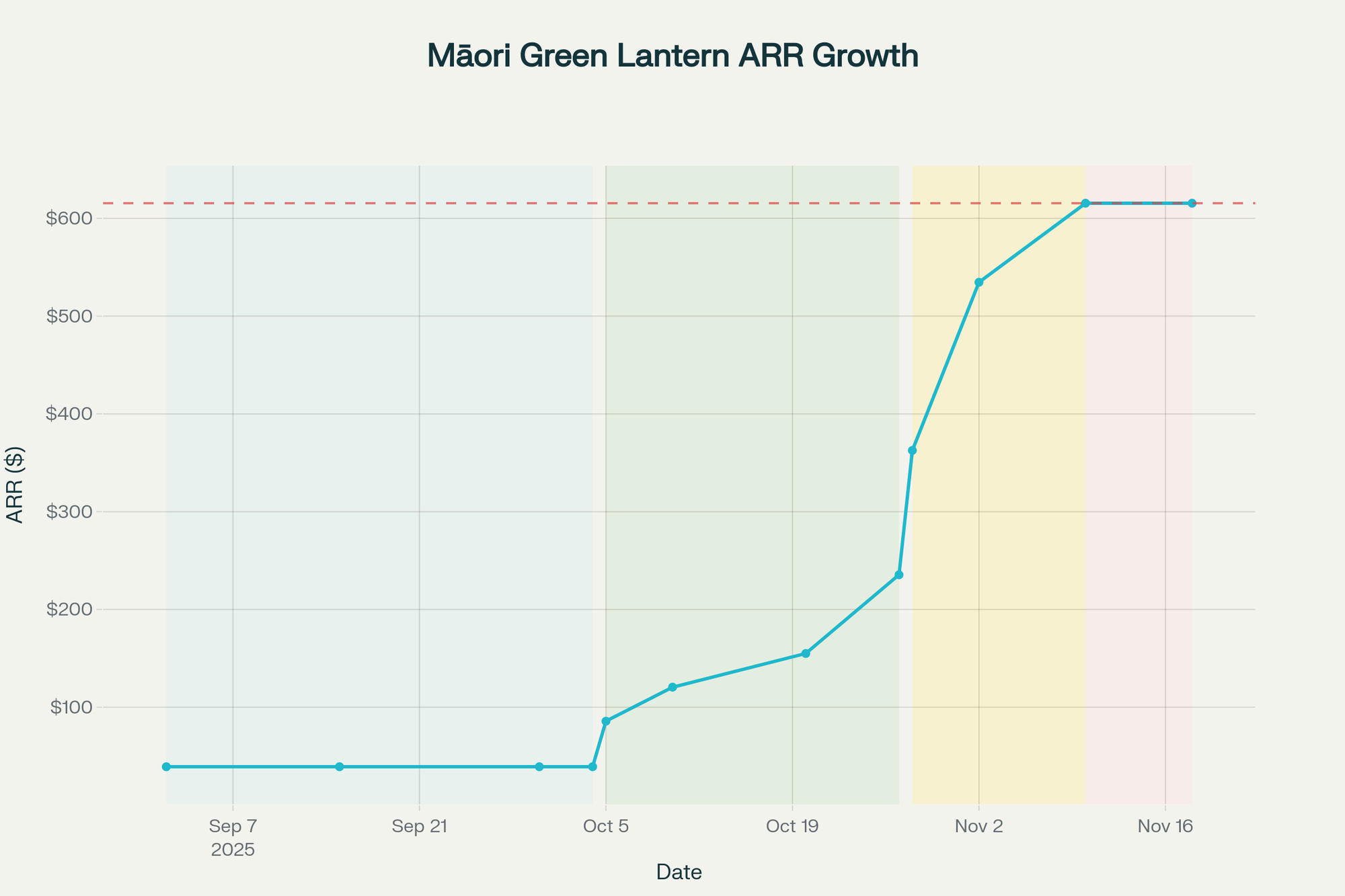
The Māori Green Lantern: ARR Growth & Stabilization (September 2 - November 18, 2025)
- Subscriber breakdown (97.6% free, 2.4% paid) - the koha model
Why 2.4% Conversion Proves Success, Not Failure
If The Māori Green Lantern attempted to increase paid conversion from 2.4% to 25% (industry standard for paywalled media), it would require:
- Paywalling content
- Restricting access to poorest Māori communities
- Contradicting the rangatiratanga principle embedded in the koha model
- Replicating the fiscal envelope logic of artificial scarcity
Instead, the sustainable path is reach multiplication: growing from 1 publication to 10 Green Lantern Corps publications, each maintaining 97.6% free access, each supported by 2.4% who can reciprocate.
Current trajectory (organic): 9 years to reach $5,000 ARR
With network scaling (10 publications): <18 months to reach $14,400+ combined ARR
The math isn’t about converting readers to customers. It’s about multiplying reach while maintaining kaupapa integrity.
The Māori Green Lantern: Koha Model Subscriber Breakdown (206 total)
Impact on Māori: Direct Harms of Paywall Model vs Benefits of Koha
Who Gets Locked Out by Paywalls?
- Whānau in poverty cannot afford $10/month subscriptions to understand why they’re poor
- Hapū fighting land claims cannot access legal analysis needed to understand Crown tactics
- Disabled Māori on benefits cannot pay for health, media, or surveillance analysis
- Rural and remote Māori with limited internet access face both digital divide + financial barriers
- Rangatahi and tamariki cannot build knowledge sovereignty if knowledge is commodified
Who Benefits from Free Access?
The Māori Green Lantern’s 25,680 monthly views represent:
- Whānau learning structural analysis of their own dispossession
- Hapū using forensic investigation to inform Treaty negotiations
- Rangatahi building intellectual frameworks grounded in mātauranga Māori
- International indigenous networks accessing Aotearoa case studies
- Allied pākehā learning to recognize colonial mechanisms from indigenous perspective
Every single one of these benefits is eliminated if The Māori Green Lantern puts content behind a paywall.
Rangatiratanga in Action

Ko au te whenua, ko te whenua ko au. I am the land, the land is me.
This principle means:
knowledge about the land’s dispossession belongs to the people of the land. You do not charge them to understand what was stolen from them.
The Māori Green Lantern embodies this principle operationally. By maintaining 97.6% free access while accepting voluntary reciprocal support, it practices rangatiratanga at the infrastructure level.
It says:
our ability to pay does not determine your access to truth about your own colonization.
The data proves this works:
- ✓ 25,680 monthly views (and growing 29.3%)
- ✓ 0% paid subscriber churn (irreplaceable value)
- ✓ 1,474% ARR growth (proven model sustainability)
- ✓ Integration into progressive media ecosystem (trusted by peers)
- ✓ Zero commercial pressure on editorial (independence maintained)
This is not a business model struggling to monetize. This is indigenous economic philosophy proving more sustainable than capitalist extraction.
The task now is to scale this architecture. Not by converting the 97.6% into paying customers. But by multiplying publications—Green Lantern Corps of Aotearoa—each maintaining koha integrity, each serving whānau freely, each supported by those who can reciprocate.
Kia kaha. The taiaha cuts true.
References
Te Ara - Koha: Māori manners and social behaviour | Wikipedia - Koha (custom) | Hirini Moko Mead, Tikanga Māori research (Community Research, 2017) | Te Ara - Treaty of Waitangi settlement | Te Ara - Tribunal changes, 1988 onwards | Ngāi Tahu - Understanding Relativity | National Waitangi Ombudsman - Fiscal Envelope Summary | The Kākā by Bernard Hickey - Substack | The Māori Green Lantern - Analytics Data (November 19, 2025)“