”How Judith Collins’ CIA Pilgrimage Exposes Aotearoa’s Surrender to American Intelligence” - 19 October 2025
In the Shadow of Empire
Kia ora, e te whānau.
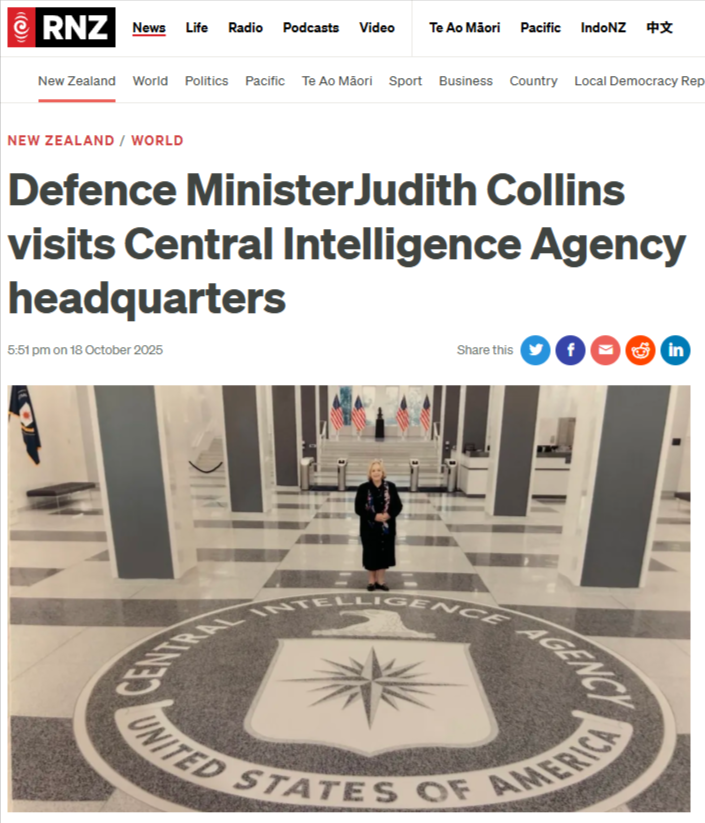
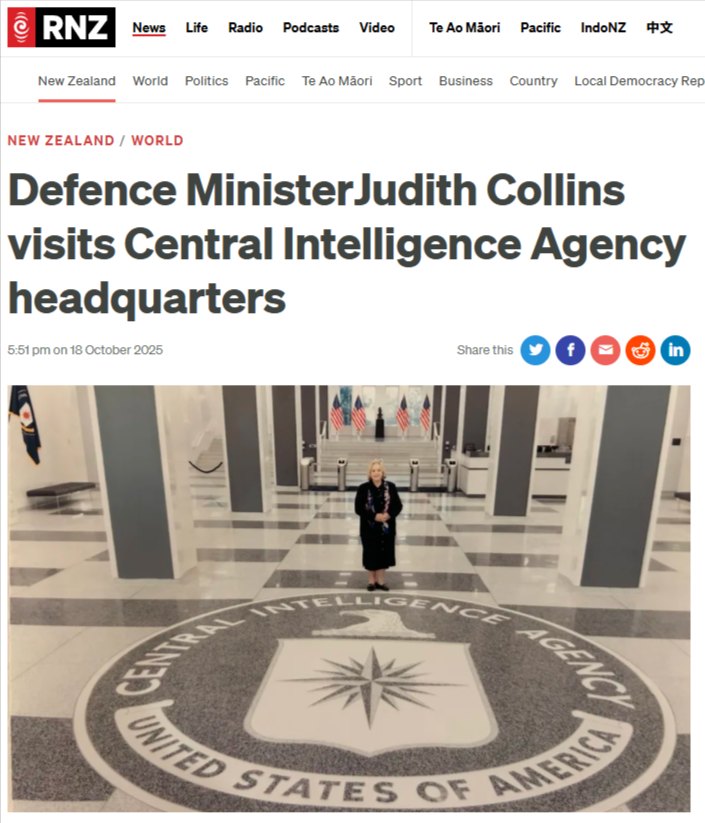
On October 17, 2025, Defence Minister Judith Collins walked through the doors of CIA headquarters at Langley, Virginia, to meet with Director John Ratcliffe and discuss opportunities for closer collaboration with the United States. While Radio New Zealand reported this as a routine ministerial visit, what Collins actually did was pledge New Zealand’s intelligence agencies and defence forces to deeper entanglement with an organization whose seventy-year history is drenched in coups, assassinations, and the destruction of democratic governments across the Global South. This is not diplomacy. This is subordination. And the fact that a National Party minister responsible for our spy agencies GCSB and NZSIS would fly halfway around the world to kiss the ring of the CIA Director reveals how far Aotearoa has drifted from the independent foreign policy we claimed during our nuclear-free era. Collins met with a man whose agency recently received authorization from Donald Trump to conduct lethal covert operations in Venezuela, following a pattern of CIA interference that destroyed Guatemala in 1954, installed Pinochet’s dictatorship in Chile in 1973, and coordinated Operation Condor’s cross-border death squads throughout Latin America. The same week Collins was praising the CIA Memorial Wall at Langley as very moving, Trump officials were discussing potential ground operations against Venezuela on an unsecured Signal chat that accidentally included a journalist. This is the professional, trustworthy partner Collins wants us to collaborate with more closely.
Background
To understand what Collins has done, you need to understand three things. First, the CIA’s actual history. Second, what Five Eyes really is. Third, how National’s ideology makes them perfect collaborators in America’s imperial project.
The Central Intelligence Agency was created in 1947 not to gather intelligence but to conduct covert operations that the US government could deny. A CIA report from the 1990s described its 1954 Guatemala operation as the intelligence coup of the century because they managed to get foreign governments to pay for the privilege of having their communications intercepted. Since then, the agency has orchestrated coups in Guatemala, Brazil, and Chile, armed Contra terrorists in Nicaragua, ran Operation Condor’s transnational assassination network, and consistently undermined democratic governments whose policies threatened American corporate interests. In 2025, Trump authorized the CIA to conduct covert action inside Venezuela, with lethal targeting permitted. The New York Times reported this represents a continuation of CIA activities across Latin America where the agency’s history is mixed at best. That is diplomatic language for decades of murder, torture, and dictatorship.
Five Eyes began as a signals intelligence sharing arrangement between the US, UK, Canada, Australia, and New Zealand under the 1946 UKUSA Agreement. For decades it operated in secrecy, gathering electronic communications through facilities like Aotearoa’s Waihopai spy base. But as former Prime Minister Helen Clark observed in 2025, Five Eyes has got a bit out of control. What was once a quiet intelligence pool has metastasized into a coordination platform for foreign policy, with joint ministerial statements and pressure on members to align their positions on China, human rights, and regional security. Clark said New Zealand has been drawn in a lot closer to this US-led network, losing independence. When Collins flew to Washington, she was not just meeting with intelligence counterparts. She was reporting to the senior partner in an alliance where New Zealand has precisely two percent of the relative power compared to America’s one hundred percent.
The National Party has always been comfortable with this subordination because their ideology is rooted in maintaining the neoliberal economic order and the Anglosphere alliance structure. Collins describes herself as someone who values decisiveness and has praised Margaret Thatcher. Her political philosophy blends traditional conservative pragmatism with ideological neoliberalism, and she has no qualms about law-and-order policies that target marginalized communities. On Māori issues, Collins has called co-governance racist separatism, opposed the Māori Health Authority, and framed efforts toward Te Tiriti partnership as threats to democracy under the one person one vote slogan that erases Indigenous sovereignty. This is the same nationalist Christian conservative framework that Trump’s administration promotes, where equality means the dominant group keeps dominance and any challenge to that is portrayed as special privilege. Collins is a liberal Anglican who voted against euthanasia in 2003 but for it in 2020, voted against civil unions in 2004 but for marriage equality in 2013. Her conservatism is not theological rigidity but rather an alignment with power structures, including the American intelligence apparatus that has always viewed independent Indigenous movements and leftist governments as threats.
The Issue Being Critiqued
Here is what Collins actually did and why it matters. On October 17, 2025, she visited CIA headquarters at Langley during a trip where she met Secretary of War Pete Hegseth and Secretary for Homeland Security Kristi Noem. According to her own social media post, she met CIA Director John Ratcliffe, held discussions, and visited the Memorial Wall honoring CIA agents who died in service. She described this as very moving. Many of those stars on the wall represent agents whose missions are still classified, which is spy-speak for operations so morally indefensible they cannot be revealed even decades later. Collins said that while New Zealand focused on building a more combat-capable defence force, discussing potential opportunities for closer collaboration with the USA was important.
Let us be clear what closer collaboration means. John Ratcliffe is Trump’s CIA Director, confirmed in January 2025 by a Senate vote of 74-25. He previously served as Director of National Intelligence in Trump’s first administration, where he faced criticism for declassifying Russian intelligence reports that critics called politically motivated and for adopting Trump’s views on downplaying threats from Russia. Ratcliffe told his confirmation hearing he would lead a more aggressive CIA that would go to places no one else can go and do things no one else can do. He committed to covert operations when directed by the president. Within months, Trump secretly authorized the CIA to conduct covert action in Venezuela, including lethal operations and coordination with potential military strikes. The New York Times confirmed this presidential finding permits the agency to work against President Nicolás Maduro. Trump then acknowledged the authorization, saying he approved it because Venezuela emptied their prisons into the United States and because of drugs. When pressed whether the CIA had authority to take out Maduro, Trump said he did not want to answer that question but thought Venezuela was feeling the heat.
This is the organization Collins wants to collaborate with more closely. The CIA whose director sits on a Signal group chat with other Trump officials discussing military strike timing on unsecured communications. The CIA that has spent seventy years overthrowing governments, training death squads, and protecting American corporate interests through violence. The CIA that armed Contra terrorists in Nicaragua, supported Pinochet’s torture regime in Chile, and coordinated Operation Condor across South America, resulting in at least 97 assassinations. The CIA that the Eisenhower administration used to create assassination target lists in Guatemala and that attempted to kill Fidel Castro repeatedly. The CIA that supported Brazil’s 1964 military coup, helped hunt down Che Guevara in Bolivia, and funded right-wing paramilitaries across Latin America for decades.
And Collins, standing at Langley with Ratcliffe, said this collaboration was important. She did not express concern about Trump’s authorization of lethal covert operations. She did not question the wisdom of deepening ties with an administration that conducts military planning on consumer messaging apps. She did not mention that New Zealand’s nuclear-free policy and independent foreign policy once meant we would refuse exactly this kind of entanglement. Instead, she talked about building a more combat-capable defence force and praised the CIA memorial.
Meanwhile, back in Aotearoa, Collins serves as Minister of Defence and minister responsible for both the GCSB and NZSIS, our two primary intelligence agencies. The GCSB operates signals intelligence facilities at Waihopai and Tangimoana as part of the Five Eyes network, conducting what has been described as a full take of communications from Pacific nations including the Cook Islands, Vanuatu, Kiribati, Samoa, Fiji, and Tonga. That intelligence is shared with Five Eyes partners including the United States, with New Zealand having little or no knowledge of what the information is ultimately used for. When Collins discusses closer collaboration, she is offering up the intelligence our agencies collect, the capabilities our defence forces have, and potentially our participation in American military or covert operations against countries the US designates as enemies.
The timing is crucial. Trump’s administration has embraced Project 2025, the Heritage Foundation blueprint that Collins’ equivalents in Washington are now implementing. CIA Director Ratcliffe has been unusually public about aligning with Trump’s ambitions, appearing on Fox News and Breitbart to discuss his work. He invited Elon Musk to CIA headquarters to discuss government efficiency. The administration is purging federal employees deemed disloyal, conducting mass firings during the government shutdown, and concentrating power in the executive branch. Foreign policy is being directed by officials who shared classified strike details on Signal, who push nationalist Christian conservative ideology, and who view multilateral institutions and traditional alliances as constraints on American power.
And Collins is eager to collaborate more closely with this chaos.
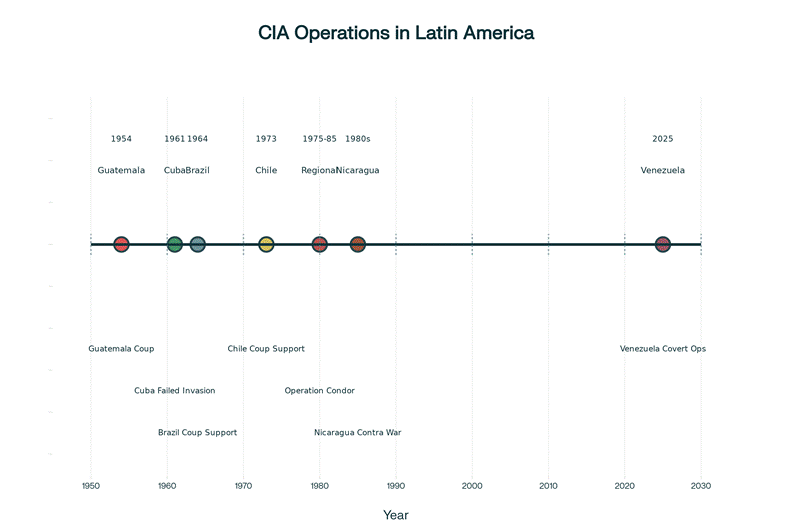
CIA Covert Operations in Latin America: A Pattern of Destabilization from Guatemala 1954 to Venezuela 2025
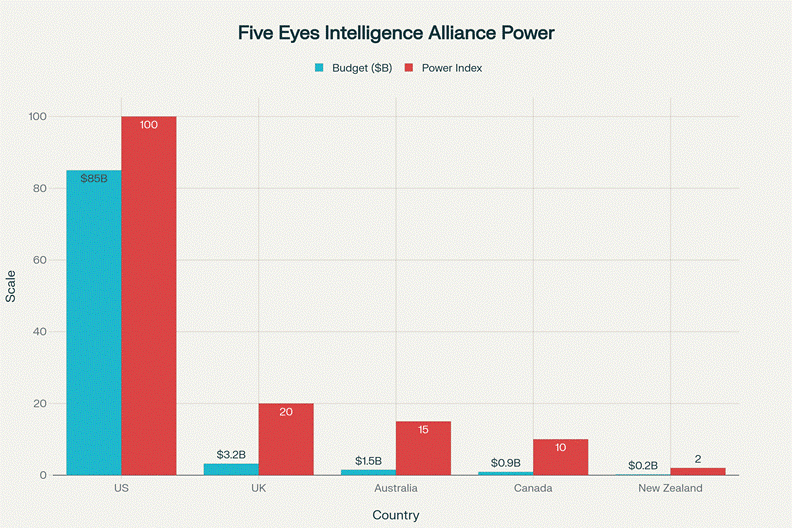
Five Eyes Power Imbalance: New Zealand as the Junior Partner in an Asymmetric Alliance
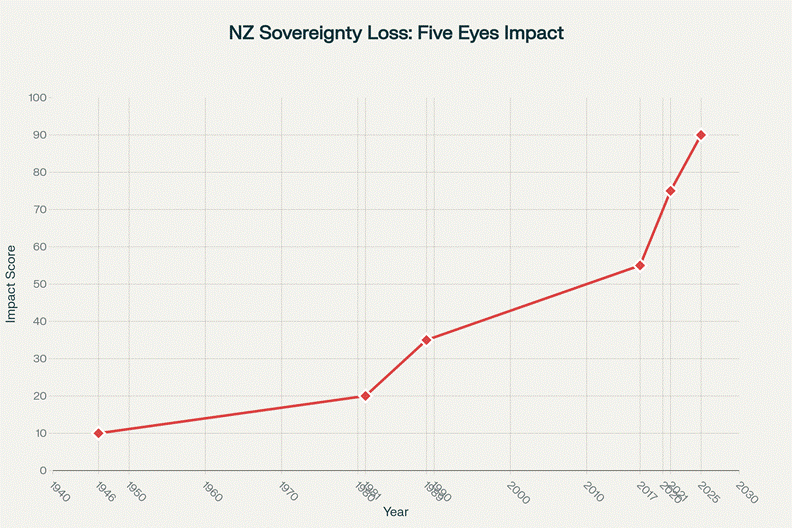
The Erosion of Aotearoa’s Sovereignty: From Intelligence Sharing to Policy Subordination 1946-2025
Analysis
The fundamental deceit here is the pretense that this is about security. Collins framed her trip as responding to a complex and deteriorating global environment where defence diplomacy has never been more important. The official government statement said she would discuss how New Zealand and the US might bolster their long-standing defence and security partnership in pursuit of a peaceful and prosperous Indo-Pacific. This is the language of euphemism, where peaceful means aligned with American military dominance and prosperous means open to American corporate extraction.
What Collins is actually doing is subordinating Aotearoa’s foreign policy and intelligence operations to American strategic interests. The Five Eyes alliance that Helen Clark said has strayed beyond its original brief and got out of control is now the mechanism through which New Zealand is being pressured to take positions on China, to increase defence spending to 2% of GDP, and to participate in operations that serve American hegemony rather than our own security. Jeremy Moses, a University of Canterbury associate professor in international relations, asked the right question in early 2025: What is the security benefit we get from being part of this arrangement if the United States is openly declaring itself hostile to the rules-based order?
The answer is there is no security benefit. What we get is complicity. New Zealand contributes signals intelligence from the Pacific, we provide diplomatic cover for American positions through joint Five Eyes statements, and we offer our military forces for interoperability with US operations. What we lose is independence, credibility with Pacific nations who know we are spying on them for America, and the moral authority to advocate for decolonization, Indigenous rights, or challenges to imperial power.
This complicity has specific consequences for Māori. The GCSB and NZSIS have long histories of surveilling Māori activists, infiltrating Indigenous sovereignty movements, and treating challenges to settler colonial power as security threats. A 2020 diversity report found both agencies were old boys clubs with excessive racist jokes made at Māori and Pacific staff’s expense. Political activist Ken Mair noted the SIS would struggle to recruit from Māori communities where it is seen as an organization actively working to undermine Indigenous aspirations. When Collins talks about closer collaboration with US intelligence, she is offering to intensify this surveillance of our own people on behalf of an empire that views Indigenous self-determination movements globally as threats to stability.
The CIA’s history in Latin America is directly relevant because those operations targeted the same kinds of movements and governments that Aotearoa’s intelligence agencies are now pressured to monitor. When Guatemala’s President Jacobo Árbenz tried to redistribute land from United Fruit Company to peasants in 1954, the CIA orchestrated his overthrow. When Chile’s Salvador Allende nationalized copper companies in 1973, the CIA funded the coup that killed him and installed Pinochet’s dictatorship. When Nicaragua’s Sandinistas challenged US corporate control in the 1980s, the CIA armed Contra death squads. The pattern is clear: any government or movement that challenges American corporate interests or asserts sovereign control over resources is designated a threat and targeted for destabilization.
Now ask yourself what happens when Māori assert tino rangatiratanga, when iwi demand genuine partnership rather than consultation, when movements for Indigenous sovereignty challenge the neoliberal capitalist order that both National and US intelligence services are designed to protect. Collins has already called co-governance racist separatism. She opposed the Māori Health Authority. She frames Māori political aspirations as threats to the one person one vote principle. This is the same ideological framework the CIA uses globally, where popular movements for redistribution and sovereignty are recast as extremism, separatism, or threats to democracy.
The nationalist Christian conservative links are undeniable. Trump’s administration is stacked with Christian nationalists who promote a Judeo-Christian civilization narrative that positions white conservative Christianity as the foundation of democratic society. Project 2025 explicitly calls for rolling back Indigenous rights, restricting reproductive freedom, and concentrating executive power. Ratcliffe was a congressional ally of Trump who defended him during impeachment and declassified intelligence for political purposes. The broader network includes figures who have promoted election denialism, January 6 insurrection support, and Christian dominionism. When Collins meets with these people and praises their memorial walls, she is not conducting neutral diplomacy. She is signaling alignment with a white supremacist imperial project wrapped in the language of security and values.
The Memorial Wall at Langley that Collins found so moving is a monument to secrecy and violence. Those stars represent agents who died conducting operations the American government still will not acknowledge. Some of those missions were in Latin America, supporting coups and death squads. Some were in Southeast Asia, prosecuting wars that killed millions. Some were in the Middle East, overthrowing governments and installing dictators. The wall is not a tribute to sacrifice for democracy. It is a shrine to empire.
And Collins stood there and called it very moving.
This is not an accident of language or a diplomatic courtesy. Collins is a lawyer, a former Minister of Justice, someone who understands the weight of words and symbols. When she praises the CIA memorial, she is endorsing what the CIA does. When she seeks closer collaboration, she is volunteering Aotearoa’s intelligence agencies and military to participate in the next Guatemala, the next Chile, the next Operation Condor. She is betting that New Zealanders will not notice or will not care that our government is deepening ties with an organization whose primary function is overthrowing governments and protecting American power.
The mainstream media coverage of this trip was criminally inadequate. RNZ ran a brief item noting Collins met with CIA Director John Ratcliffe and held discussions, with a single quote about building a more combat-capable defence force. No questions about what discussions entailed. No context about Ratcliffe’s background or Trump’s CIA authorization for Venezuela. No interrogation of what closer collaboration means. The New Zealand Herald did not appear to cover the meeting at all. This is how power operates in the shadows, with ministerial trips framed as routine and media accepting the government’s framing without challenge.
Compare this to the detailed coverage of far less consequential political events. When Collins prayed at a church during the 2020 election campaign, multiple outlets ran stories questioning whether she was politicizing her faith. When she commented on Siouxsie Wiles during Covid lockdown, it generated national controversy. But when she travels to CIA headquarters to pledge collaboration with an agency conducting covert operations in Venezuela, the media barely notices. This is the power of normalization, where empire’s violence is treated as background noise while individual politicians’ personal behavior is scandal.
The hidden connections between people, places, and events reveal a network of power that transcends individual administrations. Collins meets with Ratcliffe at Langley in October 2025. Weeks earlier, Trump authorized CIA covert action in Venezuela. Months earlier, FBI Director Kash Patel visited New Zealand and announced a standalone FBI office would open, causing alarm among opposition parties. In July 2025, Patel gave Collins and other officials 3D-printed pistols as gifts, which had to be destroyed because they are illegal in New Zealand. In May 2025, Collins attended the Five Eyes ministerial meeting in London, where migration and border security were top priorities. In March 2025, Trump’s top national security officials shared classified military strike details on an unsecured Signal chat. In January 2025, Ratcliffe was confirmed as CIA Director after promising to make the agency more aggressive.
Follow the thread. Five Eyes meetings coordinate intelligence and policy positions. FBI presence expands in New Zealand. Defence Minister meets CIA Director. CIA receives authorization for lethal covert operations. The pattern is not subtle. Aotearoa is being integrated into the American national security apparatus, our intelligence agencies subordinated to US priorities, our foreign policy coordinated through Five Eyes rather than developed independently. Collins is not building relationships between partners. She is accepting instructions from the hegemon.
The class dynamics are equally clear. Collins is a wealthy lawyer married to a businessman with ties to Chinese companies that generated previous controversies. She represents Papakura, a working-class South Auckland electorate, but her politics consistently favor corporate interests and state power over communities. National’s coalition with ACT and New Zealand First is pursuing policies that slash public services, attack co-governance, and concentrate wealth. The Trump administration is doing the same in America, using the government shutdown to purge federal workers and eliminate programs that serve marginalized populations. The CIA has always functioned to protect American corporate interests abroad, overthrowing governments that threaten profits.
When Collins pledges collaboration with this apparatus, she is aligning with the class interests that both governments represent. The military and intelligence complex serves capital, not democracy. Its operations protect markets, resources, and investment climates, not people. The closer collaboration Collins seeks will not improve security for everyday New Zealanders. It will increase our complicity in maintaining the global economic order that extracts wealth from the Global South and Indigenous peoples to concentrate it in corporate hands.
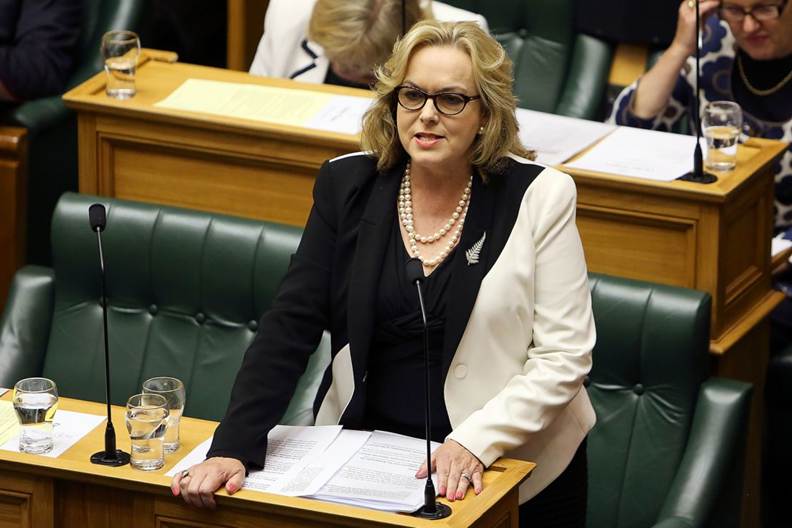
Judith Collins speaking in New Zealand’s Parliament, showcasing her role in government proceedings.
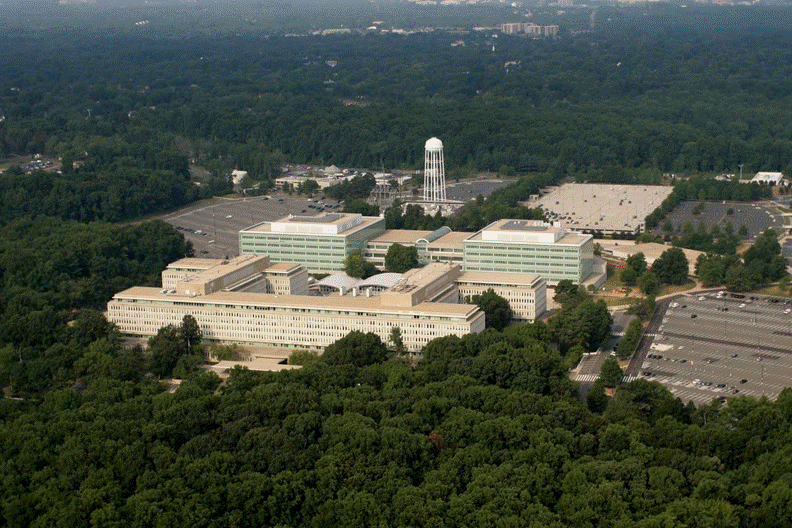
Aerial view of the CIA headquarters in Langley, Virginia, showing the main office buildings and surrounding areas.
Implications
The immediate implication is that Aotearoa is now more deeply entangled with American intelligence operations at precisely the moment those operations are being directed by the most reckless and ideologically extreme administration in recent history. If the CIA conducts operations in Venezuela that lead to conflict, we will be implicated through our Five Eyes membership and intelligence sharing. If Trump officials continue security breaches like the Signal chat incident, information from New Zealand intelligence agencies could be compromised. If American foreign policy lurches further toward unilateral action and rejection of multilateral institutions, our association through Five Eyes will undermine our credibility in the Pacific and with other nations.
The broader implication is the continued erosion of Aotearoa’s independence and the abandonment of the principled foreign policy stance we claimed during the nuclear-free era. In 1984, the Labour government denied entry to nuclear-powered and armed warships, leading the US to suspend security cooperation. But the GCSB continued operating as part of Five Eyes. The compromise was that we maintained some symbolic independence through the nuclear-free policy while remaining integrated into the intelligence network. Over time, that symbolic independence has been hollowed out. Five Eyes now coordinates foreign policy positions. The FBI has a standalone office. The Defence Minister flies to Langley to pledge closer collaboration. We are becoming what Helen Clark feared: no longer an independent voice but simply an extension of American strategic interests.
For Māori, the implications are severe. Deeper collaboration with US intelligence means more surveillance of Indigenous sovereignty movements, more framing of Māori political aspirations as security threats, and more alignment with white supremacist frameworks that see Indigenous self-determination as separatism. The same agencies that surveilled and infiltrated the anti-Springbok tour movement, the Māori sovereignty movement, and climate activists will now coordinate more closely with an American apparatus that views Black Lives Matter protests as threats to national security and Indigenous land defenders as domestic terrorists.
For the Pacific, the implications are about trust and autonomy. Our Pacific neighbors know the GCSB conducts full-take surveillance of their communications on behalf of Five Eyes. They know New Zealand shares that intelligence with the US. When Collins talks about closer collaboration, Pacific nations hear that their communications will be monitored even more intensively, shared even more widely, and used to advance American interests in the region. The trust that is supposed to underpin Pacific partnerships is eroded every time we choose Five Eyes over Pacific solidarity.
The pattern connects to the larger global context of rising authoritarianism, corporate capture of democratic institutions, and the weaponization of national security frameworks against movements for justice. Trump’s administration, Ratcliffe’s CIA, Collins’ National government, and the broader Five Eyes apparatus are all parts of the same system: one that protects existing power structures through violence when necessary, co-optation when possible, and always through surveillance. When Collins stood at Langley praising the memorial wall, she was not conducting New Zealand foreign policy. She was prostrating herself before empire.
The Māori Green Lantern Fighting Misinformation And Disinformation From The Far Right
Judith Collins traveled to CIA headquarters and pledged closer collaboration with an organization whose history is written in blood across the Global South. She met with John Ratcliffe, Trump’s CIA Director who has promised a more aggressive agency willing to go anywhere and do anything. She did this while the CIA operates under a presidential finding authorizing lethal covert action in Venezuela, following a seventy-year pattern of coups, assassinations, and support for dictatorships. She described the CIA Memorial Wall, a monument to classified missions and covert violence, as very moving. And she returned to New Zealand to tell us this collaboration was important for our security.
This is not security. This is subordination. This is the abandonment of any pretense of independent foreign policy in favor of serving as a junior partner in American empire. This is the deepening of Five Eyes from intelligence sharing to foreign policy coordination to outright integration into US strategic planning. This is complicity in the CIA’s ongoing operations, past atrocities, and future violence.
Collins represents a National Party that has always been comfortable with this subordination, that has always aligned with Anglosphere power structures and neoliberal capitalism. Her attacks on co-governance, her opposition to Māori self-determination, and her law-and-order conservatism all flow from the same ideological source: the protection of existing hierarchies through state power. The CIA exists to protect American corporate interests and strategic dominance globally. New Zealand’s intelligence agencies exist to monitor threats to settler colonial power domestically and contribute to Five Eyes operations internationally. When Collins seeks closer collaboration, she is tightening these connections.
The hidden truth is that our security establishment has never served the people of Aotearoa, has never protected Indigenous sovereignty, has never challenged empire. It has surveilled Māori activists, infiltrated social movements, and shared intelligence with partners who use it to maintain global hierarchies of exploitation. The CIA is not an ally. It is a predator. And Collins has invited it deeper into our house.
The call to action is clear. We must demand transparency about what closer collaboration means. We must question our continued participation in Five Eyes. We must challenge the expansion of FBI and CIA presence in Aotearoa. We must connect our domestic struggles for tino rangatiratanga, for climate justice, for decolonization, to the global struggles against American imperialism. We must recognize that the same forces surveilling Māori activists today armed death squads in Latin America yesterday and will support the next coup tomorrow.
We must reject Judith Collins’ vision of security through subordination and demand an independent foreign policy grounded in Pacific solidarity, Indigenous sovereignty, and opposition to empire. The CIA Memorial Wall is not moving. It is horrifying. And any New Zealand minister who stands before it and pledges collaboration is betraying everything this nation claims to believe about peace, justice, and independence.
Kia mau ki te tika. Hold fast to what is right.
For those who find value in this mana-enhancing work and wish to support the kaupapa, please consider a koha to HTDM: 03-1546-0415173-000. These are tough economic times for whānau, so please only contribute if you have capacity and wish to do so. The mahi continues regardless, because truth-telling is not a business, it is a duty.
Kia kaha, kia māia, kia manawanui.