"How Labour’s Gutless CGT Betrays a Generation While Property Speculators Laugh All the Way to the Bank" - 28 October 2025
The Capitulation
Tēnā koutou katoa e te whānau,
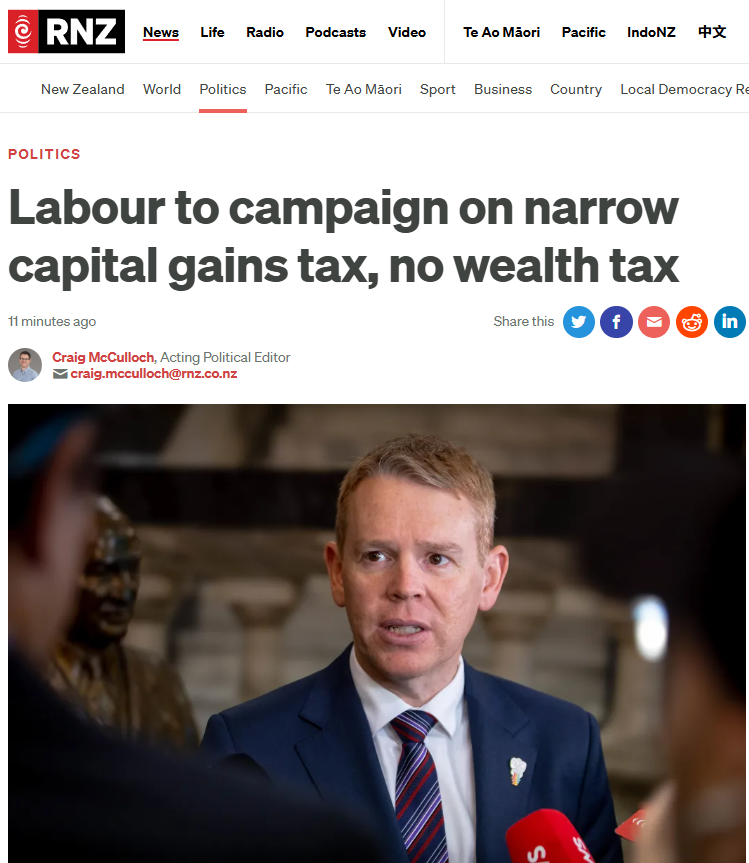
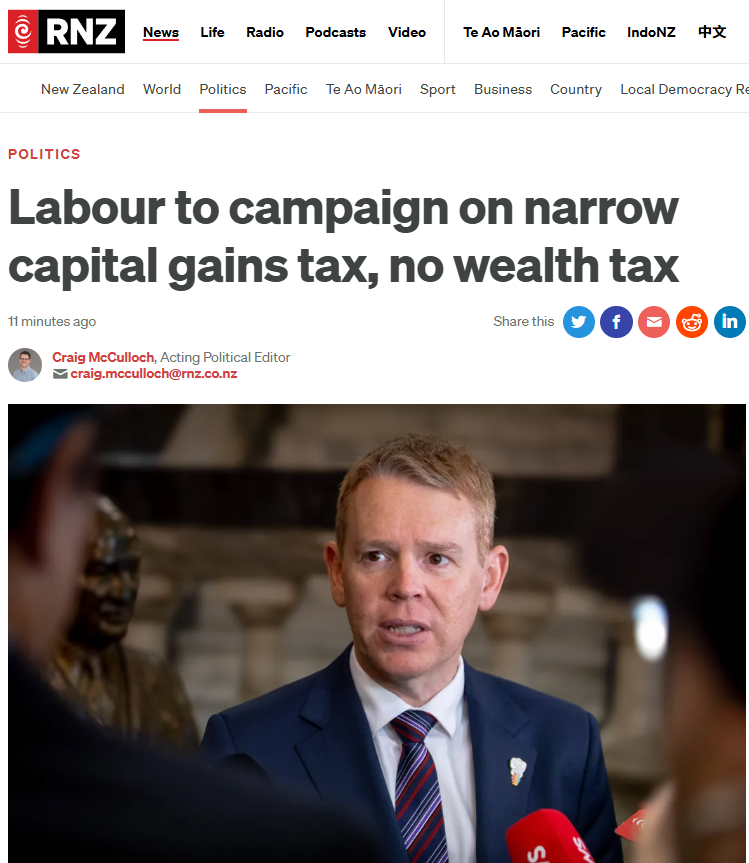
On October 28, 2025, Chris Hipkins and Labour unveiled their latest electoral offering: a watered-down, exemption-riddled capital gains tax so narrow it wouldn’t tax a landlord’s bach, so timid it protects farmers sitting on million-dollar land banks, and so calculated it confirms what many suspected all along
- Labour exists not to challenge wealth inequality but to manage it just enough to win middle-class votes.
The smoking gun? Labour’s 28% CGT will only apply to investment property sales (RNZ, 2025), explicitly exempting the family home, farms, KiwiSaver, shares, business assets, and inheritances. This isn’t tax reform - it’s theatre designed to give Labour progressive credentials while leaving the wealth extraction machine untouched.
Here’s what they’re not telling you: the top 1% of households now hold a median $11.5 million in wealth (RNZ, 2025) - 1,045 times more than the bottom 20% who survive on $11,000. Meanwhile, Māori home ownership has collapsed from 31.2% in 2013 to just 27.5% in 2023 (Stats NZ, 2024). As working whānau get priced out of their ancestral whenua, property speculators have funneled $2.5 million into National, ACT, and NZ First since 2021 (RNZ, 2023) - 97% of all property industry donations - to ensure policies like negative gearing and interest deductibility keep the wealth pump running. Labour received 2%. Two percent. Who do you think they’re really working for?
Background: The Whakapapa of Cowardice
Labour’s relationship with capital gains taxation is a masterclass in political cravenness spanning three decades. In the late 1980s, David Lange’s government began planning a comprehensive CGT (RNZ, 2024), only to abandon it before the 1990 election. Phil Goff tried again in 2011, stumbling through John Key’s “show me the money” ambush (RNZ, 2024) in a Christchurch debate that became a political execution. David Cunliffe couldn’t explain his own CGT policy details in 2014 (RNZ, 2014), gifting National another election victory.
Then came Jacinda Ardern’s spectacular betrayal.
After establishing a Tax Working Group chaired by Sir Michael Cullen, which spent $2 million and 18 months producing a comprehensive CGT proposal (RNZ, 2024), Ardern abandoned it entirely in April 2019 (Edwards, 2019), ruling out a CGT “under my leadership” forever. She blamed NZ First’s opposition, but political analyst Bryce Edwards argues there’s evidence Labour never intended to implement it (Edwards, 2019), using the Tax Working Group as progressive window dressing while avoiding the hard political work of actually fighting for redistribution.
Chris Hipkins continued this pattern, ruling out both CGT and wealth tax before the 2023 election (RNZ, 2023), prompting revenue minister David Parker to resign in protest after spending years developing progressive tax policy (Wikipedia, 2025) that Hipkins killed with a captain’s call. Now, after declaring a “blank page” on tax policy post-election, Hipkins delivers this hollow gesture (RNZ, 2025) - a CGT so narrow it wouldn’t touch the wealth portfolios propping up inequality.
The stakes are quantified and devastating. New Zealand’s wealthiest 20% control 66% of total household wealth (RNZ, 2025), while the median wealth of a top 1% household sits at $11.5 million - 22 times the median of all households (RNZ, 2025). Half of all New Zealanders have cut back on fresh fruit and vegetables as costs rise (RNZ, 2025), with the percentage of Māori who say they have adequate income dropping from 55.2% in 2021 to 53.9% in 2023 (RNZ, 2025).
Meanwhile, New Zealand has some of the least affordable housing in the OECD (Waldegrave, 2024), with average property costs hitting 8.9 times average annual household income at its 2022 peak (DLA Piper, 2023). This is not a housing crisis - it’s wealth extraction by design.
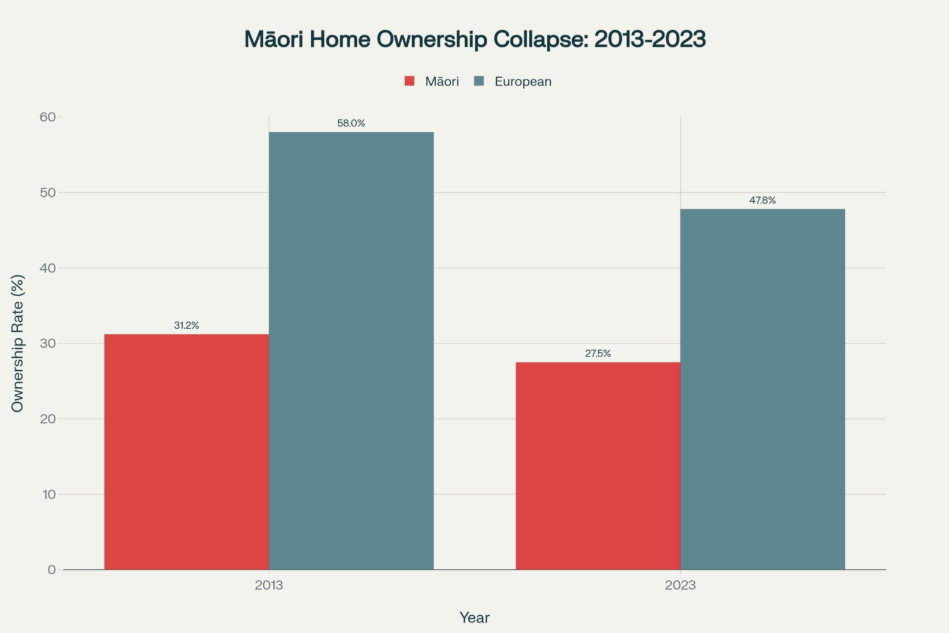
This chart shows the devastating decline in Māori home ownership from 31.2% in 2013 to just 27.5% in 2023, while European ownership also fell from 58% to 47.8%. The gap between Māori and Pākehā homeownership widened during this period of rampant property speculation.
The Issue: Deconstructing Labour’s Hollow Gesture
Labour’s proposal is a masterpiece of exemptions designed to protect wealth while performing progressivism. The 28% CGT applies only to residential and commercial investment property sold from July 2027 onward, with no retrospective application (RNZ, 2025). Excluded: the family home, farms, KiwiSaver, shares, business assets, personal items, and inheritances.
Let’s name the logical fallacies poisoning this policy:
False Compromise Fallacy: Labour frames this as a “middle ground” between comprehensive tax reform and nothing (RNZ, 2024), but excluding shares, business assets, and farms means the wealthiest New Zealanders - whose portfolios span all asset classes - remain largely untouched. The wealthiest 20% hold more than twice as much in pension funds as the next quintile and eight times as much as the poorest 20%, with 18% of their assets in stocks and bonds (RNZ, 2025) that won’t be taxed under Labour’s plan.
Cherry-Picking: Labour cites an RNZ-Reid Research poll showing 43% support for CGT on investment properties (RNZ, 2025), but conveniently ignores that their own supporters are far from sold - less than half of Labour voters back it, and more than a quarter oppose it (RNZ, 2025). They also ignore that when the family home is included, support collapses to just 11% with 70% opposed (RNZ, 2025).
Missing Context: Labour pairs the CGT with “three free doctors’ visits a year” through a Medicard scheme (NZ Herald, 2025), but some GP visits already cost close to $100 (1News, 2024), meaning three visits barely scratches the surface of healthcare affordability. Labour’s health spokesperson Ayesha Verrall notes “one in six New Zealanders cannot afford to visit their doctor when they are sick” (NZ Herald, 2025), yet their solution is performative tokenism.
Omitted Data: Economist Brad Olsen told Newstalk ZB that Labour’s announcement “doesn’t specify how much the tax is likely to raise” (Newstalk ZB, 2025), making it “hard to assess whether the tax would raise millions, hundreds of millions, or billions of dollars” (Newstalk ZB, 2025). This isn’t policy - it’s vibes.
The coordinated pattern is unmistakable. Just days before the CGT announcement, Labour botched its “Future Fund” proposal (RNZ, 2025), with Hipkins admitting it was an “oversight” to leave key numbers out while calling reporters “lazy” for expecting details (RNZ, 2025). Prime Minister Christopher Luxon called it “absolute bunch of drivel” and “commercially illiterate” (RNZ, 2025), and for once, the pompous property mogul wasn’t entirely wrong.
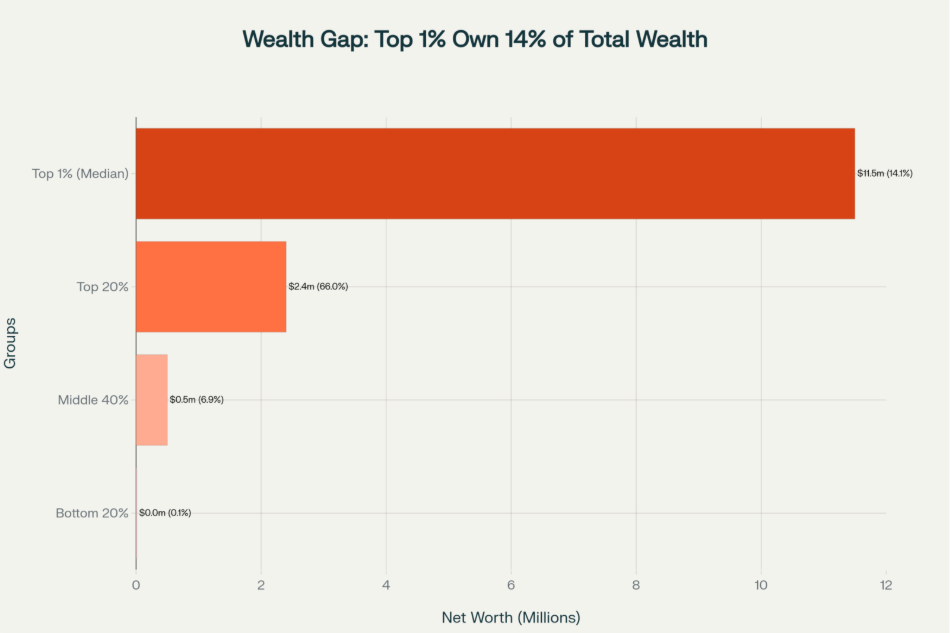
This stark visualization exposes New Zealand’s grotesque wealth inequality. The median top 1% household possesses $11.5 million - more than 1,000 times the bottom 20% who scrape by on $11,000. The wealthiest 20% control 66% of all household wealth while the bottom half owns virtually nothing.
The Wealth Protection Racket
Follow the Money: Who Profits from CGT Failure
The property industry’s capture of New Zealand politics is documented, quantified, and obscene. Between 2021 and 2023, people aligned with property donated $2.5 million to political parties (RNZ, 2023), with 53% going to National ($1.3 million), 32% to ACT ($800,000), 12% to NZ First ($300,000), and just 2% to Labour ($50,000) (RNZ, 2023).
The names tell the story. Trevor Farmer, with family wealth estimated at $900 million, gave $480,000 total - $215,000 each to National and ACT, $50,000 to NZ First (RNZ, 2023). Mark Wyborn, family worth $695 million, donated $300,000 - $150,000 to NZ First, $100,000 to National, $50,000 to ACT (RNZ, 2023). Billionaire Graeme Hart, worth $12 billion, gave $804,000 split between National, ACT, and NZ First (RNZ, 2023).
What did they buy? National pledged to cut the bright-line property tax test from 10 years to 2 years and restore full interest deductibility for landlords (RNZ, 2023) - both delivered in coalition. The bill passed in March 2024, restoring interest deductibility for residential investment property and reducing the bright-line test to two years (1News, 2024). Prime Minister Christopher Luxon personally benefited, selling his Wellington apartment for a $180,000 gain that would have been taxed under the previous 5-year bright-line test but escaped tax under his own government’s 2-year rule (RNZ, 2024).
The tax breaks are quantified welfare for landlords. Finance Minister Nicola Willis said restoring landlord interest deductibility and the bright-line changes would cost $2.31 billion over four years (1News, 2024) - $2.31 billion in foregone revenue that could fund healthcare, education, or housing. Instead, it subsidizes property speculation.
Meanwhile, Inland Revenue found over $150 million in unpaid tax from property developers and investors in just nine months of 2024-25 (RNZ, 2025), with developers claiming tax refunds when incurring costs but not paying tax when properties sell (RNZ, 2025). The system is rigged for evasion.
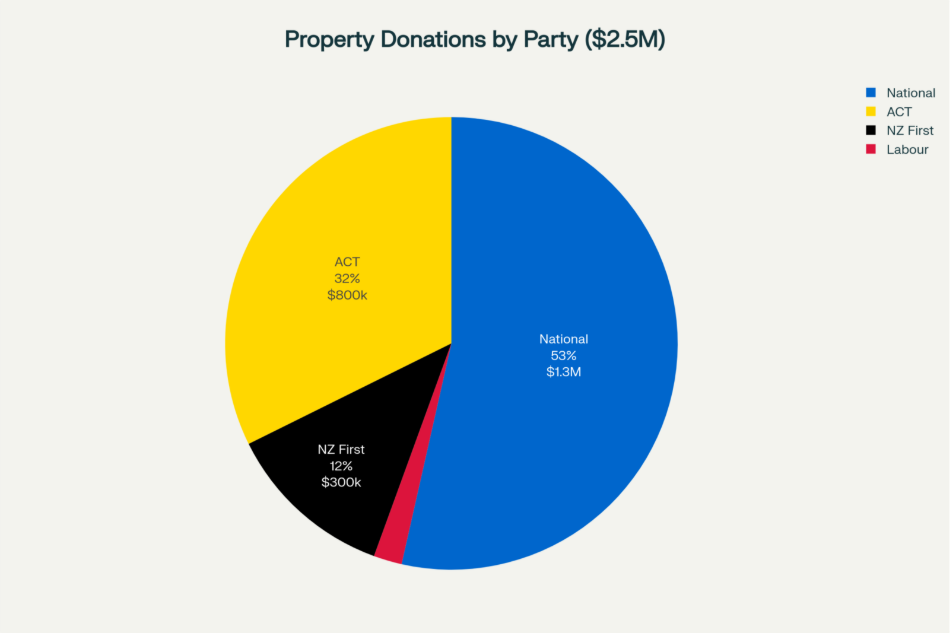
This chart reveals who property speculators really serve. Between 2021-2023, property industry donors poured $2.5 million into political parties - with 97% going to National, ACT, and NZ First, the three parties most hostile to capital gains taxation. Labour received a paltry 2%, just $50,000.
The Think Tank-to-Policy Pipeline
New Zealand’s captured democracy operates through a coordinated network of right-wing think tanks funded by the same corporate interests. The New Zealand Initiative and the Taxpayers’ Union are both members of the Atlas Network (NZ Herald, 2025), a global coalition of over 500 free-market think tanks promoting corporate deregulation.
Taxpayers’ Union executive director Jordan Williams openly admits Atlas membership (RNZ, 2024), having attended Atlas Network’s Think Tank MBA program in 2015 (RNZ, 2024). The Taxpayers’ Union claims 80% of its income comes from small donations averaging $75-85 (RNZ, 2024), but Williams admitted to receiving donations from tobacco and regulated industries accounting for “less than 3%” of income (RNZ, 2024) - conveniently obscuring larger donors. Billionaire property developer Sir Bob Jones donates rent-free Wellington office space (RNZ, 2024), the largest single in-kind contribution.
The New Zealand Initiative represents about 70 corporate members whose combined revenue equals a quarter of New Zealand’s economy (Wikipedia, 2024). In 2022, Atlas Network had revenues of US$20.2 million (NZ$32.8 million), awarding US$75,800 (NZ$123,000) in grants to Australia and New Zealand partners (PSA, 2024).
These aren’t neutral policy shops - they’re ideological enforcers funded by wealth to protect wealth. When Labour proposes even modest redistribution, this network mobilizes opposition through coordinated media releases, op-eds, and “independent” analysis that floods the discourse with free-market dogma.
Rhetoric vs. Reality: Cui Bono?
Labour’s framing positions CGT as helping ordinary New Zealanders access healthcare, but the numbers expose the lie. Three free GP visits per year (NZ Herald, 2025) for someone needing regular medical care for chronic conditions is insulting tokenism. The average GP fee varies wildly by region, with some approaching $100 per visit (1News, 2024), meaning Labour’s offering covers perhaps $300 annually - less than the cost increase in food prices that forced half of New Zealanders to cut back on fruit and vegetables (RNZ, 2025).
Who actually benefits? Not Māori. Just 27.5% of Māori own or partly own their home compared to 47.8% of Europeans (Stats NZ, 2024), meaning Māori are far more likely to be renters paying landlords who will pass CGT costs through as rent increases - a regressive transfer from the poorest to the slightly-less-poor while the wealthy remain untouched. One-third of Māori live in damp homes and 21.7% in crowded homes (Stats NZ, 2024), with only 53.9% of Māori reporting adequate income to meet daily needs in 2023 (RNZ, 2025).
The exemptions are wealth preservation by design. Excluding farms protects landed gentry sitting on multi-million-dollar estates. Excluding shares protects the top 20% whose portfolios hold 18% in stocks and bonds (RNZ, 2025) that appreciate tax-free. Excluding business assets protects the 119 individuals and families on the NBR Rich List who own $102.1 billion in assets (RNZ, 2025).
Historical Pattern: Three Decades of Capitulation
Labour’s CGT history is a 30-year pattern of raised hopes and political cowardice (RNZ, 2024). Every attempt followed the same script: announce progressive tax policy, face business sector backlash amplified by think tanks and media, fumble details in debate, lose election, blame voters for “no mandate.”
In 2014, David Cunliffe couldn’t answer details about his own CGT policy during a debate (RNZ, 2014), handing John Key an easy victory. In 2019, Jacinda Ardern abandoned CGT entirely despite Labour polling over 45% and the Tax Working Group’s comprehensive recommendations (Interest.co.nz, 2019). Political scientist Bryce Edwards argues convincingly there was never real intention to fight for it (Edwards, 2019), with Labour side-stepping questions about NZ First support during the campaign as if it didn’t matter - because they never planned to deliver.
Now Hipkins repeats the pattern with a CGT so narrow it guarantees future failure, giving Labour cover to say “we tried” while protecting the wealth accumulation machine that keeps property prices inflated and inequality entrenched.
Tikanga Violations: Te Ao Māori vs. Neoliberal Extraction
Labour’s hollow CGT violates every tikanga principle that should guide collective wellbeing:
Whanaungatanga (relationships/connection): A fair tax system strengthens community by ensuring collective needs are met. Labour’s exemption-riddled CGT weakens whanaungatanga by protecting individual wealth accumulation over collective welfare, allowing the wealthy to hoard assets while whānau struggle to afford housing on their own whenua.
Manaakitanga (care/hospitality): With one-third of Māori living in damp homes (Stats NZ, 2024) and Māori acquiring disability at age 40 compared to 57 for non-Māori (The Spinoff, 2025), manaakitanga demands we prioritize care for the vulnerable. Labour’s token GP visits while protecting billionaire property portfolios is manaakitanga’s antithesis.
Kaitiakitanga (guardianship): We are stewards of resources for future generations. If current housing trends persist, almost all Māori in Aotearoa will be renters by 2061 (ANZ, 2024) - a complete dispossession of intergenerational wealth and connection to land. Kaitiakitanga requires we reverse this trajectory, not manage its decline with narrow tax tweaks.
Wairuatanga (spirituality/values): Economic constraints limit participation in cultural events, tangi, travel to ancestral lands, and community gatherings (The Spinoff, 2025), severing Māori from wairua. Labour’s failure to significantly redistribute wealth perpetuates cultural disconnection through economic violence.
Kotahitanga (unity): True unity requires shared prosperity, not managed inequality. The top 1% owning 14% of wealth while bottom 40% owns virtually nothing (RNZ, 2025) fractures kotahitanga. Labour’s CGT preserves this division.
Rangatiratanga (self-determination): With Māori home ownership at 27.5% and falling (Stats NZ, 2024), rangatiratanga is materially impossible for most Māori. True self-determination requires economic sovereignty - land, housing, wealth to make choices free from Pākehā landlord exploitation.
Aroha (love/compassion): Labour’s health spokesperson Ayesha Verrall says “one in six New Zealanders cannot afford to visit their doctor when they are sick” (NZ Herald, 2025), but Labour’s response - three free visits funded by a gutless CGT - is aroha in name only. True aroha would comprehensively tax wealth to fund free healthcare for all, not performative scraps.
Hidden Connections: The Network Revealed
Connection 1: Barbara Edmonds, Labour’s finance spokesperson, was seconded from Inland Revenue in 2016 to work with National’s revenue ministers Michael Woodhouse and Judith Collins (RNZ, 2024). She brings IRD’s institutional caution about comprehensive tax reform, having advised the party most opposed to wealth taxation.
Connection 2: Labour received zero business donations over $15,000 between 2021-2022, and no donations over $20,000 in 2023 (RNZ, 2023), leaving them beholden to individual MP salary contributions as their funding base (Rashbrooke, 2024). This financial precarity makes Labour desperate for middle-class votes, explaining their CGT exemptions designed not to scare property-owning swing voters.
Connection 3: The New Zealand Initiative and Taxpayers’ Union are both Atlas Network partners (NZ Herald, 2025), creating an ideological echo chamber where Jordan Williams from Taxpayers’ Union receives free office space from billionaire property developer Sir Bob Jones (RNZ, 2024) while the Initiative represents 70 corporate members whose revenue equals 25% of New Zealand’s economy (Wikipedia, 2024).
Connection 4: Trevor Farmer’s son Dean Farmer is a director of Tramco, which manages a $2 billion property portfolio (RNZ, 2023). Trevor gave $480,000 to National, ACT, and NZ First (RNZ, 2023) - the coalition that restored interest deductibility saving landlords billions.
Connection 5: Prime Minister Christopher Luxon sold his Wellington apartment for a $180,000 tax-free gain (RNZ, 2024) under bright-line rules his own government loosened, personally benefiting from policies funded by $2.5 million in property industry donations to his coalition (RNZ, 2023).
Connection 6: Property developer Mark Todd gave Labour $50,000 and Greens $20,000 (Edwards, 2024), one of Labour’s only property industry donors. A representative said Todd believed legislation “which reins in the lord bit of landlord” was good (RNZ, 2023) - yet Labour’s CGT exempts business assets like Todd’s development company.
Connection 7: In 2021, just one year after entering Parliament, Barbara Edmonds was named by Christopher Luxon as the one Labour MP he’d want on his team (NZ Herald, 2024) - the ultimate endorsement from Mr. Property Profits himself, signaling Edmonds’ acceptability to the business class Labour supposedly opposes.
Implications: Quantified Harm and Threatened Rights
Labour’s failure guarantees continued dispossession. ANZ research projects that if current trends continue, almost all Māori will be renters by 2061 (ANZ, 2024) - complete intergenerational wealth erasure. Already, 88.4% of Māori live in whānau households with 86.9% having 2-4 family members (Stats NZ, 2024), yet 21.7% live in crowded homes needing extra bedrooms (Stats NZ, 2024).
The wealth gap widens daily. Between June 2021 and June 2024, the wealthiest 20% increased their wealth by 19% or $386,000 to a median $2.4 million (WSWS, 2025), while the bottom 40% saw no statistically significant change (WSWS, 2025). Some 109,000 households - the poorest 5.4% - own less than zero assets, drowning in debt (WSWS, 2025).
Healthcare remains unaffordable. Most New Zealanders don’t know how little people on benefits receive (RNZ, 2025), with JobSeeker basic benefit at $361/week for singles compared to $538/week for NZ Super (RNZ, 2025). Researcher Shamubeel Eaqub notes “inequality is quite frightening... poverty erodes people’s dignity and connection to community” (RNZ, 2025).
International precedents warn of worse to come. Australia’s property market shows what happens when negative gearing remains unchecked (ABC, 2024) - housing affordability collapse, generational wealth transfer to boomers, political capture by landlord class. New Zealand is following this path with Labour’s blessing.
The specific rights threatened: Rangatiratanga (Māori self-determination on ancestral land), Article 2 Treaty rights (guaranteed possession of lands and estates), Right to adequate housing (UN International Covenant on Economic, Social and Cultural Rights), Health equity (guaranteed under Te Tiriti partnership principles).
Kia Kaha, Kia Maia, Kia Manawanui

The Māori Green Lantern Fighting Misinformation And Disinformation From The Far Right
Labour’s capital gains tax is not progressive taxation - it’s political theatre designed to inoculate them against wealth tax demands while preserving the property speculation machine enriching the 1%. The top 1% will continue hoarding $11.5 million in median wealth (RNZ, 2025) while Māori home ownership craters toward zero by 2061 (ANZ, 2024). This is colonialism’s endgame: complete dispossession laundered through “progressive” policy.
The evidence is irrefutable. Property speculators gave 97% of their $2.5 million donations to parties opposing comprehensive CGT (RNZ, 2023). Labour’s CGT exempts the very assets - shares, business holdings, farms - where the wealthiest park their money (RNZ, 2025). Labour can’t even say how much revenue their CGT will raise (Newstalk ZB, 2025), rendering the Medicard promise meaningless.
Call to Action
Demand Labour commit to comprehensive wealth taxation: no exemptions for farms over $2 million valuation, no exemptions for share portfolios, no exemptions for business assets. Tax all wealth above $5 million at progressive rates reaching 4%. Use the revenue - estimated at billions annually - to fund free healthcare, public housing on a massive scale, and whenua Māori housing development.
Contact Labour MPs directly and demand they adopt Te Pāti Māori’s comprehensive wealth and inheritance tax policies. Organize in your unions, marae, and community groups to reject tokenism and demand redistribution that matches the scale of harm.
Support organizations fighting for housing justice and tax equity. Donate to Tax Justice Aotearoa, which advocates for comprehensive CGT. Pressure Labour’s Barbara Edmonds, who holds the finance portfolio, to stop protecting business class interests and fight for working people.
Vote strategically in 2026. If Labour won’t deliver transformative redistribution, support parties that will. Build coalition power that makes wealth taxation non-negotiable.
Our tamariki deserve better than renting on their ancestors’ land while billionaires collect tax-free gains. Our kaumātua deserve free healthcare, not means-tested scraps. Our whānau deserve homes, not crowded, damp rentals extracting wealth to offshore landlords.
Kia kaha te kaupapa. Kia maia te whakapono. Kia manawanui tātou katoa.
Humbly request readers support this mahi through koha to HTDM: 03-1546-0415173-000, only if you have the capacity and capability to do so.
Nāku noa, nā
Ivor Jones
The Māori Green Lantern
Kaitiaki, Te Arawa/Ngāti Pikiao
ABC. (2024). Jacinda Ardern slashed negative gearing in NZ. The new government reversed it. Retrieved from https://www.abc.net.au/news/2024-04-20/nz-reinstate-interest-deductibility-on-investment-properties/103685396
ANZ. (2024). ANZ research highlights challenges of Māori housing affordability. Retrieved from https://www.anz.com.au/newsroom/new-zealand/2025/09/anz-research-highlights-challenges-of-mori-housing-affordability/
DLA Piper. (2023). Tackling the affordable housing crisis in New Zealand. Retrieved from https://www.dlapiper.com/en/insights/publications/real-estate-gazette/real-estate-gazette-living-capital/12-new-zealand-tackling-the-affordable-housing-crisis-in-new-zealand
Edwards, B. (2019). Signs Labour didn’t intend to implement capital gains tax. RNZ. Retrieved from https://www.rnz.co.nz/news/national/387327/bryce-edwards-signs-labour-didn-t-intend-to-implement-capital-gains-tax
Edwards, B. (2024). Following the political money. Democracy Project. Retrieved from https://democracyproject.nz/2024/05/08/bryce-edwards-following-the-political-money/
Interest.co.nz. (2019). Government torpedoes Capital Gains Tax. Retrieved from https://www.interest.co.nz/news/99198/prime-minister-says-govt-unable-find-consensus-and-ruling-out-capital-gains-tax-under
Newstalk ZB. (2025). Brad Olsen: Infometrics Principal Economist on Labour announcing a capital gains tax. Retrieved from https://www.newstalkzb.co.nz/on-air/early-edition-with-ryan-bridge/audio/brad-olsen-infometrics-principal-economist-on-labour-announcing-a-capital-gains-tax/
NZ Herald. (2024). Mood of the Boardroom: How CEOs rate Labour’s Barbara Edmonds. Retrieved from https://www.nzherald.co.nz/business/mood-of-the-boardroom/mood-of-the-boardroom-how-ceos-rate-labours-barbara-edmonds/5LW2NX2LSZGG7JDJT23T32JFME/
NZ Herald. (2025). Labour unveils targeted capital gains tax to fund free doctor visits. Retrieved from https://www.nzherald.co.nz/nz/politics/labour-unveils-targeted-capital-gains-tax-to-fund-free-doctor-visits/644ZQX6QDFGFXAPO2O4FDSKELE/
NZ Herald. (2025). The varied faces of NZ think-tanks: Who fronts them and what they do. Retrieved from https://www.nzherald.co.nz/nz/politics/the-varied-faces-of-think-tanks-in-nz-who-fronts-them-and-what-they-do/X7M4SUFDT5GYHKTJI2JCTJPUMA/
1News. (2024). GP fees explained: How your doctor sets their prices. Retrieved from https://www.1news.co.nz/2024/07/19/gp-fees-explained-how-your-doctor-sets-their-prices/
1News. (2024). Govt passes bright-line test, interest deductibility rule changes. Retrieved from https://www.1news.co.nz/2024/03/27/govt-passes-bright-line-test-interest-deductibility-rule-changes/
PSA. (2024). Understanding Atlas: How a right-wing network is building global influence. Retrieved from https://www.psa.org.nz/journals/understanding-atlas-how-a-right-wing-network-is-building-global-influence
Rashbrooke, M. (2024). Why New Zealand political donations have more than tripled. RNZ. Retrieved from https://www.rnz.co.nz/news/in-depth/523415/why-new-zealand-political-donations-have-more-than-tripled
RNZ. (2014). Labour Party ditches two key tax policies. Retrieved from https://www.rnz.co.nz/news/political/233916/labour-party-ditches-two-key-tax-policies
RNZ. (2023). Hipkins rules out capital gains tax, wealth tax if Labour re-elected. Retrieved from https://www.rnz.co.nz/news/political/493596/hipkins-rules-out-capital-gains-tax-wealth-tax-if-labour-re-elected
RNZ. (2023). No significant donations to the Labour Party from businesses in over two years. Retrieved from https://www.rnz.co.nz/news/election-2023/497947/no-significant-donations-to-the-labour-party-from-businesses-in-over-two-years
RNZ. (2023). Property industry tops political donations. Retrieved from https://www.rnz.co.nz/news/national/499176/property-industry-tops-political-donations
RNZ. (2024). Capital gains tax: A timeline of politicians ruling it in and out. Retrieved from https://www.rnz.co.nz/news/top/532793/capital-gains-tax-a-timeline-of-politicians-ruling-it-in-and-out
RNZ. (2024). Jordan Williams on what the Taxpayers’ Union really is and who funds it. Retrieved from https://www.rnz.co.nz/programmes/30-with-guyon-espiner/story/2018938627/jordan-williams-on-what-the-taxpayers-union-really-is-and-who-funds-it
RNZ. (2024). Jordan Williams on why the Taxpayers’ Union went to Panama to debate vaping. Retrieved from https://www.rnz.co.nz/news/in-depth/517506/jordan-williams-on-why-the-taxpayers-union-went-to-panama-to-debate-vaping
RNZ. (2024). Labour lays groundwork for election-year capital gains tax. Retrieved from https://www.rnz.co.nz/news/political/535446/labour-lays-groundwork-for-election-year-capital-gains-tax
RNZ. (2024). Luxon’s property profits highlight unfairness, Labour says. Retrieved from https://www.rnz.co.nz/news/political/529635/luxon-s-property-profits-highlight-unfairness-labour-says
RNZ. (2024). Who is new Labour finance spokesperson Barbara Edmonds. Retrieved from https://www.rnz.co.nz/news/political/509692/who-is-new-labour-finance-spokesperson-barbara-edmonds
RNZ. (2025). ‘Drivel’ vs ‘lazy’: War of words over Labour’s Future Fund. Retrieved from https://www.rnz.co.nz/news/political/576532/drivel-vs-lazy-war-of-words-over-labour-s-future-fund
RNZ. (2025). Do you know what people on benefits actually get? Retrieved from https://www.rnz.co.nz/news/national/556587/do-you-know-what-people-on-benefits-actually-get
RNZ. (2025). Half of Kiwis cut back on fruit and vegetables as costs rise. Retrieved from https://www.rnz.co.nz/news/business/574025/half-of-kiwis-cut-back-on-fruit-and-vegetables-as-costs-rise
RNZ. (2025). Inland Revenue discovers millions in unpaid tax from property developers and investors. Retrieved from https://www.rnz.co.nz/news/political/560481/inland-revenue-discovers-millions-in-unpaid-tax-from-property-developers-and-investors
RNZ. (2025). Labour to campaign on narrow capital gains tax, no wealth tax. Retrieved from https://www.rnz.co.nz/news/political/577021/labour-to-campaign-on-narrow-capital-gains-tax-no-wealth-tax
RNZ. (2025). What you need to be among New Zealand’s richest people. Retrieved from https://www.rnz.co.nz/news/business/574634/what-you-need-to-be-among-new-zealand-s-richest-people
RNZ. (2025). Where the public stands on capital gains tax. Retrieved from https://www.rnz.co.nz/news/political/573383/rnz-reid-research-poll-where-the-public-stands-on-capital-gains-tax
Stats NZ. (2024). Māori families and households data released as an official Census statistic for the first time. Retrieved from https://www.rnz.co.nz/news/te-manu-korihi/532714/maori-families-and-households-data-released-as-an-official-census-statistic-for-the-first-time
The Spinoff. (2025). Poverty in Aotearoa is not accidental: How our systems deliberately keep people poor. Retrieved from https://thespinoff.co.nz/books/25-09-2025/poverty-in-aotearoa-is-not-accidental-how-our-systems-deliberately-keep-people-poor
Waldegrave, C. (2024). A history of New Zealand housing affordability. RNZ. Retrieved from https://www.rnz.co.nz/news/national/524528/a-history-of-new-zealand-housing-affordability
Wikipedia. (2024). New Zealand Initiative. Retrieved from https://en.wikipedia.org/wiki/New_Zealand_Initiative
Wikipedia. (2025). David Parker (New Zealand politician). Retrieved from https://en.wikipedia.org/wiki/David_Parker_(New_Zealand_politician)
WSWS. (2025). Stark wealth inequality in New Zealand. Retrieved from https://www.wsws.org/en/articles/2025/10/03/ghgj-o03.html
⁂
- https://www.rnz.co.nz/news/te-manu-korihi/532714/maori-families-and-households-data-released-as-an-official-census-statistic-for-the-first-time
- https://www.rnz.co.nz/news/top/515911/national-raised-10-point-4m-in-donations-in-2023
- https://www.rnz.co.nz/news/national/536146/census-2023-response-rate-up-2-percent-on-2018-but-down-on-10-years-ago
- https://www.rnz.co.nz/news/top/568640/accountants-call-for-capital-gains-tax
- https://www.rnz.co.nz/news/in-depth/523415/why-new-zealand-political-donations-have-more-than-tripled
- https://www.nzherald.co.nz/kahu/census-data-released-shows-iwi-populations-increased-significantly/3GR76JWDARC2DNK5DCI463MOXI/
- https://www.rnz.co.nz/news/top/529042/inland-revenue-raises-capital-gains-tax-questions
- https://www.rnz.co.nz/news/in-depth/511353/how-electorate-candidates-funded-their-campaigns-and-who-spent-the-most
- https://www.1news.co.nz/2025/07/01/scrapping-the-census-questions-raised-over-maori-data-trust/
- https://www.rnz.co.nz/news/national/537951/nz-report-card-2024-how-the-country-fared-in-25-key-global-and-domestic-rankings
- https://www.nzherald.co.nz/nz/election-2023-national-party-banks-75-times-more-in-donations-than-labour-party/CAKRIIEYXBGMRGUNIVQ6J3NXVM/
- https://www.rnz.co.nz/news/national/529739/home-ownership-figure-in-census-surprises-statistics-officials
- https://www.rnz.co.nz/news/political/517937/nz-is-changing-faster-than-the-census-can-keep-up-the-4-big-trends-to-watch
- https://www.stats.govt.nz/information-releases/families-households-and-housing-2023-census/
- https://www.stats.govt.nz/methods/producing-family-and-household-data-by-ethnicity-and-maori-descent-in-the-2023-census/
- https://www.stats.govt.nz/news/home-ownership-increases-and-housing-quality-improves/
- https://figure.nz/chart/YSm6PkBDd8DPLiid
- /content/files/api/v1/articles/123591-using-social-determinants-health-theory-as-a-framework-to-understand-the-complex-tapestry-of-geographic-social-and-economic-factors-that-perpetuate.pdf
- https://elections.nz/democracy-in-nz/political-parties-in-new-zealand/party-donations-and-loans-by-year/
https://2023census-statsnz.hub.arcgis.com
- /content/files/sites/default/files/2024-12/an24-10.pdf
- https://elections.nz/stats-and-research/party-donations-and-loans/
- https://www.1news.co.nz/2024/10/31/census-2023-first-whanau-maori-and-households-stats-released/
- https://es.infometrics.co.nz/article/2024-10-first-detailed-insights-from-the-2023-census
- https://theconversation.com/oecd-comparisons-reveal-an-unflattering-picture-of-inequality-in-nz-could-that-change-239306
- https://data.govt.nz/datasetrequest/show/863
- https://2023census-statsnz.hub.arcgis.com/maps/29a82d5a0ea24a3880219bcb3df126dc
- https://www.oecd.org/en/publications/society-at-a-glance-2024_918d8db3-en/full-report/income-and-wealth-inequalities_7ac4178f.html
- https://voteauckland.co.nz/en/past-local-elections-by-elections/candidate-electoral-donations-expenses-search.html
- https://www.stats.govt.nz/information-releases/2023-census-population-counts-by-ethnic-group-age-and-maori-descent-and-dwelling-counts/
- /content/files/content/dam/oecd/en/publications/reports/2024/05/oecd-economic-surveys-new-zealand-2024_42678d02/603809f2-en.pdf
- https://www.data.govt.nz/requests?AgencySearch=Electoral+Commission
- https://www.stats.govt.nz/news/families-and-households-in-the-2023-census-further-insights-into-how-we-live/
- https://www.nzherald.co.nz/kahu/maori-families-and-households-data-released-as-an-official-census-statistic-for-the-first-time/J5YLVA6HABES3BC753GL5ORHQM/
- https://www.1news.co.nz/2024/10/03/seven-things-we-learnt-about-kiwis-from-new-census-data/
- https://www.rnz.co.nz/news/national/524528/a-history-of-new-zealand-housing-affordability
- https://www.rnz.co.nz/news/political/559986/national-tops-the-list-of-donations-to-political-parties-with-almost-5m-in-contributions
- https://www.nzherald.co.nz/nz/census-updates-housing-sexuality-income-what-latest-data-shows-about-how-kiwis-live/BSUODBMY7VGT3LS4W2ALLXO23Q/
- https://www.rnz.co.nz/news/in-depth/528379/wealthy-people-pay-lower-tax-in-nz-than-in-similar-states-study-shows