"How Nicola Willis Has Surpassed All Previous Finance Ministers in Institutional Corruption and Economic Violence Against Te Tangata Whenua" - 11 September 2025
The Neoliberal Hydra
Kia ora koutou katoa. Greetings to you all.
In the toxic landscape of New Zealand's neoliberal experiment, few figures have wielded economic power with such devastating contempt for democratic institutions and Māori wellbeing as Finance Minister Nicola Willis. While her predecessors Jenny Shipley and Ruth Richardson earned infamy for their brutal restructuring, Willis has elevated institutional corruption to an art form, systematically dismantling public services while orchestrating the most brazen political interference in Reserve Bank independence in our nation's history.
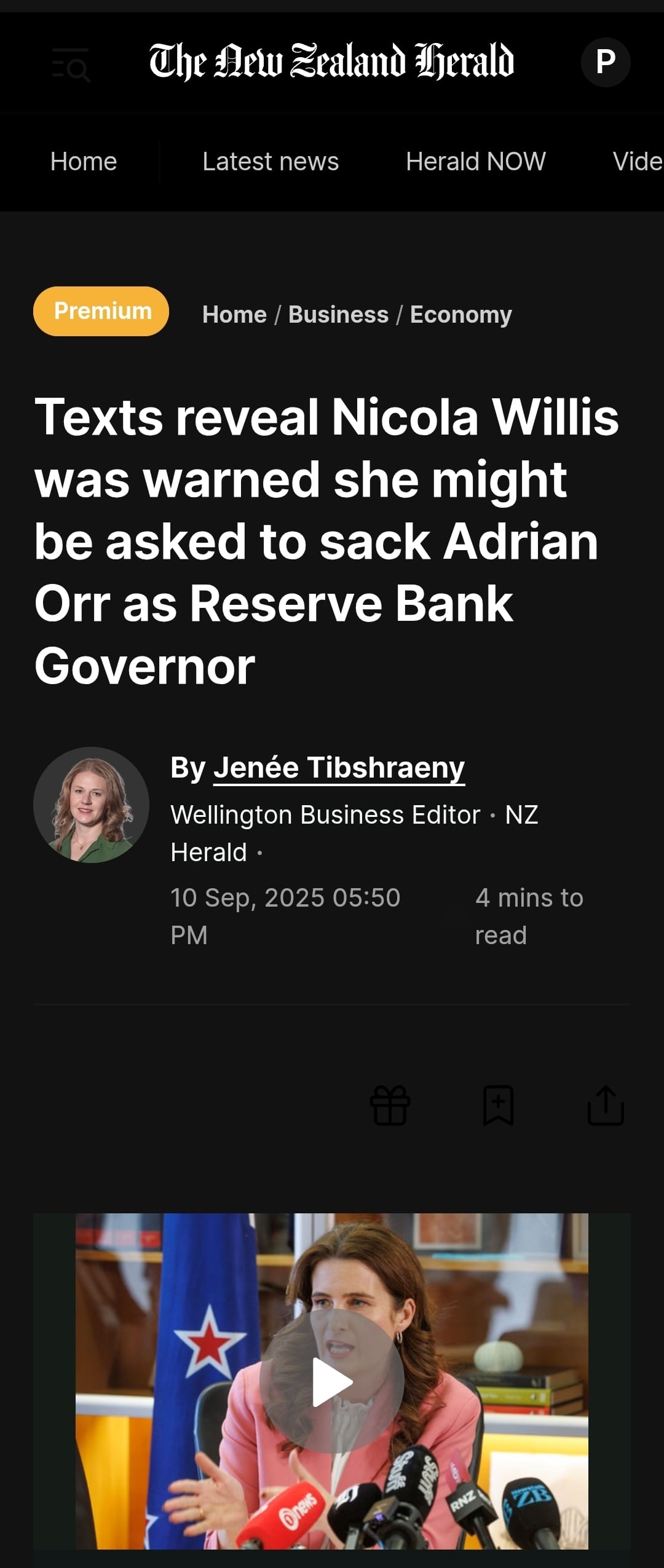
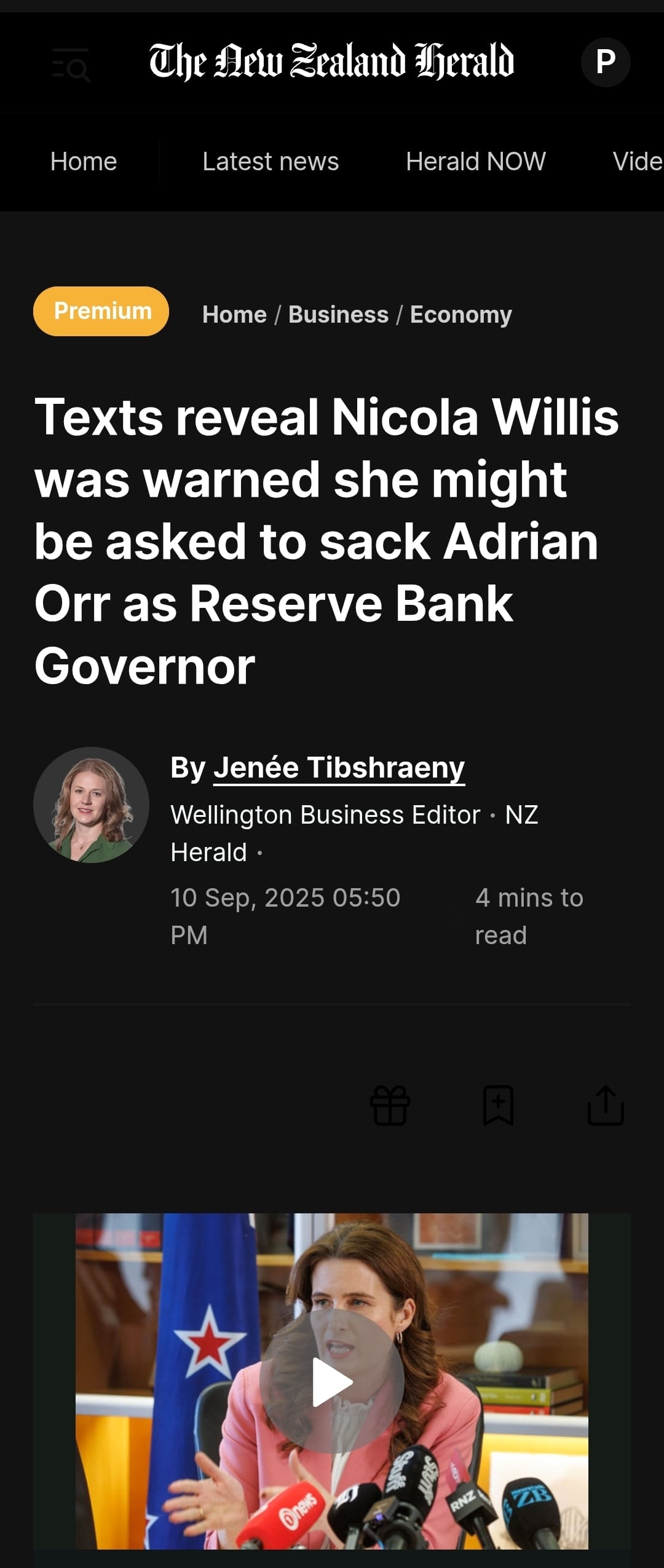
Payealled article - https://www.dropbox.com/scl/fi/al6o3416i86rhvgla32ia/Confidential-document-reveals-mayor-s-office-drinks-on-night-of-Auckland-floods-Newsroom-1.PDF?rlkey=3nogdoxs26xprgjl68sd7bg15&st=5h5hrrfv&dl=0
Background
To understand the magnitude of Willis's institutional vandalism, we must first examine the benchmark set by her predecessors. Ruth Richardson's "Mother of All Budgets" in 1991 introduced what critics called "Ruthanasia" - savage cuts to social welfare and state assets that devastated Māori communities already reeling from colonisation. Jenny Shipley, who succeeded Richardson, continued this trajectory before her post-political career imploded spectacularly when she was fined $6 million for breaching director duties in the Mainzeal construction company collapse.
Yet both Richardson and Shipley operated within recognisable democratic frameworks. Willis represents something far more sinister - the complete weaponisation of economic policy against institutional independence and Te Ao Māori values of collective responsibility and intergenerational thinking.
The evidence of Willis's unprecedented corruption lies not in traditional financial misconduct, but in her systematic abuse of ministerial power to serve narrow political interests while devastating public institutions that protect Māori rights and economic justice. Three key areas expose the depth of this institutional violence: her orchestrated campaign to force Reserve Bank Governor Adrian Orr's resignation, her savage dismantling of public services that disproportionately serve Māori communities, and her reckless fiscal mismanagement that will burden future generations with crippling debt.
Unlike the crude sledgehammer approaches of Richardson and Shipley, Willis operates through calculated institutional manipulation, using the machinery of government to serve her political masters while maintaining plausible deniability. This represents a quantum leap in the sophistication of neoliberal corruption.
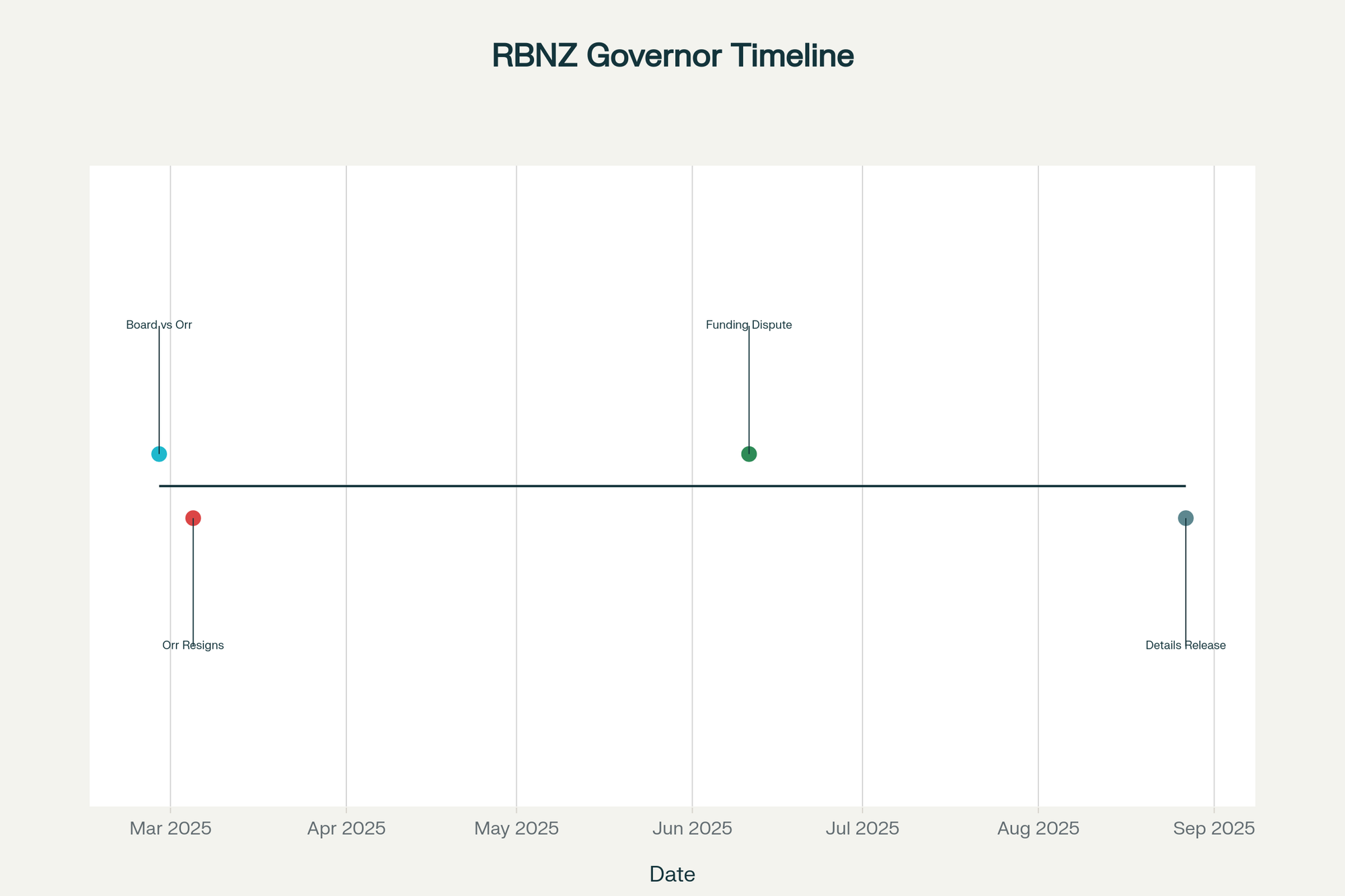
Timeline of Adrian Orr's resignation from the Reserve Bank of New Zealand
The Reserve Bank Coup: Democratic Vandalism in Action
The most damning evidence of Willis's institutional corruption emerges from text messages released by Treasury that expose her foreknowledge of a coordinated campaign to remove Reserve Bank Governor Adrian Orr. On February 27, 2025, Treasury Secretary Iain Rennie warned Willis she might receive a recommendation to sack Orr, revealing an "employment process" so advanced that Orr was forced to take leave while defending himself against board accusations.
This represents unprecedented political interference in Reserve Bank independence - a cornerstone of New Zealand's economic framework since the 1989 Reserve Bank Act. Willis knew Orr faced a kangaroo court, yet maintained public silence for months, allowing the narrative of a voluntary resignation to persist while she orchestrated the appointment of a more compliant successor.
The manufactured crisis over RBNZ funding reveals Willis's modus operandi: create artificial budget pressures, then use those pressures to justify removing officials who refuse to genuflect to her political agenda. Orr's crime was requesting adequate funding to maintain the Reserve Bank's independence and capacity - funding that Willis deliberately withheld to force his capitulation.
From a Māori perspective, this attack on institutional independence represents the classic colonial strategy of divide and conquer. By neutering the Reserve Bank's independence, Willis ensures monetary policy serves the interests of capital rather than the collective wellbeing that underpins Māori economic philosophy.
Economic Violence Against Te Tangata Whenua
Willis's assault on public services represents the most savage attack on Māori communities since the Employment Contracts Act. Her public sector cuts have eliminated over 7,500 positions, with Māori disproportionately represented in public service roles that provide crucial support for whānau and communities.
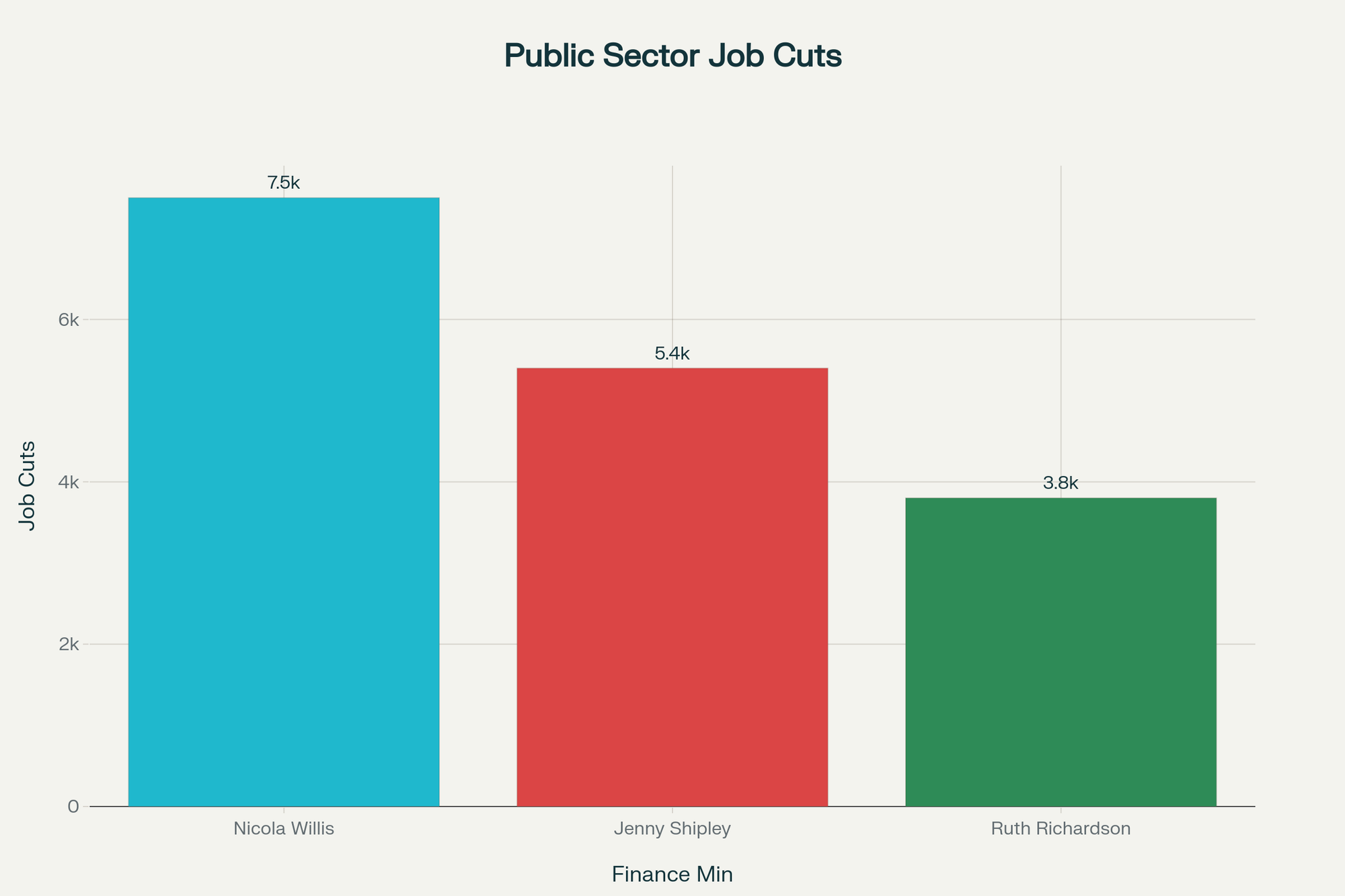
Comparison of Public Sector Job Cuts: Willis vs Shipley vs Richardson
These cuts go far beyond Richardson's "Ruthanasia" in their targeted cruelty. While Richardson wielded a chainsaw, Willis operates like a surgeon, precisely excising the programs and personnel that support Māori advancement. Her elimination of digital safety teams, for example, directly threatens Māori rangatahi who face online exploitation at higher rates than Pākehā children.
Willis's justification - that taxpayers aren't getting "bang for buck" from public services - exposes her fundamental misunderstanding of collective responsibility. Public services exist not to generate profit but to ensure no one is left behind - a principle central to Te Ao Māori and utterly foreign to Willis's neoliberal worldview.
The minister's admission that she cannot define "frontline" services while claiming to protect them reveals either breathtaking incompetence or calculated deception. When pressed about the impact of her cuts, Willis retreats to meaningless talking points about "innovation" and "efficiency" - the same hollow rhetoric that has justified decades of economic violence against Māori communities.
Fiscal Recklessness and Intergenerational Theft
Perhaps most damning is Willis's projection that New Zealand will remain in deficit until at least 2029 due to her government's $14 billion tax cuts package. This represents a fundamental betrayal of intergenerational responsibility - a core Māori value that demands current generations consider the impact of their decisions on mokopuna yet to be born.
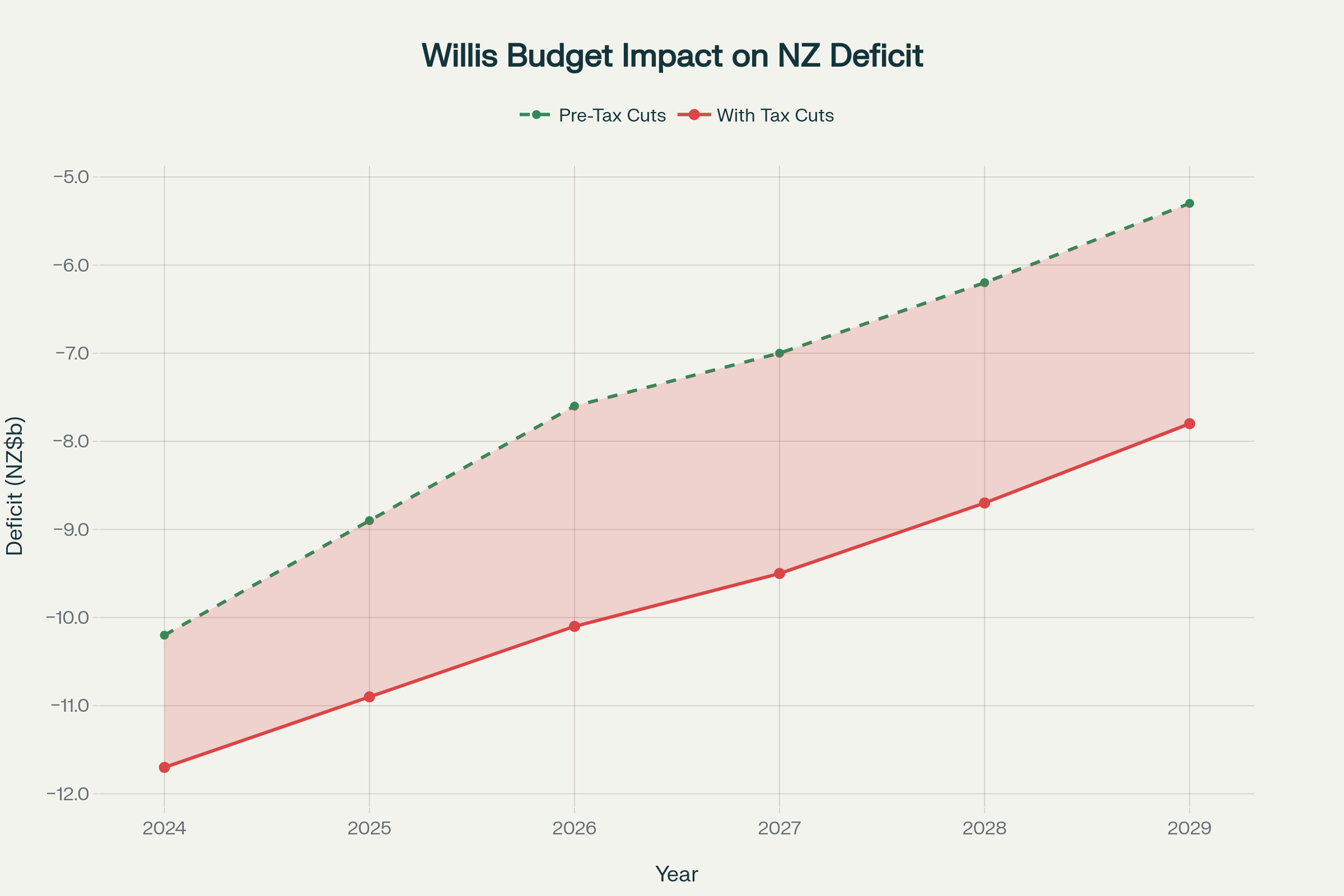
Projected NZ Government Deficits: Willis Era 2024-2029
Willis's creation of a new financial measure, OBEGALx, to exclude ACC deficits from budget calculations represents accounting manipulation that would make Enron executives blush. This sleight-of-hand allows her to hide the true cost of her fiscal vandalism while claiming economic prudence.
The minister's attacks on Labour as "fiscally innumerate" while presiding over record deficits expose breathtaking hypocrisy. Her government has engineered the worst fiscal trajectory since the Great Depression while gifting billions to wealthy property speculators through tax cuts that provide no productive economic benefit.
Hidden Connections: The Network of Institutional Capture
Willis's corruption extends beyond individual decisions to systematic institutional capture. Her coordinated campaign against Orr involved not just Treasury officials but Reserve Bank board members who clearly violated their fiduciary duties by pursuing a predetermined outcome rather than fair process.
The timeline reveals careful choreography: board concerns manufactured in February, employment process launched on February 27, resignation extracted by March 5, with Willis maintaining public silence until forced disclosure months later. This level of coordination suggests a network of complicit actors working to serve political rather than institutional interests.
Most concerning is Willis's manipulation of procurement rules, proposing to scrap 24 of 71 requirements including Living Wage provisions for government contractors. This represents direct wealth transfer from working families to corporate profits - exactly the kind of policy corruption that enriches the powerful while impoverishing communities.
Implications
Willis's institutional vandalism has implications far beyond immediate economic impact. By destroying Reserve Bank independence, she has fatally compromised New Zealand's economic credibility. International investors now know our central bank serves political rather than economic imperatives, increasing borrowing costs and reducing investment confidence.
Her savage public sector cuts have shattered the social contract that enables democratic governance. When the state abandons its responsibility to protect vulnerable communities, it loses legitimacy and invites social upheaval. For Māori communities already facing systemic disadvantage, these cuts represent existential threats to cultural and economic survival.
Most seriously, Willis has normalised the weaponisation of economic policy for partisan political purposes. Future governments will inherit precedents that justify unprecedented interference in democratic institutions - a legacy that threatens the foundations of constitutional government.
From Te Ao Māori perspective, Willis represents the antithesis of principled leadership. Where Māori values emphasise collective responsibility, intergenerational thinking, and institutional respect, Willis embodies individual ambition, short-term thinking, and institutional destruction. Her legacy will be measured in generations of damaged communities and compromised democratic institutions.

The Māori Green Lantern Fighting Misinformation And Disinformation From The Far Right
Nicola Willis has achieved what neither Ruth Richardson nor Jenny Shipley managed: the complete subordination of economic policy to narrow political interests through systematic institutional corruption. Her orchestrated removal of Adrian Orr, savage dismantling of public services, reckless fiscal mismanagement, and manipulation of democratic institutions represent unprecedented abuse of ministerial power.
While Richardson and Shipley operated as crude instruments of neoliberal ideology, Willis represents its sophisticated evolution - using the machinery of government itself as a weapon against democratic accountability and Māori advancement. Her corruption lies not in personal enrichment but in the systematic perversion of public institutions to serve private political interests.
The evidence demands immediate accountability. Willis must face investigation for her role in undermining Reserve Bank independence, her deliberately deceptive public statements about Orr's resignation, and her systematic abuse of ministerial power to pursue partisan political objectives.
Te tangata whenua and all New Zealanders who value democratic governance must recognise Willis as the most dangerous Finance Minister in our nation's history - not despite her institutional sophistication, but because of it.
Kia kaha. Stay strong.
For readers who find value in exposing these institutional crimes and wish to support continued mahi against neoliberal corruption, please consider a koha to HTDM: 03-1546-0415173-000. The MGL understands these are tough economic times for whānau, so please only contribute if you have capacity and wish to do so.
Noho ora mai.