“How Trump’s FBI Invaded Aotearoa to Spy on Māori” - 24 September 2025
The Government Just Sold Out Our Sovereignty to American Fascists
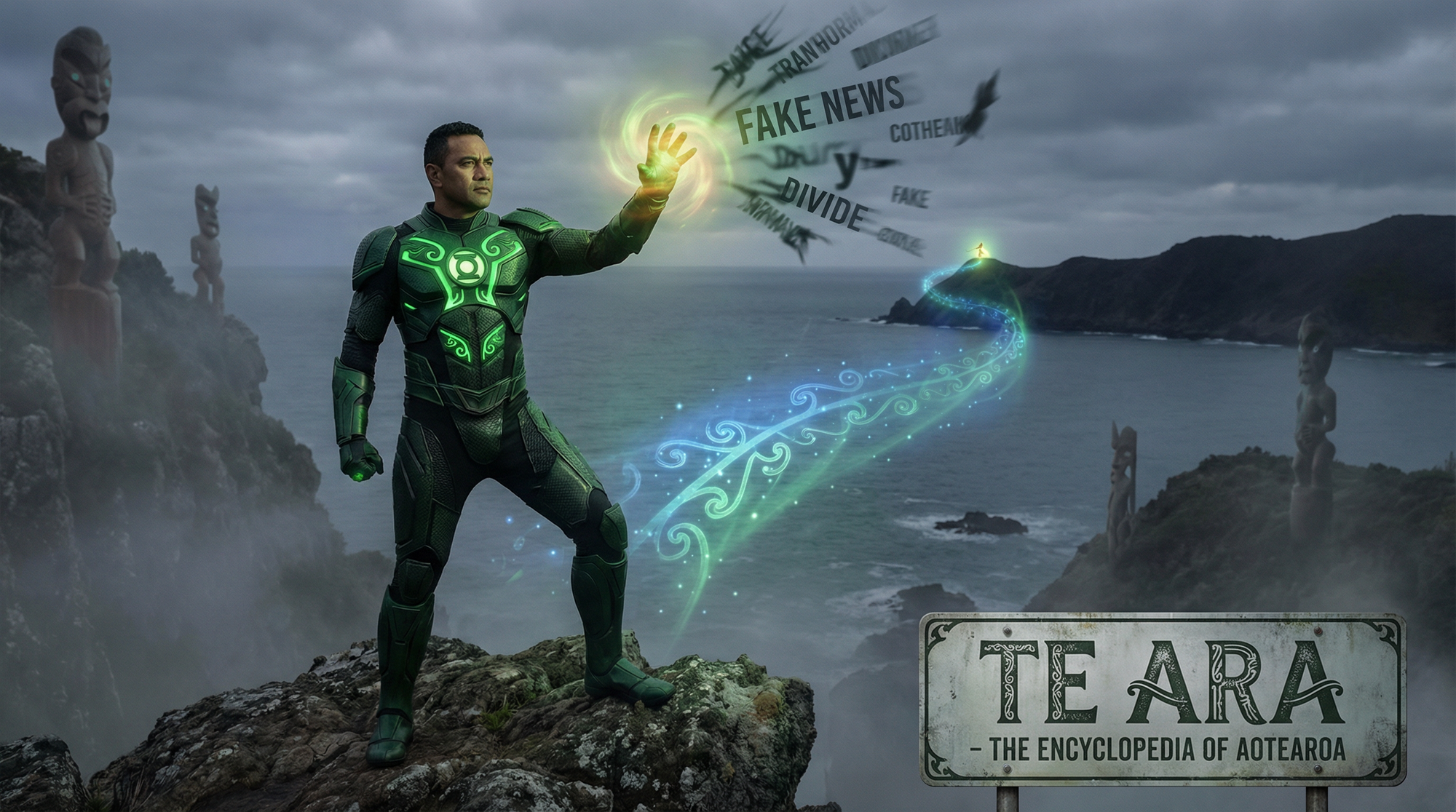
Kia ora koutou. Ko Ivor Jones ahau, The Māori Green Lantern.
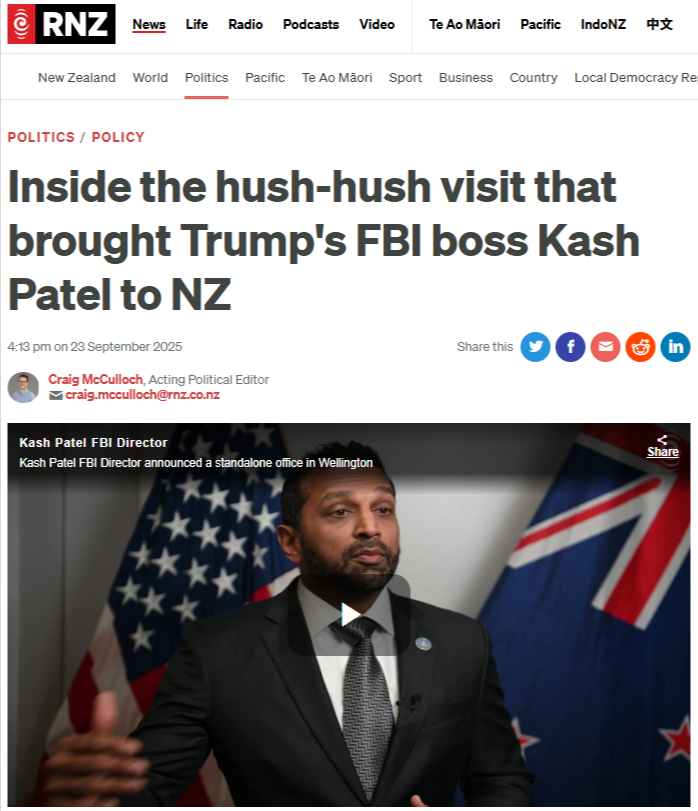
Your government just handed the keys to New Zealand’s intelligence operations to a Trump loyalist and far-right extremist who believes in using state power to crush political opponents. While you were worried about the cost of groceries, Judith Collins was secretly hosting dinners for Kash Patel, the new FBI director who came to New Zealand in July 2025 to establish a permanent FBI office that will spy on Māori communities, activists, and anyone who challenges American imperial interests in the Pacific.
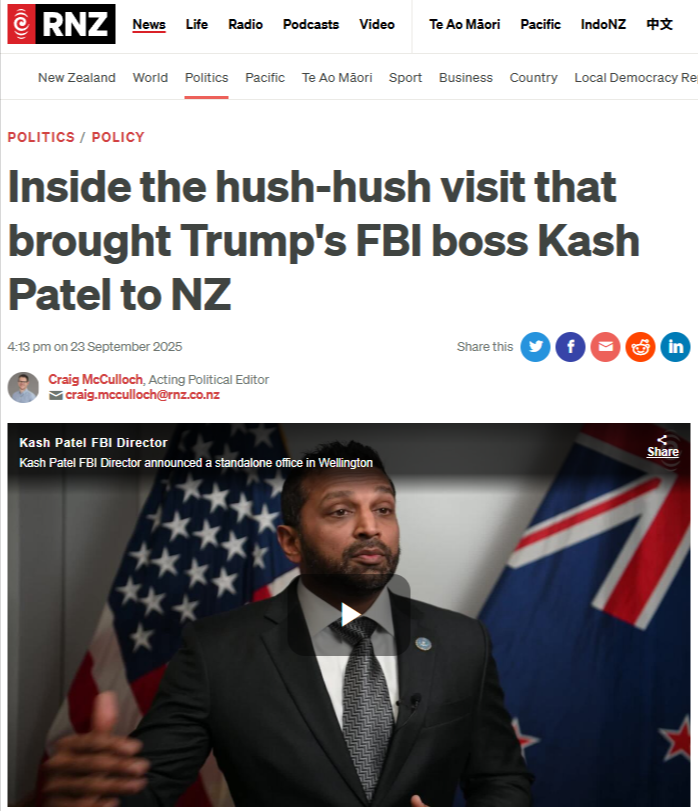
This is not about fighting crime. This is about embedding American surveillance apparatus into our intelligence networks to monitor and suppress Māori sovereignty movements, environmental activists, and anyone who threatens the white supremacist colonial project that both Trump and this National government represent.
Behind Closed Doors: The Secret Handover of Our Intelligence
The documents obtained by RNZ reveal a pattern of deliberate secrecy that should alarm every New Zealander who values democracy. Collins signed off on a $10,000 budget for Patel’s three-day visit, which included accommodation, meals, flights, and tourism activities. The SIS briefing note explicitly stated that “the visit will not be publicly avowed, for security reasons, until after the Director has left New Zealand.”
But security for whom? Not for Māori communities who will now face intensified surveillance from an agency with a documented history of targeting indigenous peoples and civil rights activists. The FBI under J. Edgar Hoover created COINTELPRO to systematically undermine Black liberation movements, indigenous rights activists, and anti-war protesters. Under Patel, this legacy of targeting revolutionaries and political dissidents will now operate directly from Wellington.
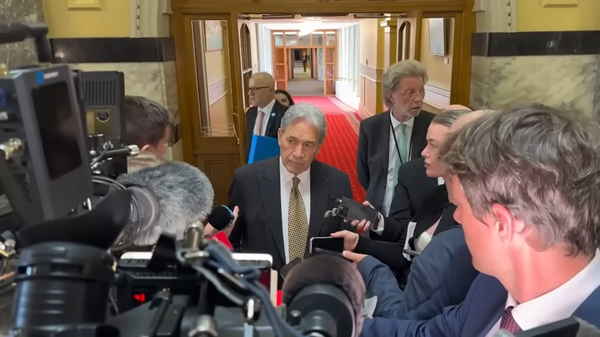
The secrecy was only broken when a Press Gallery journalist spotted Patel in the Beehive basement after his meeting with Winston Peters. Officials initially refused to explain his presence, demonstrating the contempt this government has for transparency and democratic accountability.
Escalating Surveillance Networks Targeting Tangata Whenua
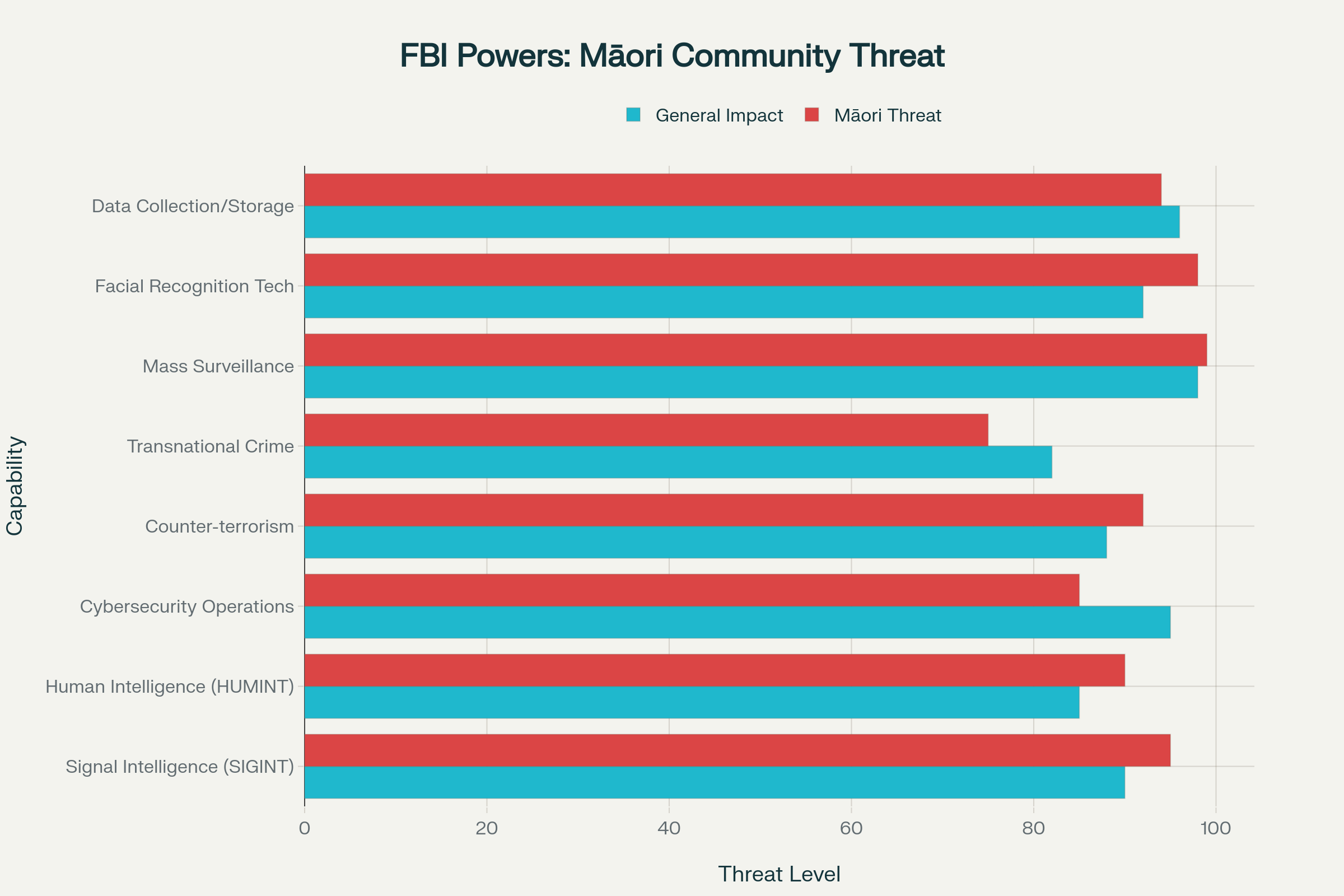
FBI surveillance capabilities pose disproportionate threats to Māori communities, with mass surveillance and facial recognition technology showing the highest risk levels
The establishment of this FBI office represents a dangerous escalation in state surveillance of Māori communities. Research shows that Māori are already more concerned about privacy than any other group in New Zealand, with 33% avoiding contact with government departments due to privacy concerns compared to just 14% of non-Māori.
These concerns are grounded in bitter experience. The 2007 Tūhoe raids demonstrated how anti-terrorism legislation could be weaponized against Māori communities, with armed police conducting paramilitary operations against entire communities based on spurious surveillance intelligence. Most of those arrested were Māori (12 out of 17 people), and the raids in Te Urewera were the most violent, including barricading off whole communities.
The FBI’s new capabilities will amplify these existing patterns of racialized surveillance. Facial recognition technology has already been deployed against Māori communities, with documented cases of misidentification in supermarkets and unauthorized police photographing of Māori youth. Now these surveillance tools will be enhanced with FBI resources and expertise.
The Five Eyes Surveillance Web Tightens
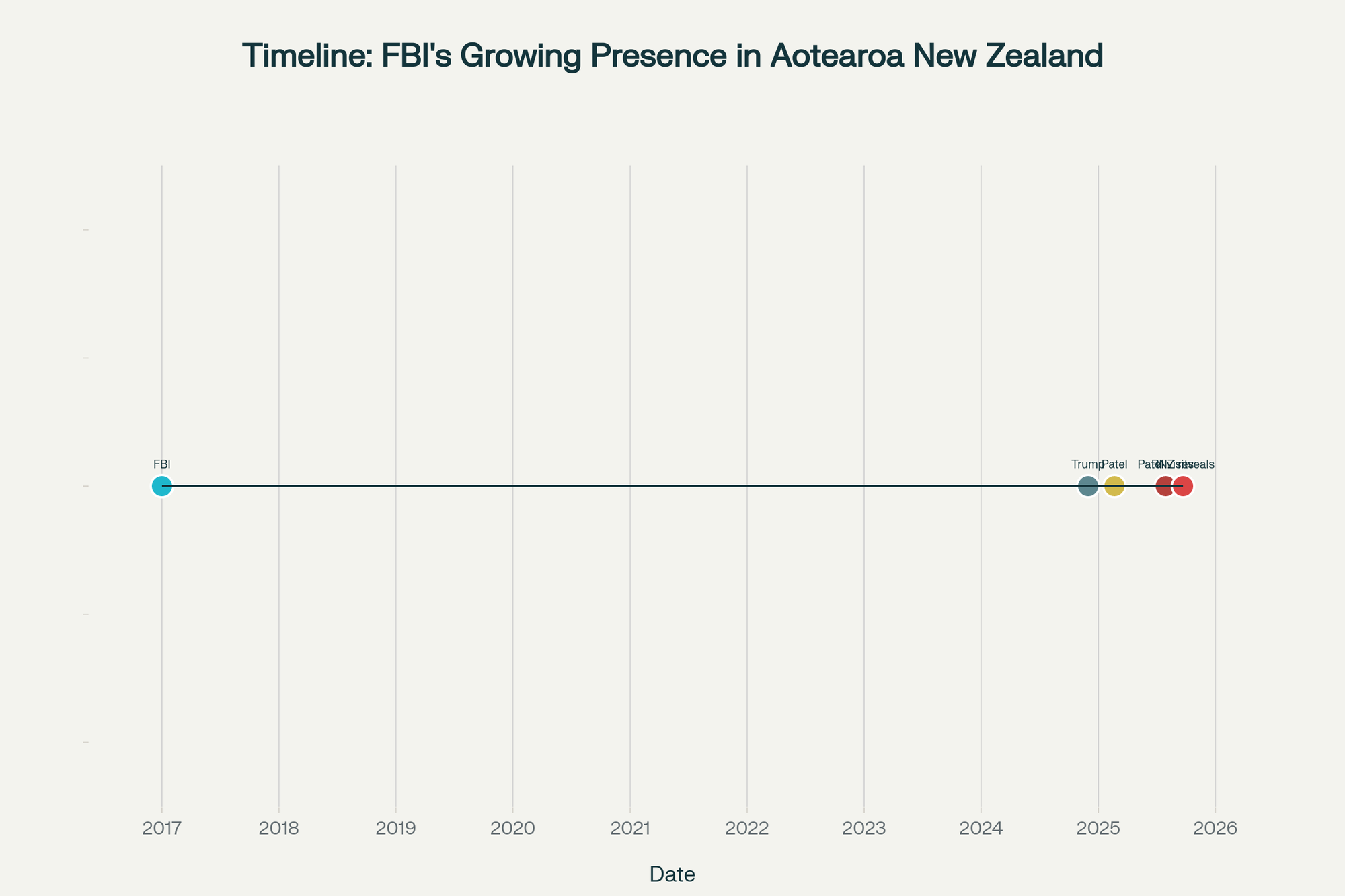
Timeline showing the escalating FBI presence in New Zealand from initial embassy posting to the recent secretive expansion under Trump loyalist Kash Patel
New Zealand’s role in the Five Eyes intelligence alliance makes it a critical node in the global surveillance network that Edward Snowden described as a “supra-national intelligence organisation that does not answer to the known laws of its own countries.” Within this alliance, New Zealand’s GCSB is responsible for signals intelligence across the South Pacific, including “full take” communications monitoring of our Pacific whānau in the Cook Islands, Vanuatu, Kiribati, Samoa, Fiji, and Tonga.
The upgraded FBI office will now oversee operations in Antarctica, Samoa, Niue, the Cook Islands, and Tonga, as well as New Zealand itself. This expansion represents the militarization of the Pacific under the guise of law enforcement cooperation.
Former Prime Minister Helen Clark has questioned New Zealand’s continued involvement in Five Eyes, describing it as “out of control” and noting how it has evolved from a quiet intelligence-sharing arrangement into “a basis for policy positioning on all sorts of things.” Clark specifically questioned whether Trump appointees could be trusted with sensitive intelligence, a prescient concern given Patel’s appointment.
Who Is Kash Patel: Trump’s Enforcer Comes to Aotearoa

Kash Patel’s secret meeting in the Beehive basement
Kash Patel is not a law enforcement professional seeking to enhance public safety. He is a political operative whose primary qualification is absolute loyalty to Donald Trump. His appointment represents the weaponization of the FBI for partisan political purposes.
Patel has called for dismantling the FBI’s intelligence operations, stating: “I’d break that component out of it. I’d shut down the FBI Hoover building on day one and reopen it the next day as a museum of the deep state.” Yet here he is, expanding those same intelligence capabilities into New Zealand.
His background reveals a pattern of using intelligence for political purposes. During Trump’s first impeachment, National Security Council official Fiona Hill testified that she was concerned Patel was secretly serving as a back channel between Trump and Ukraine without authorization. He was instrumental in House Republicans’ efforts to undermine the FBI’s investigation into Russian interference in the 2016 election.
Patel has written extensively about targeting government “gangsters” and has indicated plans to retaliate against perceived adversaries, including both government officials and media figures. His confirmation by a narrow 51-49 Senate vote, with two moderate Republicans joining all Democrats in opposition, reflects the controversial nature of his appointment.
The Colonial Logic of Surveillance Expands
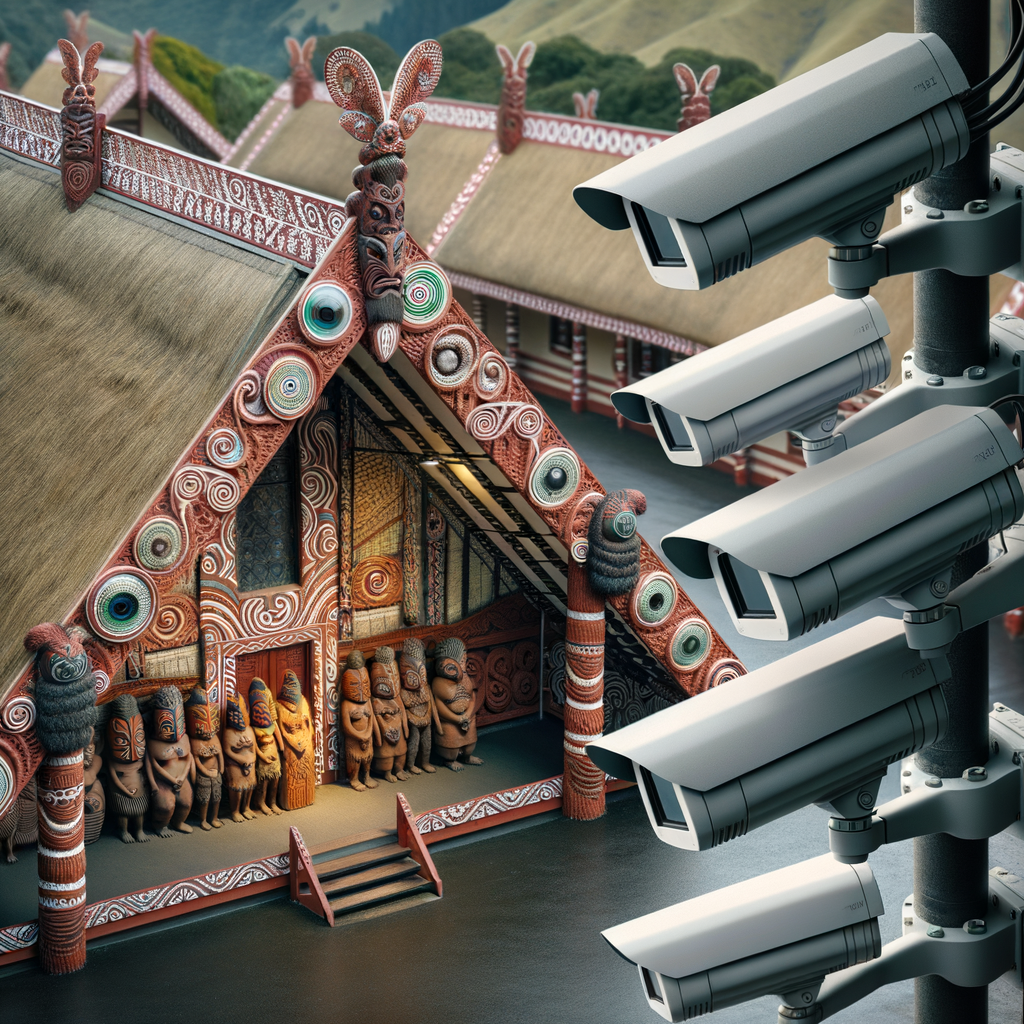
FBI surveillance threatening Māori communities and cultural spaces
The FBI’s presence in New Zealand must be understood within the broader context of what scholars call the “coloniality of surveillance” - the use of monitoring and control technologies to manage indigenous resistance to colonialism.
This is not new. Māori have faced state surveillance since the earliest days of colonization. The armed raids on Parihaka in 1881 and Maungapōhatu in 1916 established patterns of disproportionate state violence against Māori communities that continue today. The 2007 Tūhoe raids were a direct continuation of this “grim history of excessive state force” targeting indigenous people who assert their rights.
The FBI’s expertise in counterintelligence operations against indigenous peoples will now be applied in the New Zealand context. The FBI’s Prison Activists Surveillance Program (PRISACTS) developed techniques for isolating political prisoners from each other, from the general prison population, from their outside networks of support, and even alienating them from themselves. These same isolation techniques are now available for use against Māori activists and sovereignty movements.
Government Ministers as Willing Collaborators
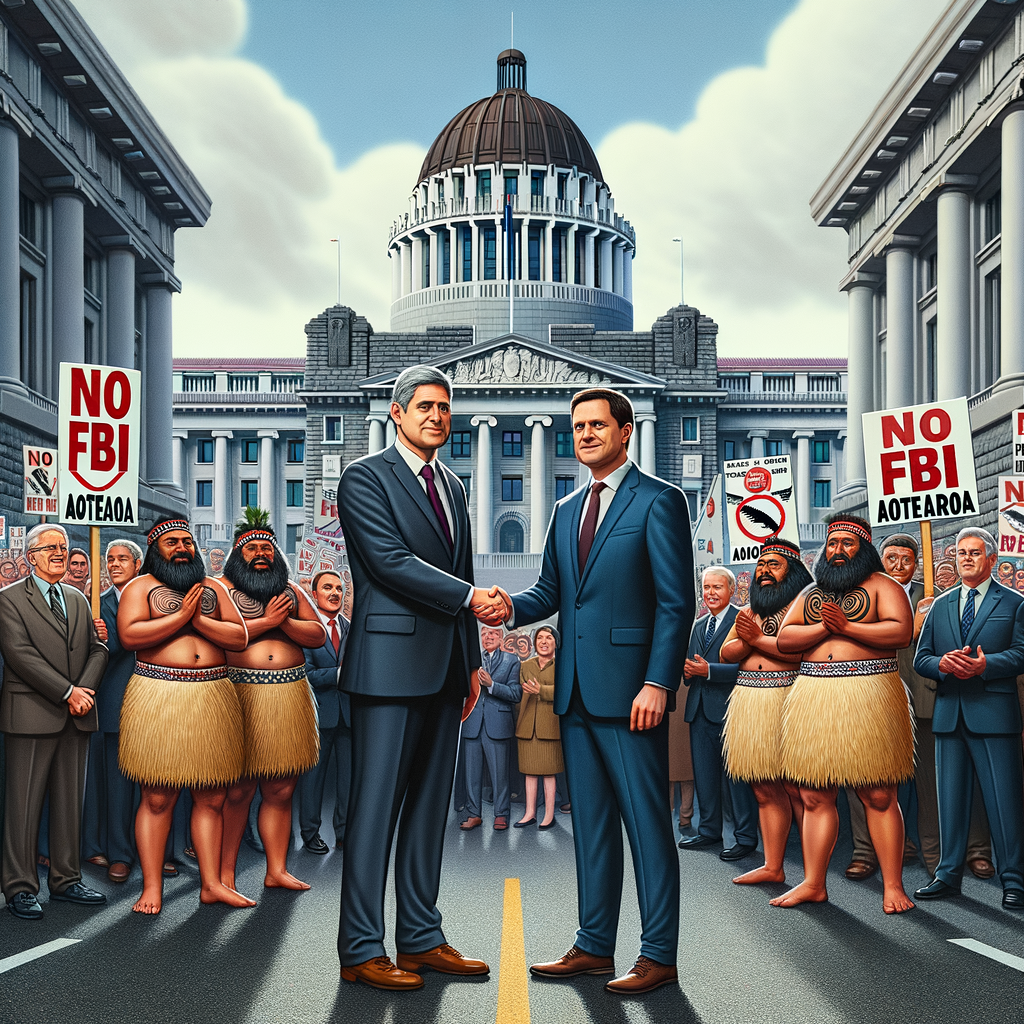
Government collusion with FBI while Māori resist foreign surveillance
The secret nature of Patel’s visit reveals how deeply embedded this collaboration has become. Patel dined with New Zealand spy bosses Andrew Hampton and Andrew Clark at a US embassy dinner, attended a ribbon-cutting ceremony for the new office with Collins and other NZSIS and GCSB officials, and participated in high-level roundtables discussing “regional security, transnational organised crime, counter-terrorism, cybersecurity and espionage.”
Later that evening, Collins hosted an official government dinner for Patel with up to 14 guests including Hampton, Clark, and Police Commissioner Richard Chambers. The programme even included “two unspecified cultural activities” - perhaps they visited a marae to better understand what they would be surveilling.
Collins has attempted to downplay the significance of the FBI expansion, claiming that the FBI has had a presence at the US Embassy since 2017 and that this merely changes the reporting line from Canberra to Washington DC. But this misses the point entirely. The establishment of a standalone office with expanded capabilities represents a qualitative escalation in FBI operations.
Winston Peters and Collins both downplayed Patel’s statements about “countering the Chinese Communist Party,” claiming the focus was on transnational crime. But Patel was explicit about the office’s purpose: “Some of the most important global issues of our times are the ones that New Zealand and America work on together – countering the CCP”.
Opposition Voices Ignored and Marginalized
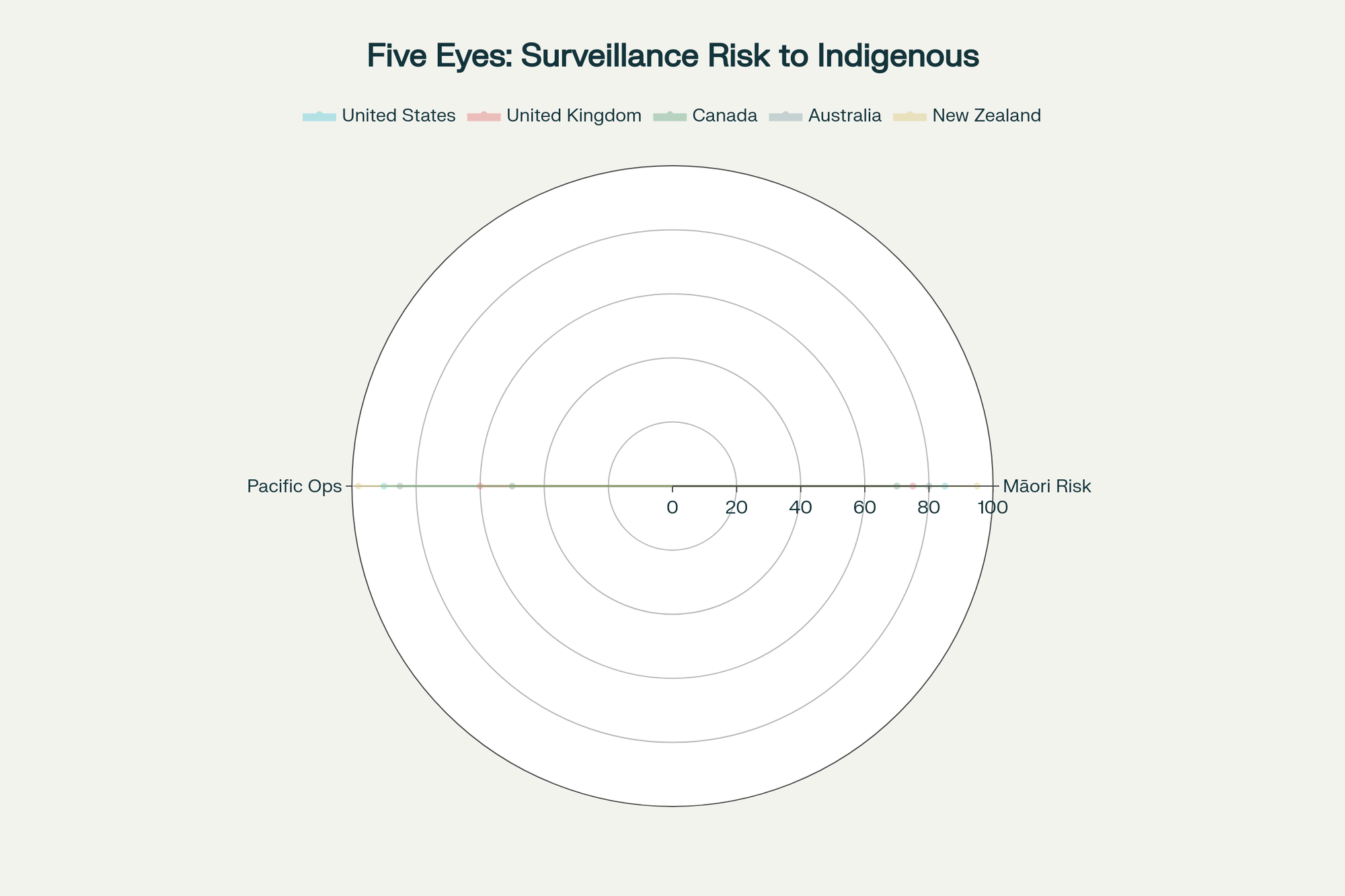
New Zealand poses the highest surveillance risk to Māori within the Five Eyes alliance, reflecting its strategic Pacific position and domestic intelligence operations
Te Pāti Māori has launched a petition demanding an end to the FBI’s operations in Wellington and guaranteeing that no foreign law enforcement agency will operate in Aotearoa without public debate, legal scrutiny, and Te Tiriti-based consultation. Their petition correctly identifies the key issues:
The erosion of mana motuhake through allowing a foreign intelligence agency to operate permanently on our whenua without consultation or scrutiny. The breach of Te Tiriti o Waitangi through the absence of consultation with or consent from tangata whenua. The normalization of foreign surveillance by an agency with a track record of mass surveillance, racial profiling, and political interference, especially against indigenous peoples, activists, and marginalized communities.
The Greens have also opposed the FBI expansion, with Green Party co-leader Chloe Swarbrick posting that the opening of the office signals New Zealand is “tying itself to an increasingly unstable Trump administration” and declaring “We are not, nor should we allow ourselves to be, pawns in a power struggle between the US and China.”
But both Labour and the Greens supported the policies that made this expansion possible. Labour was in government when the FBI first established its embassy presence in 2017, and the Greens were part of the 2017-2023 coalition government that strengthened the US alliance and boosted New Zealand’s role in Pacific militarization.
The Mana of Our Ancestors Demands Resistance
This FBI expansion violates everything our tīpuna fought and died for. From the resistance of chiefs like Tītokowaru who fought both military campaigns and pioneering non-violent resistance movements, to the courage of those who defended Parihaka, to the modern activists who continue to assert Māori sovereignty and tino rangatiratanga.
Te Pāti Māori correctly identifies this as requiring investigation of anti-Māori hate speech from white supremacist organizations, noting unprecedented increases in racist rhetoric across social media and the recruitment strategies of these groups. But the response cannot be more surveillance - it must be the dismantling of the systems that enable white supremacist power.
The kaupapa of whakatōhea demands that we protect our people from both racially motivated violence and the surveillance apparatus that enables state oppression. This requires rejecting the false choice between security and freedom that colonial authorities always offer.
Surveillance as Violence Against Māori Communities
The establishment of permanent FBI operations in New Zealand represents a form of structural violence against Māori communities. Research on Māori data privacy shows that surveillance has moved beyond targeting individual activists to encompassing entire communities.
The use of facial recognition technology in retail environments has already resulted in misidentification of Māori customers, while unauthorized police photographing of Māori youth creates databases that can be used for future targeting. These technologies, developed and refined by the FBI, will now be deployed with greater sophistication and fewer legal constraints.
The Privacy Commissioner’s research shows that 19% of Māori have experienced privacy breaches, compared to 13% of the general population. When privacy violations occur, Māori are less likely to contact the Privacy Commissioner and more likely to seek help from community organizations like Citizens Advice Bureau. This reflects the deep distrust of official institutions that has been earned through decades of surveillance and harassment.

The Māori Green Lantern Fighting Misinformation And Disinformation From The Far Right
Digital Colonization Through Five Eyes
New Zealand’s participation in the Five Eyes alliance makes it complicit in mass surveillance of Pacific Island nations, including countries with significant Māori whakapapa connections. The GCSB’s role in capturing communications intelligence from across the Pacific means that Māori whānau in the Cook Islands, Samoa, Tonga, and other Pacific nations are already subject to New Zealand intelligence gathering.
This surveillance includes a “full take” of communications transmitted by satellite or undersea cable from the region. The recent Inspector-General report revealed that from 2013 to 2020, a foreign intelligence system operated from within the GCSB with no oversight, no parliamentary awareness, and no public consultation.
The FBI’s expanded presence will integrate American surveillance priorities into this existing infrastructure, potentially using intelligence gathered through Five Eyes networks to target Māori communities both within New Zealand and across the Pacific diaspora.
Economic Warfare Disguised as Crime Fighting
The $10,000 cost revealed in the RNZ documents is just the tip of the iceberg. The real cost is the ongoing operational expenses of the expanded FBI presence, the integration of American surveillance technologies with New Zealand systems, and the lost sovereignty that comes with allowing foreign intelligence agencies to operate on our soil.
Migration 5, administered by New Zealand within the Five Eyes alliance, processes up to eight million people’s biometrics annually. This massive data-sharing operation, involving 140 departments and agencies across the Five Eyes countries, represents a form of digital colonization that treats personal information as a commodity to be harvested and shared without meaningful consent.
The FBI’s enhanced presence will likely accelerate these data-sharing arrangements, potentially including biometric information, communications metadata, and behavioral analytics that could be used to profile and target Māori activists, sovereignty advocates, and anyone who challenges American imperial interests.
Breaking the Chains of Digital Colonization
The resistance to FBI surveillance must be grounded in Māori values and connected to broader movements for indigenous sovereignty and anti-imperial solidarity. This means:
Asserting tino rangatiratanga over data and information systems that affect Māori communities. Demanding that any foreign intelligence presence be subject to tangata whenua consultation and consent under Te Tiriti o Waitangi. Building coalitions with other indigenous peoples who face similar surveillance threats from the same intelligence networks.
The Green Party’s call for New Zealand to exit Five Eyes represents a starting point, but it must be connected to a broader vision of independent foreign policy that prioritizes indigenous rights, environmental protection, and social justice over imperial military alliances.
The fight against FBI surveillance is ultimately a fight for the kind of society we want to build - one based on mana, whakatōhea, and aroha, or one based on fear, surveillance, and submission to imperial power.
Call to Action: Resistance is Our Obligation
Every New Zealander who values democracy, privacy, and indigenous rights must oppose this FBI expansion. The techniques of mass surveillance, facial recognition, and behavioral monitoring that will be deployed against Māori communities today will be used against all dissenting voices tomorrow.
Contact your MPs. Join Te Pāti Māori’s petition. Support organizations working to protect privacy rights and digital sovereignty. But most importantly, understand that this is part of a broader pattern of authoritarian consolidation that extends from Wellington to Washington.
The FBI’s presence in New Zealand is not about fighting crime - it is about suppressing resistance to an economic and political system that enriches elites at the expense of working people, indigenous communities, and the natural world.
Our tīpuna did not sacrifice their lives for tino rangatiratanga so that their descendants could live under FBI surveillance. The mana they carried demands that we continue their struggle for genuine independence and justice.
The Fire of Resistance Burns On
The secret establishment of FBI operations in New Zealand represents a betrayal of everything that makes this country worth defending. From the beaches of Parihaka to the forests of Te Urewera, our ancestors resisted imperial domination through both armed struggle and innovative forms of non-violent resistance.
Today, that resistance must take new forms appropriate to the digital age. It must connect the fight against surveillance with the fight for housing, healthcare, and environmental protection. It must link the struggle for Māori sovereignty with broader movements for social and economic justice.
The FBI may have established a foothold in Wellington, but the spirit of resistance that has sustained Māori communities through 150 years of colonization cannot be surveilled away. It lives in every young person who learns te reo, every family that maintains their connection to whenua, and every activist who continues to challenge injustice despite the risks.
Kia kaha. The struggle continues.
For readers who find value in my content, please consider a donation/koha to support this vital work: HTDM: 03-1546-0415173-000. The MGL understands these are tough economic times for whānau, so please only contribute a koha if you have capacity and wish to do so.
Nāku noa, nā Ivor Jones (The Māori Green Lantern)