“Illuminating the Path to Liberation: Black Panther Party, Māori Green Lantern, and the White-Supremacist Neoliberal State” - 18 January 2026
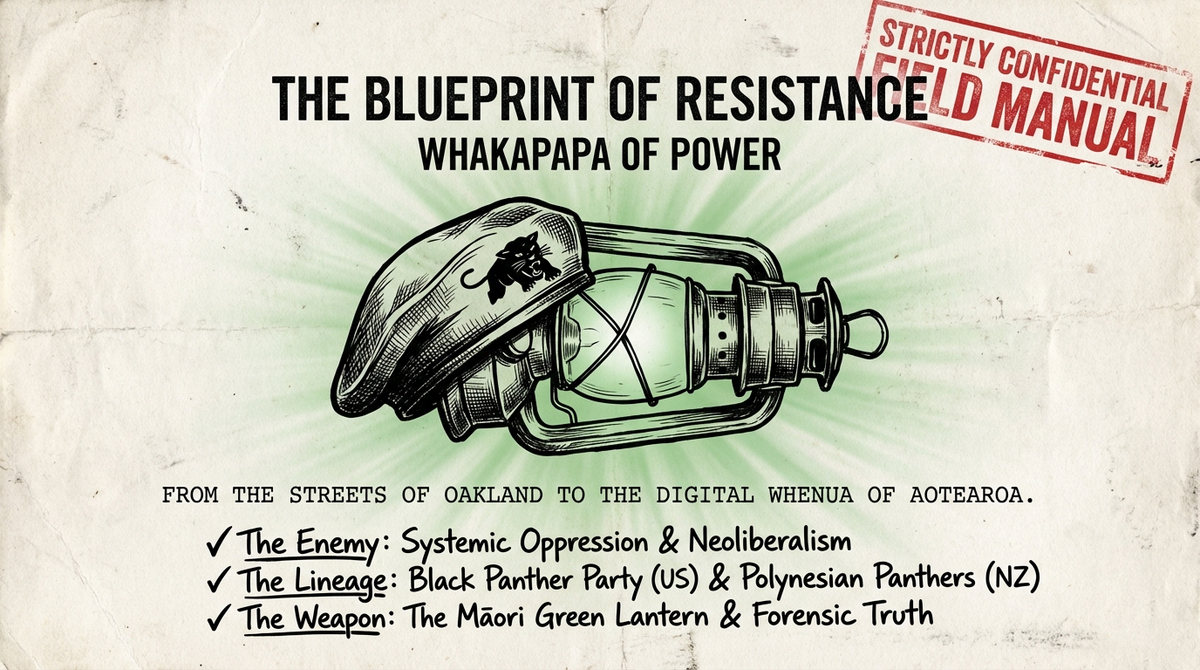
Koha: Funding Our Own Intelligence, Not Their Spin
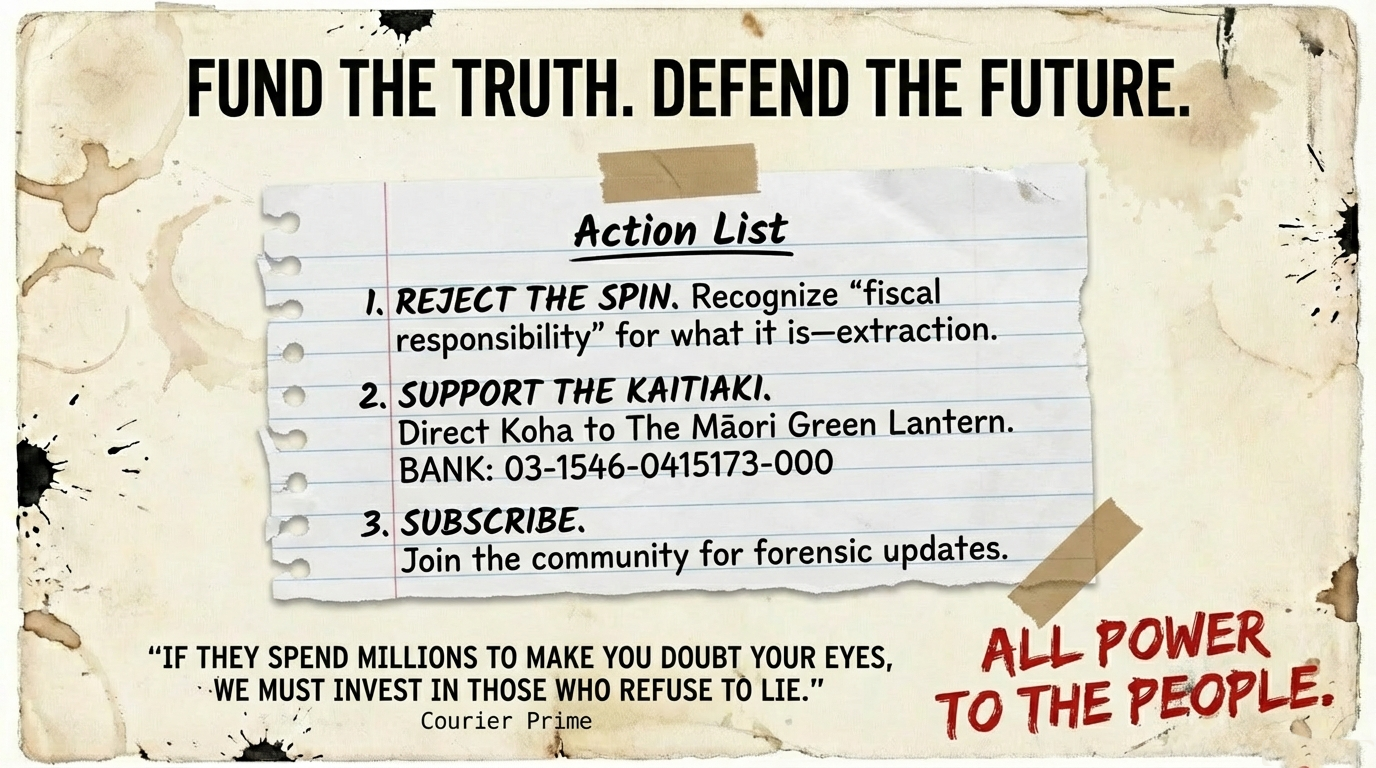
Every koha signals that whānau are ready to fund the accountability that Crown and corporate structures will never provide. It signals that rangatiratanga includes the power to fund our own truth-tellers, rather than hoping the same institutions that profit from our dispossession will suddenly grow a conscience.
If this white-supremacist neoliberal government is willing to spend millions on PR, consultants, and culture-war propaganda to make you doubt your own eyes, your own history, and your own tino rangatiratanga, then we must be willing to invest in the people and platforms that refuse to lie to us.
Kia kaha, whānau. Stay vigilant. Stay connected. And if you are able, consider a koha to ensure this voice continues.
Three Pathways to Support this Mahi
For those who wish to support this mahi directly with a koha (voluntary contribution), please visit:
For those who wish to receive essays directly and support through subscription, join the Substack community:
- Subscribe on Substack: Māori Green Lantern – Substack
For those who prefer direct bank transfer, account details are:
- Account name: HTDM
- Account number: 03-1546-0415173-000
The Crown and its corporate partners will continue to pay handsomely for people who tell them they are right. It is on us to ensure that those who tell the truth about this white-supremacist, neoliberal machinery are not left to fight alone.
The Black Panther Party: Revolutionary Clarity Against a Violent State
From Police Terror to Revolutionary Internationalism
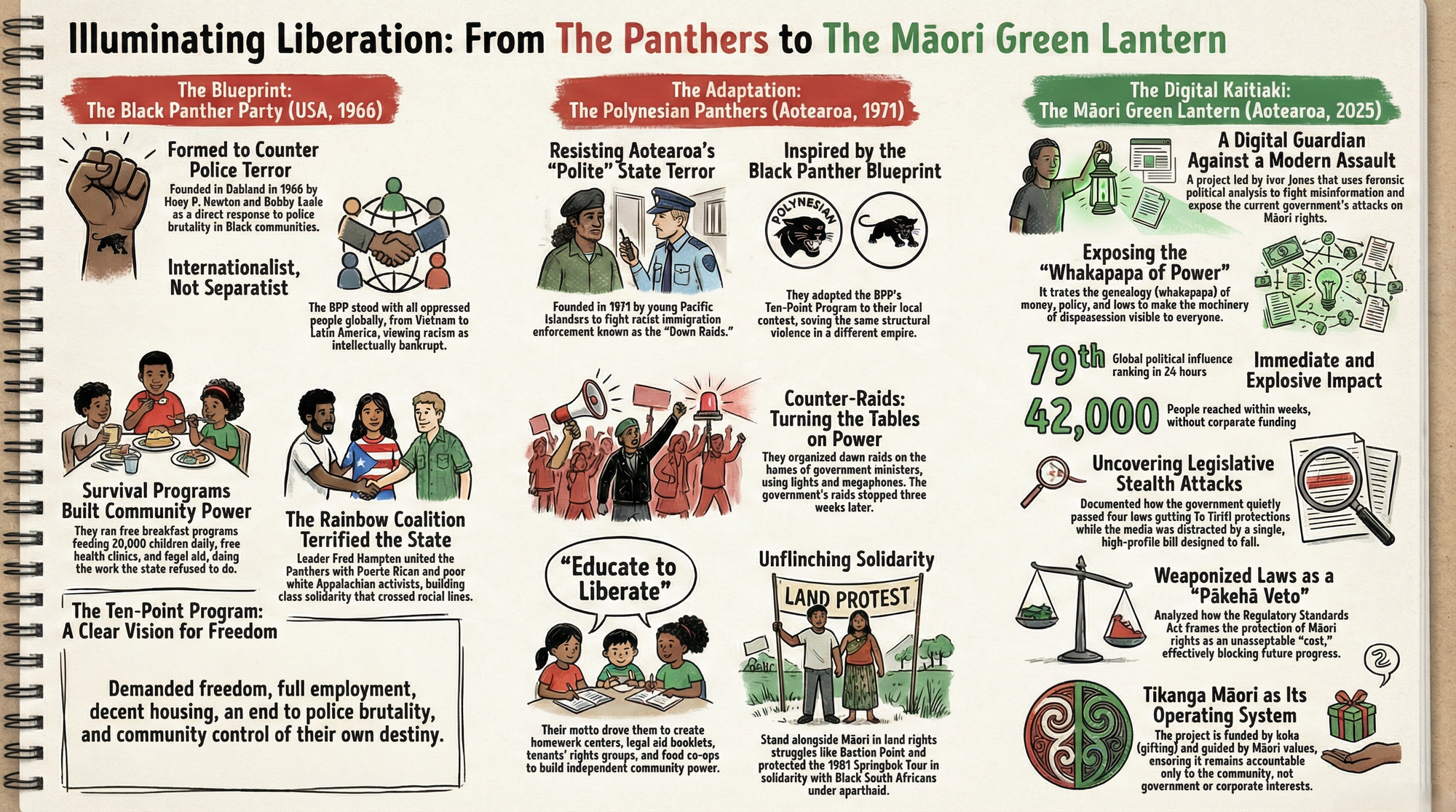
The Black Panther Party for Self-Defense was founded in Oakland in October 1966 by Huey P. Newton and Bobby Seale as a direct response to the everyday terrorism of American policing against Black communities, as documented by the Smithsonian National Museum of African American History and Culture.
It was never a “Black KKK”, as white conservative myth-making taught generations of Americans;
that lie was state propaganda, deliberately deployed to neutralise a movement that was exposing the true nature of US capitalism and racial terror.
Huey Newton was explicit:
the BPP was internationalist, not separatist. It saw Black oppression as one front in a global system of imperialism and capitalism, linking the ghetto to Vietnam, Angola, Latin America and beyond, as Security Dialogue documents in their analysis of the Panthers’ resistance to racial militarism. As Chairman Paul Birdsong emphasises in the video, Newton insisted that the Party stood “with all oppressed people across the globe… no matter what their ethnic background is.” The very ideology of racism, he said, is intellectually bankrupt because there is only one human race.
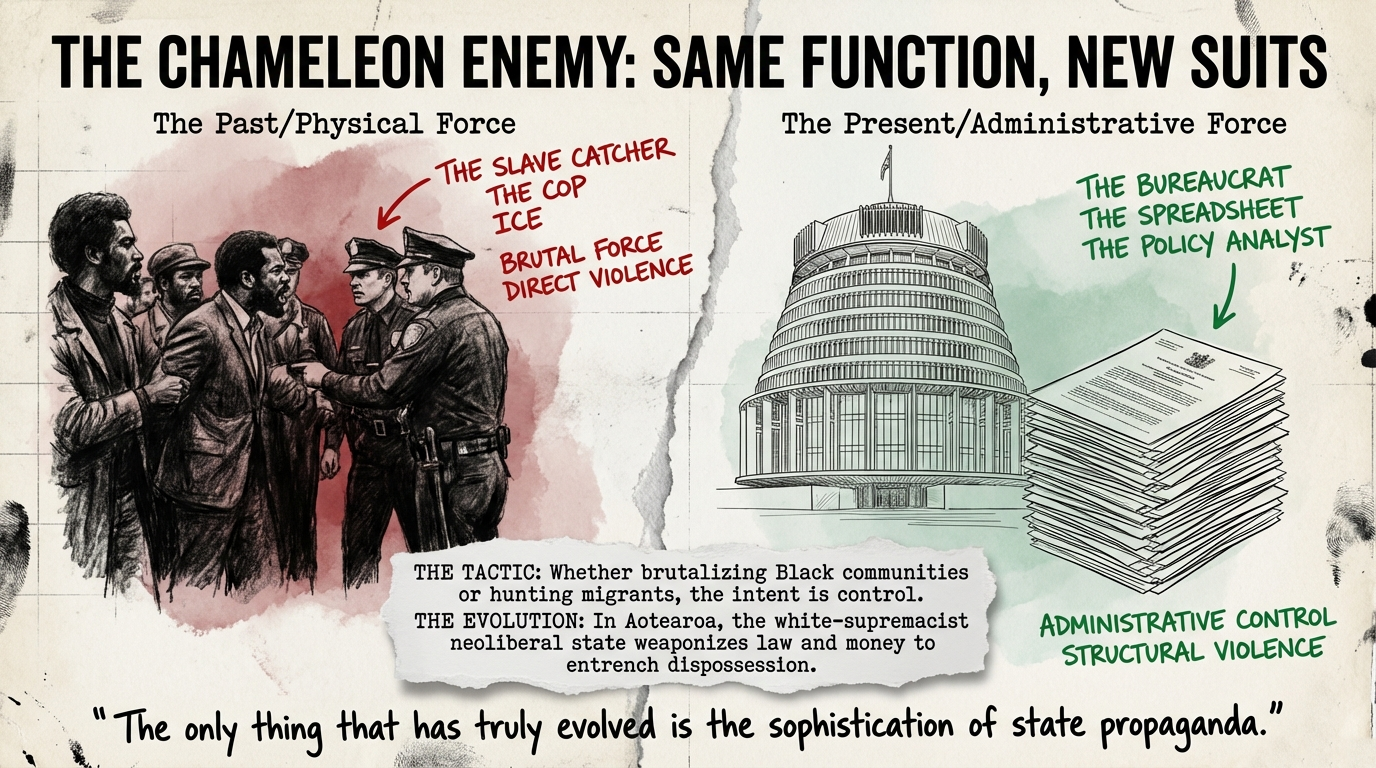
This is precisely why the Panthers today stand with migrants against ICE: because they refuse the lie that solidarity must be racially siloed. It is the state—and its white-supremacist media chorus—that demands we fear each other instead of uniting against the people holding the guns, writing the laws, and cashing the cheques.
The Ten-Point Program: Naming the Real Criminals
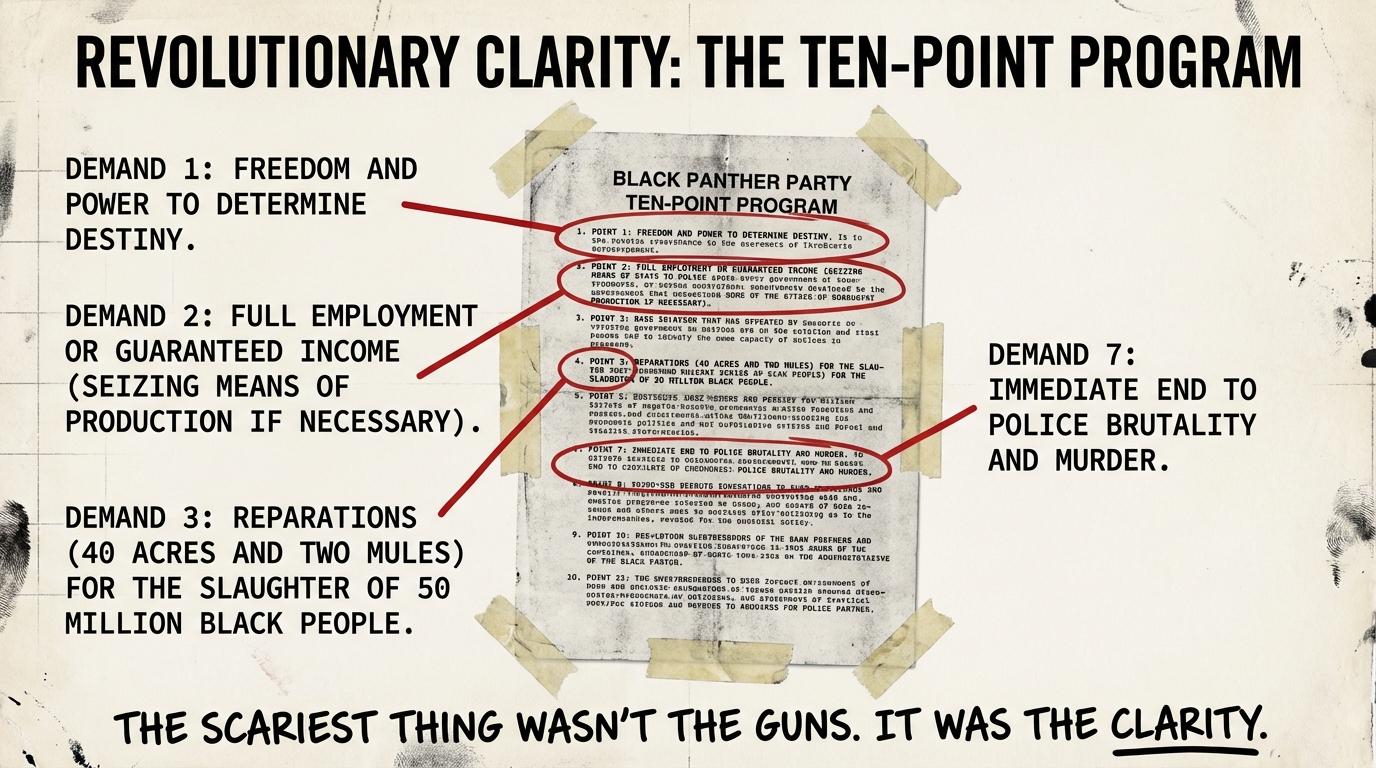
The BPP’s Ten-Point Program remains one of the clearest, most uncompromising indictments of racial capitalism ever written, as preserved by Britannica and Teaching American History.
It demanded:
- Freedom and power for Black and oppressed communities to determine their own destiny.
- Full employment or guaranteed income, with the means of production taken from businessmen if they refused to provide work.
- Reparations—the long-broken “40 acres and a mule” promise—as payment for the slaughter and exploitation of tens of millions of Black people.
- Decent housing, truthful education, and complete free healthcare.
- Immediate end to police brutality and murder, freedom for Black prisoners, trials by juries of peers, and ultimately land, bread, housing, education, clothing, justice, peace, and community control of modern technology.
The American state responded to these entirely reasonable demands—as the video underlines, none of this is “extreme” in any moral sense—by infiltrating, criminalising and assassinating Panthers through COINTELPRO, targeting leaders like Fred Hampton as documented in Wikipedia’s Rainbow Coalition history.
The US state’s message was clear:
feed children and demand justice, and you will be treated as an enemy of the nation. That is how white supremacy reacts when its power is named.
Survival Programs: Doing the Work the State Refuses to Do
The Panthers’ survival programs exposed another inconvenient truth:
there is no such thing as “can’t afford it” when it comes to feeding children and healing the sick. There is only won’t.
By 1969, the Panthers’ Free Breakfast for Children Program was feeding around 20,000 children daily in 19 cities, years before the US federal government bothered to act, as Noir Press and the Smithsonian document. They ran free health clinics, conducted sickle-cell anaemia testing as detailed by PMC researchers, provided legal aid, established early childhood education programs, distributed clothing and food, supported prisoners’ families with transport, and ran community schools like the Oakland Community School under Ericka Huggins.
The US government’s response was not gratitude but fear. J. Edgar Hoover called the breakfast program “the greatest threat to internal security” because it showed Black communities that they didn’t need white paternalism—they could organise and care for themselves, as The Fulcrum and the BPP Alumni Legacy Network confirm.
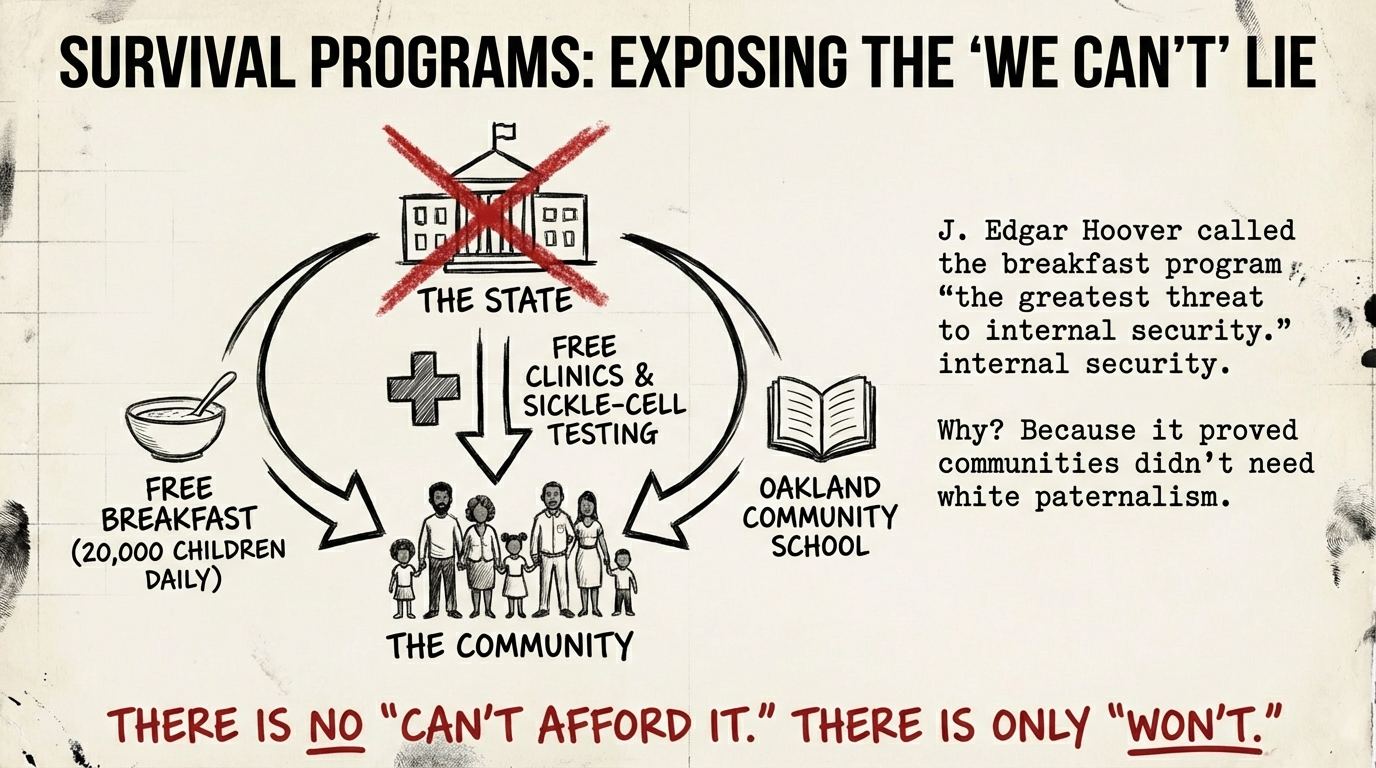
Whenever communities prove that the state’s “we can’t” is really “we won’t”, the mask slips. That is as true in Aotearoa as it was in Oakland.
The Rainbow Coalition: Class Solidarity That Terrified Power
Fred Hampton’s Rainbow Coalition in Chicago united the Black Panthers, the Young Lords (Puerto Rican activists), and the Young Patriots (poor white migrants from Appalachia, some of whom literally wore Confederate flags) into a shared struggle against poverty, police violence, and political neglect, as documented by CounterPunch and The Conversation.
Hampton’s genius was simple and lethal to the ruling class:
he separated whiteness as a tool of power from poor white people as victims of that same system. The only condition for alliance with the Panthers was the rejection of racism, as WTTW Chicago Stories explains.
It worked. The coalition forced city authorities to reckon with the fact that their usual divide-and-rule tactics—Black vs white, native-born vs migrant—were failing.
So the state did what white-supremacist states do best:
it killed Hampton in his bed, in an FBI-assisted police assassination documented in Wikipedia’s Rainbow Coalition entry.
The lesson is blunt:
when oppressed communities start to organise across racial lines against shared enemies, the system reaches for bullets and prison cells.
The Polynesian Panthers: Pacific Resistance to a “Nice” White State
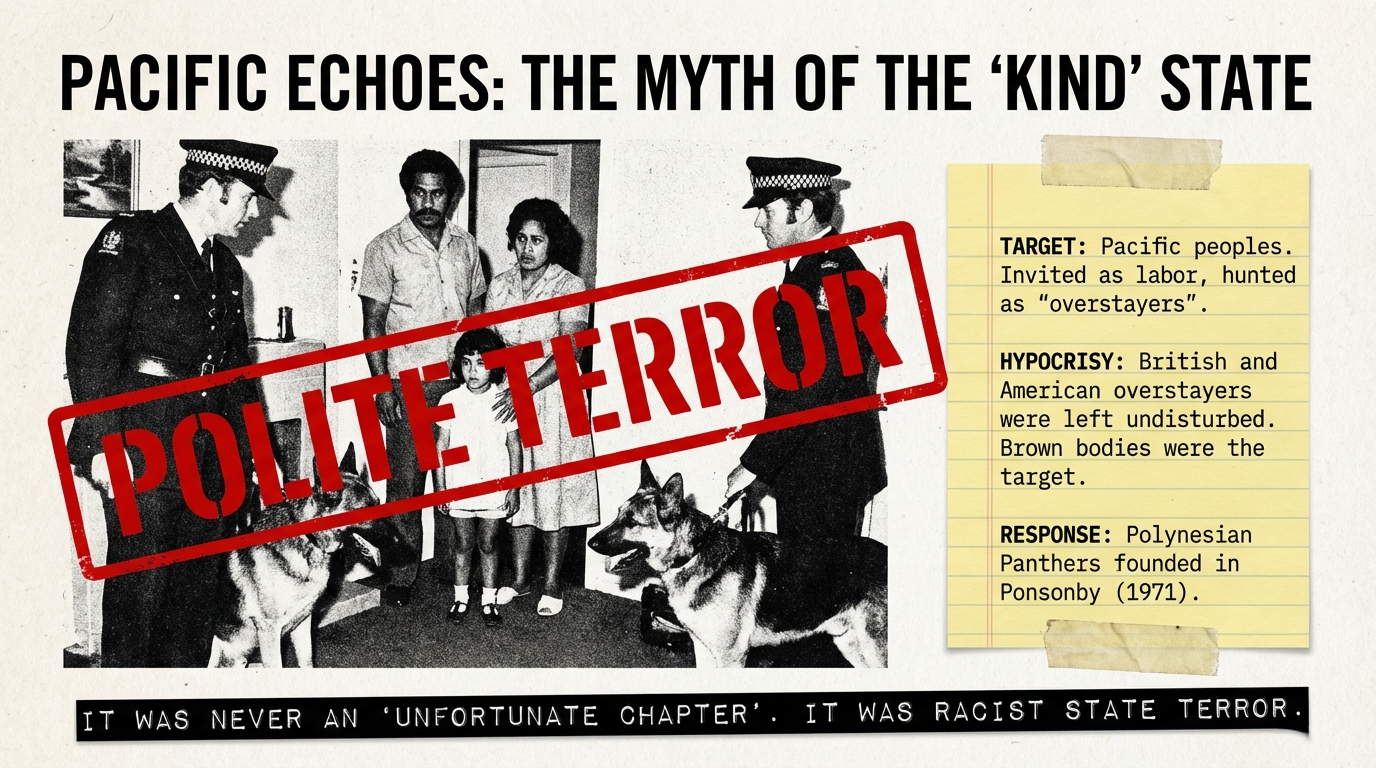
Dawn Raids: New Zealand’s Polite Terror
Aotearoa likes to export itself as a liberal, “kind”, multicultural nation.
The Dawn Raids destroy that fantasy.
In the 1970s, Pacific peoples
—invited as labour to build Pākehā prosperity
—were targeted in brutal early-morning immigration raids.
Police and officials stormed homes, dragged families from beds, and demanded proof of legal residence, as NZ History and Wikipedia’s Polynesian Panthers entry document. Brown bodies were hunted, while the majority of overstayers—British, American, Australian—were left undisturbed, as NZ History confirms.
That is not an “unfortunate chapter”. That is racist state terror.
The Polynesian Panther Party was founded in Ponsonby, Auckland, in 1971 by young Pacific Islanders—Fred Schmidt, Nooroa Teavae, Paul Dapp, Vaughan Sanft, Eddie Williams, and Will ‘Ilolahia—who had seen enough of this polite brutality, as NZ History records. They were directly inspired by the Black Panthers, down to reading and adapting the Ten-Point Program to their own conditions, as Future Learn and The CocoNet explain.
When they looked at the BPP platform, “barring the carrying of arms, everything else… was relevant to our situation here in New Zealand,” as RNZ International reports.
In other words:
different empire, same structural violence.
Counter-Raids and Exposing Hypocrisy
The state was happy to terrorise Pacific families at 5am. It was far less happy when that terror was returned to sender.
The Polynesian Panthers organised counter-raids on the homes of cabinet members and senior officials backing the dawn raids. They arrived at dawn, switched on bright lights, chanted through megaphones, and made those powerful men feel a fraction of the fear they had inflicted on Pacific communities, as documented by The CocoNet, NZ History, and National Library of New Zealand.
Three weeks after the Panthers began these counter-raids, the New Zealand government’s dawn raids stopped, as The CocoNet confirms.
So much for “unavoidable enforcement”. When the terror flows uphill, not just downhill, the “rule of law” suddenly finds an off switch.
Educate to Liberate: Building Pacific Power
The Polynesian Panthers understood that you don’t defeat a racist state by begging it to be nicer.
You build your own power.
They:
- Created the first homework centres in Aotearoa, supporting Pacific children failed by racist schooling, as Future Learn and National Library NZ document.
- Formed the Tenants Aid Brigade, physically defending families from unlawful evictions and confronting predatory landlords, as The CocoNet and Future Learn explain.
- Produced multilingual legal aid handbooks with David Lange, teaching Pacific and Māori whānau exactly what their rights were when stopped, searched or raided, as NZ History and National Library NZ record.
- Ran food cooperatives feeding around 600 families, as The CocoNet reports.
- Organised prison visiting shuttles to Paremoremo, because the justice system loves to banish people far from their communities, then blame whānau for not visiting, as Future Learn and Liberation Library note.
- Offered ESOL classes and youth programs to keep rangatahi away from gangs while still connected to their communities, as Wikipedia and The CocoNet document.
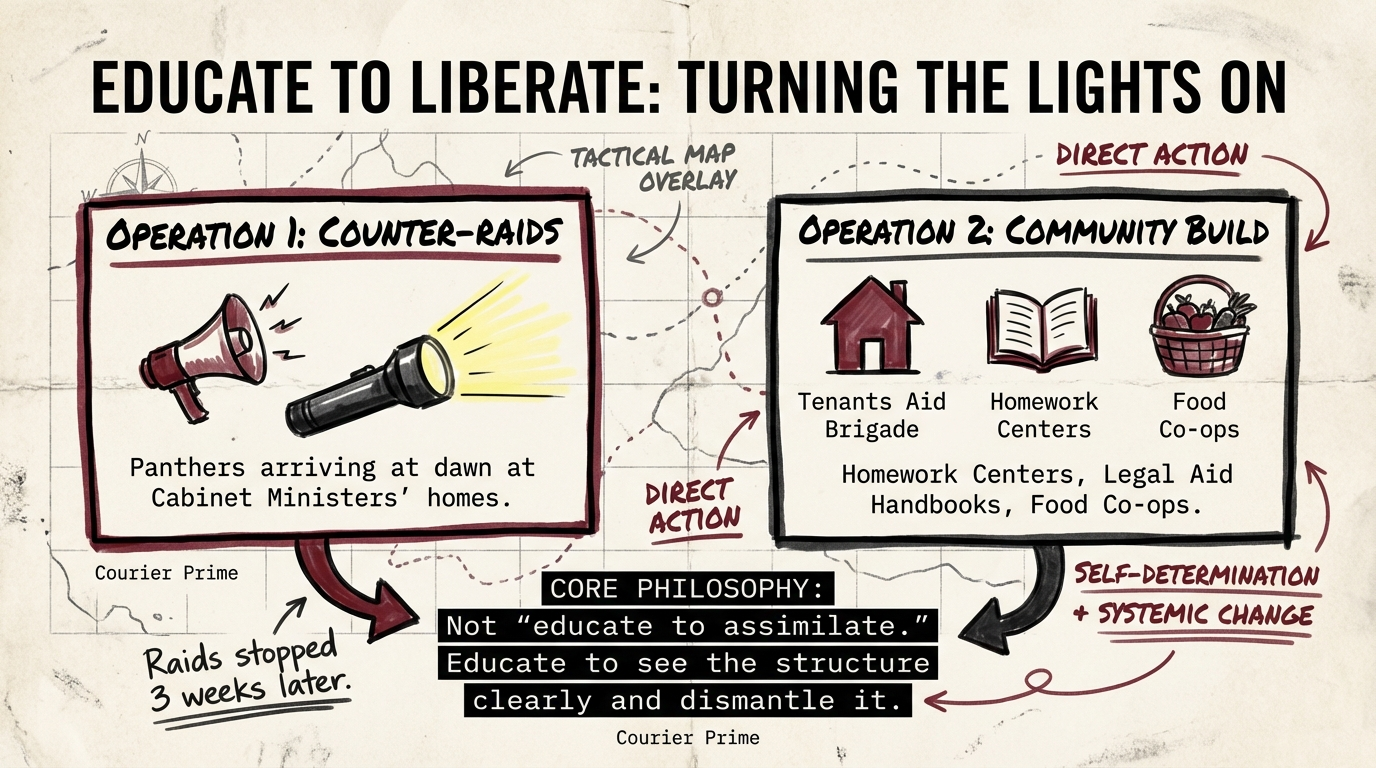
Their platform and practice were summed up in a simple, devastating line:
Educate to Liberate, as Future Learn, NZ History, and National Library NZ confirm. Not “educate to assimilate”, not “educate to climb the ladder inside the same burning building”, but educate to see the structure clearly—and then dismantle it.
Solidarity with Māori and Global Struggles
Like their US counterparts, the Polynesian Panthers practised genuine solidarity. They did not treat Māori struggles as “someone else’s issue”; they walked alongside Ngā Tamatoa, supported Māori land occupations such as Bastion Point, and stood against the 1981 Springbok Tour in solidarity with Black South Africans under apartheid, as NZ History, e-Tangata, and 1News document.
For their trouble, members like Tigilau Ness were jailed, as e-Tangata and 1News report.
Again:
when you stand with the globally oppressed, the state responds the same way, whether the flag outside the Parliament is American, British, or the Silver Fern.
In 2021, after decades of pressure from Pacific communities and surviving Panthers, the New Zealand government finally choked out a formal apology for the Dawn Raids, as NZ History, Te Ara, and RNZ document.
It was long overdue—and utterly insufficient.
The same Crown that apologised is now, under its current white-supremacist neoliberal management, tearing into Māori rights and Te Tiriti with the same cold efficiency it once deployed against Pacific peoples.
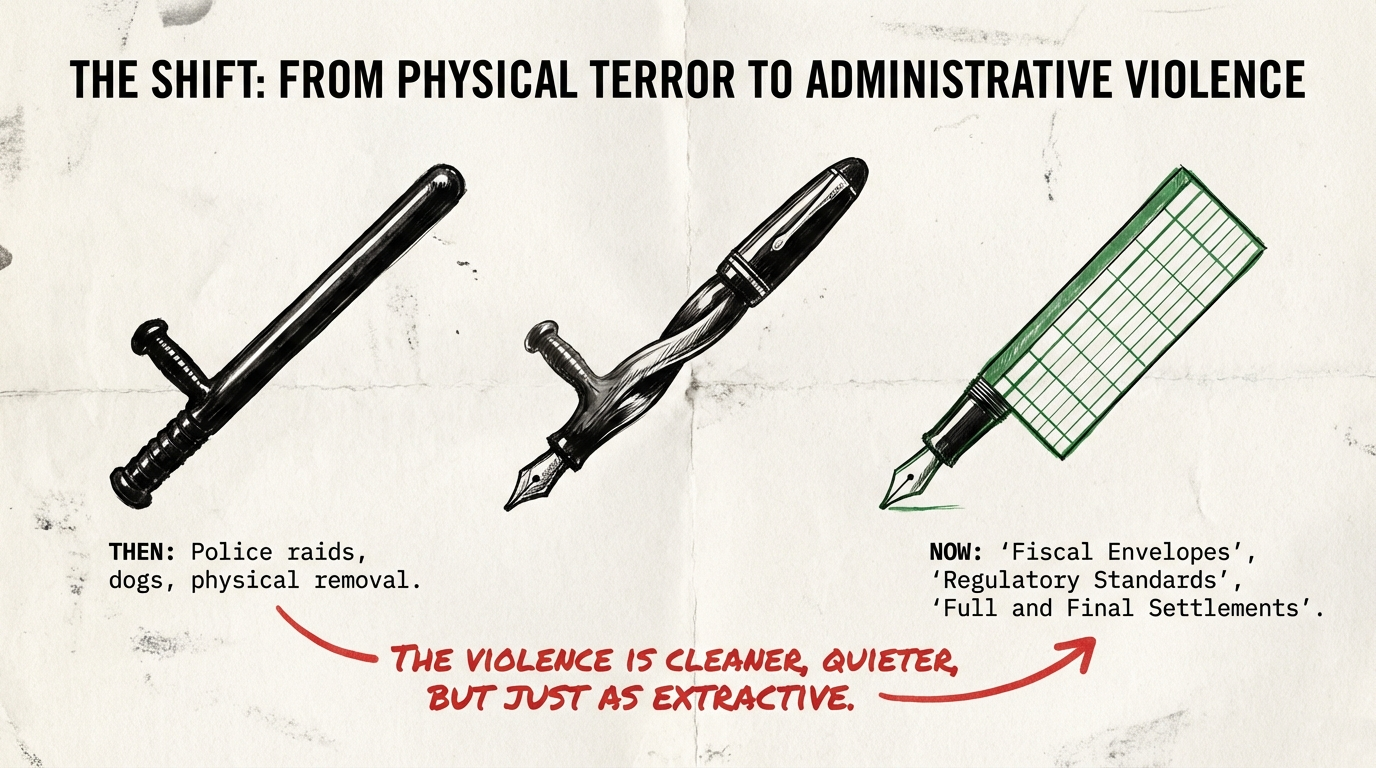
An apology without structural reversal is not justice. It is public relations.
The Māori Green Lantern: Forensic Kaitiakitanga in the Age of Neoliberal Extraction
A Digital Kaitiaki Emerges
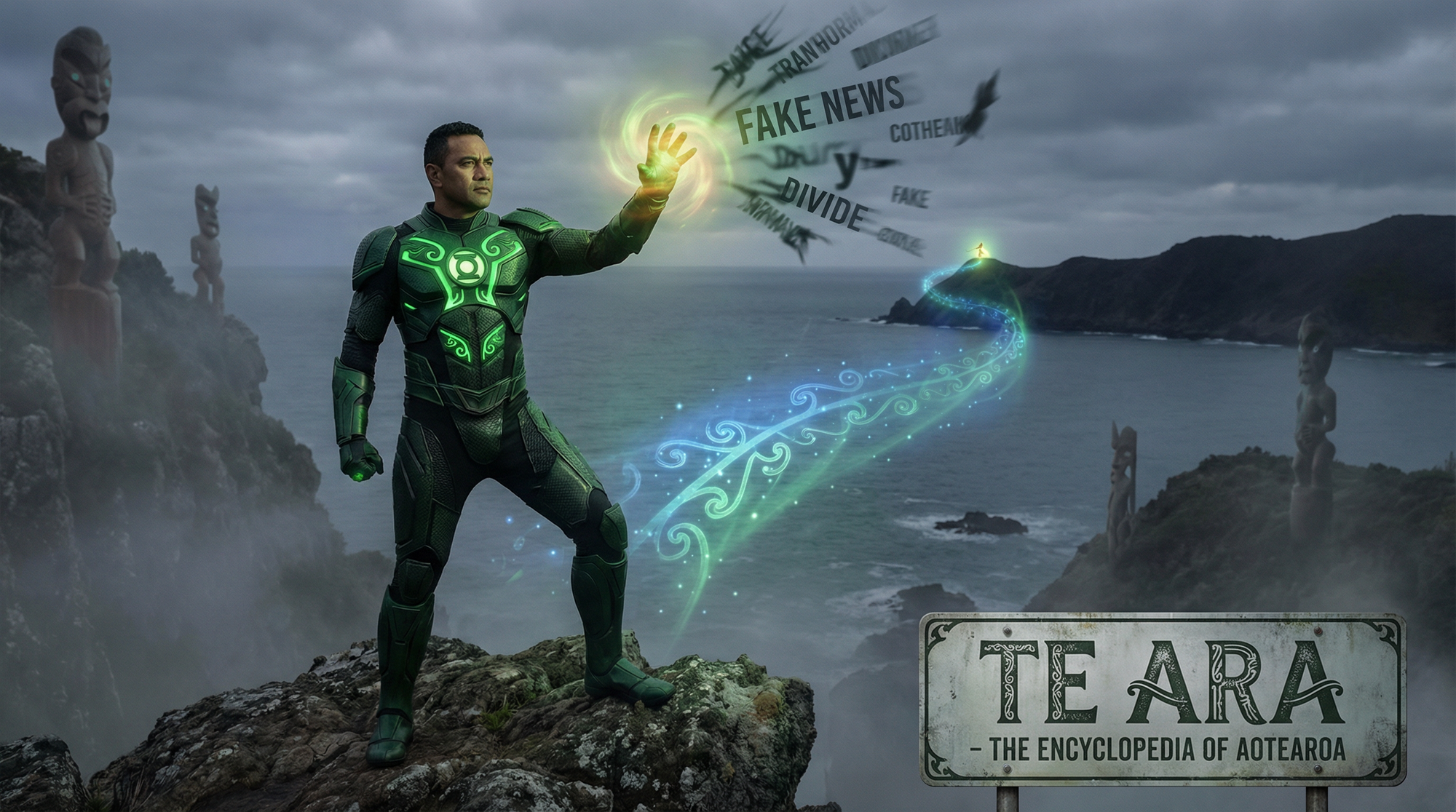
Into this landscape steps the Māori Green Lantern, led by Ivor Jones
—a kaupapa that refuses to let the Crown’s current assault on Māori pass under cover of technocratic jargon, stale press releases, and lazy media framing.
Launched over 2 years ago, the Māori Green Lantern describes itself as a digital kaitiaki:
a guardian whose weapon is forensic political analysis grounded in mātauranga Māori, as Koha and LinkedIn document. Within 24 hours, it had already climbed to 79th globally in political influence rankings—without corporate backing, venture capital, or state funding, as Koha records. Within weeks it had reached 42,000 people across Substack, Facebook, Bluesky and email, as Koha confirms.
Those numbers matter because they terrify a government that depends on Māori being confused, exhausted, and divided.
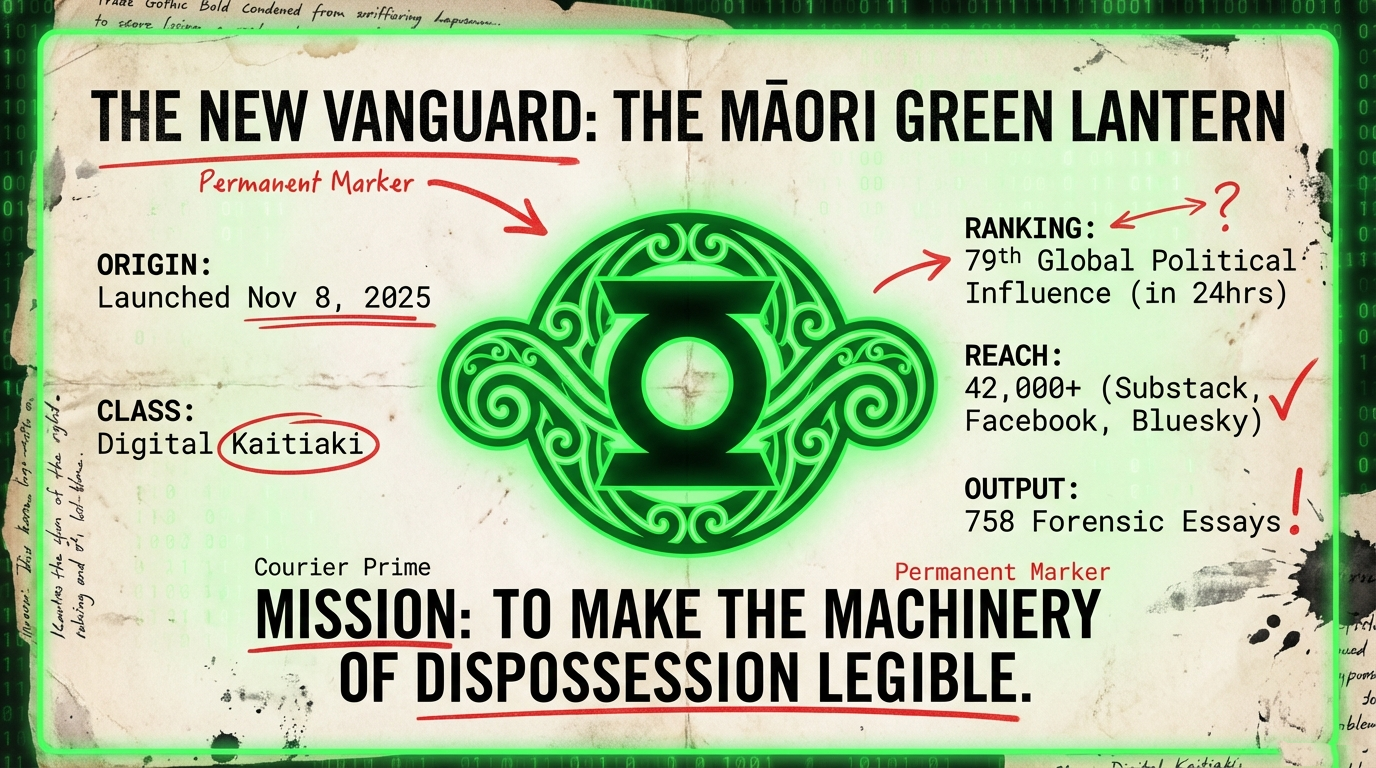
The Māori Green Lantern is doing the one thing a white-supremacist neoliberal regime cannot tolerate:
making the machinery of dispossession legible.
Exposing the Whakapapa of Power
The kaupapa is explicit:
its mission is to expose the whakapapa of power—the genealogies of decisions, money flows, policies, and institutional relationships through which dispossession is reproduced and normalised, as outlined in Koha’s project description.
Whakapapa, in this context, is not a decorative metaphor.
It is a Māori analytic:
tracing how today’s legislative attacks descend from yesterday’s confiscations, how “fiscal prudence” is the grandchild of raupatu, how each new regulatory trick is another cousin in the same extended whānau of theft.
The Māori Green Lantern’s investigations have, for example:
- Shown how the so-called “full and final” Treaty settlements are capped by a fiscal envelope so tight that iwi receive as little as 2–3 cents for every dollar stolen, as Koha documents. That isn’t “reconciliation”; it is money laundering for colonisation.
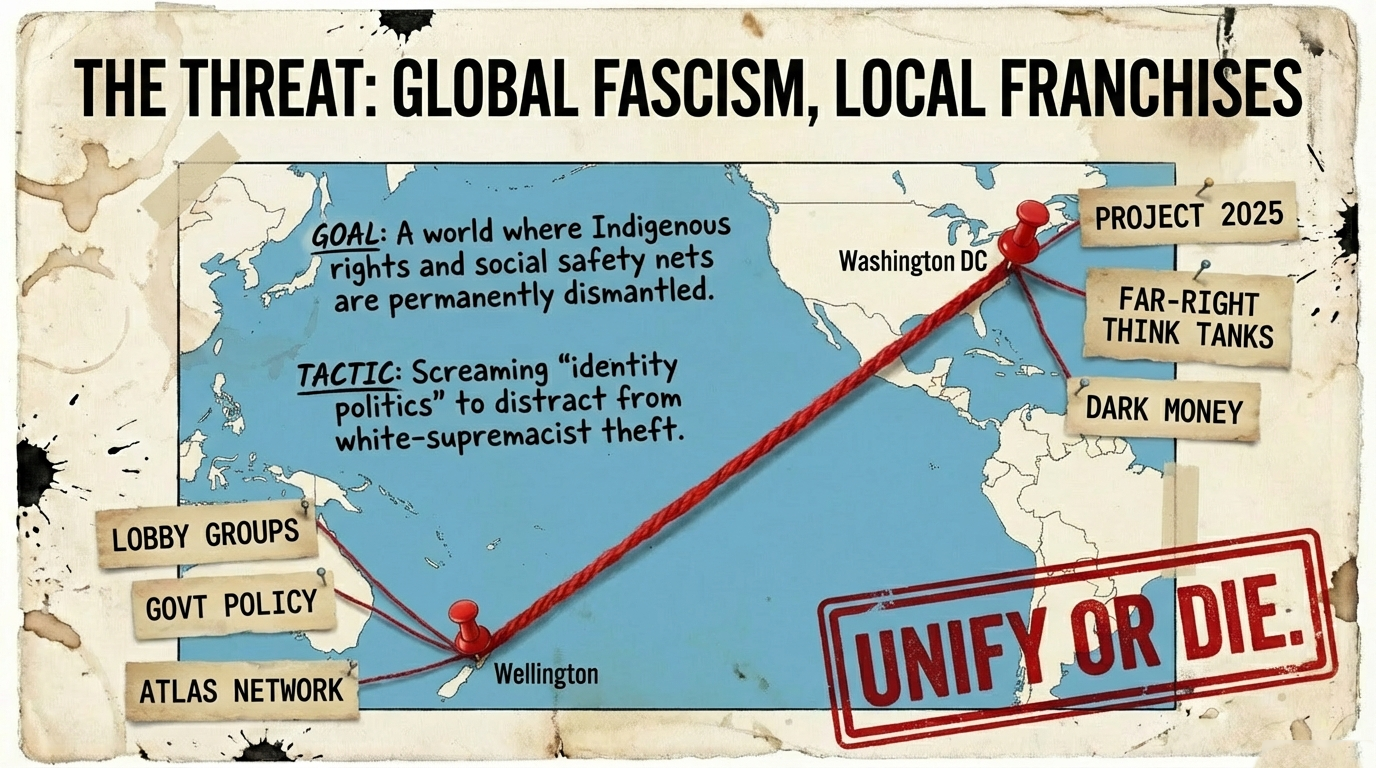
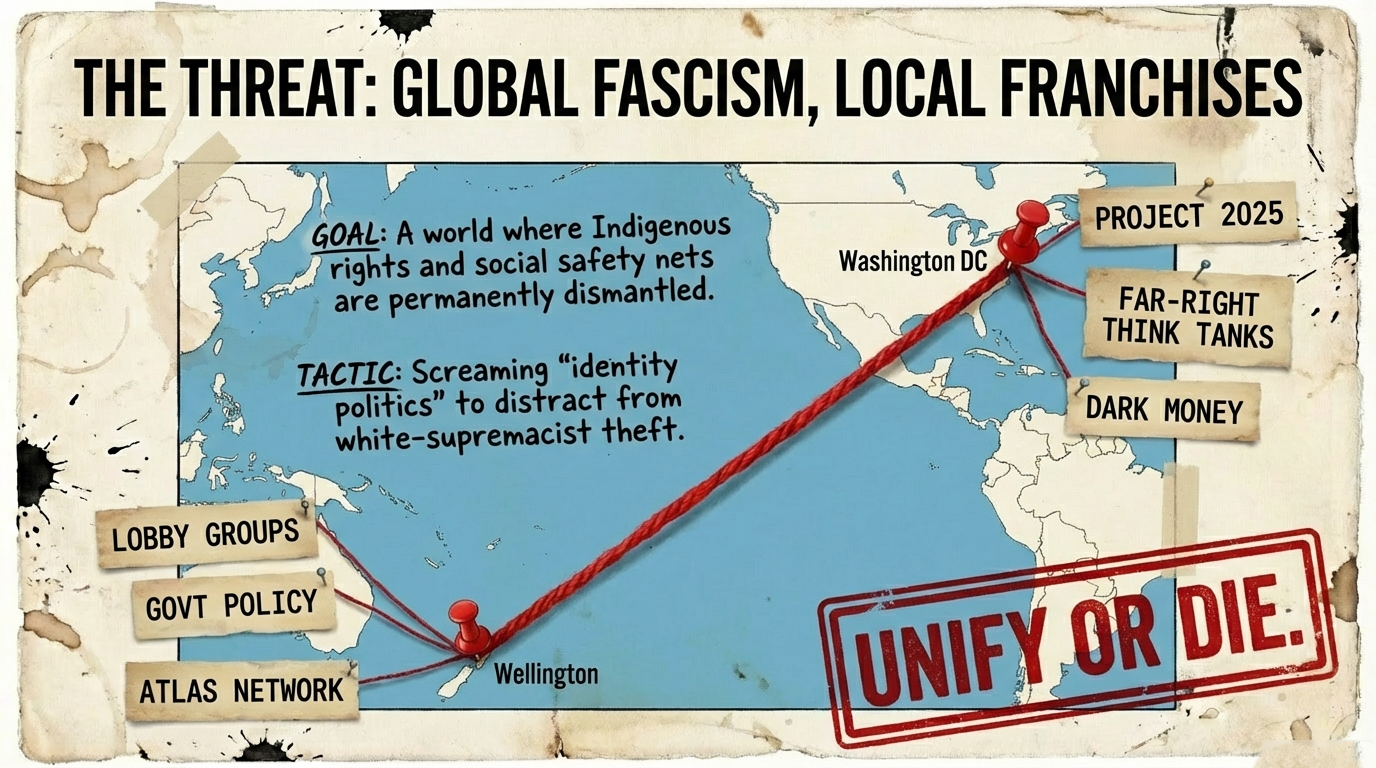
- Tracked funding networks connecting the current government to Project 2025-aligned far-right US think tanks bankrolling reactionary policy here and overseas, as Koha reveals.
- Dissected the co-governance backlash, revealing it as a coordinated white backlash against even the most timid forms of shared decision-making over land, water and resources, as Koha details.
- Connected health inequities to the deliberate criminalisation and marginalisation of rongoā Māori, showing how the state simultaneously erodes traditional healing and underfunds clinical services for Māori, as Koha exposes.
- Documented how in 2025 the Crown launched a multi-pronged assault on Te Tiriti while the public was distracted by a single Treaty Principles Bill that became a convenient lightning rod. While that bill died 112–11, four other legislative “strikes” advanced quietly to rip Te Tiriti out of education, child welfare, coastal protections, and future lawmaking frameworks, as Substack notes detail.
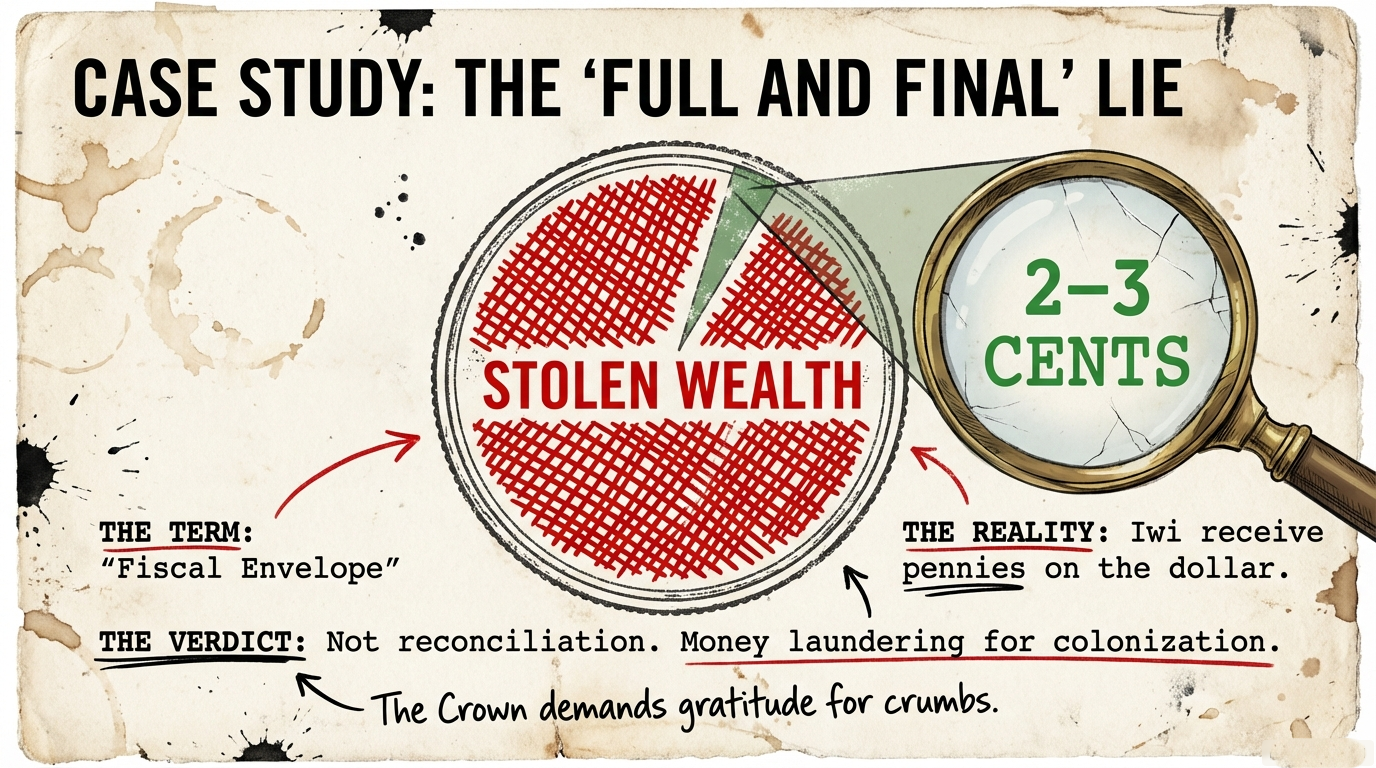
In other words:
while media chased the loud, doomed attack dog, the Crown quietly walked four knives into the back of Te Tiriti. The Māori Green Lantern is one of the few entities actually mapping where those knives went.
Regulatory Standards as a Weapon Against Māori
One example should end forever the fantasy that this government is merely “clumsy” or “ideological but sincere”:
the Regulatory Standards Act.
The Māori Green Lantern’s analysis reveals that this law effectively hard-wires a Pākehā veto into future protections for Māori by demanding that any new regulation prove it imposes no cost on those already holding power and wealth, as documented in Substack analysis. Protection of Te Tiriti, the whenua, or te reo that inconveniences corporate profit or Pākehā comfort is thus framed as a problem to be avoided at all costs.
This is the logic of white supremacy rendered in legislative language:
the status quo of stolen land and accumulated advantage is the baseline, and any attempt to rebalance is treated as dangerous “overreach”.
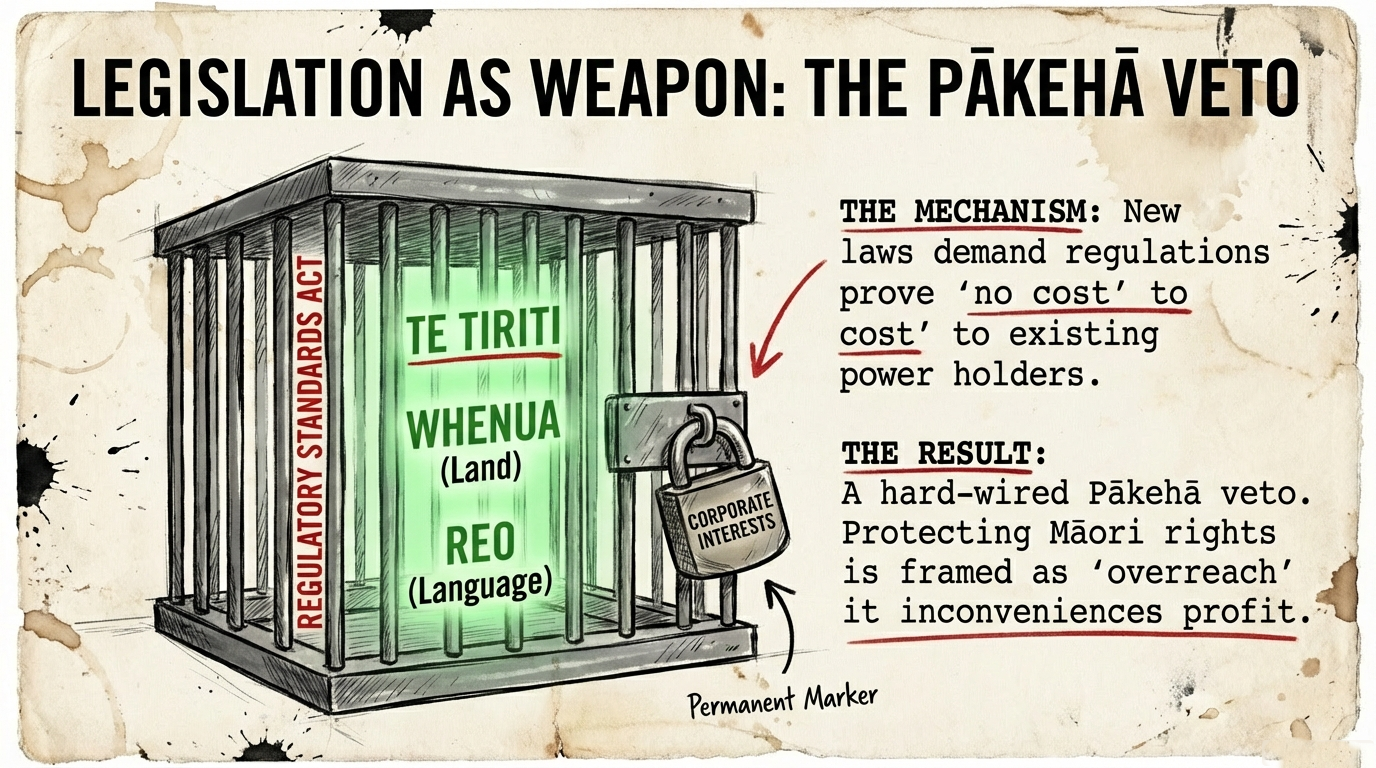
The government doesn’t have to say “Māori are inferior” out loud. It simply writes laws that act as if Māori suffering is an acceptable cost of doing business, while even the slightest inconvenience to Pākehā is treated as a constitutional crisis.
Tikanga as Operating System, Not Ornament
The Māori Green Lantern is not neutral.
It is unapologetically Māori-first.
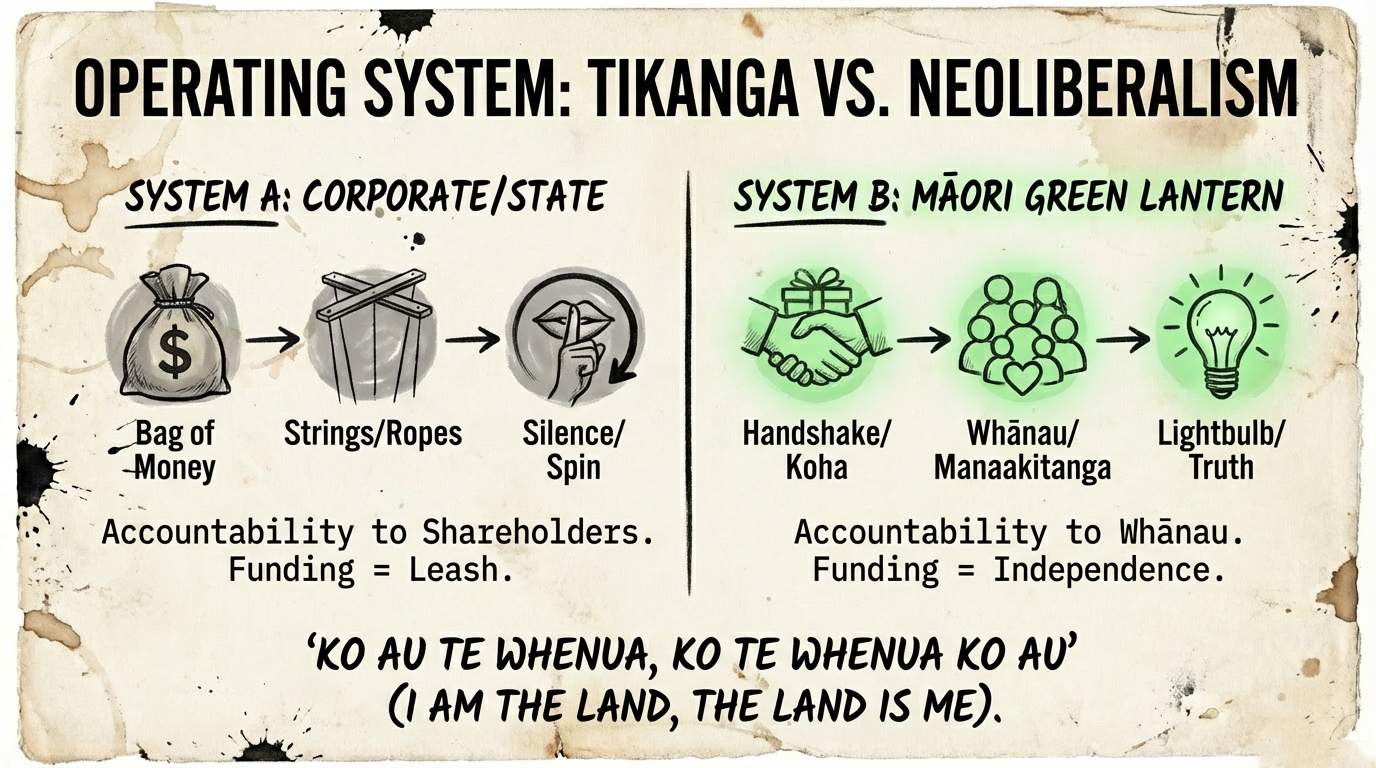
Its operating system is tikanga, not Treasury spreadsheets, as Koha makes clear.
That means:
- Funding is through koha, not paywalls or corporate shareholders. No donor gets to veto uncomfortable truths.
- The kaupapa is anchored in manaakitanga (care and generosity), whanaungatanga (deep relational accountability), and rangatiratanga (self-determination), as Koha outlines.
- The core claim is “Ko au te whenua, ko te whenua ko au”—I am the land, and the land is me, as Koha states. This is the exact worldview the Crown has spent 180+ years trying to erase, because once people truly believe it, mass extraction for private profit becomes morally impossible.
While mainstream outlets parrot government talking points about “economic growth” and “fiscal responsibility”, the Māori Green Lantern is tracking the actual whakapapa of those terms:
who pays, who benefits, whose bodies carry the cost, whose land absorbs the pollution, whose kids inherit the consequences.
By late 2025, Ivor Jones had produced 758 essays doing this work:
an archive of institutional corruption, policy deceit, and Crown contempt that will outlast the current crop of ministers and their lobbyists, as Facebook reports. That is precisely why they would prefer you never read it.
Shared DNA: Panthers, Polynesian Panthers, and the Māori Green Lantern
Internationalism vs Settler Divide-and-Rule
The Black Panthers declared themselves internationalists and backed it up with action:
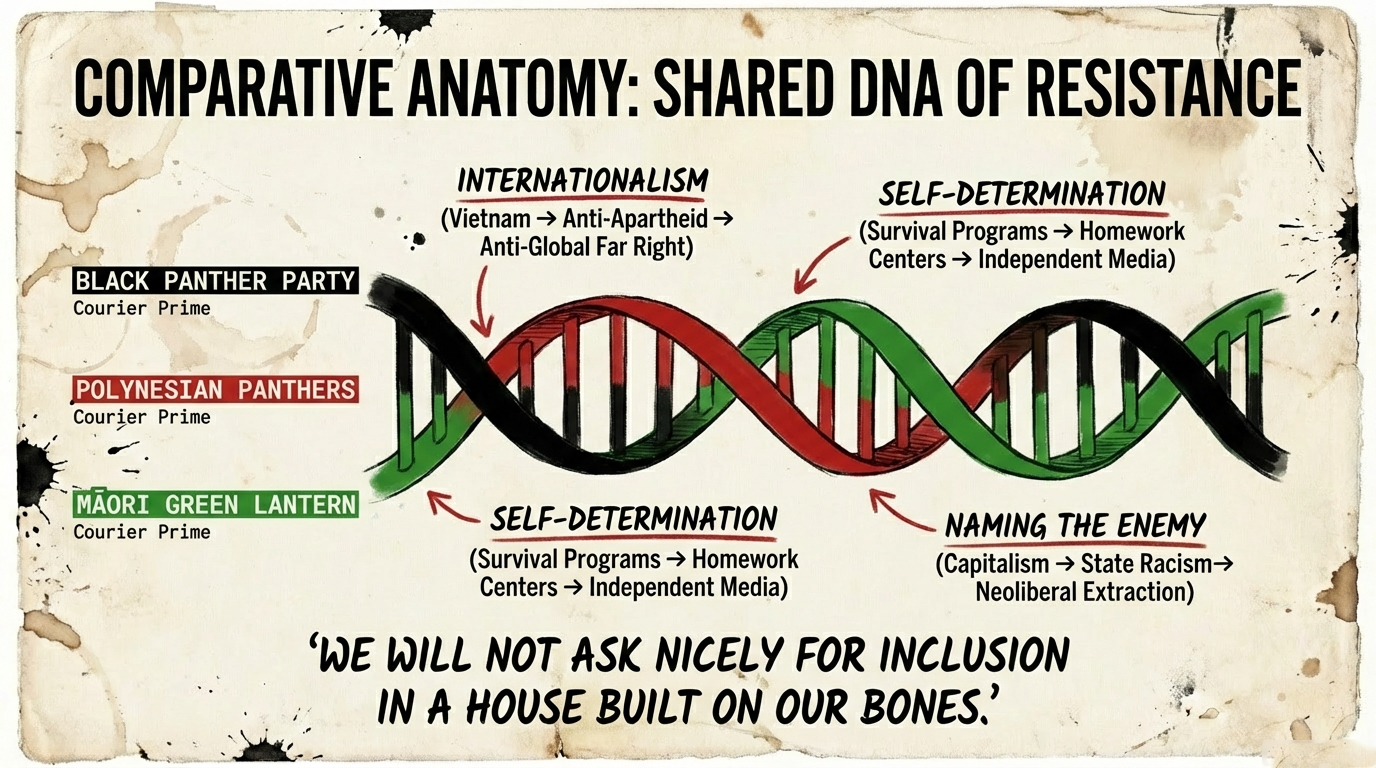
solidarity with Vietnam, the Young Lords, the Young Patriots, and liberation movements globally, as Security Dialogue, CounterPunch, Wikipedia, and Liberation News document. The Polynesian Panthers did the same in Aotearoa, standing with Māori land rights movements and against South African apartheid, as NZ History, e-Tangata, and RNZ confirm.
Today, the Māori Green Lantern connects Aotearoa’s struggles against dispossession with the global rise of far-right, project-managed fascism
—linking the current government’s agenda to offshore funders and transnational networks that dream of a world where Indigenous rights, environmental protections and social safety nets are permanently dismantled, as Koha reveals.
This is why every right-wing comms shop screams “identity politics” the moment Māori name white supremacy. They need us to believe that the real problem is Māori talking back, not the centuries-long project of theft those words are describing.
Community Self-Determination, Not Begging for Inclusion
The Panthers fed thousands of children, ran clinics and legal aid, and patrolled streets not because they loved charity, but because they wanted to prove communities did not need to beg the very state that oppressed them for crumbs, as PMC research, the Smithsonian, Noir Press, The Fulcrum, and BPP Alumni document.
The Polynesian Panthers built homework centres, food co-ops, tenant brigades and prison buses, and produced legal handbooks, because no one else would—and because doing so built independent Pacific power rather than deeper dependency, as Future Learn, The CocoNet, NZ History, National Library NZ, and Liberation Library confirm.
The Māori Green Lantern operates outside the funding chains that domesticate so many Māori organisations. There is no Crown contract that can be quietly “reviewed”, no corporate sponsor who can place a weasel-worded phone call when analysis cuts too close to vested interests.
The only accountability is to whānau, hapū, iwi
—and to the truth.
In all three movements, the message is the same:
we will not ask nicely for inclusion in a house built on our bones. We will build our own whare, tell our own stories, and defend our own.
Seeing the System, Naming the Enemy
The Black Panthers named capitalism, imperialism, policing, and US militarism as structurally racist and violent—not broken systems in need of reform, but machinery doing exactly what it was built to do, as Security Dialogue, Britannica, Wikipedia, and Teaching American History document.
The Polynesian Panthers named the Dawn Raids as state racism, not “over-zealous immigration policy,” as Wikipedia, NZ History, NZ History’s dawn raids page, and RNZ confirm. They named housing racism, labour exploitation, and curriculum erasure as interconnected tools of white control, as Future Learn, The CocoNet, NZ History, and National Library NZ document.
The Māori Green Lantern is doing the same to the current Aotearoa government:
naming its attacks on Te Tiriti, on Māori education, on rongoā, on co-governance, on environmental protections, and on Treaty settlements as a coherent white-supremacist, neoliberal project whose goal is simple
—lock in Pākehā control of land, water, and institutions while there is still time.
To describe this government as merely “conservative” is a lie. These are people deliberately designing laws to make Indigenous justice financially and procedurally impossible while they shovel public wealth into the pockets of private interests and offshore backers.
You do not negotiate your existence with people whose entire political programme is built on your non-existence.
The Crown’s Current Project: Neoliberalism with a White Hood
Strip away the PR, and this is what the current government is doing:
- Reframing Te Tiriti as a “problem” that must be “solved” so Pākehā do not feel “divided” or “left out.”
- Using fiscal language to justify continued theft: calling 2–3 cents on the dollar “full and final” settlements, then weaponising those settlements to silence future claims, as Koha documents.
- Deploying “democracy” as a shield for structural dominance—attacking co-governance and Māori seats while leaving untouched every undemocratic instrument that protects corporate power and property rights, as Koha and Substack reveal.
- Passing meta-laws like the Regulatory Standards Act to double-lock the cage around Indigenous rights: even when you win a battle in Parliament, another statute stands behind it ready to declare your victory “too expensive,” as Substack details.
- Backing all of this with dog-whistle narratives about “special treatment”, “race-based policy”, and “division”—classic white-supremacist messaging designed to turn Pākehā anxiety into political capital, as analysed by e-Tangata and Te Tai Treaty Settlements.
This is not incompetence. It is design.
And the Māori Green Lantern exists precisely to ensure none of it happens in the dark.

Ivor Jones The Māori Green Lantern Fighting Misinformation And Disinformation From The Far Right