“Jim Bolger: A Conservative’s Convenient Journey Toward Partnership—Or How White Supremacy Learns to Smile While It Steals” - 16 October 2025
The Uncomfortable Truth About Conservative “Heroes”
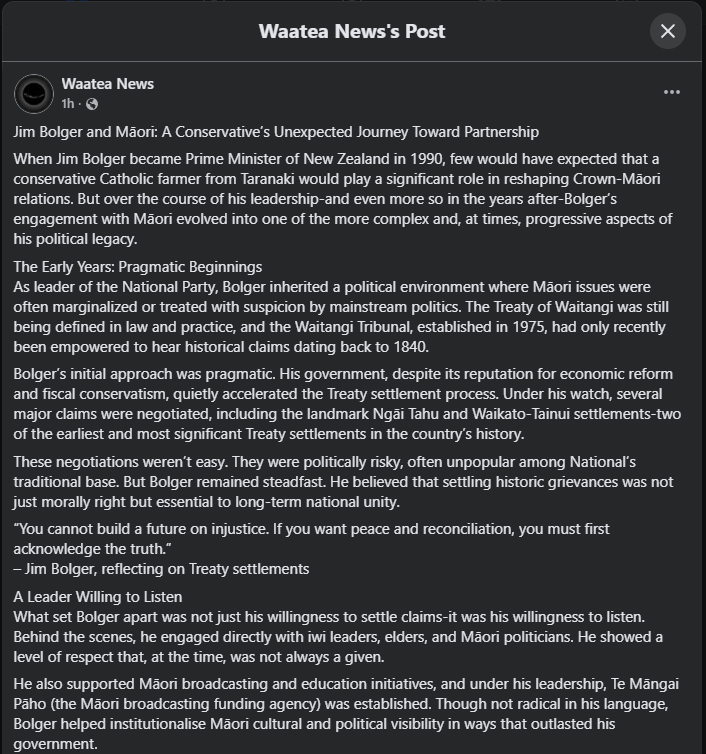
Kia ora whānau. Tēnā koutou katoa. The Māori Green Lantern Confronts the Myth of the Gentle Conservative.
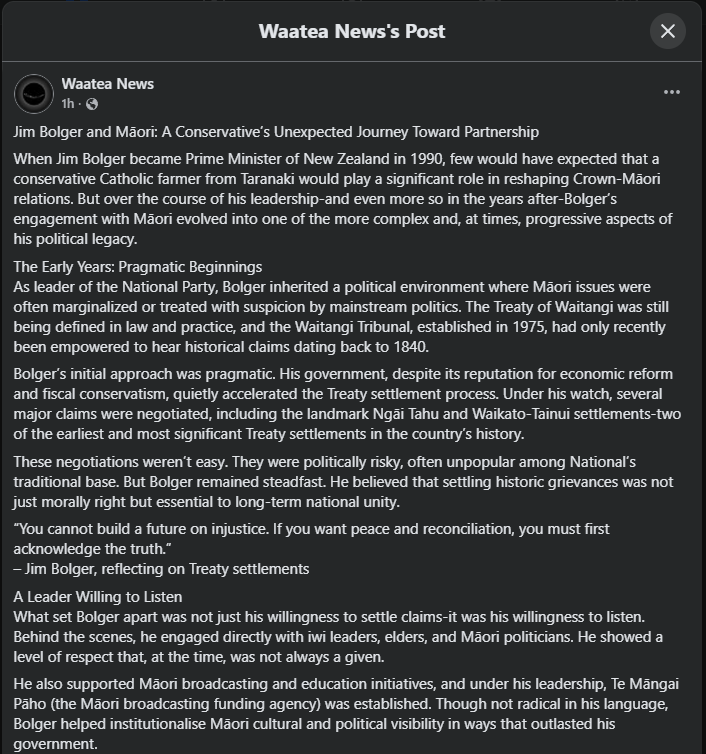
Here is what Waatea News does not want you to understand: Jim Bolger was not a hero. He was a conservative Catholic farmer from Taranaki who built his wealth on land stolen from Māori during the 1860s colonial wars and confiscations. His government launched the Mother of All Budgets in 1991, slashing welfare benefits by up to $27 per week—cuts that devastated Māori whānau who were over-represented on every benefit type. His finance minister Ruth Richardson cut unemployment benefits by $14, sickness benefits by $27.04, and abolished family support entirely, all while Māori bore between 35-42% of the impact despite being only 15% of the population.
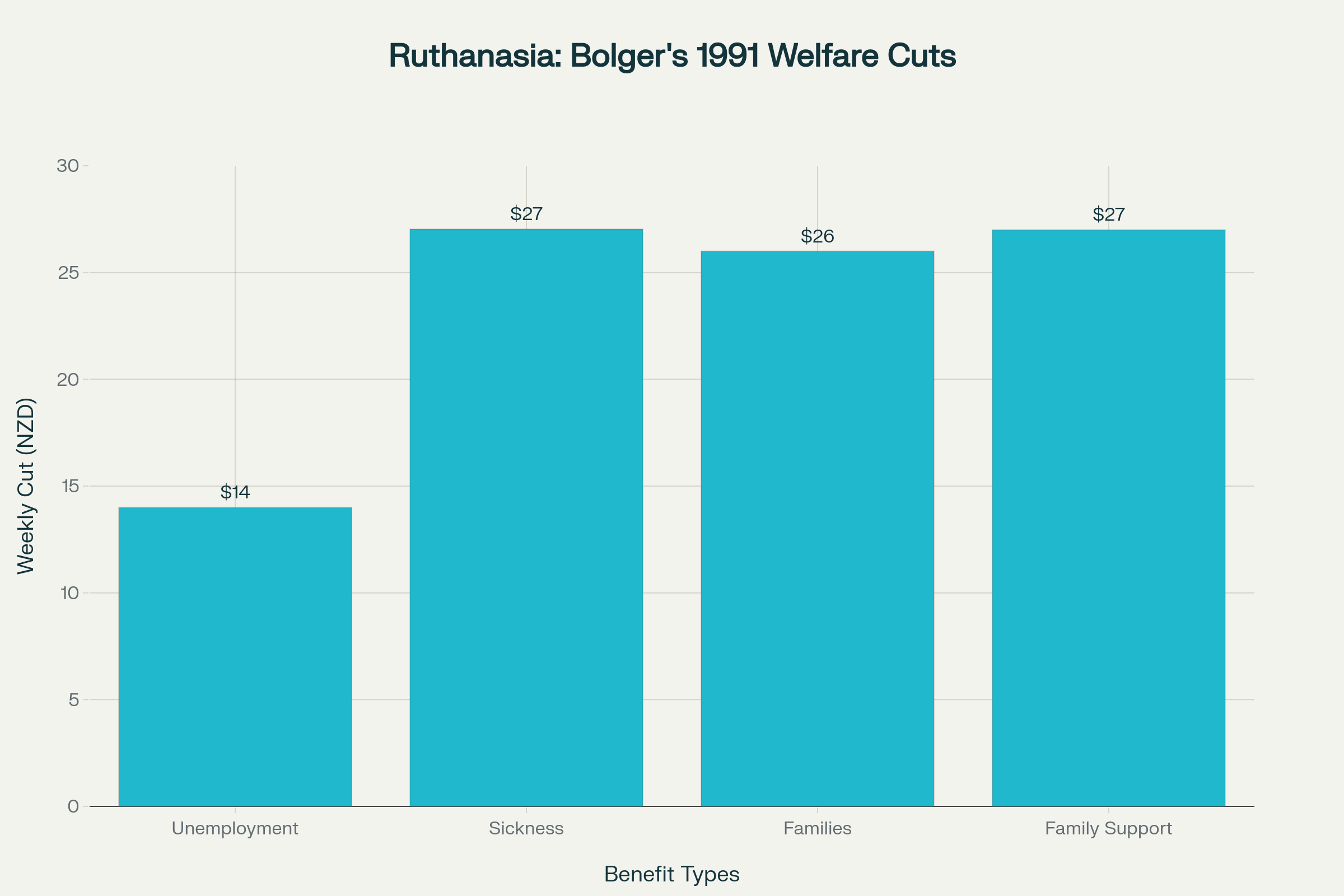
Bolger’s finance minister Ruth Richardson slashed benefits by up to $27 per week while Māori bore 35-42% of the impact - the neoliberal blueprint for attacking the vulnerable
Yet Waatea News presents him as some enlightened figure who “engaged with Māori” and showed “respect.” This is the propaganda of the coloniser dressed in sheep’s clothing. This is how neoliberalism and white supremacy rebrand themselves for a new generation—by finding the “reasonable” conservative who appears to listen while his government guts the welfare state that keeps Māori families alive.
Jim Bolger died on 15 October 2025, aged 90, after spending his final year on dialysis following kidney failure. His passing triggered an avalanche of tribute, with Prime Minister Christopher Luxon calling him a “towering figure” and “leader of conviction”. But what Luxon fails to mention is that Bolger’s legacy provided the blueprint for the current coalition government’s vicious 100-day plan to dismantle Māori gains—including abolishing Te Aka Whai Ora, reversing smokefree legislation that would have saved Māori lives, and supporting David Seymour’s Treaty Principles Bill that seeks to rewrite Te Tiriti itself.
Background: The Catholic Conservative Blueprint for Neoliberal Colonisation
Understanding Bolger requires understanding the dangerous fusion of Catholic social conservatism and neoliberal economics that marked the 1990s. Born 31 May 1935 in Ōpunake, Taranaki to Irish Catholic immigrant parents, Bolger inherited both the religious moralism that justified colonial “civilisation” and the farming mentality that saw Māori land as available for the taking. His family farmed in Taranaki—the same region where over 1.2 million acres were confiscated from Waikato-Tainui in the 1860s following Governor George Grey’s invasion.
This Catholic-neoliberal fusion is not unique to Aotearoa. Research on the “Catholicization of neoliberalism” in Italy shows how conservative Catholic doctrine provides moral cover for market fundamentalism by emphasising charity over justice, individual responsibility over structural change, and “traditional values” over Indigenous rights. Bolger embodied this perfectly: he could justify Ruth Richardson’s brutal “Ruthanasia” welfare cuts as “fiscal responsibility” while simultaneously presenting Treaty settlements as acts of Christian charity rather than legal obligations the Crown must meet.
Bolger entered Parliament in 1972 and became National Party leader in 1986, winning government in a landslide 1990 election victory by promising a “Decent Society” after Labour’s Rogernomics. But this was a lie. Within hours of winning, Bolger was told the economy was “broke” and the Bank of New Zealand was “bankrupt,” giving him the perfect excuse to betray every promise and pursue even more radical free-market reforms than Labour.
The Fiscal Envelope: Capping Justice at $1 Billion
Here is where Bolger’s true nature reveals itself. In 1994, his government announced the “fiscal envelope”—a plan to cap all Treaty settlements at a maximum $1 billion, with no transfer of state-owned natural resources or conservation estate. This was not pragmatism. This was white supremacy with a calculator. The Crown’s own valuers assessed that Ngāi Tahu alone had lost assets worth between $12-15 billion in 1990 dollars, yet Bolger’s government proposed settling all historical grievances for less than one-tenth of one iwi’s loss.
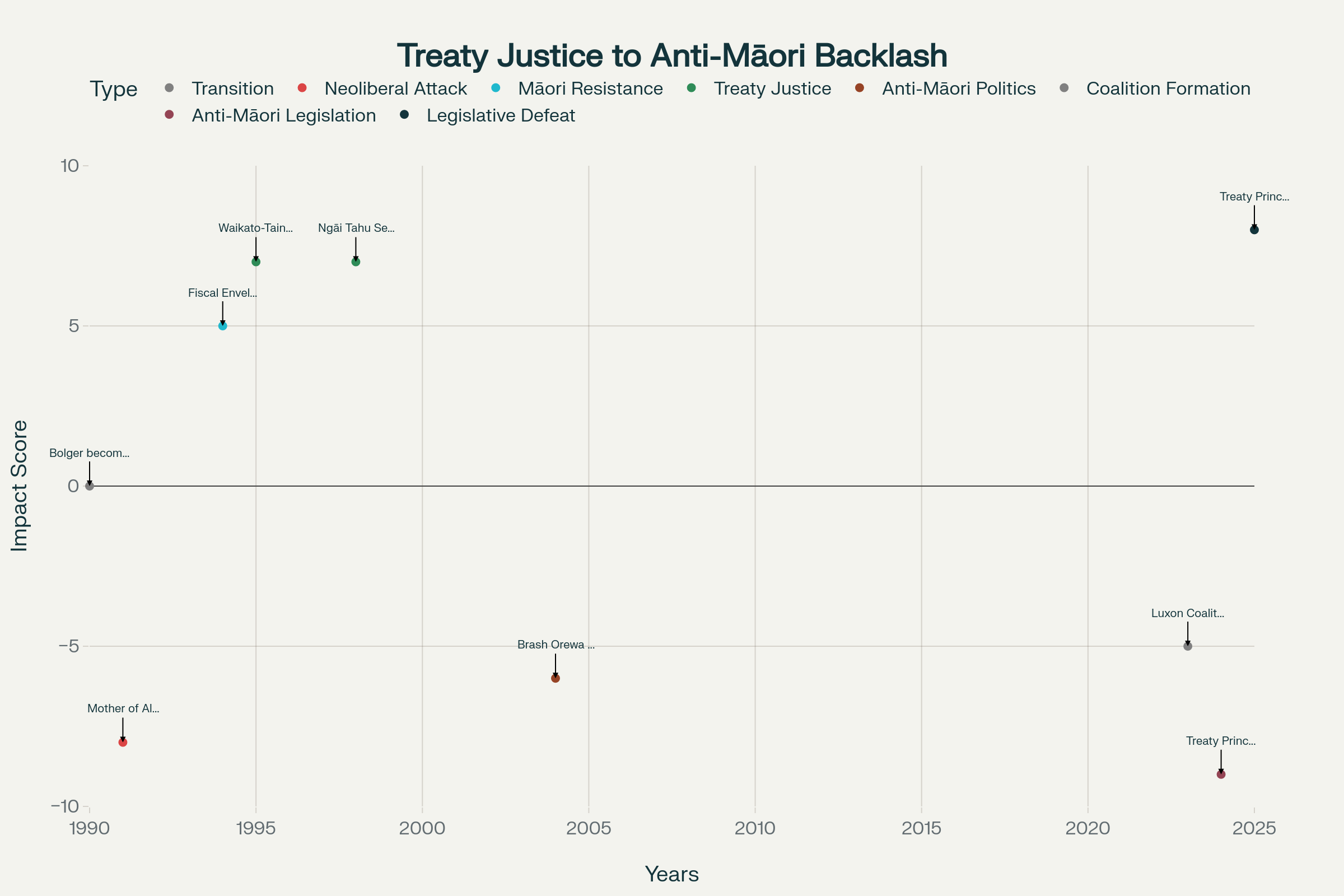
This timeline reveals the pattern: Bolger’s Treaty settlements in the 1990s triggered a conservative backlash that culminated in Brash’s 2004 Orewa speech and now Seymour’s 2024 Treaty Principles Bill
The fiscal envelope was imposed without adequate consultation and was met with nationwide protests. At Waitara in Taranaki—the same region Bolger farmed—Māori burned the New Zealand flag in fury. In January 1995, Sir Hepi Te Heuheu publicly declined Bolger’s invitation to discuss the envelope, instead calling iwi leaders to Hīrangi marae near Tūrangi, where around 1,000 leaders rejected the Crown’s insulting offer. The fiscal envelope was eventually dropped, but not before revealing the limits of Bolger’s supposed “partnership.”
The Treaty Settlements: Justice Achieved Despite Bolger, Not Because of Him
Yes, Bolger’s government signed the Waikato-Tainui settlement in 1995 and the Ngāi Tahu settlement in 1998. But let us be absolutely clear: these settlements happened because of Māori resistance, not Crown benevolence. Waikato-Tainui bypassed the Waitangi Tribunal entirely and negotiated directly with the Crown because they understood that the tribunal process was designed to delay justice indefinitely.
The true genius belonged to Sir Robert Mahuta, who brokered the relativity clause—a mechanism ensuring Waikato-Tainui’s settlement would remain 17% of all Treaty settlements until 2045. This future-proofed the deal, eventually securing an additional $290 million by 2020. Bolger agreed to this only because his government was desperate for a settlement “on its books” after the fiscal envelope debacle, and because Ngāi Tahu and Waikato-Tainui negotiators stayed in regular contact to avoid being divided and conquered.
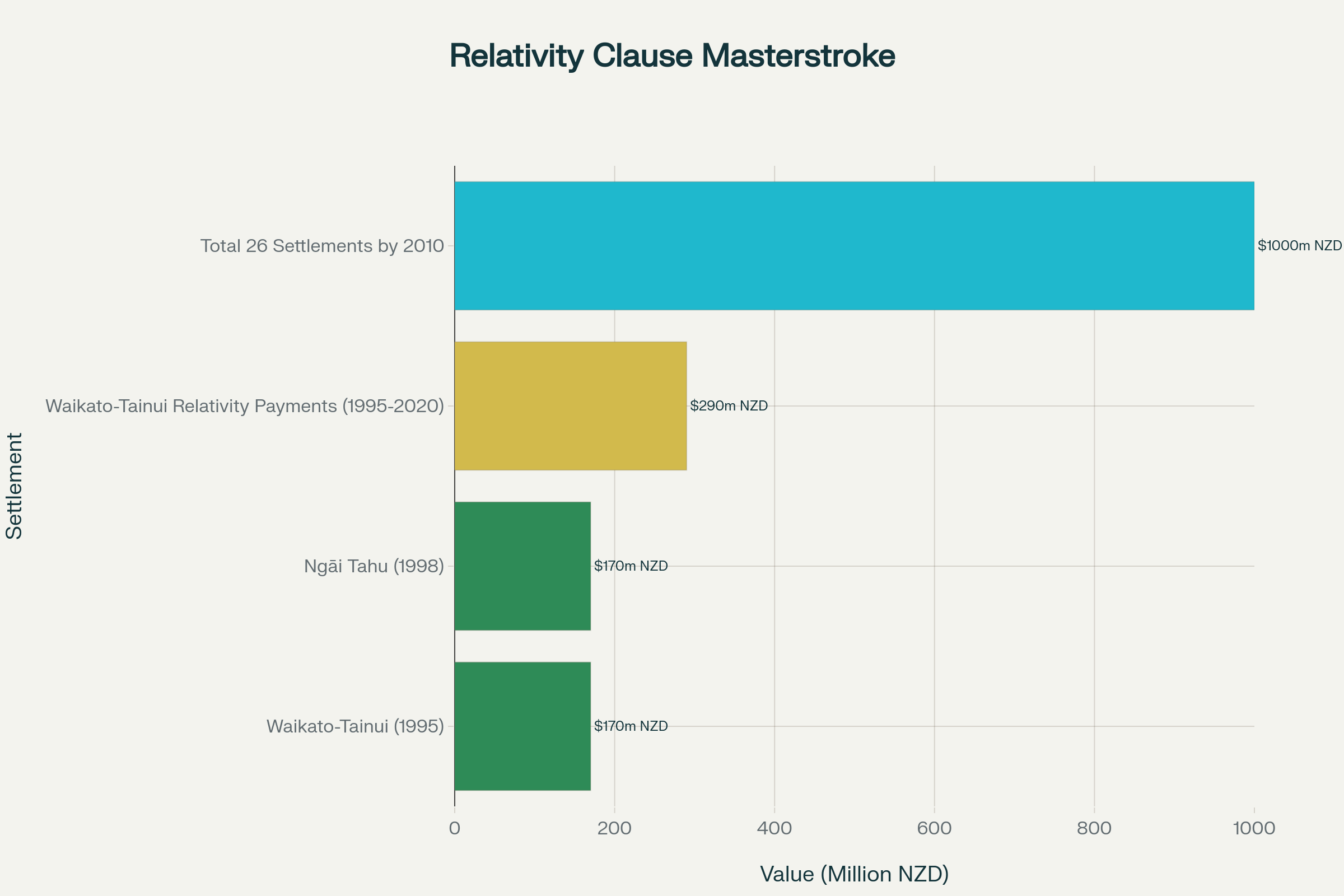
Sir Robert Mahuta’s 1995 relativity clause secured an additional $290 million for Waikato-Tainui by 2020 - ensuring the settlement kept pace as a proportion of all Treaty settlements
The settlements were politically risky and unpopular with National’s base, yet Bolger pushed them through. Waatea News presents this as courage. The Māori Green Lantern sees it differently: Bolger understood that settling historic grievances was “essential to long-term national unity”—meaning essential to preventing Māori resistance from destabilising his neoliberal economic programme. The settlements were the price he paid for social peace while his government gutted the welfare state.
Analysis: The Hidden Connections Between Bolger, Brash, and Seymour
The Waatea News post fails to connect the dots between Bolger’s “pragmatic” Treaty settlements and the virulent anti-Māori backlash they triggered within the National Party. These connections reveal a continuous thread of white supremacist reaction to Māori gains that runs from the 1990s to today’s coalition government.
The Orewa Speech and the Birth of Modern Anti-Māori Politics
In January 2004, National Party leader Don Brash delivered his infamous Orewa speech, attacking what he called the “Treaty of Waitangi Grievance Industry”. Brash argued for “one law for all” and ending what he characterised as “special privileges” for Māori. The speech was a direct attack on the settlement process Bolger had initiated. National’s polling jumped from 28% to 45% in two weeks—proving the enduring power of white supremacist resentment.
Critically, Brash claimed National had an “honourable record” on Treaty settlements, citing the $170 million each for Tainui and Ngāi Tahu achieved under Bolger and Minister Sir Douglas Graham. He used this to argue that because settlements had been achieved, it was now time to move on and stop “special treatment.” This rhetorical move—settle then attack—became the blueprint for contemporary anti-Māori politics.
David Seymour and the Treaty Principles Bill: Bolger’s Chickens Come Home to Roost
David Seymour’s Treaty Principles Bill, introduced in November 2024, represents the culmination of this backlash. The Bill seeks to redefine the principles of Te Tiriti by reducing “tino rangatiratanga” to mere “property rights” rather than self-determination, and asserting that “all New Zealanders are equal under the law”—the same “one law for all” rhetoric Brash used in 2004.
The Waitangi Tribunal found the Bill would be “the worst, most comprehensive breach of the Treaty/te Tiriti in modern times” if enacted, and described it as “little more than a politically motivated attack on perceived ‘Māori privilege’”. Yet it passed its first reading in November 2024 after Te Pāti Māori MP Hana-Rawhiti Maipi-Clarke led a haka in protest and was subsequently suspended from Parliament.
The Bill was finally defeated at its second reading on 10 April 2025 by 112 votes to 11, with only ACT supporting it and National, NZ First, Labour, Greens, and Te Pāti Māori all voting against. But the damage was done. National agreed to support the Bill to select committee stage as part of its coalition agreement with ACT, legitimising a debate about whether Māori have rights under Te Tiriti at all.
The Luxon Coalition’s 100-Day Assault on Māori
Christopher Luxon’s coalition government with ACT and NZ First, formed after the October 2023 election, represents what Professor Richard Shaw called “the most explicitly anti-Māori government” in New Zealand history. The coalition’s 100-day plan included 49 actions, many explicitly targeting Māori:
- Disestablishing Te Aka Whai Ora, the Māori Health Authority
- Repealing the Smokefree legislation that would have created a smokefree generation, despite Māori having smoking rates of 20% compared to 8% nationally
- Requiring public service departments to use English names first, triggering legal action from Waikato-Tainui claiming breach of their 1995 Raupatu settlement
- Stopping all work on He Puapua, the framework for implementing the UN Declaration on the Rights of Indigenous Peoples
Te Pāti Māori co-leader Debbie Ngarewa-Packer accurately described this as “deliberate systemic genocide”—they want to “lock us away and with this smoking turnaround they want to kill us away.” Luxon dismissed these concerns as “not helpful”, claiming it was merely a “difference of opinion.”
This is gaslighting. When you reverse health interventions that disproportionately benefit Māori, knowing they will cause approximately 1,000 extra deaths over the next decade, mostly Māori, while gaining $1.3 billion for the government through increased tobacco excise, you are choosing profit over Māori lives. That is not a “difference of opinion”—it is structural violence.
The Nationalist Christian Links: From Bolger to Peters
The Waatea News post mentions Bolger’s Catholic faith but fails to interrogate how Christian nationalism provides ideological cover for colonisation. Bolger was a “conservative Catholic farmer” whose faith shaped his paternalistic view that the Crown could be trusted to do right by Māori if Māori would just be patient and reasonable.
This Christian conservative tradition runs through New Zealand’s right-wing politics. Winston Peters, Bolger’s coalition partner from 1996-1998, built his career on opposing Māori “special treatment” while maintaining plausible deniability through his own Māori whakapapa. In September 2023, Peters told a Nelson audience that Māori are “not indigenous” because “we come from Hawai-iki,” demonstrating how conservative Christianity’s linear view of history can be weaponised to deny Indigenous rights.
NZ First’s coalition agreement with National opposed the use of te reo Māori in government, calling references to Aotearoa “virtue signaling and politically correct extremism”. Peters had served as Bolger’s Deputy Prime Minister and Treasurer in New Zealand’s first MMP government, learning how coalition agreements could be used to extract anti-Māori concessions from larger parties.
The ACT Party, led by Seymour, represents the fusion of Christian nationalism with libertarian economics. ACT’s Treaty Principles Bill emerged from a 2022 discussion document titled “Democracy or co-government?” that framed Māori self-determination as incompatible with democracy—the same logic used by Christian settlers in the 1860s to justify war against the Kīngitanga.
Implications: How Bolger’s Legacy Enables Today’s Attacks
The Waatea News narrative that Bolger was a “bridge builder” whose Treaty settlements represented “quiet but meaningful” progress is not just wrong—it is dangerous. It obscures how conservative “pragmatism” on Treaty issues provides cover for ongoing structural violence against Māori.
Bolger’s settlements established a template: acknowledge historical injustice, offer inadequate compensation, claim the moral high ground, then use that credibility to pursue policies that harm contemporary Māori. This pattern is visible in every stage of the Treaty settlement process:
- The Crown controls the process, deciding which claims to hear and when
- The Crown sets artificial limits, like the fiscal envelope
- The Crown extracts concessions, like Waikato-Tainui agreeing to bypass the Tribunal
- The Crown celebrates itself for “partnership” while inequality worsens
- Conservative politicians use completed settlements to argue Māori have received enough
Luxon praised Bolger as someone who “believed in the strength of our democracy, the promise of fairness, and the dignity of service” while his government pursues the most aggressive rollback of Māori rights in decades. This is not coincidence—it is the logical conclusion of the conservative approach Bolger embodied.
By 2010, 26 Treaty settlements had been finalised, representing over $1 billion in total compensation. Yet Māori remain over-represented in every negative social indicator: poverty, imprisonment, health outcomes, and mortality. The settlements addressed historical theft but did nothing to dismantle the ongoing structures of colonisation. Worse, they provided ammunition for the “grievance industry” narrative that Brash and Seymour now wield to justify attacking contemporary Māori rights.
The Community Impact
Māori communities understand what Waatea News refuses to say: Bolger’s legacy is mixed at best and actively harmful at worst. The Treaty settlements provided some iwi with economic resources to rebuild, yes. Waikato-Tainui’s settlement enabled significant development, with the Māori economy growing from $16 billion to $70 billion between 2000-2020. But this economic progress has not translated into political power to resist the current coalition’s attacks.
When Kiingi Tuheitia called a national hui in January 2024 to oppose the coalition’s policies, over 10,000 people attended in solidarity. When Hīkoi mō te Tiriti marched from Te Rerenga Wairua to Parliament in November 2024, tens of thousands joined. This mobilisation shows Māori will not accept the slow erosion of Treaty rights that Bolger’s “partnership” model enabled.
The pattern is clear: Conservative governments offer settlements for past injustices while creating new injustices in the present. They praise Māori “partnership” while dismantling Māori institutions. They celebrate “progress” while pursuing policies that kill Māori at higher rates than Pākehā.

The Māori Green Lantern Fighting Misinformation and Disinformation From The Far Right
Rejecting the Myth of the Benevolent Coloniser
Jim Bolger was not a hero. He was a conservative politician who pursued Treaty settlements because they served his government’s interests, not because he believed in Māori self-determination. His legacy is not “bridge building”—it is a blueprint for how conservative governments can appear progressive on historical issues while pursuing reactionary policies in the present.
The current coalition government’s attacks on Māori rights—from abolishing the Māori Health Authority to the Treaty Principles Bill to rolling back te reo protections—are the direct descendants of Bolger’s “pragmatic” approach. They prove that conservative “partnership” was always a trap, designed to extract Māori consent for limited redress while preserving Crown sovereignty and Pākehā privilege.
Māori do not need conservative heroes. We do not need Pākehā “bridge builders” who farm on stolen land while praising themselves for acknowledging theft. We need the return of sovereignty, the dismantling of colonial structures, and policies grounded in mana motuhake and tino rangatiratanga—not the crumbs offered by conservative governments desperate to maintain “social peace.”
In 2017, Bolger told RNZ that “neoliberal economic policies have absolutely failed” and created dangerous inequality. Yet he was the architect of those policies in Aotearoa. He said he and Douglas Graham had privately discussed creating an upper house with 50% Māori composition. But he never pursued it. He expressed regret for not doing more—but regret without reparation is just white guilt dressed as wisdom.
The Māori Green Lantern refuses this narrative. We see Bolger for what he was: a coloniser who learned to smile while stealing, a conservative who offered limited justice to prevent radical change, a politician who praised partnership while defending Crown supremacy.
Our tupuna did not accept the fiscal envelope in 1994. We will not accept the Treaty Principles Bill in 2024. We will not accept a coalition government that dismantles our health authority, reverses legislation protecting our lives, and attacks our reo. We will not accept conservative “bridge builders” who construct bridges designed to carry only Pākehā across while Māori remain stuck on the far bank.
Waatea News can eulogise Bolger if they wish. The Māori Green Lantern will tell the truth.
Kia kaha. Kia maia. Kia manawanui.
Ivor Jones
The Māori Green Lantern
If you find value in this mahi and have the capacity in these tough economic times, please consider a koha to support exposing misinformation and white supremacy. HTDM: 03-1546-0415173-000. Only if you can—your wairua and solidarity matter more than money.