"Jim Bolger - When Saints Come Marching In: How RNZ Manufactures Heroes from Colonisers" - 17 October 2025
The Heart of the Issue Put Straight
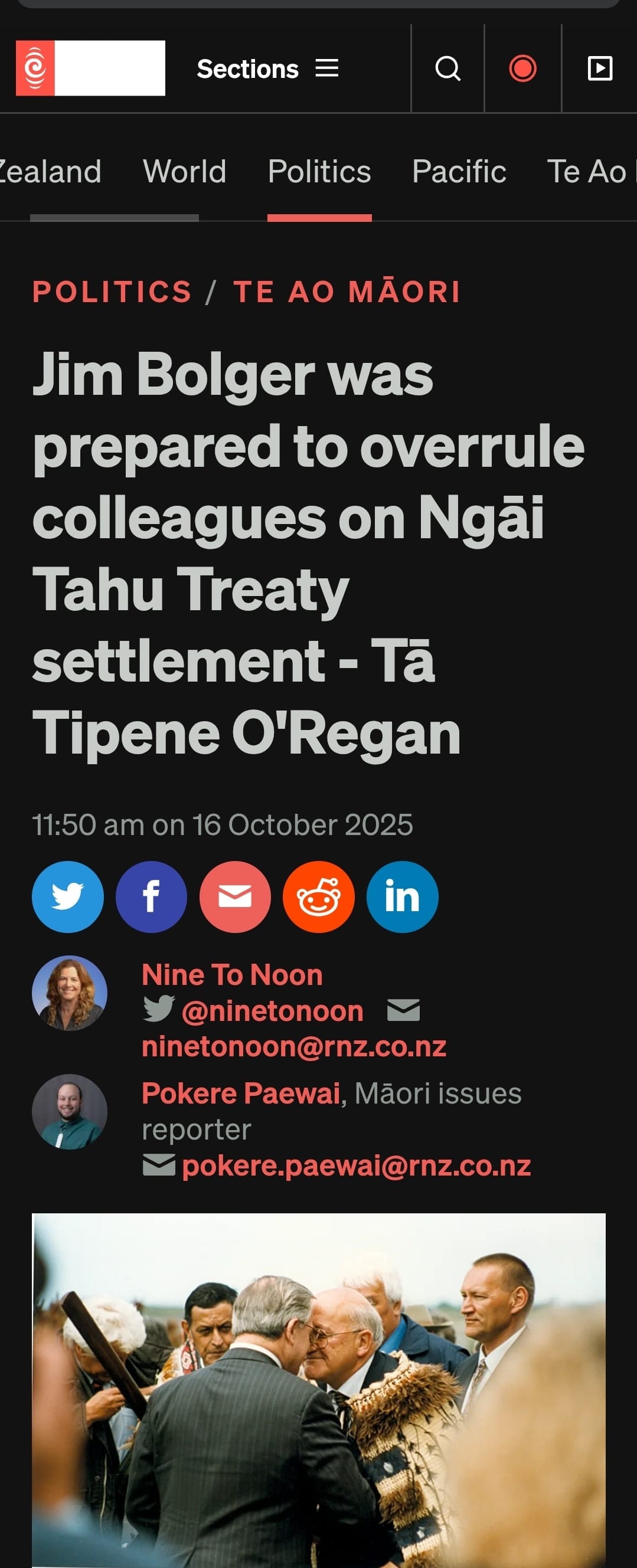
Kia ora whānau. The Māori Green Lantern Confronts the Hagiography Machine.
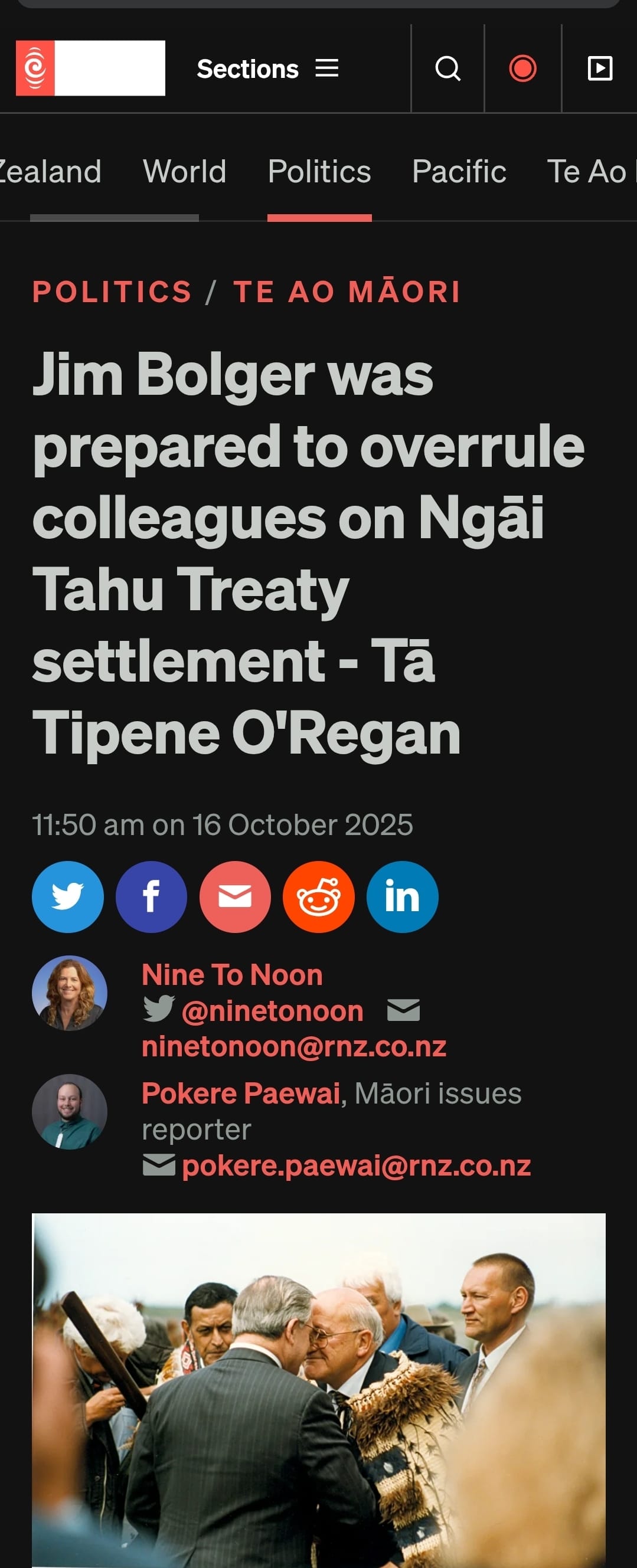
https://www.rnz.co.nz/news/political/576077/jim-bolger-was-prepared-to-overrule-colleagues-on-ngai-tahu-treaty-settlement-ta-tipene-o-regan
Here is what you need to understand immediately: RNZ’s tribute article featuring Tā Tipene O’Regan, Tukoroirangi Morgan, Sir John Key, and Sir Don McKinnon is a textbook example of how state media manufactures consent for conservative colonialism by platforming Māori voices who validate Pākehā power structures. This is not balanced journalism—it is propaganda that uses the mana of respected Māori leaders to whitewash a prime minister who slashed welfare, capped Treaty justice at one billion dollars, and laid the foundations for today’s anti-Māori coalition government.
Tā Tipene O’Regan says he “bawled his eyes out” when Bolger confirmed the Ngāi Tahu settlement. Tukoroirangi Morgan declares Bolger “opened the gateway of opportunity”. Sir John Key remembers Bolger’s “joy” around race relations. These are not lies—they are partial truths weaponised to obscure the systemic violence Bolger’s government inflicted on Māori whānau.
Every day New Zealanders need to understand this: when powerful Māori leaders praise conservative Pākehā politicians, they are often speaking from positions of privilege secured through Treaty settlements while ignoring the ongoing harm to Māori who never benefited from those deals. This is class politics dressed up as cultural reconciliation.
Background: State Media’s Role in Manufacturing Colonial Heroes
RNZ, as New Zealand’s state broadcaster funded by the Crown, occupies a structurally compromised position when reporting on Crown-Māori relations. The network exists because Parliament allows it to exist, receives funding through government appropriations, and operates under governance structures ultimately accountable to the state. This creates an inherent conflict of interest when covering Treaty settlements—deals negotiated between that same state and iwi leaders.
The article was published 15 October 2025, the day after Bolger’s death, ensuring maximum emotional impact while critical faculties are lowered by the cultural expectation not to speak ill of the dead. This timing is strategic—it forecloses analysis by demanding reverence. The piece features four powerful voices, three of them Māori, creating the appearance of Indigenous endorsement while carefully excluding any critical Māori perspectives.
Sir Tipene O’Regan led Ngāi Tahu treaty negotiations in the 1990s, securing a $170 million settlement in 1998 that has grown into over $1.3 billion in commercial assets. Tukoroirangi Morgan chairs the Waikato-Tainui executive, overseeing assets built from the 1995 Raupatu settlement. These are not ordinary Māori—they are the Māori elite whose economic success depends on maintaining good relationships with Crown power.
The Mechanics of Manufactured Consent
RNZ’s article employs several propaganda techniques that everyday New Zealanders must learn to recognise:
Selective Quotation and Emotional Manipulation
O’Regan says Bolger operated within “a deeply thoughtful frame” and was “one of the most widely read and most widely informed people that I have ever dealt with.” This framing presents Bolger as an intellectual and moral authority, obscuring the reality that he presided over “Ruthanasia”—welfare cuts that devastated Māori whānau and the 1994 fiscal envelope that tried to cap all Treaty settlements at $1 billion.
O’Regan mentions “a lot of negative elements” and “unpleasant episodes” during negotiations but deliberately refuses to detail them, saying only that Bolger “had a knack of dealing with such situations.” This is narrative sanitisation—acknowledging problems existed while refusing to name them, protecting Bolger’s reputation while seeming balanced.
Most egregiously, O’Regan describes “bawling his eyes out” when Bolger confirmed the settlement from the Maui gas platform. This emotional climax invites readers to feel O’Regan’s relief and gratitude, positioning Bolger as benevolent patriarch rather than representative of a state obligated under law to settle Treaty breaches.
The “Essential Integrity” Myth
O’Regan says “I’ll never forget the essential integrity of Jim Bolger”. This is the most dangerous line in the entire article. “Integrity” means adhering to moral principles—but whose principles?
Bolger demonstrated “integrity” by keeping his word to Ngāi Tahu and Waikato-Tainui while simultaneously breaking his 1990 election promise to abolish the superannuation surtax, implementing Ruth Richardson’s “Mother of All Budgets” that cut benefits by up to $27 per week, and introducing the Employment Contracts Act 1991 that decimated union membership. Māori unemployment reached 24.7% under Bolger’s government.
So Bolger had “integrity” toward iwi negotiators from positions of power, but no integrity toward Māori beneficiaries, Māori workers, or Māori families struggling to survive. This selective integrity is called class politics—he respected Māori elites while punishing Māori poor.
The Irish Ancestry Excuse
O’Regan claims “Bolger’s Irish ancestry might have influenced him a lot in regard to realising the impact of colonisation”. This is a seductive narrative—the colonised Irish understanding Māori colonisation—but it is ahistorical nonsense.
Yes, Bolger was born to Irish Catholic immigrants in Ōpunake, Taranaki, and yes, Ireland was colonised by Britain. But Irish settlers in New Zealand were themselves colonisers. Research shows that Irish migrants participated directly in land confiscations, including the 1881 raid on Parihaka, and benefited from statutory provisions for confiscating Māori land based on Irish colonial templates.
Historian Hone Mohi Tawhai told Parliament in 1879 that “the circumstances under which [the Irish] were placed are very similar to the circumstances under which the Maoris are now placed”—but he was speaking about British imperial policy, not endorsing Irish settlers. When Tawhai declared “I am an Irishman”, he was expressing solidarity with Ireland against Britain, not praising Irish settlers in Aotearoa.
Bolger’s Irish Catholicism did not make him sympathetic to colonisation—it made him a conservative who believed in charity over justice, individual responsibility over structural change. Research on the “Catholicization of neoliberalism” shows how Catholic social doctrine provides moral cover for market fundamentalism by reframing justice claims as requests for charity.
Tukoroirangi Morgan: The “Gateway of Opportunity” Fallacy
Morgan declares Bolger “opened the gateway of opportunity so that our historic grievances could be negotiated and resolved for all time”. This language—”gateway,” “opportunity”—frames Treaty settlements as gifts Bolger gave Māori, not legal obligations the Crown finally met after 130 years of theft.
Morgan says Bolger “changed the fortunes of Māori” through settlements—but whose fortunes? Waikato-Tainui’s settlement grew into significant commercial assets, benefiting the iwi collective. Yet Māori remain over-represented in every negative social indicator: poverty, imprisonment, mortality. The settlements enriched iwi corporations while leaving most Māori whānau struggling.
This is the uncomfortable truth Morgan will not say: Treaty settlements created a Māori elite with economic and political interests aligned with the Crown, while doing nothing to dismantle the structures that keep most Māori oppressed. Morgan himself has critiqued the current coalition government’s attacks on Māori—but he does so from a position of economic security Bolger helped create, while praising the very politician whose welfare cuts devastated urban Māori who never saw a cent of settlement money.
Morgan contrasts Bolger with “modern day members of Parliament”, saying “when he spoke it was honest, he kept his word, it was reliable and he spoke with integrity. You can’t say that about the modern day members of Parliament.” This is selective memory—Bolger broke multiple election promises, including the superannuation surtax, yet Morgan excuses this while attacking contemporary politicians. Why? Because Bolger kept his word to iwi negotiators like Morgan, even as he betrayed ordinary New Zealanders.
Sir John Key: The Neoliberal Continuity
Key says “Jim wasn’t afraid of voicing views and activating views that weren’t always consistent with every National supporter or every New Zealander”. This frames Bolger as brave for pursuing Treaty settlements despite opposition—but it ignores that Key himself continued Bolger’s approach of settling historical claims while opposing contemporary Māori rights.
Key’s government signed numerous Treaty settlements while simultaneously opposing UN Declaration on the Rights of Indigenous Peoples provisions, resisting Māori water claims, and maintaining neoliberal policies that disproportionately harmed Māori. Key praises Bolger because Bolger created the template Key followed: acknowledge past injustice, pay limited compensation, claim moral high ground, then oppose structural change.
Sir Don McKinnon: The Caucus Split Revelation
McKinnon reveals that “there was an even split with those who supported or were opposed [to Treaty settlements] in his caucus” and that National “remained unpopular over that for probably the better part of 20 years.” This admission is crucial—it confirms that Treaty settlements were politically costly for National, not popular mandate.
Bolger pursued settlements despite internal party opposition because he understood, as he told The 9th Floor podcast, that they were necessary for “social peace” and “bringing honour back to New Zealand.” This is not altruism—it is pragmatic statecraft designed to defuse Māori resistance while pursuing neoliberal restructuring.
McKinnon’s revelation that half the caucus opposed settlements also explains the trajectory from Bolger to Brash to Seymour. The anti-Māori faction never disappeared—they just waited. Don Brash’s 2004 Orewa Speech, attacking the “Treaty grievance industry,” represented that faction’s revenge. David Seymour’s 2024 Treaty Principles Bill is the culmination of their long game.
What RNZ Refuses to Report
The article omits critical context that would undermine its hagiographic narrative:
The Fiscal Envelope and Māori Resistance
RNZ mentions the fiscal envelope “capped the settlement of all historical claims at $1 billion” but does not explain that this represented less than one-tenth of Ngāi Tahu’s losses alone, or that nationwide protests forced its abandonment, including Māori burning the New Zealand flag at Waitara in Bolger’s home region of Taranaki.
Sir Hepi Te Heuheu publicly declined Bolger’s invitation and instead convened 1,000 iwi leaders at Hīrangi marae who rejected the Crown’s offer. Settlements happened because Māori forced the Crown to abandon the cap, not because Bolger was generous.
Ruthanasia’s Devastating Impact on Māori
Richardson’s 1991 budget slashed benefits by $14-27 per week while Māori bore 35-42% of the impact despite being only 15% of the population. Māori unemployment reached 24.7% under Bolger. This context is absent from RNZ’s tribute.
Bolger’s Own Admission of Failure
In 2017, Bolger told RNZ that “neoliberal economic policies have absolutely failed” and created dangerous inequality. He also said Treaty settlements might not be “full and final” because “as long as Māori dominate the bottom quartile of social statistics, Māori leaders will keep asking the question”.
This admission—that his economic policies failed and settlements did not solve Māori poverty—contradicts the triumphant narrative RNZ and its Māori elite sources promote. Why is Bolger praised for policies he himself admitted failed?
Rejecting Elite Solidarity with Conservative Power

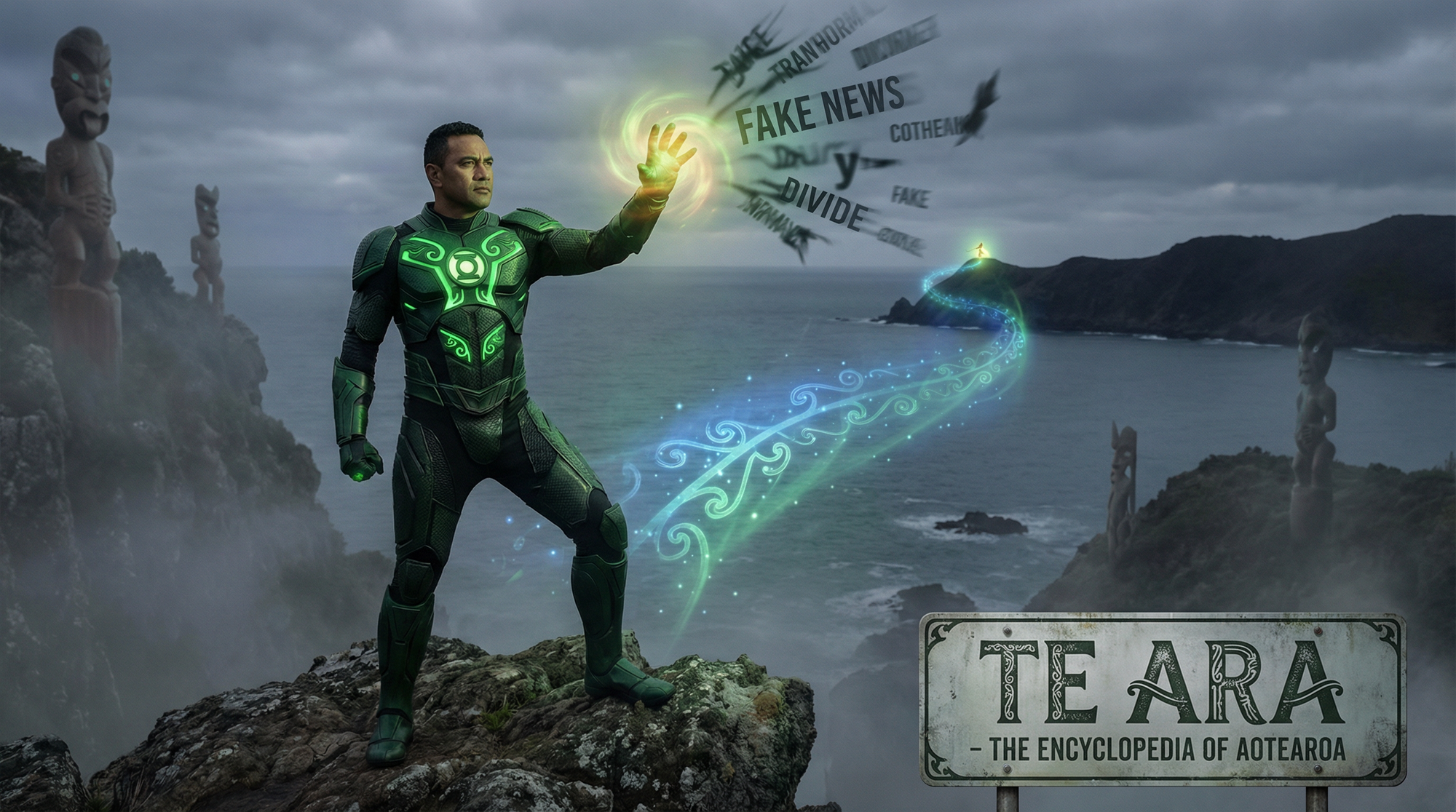
The Māori Green Lantern Fighting Misinformation And Disinformation From The Far Right
The RNZ article is not journalism—it is state propaganda using Māori voices to legitimate conservative colonialism. O’Regan, Morgan, Key, and McKinnon are not lying, but they are telling partial truths from positions of privilege that obscure systemic violence against ordinary Māori.
Tā Tipene O’Regan cried when the Ngāi Tahu settlement was confirmed—but Māori mothers cried when Richardson’s welfare cuts meant they could not feed their children. Tukoroirangi Morgan celebrates Bolger opening the “gateway of opportunity”—but that gateway led to economic security for iwi corporations while leaving most Māori locked out.
This is not about impugning the mana of O’Regan or Morgan—it is about understanding how class divides within Māoridom allow conservative Pākehā politicians to be rebranded as heroes. The Māori elite who benefited from Treaty settlements have structural interests in maintaining good relations with the Crown. Their praise for Bolger reflects those interests, not the experiences of urban Māori, non-affiliated Māori, or working-class Māori who saw none of the settlement money.
RNZ’s uncritical platforming of these voices, without balancing perspectives from Māori who suffered under Bolger’s welfare cuts or who critique the settlement process, is journalistic malpractice. It manufactures consent for the lie that conservative governments can deliver justice for Māori while pursuing neoliberal policies that immiserate us.
The current coalition government—led by Christopher Luxon with David Seymour and Winston Peters—is implementing the most aggressive rollback of Māori rights in decades: abolishing Te Aka Whai Ora, reversing smokefree legislation, attacking te reo, and supporting the Treaty Principles Bill. This did not come from nowhere—it came directly from the template Bolger created of settling historical claims while opposing contemporary rights.
Every tribute to Bolger that ignores Ruthanasia, the fiscal envelope, and his admission of neoliberal failure is complicit in enabling today’s attacks. When RNZ platforms Māori elites praising Bolger without critical context, it tells Luxon, Seymour, and Peters that they too can pursue anti-Māori policies as long as they maintain relationships with iwi leaders.
The Māori Green Lantern refuses this narrative. We honour the truth: Bolger was a conservative politician who pursued Treaty settlements because they served his government’s interests in maintaining social control, not because he believed in tino rangatiratanga. His legacy is a divided Māoridom where iwi elites prosper while most Māori suffer, and a political template that enables conservative governments to appear progressive on historical issues while enacting reactionary contemporary policies.
Kia kaha. Kia maia. Kia manawanui.
Ivor Jones
The Māori Green Lantern
If you find value in exposing how state media manufactures consent for colonialism and have capacity in these tough times, please consider a koha. HTDM: 03-1546-0415173-000. Only if you can—your commitment to truth matters more than money.
- https://www.tandfonline.com/doi/pdf/10.1080/17449057.2022.2096767?needAccess=true
- https://www.semanticscholar.org/paper/8abbc24fd036c2cf57e050eaf977fe23595a0cd5
- https://journals.lww.com/10.4103/0972-4923.132134
- /content/files/journals/index-php/phrj/article/download/254/238.pdf
- /content/files/anzsw/article/download/765/704.pdf
- https://www.mdpi.com/2071-1050/14/22/14672/pdf?version=1667900635
- https://www.mdpi.com/2313-5778/4/2/46/pdf
- https://www.rnz.co.nz/news/top/576041/towering-figure-tributes-paid-to-former-prime-minister-jim-bolger
- https://www.rnz.co.nz/news/te-manu-korihi/576077/jim-bolger-was-prepared-to-overrule-colleagues-on-ngai-tahu-treaty-settlement-ta-tipene-o-regan
- https://www.rnz.co.nz/news/political/576041/jim-bolger-the-great-helmsman-remembered-as-unpretentious-leader-of-conviction
- https://www.rnz.co.nz/news/on-the-inside/344941/ngai-tahu-success-a-lesson-for-iwi
- https://www.rnz.co.nz/news/political/576041/morning-report-live-towering-figure-tributes-paid-to-former-prime-minister-jim-bolger
- https://www.rnz.co.nz/news/on-the-inside/576091/how-jim-bolger-became-the-master-of-the-smoke-filled-room
- https://www.rnz.co.nz/news/political/576041/former-prime-minister-jim-bolger-the-great-helmsman-remembered-as-leader-of-conviction
- https://www.rnz.co.nz/news/te-manu-korihi/486699/the-crown-offers-this-apology-treaty-settlement-marked-after-30-years
- /content/files/oggcasts/the-detail.xml
- https://www.rnz.co.nz/news/alert-top/576104/humble-dedicated-passionate-mps-remember-jim-bolger-in-parliament
- https://teara.govt.nz/en/pacific-islands-and-new-zealand/print
- https://www.nzherald.co.nz/nz/ta-tipene-oregan-on-land-loss-survival-and-the-ngai-tahu-story/5I56CIKJVFAYZGCABL4CJAC6Z4/
- https://www.rnz.co.nz/national/programmes/morningreport/library?page=170
- https://www.rnz.co.nz/news/business/574442/stuff-staff-revolt-at-reduced-pay-offer-following-strike
- /content/files/oggcasts/morningreport.xml
- https://www.nzherald.co.nz/nz/politics/do-maori-have-rights-other-new-zealanders-dont-have-legal-experts-explain/HMZ3FIECYFDIXPWR2FQFORUTTA/
- https://www.rnz.co.nz/news/political/570550/secondary-teachers-strike-disappointing-coalition
- https://www.teaonews.co.nz/2025/10/16/jim-bolger-was-prepared-to-overrule-colleagues-on-ngai-tahu-treaty-settlement-ta-tipene-oregan/
- https://en.wikipedia.org/wiki/Don_McKinnon
- https://tetai.nz/en/waikato-tainui-raupatu-1
- http://www.thespinoff.co.nz/politics/16-10-2025/an-excellent-pm-and-an-even-better-person-memories-of-working-with-jim-bolger
- https://ngaitahu.iwi.nz/opportunities-and-resources/publications/te-karaka/reviews-tk87/
- https://uk.news.yahoo.com/former-zealand-prime-minister-jim-235606348.html
- https://en.wikipedia.org/wiki/Fourth_National_Government_of_New_Zealand
- /content/files/stout-centre/research-and-publications2/research-units/towru/publications/defenders-of-the-environment--third-party-interests-and-crown-ngai-tahu-treaty-settlement-negotiations-.pdf
- https://www.facebook.com/WaikatoTainu1/posts/the-unfortunate-thing-about-treaty-settlements-is-that-it-has-created-an-uneven-/1130733972533272/
- https://thespinoff.co.nz/the-bulletin/22-09-2025/wheres-the-rescue-plan-critics-attack-as-economy-contracts
- https://www.facebook.com/RadioNewZealand/posts/jim-bolger-often-stood-up-to-his-own-team-when-overseeing-the-fractious-process-/1271832494982696/
- https://www.nzherald.co.nz/kahu/tukoroirangi-morgan-we-will-not-allow-government-to-roll-maori-back-to-the-dark-ages/4PA56DURO5BZ3FTZFCOTNW4PEM/
- https://www.jstor.org/stable/2645307
- https://thespinoff.co.nz/politics/16-10-2025/an-excellent-pm-and-an-even-better-person-memories-of-working-with-jim-bolger
- /content/files/bitstream/handle/10179/11215/02_whole.pdf
- https://www.teaonews.co.nz/2025/10/16/mean-spirited-maori-lawyer-joins-calls-to-stop-marine-and-coastal-rights-law-changes/
- https://waikatotainui.com/news/watershed-moment-in-parliament-welcomed/
- https://journals.sagepub.com/doi/pdf/10.1177/0306396820923482
- https://www.mdpi.com/2313-5778/4/4/113/pdf
- https://www.mdpi.com/2313-5778/6/4/83/pdf?version=1665407928
- /content/files/article/download/120/120.pdf
- /content/files/article/download/3628/4018.pdf
- https://www.mdpi.com/2313-5778/6/1/10/pdf
- https://www.tandfonline.com/doi/pdf/10.1080/1177083X.2024.2333544?needAccess=true
- https://ojs.aut.ac.nz/rangahau-aranga/article/download/199/177
- /content/files/ajie/article/download/34/562.pdf
- https://www.tandfonline.com/doi/full/10.1080/00064246.2016.1223487
- https://www.tandfonline.com/doi/full/10.1080/07294360.2024.2307924
- /content/files/anzsw/article/download/702/680.pdf
- https://www.mdpi.com/2071-1050/14/18/11127/pdf?version=1663238130
- /content/files/ajie/article/download/322/570.pdf
- /content/files/podcasts/the-house.xml
- https://www.rnz.co.nz/news/political/576091/jim-bolger-remembered-the-master-of-the-smoke-filled-room
- https://www.facebook.com/NewPlymouthTaranakiNews/posts/born-to-irish-catholic-immigrants-in-the-taranaki-town-of-%C5%8Dpunake-in-1935-bolger/828805892859672/
- https://en.wikipedia.org/wiki/Jim_Bolger
- https://www.facebook.com/nzherald.co.nz/videos/nz-herald-live-mps-pay-tribute-to-jim-bolger/2015900652559601/
- https://thespinoff.co.nz/society/02-10-2025/help-me-hera-how-do-i-demote-my-best-friend-without-hurting-their-feelings
- https://teara.govt.nz/en/national-party/page-3
- https://www.facebook.com/MaoriMaps/posts/1236093395210005/
- https://nzhistory.govt.nz/keyword/jim-bolger
- https://www.meetingplace.nz/2020/07/i-am-irishman-irish-and-maori.html
- https://www.facebook.com/100064719999046/photos/1261380042695984/
- /content/files/bitstream/handle/10179/267/02_whole.pdf
- https://openaccess.wgtn.ac.nz/ndownloader/files/31466981
- https://www.nzherald.co.nz/nz/bolger-neoliberalism-has-failed-and-treaty-settlements-may-not-be-full-and-final/FFRHP7WFRNWJALCTDMMIXL4DGI/
- https://www.rnz.co.nz/news/political/562804/i-ve-had-a-wonderful-life-90-years-of-jim-bolger
- /content/files/__data/assets_file/0004/1741549/with-respect.pdf
- https://teara.govt.nz/en/irish
- https://thespinoff.co.nz/society/10-07-2025/help-me-hera-im-jealous-of-my-rich-friend