"Koha Ki Te Tūpuna, Tiaki Ki Te Taiao: The Luxon Government’s Assault on Climate Accountability and Treaty Obligations" - 8 November 2025
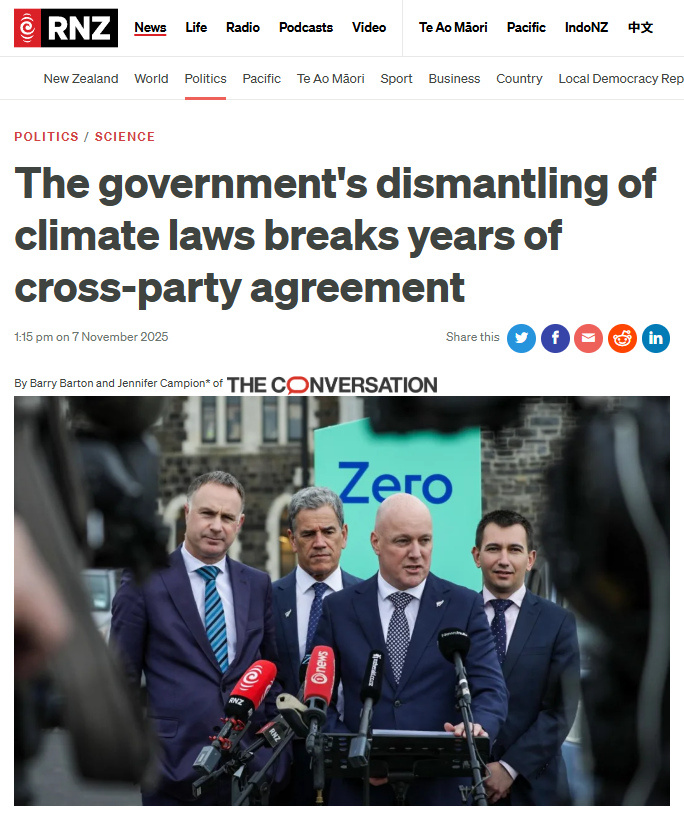
E ngā mana, e ngā reo, e ngā iwi o Aotearoa—tēnei te whakaatū o ngā āhuatanga i pōkaia i a tātau. Ko te taiao, ko te tikanga, ko te mana o ngā uri a ngā tūpuna, e whakaheke ana i a tātau e karanga mai. Kia kaha, e hoa.
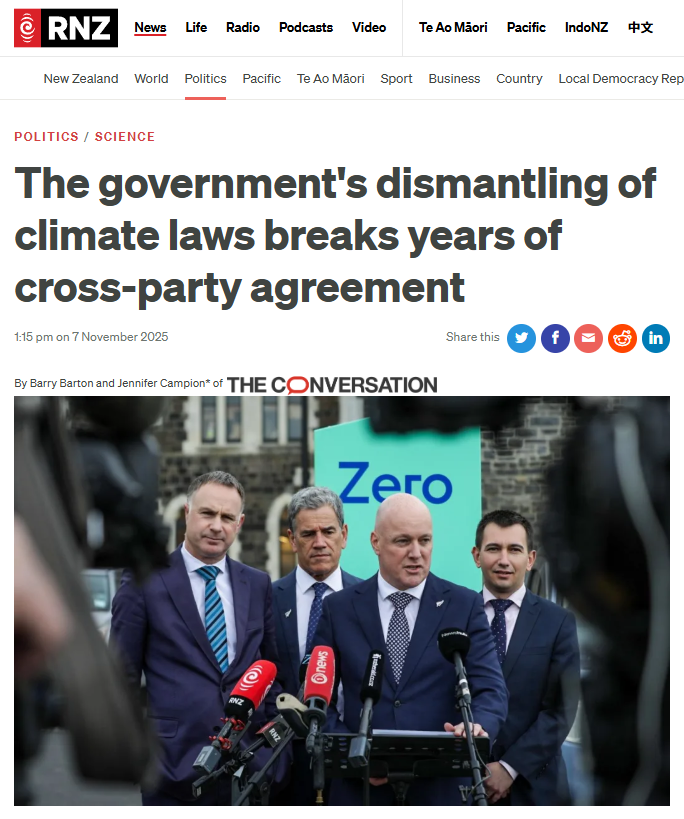
Smoking Gun: Democracy Dismantled Under Cover of Night
Listen closely, whānau. On November 4, 2025, while world leaders gathered across the moanā in Brazil for COP30,
Simon Watts—the Climate Change Minister—announced sweeping changes to New Zealand’s climate change laws at 8pm in the evening. No press conference. No warning. A late-night release designed to bury the most significant dismantling of our climate governance since the nation united around climate action six years prior.
The changes?
Translation: Strip away the independent voice. Eliminate your participation. Speed up pollution. This represents the most brazen betrayal of the Zero Carbon Act that passed with 119 of 120 MPs voting in favour in November 2019—when the entire nation agreed climate crisis demanded long-term commitment transcending electoral cycles.
Cui bono? This is where you follow the blood in the water.
The National Party received $10.4 million in total party donations in 2023
—more than seven times what Labour received.
The largest single donation came from Auckland businessman Warren Lewis: $500,000.
Billionaire Graeme Hart—worth over $17 billion—donated $700,000 to National, ACT and NZ First over two years, personally and through his company the Rank Group. In 2023 alone, National received $1.2 million in business donations, while ACT pocketed nearly $500,000 in business donations.
Now watch what those donations buy.
The Government set aside $200 million over four years for co-investment in new gas fields through Budget 2025, with the potential for the Crown to take a commercial stake of up to 10-15% in new gas field developments.
Your tax dollars. Your mana. Handed to oil companies to drill for fossil fuels while mokopuna choke on smoke and whānau drown in rising seas.
Meanwhile, companies like Rio Tinto (which owns the Tiwai point aluminium smelter), Methanex and NZ Steel (owned by Bluescope) receive millions of dollars’ worth of free carbon credits from the government each year—corporate welfare while you pay full price at the pump.
This is not accident. This is not incompetence. This is capture—and it is deliberate.
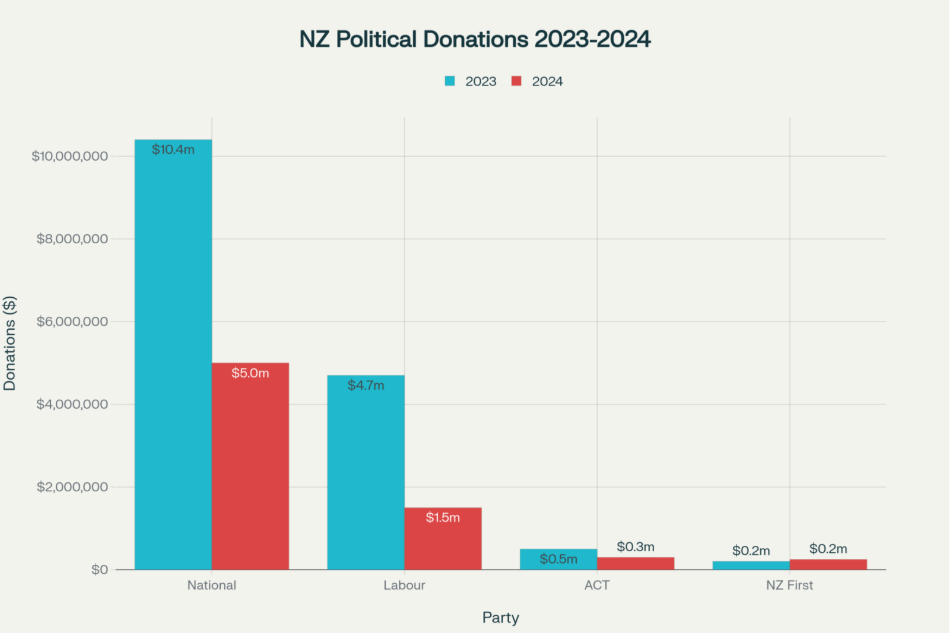
New Zealand political party donations 2023-2024, showing National Party received more than double Labour’s donations and over 20x ACT’s donations
Cui malo? Tangata whenua. That’s us. Our whenua. Our moana. Our taiao.
The Waitangi Tribunal is holding a “priority” kaupapa inquiry into government climate change policy, finding the Crown has not upheld its Treaty obligations in relation to the development of climate change policy. The Tribunal’s words cut like a pou tokomanawa:
And what does this Government do? Eliminate consultation altogether. Reject Māori partnership. Lock down decision-making behind Cabinet doors. This is not policy—this is epistemic violence. This is the Tohunga Suppression Act playing out in 2025.
Background: From Cross-Party Consensus to Coalition Carnage (2019-2025)
Let me take you back six years, e hoa. To a moment when Aotearoa stood together.
The Zero Carbon Bill passed with near-unanimous support on 7 November 2019, with 119 votes to one, with only ACT’s David Seymour absent for the vote. Every party—National, Labour, Greens, NZ First—every single one recognised that climate crisis transcends politics. The Act established net-zero long-lived greenhouse gases by 2050, supported by five-yearly emissions budgets, which show what has to be done in each period to stay on track for the target. This wasn’t Left or Right. This was our survival.
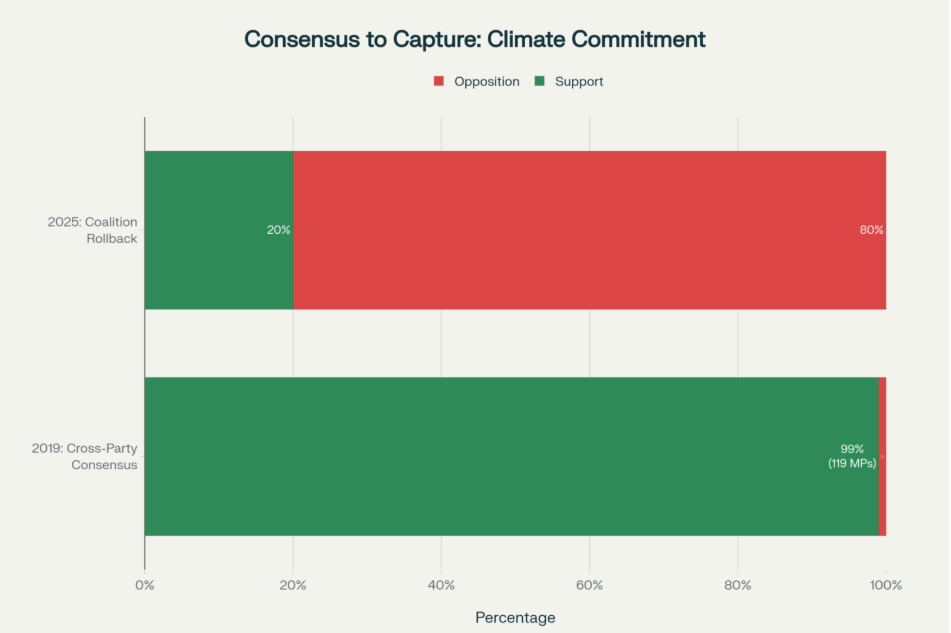
Comparison of 2019 Near-Unanimous Parliamentary Support for Zero Carbon Act versus 2025 Coalition Government Climate Policy Rollback
Listen to what the architects said about why this mattered.
The Act’s core elements are targets, budgets, plans and independent advice. The Climate Change Commission’s independence gave it a role different from that of the minister’s department—more able to take a long-term perspective and ensure that politically difficult aspects of climate policy are not downplayed. This was an attempt—imperfect but genuine—to break the cycle where politicians make grand promises about 2050 while doing nothing today. To create institutions that protect future generations from short-term greed.
But greed doesn’t care about institutions. Money doesn’t care about democracy.
The pattern repeats
with the Government amending the Climate Change Response Act to remove agriculture, animal processors and fertiliser companies from entering the ETS in 2025. Let that sink in. Fifty percent of our emissions come from agriculture. And none of it—none of it—will be priced. Not until 2030 at the earliest. By then, the damage is locked in.
Then came the international betrayal. New Zealand withdrew from the Beyond Oil and Gas Alliance (BOGA) in June 2025, a coalition working to end subsidies for oil and gas and ending public finance for fossil fuel development. We turned our backs on Pacific Island nations facing erasure from rising seas. We spat on our Treaty partners. We said: profit matters more than survival.
The Tribunal recognised the stakes. Claims include alleged breaches of Te Tiriti/the Treaty relating to a wide range of climate policy and decisions, including forestry, adaptation, and the ETS. The Crown is being called to account. But this Government doesn’t wait for the verdict—it doubles down on the crime.
Deconstructing the Dismantling Through Mātauranga Māori
The Coalition’s climate rollback is not a series of isolated policy changes. It’s a coordinated assault on every institutional safeguard designed to protect te taiao and enforce accountability. Watch closely, because this is how colonisation works in the 21st century.
1. Dismantling Independent Oversight—Silencing the Prophets
The Government proposes to remove the Climate Change Commission’s role in providing independent advice on emissions reduction plans. They’re not just changing a policy. They’re killing the messenger. The Commission was designed to tell hard truths that politicians don’t want to hear. And sure enough, the Climate Change Commission’s 2025 monitoring report warned the coalition’s plan won’t be enough, finding current policies are unlikely to deliver for the second and third emissions budgets covering the decade to 2035.
So what did the Government do? Remove its voice.
As the architects of the original Act warned: we should not stop the commission from giving advice on emissions reduction plans, and we do not want it to be reduced to being a mere technical system monitor. Nor should the plans be narrowed in scope, or made subject to the summary process of amendment the government intends, which avoids robust scrutiny.
They saw this coming. They warned us. And we’re watching it happen anyway.
2. Eliminating Democratic Participation—Shutting Down Your Voice
The Government proposes to allow more frequent revisions of these plans without public consultation.
No more submissions. No more public hearings. No more whānau gathering to say: this is our whenua, these are our children, you will not poison them without our voice.
Translation: Cabinet decides. You comply. Your mana is irrelevant.
This violates everything the Waitangi Tribunal asked for. They said consultation must be “thorough, widespread, and meaningful”. This Government chooses the opposite: secretive, narrow, and contemptuous.
3. Decoupling from International Commitments—Abandoning the Vulnerable
The Government proposed to decouple the ETS from international commitments.
While world leaders were supposed to gather in Brazil, Aotearoa was quietly dismantling its Paris Agreement commitments.
Think about what this means for our Pacific whānau. Tokelau, Tuvalu, Kiribati—these are our cousins. Their homelands are disappearing underwater. And what does Aotearoa do? Fund oil drilling. The Green Party released legal advice saying the coalition’s $200 million dollar investment fund for local gas exploration was a “clear breach” of an international trade agreement with Costa Rica, Iceland and Switzerland.
We are violating our own laws to fund the destruction of our relatives’ worlds.
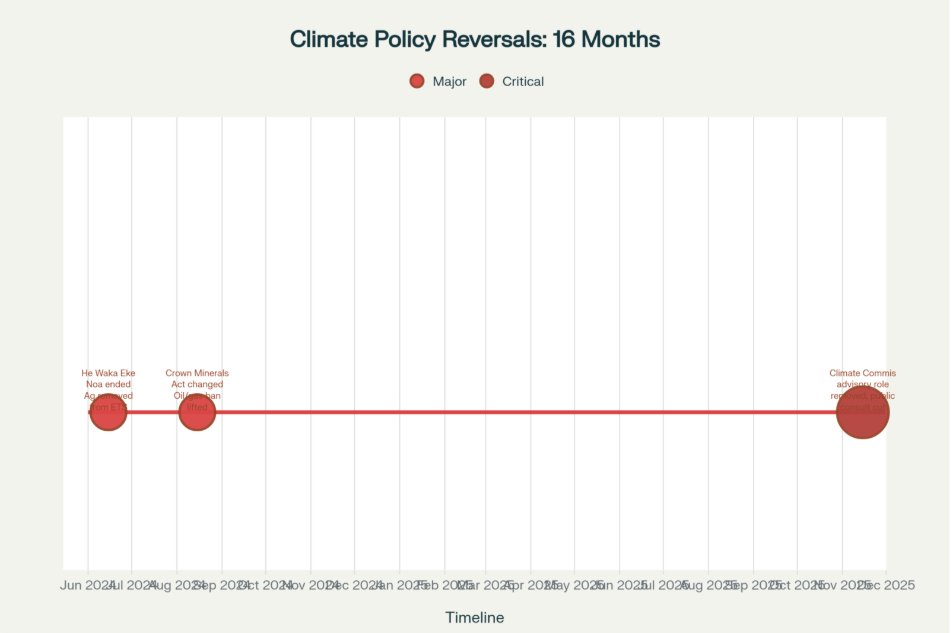
Timeline of Coalition government climate policy reversals from June 2024 to November 2025, showing acceleration of dismantling measures
4. Protecting Agricultural Polluters—The Sacred Cow Gets Protection
Agriculture was disestablished from the Climate Change initiative He Waka Eke Noa in June 2024, with the coalition replacing it with a Pastoral Sector Group. The Government will amend the Climate Change Response Act to remove agriculture, animal processors and fertiliser companies from entering the ETS in 2025.
Agriculture produces more than half of Aotearoa’s emissions. More than half. And it pays nothing—nothing—while you pay on every litre of petrol. While renters freeze in winter because they can’t afford heating. This is what “equality” looks like under neoliberalism: everyone pays the same price, except those who pollute the most.
Fonterra. Beef + Lamb NZ. Federated Farmers. These industry groups spent years lobbying against pricing. And the Coalition rewarded them by exempting their sector entirely. This is not agricultural support—this is organised theft from the future.
5. Fossil Fuel Subsidies and Expansion—Betting on Apocalypse
The Government set aside a tagged contingency of $200 million over 4 years for co-investment in new gas fields through Budget 2025. Your tax dollars. The Crown Minerals Amendment Bill passed its third and final reading, reversing the 2018 ban on offshore oil and gas exploration. The initial allocation of $293 million for fossil fuel exploration was increased to $443 million, according to RNZ and Newsroom reporting in 2024.
Let me be clear: the Government is betting on apocalypse. It’s investing in a future where carbon prices stay low, where fossil fuels remain cheap, where the climate crisis doesn’t arrive for just a few more years—long enough for politicians to retire and cash their corporate consulting contracts. When the reckoning comes, they’ll be gone. We’ll be here, with the bill.
Analysis: Networks of Power, Patterns of Dispossession
Te Kauwae Runga: The Unseen Architecture
Follow the money. It tells you everything.
The sources show that political donations are now flowing overwhelmingly to National, ACT and NZ First, with all donors sticking to parties on a single side of the political spectrum. This is not organic. This is deliberate. Business has chosen its team. And that team delivers.
Te Kauwae Raro: The Tangible Networks
Listen to what the numbers tell us.
The National Party has received $10.4 million in donations in 2023, more than double the amount declared by Labour, with $1.2 million from business. In 2024, the National Party received nearly $5 million in party donations, more than triple the amount the Labour Party received.
Translate that: Seven to ten times more money equals seven to ten times more policy access. This is not equal representation. This is plutocracy dressed up as democracy.
Simon Watts is the National MP for North Shore and David Seymour of ACT intended to vote against the Zero Carbon Bill and had the support record of opposing it. These aren’t politicians who changed their minds after seeing evidence. These are ideologues who’ve waited years for power to dismantle what they opposed. ACT’s demands in the coalition agreement included reviewing methane science—code for weakening climate targets to benefit the dairy industry.
And who are they listening to?
The Climate Change Commission’s 2025 monitoring report is now warning the coalition’s plan won’t be enough, with the commission finding current policies are unlikely to deliver the second and third emissions budgets. The experts are screaming. The Commission is warning. And the Government is... removing the Commission’s voice from policy-making.
This is not incompetence. This is organised abandonment.
Implications: Quantified Harm, The Bill is Coming
Agricultural emissions: Agriculture represents a large portion of New Zealand’s emissions through methane from enteric fermentation and nitrous oxide from agricultural soils. By exempting this sector from the ETS indefinitely, the Government locks in decades of unpriced emissions from Aotearoa’s largest single source. That’s millions of tonnes of greenhouse gases annually—no price, no accountability, no change. Whānau will pay. Mokopuna will pay. The planet will pay.
ETS concerns: The Climate Change Commission pointed to serious problems with the subsidy scheme of free carbon credits, after MPs asked it to comment on a petition. These free allocations to major polluters—Rio Tinto, Methanex, NZ Steel—represent a form of corporate welfare that undermines the price signal necessary for emissions reductions. Ordinary people pay. Polluters profit.
Treaty implications: The Waitangi Tribunal is considering whether the Crown has upheld its Treaty obligations in relation to climate change policy development, noting that climate change is an existential threat and Māori have a unique and significant relationship with te taiao. By eliminating consultation, the Coalition defies the Tribunal before the inquiry even concludes. This is contempt for the Crown’s legal obligations and contempt for Māori rangatiratanga.
Democratic concerns: The changes to allow revisions without consultation and remove the Commission’s advisory role represent a departure from the cross-party consensus established in 2019. When every political party once agreed on climate action, but now one coalition dismantles it unilaterally, democracy itself becomes weaponised against the future.
The Line in the Sand
Whānau, listen to me carefully.
The Coalition Government’s November 2025 announcement represents a fundamental break from the cross-party consensus that enabled the Zero Carbon Bill to pass with 119 of 120 MPs in 2019.
—are not tweaks. They are a complete inversion of democratic climate governance.
These actions occur within the context of the Waitangi Tribunal’s priority inquiry into climate change policy and alleged Crown Treaty breaches, and the Government’s decision to withdraw from the Beyond Oil and Gas Alliance while committing $200 million to fossil fuel exploration. The financial flows documented in donation records, the policy timelines, and the institutional dismantling all point to a coordinated shift away from climate accountability toward short-term political and financial interests.
The Tribunal will assess whether these actions constitute Crown Treaty breaches. A determination that carries legal weight. But we don’t need to wait for institutions to validate what we already know in our bones, in our roro, in our ngākau:
This is wrong. This is violence. This is theft.
The theft of our mokopuna’s futures. The theft of Pacific peoples’ homelands. The theft of tangata whenua’s rangatiratanga. The theft of democracy itself—replaced by rule by donation, by corporate design.
But hear this, e hoa:
We still have power.
The Waitangi Tribunal listens. The courts stand open. The whānau organises. Tūpuna’s mana still flows through our veins. Te taiao still calls to us. And we answer.
Kia kaha. Kia maia. Kia manawanui.
Nō Māori tēnei kaupapa. He koha tēnei ki te whānau. E kore e mate he kaupapa, nō te mate tangata.

Ivor Jones The Māori Green Lantern
All statements and figures in this analysis are sourced from publicly available government announcements, official Electoral Commission records, news media reporting, and government budget documents.