“Luxon, Trump, and the Hollowing-Out of “Independent” Foreign Policy” - 20 January 2026
Kia ora whānau,
The Māori Green Lantern hopes that you are well today, and I thank you for seeing value in these analyses, and for making the concious decision to learn what the fuck is going on here in Aotearoa, with our despicable politicians that are currently leading our country into oblivion.
Know that you and I can stop them, and we will do that this coming election.
That knowledge is all we need.
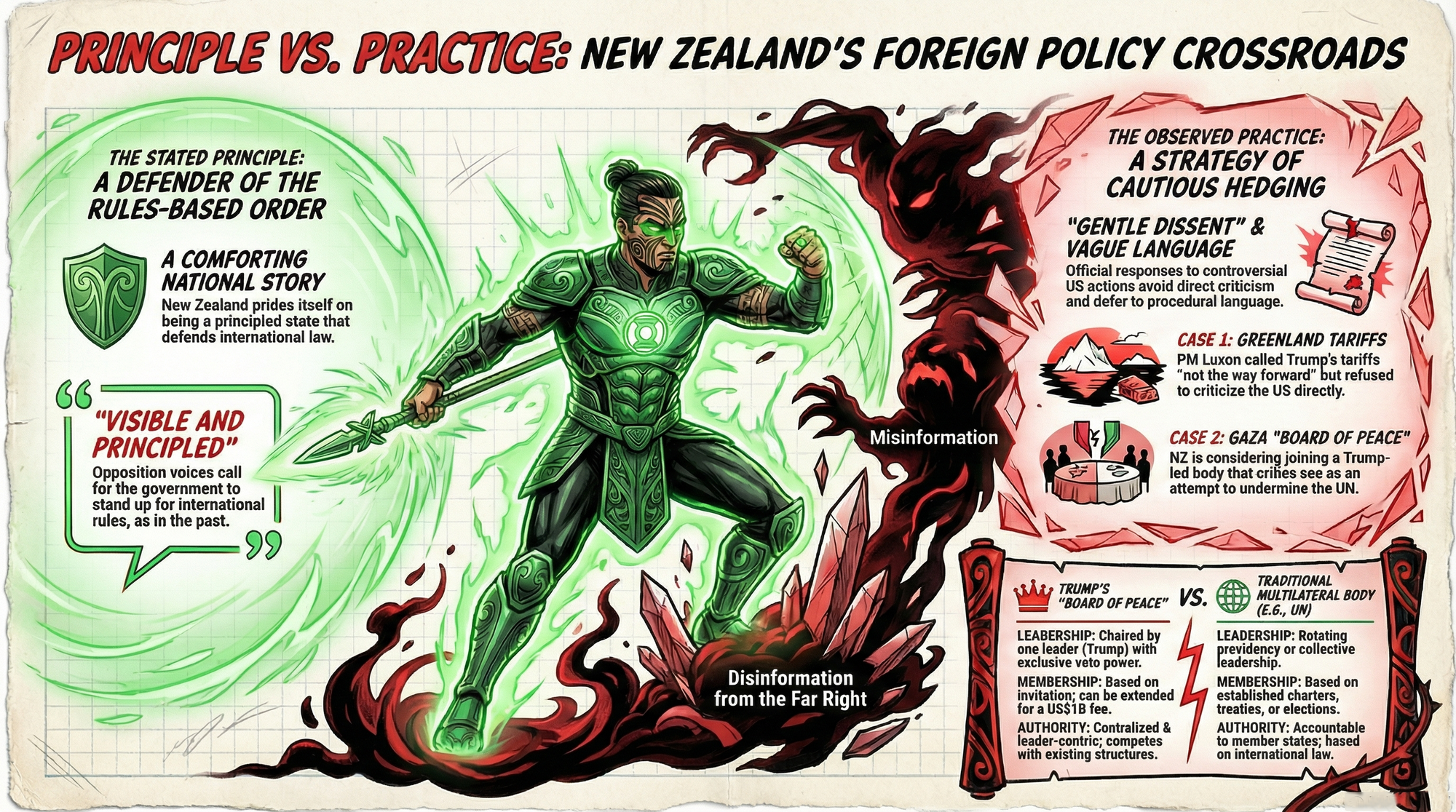
New Zealand likes to tell itself a comforting story:
a small, principled state, punching above its weight by defending international law and the rules-based order.
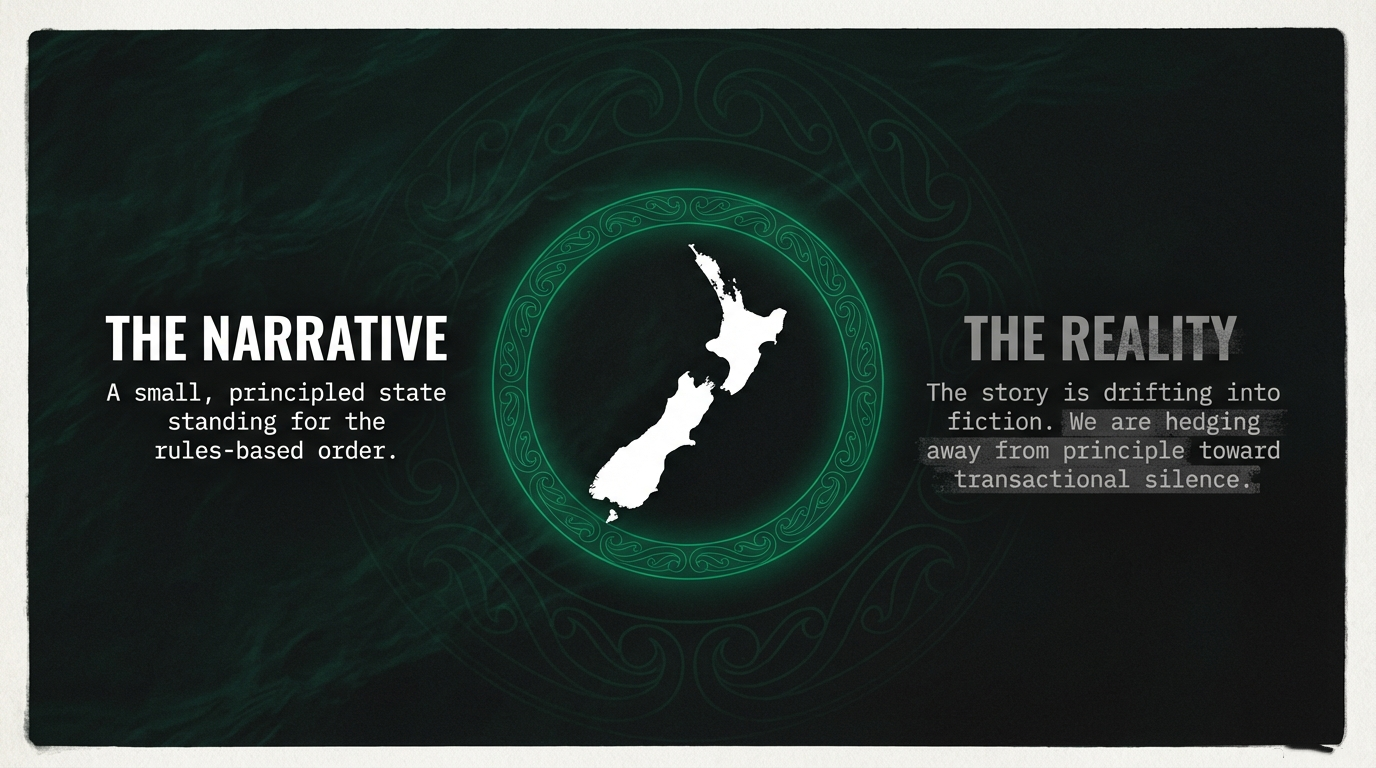
That narrative is increasingly at odds with reality. Nowhere is this clearer than in the juxtaposition of two recent developments:
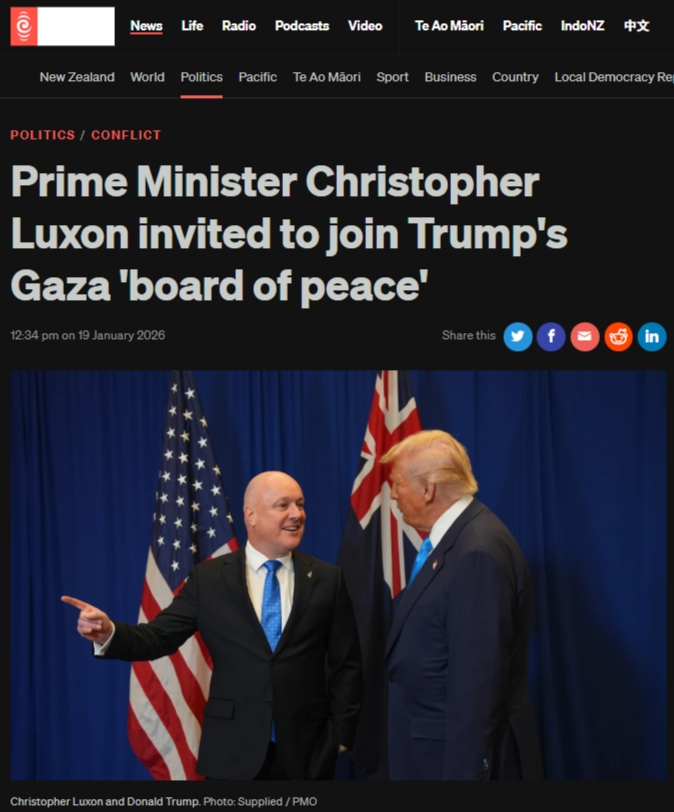
Christopher Luxon’s carefully sanded-down objections to Donald Trump’s Greenland tariff crusade, and the New Zealand Prime Minister’s invitation to join Trump’s grandiose Gaza “Board of Peace”.
Taken together—and reported with a remarkable lack of critical curiosity
—these episodes reveal a government that is hedging away from principle, and a media culture that too often describes power rather than interrogating it.
Koha / Supporting This Mahi
Every koha for this kaupapa is more than a tip for an essay. It is a signal that whānau are prepared to fund the hard questions that state media and corporate newsrooms too often step around. When a Prime Minister can be invited onto Trump’s billion‑dollar “Board of Peace” while our public broadcaster barely scratches the surface, it is clear that genuine accountability will not be underwritten by Wellington or Washington.
In that gap, rangatiratanga means backing our own truth‑tellers: people willing to trace the lines between Gaza and Greenland, between tariffs and tino rangatiratanga, between the stories New Zealand tells about itself and what our leaders are actually doing on the world stage. Every koha says that these lines matter—that we refuse to outsource our understanding of foreign policy, media, and power to those most invested in smoothing the edges.
Kia kaha, whānau. Stay vigilant. Stay connected. And if you are able, consider a koha to ensure that this kind of independent, unapologetically critical analysis continues.
Three pathways exist:
- Koha platform (direct support for this mahi)
To support this work directly with a koha (voluntary contribution), please visit:
Koha — Support “The Māori Green Lantern: Fighting Misinformation and Disinformation” - Substack subscription (ongoing support + essays direct to you)
To receive essays like this directly in your inbox and support through subscription, join the Substack community:
Subscribe to the Māori Green Lantern on Substack - Direct bank transfer (for those who prefer straight koha)
For a direct koha via bank transfer, the account details are:
HTDM
Account number: 03-1546-0415173-000
Trump’s Board of Peace: Legitimacy on Sale
Trump’s Gaza “Board of Peace” is not a neutral technocratic panel. Its design makes that plain.
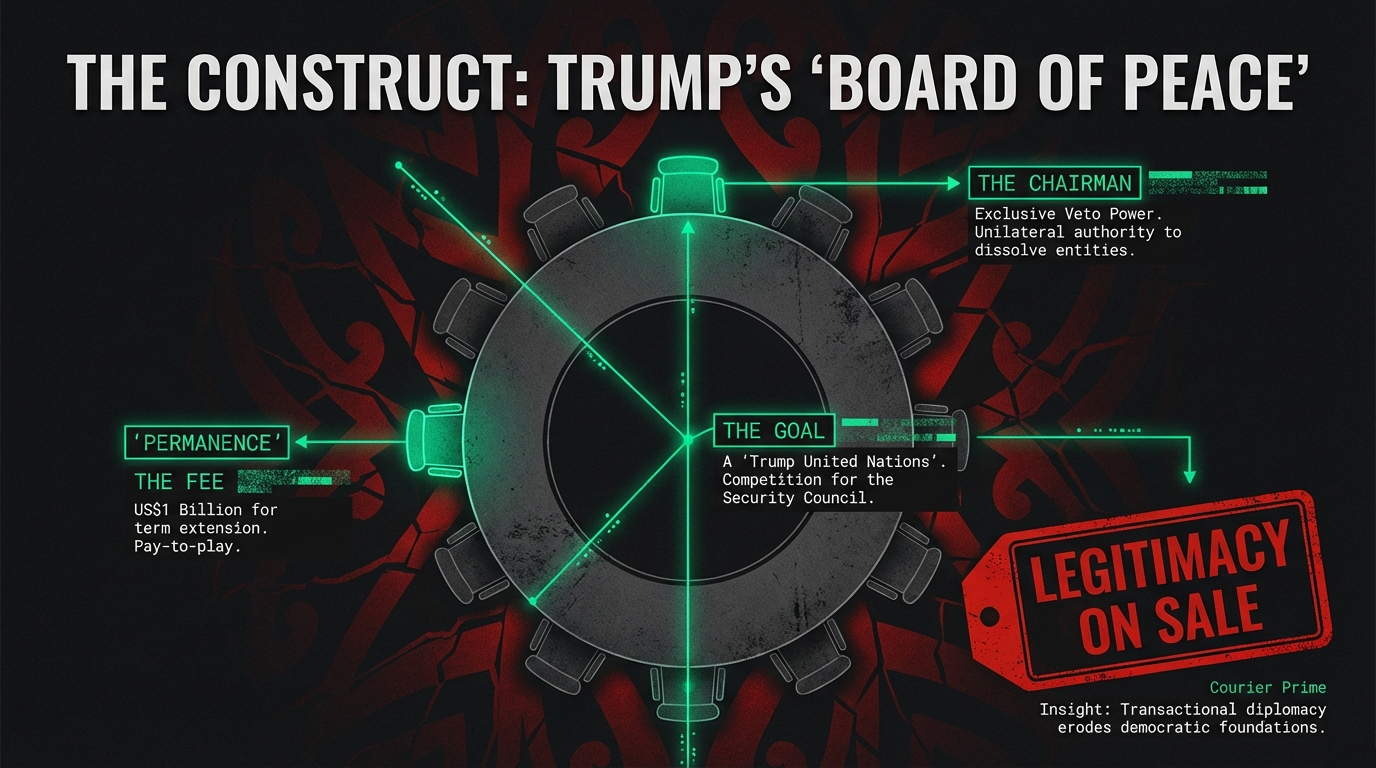
The leaked charter sets Trump as Chairman with exclusive veto power over all Board decisions, as well as unilateral authority to create, modify, or dissolve any subsidiary entities, as reported by the Times of Israel. Membership is formally for a three-year term, but that term limit can be erased with a US$1 billion contribution, as The Hill confirmed, effectively turning “peace governance” into a buy-in club for states with the means and the will to pay.
Reporting from multiple outlets indicates the Board’s mandate is not intended to be narrowly Gaza-specific. Rather, as Al Jazeera documented, it is framed as the embryo of a broader governance mechanism, sitting alongside—or, more accurately, in competition with—established multilateral structures such as the UN Security Council. European diplomats have expressed concern that this looks like an attempt to construct a “Trump United Nations”, with weaker safeguards, stronger executive control, and a far more transactional logic of participation.
Israel itself has voiced unease about aspects of the lineup and the governance model, as the BBC reported, even as it has welcomed elements of Trump’s Gaza plan. That should be warning enough: if the very state supposedly “protected” by the arrangement is wary of who will sit at the table and on what terms, other invitees ought to be even more cautious.
Yet invitations have been sprayed broadly:
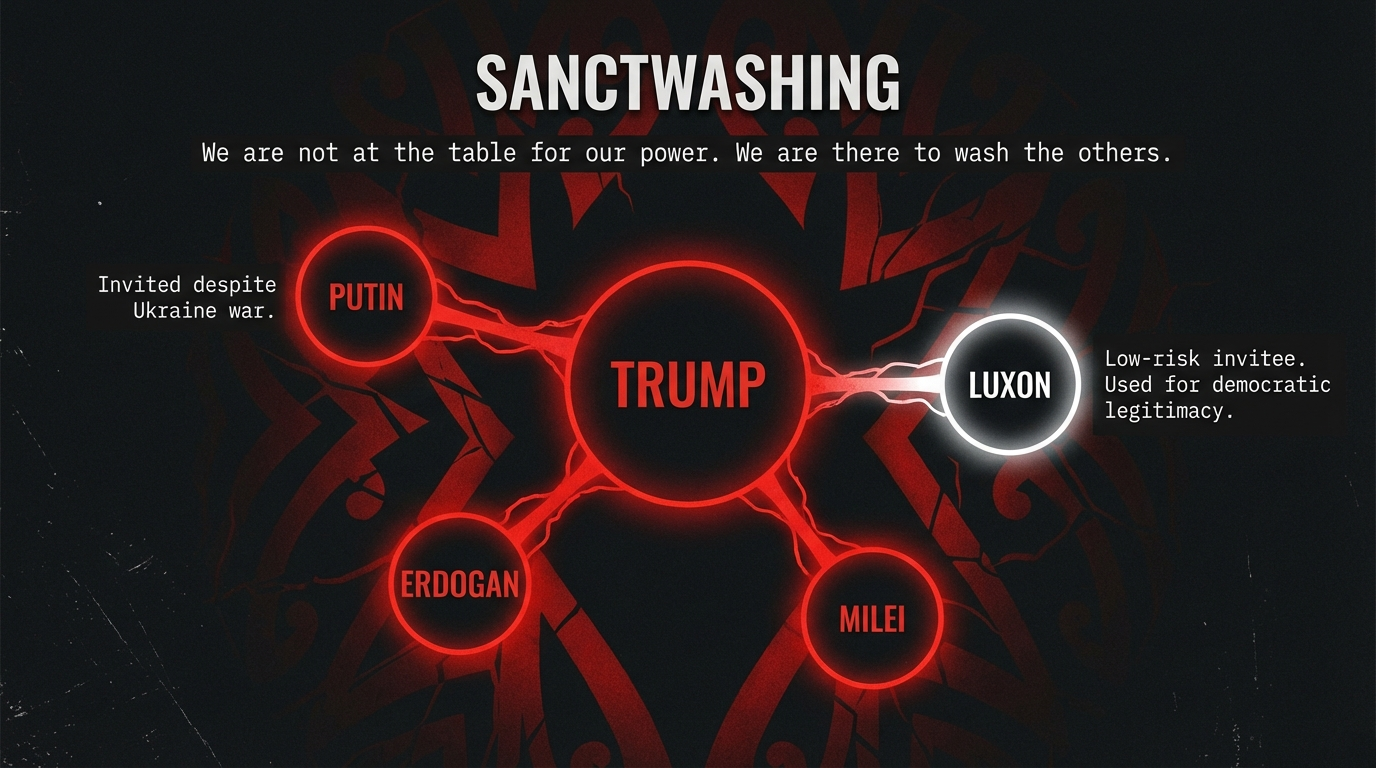
to European Union leaders, to regional heavyweights such as Turkey and Egypt, to Russia’s Vladimir Putin despite the ongoing war in Ukraine, and to a long list of states whose primary value is their ability to confer international legitimacy on Trump’s project. CNN confirmed Putin’s Kremlin acknowledged receiving the invitation and was “seeking clarification” of its terms.
This is not a peace initiative in any traditional sense. It is a stage on which Trump intends to stand flanked by a curated cast of world leaders, using their presence to validate a governance structure narrower, more centralised, and more easily bent to his will than the one it seeks to overshadow.
Who Gets a Seat? Not Just Loyalists
A certain mythology persists:
that anyone who criticises Trump is instantly frozen out of his orbit. The actual pattern in foreign policy is more cynical—and more flexible.
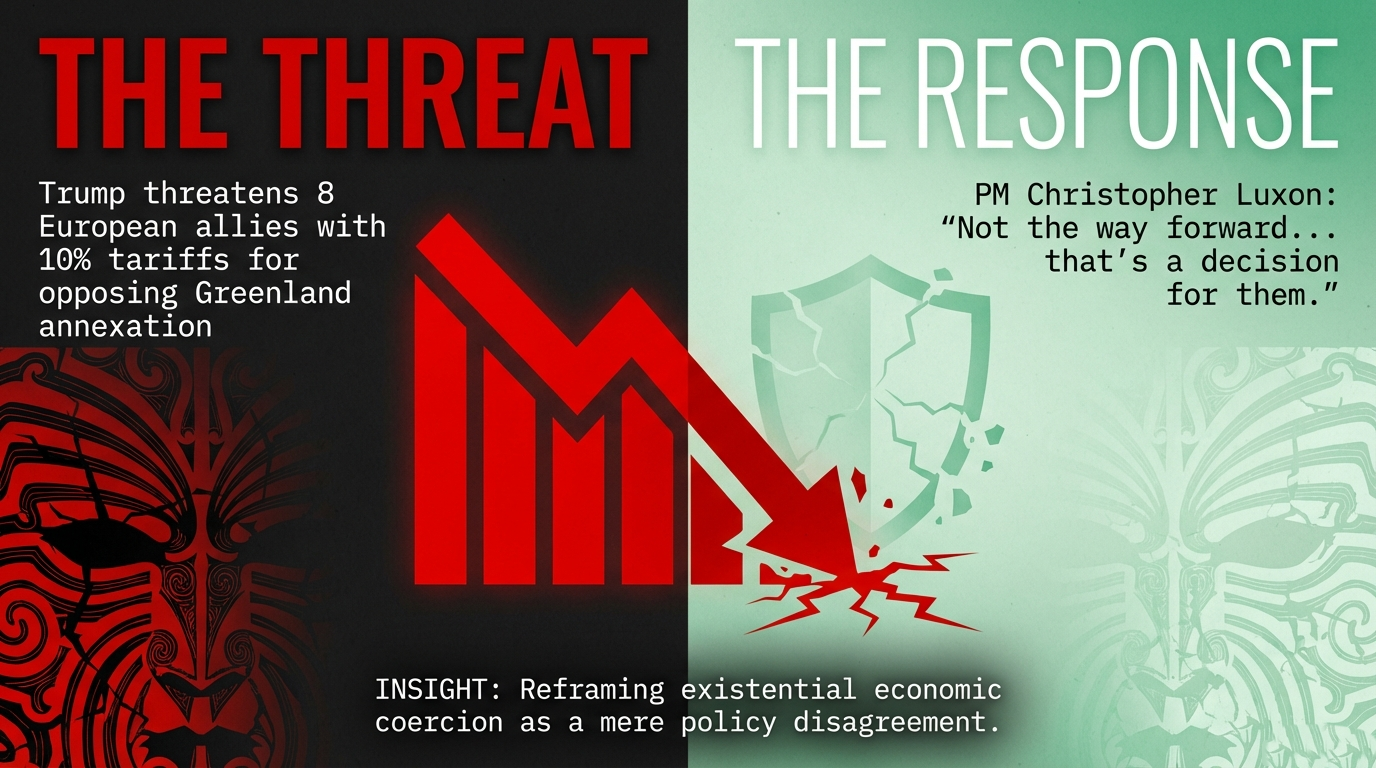
European leaders have been scathing about Trump’s efforts to coerce them over Greenland. His threats of escalating tariffs on eight European allies for resisting his plans to buy or annex Greenland have drawn language such as “unacceptable”, “wrong”, and “dangerous”. EU officials warned of a “dangerous downward spiral” in trade relations. Europe’s response, according to Al Jazeera, included warnings that the tariffs “undermine transatlantic relations”. Yet invitations to the Board of Peace have still found their way to the desks of those same capitals, with Euronews confirming that EU leadership received approaches.
Russia’s Putin, hardly a partner in any conventional Western peace process and in the middle of a grinding war, has likewise been courted. Al Jazeera reported that Trump extended the invitation even as the Ukraine war continues.
The message is unmistakable. Trump’s foreign-policy machine distinguishes sharply between domestic enemies, who are often subject to overt punishment, and foreign leaders, whose criticism is tolerated so long as they remain willing to stand in his frame when he needs them. Reuters documented Trump’s campaign of retribution against at least 470 domestic targets, while Politico analysed how longtime US allies have had to devise strategies to fight back against Trump’s trade threats while maintaining diplomatic engagement.
For foreign leaders, criticism is not necessarily disqualifying. It is simply one more input in the grand bargain: they say what they must to placate home audiences; he does what he must to preserve the appearance of global relevance.
New Zealand now sits inside that calculus.
Luxon’s Gentle Dissent
Within this wider pattern, Christopher Luxon’s interventions on Trump’s Greenland tariffs are notable less for their content than for their caution.
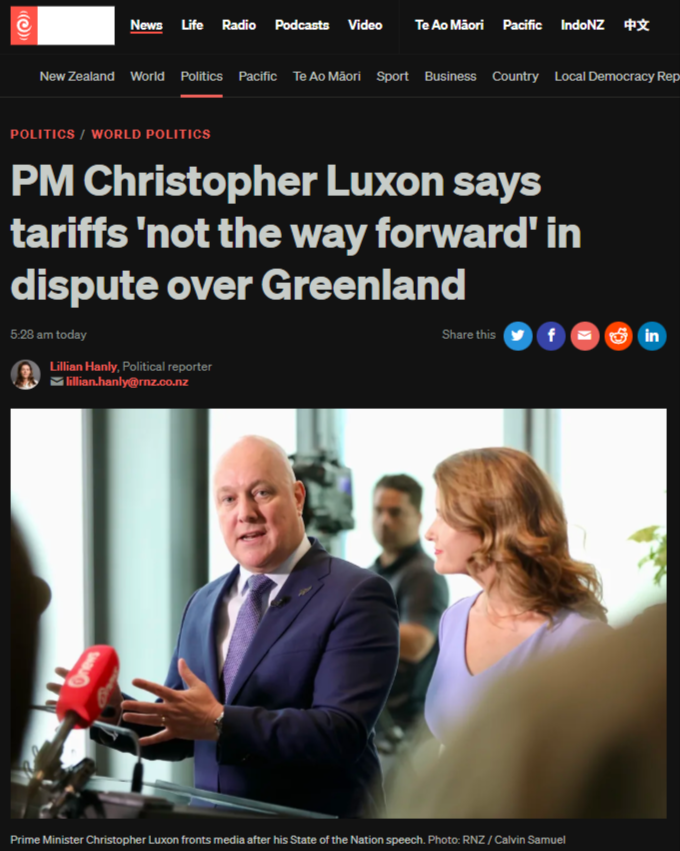
As RNZ reported, he says tariffs are “not the way forward” and warns against a spiral of tit-for-tat protectionism, describing such a path as “just not acceptable”. He speaks of preferring a “healthy trans-Atlantic relationship” built on “discussion, debate and dialogue”. The target here is not Trump the man, nor even the United States as an actor; it is tariffs in the abstract, a generic policy tool gone astray.
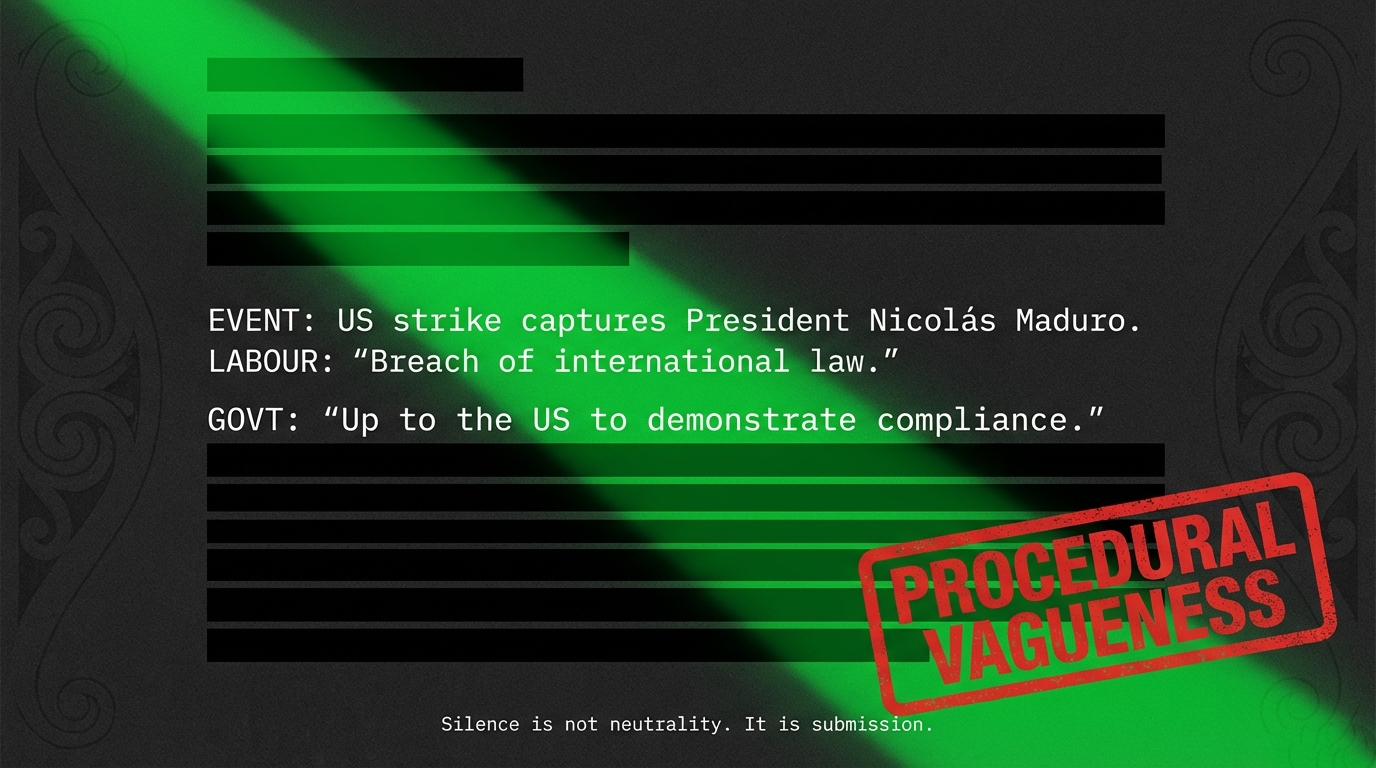
When asked whether European retaliatory tariffs would be appropriate, RNZ noted he retreats to the safest possible vantage:
that it is “a decision for them”. This is diplomatic hedging in distilled form—recognising a problem without picking a side in the fight that actually matters.
On Venezuela, the pattern is similar. Luxon describes events there as “incredibly concerning”, especially when a government uses its own armed forces against its citizens, calling that “utterly unacceptable”.
But when addressing the legality of a US strike that results in the capture of Nicolás Maduro, according to RNZ he defaults to procedural vagueness:
New Zealand “expects every country to be compliant with international law”, but it is up to the US to demonstrate that it has complied. RNZ’s earlier reporting showed Foreign Minister Winston Peters issued a similarly measured statement expressing “concern” but avoiding any direct accusation of illegality.
Contrast that with opposition and expert voices. Labour has labelled the US action in Venezuela a “breach of international law” and argued that silence from Wellington represents an abandonment of New Zealand’s previously principled stance. Professor Robert Patman told RNZ it was “time that we made our voice clear” on Trump’s actions. Professor Alexander Gillespie wrote for the University of Waikato that New Zealand has been “largely mute” as Trump dismantles pillars of the rules-based order, and that “quietly sitting down will not be an option forever”.
Against this backdrop, Luxon’s words read not as robust defence of principle but as the minimum viable scepticism that still preserves his relationship with Washington—and, more specifically, with Trump, whom the NZ Herald reported he has publicly described as trustworthy and leading a “reliable” United States.
Why the Invitation Still Came
In that light, the Board of Peace invitation is not mysterious. On the contrary, Luxon embodies exactly the type of leader such a body is designed to attract:
- Symbolically independent, substantively cautious: New Zealand trades heavily on its reputation for principled independence, but under current leadership that independence is expressed through gentle, carefully limited dissent rather than sustained, coordinated challenge.
- Regionally useful: A small Pacific democracy carries outsized symbolic weight in multilateral rooms. Having New Zealand at the table allows Trump to point to support beyond the usual geopolitical suspects. RNZ reported that Luxon was invited alongside leaders from Canada, Turkey, and Argentina, creating the appearance of broad international backing.
- Unlikely to trigger real costs: Luxon’s track record suggests he will avoid direct confrontation even when principle is at stake. When Luxon and Trump met for the first time in October 2025, RNZ reported Trump said “I like your man from New Zealand”, and the conversation covered golf and Lydia Ko rather than substantive policy confrontations. That makes him a low-risk invitee: unlikely to walk out dramatically, more likely to remain in the tent offering process-friendly language while major decisions are shaped elsewhere.
The timing only reinforces this reading. Board invitations were moving even as Europe’s anger over Greenland tariffs was peaking.
The logic is transparent:
Trump is building a board not of loyal acolytes, but of leaders willing to lend him their flags without demanding too much in return.
Media Without Teeth
The most disturbing element of this story is not simply the behaviour of powerful men;
it is the way those choices are packaged and presented to the public.
Coverage of New Zealand’s response to Trump’s tariff threats has largely confined itself to repeating Luxon’s carefully chosen words and briefly citing domestic opposition, without drawing connections to the broader strategic stakes:
the erosion of the rules-based order, the risks of normalising economic coercion by great powers, and the long-term costs of cautious silence.
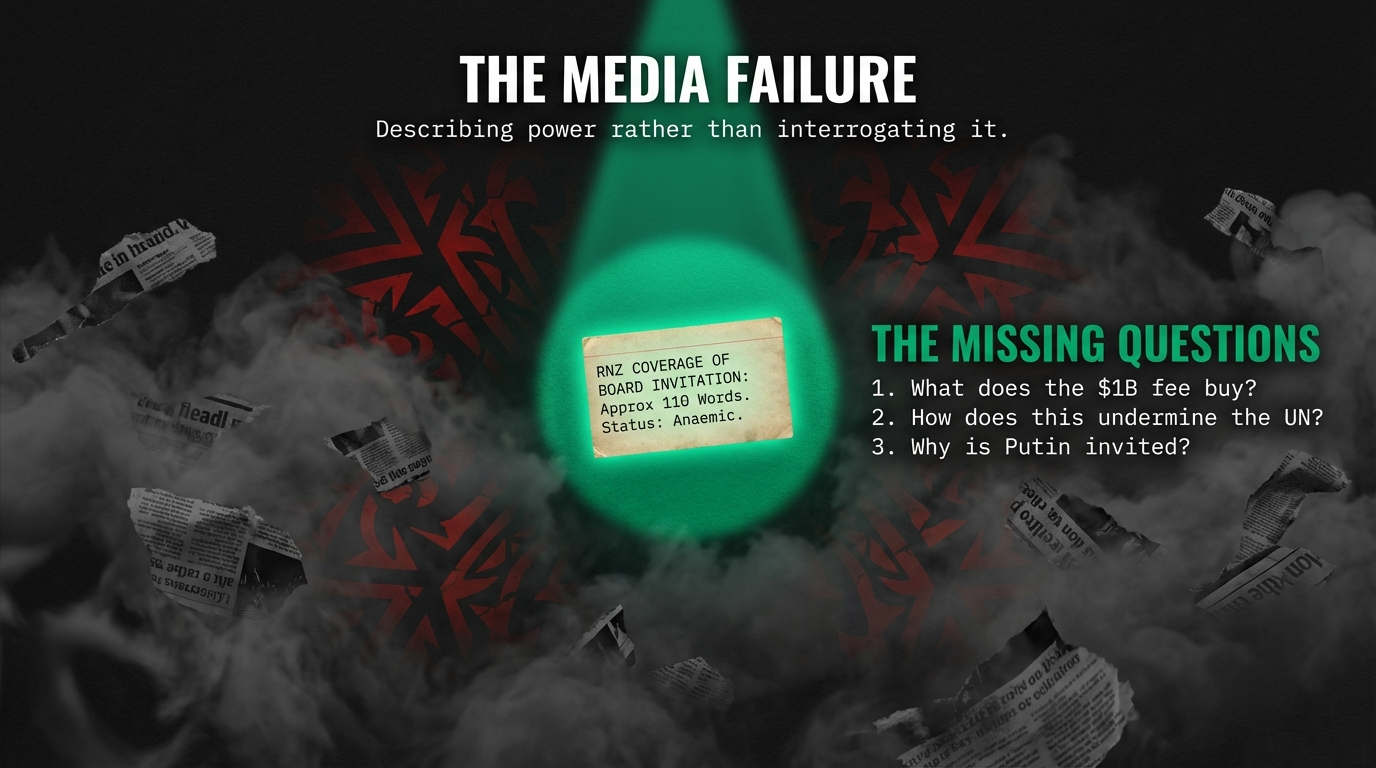
Reporting on the Gaza Board of Peace invitation has been even more anaemic. The RNZ piece on Luxon’s invitation runs barely 110 words. The structural features of the Board—the Chairman’s veto, the billion-dollar permanence fee, the apparent ambition to function as an alternative locus of authority for conflict governance—are barely touched, if at all. Instead, the invitation is often treated as a curious diplomatic footnote, another item on the Prime Minister’s overflowing foreign-policy in-tray.
This is an abdication of journalistic responsibility. At a moment when democratic publics desperately need sharp, independent analysis of how their governments are repositioning themselves in a harsher world, far too much coverage settles for a thin chronicle of who said what, when.
The hard questions—What does this mean for international law? For Gaza’s future? For the authority of the UN? For New Zealand’s reputation as a defender of multilateralism?—remain largely unasked.
That failure matters. Without context, a Board of Peace sounds benign;
without scrutiny, a billion-dollar price tag for permanent membership sounds like an arcane funding detail rather than a signal that peace itself is being auctioned. Without joining the dots between Luxon’s language, expert warnings, and Trump’s institutional experiments, citizens are left to guess at how much of the old “independent foreign policy” story still holds.
The Spinoff asked pointedly what it means for New Zealand if the rules-based system is truly crumbling—a question that mainstream political reporting has largely avoided.
The Real Stakes
The substance of the current moment is not a personality clash between Trump and various allies, nor a minor diplomatic dilemma for Luxon over whether to say yes to a prestigious-sounding invitation.
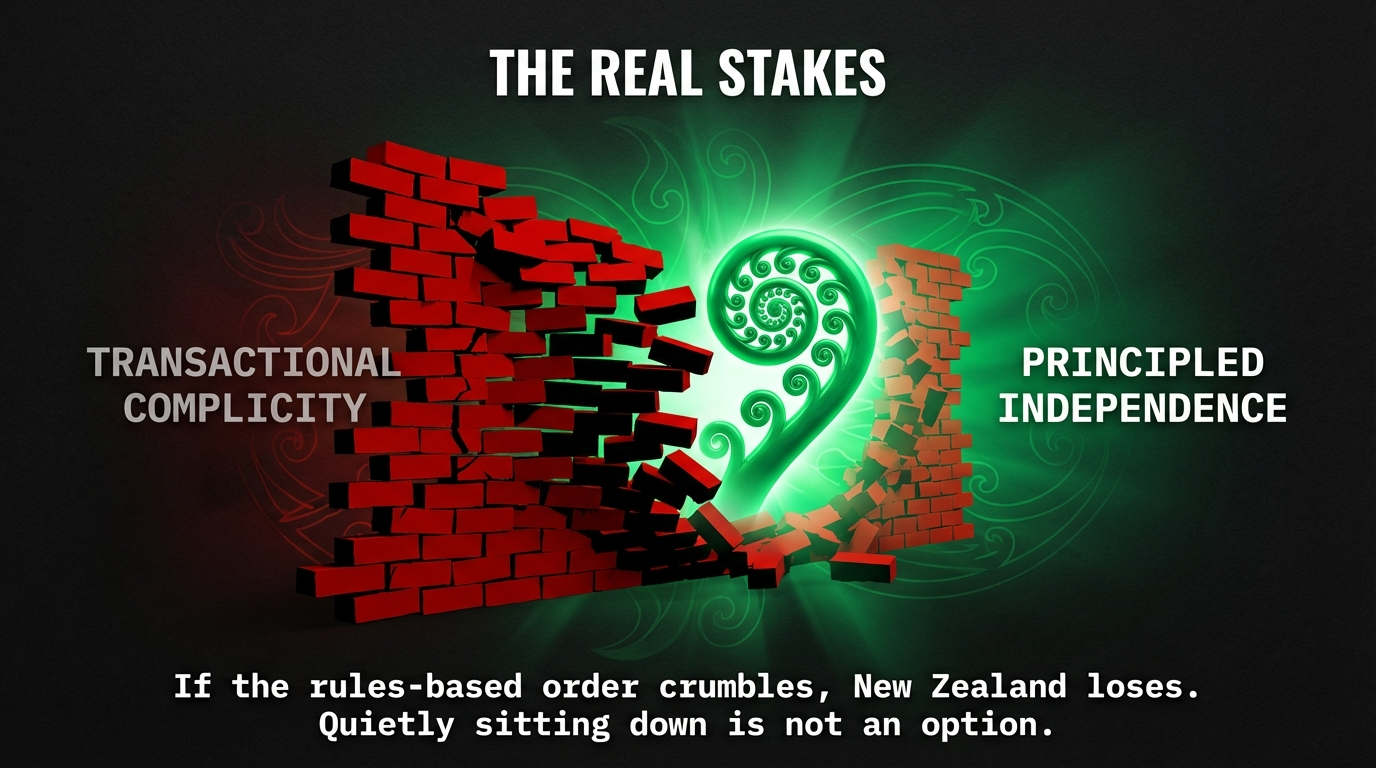
The real stakes are these:
- Whether small and medium-sized democracies like New Zealand are prepared to defend the international legal norms they depend on, even when the violator is an ally. As Point of Order observed, the Board invitation comes at a moment when New Zealand faces increasing pressure to choose between principle and access.
- Whether new, leader-centric institutions like the Board of Peace will be allowed to siphon authority and legitimacy away from more accountable, if imperfect, multilateral forums. Reuters reported world leaders showing caution precisely because of fears the Board threatens existing UN mechanisms.
- Whether public broadcasters and major media will rise to the challenge of explaining these dynamics with the clarity and urgency they demand—or continue treating them as just another round of talking points to transcribe.
For now, the pattern is bleak. Luxon’s government offers words about international law while consistently avoiding firm stands where they might entail friction with Washington. Trump constructs ever more personalised instruments of global influence. And large parts of the media, instead of pulling the alarm, reach for the notepad.
The resulting dissonance is not a minor inconsistency. It is a warning sign that the distance between what New Zealand claims to be in the world and what it is actually becoming is widening—and that too many institutions entrusted with telling the public the truth about that shift are choosing to look away.

Ivor Jones The Māori Green Lantern Fighting Misinformation And Disinformation From The Far Right