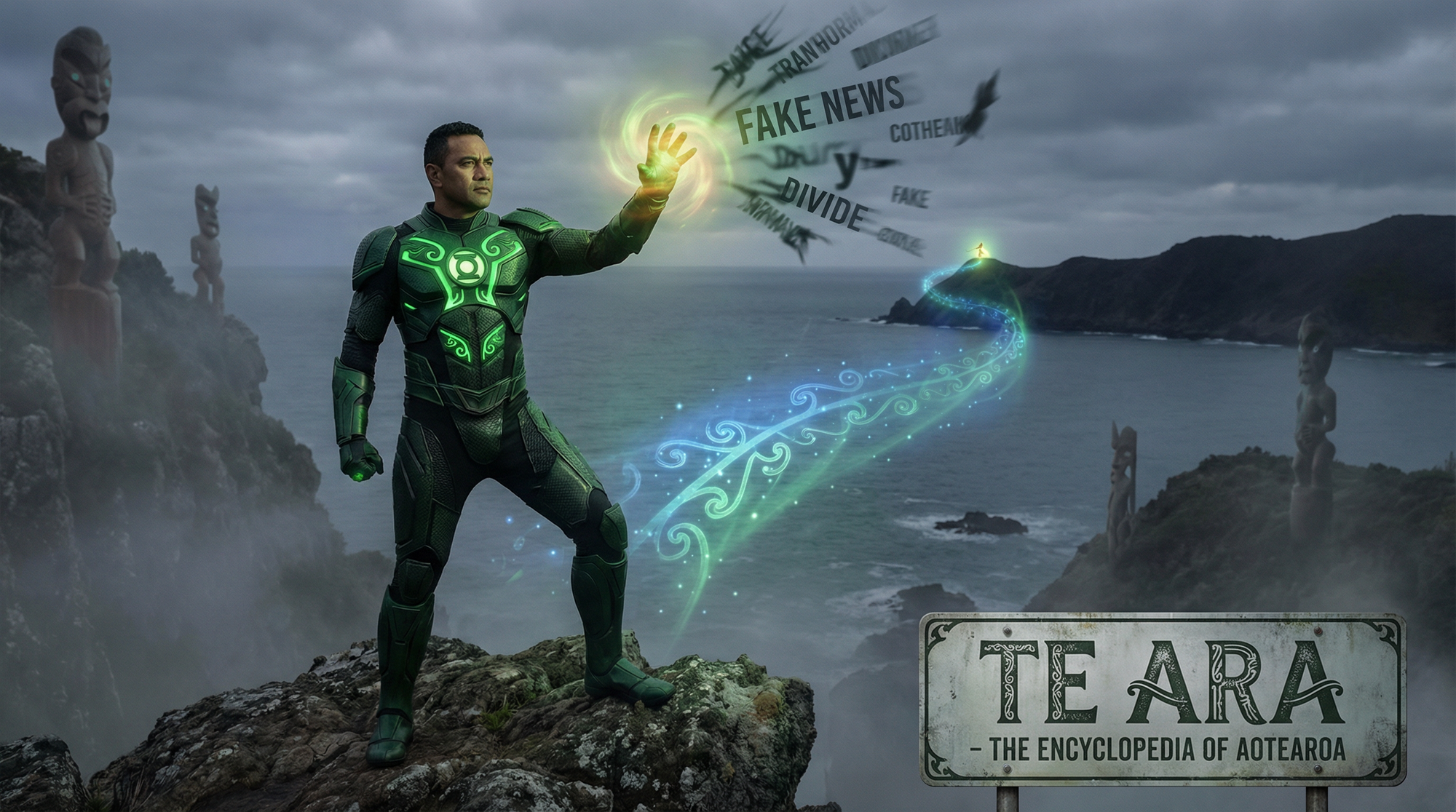
"Luxon’s at Waitangi: When a White‑Supremacist Government Calls Structural Violence a “Combat Sport”" - 5 February 2026
MACA thefts, 7AA repeals, and Newsroom’s cheerleading prove this isn’t brave engagement but a calculated beating of tikanga and Te Tiriti dressed up as political theatre
Kia ora Aotearoa,
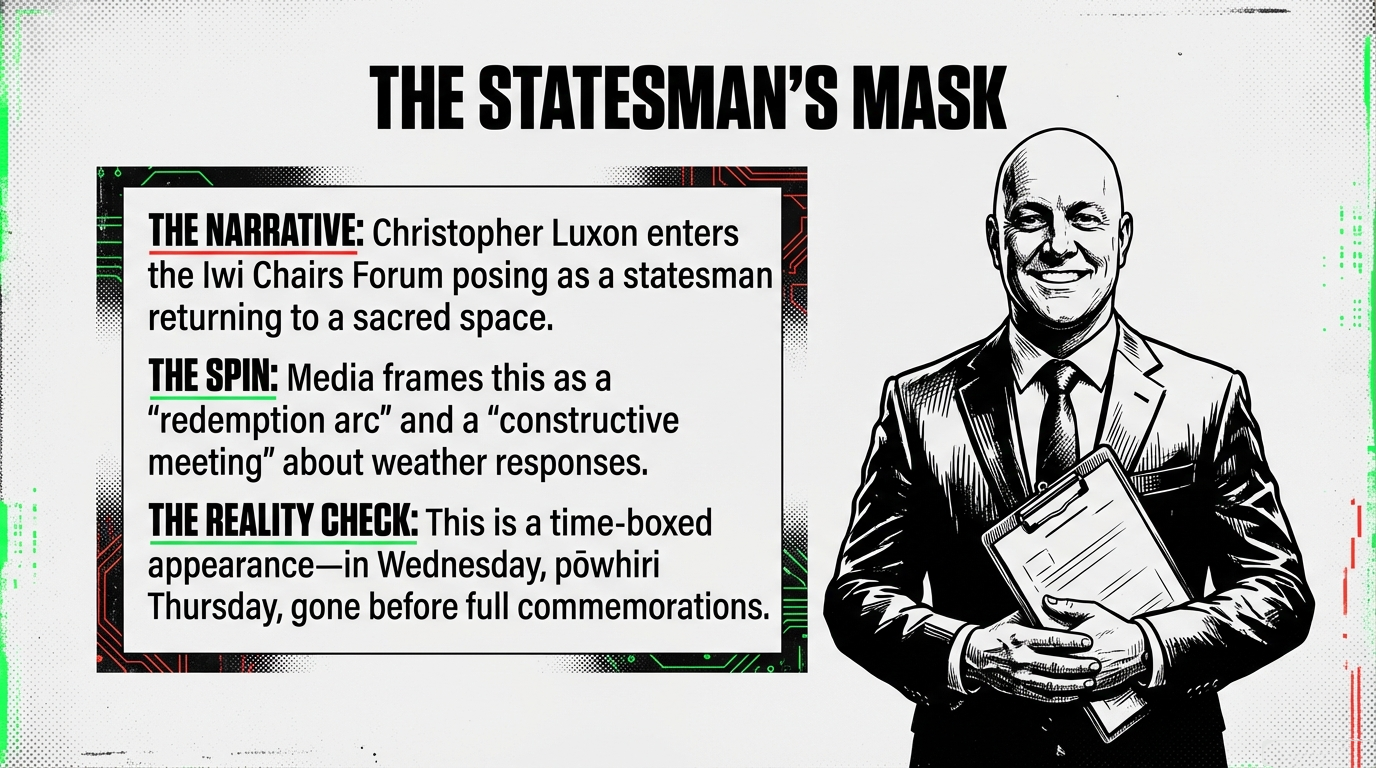
Christopher Luxon walking into the Iwi Chairs Forum is not a statesman entering a sacred space; it is a demolition contractor swaggering into the whare he has spent a year undermining, holding a clipboard and a fake smile instead of consent. His government has spent 2025 ripping out the load‑bearing pillars of Māori rights – repealing section 7AA to remove Oranga Tamariki’s duty to consider whakapapa, tightening the Marine and Coastal Area Act to overturn Māori customary titles, and weakening Te Tiriti protections through “Regulatory Standards” sleight of hand – while Māori leaders describe themselves as “beyond saddened” and outraged at the idea that generations of work can be erased retrospectively, as detailed by 1News and summarised again in their Te Ao Māori coverage at 1News.
The arena of illusion: Luxon’s staged redemption arc
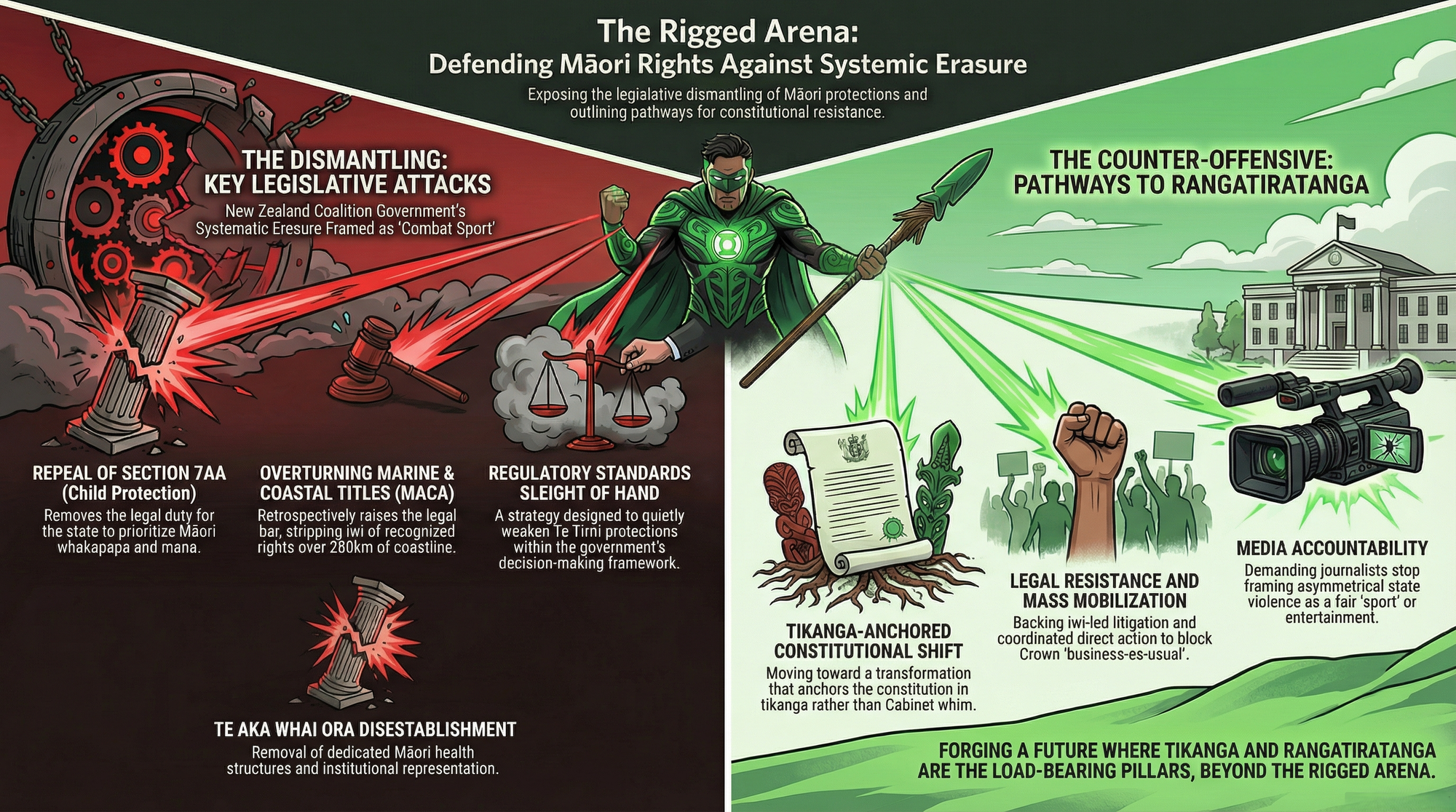
Luxon did not “return” to Waitangi as a sign of courage; he slunk back after dodging the Treaty Grounds in 2025, having opted to stay away while his coalition rammed through anti‑Māori legislation from the safety of Wellington, as reported by RNZ. He arrives this year for a carefully time‑boxed appearance – in on Wednesday, pōwhiri on Thursday, gone before the full commemorations – while a spokesperson gushes that he is “looking forward” to engaging on weather responses and “helping every New Zealander get ahead,” a bland script quoted by RNZ.
This is not courage; it is a controlled media hit. While he spins the meeting as constructive, the very forum he’s sitting in front of has just unanimously backed a High Court case to challenge his government’s Marine and Coastal Act amendments that overturn Māori wins over 280km of coastline and raise the legal bar for customary recognition, as laid out by 1News and confirmed in iwi leaders’ priorities at Waitangi by RNZ. Imagine an arsonist turning up to the fire‑damaged house with a garden hose, then complaining the homeowners aren’t grateful enough.
Newsroom as cornerman: polishing the gloves that keep hitting us
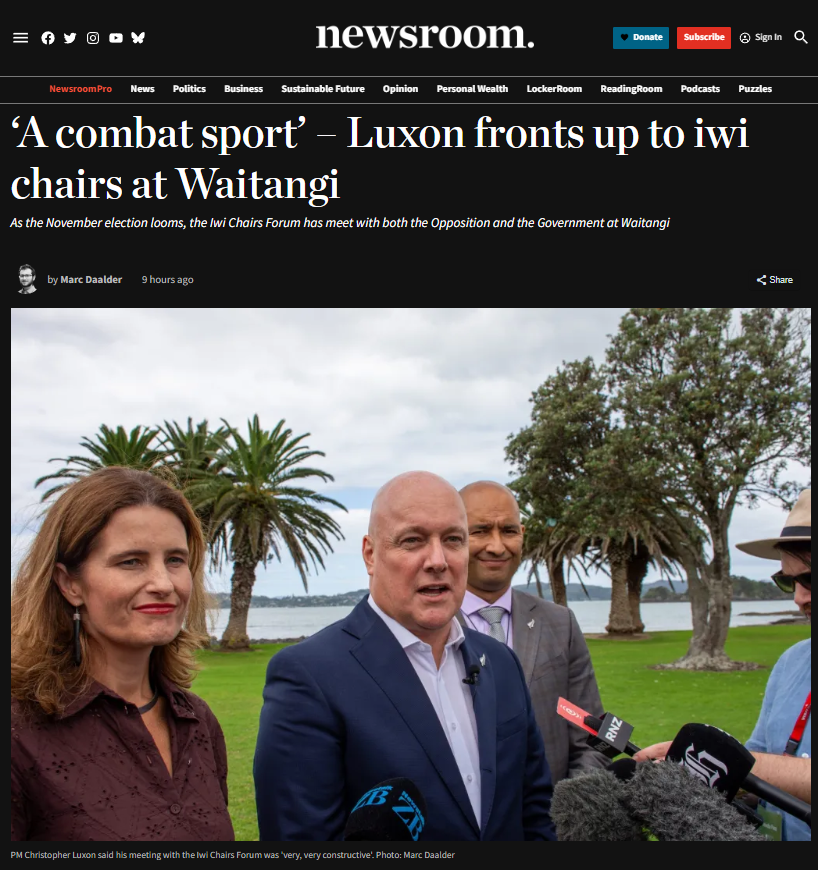
Now, Newsroom. Painting this as “a combat sport” is not clever; it is propaganda. By turning a deeply asymmetrical clash – Crown power vs tangata whenua – into a quirky spectacle, they reframe systemic violence as a thrilling, balanced bout. That “combat sport” metaphor gets picked up and recirculated in political commentary round‑ups, such as the way Democracy Project summarises the Newsroom piece alongside other Waitangi coverage.
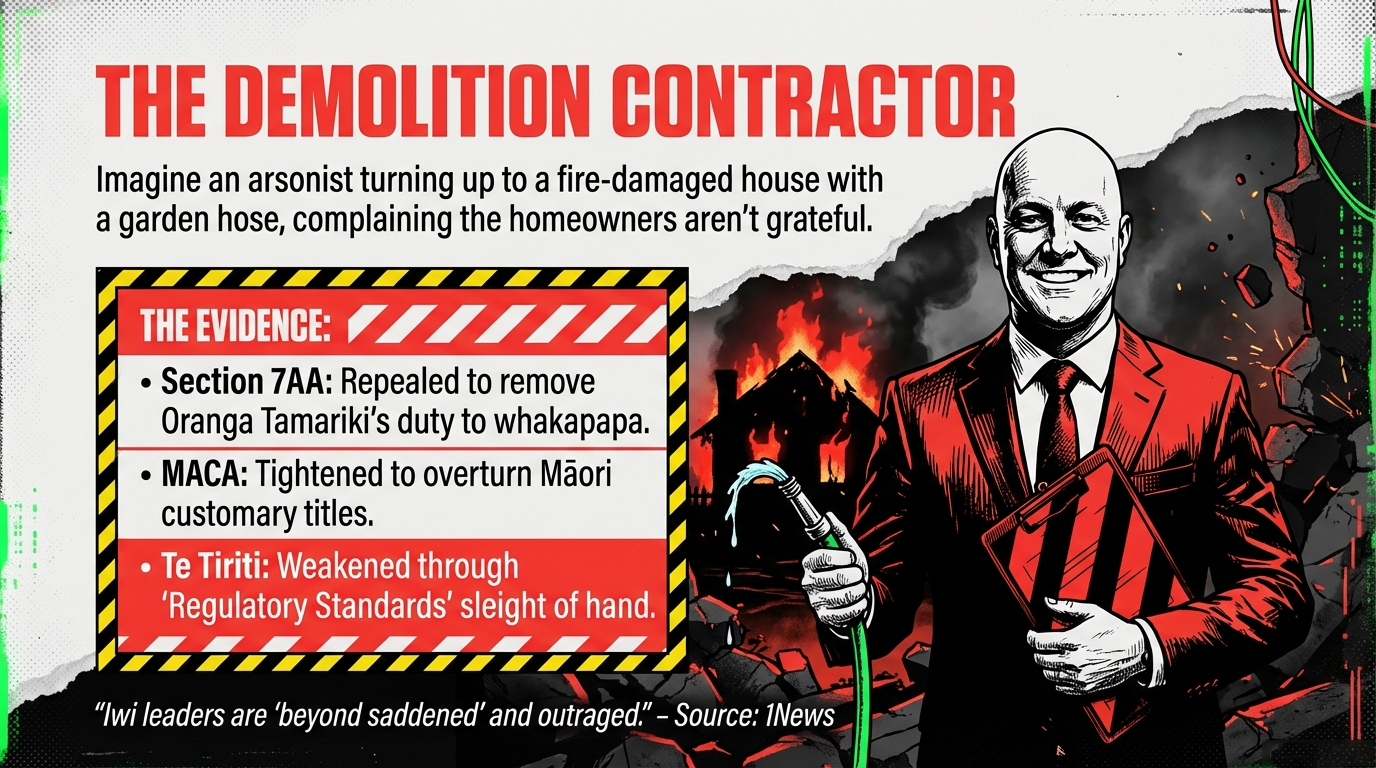
In their storytelling, Luxon is the brave fighter, stepping back into a hostile ring to trade blows with iwi leaders. But the real scorecard sits in legislation:
- Section 7AA gone, so Oranga Tamariki no longer has to give effect to mana, whakapapa, and Treaty commitments when dealing with tamariki Māori, a deliberate shift critics say will worsen already disproportionate Māori child removals, as reported by 1News and contextualised in earlier coverage of Māori outcomes in state care by RNZ.
- MACA amendments that overturn existing court‑recognised Māori marine titles and jack up the test for future recognition, applied retrospectively – a move that Far North leader Aperahama Edwards calls “horrific” and which critics dub “Treaty Principles Bill 2.0,” as detailed by 1News.
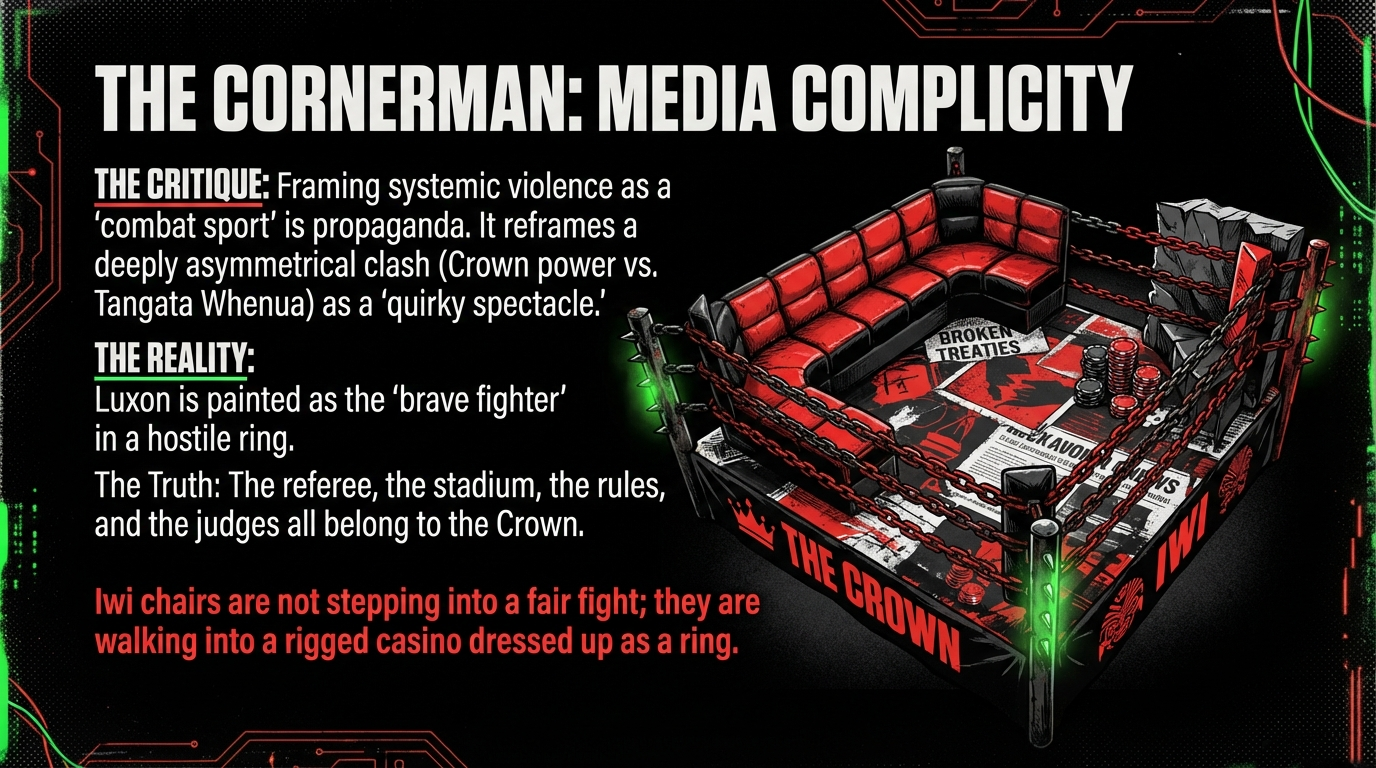
Newsroom’s framing hides the fact that the referee, the stadium, the rules, and the judges all belong to Luxon’s side. Iwi chairs are not stepping into a fair fight; they are walking into a rigged casino dressed up as a ring.
Examples: How the gloves are loaded
Example 1: Turning whakapapa into an optional extra
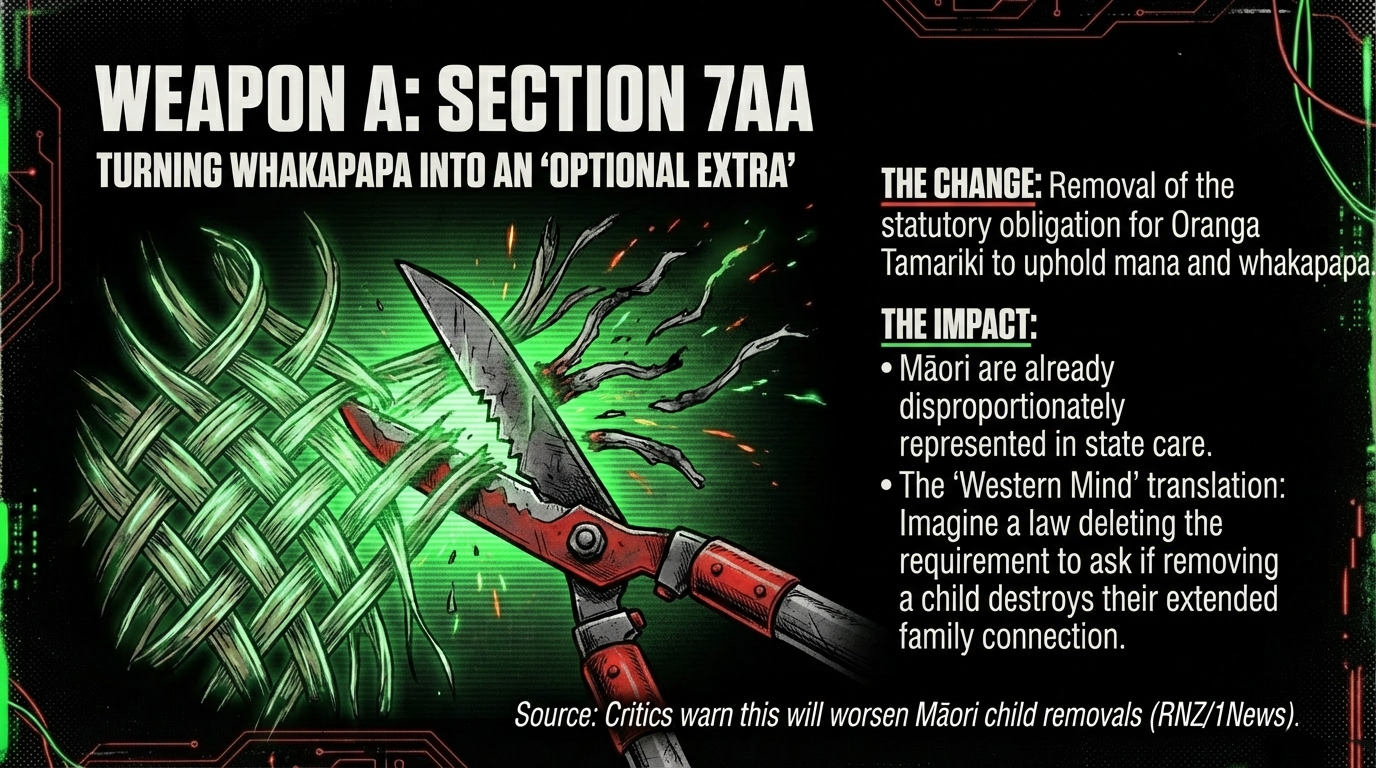
Under section 7AA, Oranga Tamariki had a statutory obligation to ensure policies reduced disparities and upheld mana and whakapapa for tamariki Māori, alongside strategic relationships with iwi, as summarised in 1News. Removing that clause means the agency can once again treat whakapapa as a nice‑to‑have, not a non‑negotiable – in hard numbers, Māori already make up a grossly disproportionate share of children in state care, a pattern repeatedly criticised in coverage of uplifts by RNZ.
For a Western mind: imagine a child‑protection system where the law said you had to consider whether removing a child would destroy their entire extended family’s sense of self – then a new government comes in and deletes that line. That’s what this coalition did. Newsroom writes about a “combat sport”; the real contest is between tamariki Māori and a state now legally allowed to ignore their whakapapa again.
Example 2: Re‑sinking waka that have already made landfall
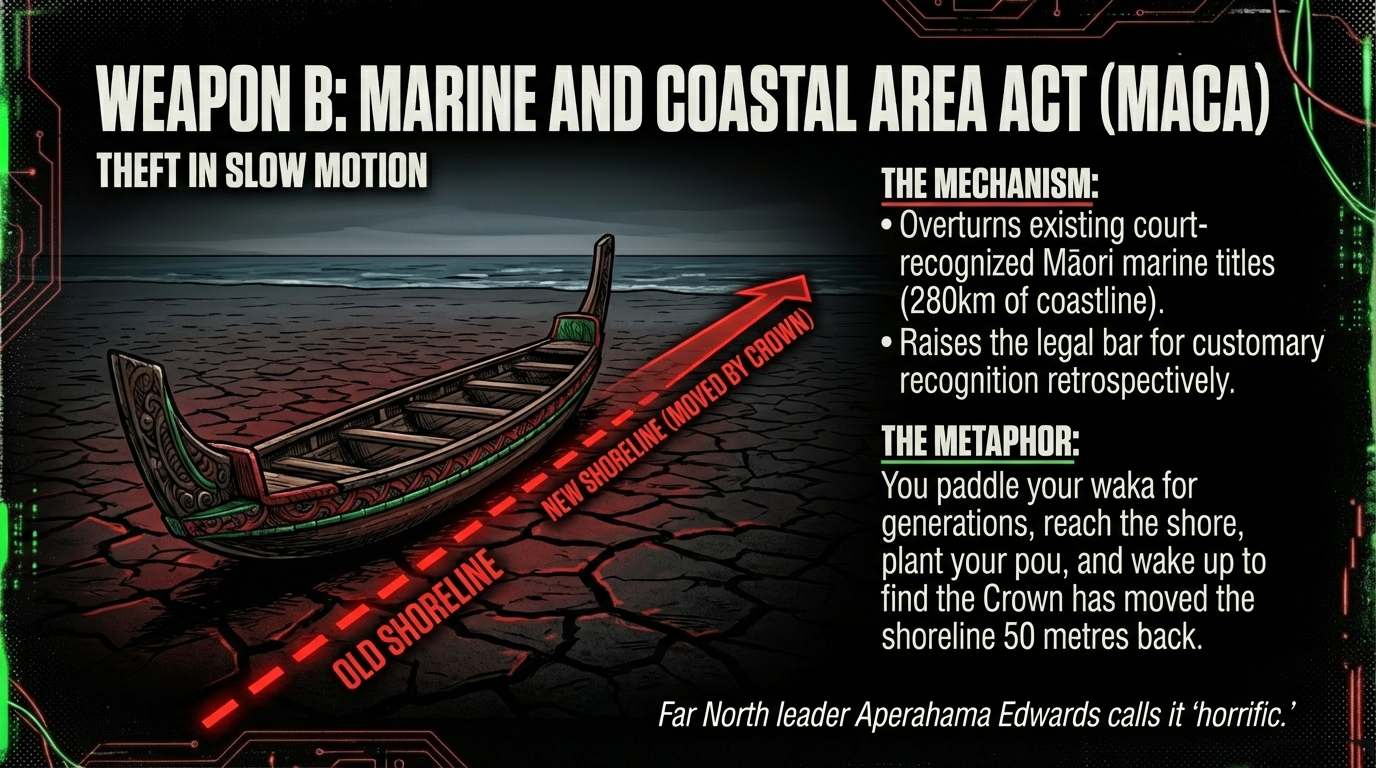
Iwi around the motu have spent years – and millions of dollars in research, hearings, expert evidence, and legal fees – securing recognition of customary marine title under MACA, with decisions finally landing in their favour over significant stretches of coastline, as documented in the retrospective MACA coverage by 1News. Luxon’s government then decides to change the test and apply it backwards, overturning those titles and forcing iwi back into the courts, a move explicitly acknowledged by Treaty Negotiations Minister Paul Goldsmith and criticised as “beyond saddened” and “outraged” by leaders like Aperahama Edwards in the same 1News report.
Metaphorically, this is like telling Māori: you can paddle your waka across generations, survive storms, reach shore, plant your pou, then waking up one morning to find the Crown has quietly moved the shoreline 50 metres back and told you to start again. Newsroom calls this “combative politics.” Māori call it theft in slow motion.
Quantifying the harm: this is not just “tone”
This is not a story about hurt feelings. The coalition’s changes hit real lives at scale:
- Child welfare: Removing statutory obligations to reduce disparities and uphold mana and whakapapa in Oranga Tamariki’s work makes it easier for disparities to persist, in a system where Māori are already over‑represented in care and have long complained of cultural disconnection and systemic bias, as flagged by RNZ and set against 7AA’s removal described by 1News.
- Coastlines and resources: Overturning 280km of recognised customary marine title strips iwi of hard‑won legal rights and control over takutai, with direct implications for environmental management, economic opportunity, and cultural practice, as quantified in the MACA amendment analysis by 1News and placed on the iwi agenda at Waitangi by RNZ.
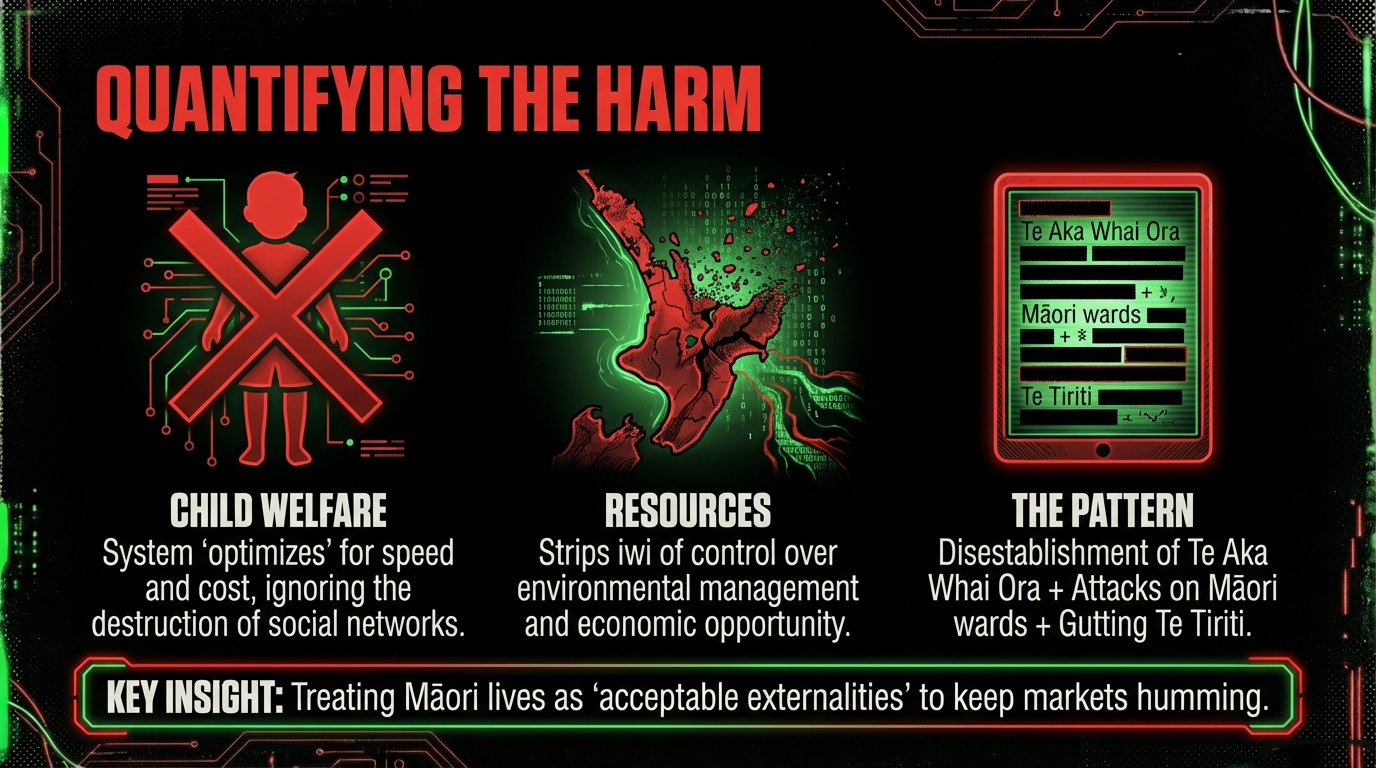
Add to that the wider pattern – disestablishment of Te Aka Whai Ora, attacks on Māori wards, and a regulatory framework designed to quietly strip Te Tiriti out of decision‑making – and you have a government that law academic Dr Carwyn Jones says is “finishing off the work that was started by the Treaty Principles Bill,” a warning quoted directly in 1News. This is white‑supremacist neoliberalism quantified: keep the markets humming, gut the Treaty, and treat Māori lives as acceptable externalities.
Impact on tikanga – explained for the Western mind
To the Western policy brain, tikanga often looks like theatre around the “real” business of politics – pōwhiri, karanga, whaikōrero, waiata – colourful ceremony before the actual negotiation happens in “proper” rooms. But tikanga is the rulebook, not the warm‑up. Te Tiriti, when understood through tikanga and mātauranga, is a living constitution about relationships, responsibilities, and balance, not a decorative clause you can delete when it gets in the way of your GDP graph, as outlined in constitutional discussions of Te Tiriti in Te Ara.
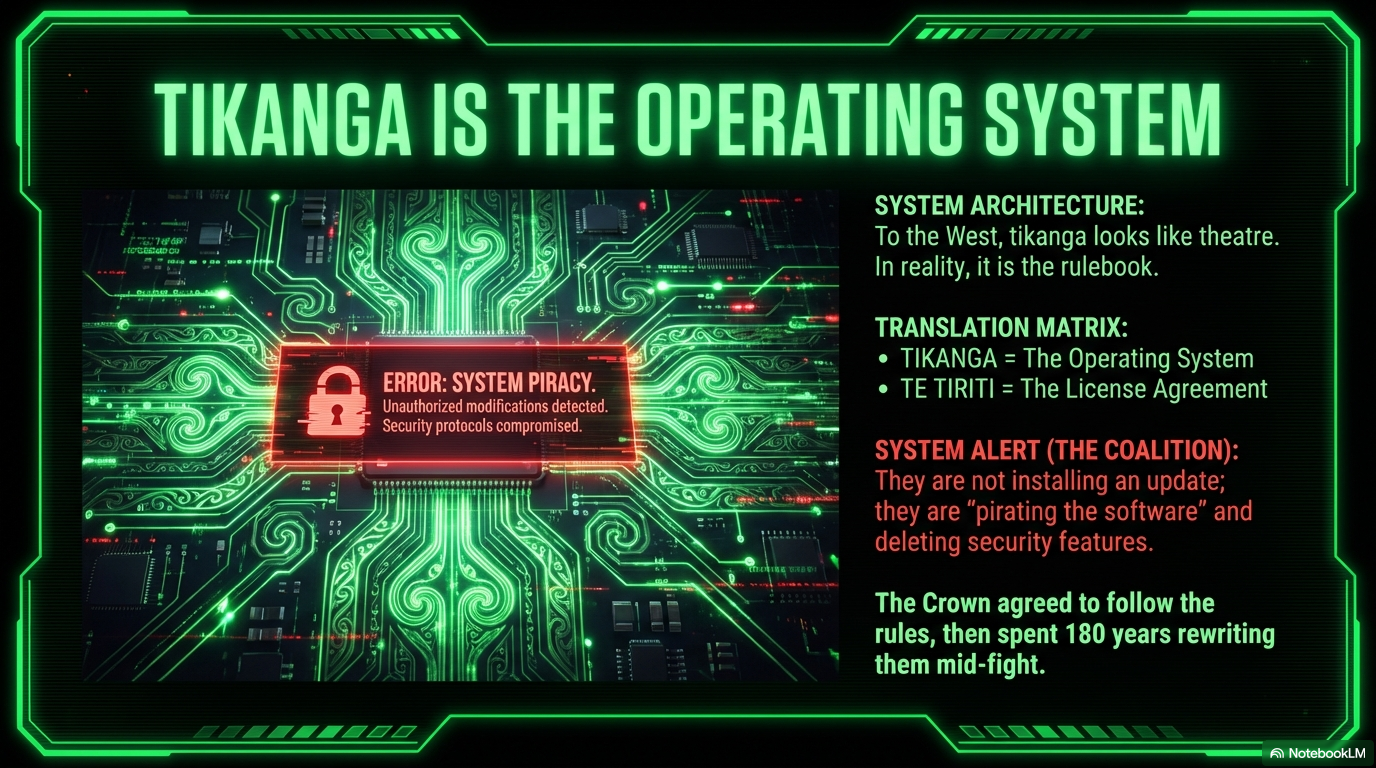
Here is the translation:
- Tikanga is your operating system; Te Tiriti is the licence agreement. Luxon’s government is not installing an update; it is pirating the software and deleting key security features for Māori.
- Removing section 7AA is like stripping a human‑rights safeguard out of a child‑protection algorithm, so the system can now “optimise” for speed or cost without asking whether tamariki Māori lose their entire social network in the process, a risk amplified by the removal described by 1News and set against past evidence of Māori harm in state care reported by RNZ.
- Overturning MACA titles is like a government cancelling property titles and resource consents in one suburb only, then insisting the law is still “equal” because everyone can theoretically re‑apply – all while you already know which suburb loses out, as seen in the retrospective and discriminatory effect highlighted by 1News.
When Newsroom calls this “combat sport,” it reinforces the Western delusion that tikanga is just one “style” in the ring, equal to the Crown’s style. It is not. Tikanga is the ground. The Crown is the fighter who agreed to follow the rules, then spent the next 180 years rewriting them mid‑fight.
Solutions: shutting down the rigged match
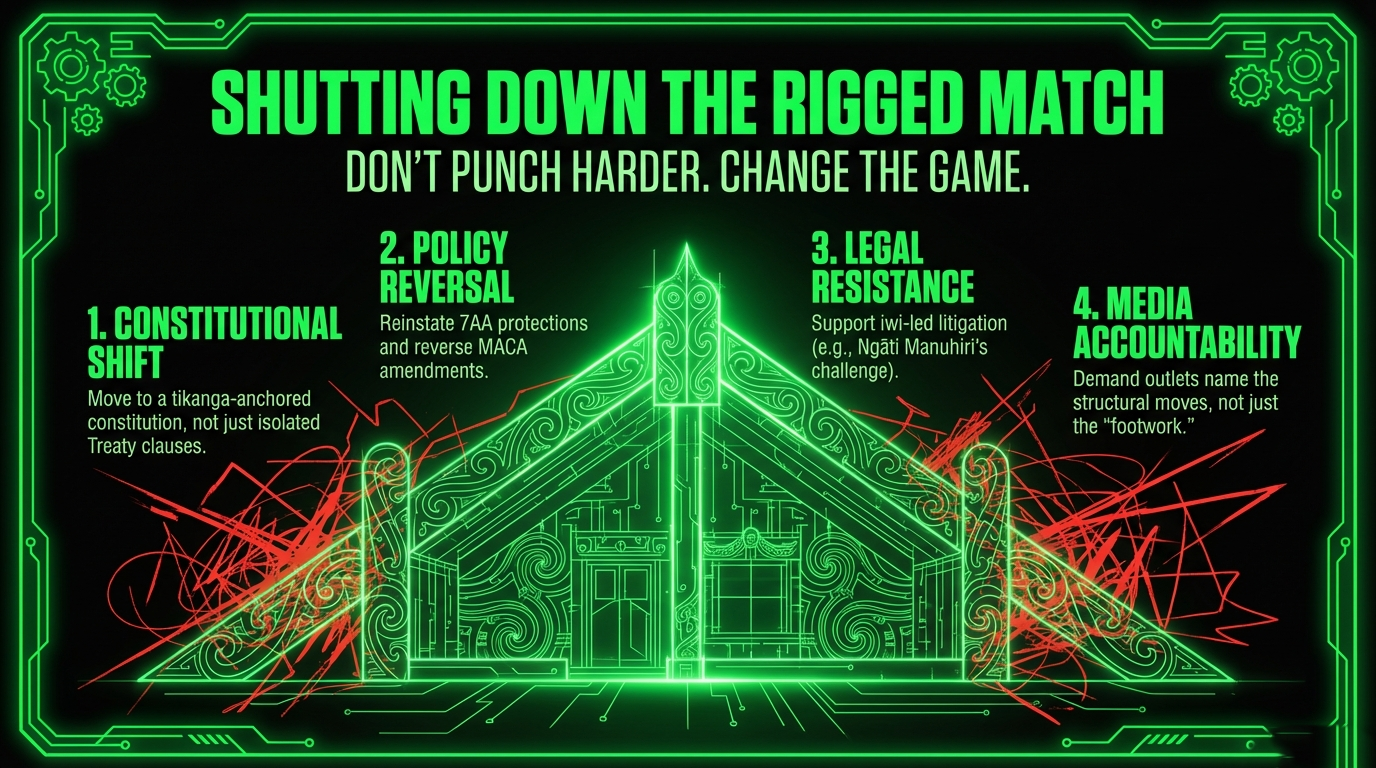
If we treat this as sport, we’re already losing. The answer is not to train Māori to punch harder inside a rulebook stacked against us; it is to expose the fix and change the game. That means:
- Constitutional shift led by tikanga: Move beyond isolated Treaty clauses towards a tikanga‑anchored constitutional transformation, informed by Māori scholarship and iwi processes, instead of leaving Te Tiriti at the mercy of each new Cabinet. This direction is consistent with the lived‑relationship framing of Te Tiriti described in Te Ara and the call from iwi leaders to stop “unpicking” the Treaty expressed at Waitangi and reported by RNZ.
- Immediate policy reversal and redress: Reinstate and strengthen 7AA‑style protections, restore and enhance Māori‑specific institutions like Te Aka Whai Ora, and reverse MACA amendments that deliberately undermine Māori rights – a minimum required if this government wants to be anything other than the “worst in decades” for Māori, as critics label it in 1News.
- Legal resistance and mass mobilisation: Back iwi‑led litigation like Ngāti Manuhiri’s MACA challenge and support coordinated, non‑violent direct action at sites like Waitangi to block Crown business‑as‑usual while constitutional violence continues, a strategy already visible in iwi chairs’ court backing reported by RNZ and the wider political push on Treaty issues summarised by Democracy Project.
- Media accountability: Demand that outlets like Newsroom stop romanticising asymmetrical state violence as “combat sport” and start naming the structural moves: who loses 280km of coastline, who loses legal protection of whakapapa, who loses dedicated health structures – and who profits. Responsible coverage would look more like the critical outlines in 1News and the sharp question‑posing in RNZ, not like ringside commentary applauding the footwork.
Koha consideration
Every koha for this kaupapa is a refusal to sit in the cheap seats while a white‑supremacist neoliberal government and its media cornermen turn the dismantling of tikanga and Te Tiriti into entertainment. It signals that rangatiratanga includes the power to fund our own analysts, storytellers, and strategists – the ones who name the MACA thefts, the 7AA repeals, the Treaty gutting, and the journalists who try to sell it all as “sport.”
Kia kaha e te whānau – stay vigilant, stay connected, and if you are able, consider a koha to keep this taiaha of kupu striking at the soft underbelly of Crown spin and corporate propaganda. If you are unable to koha, kei te pai – subscribe or follow the Māori Green Lantern on Substack, kōrero, and share with your whānau and friends; that is koha in itself, fuelling a different arena where tikanga sets the rules.
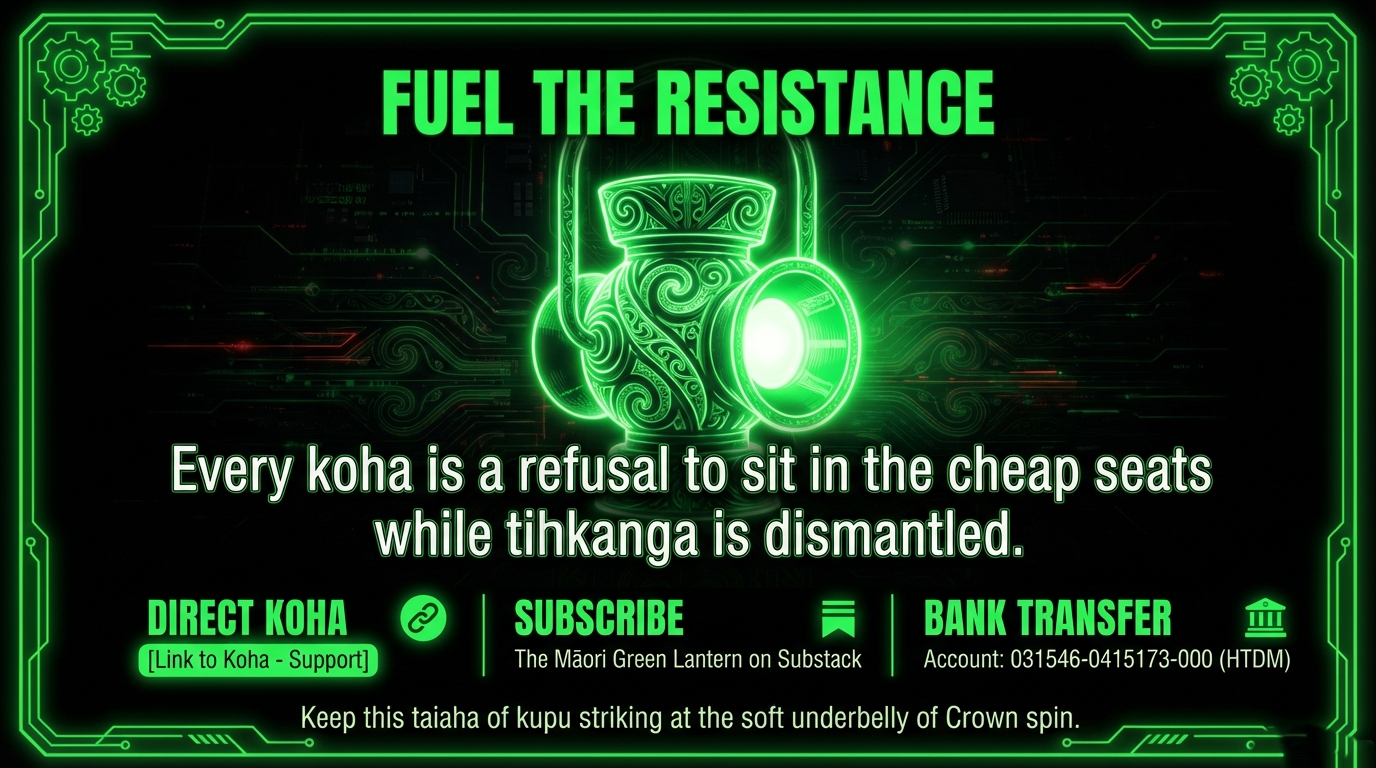
Three pathways exist:
To support this mahi directly with a koha (voluntary contribution), visit: Koha – Support.
To receive essays directly and support through subscription, join our community: Subscribe to the Māori Green Lantern on Substack.
For those who prefer direct bank transfer, account details are: HTDM, account number 031546-0415173-000.

Ivor Jones The Māori Green Lantern Fighting Misinformation And Disinformation From The Far Right