“Luxon’s Corporate Con Job: How New Zealand’s Fake CEO Prime Minister Got Exposed by His Own Business Mates” - 23 September 2025
The Emperor Has No Clothes: Business Leaders Destroy Their Golden Boy
Kia ora whānau. The Māori Green Lantern here with another scorching takedown of the neoliberal puppets destroying our whenua.
Here’s the brutal truth that every working whānau in Aotearoa needs to understand: Christopher Luxon, the man who sold himself as New Zealand’s business savior, just got absolutely destroyed by the very corporate elite who were supposed to be his strongest supporters.
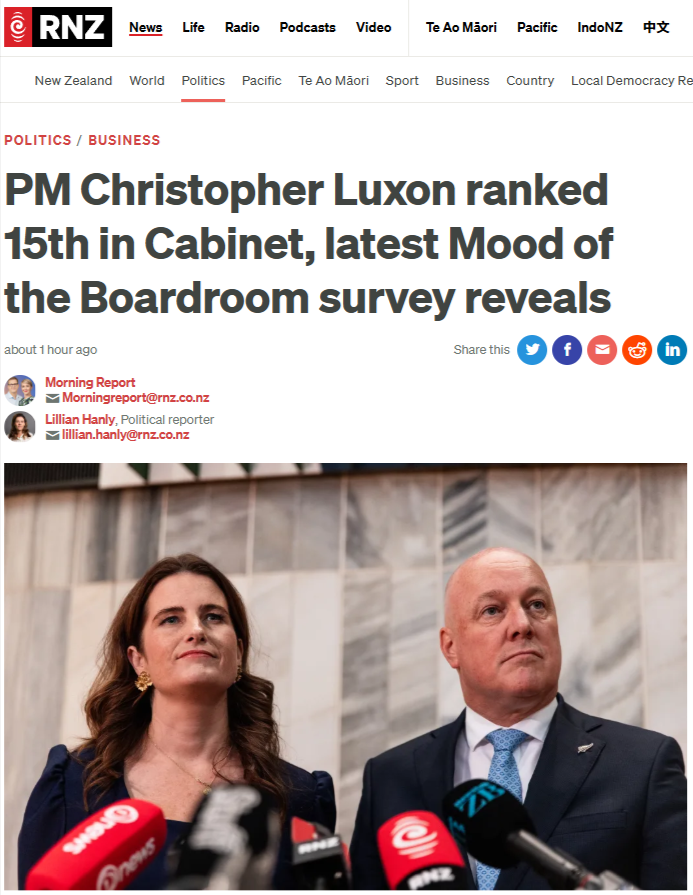
The latest New Zealand Herald Mood of the Boardroom survey has delivered a devastating verdict that exposes everything we’ve been saying about this corporate fraud. The man who promised to run the country like a business can’t even impress the business community - ranking a pathetic 15th out of 20 in his own Cabinet. Even his Finance Minister Nicola Willis ranked 13th, barely scraping ahead of him in this parade of mediocrity.
The Corporate Myth Explodes in Real Time

Luxon facing disappointed business leaders in boardroom setting
Let’s be crystal clear about what just happened. The 150 chief executives and business leaders who responded to this survey were supposed to be Luxon’s people. These are the corporate elite who benefit from his neoliberal policies, his attacks on working people, and his systematic dismantling of Māori rights. Yet even they can see through his shallow corporate-speak and empty promises.
One energy boss quoted in the survey summed it up perfectly:
“The Government is ineffective. There is no compelling leadership and strategic plan evident that will turn New Zealand around. The prime minister doesn’t resonate, and bold decisions are required.”
But here’s the most damning quote from a company chairperson:
“Luxon has been a disappointment. The public don’t like him. It’s too late for him. He needs to stand aside or be removed by his colleagues. Otherwise we will end up with the completely looney tune of Labour with the very left Greens and radical Māori party. God help New Zealand.”
Notice how even when they’re destroying Luxon, these corporate parasites still can’t help but attack Māori and the progressive parties actually fighting for working people. This tells us everything about their mindset and priorities.
The Mergers and Acquisitions Lie Finally Exposed

Failed merger documents representing Luxon’s questionable business record
Remember how Luxon constantly bragged about his “mergers and acquisitions” experience? Political commentator Matthew Hooton exposed this corporate mythology back in 2023, revealing that apart from the Air New Zealand-Virgin alliance that spectacularly failed under Luxon’s leadership, there’s little evidence of any successful mergers he actually worked on.
The Virgin Australia disaster is particularly telling. When Luxon was CEO of Air New Zealand, he attempted a coup to oust Virgin CEO John Borghetti in 2016. When that failed, Luxon resigned from the board and sold Air NZ’s stake, losing tens of millions of dollars for the company and shareholders.
This is the “business genius” who was supposed to save New Zealand’s economy. A man whose major business decision was so catastrophically bad it cost a state-owned enterprise millions of dollars. Yet he had the audacity to lecture us about fiscal responsibility while systematically defunding public services that Māori and working-class communities depend on.
The Coalition Chaos Strategy Backfires

Coalition partners in conflict, showing government dysfunction
The survey results reveal another damning truth about Luxon’s leadership. While business leaders gave him credit for “keeping his Cabinet ministers focused” and “coalition management,” they absolutely destroyed him on the things that actually matter: building business confidence, political performance, and economic transformation.
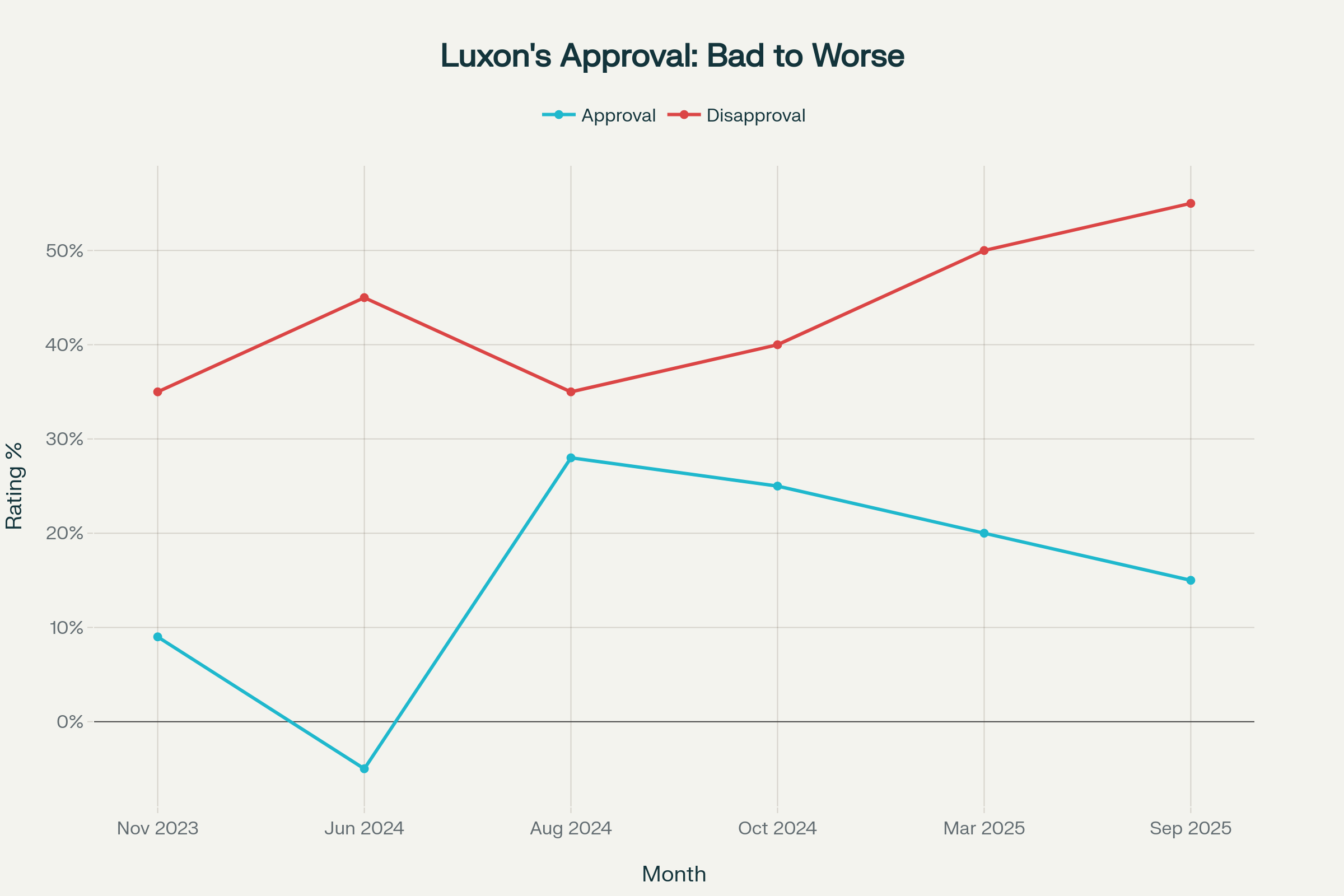
Chart showing Christopher Luxon’s declining approval ratings from November 2023 to September 2025, demonstrating his failure to connect with voters
This exposes the fundamental hollowness of his approach. Luxon is good at the performative aspects of leadership - the photo ops, the corporate buzzwords, the carefully managed international trips. But when it comes to actually delivering results for New Zealand, he’s an abject failure.
The coalition negotiations in 2023 already showed us this pattern. Political commentators on both left and right were openly mocking Luxon’s incompetence. Heather du Plessis-Allan pointed out that only the 1996 MMP coalition negotiations took longer - “That’s embarrassing for Chris Luxon. Because he’s the guy who’s talked up his negotiating skills.”
The Anti-Māori Agenda Finally Admitted
The most revealing moment in this entire debacle came when Nicola Willis openly admitted what we’ve always known. Asked what National would have done differently if governing alone, she said there would have been
“less focus on Māori-related issues.”
Let that sink in, whānau. Willis just confirmed that this government’s attacks on Māori aren’t some unfortunate compromise with coalition partners - they’re a deliberate strategy that National fully supports. The Treaty Principles Bill, the dismantling of the Māori Health Authority, the attacks on co-governance - all of this comes from National’s own anti-Māori ideology.
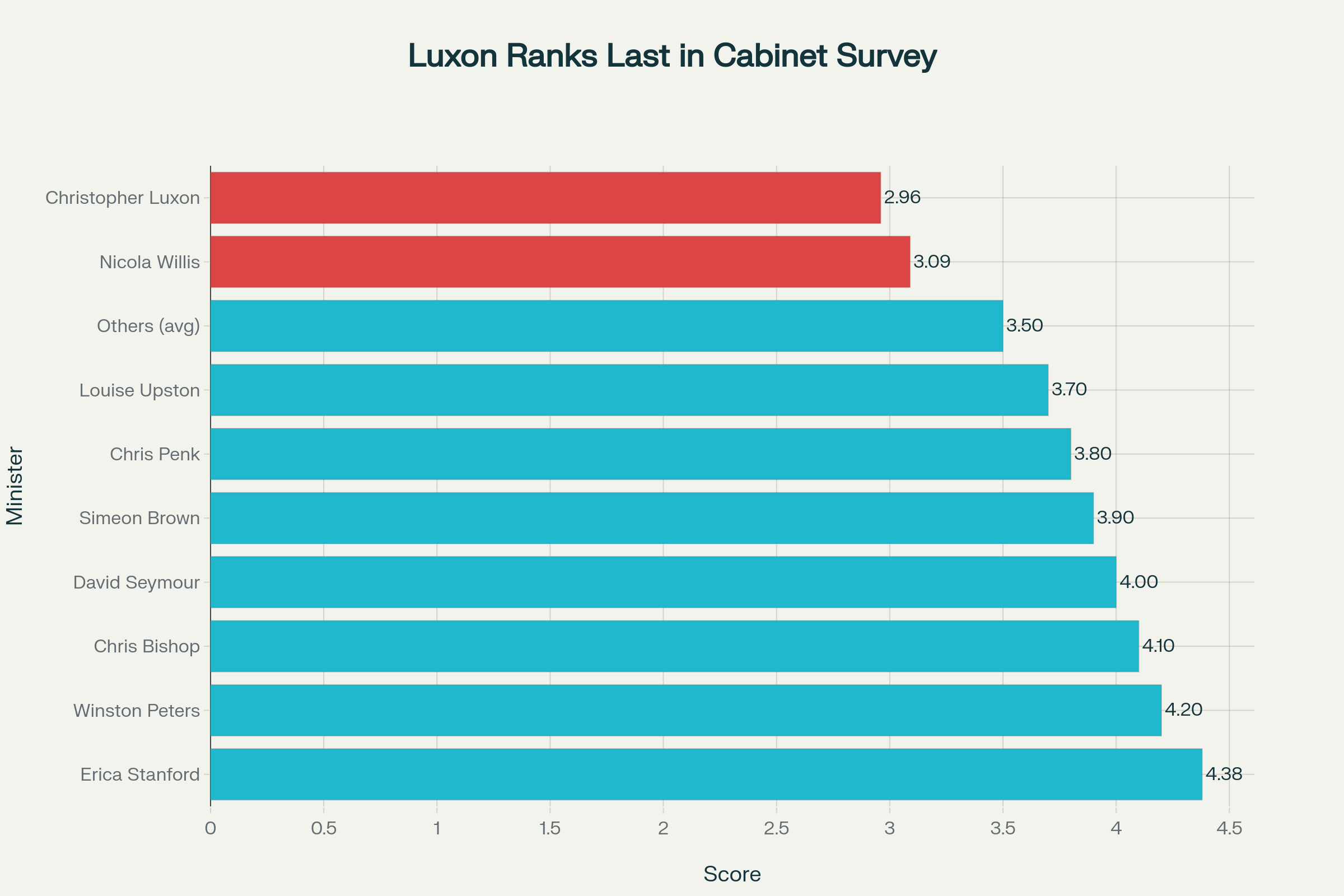
Chart showing Cabinet minister rankings from the 2025 Mood of Boardroom survey, with Luxon ranking poorly at 15th place
This is white supremacy in action, dressed up in corporate suits and delivered with MBA buzzwords. They’re using the coalition as cover for their systematic assault on tino rangatiratanga and Māori rights.
The Real Numbers Tell the Story of Failure
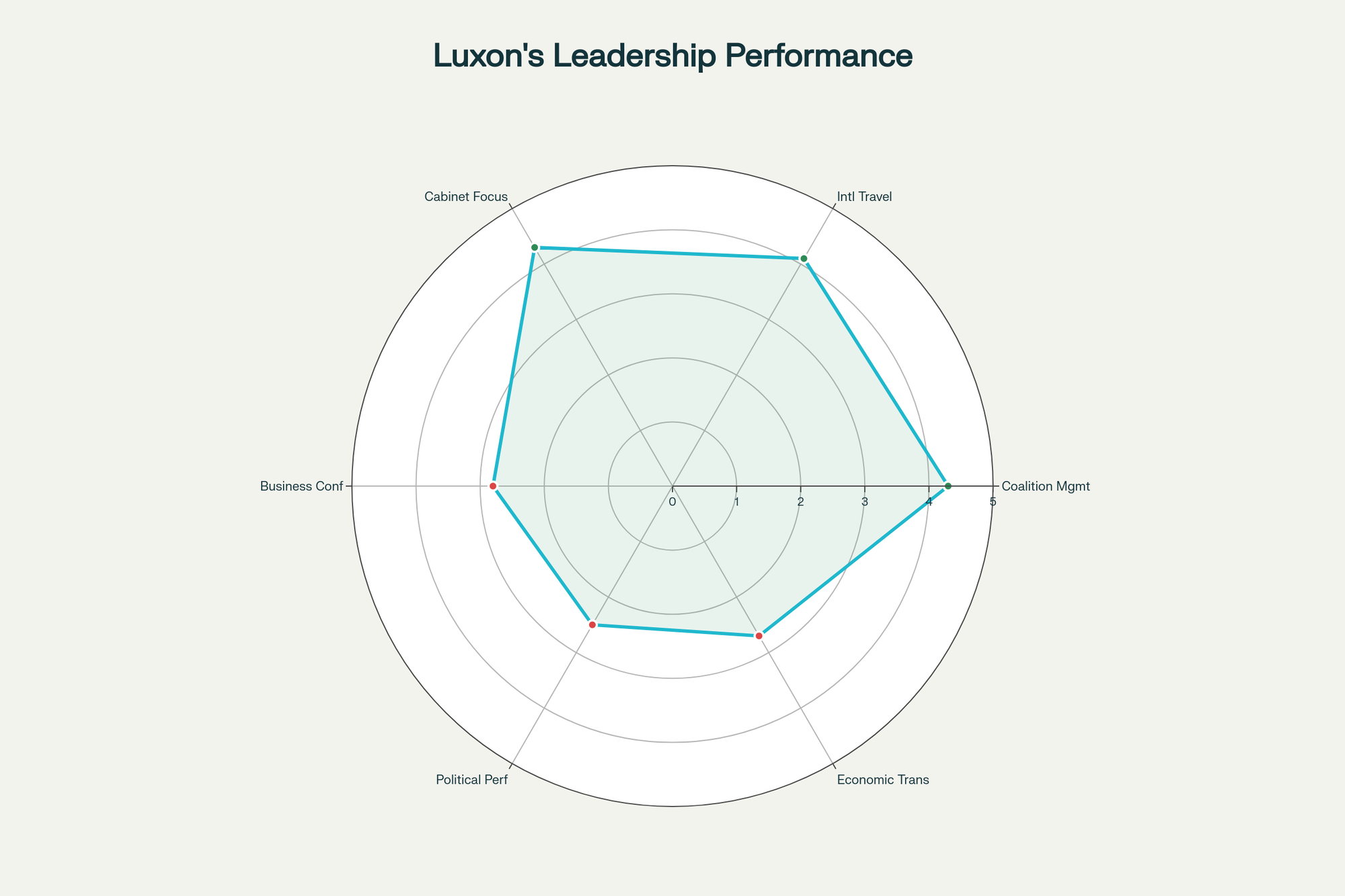
Radar chart showing Christopher Luxon’s performance strengths and weaknesses according to business leaders
The data from this survey is absolutely devastating for Luxon. Let’s break down what these business leaders - his supposed base - are actually saying:
Luxon’s Strengths (According to Business Leaders):
- Coalition management: 4.3/5
- International travel: 4.1/5
- Cabinet focus: 4.3/5
Luxon’s Catastrophic Failures:
- Business confidence: 2.8/5
- Political performance: 2.5/5
- Economic transformation: 2.7/5
This reveals the fundamental problem with neoliberal leadership in a nutshell. Luxon excels at the performative, managerial aspects of power - keeping his ministers in line, managing the optics, playing the role of PM on international trips. But when it comes to actually delivering the economic transformation he promised, he’s an abject failure.
The Pattern of Corporate Colonialism
What we’re witnessing isn’t just political incompetence - it’s the inevitable failure of corporate colonialism when applied to governing a diverse, democratic society. Luxon represents everything wrong with the neoliberal project: the assumption that business skills automatically translate to political leadership, the belief that market solutions can solve social problems, and the fundamental disconnect between corporate culture and community needs.
This is exactly what happens when you put a corporate suit in charge of a country. They understand profit margins and shareholder value, but they have no idea how to build genuine relationships with people or communities. They can manage up to their corporate masters, but they can’t connect with ordinary New Zealanders struggling with the cost of living, housing unaffordability, and systemic inequality.
The Deeper Connections: Following the Money Trail
Let’s connect some dots that the mainstream media won’t touch. Luxon’s failure to build business confidence isn’t just about his personal inadequacy - it reflects the fundamental contradictions of neoliberalism in 2025.
The same corporate class that demands tax cuts and deregulation also wants government investment in infrastructure, education, and healthcare that benefits their businesses. But Luxon’s ideological commitment to austerity means he can’t deliver the public investment that even his corporate supporters know the economy needs.
Meanwhile, his coalition’s obsession with culture war issues - attacking Māori rights, promoting “anti-woke” legislation, pushing through the Treaty Principles Bill - is distracting from the economic transformation that businesses are demanding. Even National voters are skeptical, with only 10% of New Zealanders believing the government’s policies are reducing racial tensions.
This is the inevitable result when you try to govern through division and scapegoating rather than building genuine economic solutions.
The International Embarrassment Factor
Luxon’s declining approval ratings aren’t just a domestic political problem - they’re becoming an international embarrassment. Business leaders who travel with him internationally might rate his performance, but his net favorability rating of minus twelve percent after just eighteen months is historically unprecedented for a first-term prime minister.
Compare this to previous prime ministers: Helen Clark saw a thirteen-point jump in her preferred PM rating within months of taking office. John Key’s support climbed from 40% to 51%. Even Bill English and Chris Hipkins enjoyed honeymoon bumps when they became PM. Luxon? His favorability has remained flat around 20-25%, with no honeymoon period at all.
This matters because international business relationships depend partly on the perception of political stability and competence. When your own corporate class is openly calling for your removal, it sends a terrible signal to international investors and trade partners.

The Māori Green Lantern Fighting Misinformation And Disinformation From The Far Right
Te Ao Māori Analysis: The Whakapapa of Colonial Failure
From a Māori worldview, what we’re witnessing is the inevitable consequence of leadership that lacks whakapapa - genuine connection to the people and the land. Luxon embodies everything that’s wrong with the colonial mindset: the belief that you can parachute into leadership without understanding the community you’re supposed to serve.
Traditional Māori leadership was based on relationships, reciprocity, and responsibility to future generations. Corporate leadership is based on quarterly profits, shareholder value, and personal advancement. These worldviews are fundamentally incompatible, and that incompatibility is playing out in real time as Luxon’s government fails on every meaningful measure.
The fact that his own corporate supporters are turning against him demonstrates a crucial point: even within the capitalist system, leadership requires more than just business credentials. It requires the ability to build coalitions, inspire confidence, and deliver results. Luxon has failed on all counts.
The Coalition Cracks Widen
The tensions within the three-party coalition are becoming increasingly obvious, and this survey reveals how those tensions are undermining the government’s effectiveness. When Luxon and David Seymour are publicly feuding, when Winston Peters is positioning himself as the steady hand, and when business leaders are rating multiple coalition ministers higher than the Prime Minister himself, you know the government is in serious trouble.
This is exactly what political scientists predicted when the coalition was formed. The structural design was always going to create instability, but Luxon’s poor leadership has accelerated the process.
The Media’s Role in Propping Up Failure
What’s particularly galling is how much of the mainstream media continues to treat Luxon with kid gloves, even as the evidence of his incompetence mounts. The survey data shows that voters have consistently been unimpressed with his performance, yet many journalists continue to frame his struggles as external factors rather than fundamental leadership failures.
This is classic corporate media behavior - protecting the interests of the business class even when those interests are obviously failing. The same media that spent years attacking Jacinda Ardern for every minor mistake is giving Luxon pass after pass as he presides over declining business confidence, rising unemployment, and complete coalition dysfunction.
What This Means for Māori and Working People
For Māori communities and working-class New Zealanders, Luxon’s failure represents both an opportunity and a danger. The opportunity lies in the obvious weakness of this government and the growing recognition that their corporate ideology doesn’t work.
But the danger is that as Luxon becomes more desperate to shore up his position, he may double down on the divisive, anti-Māori policies that his coalition partners are pushing. Willis’s admission that they want to focus more on “Māori-related issues” suggests they see scapegoating Māori as their path back to political relevance.
This is classic neoliberal strategy: when your economic policies fail, blame the indigenous people and other marginalized communities. We’ve seen this playbook before, and we need to be ready to counter it with organized resistance and alternative vision.
The Path Forward: Building Real Alternatives
The spectacular failure of Luxon’s corporate leadership creates space for genuine alternatives based on Māori values and community-centered economics. While the business elite are realizing their golden boy is fool’s gold, we need to be building the movements and relationships that can offer real solutions.
This means supporting Indigenous sovereignty, defending public services, building cooperative economics, and creating leadership structures based on accountability to community rather than shareholders. The failure of corporate colonialism is an opportunity to advance tino rangatiratanga and economic justice.
Implications: The Collapse of Corporate Credibility
The broader implications of this survey extend far beyond Luxon’s personal political fortunes. What we’re witnessing is the collapse of the entire myth that business experience automatically translates to political competence.
For decades, neoliberal ideology has insisted that governments should be run like businesses, that corporate leaders make the best political leaders, and that market solutions can solve social problems. Luxon’s failure represents the empirical refutation of these claims.
When even the business community recognizes that their supposed champion is ineffective, it opens space for alternative approaches to governance and economics. This is why the corporate class chairperson’s quote about “the completely looney tune of Labour with the very left Greens and radical Māori party” is so revealing - they’re terrified that their ideology has been exposed as bankrupt.
The CEO Emperor’s New Clothes
Christopher Luxon came to power promising to bring business discipline to government, to manage New Zealand like a successful corporation, and to deliver economic transformation through market-friendly policies. The latest Mood of the Boardroom survey represents the definitive verdict on this experiment: it has failed spectacularly.
Even his own corporate supporters can see through the empty suits and meaningless buzzwords. When you rank 15th out of 20 in your own Cabinet, when business leaders are openly calling for your removal, when your approval ratings are historically unprecedented in their negativity - you’ve lost all political credibility.
But this failure isn’t just about Luxon personally. It’s about the entire neoliberal project and the myth of corporate leadership. The emperor has no clothes, and even his courtiers are finally willing to admit it.
For Māori and working people, this represents both vindication and opportunity. We’ve always known that corporate values are incompatible with community wellbeing, that market solutions create more problems than they solve, and that real leadership comes from authentic relationships with people and place.
Now even the business elite are starting to figure it out. The question is whether we can build the alternative before they find another corporate puppet to put in Luxon’s place.
The Māori Green Lantern will continue exposing these corporate con artists and their neoliberal lies. Kia kaha, whānau. The truth is powerful, and it’s finally breaking through.
If you found value in this analysis of corporate political failure and neoliberal mythology, please consider making a koha to support independent Māori media: HTDM: 03-1546-0415173-000. The MGL understands these are tough economic times for whānau, so please only contribute if you have capacity and wish to do so.
Kia ora, kia kaha, kia kotahi
The Māori Green Lantern