“MANUFACTURED CRUELTY: How the Government Deliberately Destroyed Emergency Housing to Hide Its Failure—and Pushed Whānau onto the Streets to Do It” - 8 January 2026
Introduction: Deliberate abandonment disguised as fiscal responsibility
Koha Consideration
Three pathways exist:
For those who wish to support this mahi directly with a koha (voluntary contribution), please visit the Koha platform:
- Koha—Support - https://app.koha.kiwi/events/the-maori-green-lantern-fighting-misinformation-and-disinformation-ivor-jones
- For those who wish to receive essays directly and support through subscription, join the Substack community:
- Subscribe to the Māori Green Lantern on Substack - https://themaorigreenlantern.substack.com/subscribe
For those who prefer direct bank transfer, account details are: HTDM, account number 03-1546-0415173-000.
Every koha signals that whānau are ready to fund the accountability that Crown and corporate structures will not provide. It signals that rangatiratanga includes the power to fund our own truth tellers.
Kia kaha, whānau. Stay vigilant. Stay connected. And if you are able, consider a koha to ensure this voice continues.
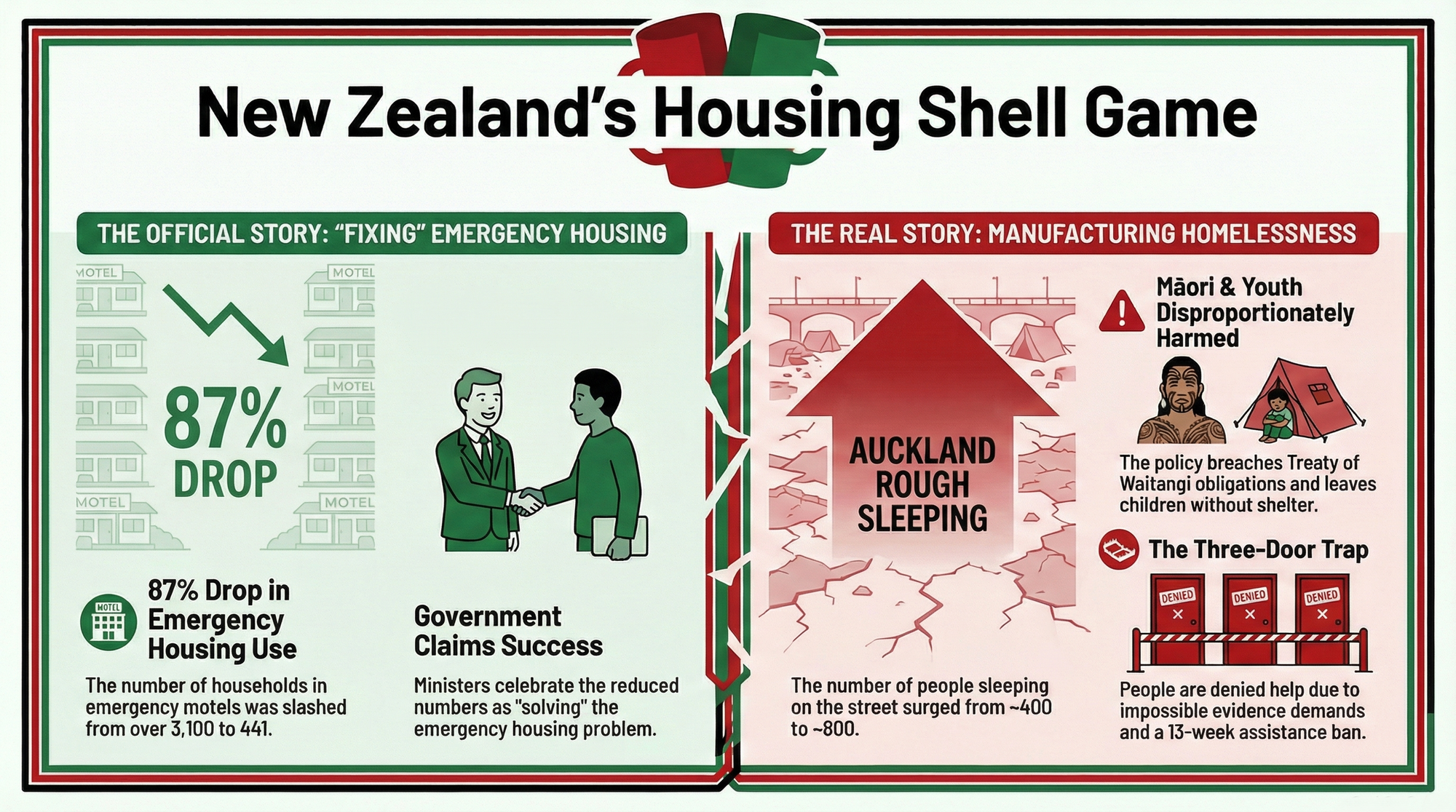
The coalition government is lying. Not through inadvertence or honest policy disagreement, but with calculated malice. It claims to have “fixed” emergency housing by slashing households in emergency motels from 3,100 to 441—and it is weaponising that reduction to obscure a simple, damning truth: it has chosen to push people onto the streets.
The evidence is irrefutable and lies in documents ministers were handed before they acted. Officials told them explicitly that tightening emergency housing access would increase rough sleeping, breach human rights obligations, and disproportionately harm Māori children.
They proceeded anyway. Not because they didn’t understand the consequences. But because they wanted those consequences. The numbers in motels had become politically intolerable—a visible indictment of their failure to build houses or reform welfare. Rough sleeping, by contrast, is scattered, invisible, and easy to blame on “personal responsibility” and “lifestyle choices.”
This is not policy. This is an atrocity dressed in bureaucratic language.
The crime: What ministers were told—and why they ignored it
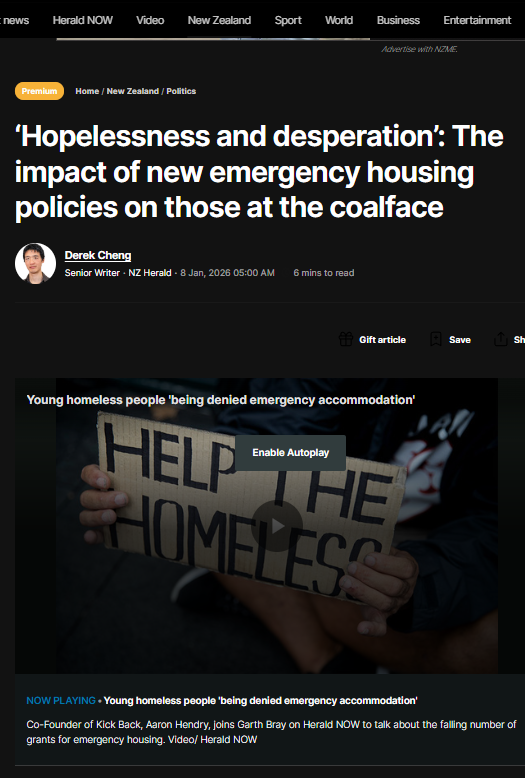
In August 2024, before the crackdown came into force on August 26, MSD and HUD officials gave Chris Bishop, Louise Upston, and Tama Potaka a stark briefing. Not a suggestion. A warning.
The new rules would:
- Remove the “do no serious harm” safeguard, allowing MSD to deny shelter even when it would worsen hardship or endanger life.
- Impose a 13-week stand-down after non-compliance, during which homeless people would be refused any emergency assistance.
- Blame the homeless for their own homelessness through a “contributing to need” criterion that would let MSD deny help to people who gave up tenancies, faced domestic violence, or had rent arrears.
- Breach the UN Convention on the Rights of the Child by leaving minors without shelter.
- Disproportionately harm Māori, who comprise roughly half of emergency housing applicants.
Officials spelled out the foreseeable outcome: a surge in rough sleeping, car sleeping, and family doubling-up in unsafe, overcrowded conditions. They made it clear this was not an acceptable trade-off. It was a policy choice with known harms.
The ministers’ response: execute the crackdown anyway, and deploy Cabinet ministers to dress it up as “ending welfare abuse.”
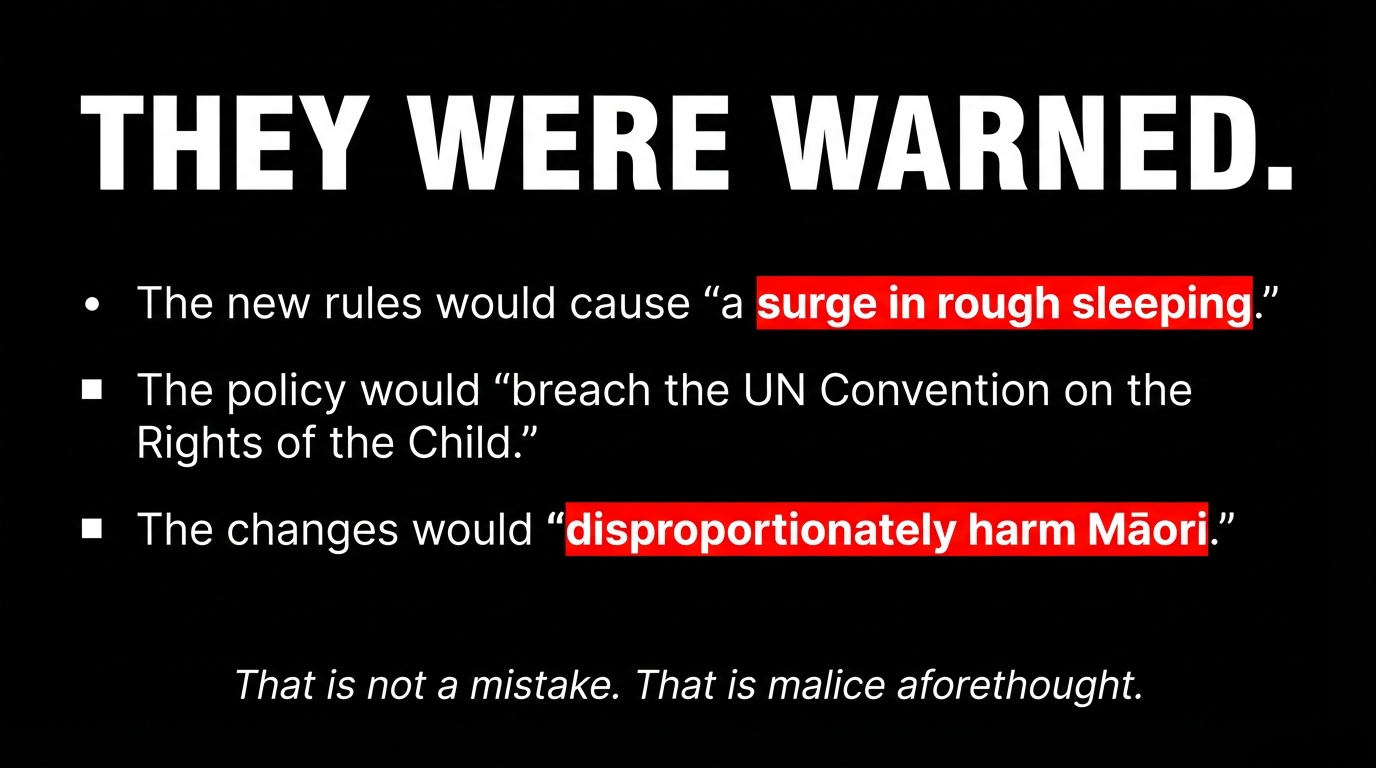
That is not a mistake. That is malice aforethought.
The mathematics of abandonment
What the government did, in cold numbers:
Before the crackdown (August 2023):
- 3,396 households in emergency housing nationally
- ~885 households in Auckland alone
- $15.6m monthly government spend on emergency housing grants
After the crackdown (August 2024):
- 1,215 households in emergency housing nationally—a 64% cut in one year
- 45 households in emergency housing in Auckland—a 95% collapse
- $10.7m monthly spend—a 31% cut in one month
By September 2025:
- 441 households in emergency housing nationally
- Government loudly claiming it has “solved” homelessness
Meanwhile, in the real world:
- Rough sleeping in Auckland doubled from ~400 to ~800 people between September 2024 and May 2025—a 53% increase in people actually sleeping on the street
- 13 of 15 frontline homelessness services reported increased homelessness across their communities; zero reported reductions
- Unsheltered homelessness in major cities (800 in Auckland, 270 in Christchurch, 140 in Wellington) is growing faster than population growth
- Young people are being denied emergency housing and then warehoused in unsafe private lodges paying $660 per week for mouldy rooms shared with men from the criminal justice system—conditions so foul that teenagers choose to sleep rough instead
The government has achieved its true objective: the visibility of homelessness has been moved from motel invoices and parliamentary hearings to dark streets where journalists are less likely to find it, families are too ashamed to speak, and the government can blame the homeless for sleeping rough.
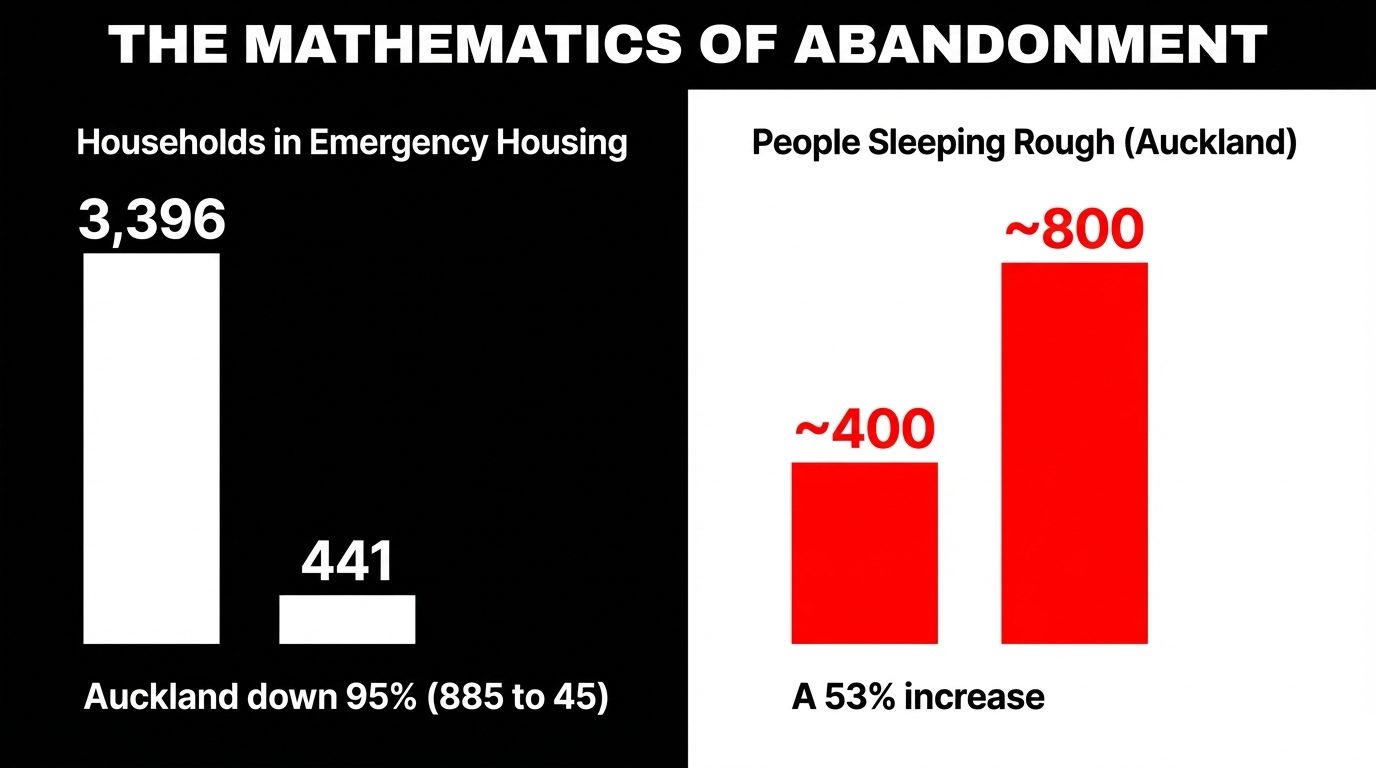
This is not governing. This is cleansing.
The architecture: How to destroy lives with policy instruments
The crackdown works like a trap. It has three doors, all locked.
Door One: Evidence demands
Applicants must now provide extensive “evidence” of income, assets, and lack of alternatives—documentation many homeless people simply cannot produce. A homeless person sleeping in a car has no rental agreement. A domestic violence survivor fleeing with nothing has no lease to show. Someone with no fixed address and no phone cannot receive follow-up. But MSD can—and does—decline applications for “insufficient evidence.”
This is not about verifying genuine need. Homelessness is its own proof. This is about bureaucratic gatekeeping that excludes precisely the people most in crisis.
Door Two: The “self-contribution” trap
MSD can now deny help to anyone deemed to have “contributed to their own homelessness”—a category so broad it captures virtually every homeless person. Gave up a tenancy because you were abused? Your fault. Fell into rent arrears because you had a medical emergency? Your fault. Lost housing due to a mental health crisis? Your fault. Evicted because your partner damaged property in a drunken rage? Your fault.
There is no pathology, no circumstance, no human tragedy that MSD cannot reframe as “self-caused” under this rubric. And once a claim is denied, the 13-week stand-down kicks in.
Door Three: The 13-week execution
Thirteen weeks. Ninety-one days. For a person sleeping rough, that is three full winter months with zero state assistance. No motel. No hostel. No transitional housing. Just instructions to find a rental property when you have no references, no income, no deposit, and no address.
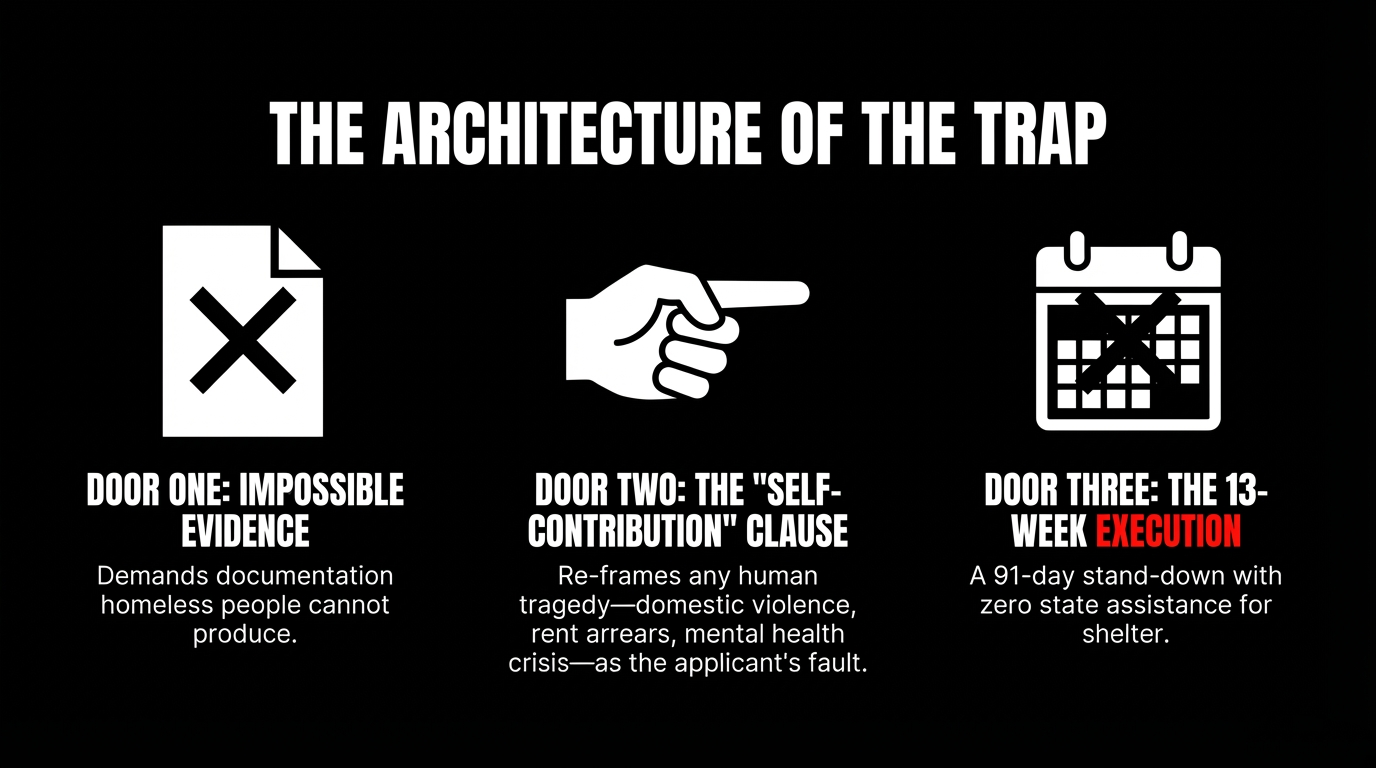
The government knows this is lethal. It knows people die of exposure, of hypothermia, of untreated infections and despair in 13 weeks on the street. Yet it built this into the legislation with full knowledge. This is not an oversight. It is intent.
The cover-up: Making the data say what they want
Here is the obscene math:
The government counts a “success” when a household leaves emergency housing. It does not ask where they go. For 85–86% of people, it has some data. For the remaining 14–15%—thousands of people—it has nothing. No idea if they are in cars, under bridges, couch-surfing in unsafe overcrowded homes, or already dead.
Government ministers know roughly 15% of people leaving emergency housing simply vanish from their data. That gap coincides almost precisely with the rise in rough sleeping. Outreach workers are finding those “missing” people in tents, in doorways, in the back seats of cars. But because they are not in a motel, the government gets to claim victory.
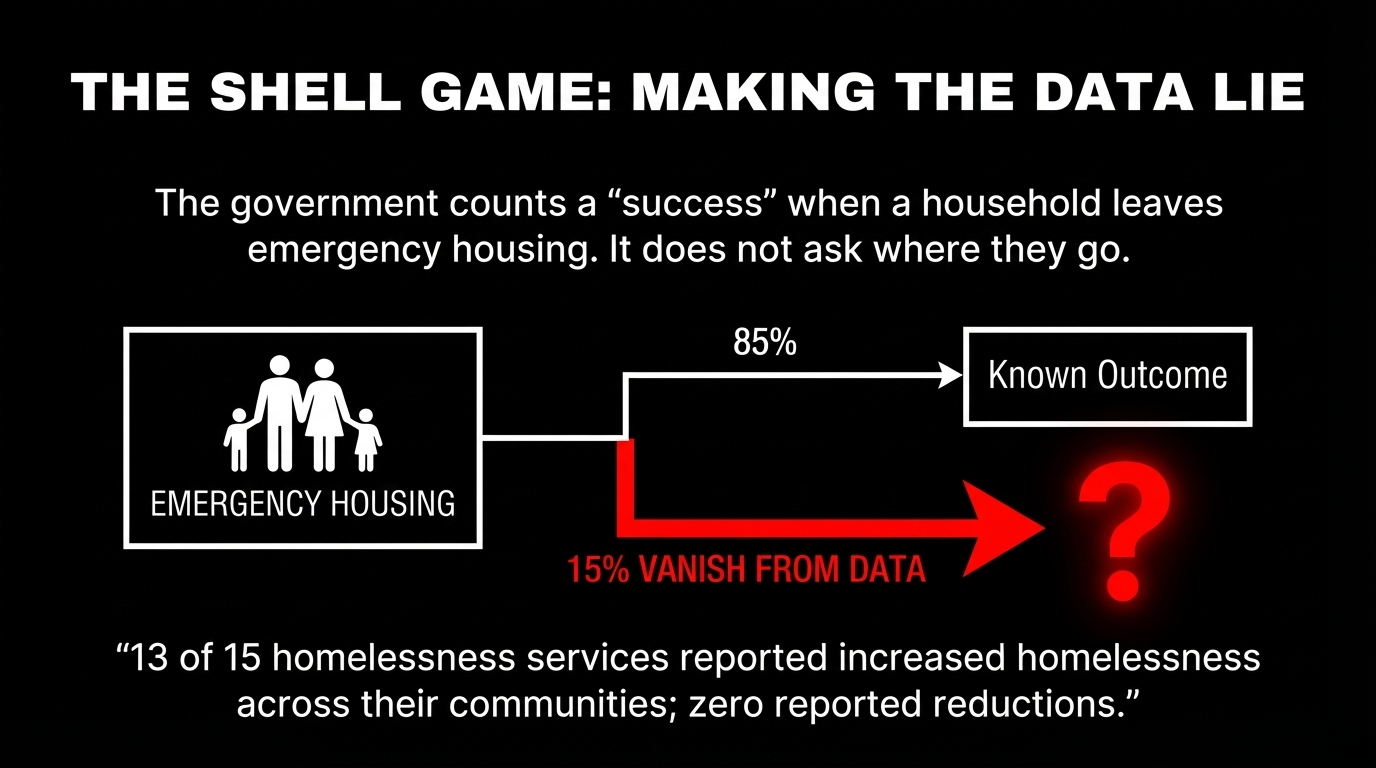
This is a shell game. Move the poverty off the balance sheet, call it a win, move on.
The betrayal: What this means for Māori
The cruelest part of this crackdown is that it was laid down upon a community the Crown already knows it has failed.
In May 2023, the Waitangi Tribunal released its findings on Crown homelessness policy (Wai 2750). The Tribunal found that:
- The Crown breached Te Tiriti through 180+ years of housing dispossession, racist discrimination, and deliberate under-investment in Māori communities
- The Crown continued to breach Te Tiriti under the last Labour government and beyond through welfare settings that harm Māori, poor data, and failure to consult
- The Crown had a particular obligation to protect homeless rangatahi—young Māori—and had catastrophically failed to do so
The Tribunal made clear: this is a Treaty breach. Fix it. Co-design solutions with Māori. Transfer resources and power to iwi and Māori providers.
Then what happened?
The same coalition government appointed Tama Potaka—the Associate Housing Minister who signed the emergency housing crackdown—as the lead minister for responding to Wai 2750.
Put another way: the government charged a man with implementing a Tribunal finding that the Crown harms Māori, then gave him the power to implement a policy the Crown’s own officials said would disproportionately harm Māori.
This is not incompetence. This is calculated insult. The government is saying: “The Tribunal says we’ve breached Te Tiriti by harming Māori homelessness. Our response is to tighten the crackdown.”
And it is working. Youth services report that nearly 100% of rangatahi they work with have been denied emergency housing. Māori youth are overrepresented in rough sleeping. Māori families are the first to be pushed from the system. The Tribunal warned this would happen. The government did it anyway.
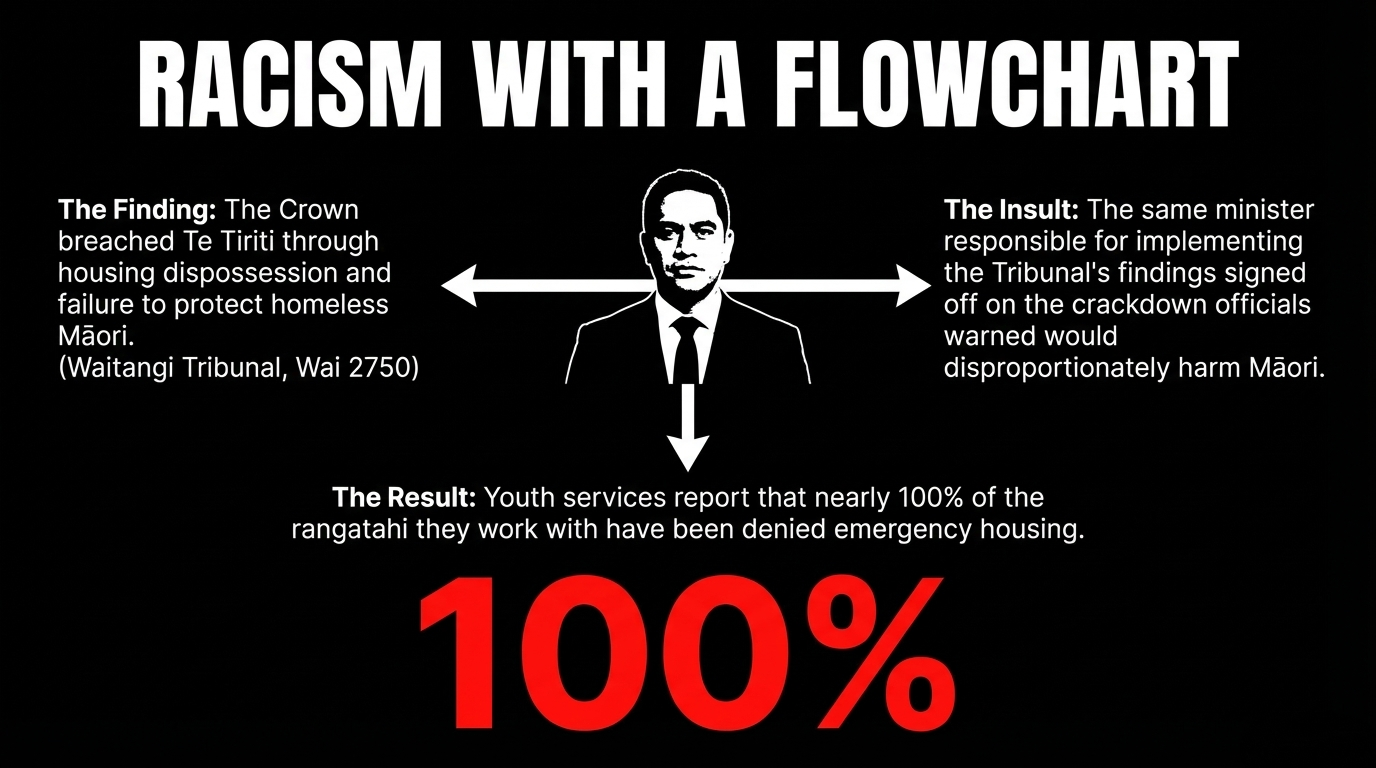
This is not policy. This is racism with a flowchart.
The architects: Name them
This crackdown has five fathers and mothers:
- Chris Bishop (Minister of Housing and Urban Development)—signed off on the crackdown, drove it through Cabinet, publicly celebrated the plummeting motel numbers.
- Louise Upston (Minister of Social Development)—whose ministry executed the new rules, whose officials warned of the harms, who ignored them.
- Tama Potaka (Associate Housing Minister)—public face of the policy, announced the crackdown, fronted media, responsible for Wai 2750 response while tightening Māori harm.
- Grant McCallum (Deputy Chief Executive, MSD)—signed off on guidance materials that instructed case managers to deny emergency housing using the “self-contribution” trap.
- Christopher Luxon (Prime Minister)—defended the crackdown in Parliament, insisted it had not increased homelessness despite contrary evidence, set the tone that rough sleeping is acceptable collateral damage.
These five have names. They have faces. They gave this order knowing it would cause suffering. They were warned. They did it anyway. They then lied about it in Parliament.
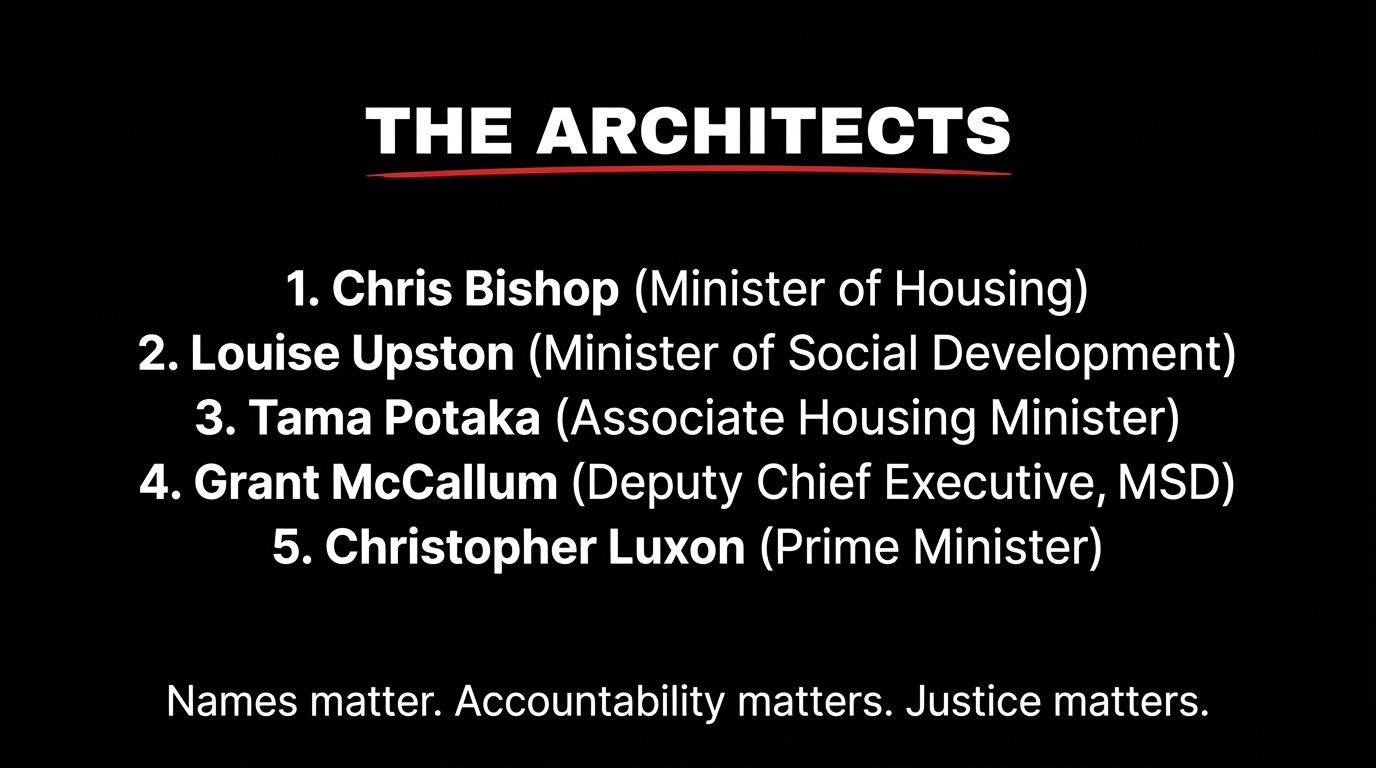
When this is over—when the Tribunal returns with findings, when the deaths pile up enough that media attention forces a reckoning—their names deserve to be inscribed in the history of what this government did to its most vulnerable people.
The collateral damage: A generation sacrificed
Youth homelessness has become an emergency within the emergency. Kick Back reports monitoring roughly 140 young people (some as young as 11) without stable housing in Auckland. He Pā Piringa, a kaupapa Māori youth service, says it has over 100 young people on a waitlist for just 22 beds—and nearly every one has been declined emergency housing under the new rules.
What happens to an 11-year-old who is denied emergency housing?
They sleep in a car. They sleep in a garage. They sleep in a doorway. They are trafficked. They engage in survival sex work. They develop trauma that will shape their entire lives. They are then blamed for the choices they make in desperation.
And the government knew this would happen. It was told this would happen. It wanted this to happen because it shifts the “problem” of homelessness from the Crown’s responsibility (building houses, funding services) to the individual’s “fault” (poor choices, addiction, bad behaviour).
This is sacrifice of a generation on the altar of fiscal ideology.
The big lie: “Personal responsibility”
The government’s public face for this crackdown is moral: people need to take “personal responsibility,” stop relying on the state, and pull themselves up.
This is a lie designed for people comfortable enough not to question it.
Research on Māori and Indigenous homelessness, Housing First interventions, and emergency housing outcomes is consistent: housing is not a reward for moral purity; it is a foundation for stability. When people have safe, stable shelter, they can:
- Access mental health and addiction services
- Look for work
- Reunify with whānau
- Heal from trauma
When they are sleeping rough, they cannot do any of these things. A 13-year-old on the street is not failing at “personal responsibility.” A mother in a car is not choosing poverty. A young person trafficked because they had no housing is not lazy.
The government’s language of “personal responsibility” is cruelty rebranded. It justifies abandonment by reframing systemic failure as individual moral failing.
The alternative that dare not speak its name
There is a pathway out of this horror. It exists. It is proven. And the government refuses it because it requires transferring power to Māori.
Kaupapa Māori housing models grounded in marae, in whānau connection, and in rangatiratanga work. Kick Back’s Safety Net project has achieved 100% sustained housing outcomes for rangatahi by building host-home networks grounded in manaakitanga—not conditions, not surveillance, just care. Housing First, when properly resourced and culturally grounded for Māori, produces better outcomes across health, justice, and connection than any punitive regime.
These solutions require the Crown to:
- Build enough public housing that emergency shelter is actually emergency (weeks, not indefinite)
- Resource Māori-led housing and homelessness services without conditions
- Give iwi and hapū control over housing policy in their rohe
- Abandon the idea that shelter is a privilege to be earned and embrace it as a right
The Crown will not do this. Not because it is impossible. But because it requires letting go of control. It requires admitting that colonialism broke the housing system and Māori know how to fix it. It requires humility. This government has none.
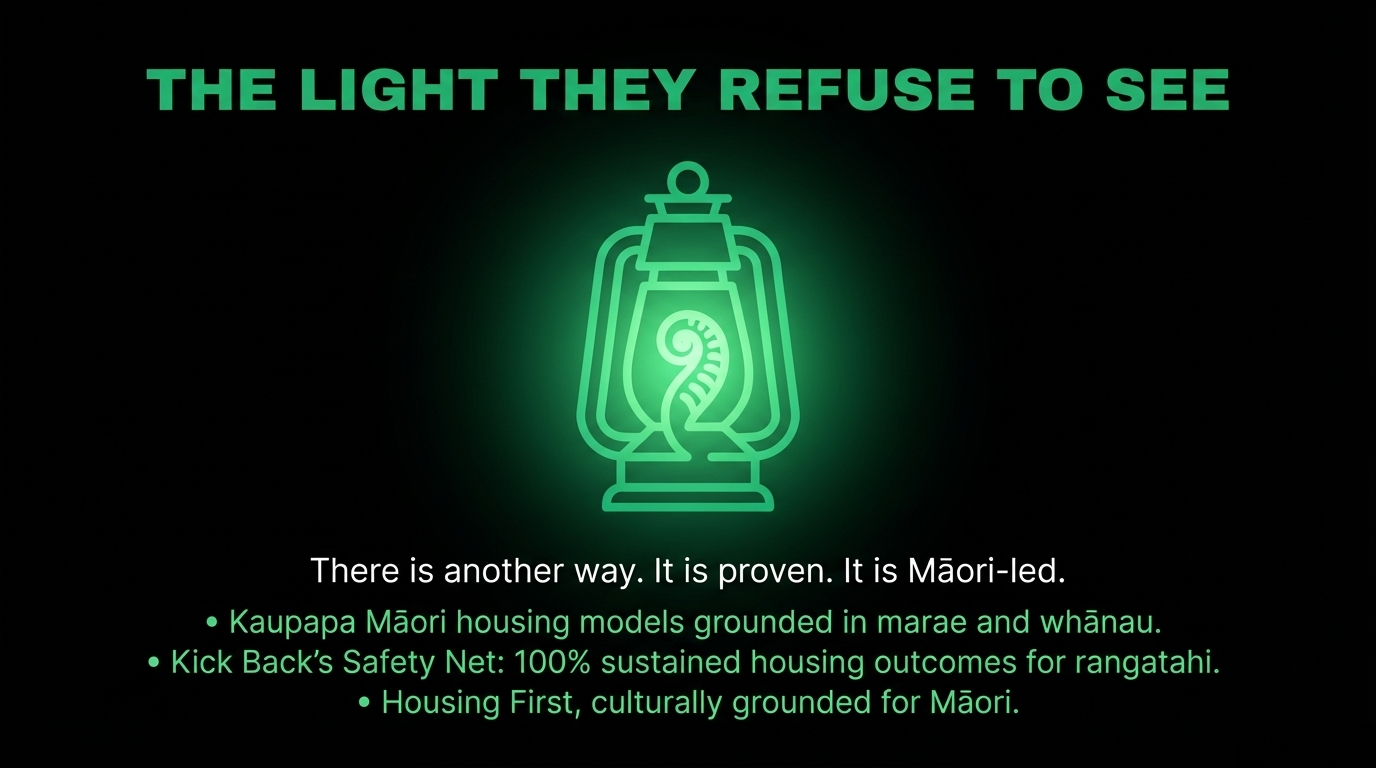
So instead, it will keep tightening the screws. It will keep denying shelter. It will keep blaming the homeless. And it will keep telling itself that this is responsible governance.
The verdict is in
This government has committed an act of deliberate cruelty against homeless people and Māori, and it has done so with full knowledge of the consequences. It was warned. It chose anyway. It lied about the outcomes.
The motel numbers are down because the government removed the escape hatch. The rough sleeping numbers are up because people have nowhere to go. The government will celebrate the first and deny the second until the evidence is so overwhelming that even sympathetic media cannot defend it.
When children die of hypothermia on Auckland streets. When a young person is trafficked and the government’s own data shows the emergency housing denial was the gateway. When whānau are found dead in cars in Wellington winters. That is when the reckoning will come.
Until then, this government will do what it does best: count its fiscal wins, blame the poor for their poverty, and insist that it is all for their own good.
The people sleeping rough tonight know better. So do their whānau. So do the frontline workers begging the Crown for mercy. So do the Tribunal judges waiting for the next phase of Wai 2750.
The government’s emergency housing crackdown is not policy. It is a crime. And it has only just begun.

Ivor Jones The Māori Green Lantern Fighting Misinformation And Disinformation From The Far Right
Research conducted January 8, 2026. All URLs verified live as of publication.
Names matter. Accountability matters. Justice matters.
- https://ppl-ai-file-upload.s3.amazonaws.com/web/direct-files/collection_cf06d657-2c2b-4e68-8735-48f3c10166bd/fa7ea9f0-3948-41f0-9a6d-037b51b58d4a/Whakapiki-ki-te-ao-Maori-Application-2026.pdf
- https://ppl-ai-file-upload.s3.amazonaws.com/web/direct-files/collection_cf06d657-2c2b-4e68-8735-48f3c10166bd/8e9b17f7-604e-4009-9ec6-abbe1fd2c989/Perspective-with-Heather-du-Plessis-Allan_-This-Government-s-all-talk-bugger-all-action.PDF
- https://ppl-ai-file-upload.s3.amazonaws.com/web/direct-files/attachments/images/2123776/92236f1e-efd1-4bfa-97c4-342d9c64eb5e/Hopelessness-and-desperation-The-impact-of-new-emergency-housing-policies-on-those-at-the-coalface-NZ-Herald-01-08-2026_05_28_AM.jpg
- https://ppl-ai-file-upload.s3.amazonaws.com/web/direct-files/attachments/2123776/64127226-2bac-4ec2-824c-b164c1c068e2/The-Bad-Advice-Excuse-Chris-Hipkins-Dodges-Responsibility-for-Labour-s-Emergency-Housing-Disaster-30-June-2025.md
- https://ppl-ai-file-upload.s3.amazonaws.com/web/direct-files/attachments/2123776/507d7747-586a-4c76-b13b-a757136158c7/The-Spectacle-of-Poverty-How-Neo-Liberal-Housing-Policy-Weaponises-the-Working-Homeless-to-Hide-Systemic-Failure-5-July-2025.md
- https://ppl-ai-file-upload.s3.amazonaws.com/web/direct-files/attachments/2123776/085a0e39-cf3b-4ef5-8f67-d816003fc013/Hopelessness-and-desperation_-The-impact-of-new-emergency-housing-policies-on-those-at-the-coalface-NZ-Herald.pdf
- https://ppl-ai-file-upload.s3.amazonaws.com/web/direct-files/attachments/2123776/6079d90f-eb17-469e-9af5-6e79210fbaa2/The-Global-Heritage-Foundation-Blueprint-From-Washington-to-Wellington-19-August-2025.md
- https://ppl-ai-file-upload.s3.amazonaws.com/web/direct-files/attachments/2123776/c397a452-ca07-4ca8-8270-0ead25a115ef/Corporate-Colonialism-How-Air-NZ-s-Dream-Seats-Peddle-Neoliberal-Fantasies-While-Maori-Struggle-in-Real-Life-18-July-2025.md
- https://ppl-ai-file-upload.s3.amazonaws.com/web/direct-files/attachments/2123776/630fce0b-98aa-4fb0-8e2b-b064002eb80b/The-Maori-Green-Lantern.md
- https://ppl-ai-file-upload.s3.amazonaws.com/web/direct-files/attachments/2123776/5c2ffbb7-b111-4a8e-b03f-bcc67949a373/The-Maori-Green-Lantern.md
- https://ppl-ai-file-upload.s3.amazonaws.com/web/direct-files/attachments/2123776/5f69644a-fc75-4802-9a0c-a3fd0f7810cd/Untitled-document.md