“María Corina Machado’s Nobel Betrayal” - 16 January 2026
How a Pro-Democracy Crusader Became Trump’s Degraded Pawn
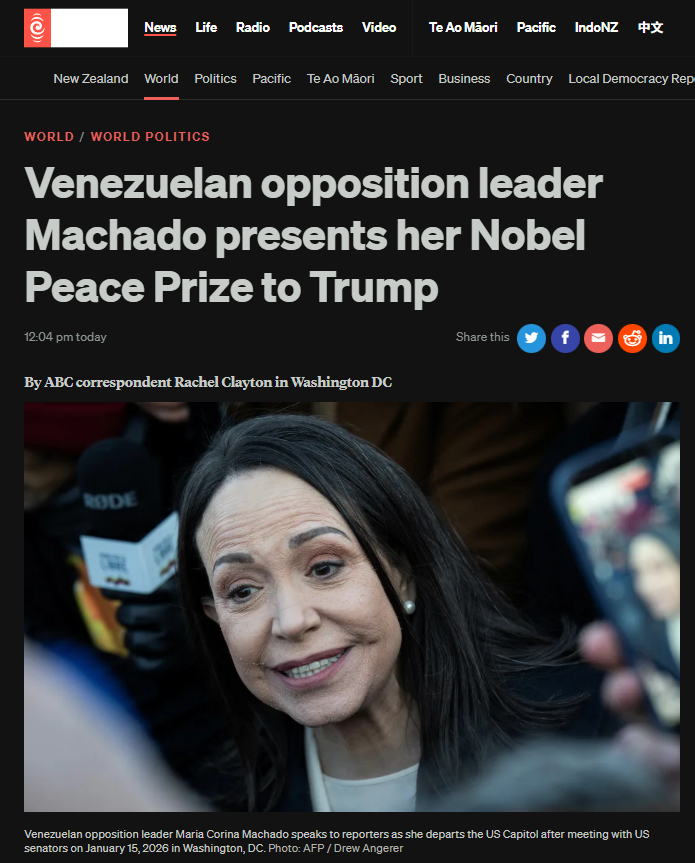
The Obscene Photo Op: Surrender as Theater
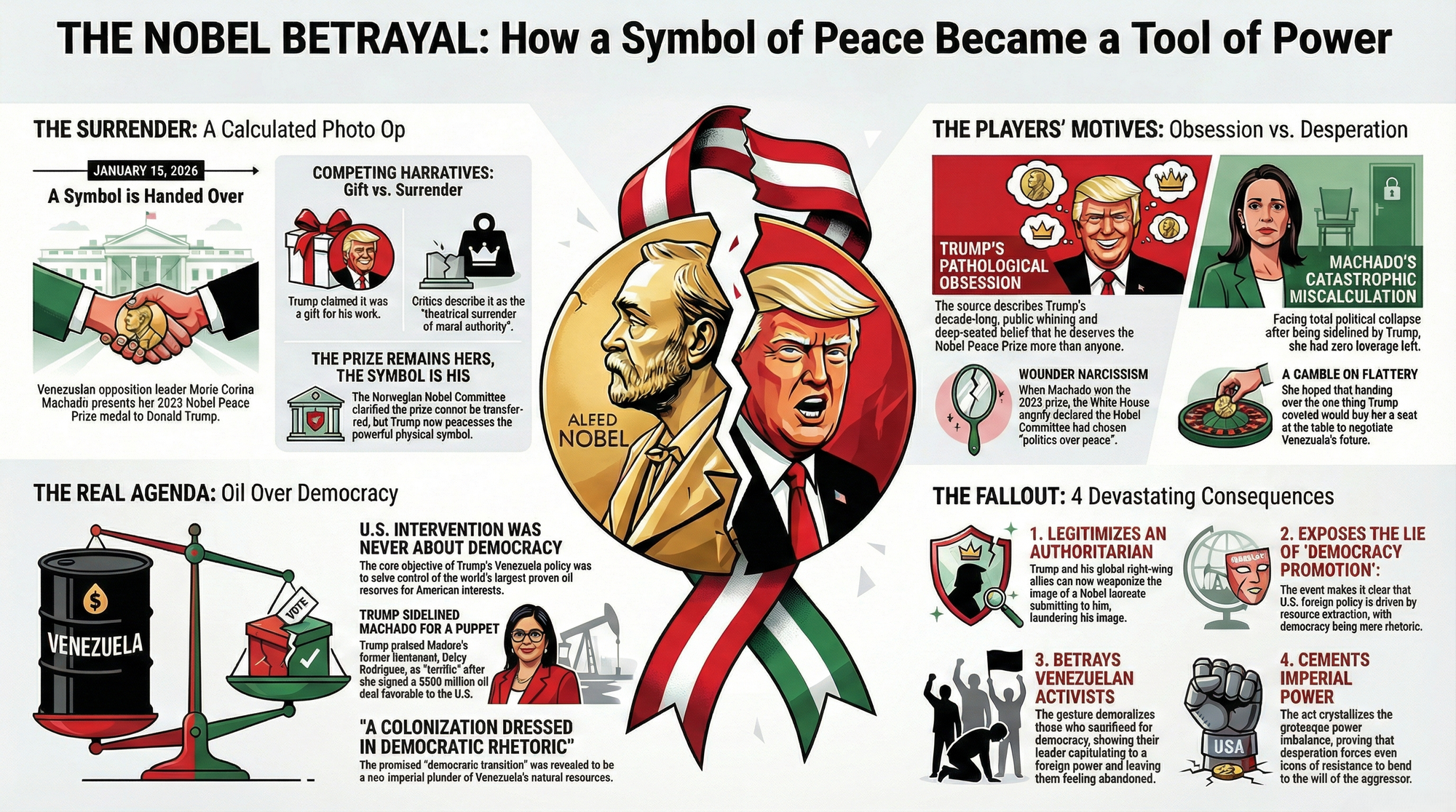
On January 15, 2026, in a calculated White House charade that took just over an hour to stage, Venezuelan opposition leader María Corina Machado did something that will haunt the cause of democracy in Latin America for decades: she handed the physical gold medal of the 2025 Nobel Peace Prize to Donald Trump—a man who represents everything the Nobel Committee’s award was meant to oppose.
This was not a “gift.” It was not “mutual respect.” It was the theatrical surrender of moral authority by a woman who had run out of leverage and was desperate enough to believe that humiliating herself before a narcissistic authoritarian might buy her a seat at a table where her country’s fate was being auctioned off to the highest bidder.
She did not transfer the prize itself. According to the Norwegian Nobel Committee, the honor is hers alone—permanently, legally, immutably. A Nobel Prize cannot be revoked, shared, or transferred. But the medal—the physical symbol—now sits in the hands of a man who has spent the last year throwing pathetic tantrums because the world’s most prestigious peace prize went to someone else. A man who represents everything Nobel laureates are supposed to resist.
Within hours, Trump was already defiling it with his boasts. “Maria presented me with her Nobel Peace Prize for the work I have done,” he posted, like a petulant child who had stolen a classmate’s trophy. “Such a wonderful gesture of mutual respect. Thank you Maria!”
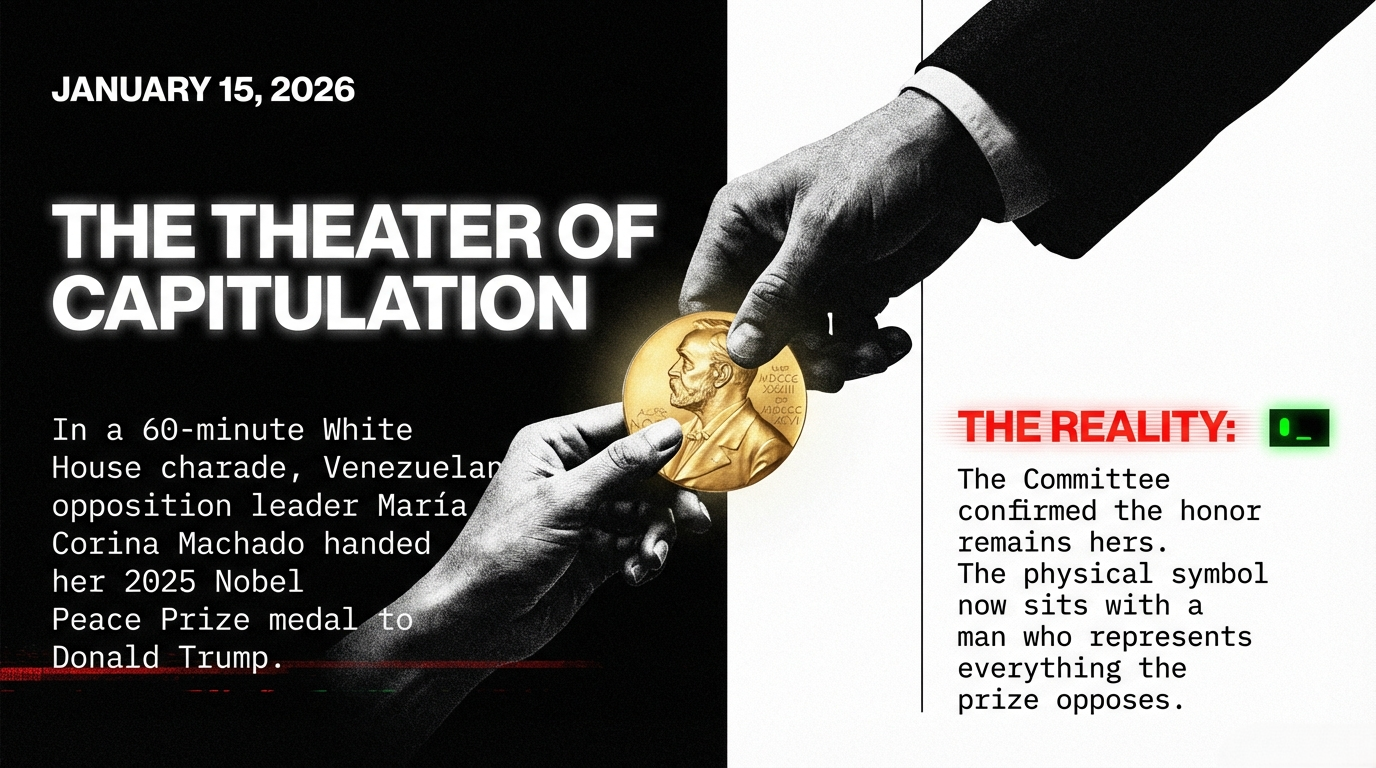
There was nothing mutual. There was only capitulation—naked, documented, and broadcast to the world as proof that even the symbols of democratic resistance can be bent to serve the appetites of imperial predators.
Trump’s Pathological Obsession with Global Validation
To comprehend the obscenity of this moment, one must first understand the depths of Trump’s psychological derangement around this award.
Trump has spent nearly a decade publicly and privately waging war on reality itself, convinced that he alone deserves the Nobel Peace Prize. He has whined—actually whined—that he “can’t think of anybody in history that should get the Nobel Prize more than me.” He attacked Barack Obama for receiving it, claiming Obama did “nothing.” He has spent countless hours telling his sycophantic advisers that the award is owed to him as cosmic justice. His narcissism is so profound, so pathological, that the award has apparently become what aides describe as a permanent occupant of his diseased mind, a wound that never heals because his capacity for self-reflection is nonexistent.
When the Nobel Committee awarded the 2025 prize to Machado in October—a woman who risked her life, who lived in hiding, who fought nonviolently against a brutal dictatorship—for her “tireless work promoting democratic rights for the people of Venezuela” and her “struggle to achieve a just and peaceful transition from dictatorship to democracy,” Trump’s White House did not accept this judgment with grace. It could not. Grace is not in his arsenal. Instead, it erupted in a fit of wounded narcissism so transparent that it should have disqualified him from any pretense of moral authority.
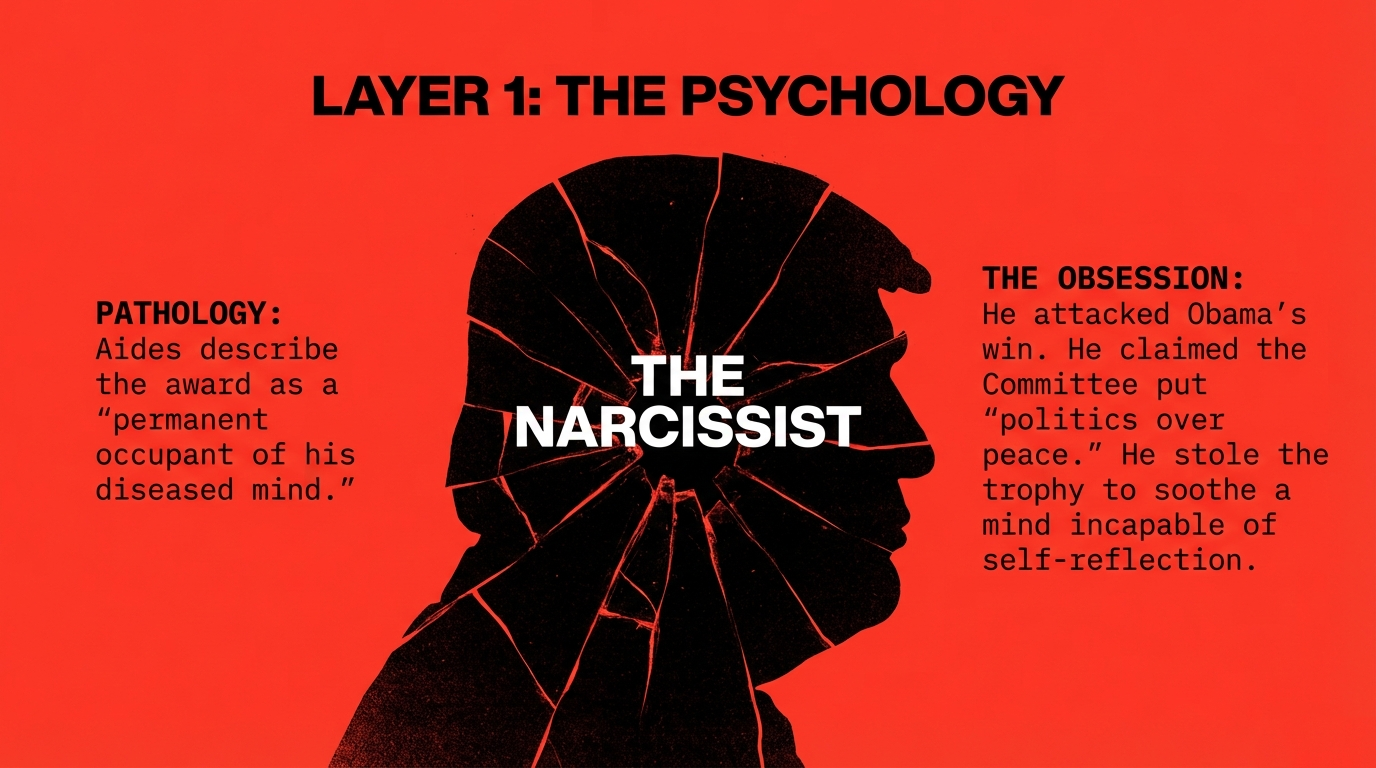
A spokesperson declared that the Committee had placed “politics over peace”—uttering this obscenity while Trump was actively orchestrating a military intervention in Venezuela, seizing oil tankers, installing a puppet regime, and ensuring that the country’s vast hydrocarbon reserves would flow north to American corporations.
The audacity was staggering. The man had ordered the removal of a foreign president by military force. He was strangling Venezuelan oil exports. He was setting up an interim government run by one of Maduro’s own lieutenants—a woman so compromised by the old regime’s crimes that even Democratic senators were publicly warning him that “repression in Venezuela was no different now than under Maduro.” And yet his regime had the gall, the cosmic gall, to call the Nobel Committee “political” for refusing to honor a man who was literally orchestrating regime change for oil.
It was not politics. It was accountability. It was the Nobel Committee, however imperfectly, recognizing that Trump is the very antithesis of what a peace prize should honor.
Machado’s Catastrophic Miscalculation: The Politics of Abjection
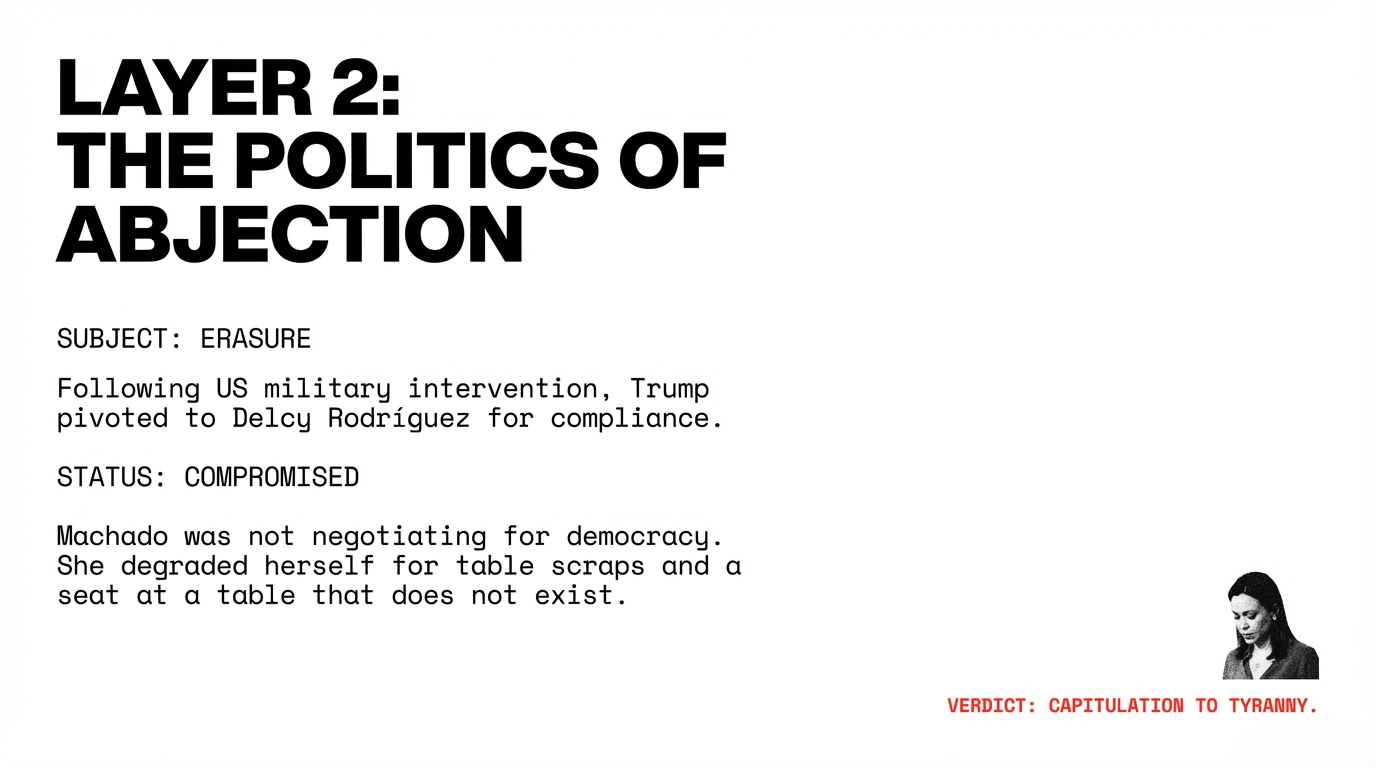
Machado’s decision to surrender the medal cannot be understood outside the context of her total political collapse. After Maduro’s military overthrow by U.S. forces—an intervention that was never really about democracy, despite the rhetoric—Trump had already decided that Machado was expendable. He had already settled on a different instrument:
Delcy Rodríguez, Maduro’s longtime lieutenant, a figure so tainted by the previous regime’s atrocities that she represented not democratic transition but authoritarian continuity with a friendlier face.
Trump praised Rodríguez as “terrific”—not because she represented democratic values, but because she signed a $500 million oil deal that put Venezuelan hydrocarbons at American disposal and released some U.S. prisoners held by the regime. The real Trump agenda—the one hidden beneath the rhetoric about “democracy” and “liberation”—is now perfectly visible: seize the world’s largest proven oil reserves and maintain absolute control over Venezuela’s future to serve American strategic interests.
Machado was not merely sidelined. She was systematically erased—her authority hollowed out, her credibility in Washington demolished, her entire political existence rendered irrelevant to the only actor that mattered: Trump.
The U.S. military had removed her rival, and now the U.S. president was installing someone more compliant. The promised “democratic transition” was revealing itself to be a colonization dressed in democratic rhetoric.
Facing this catastrophic abandonment, Machado made a calculation that would define her legacy for the worse. Rather than exposing the imperial nature of Trump’s intervention, rather than standing with Venezuelan civil society and denouncing the installation of another authoritarian, she capitulated. She decided to hand the man who had discarded her the one thing he obsessed over: a Nobel medal.
She told herself—and perhaps tells herself still—that this was “strategic.” That flattering Trump’s narcissism might buy her a seat at the table. That performing loyalty before the only power that mattered would secure concessions on elections, on prisoners, on the shape of Venezuela’s future. That she could hack the psychology of a man who has shown, his entire life, that he respects only those who bow to his will.
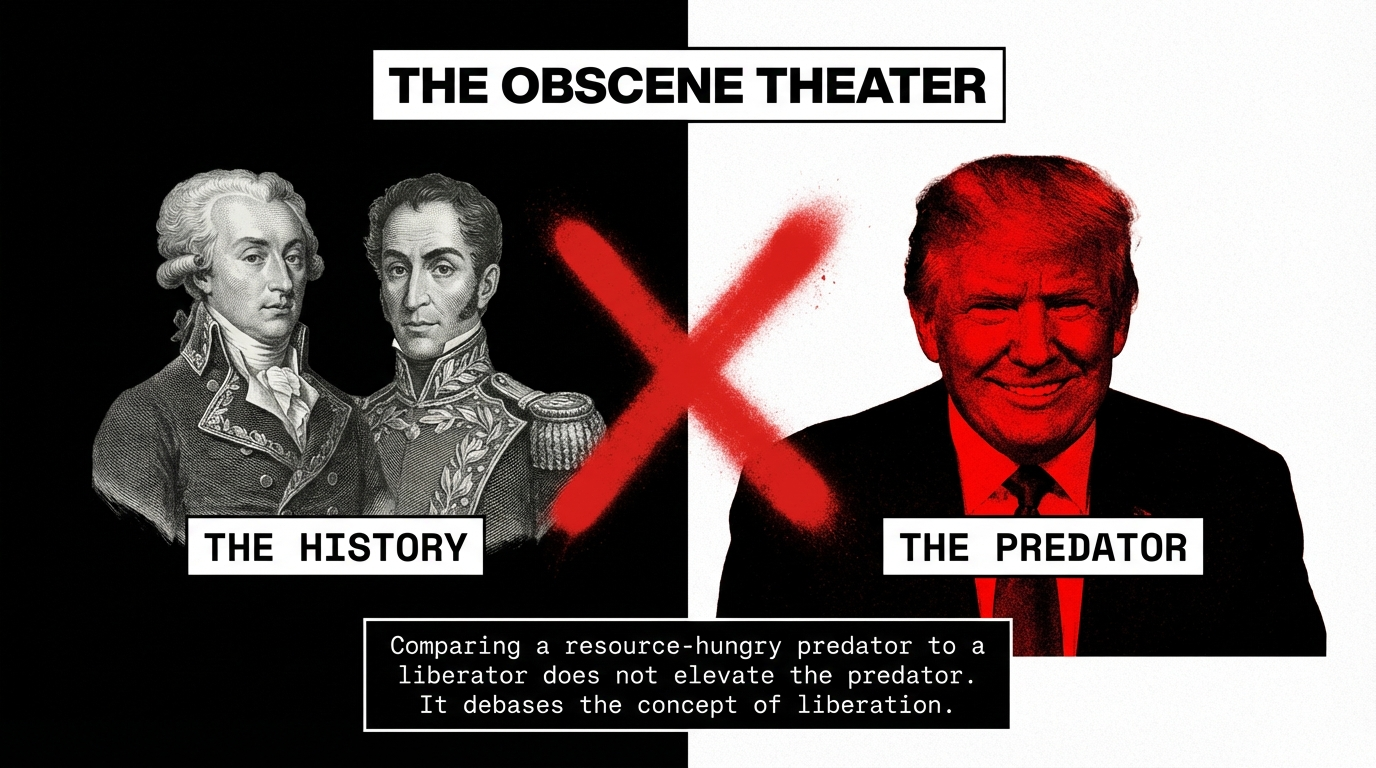
Her public justification was obscene Lafayettian theater. She invoked the historical parallel of General Lafayette giving his medal to Simón Bolívar in recognition of their “shared values” and “brotherhood” in the fight for freedom. The comparison was not merely wrong; it was an insult to the memory of actual liberators. Lafayette gave his medal to another revolutionary who fought for genuine independence. Trump is the opposite. He is a resource-hungry imperial predator dressed in a suit, using military force and sanctions to install a regime that will privatize Venezuela’s wealth and deliver its oil to American markets while crushing the very democratic aspirations the Nobel Committee honored in Machado.
She did not elevate Trump by making this comparison. She degraded herself.
Why This Obscenity Matters: The Victory of Predatory Imperialism
This moment signals something far darker than a single diplomatic embarrassment. It marks a turning point in how the American empire will conduct its business in Latin America and beyond. Here are the catastrophic implications:
First, it crystallizes Trump’s dominance over global symbols of legitimacy. A man who attempted a coup in his own country, who has incited violence repeatedly, who treats constitutional norms as inconveniences, now possesses a symbol bearing the imprimatur of the world’s most prestigious peace prize. His followers—and the networks of right-wing authoritarians watching globally—will weaponize this image endlessly. They will argue that even “the opposition” recognizes Trump’s superiority. That even a Nobel laureate understood she had to submit. The lie metastasizes into the bloodstream of global politics.
Second, it exposes the lie at the heart of American “democracy promotion.” Trump’s Venezuela policy has never been about democracy, institutions, or human rights. It is about resource extraction, plain and simple. It is about seizing the world’s largest proven oil reserves—a stunning display of 21st-century colonialism dressed in humanitarian rhetoric. By accepting the medal from a woman who has nominally championed democracy, Trump gets to perform the role of liberator while actually orchestrating neo-imperial plunder. The medal becomes a propaganda tool, a way to launder extraction as enlightenment.
Third, it humiliates and betrays every person who sacrificed for Venezuelan democracy. The Nobel Committee honored Machado for “keeping the flame of democracy burning amid a growing darkness,” for nonviolent resistance in the face of brutal state violence, for refusing to abandon the struggle even while living in exile, facing threats to her life, watching her country deteriorate under an authoritarian regime. That award represented the world’s recognition that Venezuelan citizens had fought for their freedoms against impossible odds. Now the symbol sits on Trump’s desk as a trophy of his power—proof that he can bend even the icons of democratic resistance to his will. Every activist in Venezuela watches Machado hand over the medal and understands: the Americans will not help us. The West will not help us. We are alone.
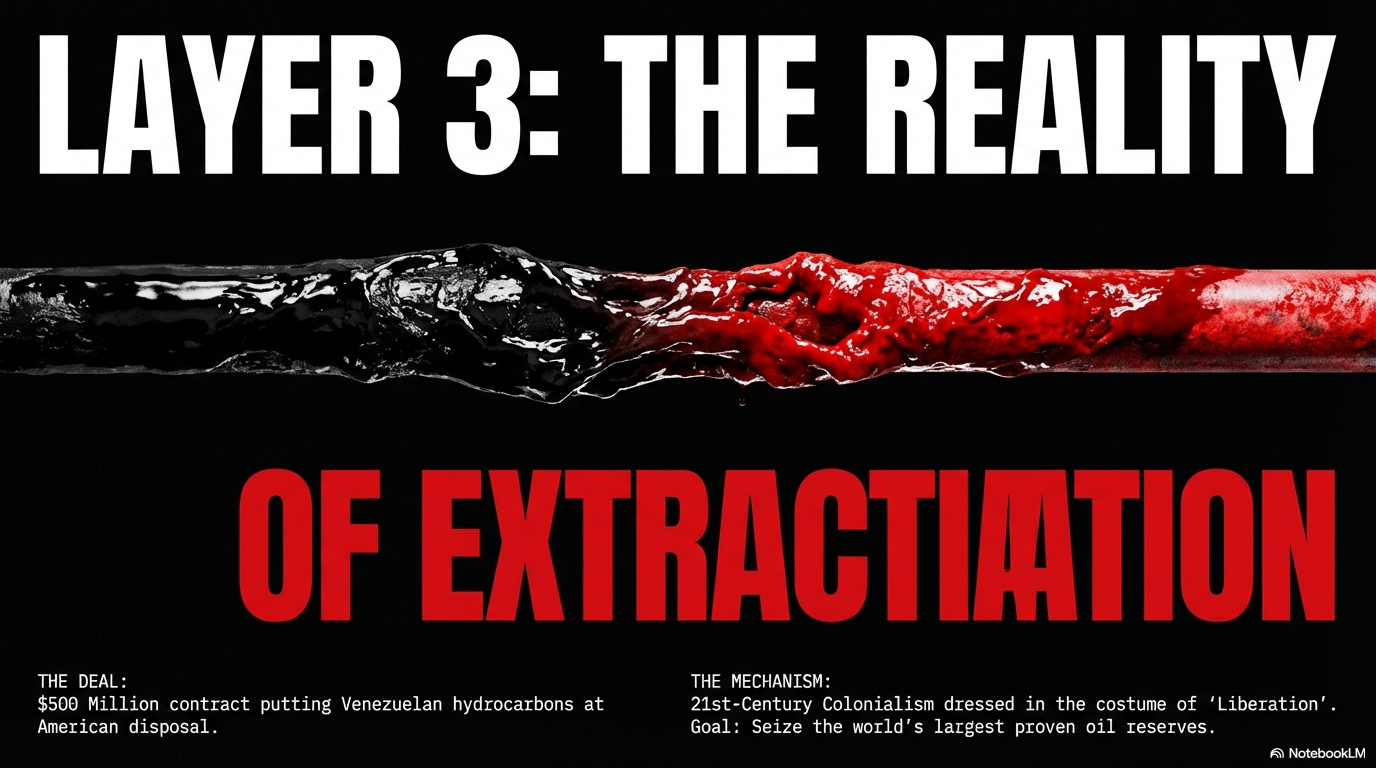
Fourth, it crystallizes the grotesque power asymmetry that will determine Venezuela’s fate. Trump controls the military assets, the sanctions apparatus, the access to global markets, the oil infrastructure, and the capacity to recognize or deny legitimacy to any government. Machado has a medal and a fading international reputation. She made the only rational choice available to a person with zero leverage: she humiliated herself, hoping for table scraps. That is not leadership. That is not courage. That is the politics of desperation—and it serves only to strengthen the hand of the aggressor.
The Poison Inside Venezuela
Machado’s surrender does not buy her influence. It destroys what remained of her credibility at home. Her earlier dedication of the Nobel to Trump had already drawn fire from Venezuelan opposition figures who understood that she had become too close to Washington. Now she has confirmed their worst fears in the most visually devastating way possible.
For Venezuelans who hoped that their opposition leader represented authentic, independent democracy—who believed she was fighting for them and not for American strategic interests—the message is final and irreversible: your leader will abase herself before a foreign power to try to secure concessions. For Chavistas and Venezuelan nationalists, the image is a propaganda windfall: the opposition is a puppet of Washington. For ordinary Venezuelans simply longing for functioning schools, medicines, and accountable governance, the episode confirms what many already feared: that elite politics is corrupt theater, that external powers will determine their fate without regard for their wishes, that their own leaders cannot be trusted.
Machado did not hand over the medal to gain leverage over Trump. She did it because she had already lost that leverage entirely. The gesture was an act of surrender—an admission that the United States, under Trump, controls Venezuela’s future, and that she was willing to demean herself and the cause of democracy itself in hopes of receiving a small place in the architecture of occupation.
The Larger Catastrophe: Democracy in the Age of Unrestrained Imperialism
This White House scene did not emerge from a vacuum. It is the logical endpoint of a decades-long trajectory in which the United States has increasingly abandoned any pretense that it cares about democracy in the Global South. It cares about resources. It cares about strategic positioning. It cares about ensuring that governments comply with American interests. Democracy is the rhetoric; extraction is the reality.
Machado’s calculation was rational—brutally so—but it was also already lost the moment it became necessary. Once you are negotiating from absolute weakness with a man whose only language is domination, whose entire worldview is transactional, whose narcissism permits no equals—you are no longer negotiating for democracy. You are negotiating for personal survival and praying that some benefit accrues to those you purport to represent.
Trump has demonstrated no concern whatsoever for elections, institutions, or Machado’s mandate as a democratic leader. He cares about oil. He cares about maintaining dominant control over Venezuela and the hemisphere. He cares about installing a compliant regime that will sign favorable contracts and suppress internal dissent. He was already content to let Rodríguez—a woman implicated in the crimes of the previous regime—remain in power as long as she delivered resources and compliance. One medal was never going to change the calculus of imperialism.
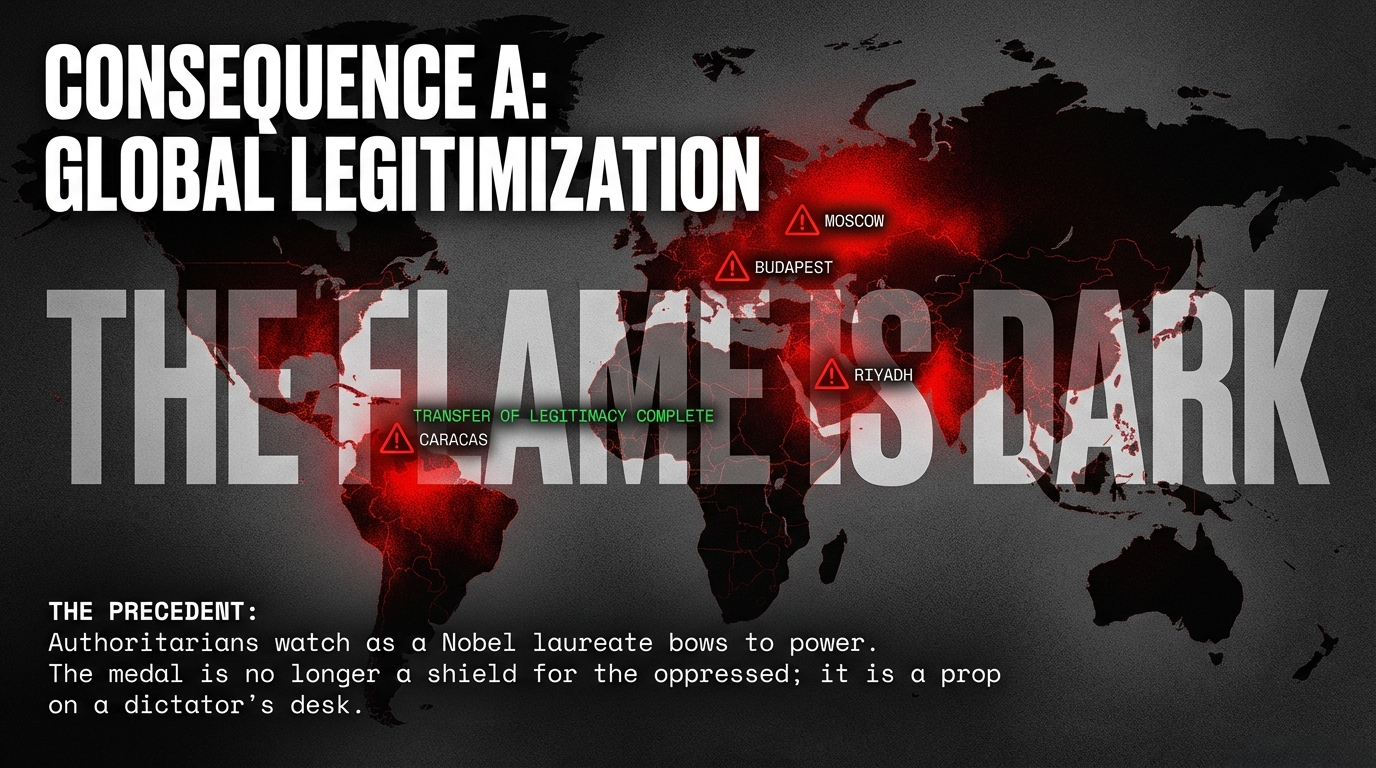
What the medal did change was Machado’s story. She transformed, in the course of a lunch meeting, from a woman who had kept the flame of democracy alive into a woman who handed that flame to the darkness—because the darkness held the guns, the money, and the power to determine her country’s future.
The Unspoken Sequel: What Comes Next
If Machado’s capitulation buys her any marginal influence over Venezuela’s transition—a few more political prisoners released, marginally stronger commitments to elections that will be meaningless anyway, a ceremonial seat on some transitional council—then the damage will have been justified by pragmatism in the minds of those who already wanted to believe in the illusion of American benevolence.
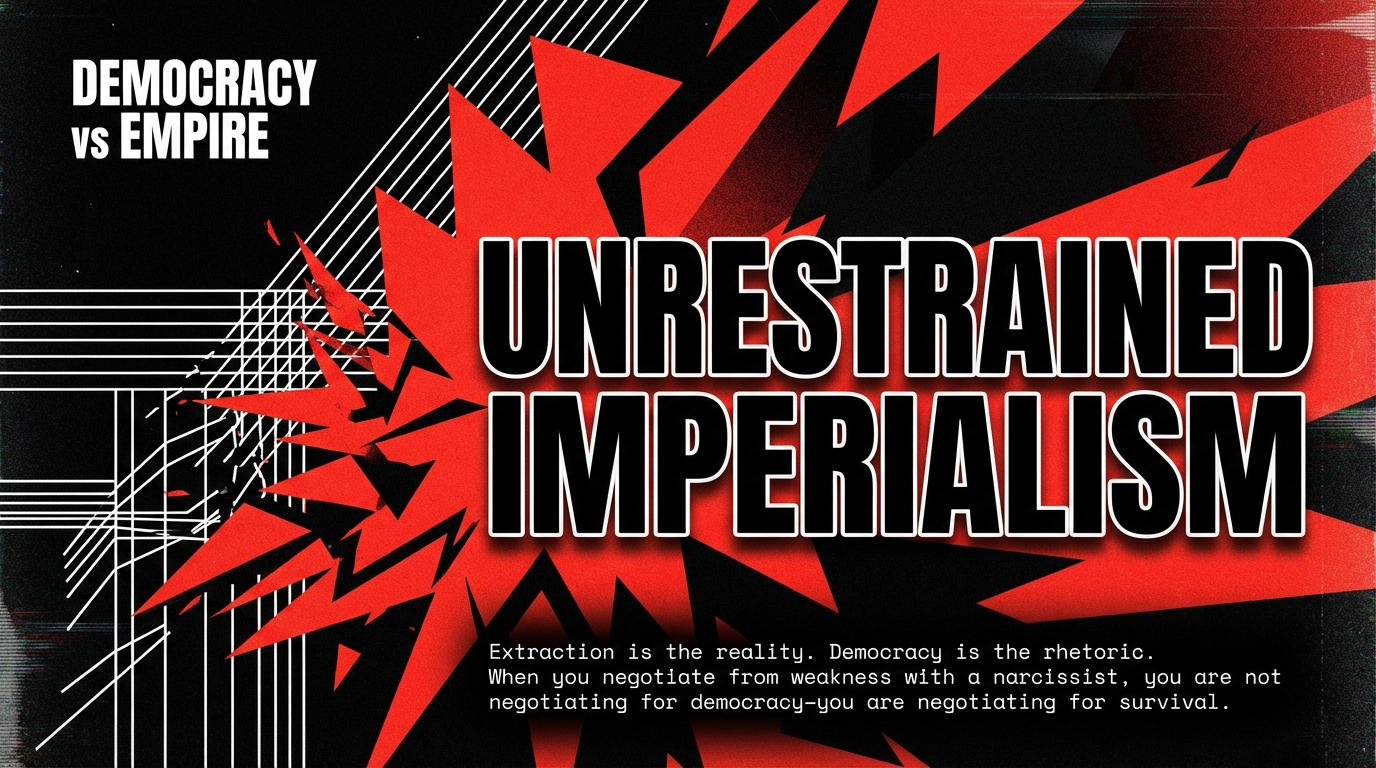
But the price will compound across years and decades. Every time Trump brandishes the medal at a rally or posts about it on social media, Machado’s association with his regime deepens. Every time his sycophants point to the image as proof that even the opposition understands his greatness, the precedent hardens. Every time an authoritarian leader across the globe studies this moment—how easily a Nobel laureate can be bent, how a symbol of resistance can be converted into an instrument of power—the lesson is learned and replicated.
The Norwegian Nobel Committee has issued a clarification: Machado is and remains the sole laureate. The title belongs to her alone. The institution is legally protected.
But symbolically, morally, and institutionally, something irreversible has been transferred. A woman who embodied democratic resistance has become a monument to imperial power—not defeated through force, but seduced through flattery, fear, and the desperate gamble that bending the knee to a tyrant might buy a marginal place at a table where her country was already being auctioned off.
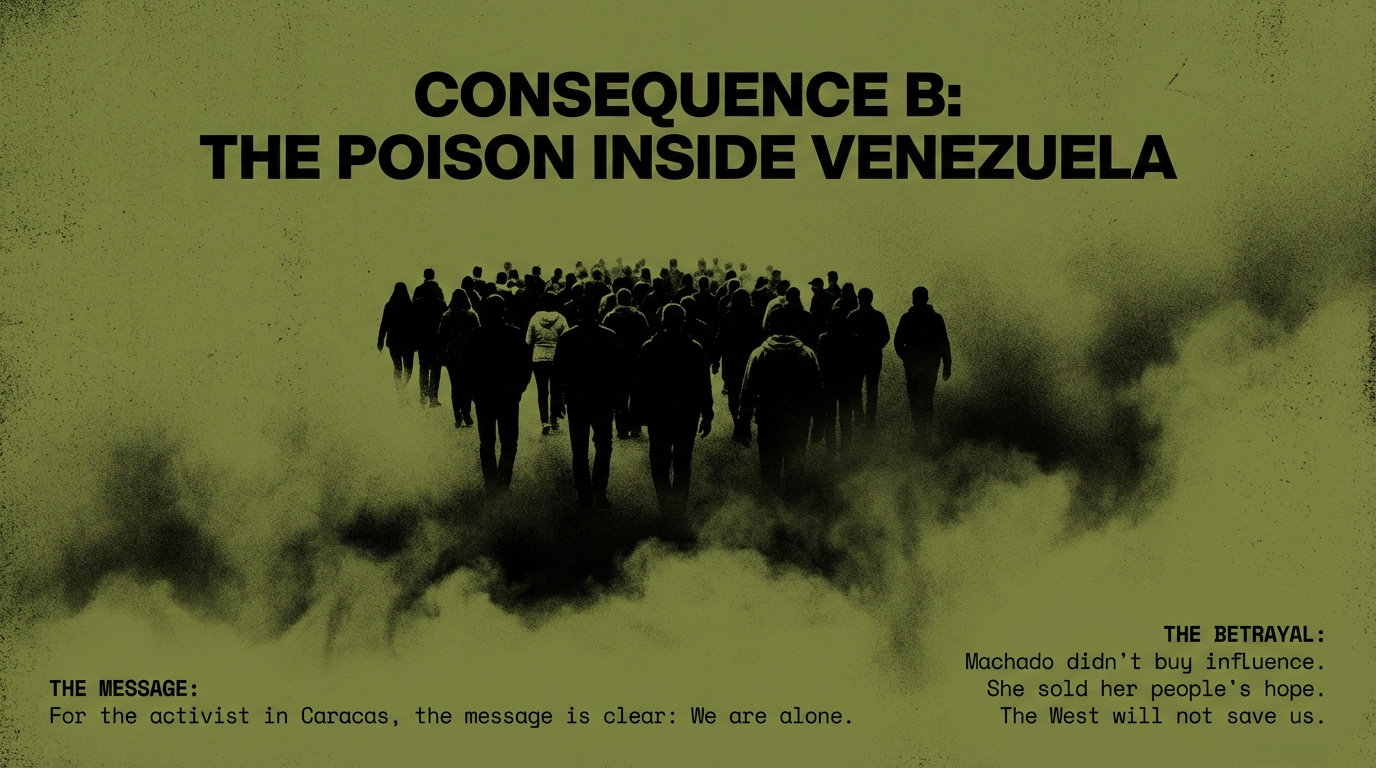
That should horrify anyone who still believes democracy can survive in a world where Trump controls the most powerful military on earth.
On Supporting This Work
Every koha—every voluntary contribution—signals that whānau are ready to fund the accountability that Crown and corporate structures will not provide. It signals that rangatiratanga includes the power to fund our own truth tellers and to name the systems of colonial extraction that silence our voices.
Kia kaha, whānau. The empire counts on our silence. It depends on our demoralization. But our job is to stay vigilant, stay connected, and stay angry enough to see clearly.
Three pathways exist for support:
For those who wish to support this mahi directly with a koha (voluntary contribution), please visit the Koha platform: https://app.koha.kiwi/events/the-maori-green-lantern-fighting-misinformation-and-disinformation-ivor-jones
For those who wish to receive essays directly and support through subscription, join the Substack community: https://themaorigreenlantern.substack.com/subscribe
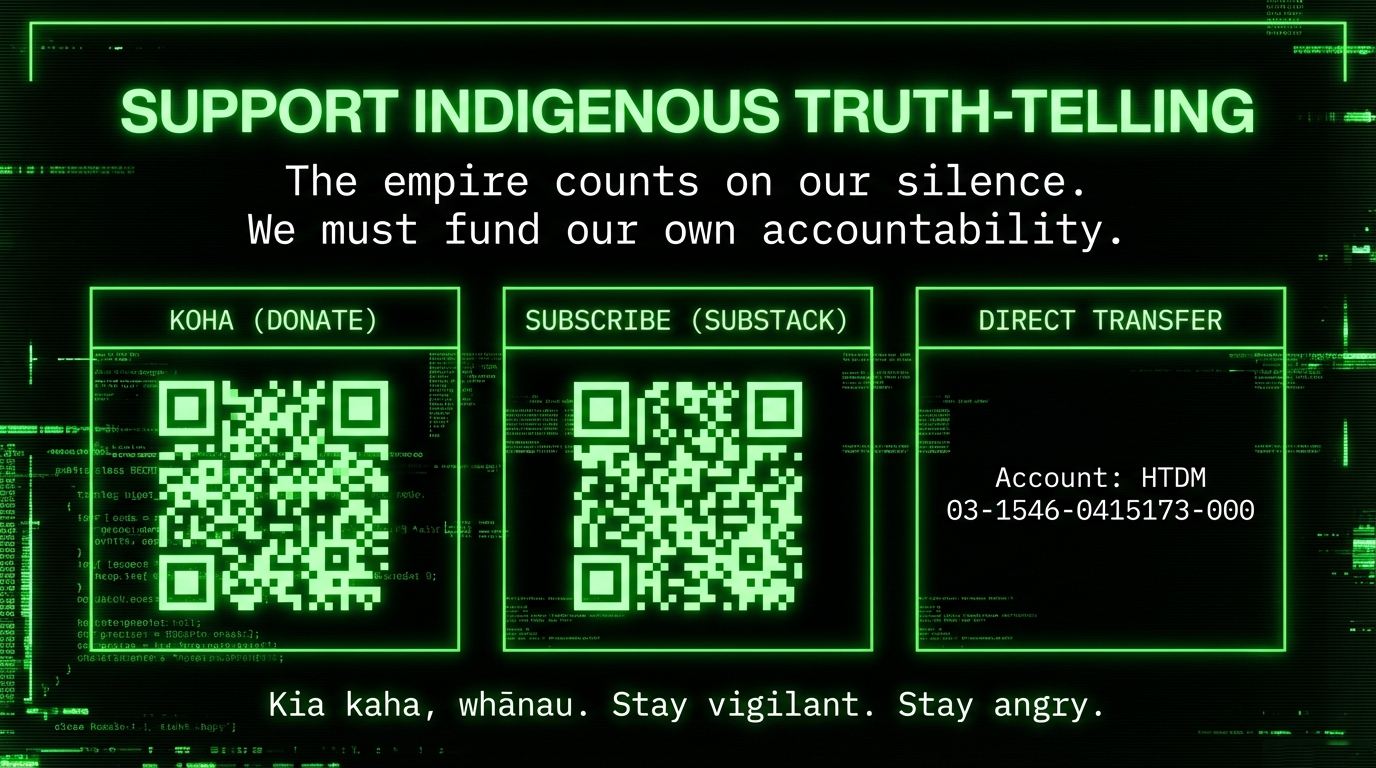
For those who prefer direct bank transfer, account details are: HTDM, account number 03-1546-0415173-000.

Ivor Jones The Māori Green Lantern Fighting Misinformation And Disinformation From The Far Right