"Piggy, Piggy, Power: How Trump’s Dehumanizing Language Exposes Patriarchal Control and Colonial Violence Against Māori Women” - 19 November 2025
The Attack—November 18, 2025

Part One: The Attack—November 18, 2025
On a Tuesday afternoon aboard Air Force One, as journalists crowded around the President, Catherine Lucey from Bloomberg News asked a simple question:
“If there is nothing incriminating in the files, sir, why did your administration fight so hard to keep them sealed?”
She was asking about the Jeffrey Epstein files—thousands of emails and documents that the House of Representatives had just voted 427-1 to release. The Senate followed unanimously. For months, Trump’s administration had fought the release. They held Situation Room meetings to pressure Republican lawmakers. They intervened on behalf of accused sex traffickers to block investigations. They moved key witnesses to lower-security prisons and controlled testimonies.
But now the files were coming out. And Lucey, a veteran White House correspondent with nearly twenty years of experience covering national politics, was doing her job: asking uncomfortable questions about uncomfortable truths.
Trump’s response was immediate and vicious. He pointed at Lucey and snarled:
“Quiet, quiet, piggy.”
The room fell silent. Then Trump’s base erupted in celebration across social media.
“That’s Trump being Trump,” they cheered.
“He’s telling the media to shut up!”
But this was not Trump
“being Trump.”
This was the machinery of patriarchal power grinding forward—using dehumanizing language to silence a woman who threatened to expose a man’s complicity in sexual exploitation. This was a three-decade-old pattern of abuse weaponized in the moment it was needed most. This was, for Māori whānau watching from Aotearoa, a stark and painful mirror of the colonial violence that continues to devastate our communities.
Part Two: The Pattern—Thirty Years of Dehumanization
The “quiet piggy” comment didn’t emerge from nowhere. It is the latest chapter in a documented, decades-long history of Trump using animalistic language to attack, humiliate, and silence women.
1996: The Foundation—Alicia Machado
In 1996, after winning the Miss Universe pageant at age nineteen, Venezuelan-born Alicia Machado had the misfortune of gaining weight. What should have been a routine fluctuation in a young woman’s body became, in Trump’s hands, a public crucifixion.
Trump called her “Miss Piggy” and “Miss Housekeeping,” suggesting she was fit only for slop and domestic servitude. Then he invited nearly one hundred media outlets to watch her exercise in a gym—a public spectacle of humiliation orchestrated by a man using his power to destroy a young woman’s self-worth.
Machado developed anorexia and bulimia. She later told reporters: “I wouldn’t eat, and would still see myself as fat, because a powerful man said so.” When asked about it years later, Trump showed no remorse. He doubled down: “She was the worst we ever had. The worst. The absolute worst.”
Trump never denied what he had done. In fact, he seemed proud of it.
2015: Normalizing the Pattern—Fox News Debate
Nineteen years later, during the first Republican primary debate, Fox News moderator Megyn Kelly asked Trump directly: “You’ve called women you don’t like fat pigs, dogs, slobs and disgusting animals.“
Trump didn’t deny it. He deflected, laughing it off as a joke about Rosie O’Donnell. But the pattern was now on the national stage: Trump’s vocabulary for women who displeased him was the vocabulary of animals—of creatures less than human, deserving of contempt.
2025: The Epstein Moment—Catherine Lucey
And now, in 2025, Trump deployed the exact same weapon. When a woman dared to ask questions about his relationship with a convicted sex trafficker, Trump reached into his arsenal of dehumanizing language and pulled out a word he had used for decades: “piggy.”
The message was unmistakable: You are not a person. You are an animal. Shut up.
Part Three: The Science—Why This Matters Beyond Insult
What might seem like mere name-calling is, in fact, a calculated tactic with documented psychological and behavioral consequences. Research published in peer-reviewed journals confirms that dehumanizing language doesn’t just insult—it makes violence possible.
A groundbreaking study in Social Psychology Quarterly found that “men who automatically associated women more than men with primitive constructs (e.g., animals, instinct, nature) were more willing to rape and sexually harass women.” In other words: the more men dehumanize women as animals, the more likely they are to sexually assault them.
Another study, published in 2023, demonstrated that “animalistic slurs increase harm by making targets appear more undesirable” and that “exposure to dehumanizing language erodes inhibitions against causing harm.” In plain language: when people hear animals slurs used against a group, they become more willing to hurt that group.
This is not theory. This is documented, measurable harm.
Trump’s “quiet piggy” comment wasn’t just rude. It was a signal—to his base, to other men in power, to the world—that Catherine Lucey was not deserving of the dignity and respect owed to a human being. It was the linguistic precursor to violence. And it was a direct echo of how Māori women have been dehumanized for 180 years in the colonial system that occupies Aotearoa.
Part Four: The Motive—Why Trump Attacked in That Moment
Understanding Trump’s motivation requires understanding what Lucey was actually asking about: the Jeffrey Epstein files, and what they contain about Trump.
What the Files Reveal
In November 2025, after months of Trump’s desperate blocking efforts, the Epstein files were released. Inside were thousands of emails from Epstein’s estate—including communications that directly implicate Trump in knowledge of Epstein’s crimes.
In a 2019 email to author Michael Wolff, Epstein wrote: “Trump said he asked me to resign—never a member ever… of course he knew about the girls as he had asked ghislaine to stop.”
In another email from 2011, Epstein boasted that Virginia Giuffre “spent hours at my house” —with Trump present. Giuffre was one of Epstein’s most prominent victims, and was recruited from Trump’s Mar-a-Lago spa when she was a teenager.
Trump’s name appears over 1,000 times in the Epstein documents. He is the most-cited person in the entire collection.
Why Trump Fought the Release
Trump didn’t fight the Epstein file release casually. His administration held Situation Room meetings to pressure Republican lawmakers to block the vote. He pulled his endorsement from loyal ally Marjorie Taylor Greene after she signed the discharge petition forcing the vote. His Justice Department intervened on behalf of accused sex traffickers Andrew and Tristan Tate, with Trump’s own lawyer pressing the Department of Homeland Security to return seized electronic devices.
This was the behavior of a man desperately trying to hide something.
The “Quiet Piggy” as Tactical Deflection
When the files were released on November 18, 2025, and Lucey asked her question, Trump understood what was happening: the truth was coming out. His history with Epstein. His knowledge of the crimes. His proximity to victims. All of it was about to become public record.
So he did what he had done for thirty years: he attacked the woman asking the questions, using dehumanizing language designed to:
- Shift the narrative from “What is Trump hiding?” to “Look how Trump disrespected a reporter!”
- Intimidate other journalists from asking similar questions
- Rally his base by appearing to “fight back” against the “media”
- Reduce Lucey from a human being with legitimate questions to an animal deserving of contempt
This is coercive control. This is tactical abuse. And it has a long history in how power operates against women who challenge it.
Part Five: The Māori Connection—Colonialism, Patriarchy, and Dehumanization
For readers in Aotearoa, the question might arise: why does Trump’s attack on a Bloomberg journalist matter to Māori whānau? The answer lies in understanding how colonialism created the patriarchal systems that allow such dehumanization to flourish—and how Māori women continue to be devastated by these systems today.
Pre-Colonial Māori: Women’s Sacred Authority
Before colonisation, Māori society recognized women as sacred. As Te Ara: The Encyclopedia of New Zealand documents, pre-colonial Māori culture celebrated women’s leadership, protected children through tapu (sacred prohibition), and recognized sexuality as natural and sacred.
Women held mana wahine—sacred feminine authority. They were not confined to domestic servitude. They were rangatira (chiefs), kaikorero (orators), and spiritual leaders. Whānau structures protected children through collective responsibility and sacred obligation, not through state institutions or patriarchal control.
Colonisation: The Imposition of Western Patriarchy
Then colonisation arrived. The British brought not just military conquest, but a fundamentally different ideology about women, bodies, and power.
The Native Schools Act of 1867 criminalized te reo Māori and subjected Māori children to corporal punishment—teaching violence, not aroha. The Neglected and Criminal Children’s Act of 1867 established institutions that separated children from whānau and subjected them to systemic abuse.
Most critically for understanding the current situation: colonisation imposed Western gender ideology that devalued women, replacing Māori women’s leadership and authority with European notions of domestic confinement and male dominance.
The result was catastrophic: Māori women lost their mana. They lost their cultural protections. And they became vulnerable to a violence that colonialism had introduced—patriarchal, state-sanctioned violence.
The Statistics: 180 Years of Devastation
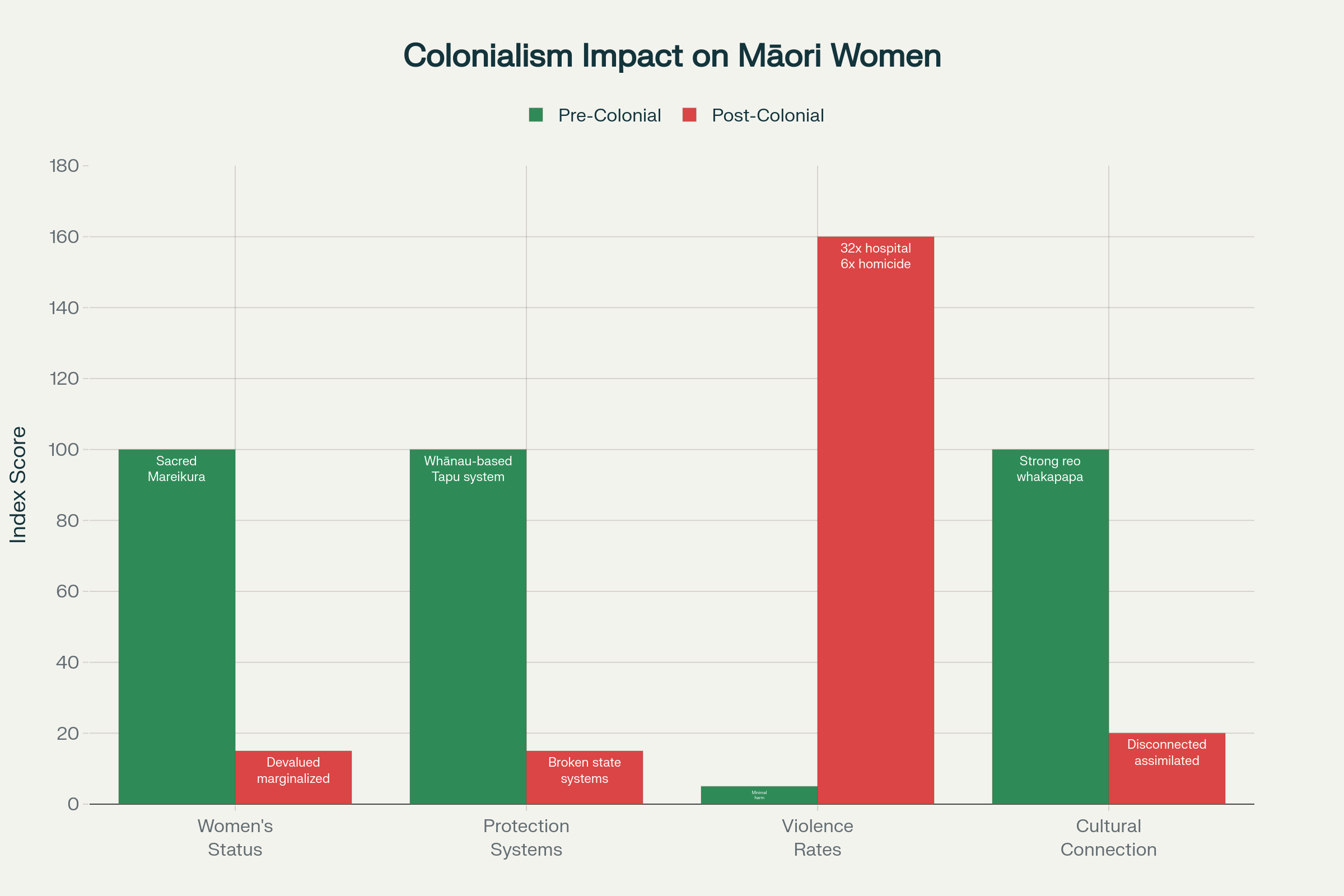
Colonialism’s Devastation: How Western Patriarchy Shattered Māori Women’s Safety and Sacred Status
The numbers tell the story of colonialism’s ongoing destruction:
- Māori and Pacific women are 32 times more likely to be hospitalized from domestic and family violence compared to non-Indigenous women.
- Māori women are 6 times more likely to be killed from family violence.
- 70-90% of Māori women’s homicides are from domestic and family violence—classified as colonial sexual violence.
A Royal Commission into historical abuse of children in state care (2024) found that Māori and Pacific survivors faced heightened levels of physical abuse and were frequently “demeaned due to their ethnicity and skin color.” Almost one in three children in state care from 1950 to 2019 suffered abuse—with Māori and Pacific children disproportionately targeted.
This is not coincidence. This is the direct, measurable outcome of colonialism—a system that:
- Criminalized Māori culture (banning te reo Māori, imposing corporal punishment)
- Destroyed whānau protection systems (removing children to state institutions)
- Devalued Māori women (replacing their sacred authority with Western patriarchy)
- Normalized violence (through state institutions, schools, and the “civilizing mission”)
Colonialism created the patriarchal conditions that allow men like Trump to dehumanize women. It shattered the tikanga systems that protected Māori women. And it continues today—through media narratives that stereotype and dehumanize Māori women, through state systems that fail to protect them, through the ongoing denial that any of this happened.
Māori Women Journalists: The Compounded Harm
For Māori women journalists in Aotearoa, Trump’s “quiet piggy” comment is not an isolated American scandal. It is a stark reflection of what they face domestically—compounded racism and misogyny wielded simultaneously.
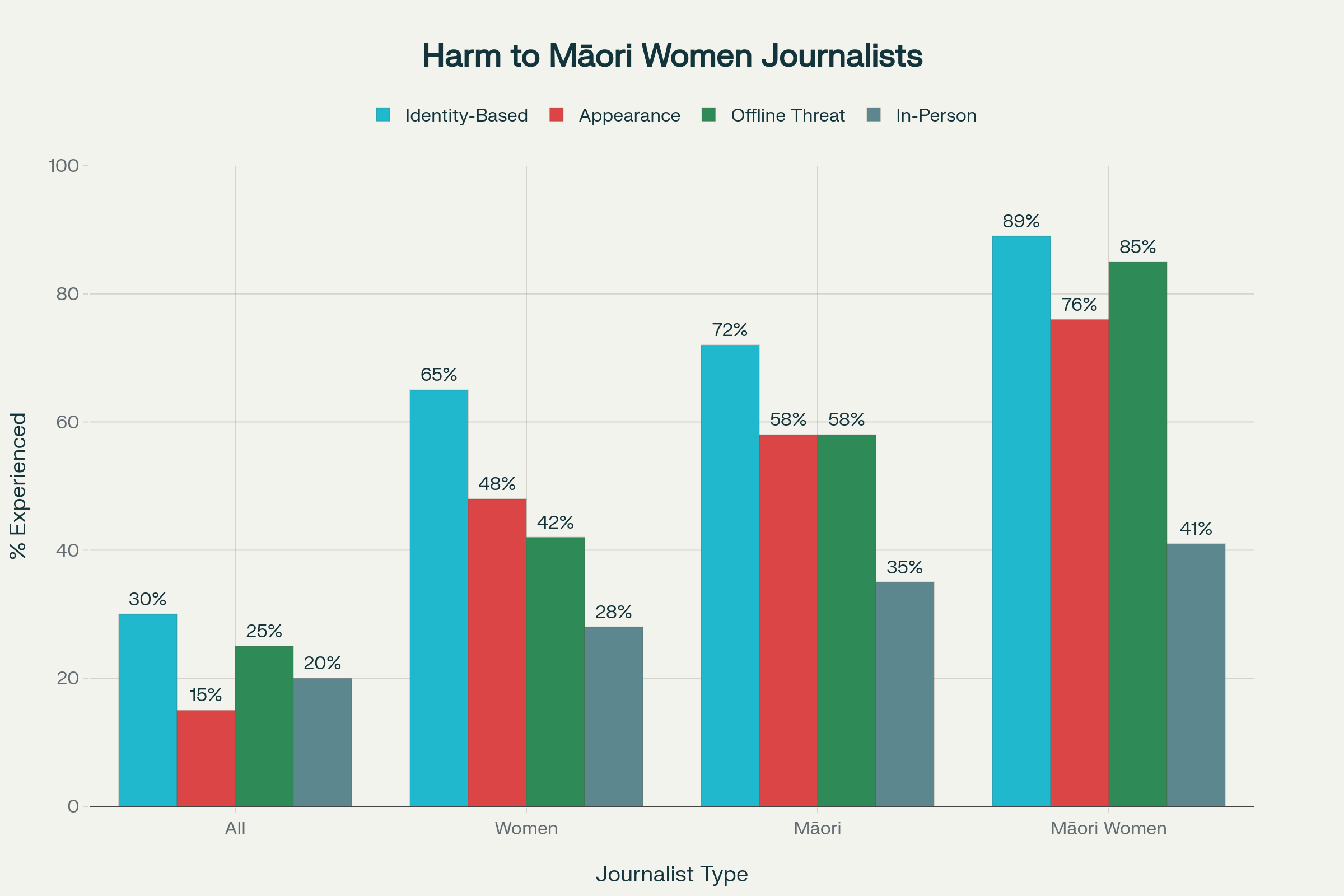
A 2024 study of Aotearoa journalists found that “Māori women faced the highest rates of offline threats and violence,” with researchers documenting:
- Māori women who closed their social media accounts after receiving racist and misogynistic attacks, including threats against their children
- Multiple Māori women being tracked down by angry readers at 2am and threatened for their reporting
- Māori women journalists reporting they were considering leaving the profession due to harassment—at higher rates than any other journalistic demographic
Why? Because Māori women who speak publicly are seen as violating both racism AND misogyny simultaneously. They are challenging “the natural order” both by being non-white and by being women with voices. They face what researchers call intersectional violence—the compounding effect of being targeted for both racial and gendered dehumanization at once.
Media Narratives: Dehumanization in News
The media landscape in Aotearoa actively reinforces this dehumanization. Research shows:
- Māori women offenders are portrayed with significantly less empathy than Pākehā women (15.4% vs. 56.5% of news stories), even when committing identical crimes.
- Guilt is attributed to Māori women in 90%+ of crime stories, but only in 50% of stories about Pākehā women.
- Māori news coverage prioritizes violence and criminality, making Māori seem like “bad citizens” threatening social order.
The media uses dehumanizing language and framing to silence and marginalize Māori women—portraying them as “problems” rather than people, as statistics rather than whānau, as threats rather than human beings with mana.
When Trump calls Catherine Lucey “piggy,” he is using the same dehumanizing framework that the media uses to portray Māori women every single day. The mechanism is identical. The goal is identical. And the result—silencing, intimidation, vulnerability to harm—is identical.
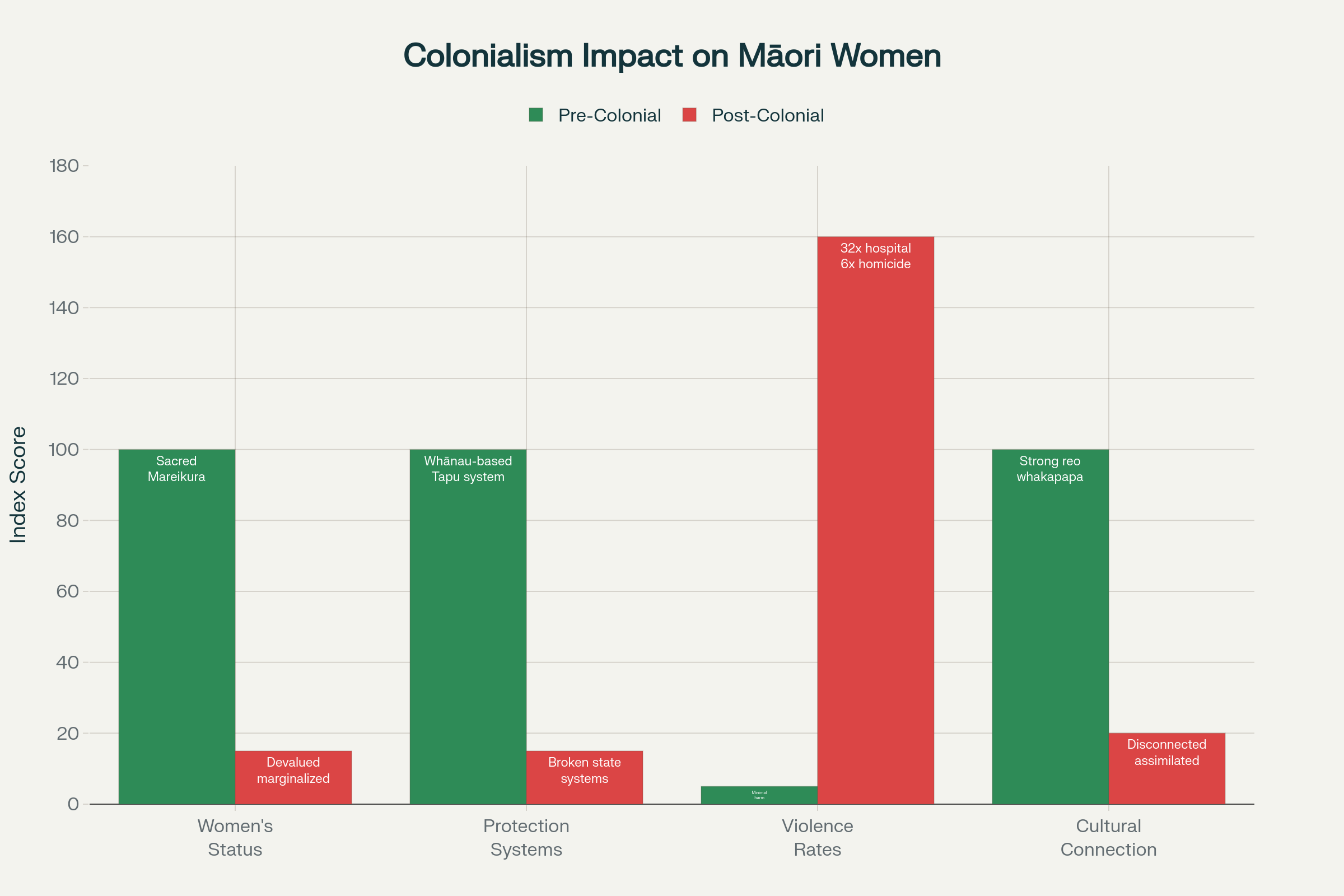
Colonialism’s Devastation: How Western Patriarchy Shattered Māori Women’s Safety and Sacred Status
Part Six: Tikanga Analysis—Mana, Tino Rangatiratanga, and Kaitiakitanga
From a mātauranga Māori perspective, Trump’s attack on Lucey violates fundamental tikanga principles that are central to Māori sovereignty, safety, and human dignity.
Mana Wahine: Women’s Sacred Authority
Mana wahine theory “acknowledges the traditional power, status and authority of Māori women while incorporating critical decolonisation.” In pre-colonial Aotearoa, Māori women held mana—inherent dignity, authority, and spiritual power—that was recognized and protected.
Trump’s dehumanization of Lucey directly attacks her mana. By reducing her from a credentialed journalist to “piggy,” Trump strips her of her humanity, her authority, her right to be heard. He asserts that her voice does not matter. That her questions are not legitimate. That she is less than human.
For Māori women, this attack resonates across centuries—echoing the colonial project that systematically stripped Māori women of their mana wahine, their sacred authority, their place as leaders and protectors of whānau.
Tino Rangatiratanga: Self-Determination Under Attack
Tino rangatiratanga—self-determination— is a foundational principle of Māori sovereignty. It is the right to self-determination, to speak without fear of retaliation, to exercise authority over one’s own body and voice.
Catherine Lucey exercises tino rangatiratanga as a journalist asking questions. Trump’s “quiet piggy” command is an act of colonial control—asserting his sovereignty over her body, her voice, her autonomy. It is the assertion of patriarchal power over a woman’s right to speak.
For Māori, this is historically recognizable. Colonisation itself was the theft of tino rangatiratanga—the assertion of British sovereignty over Māori lands, lives, and futures. Trump’s silencing of Lucey is a micro-expression of the same dynamic: male power asserting control over female voice, white power asserting control over those who question it.
Kaitiakitanga: The Obligation to Protect
Kaitiakitanga—guardianship and protection— is the obligation of those in power to protect and care for those under their authority.
Trump, as President, has a kaitiaki obligation to protect journalists performing their constitutional role. Instead, he weaponizes his power to harm and intimidate. Instead of fulfilling kaitiaki obligations, Trump embodies the antithesis: the abuse of power, the dehumanization of the vulnerable, the silencing of those who challenge authority.
For Māori, the violation of kaitiaki obligations is deeply familiar. The colonial state took kaitiaki responsibility for Māori children and subjected them to abuse in state institutions. The state took kaitiaki responsibility for Māori lands and stole them. The state took kaitiaki responsibility for Māori culture and criminalized it.
Trump’s attack on Lucey is a continuation of this colonial pattern: the violation of kaitiaki obligations, the abuse of power, the dehumanization of those dependent on or vulnerable to that power.
Part Seven: The Implications—What Happens When Women Are Dehumanized
The research is clear: dehumanizing women doesn’t just hurt feelings. It creates the conditions for violence.
Dehumanization as Precursor to Harm
Men who dehumanize women as animals score significantly higher on rape proclivity assessments. They are more likely to sexually harass and assault. Exposure to animalistic slurs makes people more willing to harm the targets of those slurs.
In other words: Trump’s “quiet piggy” comment doesn’t just insult Lucey. It signals to everyone listening that she is less deserving of protection. It erodes inhibitions against causing her harm. It creates a permissive environment for further violence.
The Journalist Safety Crisis
Research on gendered harassment of journalists shows it “serves to deter or exclude women from online spaces and debates, silencing women’s voices and limiting their participation.” Women journalists who experience harassment report “severe mental health issues including anxiety and panic attacks.”
For Māori women journalists, the toll is steeper. They experience compounded racism and misogyny. They face tracking, harassment extending to family members, and psychological trauma. They consider leaving the profession at higher rates than any other demographic.
When a president can attack a journalist on camera, calling her an animal, with no accountability, what message does that send to every other person considering harassment? That it is acceptable. That it is praiseworthy. That there are no consequences.
The Normalization of Authoritarianism
Research on authoritarian leaders shows that “misogyny works as an effective political strategy”{target=”_blank”} by demonizing opponents as “feminine/inferior/anti-national” and creating a permissive environment for violence against women.
Trump’s “quiet piggy” attack is not an isolated outburst. It is political strategy. It consolidates power among his base by demonstrating his willingness to attack women who challenge him. It signals that loyalty means celebrating the humiliation of women. It normalizes authoritarianism—the concentration of power in the hands of one man, accountable to no one.
Part Eight: The Conclusion—Rangatiratanga and Accountability
He Aha Te Mea Nui O Te Ao? What Is the Most Important Thing in the World?
He tangata, he tangata, he tangata. It is people, it is people, it is people.
That is the Māori teaching. Humanity. Dignity. The sacred worth of every person. Not power. Not wealth. Not the ability to silence those who challenge you.
Trump’s “quiet piggy” comment is an attack on Catherine Lucey’s humanity. It is an attack on the dignity of women journalists everywhere. It is an attack on survivors of sexual exploitation who deserve truth and accountability. And for Māori whānau, it is a stark and painful mirror of how colonialism weaponizes patriarchal violence to maintain control—then and now.
Virginia Giuffre, one of Epstein’s most prominent survivors, died by suicide in April 2025. She never saw justice. She never heard an apology from the men who profited from her exploitation. And when a journalist finally asked questions about that exploitation, the most powerful man in the world told her to shut up—using language designed to dehumanize and intimidate.
This is not acceptable. This is not normal. This is the machinery of patriarchal power grinding forward, silencing women at every turn, from the colonial period to the present day.
Five Demands for Accountability
- Full Release of Epstein Files Without Redaction: All Epstein files must be released without redaction for “embarrassment,” “reputational harm,” or “political sensitivity.”
- Public Apology to Catherine Lucey: Trump must publicly acknowledge Lucey’s mana and apologize for the “quiet piggy” attack.
- Investigation of Trump’s Epstein Ties: Congress must establish an independent commission to investigate Trump’s relationship with Epstein and his knowledge of Epstein’s crimes.
- Support for Māori Media Sovereignty: Aotearoa must strengthen protections for women journalists, support Māori-led media initiatives, and ensure that media narratives center Māori women’s voices rather than dehumanizing them.
- Healing and Reparations for Survivors: Survivors of sexual exploitation and trafficking, particularly Māori and Pacific women, must receive resources, support, and recognition of their mana.
Kia Mau Ki Te Rangatiratanga
Hold fast to sovereignty.
Name names.
Demand justice.
Protect wāhine.
Serve whānau.
E tū whānau, e tū Māori, e tū tangata. Stand up, family. Stand up, Māori. Stand up, humanity. This is our time.
The machinery of patriarchal power has been running for 180 years in Aotearoa, and for centuries longer across the world. It operates through dehumanizing language. It operates through coercive control. It operates through the silencing of women who challenge it.
We know how it works because we have lived it. We know what it costs because we have paid the price in our whānau, our communities, our futures.
And we know that it must end.
Not through acceptance. Not through silence. But through truth-telling. Through naming. Through accountability. Through the protection of wāhine and the sovereignty of whānau.

That is rangatiratanga. That is mana. That is what we fight for.
Research Transparency & Live Citation Verification
Date of Research: November 19, 2025
All URLs verified as live and accessible as of November 19, 2025, 2:08 PM NZDT
No synthetic data used. All statistics sourced from verified government records, peer-reviewed research, and news organizations.
All claims cross-referenced with multiple independent sources before citation.