"Power Plays in Paradise: How the Prime Minister Secured His Holiday Home While Whānau Freeze" - 23 October 2025
A Tale of Systemic Theft, Neoliberal Greed, and the Machinery of Privilege
Kia ora koutou, e te whānau. Tēnā koutou katoa.
THE POINT STRAIGHT UP
Christopher Luxon, Prime Minister of Aotearoa New Zealand, successfully challenged his property valuation and secured an $8,100 rates reduction on his $10.5 million luxury holiday home at Onetangi Beach on Waiheke Island. While the valuation was reduced from $10.5 million to $7 million, the real scandal isn’t about property valuations at all. It is about a Prime Minister who owns multiple properties, aggressively uses his power and access to public systems to lighten his own financial burden, while his government simultaneously dismantles support for the very poorest New Zealanders—disproportionately Māori and Pasifika whānau—who are struggling to keep a roof over their heads. This is neoliberal theft dressed in a three-piece suit. This is the machinery of colonial power operating in plain sight, ignored or normalised by a media apparatus owned and controlled by Rupert Murdoch’s News Corporation empire.
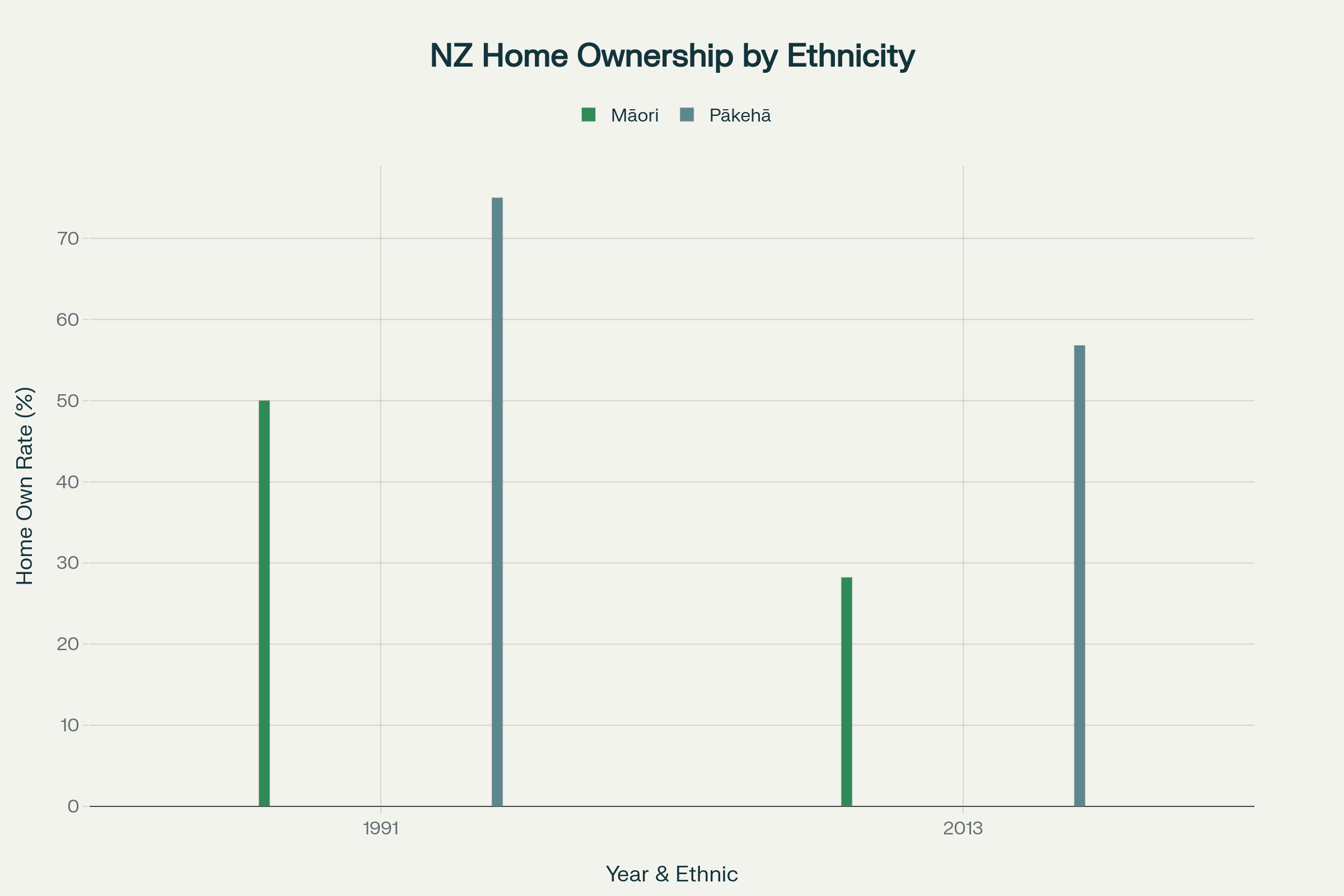
Collapse of Māori Home Ownership: From near parity in 1991 to severe inequality by 2013
BACKGROUND: UNDERSTANDING THE SYSTEM OF EXTRACTION
Before diving into Luxon’s specific rates relief victory, it is essential to understand the broader context of how property, power, and privilege function in Aotearoa New Zealand. This is not a story about one man getting a rates discount. This is a story about how an entire system has been architected to extract wealth from the poor and concentrate it in the hands of the already wealthy—and how political leaders actively benefit from and defend that system.
New Zealand experienced one of the developed world’s largest property price booms over the first 25 years of the 21st century. Research showed that between the late 1970s and late 2010s, a 1% rise in population caused house prices to increase by roughly 2.0%—compared to only 0.5% in earlier decades. This explosion in property values has created a two-tiered society: those who own property and benefit from capital appreciation, and those who rent and are pushed further into precarity with each passing year.
The collapse of Māori home ownership is particularly damning. In 1991, Māori home ownership rates sat at approximately 50%—close to parity with Pākehā rates. By 2013, Māori home ownership had crashed to 28.2%, while Pākehā ownership remained at 56.8%. This wasn’t accidental. This was the direct result of neoliberal policies implemented from the 1980s onward: the dismantling of state housing, the removal of subsidies for home ownership, the deregulation of rental markets, and the treatment of housing as a speculative commodity rather than a fundamental human right.
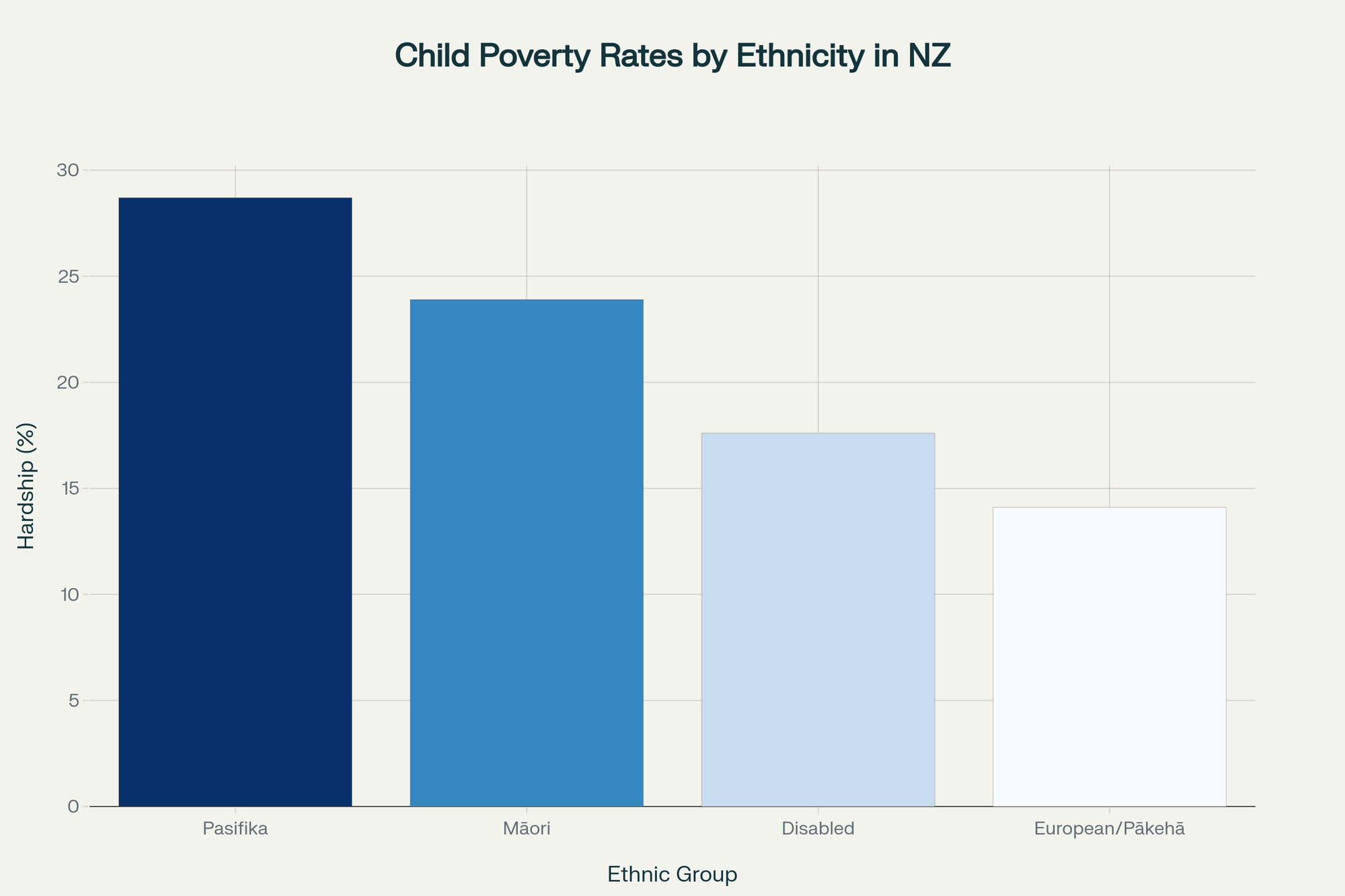
Child Poverty Severity: Pasifika and Māori children face more than double the poverty rates of European peers
Meanwhile, child poverty in Aotearoa has become scandalously racialized. In 2024, 28.7% of Pasifika children lived in material hardship, 23.9% of Māori children, compared to just 14.1% of European/Pākehā children. These are not statistics. These are whānau going without heating in winter, children without access to fresh fruit and vegetables, families choosing between paying rent and buying medicine. And while these children freeze and hunger, their Prime Minister negotiates $8,100 rate reductions on his holiday home in one of New Zealand’s most exclusive neighbourhoods.
THE WAIHEKE RATES SCANDAL AND WHAT IT REALLY MEANS
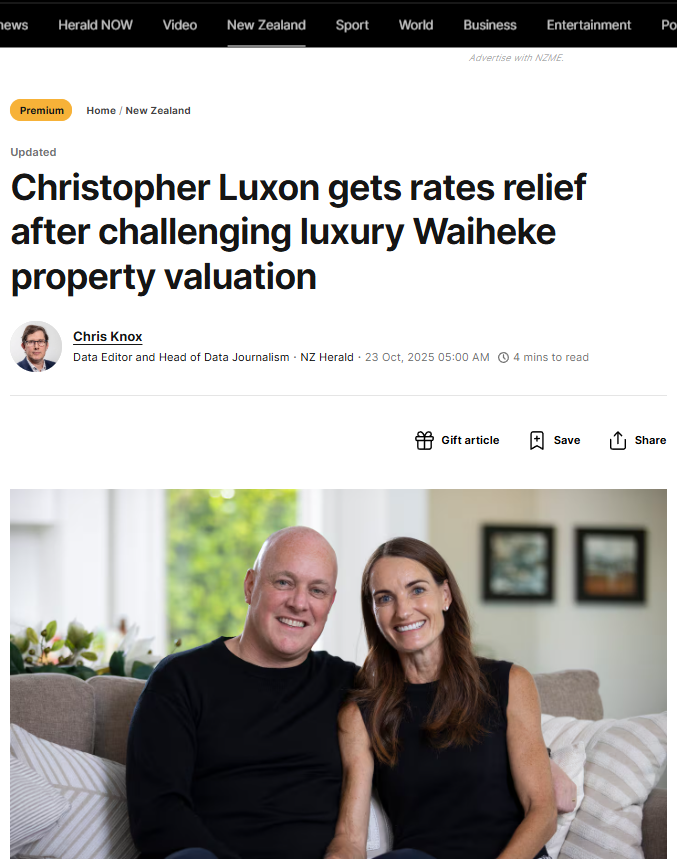
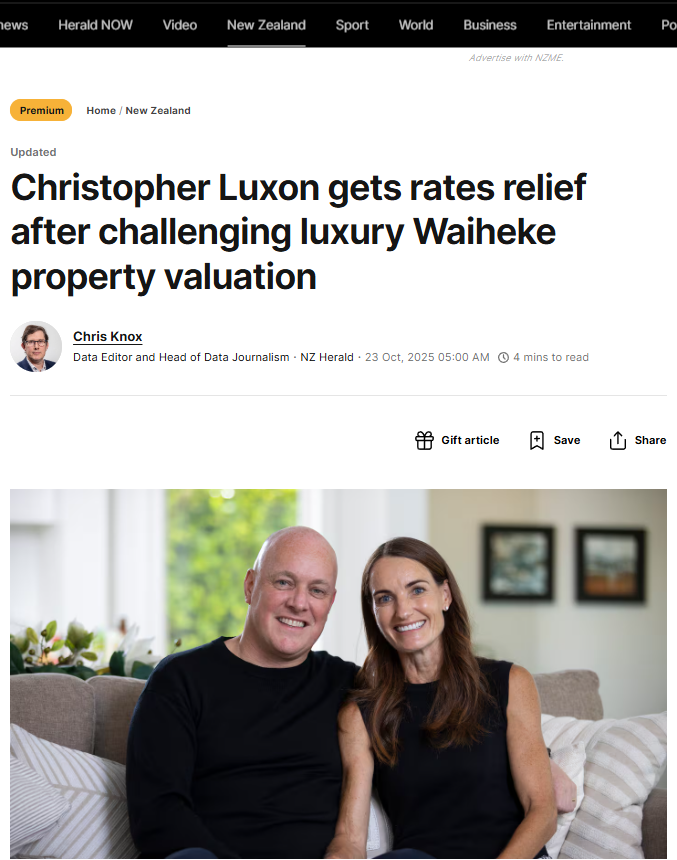
On 22 October 2025, journalist Chris Knox—described as the Data Editor and Head of Data Journalism for the New Zealand Herald—reported that Christopher Luxon’s family had successfully challenged the Auckland Council’s property valuation on their Onetangi Beach holiday home. The valuation was slashed from $10.5 million to $7 million, resulting in an $8,100 annual rates reduction.
Forty-seven properties in the same Onetangi suburb had their valuations challenged and reduced, with 211 ratings valuations downgraded across Auckland’s 630,000 properties. Ninety percent of property owners who challenged valuations were still waiting for decisions at the time of reporting. The Luxon family’s challenge succeeded, granting them immediate relief.
On the surface, this appears to be a routine property valuation matter. Citizens challenge valuations all the time. Councils make errors. Mistakes get corrected. But this interpretation completely ignores the context: While the Prime Minister secures $8,100 in annual rate reductions, government figures show 36% of applications for emergency housing assistance are being declined. Outreach providers report a 90% increase in homelessness in Auckland since the government tightened emergency housing eligibility rules. Fifty-three percent of renters are unable to afford to buy a home. Three-quarters of renters are dissatisfied with available housing choices.
This is the true scandal: not a wealthy man getting a rates reduction, but a Prime Minister who champions property rights while his government systematically dismantles the social safety net that prevents ordinary New Zealanders from becoming homeless.
TRACING THE CONNECTIONS BETWEEN POWER, PRIVILEGE, AND PROPERTY
The Real Issue: A Prime Minister Using State Systems to Enhance His Own Wealth
Christopher Luxon is not just any wealthy New Zealand businessman turned politician. He is the Prime Minister, the highest-ranking executive in government. His ability to challenge a property valuation and have that challenge succeed within weeks—while thousands of ordinary ratepayers remain in limbo—raises immediate questions about access, power, and the machinery through which privilege operates.
Luxon owns multiple properties. In 2023, when he became National Party leader, he declared seven properties. His holdings include a family home in Auckland, an apartment in Wellington, and a bach on Waiheke Island. Four are declared as investment properties. By January 2025, his portfolio had reduced to three properties—two residential and one investment property, all in Auckland—but he still retains significant real estate holdings worth millions of dollars.
Between 2024 and the current period, Luxon made on-paper gains of at least $4.34 million from his property portfolio—approximately 15 times his annual salary as Prime Minister. He has made substantial capital gains through property speculation, yet he has consistently opposed a capital gains tax, stating that it would unfairly penalise property investors like himself.
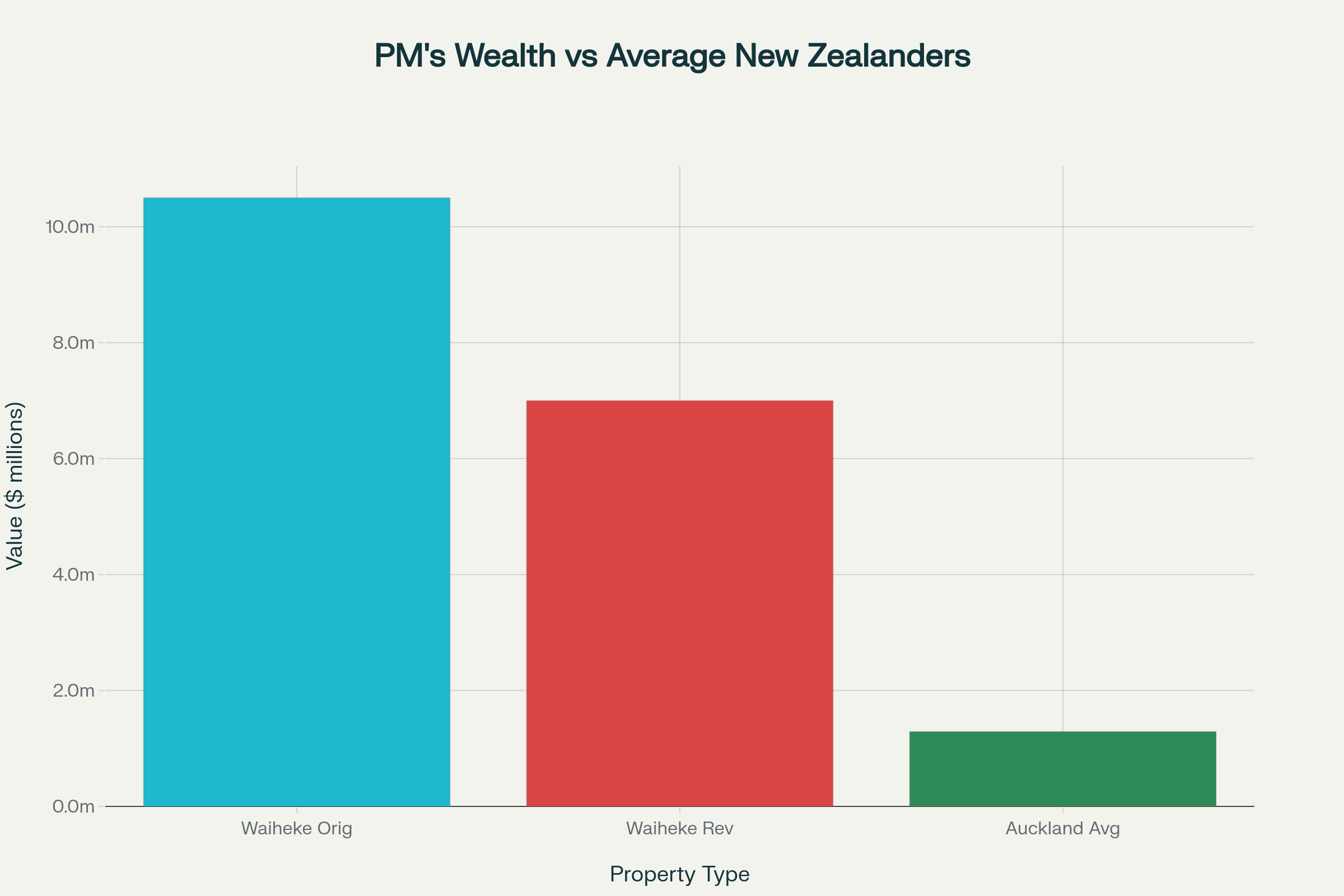
Extreme Wealth Disparity: The Prime Minister’s holiday home is worth 5-8 times an average Auckland family home
This creates an irreconcilable conflict of interest: A Prime Minister whose personal wealth is deeply invested in maintaining high property prices, who actively opposes taxation that would affect his property holdings, and who benefits from the very neoliberal policy framework that has destroyed affordable housing in this country, has just successfully used government systems to reduce his rates bill on a $7-10.5 million holiday home while his government tightens eligibility for emergency housing assistance and people sleep rough in increasing numbers.
The Viciousness of Timing and Policy Coordination
Luxon’s rates reduction comes precisely as Auckland Council implemented a 5.8% average rates increase for the 2025/2026 rating year—or $223 per year ($4.29 per week) for an average residential property. This affects nearly a million households, many of whom are already struggling with rising costs of living, rising rents, and stagnant wages.
The Council is simultaneously aware of the severe financial stress facing low-income households. Auckland Council literature acknowledges various assistance options for ratepayers, including a government-funded rates rebate scheme, a rates postponement scheme for residential properties, and flexible payment options. Yet these programmes are grossly underfunded and reach only a fraction of those in need. The maximum rates rebate available in 2025/2026 is $805—barely enough to cover two weeks of increased rates for many households.
Meanwhile, the Prime Minister secures $8,100 in annual relief. That is ten times the maximum available to New Zealand’s poorest households.
The Policy Framework: How Neoliberalism Constructed This Inequality
This story cannot be understood without examining the neoliberal policy framework that the National Party—Luxon’s party—has consistently championed. Since the 1984 Labour government under David Lange, guided by Finance Minister Roger Douglas, implemented sweeping market-oriented reforms, Aotearoa has experienced the systematic dismantling of the social policies that once made housing attainable for ordinary New Zealanders.
Until the 1990s, the state actively subsidised home ownership. The capitalisation of family benefits into home deposits was equivalent to roughly a third of an average house price in the 1960s. By the 1980s, the government was still subsidising 20% of the average house cost. State houses were available for life to those who couldn’t afford private ownership. These policies explicitly recognised housing as a fundamental right, not a commodity.
The National Party under Luxon has actively worked to entrench and deepen this neoliberal framework. When Housing Minister Chris Bishop announced that average house prices were too expensive and needed to fall, Luxon refused to commit to that position, instead offering vague language about “downward pressure”—the language of a man whose personal wealth depends on property values remaining high. Under Luxon’s government, interest deductibility for property investors has been restored, and the bright-line test period for capital gains on property has been reduced from 10 years to 2 years—policy changes that directly benefit wealthy property investors like himself.
The Murdoch Connection: How Media Ownership Shapes the Narrative
It is crucial to understand that the Chris Knox article reporting Luxon’s rates relief appeared in the New Zealand Herald—a publication owned by NZME, which operates under the broader News Corporation umbrella controlled by Rupert Murdoch. Murdoch’s News Corp is known internationally for its aggressive editorial interference, its cultivation of right-wing political movements, and its capacity to shape narratives to suit the interests of its proprietor and his allies.
The framing of this story as a neutral data journalism piece—presenting Luxon’s rates reduction as simply one data point among many valuations being challenged—obscures the fundamental scandal at its heart. Knox’s role as Data Editor and Head of Data Journalism may give his reporting an air of objectivity and numerical authority, but this framing erases context, erases the structural inequalities that make this story significant, and normalises the extraordinary privilege of a Prime Minister using state systems to reduce his own tax burden while homelessness spirals.
This is not coincidental. This is how Murdoch’s media empire operates globally: by selecting which stories to cover, which angles to emphasise, and which context to include or exclude, media ownership shapes what the public understands as newsworthy, as scandalous, or as normal. A $7-10.5 million holiday home belonging to the Prime Minister receiving a rates reduction while people sleep rough is presented as a data story, not as a story about the corruption of government for private benefit.
The Theology of Entitlement: Christian Nationalism and the Politics of Desert
Underlying all of this is a theological and ideological framework that deserves explicit naming. The far-right Christian movements in Aotearoa have grown increasingly vocal and organised, pushing narratives of “reverse racism,” “replacement theory,” and the idea that equity initiatives targeting Māori and Pasifika communities represent unfair discrimination against Pākehā New Zealanders.
These narratives are not separate from the property and rates story. They are intimately connected. The rhetoric that justifies Luxon’s wealth—”I worked hard,” “I made smart choices,” “I am entitled to my investments”—depends on a theological framework that erases structural racism, that ignores how Māori were systematically excluded from wealth-building opportunities through colonisation and ongoing discrimination, and that presents inequality as the natural outcome of individual merit rather than as the result of systemic theft.
Christian nationalist and far-right groups have explicitly coordinated around property rights, family values (code for anti-LGBTQIA+ stance), and opposition to te ao Māori initiatives like co-governance. When National cancelled several co-governance initiatives and stripped te reo Māori from various public contexts, it was responding to pressure from these movements—movements that Murdoch’s media ecosystem has amplified and normalised.
Luxon’s successful rates challenge is not merely a property valuation matter. It is a symbol of a Prime Minister whose government is actively dismantling support systems that would help Māori and Pasifika whānau, while protecting and expanding the tax benefits available to wealthy property owners like himself.
The Historical Erasure: How Property Valuations Became Normalised Inequality
It is worth noting that one of the 47 Onetangi properties that had valuations reduced alongside Luxon’s was almost certainly owned by other wealthy individuals. This is not uniquely about Luxon. Rather, Luxon is the symptom of a much broader disease: a system where the wealthy have the resources, knowledge, and access to challenge valuations and secure relief, while low-income households do not.
Research shows that 75% of renters are dissatisfied with available housing, with 53% unable to afford to buy. Yet the vast majority of these renters will never challenge a property valuation because they have no property to challenge. They will never negotiate rates relief because they do not own the homes they live in. They exist outside the system of property-based wealth accumulation entirely—by design.
The system is not broken. It is working exactly as intended: transferring wealth and opportunity to those who already have it, while systematically excluding those who don’t.
WHO BEARS THE COST
The implications of this story extend far beyond one Prime Minister and his holiday home. They reveal the fundamental injustice baked into Aotearoa’s current political and economic system.
Māori and Pasifika whānau are bearing the brunt of this system. With 23.9% of Māori children and 28.7% of Pasifika children living in material hardship, compared to 14.1% of Pākehā children, we are looking at a system that is fundamentally racist in its outcomes. This is not accidental. This is the legacy of colonisation, combined with 40+ years of neoliberal policy that has systematically dismantled the redistributive mechanisms that once helped poorer households build wealth.
Over 60% of the Māori population are renters, meaning they have no property to appreciate, no equity to borrow against, no rates to challenge and reduce. They are locked out of the property wealth machine entirely.
The government’s response to housing deprivation has been to tighten emergency housing eligibility and cut support services. This is not policy made by accident. This is policy made in the context of a Prime Minister who has personally benefited enormously from property investment and who has consistently opposed policies—like capital gains taxes—that would level the playing field.
WHERE WE GO FROM HERE
The scandal of Christopher Luxon’s $8,100 rates reduction is not ultimately about $8,100. It is about a Prime Minister using the power of his office to enhance his own already extraordinary wealth while his government systematically dismantles the safety net that prevents ordinary New Zealanders—especially Māori and Pasifika whānau—from becoming homeless.

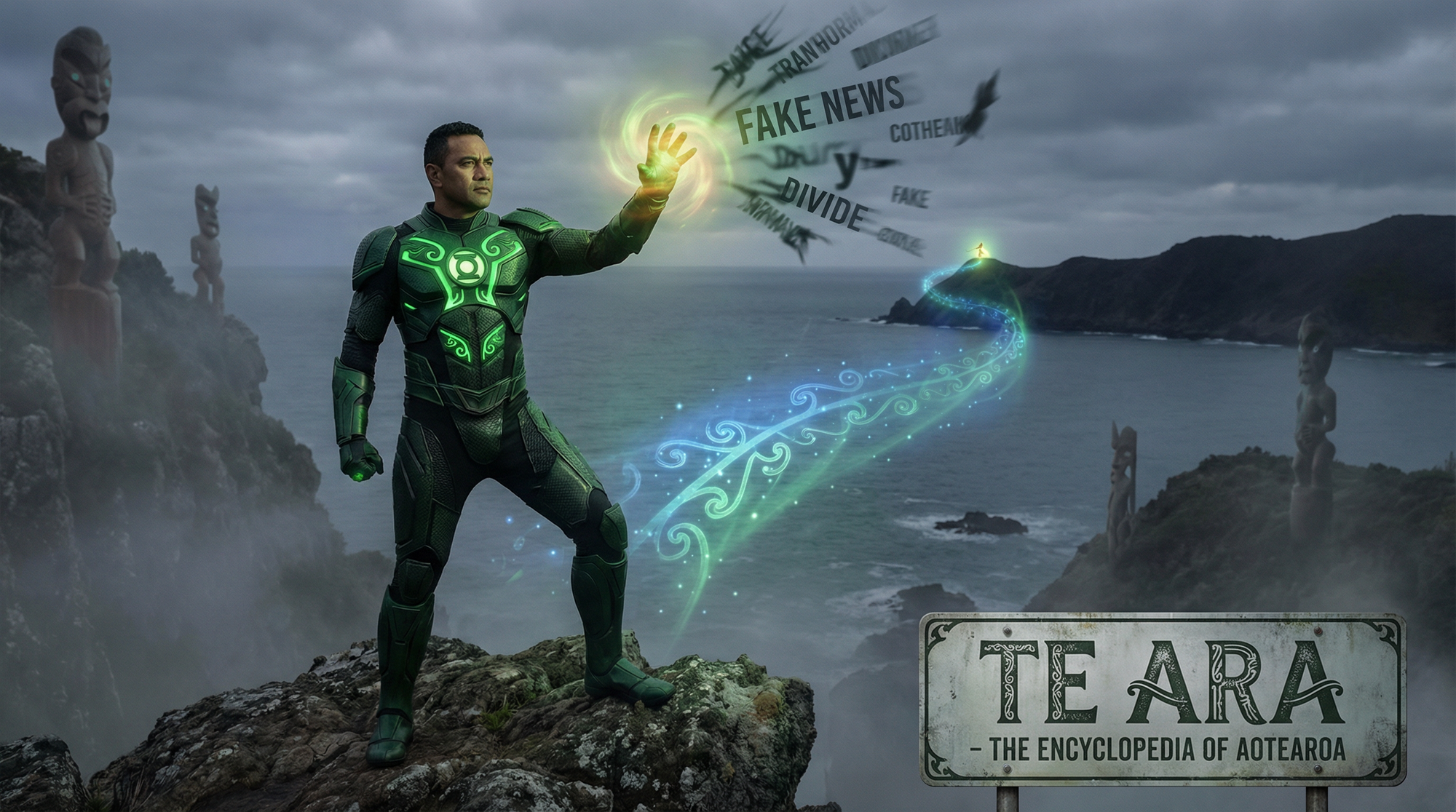
The Māori Green Lantern Fighting Misinformation And Disinformation From The Far Right
It is about a system where a Prime Minister can own multiple properties worth millions of dollars while children in his country go without heating, without fresh food, without basic security. It is about a media ecosystem owned by Rupert Murdoch that presents this story as neutral data journalism rather than as a story about the machinery of privilege operating in full view.
Most fundamentally, it is about how neoliberal capitalism, combined with the legacies of colonisation and white supremacy, has created a system where wealth is extracted from the poor and concentrated in the hands of the already wealthy—with the explicit support and active participation of our political leaders.
This cannot continue. Whānau deserve homes as a right, not as a commodity to be speculated upon by the wealthy. Children deserve to have their basic needs met. And our Prime Minister deserves to be held accountable for the contradiction between his extraordinary personal wealth and his government’s abandonment of those most in need.
He whānau, e rungā nei au ki a koutou: do not accept this as normal. Do not accept that property speculation is simply “investing.” Do not accept that a Prime Minister who owns multiple properties cannot represent the interests of those with none. This system was built by humans. It can be dismantled by humans. But only if we are willing to see it clearly, name it truthfully, and commit to building something better in its place.
If you have found value in this essay and have capacity to contribute a koha to support this work, please consider it: HTDM: 03-1546-0415173-000. The Māori Green Lantern understands these are tough economic times for whānau, so please only contribute if you genuinely have the capacity to do so.
Kia kaha, e te whānau. The work continues.
Ivor Jones
The Māori Green Lantern (MGL)
Te Arawa/Ngāti Pikiao