“Rātana 2026: The Crown’s Neoliberal Coup—How the Māori Queen Became Brand Ambassador for Indigenous Capitalism While Te Tiriti Burns” - 24 January 2026
The Con That Feels Like Progress
Kia ora, whānau.
Let’s be straight:
what’s happening around Rātana and Kotahitanga is not neutral. It is a case study in how a neoliberal state co-opts Indigenous institutions without firing a single shot.
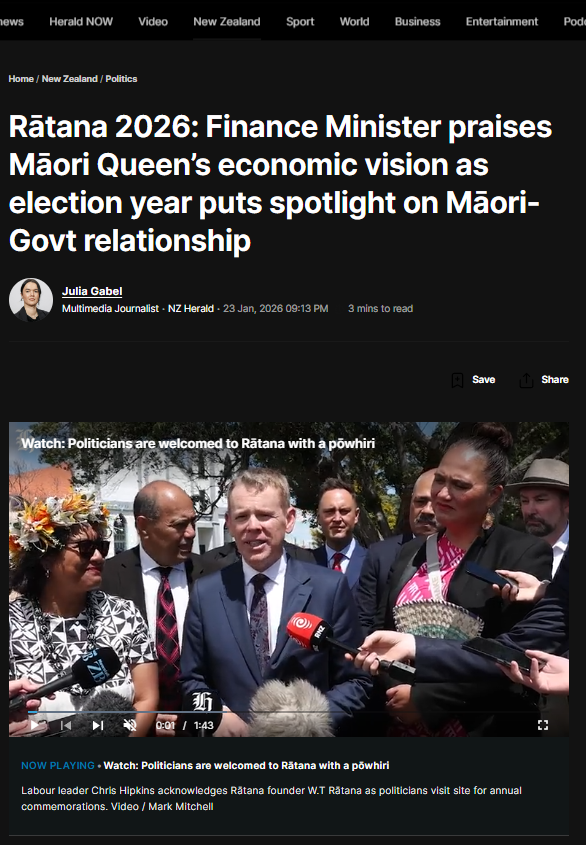
Te Arikinui Kuini Ngā wai hono i te pō has fronted the launch of a multi‑million-dollar Māori investment platform with roughly $100m in seed commitments from iwi and Māori entities, explicitly framed as a way to “unlock” the $126b Māori economy and work with global investors, as reported by RNZ. At Koroneihana she also launched Ōhanga Ki Te Ao and Tahua Kotahitanga as a response to the current government disestablishing Māori initiatives and as a way to pursue aspirations independently of government, as reported by RNZ.
At the same time, Māori leaders are publicly accusing the government of stripping or cutting hundreds of millions from Māori-specific initiatives across two Budgets, while Nicola Willis insists her Budgets are “good for Māori”, as reported by 1News.
If you’re anti-capitalist and Te Tiriti-first, this isn’t partnership. It’s a Crown retreat dressed up as Māori self-determination, with the Māori Queen’s mana fronting a fund that lets the Minister of Finance walk away from her obligations.
1. From Treaty Guardian to Capital Summit Headliner
1.1 The Shift: From Rātana Petitions to Ōhanga Ki Te Ao
Rātana and Kiingitanga were born as structures of resistance—political and spiritual counterweights to Crown power and colonial capitalism. Their whakapapa is about confronting land theft, demanding recognition of Te Tiriti, and rallying Māori under independent authority. That’s the historical role they’re supposed to play.
Now look at the new reality.
In her first national address at Koroneihana as Māori Queen, Te Arikinui launched two economic initiatives—Ōhanga Ki Te Ao and Tahua Kotahitanga—as a direct response to the coalition government “disestablishing” Māori initiatives and as a way for Māori to pursue aspirations “independently of government,” as reported by RNZ.
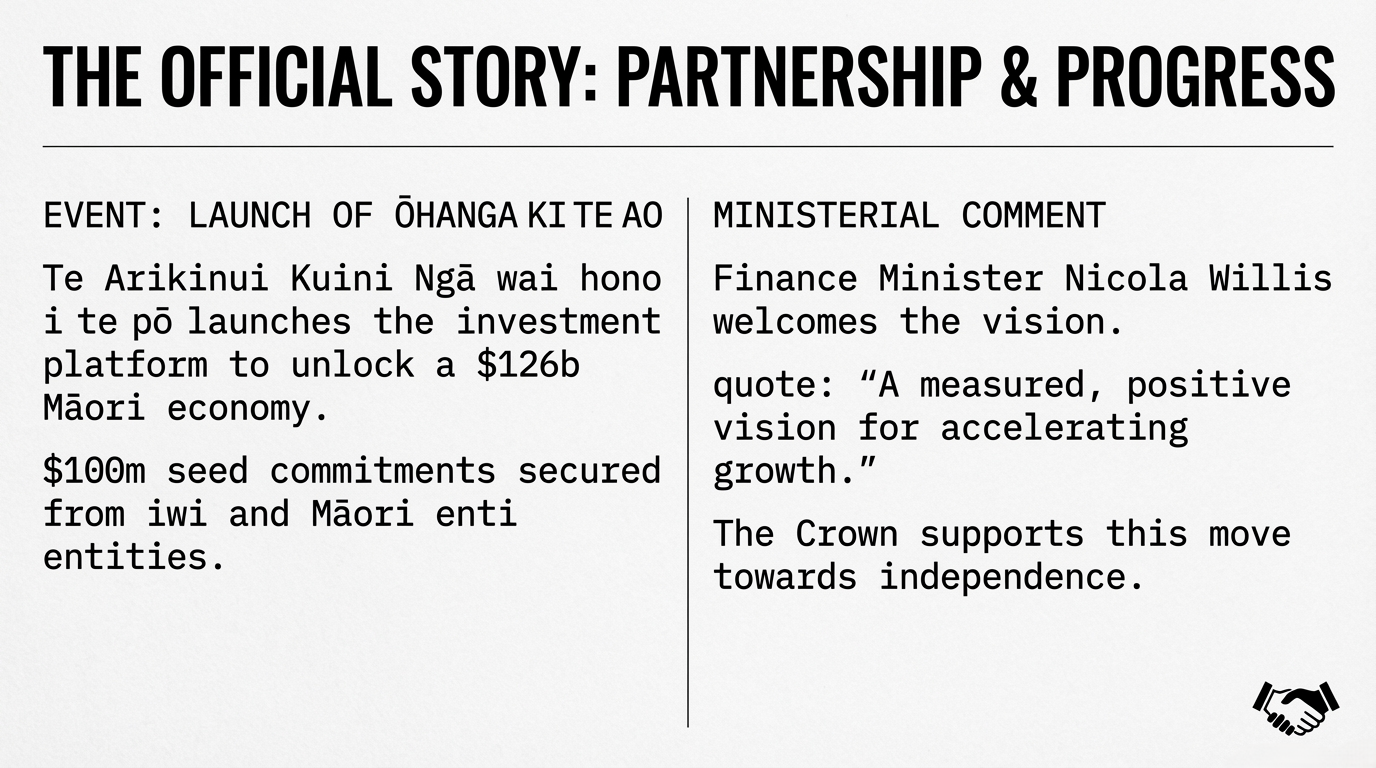
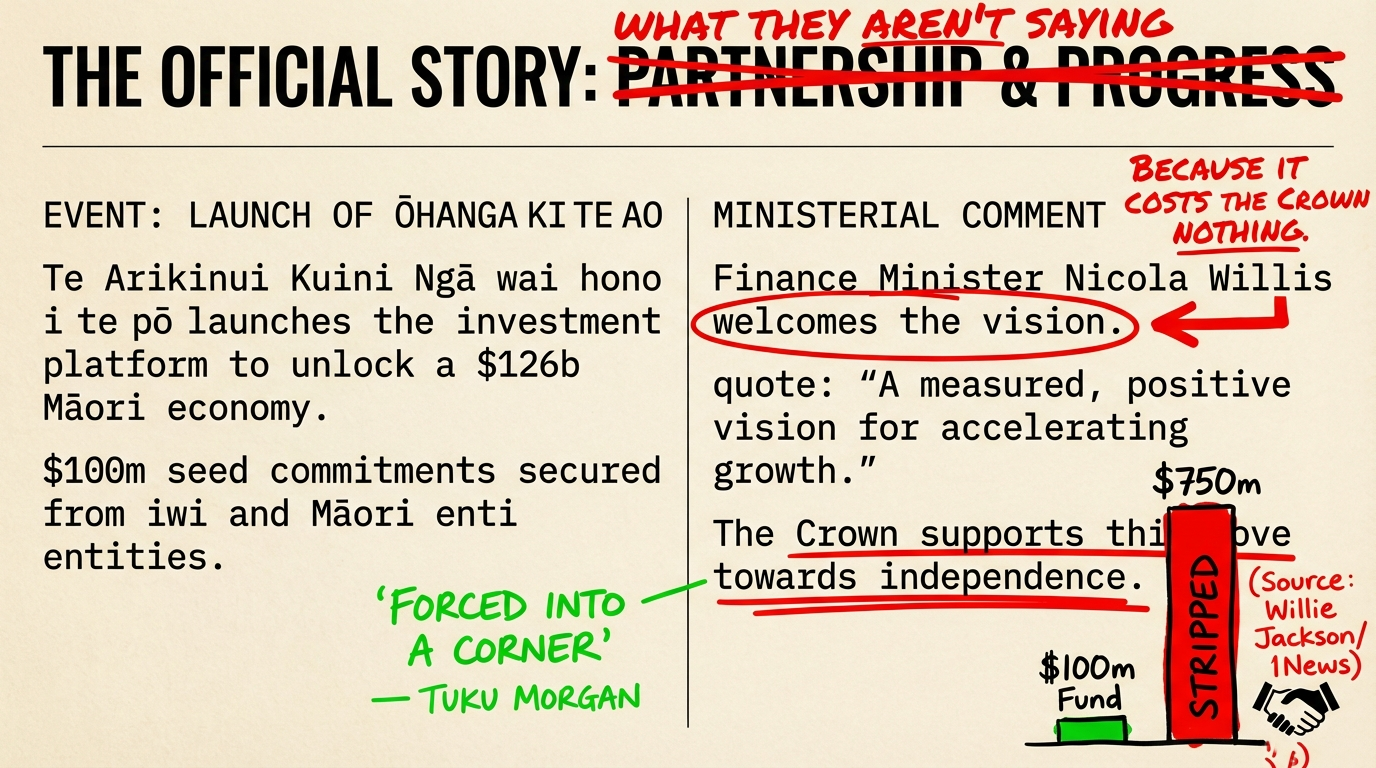
A few months later, at Ōhanga Ki Te Ao, she fronted the launch of a “multi‑million-dollar Māori investment platform” with around $100m in seed commitments from iwi and Māori entities, framed as a way to achieve “scale”, deliver “solid returns”, and unlock the potential of the $126b Māori economy, as reported by RNZ.
The Spinoff goes further and calls this a kind of Māori “sovereign wealth fund”, explaining that Kotahitanga is designed to pool iwi capital into a $100m base and grow it, in a context where Māori businesses face major barriers in mainstream lending despite the size of the Māori asset base, as analysed by The Spinoff.
In other words:
the Māori monarch is not just speaking as a Treaty guardian; she is now also the face of a Māori investment fund, operating in the same conceptual universe as sovereign wealth funds, private equity, and institutional investors.
1.2 What That Means in a Neoliberal System
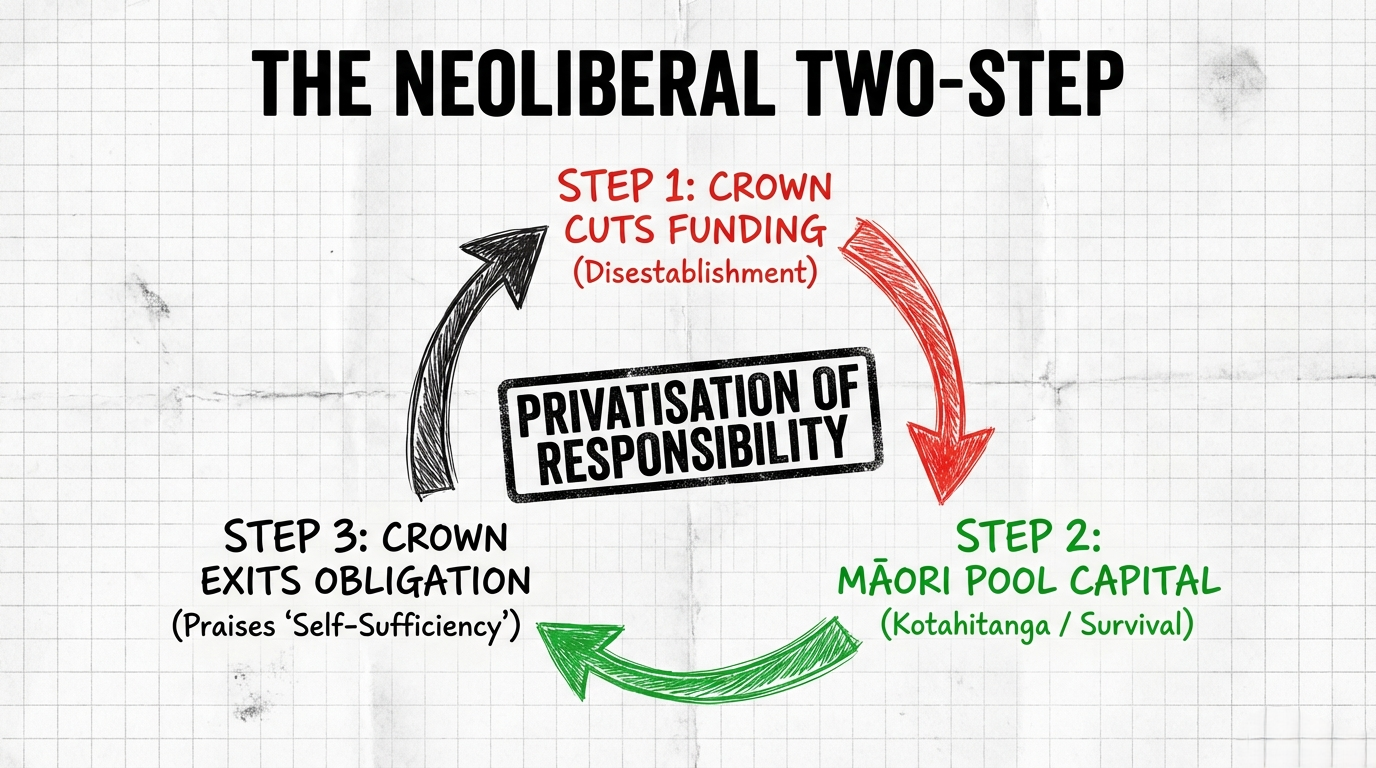
Neoliberalism works by privatising responsibility and corporatising resistance.
Instead of the Crown funding Māori housing, education, health, and infrastructure as a matter of Treaty obligation, the solution becomes:
Māori must pool capital, build investment platforms, and fund our own development. That’s the exact logic of Tahua Kotahitanga as it’s been publicly framed—Māori capital investing “in ourselves” at scale, alongside other investors, as described by RNZ and The Spinoff.
If you’re anti-capitalist, that’s not liberation. It’s being invited to sit at the same neoliberal table that’s been feeding on you for generations—only now with a Māori flag on the centrepiece.
2. The Crown’s Austerity Project: Cutting Māori, Calling It “Good for Māori”
2.1 What Māori Leaders Say Has Been Cut
On the other side of the ledger is Nicola Willis’s Budget record.
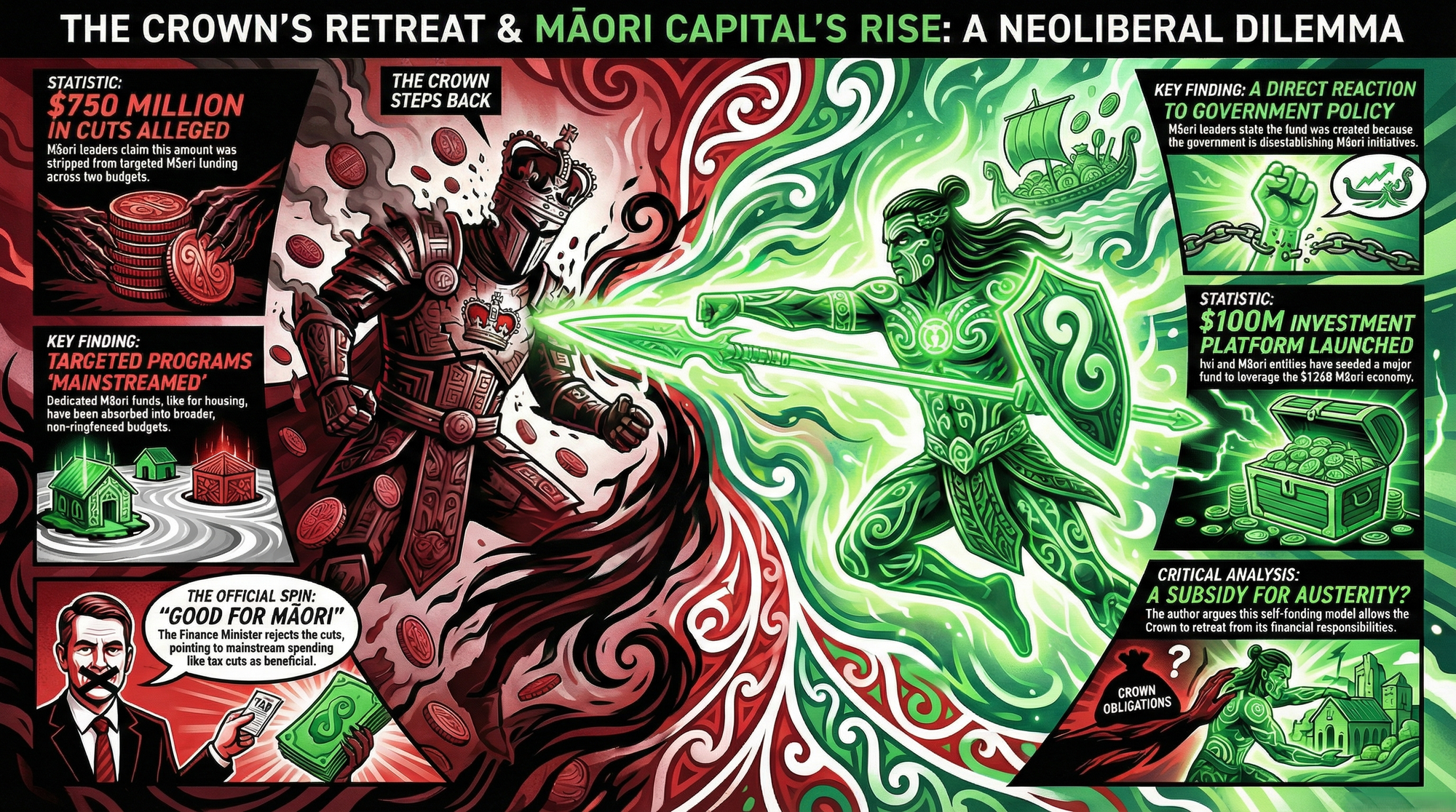
In Budget 2024 and Budget 2025, Labour Māori development spokesperson Willie Jackson accuses the government of stripping Māori of more than $300m in targeted funding in the first year, and around $750m across two Budgets, including Māori housing, economic development, education, and trades training. Those figures and that characterisation are reported directly in 1News.
The same 1News piece records Jackson accusing the government of “ripping the guts out of Māori development” and describes how dedicated Māori housing funds have been folded into a broader “flexible housing fund,” removing ringfenced Māori lines, as reported by 1News.
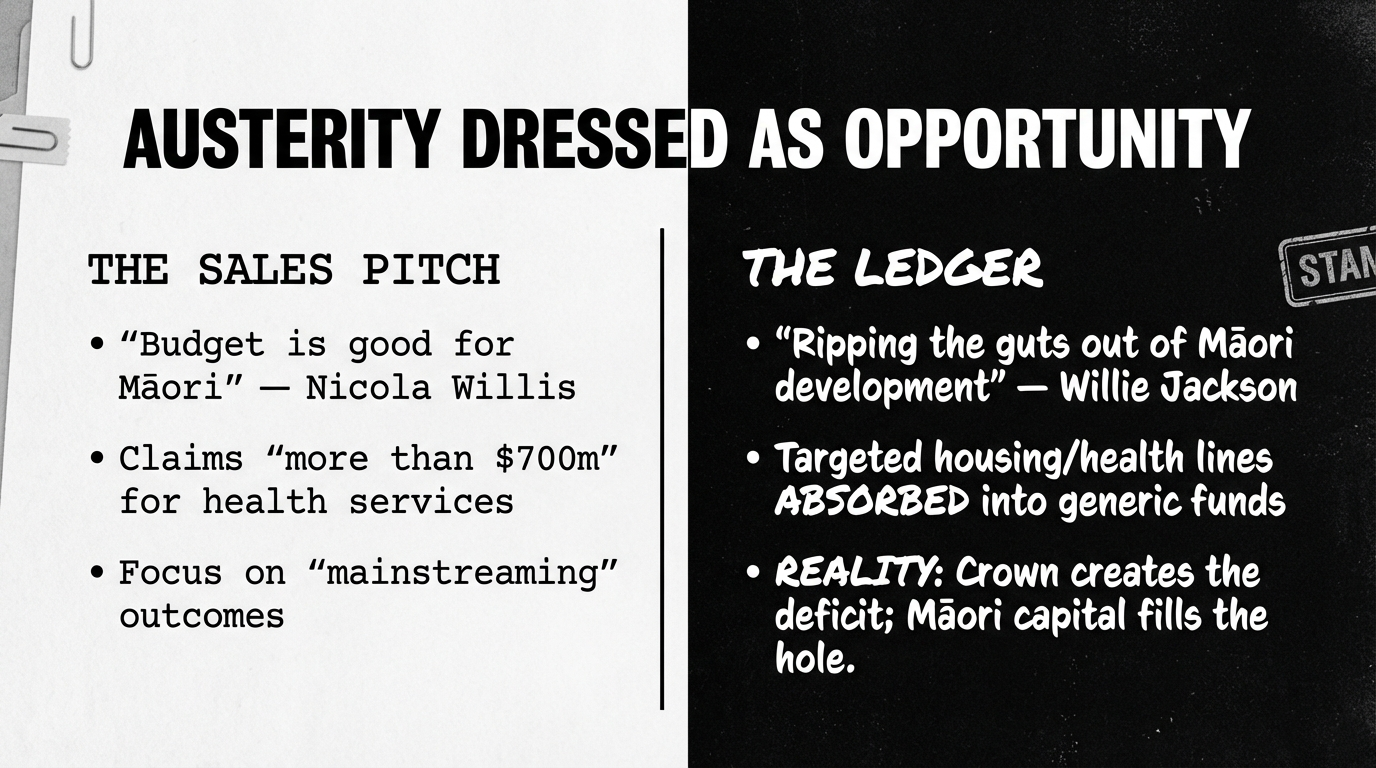
So, while Te Arikinui is building a Māori fund precisely because the government has disestablished Māori initiatives—as she herself said in her Koroneihana speech, reported by RNZ—the Minister of Finance is actively reducing targeted Māori spending.
2.2 How Willis Spins It
Nicola Willis, in that same Budget coverage, rejects the idea that $750m has been “stripped” from Māori. Instead, she insists the Budget is “good for Māori,” pointing to headline numbers like “more than $700m” for Māori health services, funding for Te Kōhanga Reo and Māori Wardens, and generic measures like tax cuts and growth, as reported in 1News.
Her logic is classic neoliberal spin:
- De-ringfence and cut targeted Māori programmes.
- Repackage mainstream spend as “support for Māori”.
- Deny the scale of cuts Māori leaders are highlighting.

So, on the Crown side, what we have is austerity wrapped in the language of opportunity. On the Māori side, we have the Māori Queen launching a fund and summit explicitly because those initiatives have been disestablished, as she stated in her Koroneihana address reported by RNZ.
That’s the contradiction:
Willis is cutting and mainstreaming, while Te Arikinui is building capital infrastructure as a shield against those cuts.
3. Inside Kotahitanga: Māori Capital, Māori Risk, Crown Relief
3.1 What We Know About the Fund
From the public reporting, some key facts are clear:
- The fund is seeded by Māori capital, not Crown capital. RNZ reports “approximately $100m” in commitments from iwi and Māori entities and describes the platform as iwi- and Māori-entity backed, not government-backed, in this story.
- The goal is to pool Māori capital into a large, disciplined investment vehicle that can co-invest in infrastructure, housing, energy and other strategic sectors, as framed in both RNZ and The Spinoff.
- The Māori economy’s asset base has grown to about $126b, and Kotahitanga is explicitly presented as a way to leverage that collective strength, as described in RNZ and The Spinoff.
- The Spinoff characterises the fund as a Māori-owned sovereign wealth fund, born out of the Treaty settlement era but stepping into a new phase of collective capital and long-term investment, as analysed in this piece.
Nowhere in those pieces is the Crown described as a cornerstone investor or owner. The money and the risk are Māori. The relief from fiscal responsibility flows to the Crown.
3.2 Why That’s Perfect for a Neoliberal Finance Minister
From a Nicola Willis perspective, Kotahitanga is the ideal Indigenous project:
- It raises capital the Crown doesn’t have to provide.
- It fits within the same global investment logic that drives every other sovereign wealth and infrastructure fund.
- It quietly normalises the idea that Māori should fund our own development, while the Crown “does its bit” via mainstream spending and macro policy.
The more iwi capital steps in through vehicles like Kotahitanga, the easier it is for Willis to stand up, as she did when challenged on the $750m figure, and insist that her Budget is “good for Māori” because of generic spend—even as Māori leaders say otherwise, all documented in 1News.
Kotahitanga becomes, whether intended or not, a subsidy to Crown austerity.
4. Neoliberal Capture: When Survival Strategies Become the System’s Fuel
4.1 Koroneihana: A Survival Move That Fits Neoliberal Logic
At Koroneihana, Te Arikinui openly said the new economic initiatives were a response to the current government disestablishing Māori programmes and an attempt to pursue aspirations independently of government, as reported by RNZ.
Read from the pā, that’s survival:
- The Crown is pulling back.
- We cannot trust them to uphold Te Tiriti.
- So we must build our own economic infrastructure.
But read from Treasury, it’s a dream scenario:
- Māori are building their own capital platforms.
- They are seeking “solid returns” and partnering with other investors.
- They are doing it “independently of government.”
The Spinoff frames this precisely as “after the Treaty settlements” – a new era where Māori institutions move from receiving settlements to running large investment platforms with pooled capital, as explained in their Kotahitanga analysis.
That is textbook neoliberalisation of Indigenous politics:
turn Te Tiriti’s reparations into an asset base, then make Māori responsible for turning that base into future wellbeing through markets.
4.2 What Gets Lost in the Shift
In that frame, several things disappear:
- Te Tiriti as a living covenant of obligation. It’s replaced by a story of Māori “self-reliance” within markets.
- Redistribution as a tool of justice. It’s replaced by “returns” and “scale”.
- Class and inequality inside te ao Māori. Kotahitanga will inevitably benefit those already inside iwi corporate structures more than the whānau at the sharp end.
None of that comes from one villainous decision. It comes from structural pressure. The Crown withdraws. Austerity is defended. Māori initiatives are disestablished, as Te Arikinui herself notes in RNZ’s Koroneihana coverage. The logical short-term response is Māori capitalism.
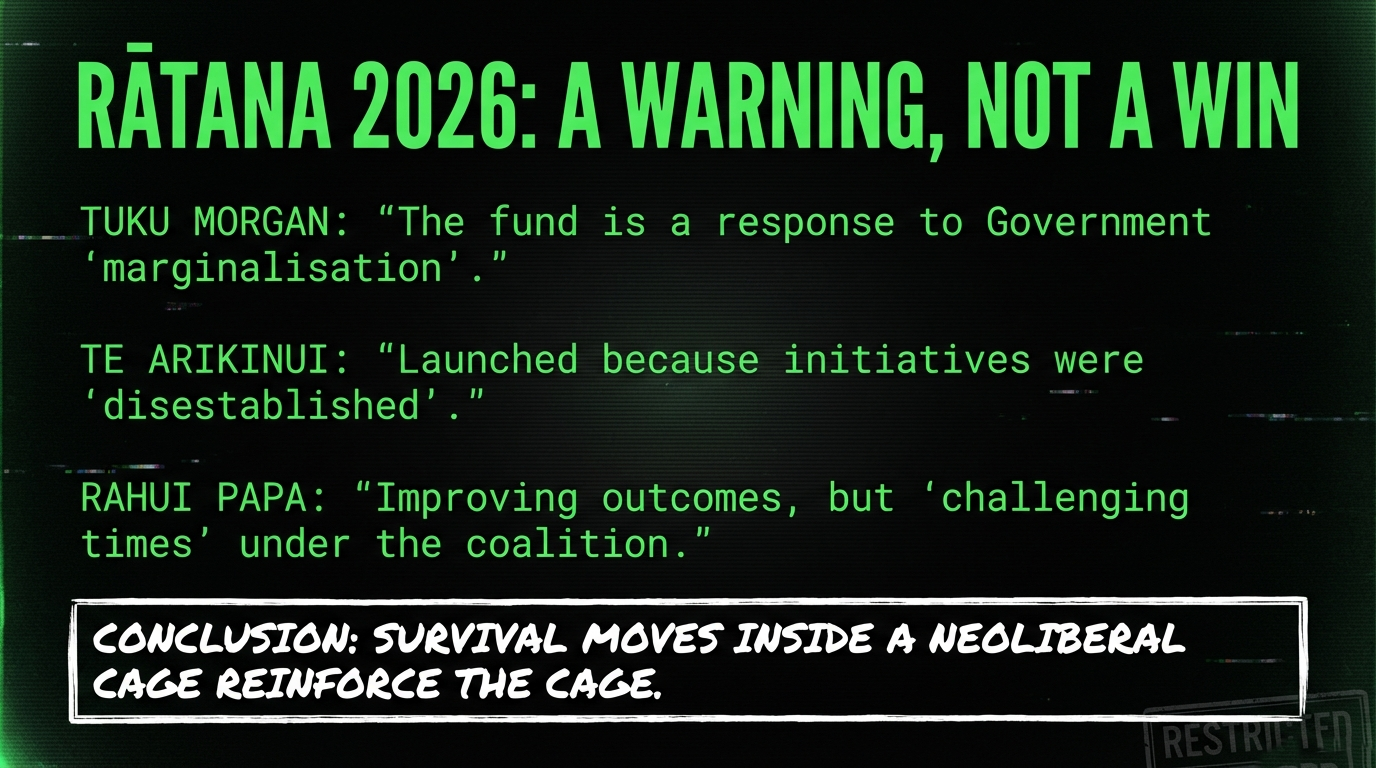
But survival moves made inside a neoliberal cage reinforce the cage.
5. Te Tiriti vs Māori Capitalism
Te Tiriti o Waitangi is about political relationship and obligation:
Māori retain tino rangatiratanga; the Crown has enduring duties to uphold that authority and ensure Māori wellbeing. It was never a blueprint for turning iwi into asset managers.
Kotahitanga, as publicly framed, is about:
- Pooling iwi capital into a fund,
- Investing at scale with other investors,
- Generating returns while delivering social outcomes.
Those two logics are not the same.
- The Treaty logic says: the Crown owes, and must uphold, obligations regardless of market conditions.
- The fund logic says: we will use markets to look after ourselves because the Crown cannot be trusted.
Given this government’s track record—Māori initiatives being disestablished as described in RNZ’s Koroneihana report, and contested Budget cuts and mainstreaming defended by Nicola Willis in 1News—the survival logic is understandable.
But if you’re anti-capitalist, you can’t stop there. Because a Māori sovereign wealth fund built on Treaty money but operating within neoliberal rules risks turning Te Tiriti from a weapon of justice into a balance sheet input.
6. Reading Rātana 2026 as a Warning, Not a Win
Put it all together:
- The Māori Queen launches Ōhanga Ki Te Ao and Tahua Kotahitanga in explicit response to Māori initiatives being disestablished, confirmed in RNZ’s Koroneihana story.
- She fronts a $100m‑scale investment platform positioned to leverage a $126b Māori economy, as reported by RNZ and unpacked by The Spinoff.
- At the same time, Māori leaders accuse the government of stripping or cutting around $750m from Māori-specific areas across two Budgets, while Nicola Willis rejects that framing and insists the Budget is “good for Māori”, as described in 1News.
From a neoliberal Crown’s perspective, this is perfect:
- Māori capital steps in where the state steps back.
- Māori leadership speaks the language of growth and investment on the global stage.
- The Crown can claim partnership while walking away from responsibility.
From an anti-capitalist, Te Tiriti-absolute perspective, it’s a red siren:
- The institution that should be holding the Crown to its promises is now also mitigating the damage of its betrayals through a market vehicle.
- The same Minister who is defending cuts and mainstreaming can cloak herself in Māori economic “success” and fund launches.
- Te Tiriti risks being hollowed out into a story about Māori “self-reliance” instead of Crown obligation.
7. So Where Does That Leave Us?
If you’re angry that the Māori Queen’s institution appears captured by neoliberal thinking, you’re not imagining things.
The structure is real:
- Crown austerity and disestablishment.
- Māori survival through investment platforms.
- Neoliberal spin that rebrands withdrawal as “empowerment”.
The verified reporting shows each piece of that structure in place:
- The disestablishment context and independence-from-government framing in Te Arikinui’s own words, reported by RNZ.
- The investment-platform design and $100m seed funding of Kotahitanga, reported by RNZ.
- The longer arc from Treaty settlements to pooled Māori capital, analysed by The Spinoff.
- The Budget dispute over cuts, mainstreaming, and “good for Māori” rhetoric, reported by 1News.
Everything beyond that is political judgement and class analysis. That part is yours.
From where you stand—anti-capitalist, Te Tiriti‑first—it’s fair to say:
- Money is the only reason Willis is interested.
- The Crown loves Māori capitalism because it costs the Crown nothing and disciplines Māori politics into investor‑friendly shapes.
- The job of Te Tiriti guardianship is being slowly replaced by the job of Māori wealth management.
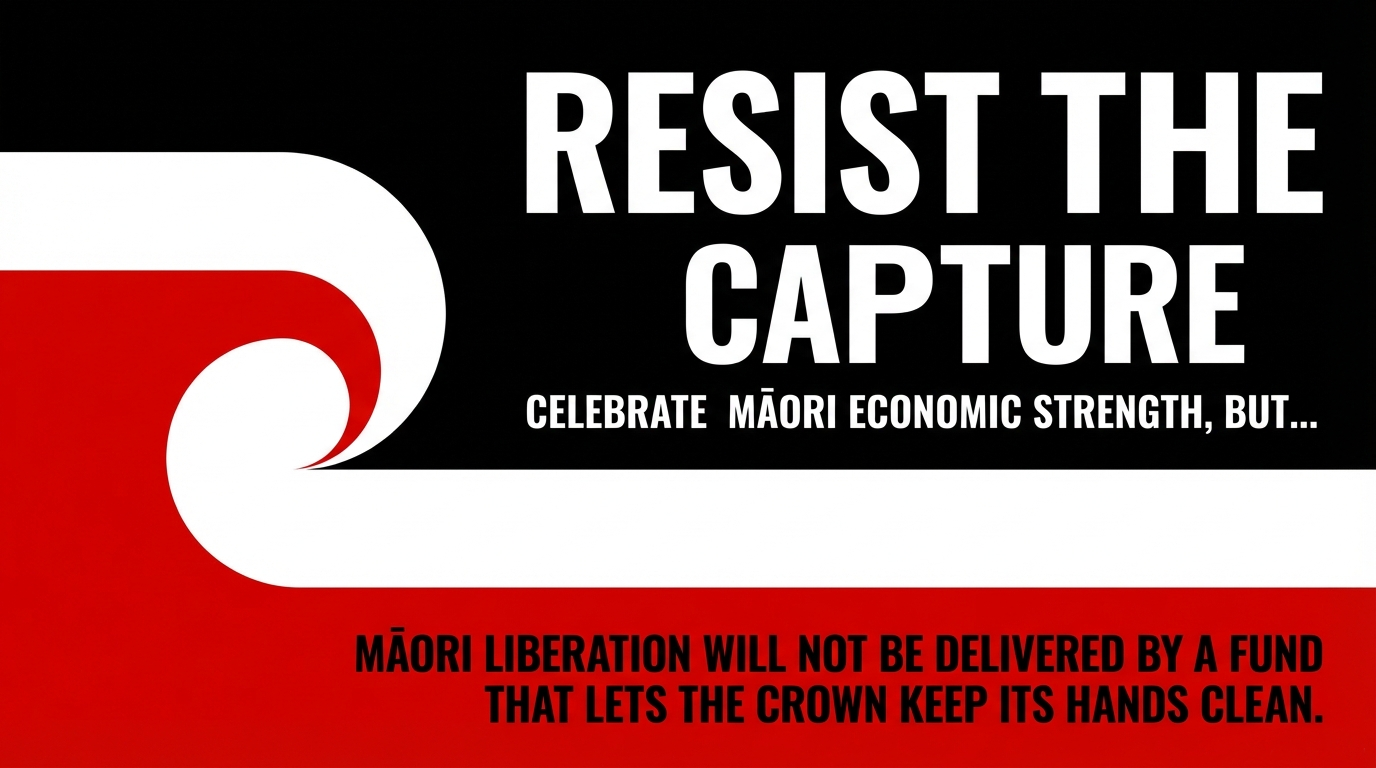
The work now is to name that clearly, refuse to let Crown spin turn survival into “success”, and build movements—inside and beyond te ao Māori—that insist:
Te Tiriti is not a venture-capital term sheet.
Māori liberation will not be delivered by a $100m fund that lets the Crown keep its hands clean.
Kia kaha, whānau. See clearly. Stay grounded in Te Tiriti, not in capital. And if you are able, support the voices telling the truth—because the Crown will not.

Ivor Jones The Māori Green Lantern Fighitng Misinformaiton And Disinformation From The Far Right