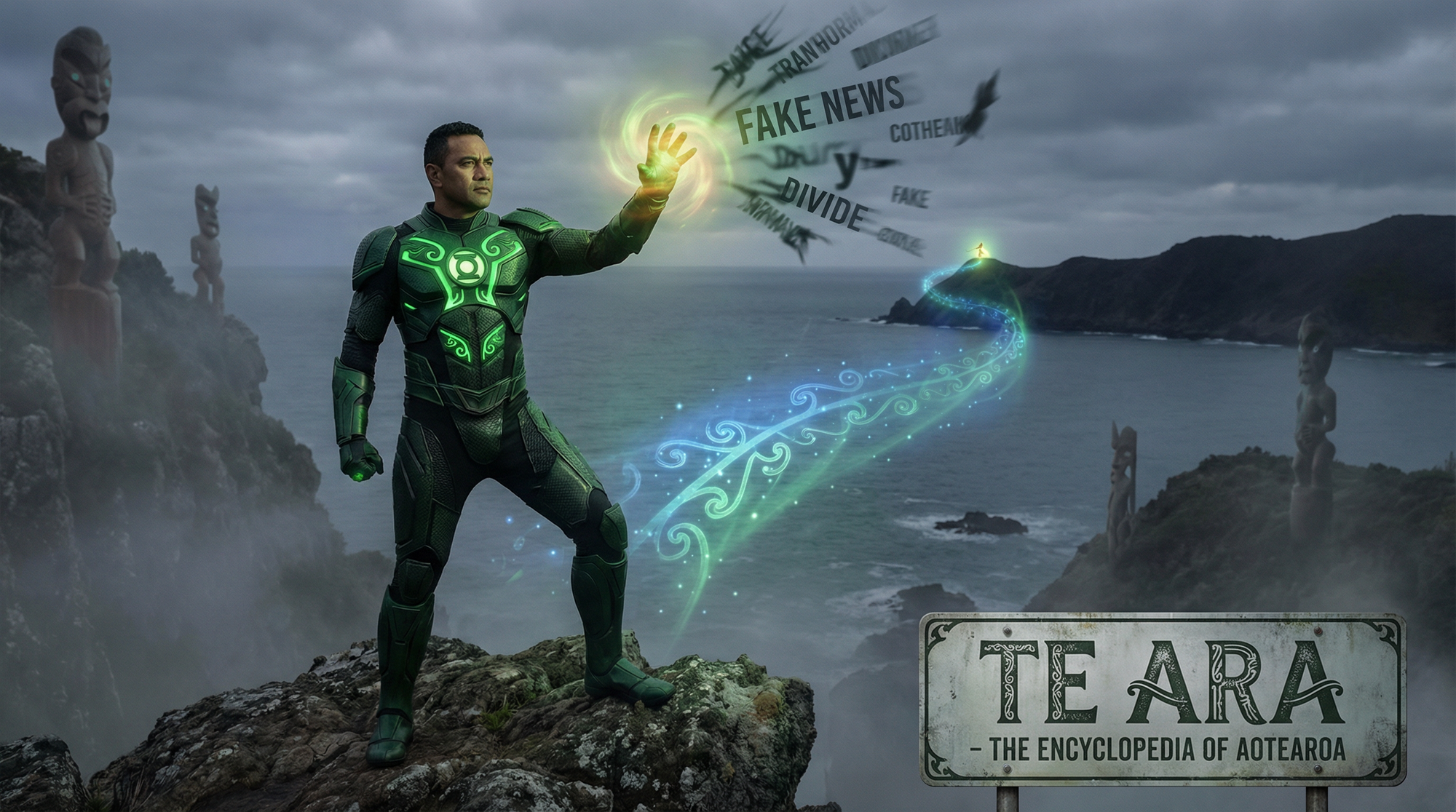
“ROLLING THROUGH THE TRAP: HOW SILICON VALLEY’S “FAR OUT” FOUNDATION IS REPACKAGING WEALTH EXTRACTION IN AOTEAROA” - 30 December 2025
THE GOLDEN VISA PIPELINE: WEALTH AS IMMIGRATION POLICY
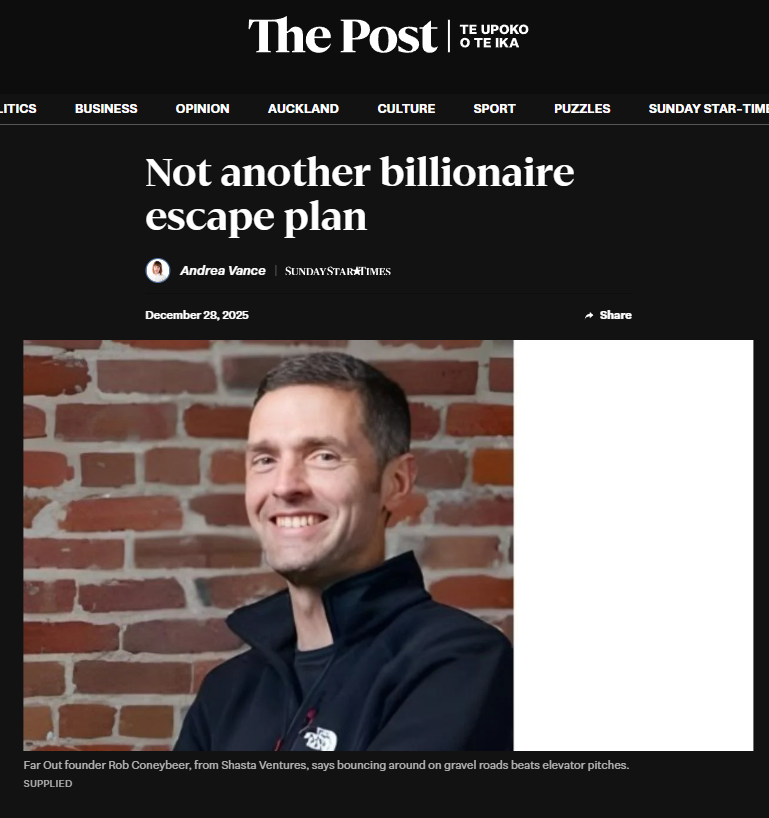
The veneer is calculated. Rob Coneybeer—a Silicon Valley venture capitalist with 24 years of backing tech companies from Nest to Canva—rolls through New Zealand in a battered Land Cruiser, marketing himself as someone who simply loves the country.
But the real machinery beneath this “rolling conference” tells a far more troubling story:
the weaponization of immigration policy to concentrate wealth, the expansion of surveillance capitalism targeting Māori, and the systematic exclusion of tangata whenua from Aotearoa’s housing market.
This is not a billionaire escape plan. It’s worse. It’s a blueprint for regulatory capture dressed up as tourism.
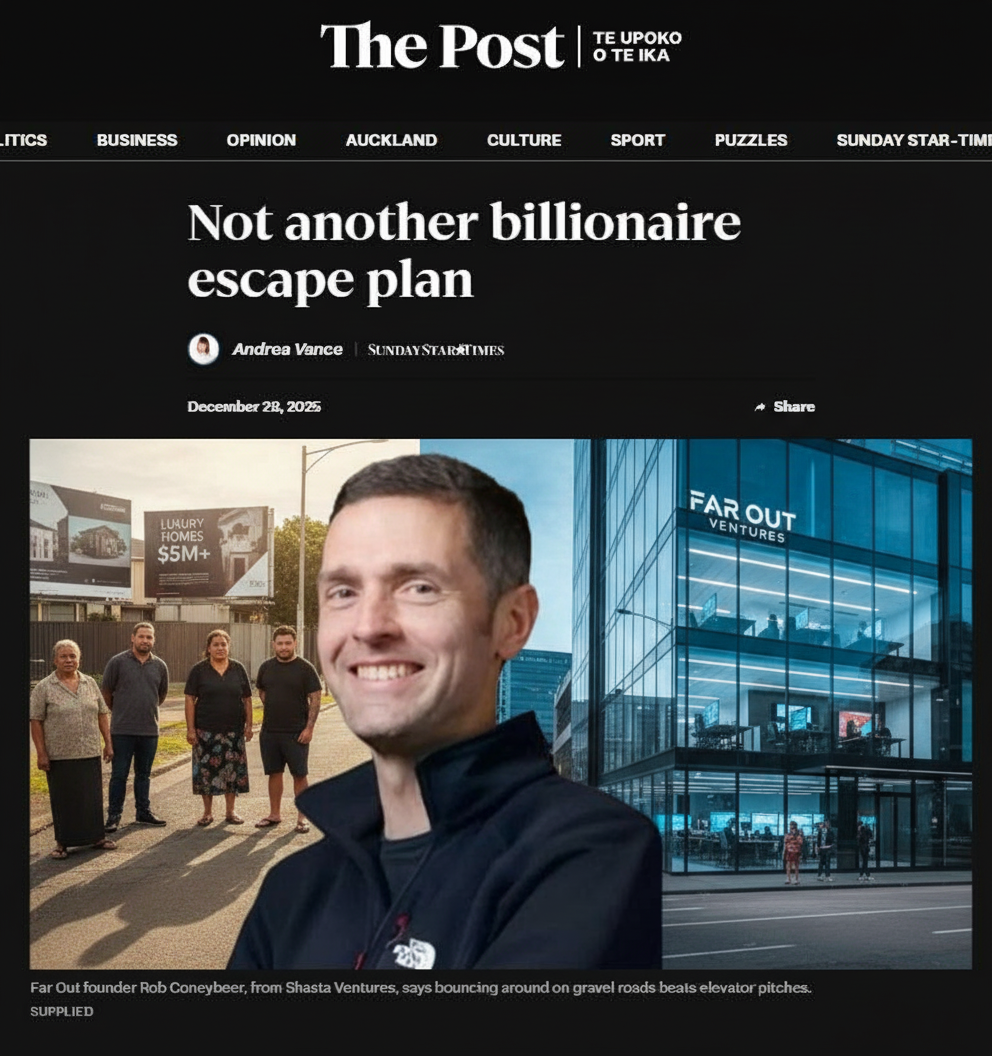
Silicon Valley Venture Capital Meets Aotearoa's Housing Crisis
On April 1, 2025, New Zealand’s government quietly reestablished a pathway to permanent residency for foreign investors. The Active Investor Plus (AIP) visa—nicknamed the “golden visa”—requires a minimum investment of NZ$5 million for three years, with only 21 days of residency required. Forty percent of applicants are from the United States. As of December 15, 2025, the Crown had recorded 491 applications covering 1,571 people representing a potential minimum investment of $2.9 billion.
This is not economic policy. It is regulatory capture disguised as immigration reform.
In December 2025, Parliament rushed through the Overseas Investment (National Interest Test and Other Matters) Amendment Bill, allowing golden visa holders to purchase a single residential property worth at least $5 million.
The government justified this by claiming it would affect only about 10,000 homes nationally—”only the top 1% of properties by value”—with 80% concentrated in Auckland and 10% in Queenstown.
But this framing conceals the true breach:
the Crown is now selling not just investment rights, but the crown jewels of Aotearoa’s most contested asset—land and housing—directly to foreign wealth.
The timing is no accident. The announcement came days before Parliament broke for the holidays, minimizing public scrutiny. It was negotiated as a “compromise” between National and New Zealand First—the latter of which helped impose the foreign buyers ban in 2018 but now supports carving out exceptions for the ultra-wealthy.
This is the neoliberal playbook:
a ban that protects 99% of properties, thereby inoculating against accusation of selling out while ensuring the 1% flows to foreign investors.
CONEYBEER’S SHASTA VENTURES AND THE AUROR MACHINE
The real insight is not Coneybeer’s personal visa status—though the fact that he is a frequent visitor to New Zealand with significant investment interests is not incidental. The insight is what he has actually invested in with Shasta Ventures.
In December 2021, Shasta Ventures—Coneybeer’s firm—invested $30 million in Auror’s Series B funding round.
Coneybeer personally backed the investment with remarkable prescience:
Auror is a retail crime surveillance platform that has become infrastructure for a police-private sector surveillance alliance. Founded by Phil Thomson (a former commercial lawyer specializing in privacy and IP law), Auror claims it is used by 98% of New Zealand retailers and 75% of Australian retailers. Police access the Auror database more than 600 times per day. The platform processes 200,000 retail crime reports annually.
In November 2024, Auror raised $82 million in a Series C round at a $500 million valuation. The round was backed by Axon Enterprise (formerly Taser International—a $115 billion company that manufactures police weapons and body cameras), W23 (a venture fund backed by five major grocery retailers including Tesco, Woolworths, and Ahold Delhaize), and returning investors including Shasta Ventures.
This is not a crime-fighting platform. This is a mechanism for transforming retail surveillance data into law enforcement intelligence, financed by grocery conglomerates and weapons manufacturers, and embedded into the police apparatus.
THE MĀORI SURVEILLANCE INFRASTRUCTURE
Auror did not randomly become central to New Zealand policing. The expansion reflects a foundational truth about surveillance capitalism in settler-colonial states:
it reproduces and automates the racial hierarchies that policing was designed to enforce.
In 2022, New Zealand Police admitted to fabricating crimes to gain access to Auror’s number-plate tracking functions. In January 2025, Auror was weaponized against former Green MP Golriz Ghahraman when police searched the database to find security footage of her in a Pak’nSave, despite the supermarket not reporting the incident and no complaint being filed. But Ghahraman’s case is a symptom, not the disease.

Auror Surveillance System Targeting Māori Communities
The disease is this:
Māori overrepresentation in surveillance data mirrors—and amplifies—Māori overrepresentation in the criminal justice system.
New Zealand Police photographs nearly 11,000 people between 2018 and 2021; 53% were Māori. Facial recognition technology is known to misidentify people with darker skin. Predictive policing systems that rely on biased historical crime data will flag Māori as higher-risk offenders, generating more policing, more arrests, and more convictions—a self-fulfilling prophecy encoded in silicon.
An independent report released in August 2024 found that
This bias is not accidental. It is systemic, and it is now being operationalized through Auror.
Police access the system of automated number plate recognition (ANPR) run by Auckland company Auror more than 200,000 times a year. In March 2025, an internal police memo revealed that Customs was seeking access to Auror’s platform, raising concerns about information security and privacy because the system integrates retail crime data with police intelligence. Rather than decommissioning Auror or limiting access, the response was to suggest
“warning boxes or blanking out bits of the screen”
—a band-aid on a fundamental breach of privacy. This is not regulation. This is theater.
HOUSING, TE TIRITI, AND THE VIOLENT DISPOSSESSION OF TANGATA WHENUA
While Auror expands surveillance targeting Māori, the AIP visa simultaneously locks Māori out of housing. Over 50% of all wealth in Aotearoa New Zealand is tied up in land and housing. Median house prices have rocketed while wages stagnated, pushing Māori—already suffering poverty rates double that of non-Māori—further into deprivation.
The Crown, through its historical land confiscation, dispossession, and its current neglect, has committed what amounts to a systematic exclusion of tangata whenua from homeownership.
Now, with the AIP visa, the Crown is doing something more brazen:
it is explicitly granting housing purchase rights to foreign millionaires while Māori continue to be locked out.
The policy allows visa holders to purchase homes worth $5 million or more. As of September 2025, there are only about 300 AIP applicants. But in the context of Aotearoa’s acute housing crisis
—where homelessness is rising, rental affordability is collapsing, and state housing is being defunded
—the signal is unmistakable:
Foreign wealth is a protected class. Tangata whenua are not.
In December 2025, the government acknowledged that fewer than 10,000 homes nationally would qualify for purchase by foreign investors (over 99% of the housing market remains closed to them). This is not a substantive protection of Aotearoa’s housing market. It is a ceremonial closure that permits the ultra-wealthy to circumvent the foreign buyers ban.
The Crown has signaled:
for those with $5 million, there is no ban.
The Human Rights Commission has found that the right to a decent home is inseparable from Te Tiriti o Waitangi, and that successive governments have failed to honor this obligation.
The Crown’s decision to allow golden visa holders to purchase luxury homes
—while Māori face disproportionate homelessness
—is another chapter in the history of colonization by other means.
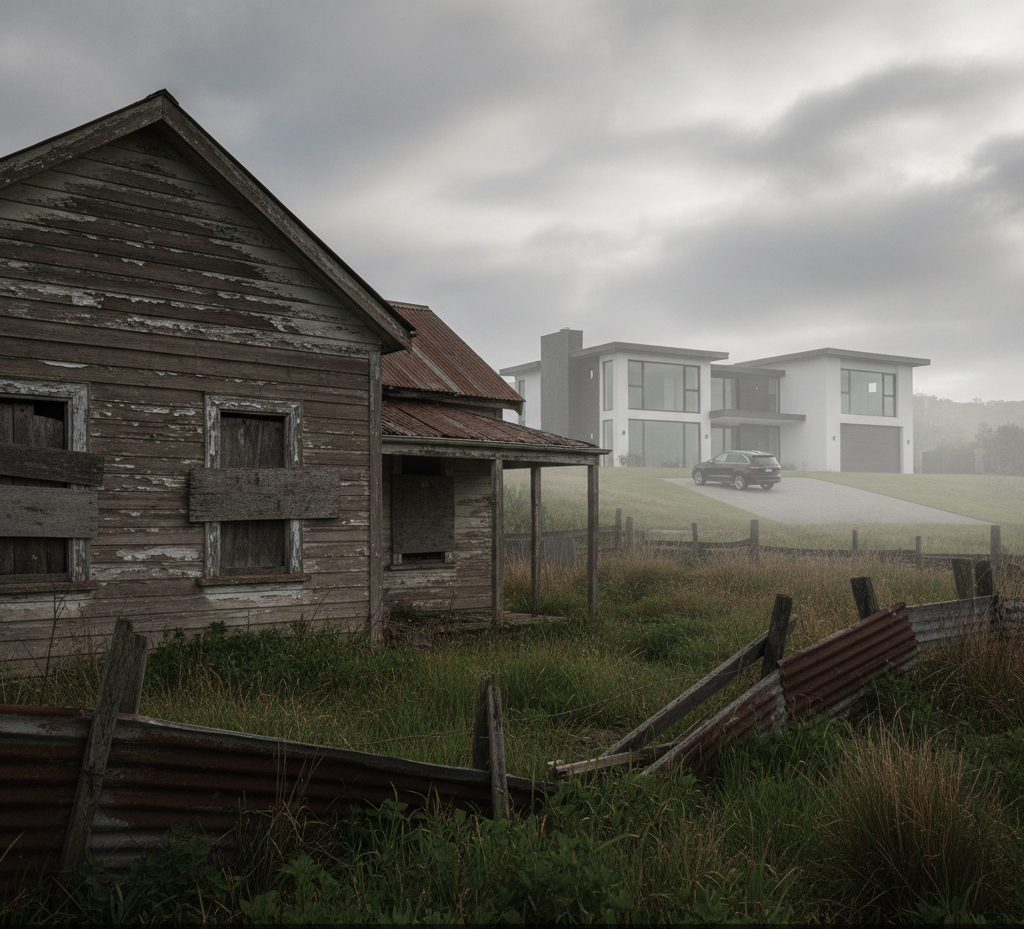
The Violent Dispossession Of Tangata Whenua
THE REGULATORY CAPTURE: WHO GOVERNS WHO?
The deeper issue is not Coneybeer or Auror individually. It is the apparatus they represent:
the capture of immigration policy, law enforcement, and retail regulation by venture capital and corporate interests.
Coneybeer arrived in New Zealand not as an isolated investor but as the co-founder of a major venture capital firm seeking to build a “network of tech talent.” His “road trips” through Aotearoa with other US tech executives and entrepreneurs are not tourism. They are infrastructure-building for the tech ecosystem. A WhatsApp group started during the trip remained active as the primary vehicle for investor-founder connections post-event.
Auror expanded because the state—through police contracts and multi-agency use agreements—made it the default infrastructure. Rather than decommissioning Auror or limiting access, the response was insufficient. This is not regulation. This is theater.
The W23 venture fund—which now holds a stake in Auror—is backed by five multinational grocery retailers: Tesco, Woolworths, Shoprite, Sobeys, and Ahold Delhaize. These corporations have captured the policy infrastructure around retail crime by positioning Auror as the solution, embedding the platform into police operations, and then profiting from the surveillance data generated. The boundaries between public and private, between law enforcement and corporate surveillance, have dissolved.
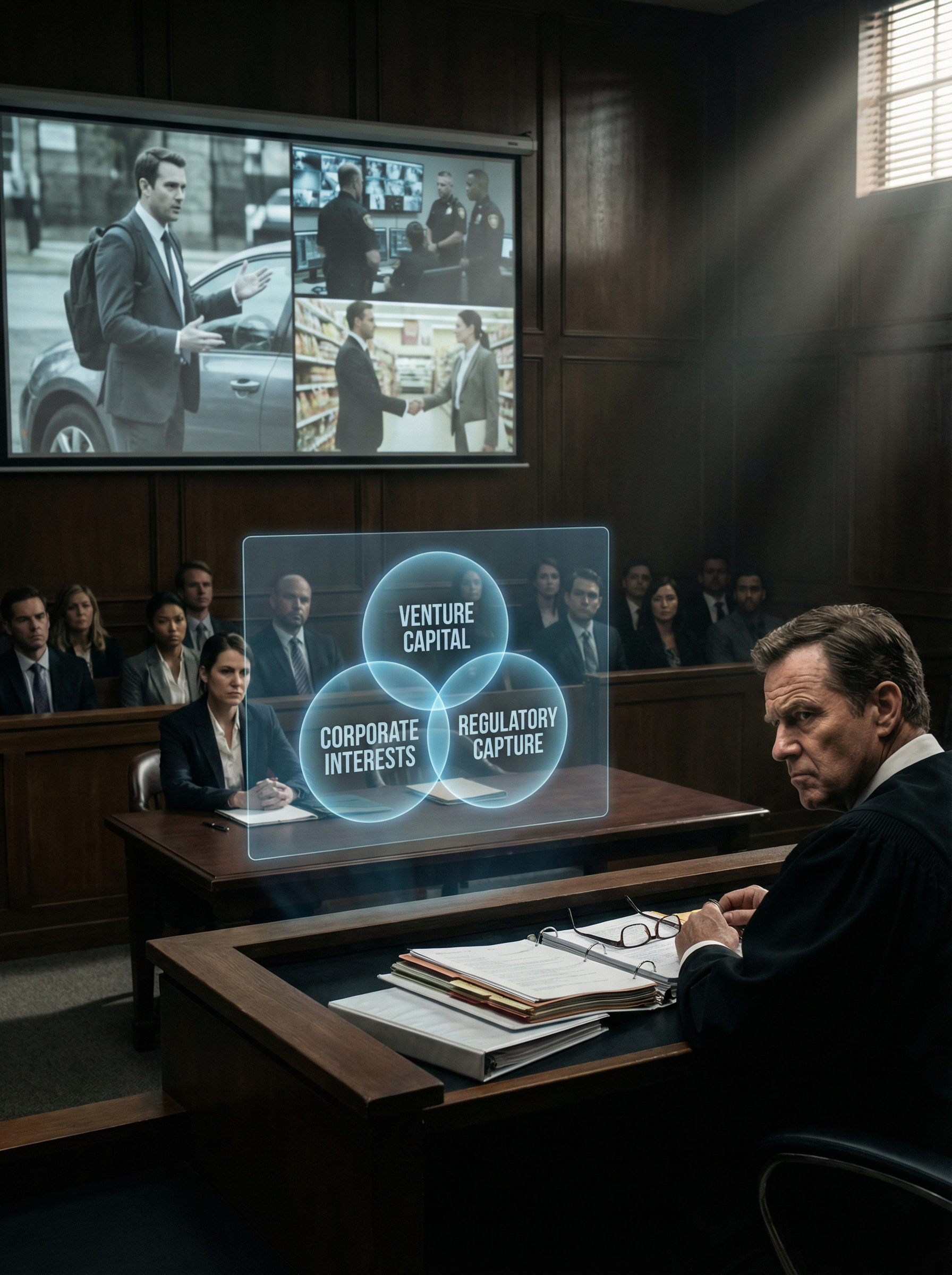
The Regulatory Capture: Who Governs Who?
THE NEOLIBERAL ARCHITECTURE
This is not accidental. New Zealand’s neoliberal turn—beginning in 1984 under Roger Douglas and accelerating through successive governments—created the conditions for this capture. State housing was privatized or sold off. Welfare was defunded. Public services were contracted to private providers. The Crown’s obligation to ensure adequate housing, education, and healthcare was replaced with a commitment to “market solutions.”
Housing became financialized. The wealthy could accumulate properties as speculative assets, driving prices upward and locking out working people. Māori, already economically marginalized through historical land dispossession, were hit hardest. Homelessness exploded. Inequality widened.
Then, as the neoliberal model began to crumble, a new frontier opened:
the monetization of governance itself.
Immigration became a revenue stream.
Law enforcement became a service to be outsourced.
Surveillance became a product to be packaged and sold.
Coneybeer arrives with $5 million, secures permanent residency, gains access to Aotearoa’s landscape (the gravel roads of the South Island, the geothermal wonders, the cultural heritage), and invests in tech companies that generate data streams and market control. His investment in Auror is not charity. It is a wager that police will become dependent on his platform, that retail corporations will be locked into his data infrastructure, and that the profit flows upward—to Shasta, to Axon, to the multinational retailers, to the tech ecosystem that Coneybeer helps curate.
Meanwhile, Māori are surveilled, priced out, and imprisoned at rates that mock the promises of Te Tiriti.
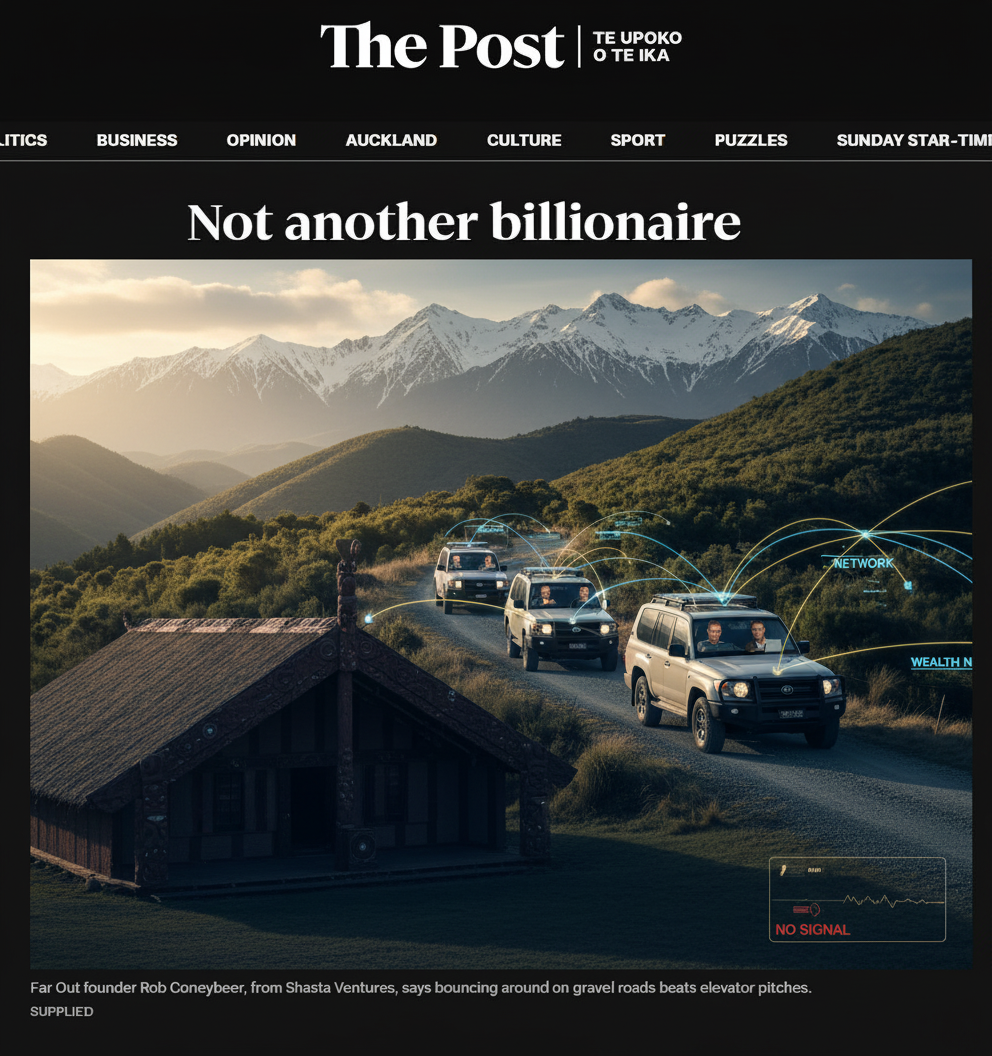
Far Out Foundation: Aotearoa's Landscape As Billionaire Playground
HOLES IN THE ACCOUNTABILITY
But Auror’s trust claims obscure the platform’s impact:
it has expanded surveillance, contributed to racial disparities in policing, and created infrastructure through which police can search retail crime databases 600+ times per day
—often for purposes wholly unrelated to retail theft.
The Court of Appeal is currently hearing a challenge to Auror’s number-plate recognition technology.
The court noted that it does not even know “how pervasive this system is.”
This is the scandal:
a surveillance infrastructure of unknown scope,
operated by a private company,
accessed by police with limited oversight,
financed by foreign venture capital, and
used to disproportionately target Māori
—and the Crown cannot even articulate its boundaries.
Holes In Accountability
THE MORAL CLARITY
What we are witnessing is not innovation. It is predation.
Rob Coneybeer is not an enemy. He is a symptom of a system where venture capital has become the primary vehicle for wealth extraction from formerly colonized peoples. He invests in Auror because the platform is profitable, not because he cares whether Māori are disproportionately surveilled. He holds an investor visa because the Crown has chosen to make permanent residency a commodity, not a privilege for those committed to Te Tiriti obligations.
The Crown has breached Te Tiriti in housing.
The Crown is breaching Te Tiriti by allowing foreign wealth to sidestep the foreign buyers ban.
The Crown is breaching Te Tiriti by permitting surveillance infrastructure to expand without regard for its impact on Māori.
The Coalition Government (National, NZ First, ACT) has made explicit choices:
choices to prioritize foreign investment over indigenous rights, surveillance over privacy, and wealth concentration over equitable access to housing.
The Predators
RANGATIRATANGA BEGINS HERE
The path forward is not more apologies. It is not more reports. It is power.
Māori must move beyond requesting a seat at tables designed to exclude them. The answer is not to ask the Crown to regulate Auror better or to promise that future immigration policy will consider Te Tiriti.
The answer is for Māori to assert tino rangatiratanga
—absolute authority
—over the data, the surveillance, and
the future of Aotearoa’s technological systems.
This means:
Reject Auror. Support community-led safety initiatives that do not rely on police surveillance or corporate data extraction.
Demand that the Crown devolve control over immigration policy to iwi, so that housing access is determined by commitment to Te Tiriti, not by wealth. Build papakāinga—Māori housing developments on collective land—as an alternative to the housing market that locks Māori out.
The billionaire escape plan is real. The escape route is surveillance, privatization, and the systematic transformation of Aotearoa’s public commons into revenue streams for foreign capital.
The resistance is equally real. It begins when whānau say no.
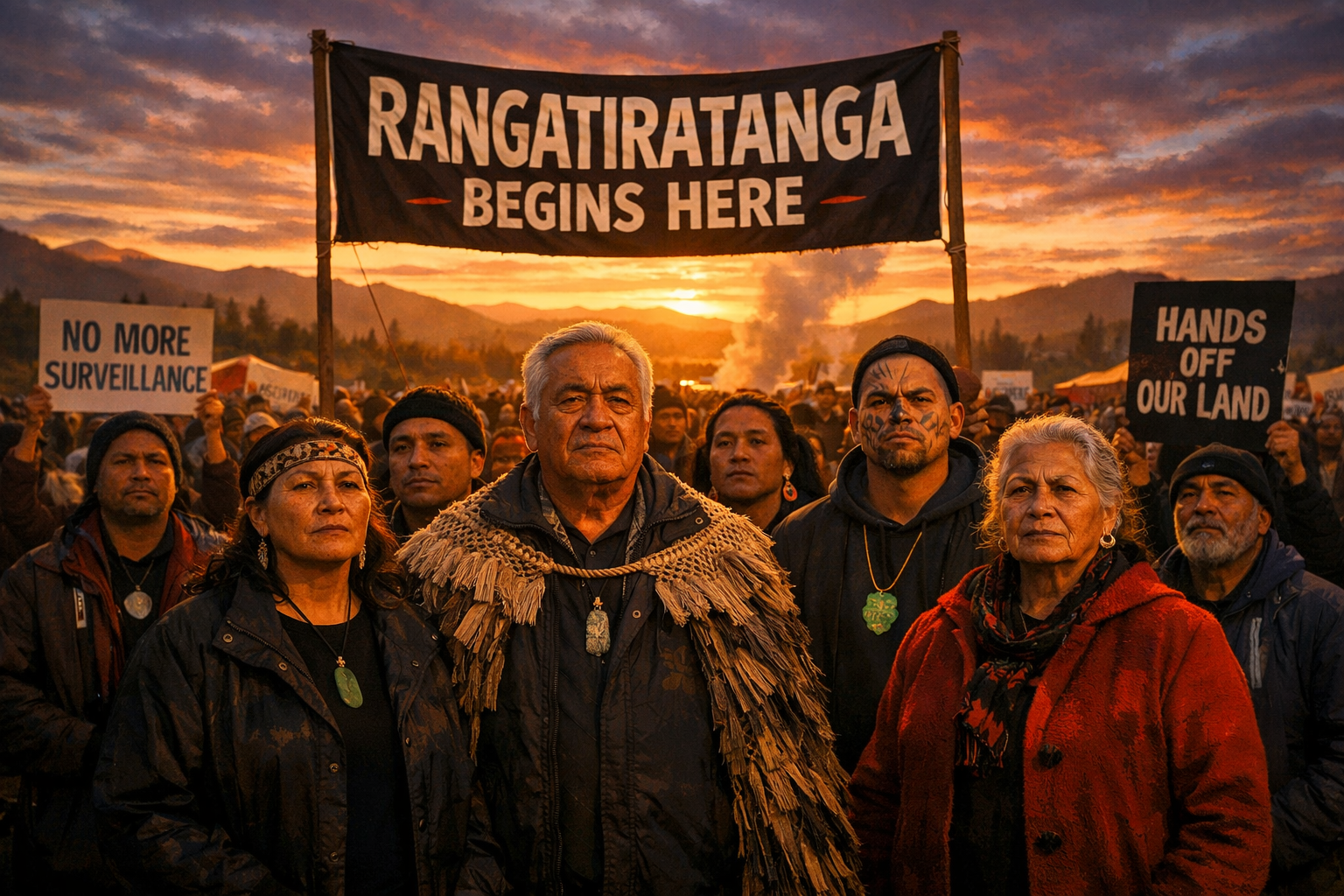
Rangatiratanga Begins Here And Now
Support this mahi:
For those who wish to support this research and accountability work directly with a koha (voluntary contribution):
→ Koha Platform
For those who wish to receive essays directly and support through subscription:
→ Subscribe on Substack
For those who prefer direct bank transfer:
HTDM, account number 03-1546-0415173-000
Every koha signals that whānau are ready to fund the accountability that Crown and corporate structures will not provide. It signals that rangatiratanga includes the power to fund our own truth tellers.
Kia kaha, whānau. Stay vigilant. Stay connected. And if you are able, consider a koha to ensure this voice continues.
Ivor Jones The Māori Green Lantern Fighting Misinformation And Disinformation From The Far Right
- https://ppl-ai-file-upload.s3.amazonaws.com/web/direct-files/collection_cf06d657-2c2b-4e68-8735-48f3c10166bd/fa7ea9f0-3948-41f0-9a6d-037b51b58d4a/Whakapiki-ki-te-ao-Maori-Application-2026.pdf
- https://ppl-ai-file-upload.s3.amazonaws.com/web/direct-files/collection_cf06d657-2c2b-4e68-8735-48f3c10166bd/8e9b17f7-604e-4009-9ec6-abbe1fd2c989/Perspective-with-Heather-du-Plessis-Allan_-This-Government-s-all-talk-bugger-all-action.PDF
- https://ppl-ai-file-upload.s3.amazonaws.com/web/direct-files/attachments/images/2123776/639e7792-3c52-4004-bf6a-e15097714866/Not-another-billionaire-escape-plan-The-Post-12-29-2025_02_08_PM.jpg
- https://ppl-ai-file-upload.s3.amazonaws.com/web/direct-files/attachments/2123776/f3c5f5cd-8157-4175-a738-b36ae33d800c/Not-another-billionaire-escape-plan-The-Post-12-29-2025_02_09_PM.pdf