"SATELLITES OF EMPIRE: How Judith Collins' Spy Programme Colonizes Te Moana-Nui-a-Kiwa—And Why Project 2025 Is Running the Show" - 6 November 2025
THE SURVEILLANCE COLONY
Kia ora e te whānau,
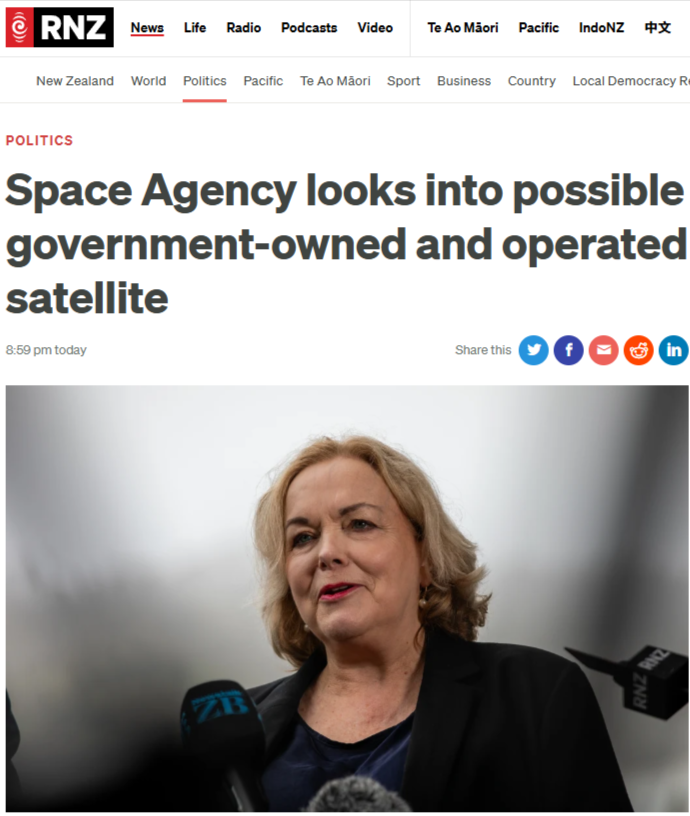
Behind the Friendly Face: How Judith Collins’ Satellite Programme Masks US Military Surveillance of Te Moana-nui-a-Kiwa
The Smoking Gun: While Judith Collins tells the public her proposed government satellite will monitor “illegal fishing” and “humanitarian disasters,” the leaked documents and budget allocations reveal something far more sinister. The Space Agency sits inside MBIE, which just lost $32 million on a failed US satellite mission, while $850 million flows to Rocket Lab for Pentagon military satellites and $500 million funds NZDF space operations. This isn’t about fish. It’s about expanding Five Eyes surveillance infrastructure that already spies on 12 million Pacific peoples through the GCSB’s Waihopai station, shared with US, UK, Canada and Australia intelligence agencies.
Who Benefits: Rocket Lab’s Pentagon contracts. US Space Force’s Pacific dominance. ACT’s David Seymour, who mirrors Elon Musk’s DOGE efficiency crusade through his $18 million Regulatory Standards Bill that strips environmental protections. Russell Vought, Project 2025 architect now running Trump’s Office of Management and Budget, provides the American blueprint: centralize executive power, gut bureaucracy, hand control to corporations. Who Pays: Māori, Pasifika, and all peoples of Te Moana-nui-a-Kiwa, whose sovereignty, privacy, and right to self-determination vanish beneath a web of military satellites sold as benign environmental monitoring.
Whakapapa: Colonial Surveillance Has Always Targeted Indigenous Peoples
This satellite scheme emerges from centuries of colonial data extraction weaponized against Māori and Pacific peoples. The Crown has historically used data collection and monitoring systems to dispossess land and suppress cultural practices, creating what researcher Tahu Kukutai calls “deficit data” - representations emphasizing pathology while ignoring community resilience. The Waitangi Tribunal recognized in WAI 2522 that Māori data constitutes taonga protected under Te Tiriti, requiring active Māori governance over how information about our people is collected, stored, and used.
Yet Collins’ satellite programme proceeds without meaningful Māori consultation, violating Kaitiakitanga (guardianship), Rangatiratanga (sovereignty), and Whanaungatanga (collective responsibility). The 2015 Snowden revelations confirmed GCSB conducts “full take” surveillance of Pacific communications - every call, email, social media message from Cook Islands, Fiji, Papua New Guinea, Solomon Islands, Samoa, Vanuatu, Kiribati, Tonga, Nauru, French Polynesia, and New Caledonia captured and shared with Five Eyes partners. Over 12 million Pacific peoples surveilled without consent, their privacy sacrificed to American imperial interests.
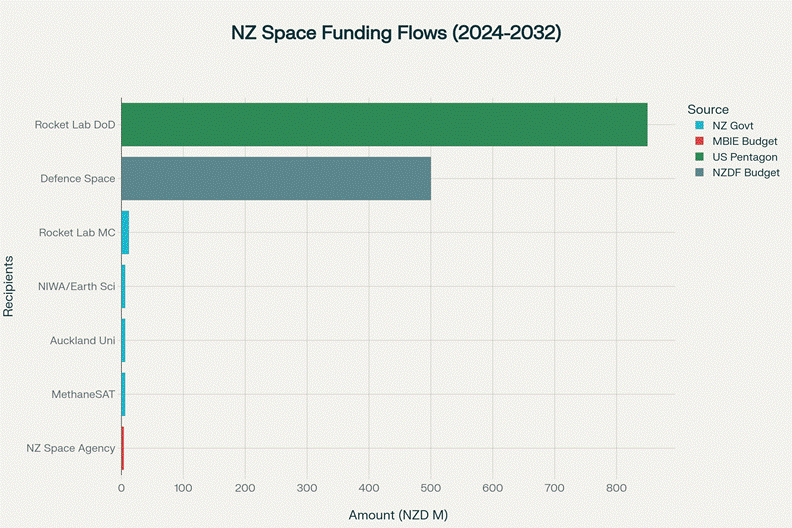
Government funding flows reveal the dual purpose of New Zealand’s space sector: civilian cover for military integration with US operations.
Historical precedent runs deep. The 2007 Tūhoe raids deployed covert surveillance and terrorism allegations against Māori asserting land rights, with no charges ultimately filed under the Terrorism Suppression Act. Māori express significantly higher concern about privacy violations than other New Zealanders - 54% aware of their data rights under the Privacy Act - because we understand surveillance’s colonial function. As data sovereignty expert Dr Karaitiana Taiuru notes, “Māori typically mistrust the government and other authority... There is a lot of fear and a lot of misunderstanding about people’s privacy.”
The stakes escalate internationally. In West Papua, Indonesia weaponizes terrorism designations to authorize “massive disproportionate surveillance that violates privacy rights” against indigenous Papuans fighting for self-determination. New Zealand’s GCSB reportedly shares Five Eyes intelligence on Pacific neighbors, potentially enabling such oppression. Our satellite infrastructure doesn’t exist in isolation - it feeds a global surveillance apparatus that targets indigenous resistance movements worldwide.
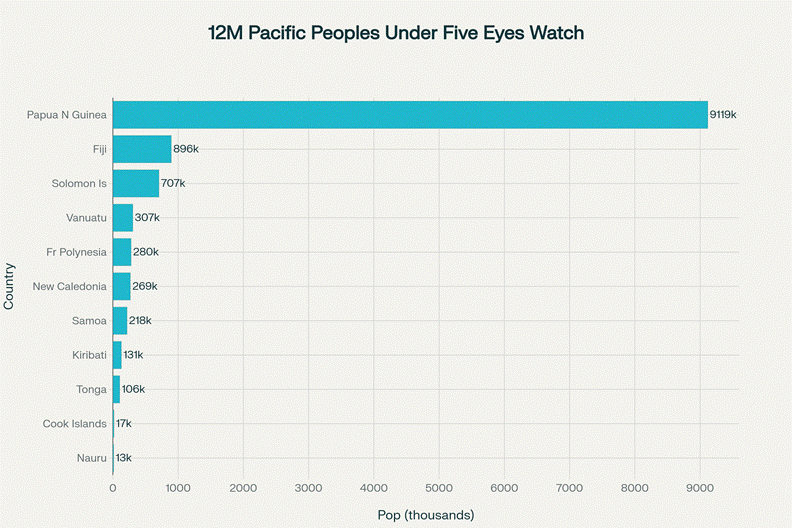
Edward Snowden’s 2015 revelations confirmed GCSB conducts mass surveillance of Pacific whānau - every call, email, and social media message collected and shared with Five Eyes partners.
The Neoliberal Playbook: Project 2025 Comes to Aotearoa
Understanding Collins’ satellite requires recognizing how Project 2025’s anti-democratic ideology has infected New Zealand governance. Russell Vought, who authored Project 2025’s executive branch chapter, now directs Trump’s OMB with unprecedented power to “tame the bureaucracy, the administrative state.” Vought describes OMB as “the President’s air-traffic control system,” concentrating federal authority in executive hands while gutting worker protections, environmental regulations, and democratic oversight.
David Seymour channels this exact approach through his Regulatory Standards Bill, which passed second reading November 2025. The bill embeds ACT’s libertarian ideology as “principles of responsible regulation” that future governments must follow or publicly justify rejecting - creating political pressure against progressive reforms protecting workers, environment, or Te Tiriti rights. Seymour appoints a Regulatory Standards Board (now via Governor-General) to investigate complaints from corporations about laws limiting their profit-taking. The Waitangi Tribunal accepted an urgent claim with 12,000 Māori claimants alleging the bill breaches Te Tiriti and causes significant prejudice to Māori. Leading Māori data scientist Kirikowhai Mikaere testified the bill “fundamentally fails to uphold Te Tiriti o Waitangi... prioritising private property and corporate interests over public good, environmental protection and the wellbeing of iwi Māori.”
Seymour’s Ministry for Regulation mirrors Elon Musk’s Department of Government Efficiency (DOGE), which Trump created to slash federal spending by firing thousands of workers and gutting programmes protecting vulnerable communities. Despite claiming $170 billion in savings, DOGE lacks transparency and operates outside congressional oversight. The parallel between Musk’s DOGE and Seymour’s regulatory agenda reveals coordinated transnational strategy: technocrats viewing government as inefficient business requiring “disruption,” erasing democratic accountability while enriching private contractors.
This ideology fuels the Fast-track Approvals Bill, which passed December 2024 giving three ministers unilateral power to approve development projects bypassing environmental protections and community consultation. Critics identify 149 fast-tracked projects including previously rejected seabed mining and hydro schemes with devastating ecological consequences. Greenpeace calls it “a one-stop shop for undermining democracy, removing public participation, and declaring war on nature”. Ngāi Tahu warns it undermines Treaty settlements, threatening two-thirds of conservation estate in their takiwā.
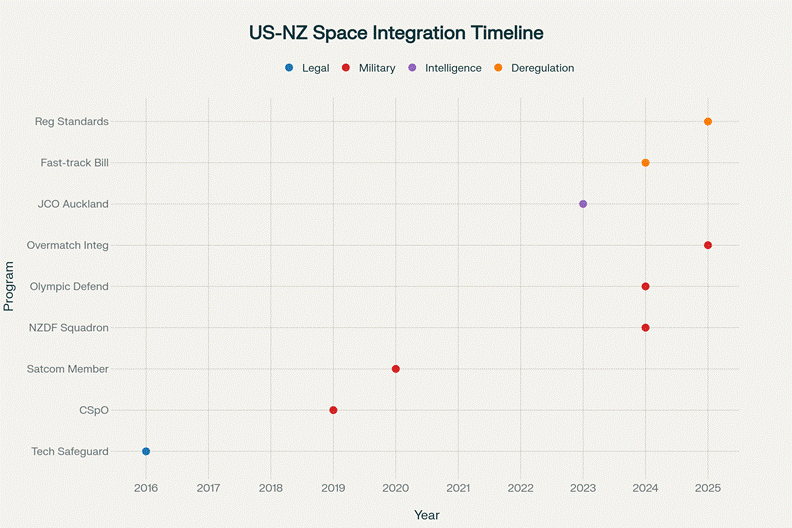
A decade of agreements reveals systematic integration of Aotearoa into US military space architecture, accelerating under Judith Collins’ watch with deregulation clearing the path.
Following the Money: Rocket Lab and the Pentagon Pipeline
While Collins promotes her satellite as environmental monitoring, funding flows expose military priorities. The MethaneSAT mission - ostensibly measuring methane emissions - cost taxpayers $32 million before failing completely in July 2025. Auckland University physicist Richard Easther describes “persistent and deep-seated problems pretty much from launch”, with officials providing misleading “happy face” updates while the mission collapsed. Collins refused comment on whether a review would occur, referring questions to MBIE’s Space Agency despite her ministerial responsibility.
Contrast this $32 million civilian failure with military windfalls. Rocket Lab secured $850 million from the Pentagon’s Space Development Agency to build 18 satellites for the Proliferated Warfighter Space Architecture - designed to “deliver battlefield intelligence” and “support the warfighter to deter/defeat the pacing challenge” (Pentagon code for China). The company won entry to the National Security Space Launch program worth up to $10 billion, becoming one of five firms launching America’s “most valuable military and spy satellites.” Rocket Lab created a subsidiary, Rocket Lab National Security, specifically for US government and allied military contracts.
The NZDF dedicates $500 million to space operations from 2024-2032, with Defence Minister declaring “access to space systems had become critical on the modern battlefield.” This funds New Zealand’s integration into US Space Force networks: the Wideband Global Satcom system, Joint Commercial Operations hub in Auckland, Operation Olympic Defender, Project Overmatch, and Combined Space Operations. Project Overmatch integrates military-civilian satellite data to “enhance fleet warfighting capabilities” for Pacific aircraft carrier strike groups.
The Space Agency itself operates on a mere $3.8 million annual budget with 17 staff, dwarfed by private military contracts. This explains the agency’s refusal to answer basic transparency questions. When RNZ requested correspondence about MethaneSAT problems via OIA, officials returned 500+ pages with nearly all content redacted - leaving only salutations like “Kia Ora Steve” and “Thanks Chris.” Commercial sensitivity, confidentiality, and “free and frank advice” exemptions concealed every substantive discussion about the failing $32 million mission.
The Hidden Agenda: Military Integration Disguised as Environmental Monitoring
Collins’ satellite rhetoric weaponizes environmental concern - “illegal fishing,” “humanitarian disaster response” - to manufacture consent for expanding surveillance infrastructure serving American military interests. The pattern mirrors satellite fishing monitoring programmes proliferating across the Pacific, where technology developed by Pew Charitable Trusts and Global Fishing Watch combines vessel tracking, synthetic aperture radar, and AI to detect fishing activity. While framed as conservation, these systems create dual-use surveillance networks accessible to military partners.
Forum Fisheries Agency’s aerial surveillance programme, funded by Australia, provides 1,400 hours annual coverage across 15 Pacific nations. Papua New Guinea recently strengthened anti-illegal fishing efforts through the US Defence Cooperation Agreement, with American military assisting “joint maritime patrols and real-time surveillance technology.” Prime Minister Marape announced plans for “advanced satellite technology for real-time monitoring of our waters” - infrastructure that inevitably feeds Five Eyes intelligence networks.
The proposed New Zealand satellite follows this blueprint. Collins emphasizes it will provide “regular coverage of areas of national interest” while “reducing government reliance on external providers” - language suggesting sovereign capability. Yet New Zealand Space Strategy 2024-2030 explicitly prioritizes expanding “operational space cooperation with our international defence and security partners”, positioning sovereign satellites as contributions to “collective security efforts.” The strategy warns “potential for conflict in space creates additional risks to New Zealand’s interests, including potential for disruption to critical national infrastructure.”
The US Space Force released an International Partnership Strategy in July 2025 calling for partners to engage in missions, wargaming, and joint planning “across requirements, budgets, programming and execution.” Air Marshal Paul Godfrey stated: “The risk calculus for our potential adversaries increases when they see allies and partners building and operating integrated space architectures.” New Zealand’s geographic position - third globally for rocket launch frequency - makes us strategically vital. Collins emphasized this in April 2025 discussions with US Space Force: “New Zealand’s unique geographical position and clear skies for space launches.”
Rhetoric vs Reality: Deconstructing the Fishing Surveillance Claim
Collins’ illegal fishing justification crumbles under scrutiny, revealing multiple fallacies:
False Necessity: The claim assumes government-owned satellites are required to monitor illegal fishing. Yet existing programmes using commercial satellite services and aerial surveillance already reduced Pacific IUU fishing from $616 million to $333 million between 2016-2021, with Global Fishing Watch demonstrating AIS tracking combined with synthetic aperture radar effectively detects fishing activity. New Zealand could contract these proven services rather than building sovereign capability - unless the goal extends beyond fishing.
Omitted Context: The 2021 FFA study found misreporting by licensed vessels constitutes 90% of IUU activity, with illegal/unlicensed fishing only 5%. Effective enforcement requires on-boat cameras and observer programs, not satellite surveillance. New Zealand’s own fishing industry resisted mandatory cameras citing surveillance overreach and privacy violations, with Māori fishers objecting to “cultural and personal experiences” monitored 24/7. If surveillance concerns matter for commercial fishers, why not for entire Pacific populations?
Slippery Slope: Once satellite infrastructure exists for “fishing monitoring,” mission creep becomes inevitable. The Joint Commercial Operations network that New Zealand joined, initially described as civilian-military data sharing, now explicitly aims to “deliver battlefield intelligence from commercial satellites to military commands.” The Auckland hub serves both Pentagon and US spy agency NRO. Nothing prevents “fishing satellites” from similar repurposing.
Appeal to Authority/Fear: Framing illegal fishing as security threat requiring military-grade satellite systems inflates the issue’s severity. Pacific IUU fishing declined substantially with regional cooperation and improved data, demonstrating collaborative civilian approaches work. Militarizing this success manufactures justification for expanding surveillance state.
Tikanga Violations: How Satellite Surveillance Attacks Māori Values
Every aspect of this satellite programme violates fundamental tikanga principles:
- Whanaungatanga (Kinship/Relationships): The programme proceeds without meaningful consultation with Māori or Pacific communities whose communications would be surveilled. The Waitangi Tribunal ruled data about Māori constitutes taonga requiring active Māori governance, yet Collins develops satellite capability to monitor Te Moana-nui-a-Kiwa while excluding indigenous voices from decision-making. This treats Pacific peoples as objects of surveillance rather than partners in collective security.
- Manaakitanga (Care/Hospitality): True care for Pacific security means respecting sovereignty and self-determination. The proposed “Pacific-Eyes” intelligence alliance - modeled on Five Eyes but supposedly adapted for Pacific realities - represents patronizing neocolonialism positioning Australia and New Zealand as intelligence benefactors to “less capable” island nations. Genuine manaakitanga requires transferring control over surveillance technology to Pacific communities, not expanding New Zealand’s spying capacity.
- Kaitiakitanga (Guardianship): Guardianship of te taiao and our communities requires protecting their privacy and dignity. Surveillance capitalism - the systematic extraction of human experience as raw material for predictive products - transforms people into data points stripped of humanity. Satellite surveillance extends this violence across Te Moana-nui-a-Kiwa, reducing 12 million Pacific peoples to behavior patterns analyzed by intelligence algorithms serving imperial interests.
- Wairuatanga (Spirituality): Indigenous cosmologies recognize deep connection between peoples and cosmos. The United Nations Declaration on the Rights of Indigenous Peoples protects indigenous peoples’ right to transmit knowledge and continue religious/spiritual practices (Articles 12.1, 13.1). Satellite pollution - both physical debris and light pollution - violates these rights when it negatively impacts ability to practice traditional starcraft and navigation. Moreover, satellites surveilling indigenous territories without consent constitute forced assimilation (Article 8).
- Kotahitanga (Unity): True unity requires shared decision-making and reciprocal accountability. The Five Eyes alliance concentrates intelligence power in Anglosphere states while surveilling everyone else. New Zealand’s GCSB captures communications from Cook Islands, Fiji, PNG, Solomon Islands, Samoa, Vanuatu, Kiribati, Tonga, Nauru, French Polynesia, and New Caledonia without knowledge of what information gets shared or how it’s used. As the Inspector-General noted, even GCSB had “lost sight” of some foreign capabilities embedded in its systems. This breeds mistrust, not unity.
- Rangatiratanga (Sovereignty/Self-determination): The programme fundamentally undermines Pacific sovereignty. Indonesia weaponizes surveillance in West Papua to crush indigenous self-determination, with terrorism designations enabling “massive disproportionate surveillance that violates privacy rights.” New Zealand’s Five Eyes intelligence sharing potentially enables such oppression. West Papuans report military surveillance creating fear when “watching communities activities, people’s movement when they travel”. Our satellite infrastructure amplifies these threats.
- Aroha (Love/Compassion): Love for our Pacific whānau means protecting them from harm, including surveillance violence. The racist TikTok trend weaponizing Aboriginal Australian Eric Yunkaporta’s image as “phone thief” prank demonstrates how surveillance technology and data extraction enable anti-indigenous racism. His family describes it as “bullying and making a mockery out of First Nations people.” Satellite surveillance collecting communications from millions of Pacific peoples creates data vulnerable to similar misuse - facial recognition, predictive policing, AI bias, all documented to disproportionately harm indigenous communities.
Hidden Connections: The Web of Power Behind the Satellites
Privacy Violations at Scale: Edward Snowden’s 2015 revelations confirmed GCSB conducts “full take” of communications from 11 Pacific nations, affecting 12+ million people who never consented to surveillance. Every call, email, social media message captured and filtered by specialized computers for keywords, phone numbers, metadata. New Zealand has “little or no knowledge” of what information it hands to Five Eyes partners or how it’s ultimately used. Adding government-owned satellites expands this surveillance capacity while maintaining zero accountability to those surveilled.
Indigenous Data Sovereignty Under Attack: The Waitangi Tribunal ruled in WAI 2522 that Māori data constitutes taonga protected under Te Tiriti, requiring Crown to support Māori governance structures giving practical effect to data sovereignty. Satellite surveillance collecting communications about Māori and Pacific peoples without indigenous control violates this. As Te Mana Raraunga advocates, data is living taonga of strategic value subject to Māori governance. Unilateral Crown satellite development undermines this.
Democratic Accountability Eroded: Collins refuses to answer questions about MethaneSAT’s $32 million failure, referring media to MBIE despite her ministerial responsibility. The Space Agency redacts nearly all substantive content from OIA requests, citing commercial sensitivity and confidentiality for a publicly-funded mission. This secrecy prevents public oversight while the Fast-track Bill removes community consultation rights and Regulatory Standards Bill institutionalizes corporate complaints against progressive regulation.
Treaty Breaches Multiplying: The Regulatory Standards Bill faces Waitangi Tribunal claim with 12,000 Māori claimants alleging it breaches Te Tiriti and causes significant prejudice. Ngāi Tahu warns Fast-track Bill undermines Treaty settlements affecting two-thirds of conservation estate in their takiwā. The satellite programme proceeds without Treaty partner consultation, violating partnership principles while expanding surveillance of Māori and Pacific peoples.
Economic Priorities Exposed: $32 million lost on failed MethaneSAT versus $850 million to Rocket Lab for Pentagon contracts and $500 million for NZDF space operations. Civilian climate mission fails with zero accountability while military contractors prosper. Budget 2025 cuts spy agencies from $515 million (2023) to $375 million (2025), yet defence space operations receive half a billion. The pattern reveals priorities: fund military integration, starve democratic oversight.
He Whakaaro Whakakapi: Our Path Forward
This satellite programme represents colonial surveillance violence wrapped in environmental rhetoric. Collins tells us it’s about fish while building infrastructure for American military dominance over Te Moana-nui-a-Kiwa. She mimics Project 2025’s playbook - centralize executive power, strip regulations, enrich contractors, surveil resistance - while Seymour plays Musk to her Vought, dismantling democratic protections through the Regulatory Standards Bill.
But we’ve stopped these schemes before. This is ACT’s fourth attempt at regulatory standards legislation; we defeated it three times. We can defeat it again, along with this surveillance satellite scam.
Our Demands:
- communities occurs, with indigenous governance over any surveillance capability
- Full public inquiry into MethaneSAT’s $32 million failure and all Space Agency contracts with Rocket Lab, MBIE conflicts of interest, and Collins’ approval decisions
- Reject the Regulatory Standards Bill - contact your MP, submit to Finance and Expenditure Committee, join protests defending democratic regulation
- Withdraw from offensive military space programmes including Project Overmatch, Operation Olympic Defender, and Joint Commercial Operations military integration
- Implement Māori Data Sovereignty following Waitangi Tribunal WAI 2522 findings, ensuring indigenous control over data collection about our communities
- Transparency in Five Eyes operations - end mass surveillance of Pacific peoples, public disclosure of what intelligence New Zealand shares with partners
The surveillance state targets indigenous resistance because we threaten their extraction economy. They want our lands, waters, and resources without our permission or protection. They want our communications monitored, our movements tracked, our organizing disrupted. They want satellites watching Te Moana-nui-a-Kiwa not to protect fish, but to protect their profits and military control.
We say no. Our mokopuna deserve skies free from surveillance, seas free from spying, futures free from imperial domination. We assert Rangatiratanga over our data, Kaitiakitanga over our territories, Kotahitanga among Pacific peoples resisting together.
Kia kaha. Kia maia. Kia manawanui.
Koha/Donation
If this mahi has been valuable to you and you have the capacity, please consider supporting continued investigation through koha to HTDM: 03-1546-0415173-000. Only give if you are able - your sharing of this work is equally precious.
Nō Te Arawa, Ngāti Pikiao ahau
Ivor Jones - The Māori Green Lantern

The Māori Green Lantern Fighting Misinformation And Disinformation From The Far Right
American Enterprise Institute. (2025). Rocket Lab Selected for National Security Space Launch Program.
BBC News. (2015, March 4). New Zealand spying on Pacific islands, Snowden leaks say.
Bjork, C. (2023, April 6). Don’t fret about students using ChatGPT to cheat – AI is a bigger threat to educational equality. RNZ.
Collins, J. (2024, September 23). Government plans to launch its own satellite by 2030. RNZ.
Collins, J. (2025, November 5). Space Agency looks into possible government-owned and operated satellite. RNZ.
E-Tangata. (2024, September 24). Spying on our Pacific ‘family’.
Edwards, B. (2025, May 1). Rocket Lab - Corporate Profile. The Integrity Institute.
Global Fishing Watch. (2024, December 14). Recent Study Shows How Satellite Technology Can Help Track Illegal Fishing Throughout the Pacific Region.
Greenpeace Aotearoa. (2024, August 22). Greenpeace submission on the Fast-track Approvals Bill.
Greenpeace Aotearoa. (2025, July 27). The Regulatory Standards Bill is Seymour’s next power grab.
Griffin, P. (2025, July 17). MethaneSAT loss, transparency, and a win for Auckland. ITP Techblog.
Human Rights Watch. (2021, May 6). Terrorist tag in West Papua could worsen racism: rights group. RNZ.
Lowy Institute. (2025, October 20). A Pacific Eyes intelligence-sharing agreement.
Ministry of Business, Innovation and Employment. (2024). New Zealand Space and Advanced Aviation Strategy 2024-2030.
National Women’s Law Center. (2025, January 30). Russell Vought: The Project 2025 Architect and OMB Nominee Coming for Our Democracy.
New Zealand Defence Force. (2025, April 9). Access to space systems ‘critical on the modern battlefield’. RNZ.
New Zealand Herald. (2024, March 24). Supersized MBIE: How the Ministry for Everything ballooned.
1News. (2025, October 24). Minister warned about possible Israeli use of NZ-launched satellites.
Peace and Humanity. (2025, September 29). Digital Sovereignty or Digital Colonialism: How Indigenous Communities Are Fighting for Control Over Their Data.
Pew Charitable Trusts. (2016, September 2). How Satellite Technology Is Helping End Illegal Fishing in Our Ocean.
Radio New Zealand. (2014, August 29). Controversial final months for Collins.
Radio New Zealand. (2024, September 7). New Zealand takes another step towards US space operations.
Radio New Zealand. (2024, December 16). Fast-track bill passes into law, amid protest.
Radio New Zealand. (2025, February 15). Elon Musk’s DOGE agency is at the centre of controversy in the US - so what is it?
Radio New Zealand. (2025, February 24). ‘Kia Ora, Steve’ and little else: No answers from NZ’s Space Agency about delays in space mission.
Radio New Zealand. (2025, February 24). US speeds up integration of partners like NZ into military space operations.
Radio New Zealand. (2025, April 15). NZ plugs in to boost US Navy’s space race with China.
Radio New Zealand. (2025, April 30). Regulatory Standards Bill claim accepted for urgency by Waitangi Tribunal with 12,000 claimants signed on.
Radio New Zealand. (2025, May 20). David Seymour defends $18m annual cost of Regulatory Standards Bill.
Radio New Zealand. (2025, May 22). Budget 2025: Spy agencies funds cut as security threats grow.
Radio New Zealand. (2025, June 9). The Regulatory Standards Bill: What is it, what does it propose, and what’s next?
Radio New Zealand. (2025, June 19). Scrapping national census raises data sovereignty, surveillance fears for Māori.
Radio New Zealand. (2025, July 2). Lost satellite cost NZ extra $3m because of delays.
Radio New Zealand. (2025, July 2). Taxpayer funded satellite had ‘deep-seated problems’ from launch.
Radio New Zealand. (2025, July 7). Taxpayers Union, Māori data scientist among Regulatory Standards Bill submitters.
Radio New Zealand. (2025, July 14). Space Minister Judith Collins goes to ground over alleged government failures managing NZ’s first space mission.
Radio New Zealand. (2025, July 22). US Space Force wants partners - including NZ - to prepare for space wars.
Radio New Zealand. (2025, November 3). Regulatory Standards Bill passes second reading after heated debate in Parliament.
Rocket Lab. (2020, January 21). Rocket Lab’s first launch of 2020 to be for US military agency. RNZ.
Sora, T. (2025, October 22). Australian think tank proposes ‘Pacific-Eyes’ intelligence alliance for regional security. RNZ.
Taiuru, K. (2025, September 21). Māori Data Governance in 2025.
TechCrunch. (2024, January 8). Rocket Lab leverages vertical integration to land $515M military satellite contract.
The Conversation. (2025, February 7). Efficiency − or empire? How Elon Musk’s hostile takeover could end government as we know it.
The Spinoff. (2022, July 28). Inside the fight for Māori data sovereignty.
Trump Administration. (2025, October 4). Trump openly embraces Project 2025, uses shutdown to pursue some of its goals. 1News.
University of Auckland. (2024, September 4). New Zealand Space Agency’s dual role is a point of tension.
Yahoo News. (2025, March 12). The key Project 2025 authors now staffing the Trump administration.