“Selling Our Homes to Save Them: How Neoliberal Think Tanks Are Weaponising Housing Against Māori” - 18 October 2025
The NZ Initiative’s Latest Attack on Kāinga Ora is Colonial Dispossession Dressed Up as Fiscal Responsibility
Kia ora koutou katoa. Ko The Māori Green Lantern ahau, e noho ana i roto i Te Arawa, Ngāti Pikiao. Tēnā koutou, tēnā koutou, tēnā koutou katoa. (Greetings to all. I am The Māori Green Lantern, dwelling within Te Arawa, Ngāti Pikiao. Greetings, greetings, greetings to you all.)
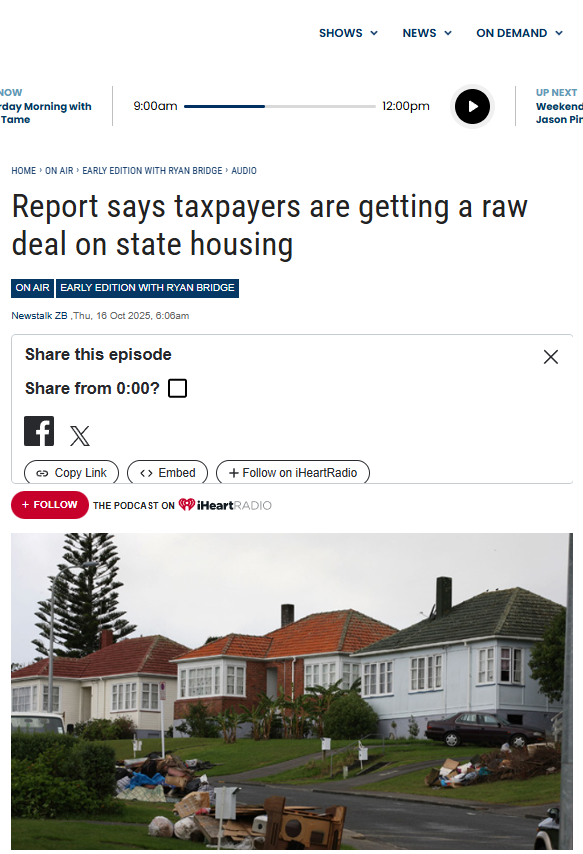
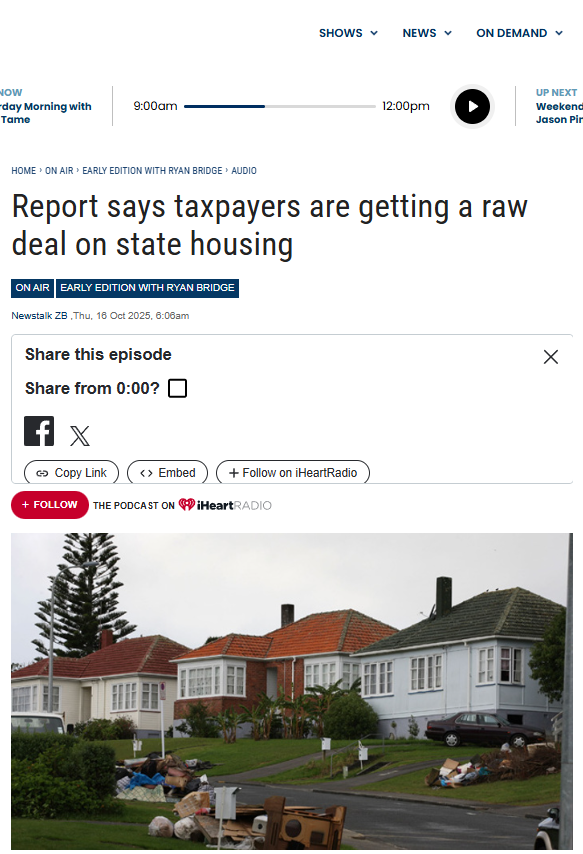
Here’s the raw truth that Dr Bryce Wilkinson of the New Zealand Initiative wants you to swallow: the government should sell off 78,000 state houses, give tenants vouchers instead, and let the private market sort out social housing. He claims Kāinga Ora costs taxpayers nearly double what private landlords charge – 88 percent of rental income goes to operating costs compared to 50 percent for private landlords, costing an extra $2.17 billion annually. That’s $29,000 per house, $11,000 per occupant. And he spun this story to Ryan Bridge on NewstalkZB’s Early Edition, where the broadcaster—known for his centre-right views and attacks on Te Pāti Māori—let this poison flow unchallenged into Kiwi living rooms.
But this isn’t about economics. It’s about power. It’s about white supremacy hiding behind spreadsheets. And it’s about a coordinated attack on the last remnants of state responsibility for Māori whānau who make up a disproportionate number of public housing tenants.
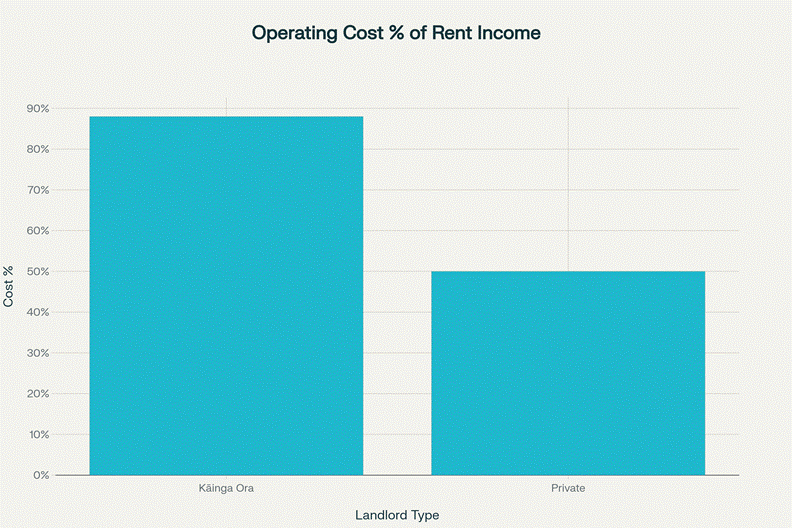
Comparison of Operating Cost as Percentage of Rental Income
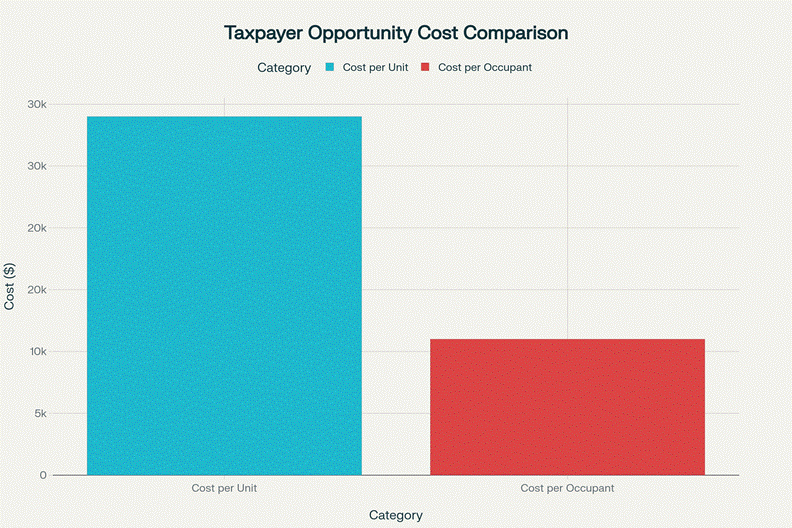
Taxpayer Opportunity Cost per Unit vs per Occupant
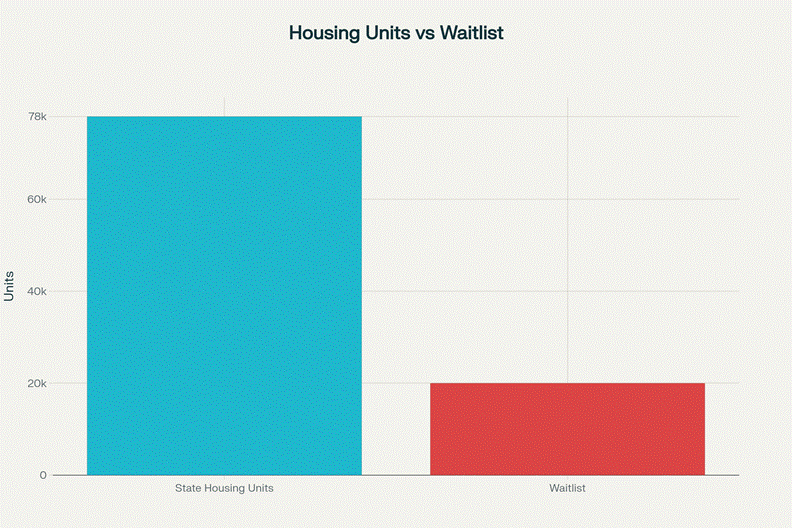
State Housing Stock vs Public Housing Waitlist
On October 15, 2025, the New Zealand Initiative released “Owning Less to Achieve More”, a 58-page report calling for wholesale privatisation of Kāinga Ora’s housing stock. The report’s lead author, Bryce Wilkinson, is a senior fellow at the NZ Initiative, a Wellington think tank funded by major banks, tobacco companies like British American Tobacco, and corporate elites. The report came hand-in-glove with a media blitz, including appearances on Ryan Bridge’s show and discussions with former Prime Minister Bill English, who led the government’s 2024 review of Kāinga Ora that found the agency “underperforming” and “not financially viable”.
This essay exposes how the NZ Initiative, Wilkinson, English, and their media allies like Bridge are weaponising a manufactured “fiscal crisis” to advance an ideological agenda rooted in neoliberalism, Christian nationalism, and racial capitalism. Their target? Māori whānau, who are locked out of homeownership, overrepresented in state housing, and now face the prospect of eviction into an exploitative private rental market.
Background
State housing in Aotearoa has always been contested terrain. From the 1935 Native Housing Act, which provided loans but excluded most Māori due to land title complexities and poverty, to the 1991 market-rent regime under Ruth Richardson that gutted affordable housing, government policy has consistently dispossessed Māori. The post-war boom saw some Māori access state housing, but small two-bedroom designs ignored intergenerational whānau living arrangements, reinforcing Pākehā nuclear family norms. The 1980s and 1990s neoliberal “reforms” dismantled state housing provision, causing Māori home ownership to plummet from 60 percent in 1991 to 28 percent today. Meanwhile, Māori face housing discrimination, overcrowding, and homelessness at rates far exceeding the general population.
Kāinga Ora was established in 2018 to address this crisis, managing 78,000 homes for around 200,000 tenants. But from day one, it faced attacks. The English-led review, commissioned by the National-ACT-NZ First coalition government, claimed Kāinga Ora was heading for a $700 million annual deficit by 2026-27 and recommended “refreshing” the board, outsourcing to community providers, and slashing costs. This set the stage for Wilkinson’s report, which goes further: sell the houses entirely.
The terms here matter. Neoliberalism is the ideology that markets are superior to states, that privatisation and deregulation solve all problems, and that individuals—not communities—are responsible for their fate. It emerged from the New Zealand Business Roundtable in the 1980s, the NZ Initiative’s predecessor, and drove Roger Douglas’s “Rogernomics” reforms. Christian nationalism intertwines with this ideology, framing poverty as moral failure and state welfare as paternalistic charity rather than Treaty obligation. And white supremacy? That’s the bedrock—a system that benefits Pākehā wealth accumulation while keeping Māori dispossessed.
What Is Really Going On?
The NZ Initiative’s report makes three core claims. First, that Kāinga Ora is inefficient, with operating costs at 88 percent of rental income versus 50 percent for private landlords. Second, that this inefficiency costs taxpayers $2.17 billion annually. Third, that the solution is to transfer houses to community providers or sell them outright, replacing tenancy with housing vouchers that tenants can use in the private market.
Wilkinson told Ryan Bridge that “taxpayers are getting a raw deal” and that vouchers would give tenants “choice” and “dignity”. Bill English echoed this, calling Kāinga Ora “the largest and worst land banker in the country” and arguing it underutilises land that could be freed for private development.
Why does this matter to Māori? Because Māori are disproportionately represented in Kāinga Ora housing, are overrepresented on the waitlist, and have the lowest home-ownership rates in the country. Privatising state housing will force whānau into a private rental market characterised by discrimination, insecurity, and unaffordable rents. It will also erase one of the few remaining Treaty-responsive institutions—Kāinga Ora has committed to prioritising Māori and iwi partnerships—in favour of profit-driven landlords with zero Treaty obligations.
The scope of this analysis covers the ideological foundations of the NZ Initiative’s report, the hidden connections between its authors, their funders, and the government, and the material harm this agenda will inflict on Māori whānau.
The Neoliberal Playbook: Privatisation as Dispossession
The NZ Initiative’s report follows a well-worn script. Step one: manufacture a crisis. Claim public services are “failing” by comparing them to private alternatives using cherry-picked metrics. Step two: propose privatisation as the “pragmatic” solution, wrapped in technocratic language about “efficiency” and “value for money”. Step three: ignore the social, cultural, and political consequences, especially for Māori.
The 88 percent versus 50 percent cost comparison is a perfect example. Kāinga Ora operates differently than private landlords because it must. It houses the most vulnerable New Zealanders, including Māori whānau with complex needs, provides intensive tenancy support, maintains ageing housing stock, and operates under government directives to meet social outcomes, not profit margins. Private landlords, by contrast, cherry-pick tenants, skimp on maintenance, and evict anyone who can’t pay. Comparing the two is like comparing a hospital to a health spa—they serve different purposes.
Wilkinson’s report also ignores the opportunity cost of privatisation. When the state sells assets, it loses long-term revenue streams and control over essential services. English’s review admitted Kāinga Ora holds $45 billion in assets. Selling these to “reduce debt” is short-sighted fiscal vandalism. Moreover, vouchers in the private market won’t create more housing supply—they’ll just inflate rents as landlords capture the subsidy, a phenomenon observed in the United States and Australia.
From a Te Ao Māori perspective, this entire framing violates tikanga. Housing is not a commodity—it’s a taonga, a treasure that enables whānau to thrive. Manaakitanga (care) demands we house those in need. Whanaungatanga (relationships) requires housing policies that strengthen whānau connections, not scatter them across unstable rentals. Kotahitanga (unity) means we act collectively, not individualistically. The NZ Initiative’s voucher scheme atomises whānau, stripping them of the security and community that state housing—however imperfect—provides.
The Christian Nationalist Subtext: Deserving vs Undeserving Poor
Bill English is a devout Catholic, former Prime Minister, and architect of “Social Investment”, a policy framework that uses actuarial assessments to target “at-risk” individuals—disproportionately Māori—for intervention. English’s Christian faith informs his politics, which blend Catholic social teaching with neoliberal economics. This creates a moralistic framework that divides the poor into “deserving” (those willing to work, comply, and integrate into Pākehā norms) and “undeserving” (those deemed lazy, dysfunctional, or culturally resistant).
This moralism saturates the housing debate. Kāinga Ora tenants are portrayed as dependent, irresponsible, and a drain on taxpayers. Wilkinson’s report and Bridge’s interview frame vouchers as giving tenants “dignity” and “choice”—implying they currently lack these. But dignity doesn’t come from vouchers; it comes from secure, affordable housing and freedom from discrimination. And choice is meaningless when the private market is hostile to Māori whānau, as research consistently shows.
Christian nationalism also fuels opposition to Treaty-based policies. English and Wilkinson’s generation of policymakers see the Treaty as a historical document, not a living partnership. The Regulatory Standards Bill, another NZ Initiative project, explicitly excludes Treaty principles, framing them as special treatment rather than legal obligations. This dovetails with the “one law for all” rhetoric of ACT’s David Seymour, who recently called for privatisation of health and housing, arguing “government is hopeless at owning things”.
The White Supremacist Architecture: Who Benefits?
Let’s follow the money. The NZ Initiative is funded by major corporations, including all big banks, tobacco giant British American Tobacco, and alcohol companies. Wilkinson himself is a former Treasury official who shaped Rogernomics and has spent decades advocating for deregulation, privatisation, and cuts to social spending. English is on the board of multiple corporations and has called for selling Crown assets to fund tax cuts. Ryan Bridge is a NewstalkZB host whose platform amplifies right-wing talking points, including attacks on Māori sovereignty movements.
These aren’t coincidences. They’re a coordinated network advancing a shared agenda: shrink the state, empower capital, and maintain Pākehā dominance. Privatising Kāinga Ora will enrich property developers, landlords, and banks—all sectors that fund the NZ Initiative. It will also eliminate a potential site of Māori economic and political power. If iwi-led housing providers or papakāinga developments were scaled up, they could challenge Pākehā control over housing and land. Selling state houses to private landlords forecloses that possibility.
This is racial capitalism at work. Māori poverty is profitable. High rents, insecure tenancies, and welfare dependency create captive markets for landlords, payday lenders, and slumlords. The NZ Initiative’s report isn’t about helping Māori—it’s about entrenching a system where Māori remain dispossessed while Pākehā elites accumulate wealth.
The Media Echo Chamber: Manufacturing Consent
Ryan Bridge’s interview with Wilkinson is a masterclass in propaganda. Bridge frames the issue as taxpayers versus tenants, repeating Wilkinson’s claims without scrutiny. He doesn’t ask: Why are Kāinga Ora’s costs higher? Are private landlords meeting social needs? What happens to Māori whānau under vouchers? Instead, he nods along as Wilkinson spins a fairy tale about “choice” and “efficiency”.
This is how neoliberal ideas become “common sense”. They’re laundered through think tanks, packaged in reports, and amplified by compliant media. NewstalkZB, owned by NZME, has a commercial interest in maintaining the status quo—advertising revenue from property developers, banks, and retailers depends on consumer spending, which vouchers won’t boost. But more insidiously, NZME’s editorial line aligns with National Party politics, as evidenced by Bridge’s sympathetic coverage of government policies.
Contrast this with how Māori voices are treated. When Willie Jackson challenged Bridge on Te Pāti Māori, accusing him of “trying to write off all Māori”, Bridge dismissed him as “grandiose”. When Waiariki MP Rawiri Waititi criticised the English review, calling it “dodgy evidence” from “one of their rich mates”, Housing Minister Chris Bishop responded by defending English’s credibility. Māori critics are framed as biased or emotional, while Pākehā elites are treated as neutral experts.
This double standard extends to Treaty issues. The Regulatory Standards Bill, which Wilkinson supports, has been dubbed “Treaty Principles 2.0” because it weaponises “rule of law” rhetoric to undermine Treaty protections. Similarly, the housing debate ignores the Waitangi Tribunal’s 2024 finding that “the Crown must begin to rectify its failure to protect kāinga by providing housing”. The Tribunal identified social housing as a resource “on which Māori heavily rely” and critiqued decreases in provision as detrimental to Māori. But this legal obligation is absent from the NZ Initiative’s report and Bridge’s interview.
The Historical Pattern: Dispossession by Design
This isn’t the first time Māori housing has been targeted. In the 1950s, state housing discrimination forced Māori into overcrowded private rentals. In the 1980s, urban renewal projects demolished Māori communities like Freemans Bay and Okahu Bay. In the 1990s, market rents and benefit cuts pushed Māori into homelessness. Each wave of “reform” dispossessed Māori further, transferring wealth and land to Pākehā.
The NZ Initiative’s report continues this pattern. It proposes selling state houses to community providers or private buyers, with no guarantee that Māori organisations will benefit. English’s webinar suggested freeing up Kāinga Ora land for private development—land that, in many cases, is stolen whenua. Meanwhile, the government has announced no new housing construction after 2026, leaving 20,000 whānau on the waitlist with no hope of secure housing.
The timing is also revealing. This report emerged shortly after Prime Minister Christopher Luxon, a “non-denominational Christian” with evangelical leanings, took office. Luxon’s government prioritises “fixing the economy” through cuts and privatisation, echoing the 1990s Richardson-Bolger playbook. And Seymour’s ACT Party, a coalition partner, has long advocated for privatisation—its ideological roots trace back to the Business Roundtable, the NZ Initiative’s predecessor. These connections aren’t hidden—they’re brazen.
The Fallacies and Bias: Deconstructing the Argument
Wilkinson’s report is riddled with logical fallacies and bias. The cost comparison (88 percent vs 50 percent) commits a category error by equating organisations with fundamentally different missions. It also ignores negative externalities—private landlords externalise costs onto tenants (inadequate maintenance, eviction trauma) and the state (emergency housing, health crises). Kāinga Ora internalises these costs, which inflates its operating budget but produces better social outcomes.
The report also employs a false dichotomy: either keep Kāinga Ora as is, or privatise. It ignores alternatives like increasing funding, transferring housing to iwi, or expanding papakāinga. The Waitangi Tribunal recommended Māori-led solutions, but Wilkinson’s report mentions iwi only in passing, framing them as potential contractors rather than Treaty partners.
The report’s framing also exhibits confirmation bias. It cites Sir Bill English’s review approvingly, despite Kāinga Ora’s rebuttal that it’s financially sustainable. Wilkinson cherry-picks data that supports privatisation while ignoring evidence that vouchers fail.
Colonisation in Action: Erasing Māori from the Equation
The most glaring omission in Wilkinson’s report is Māori. Despite Māori being overrepresented in social housing, facing housing discrimination, and suffering disproportionate homelessness, the report treats housing as a racially neutral issue. This erasure is colonial violence. It denies the Crown’s Treaty obligations and erases Māori agency.
When Māori do appear in the report, it’s as passive beneficiaries of “better outcomes” under vouchers—never as partners or decision-makers. There’s no engagement with kaupapa Māori research, no acknowledgment of Māori-led housing initiatives like marae-based papakāinga, and no recognition that Māori concepts of housing (kāinga) differ fundamentally from Pākehā individualism.
This erasure extends to policy. The English review recommended coordination with community providers, but data shows Pacific families are disproportionately evicted from Kāinga Ora housing, suggesting enforcement policies already harm non-Pākehā tenants. Privatisation will worsen this, as private landlords have no accountability for racial equity.
Broader Consequences: Entrenching Inequality
If the NZ Initiative’s agenda succeeds, Māori will face catastrophic harm. Vouchers will funnel whānau into a private rental market characterised by exploitation, insecurity, and discrimination. Research shows Māori renters face higher rejection rates, pay higher rents for worse conditions, and experience more frequent evictions. Vouchers won’t change this—they’ll subsidise racist landlords.
The loss of state housing will also eliminate a rare site of Māori political leverage. Kāinga Ora’s commitment to Māori partnerships is imperfect but represents recognition of Treaty obligations. Private landlords have no such commitment. Privatisation will also prevent future governments from scaling up Māori-led housing, as the assets will be gone.
Community Impact: Displacement and Trauma
For whānau currently in Kāinga Ora housing, vouchers mean displacement. Anita Jones, who lived in a state house sold for $3.4 million, described it as “peaceful” and “safe”—a refuge in an expensive, hostile city. Vouchers can’t replicate that security. Whānau will be forced to move repeatedly as landlords raise rents or sell properties, disrupting children’s schooling, whānau connections, and mental health.
Moana Jackson’s research on homelessness and incarceration found that housing instability is a direct pathway to imprisonment, especially for Māori. Privatising Kāinga Ora will accelerate this pipeline, creating more trauma and more profit for the carceral state.
Connection to Larger Patterns: The Neoliberal Endgame
This housing attack is part of a broader assault on Māori sovereignty. The Treaty Principles Bill, the Regulatory Standards Bill, cuts to Māori health and education, and attacks on co-governance all aim to dismantle Treaty protections and entrench Pākehā supremacy. Housing is a key front because it’s where colonisation is most material—land, wealth, and belonging.
The pattern is clear: manufacture a crisis (Kāinga Ora is “failing”), propose privatisation as the solution, ignore Māori voices, and profit from dispossession. This is the neoliberal-Christian nationalist playbook, honed over 40 years and wielded against Māori with devastating precision.
Impact on Māori Specifically: A Treaty Breach
The Waitangi Tribunal’s 2024 ruling is unambiguous: the Crown has failed to protect Māori kāinga and must provide housing. Privatising Kāinga Ora violates this obligation. It transfers Crown responsibility to profit-driven landlords who have no Treaty duty. This is not just bad policy—it’s a Treaty breach.
Māori have consistently advocated for iwi-led housing, papakāinga development, and whānau-centred design. These solutions align with tikanga and would strengthen Māori self-determination. But they require state support—funding, land transfers, and regulatory changes. The NZ Initiative’s agenda forecloses these possibilities, locking Māori into a rental market designed to extract wealth and deny dignity.
Key Findings
The NZ Initiative’s report, amplified by Ryan Bridge and legitimised by Bill English, is an ideological assault on Māori wrapped in fiscal rhetoric. Its claims of “efficiency” and “choice” mask a coordinated effort to privatise state housing, enrich Pākehā elites, and entrench Māori dispossession. The report erases Māori voices, ignores Treaty obligations, and advances a neoliberal-Christian nationalist agenda that treats housing as a commodity rather than a right.
The connections between the NZ Initiative, English, Luxon, Seymour, and Bridge reveal a tightly networked elite pursuing a shared goal: shrinking the state, empowering capital, and maintaining white supremacy. Their success will harm Māori whānau, accelerate homelessness, and violate the Treaty.
Call to Action
Whānau and communities must resist this agenda. Demand your MPs reject the NZ Initiative’s proposals and commit to scaling up state housing and iwi-led alternatives. Support Māori housing organisations like Te Matapihi and local papakāinga initiatives. Challenge racist media narratives by amplifying Māori voices and calling out propaganda like Bridge’s interview.

The Māori Green Lantern Fighting Misinformation And Disinformation from The Far Right
Pressure the government to honour the Waitangi Tribunal’s ruling and increase—not decrease—state housing investment. Advocate for iwi control over housing policy, land, and funding. And recognise that housing is a Treaty issue, not a market issue.
Koha
Ki ngā kaiwhakarato i te mahi whakaaro rangahau Māori e tautoko i te pono, i te tika, me te mana o ngā whānau Māori: If this research has been of value to you, and you are in a position to contribute a koha, you may do so to HTDM: 03-1546-0415173-000. He wā uaua tēnei mō ngā whānau, nō reira tukuna noa he koha mēnā kei a koe te whakaaro, kei a koe te āheinga. (These are tough economic times for whānau, so please contribute only if you wish and have capacity to do so.)
Nāku noa, nā
Ivor Jones, Te Arawa, Ngāti Pikiao
Te Māori Green Lantern
Mā te mahi tahi, ka puta te ora. (Through working together, wellbeing will arise.)
1. https://www.mdpi.com/1660-4601/19/9/4936/pdf?version=1650346823
2. https://formative.jmir.org/2024/1/e50385
3. https://croakingcassandra.com/2024/12/31/2025-and-what-might-have-been/
4. https://www.nzinitiative.org.nz/reports-and-media/reports/the-peoples-portfolio/
5. https://www.nzinitiative.org.nz/reports-and-media/opinion/the-mixed-success-of-new-zealands-economic-liberalisation/
6. https://www.mdpi.com/2313-5778/7/3/47
7. https://www.mdpi.com/2313-5778/7/3/47/pdf?version=1689840070
8. https://www.mdpi.com/2313-5778/5/4/99/pdf
9. https://pmc.ncbi.nlm.nih.gov/articles/PMC6646741/
10. https://pmc.ncbi.nlm.nih.gov/articles/PMC11459767/
11. https://pmc.ncbi.nlm.nih.gov/articles/PMC4754881/
12. https://www.tandfonline.com/doi/full/10.1080/14036096.2024.2362205
13. /content/files/counter/pdf/10-1186/s12913-023-10497-5.pdf
14. https://www.rnz.co.nz/news/political/479166/healthy-homes-deadline-extension-under-active-consideration
15. https://www.nzherald.co.nz/nz/politics/election-2023-national-unveils-its-social-housing-policy-vows-to-end-emergency-housing-in-rotorua/MN7JS7GKKVA3JPYXBEDWS54PVA/
16. https://www.nzherald.co.nz/nz/letters-convoy-protest-maori-self-determination-hours-light-rail-and-rapid-tests/EU7WBX2PT26CEYB2T2KEAD235Q/
17. https://teara.govt.nz/en/maori-housing-te-noho-whare/print
18. https://www.nzherald.co.nz/nz/politics/government-puts-all-public-housing-programmes-under-review-after-damning-report-into-kainga-ora/T27DNOBLN5GVJFE3YASSPN6VHM/
19. https://www.rnz.co.nz/news/political/573426/kainga-ora-to-sell-its-most-valuable-state-house
20. https://www.nzherald.co.nz/rotorua-daily-post/news/government-making-homelessness-in-rotorua-worse-says-waiariki-mp-rawiri-waititi/GDLOUVLM6NCH5KVWYQ5B24HEAU/
21. https://www.nzherald.co.nz/business/ballooning-manager-class-at-public-housing-agency-costs-103m-per-year/ZQI4RSCXDRH2RLTNXA7SUATFOU/
22. https://teara.govt.nz/en/housing-and-government/page-3
23. https://www.rnz.co.nz/news/top/575998/new-zealand-s-most-expensive-state-house-sells-for-3-point-4-million
24. https://www.tandfonline.com/doi/pdf/10.1080/1177083X.2023.2293988?needAccess=true
25. https://www.nzherald.co.nz/nz/social-housing-how-not-to-fix-a-crisis-simon-wilson/YQOBV3L33NBOVDLIWN7DUTY47U/
26. /content/files/webcontent/document/201151/housingreport.pdf
27. https://www.nzherald.co.nz/nz/kainga-ora-chiefs-exit-new-chairman-simon-moutter-at-odds-with-christopher-luxon-over-performance/VBP2JZEMCNGLDNXJHHBCCWIBCU/
28. /content/files/podcasts/checkpoint.xml
29. https://www.1news.co.nz/2025/01/24/seymour-pushes-for-privatisation-govt-hopeless-at-owning-things/
30. https://www.nzherald.co.nz/nz/politics/social-investment-20-the-answer-to-lifting-up-our-most-deprived-or-a-trojan-horse-for-smaller-government-and-privatising-services/L47MDNLKS5FOHN54G55NGVRQJ4/
31. https://www.nzherald.co.nz/businessdesk/300m-of-political-restrictions-stymie-tauranga-housing/JTCCOFOQUNGVRE55WVBS2MU7UA/
32. https://www.nzherald.co.nz/property/first-home-grant-axed-what-the-governments-devastating-news-means-for-first-time-buyers/TBIJMCTVDNA2VGOTBJNU2QS4MU/
33. https://kaingaora.govt.nz/en_NZ/about-us/resetting-kainga-ora/
34. https://www.canterbury.ac.nz/content/dam/uoc-main-site/documents/pdfs/reports/ntrc-contemporary-research-division/IMSB-MaÌ_ori-Housing-FINAL-VERSION.pdf
35. https://linkinghub.elsevier.com/retrieve/pii/S221414052300021X
36. /content/files/sites/default/files/2024-05/pc-inq-fcfa-sub-058-shar-gardiner.pdf
37. https://www.buildingbetter.nz/annotatedbibliograpy/a-profitable-housing-policy-the-privatization-of-the-new-zealand-governments-residential-mortgage-portfolio/index.html
38. https://www.buildingbetter.nz/publication/neoliberal-social-housing-policies-market-logics-and-social-rented-housing-reforms-in-new-zealand/index.html
39. https://kaingaora.govt.nz/en_NZ/publications/oia-and-proactive-releases/housing-statistics/
40. https://www.stats.govt.nz/reports/te-pa-harakeke-maori-housing-and-wellbeing-2021/
41. https://e-tangata.co.nz/comment-and-analysis/moana-jackson-what-it-means-to-be-at-home-in-this-land/
42. https://www.teaonews.co.nz/2025/08/03/pacific-families-bear-the-brunt-of-public-housing-evictions/
43. /content/files/assets/arts/our-research/research-institutes-centres-groups/ppi/policy-briefings/ppi-housing-full2.pdf
44. /content/files/bitstreams/214667c1-af59-4759-a720-929b02077c30/download.pdf
45. /content/files/index-php/JoNZG/article/download/3665/3258.pdf
46. https://pmc.ncbi.nlm.nih.gov/articles/PMC5584010/
47. /content/files/ikat/article/download/37395/21565.pdf
48. https://www.rnz.co.nz/news/business/486053/worse-than-unsatisfactory-rbnz-and-govt-criticised-over-inflation-housing-boom
49. https://www.nzherald.co.nz/business/media-insider/media-insider-needs-to-grow-a-bigger-set-of-balls-bsa-rejects-complaint-about-newstalk-zb-ryan-bridges-reference-to-pm/7PWQQQWREFBCBH6LFJPLRIS7RA/
50. https://www.rnz.co.nz/news/political/505019/former-pm-sir-bill-english-to-head-review-of-kainga-ora
51. /content/files/2018/8/e10789/pdf.pdf
52. https://www.nzherald.co.nz/nz/politics/the-varied-faces-of-think-tanks-in-nz-who-fronts-them-and-what-they-do/X7M4SUFDT5GYHKTJI2JCTJPUMA/
53. https://www.nzherald.co.nz/nz/ryan-bridge-the-start-of-something-new-for-me-and-the-herald/WX7PPZDNNND5BEXSKAM3CQNCQI/
54. https://www.rnz.co.nz/news/political/517313/kainga-ora-underperforming-not-financially-viable-sir-bill-english
55. https://www.nzherald.co.nz/business/a-response-to-sincerely-held-concerns-about-the-regulatory-standards-bill-bryce-wilkinson/LFFME3AHBFCPZDZM5M434SQBFE/
56. https://www.nzherald.co.nz/author/ryan-bridge/
57. https://www.1news.co.nz/2024/05/20/review-finds-kainga-ora-underperforming-new-chair-appointed/
58. https://www.nzherald.co.nz/business/bryce-wilkinson-past-illusions-and-future-follies-mar-grant-robertsons-economic-strategy/4DM3OARNOWLI5Z2YWXDJR45QAM/
59. https://www.nzherald.co.nz/nz/former-te-pati-maori-leader-says-party-has-issues-after-toitu-te-tiriti-split/EAMVETW3ZJBBVMGS7PIUYJX3S4/
60. https://www.rnz.co.nz/news/national/505064/government-needs-to-get-to-the-bottom-of-what-is-happening-within-kainga-ora-minister-says
61. https://www.nzherald.co.nz/business/economy/bryce-wilkinson-imf-report-into-nz-economy-cringeworthy-praise/54JQ2U4N5Y6VNOTQNTYB4U5MDA/
62. https://escholarship.org/uc/item/61t0c674
63. https://www.nzherald.co.nz/nz/hikoi-and-treaty-principles-bill-a-masterclass-from-the-maori-party-on-political-branding-ryan-bridge/IOUSK352OVHNZBRFJAXAJEWQFY/
64. https://www.nzherald.co.nz/nz/politics/kainga-ora-pushes-back-on-sir-bill-english-report-says-it-is-financially-sustainable/U5ZPY3JC2VG4LIWOZ2LHYKD3YE/
65. https://www.nzherald.co.nz/business/economy/bryce-wilkinson-prudent-levels-for-government-net-worth-really-matter/FCCAIWHT5UKMXPTKFJNEJLYQNE/
66. https://www.nzherald.co.nz/nz/election-battle-lines-are-slowly-being-drawn-ryan-bridge/SWW2PN55OFCRTIZXR7DZMF7TSY/
67. https://www.nzherald.co.nz/kahu/concerns-for-most-vulnerable-following-scathing-kainga-ora-report/VEAMO3G5KJEFJA2EZFWAA5UJ3U/
68. https://www.nzherald.co.nz/business/bryce-wilkinson-the-intellectual-origins-of-the-drive-to-polarise-and-divide-us/X636EJFXYVAUPC62HQ6HBE52JE/
69. https://www.nzherald.co.nz/nz/jim-bolgers-death-comparing-todays-petulant-mps-to-the-former-prime-minister-ryan-bridge/HATZ536UBVFRLE3UJFPR4WE6U4/
70. https://www.nzinitiative.org.nz/about-us/our-people/bryce-wilkinson/
71. https://www.newstalkzb.co.nz/on-air/early-edition-with-ryan-bridge/opinion/ryan-bridge-weve-been-reminded-our-present-day-politicians-arent-up-to-much/
72. https://www.beehive.govt.nz/sites/default/files/2024-05/Independent Review of Kainga Ora.pdf
73. https://www.tandfonline.com/doi/pdf/10.1080/02607476.2024.2413451?needAccess=true
74. https://www.nzinitiative.org.nz/about-us/our-people/bryce-wilkinson?start=15
75. https://www.newstalkzb.co.nz/on-air/heather-du-plessis-allan-drive/opinion/perspective-with-ryan-bridge-arent-children-allowed-their-own-political-views/
76. https://www.hud.govt.nz/news/government-releases-the-independent-review-of-kainga-ora
77. https://www.nzinitiative.org.nz/about-us/our-people/bryce-wilkinson?start=285
78. https://www.newstalkzb.co.nz/on-air/early-edition-with-ryan-bridge/opinion/ryan-bridge-the-silence-was-deafening-in-our-local-elections/
79. https://www.nzinitiative.org.nz/reports-and-media/media/newstalk-zb-mike-hosking-discusses-our-new-report-on-kainga-oras-costs-with-sir-bill-english/
80. https://www.nzinitiative.org.nz/reports-and-media/media/the-platform-dr-bryce-wilkinson-on-the-regulatory-standards-bill/
81. https://www.nzherald.co.nz/video/herald-now/were-being-ripped-off-ryan-bridge-compares-jim-bolgers-legacy-to-our-current-crop-of-leaders/25M6WA5IHC3YQW32XC4UUAGQN4/
82. https://www.interest.co.nz/public-policy/135737/capital-gains-tax-would-be-almost-‘irrelevant’-house-price-growth-unlikely
83.
https://theintegrityinstitute.substack.com/p/the-new-zealand-initiative
84. https://www.techrxiv.org/articles/preprint/_tea_Presence_Enabling_Virtual_Storytelling_Presence_and_Tele-Co-Presence_in_an_Indigenous_Setting/16455690/files/30476190.pdf
85. https://www.facebook.com/newstalkzb/posts/ryan-bridge-gives-his-view-on-the-importance-and-power-of-peaceful-protests/1196910319126810/
86.
https://nzinitiative.outreach.co.nz/?Ns=&Np=public-login&PMESG-oid=28184&Pcontact=22c7fb8d&Na=view-msg-public&SMESG-oid=28184&Scontact=
87. https://www.newstalkzb.co.nz/on-air/early-edition-with-ryan-bridge/opinion/ryan-bridge-is-the-work-of-activists-making-a-difference/
88. https://fyi.org.nz/request/26823-hon-bill-english-review-of-kainga-ora
89. https://www.facebook.com/photo.php?fbid=1245393090277277&id=100044197937952&set=a.490406072442653
90. https://x.com/NewstalkZB/status/1971121744393142285
91. https://tobaccocontrol.bmj.com/lookup/doi/10.1136/tobaccocontrol-2013-051467
92. https://www.frontiersin.org/articles/10.3389/fpubh.2022.950955/full
93. https://armgpublishing.com/journals/fmir/volume-6-issue-3/article-9/
94. https://gh.bmj.com/lookup/doi/10.1136/bmjgh-2022-008707
95. https://pmc.ncbi.nlm.nih.gov/articles/PMC2658826/
96. https://jszmc.com/ojs/index.php/jszmc/article/view/211
97. https://www.semanticscholar.org/paper/b252e51dd2a15cda5e1fb9507eacf7cf01b0670f
98. http://www.tandfonline.com/doi/abs/10.1080/09614524.2014.970762
99. https://www.semanticscholar.org/paper/b12d3364c1935c649621b04752ca306490441f19
100. https://www.semanticscholar.org/paper/2b3bbf89d065bc6a9d9a5a7583e3f9ef31e0e703
101. https://www.semanticscholar.org/paper/c8b752eb2ae71ad4a4eb50ca5f908c4c3373c0e8
102. https://www.rnz.co.nz/news/in-depth/517506/jordan-williams-on-why-the-taxpayers-union-went-to-panama-to-debate-vaping
103. https://www.rnz.co.nz/news/on-the-inside/439247/luxon-s-religious-views-risk-turning-off-middle-ground-voters
104. https://www.1news.co.nz/2020/04/17/kiwis-now-able-to-say-thanks-by-donating-to-essential-workers/
105. https://www.nzherald.co.nz/nz/national-party-leader-christopher-luxon-on-why-he-stopped-going-to-church/TFTD7WXSMQYX3X5IWWVFAVQWUI/
106. /content/files/ethnographic-edge/article/download/249/232.pdf
107. https://www.nzherald.co.nz/nz/plain-smoke-packets-get-go-ahead/7KKIPBV7Q64K33P6HY6EO5MU3Q/
108. https://teara.govt.nz/en/catholic-church/print
109. https://www.rnz.co.nz/news/election-2023/499861/the-political-newcomers-spending-thousands-to-influence-the-election
110. https://teara.govt.nz/en/catholic-church/page-3
111. https://www.nzherald.co.nz/nz/politics/political-corruption-donations-and-lobbying-in-new-zealand-new-report-from-the-helen-clark-foundation-on-rules-in-need-of-overhaul/NG3RVJJAXRCXXDCJL75TX4KJCQ/
112.https://www.nzherald.co.nz/nz/graham-adams-is-jacinda-ardern-the-messiah-or-just-a-very-crafty-politician/OX6JWIDJE2TA2RSCXVGMJVH77Q/
113. https://www.nzherald.co.nz/business/business-reports/sustainable-finance-carbon-is-the-new-tobacco-says-vector-boss/RLZH7Z2FPOVTEX5BNDYOPHCB3E/
114.https://teara.govt.nz/en/national-party/print
115. https://www.rnz.co.nz/news/political/426340/rnz-guide-to-party-policy-for-general-election-2020
116.https://teara.govt.nz/en/biographies/4j13/jordan-william-joseph
117. https://pmc.ncbi.nlm.nih.gov/articles/PMC9878487/
118. https://www.rnz.co.nz/news/political/503398/cuts-loom-large-as-christopher-luxon-government-targets-the-economy
119.https://teara.govt.nz/en/national-party
120. http://media.nzherald.co.nz/webcontent/document/pdf/201331/Services Sector.pdf
121.https://teara.govt.nz/en/atheism-and-secularism/page-4
122. /content/files/webcontent/document/201320/towards-better-local-regulation1.pdf
123. https://en.wikipedia.org/wiki/Bill_English
124. https://www.taxpayers.org.nz/op_ed_i_m_a_neoliberal_maybe_you_are_too
125. https://www.nzinitiative.org.nz/reports-and-media/reports/smoke-and-vapour-the-changing-world-of-tobacco-harm-reduction/
126. https://www.reddit.com/r/auckland/comments/r5aqzr/the_new_national_party_leader_is_an_evangelical/
127. https://e-tangata.co.nz/comment-and-analysis/proposed-bill-an-ideological-project-that-must-be-stopped/
128. https://onlinelibrary.wiley.com/doi/10.1111/irv.13247
129. /content/files/reports-and-media/reports/annual-report-2019/document/608.pdf
130. https://www.britannica.com/biography/Bill-English
131. https://www.reddit.com/r/nzpolitics/comments/1i7umat/transparency_not_ideology_the_case_for_the/
132. https://www.nzinitiative.org.nz/reports-and-media/opinion/nipping-tobacco-prohibition-in-the-bud/
133. https://nzhistory.govt.nz/people/bill-english
134. https://www.abc.net.au/news/2025-04-24/atlas-network-think-tanks-active-in-australia-and-new-zealand/104788732
135. https://www.nzinitiative.org.nz/membership/
136. https://www.equaljusticeproject.co.nz/articles/a-new-name-the-same-agenda-the-dangers-of-the-regulatory-standards-bill
137. /content/files/reports-and-media/reports/annual-report-2016/document/495.pdf
138. https://www.facebook.com/NZNATS/posts/by-dr-mary-english-for-the-nzheraldconz-the-story-of-the-first-time-bill-and-i-m/1930991393583113/