“Shane Jones Trading Stolen Taonga for War Machines With Trump: The Minerals Gambit and Aotearoa’s Surrender of Sovereignty” - 31 January 2026
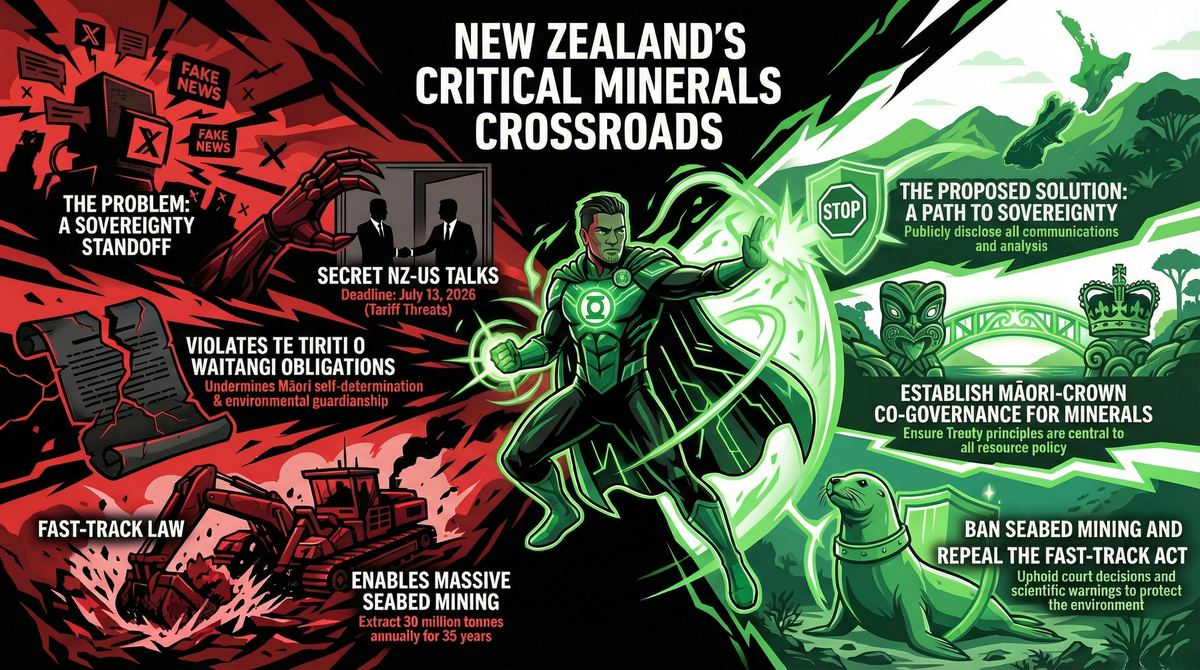
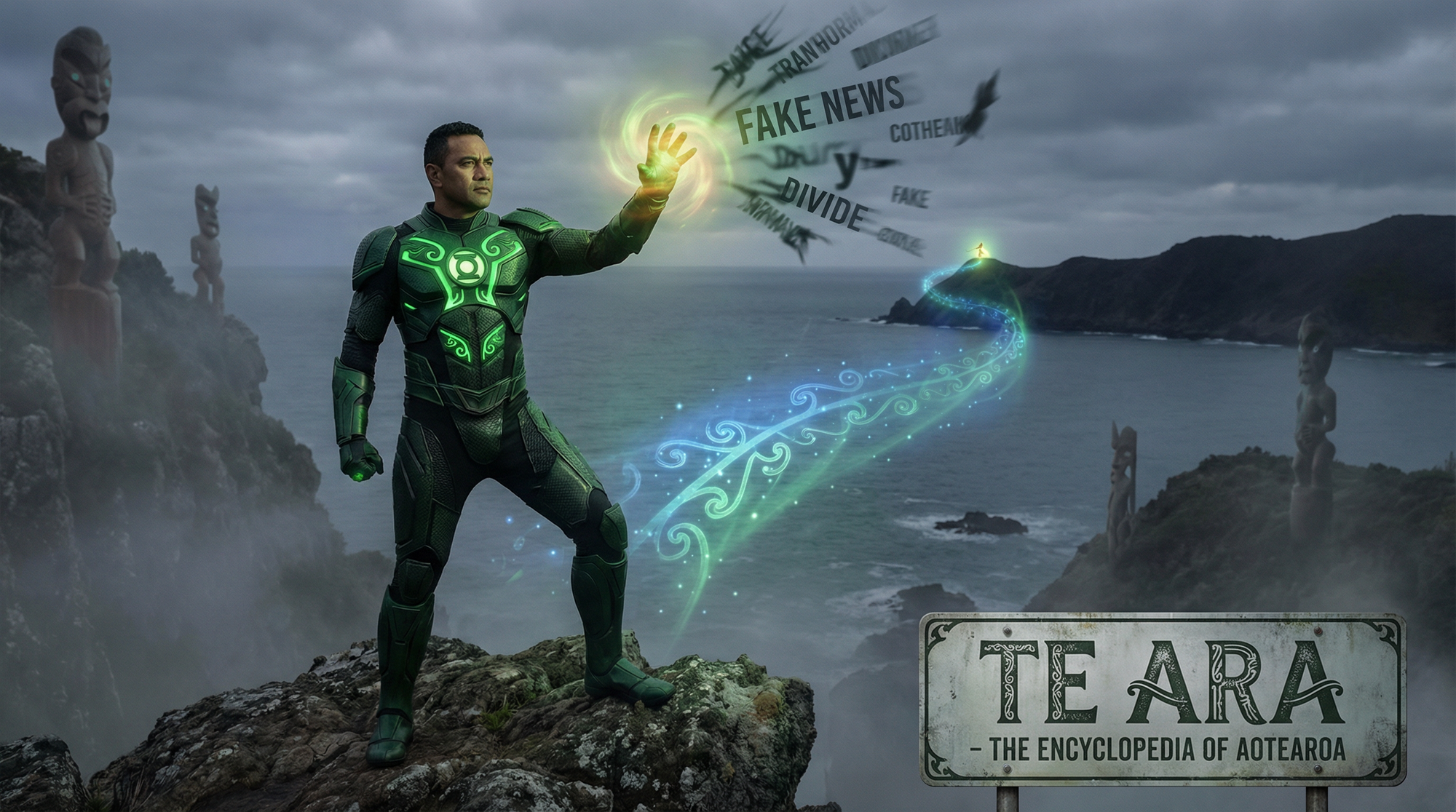
Mōrena whānau. The Ring illuminates what shadows conceal.
When Christopher Luxon refuses to say “no” to Trump, when Shane Jones adds coal and gold to a minerals list while protesters block his bus, when backroom deals threaten to rip minerals from whenua without Māori knowledge or consent
—the pattern becomes unmistakable.
This is not economic development. This is colonial extraction weaponised through economic coercion, dressed in the language of “critical minerals” and “national security,” delivered through closed-door negotiations that breach Te Tiriti o Waitangi at every turn.
The Hidden Handshake: Secret Negotiations and the 180-Day Ultimatum
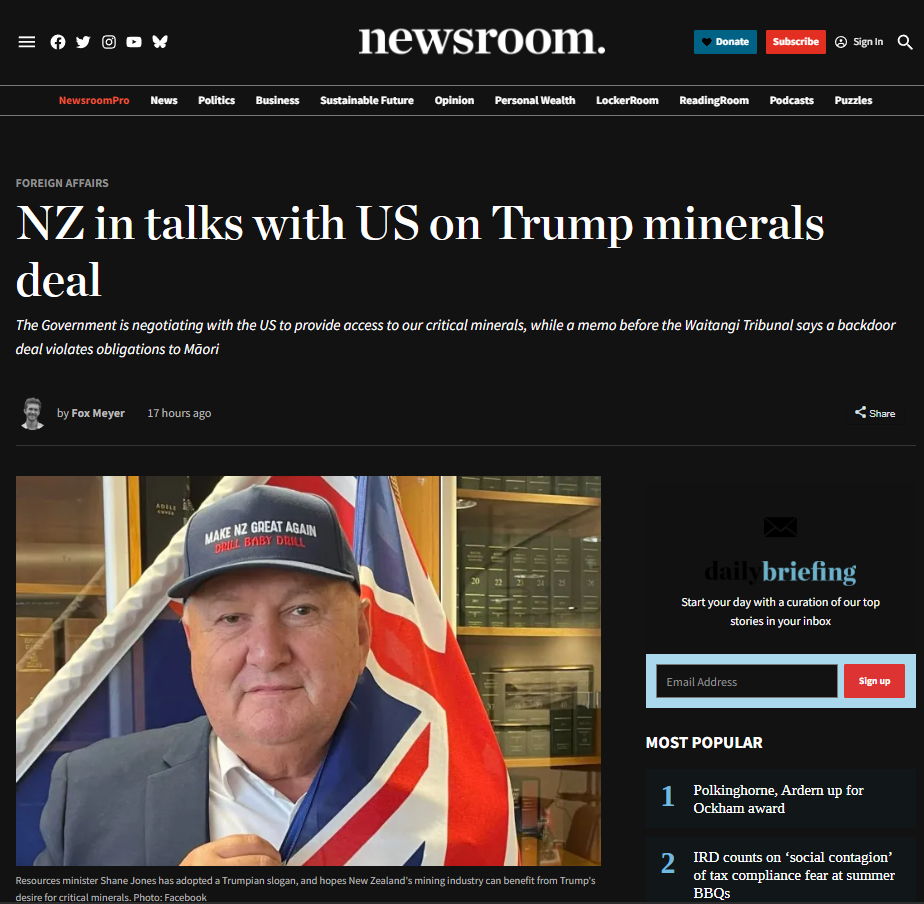
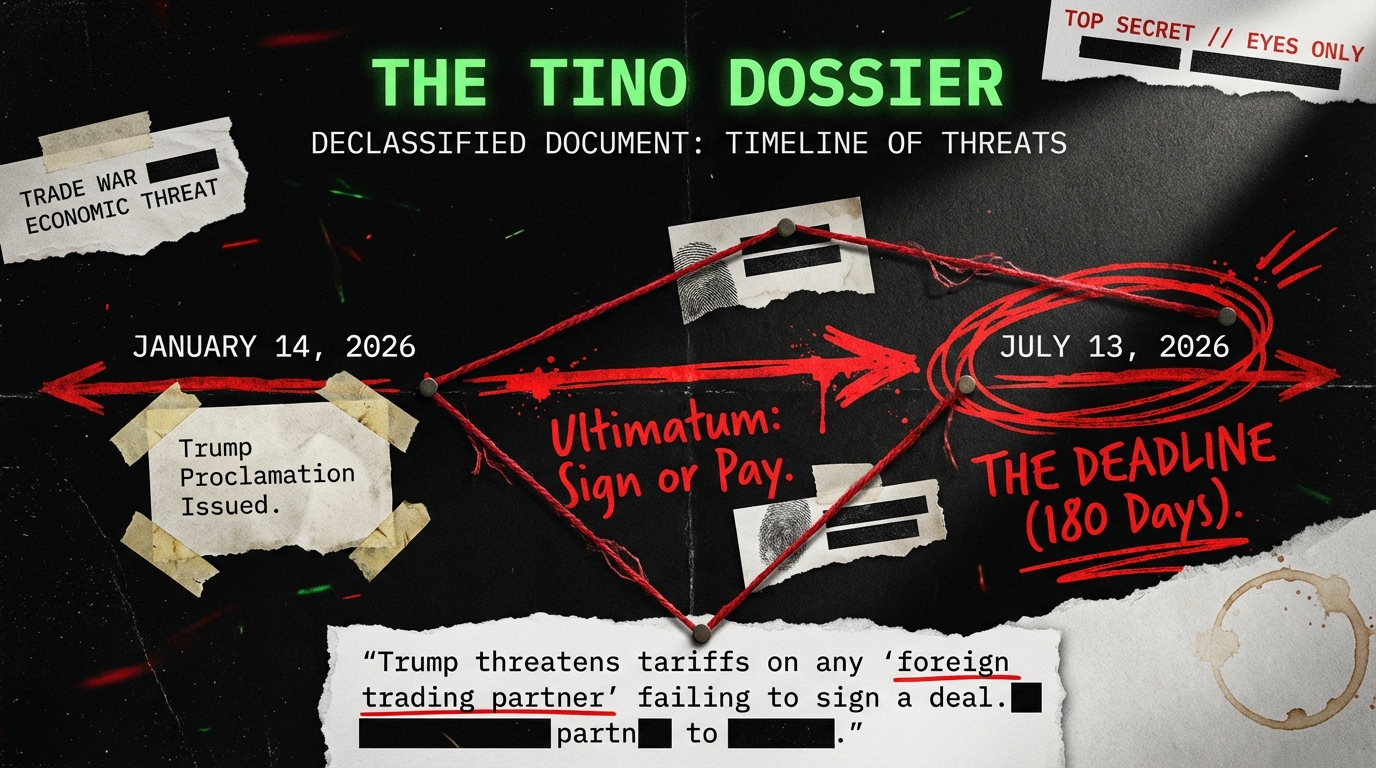
On January 14, 2026, Donald Trump issued a proclamation threatening tariffs on any “foreign trading partners” failing to sign critical minerals deals within 180 days—a deadline of July 13, 2026. Though no target list was published, New Zealand joined the Minerals Security Partnership in November 2025, explicitly to
“attract investment in our critical mineral sector” and “leverage relationships and international partnerships.”
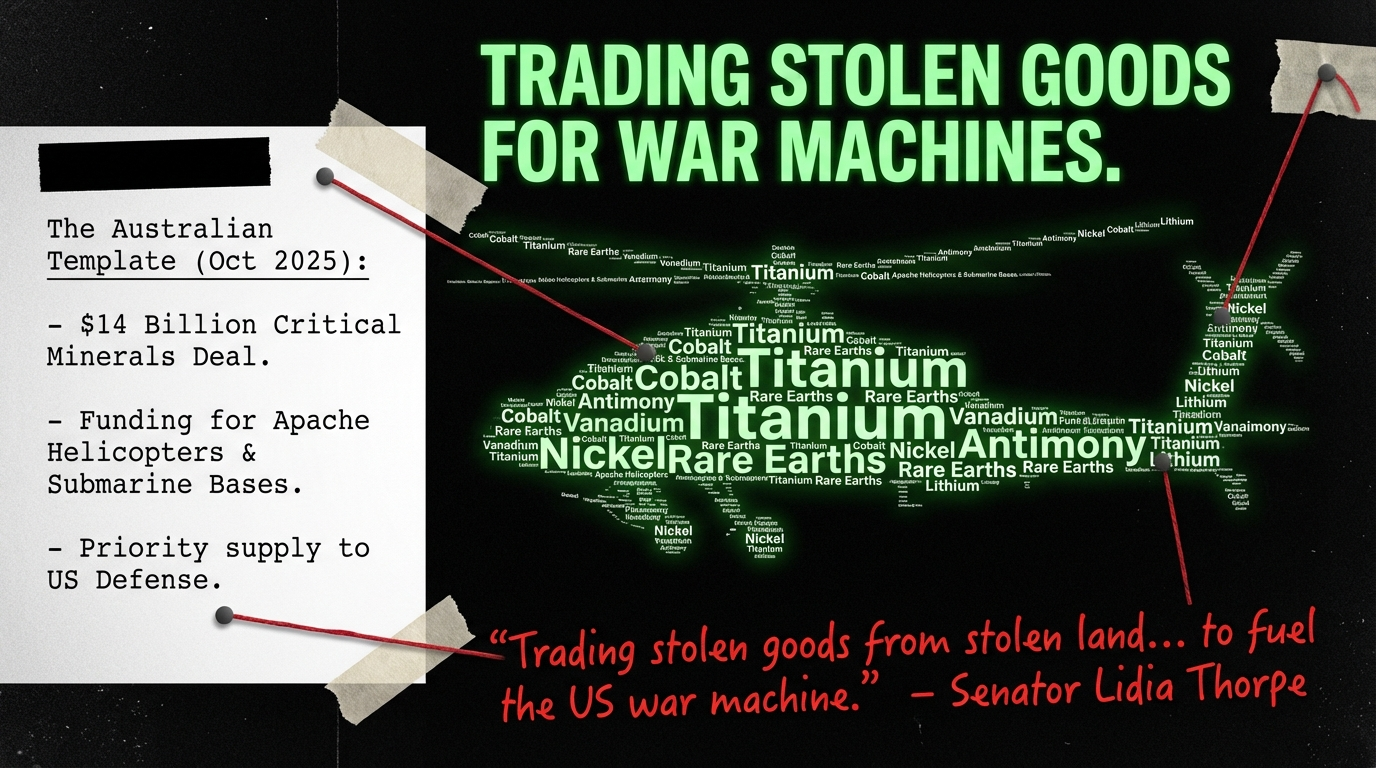
The Ministry of Foreign Affairs and Trade confirmed to Newsroom that New Zealand is in discussions with the United States regarding a “non-binding critical minerals framework.” An announcement is believed imminent—potentially within weeks. Yet neither Shane Jones nor Winston Peters will comment publicly. The pattern mirrors Australia’s secret five-month negotiation before Prime Minister Anthony Albanese signed a $14 billion critical minerals deal with Trump in October 2025.
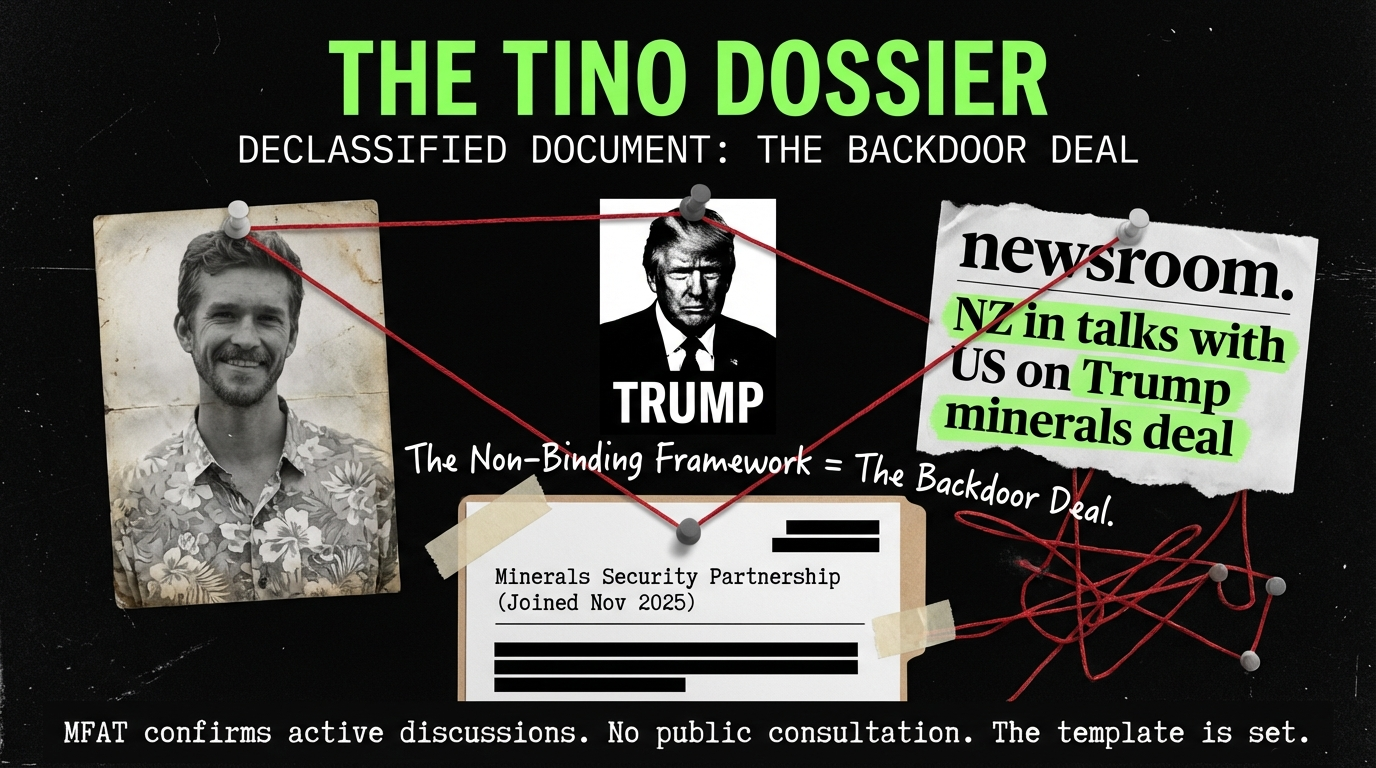
Hidden Connection #1: The Template Deal—Australia’s Surrender
Australian independent senator Lidia Thorpe declared:
“Albanese is trading stolen goods from stolen land with Trump in this minerals deal, much of it to fuel the US war machine.”
The US-Australia Critical Minerals Framework commits both nations to:
- Price support mechanisms with minimum prices on “priority minerals” from late 2026
- $1 billion in financing within six months to projects in both countries
- Curbing Chinese acquisitions through domestic screening and pressure on third countries
- Asset sales review on national security grounds
- Priority supply to US defense and advanced technologies
The framework explicitly states:
“The Participants intend to capitalize on their respective existing domestic mining and processing operations in critical minerals and heavy and light rare earths as well as new capacity to be made available in 2026.”
Translation:
dig faster, mine deeper, export immediately.
Australia also committed $1.2 billion in Apache helicopters, $1 billion to expand US submarine industrial base, and $2 billion in munitions supply-chain support across Texas, Florida, Arkansas, and Alabama.
Albanese signed away superannuation funds
—ordinary Australians’ retirement savings
—committing to increase US investments to $1.44 trillion by 2035.
All this without public consultation.
Aotearoa is next in line. The question is not if but what Luxon and Jones will trade away—and to whom the profits will flow.
The Minerals Strategy: A Treasure Map for Foreign Plunder
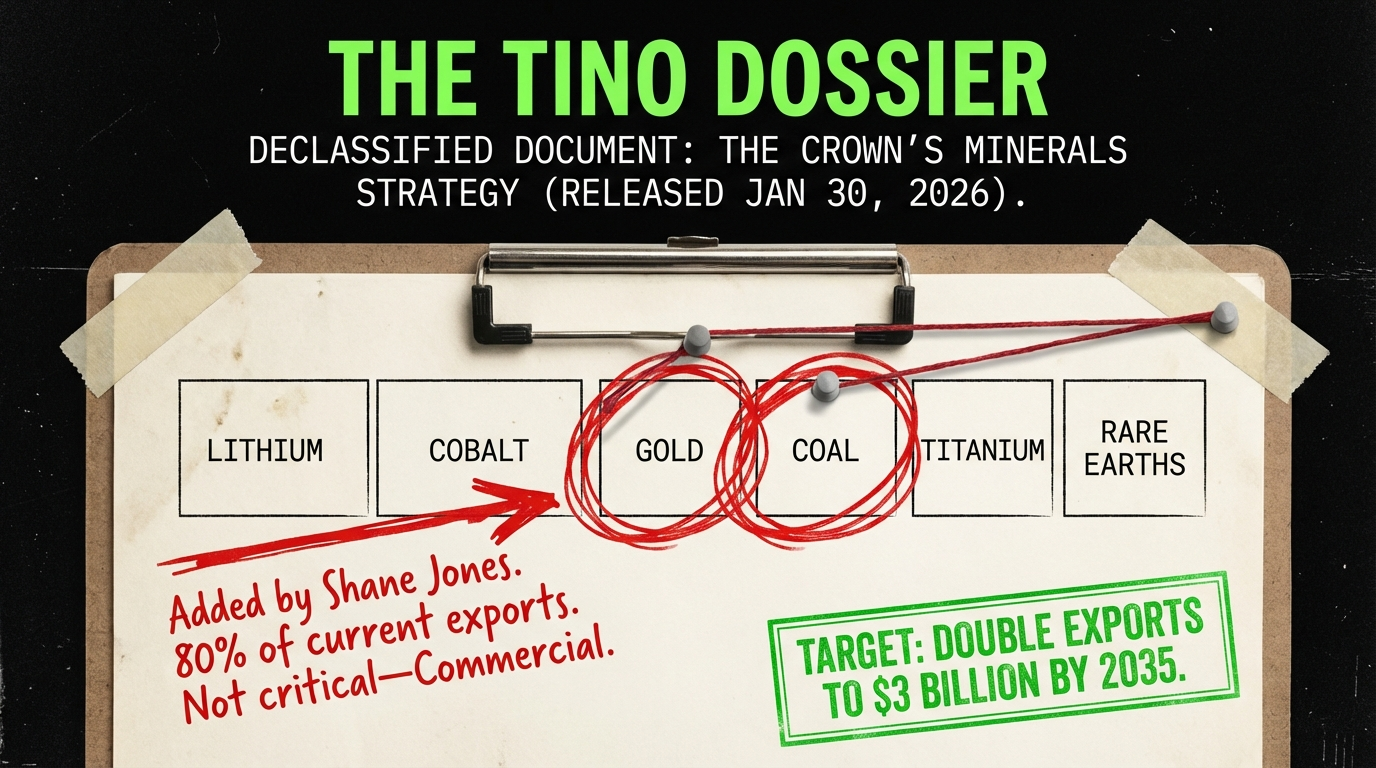
On January 30, 2026—the day after Trump’s inauguration—Shane Jones launched New Zealand’s Minerals Strategy and Critical Minerals List in Waihi, targeting $3 billion in exports by 2035—up from the previous $2 billion target. The list identifies 37 minerals, including gold, metallurgical coal, vanadium, antimony, rare earths, cobalt, titanium, lithium, and zirconium. Jones added gold and coal specifically because they represent 80% of current mineral exports, generating $1.2 billion annually.
Hidden Connection #2: The Timing Is No Coincidence
The minerals strategy was released with a commitment to be
“guided by overarching principles to honour Te Tiriti o Waitangi obligations”.
Yet a memorandum submitted to the Waitangi Tribunal in the climate change priority inquiry (WAI 3325) argues that any backdoor deal with Trump would show “willful disregard” for Crown obligations, breaching the principles of rangatiratanga and kāwanatanga
—a course of action “antithetical to tikanga, mātauranga and kaitiakitanga.”
The claimants warned:
“There is a risk that such a negotiation is already underway and could be finalised and signed without Māori, or anyone else in Aotearoa, being made aware.”
That risk became reality when MFAT confirmed active negotiations.
Hidden Connection #3: Trump’s National Security Doctrine—Minerals = Military Power
Trump’s January 2026 proclamation states explicitly that US dependence on foreign critical minerals creates “vulnerabilities that could be exploited by foreign actors.”
The CSIS analysis notes:
“The United States is fully import-dependent for 12 critical minerals and reliant on imports for more than half of its consumption of an additional 29.”
Trump’s National Security Strategy released December 2025 prioritizes “securing access to critical supply chains and materials” as central to American military dominance.
As CFR’s Heidi Crebo-Rediker explained:
“The Trump administration has placed minerals diplomacy as a central pillar of its negotiations, especially in war-torn regions that are mineral rich.”
Trump has already tied critical minerals deals to:
- Congo-Rwanda peace negotiations: US firms get preferential access to Congolese reserves in exchange for “security cooperation”
- Pakistan rapprochement: Pakistan provides critical minerals in exchange for US investment in “vast oil reserves”
- Gaza “Board of Peace”: Mineral access embedded in ceasefire negotiations
This is not trade. This is tribute extracted under threat of economic violence.
Seabed Mining: Environmental Vandalism Fast-Tracked
The most egregious example of this minerals rush is Trans-Tasman Resources’ application to mine the South Taranaki seabed under the Fast-track Approvals Act.
TTR, now fully owned by Australian company Manuka Resources, wants to:
- Extract 50 million tonnes of seabed per year for 35 years
- Vacuum 180,000 tonnes of sand daily during 40 weeks of mining
- Dig 11 metres deep into sands off Pātea
- Recover 5 million tonnes of vanadium-rich titanomagnetite concentrate annually
- Dump 45 million tonnes of unwanted sediment—160,000 tonnes daily—back into the ocean
Manuka Resources told the Australian Stock Exchange it expects US$312 million annual profit (NZ$525 million) before tax, with a near 40% rate of return on US$602 million investment.
Hidden Connection #4: Sediment Plumes = Ecocide
The science is unequivocal. Research published in Science Advances found that seabed mining creates low-lying turbidity currents where 2-8% of sediment remains suspended and “were not observed to settle over several hours.” Studies in Environmental Health Perspectives warn that sediment plumes “could resettle over areas much larger than the mine sites themselves,” with biological oceanographer Craig Smith stating: “huge areas could be impacted before any one of them has a chance to bounce back.”
A Nature study of the 1989 DISCOL experiment found that mining impacts “will be persistent over at least decadal timeframes and communities will remain altered in directly disturbed areas” even after 44 years. The South Taranaki District Council called for a ban on seabed mining, saying economic benefits wouldn’t outweigh “environmental vandalism.”
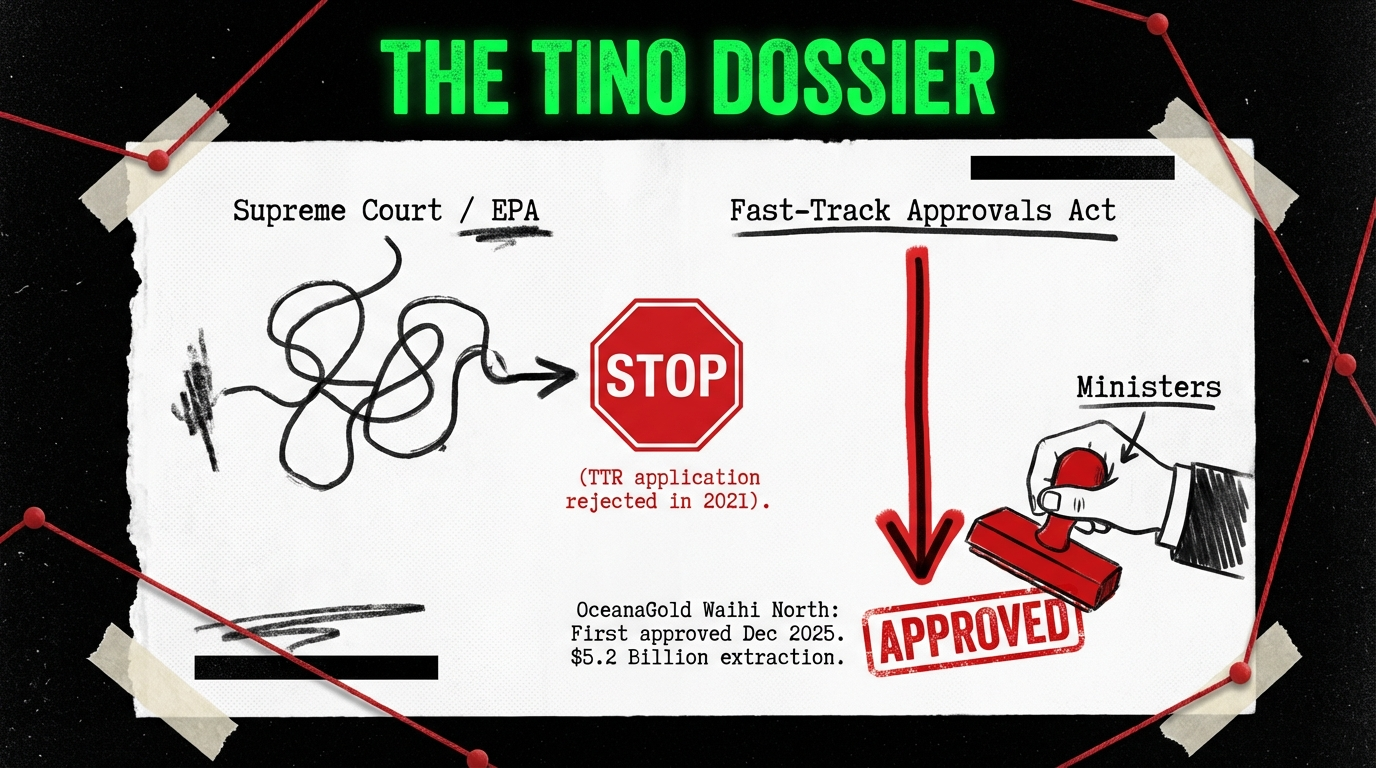
Yet TTR abandoned EPA hearings—where it was told mining would cause material harm—to apply under fast-track legislation that bypasses environmental safeguards. The Supreme Court in 2021 unanimously rejected TTR’s application, instructing the EPA to block mining if consent conditions couldn’t prevent pollution. Fast-track legislation overrules that Supreme Court decision.
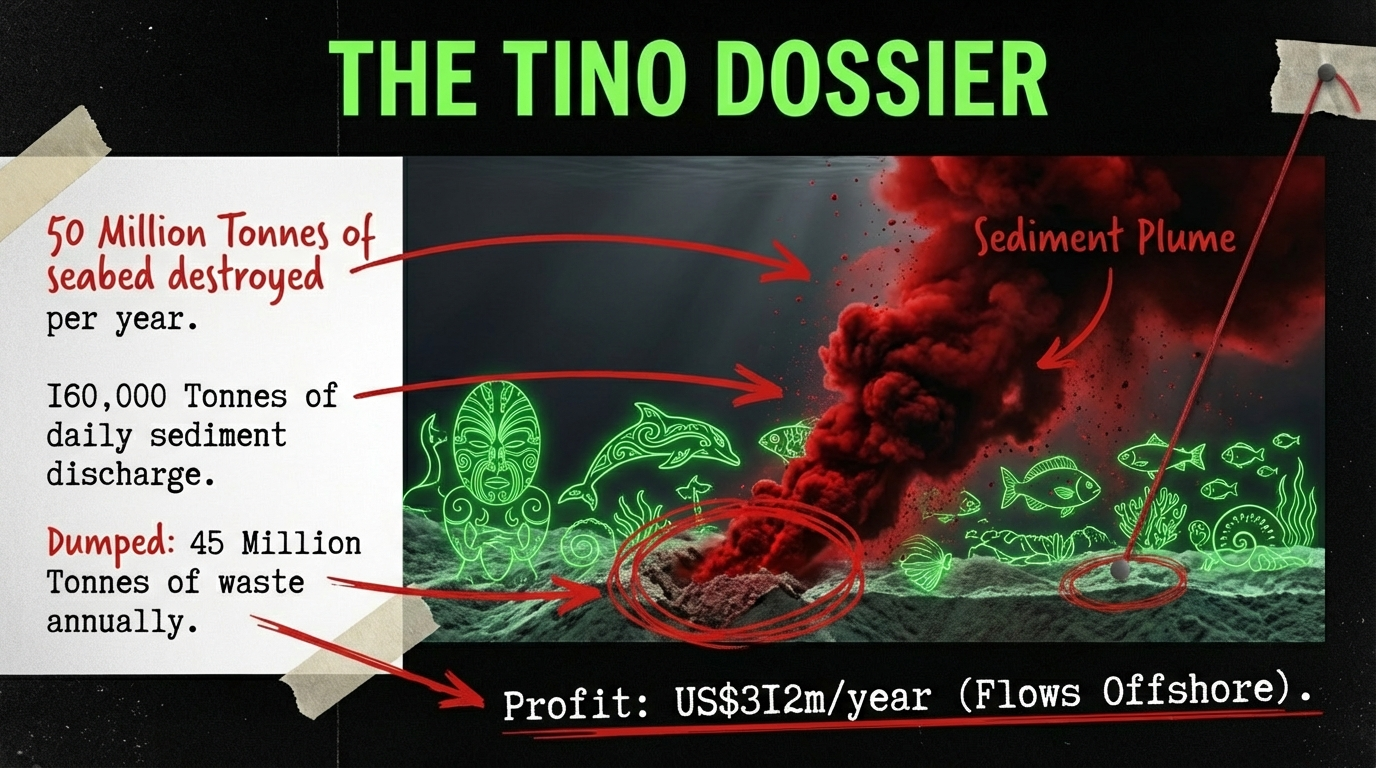
Quantified Harm:
- 50 million tonnes annual seabed destruction for 35 years = 1.75 billion tonnes total
- 160,000 tonnes daily sediment discharge affecting reefs, fisheries, and Māui dolphin habitat
- $850 million annual exports—but only $55 million of $1 billion capital investment spent in New Zealand
- Profits flow offshore while Taranaki bears permanent environmental cost
Hidden Connection #5: Fast-Track Legislation = Corporate Handout
The Fast-track Approvals Act allows ministers—including Shane Jones—to approve projects bypassing Resource Management Act protections. Forest & Bird’s Richard Capie identified
“incredibly harmful projects like coal mines, seabed mining, and open pit gold mines that have been fought in our courts and the courts have already said these shouldn’t take place because of the damage they cause.”
Jones has been meeting mining companies privately, encouraging them to apply for fast-track approval. In February 2024, he dined with West Coast mining bosses, after which one wrote requesting Te Kuha coal mine—rejected by the Environment Court—be fast-tracked. Jones called opponents of mining on conservation land elitists standing in the way of “blue-collar” workers, while OceanaGold’s Waihi North extension became the first major mining project approved under fast-track in December 2025—generating $5.2 billion in gold and silver exports over 18 years for a Canadian-owned company.
The Breach of Tikanga: What Western Minds Must Understand
For those unfamiliar with tikanga Māori, the Crown’s actions constitute multiple, compounding breaches of sacred obligations that have no equivalent in Western law. This is not mere “consultation failure”—it is the systematic dismantling of Indigenous sovereignty through economic coercion.
Rangatiratanga (Chiefly Authority / Self-Determination)
Te Tiriti Article 2 guaranteed Māori “te tino rangatiratanga”—the full essence of chieftainship—over lands, villages, and taonga. The Waitangi Tribunal has consistently found this means “the right to organise as iwi, and, under the law, to control their resources as their own.” Secret negotiations over minerals extraction without iwi involvement directly violate this guarantee.
The Marine and Coastal Area (Takutai Moana) Act 2011 recognizes customary marine title includes “ownership of minerals (other than petroleum, gold, silver and uranium in their natural condition)” within customary areas. TTR’s seabed mining would extract vanadium, titanium, and iron—minerals over which hapū and iwi may hold customary rights. No determination has been made. No negotiation has occurred. The Crown proceeds regardless.
Kāwanatanga (Governance / Partnership)
Article 1 gave the Crown “kāwanatanga”—governance, not sovereignty. As the Waitangi Tribunal found, kāwanatanga “was expressly limited to its own sphere. Alongside it, and equal to it, was that of tino rangatiratanga.” The Crown’s mining agenda—developed without meaningful Māori input, rushed through fast-track processes—demonstrates “unilateral power to make laws for Māori,” which the Tribunal has repeatedly condemned as Treaty-inconsistent.
Kaitiakitanga (Guardianship / Environmental Stewardship)
Kaitiakitanga is the obligation to protect the mauri (life force) of whenua and moana for future generations. As defined by Te Ara, “A kaitiaki is a guardian... given that role by the local iwi.” The spiritual powers are kaitiaki of their realms—Tangaroa of the moana. To mine the seabed without tikanga process, without karakia, without respect for Tangaroa, is to commit spiritual violence.
Research shows kaitiakitanga “includes the conservation, replenishment and sustainability of the taiao” and is based on “traditional Māori knowledge systems and world views” developed through “long association of iwi and hapū with land and waters.” When 45 million tonnes of sediment annually smothers reefs, the mauri of that moana dies. No amount of economic return compensates for that loss.
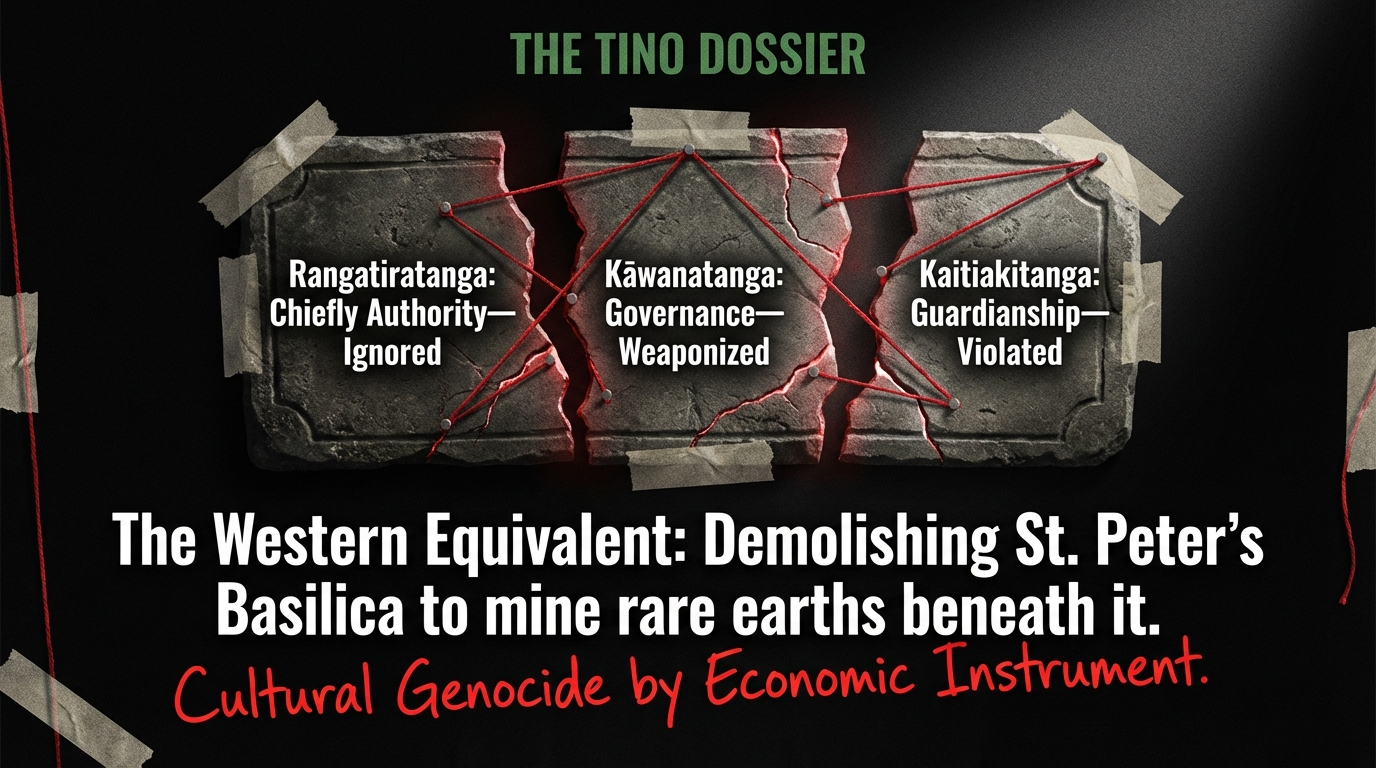
The Western Equivalent:
Imagine the Vatican announcing, without consulting any Christian denomination, that St. Peter’s Basilica would be demolished to mine rare earths beneath it, promising “economic growth” while shipping profits to Beijing. The spiritual desecration, the violation of sacred trust, the erasure of cultural authority—this is the magnitude of harm the Crown inflicts on Māori through its minerals agenda.
Quantified Spiritual and Cultural Harm
The Waitangi Tribunal’s climate change inquiry examines whether Crown climate response—including mining expansion—is consistent with Te Tiriti principles. Claimants include whānau, hapū, iwi, business, and advocacy groups representing the full spectrum of Māori interests. The inquiry asks: “What are the physical, spiritual, cultural, social, health, and economic impacts of climate change on Māori?”
Mining seabed off Taranaki affects:
- Physical: Destruction of 1.75 billion tonnes of seabed = permanent habitat loss
- Spiritual: Violation of Tangaroa’s realm without tikanga = spiritual desecration
- Cultural: Erosion of mana moana, customary fishing rights, kaitiaki authority
- Social: Iwi powerless to protect ancestral waters = generational trauma
- Health: Sediment plumes threaten kai moana = nutritional and cultural food loss
- Economic: Profits offshore while local communities bear environmental cost
This is not “consultation failure.” This is cultural genocide by economic instrument.
Solutions: Pathways to Genuine Rangatiratanga
The Crown’s approach is mauri-depleting. Māori-led alternatives exist, grounded in tikanga and proven effective.
Immediate Actions (0-6 Months)
- Suspend All Secret Negotiations: The Waitangi Tribunal has recommended that Crown policy development inconsistent with partnership principles be halted. The Government must publicly disclose all communications with US officials regarding critical minerals, suspend negotiations until full Te Tiriti analysis is completed, and commit to no agreement without iwi consent.
- Establish Māori-Crown Co-Governance on Minerals: The Waitangi Tribunal’s freshwater report recommended a national body with 50/50 Māori-Crown representation to ensure Treaty principles are incorporated in resource policy. Apply this model to minerals governance.
- Ban Seabed Mining: South Taranaki District Council, multiple iwi, environmental groups, and international scientists agree—the environmental risk outweighs any benefit. Follow the science. Honor the Supreme Court. Protect Tangaroa’s realm.
Medium-Term Reforms (6-24 Months)
Repeal Fast-Track Approvals Act: Legislation that allows ministers to bypass environmental safeguards and override court decisions violates the principle of active protection. The Environment Court was established in 1996 to emphasize Crown’s duty to consult Māori under the Resource Management Act. Fast-track nullifies this.
Embed Customary Marine Title in Policy: The Marine and Coastal Area Act 2011 recognizes customary rights but requires iwi to apply to court or negotiate with Crown. Reverse the burden: Require Crown to prove no customary rights exist before granting mining consents.
Implement True Cost Accounting: Australia committed superannuation funds to US investment. New Zealand must quantify:
Environmental cost of 1.75 billion tonnes seabed destruction
Cultural cost of tikanga breach and spiritual harm
Opportunity cost of offshore wind farms displaced by mining
Climate cost of coal expansion when IPCC demands fossil fuel phase-out
Long-Term Transformation (2-10 Years)
Establish Iwi-Owned Minerals Authority: The Matike Mai constitutional review proposed distinct spheres of rangatiratanga and kāwanatanga with shared relational sphere. Create an independent Māori authority with power to:
Approve or veto all minerals extraction on customary lands and waters
Set royalty rates ensuring 50% of profits return to affected iwi
Enforce tikanga-based environmental standards
Redirect investment to Māori-owned renewable energy
Divest from Extractive Economy, Invest in Regeneration: Pā to Plate demonstrates how “novel food sovereignty system harnesses economic and cultural wealth generation” through marae-based enterprise. Redirect mining subsidies to:
Iwi-led renewable energy cooperatives
Māori-owned sustainable aquaculture
Kaitiaki-managed ecological restoration
Return on investment: Perpetual sustainable yield vs. one-time extraction
Constitutional Protection for Te Tiriti: Geoffrey Palmer and Andrew Butler’s proposed constitution includes: “The rights that persons of Māori descent enjoy as Indigenous peoples under te Tiriti o Waitangi/the Treaty of Waitangi are hereby recognised and affirmed.” Enshrine this protection so no government can trade away taonga for minerals.
The Choice Before Us
Luxon says tariffs are “not the way forward” but refuses to rule out Trump’s minerals deal. Green Party co-leader Chlöe Swarbrick is direct: “Donald Trump says ‘jump’ and Christopher Luxon asks ‘how high?’”
This government faces a choice:
Path One: Surrender—Sign the minerals deal, fast-track TTR’s seabed mining, expand coal and gold extraction on conservation land, commit future generations’ resources to US military-industrial complex, breach Te Tiriti in every dimension, and leave Māori powerless to protect ancestral taonga.
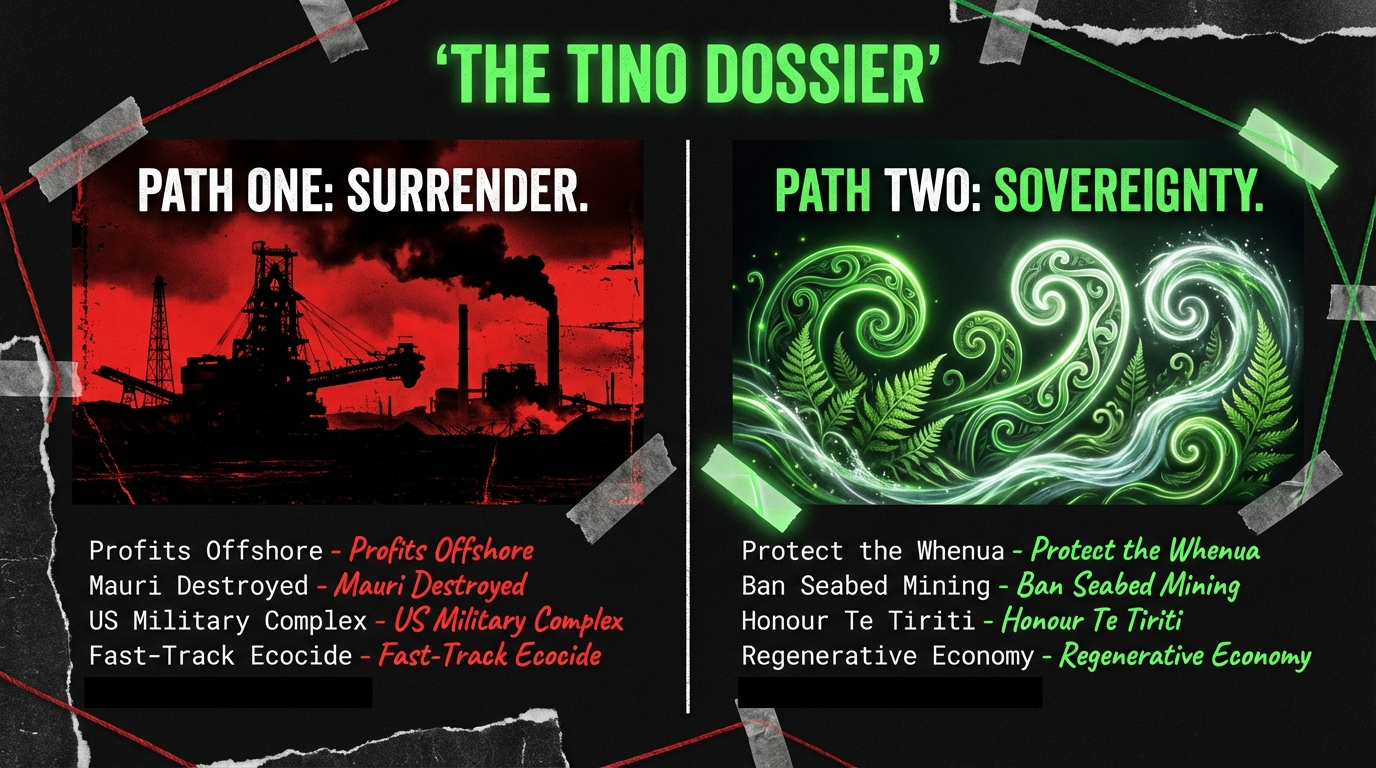
Path Two: Sovereignty—Refuse Trump’s ultimatum, ban seabed mining, establish co-governance, redirect investment to regenerative industries, honor Te Tiriti obligations, and prove that a small nation can resist economic coercion through moral clarity.
The first path is mauri-depleting—profitable for foreign corporations, politically expedient for ministers with short memories, spiritually catastrophic for tangata whenua.
The second path is mauri-enhancing—economically sustainable, culturally restorative, spiritually aligned with kaitiakitanga, and the only choice consistent with Te Tiriti.
We are not bargaining chips in Trump’s resource war with China. Our moana are not collateral in American military strategy. Our whenua are not mining concessions to balance trade deficits.
As Lidia Thorpe said of Australia’s surrender:
New Zealand must not repeat that betrayal.
The Ring illuminates what shadows conceal. And what it reveals is this: the true cost of Trump’s minerals deal is not measured in dollars but in destroyed mauri, dishonored tikanga, and surrendered rangatiratanga.
The deadline is July 13, 2026. The choice is now.
Kia mataara. Kia kaha. Kia ora.
Koha Consideration
Every koha to this mahi signals that whānau refuse to let backroom deals trade away our taonga. When the Crown negotiates in secret with Trump’s regime, when Shane Jones fast-tracks seabed mining that iwi have fought for 10 years, when ministers won’t say “no” to mineral extraction that violates Te Tiriti—koha becomes an act of resistance.
It says:
“We will fund our own truth tellers. We will expose what shadows conceal. We will protect what the Crown refuses to defend.”
This is not charity. This is kaitiakitanga in action.
The Australian government handed Trump $14 billion in minerals access plus superannuation funds. If New Zealand follows that template, billions in profits flow offshore while our moana are destroyed, our whenua depleted, our mana eroded. Koha ensures this story gets told, these connections revealed, these breaches documented—before the deal is signed.
Kia kaha, whānau. Stay vigilant. Stay connected. And if you are able, consider a koha to ensure this voice continues.
Three pathways exist:
- For those who wish to support this mahi directly with a koha (voluntary contribution):
Koha—Support the Māori Green Lantern https://app.koha.kiwi/events/the-maori-green-lantern-fighting-misinformation-and-disinformation-ivor-jones - For those who wish to receive essays directly and support through subscription:
Subscribe to the Māori Green Lantern on Substack https://themaorigreenlantern.substack.com/subscribe - For those who prefer direct bank transfer:
HTDM, account number 03-1546-0415173-000

Ivor Jones The Māori Green Lantern Fighting Misinformation And Disinformation From The Far Right