"Sold to the Chaebols: How Luxon's Korea Deal Bleeds Aotearoa for Corporate Profit" - 31 October 2025
Luxon's Corporate Elite Partnership Sells Out Aotearoa
Tēnā koutou katoa
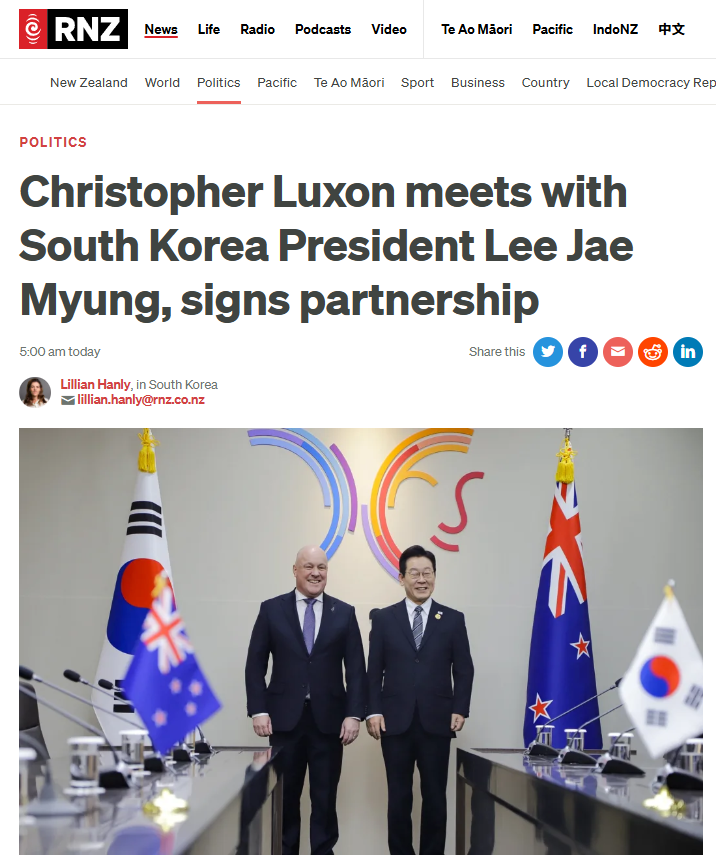
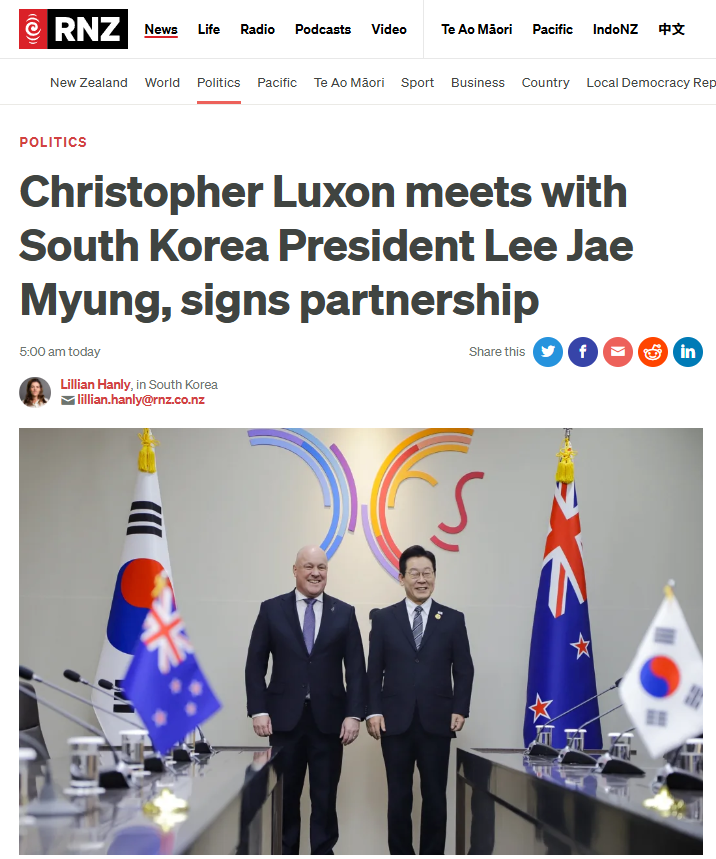
When Christopher Luxon posed for cameras with South Korean President Lee Jae Myung at APEC, announcing a “Comprehensive Strategic Partnership,” he sold it as trade opportunity. But follow the money, trace the networks, examine who profits and who pays—and you’ll find something far more sinister: a neoliberal playbook being executed in real-time, where corporate interests trump public good, where deregulation ideology travels across borders, and where Māori rights and environmental protections become collateral damage in the race to serve global capital.
The smoking gun? A $671 million ferry fiasco that Luxon’s government is now desperately trying to spin into a “win” by crawling back to the same Korean shipbuilder they stiffed with hundreds of millions in cancellation fees (1News, 2025). While Aotearoa exports $2.63 billion to South Korea, we import $6.59 billion—a staggering $3.96 billion trade deficit that enriches Korean chaebol conglomerates while our own economy bleeds (Korea Herald, 2025; MFAT, 2024). This “partnership” commits us to doubling defense spending to 2% of GDP—$12 billion over four years—ostensibly for “regional security” but actually lining the pockets of foreign arms manufacturers (NZ Defence Force, 2025). And it’s happening while Luxon’s coalition partner David Seymour pushes the Regulatory Standards Bill—a near-identical twin to Elon Musk’s DOGE deregulation blitz in America, both rooted in Project 2025’s corporate wish list.
This is no coincidence. This is coordinated. And Māori will pay the price.
Whakapapa: The Chaebol System and Corporate Colonialism
To understand this partnership, you must first understand the chaebol—South Korea’s family-run corporate empires that dominate every facet of Korean life. Samsung alone accounts for one-fifth of South Korea’s exports (CFR, 2018). The top five chaebols—Samsung, Hyundai, SK, LG, Lotte—control 45% of the nation’s GDP (Council on Foreign Relations, 2018). These aren’t just companies; they’re economic fiefdoms built on government favoritism, tax evasion, bribery, and the systematic exploitation of workers (NY Times, 2023).
The chaebol relationship with government is symbiotic and corrupt. Samsung’s Lee Jae-Yong was convicted of bribery, embezzlement, and perjury in the scandal that brought down President Park Geun-hye (RNZ, 2017). President Lee Myung-bak, Park’s predecessor, was arrested on graft charges that could have resulted in a life sentence (Britannica, 2025). The pattern is clear: political leaders grant chaebols preferential treatment—contracts, subsidies, regulatory exemptions—in exchange for campaign donations and personal enrichment. Critics call it a “too big to jail” problem where economic power shields corporate criminals from accountability (Britannica, 2025).
This is the system Luxon now embraces as a model “partner.”
The Ferry Debacle: $671 Million Down the Drain, Then Back to Hyundai
Before examining the new partnership, we must expose the ferry scandal—because it reveals the incompetence, corruption, and corporate capture at the heart of this government.
The Cancellation: Willis and Peters Blow $671 Million
In December 2023, Finance Minister Nicola Willis cancelled the iReX ferry project—a contract signed by Labour with Hyundai Mipo Dockyard to build two new rail-enabled ferries for $551 million (1News, 2025). Willis claimed costs had “ballooned” to $3 billion due to port infrastructure requirements and refused further funding (RNZ, 2024).
The total cost of this cancellation? $671 million (KiwiRail, 2025):
· $144 million break fee to Hyundai (Beehive, 2025)
· $78 million already paid in deposits and design costs
· $449 million spent on landside infrastructure, project management, and wind-down costs
That’s $671 million with nothing to show for it—no new ferries, compromised infrastructure, and an aging fleet limping toward failure (Labour NZ, 2025).
Labour transport spokesperson Tangi Utikere called it “terrible decision-making” that cost taxpayers more than half a billion dollars “with no new ferries to show for it” (Labour NZ, 2025). Green Party transport spokesperson Julie Anne Genter said the cancellation showed “wastefulness and short-term thinking,” noting that for $671 million “we could have funded the electrification of the main rail line from Waikanae to Palmerston North, or built thousands of much-needed homes” (Greens NZ, 2025).
###The Cover-Up: Officials Warned Against Hasty Action
Newly released documents expose that officials warned against cancellation. Treasury briefings stated: “The main risk of decreasing Crown funding and Project iReX stopping is the cost of the break fees, which cannot be estimated with precision” (RNZ, 2024).
Even more damning: Willis’s own Ministerial Advisory Group (MAG) told her just weeks after cancellation to urgently renegotiate with Hyundai to salvage the contract (Reddit NZ Politics, 2025). She refused, calling it “too expensive” (NZ Herald, 2025).
The Ministry of Foreign Affairs and Trade warned that cancellation would require “careful and deliberate communications with the Korean Government” in advance of any public announcement (RNZ, 2024). But Willis announced the cancellation on December 13, 2023—the same afternoon MFAT sent that warning (RNZ, 2024).
This wasn’t prudent fiscal management. This was reckless, ideologically-driven vandalism.
The Humiliation: Crawling Back to Hyundai
Here’s where it gets truly obscene. After stiffing Hyundai with a $144 million break fee and damaging New Zealand’s reputation, Winston Peters flew to Seoul in February 2025 to beg Hyundai to bid on new ferries (RNZ, 2025).
Peters invoked the Korean War and New Zealand’s role in the 1997 Asian financial crisis, telling Hyundai: “It’s a thing called respect and gratitude, and that he could go forward in the future and trust my country and me” (NZ Herald, 2025).
The audacity is breathtaking. After breaking a contract, costing Hyundai millions, and insulting Korea with no prior diplomatic consultation, Peters now appeals to “respect and gratitude” to salvage the relationship?
Hyundai, ever the pragmatic corporation, agreed to consider bidding. Peters crowed: “I’ve got a serious contender back in the ring” (RNZ, 2025). When asked why Hyundai would bid again after being “burned,” Peters said: “Hyundai understand the vagaries of politics as much as anybody else and we had a marvellous conversation” (RNZ, 2025).
Translation: Hyundai understands that desperate governments are easier to exploit. Having already extracted $144 million in break fees, they’re positioned to demand premium prices for new ferries—knowing New Zealand has no leverage and an aging fleet about to fail.
The Timing: Luxon’s APEC Trip Seals the Deal
Fast-forward to October 2025. Luxon arrives in South Korea for APEC, where he signs the “Comprehensive Strategic Partnership” with President Lee (RNZ, 2025). Simultaneously, at the exact same APEC forum, Hyundai Heavy Industries (Hyundai’s parent company) signed a memorandum of agreement with American defense contractor HII to collaborate on military shipbuilding, including “Navy auxiliary shipbuilding programs” and investments in U.S. shipyards (HII, 2025).
The HII-Hyundai deal explicitly mentions supplying the Royal New Zealand Navy, noting that Hyundai “delivered its first auxiliary vessel, HMNZS Endeavour, to New Zealand in 1987, followed by the HMNZS Aotearoa in 2020” (HII, 2025).
This is no coincidence. Luxon’s “trade partnership” and Peters’s ferry negotiations are part of a larger defense procurement package tying New Zealand into Korean-American military supply chains.
The Partnership: What Luxon Didn’t Tell You
On October 30, 2025, Luxon and Lee announced the upgrade to a Comprehensive Strategic Partnership, the diplomatic language that signals deep integration across trade, defense, and “people-to-people exchanges” (China.org, 2025; RNZ, 2025). Luxon touted it as strengthening our “fifth-largest trading partner,” celebrating that bilateral trade has doubled since the 2015 Free Trade Agreement took effect.
What he didn’t mention:
The Trade Imbalance: South Korea enjoys a massive trade surplus. In 2024, NZ exported $2.63 billion but imported $6.59 billion—meaning for every dollar we earn, we spend $2.50 on Korean goods (MFAT, 2024; OEC, 2025). This deficit has grown substantially since the FTA, with Korean export growth “dwarfing” New Zealand’s, particularly in oil and petroleum products (Asia NZ Foundation, 2025).
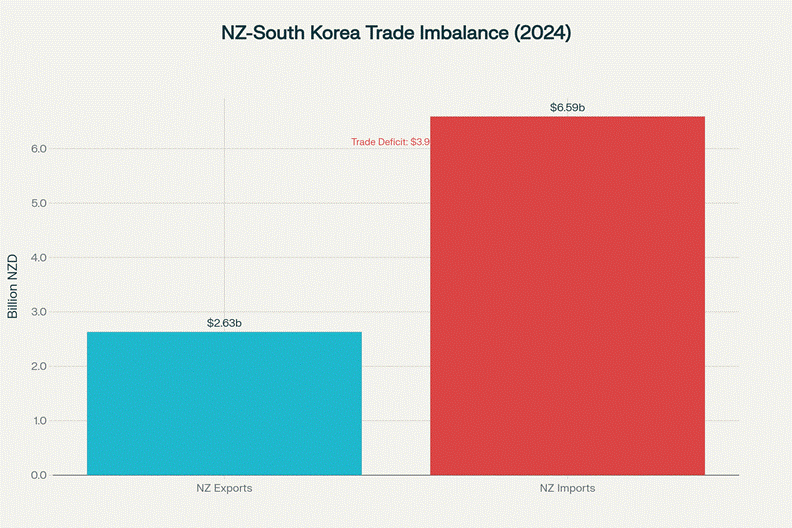
New Zealand’s trade relationship with South Korea heavily favors Korea, with a $3.96 billion deficit - NZ imports 2.5 times more than it exports.
Defense Industry Capture: The partnership deepens “defense cooperation,” which translates to New Zealand buying more Korean military hardware. Luxon met with Hyundai—the same company his government stiffed on the Cook Strait ferry contract—and Winston Peters hinted South Korea could supply our defense needs (RNZ, 2025). This comes as New Zealand commits to spending $12 billion on defense over four years, targeting 2% of GDP by 2032/33—a doubling that Peters admitted is driven by pressure from trading partners who “judge us by it” (RNZ, 2025).
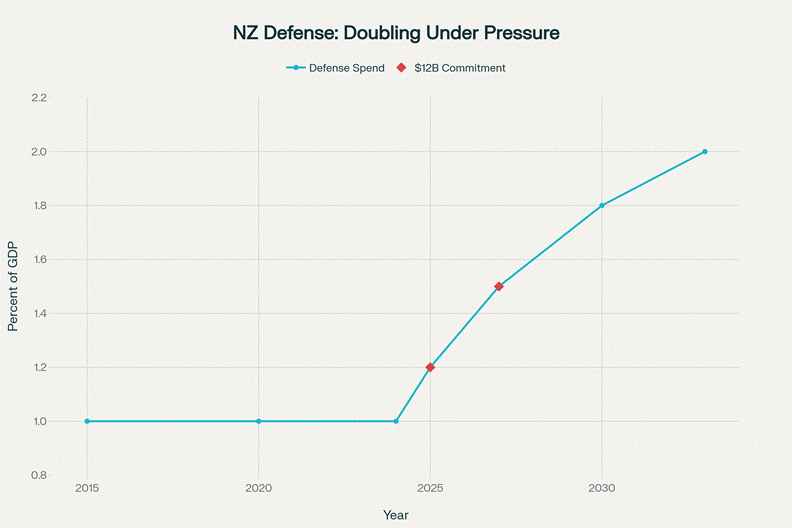
New Zealand defense spending to double from 1% to 2% of GDP by 2033, with $12 billion committed over next four years - benefiting foreign arms contractors.
Science & Tech Collaboration: Luxon emphasized “joint collaboration on some science efforts,” which sounds innocuous until you realize chaebols dominate Korean R&D and have a track record of intellectual property theft and technology transfer demands (ANZAM, 2014). This “collaboration” could mean New Zealand innovations flow to Korean corporations while local firms get crumbs.
No Māori Consultation: As with Seymour’s Regulatory Standards Bill, there’s zero evidence Māori were consulted about this “partnership” despite its implications for trade policy, resource extraction, and regulatory frameworks that affect te Tiriti rights.
The Network Exposed: Chaebol-Luxon-Corporate Donors
Who benefits from this partnership? Not everyday New Zealanders. Not Māori. Follow the money:
1. Luxon’s Wealth and Corporate Ties
Christopher Luxon is worth $21-30 million, making him the second-wealthiest National leader after John Key (Wikipedia, 2025). As Air New Zealand CEO, he earned $4.2 million annually—corporate executive pay that reflects his class allegiances. He owns seven properties valued at over $21 million (Wikipedia, 2025). This isn’t a leader who understands struggle; this is a corporate boardroom operator running government like a business.
2. Big Business Bankrolls National
In 2023, the National Party raised $10.4 million in donations—more than 10 times Labour’s haul (NZ Herald, 2024). This included:
· Warren Lewis (FMI Building Innovations): $500,000—the largest single donation in National’s history (The Spinoff, 2024)
· Graeme Hart (NZ’s richest man, worth $17 billion): $250,000 (The Integrity Institute, 2023)
· Nick Mowbray (toy entrepreneur, family worth $2.5 billion): $250,000 (The Integrity Institute, 2023)
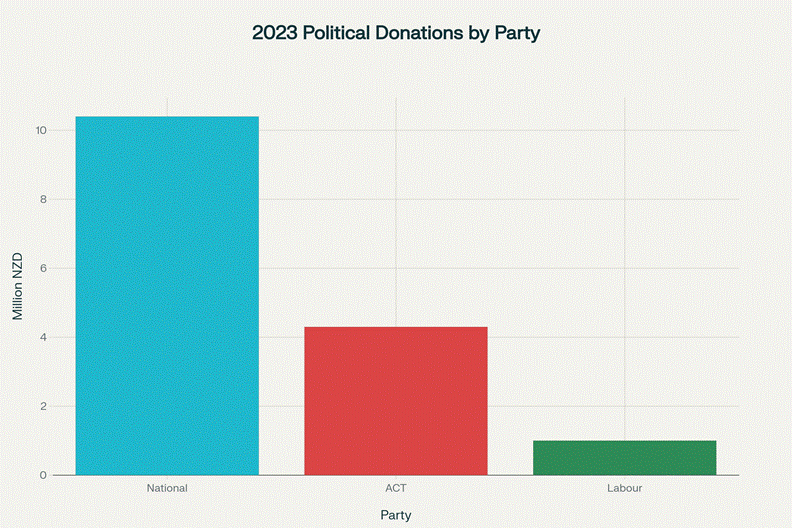
Coalition parties National and ACT raised $14.7 million from wealthy donors in 2023 - nearly 15 times more than Labour’s $1 million.
National’s pollster David Farrar admitted donations were “unprecedented” and “almost exponentially larger” than before (The Integrity Institute, 2023). Corporate New Zealand wants something for this money—and they’re getting it.
3. ACT’s Foreign Influence Network
David Seymour’s ACT Party raised $4.3 million in 2023—a staggering sum for a “minor” party (NZ Herald, 2024). Much of this flows through networks like the New Zealand Taxpayers’ Union, which is connected to the Atlas Network—a global web of think tanks funded by oil, gas, and mining billionaires pushing deregulation worldwide (Reddit NZ, 2024). Former ACT staffer Grant McLachlan revealed the party creates “astroturf” fake grassroots groups to manufacture consent for corporate interests (RNZ, 2021).
4. The Chaebol-Government Nexus
Lee Jae Myung, South Korea’s new president, rose from extreme poverty to power—a “rags to riches” story Korea’s media loves (Korea Herald, 2025). But Lee governs in a system where chaebols wield immense power through campaign donations and lobbying. Asking chaebol leaders for money “in return for political favors was considered quite normal until very recently,” according to Seoul National University’s Kang Won-taek (CFR, 2018). Lee’s administration—like predecessors—will negotiate deals that serve chaebol interests, not workers or the environment.
The Parallel Playbook: DOGE and the Regulatory Standards Bill
Here’s where it gets chilling. The Luxon-Seymour deregulation agenda mirrors precisely what Elon Musk is doing with DOGE (Department of Government Efficiency) in Trump’s America—and both trace back to Project 2025, the Heritage Foundation’s authoritarian blueprint.
Musk’s DOGE: Gutting the State
Musk’s DOGE team, staffed by tech bros with zero government experience, has targeted at least 15 federal agencies for dismantling or downsizing (ABC, 2025). Nine of those 15 were explicitly named in Project 2025 for elimination (Gov Exec, 2025). DOGE gutted the Consumer Finance Protection Bureau (which returned $21 billion to defrauded consumers), fired all Voice of America employees, and called for eliminating the Department of Education—all Project 2025 priorities (Gov Exec, 2025).
Critics note DOGE isn’t about efficiency—it’s about “philosophical and ideological differences conservatives have with the work these agencies do” (Gov Exec, 2025). Jill Filipovic wrote that “the mass firings, the power grabs, and the agency shutterings are not just Musk’s doing. They were planned and proposed well before Trump was even elected, right there for everyone to see, in Project 2025” (Gov Exec, 2025).
Seymour’s Regulatory Standards Bill: The NZ Version
David Seymour’s Regulatory Standards Bill is his fourth attempt to enshrine neoliberal ideology into New Zealand’s constitutional framework (Greenpeace Aotearoa, 2025). The bill:
· Establishes “principles of responsible regulation” prioritizing property rights and economic efficiency over health, environment, and te Tiriti
· Creates a Regulatory Standards Board—appointed entirely by Seymour—to investigate laws corporations don’t like
· Enables “regulatory takings” claims where businesses could demand compensation for laws that reduce their profits (E-Tangata, 2025)
The bill received 157,000 submissions—99% opposed (Greenpeace Aotearoa, 2025). Legal experts, health professionals, environmental groups, and Māori leaders all condemned it. The Waitangi Tribunal found “serious issues” and recommended halting the bill until proper Māori consultation occurred (E-Tangata, 2025). Seymour ignored them all.
Jane Kelsey, emeritus professor of law, warned the bill is “dangerous” and “alarm bells need to ring” because it entrenches ACT ideology in our constitutional framework without democratic mandate (RNZ, 2025).
The Connection
Both DOGE and the Regulatory Standards Bill share:
· Deregulation as ideology: Cutting protections for people and planet to serve corporate profit
· Attacks on independent agencies: Replacing expert oversight with political appointees serving business
· Economic efficiency über alles: Ignoring equity, health, environment, and Indigenous rights
· Billionaire backing: Musk self-funded, Seymour funded by corporate elites through Atlas Network
· Project 2025 DNA: Same ideological framework, same policy goals, coordinated timing
This isn’t parallel evolution—it’s a coordinated international strategy by neoliberal elites to dismantle the regulatory state worldwide.
Tikanga Violations: How This Betrays Māori Values
Every principle of tikanga is violated by this partnership:
Whanaungatanga (relationships, kinship): True relationships are built on reciprocity and balance. This “partnership” creates dependence and debt—Korea profits while Aotearoa hemorrhages wealth.
Manaakitanga (caring, hospitality): Manaakitanga means caring for the collective, especially the vulnerable. Defense spending doubling while child poverty persists (Monocle, 2025) shows where this government’s priorities lie—not with whānau.
Kaitiakitanga (guardianship): The Regulatory Standards Bill allows corporations to challenge environmental protections through “regulatory takings” (E-Tangata, 2025). Korean chaebols have poor environmental records. This partnership threatens our role as kaitiaki of Papatūānuku.
Wairuatanga (spirituality, holiness): Reducing everything to economic efficiency denies the spiritual dimension of te ao Māori. Mountains, rivers, forests—these aren’t “resources” to be exploited but ancestors to be honored.
Kotahitanga (unity, solidarity): This partnership divides us—enriching corporate elites while workers struggle. It prioritizes foreign capital over domestic wellbeing.
Rangatiratanga (sovereignty, self-determination): Te Tiriti guaranteed Māori tino rangatiratanga over taonga. The Regulatory Standards Bill’s “equal treatment” principle ignores our status as tangata whenua with specific rights. As Te Pāti Māori’s Debbie Ngarewa-Packer warned, it “weaponises future governments to challenge Treaty focussed laws” (RNZ, 2025).
Aroha (love, compassion): Where is aroha in cutting public services while doubling defense spending? Where is aroha in partnerships that enrich foreign billionaires while whānau Māori face poverty rates twice those of Pākehā?
The Hidden Connections: Six Smoking Guns
1. The Ferry Fiasco as Corporate Welfare
The ferry scandal isn’t just incompetence—it’s corporate welfare dressed as fiscal responsibility. By cancelling the contract, New Zealand handed Hyundai $144 million for nothing (Beehive, 2025). Hyundai pocketed the money, kept the ship slots for other customers, and now gets to bid on new ferries with all the leverage.
Peters and Willis claim they “saved” money by avoiding the $3 billion project. But that’s a lie. The total includes:
· $671 million already spent with nothing to show for it
· Unknown costs for new ferries (likely higher than the original $551 million given inflation and NZ’s weakened negotiating position)
· Ongoing maintenance costs for aging ferries that should have been replaced in 2026
Labour’s Tangi Utikere estimates the true cost—including cancellation and future procurement—at $1.16 billion (RNZ, 2025). That’s more than double the original contract.
Benefit: Hyundai (free $144 million), future inflated contract
Cost: New Zealand taxpayers ($671M + rising costs)
Māori Impact: $671 million that could have built 13,420 homes at $50,000 each, or funded social services for years
2. Defense Industry Capture
Winston Peters admitted “countries are judging us” by defense spending and that South Korea—”one country that is going to judge us by it”—is positioned to supply our military (RNZ, 2025). The $12 billion commitment targets 2% of GDP by 2032/33, with most spending going to foreign contractors—only 2% currently goes to local firms (RNZ, 2024).
At the same APEC summit where Luxon signed the partnership, Hyundai Heavy Industries signed an agreement with American defense contractor HII to collaborate on U.S. Navy shipbuilding, explicitly mentioning supplying vessels to the Royal New Zealand Navy (HII, 2025). The agreement covers “Navy auxiliary shipbuilding programs” and notes Hyundai’s track record supplying HMNZS Endeavour (1987) and HMNZS Aotearoa (2020).
Benefit: Korean and American defense contractors
Cost: New Zealand taxpayers ($12 billion over 4 years)
Māori Impact: Defense spending crowds out education, health, housing—areas where Māori are most underserved
3. Trump’s Tariff Extortion
At the same APEC summit, South Korea reached a trade deal with Trump’s America, agreeing to invest $350 billion in the U.S. ($200 billion in cash capped at $20 billion annually, plus $150 billion in shipbuilding) to reduce reciprocal tariffs from 25% to 15% (Straits Times, 2025). Korea marketed this as “Make American Shipbuilding Great Again,” emphasizing its role in countering China’s naval dominance.
New Zealand faces a 15% Trump tariff costing us $1.35 billion annually because we export more to America than we import (NZ Herald, 2025). Officials concluded the “only way to reduce the tariff would be to address that deficit, perhaps by making major purchases, like aircraft, from US suppliers” (RNZ, 2025). Translation: buy American weapons to get trade relief.
The Korea partnership—with its defense cooperation and ferry procurement—is New Zealand’s version of Korea’s $350 billion extortion payment to Trump.
Benefit: American and Korean arms dealers, Trump’s ego
Cost: NZ sovereignty, billions in unnecessary military spending
Māori Impact: Billions diverted from domestic needs to satisfy Trump
4. The Atlas Network Pipeline
David Seymour has documented ties to the Atlas Network, a global network of neoliberal think tanks funded by fossil fuel billionaires (Reddit NZ, 2024). The Taxpayers’ Union—which does ACT’s groundwork—is an Atlas affiliate. RNZ’s investigation showed ACT creates fake “astroturf” groups like the Campaign for Affordable Housing to manufacture support for policies serving corporate interests (RNZ, 2021). Atlas Network promotes the same deregulation agenda globally—what Musk does with DOGE, Seymour does with the Regulatory Standards Bill, all coordinated through think tank networks spanning continents.
Benefit: Fossil fuel companies, mining interests, property developers
Cost: Environmental protections, public health, democratic input
Māori Impact: Resource extraction on whenua, weakening of te Tiriti protections
5. Luxon’s Living Allowance Scandal
For nine months, Luxon—worth $21-30 million—claimed a $52,000 annual living allowance while staying in his own mortgage-free Wellington apartment, becoming the first PM in 34 years to do so (Wikipedia, 2025). He initially defended it as his “entitlement” before public outcry forced repayment. This reveals the mindset: a millionaire corporate CEO who thinks taxpayers should subsidize his Wellington accommodation while he cuts spending on public services. As Danyl McLauchlan wrote in The Listener, Luxon’s “wealth seems to insulate him from an elementary grasp” of problems ordinary New Zealanders face (Wikipedia, 2025).
Benefit: Luxon personally
Cost: Taxpayer funds, public trust
Māori Impact: Symbolizes disconnect from Māori poverty and struggle
6. The Diplomatic Insult Turned Opportunity
MFAT warned that cancelling the ferry contract without prior Korean consultation would damage relations (RNZ, 2024). Willis ignored that warning and announced cancellation the same afternoon. This diplomatic insult should have soured relations.
Instead, it created opportunity. New Zealand’s desperation—aging ferries, no alternatives, and a $671 million sunk cost—gave Korea leverage to demand sweeter deals. The “Comprehensive Strategic Partnership” is compensation for the ferry humiliation, with New Zealand committing to:
· More Korean imports (widening the trade deficit)
· Defense procurement from Korean firms
· Technology transfer through “science collaboration”
· Political alignment with Korea’s U.S.-aligned foreign policy
Benefit: Korean chaebols, U.S. strategic interests
Cost: NZ sovereignty, deepening trade deficit
Māori Impact: Partnership negotiated without Māori input despite treaty implications
Implications: Who Pays, Who Profits
The impacts of this partnership will be devastating for Māori and working-class New Zealanders:
Quantified Harm
Trade Deficit: $3.96 billion annually flows to Korea while NZ exports struggle. That’s money leaving our economy—money that could fund 79,200 new homes at $50,000 each, or employ 39,600 nurses at $100,000 annually.
Ferry Debacle: $671 million with nothing to show for it. That sum could have:
· Built 13,420 homes at $50,000 each
· Funded 6,710 teachers at $100,000 annually
· Covered the entire annual budget of Te Puni Kōkiri (Ministry of Māori Development) for 5 years
Defense Spending: $12 billion over four years means $3 billion annually. For context, Budget 2025 allocated just $2.7 billion capital to defense (Dentons, 2025). That $3 billion could instead:
· Build 60,000 homes
· Fund 30,000 teachers
· Eliminate child poverty (estimated cost: $2-3 billion annually)
Political Capture: National and ACT raised $14.7 million from wealthy donors in 2023—15 times more than Labour. This isn’t democracy; it’s plutocracy. Policies serve donors, not voters.
Threatened Rights
Te Tiriti Protections: The Regulatory Standards Bill’s “equal treatment” principle directly challenges te Tiriti rights. As Ryan Ward explained, it “sets the stage for corporate interests to trump all public and Indigenous rights” (E-Tangata, 2025).
Environmental Safeguards: Korean chaebols have poor environmental records. Samsung faced scandals over toxic waste; Hyundai’s shipyards pollute extensively. The partnership could bring Korean industrial practices—and resistance to regulation—to Aotearoa.
Worker Protections: Chaebols are notorious for suppressing unions and exploiting workers. “Getting a job at a chaebol” is seen as essential in Korea because smaller firms pay so much less (Reddit Korea, 2025). This corporate feudalism is what Luxon admires.
International Precedents
Chile under Pinochet: The original neoliberal laboratory, where “Chicago Boys” deregulated everything, privatized state assets, and crushed unions—with horrific results for workers and Indigenous Mapuche.
Ireland’s “Celtic Tiger”: Tax haven policies attracted foreign capital but created massive inequality, housing crisis, and ultimately economic collapse.
South Korea itself: The chaebol model produced rapid growth but also extreme inequality, suicide rates among the world’s highest, and a “Korea discount” where Korean stocks trade at lower valuations due to governance concerns (Straits Times, 2024).
Call to Action: Resistance and Alternatives
The Māori Green Lantern Fighting Misinformation And Disinformation From The Far Right
The Korea deal isn’t finalized. The Regulatory Standards Bill hasn’t passed final reading. We can stop this—but only if we mobilize now.
Immediate Actions
1. Submit on the Regulatory Standards Bill: The select committee process continues. Join the 157,000 who’ve already submitted. Make your voice heard at Parliament’s website.
2. Demand Treaty Impact Assessment: Before any “Comprehensive Strategic Partnership” takes effect, demand full consultation with iwi and hapū. Te Tiriti is our founding document—no partnership undermining it should proceed without Māori consent.
3. Expose the Money: Share information about political donations. National and ACT are bought and paid for by corporate interests. Make this visible. Tag @NZNational and @NZAct on social media with #FollowTheMoney.
4. Demand Ferry Accountability: Willis and Peters wasted $671 million with nothing to show for it. Demand they explain how this serves New Zealanders. Ask why Hyundai gets to profit twice—once from break fees, again from new contracts.
5. Pressure Local MPs: National and ACT MPs face re-election. Let them know this corporate capture is unacceptable. Attend town halls, write letters, organize protests.
6. Support Independent Media: Corporate media won’t expose these networks because they’re funded by the same interests. Support outlets like RNZ, The Spinoff, E-Tangata, and investigative journalists doing this mahi.
Long-Term Strategy
Build Worker Power: Unions are our defense against corporate exploitation. Join yours. Organize your workplace. Support strikes and collective action.
Strengthen Māori Institutions: Iwi, hapū, and Māori organizations must coordinate resistance. What worked against the Treaty Principles Bill can work here.
Create Alternative Economics: Support worker co-ops, community enterprises, and Indigenous-led businesses. Build an economy that serves people, not profit.
Constitutional Reform: We need a written constitution that protects te Tiriti, environmental rights, and democratic participation from corporate capture. The current system allows Seymour’s bill to pass with no referendum, no super-majority—just coalition horse-trading.
International Solidarity: Link with movements fighting neoliberalism globally—Chilean students, Korean workers, American organizers resisting DOGE. This is a global fight requiring global solidarity.
The Choice Is Ours
Christopher Luxon’s Korea deal represents everything wrong with neoliberal governance: corporate capture, trade imbalances that bleed our economy, a $671 million ferry fiasco that enriched Hyundai twice, defense spending serving foreign interests, and regulatory “reforms” that strip away protections for people and planet—all wrapped in the language of “partnership” and “prosperity.”
But here’s what they can’t obscure: We see the networks. We’ve traced the money—$10.4 million to National, $4.3 million to ACT, $671 million to Hyundai for cancelled ferries, billionaires buying policy. We’ve exposed the playbook—DOGE in America, the Regulatory Standards Bill here, both serving Project 2025’s corporate agenda. We’ve shown the model—Korean chaebols built on corruption, inequality, and worker exploitation. We’ve quantified the harm—$3.96 billion trade deficit, $671 million ferry waste, $12 billion for weapons while child poverty persists.
And we’ve named the betrayal: every tikanga principle violated, te Tiriti undermined, Māori rights under attack through “equal treatment” rhetoric that erases our status as tangata whenua. We’ve revealed the ferry scandal—$671 million down the drain, then crawling back to Hyundai with all the leverage on their side.
They think we won’t connect the dots. They think we’ll accept their framing—that this “partnership” serves New Zealand, that the ferry cancellation was “prudent,” that defense spending is about “security,” that deregulation creates “freedom.” They’re wrong.
The resistance begins with knowledge. Share this analysis. Spread these connections. Make visible what they want hidden. From there, we organize. We submit. We protest. We vote. We build alternatives.
Luxon and Seymour serve corporate elites—Korean chaebols, American arms dealers, local billionaires. We serve whānau, whenua, and the future of Aotearoa. The choice is stark. The time is now.
Kia kaha. Kia māia. Kia manawanui.
If this research has been valuable to you and you have the capacity, a small koha would support continuing this mahi. Only give if you can afford it—this knowledge belongs to all of us.
HTDM: 03-1546-0415173-000
Nāku noa, nā
The Māori Green Lantern
(1News, 2025) “How much it cost to cancel iRex ferry contract.” 1News.
(ABC, 2025) “Here are all the agencies that Elon Musk and DOGE have been trying to dismantle so far.” ABC News.
(Asia NZ Foundation, 2025) “The NZ-Korea FTA at 10: a platform for cooperation in challenging times.”
(ANZAM, 2014) “Corporate Governance of South Korean Chaebols.” ANZAM Conference.
(Beehive, 2025) “KiwiRail settlement with Hyundai.”
(Britannica, 2025) “Chaebol | History, Impact & Structure.” Britannica Money.
(CFR, 2018) “South Korea’s Chaebol Challenge.” Council on Foreign Relations.
(China.org, 2025) “S. Korea, New Zealand lift ties to comprehensive strategic partnership.”
(Dentons, 2025) “New Zealand’s Defence Budget Surge: A Strategic Realignment.”
(E-Tangata, 2025) “How the Regulatory Standards Bill gives companies more rights than the public.”
(Gov Exec, 2025) “Project 2025 wanted to hobble the federal workforce. DOGE has hastily done it, and more.”
(Greenpeace Aotearoa, 2025) “The Regulatory Standards Bill is Seymour’s next power grab.”
(Greens NZ, 2025) “Govt gets it wrong with cancelled ferries.”
(HII, 2025) “HD Hyundai Heavy Industries and HII execute memorandum of agreement.”
(KiwiRail, 2025) “KiwiRail concludes iReX ferry replacement project.”
(Korea Herald, 2025) “Korea, New Zealand to strengthen strategic partnership.”
(Labour NZ, 2025) “Release: Eye-watering break fee for botched ferries.”
(MFAT, 2024) “Korea-New Zealand Free Trade Agreement Overview.”
(Monocle, 2025) “Interview: Christopher Luxon says debate over New Zealand’s treaty has been resolved.”
(NY Times, 2023) “Chaebol Families Dominate South Korea’s Economy.”
(NZ Defence Force, 2025) “NZ Army combat-ready infantry platoon deploys to the Republic of Korea.”
(NZ Herald, 2024) “Election donations: National Party raises $10.4 million for election.”
(NZ Herald, 2025) “Winston Peters woos jilted ferry builder with Korean War talk.”
(NZ Herald, 2025) “Documents prove Willis too hasty in cancelling ferry contract.”
(OEC, 2025) “South Korea (KOR) and New Zealand (NZL) Trade.”
(Reddit Korea, 2025) “Do you think South Korea’s chaebol problem is still serious?”
(Reddit NZ, 2024) “Seymour’s ties to the Atlas Network & Treaty Referendum.”
(Reddit NZ Politics, 2025) “Documents prove Nicola Willis too hasty in cancelling ferry contract.”
(RNZ, 2017) “Samsung heir Lee Jae-yong jailed for corruption.”
(RNZ, 2021) “Ex-ACT staffer Grant McLachlan says party created fake grassroots groups.”
(RNZ, 2024) “Interislander: Officials’ mistrust of KiwiRail led push to scrap project.”
(RNZ, 2024) “Interislander: Ministers warned ‘careful’ talks with Korea needed.”
(RNZ, 2024) “NZ joins new group that ‘might be answer’ to US exhausting weapons in a war.”
(RNZ, 2025) “Christopher Luxon meets with South Korea President Lee Jae Myung, signs partnership.”
(RNZ, 2025) “Hyundai in running to build two new Cook Strait ferries.”
(RNZ, 2025) “Kiwirail reveals $500 million spent on axed Cook Strait ferry project.”
(RNZ, 2025) “New Zealand needs to ‘step up’ on defence spending, Winston Peters says.”
(RNZ, 2025) “Regulatory Standards Bill passes first reading.”
(RNZ, 2025) “Regulatory Standards Bill slammed as ‘dangerous’ call for ‘alarm bells’.”
(Straits Times, 2024) “What’s the ‘Korea discount’ and why is it a problem?”
(Straits Times, 2025) “South Korea strikes gold with Trump’s visit, sealing trade deal.”
(The Integrity Institute, 2023) “Political Roundup: Who is funding National to victory?”
(The Spinoff, 2024) “A record-breaking year for political donations is no cause for celebration.”
(Wikipedia, 2025) “Christopher Luxon.”
⁂

1. https://www.1news.co.nz/2025/08/15/how-much-it-cost-to-cancel-irex-ferry-contract-671-million/
2. https://www.greens.org.nz/govt_gets_it_wrong_with_cancelled_ferries
3. https://www.rnz.co.nz/news/political/543699/government-s-irex-ferry-cancellation-costed-at-300-million-for-now
4. https://www.beehive.govt.nz/release/kiwirail-settlement-hyundai
5. /content/files/sites/default/files/2024-05/project-irex-4893754.pdf
6. https://www.facebook.com/groups/shipspottersnz/posts/24434823162795615/
7. https://www.nzherald.co.nz/nz/politics/kiwirail-settles-with-hyundai-over-cancelled-ferries-with-144-million-payment/XQGS7HO5PFFYBNSXE4BD3FVTEQ/
8. https://www.reddit.com/r/newzealand/comments/1mqh1qk/government_pays_almost_150_million_to_cancel_new/
9. https://www.facebook.com/groups/shipspottersnz/posts/8853258708045312/
10.
11. https://businessdesk.co.nz/article/transport/kiwirail-ferry-cancellation-cost-nears-half-a-billion
12. https://transporttalk.co.nz/news/kiwirail-reaches-144m-settlement-with-hyundai-over-cancelled-irex-ferries
13. https://www.rnz.co.nz/news/political/560273/kiwirail-reveals-500-million-spent-on-axed-cook-strait-ferry-project
14. https://www.rnz.co.nz/news/political/570081/final-cost-of-breaking-south-korean-ferry-contract-revealed
15. https://www.nzherald.co.nz/nz/politics/barbara-edmonds-says-nicola-willis-should-resign-as-union-warns-ferry-costs-could-hit-1b/IC3BSLZFWBAAROO2GNDPE3I7LM/
16. https://www.1news.co.nz/2024/07/09/taxpayer-bill-for-abandoned-mega-ferries-project-climbs-to-484m/
17. https://www.1news.co.nz/2025/10/14/govt-confirms-shipyard-for-new-cook-strait-ferries/
18. https://www.rnz.co.nz/news/political/536203/ferry-replacement-to-cost-less-than-labour-s-irex-christopher-luxon
19. https://www.nzherald.co.nz/nz/why-cancellation-of-cook-strait-mega-ferry-contract-is-taking-so-long/ZGVRCFA5I5F3PE3DFMYS3XN7QA/
20. https://www.rnz.co.nz/news/political/536384/interislander-replacement-opposition-astounded-disgusted-over-omnishambles
21. https://www.rnz.co.nz/news/political/522144/interislander-ministers-warned-careful-talks-with-korea-needed-over-ferry-cancellations
22. https://www.rnz.co.nz/news/political/536339/government-won-t-reveal-cost-of-new-cook-strait-ferry-plan
23. https://www.nzherald.co.nz/nz/coalition-sets-aside-300m-for-hyundai-ferry-contract-break-fee/IXRJXA2W45CZLBW5CX4Z7WFTR4/
24. https://www.nzherald.co.nz/nz/negotiations-to-exit-kiwirail-cook-strait-mega-ferry-contract-will-drag-into-next-year/I6FLBGN5Y5EPBOG45SVD3WQISE/
25. https://www.rnz.co.nz/news/national/509154/kiwirail-in-talks-to-cancel-contracts-for-new-interislander-ferries
26. https://www.nzherald.co.nz/nz/documents-prove-nicola-willis-too-hasty-in-cancelling-ferry-contract-editorial/FK2PDW5P6VHYTDNBJBAABLJLXI/
27. https://www.nzherald.co.nz/nz/budget-2024-money-to-investigate-emergency-towing-but-no-new-cook-strait-ferries/AWPPUR6UTJHI7KRGNIGLJCVPAQ/
28. https://www.nzherald.co.nz/nz/government-unimpressed-with-kiwirails-maintenance-of-cook-strait-interislander-ferries/3JDRRFXHWZAY5F3PWSCNH3WRHM/
29. https://www.rnz.co.nz/news/political/543384/hyundai-in-running-to-build-two-new-cook-strait-ferries
30. https://www.1news.co.nz/2025/09/03/preferred-supplier-for-new-cook-strait-ferries-chosen/
31. https://businessdesk.co.nz/article/infrastructure/winston-peters-slated-to-meet-hyundai-mipo-shipyard-reps-in-south-korea
32.
33. https://www.nzherald.co.nz/nz/politics/its-a-thing-called-respect-and-gratitude-winston-peters-woos-hyundai-with-korean-war-talk/QHZAAZ57UNEYXIWHE7DGVNTGSE/
34. https://www.odt.co.nz/star-news/star-business/cost-breaking-cook-strait-ferry-contract-revealed-rnz
35. https://hii.com/news/hd-hyundai-heavy-industries-and-hii-execute-memorandum-of-agreement-to-collaborate-on-distributed-shipbuilding-and-pursue-teaming-on-auxiliary-and-commercial-vessels/
36. https://www.straitstimes.com/asia/east-asia/south-korea-strikes-gold-with-trumps-visit-sealing-trade-deal
37. https://www.beehive.govt.nz/release/foreign-minister-concludes-north-asia-visit
38. https://www.1news.co.nz/2025/10/29/south-korea-trade-deal-elusive-as-trump-seeks-605b-investment/
39. https://www.kiwirail.co.nz/media/kiwirail-concludes-irex-ferry-replacement-project/
40. https://www.facebook.com/groups/869681907589249/posts/1297770541447048/
41. https://koreajoongangdaily.joins.com/news/2025-10-30/national/diplomacy/From-subs-to-supply-chains-Lee-expands-ties-with-Canada-others-in-summit-relay/2433148
42. https://www.rnz.co.nz/news/political/571906/government-move-closer-to-striking-deal-with-shipbuilder-for-new-cook-strait-ferries
43. https://transporttalk.co.nz/news/winston-peters-explores-hyundai-shipbuilding-options-on-north-asia-tour
44. https://www.rnz.co.nz/news/top/577221/trump-lands-in-south-korea-to-face-trade-talks-and-north-korean-missiles
45. https://www.reddit.com/r/newzealand/comments/1aq8fet/kiwirail_in_talks_to_cancel_contracts_for_new/
46. https://www.nzherald.co.nz/nz/politics/christopher-luxon-flies-into-south-korea-for-apec-ahead-of-donald-trump-dinner/ACCEFDSRFFDO5A4JPIEFZKTMX4/
47. https://www.rnz.co.nz/news/political/543377/hyundai-in-running-to-build-two-new-cook-strait-ferries
48. https://www.nzherald.co.nz/nz/politics/hyundai-may-bid-again-for-cook-strait-ferries-after-winston-peters-meeting/DH3UITQ5SVGMNNKSJ3FAKOTFEE/
49. https://www.nzherald.co.nz/nz/deadline-for-private-sector-cook-strait-interislander-ferry-proposals-expires-tonight/W5GLR6H53ND7DF2QTTJRALYQ4I/
50. https://www.rnz.co.nz/news/political/556720/new-details-of-cook-strait-ferry-replacement-plan-unveiled
51. https://www.1news.co.nz/2025/03/31/two-new-cook-strait-rail-ferries-to-enter-service-in-2029-peters/
52. https://www.nzherald.co.nz/nz/nicola-willis-told-to-renegotiate-with-hyundai-mipo-dockyard-three-months-after-cancelling-mega-ferries/V3Q7QZJ45JGRJHW3JKTKW2KXZU/
53. https://www.1news.co.nz/2025/08/15/five-big-things-that-happened-today-friday-august-15/
54. https://www.nzherald.co.nz/nz/editorial-warships-and-ferries-leave-troubled-waters-for-peters-to-calm-in-asia/VG4SVFA4Z5HQDA4DBNGYBM3FIA/
55. https://www.reddit.com/r/nzpolitics/comments/1j5hbon/documents_prove_nicola_willis_too_hasty_in/
56. https://www.rnz.co.nz/news/political/522335/interislander-officials-mistrust-of-kiwirail-led-push-to-scrap-project
57. https://www.labour.org.nz/news/release-eye-watering-break-fee-for-botched-ferries/
58. https://www.rnz.co.nz/news/political/570125/minister-for-rail-winston-peters-on-the-671m-scrapped-ferry-fiasco