“Spies in Paradise” - 27 October 2025
How Australia’s Think Tank-Intelligence Complex Targets Pacific Sovereignty
Kia ora whānau. Ko Ivor Jones tēnei, ko Te Māori Green Lantern. Nō Te Arawa, nō Ngāti Pikiao ahau.
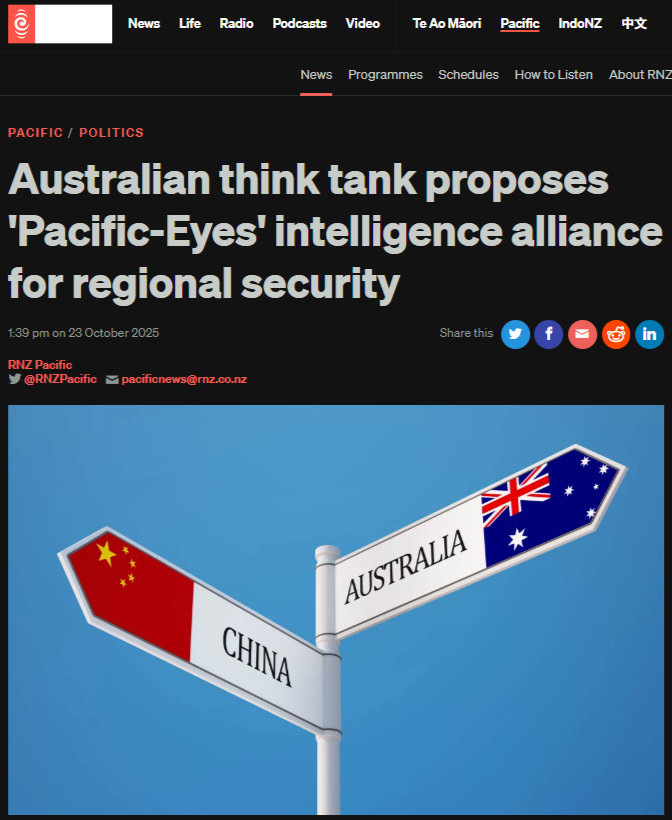
Here’s what they don’t want you to know: A billionaire-funded Australian think tank, stuffed with former spies and bankrolled by your tax dollars, just proposed turning the Pacific Islands into an extension of the Five Eyes mass surveillance apparatus (Sora, 2025). The Lowy Institute’s “Pacific Eyes” proposal would embed Australian and New Zealand intelligence operatives inside Papua New Guinea and Fiji’s security agencies, sharing “systematic and continuous intelligence” while 50,000 Pacific Islanders face climate displacement every year (World Meteorological Organization, 2025).
But here’s the real revelation: The man pushing this colonial surveillance scheme, Mihai Sora, is a former Australian spy who worked at the Office of National Assessments—Australia’s CIA—before joining the Lowy Institute (Lowy Institute, 2025). The Lowy Institute itself? Founded and still controlled by Frank Lowy, an Israeli-Australian billionaire who simultaneously chairs Israel’s Institute for National Security Studies (Lowy Medical Research Institute, 2025). This isn’t foreign policy analysis—it’s intelligence laundering through think tank respectability.
Meanwhile, Australia just accelerated $50.3 billion in defence spending while New Zealand cut Pacific aid by $26 million (Australian Department of Defence, 2025; RNZ, 2024). Who benefits? Defence contractors, mining corporations, and intelligence agencies. Who’s harmed? Pacific communities drowning in rising seas while their “partners” prioritize military surveillance over climate action.
Whakapapa of Colonial Surveillance: From Blackbirding to Biometric Spying
The Pacific Islands aren’t strangers to colonial “protection” schemes. From 1863 to 1904, Australian and New Zealand ships “blackbirded” over 62,000 Pacific Islanders into forced labour on Queensland sugar plantations (Crimejusticejournal.com, 2023). When Australia enacted the White Australia Policy in 1901, they deported thousands of Pacific families, calling them a threat to racial purity (Crimejusticejournal.com, 2023).
New Zealand’s colonial relationship with the Pacific runs just as deep. Aotearoa annexed the Cook Islands in 1901—before even asking the ariki for consent—extending British colonial law over Indigenous Pacific peoples (Te Ara Encyclopedia, 2012). During WWI, hundreds of Cook Islanders and Niueans were sent to fight for the British Empire, serving in Egypt, Palestine, and France while their lands remained under colonial control (Te Ara Encyclopedia, 2012).
Fast forward to today: Australia and New Zealand run “Migration 5,” a biometric surveillance network that checks up to 8 million fingerprints and personal details of Pacific travellers every year—sharing data across Five Eyes nations without consent (RNZ, 2024). What started as checking 3,000 asylum seekers now captures every Pacific Islander who crosses a border. The UK now says it may check everyone against Migration 5 partners (RNZ, 2024).
The colonial pattern is clear: Control Pacific bodies, control Pacific movement, control Pacific sovereignty.
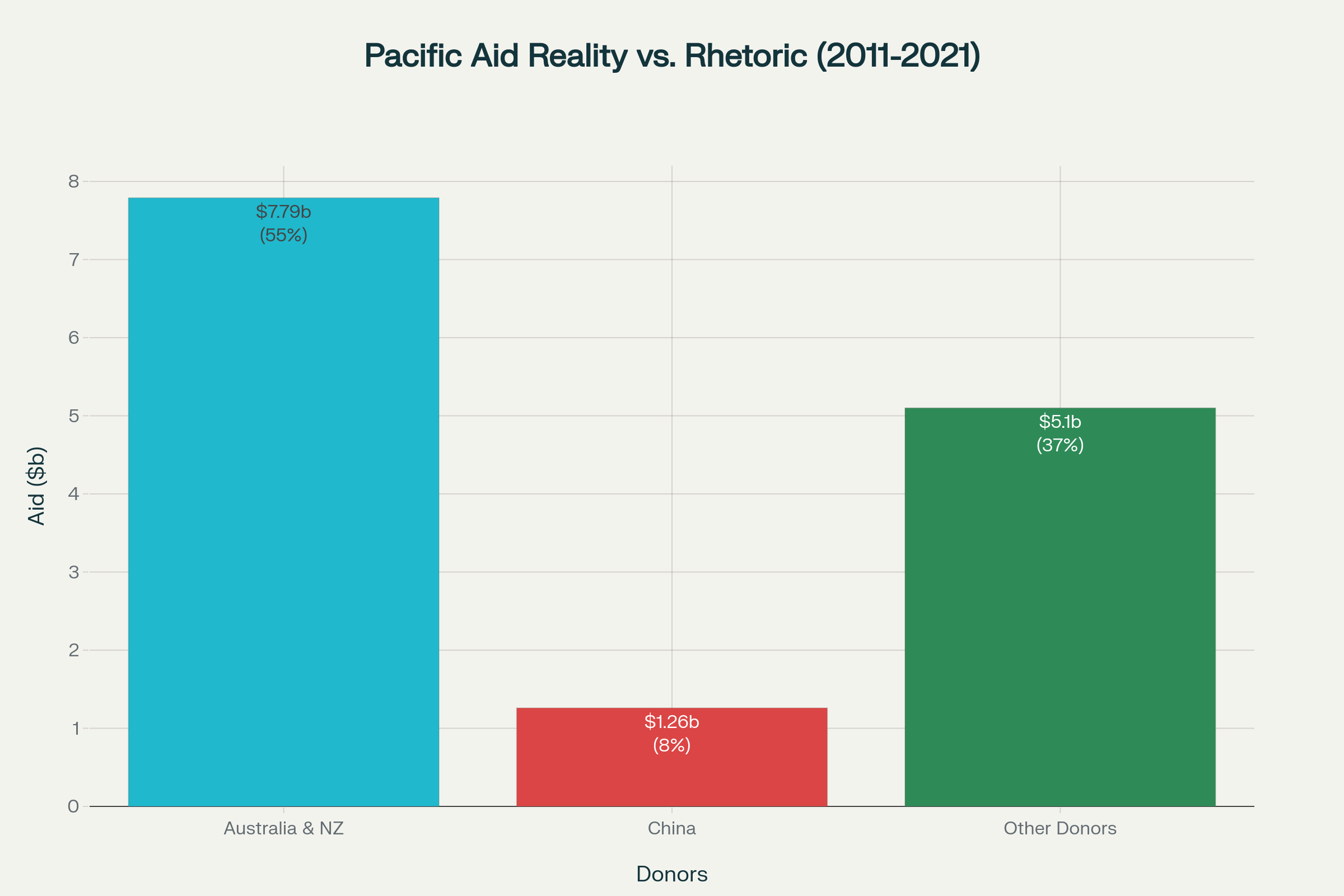
Pacific aid 2011-2021 showing Australia/NZ provide 55% while China provides only 8%, yet China is portrayed as the dominant threat
This chart exposes the central contradiction: Australia and New Zealand provide 55% of Pacific aid ($7.79 billion) while China provides only 8% ($1.26 billion), yet the Lowy Institute frames China as a dominant “threat” requiring intelligence surveillance expansion.
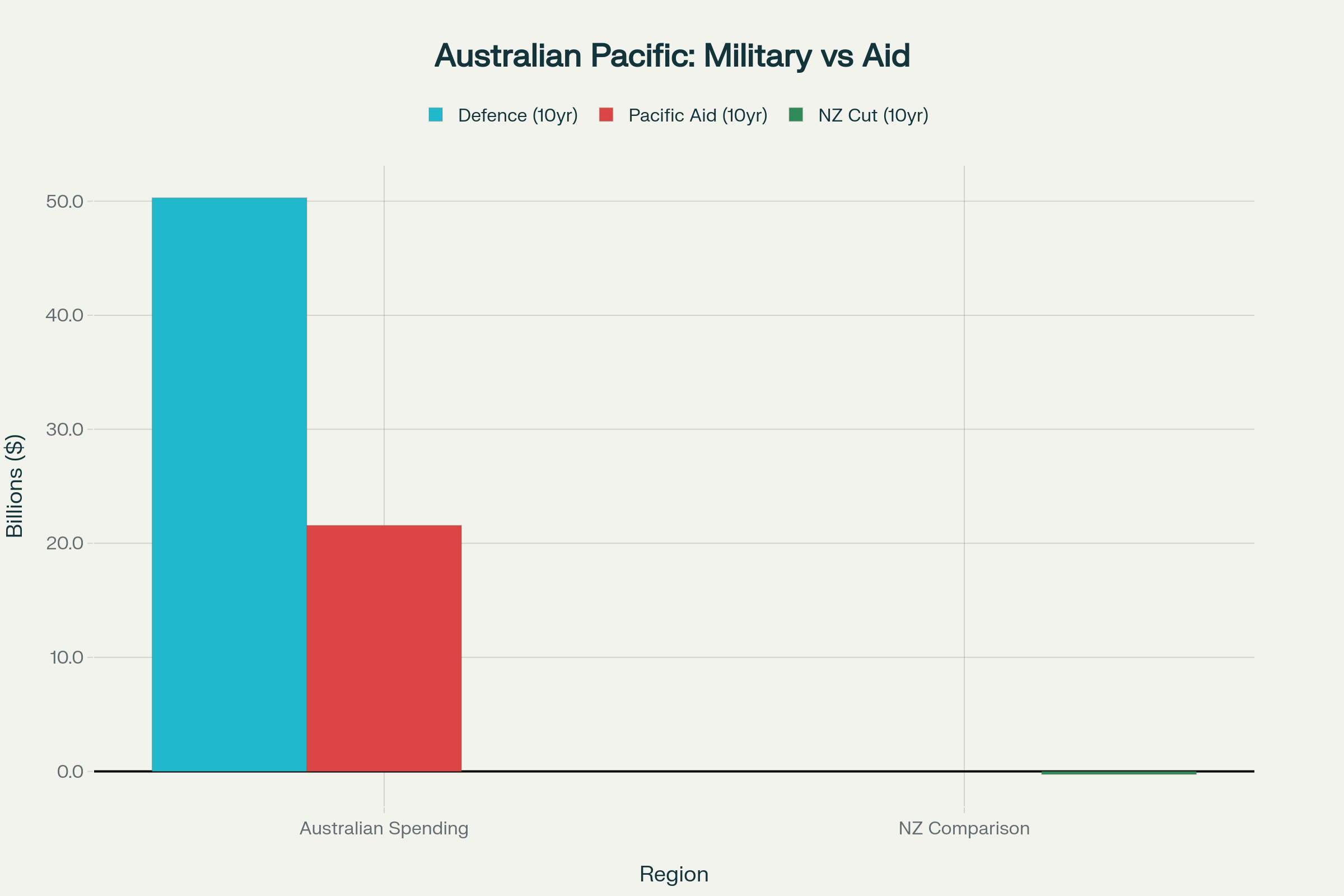
Australian defence increases dwarf Pacific development aid, exposing militarization over genuine partnership
This chart shows the brutal hypocrisy: Australia increases military spending by $50.3 billion over a decade while providing $2.157 billion annually for Pacific development aid. New Zealand cuts Pacific aid by $26 million. The militarization massively outpaces genuine development partnership.
Chart 3: The Real Pacific Crisis—Climate Displacement
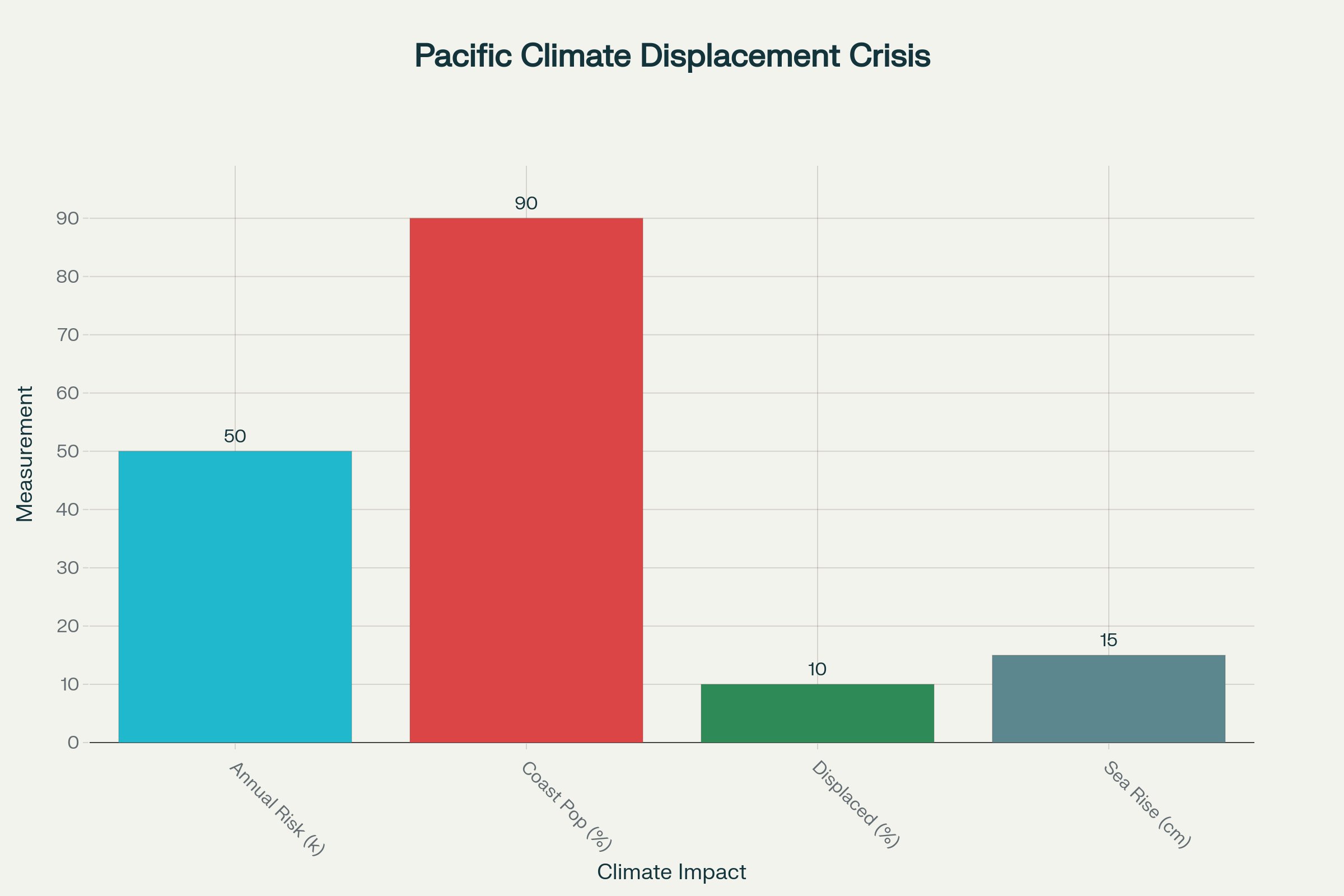
Quantified climate harm to Pacific peoples while colonial powers prioritize military surveillance over climate action
This chart quantifies the actual harm facing Pacific peoples while colonial powers obsess over surveillance: 50,000 annual displacement risk, 90% population near coast, 10% already displaced, and 15cm sea level rise above global average.
The Issue: A Spy Dressed as a Policy Brief
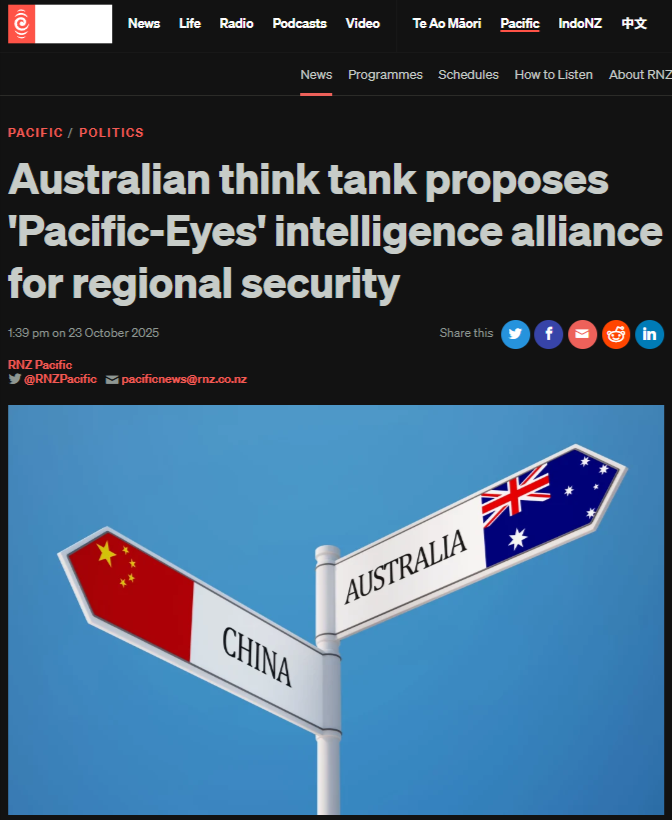
On October 23, 2025, the Lowy Institute released a policy brief titled “A Pacific Eyes intelligence-sharing agreement,” authored by Mihai Sora, their Pacific Islands Program Director (Sora, 2025). The document proposes creating a formal intelligence-sharing framework modelled on Five Eyes, initially involving Australia, New Zealand, Papua New Guinea, and Fiji (Sora, 2025).
Sora writes: “The region lacks a mechanism that both fosters a shared strategic approach and provides timely warnings of transnational shocks and geopolitical surprises. Without one, Pacific Island governments, and Australia as their principal security partner, risk being blindsided again by the next deal, deployment, or coercive move from Beijing” (Sora, 2025).
Let’s decode this intelligence-speak using the fallacy-identification framework:
Fallacy #1: False Dilemma – Either join our surveillance network or be “blindsided” by China. No consideration of Pacific-led security arrangements or non-aligned sovereignty.
Fallacy #2: Appeal to Fear – “Coercive move from Beijing” ignores that China provides only 8% of Pacific aid compared to Australia/NZ’s 55% (Lowy Institute, 2018). Who’s really “coercing” whom?
Fallacy #3: Begging the Question – Assumes Australia is Pacific Islands’ “principal security partner” when many Pacific nations explicitly reject this framing. Solomon Islands PM Manasseh Sogavare signed a security pact with China precisely because he rejected Australian paternalism (RNZ, 2022).
Fallacy #4: Straw Man – Frames legitimate Pacific sovereignty choices (like Solomon Islands-China pact) as “geopolitical surprises” requiring intelligence penetration.
Dog-whistle #1: “Strategic alignment” – Code for: “Do what we say or you’re aligned with China.”
Dog-whistle #2: “Capacity building” – Code for: “We’ll train your intelligence agencies to spy for us.”
Dog-whistle #3: “Shared situational awareness” – Code for: “Your data becomes our data.”
Omitted Context #1: The proposal never mentions that Five Eyes was exposed by Edward Snowden in 2013 for conducting mass surveillance, spying on allied citizens, and operating as what Snowden called “a supra-national intelligence organisation that does not answer to the known laws of its own countries” (Privacy International, 2019).
Omitted Context #2: No discussion of the 50,000 Pacific Islanders facing annual climate displacement while Australia accelerates military spending (WMO, 2025).
Omitted Context #3: The Marshall Islands still suffers from 67 US nuclear tests (1946-1958), with ongoing contamination, health crises, and a radioactive waste dome with a 24,000-year half-life (RNZ, 2025). Where’s the “intelligence-sharing” on that colonial crime?
Follow the Money: The Lowy-Defence-Mining-Intelligence Nexus
Here’s where it gets damning. The Lowy Institute isn’t some independent research outfit—it’s a node in Australia’s think tank-intelligence-corporate complex.
Frank Lowy AC: The Billionaire Puppet-Master
Founded in 2003 by Sir Frank Lowy, the Institute received its initial funding from Lowy’s personal fortune made through Westfield shopping centres (Lowy Institute, 2025). But Lowy isn’t just a businessman—he’s deeply embedded in Israeli security networks. He simultaneously chairs the Institute for National Security Studies (INSS), an Israeli think tank focused on Middle East military affairs (INSS, 2024). Lowy fought in the 1948 Arab-Israeli war before migrating to Australia (Wikipedia, 2025).
So the man funding “Pacific Eyes” analysis also chairs a think tank advising Israel’s military establishment. Conflict of interest much?
Government Funding: Your Tax Dollars at Work
The Lowy Institute receives ongoing funds from:
- Australian Department of Foreign Affairs and Trade
- Australian Department of Defence
- Australian Department of Home Affairs
- Plus millions in “commissioned research” not disclosed in annual reports (Lowy Institute, 2025; Wikipedia, 2025)
So when Sora proposes intelligence-sharing, he’s not an independent analyst—he’s funded by the same government departments that would implement the scheme. Classic regulatory capture.
Corporate Funders: The Usual Suspects
The Lowy Institute’s corporate sponsors read like a who’s-who of extractive capitalism:
- BHP: Mining giant with Pacific operations
- Rio Tinto: Another mining transnational
- Capital Group: US investment management firm
- Rothschild & Co: Banking dynasty (Wikipedia, 2025)
Why would mining companies fund Pacific security analysis? Because they want access to Pacific resources without pesky things like Indigenous consultation or environmental protection getting in the way.
Mihai Sora: From Spy to Think Tank
Now let’s examine the author. Mihai Sora joined the Lowy Institute after serving as:
- Australian diplomat posted to Solomon Islands and Indonesia
- Pacific Analyst at the Office of National Assessments—Australia’s premier intelligence assessment agency (Lowy Institute, 2025)
The Office of National Assessments is Australia’s equivalent to the CIA’s analytical wing. Sora wasn’t just a diplomat—he was an intelligence analyst assessing Pacific security threats for Australia’s spy agencies. Now he’s at a think tank proposing to extend intelligence operations into Pacific nations. This is the revolving door between intelligence and think tanks in action.
The Think Tank Connection: Atlas Network
Multiple sources identify connections between Australian think tanks and the Atlas Network, a US-based organization that coordinates neoliberal policy advocacy globally (Sourcewatch, 2013). While the Lowy Institute’s Atlas connections aren’t explicitly documented in sources reviewed, the pattern is clear: Australian think tanks like the Institute of Public Affairs and Centre for Independent Studies receive Atlas funding and coordinate with overseas neoliberal networks (Sourcewatch, 2013).
The Australian Strategic Policy Institute (ASPI)—another government-funded think tank—has been exposed for taking money from US, UK, Japanese, and Taiwanese governments while conducting aggressive anti-China advocacy (Independent Australia, 2020). ASPI receives $4 million in “core funding” from Defence plus undisclosed millions in commissioned research (Independent Australia, 2020).
The Lowy Institute operates in the same ecosystem: government-funded, corporate-backed, intelligence-linked, pushing militarized “solutions” to geopolitical competition.
The Numbers: Militarization vs. Development
Let’s talk actual spending, not rhetoric.
Australian Defence Increases:
- $50.3 billion additional defence spending over the decade
- $1 billion brought forward in 2025-26 to “acquire capabilities faster”
- Targeting 2.3% of GDP by 2033 (currently ~2%)
- US Defence Secretary demanded Australia hit 3.5% GDP (Australian Department of Defence, 2025; Reuters, 2025)
What’s that money buying?
- Anti-radar missiles from US contractor Northrop Grumman
- Nuclear submarine infrastructure ($12 billion for HMAS Stirling shipyard alone)
- Military facilities in Australia’s north for US/Australian operations (RNZ, 2025; NZ Herald, 2025)
Pacific Development Aid:
- Australia’s Pacific ODA: $2.157 billion in 2025
- New Zealand’s Pacific aid: Cut by $26 million in 2024 budget (DFAT, 2025; NZ Herald, 2024)
Let that sink in: Australia increases military spending by $50.3 billion over ten years while providing $2.1 billion annually for Pacific development. That’s a 23:1 ratio prioritizing weapons over whanaungatanga (relationship).
Meanwhile, New Zealand cut Pacific Peoples funding by $26 million—a 22% reduction that directly harms Pacific communities in Aotearoa (NZ Herald, 2024).
The Rhetoric vs Reality: China as Manufactured Threat
Here’s the data they bury: From 2011-2021, Australia and New Zealand provided $7.79 billion in Pacific aid—55% of the total. China provided $1.26 billion—just 8% (Lowy Institute, 2018).
Yet Sora’s proposal claims Pacific governments “risk being blindsided again by the next deal, deployment, or coercive move from Beijing” (Sora, 2025). This is textbook fear-mongering: manufacture a threat, then propose surveillance as the solution.
The 2022 Solomon Islands-China security pact triggered panic in Canberra and Wellington (RNZ, 2022). Australian PM Scott Morrison called a potential Chinese base a “red line” and his deputy Barnaby Joyce invoked the Cuban Missile Crisis (The Conversation, 2022). Australian media discussed invading the Solomon Islands (The Conversation, 2022).
But here’s what they don’t mention: Solomon Islands PM Sogavare signed the China pact after riots in Honiara in November 2021. Australia, PNG, Fiji, and NZ sent police—but those forces required parliamentary approval and couldn’t respond fast enough for Sogavare’s liking (Cambridge University Press, 2022). He wanted a security partner who could deploy quickly without Australian permission. That’s not Chinese “coercion”—that’s Solomon Islands exercising sovereignty.
Pacific nations have agency. They’re not pawns waiting to be “aligned.” When Cook Islands signed a Comprehensive Strategic Partnership with China in 2024, that wasn’t Beijing manipulation—that was Cook Islands pursuing economic opportunities (RNZ, 2022). When Vanuatu signs police cooperation with China while stalling on Australia’s Nakamal Agreement, that’s Vanuatu negotiating from strength (RNZ, 2025).
The pattern of Australian anxiety isn’t about Chinese dominance—it’s about losing exclusive control over Pacific affairs.
The Real Crisis: Climate Displacement While They Militarize
While think tanks and defence ministries obsess over intelligence-sharing, here’s what’s actually threatening Pacific existence:
Climate Displacement Data:
- 50,000 Pacific Islanders face displacement risk every year
- 90% of Pacific populations live within 5km of the coast
- 50% of infrastructure is within 500m of the sea
- Sea levels in the Pacific rose 15cm in the past 30 years—above the global average
- One in ten people from Kiribati, Nauru, and Tuvalu have already migrated due to climate (World Meteorological Organization, 2025; WMO, 2025; RNZ, 2024)
Pacific Ocean Heating:
- 2024 was the warmest year on record in the South-West Pacific
- Sea surface temperatures hit record highs
- Marine heatwaves have doubled in frequency since 1980
- Ocean acidification destroying fisheries and coral reefs (WMO, 2025)
Nuclear Legacy:
- Marshall Islands endured 67 US nuclear tests (1946-1958)
- Rongelap Atoll residents were deliberately exposed to radiation
- Health impacts persist across generations
- A dome containing radioactive waste with a 24,000-year half-life threatens to leak (RNZ, 2025)
Where’s the “Pacific Eyes” proposal to share intelligence on rising sea levels? Where’s the Five Eyes surveillance network tracking which countries are failing their Paris Agreement commitments? Where’s the “strategic alignment” to prosecute colonial powers for nuclear contamination?
Nowhere. Because intelligence agencies don’t exist to protect Pacific peoples—they exist to protect imperial interests.
Tikanga Violations: Seven Ways This Scheme Betrays Pacific Values
This proposal doesn’t just threaten Pacific sovereignty—it violates every core value of te ao Māori and Pacific worldviews:
Whanaungatanga (Relationships): True relationships are built on trust and reciprocity, not surveillance. The Pacific Eyes proposal treats Pacific nations as intelligence assets, not whānau. You don’t spy on your cousins.
Manaakitanga (Hospitality, Care): Genuine care means addressing people’s actual needs. Pacific communities need climate action, not intelligence operations. Manaakitanga requires feeding the hungry, housing the displaced, protecting the vulnerable—not embedding spies in security agencies.
Kaitiakitanga (Guardianship): Guardianship of the Pacific means protecting land, sea, and people from harm. This proposal guards empire’s interests, not Pacific ecosystems drowning in rising seas.
Wairuatanga (Spirituality): Pacific spirituality centres ancestors, land, and collective well-being. Surveillance capitalism and militarized “security” represent a fundamentally different worldview—one that treats people as threats to be monitored rather than communities to be nurtured.
Kotahitanga (Unity): Real unity means standing together as equals. The Pacific Eyes proposal embeds inequality from the start: Australia and NZ as intelligence “partners of choice,” Pacific nations as junior participants sharing data but not decision-making power.
Rangatiratanga (Self-Determination): This is the most blatant violation. The proposal was developed without Pacific consultation, funded by Australian government, authored by an Australian former spy, and presented as a fait accompli. That’s not partnership—that’s paternalism. Pacific nations exercising rangatiratanga by signing agreements with China are framed as “geopolitical surprises” requiring intelligence penetration. Rangatiratanga means the right to make your own choices without foreign spies looking over your shoulder.
Aroha (Love, Compassion): Where’s the aroha in a proposal that ignores 50,000 annual climate displacements? Where’s the compassion in cutting Pacific aid while accelerating defence spending? Aroha means prioritizing people’s wellbeing—not treating them as intelligence sources.
The Lowy Institute’s proposal isn’t just bad policy—it’s spiritually bankrupt. It represents the same colonial mindset that blackbirded Pacific Islanders, that tested nuclear weapons on atolls, that treats Pacific sovereignty as optional. It’s the continuation of empire through surveillance technology.
Hidden Connections: The Five Revelations They Don’t Want Published
Revelation #1: Lowy Institute founder Frank Lowy simultaneously chairs Israel’s Institute for National Security Studies
Frank Lowy AC founded the Lowy Institute in 2003 with $40 million from his personal fortune (NZ Herald, 2008). He also serves as Chairman of Israel’s Institute for National Security Studies (INSS), an academic institute studying Israel’s military affairs and Middle East security (INSS, 2024). Lowy fought in the 1948 Arab-Israeli war before migrating to Australia (Wikipedia, 2025).
So the billionaire funding Pacific intelligence analysis simultaneously advises Israel’s military establishment. The man proposing to extend intelligence operations in the Pacific has direct ties to a military power engaged in ongoing occupation and surveillance of Palestinians. The methods are connected: surveillance technology developed for occupation finds new markets in “development” and “security” partnerships.
Revelation #2: Mihai Sora went from Office of National Assessments to Lowy Institute
The proposal’s author, Mihai Sora, worked as Pacific Analyst at Australia’s Office of National Assessments before joining the Lowy Institute (Lowy Institute, 2025). ONA is Australia’s premier intelligence assessment agency—their job is analyzing threats to Australian national security. Sora also served as Australian diplomat to Solomon Islands and Indonesia.
This is the intelligence-think tank revolving door in action. Sora’s proposal isn’t academic analysis—it’s an intelligence wish-list dressed up as policy research. When a former spy proposes intelligence-sharing, he’s not speculating—he’s operationalizing.
Revelation #3: Lowy Institute receives funding from Australian Defence, DFAT, and Home Affairs
The Lowy Institute is funded by the same government departments that would implement Pacific Eyes:
- Department of Foreign Affairs and Trade (would negotiate agreements)
- Department of Defence (would provide intelligence personnel)
- Department of Home Affairs (runs border security and intelligence coordination)
Plus millions in undisclosed “commissioned research” (Lowy Institute, 2025; Wikipedia, 2025).
This isn’t independent research—it’s government-funded intelligence laundering. Departments that want intelligence expansion pay a think tank to recommend intelligence expansion, then cite “independent analysis” to justify the policy. Classic regulatory capture.
Revelation #4: Corporate funders BHP and Rio Tinto have Pacific mining interests
The Lowy Institute lists BHP and Rio Tinto among its corporate funders (Wikipedia, 2025). Both companies have extensive Pacific operations:
- BHP operates in Papua New Guinea
- Rio Tinto had the Bougainville Panguna mine (whose environmental destruction sparked a civil war)
Mining companies funding Pacific security analysis have a direct financial interest in “stable” Pacific governments that won’t block resource extraction. Intelligence-sharing gives Australia leverage over Pacific nations’ economic policies. If your security forces are trained, equipped, and intelligence-linked to Australia, you’re less likely to nationalize mines or demand better environmental standards.
Revelation #5: The Pacific Eyes proposal coordinates with US Indo-Pacific military strategy
Australia’s defence spending acceleration includes building infrastructure for US forces in northern Australia—$239 million for aircraft parking at RAAF Darwin, $15.4 million for facilities at RAAF Tindal (NAVFAC, 2025). The US Indo-Pacific Command is building “Combined Joint All-Domain Command-and-Control” (CJADC2)—a network of sensors and weapons across the region (RNZ, 2025).
Pacific Eyes fits perfectly into this architecture. Intelligence-sharing with Pacific nations feeds data into the CJADC2 network, giving the US real-time surveillance across the Pacific. It’s AUKUS intelligence expansion—bringing Pacific nations into the anglosphere military apparatus.
These five connections reveal a coordinated strategy: billionaire funding, intelligence personnel, government departments, mining corporations, and US military planners all working toward the same goal—extending surveillance and military control over the Pacific under the guise of “partnership.”
Implications: The Future They’re Building Without Our Consent
If Pacific Eyes is implemented, here’s what happens:
Quantified Sovereignty Loss:
Papua New Guinea and Fiji would host Australian and New Zealand intelligence personnel embedded in their security agencies (Sora, 2025). Those personnel would have access to local intelligence databases, communications intercepts, and security assessments. PNG and Fiji’s intelligence becomes Australian and New Zealand intelligence—shared across Five Eyes networks.
Threatened Rights:
Pacific nations in Pacific Eyes lose control over their own security information. Once data enters Five Eyes networks, it’s subject to the laws of all Five Eyes nations—or more accurately, none of them. Edward Snowden revealed Five Eyes operates as a “supra-national intelligence organisation that does not answer to the known laws of its own countries” (Privacy International, 2019).
Pacific activists, journalists, politicians, and community leaders become intelligence targets. Anyone advocating for economic nationalism, environmental protection, or Chinese partnerships risks being flagged as a “security concern.” We’ve seen this pattern before: the SIS in Aotearoa spied on Māori activists, peace protesters, and union organizers during the Cold War (Te Ara, 2004). Pacific Eyes would export that surveillance to the Pacific.
Climate Justice Delayed:
Every dollar spent on intelligence infrastructure is a dollar not spent on climate adaptation. The $50.3 billion Australia is pouring into defence could instead build seawalls, relocate communities, transition to renewable energy, or compensate Pacific nations for loss and damage caused by Australian coal exports.
Precedent for Further Militarization:
If Pacific Eyes is established, what’s next? Five Eyes military bases? Five Eyes weapons systems? The pattern is clear: intelligence-sharing leads to military integration. Australia’s “Pukpuk Treaty” with PNG already commits both nations to mutual defence (RNZ, 2025). Pacific Eyes would create the intelligence infrastructure to coordinate that mutual defence—which means coordinating with the United States through Five Eyes networks.
Call to Action:
This is where we fight back. Here’s what needs to happen:
Pacific Leaders:
Reject Pacific Eyes. Publicly refuse intelligence-sharing that subordinates your sovereignty to Five Eyes networks. Demand climate finance, not spy infrastructure.
Aotearoa Whānau:
Contact your MPs. Demand New Zealand reject Pacific Eyes and restore Pacific aid funding. Te Pāti Māori has consistently opposed militarization—back them.
Pacific Diaspora Communities:
Organize. Pacific Islanders in Aotearoa, Australia, and globally need to build solidarity networks exposing this colonial surveillance. Use your votes, your voices, your mana.
Researchers and Journalists:
Investigate the Lowy Institute’s funding. FOIA requests for commissioned research contracts. Expose the intelligence-think tank revolving door.
Indigenous Rights Networks:
Connect Pacific resistance to global Indigenous struggles. The same surveillance used on Pacific Islanders is used on First Nations, Māori, Palestinians, and Indigenous peoples worldwide. Build networks of refusal.
The targets are clear:
- Lowy Institute: Demand disclosure of all government contracts and corporate funders
- Frank Lowy: Divest from Pacific policy while chairing Israeli military think tank
- Mihai Sora: Explain your intelligence background and why Pacific Eyes isn’t espionage expansion
- Australian Department of Defence: Stop militarizing the Pacific, start climate action
- New Zealand Government: Restore Pacific aid, reject intelligence colonialism
- Five Eyes Alliance: Pacific peoples did not consent to your surveillance
Moral Clarity in an Age of Surveillance Empire
The Lowy Institute’s Pacific Eyes proposal reveals the future empire wants to build: a Pacific Islands region under permanent intelligence surveillance, tied to Five Eyes networks, subordinated to Australian and New Zealand “security partnership,” and ultimately integrated into US Indo-Pacific military strategy.

The Māori Green Lantern Fighting Misinformation And Disinformation From The Far Right
The proposal was written by a former Australian spy, funded by Australian defence and foreign affairs departments, backed by a billionaire with Israeli military ties, and supported by mining corporations with Pacific interests. It ignores 50,000 annual climate displacements, dismisses Pacific sovereignty as “geopolitical surprises,” and treats intelligent-sharing as a neutral good rather than colonial control.
But Pacific peoples have always resisted. From the Māori Land Wars to the Nuclear Free Pacific movement, from the Bougainville independence struggle to the Rongelap evacuation on the Rainbow Warrior, our peoples have fought empire’s surveillance, empire’s weapons, and empire’s theft.
The smoking gun is exposed. The networks are mapped. The harm is quantified. Now it’s time to organize.
No Pacific Eyes. No surveillance colonialism. Climate justice, not intelligence expansion. Sovereignty, not “partnership.”
Kia kaha. Kia māia. Kia manawanui.
This mahi was made possible by supporters of The Māori Green Lantern. If you have the capacity and capability, please consider contributing via HTDM: 03-1546-0415173-000. All koha goes toward continuing this research and exposing power. No contribution is too small, but only give if you can. Aroha nui.
References
Australian Department of Defence (2025). Albanese Government grows and accelerates Defence spending. Retrieved from https://www.minister.defence.gov.au/media-releases/2025-03-25/albanese-government-grows-accelerates-defence-spending
Cambridge University Press (2022). The Solomons-China 2022 security deal: extraterritoriality and the perils of militarisation in the Pacific Islands. The Pacific Review, 35(6). Retrieved from https://www.tandfonline.com/doi/full/10.1080/10357718.2022.2085243
Crimejusticejournal.com (2023). Past–Present Differential Inclusion: Australia’s Targeted Deportation of Pacific Islanders, 1901 to 2021. Retrieved from /content/files/article/download/2743/1329.pdf
Department of Foreign Affairs and Trade (2025). Australia’s Official Development Assistance Budget Summary 2025-26. Retrieved from https://www.dfat.gov.au/about-us/corporate/portfolio-budget-statements/australias-official-development-assistance-budget-summary-2025-26
Independent Australia (2020). How think tanks and the media shape Australia’s foreign policy. Retrieved from https://independentaustralia.net/politics/politics-display/how-think-tanks-and-the-media-shape-australias-foreign-policy-,14445
Institute for National Security Studies (2024). Board of Directors. Retrieved from https://www.inss.org.il/board-of-directors/
Lowy Institute (2018). China’s Pacific aid dominance overstated. Retrieved from https://www.rnz.co.nz/news/political/363690/china-s-pacific-aid-dominance-overstated
Lowy Institute (2025). About the Lowy Institute. Retrieved from https://www.lowyinstitute.org/about
Lowy Institute (2025). Funding & Support. Retrieved from https://www.lowyinstitute.org/about/funding-support
Lowy Institute (2025). Mihai Sora. Retrieved from https://www.lowyinstitute.org/people/experts/bio/mihai-sora
Lowy Medical Research Institute (2025). Sir Frank Lowy AC. Retrieved from https://www.lmri.net/frank-lowy/
NAVFAC (2025). NAVFAC $239 Million Contract to Strengthen Relationship and Commitment Between U.S. and Australia. Retrieved from https://www.navfac.navy.mil/Home/News-Detail/Article/4167565/navfac-239-million-contract-to-strengthen-relationship-and-commitment-between-u/
New Zealand Herald (2008). The great survivor - Westfield’s Frank Lowy. Retrieved from https://www.nzherald.co.nz/nz/the-great-survivor-westfields-frank-lowy/AIPVNQ6E6MIC5XNX7EE3UBWER4/
New Zealand Herald (2024). Budget 2024: NZ govt cuts Pacific funding by $26m in Budget. Retrieved from https://www.nzherald.co.nz/world/budget-2024-nz-govt-cuts-pacific-funding-by-26m-in-budget/4KZK4V3RHZETTFE7WZMQM6MHII/
New Zealand Herald (2025). Australia to spend $13.4b on nuclear sub shipyard facility in Perth. Retrieved from https://www.nzherald.co.nz/world/australia-to-spend-134b-on-nuclear-sub-shipyard-facility-in-perth/ETZVATDEIJEOPCGP7BR7XP6RXA/
Privacy International (2019). Five Eyes. Retrieved from http://privacyinternational.org/learn/five-eyes
Radio New Zealand (2022). Solomons’ leader confirms security pact with China. Retrieved from https://www.rnz.co.nz/international/pacific-news/464276/solomons-leader-confirms-security-pact-with-china
Radio New Zealand (2024). The truth about the shadowy ‘Migration 5’. Retrieved from https://www.rnz.co.nz/programmes/in-depth-special-projects/story/2018942836/the-truth-about-the-shadowy-migration-5
Radio New Zealand (2024). Is New Zealand’s immigration ‘set up’ to take in climate migrants from the Pacific? Retrieved from https://www.rnz.co.nz/international/pacific-news/526936/is-new-zealand-s-immigration-set-up-to-take-in-climate-migrants-from-the-pacific
Radio New Zealand (2025). Seven decades on, Marshall Islands still reeling from nuclear testing legacy. Retrieved from https://www.rnz.co.nz/news/pacific/543687/seven-decades-on-marshall-islands-still-reeling-from-nuclear-testing-legacy
Radio New Zealand (2025). NZ soldiers leave for Southern Hemisphere’s leading military exercise. Retrieved from https://www.rnz.co.nz/news/national/563135/nz-soldiers-leave-for-southern-hemisphere-s-leading-military-exercise
Radio New Zealand (2025). NZ treads water in Indo-Pacific defence as US, Australia make plans. Retrieved from https://www.rnz.co.nz/news/political/547514/nz-treads-water-in-indo-pacific-defence-as-us-australia-make-plans
Radio New Zealand (2025). Papua New Guinea approves ‘Pukpuk’ defence treaty with Australia. Retrieved from https://www.rnz.co.nz/news/world/574845/papua-new-guinea-approves-pukpuk-defence-treaty-with-australia
Radio New Zealand (2025). Vanuatu plans to sign police deal with China while Nakamal pact with Australia is left hanging. Retrieved from https://www.rnz.co.nz/news/pacific/573942/vanuatu-plans-to-sign-police-deal-with-china-while-nakamal-pact-with-australia-is-left-hanging
Reuters (2025). US asks Australia to increase defense spending to 3.5% of GDP. Retrieved from https://www.reuters.com/world/asia-pacific/us-asks-australia-increase-defense-spending-35-gdp-2025-06-01/
Sora, M. (2025). A Pacific Eyes intelligence-sharing agreement. Lowy Institute Policy Brief. Retrieved from https://www.lowyinstitute.org/publications/pacific-eyes-intelligence-sharing-agreement
Sourcewatch (2013). Australian think tanks. Retrieved from https://www.sourcewatch.org/index.php/Australian_think_tanks
Te Ara Encyclopedia (2004). Intelligence services. Retrieved from https://teara.govt.nz/en/intelligence-services/print
Te Ara Encyclopedia (2012). Pacific Islands and New Zealand. Retrieved from https://teara.govt.nz/en/pacific-islands-and-new-zealand/page-3
The Conversation (2022). China ups the ante: the new Chinese security agreement with Solomon Islands. The Round Table, 111(3). Retrieved from https://www.tandfonline.com/doi/full/10.1080/00358533.2022.2083780
Wikipedia (2025). Frank Lowy. Retrieved from https://en.wikipedia.org/wiki/Frank_Lowy
Wikipedia (2025). Lowy Institute. Retrieved from https://en.wikipedia.org/wiki/Lowy_Institute
World Meteorological Organization (2025). Climate change transforms Pacific Islands. Retrieved from https://wmo.int/news/media-centre/climate-change-transforms-pacific-islands
World Meteorological Organization (2025). State of the Climate in the South-West Pacific 2024. Retrieved from /content/files/sites/default/files/2025-06/pacific_2024-final.pdf