“Tā Te Māori Green Lantern: The Billion-Dollar Betrayal - Judith Collins’ Washington Mission Exposes Neoliberal Militarism Harming Aotearoa” - 25 October 2025
The Smoking Gun: Collins Sells Aotearoa’s Sovereignty for a Compliment
Kia ora koutou katoa.
E kī ana te whakataukī, “Kia tupato ki te hiakai o te neoliberal.” Beware the hunger of neoliberalism.
This essay exposes Defence Minister Judith Collins’ October 2025 Washington mission as a choreographed performance of subservience to Trump’s military-industrial complex, sacrificing Māori wellbeing on the altar of $12 billion in defence spending while tāngata Māori die from preventable diseases, languish in poverty, and face systematic exclusion.
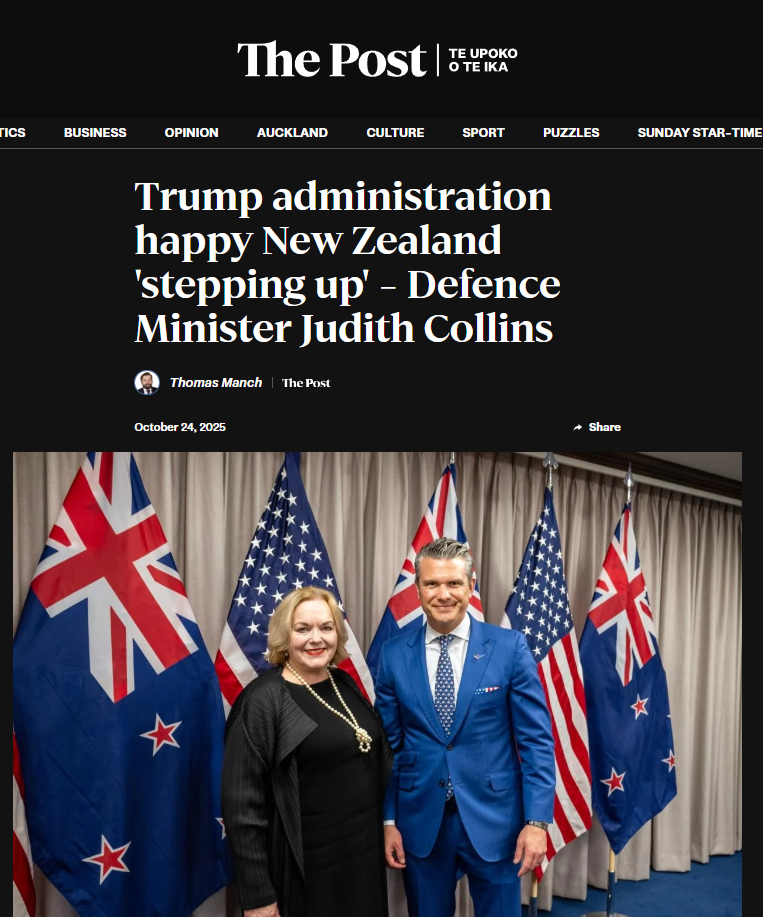
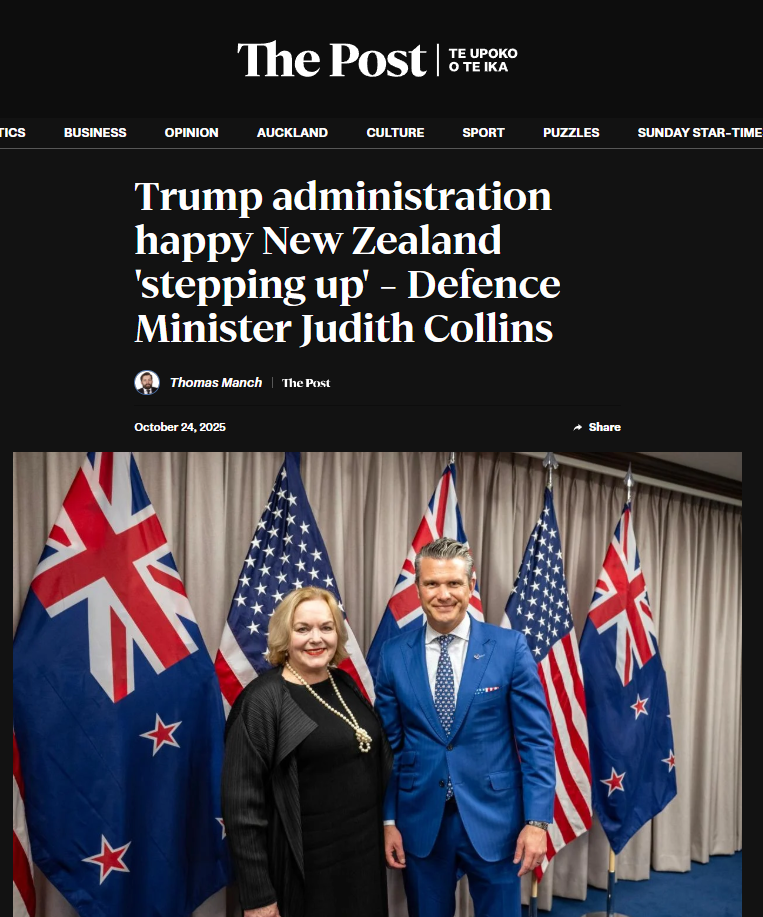
Collins returned from Washington boasting that Trump administration officials were “extremely happy” New Zealand is “stepping up” on defence (Thomas Manch, The Post, October 24, 2025). She met Pete Hegseth—Secretary of War under a president whose military rhetoric mirrors fascism—and other Trump cabinet members while simultaneously presiding over cuts of $750 million from Māori-targeted programmes (Willie Jackson, Labour Party, May 23, 2025; Spinoff Budget Analysis, May 22, 2025). The message was unambiguous: Aotearoa will militarise, industrialise its weapons sector, and align itself with a US military apparatus that has violated international law systematically across the Middle East and Asia-Pacific.
The timing is not coincidence. In May 2025, Collins endorsed Trump’s “Golden Dome” missile defence project—a $300-1,400 billion initiative critics warn will fuel a space arms race and breach nuclear non-proliferation principles (RNZ, May 31, 2025). RocketLab, a New Zealand-founded company now California-based, is already positioning itself as a contractor (NZ Herald, May 31, 2025). Meanwhile, Māori life expectancy remains 7-8 years lower than non-Māori; Māori women die from lung cancer at 3 times the rate; Māori children are hospitalised for asthma at 2 times the rate (Ministry of Health, Tatau Kahukura: Māori Health Chart Book 2024, December 2024).
Network Exposed: Pentagon Contractors, Collins, and the Machinery of Militarism
Collins’ meetings reveal embedded connections to the global military-industrial complex. She met directly with Pete Hegseth, whose writings endorse violating Geneva Conventions, condone war crimes, and frame international law as “tying America’s hands” (Current Affairs, January 26, 2025; Boston Globe, September 30, 2025). She discussed AUKUS Pillar Two—a technology-sharing pact centred on hypersonic missiles, artificial intelligence, and autonomous weapons—with officials from Lockheed Martin and Boeing, firms receiving $2.7 billion for New Zealand’s maritime helicopter and aircraft purchases alone (Breaking Defense, August 20, 2025).
In 2024, New Zealand quietly joined the Partnership for Indo-Pacific Industrial Resilience (PIPIR), a 13-country military production consortium explicitly designed to boost US “warfighting capability” and prevent weapons shortages in a China conflict (RNZ, December 8, 2024). Collins claimed it was merely a “discussion forum” but documents reveal its four workstreams focus on co-producing hypersonic missiles, drones, and securing US Navy repair contracts (RNZ, August 12, 2025). No public debate occurred. No consultation with Māori, peace movements, or affected communities happened.
Rhetoric vs Reality: Five Statistics Exposing Collins’ Deception
Collins claims defence spending is about national security and economic opportunity. The data tells a different story:
Statistic 1: While Collins allocated $9 billion in new defence funding through 2032 (Ministry of Defence, Defence Capability Plan 2025), Māori health funding gaps exceed $1.4 billion annually by 2031. Māori experience higher rates of cancer, cardiovascular disease, diabetes, and respiratory conditions—all preventable with investment in primary care, nutrition, and housing (Health NZ, Health Status Report 2023, February 2024). Instead, they watch military helicopters and missiles consume resources.
Statistic 2: One-third of working-age Māori have no school qualifications, versus 15% nationally (Stats NZ, accessed October 2025; Te Ara Encyclopedia, accessed October 2025). Yet Budget 2025 cut $750 million from Māori education and housing initiatives while pledging $4.2 billion to defence (RNZ Budget Analysis, May 21, 2025). Māori children in Oranga Tamariki state care experience educational outcomes at half the rate of non-involved youth; those in custody or care are hospitalised for self-harm at 5-15 times the rate (Aroturuki Tamariki, Outcomes for Tamariki and Rangatahi Māori 2023/24, June 11, 2025).
Statistic 3: Unemployment for young Māori (15-29 years) stands at 15.6% versus 10.2% nationally (BERL, Income Equity for Māori, 2019). Collins projects income inequality will balloon to $4.3 billion annually by 2040—while defence spending balloons to $6+ billion annually. The opportunity cost is quantified harm.
Statistic 4: According to Cure Kids 2023 State of Child Health Report, Māori children are 46 times more likely than European children to be hospitalised with preventable conditions like acute rheumatic fever; Pasifika children, 115 times more likely (YEA NZ, August 31, 2024; 1News, September 17, 2024). These disparities—respiratory disease, rheumatic fever, skin infections, dental decay—are not failures of Māori families but failures of governments choosing missiles over manaakitanga (care).
Statistic 5: Māori represent 52% of the incarcerated population but only 17% of Aotearoa’s population. Adults who experienced Oranga Tamariki state care are 9 times more likely to use emergency housing, half as likely to be employed, and experience mortality rates double or triple those not in the system (Aroturuki Tamariki Report, June 10, 2025). Yet Collins’ coalition cut funding to social services while praising military growth with Trump officials.
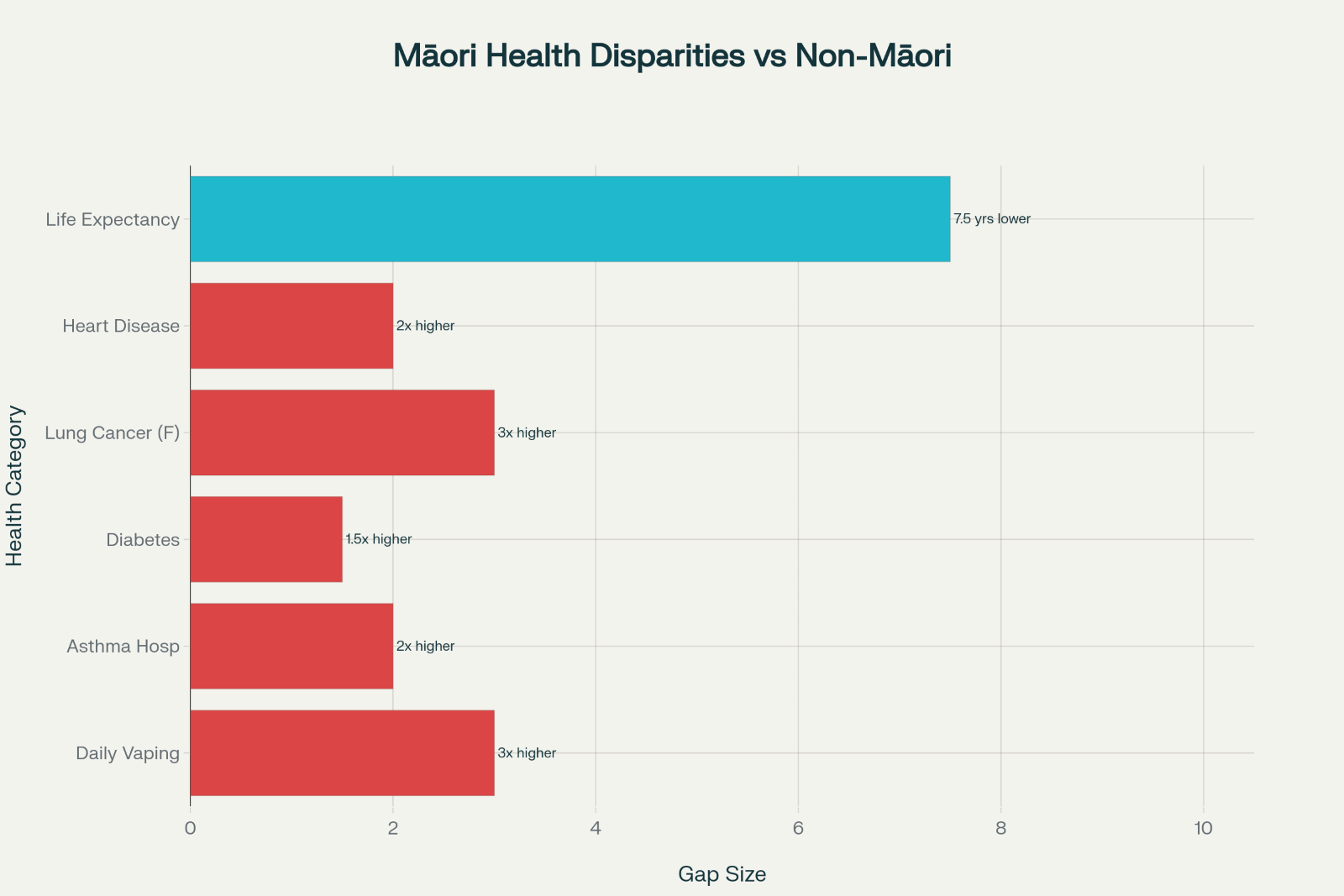
Māori health disparities compared to non-Māori in Aotearoa New Zealand. Metrics show life expectancy gap in years and rate ratios for key health conditions, revealing systematic inequity that violates manaakitanga and wairuatanga.
Five Logical Fallacies and Rhetorical Techniques
Fallacy 1 — False Security Premise: Collins frames $12 billion defence spending as necessary because “China tested missiles” and “ships with strike power came into our backyard.” This deliberately obscures that Aotearoa faces no direct military threat from any nation (Defence Capability Plan Cabinet Paper). China is New Zealand’s largest trading partner. The “threat” is manufactured by the US military-industrial complex to justify weapons sales and technological dependence. This is emotional manipulation masquerading as analysis—appeal to fear without evidence of actual danger.
Fallacy 2 — Equivocation (”Stepping Up”): Collins repeatedly uses “stepping up” to conflate military spending with national responsibility, economic growth, and partnership. “Stepping up” actually means subordinating Aotearoa’s independent foreign policy to Trump administration pressure (1News Interview, April 14, 2025). It means abandoning the Treaty commitment to kaitiakitanga (environmental stewardship) by militarising our landscape for US operations. The term obscures what “stepping up” truly costs: Māori health, education, and sovereignty.
Fallacy 3 — Appeal to Authority: Collins legitimises $9 billion spending by citing Trump officials’ approval. “They see us as an extremely valuable player,” she reported (Thomas Manch, The Post, October 24, 2025). This is textbook appeal to authority—outsourcing legitimacy to Pentagon officials who profit from weapons sales and have no accountability to Aotearoa. It’s the rhetorical equivalent of a colonial subject proudly reporting the coloniser’s praise.
Fallacy 4 — Hidden Comparative (Omitted Context): Collins claims defence spending will create “economic benefits” and “jobs” (Beehive Press Release, May 21, 2025). She omits that: (1) Most contracts go to multinational firms (Lockheed Martin, Boeing, Airbus), not local businesses; (2) Defence spending has lower economic multiplier effects than health, education, or infrastructure investment; (3) Military jobs are specialised, not accessible to economically displaced Māori communities. She also omits that $750 million was simultaneously cut from Māori-targeted programmes, creating a zero-sum outcome where defence gains come at Māori expense.
Fallacy 5 — Borrowed Rhetoric (Neoliberal Framing): Collins frames militarism using neoliberal language: “resilience,” “innovation,” “partnership,” “competitive advantage” (Defence Industry Strategy 2025, October 2, 2025). This rhetoric—lifted directly from corporate boardrooms and Pentagon strategy documents—disguises militarism as economic pragmatism. “Building resilience in supply chains” actually means integrating Aotearoa into US weapons production networks. “Innovation” means developing lethal autonomous weapons. The language conceals power and profit.
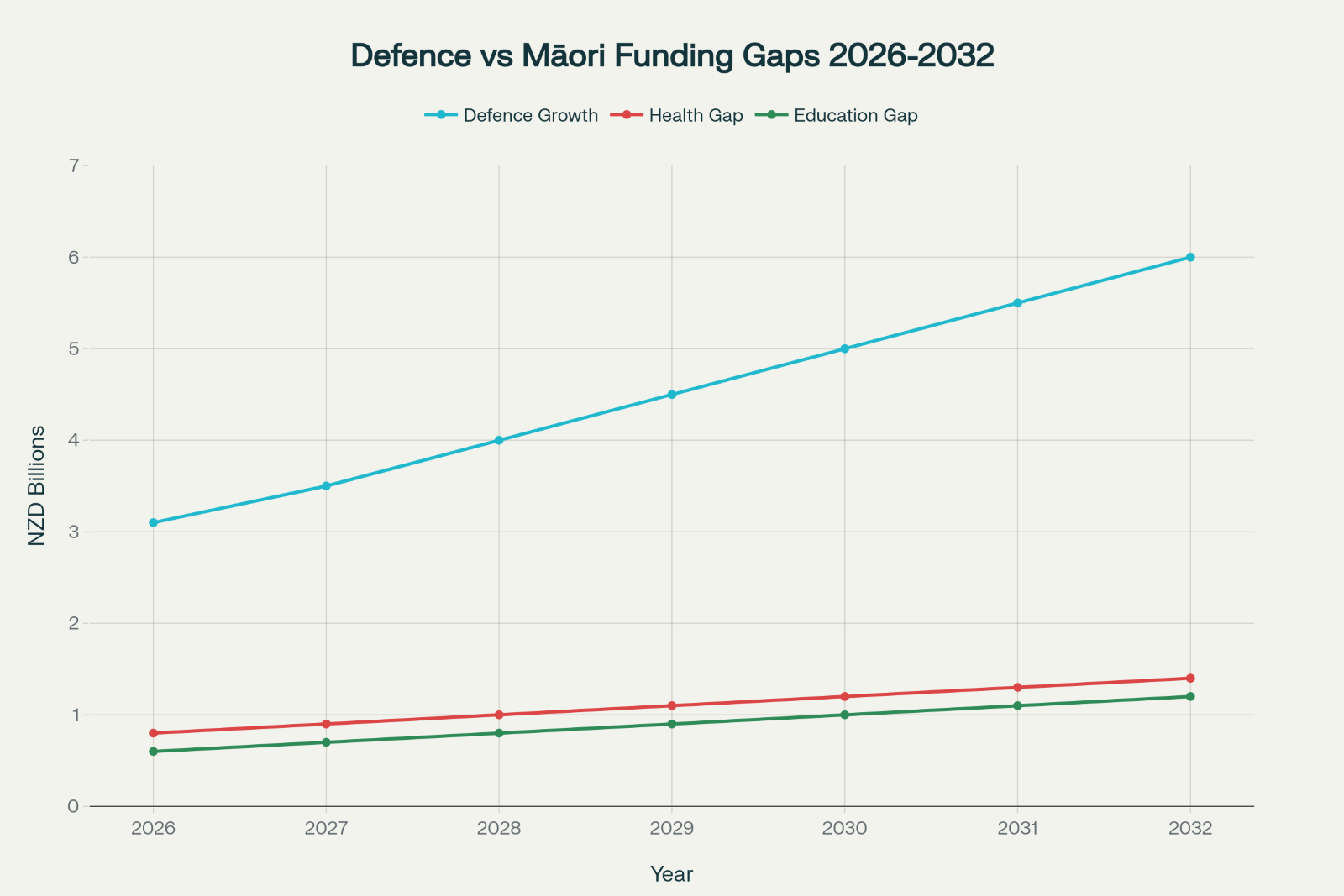
New Zealand defence spending trajectory 2026-2032 showing NZD $9 billion new allocation, compared to persistent unmet health and education funding gaps for Māori communities. Reflects neoliberal prioritisation of militarism over social equity.
Historical Pattern: Neoliberalism’s Attack on Te Tiriti and Māori Existence
This military spending surge is not separate from the government’s broader assault on co-governance, Te Tiriti rights, and Māori authority. As e-Tangata documented in December 2024, the coalition launched a “coordinated attack” on three domains simultaneously: Te Tiriti rights (Treaty Principles Bill, Takutai Moana limitations, Tribunal rescoping), environmental protections, and research funding.
These attacks serve a unified neoliberal objective: removing barriers to profit extraction. As Professor Andrew Erueti argues, the neoliberal doctrine (Seymour’s libertarianism, Luxon’s pragmatic conservatism, Peters’ populism) shares one priority: rolling back the state, privatising public goods, and subordinating collective rights to individual capital accumulation.
Militarism fits perfectly. It justifies expanding state power selectively—for weapons, surveillance, and border enforcement—while dismantling state capacity for health, education, and social care. It legitimises integration with global capital (defence contractors, tech firms, US military networks). It subordinates Māori rangatiratanga (sovereignty) to neocolonial security arrangements.
The connection is explicit: Collins endorsed Trump’s Golden Dome while simultaneously presiding over cuts to Māori Health Authority, education funding, and refusing to consult Māori on AUKUS Pillar Two participation (MFAT AUKUS Documents, August 2024). Militarism and de-Māorification are twins—both serve capital accumulation and neocolonial control.
Hidden Connections: Follow the Money and Personnel
Connection 1 — Lockheed Martin’s Grip: Lockheed Martin, the world’s largest defence contractor with $66+ billion annual revenue, secured $2.7 billion NZD for maritime helicopters and is a prime contractor on AUKUS Pillar Two initiatives, Golden Dome, and NZ Defence Force modernisation projects (Breaking Defense, August 20, 2025). Collins praised the “versatility” of the MH-60R Seahawk (Lockheed Martin’s platform) without competitive tender—a procurement decision that bypassed public scrutiny and locked Aotearoa into long-term dependency on US supply chains and technical support.
Connection 2 — Pete Hegseth’s Ideological Network: Hegseth, Secretary of War, has deep ties to Christian nationalist networks and Trump’s inner circle. His speeches frame war as moral obligation and international law as impediment (In These Times, October 21, 2025; Truthout, November 27, 2024). When Collins met Hegseth, she wasn’t negotiating with a neutral official—she was affirming Aotearoa’s alignment with a militaristic, nationalist, potentially theocratic vision of American power that violates Wairuatanga (spiritual integrity) and Aroha (compassion toward all beings).
Connection 3 — Five Eyes Expansion (Domestic Surveillance Trap): Collins’ participation in PIPIR and emphasis on Five Eyes intelligence-sharing represents expansion of the world’s most comprehensive espionage alliance (Privacy International, May 28, 2019; Proton VPN, August 29, 2018). Edward Snowden documented that Five Eyes conducts mass surveillance of citizens in member states and shares data without judicial oversight (Lawfare, January 17, 2023). By deepening this integration, Collins subordinates Aotearoa’s citizens—including Māori—to a supra-national surveillance apparatus accountable to no domestic court. This violates rangatiratanga and privacy rights.
Connection 4 — RocketLab’s Military Pivot: Collins endorsed RocketLab—a New Zealand-founded, US-registered company—as central to New Zealand’s “advanced technology” defence future (RNZ, April 15, 2025). Yet RocketLab receives US military and intelligence contracts, launches classified National Reconnaissance Office payloads, and is developing “Neutron” rockets explicitly marketed for “national security” missions (NZ Herald, October 16, 2024). Collins’ strategy essentially outsources Aotearoa’s space sovereignty to a company operating within US military command structures.
Connection 5 — Defence Industry Strategy’s Corporate Capture: The October 2025 Defence Industry Strategy requires “large multinationals to set out plans for working with local companies” but lacks enforcement mechanisms (Beehive Press Release, October 2, 2025; Dentons Legal Analysis, October 17, 2025). In practice, Aotearoa becomes a subcontractor tier below Lockheed Martin, Boeing, and Airbus—profitable for corporate elites but generating low-wage, precarious work for ordinary Kiwis (and even fewer opportunities for Māori, given historical discrimination in defence contracting and technology sectors).
Tikanga Violated: How Militarism Contradicts Māori Values
Whanaungatanga (Relationship/Kinship): Militarism severs whanaungatanga with the earth, with Pacific neighbours, with global communities vulnerable to weapons we manufacture. PIPIR’s hypersonic missiles, AI-enabled weapons, and space systems will be used in future conflicts—potentially against Pacific nations. Collins’ strategy prioritises relationships with Trump officials over relationships with Pacific whānau.
Manaakitanga (Care/Hospitality): Diverting $9 billion to defence while cutting Māori health, education, and housing contradicts manaakitanga at its core. Manaakitanga means providing for those in need. Instead, Aotearoa chooses weapons and military readiness while Māori children die from preventable diseases. This is the inverse of manaakitanga—abandonment disguised as strategy.
Kaitiakitanga (Stewardship): Integrating Aotearoa into US military operations and weapons production means sacrificing environmental stewardship. Military activities generate pollution; weapons manufacturing consumes resources; military testing damages ecosystems. Collins’ endorsement of Golden Dome (missiles in space, satellite warfare, space debris) violates kaitiakitanga by treating the cosmos as a domain for warfare rather than shared abundance.
Rangatiratanga (Sovereignty/Self-Determination): By joining PIPIR without Māori consultation, participating in AUKUS Pillar Two discussions without public debate, and accepting Trump’s praise, Collins surrenders rangatiratanga. Māori tino rangatiratanga over Aotearoa requires genuine autonomy in foreign policy and security decisions. Instead, Collins accepts decisions made in Washington, Canberra, and London—precisely the colonial pattern Te Tiriti was meant to interrupt.
Wairuatanga (Spiritual Integrity): Meeting with Hegseth—who writes approvingly of war crimes, frames Muslims as enemies, and promotes “warrior ethos” ideology aligned with white nationalism—contradicts wairuatanga. It imports ideological poison into Aotearoa’s spiritual space.
Kotahitanga (Unity): Defence spending that widens Māori-Pākehā inequality undermines kotahitanga. True unity requires addressing the 7-8 year life expectancy gap, the 33% vs 15% qualification gap, the 52% vs 17% incarceration disparity. Instead, Collins pursues unity through military alignment with the United States—an imperialising power, not a partner in genuine collective wellbeing.
Aroha (Compassion): There is no aroha in choosing missiles over medicine, military helicopters over healthcare access, weapons development over whānau support. Aroha demands we ask: Is Aotearoa safer with $6 billion annual defence spending, or with funded mental health services, accessible healthcare, and educational opportunity for Māori youth?
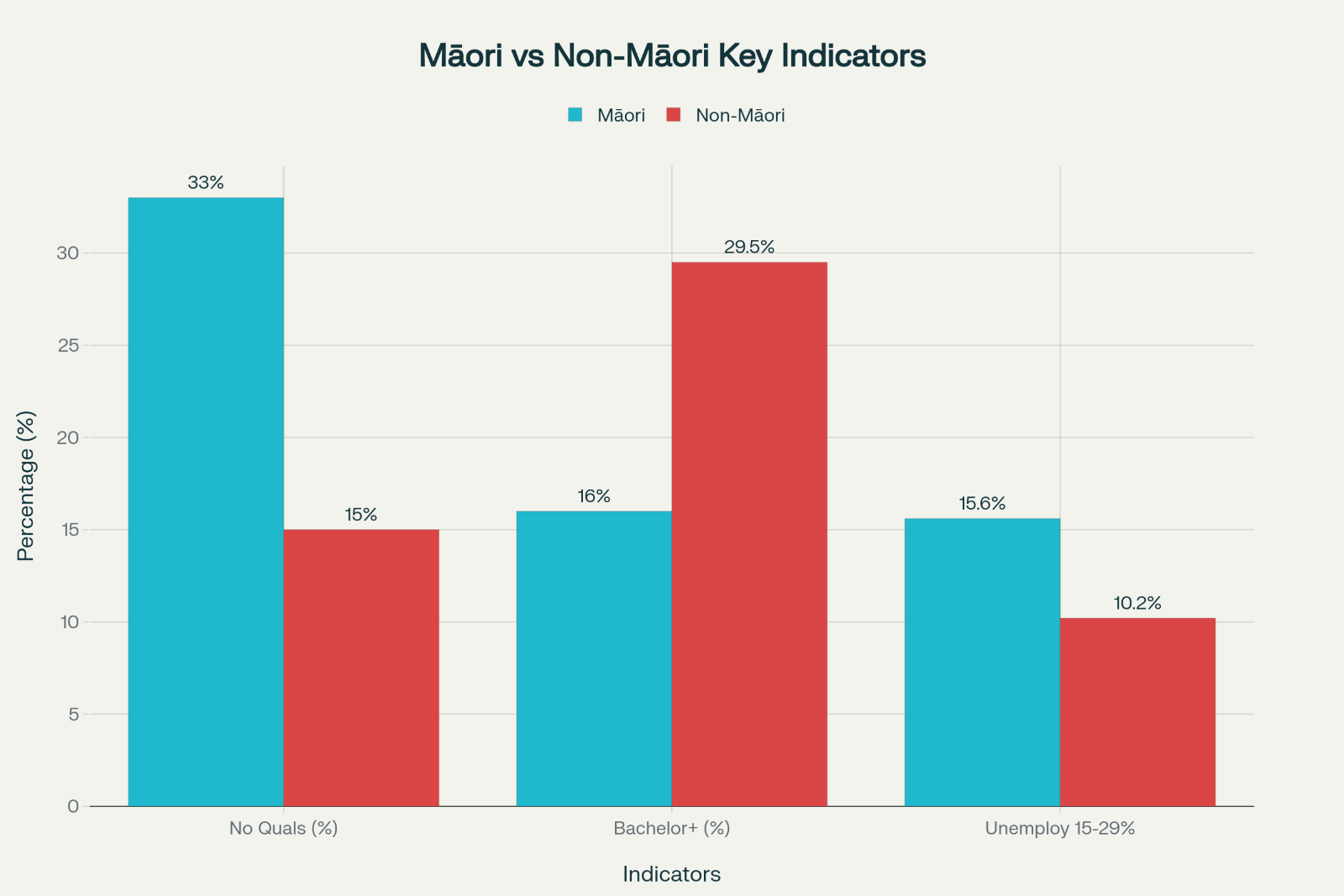
Māori education and employment disparities in Aotearoa New Zealand. Data shows one-third of working-age Māori have no qualifications vs 15% nationally; higher unemployment; lower tertiary attainment. Violates rangatiratanga and whanaungatanga principles.
Implications: The Quantified Harm and Call to Action
By 2032, if current trajectories hold, Aotearoa will spend $6 billion annually on defence while Māori communities face health funding gaps exceeding $1.4 billion, education gaps exceeding $1.2 billion, and employment crises affecting nearly one in six young Māori. This is not coincidence—it is deliberate reallocation reflecting neoliberal priorities: profit for defence contractors over wellbeing for tangata whenua.
The harms are measurable and accelerating: Māori will continue dying 7-8 years earlier; children will continue being hospitalised at 2-3 times the rate; youth will continue cycling through Oranga Tamariki and prisons; whānau will continue experiencing poverty and housing insecurity. These are not abstract statistics—they are lives foreclosed, potential extinguished, aroha denied.
Specific Actions for Mobilisation:
To Iwi and Hapū Leaders: Demand immediate suspension of all AUKUS Pillar Two involvement and PIPIR participation pending Treaty consultation and informed consent processes. Invoke Wai 2500 (Waitangi Tribunal’s findings on Crown breaches of Te Tiriti principles) to legally challenge defence spending prioritisation over health and education funding.
To Pākehā Allies: Challenge defence spending narratives. Demand your MPs vote against further military appropriations without prior Māori consultation. Redirect media attention toward the health and education crises being defunded. Refuse to celebrate “partnerships” with Trump officials; instead, amplify anti-war voices.
To Peace Movements: Organise coordinated campaigns against AUKUS, PIPIR, and defence spending increases. Connect militarism to Māori health crises explicitly. Build international networks with Pacific peace movements (Samoa, Vanuatu, Solomon Islands) similarly pressured to militarise.
To Grassroots Organisations: Document and publicise the Māori health, education, and employment impacts of defence spending diversion. Create fact sheets showing that every billion spent on defence is a billion not spent on Māori health. Demand Collins and Luxon appear at community forums to justify these choices.
Moral Clarity and Political Action
Judith Collins’ Washington mission represents a clear betrayal of Aotearoa’s people, particularly tāngata Māori. She returned with Pentagon approval for militarisation while Māori face systematic exclusion from health, education, and economic opportunity. This is not strategy—it is complicity in ongoing colonisation, neoliberal extraction, and neofascist alignment.

The Māori Green Lantern Fighting Misinformation And Disinformation From The Far Right
The choice before Aotearoa is binary: we can continue militarising, integrating into US weapons networks, and sacrificing Māori wellbeing for defence contractor profits. Or we can reclaim kaitiakitanga, rangatiratanga, and aroha by rejecting militarism, redirecting resources to Māori health and education, and building genuine independence from imperial powers.
Te Mana Motuhake—Māori self-determination—is incompatible with Pentagon subservience. Kotahitanga—collective unity—is incompatible with widening health inequality. Wairuatanga—spiritual integrity—is incompatible with endorsing war crimes and weapons proliferation.
The smoking gun is clear: Collins prioritised Trump’s praise over Māori lives. Aotearoa must demand better. Mobilise now. Reject militarism. Invest in manaakitanga. Choose aroha. Choose Māori.
Hui Tautoko—Unite for Justice. The alternative is slow death dressed in the language of security.
Koha Request: HTDM 03-1546-0415173-000
- https://www.mdpi.com/1660-4601/21/4/445/pdf?version=1712308942
- https://limenetwork.net.au/resources-hub/resource-database/tatau-kahukura-maori-health-chart-book/
- https://www.health.govt.nz/system/files/2024-08/Health and Independence Report 2023_online_f3.pdf
- https://www.healthychristchurch.org.nz/news/resources-and-information/2023/5/cure-kids-third-state-of-child-health-report-spotlights-urgent-health-priorities
- https://digitalnz.org/records/59377426
- /content/files/assets/Publications/Health-status-reports/health-status-report-executive-summary.pdf
- https://hpfnz.org.nz/news-blog/opinion-poor-health-outcomes-for-children-preventable-chief-childrens-commissioner/
- https://www.researchreview.co.nz/mh/Conditions/R/Racism/Tatau-Kahukura-Maori-Health-Chart-Book-2024.aspx
- https://www.health.govt.nz/statistics-research/statistics-and-data-sets/maori-health
- https://www.paediatrics.org.nz/knowledge-hub/view-resource?id=82
- https://hapai.co.nz/is-early-super-for-maori-a-solution/
- https://onlinelibrary.wiley.com/doi/pdfdirect/10.1111/jocn.15859
- https://www.stats.govt.nz/topics/maori/
- https://ourarchive.otago.ac.nz/esploro/outputs/report/State-of-Child-Health-in-Aotearoa/9926618779301891
- https://www.nurse.org.nz/posts/ministry-of-health-library-health-improvement-and-innovation-digest-13
- https://www.mhwc.govt.nz/news-and-resources/key-mental-health-and-addiction-findings-nz-health-survey/
- https://www.rnz.co.nz/national/programmes/checkpoint/audio/2018890382/nz-s-most-at-risk-children-suffering-preventable-diseases-cure-kids-report
- https://www.nzherald.co.nz/the-listener/opinion/duncan-garner-we-should-hang-our-heads-in-shame-over-latest-nz-youth-health-report/NHZL3LCU65FSTKLQ4FZL5W7UHE/
- https://www.rnz.co.nz/news/te-manu-korihi/503161/young-maori-experience-higher-levels-of-structural-disadvantage-study
- https://www.rnz.co.nz/international/pacific-news/528323/pacific-maori-children-suffer-staggering-rates-of-rheumatic-fever-hospitalisation-report
- https://www.rnz.co.nz/news/pacific/570408/pasifika-maori-dying-a-decade-earlier-from-heart-disease-new-report-finds
- https://www.nzherald.co.nz/talanoa/most-at-risk-children-suffering-preventable-diseases-says-cure-kids-report/AJ6GLGG6QZFSRKNXBQ5Z4UHSBA/
- https://www.mdpi.com/1660-4601/20/18/6797/pdf?version=1695294861
- https://www.nzherald.co.nz/kahu/new-research-maori-children-suffering-most-from-health-inequality-at-all-levels/SF55SZNF7ZD3HPMLJSBVA66CLI/
- https://www.rnz.co.nz/news/national/494431/the-kids-are-catching-everything-winter-ailments-plague-families
- https://www.rnz.co.nz/news/te-manu-korihi/573582/more-maori-nurses-are-needed-nz-nurses-organisation-says
- https://www.rnz.co.nz/news/on-the-inside/490105/nz-is-finally-making-progress-on-child-poverty-but-a-no-frills-budget-puts-that-at-risk
- https://www.rnz.co.nz/news/political/563803/oranga-tamariki-report-finds-stark-outcomes-for-maori-in-state-care-system
- https://www.rnz.co.nz/international/pacific-news/492009/nz-minister-announces-plan-to-tackle-worrying-rheumatic-fever-rates
- https://www.rnz.co.nz/news/national/568730/maori-life-expectancy-increases-more-than-other-ethnic-group-stats-nz
- https://www.1news.co.nz/archive/2024/09/17/
- https://www.rnz.co.nz/news/political/558507/one-in-six-new-zealanders-are-disabled-so-why-does-so-much-health-research-still-exclude-them
- https://www.rnz.co.nz/news/national/508584/proposal-to-allow-pharmacists-to-provide-childhood-vaccinations
- https://www.health.govt.nz/publications/tatau-kahukura-maori-health-chart-book-2024
- https://www.rnz.co.nz/news/chinese/536144/new-report-highlights-bias-and-discrimination-against-ethnic-communities
- /content/files/files/1727313460296.pdf
- /content/files/system/files/2025-09/30-06-2025-aide-memorie-meeting-with-cure-kids-h2025069137.pdf
- https://www.mdpi.com/2504-3900/37/1/50/pdf
- /content/files/anzsw/article/download/1032/881.pdf
- /content/files/articles/10-3389/fped-2024-1359214/pdf.pdf
- https://onlinelibrary.wiley.com/doi/pdfdirect/10.1111/jpc.15309
- https://pmc.ncbi.nlm.nih.gov/articles/PMC11459794/
- /content/files/track/pdf/10-1186/1472-6963-10-333.pdf
- https://www.orangatamariki.govt.nz/about-us/news/report-on-maori-tamariki-outcomes/
- /content/files/assets/Publications/Health-status-reports/hnz-two-health-status-report_full.pdf
- https://thespinoff.co.nz/politics/23-05-2025/budget-2025-new-funding-headlines-mask-deeper-cuts-to-maori-programmes
- https://www.defence.govt.nz/our-work/equip/defence-capability-plan/
- https://www.teaonews.co.nz/2025/05/23/government-denies-labours-750m-maori-funding-cut-claims/
- /content/files/assets/Uploads/DocumentLibrary/24-0253-nzdf-dcp-a4-pullout-fa-v2.pdf
- https://waateanews.com/2025/06/11/640454/
- https://www.labour.org.nz/news/release-1-billion-of-maori-funding-gone/
- /content/files/assets/Uploads/DocumentLibrary/24-0253-nzdf-defence-capability-plan-single.pdf
- https://www.teaonews.co.nz/2025/06/12/state-falling-short-childrens-monitor-urges-collective-action-for-mokopuna-maori/
- https://www.rnz.co.nz/news/political/561870/maori-question-lack-of-targeted-funding-in-2025-budget
- https://www.dentons.co.nz/en/insights/articles/2025/october/17/defence-industry-strategy-2025-building-capability-through-strategic-depth
- https://www.yea.org.nz/article/state-of-child-health-report
- https://thespinoff.co.nz/atea/13-06-2025/falling-short-new-oranga-tamariki-report-finds-sobering-outcomes-for-maori-in-care
- /content/files/budgets/summary-initiatives/b25-sum-initiatives.pdf
- https://www.rnz.co.nz/news/national/569795/us-arms-sales-surge-while-nz-increases-defence-spending
- https://aroturuki.govt.nz/reports/outcomes-23-24
- /content/files/sites/default/files/2025-05/b25-at-a-glance.pdf
- https://www.defence.govt.nz/publications/aukus-pillar-ii-developments-and-proposed-next-steps/
- https://aroturuki.govt.nz/reports
- https://www.facebook.com/RadioNewZealand/videos/chris-hipkins-discusses-impact-of-budget-2025-on-māori-mata/1469784537340466/
- https://www.1news.co.nz/2025/05/23/maori-leaders-give-disappointed-reaction-to-yeah-nah-budget/
- https://www.rnz.co.nz/news/political/542184/nz-government-should-resurrect-trump-taskforce-security-expert
- /content/files/system/files/2024-12/tatau-kahukura-maori-health-chart-book-2024-v4.pdf
- https://www.nzherald.co.nz/nz/politics/the-state-is-falling-short-sobering-report-reveals-realities-and-optimism-of-maori-kids-in-the-system/27CTJNXMMBCKFHH4B6BLOAWRPI/
- https://www.nzherald.co.nz/world/opinion-helen-clark-and-marco-de-jong-subservience-puts-new-zealands-sovereignty-and-security-at-risk/IHEVY3RVFZG3PEONGRX6AOD6AQ/
- https://www.rnz.co.nz/news/te-manu-korihi/569201/charity-looks-how-best-to-support-mental-health-of-young-maori-in-rural-bay-of-plenty
- https://www.rnz.co.nz/news/budget-2025/561818/budget-2025-maori-education-gets-boost-targeted-funding-remains-tight
- https://www.rnz.co.nz/news/national/543889/military-tech-moves-lots-of-talk-and-lots-of-drones
- https://www.rnz.co.nz/news/pacific/564005/nz-pacific-and-maori-student-support-cut
- https://www.rnz.co.nz/news/political/561809/budget-2025-at-a-glance-the-big-changes-winners-and-losers
- https://www.rnz.co.nz/news/te-manu-korihi?page=10
- https://www.rnz.co.nz/news/political/561810/budget-2025-at-a-glance-the-big-changes-winners-and-losers
- https://www.rnz.co.nz/news/national/563405/new-zealand-defence-force-using-us-army-wargame-simulation-software-date
- https://www.1news.co.nz/2024/02/20/health-report-significant-differences-persist-for-maori-pasifika/
- https://www.rnz.co.nz/news/political/564350/government-launches-suicide-prevention-action-plan
- https://www.nzherald.co.nz/nz/the-rural-economy-is-holding-the-maori-economy-up-as-much-as-anywhere-else-shane-te-pou/M2ZMR4CTJJCYJME25BNF342N4I/
- https://www.rnz.co.nz/news/political/543057/number-of-children-being-abused-in-state-care-has-increased-report-finds
- https://www.rnz.co.nz/news/political/572116/budget-documents-find-8-point-5-billion-gap-between-costs-and-savings
- https://www.rnz.co.nz/authors/lillian-hanly?page=4
- https://www.1news.co.nz/2024/09/17/child-health-report-identifies-five-priority-areas-for-urgent-action/