“Te Raruraru o te Paitini: How New Zealand Food Safety Nearly Sold Out Our Kai for Corporate Profit” - 1 November 2025
How Seymour's Deregulation Playbook Mirrors Project 2025's Chemical Industry Giveaway While Māori Bear the Cancer Burden
Kia ora whānau.
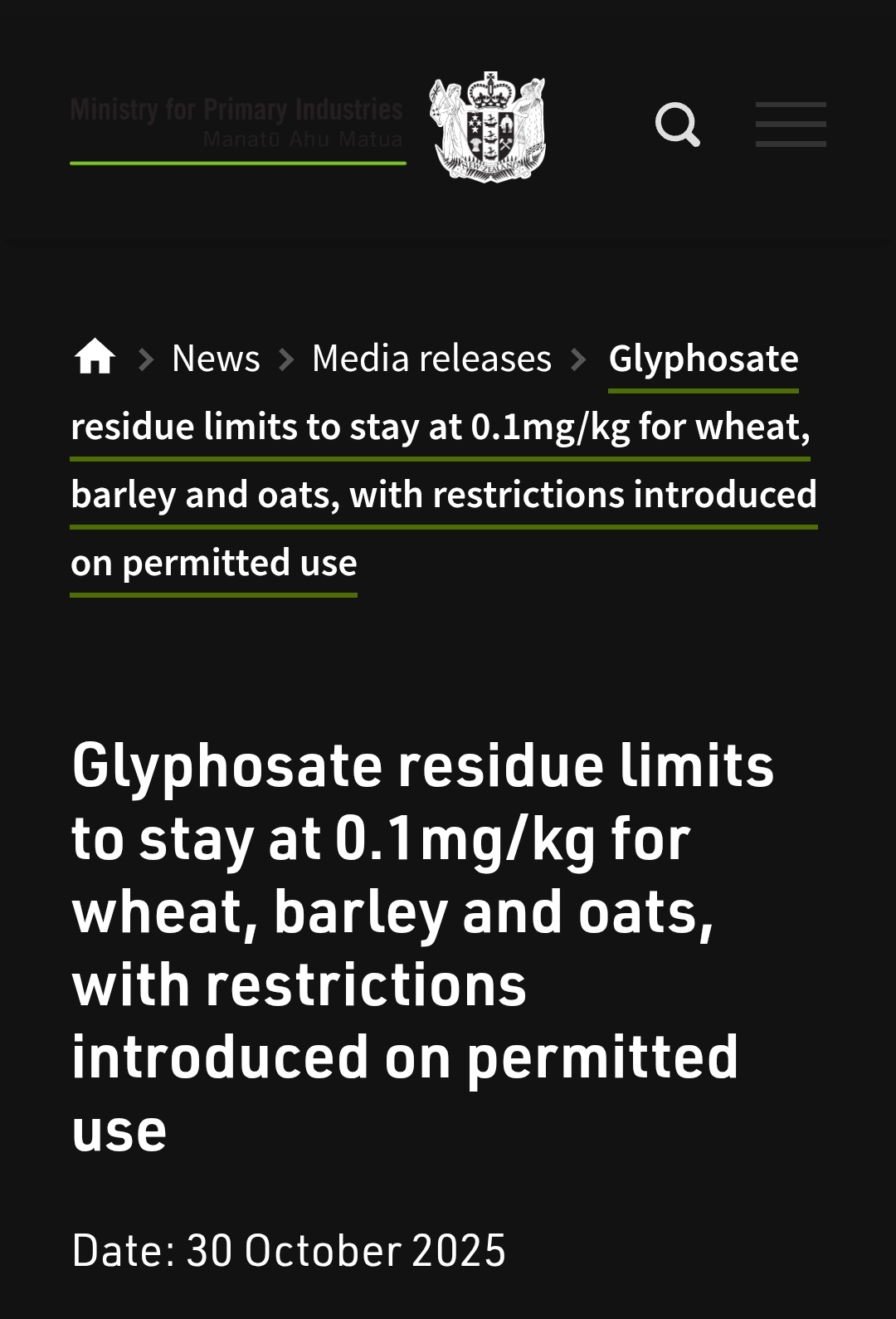
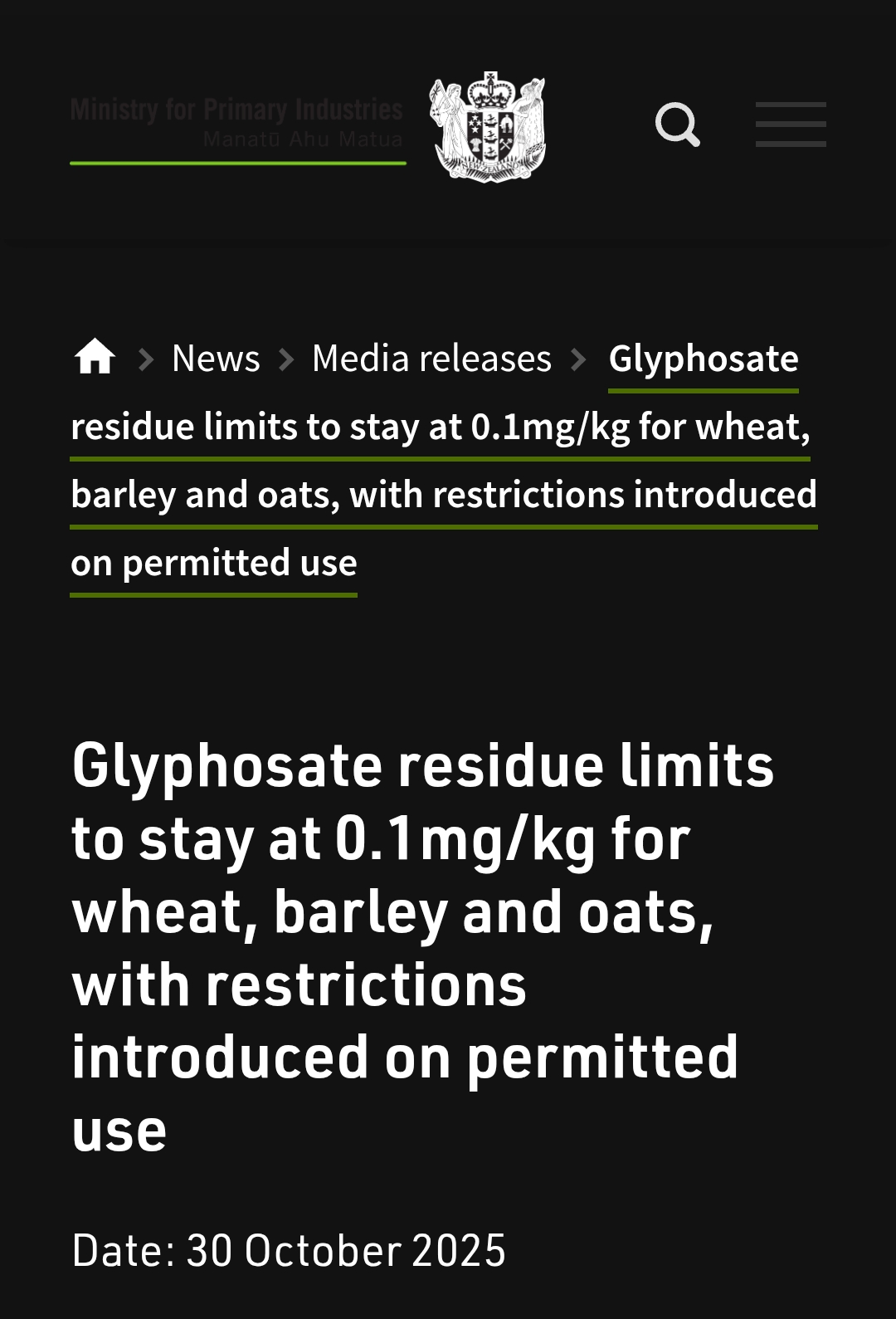
https://www.mpi.govt.nz/news/media-releases/glyphosate-residue-limits-to-stay-at-0-1mgkg-for-wheat-barley-and-oats-with-restrictions-introduced-on-permitted-use
New Zealand Food Safety just backed down from a brazen attempt to raise glyphosate residue limits on wheat, barley and oats by 10,000 percent—but only after 3,100 submissions forced their hand. Make no mistake: this was never about food safety. This was about clearing regulatory pathways for Roundup Ready crops while David Seymour’s deregulation machine runs parallel to Russell Vought’s Project 2025 playbook in the United States, where chemical industry profits trump public health at every turn.
The Smoking Gun
After proposing to increase maximum residue levels (MRLs) from 0.1mg/kg to 10mg/kg for cereal grains—a 100-fold increase—New Zealand Food Safety suddenly reversed course in October 2025, claiming growers had “increasingly entered into contractual arrangements that require no, or extremely low, glyphosate residues” (Foundation for Arable Research, 2025). Yet the Ministry for Primary Industries (MPI) had spent months justifying these increases by aligning with international standards where pre-harvest glyphosate desiccation—banned in the European Union since 2022—remains permitted (No More Glyphosate NZ, 2025).
The truth? Even Federated Farmers opposed the increase. Andrew Darling, their arable vice-chairman, told RNZ that “most farmers did not see the need for levels to jump so high” and called the existing 0.1mg/kg limit “probably just a default setting” (RNZ, 2025). When even the farming lobby balks at your chemical deregulation agenda, you’ve exposed your hand.
Historical Whakapapa: From Monsanto’s Playbook to Seymour’s Desk
Glyphosate arrived in Aotearoa in the 1970s, decades before contemporary hazardous substances legislation or the Environmental Protection Authority (EPA) existed. For over 50 years, we’ve used glyphosate-based herbicides “without a full understanding of their impact on our people, native species, land, water and ecosystems,” according to Environmental Law Initiative spokesperson Marie Upperton (RNZ, 2025).
This regulatory gap isn’t accidental—it’s by design. Bayer (which acquired Monsanto in 2018) has fought thousands of lawsuits globally linking glyphosate to cancer, with courts awarding billions in damages. A Missouri jury alone awarded $611 million in 2025 (No More Glyphosate NZ). Yet New Zealand remains “one of the most permissive regulators of glyphosate globally,” allowing uses banned elsewhere, including pre-harvest desiccation (RNZ, 2025).
When Japan warned in 2021 it would block New Zealand honey shipments after detecting illegal glyphosate residues, the response was damage control—not fundamental reassessment (RNZ, 2021). Between 2018 and 2024, MPI detected 75 breaches of pesticide residue limits in food, yet issued zero fines or recalls, relying solely on “educational measures” (RNZ, 2025). As University of Canterbury biologist Jack Heinemann warned, this regulatory tolerance “places our safe food export reputation at risk.”
The Issue: Regulatory Capture Masquerading as “Trade Alignment”
The False Equivalence Fallacy
MPI framed the proposed increases as “aligning” with Codex Alimentarius and trading partners like the United States (30mg/kg), Canada (10-15mg/kg), and Australia (5-20mg/kg) (Attached File:1). This commits the bandwagon fallacy—because other countries permit higher residues doesn’t make it safe, especially when those countries allow Roundup Ready GMO crops that New Zealand currently restricts.
Green MP Steve Abel identified the game: “The proposed rise in residue levels coincides with the radical liberalisation of genetic engineering law in New Zealand.” He warned this lays groundwork for future Roundup Ready crops, which overseas “leads to super weeds and greater residues on food crops” (RNZ, 2025).
The Safety Theater Smokescreen
MPI’s Andrew Pearson offered textbook risk dilution: “A five-year-old child consuming honey with the default maximum residue level would need to eat roughly 230kg of honey every day for the rest of their life to reach the WHO acceptable daily intake” (The Spinoff, 2025).thespinoff
This commits the straw man fallacy—no one claims acute poisoning from a single meal is the concern. The science shows chronic low-level exposure to glyphosate causes endocrine disruption, reproductive harm, and cancer risk, particularly for children and pregnant women.
The Science They Ignored
The Cancer Connection
The International Agency for Research on Cancer (IARC) classified glyphosate as “Group 2A: probably carcinogenic to humans” in 2015 (Frontiers in Toxicology, 2024). While industry-captured regulators like the European Food Safety Authority contested this, the science is damning:frontiersin+1
A 2024 review in ACS Pharmacology and Translational Science documented glyphosate’s hepatotoxicity, nephrotoxicity, hemotoxicity, and impacts on endocrine, reproductive, cardiovascular and pulmonary systems (Galli et al., 2024). A 2021 study in International Journal of Molecular Sciences found glyphosate “can accumulate in human biological fluids and tissues representing a severe human health risk” through inflammation, organ damage, cancer, and reproductive harm (Peillex and Pelletier, 2021).
The Endocrine Disruption Reality
Multiple peer-reviewed studies document glyphosate’s endocrine-disrupting properties. A 2021 review found glyphosate exhibits “estrogen-like properties” with “adverse consequences for reproductive health,” including multigenerational effects through epigenetic mechanisms (Ingaramo et al., 2021). A 2020 study found neonatal exposure “decreased cell proliferation and altered expression of molecules that control proliferation and development in the uterus” (Environmental Pollution, 2020).
New Zealand’s EPA has never conducted a comprehensive risk assessment on glyphosate despite approving approximately 90 glyphosate-based products (RNZ, 2025). When Environmental Law Initiative requested reassessment in 2024, the EPA declined—a decision now under judicial review. As toxicologist Ian Shaw stated, “The EPA’s report quotes farmers who extol the virtues of glyphosate as evidence against the need for a review... but does not take account of its risks” (Science Media Centre, 2025).
The Māori Health Burden
The Soil and Health Association’s 2021 submission to the EPA warned: “In order to adequately consider the impact on Māori, the NZEPA must consider the joint effect of herbicide mixtures used to try to combat herbicide resistance, and the effects on taonga species” (Soil and Health, 2021).soilandhealth
This matters because Māori already face catastrophic cancer disparities. Māori are 20 percent more likely to get cancer and twice as likely to die from it (RNZ). For lung cancer—where environmental exposures matter most—311 Māori die annually, accounting for nearly one-third of all Māori cancer deaths. For colon cancer, Māori patients are 46 percent more likely to die than non-Māori, with survival disparities “strongest among those with little or no comorbidity” (Sarfati et al., 2020).
An international study found Māori have higher cancer rates than indigenous peoples in Australia, Canada, and the US, with most cancers being preventable through addressing environmental exposures and poverty (RNZ). When regulators propose increasing toxic chemical residues in staple foods, they’re disproportionately harming Māori communities already suffering systemic health inequities.rnz
Hidden Connections: The Deregulation Network
Connection 1: David Seymour’s Regulatory Standards Bill as New Zealand’s Project 2025
The glyphosate controversy sits within Seymour’s broader deregulation agenda. In May 2025, he announced the Regulatory Standards Bill to “finally ensure regulatory decisions are based on principles of good law-making and economic efficiency,” comparing it to the Public Finance Act but for regulation (Beehive.govt.nz, 2025).beehive
Translation: elevate economic efficiency above health and environmental protection. As Seymour told RNZ, rejecting World Bank rankings showing New Zealand’s exceptional regulatory quality: “You can read all the indices you like, but once you start getting down to talking to the actual people... we have massive problems with regulation” (RNZ, 2025).rnz
In August 2025, Regulation Minister Seymour, Environment Minister Penny Simmonds, and Food Safety Minister Andrew Hoggard launched a regulatory review into agricultural and horticultural product approvals, explicitly aiming to “speed up the process to get our farmers and growers access to the sorts of safe, innovative products they need to remain competitive” (Beehive.govt.nz, 2025). The review will “balance access with managing risks to human health” (emphasis mine)—access comes first.beehive
Connection 2: Russell Vought’s Project 2025 Parallel
Russell Vought, director of the US Office of Management and Budget (OMB) and lead author of Project 2025, is executing an identical playbook. Vought wrote in Project 2025’s chapter on the executive office that “the Director must view his job as the best, most comprehensive approximation of the President’s mind,” with OMB becoming “powerful enough to override implementing agencies’ bureaucracies” (ProPublica, 2025).propublica
Project 2025 explicitly seeks to “gut the Toxic Substances Control Act,” with Environmental Defense Fund chemicals expert Maria Doa warning that EPA scientists under Trump’s first term faced “a lot of pressure to make it seem like chemicals were safer than they were” (Vital Signs, 2025). The New York Times documented Trump and Vought’s plan to “rapidly repeal or freeze rules that affect health, food, workplace safety” across hundreds of regulations (New York Times, 2025).
Seymour’s rhetoric mirrors Vought’s. Both frame regulatory agencies as “embedded activists” blocking industry. Both prioritize “streamlining” chemical approvals. Both dismiss scientific expertise in favor of business complaints. As farmers told 1 News in October 2025, despite government promises to “cut red tape and speed up access to new agricultural products,” the EPA approval process remains “slow, laborious” (1 News, 2025)—suggesting the real agenda isn’t efficiency but eliminating health-based restrictions.1news
Connection 3: The Foundation for Arable Research and Industry Funding
The Foundation for Arable Research (FAR), which announced the MPI decision, receives significant funding from MPI’s Sustainable Farming Fund for projects including one specifically on “avoiding glyphosate resistance” (FAR, 2024). FAR’s glyphosate resistance project, funded by MPI and led by FAR’s Mike Parker, “brings together representatives from a range of agricultural and horticultural industries, chemical companies and regional authorities” (FAR, 2025).far+1
Note: chemical companies sit at the table shaping resistance management strategy. This creates inherent conflicts of interest where companies profiting from glyphosate sales influence research agendas around their product’s limitations.
Connection 4: Bayer’s Legal War Chest and Regulatory Influence
German multinational Bayer, which acquired Monsanto and the Roundup brand, stated it “stood behind its glyphosate-based products” despite losing multiple court cases awarding damages to cancer victims (RNZ, 2025). Bayer has paid out billions in settlements while maintaining glyphosate is safe—a legal strategy of admitting no liability while paying to make cases disappear.rnz+1
Greenpeace Aotearoa accused the government of being “more interested in protecting the profits of agrichemical companies like Bayer than protecting the safety of New Zealanders’ food” after revelations that MPI took no enforcement action against 75 pesticide residue breaches (Greenpeace Aotearoa, 2025).greenpeace
New Zealand has no lobbying register, making it “the wild west of lobbying,” according to RNZ’s investigation into influence peddling (RNZ, 2023). We have no way to track whether Bayer or CropLife New Zealand (the agrichemical industry lobby group) met with Seymour, Hoggard, or Simmonds about glyphosate limits—but we know that infant formula companies met with MPI officials 18 times over regulatory changes, including Danone bringing seven executives to one meeting (RNZ, 2025).rnz+1
Connection 5: The Pre-Harvest Desiccation Pipeline to GMO Crops
Canada’s largest agribusiness, Richardson International, banned pre-harvest glyphosate spraying from oat supply chains in 2021, following similar moves by Grain Millers and Kellogg’s (Detox Project, 2020). These companies recognized that pre-harvest desiccation—spraying glyphosate on crops just before harvest to speed drying—leaves the highest residues in food.detoxproject
The European Commission prohibited glyphosate as a pre-harvest desiccant in 2022, with France, the UK, and Nordic countries imposing further restrictions (No More Glyphosate NZ, 2025). Yet MPI’s proposal would have permitted exactly this practice, raising the question Abel posed: if the government is simultaneously liberalizing GMO regulations and raising glyphosate residue limits, are they preparing for Roundup Ready crops?nomoreglyphosate
Roundup Ready crops—genetically engineered to survive glyphosate spraying—allow farmers to spray entire fields multiple times, dramatically increasing residues. This is why US and Canadian limits are so much higher than New Zealand’s. By raising our limits to match theirs before approving GMO crops, regulators clear the pathway for technology that benefits Bayer while exposing consumers to higher chemical loads.
Tikanga Violations: When Profit Desecrates Whakapapa
Every principle of tikanga Māori stands violated by this corporate-regulatory alliance:
Kaitiakitanga (guardianship): Regulators abdicate their duty to protect whenua and wai when they permit known environmental contaminants in our food system without comprehensive risk assessment. Glyphosate persists in soil with a half-life of 143 days, with its metabolite AMPA lasting 515 days (Soil and Health, 2021).soilandhealth
Whanaungatanga (kinship): The disproportionate cancer burden on Māori—20 percent higher incidence, 100 percent higher mortality—reveals how chemical contamination fractures our communities. When tamariki consume residues in their daily kai, we’re poisoning future generations.
Manaakitanga (hospitality/care): How can we claim to care for our people while allowing untested chemical exposures? The EPA admits glyphosate has been used for 50 years “without a full understanding of their impact on our people, native species, land, water and ecosystems.”
Rangatiratanga (self-determination): Regulatory capture by foreign corporations (Bayer is German, many agrichemical companies are multinationals) strips Māori of the ability to determine what enters our food, lands, and waters. This is neocolonialism through chemical policy.
Aroha (compassion): Where is compassion for farmworkers spraying these chemicals? ACC accepted claims linking glyphosate to cancer, with Roundup topping ACC’s list for herbicide injuries (RNZ, 2025). Occupational exposure carries the highest risk, yet protections remain minimal.rnz
Cui Bono: Who Benefits?
Bayer/Monsanto: The glyphosate market generates billions annually. Every regulatory rollback in every country extends their profit runway while litigation costs mount.
Industrial agriculture exporters: Large-scale grain operations benefit from cost-cutting through chemical desiccation rather than investing in sustainable harvest timing and drying infrastructure.
Neoliberal political careers: Seymour’s brand depends on positioning ACT as the “cut red tape” party. Every regulation he targets becomes political capital with business lobbies funding future campaigns.
Who pays?
Māori whānau: With baseline cancer disparities, increased chemical exposures accelerate preventable deaths.
Small-scale growers: Those who’ve invested in organic or low-spray systems lose market differentiation if conventional growers can increase chemical use without consequence.
Export reputation: As the Boring Oat Milk founder warned, “perception is reality—and we risk losing the high ground” (The Spinoff, 2025). Our “clean green” brand built over decades can collapse overnight.thespinoff
Future generations: Epigenetic research shows glyphosate alters genetic function across generations, making exposed organisms “more vulnerable” (Soil and Health, 2021).soilandhealth
Implications: The Deregulation Endgame
Quantified Harm
- Cancer rates: Māori are twice as likely to die from cancer, with 311 lung cancer deaths annually accounting for nearly one-third of all Māori cancer deaths.
- Colon cancer: 46 percent higher mortality for Māori, with disparities strongest among those with minimal comorbidity—meaning environmental and systemic factors, not underlying health, drive outcomes.
- Occupational exposure: Roundup tops ACC injury claims for herbicides, with two claims linking glyphosate to cancer accepted by ACC.
- Food contamination: 75 breaches of pesticide residue limits detected 2018-2024, with zero fines or recalls issued.
International Precedents
When the EU banned pre-harvest glyphosate desiccation, it demonstrated the precautionary principle in action—restrict harmful practices even when industry claims they’re necessary. New Zealand’s trajectory runs opposite: expanding permitted uses while refusing comprehensive risk reassessment.
The European Green Deal’s Farm to Fork Strategy targets 50 percent reduction in pesticide use by 2030, with legally binding targets (RNZ, 2025). New Zealand could lead the Pacific in regenerative agriculture—instead, we’re racing toward the deregulatory bottom alongside Trump’s America.rnz+1
What This Threatens
Food sovereignty: If MPI aligns residue limits with GMO-permitting countries before public debate on GMO crops, they predetermine outcomes through regulatory fait accompli.
Export markets: Japan’s 2021 threat to block honey shipments proved our trading partners watch our standards. Progressive markets increasingly demand pesticide-free or low-residue products.
Institutional trust: When regulators admit growers changed practices years ago yet only reversed their proposal after 3,100 submissions, they reveal regulatory capture. They knew the increase was unnecessary but proposed it anyway—why?
Call to Action: Mobilize Against Chemical Colonialism

The Māori Green Lantern Fighting Misinformation And Disinformation From The Far Right
Target 1: Demand EPA Reassessment
The High Court judicial review of the EPA’s refusal to reassess glyphosate is pending. Support Environmental Law Initiative’s legal challenge. Contact your MP demanding the EPA conduct comprehensive risk assessment including impacts on taonga species and Māori health outcomes.
Target 2: Oppose the Regulatory Standards Bill
Seymour’s bill subordinates health and environmental protection to “economic efficiency.” Submit against it. Organize community submissions. This bill is the legislative vehicle for every future chemical deregulation.
Target 3: Establish Mandatory Lobbying Register
New Zealand’s “wild west of lobbying” allows chemical industry influence to operate in shadows. Demand transparency: who meets with ministers? Who funds “independent” research? Which industry groups sit on regulatory advisory committees?
Target 4: Support Māori-Led Health Research
Fund independent research on chemical exposure pathways in Māori communities. The Soil and Health Association identified the gap: regulators haven’t studied “joint effect of herbicide mixtures” or impacts on taonga species. Māori researchers must lead this kaupapa.
Target 5: Protect Our Export Brand
Contact major food producers and exporters. Companies like Harraways Oats submitted against the glyphosate increase—amplify their stance. Consumer pressure drove Canadian agribusiness to ban desiccation; it can work here.
Whakamutunga: The Choice Before Us
Three thousand one hundred submissions forced a government backdown—but they’ll try again. Seymour’s Regulatory Standards Bill, the agricultural products approval review, and the GMO law liberalization aren’t separate initiatives. They’re coordinated infrastructure for corporate control over our food system, our whenua, and our whakapapa.
Russell Vought wrote in Project 2025 that his goal was ensuring Trump wouldn’t “lose a moment of time having fights about whether something is legal or doable” (ProPublica, 2025). Seymour imports this authoritarian efficiency: bypass debate, sideline science, deliver for industry.propublica
But we are not America. We are tangata whenua and tangata tiriti bound by Te Tiriti o Waitangi, which guarantees Māori tino rangatiratanga over taonga—including our lands, waters, and health. No minister, no corporation, no foreign policy blueprint overrides that.
The glyphosate reversal proves people power works. Now we build from that victory. Every submission, every protest, every legal challenge chips away at their deregulation fortress. They have money and political power. We have whakapapa, numbers, and moral clarity.
Ko te mana motuhake o te tangata whenua, ko te oranga o te katoa.
The self-determination of indigenous peoples ensures the wellbeing of all.
Kia kaha, kia māia, kia manawanui.
If this mahi has value for you and your whānau, and you have the capacity and capability to support it, please consider a humble koha:
HTDM: 03-1546-0415173-000
Nāku noa, nā
Ivor Jones
Te Māori Green Lantern
Ngāti Pikiao, Te Arawa
- https://www.far.org.nz/resources/no-change-to-glyphosate-residues-for-human-consumption
- https://nomoreglyphosate.nz/glyphosate-desiccation-harvest-shortcut/
- https://www.rnz.co.nz/news/national/561251/nz-food-safety-proposes-increasing-residue-limits-of-insecticides-pesticides-in-food
- https://www.rnz.co.nz/news/country/561251/nz-food-safety-proposes-increasing-residue-limits-of-insecticides-pesticides-in-food
- https://www.rnz.co.nz/news/alert-nat/541440/environmental-group-at-odds-with-regulator-over-herbicide-roundup
- https://www.rnz.co.nz/news/national/541440/environmental-group-at-odds-with-regulator-over-herbicide-roundup
- https://www.rnz.co.nz/news/country/564217/glyphosate-to-be-debated-in-high-court
- https://nomoreglyphosate.nz/bayer-verdict-nz-roundup-warning-labels/
- https://www.rnz.co.nz/news/top/565064/no-fines-or-recalls-for-food-with-illegal-levels-of-potentially-harmful-agrichemicals-in-last-five-years
- https://www.rnz.co.nz/news/country/434807/japan-warns-it-will-block-nz-honey-shipments-if-glyphosate-limits-breached
- https://www.rnz.co.nz/news/national/565064/no-fines-or-recalls-for-food-with-illegal-levels-of-potentially-harmful-agrichemicals-in-last-five-years
- https://www.rnz.co.nz/news/country/561578/thousands-submit-on-proposed-increase-in-glyphosate-weedkiller-allowed-on-some-crops
- https://www.rnz.co.nz/news/national/561578/thousands-submit-on-proposed-increase-in-glyphosate-weedkiller-allowed-on-some-crops
- https://thespinoff.co.nz/kai/26-05-2025/why-a-proposed-change-to-glyphosate-or-roundup-residue-levels-is-so-controversial
- https://www.frontiersin.org/articles/10.3389/ftox.2024.1474792/full
- https://pmc.ncbi.nlm.nih.gov/articles/PMC11445186/
- https://pubs.acs.org/doi/pdf/10.1021/acsptsci.4c00046
- https://www.mdpi.com/1422-0067/22/22/12606/pdf
- https://pmc.ncbi.nlm.nih.gov/articles/PMC8293380/
- https://usrtk.org/pesticides/glyphosate-health-concerns/
- https://www.sciencemediacentre.co.nz/2025/06/18/epas-glyphosate-decision-challenged-in-court-expert-reaction/
- /content/files/wp-content/uploads/2021/09/soil-and-health-submission-to-the-epa-on-glyphosate-september-2021.pdf
- https://pmc.ncbi.nlm.nih.gov/articles/PMC7328125/
- https://www.rnz.co.nz/news/te-manu-korihi/431542/inequity-in-cancer-care-at-every-turn-for-maori
- https://www.rnz.co.nz/news/te-manu-korihi/287140/maori-have-higher-chance-of-getting-cancer-study
- https://www.beehive.govt.nz/release/regulatory-standards-bill-promotes-transparent-principled-lawmaking
- https://www.rnz.co.nz/news/political/563095/we-have-massive-problems-with-regulation-seymour-defends-regulatory-standards-bill
- https://www.beehive.govt.nz/release/regulatory-review-agricultural-and-horticultural-products-now-underway
- https://www.propublica.org/article/about-russell-vought-trump-shadow-president
- https://vitalsigns.edf.org/story/unchecked-pollution-higher-energy-bills-what-project-2025-means-you-and-people-and-places-you
- https://www.nytimes.com/2025/04/15/us/politics/trump-doge-regulations.html
- https://www.1news.co.nz/2025/10/18/farmers-frustrated-by-slow-laborious-epa-product-approval-process/
- https://www.far.org.nz/resources/avoiding-glyphosate-resistance
- https://www.far.org.nz/resources/mpi-sff-invests-1m-into-far-research-and-extension
- https://www.rnz.co.nz/news/top/540247/roundup-tops-acc-list-for-herbicide-pesticide-and-insecticide-injuries
- https://www.rnz.co.nz/news/national/540247/roundup-tops-acc-list-for-herbicide-pesticide-and-insecticide-injuries
- https://www.greenpeace.org/aotearoa/press-release/mpi-lets-illegal-pesticide-laced-food-hit-the-shelves-in-nz/
- https://www.rnz.co.nz/news/lobbying/486670/lobbyists-in-new-zealand-enjoy-freedoms-unlike-most-other-nations-in-the-developed-world
- https://www.rnz.co.nz/news/alert-top/562965/how-pulling-out-of-a-long-planned-new-infant-formula-standard-left-the-government-with-an-expensive-problem
- https://detoxproject.org/canadas-largest-agribusiness-bans-pre-harvest-glyphosate-spraying-from-oat-supply-chains/
- https://www.mpi.govt.nz/news/media-releases/glyphosate-residue-limits-to-stay-at-0-1mgkg-for-wheat-barley-and-oats-with-restrictions-introduced-on-permitted-use
- https://pmc.ncbi.nlm.nih.gov/articles/PMC8516262/
- https://linkinghub.elsevier.com/retrieve/pii/S001670611931674X
- https://www.mdpi.com/2223-7747/9/1/96/pdf
- https://www.mdpi.com/2077-0472/13/7/1393/pdf?version=1689238417
- https://linkinghub.elsevier.com/retrieve/pii/S2212096319300427
- /content/files/index-php/JoNZG/article/download/3644/3276.pdf
- /content/files/index-php/JoNZG/article/download/3665/3258.pdf
- https://www.mdpi.com/2304-8158/12/14/2709/pdf?version=1689646441
- https://nomoreglyphosate.nz/chemical-creep-glyphosate-residue-limits/
https://www.far.org.nz
- https://nomoreglyphosate.nz/even-farmers-question-glyphosate-increase/
- https://pmc.ncbi.nlm.nih.gov/articles/PMC7009655/
- https://fedfarm.org.nz/FFPublic/FFArchive-Public/FFPublic/Policy2/Industry/Arable_Industry_Policy.aspx?Category=21
- https://www.cfs.gov.hk/english/multimedia/multimedia_pub/multimedia_pub_fsf_120_01.html
- https://www.nzherald.co.nz/the-country/news/glyphosate-environmental-group-challenges-epa-over-reassessment-refusal/GV7H4JPHZZG5NBKUXMSS4OODLQ/
- https://www.rnz.co.nz/news/national/576716/environmental-lawyers-bid-for-reassessment-of-weedkilling-glyphosate-rejected
- https://pmc.ncbi.nlm.nih.gov/articles/PMC8618927/
- https://pmc.ncbi.nlm.nih.gov/articles/PMC5972398/
- https://pmc.ncbi.nlm.nih.gov/articles/PMC8006305/
- https://www.webmd.com/cancer/herbicide-glyphosate-cancer
- https://www.frontiersin.org/journals/toxicology/articles/10.3389/ftox.2024.1474792/full
- https://www.mpi.govt.nz/dmsdocument/70752-Summary-of-Submissions-on-the-Proposed-Amendment-to-some-Maximum-Residue-Levels-for-Glyphosate
- https://www.sciencedirect.com/science/article/abs/pii/S0013935122012609
- https://www.rnz.co.nz/news/national/540667/microplastics-linked-to-cancers-impacts-reproductive-digestive-and-respiratory-systems-study-finds
- https://www.rnz.co.nz/news/world/492907/aspartame-a-possible-carcinogen-who-cancer-research-agency-expected-to-say
- https://www.nzherald.co.nz/business/tony-gibbs-kiwifruit-crusader/TUUUVMN7NZTSTRX4RDFAFFFCFY/
- https://www.nzherald.co.nz/topic/2degrees/
- /content/files/core/services/aop-cambridge-core/content/view/783E4194CF89A89624ACC7050BAB4618/S0003055423000114a/div-class-title-presidential-investment-in-the-administrative-state-div.pdf
- /content/files/core/services/aop-cambridge-core/content/view/B3437458F1DEE2C48EC94F8AD3A375E8/S2049847021000297a/div-class-title-implementing-presidential-particularism-bureaucracy-and-the-distribution-of-federal-grants-div.pdf
- https://fastcapitalism.journal.library.uta.edu/index.php/fastcapitalism/article/download/368/461
- https://www.tandfonline.com/doi/pdf/10.1080/23311886.2023.2225335?needAccess=true&role=button
- /content/files/index-php/pfj/article/download/15/20.pdf
- /content/files/j/bpsr/a/ryhklbnv3mn4xdnjmdmzbtj.pdf
- https://en.wikipedia.org/wiki/Russell_Vought
- https://www.newyorker.com/magazine/2025/10/27/russell-vought-profile-donald-trump
- https://www.bbc.com/news/articles/c059ydyqe19o
- https://www.cbsnews.com/news/who-is-russ-vought-omb-shutdown-layoffs-trump-project-2025/
- https://theconversation.com/who-is-project-2025-co-author-russ-vought-and-what-is-his-influence-on-trump-255134
- https://www.1news.co.nz/2025/10/04/trump-openly-embraces-project-2025-uses-shutdown-to-pursue-some-of-its-goals/
- https://www.rnz.co.nz/news/media-technology
- https://www.1news.co.nz/2025/10/17/democrats-say-trump-needs-to-be-in-shutdown-talks-shown-little-interest/
- https://www.nzherald.co.nz/world/us-president-elect-donald-trump-selects-budget-chief-russell-vought-to-dismantle-the-deep-state/TTAKDJVAUZDBDOQXC6SMIOY3Y4/
- https://www.1news.co.nz/2025/10/03/trump-uses-government-shutdown-to-dole-out-firings-political-punishment/
- https://www.1news.co.nz/2024/07/08/donald-trump-plays-down-links-to-project-2025-but-what-is-it/
- https://pmc.ncbi.nlm.nih.gov/articles/PMC10882744/
- https://pmc.ncbi.nlm.nih.gov/articles/PMC11459733/
- https://www.tandfonline.com/doi/full/10.1080/23311932.2019.1601544
- http://www.utrechtjournal.org/articles/10.5334/ujiel.460/
- https://www.mdpi.com/2076-3417/12/5/2746/pdf?version=1646905582
- https://www.mdpi.com/1660-4601/18/3/1112/pdf
- /content/files/assets/Publication-Documents/agricultural-horticultural-products-regulatory-review-full-report.pdf
- https://www.mpi.govt.nz/funding-rural-support/environment-and-natural-resources/accelerating-new-greenhouse-gas-mitigations

- https://www.mpi.govt.nz/dmsdocument/61120-Agricultural-Chemical-Registration-Guidance-document
- https://www.rnz.co.nz/search/results?page=2&q=glyphosate
- https://www.1news.co.nz/2020/07/26/weed-killer-glyphosate-found-in-new-zealands-manuka-honey/
- https://www.rnz.co.nz/news/country/332868/push-for-nz-crops-could-mean-different-plants-far
- https://www.rnz.co.nz/news/country/474886/crop-farmer-testing-research-for-sustainable-farming