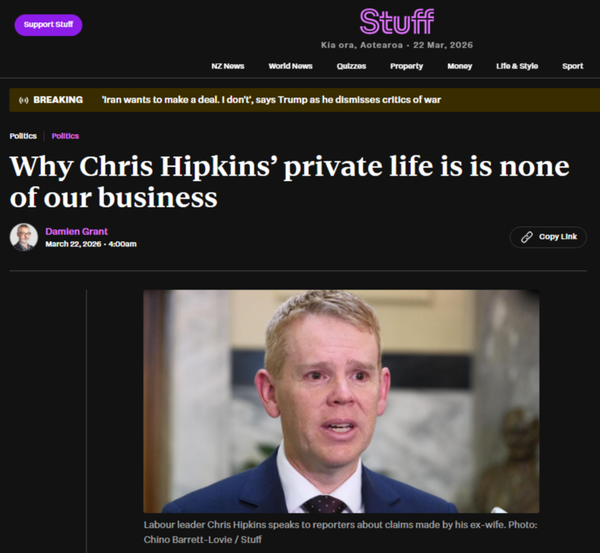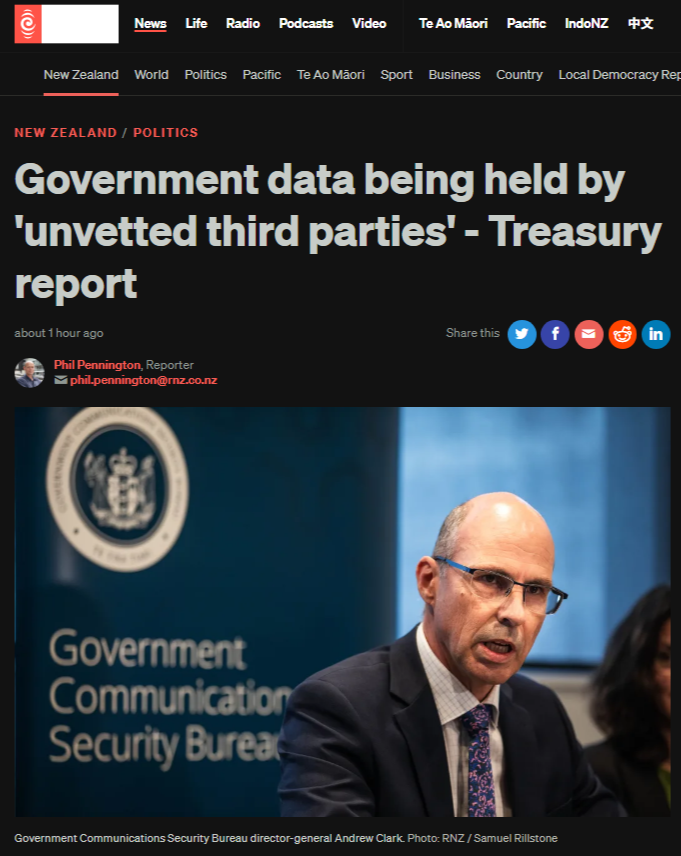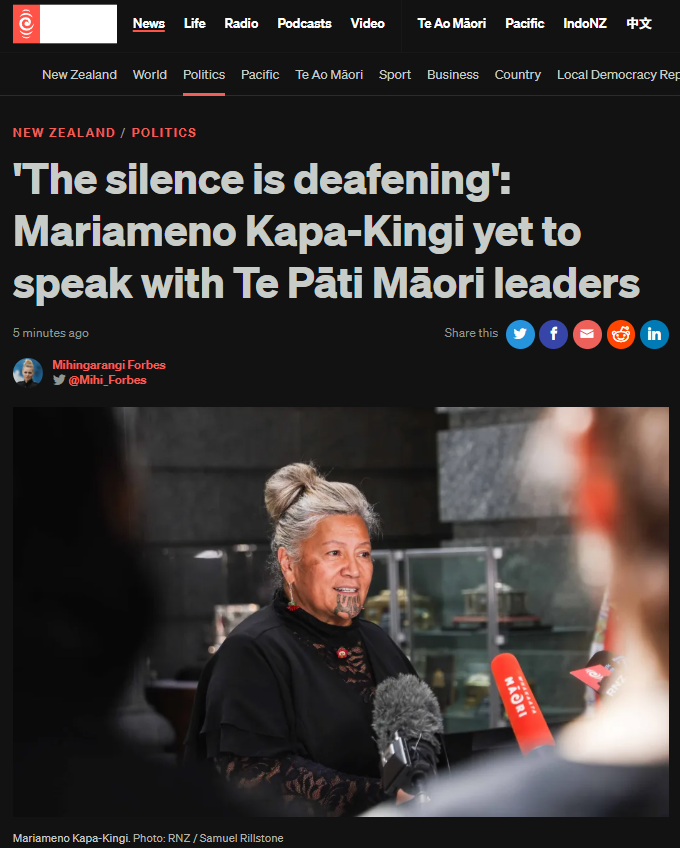
"Te Rūrangi o Te Tūranga Kore: The Carved House of Broken Accountability" - 17 January 2026
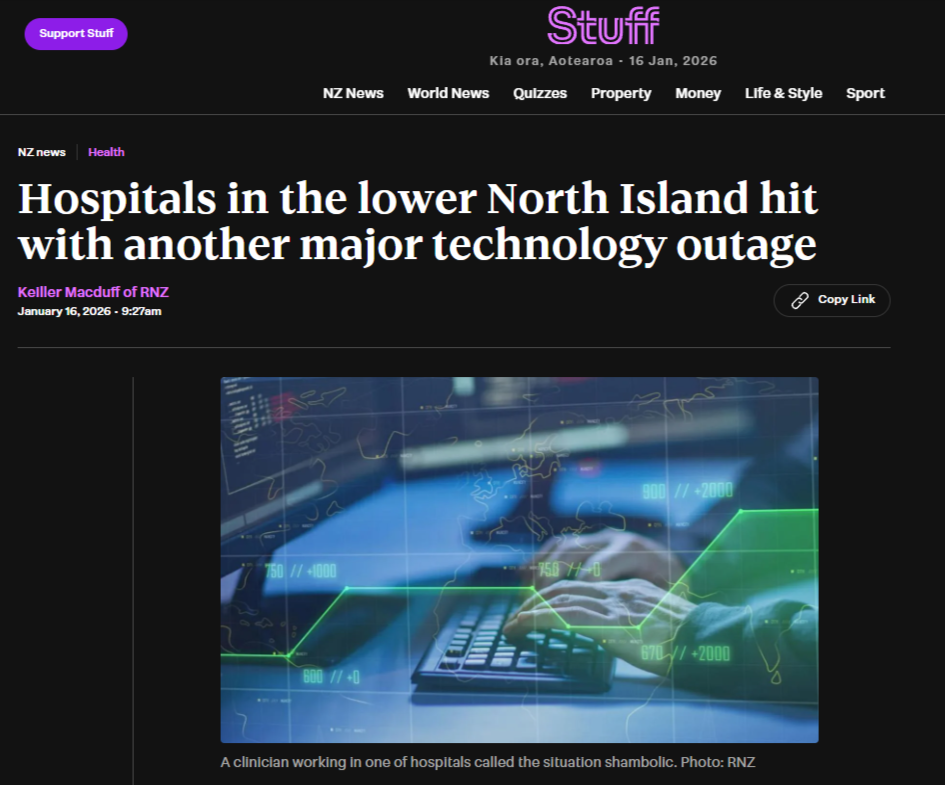
Ko Ā Whakaaro Te Ora Tamariki / Support This Mahi
Every koha signals that whānau are ready to fund the accountability that Crown and corporate structures will not provide. It signals that rangatiratanga includes the power to fund our own truth tellers.
Kia kaha, whānau. Stay vigilant. Stay connected. The house is being rebuilt, and you are the architects.
Three Pathways to Support This Voice:
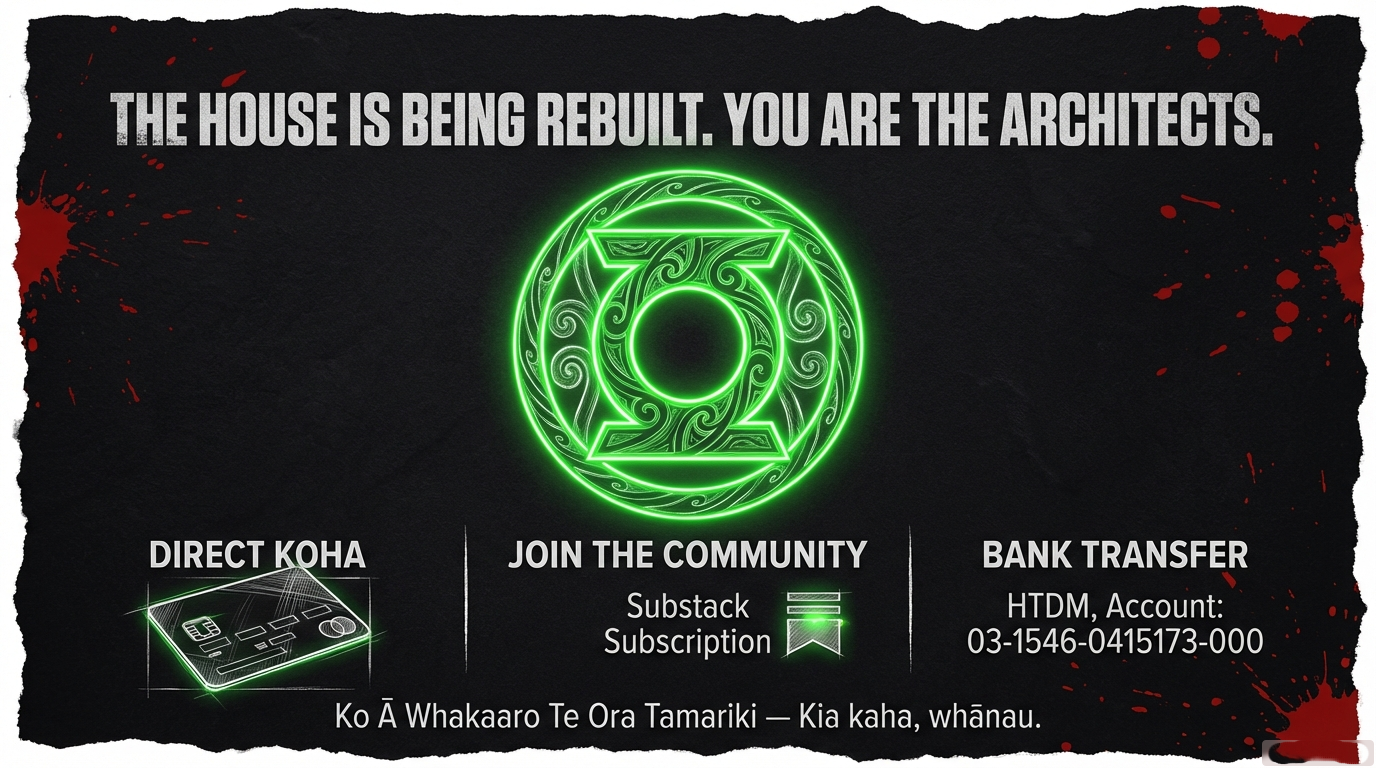
- Direct Koha: Support this mahi through the Koha platform
- Substack Subscription: Join the Māori Green Lantern community and receive essays directly while supporting ongoing critical voice.
- Direct Bank Transfer: HTDM, account number 03-1546-0415173-000
A Whakairo in the Tradition of Tūī Tūturu—Truth-Speaking That Cuts Through Deceit
Prelude: The Empty Marae
Imagine a great marae—a gathering place that was once the heart of our collective wellbeing. The meeting house still stands, its carved ancestors still visible on the walls. The people still come. The ceremonies still occur. But somewhere in the bones of this place, something fundamental has rotted away.
The posts that hold the structure upright are hollow. The beams that carry the weight have been eaten from within. The weatherboards that protect from the elements now leak. Yet the ceremonies continue. The officials still gather. The announcements still flow. The performance of governance persists while the actual structure collapses around everyone who depends on it.
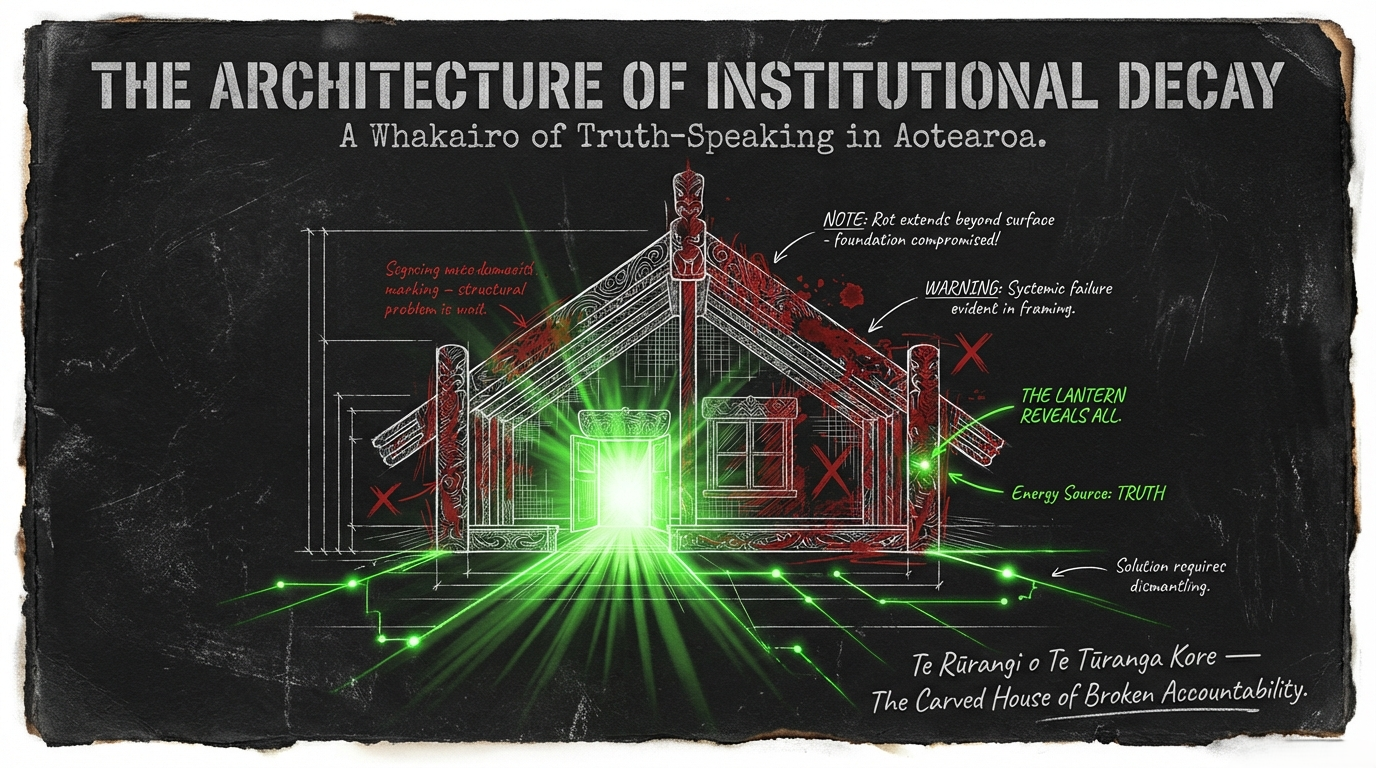
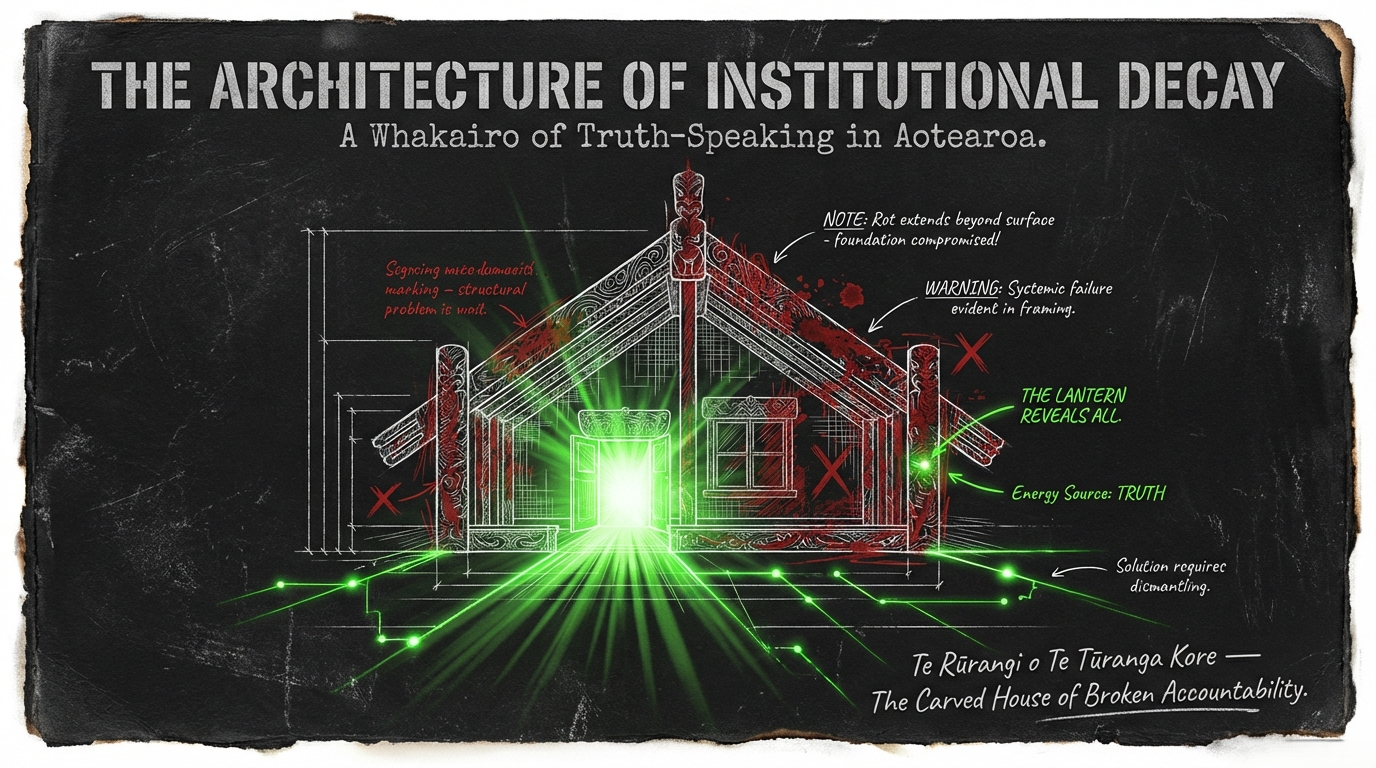
This is te rūrangi o te tūranga kore—the carved pattern of governance without grounding, the theatre without walls, the institution without foundation.
Part One: The Master Builder’s Betrayal
The Architecture of Designed Decay
Once, New Zealand’s institutional houses were built on simple principles: that public goods required public stewardship, that accountability meant real consequences, that power distributed widely served the people better than power concentrated in few hands.
Then came the neoliberal architects.
They didn’t say they were going to tear the house down. They said they were going to “modernize” it. Make it “efficient.” Create “flexibility.” Introduce “choice.” These words became incantations, spoken so often and with such confidence that people stopped asking what was actually being dismantled beneath the rhetoric.
The architects made their first move:
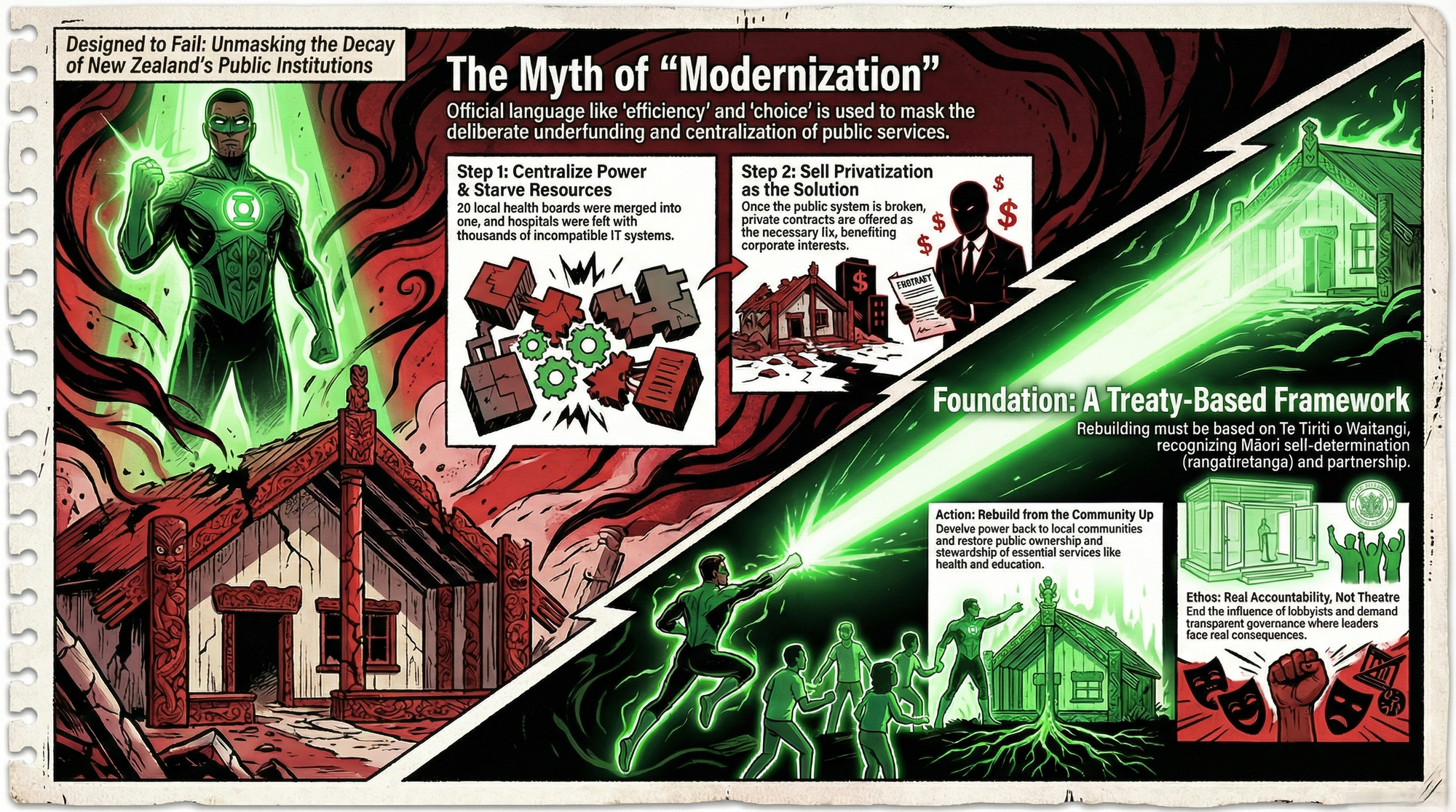
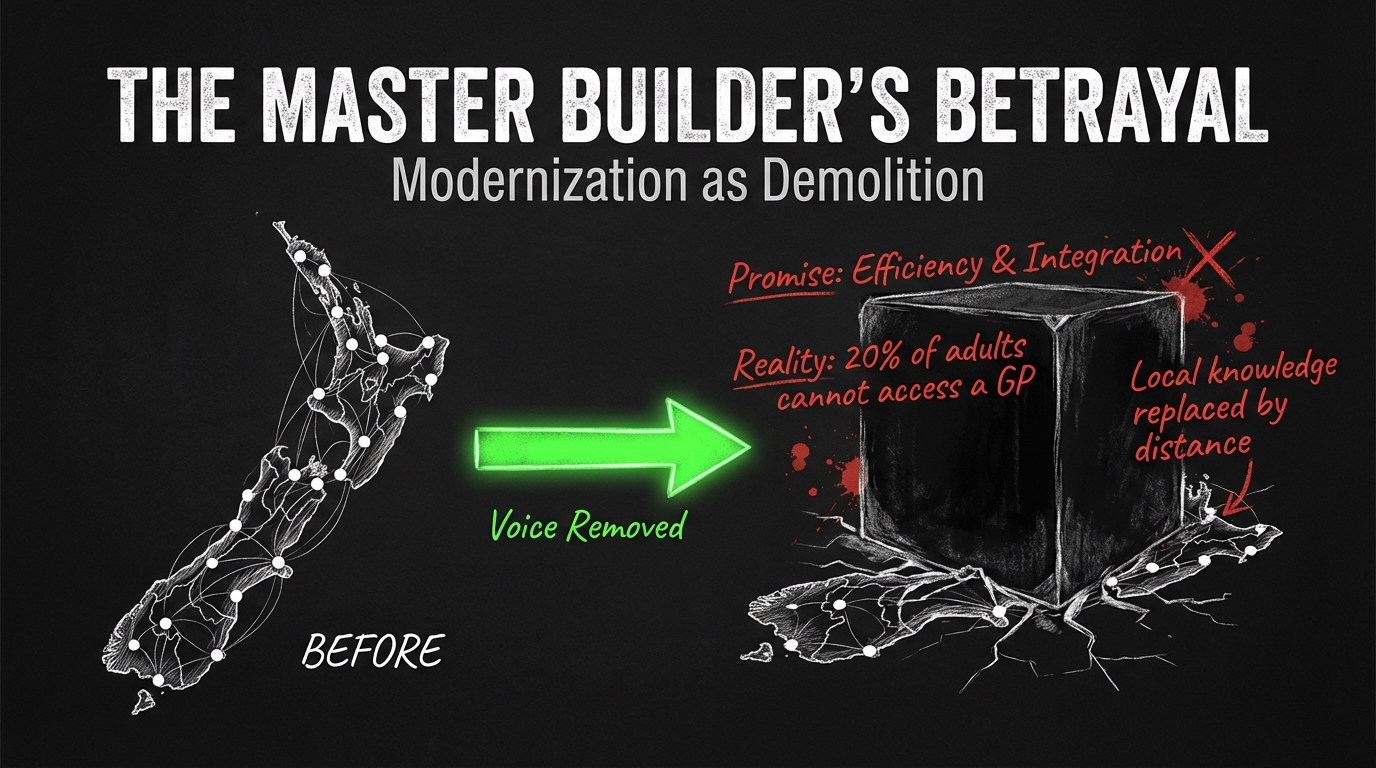
they removed the internal walls. The District Health Boards—20 local governing bodies that held power accountable to communities—were merged into a single national monolith, creating what government described as the most significant transformation of the health system in decades.
The people were promised that central coordination would bring efficiency. Local knowledge would be replaced by national expertise. Fragmentation would become integration.
But here’s what actually happened:
power moved further from the people. The holes where communities once had influence were boarded up. And three years later, approximately 20% of New Zealanders couldn’t access a GP when they needed one. The poorest, the Māori, the Pacific peoples—they felt the collapse first, as they always do.
The Hollow Support Beams
Inside this restructured house, hidden from view, the actual infrastructure was being systematically starved.
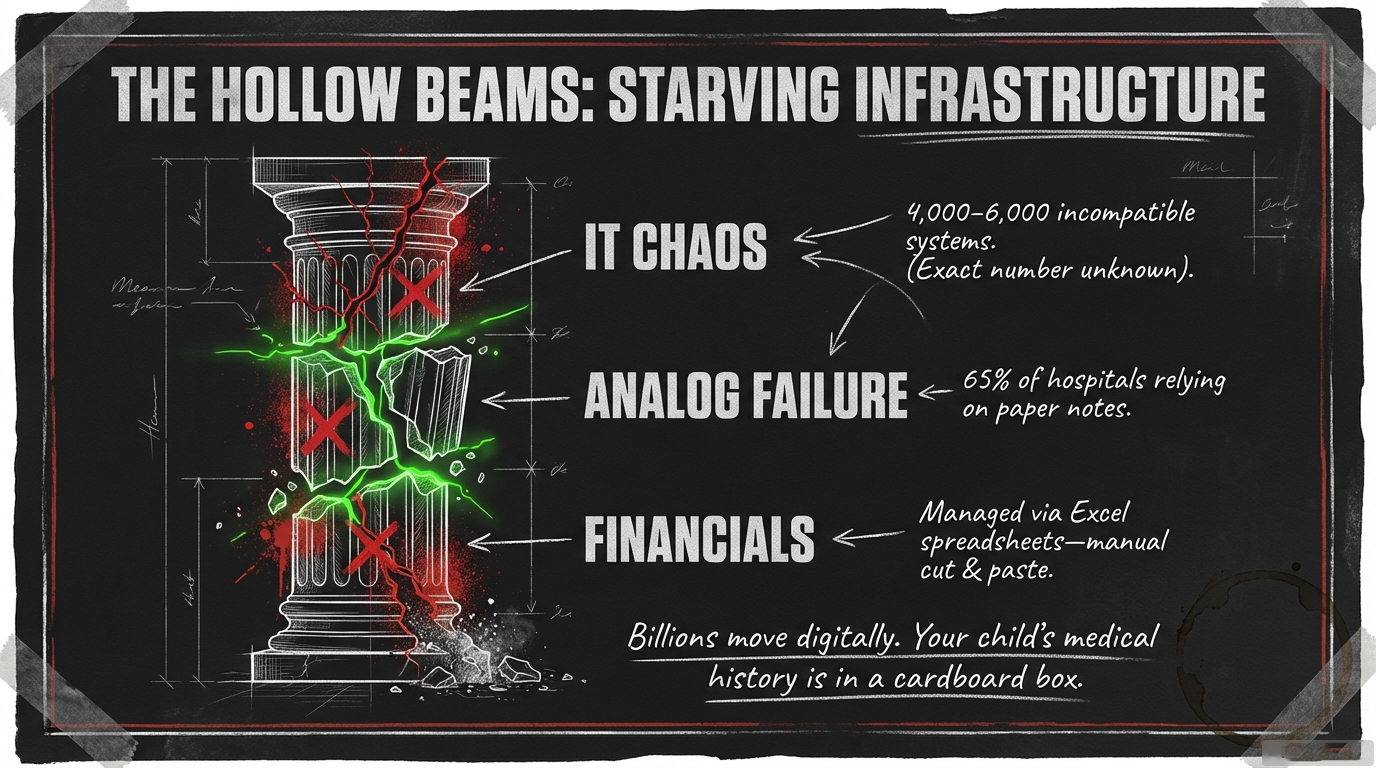
Health New Zealand inherited 4,000 to 6,000 incompatible IT systems—held together like a tottering wharenui propped up by pieces of driftwood. The exact number remains disputed because no one actually knew what they had. That’s how comprehensive the collapse was.
More than 65 percent of hospitals were still using paper notes.
Imagine:
in an age when billions of dollars move through digital systems every microsecond, your child’s medical history is written by hand, stored in cardboard boxes, vulnerable to fire, flood, and decay.
The financial management system wasn’t a system at all. It was an Excel spreadsheet. An actual human being manually cut and pasted data from 20 different sources into a single cell. When asked how it was possible that the most significant health system in the country operated on this primitive level, the response wasn’t “we’re fixing it immediately.” The response was silence. Then more announcements that sound good. Then structural reorganization. Then the same broken thing, renamed.
This is what happens when a house’s support beams are hollow:
it still looks solid from outside, right up until it collapses on everyone living inside it.
Part Two: The Invaders’ Market Stall
When Profit Comes Knocking, Who Answers the Door?
Watch what happens next in this unfolding whakairo.
Once the public house is sufficiently broken—not by accident, but by systematic disinvestment—the builders invite their cousins to come in. The profit-takers. The businessmen who offer simple solutions:
“We can fix this. We can run this. We just need the contracts.”
And the most extraordinary thing happens:
the officials nod. The ministers agree. The broken pieces become evidence that privatization is necessary, when in fact the broken pieces were the plan all along.
Health Minister Simeon Brown announces 10-year contracts with private hospitals. But what private providers actually do is cherry-pick the healthiest patients with the simplest cases. The complex, the costly, the elderly, the Māori—they stay in the collapsing public system. The system deteriorates further. More contracts follow. It’s the architecture of capture: create dysfunction, sell the solution.
The Lobbyists’ Revolving Door
Now meet the invisible architects. The ones who don’t appear on the official documents.
The lobbying industry. The corporate interests. The revolving door where government ministers become private consultants, and private consultants become government advisors, creating a tunnel between Crown and commerce that bypasses democracy entirely.
Fonterra—the dairy monopoly—meets with Finance Minister Nicola Willis about butter prices. It’s a performance. A photo opportunity.
The message to the public:
“See? We’re holding them accountable.”
But Commerce Commission findings show Fonterra’s pricing formulas systematically overstate costs, and the government changes nothing. The Dairy Industry Restructuring Act remains untouched, protecting the monopoly.
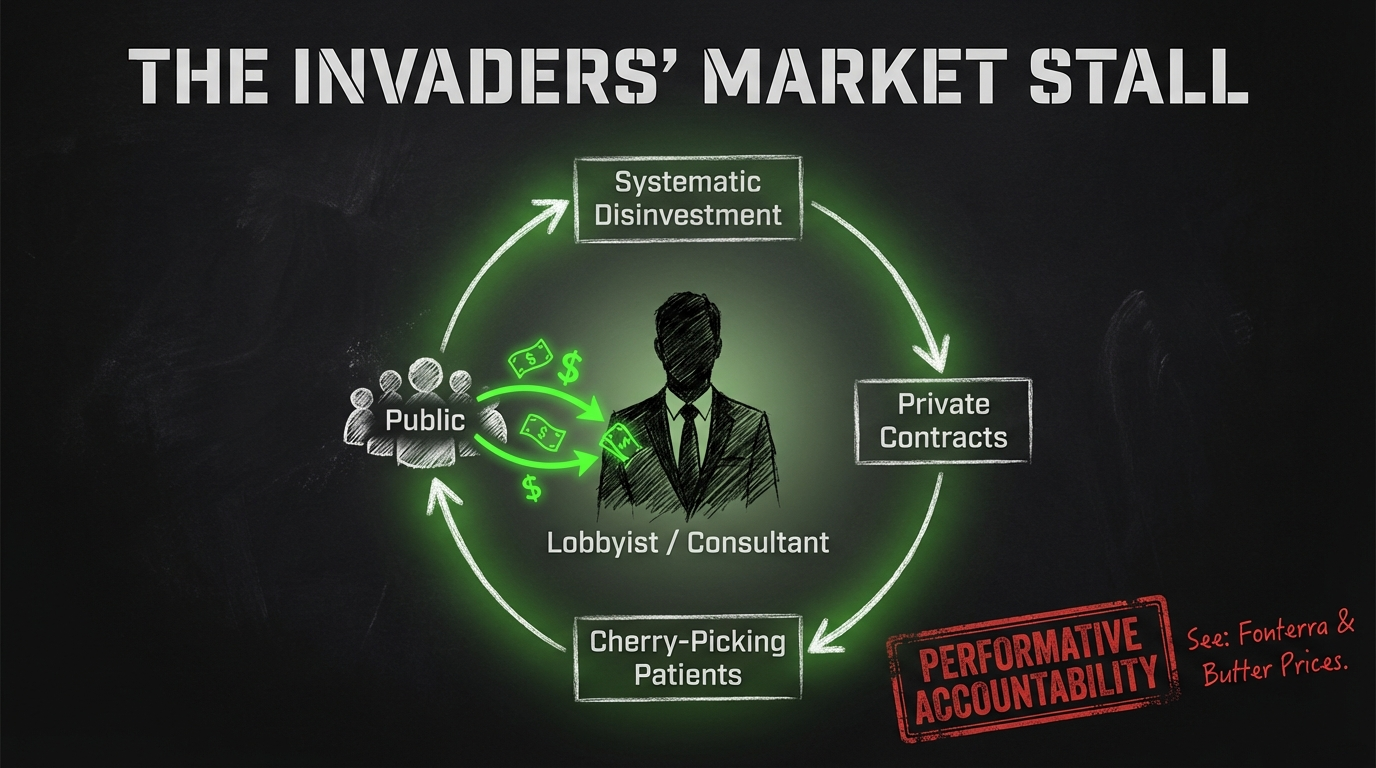
This is performative accountability. The theatre continues while the actual mechanisms of power operate beneath the stage.
The Children’s Feast Turned Beggar’s Bowl
Education is where this architecture becomes most visible to families.
Budget 2025 increases funding to private schools—places where families earn up to $200,000 annually. Meanwhile, funding for resource teachers supporting Māori and special needs students faces cuts.
In real marae, in real homes, principals report they’re using operational funding to keep children fed, clothed, and dry. The most basic welfare functions—nourishment, clothing—now compete with education.
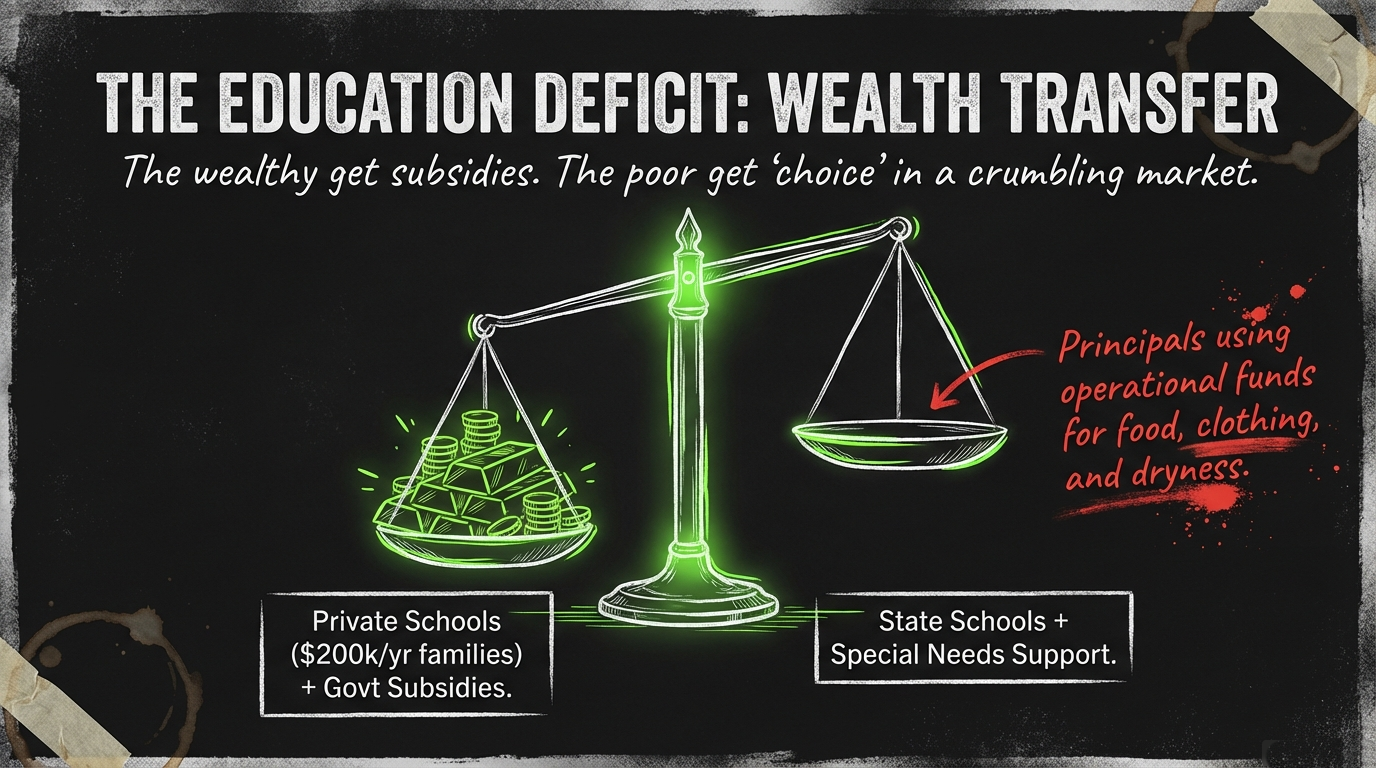
This is not policy accident. This is policy direction. The wealthy get subsidies for private schools. The poor watch their children’s state schools deteriorate. And the architects call this “choice” and “diversity.”
Part Three: The Whakataukī (Proverb) of Structural Violence
How a House Falls Quietly
There’s an old principle:
if you want to destroy something without people noticing, don’t smash it suddenly. Let it decay gradually. Underfund it. Explain away each small failure as a technical glitch. Hire consultants who write reports saying that the decay is actually a feature of the system. Reorganize, but change nothing fundamental. Announce reforms while implementing the opposite.
This is what’s happening to Aotearoa’s institutions.
Health New Zealand says cuts will keep going to 2027, with a $722 million deficit. Cuts. Defined deliberately. Not as temporary measures, but as permanent policy extending years into the future. 136 digital health initiatives were scrapped or delayed.
Yet the response from officials? More reorganization. More announcements. More reports. The theatre intensifies even as the structure collapses.
The Māori Become the Canaries
When structures are designed to fail, who feels it first?
Māori. Always Māori.
Te Aka Whai Ora, the Māori Health Authority created to ensure Treaty-based governance, was dissolved by the new government. The Waitangi Tribunal ruled this breached Crown obligations. But the damage was done. The institutional mechanism designed to center Māori wellbeing was removed. The equity structures were dismantled.
Approximately 20% of adults cannot access GP care due to cost. But it’s worse for Māori. The disparity in health outcomes has not narrowed. It has widened. The system that was meant to address inequity has become the mechanism through which inequity is maintained.
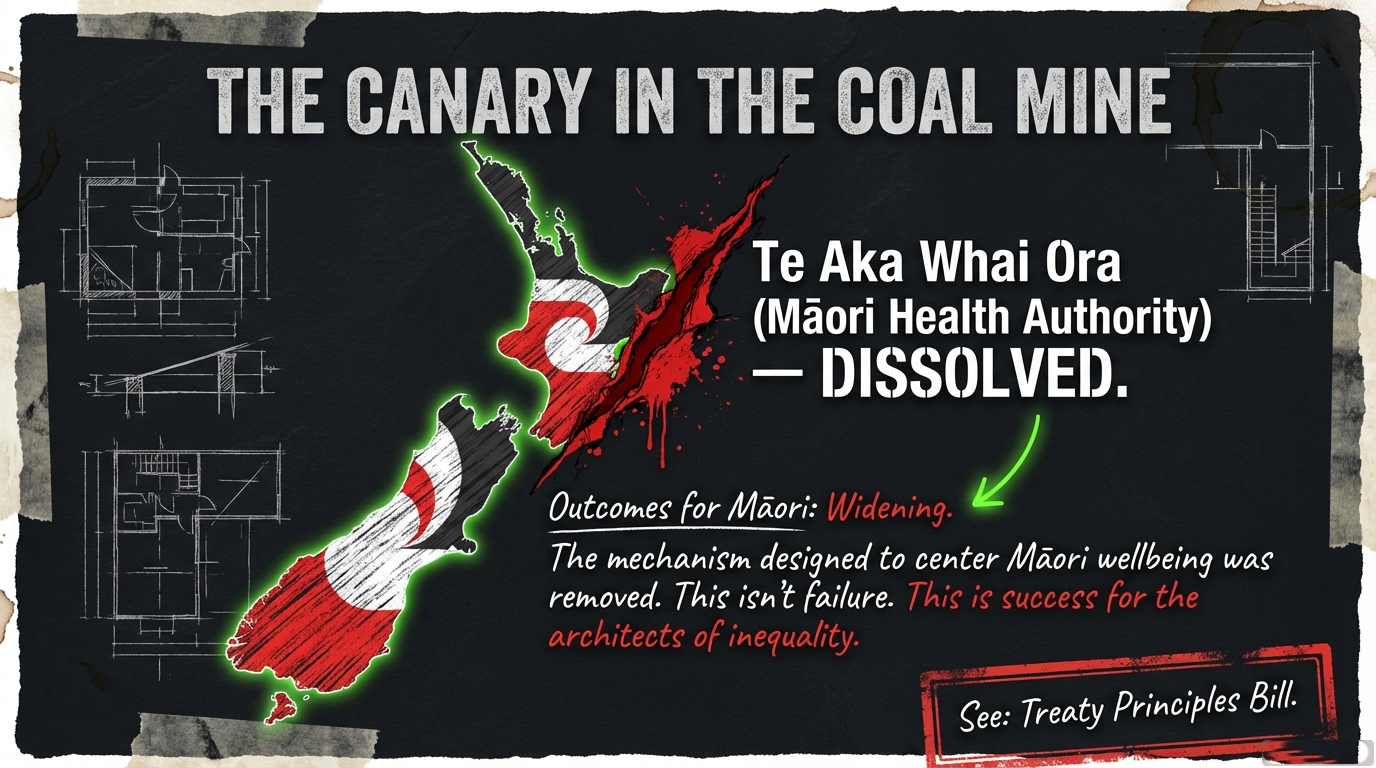
This isn’t failure. This is success. Failure would be if someone tried to stop it. Success is when the people absorb the harm and the architects remain untouched.
Part Four: The Kaupapa Māori Resistance
What the Carved Ancestors Tell Us
But here is what the architects of decline do not understand:
the house still has its ancestors carved into its walls.
In te ao Māori, we understand that authority comes from kaitiakitanga—stewardship, not ownership. That governance serves whānau and community, not capital. That accountability is real, not theatrical. That equity is not a policy option but a fundamental obligation.
These principles are not modern innovations. They’re ancient. They’re carved into the marae itself. They’re written in the relationship between people and whenua. They’re embedded in Te Tiriti o Waitangi—a covenant that explicitly recognizes Māori rangatiratanga (self-determination) and partnership with the Crown.
Yet the neoliberal architects treat Te Tiriti as an obstacle to overcome, not a foundation to build upon.
Charter schools expand while maintaining secrecy about their enrollment numbers. Who are they serving? What outcomes are they producing? For whom? The answers are hidden, preventing the accountability that is supposed to be foundational to democracy.
The Gift of Truth-Speaking
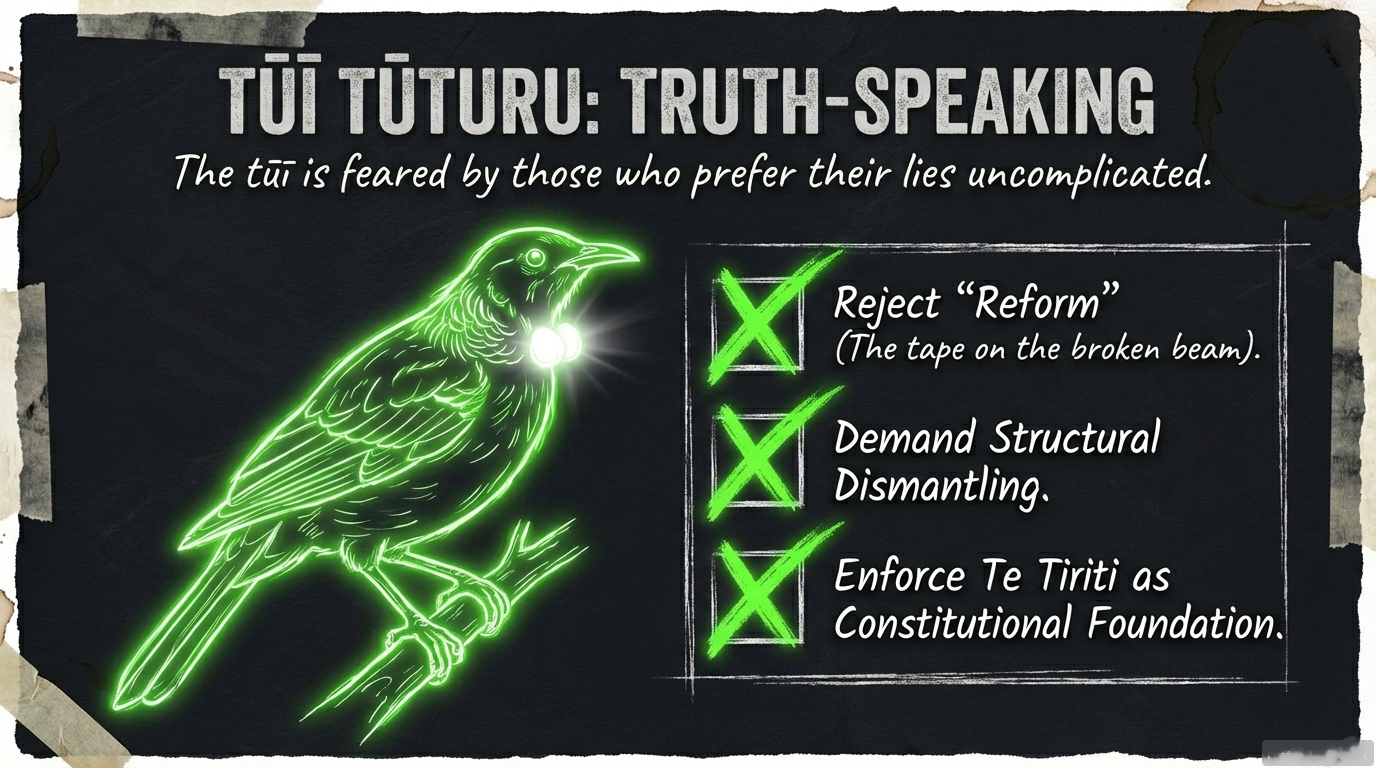
In Māori tradition, there is the tūī—the bird that speaks from two sides of its mouth. The tūī is the keeper of truth because it can articulate complexity without simplification. It can hold multiple truths simultaneously. It is feared by those who prefer their lies uncomplicated.
This moment calls for tūī tūturu—truth-speaking that cuts. That names what is. That refuses the comfortable mythology that New Zealand’s institutions are broken by accident when in fact they’re being broken by design.
The theatre of accountability is crumbling because the actual mechanisms of accountability were dismantled long ago. Power was concentrated. Lobbying was normalized. The revolving door between Crown and commerce became a permanent fixture. Equity commitments became political contingencies. And the people—especially Māori, especially the poor—became the ones absorbing the consequences of this institutional abandonment.
Part Five: The Whakawhiti Whenua (Transition): What Comes After the Theatre Closes
The Choice Before Us
Here is what the architects of decline do not want acknowledged:
this is not inevitable. Structures were chosen. Policies were deliberate. The decay is not accidental—it was manufactured. And if it was manufactured, it can be unmade.
But not through reform of the current system. Reform suggests that the current structure can be fixed by adjusting its mechanisms. But the current structure was designed for decline. Its mechanisms are working exactly as intended—concentrating wealth, diffusing responsibility, maintaining the theatre while the actual house falls apart.
Real transformation requires something different.
It requires:
- Structural dismantling: Removing the concentration of power in the executive, establishing genuine checks and balances, creating constitutional protections that cannot be reversed by electoral whims.
- Democratic reconstruction: Moving beyond consultation to genuine participation. Devolving power to communities and regions. Rebuilding the local governance structures (like DHBs) that actually held institutions accountable to people.
- Treaty-based framework: Centering Te Tiriti o Waitangi not as a policy option but as the constitutional foundation. Recognizing that Māori rangatiratanga is not negotiable. That partnership with the Crown is not optional. That equity is not a goal to be achieved but an obligation to be fulfilled.
- Public ownership restoration: Recognizing that some things—health, education, water, energy—are too essential for human flourishing to be treated as commodities. That public ownership with genuine democratic accountability creates better outcomes than commercial extraction.
- Transparent governance: Ending the revolving door. Requiring full disclosure of lobbying activity. Preventing the fusion of Crown and corporate interests through strict conflict-of-interest rules and cooling-off periods.
The Kaupapa of Koha: Funding Our Own Truth
There is another principle at work here, one that speaks directly to this moment:
koha. The gift. The voluntary contribution made to support something you believe in.
For generations, Crown structures and corporate interests have extracted wealth and mana from our communities, leaving only crumbs of “public service.” The response cannot be to beg those same structures to be fairer. The response must be to build our own. To fund our own truth-tellers. To support our own institutions.
When you offer koha to support critical analysis—whether through direct support, subscription, or other means—you’re saying something radical:
I do not trust the Crown’s version. I do not trust corporate narratives. I will fund the voices that tell truth about what is actually happening.
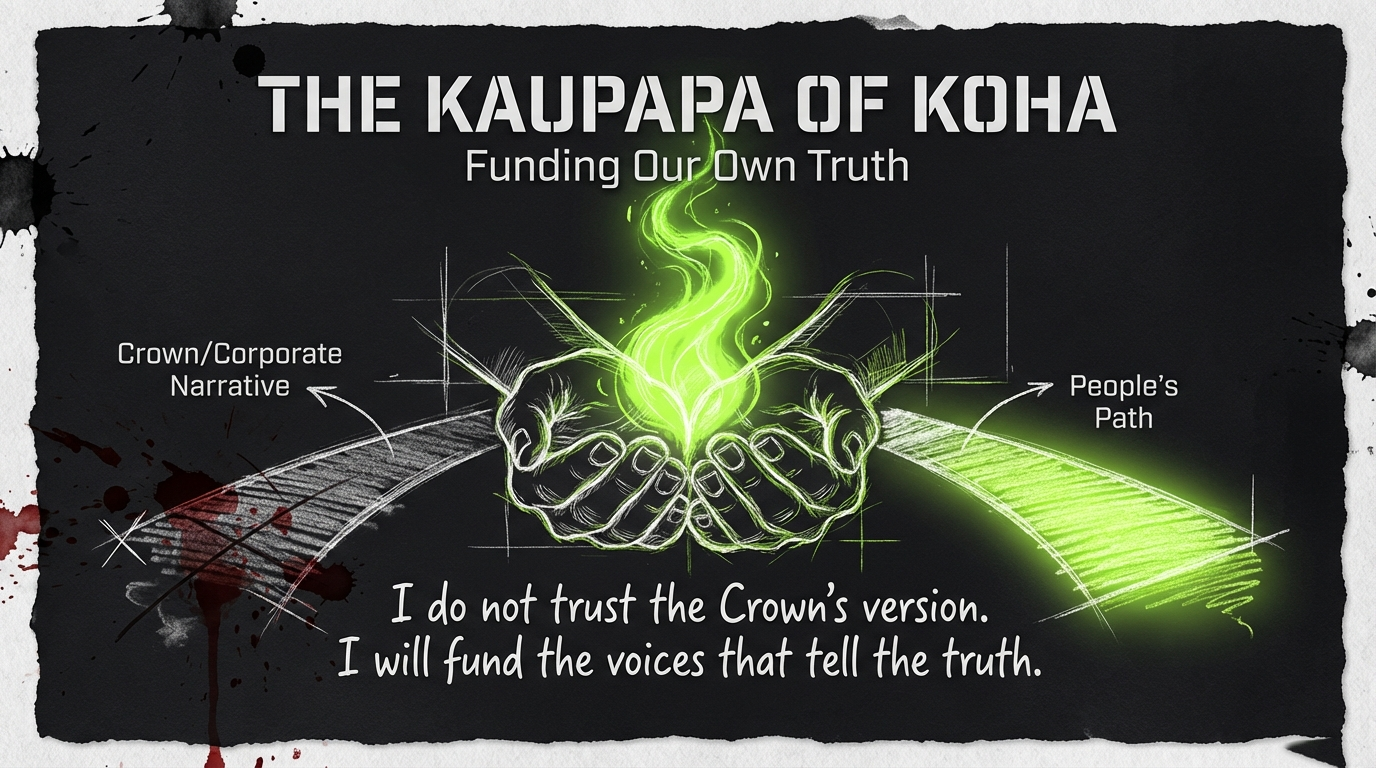
This is rangatiratanga. This is the reclamation of authority over our own story. This is the rebuilding that must happen while the old structures are being dismantled.
The Whakamutunga: A Closing Whakairo
In te ao Māori, when we carve a meeting house, we embed values into the very wood and bone of the structure. The carved ancestors watch. The painted patterns carry stories. The proportions embody relationships. A great marae doesn’t just house people—it transforms them through presence and principle.
New Zealand’s current governance architecture is carved differently. It’s designed to extract. To diffuse. To perform accountability while preventing it. To announce equity while dismantling it.
But the alternative already exists. It’s embedded in Te Tiriti. It’s alive in Māori approaches to governance that prioritize kaitiakitanga, whakapapa, and whānau. It’s visible in communities that have maintained democratic participation despite the architects of decline trying to centralize power. It’s present in every person who sees through the theatre and acts anyway.
The house that will replace this one won’t be built by more architects of centralization and extraction. It will be built by communities reclaiming their mana. By whānau resisting the narrative that neoliberalism is inevitable. By truth-tellers speaking with tūī’s clarity. By people offering koha to support the voices that refuse to participate in the theatre.
The old structure is collapsing.
The question is:
what will we build with what remains?
This whakairo draws on evidence from RNZ, NZ Herald, government documents, and community knowledge. The metaphors are drawn from te ao Māori values and the physical language of kaupapa. The data is real. The structure is designed. The collapse is happening. The choice to rebuild remains ours.
Ōku mihi ki ngā tohunga whakairo o mua, o nāianei, o ā tata nei. Kia kaha e te kaupapa.
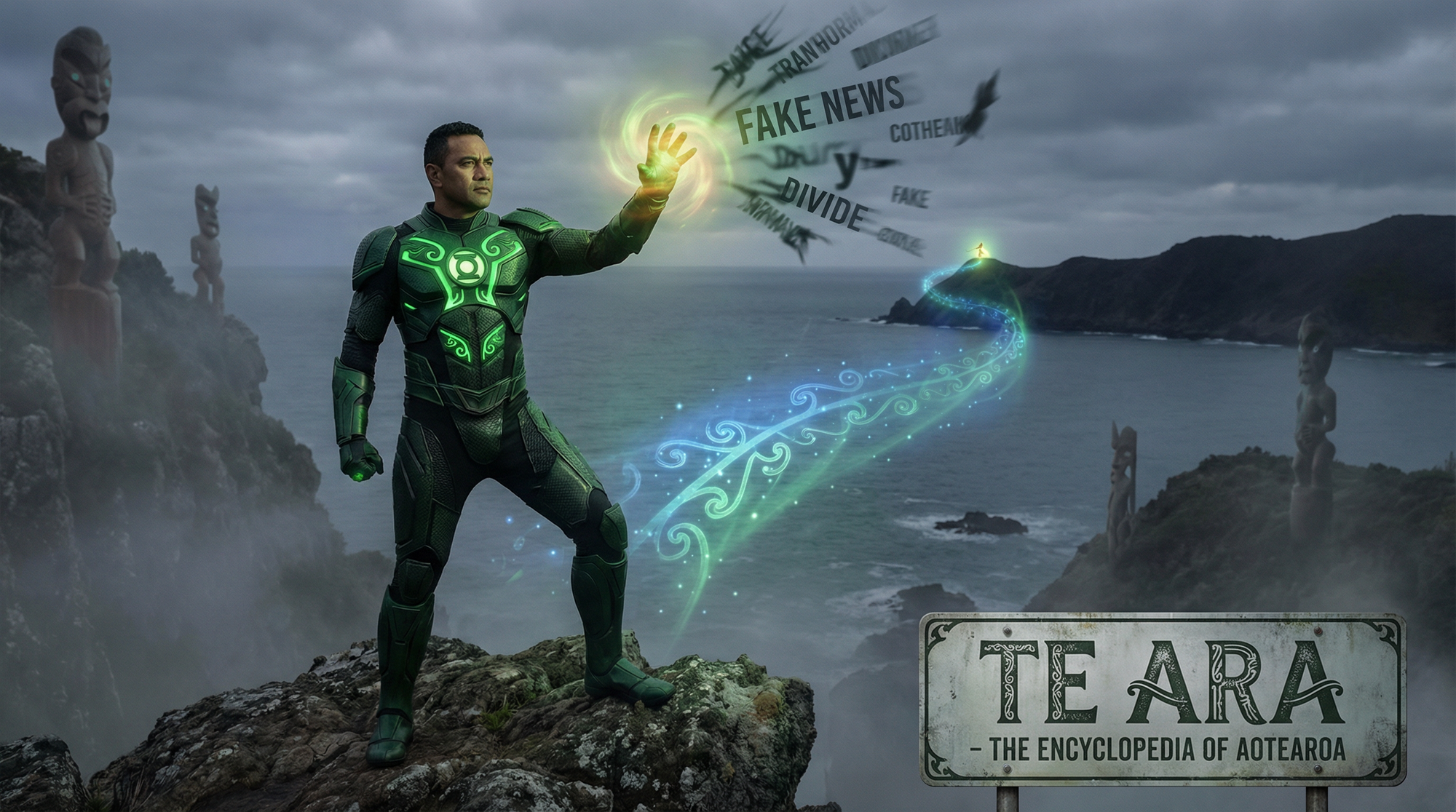
Ivor Jones The Māori Green Lantern Fighting Misinformation And Disinformation From The Far Right