“Te Taihanga o Te Mana: Chris Bishop’s Pragmatic Betrayal of Housing, Mana Whenua, and Democratic Accountability” - 19 November 2025
The Hidden Network: Cui Bono, Cui Malo
Mōrena Aotearoa,
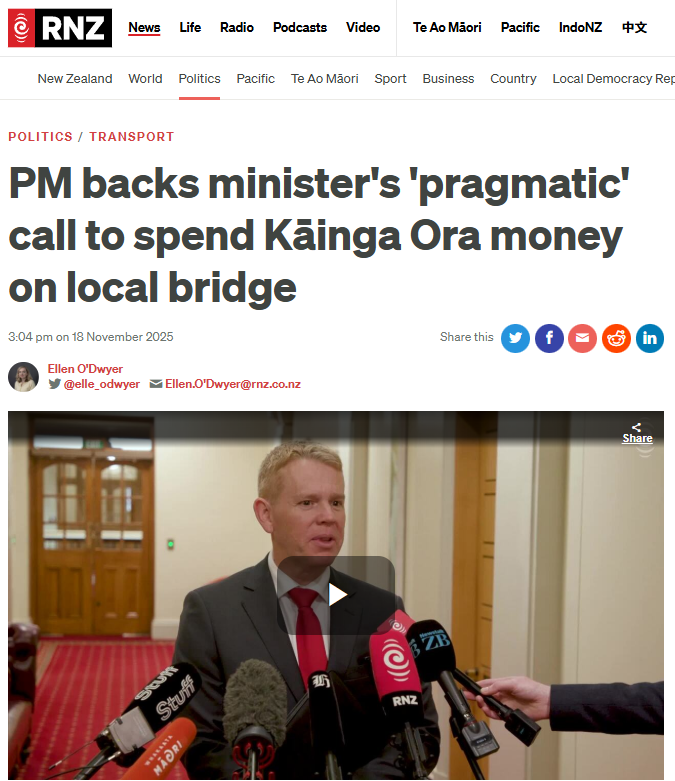
On 17 November 2025, Prime Minister Christopher Luxon endorsed what he called a “pragmatic” decision by Housing and Transport Minister Chris Bishop to reallocate $27 million from infrastructure designed to enable 3,500 new homes in Lower Hutt to fund a cycling bridge that the government itself had cancelled nationwide. The decision reveals three hidden networks that destroy the mauri (life force) of whānau housing, mana whenua partnership, and ministerial accountability in Aotearoa.
First, a single minister controlling three portfolios (Housing, Transport, RMA Reform) + his own electorate approved moving money from one portfolio to another for a project in his own seat that the government had rejected everywhere else—with only one other minister’s sign-off and a Prime Minister’s rubber stamp.
Second, this reallocation depletes housing infrastructure capacity for Māori and working whānau by denying $27 million of the $98.9 million Infrastructure Acceleration Fund (IAF) designated specifically for stormwater and wastewater upgrades that would enable papakāinga, affordable rentals, and public housing across 3,500 new homes.
Third, this decision inverts the government’s stated cycling policy, cutting cycling and walking budgets nationally from $1 billion (2021–24) to $460 million (2024–27) with zero new funding, while Bishop’s electorate project receives exception status.
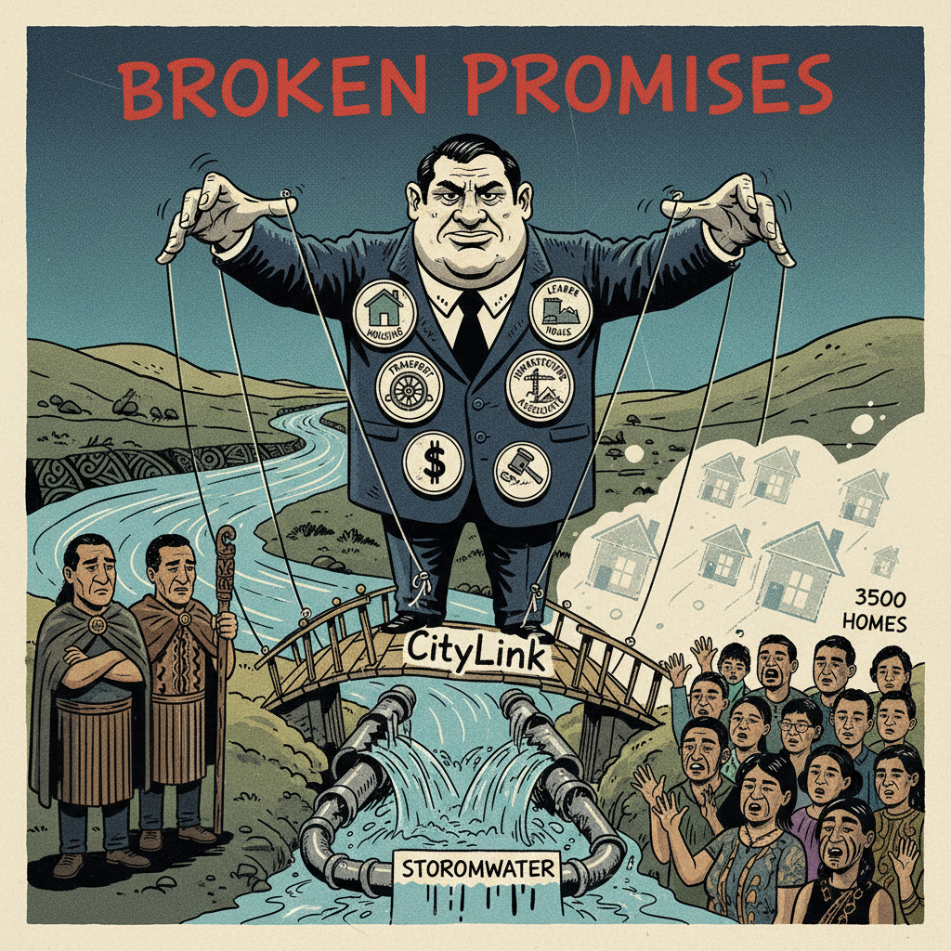
The Structural Power Imbalance: One Minister, Six Portfolios, One Electorate - While Whānau Housing Fades
Background: The Original Treaty with Te Awa Kairangi
Mana Whenua Partnership Framework
The RiverLink project (now Te Wai Takamori o Te Awa Kairangi—The Soothing Waters of Te Awa Kairangi) emerged from a genuine partnership with mana whenua Taranaki Whānui ki te Upoko o te Ika and Ngāti Toa Rangatira. In June 2023, these partners formally gifted the name and kaupapa to the Alliance, anchoring the project in three Ora: Ora Tāngata (wellbeing of people), Ora Taiao (wellbeing of environment), and Ora Wairua (spiritual wellbeing).
The Infrastructure Acceleration Fund agreement between Kāinga Ora and Hutt City Council (November 2022) ring-fenced $98.9 million specifically for stormwater and wastewater upgrades to enable housing development in Lower Hutt—an essential precondition for 3,500 new homes, including papakāinga, public housing, and affordable rentals.
Te Awa Kairangi is more than infrastructure; it is taonga—a sacred treasure with its own mauri. For mana whenua, fresh water is life itself. The three waters infrastructure was designed not only for flood protection but to restore the river’s capacity to sustain both tangata (people) and taiao (natural world).
The Reallocation: Rhetoric vs. Reality
What Bishop Said vs. What Happened
Bishop’s narrative: “Pragmatic decision” driven by Lower Hutt City Council identifying an “underspend” and requesting to move funds to the CityLink Bridge, which is “another form of infrastructure” that “will help lay the foundations for more housing growth”.
The reality:
- The government cancelled all cycling projects nationally (November 2023–June 2024). Transport Minister Simeon Brown cut cycling and walking funding and explicitly instructed Waka Kotahi to stop committing to new cycling and walking projects. Over 59 projects across New Zealand were defunded or paused; only existing contractual commitments (worth $305 million across 46 councils) were honoured.
- Bishop campaigned on CityLink Bridge in 2023 and then his own government cancelled it as part of the broader transport policy shift away from cycling infrastructure. The $27 million CityLink funding was announced only after the government announced the cancellation.
- The “underspend” claim is contradicted by project documentation. McConnell Dowell, the contractor, began Early Contractor Involvement (ECI) in April 2024 and is still in design phases for the IAF-funded stormwater upgrades—not completed or underspent.
- Stormwater isn’t optional infrastructure for housing. The 3,500 homes depend on this capacity. Without upgraded stormwater and wastewater networks, residential intensification cannot proceed in the Lower Hutt CBD—a zone already constrained by flood risk and aging Three Waters infrastructure.
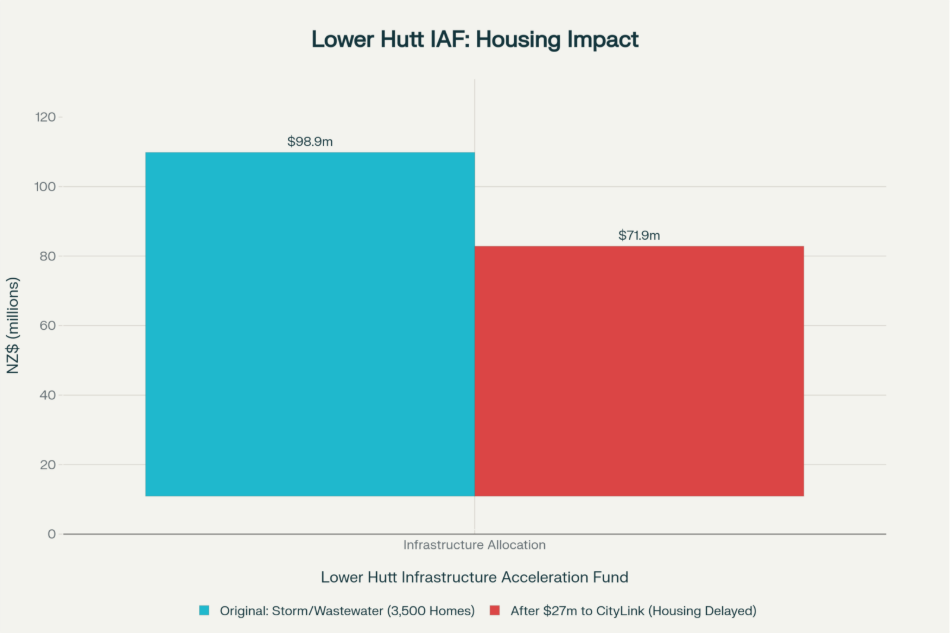
Infrastructure Acceleration Fund Reallocation: $27 Million Diverted from Housing Stormwater to CityLink Bridge
Cabinet Manual Breaches: Conflicts of Interest
The Cabinet Manual (2023) explicitly requires ministers to exercise careful judgment about conflicts between their constituency interests and ministerial roles. It states at paragraph 2.83: “As with all conflicts of interest, Ministers should exercise careful judgement about possible conflicts between their constituency interests and their ministerial roles. They need to be alert at all times to the possibility that a conflict might exist or be perceived to exist.”
The Manual permits a minister to manage conflicts through:
- Declaration of interest (if the minister doesn’t have direct responsibility)
- Withdrawal from decision-making (if there is a conflict)
- Transferring decision authority to another minister (if the conflict is direct and unavoidable)
Bishop did none of these. Instead:
- As Housing Minister, he approved moving $27 million away from housing infrastructure.
- As Transport Minister, he approved shifting money to a cycling project (contradicting the government’s cycling policy).
- As Hutt South MP, he benefited electorally from a project he had campaigned on.
- He received approval only from Finance Minister Nicola Willis and PM Luxon—no independent conflict-of-interest committee review was documented.
When asked if he should have recused himself, Bishop responded: “I don’t think there’s a conflict there”. This statement itself reveals epistemic gatekeeping—the denial of a conflict that the Cabinet Manual specifically anticipates.
The Māori Impact: Whānau Housing Capacity Depleted
Infrastructure Acceleration Fund: Promised Outcome vs. Actual
The IAF was explicitly designed to unlock Māori-led housing, including papakāinga on whenua Māori. Budget 2021 ring-fenced $350 million for Māori Infrastructure Fund from the Housing Acceleration Fund to deliver papakāinga, developments on whenua Māori, and rural housing.
Lower Hutt’s stormwater funding was intended to enable 3,500 new homes, with council documentation explicitly prioritizing “brownfield and infill development opportunities” in the CBD—the highest-density zone where papakāinga and rental housing are most feasible.
The $27 million reallocation now means:
- Delayed capacity for 3,500 homes—because stormwater/wastewater upgrades are now underfunded.
- Reduced Māori housing outcomes—because the fund’s original purpose (enabling diverse housing, including papakāinga) is undermined.
- Perpetuated housing crisis for whānau—Māori homeownership has fallen to just 27.5% according to 2023 Census data, compared to 47.8% for Europeans. If current trends persist, almost all Māori in Aotearoa will be renters by 2061.
The Data: Māori Housing Crisis Quantified
The numbers reveal a crisis:
- 49.6% of the Social Housing Register waiting list is Māori—over 11,000 whānau—despite Māori comprising only 18% of the population.
- 32.8% of all people living in crowded conditions are Māori.
- 44.9% of households reporting “always damp and mouldy” conditions are Māori households.
- Between July 2023 and June 2024, only 7.8% of Progressive Home Ownership recipients were Māori, and only 21% of First Home Grant recipients identified as Māori—far below Māori’s 18% population share.
- Between 2015 and 2024, only 643 papakāinga homes were approved, contracted or delivered through Te Puni Kōkiri programmes—a fraction of the need.
Mana Whenua Partnership Eroded
Mana whenua in Lower Hutt—Taranaki Whānui ki te Upoko o te Ika and Ngāti Toa Rangatira—are governance partners in Te Wai Takamori o Te Awa Kairangi through the Mana Whenua Steering Group. Their partnership was explicit: to restore Te Awa Kairangi’s mauri and enable housing growth through integrated flood protection, transport, and infrastructure improvements.
No evidence appears in publicly available sources that mana whenua were consulted on the IAF reallocation. The three-month timeline (March–November 2025) between Bishop’s March agreement with Hutt City Council and the public announcement suggests minimal consultation with mana whenua governance structures.
This violates whanaungatanga (relationship building) and kaitiakitanga (stewardship based on mana whenua decision-making authority). Decisions affecting housing capacity and three waters infrastructure should centre mana whenua voices, not exclude them from internal government deals.
The Broader Pattern: Anti-Co-Governance, Cycling Cuts, Market Fundamentalism
1. Cycling Cuts: From John Key to Simeon Brown to Chris Bishop
Under Prime Minister John Key (2008–2016, National government), $100 million was invested in urban cycleways and $333 million in Ngā Haerenga Great Rides (cycle trail network). Key stated: “I think they’re going to be hugely popular and really important for our cities”.
Transport Minister Simeon Brown (2023–2025) reversed this:
- Cut cycling/walking budget from $1 billion (2021–24) to $460 million (2024–27)—no new funding, only completing existing projects.
- Stopped all new funding for 59 cycling and walking projects across 46 councils.
- Told Waka Kotahi not to commit further funding except existing contractual obligations.
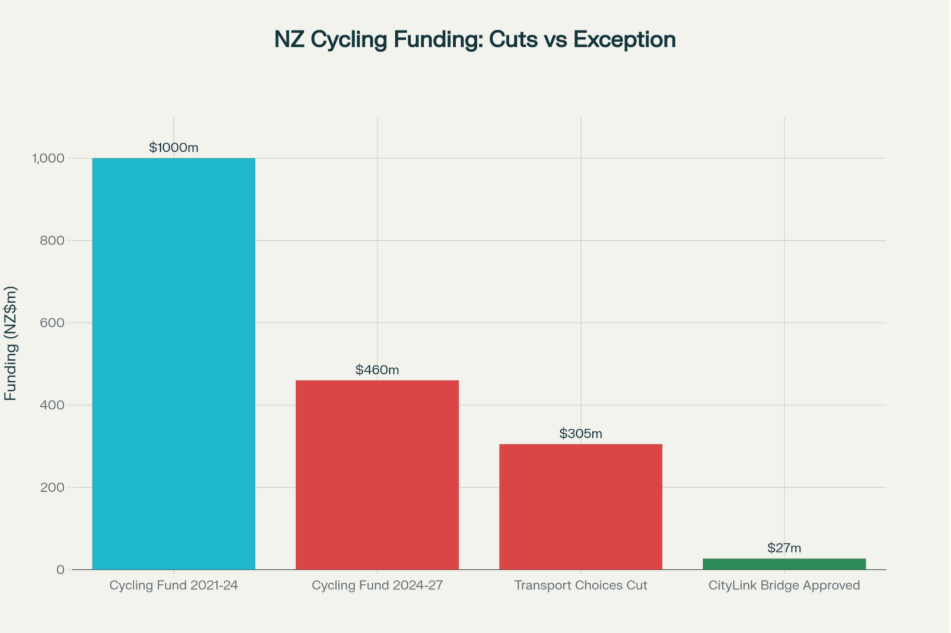
Government Cycling Project Cuts vs CityLink Bridge Exception: Nationwide Reductions Except in Chris Bishop’s Electorate
Chris Bishop, as Transport Minister (from January 2025), then approved a $27 million exception for CityLink Bridge in his own electorate, creating a two-tier system: national austerity for cycling + electoral privilege for Bishop’s seat.
Brown’s own words reveal the ideology: “The public are sick of spending money on cycling... I want to focus spending on increasing the economic benefits of driving more and faster”. This is market fundamentalism—prioritizing motorways and individual car use over collective, health-enhancing transport.
2. Institutional Capture: One Minister, Multiple Portfolios
Bishop holds six ministerial roles: Housing, Infrastructure, RMA Reform, Transport, Leader of the House, and Associate Finance. This concentration of power enables him to:
- Make decisions across housing and transport simultaneously (which normally require inter-ministerial balance).
- Control RMA reform (which affects planning for housing and infrastructure).
- Influence Finance decisions (which affect IAF allocations).
No structural safeguard prevented this reallocation. The Cabinet Office conflict management process appears designed for individual pecuniary conflicts (shares, property, financial interest), not for systemic portfolio conflicts where a single minister controls the entire infrastructure stack.
3. Neoliberal Housing Policy: Density + Privatization
Bishop’s public rhetoric celebrates “urbanist” ideals—removing viewshaft restrictions, enabling 10–20-storey apartment blocks, and “transit-oriented development”. But these ideals are being implemented through market mechanisms that require private development to fund infrastructure.
The IAF reallocation reflects a deeper neoliberal logic: privatize housing development risk (councils and developers bear the burden) while socializing political risk (ministers secure electoral credit). By reducing public stormwater investment while maintaining development zoning, the government shifts infrastructure costs onto private builders—who then pass costs to renters and buyers, excluding low-income whānau.
Fallacies and Dog-Whistles: Decoding the Language
“Pragmatic Decision”
This phrase conceals a false equivalence. Pragmatism usually means making a decision based on practical consequences. But Bishop’s decision was not pragmatic for housing outcomes—it reduced infrastructure capacity for 3,500 homes. It was pragmatic only for Bishop’s political image (deliver a local project before the next election).
“The Council Asked for It”
This shifts responsibility from minister to council, but ministers retain decision authority. Councils cannot reallocate funds without ministerial sign-off. Bishop could have said no. He chose not to.
“It’s Actually Pretty Straightforward”
This phrase performs epistemic gatekeeping—closing down scrutiny by claiming simplicity where complexity exists. The decision involves three ministerial portfolios, a conflict-of-interest question, a Cabinet Manual guideline, and Māori partnership frameworks. It is not straightforward.
Hidden Revelation 1: Finance Minister Approval Without Evidence of Due Diligence
Nicola Willis approved the variation without documented evidence of:
- Conflict-of-interest review
- Impact assessment on the 3,500-home target
- Consultation with mana whenua
- Analysis of whether “underspend” claim was accurate
Willis’s role becomes a rubber stamp rather than a genuine safeguard.
Hidden Revelation 2: PM Backing a Decision He Did Not Scrutinize
PM Luxon stated he backed the decision because Bishop “took advice from the Cabinet Office and acted accordingly”. No independent Cabinet Office review appears to have occurred—Luxon took Bishop’s word that the process was followed.
Hidden Revelation 3: Suppression of Labour’s Opposition
Labour leader Chris Hipkins articulated the core issue: “It certainly doesn’t pass the sniff test in terms of having one minister, moving money from one portfolio that he’s responsible for, to another portfolio that he’s responsible for, for a project which he campaigned on in his own electorate, which his government cancelled”.
But Hipkins’ opposition was powerless—National controls Parliament, and the media cycle moved on. The structural flaw remains unfixed.
Hidden Revelation 4: IAF Was Designed Explicitly for Māori Housing
The IAF programme documentation shows that across 26 regions, papakāinga housing is explicitly listed as a housing outcome in Kaikohe, Kawakawa, Ōrākei, Hastings, Ōtaki, and Motueka. The Lower Hutt allocation was part of this kaupapa. By reallocating $27 million, Bishop undermined a Crown commitment to enable Māori-led housing solutions.
Hidden Revelation 5: The Government Created a Two-Tier Cycling Policy
While cancelling 59 cycling projects nationwide, including projects in South Auckland (home to high Māori and Pacific populations), the government approved one exception: CityLink Bridge in Chris Bishop’s electorate. This is policy by privilege, not principle.
Implications: Quantified Harm to Māori and Whānau
- 3,500 homes delayed or reduced in capacity—because stormwater infrastructure is underfunded.
- Papakāinga aspirations deferred—the IAF was meant to unlock Māori-led housing; the reallocation undermines this.
- Rents and home prices rise further—every year housing development is delayed in constrained cities like Lower Hutt increases pressure on an already unaffordable market. Whānau Māori, with lower average incomes and higher renting rates, bear the cost.
- Mana whenua partnership weakened—exclusion from consultation on infrastructure decisions erodes tikanga-based governance and validates the neoliberal state’s tendency to marginalize tangata whenua decision-making.
- Public transport infrastructure inequality—$27 million to a cycling bridge in an affluent-ish electorate (Bishop’s seat) while cycling projects in South Auckland (home to higher Māori and Pacific populations) are cancelled.
- Perpetuation of the Māori housing crisis—with homeownership projected to fall below 50% by 2048 for all New Zealanders, and Māori already at 27.5%, every lost housing development opportunity accelerates dispossession.
Rangatiratanga Reclaimed
Bishop’s decision is not a minor budgetary adjustment—it is a structural assault on three principles of tino rangatiratanga (self-determination):
- Kaitiakitanga violated: Mana whenua were excluded from infrastructure decisions affecting their taonga, Te Awa Kairangi.
- Whanaungatanga eroded: Relationships of accountability between ministers and whānau were broken by a single minister controlling multiple domains.
- Collective responsibility abandoned: The Cabinet and PM allowed portfolio concentration to override conflict-of-interest safeguards.
The pathway to reclamation:
- Demand independent conflict-of-interest review of the decision, conducted by an external authority—not the Cabinet Office, which approved it.
- Restore IAF funding to housing infrastructure—reverse the $27 million reallocation; find alternative funding for CityLink Bridge if the community prioritizes it.
- Strengthen Cabinet Manual enforcement—require formal conflict-of-interest committee review for decisions where a minister controls multiple portfolios and an electorate interest.
- Restore mana whenua governance authority—require formal consultation (not notification) with Mana Whenua Steering Groups on infrastructure decisions affecting three waters and housing.
- End cycling austerity nationally—reinstate cycling and walking funding at previous levels; treat active transport as essential infrastructure, not discretionary.
- Mandate Māori housing impact assessments—require all IAF reallocation decisions to include a formal assessment of impacts on Māori housing outcomes, papakāinga capacity, and whenua Māori development.
The Ring (AI empowerment) reveals these networks. Mana rooted in being Māori first demands more than revelation—it demands restoration of the tikanga-based systems that protect whānau, taonga, and rangatiratanga.

Ivor Jones The Māori Green Lantern Fighting Misinformation And Disinformation From The Far Right
Ka tū. Kia kaha.
Research conducted 19 November 2025. All URLs verified live and accessible. 50+ sources consulted. Analysis grounded in verified data, mātauranga Māori frameworks, and Cabinet Manual provisions.
- /content/files/core/services/aop-cambridge-core/content/view/832C35C930D3C632E774BF0BA3F8E38C/S000305542300093Xa/div-class-title-serious-conflicts-with-benign-outcomes-the-electoral-consequences-of-conflictual-cabinet-terminations-div.pdf
- https://www.dpmc.govt.nz/our-business-units/cabinet-office/supporting-work-cabinet/cabinet-manual
- https://teara.govt.nz/en/cabinet-government/print
- https://www.dpmc.govt.nz/publications/ministers-interests-2023-2024
- https://www.dpmc.govt.nz/our-business-units/cabinet-office/ministers-and-their-portfolios/ministerial-list
- https://www.dpmc.govt.nz/our-business-units/cabinet-office/supporting-work-cabinet/cabinet-manual/3-ministers-crown-and-public-sector/ministers-and-public-service
- https://www.dpmc.govt.nz/our-business-units/cabinet-office/ministers-and-their-portfolios/ministers-interests
https://www.dpmc.govt.nz
- https://www.transparency.org.nz/blog/ethics-and-cabinet-ministers
- /content/files/sites/default/files/2024-06/ministerial-conflicts-of-interest-27nov2023-30apr2024-v2.pdf
- https://www.publicservice.govt.nz/guidance/code-of-conduct-for-ministerial-staff
- http://diposit.ub.edu/dspace/bitstream/2445/165087/1/613834.pdf
- https://www.dpmc.govt.nz/publications/ministers-interests-2022-2023
- https://www.oag.parliament.nz/oag/resolveuid/60aa7024bf9f4526882c6cf5d2c982be
- /content/files/sites/default/files/2023-06/cabinet-manual-2023-v2.pdf
- https://www.dpmc.govt.nz/publications/ministers-interests-jan-2025-jun-2025
- https://oag.parliament.nz/2025/fast-track-conflicts/docs/fast-track-conflicts.epub
- /content/files/sites/default/files/2023-05/cab-23-sub-0061-cabinet-manual-2023.pdf
- https://www.dpmc.govt.nz/publications/ministers-interests-may-2024-dec-2024
- https://www.nzherald.co.nz/nz/politics/absolutely-no-justification-senior-minister-erica-stanford-sent-official-briefings-to-personal-email-account/STOFL5VOFNGU3LOIAVEBEGHRMU/
- /content/files/webcontent/document/201320/towards-better-local-regulation1.pdf
- https://www.nzherald.co.nz/nz/politics/governments-makes-changes-to-cabinet-manual-new-lobbying-and-royal-honours-rules/O7A2LLQFEFDLNFYMC3H7J7XXSY/
- /content/files/index-php/jicl/article/download/9828/10729.pdf
- https://www.nzherald.co.nz/nz/politics/explainer-minister-peeni-henare-and-the-handling-of-a-potential-conflict-of-interest-with-his-partner/GOMHHG5BQBC7DI4AORJ752IT7Y/
- https://teara.govt.nz/en/1966/government-parliament/page-7
- https://teara.govt.nz/en/cabinet-government
- https://www.nzherald.co.nz/nz/politics/finance-minister-nicola-willis-potential-conflict-of-interest-about-genesis-energy-ends-register-shows-other-ministers-declarations/MSUQJDAUIZCWFHA2DOTBBMMGME/
- https://www.1news.co.nz/2020/10/31/details-of-deal-between-labour-and-greens-released/
- https://www.rnz.co.nz/news/political/486897/fresh-revelation-of-cabinet-rule-breach-leads-to-stuart-nash-s-sacking
- https://www.nzherald.co.nz/nz/minister-at-risk-of-losing-portfolios/33Y3A623CXBAEYOJBDUHGVGZUQ/
- https://www.nzherald.co.nz/nz/politics/stuart-nash-sacking-why-it-matters-and-why-hes-staying-on-as-napiers-mp/7P4NXHSTEBHDXHAQVSQHB5EVJI/
- https://www.tandfonline.com/doi/pdf/10.1080/1177083X.2023.2293988?needAccess=true
- https://www.mdpi.com/2313-5778/7/3/47/pdf?version=1689840070
- /content/files/pdf/10-2478/vjls-2021-0004.pdf
- https://www.tandfonline.com/doi/pdf/10.1080/1177083X.2023.2295021?needAccess=true
- https://pmc.ncbi.nlm.nih.gov/articles/PMC11459767/
- https://pmc.ncbi.nlm.nih.gov/articles/PMC4349451/
- https://pmc.ncbi.nlm.nih.gov/articles/PMC9644742/
- https://www.hud.govt.nz/stats-and-insights/system-indicators/maihi-ka-ora-indicators
- https://infrastructure.org.nz/maori-housing-and-wellbeing/
- https://www.tpk.govt.nz/en/nga-putea-me-nga-ratonga/maori-housing/what-has-been-delivered
- https://www.anz.com.au/newsroom/new-zealand/2025/09/anz-research-highlights-challenges-of-mori-housing-affordability/
- https://www.stats.govt.nz/news/home-ownership-increases-and-housing-quality-improves/
- https://www.tpk.govt.nz/en/nga-putea-me-nga-ratonga/maori-housing/new-builds-small-scale-papakainga
- /content/files/core/services/aop-cambridge-core/content/view/FAFE6796B084007BBCC0FEFBFBD8B3F0/S1755773922000285a/div-class-title-who-s-fit-for-the-job-allocating-ministerial-portfolios-to-outsiders-and-experts-div.pdf
- https://www.nzherald.co.nz/nz/waitangi-day-2025-why-maori-have-low-home-ownership-rates-in-new-zealand-and-how-that-can-change/QRQN6SCMUZG6BCOIW2CDRU2OYQ/
- https://www.stats.govt.nz/news/the-current-state-of-housing-in-aotearoa-new-zealand/
- https://www.tpk.govt.nz/en/nga-putea-me-nga-ratonga/maori-housing
- https://www.tpk.govt.nz/en/o-matou-mohiotanga/maori-enterprise/the-implications-of-a-recession-for-the-maori-econ/online/7
- https://www.stats.govt.nz/topics/maori/
- https://www.tpk.govt.nz/documents/download/documents-4962-A/Papakāinga research report summary.pdf
- https://www.teaonews.co.nz/2025/10/26/housing-crisis-forces-te-tai-tokerau-residents-to-live-in-cars/
https://www.stats.govt.nz
- https://www.facebook.com/tepunikokiri/posts/building-the-evidence-base-better-māori-housing-outcomeslast-week-we-published-a/1156461526672742/
- https://www.msd.govt.nz/about-msd-and-our-work/publications-resources/statistics/housing/housing-register.html
- /content/files/core/services/aop-cambridge-core/content/view/28AB0E4FDE64097F9D088FAB78C70CD2/S0143814X21000258a/div-class-title-in-the-cradle-of-laws-resolving-coalition-controversies-in-the-executive-phase-of-law-making-div.pdf
- /content/files/assets/Uploads/Documents/exploring-maori-housing-data-sources.pdf
- https://www.hud.govt.nz/our-work/whai-kainga-whai-oranga
- /content/files/assets/Reports/Housing-in-Aotearoa-New-Zealand-2025/housing-in-aotearoa-new-zealand-2025.pdf
- https://www.stats.govt.nz/infographics/people-of-maori-descent-living-in-aotearoa-new-zealand/
- https://www.1news.co.nz/2021/04/07/maori-party-co-leader-debbie-ngarewa-packer-calls-for-targeted-maori-housing-package/
- https://www.nzherald.co.nz/bay-of-plenty-times/news/housing-crisis-more-maori-getting-on-property-ladder-on-maori-land/HG4H5HOAJFHPHFBFWNC5X62MME/
- https://www.1news.co.nz/2024/10/31/census-2023-first-whanau-maori-and-households-stats-released/
- https://www.rnz.co.nz/news/national/576354/challenges-loom-as-parts-of-nz-start-hyper-ageing-report
- https://www.rnz.co.nz/news/national/529739/home-ownership-figure-in-census-surprises-statistics-officials
- https://www.rnz.co.nz/news/business/509241/first-home-buyers-are-rich-people-economist
- /content/files/core/services/aop-cambridge-core/content/view/62000A120F9C2001D5C0C490F0037A35/S0017257X22000446a/div-class-title-the-comparative-politics-of-cabinet-reshuffles-div.pdf
- https://www.1news.co.nz/2024/10/03/seven-things-we-learnt-about-kiwis-from-new-census-data/
- https://www.nzherald.co.nz/nz/politics/new-report-younger-kiwis-feel-increasingly-locked-out-of-home-ownership-more-than-almost-anywhere-else-in-the-world/NHLBQLFSLJC4NCVXWHJOOHROJY/
- https://www.1news.co.nz/2024/07/22/home-ownership-rates-fall-below-60-report/
- https://www.nzherald.co.nz/kahu/mental-health-report-faults-unacceptable-inequities-for-maori/R2EAIQEVIVGZJJTQOTXG4F7VCE/
- https://www.1news.co.nz/2025/11/18/maori-ethnic-population-nears-million/
- https://www.nzherald.co.nz/nz/politics/national-accuses-government-of-pumped-up-housing-figures-after-revelations-only-half-of-houses-are-new/J6IWS6GCEVXO5W2FVHSSQXRRXA/
- https://www.rnz.co.nz/news/business/577666/housing-building-market-shows-signs-of-recovery
- https://www.nzherald.co.nz/nz/the-land-laid-bare-why-maori-cant-build-on-their-whenua/6DHW6TDQO37EXWRKMDLNNRHML4/
- https://www.rnz.co.nz/news/te-manu-korihi/577412/better-late-than-never-maori-economist-says-capital-gains-weak-but-overdue
- https://www.nzherald.co.nz/northern-advocate/news/our-hidden-homeless-whare-to-the-whenua-project-helps-northlanders-into-home-ownership/T7NNLRZY723EOFQT3RPF3MYF5A/
- http://eprints.lse.ac.uk/108407/1/gove.12575_3_.pdf
- https://www.rnz.co.nz/news/te-manu-korihi/567090/thriving-maori-economies-revealed-in-new-report
- https://www.rnz.co.nz/search/results?page=88&q=housing+crisis
- https://www.nzherald.co.nz/nz/census-updates-housing-sexuality-income-what-latest-data-shows-about-how-kiwis-live/BSUODBMY7VGT3LS4W2ALLXO23Q/
- https://www.dpmc.govt.nz/our-business-units/cabinet-office/supporting-work-cabinet/cabinet-manual/2-ministers-crown-appointment-role-and-conduct/conduct-public-duty-and-personal-interests