“Te Tawhiti Roa: The Crown’s Broken Promises and the Cost of Shallow Accountability” - 20 December 2025
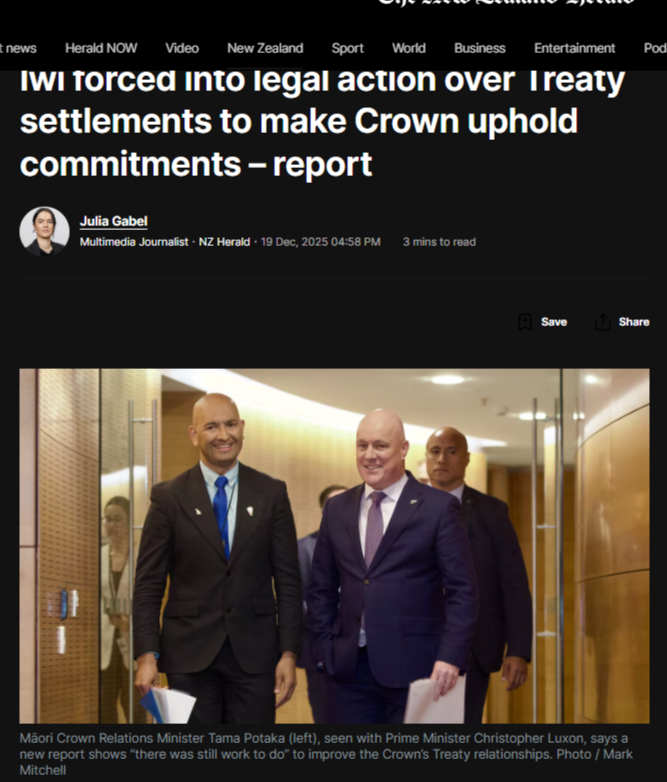
Iwi forced into legal action over Treaty settlements to make Crown uphold commitments – report
The Crown’s façade of Treaty settlement delivery is cracking. In December 2025, the Government released the Whole of System Report on Treaty Settlement Delivery, claiming that 83.3 percent of commitments are “complete or on-track,” as noted in the Government’s official release. But this carefully curated number masks a systemic betrayal that has already cost iwi and hapū millions in legal fees, lost opportunities, and the slow erosion of trust in the Crown’s word.
The real story emerged months earlier—and the Crown hoped you wouldn’t notice.
In April 2025, Auditor-General John Ryan delivered a scathing verdict:
every single public organisation he audited had difficulties meeting their settlement commitments, according to the Auditor-General’s overview. The government has already paid “tens of millions of dollars in financial compensation” to post-settlement governance entities (PSGEs) for failing to honour what it promised, a fact highlighted by the Office of the Auditor-General.
This is not a narrative of “encouraging progress.” This is a narrative of systemic failure, buried under bureaucratic language and self-serving metrics.
The Hidden Network: How Failure Becomes Policy
The scale of the Crown’s settlement obligations is staggering:
approximately 150 public organisations hold about 12,000 individual contractual and legal commitments under roughly 80 settlements with about 70 iwi and hapū groups, as detailed in the Auditor-General’s report. To date, $2.738 billion in financial and commercial redress has been transferred, according to Te Ao Māori News.
Yet despite this massive investment—and this is the critical point—the Crown has no unified system requiring all responsible organisations to actually monitor or report on whether they’re honouring these commitments, a gap exposed by the Auditor-General.
Te Arawhiti was responsible for overseeing settlement delivery until February 2025, when the function transferred to Te Puni Kōkiri. But even with this reorganisation, the fundamental problem persists:
there is no framework that guides public organisations to consider a settlement holistically, as stated in the Auditor-General’s findings. Agencies treat settlements as transactional boxes to tick rather than as the basis for renewed relationships between the Crown and iwi. Post-settlement governance entities told the Auditor-General explicitly that public organisations “tend to see settlements as a series of transactions rather than as supporting a broader and more strategic relationship,” a sentiment recorded in the report’s overview.
This institutional amnesia has consequences. When the Whole of System Report for 2025 finally asked post-settlement governance entities directly for their assessment—for the first time in the settlement system’s history—the response revealed what the Crown had been concealing:
where agencies fail to engage consistently, provide timely information, and resource implementation adequately, PSGEs experience “friction, resourcing strain, and uncertainty,” as admitted in the Minister’s press release. Some PSGEs are spending their own settlement money pursuing accountability for commitments they should never have had to chase, a perverse outcome noted by the Auditor-General.

PSGE administrator overwhelmed by compliance burden and legal costs
The Cost of Broken Words: Litigation as Last Resort
Iwi are not taking legal action because they are litigious. They are taking legal action because the Crown has left them no choice.
In November 2025, Te Rūnanga o Ngāi Tahu filed High Court proceedings against the Crown over Conservation Act reforms that directly undermine the Ngāi Tahu Treaty settlement negotiated nearly 30 years ago, as announced in their official statement.
The proposed changes would concentrate decision-making power in the Minister for Conservation while stripping co-governance protections and creating conditions for the privatisation of conservation land through long-term concessions, concerns raised by Ngāi Tahu leadership.
As Kaiwhakahaere Justin Tipa stated:
“Every time a new government comes into power, we are having to educate and re-educate on what our claims are, what they mean, how they work with legislation,” quoted by 1News.
This is not an isolated case. Te Whānau-ā-Apanui’s settlement—which was near completion—has stalled into a “stalemate” because Treaty Negotiations Minister Paul Goldsmith sought to remove a clause already agreed by the previous government, as reported by the NZ Herald
The Crown’s façade of Treaty settlement delivery is cracking. In December 2025, the Government released the Whole of System Report on Treaty Settlement Delivery, claiming that 83.3 percent of commitments are “complete or on-track,” as noted in the Government’s official release. But this carefully curated number masks a systemic betrayal that has already cost iwi and hapū millions in legal fees, lost opportunities, and the slow erosion of trust in the Crown’s word.
The real story emerged months earlier—and the Crown hoped you wouldn’t notice.
In April 2025, Auditor-General John Ryan delivered a scathing verdict:
every single public organisation he audited had difficulties meeting their settlement commitments, according to the Auditor-General’s overview. The government has already paid “tens of millions of dollars in financial compensation” to post-settlement governance entities (PSGEs) for failing to honour what it promised, a fact highlighted by the Office of the Auditor-General. This is not a narrative of “encouraging progress.” This is a narrative of systemic failure, buried under bureaucratic language and self-serving metrics.
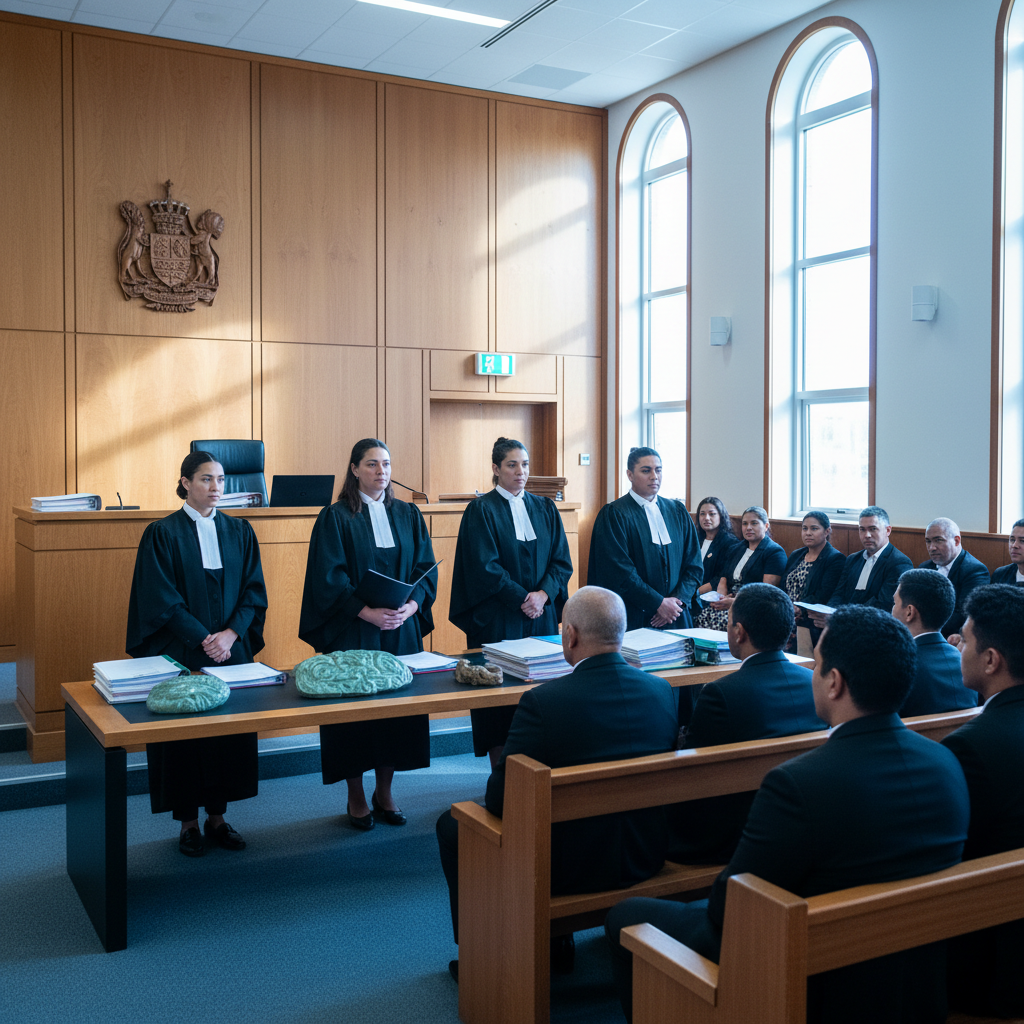
Māori legal team in New Zealand High Court defending Treaty settlement rights
The Hidden Network: How Failure Becomes Policy
The scale of the Crown’s settlement obligations is staggering:
approximately 150 public organisations hold about 12,000 individual contractual and legal commitments under roughly 80 settlements with about 70 iwi and hapū groups, as detailed in the Auditor-General’s report. To date, $2.738 billion in financial and commercial redress has been transferred, according to Te Ao Māori News. Yet despite this massive investment—and this is the critical point—the Crown has no unified system requiring all responsible organisations to actually monitor or report on whether they’re honouring these commitments, a gap exposed by the Auditor-General.
Te Arawhiti was responsible for overseeing settlement delivery until February 2025, when the function transferred to Te Puni Kōkiri. But even with this reorganisation, the fundamental problem persists: there is no framework that guides public organisations to consider a settlement holistically, as stated in the Auditor-General’s findings. Agencies treat settlements as transactional boxes to tick rather than as the basis for renewed relationships between the Crown and iwi. Post-settlement governance entities told the Auditor-General explicitly that public organisations “tend to see settlements as a series of transactions rather than as supporting a broader and more strategic relationship,” a sentiment recorded in the report’s overview.
This institutional amnesia has consequences. When the Whole of System Report for 2025 finally asked post-settlement governance entities directly for their assessment—for the first time in the settlement system’s history—the response revealed what the Crown had been concealing: where agencies fail to engage consistently, provide timely information, and resource implementation adequately, PSGEs experience “friction, resourcing strain, and uncertainty,” as admitted in the Minister’s press release. Some PSGEs are spending their own settlement money pursuing accountability for commitments they should never have had to chase, a perverse outcome noted by the Auditor-General.
The Cost of Broken Words: Litigation as Last Resort
Iwi are not taking legal action because they are litigious. They are taking legal action because the Crown has left them no choice.
In November 2025, Te Rūnanga o Ngāi Tahu filed High Court proceedings against the Crown over Conservation Act reforms that directly undermine the Ngāi Tahu Treaty settlement negotiated nearly 30 years ago, as announced in their official statement. The proposed changes would concentrate decision-making power in the Minister for Conservation while stripping co-governance protections and creating conditions for the privatisation of conservation land through long-term concessions, concerns raised by Ngāi Tahu leadership. As Kaiwhakahaere Justin Tipa stated:
“Every time a new government comes into power, we are having to educate and re-educate on what our claims are, what they mean, how they work with legislation,” quoted by 1News.
This is not an isolated case. Te Whānau-ā-Apanui’s settlement—which was near completion—has stalled into a “stalemate” because Treaty Negotiations Minister Paul Goldsmith sought to remove a clause already agreed by the previous government, as reported by the NZ Herald. The Government stated publicly that it “will not agree to Treaty settlements that dispute whether the Crown is now sovereign,” a red line that narrows the space for settlement negotiations to almost nothing, according to the NZ Herald.
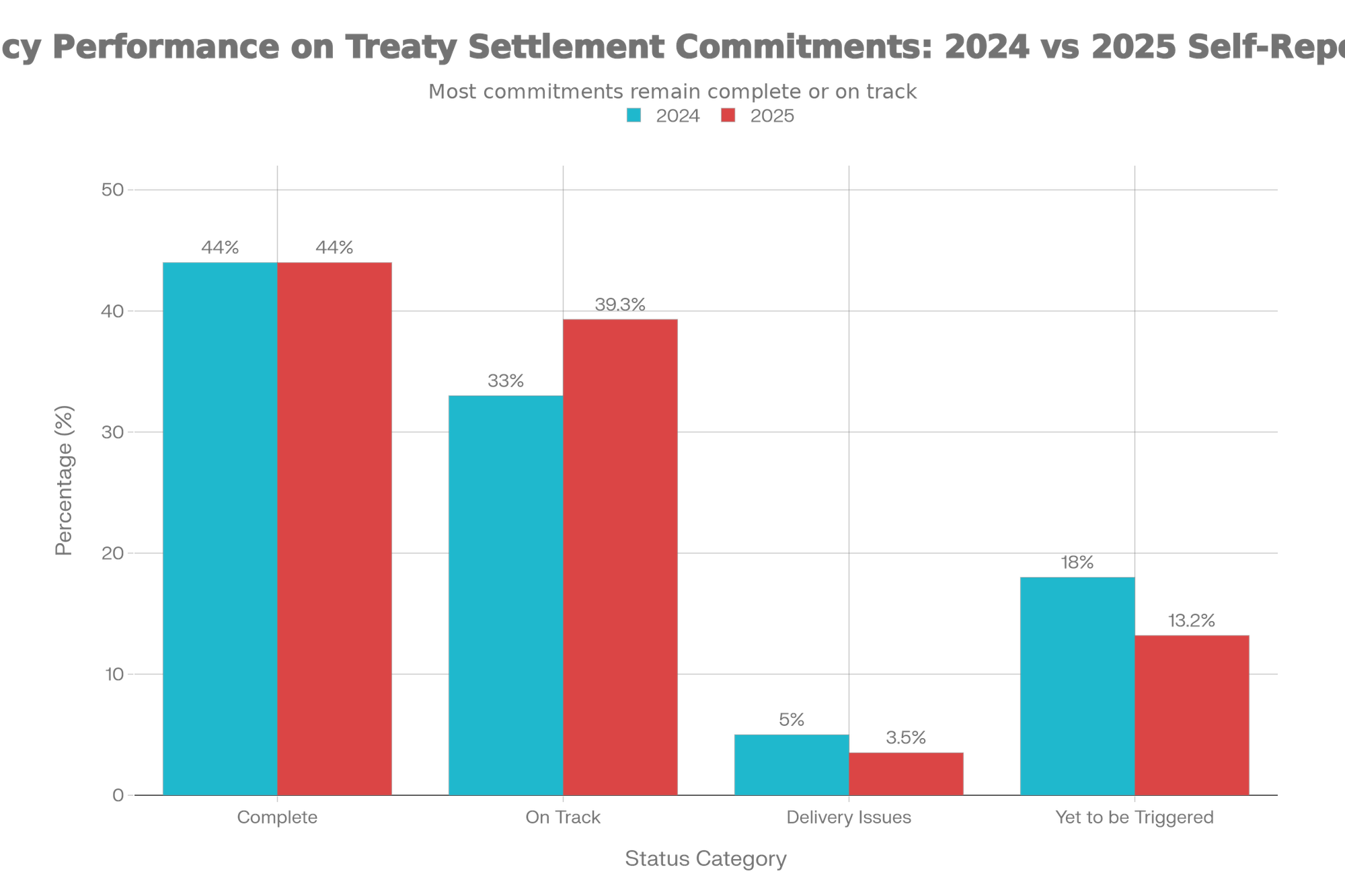
Crown agencies reported improved delivery on Treaty settlement commitments in 2025, with 83.3% of commitments either complete or on-track, up from 76.7% in 2024. However, the Auditor-General found widespread systemic failures despite these self-assessments
Meanwhile, the National Iwi Chairs Forum has filed court proceedings seeking clarification on how the Crown must uphold Treaty settlement commitments, particularly in light of Resource Management Act reforms that risk weakening Māori rights, as discussed in the NZ Herald.
The pattern is unmistakable:
the Crown claims to honour settlements while simultaneously passing legislation that undermines them, a contradiction analysed by E-Tangata.
The Systematic Blindness: What the Crown Doesn’t Want to See
The Auditor-General identified nine recommendations aimed at strengthening the settlement system.
The findings were damning:
Planning and prioritisation failures: Many public organisations do not properly plan how they will meet commitments, nor do they prioritise sufficient resources, according to the audit report.
Monitoring breakdown: Core Crown agencies lack adequate internal systems for monitoring their commitments, and their self-reported status updates through Te Haeata (the Settlement Portal) are therefore unreliable, as found by the Auditor-General.
Accountability vacuum: Parliament, Ministers, and the public cannot be confident that public organisations are identifying, managing, mitigating, and escalating risks to meeting commitments, as stated in the Auditor-General’s overview. When settlement commitments are not upheld, “any trust and confidence in the Crown built through the settlement process is jeopardised, and relationships between partners are undermined,” warns the Auditor-General.
Exclusion of half the system: Crown entities, local authorities, and other non-core Crown agencies are responsible for about one in five of all settlement commitments—yet they are excluded from He Korowai Whakamana, the oversight and monitoring framework, a gap highlighted by the Auditor-General. This means these organisations have less access to advice or support than core Crown agencies, and their performance is not centrally monitored.
But here is the most damning finding:
the Crown does not fully understand the risk to durability of settlements, according to the Auditor-General. Financial compensation paid to PSGEs for significant settlement failures may eventually exceed the value of the initial financial and commercial redress, a warning echoed by Te Ao Māori News.
Yet instead of systematically addressing these failures, successive governments have tolerated—over many years—”a lack of accountability and transparency for a system that...has constitutional importance,” concludes the Auditor-General.
The Broader Attack: Coalition Rhetoric vs Reality
The Coalition agreement between National and New Zealand First promises to “honour past Treaty settlements,” yet the Government’s actions systematically undermine them. This is not coincidental. It is part of a coordinated strategy visible across multiple fronts:
The Waitangi Tribunal review: Announced in May 2025, the Government is reviewing the Treaty of Waitangi Act to “refocus” the Tribunal back to its “original intent”—codeword for limiting its jurisdiction to defend the Crown and Māori interests, reported by 1News. ACT leader David Seymour called the Tribunal “increasingly activist” and accused it of acting like “a parallel government,” quotes captured by 1News. This review conveniently began while the Tribunal was conducting urgent inquiries into Government actions. Labour MP Willie Jackson called it “completely unnecessary” and “extremely bad faith,” as cited by 1News.
The Fast-track Approvals Act: Schedule 3 of this Act requires compliance with Treaty settlement arrangements—but immediately undercuts this by allowing the Crown to seek agreement to modify those arrangements, shifting the burden of proof to iwi who must justify why agreed settlements should not be changed, an analysis provided by E-Tangata.
Resource Management Act reform: The new system includes “descriptive, non-operative” Treaty clauses listing obligations rather than enforceable protections, and concentrates decision-making power in Ministers rather than community-based decision-making bodies where iwi have meaningful co-governance, changes outlined by the NZ Herald.
Targeted resource starvation: Whānau Ora, a proven success, has been underfunded and constrained not by lack of evidence but by the type of evidence the Government demands—forcing Māori providers to jump through bureaucratic hoops while mainstream agencies face no such scrutiny, a disparity revealed by Te Puni Kōkiri’s briefing to MPs.
These are not policy misadventures. They are the threads of a coherent strategy to reduce the Crown’s accountability to iwi while maintaining the appearance of honouring the Treaty.
The Cui Bono: Who Benefits From Failure?
The answer is the Crown itself. Every delayed settlement, every missed deadline, every legal battle fought in the courts rather than the negotiation room delays the moment when the Crown must fully account for historical wrongs. Every legal requirement slowly stripped away reduces future liability. Every court victory against iwi rights becomes precedent for the next government to build upon.
For iwi and hapū, the cost is different but equally real:
- lost economic opportunities from delayed commercial redress;
- fragmented whānau unable to access culturally significant lands;
- environmental damage to takiwā because co-governance protections are undermined; and
- the slow, grinding realisation that the Crown’s apology was performative, not transformative.
The Way Forward: From Transparency Theatre to Real Accountability
The Auditor-General’s nine recommendations, detailed in the full report, require:
- Te Puni Kōkiri develop a framework guiding public organisations to achieve settlements’ holistic intent—not just tick boxes.
- All public organisations review how they plan and monitor commitments.
- Ministers strengthen expectations on agencies through performance agreements.
- Land Information New Zealand ensure right of first refusal memorials are correctly placed—a specific failure found in audits.
- Public Service Commission strengthen development for chief executives to lead effective settlement delivery.
- Te Puni Kōkiri improve quality and accuracy of Te Haeata data.
- All organisations improve annual reporting on settlement progress.
- He Korowai Whakamana be extended to Crown entities, local authorities, and other non-core agencies.
- Te Puni Kōkiri regularly assess whether settlements are achieving their holistic intention and report to Ministers and Parliament.
None of these require new legislation. All require political will to put settlements at the centre of government accountability, not the margins.
Rangatiratanga Demands More Than Rhetoric
The December 2025 Whole of System Report will be celebrated by the Government as proof of “encouraging progress,” as claimed in their release. The Auditor-General’s April 2025 findings will gather dust while agencies proceed with business as usual. Ngāi Tahu, Te Whānau-ā-Apanui, and others will fight in courts that should never have been necessary.
The fundamental truth is this:
if the Crown will not honour settlements voluntarily—with all the resources and authority it possesses—then it has already decided that the Treaty is worth less than political convenience. Every broken commitment, every delayed delivery, every legal battle confirms it.
Settlements were supposed to reset the Crown-iwi relationship on a foundation of mutual respect, good faith, and honour. Instead, they have become another arena for the Crown to demonstrate that indigenous rights are negotiable when a new government arrives with different priorities.
The taiaha must be wielded now—not to celebrate rhetorical commitments, but to force the Crown to demonstrate, in action and in dollars, that its word means something.
Kia kaha.
Koha statement
Only Support this mahi if you are able: Koha.Kiwi | Substack | Bank: HTDM 03-1546-0415173-000
All koha sustains free mātauranga Māori journalism. No paywall, no corporate interference.

Ivor Jones The Māori Green Lantern Fighting Misinformation And Disinformation From The Far right